







Abstract
It is now well established among architectural and engineering historians that William Le Baron Jenney did not invent the skyscraper and that the Home Insurance Building (HIB), completed in 1885 in Chicago, was not the first one. Nonetheless, the idea of the HIB being the first skyscraper remains deeply lodged in the public consciousness. This paper traces the historiography of how Jenney won the public debate. Based on archival research and historical documents, the evidence shows that starting in the early 1890s, Jenney and his Chicago colleagues, including Daniel Burnham, initiated a public relations campaign to anoint Jenney as the inventor of the skyscraper. The campaign was so successful that by 1907, when Jenney died, the popular press propagated the “Jenney Myth” in their obituaries. In the mid-20th century, the myth was further perpetuated by architectural critics who sought to make the “Chicago School” the pivotal architectural movement in Modern Architecture. The widespread and deeply rooted success of these boosters and polemicists has meant that recent scholarship disproving Jenney’s pivotal role in skyscraper history has been downplayed or ignored.
Keywords
“Mr. Jenney was always opposed to any statement that spoke of skeleton construction literally as an invention, or that it had just ‘burst forth’ from somewhere. It was Nature’s child. Progressive through the ages, it was the evolution of principles.” “The skeleton construction was a radical departure from anything that had been heretofore appeared and was exclusively my invention.” —William Le Baron Jenney (1896)
In 1907, when William Le Baron Jenney died, the press universally mourned the loss of “the inventor of the steel skeleton skyscraper.” 1 Jenney’s life embodied that of an American engineering hero who, by sheer grit and intelligence, created a purely American technological and commercial phenomenon with his Home Insurance Building (HIB), completed in Chicago in 1885. And yet, today, it is well established among architectural and engineering historians that Jenney did not invent the skyscraper, and the HIB was not the first one. 2
Nonetheless, the idea that it was the first skyscraper remains deeply ingrained in the public consciousness. How and why is this so? This paper revisits the question of how Jenney won the debate amongst the wider public and among architecture critics and historians in the 20th century. When the Home Insurance Building (Figure 1) was completed, neither Jenney, the press, nor the architectural and engineering community considered the Home Insurance Building unusual. The building was recognized for its structural innovations, but it was not viewed as anything so radical that it represented a complete break from the buildings that preceded it.
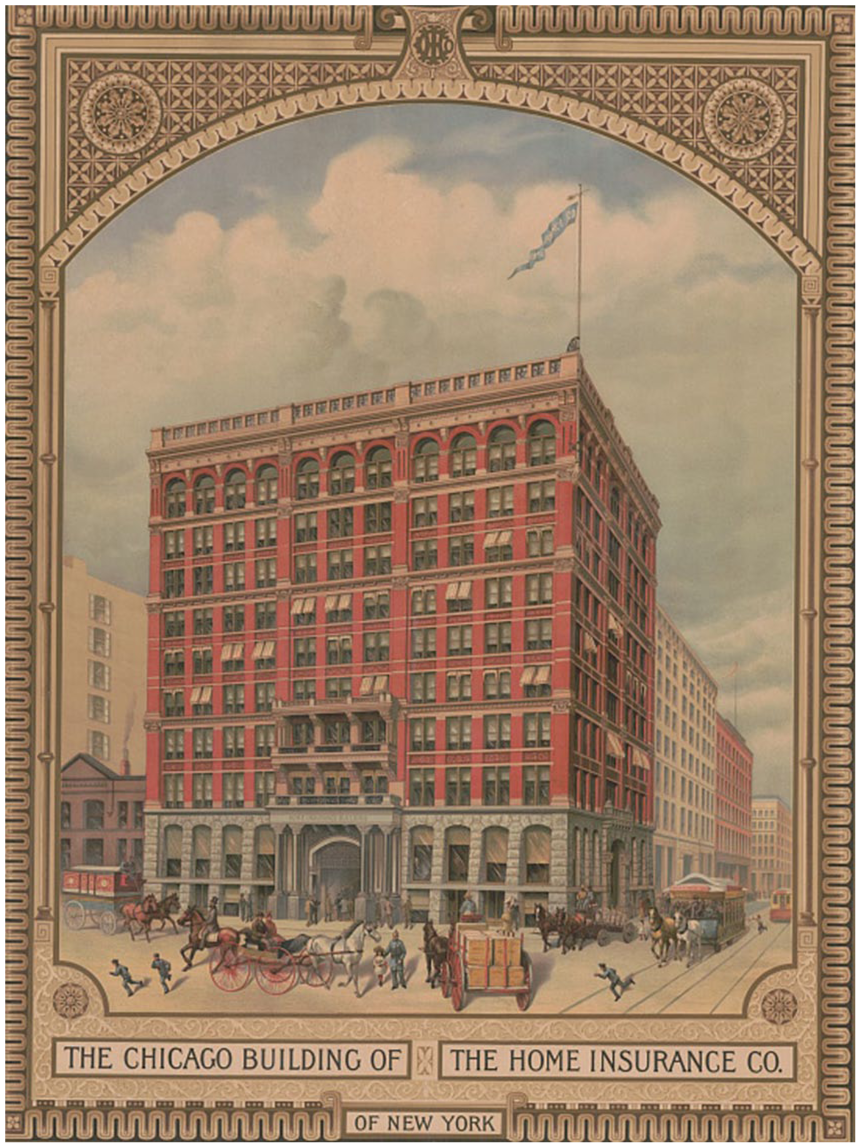
Home Insurance Building (1885), Chicago.
However, in 1896, a public relations opportunity arose, allowing the Chicago architects to retake control of the narrative and cast Chicago as “the home of the first skyscraper.” In that year, a letter-writing “debate” among the professional community appeared in the trade journal The Engineering Record (ER). Jenney drummed up support among his colleagues and clients to collectively anoint him as the inventor of the steel skeleton frame and, by extension, the inventor of the skyscraper.
In the years between 1885 and 1896, other architects and cities were vying for the title of “first steel skeleton skyscraper,” and the Chicago community fought to claim what they believed was rightfully theirs. As a result, they began rewriting history and offering misleading statements about the HIB’s structure. Jenney was motivated in large part by the lawsuits of Leroy Buffington, a Minneapolis architect who had received a patent in 1888 for an iron-framed tall building. Buffington started suing people in 1892 and had warned Jenney “to refrain from infringement of said patent or any of its claims.” 3 Although Jenney was never served lawsuit papers, he used the 1896 letter-writing campaign to make the case, in a quasi-legal fashion, that he invented skeleton framing, in large part to obviate Buffington’s legal claims.
Because of this PR campaign, the “first skyscraper” historiography shifted markedly, with the media and historians directly quoting or citing the words from these letters as proof of Jenney’s “invention.” Then, starting in the 1920s, a new generation of architectural critics began arguing that the period between the 1871 Great Chicago Fire and the 1893 World’s Columbian Exposition (Chicago World’s Fair) sowed the seeds of Modern Architecture. To these writers, architects such as Jenney, John Wellborn Root, and Louis H. Sullivan not only created the Chicago School of Architecture but were also the founding fathers of Modernism. After Jenney convinced the world that he invented the steel framed skyscraper, this notion became entwined in the polemics of the Chicago School. In this way, the respected—often revered—critics and writers of the mid-20th century helped propagate the “Jenney Myth” because it gave them a foundation story for the Chicago School.
More recent scholarship, beginning in the 1980s, by architectural critics and historians, has demonstrated Jenney’s less pivotal, yet still important, role within the long history of building technology and architecture. 4 However, these writings have remained largely within the academy and have had little impact on public perceptions. The historical recounting in museums, popular books, articles, and websites remains dominated by the historiography of the mid-20th century, which echoes Jenney’s PR campaigns of the late 19th century. 5
This paper is not meant to diminish Jenney’s importance in skyscraper history. Jenney was, indeed, quite innovative and one of the great contributors to the skyscraper’s technological development. However, what has been lost in the ensuing years is the historical context and Jenney’s role within the larger ecosystem of the skyscraper-building world in the 19th century.
To say that one person invented the skyscraper is to disregard the long-run global evolution of building technology and the many individuals who “stood on the shoulders” of their predecessors. As the epigraphs in this paper demonstrate, Jenney, his colleagues, and his acolytes would attempt to have it “both ways” when discussing the HIB. They would admit, on one hand, that the building was part of a natural progression of building technology while claiming, on the other hand, that it was a radical invention without precedent.
The idea that we can pick the first skyscraper is a social convention. The ability to name a “first”—whereby “first” means a building radically different from what came before and so pivotal that the future is fundamentally different—is impossible because no such trajectory like this has occurred. Over the 19th century, the evolution of building technology was moving along, in fits and starts, on a trajectory toward the elevatored, fireproofed, steel, riveted, wind-resisting skeleton frame with stable foundations.
If Jenney had never existed, the skyscraper would have been “invented” all the same. In truth, no one was specifically trying to invent the skyscraper. The architectural and engineering community aimed to please their clients who demanded taller (and safer) buildings in America’s business districts. 6 The concept that one could invent such a structure only emerged after it was, in fact, invented. When steel-riveted, 20-plus-story buildings became common in the mid-1890s, people began asking who had discovered the techniques that made such giants possible. Several architects and engineers then sought to claim credit.
In the debates, the Chicago architects and writers helped facilitate a verbal “bait and switch,” as the phrase “first steel skeleton skyscraper” became interchangeable with “first skyscraper.” By the time of Jenney’s death, they were one and the same in the public’s mind, even though the HIB was neither the first steel skeleton nor the first skyscraper.
If Jenney had not been presented with such a propitious opportunity as The Engineering Record letter-writing campaign, his building would likely have been just a historical curiosity among architects and engineers with little notice among the public. It would have remained simply one experimental structure in a sea of such buildings erected across America from the 1870s to the 1890s.
Jenney and the Home Insurance Building
In March of 1884, Jenney won the commission to design a Chicago headquarters for the Home Insurance Company of New York. 7 The company’s Building Committee wanted as much sunlight in each office as possible, which evidently prompted Jenney to think of a way to reduce the thickness of the masonry piers and walls to allow for larger windows and ones not so deeply set back.
Part of the reason for the controversy surrounding the Home Insurance Building is that Jenney’s building incorporated some novelties. Jenney appears to have been the first in Chicago to embed cast iron columns directly into the load-bearing piers of a tall and very heavy office building, helping to share the load and reduce the amount of masonry (Figure 2). Furthermore, he connected these columns to the iron girders, lintels, and spandrels.
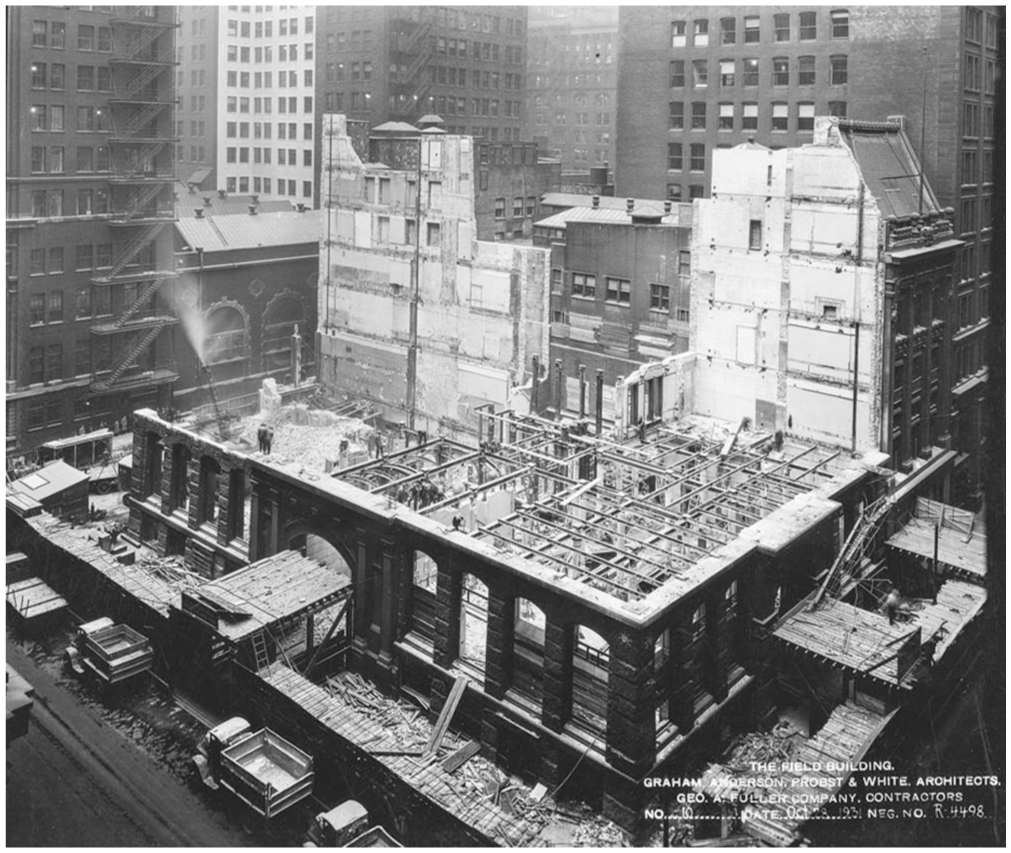
Home Insurance Building during demolition (1931).
If the masonry had been removed, the building frame would have appeared as a skeletal structure in the modern sense (though only in the street-facing and courtyard facades). However, the structure was never designed to function without the masonry. In particular, the masonry did nearly all the wind-bracing. Without it, the iron framing would have been a “house of cards,” as it would have collapsed in the face of strong wind loads. 8 Jenney, however, was the first architect to incorporate steel in a tall office building, but it was limited to the upper three stories, where it was used only for floor beams. 9
After the building was completed, Jenney gave an address at the 19th annual meeting of the American Institute of Architects (AIA) in 1885. It was republished in The Sanitary Engineer and The Inland Architect. 10 In that year, Jenney was the secretary of the Foreign Correspondence Committee of the AIA. While not in a top leadership position, he was an involved member. It would, therefore, be natural to seek the approval of his colleagues and stake his claim.
However, in his talk, there are many glaring omissions, and what he does say strongly suggests that he felt his building was not revolutionary. He never says anything to the effect of “This is the first time this was done,” or “This is the culmination of years of building adaptations.” Curiously, Jenney never mentions the word “steel” in his address. We can only speculate as to why that is, but its omission suggests that he felt it wasn’t so radical at the time. He later referred to the HIB as a “steel skeleton,” but this statement was a gross exaggeration, since only a small fraction of the building had steel beams. 11
Jenney titled his talk “The Construction of a Heavy, Fire-Proof Building on a Compressible Soil.” This title strongly suggests that Jenney viewed his building as a masonry one, one so heavy that it was going to settle—unevenly—and this was going to be a problem unless he came up with a solution. 12
Furthermore, for someone who would later claim he invented the steel skeleton, he completely “buries the lead.” He mentions the framing methods only after thoroughly discussing his foundation techniques. This ordering of the paper seems odd in hindsight, given that a decade later, he would claim that his building was a “radical” and unprecedented structure that he “invented.”
Regarding the framing, Jenney writes: “Iron was used as the skeleton of the entire building except the party walls . . .. A square iron column was built into each of the piers in the street fronts.” 13 Note how he uses “built into,” meaning that the columns and masonry piers shared the load, and thus the iron was not acting as an independent frame, unlike modern framing.
It’s also important to note that the word “skeleton,” as Jenney used it, refers only to the internal iron framing that carried the floor loads. 14 The term “skeleton” for the entire framing, encompassing all gravity and lateral loads, only gained its current usage in the 1890s. However, it’s easy to see how people later reading Jenney’s article could conclude that Jenney’s use of the word “skeleton” meant internal and external framing, but it did not.
When completed, the Home Insurance Building received rave reviews from the real estate and architectural press. The consensus was that it was an excellent example of “Class A” office space. However, my searches through the press and trade journals revealed no mention of phrases that indicate the press saw it as the “first skyscraper.” While people recognized it as having some novelties, there was no belief or argument that he “invented” a radically new building form. 15
The Emergence of the Jenney Myth
But by 1891, we see the early emergence of the Jenney Myth. Two things had changed for Jenney since 1885. First, he completed the Manhattan Building (1890) in Chicago, which was one of the first wind-braced skeleton buildings, although it was still imperfect, as discussed below. Thus, Jenney (with the help of structural engineer Louis E. Ritter) did indeed “figure it out,” and he started proffering stronger connections between the framing system in the HIB and the Manhattan Building. However, their structural systems were quite different. 16
Second, as discussed below in more detail, the architect Leroy Buffington of Minneapolis received a patent for an iron-framed structure in 1888 and was emerging as a rival. While it’s unclear whether there was any personal relationship between Jenney and Buffington, they did run in the same professional circles, and both held leadership roles in the Western Association of Architects. Jenney likely became aware of the patent that year because it was widely circulated in the trade press, including The Inland Architect, a journal with which Jenney was closely associated. 17
By 1891, Jenney began to publicly craft an exaggerated and misleading version of history to make himself more pivotal than he really was. His first significant attempt at PR was to introduce the phrase “Chicago Construction” to the world. 18 On October 28, at the 25th annual meeting of the American Institute of Architects, Jenney gave a talk entitled, “The Chicago Construction: Or, Tall Buildings on a Compressible Soil.” He begins by saying, “What is generally known as the Chicago Construction consists of a fireproofed steel skeleton so arranged that all the loads, including the walls and partitions, are carried story by story on the columns. The foundations, as far as practicable, are on isolated piers.” 19
By using the phrase “generally known,” Jenney is trying to turn the spotlight back onto Chicago. However, Jenney’s claim that the phrase was “generally known” was not, in fact, generally known before Jenney claimed that it was “generally known” (though it seems a phrase that was bandied about within Chicago circles). While Chicago architects were trying to solve problems specific to that city, iron framing methods, fireproofing, and stable foundation techniques were not unique to, or invented in, Chicago. Only from 1891 did the term “Chicago construction” gain widespread currency, after Jenney insisted that it was a real phenomenon. In his talk, he also suggests that the HIB was an early example of Chicago Construction. 20
Due to Jenney’s stature, his talk was reprinted in November 1891 in some of the most prominent trade journals of the day, including The Inland Architect, The Engineering Record, and Architecture and Building. 21 Jenney also managed to secure a version of his “Chicago Construction” article in the 1891 American Revisions and Additions to the Encyclopaedia Britannica. It was reprinted in later editions throughout the decade. 22
Also in 1891, the book Industrial Chicago was published. It was an essential source for later Modernists, including Siegfried Giedion and Carl Condit (discussed below). Taking cues from Jenney, the book states, “The architect applied to the Manhattan [Building] the perfected system, known as ‘the Chicago construction,’ first introduced by [Jenney] in the Home Insurance Building in 1885.” 23
However, this statement is wrong or misleading in several ways. First, the implication that the HIB was a winding-resisting skeleton (or close to it) is incorrect. Second, the suggestion that Jenney’s building was so novel that it launched the unprecedented “Chicago construction” is also false. Third, the Manhattan Building was far from a “perfected system.” While it was one of the earliest buildings to feature a curtain wall and wind bracing, subsequent research has shown that the masonry still performed much of the bracing (although Jenney and others would probably not have fully realized this at the time). 24
Later in the book, the author reproduces Jenney’s PR, stating: “W. L. B. Jenney, who justly claims to have been the first architect to introduce the method of building known as the Chicago construction, gives the following description of the system, which is of special interest, as coming directly from him . . ..” 25 This appears to be the first time that Jenney, though indirectly, claims he invented skeleton framing.
On October 31, 1891, Harper’s Weekly ran a story entitled “High Buildings in Chicago,” by M. A. Lane. Jenney, who was interviewed for the piece, fed the reporter misleading information, suggesting the HIB was the first example of skeleton construction. 26 Summaries of the Harper’s article and requoting of the phrase “Chicago construction” were widely spread by the press in November, including in such outlets as The Brooklyn Daily Eagle, The Boston Globe, The Miami Helmet, and The Sioux City Journal. 27
After 1892, however, Jenney and his colleagues intensified their PR efforts (for reasons discussed below). In August 1894, D. Everett Waid, who began as a draftsman and rose to become head draftsman at Jenney’s firm (and who would go on to be an architect of some renown in his own right) wrote an article in The Brick Builder, a journal “[d]evoted to the interest of architecture in materials of clay,” where he recounts a history of the Home Insurance Building. 28
Wording from this piece would be reproduced nearly verbatim in 1896 when Jenney began directly claiming that he invented the steel framed skyscraper. Waid’s article tries to have it two ways, implying, on the one hand, that Jenney invented steel skeletal framing, while on the other hand suggesting that he made an evolutionary step. Waid begins with the declaration that the birth of the modern office building was an evolutionary process. He writes, For the development of every great departure in art or science, several minds seem to have been working simultaneously on the same originating idea. No one knows who originated any particular style in architecture. Each was a growth, the products of many minds. So to a certain extent was it with the development of the construction of the modern office building. Many architects have contributed hard work and fruitful thought to such effect that one can look at the latest building and scarcely know what ideas were his own and what he borrowed from his co-laborers.
29
Although this is a true statement, he then turns to the HIB’s framing, quoting Daniel Burnham, “But the ‘skeleton construction,’ remarked Mr. Burnham, ‘that belongs to Mr. Jenney.’ The first building to embody the ‘skeleton contruction’ idea, that is, in which the metal framework supported the floors, and even the masonry covering, was the Home Insurance Building . . ..” 30
This appears to be the first time that someone of such renown directly states that Jenney invented skeletal framing, though by adding the word “idea” Waid doesn’t say the HIB had a wind-resisting, curtain-walled frame. However, he is engaging in semantics to make it seem that the HIB, which has some proto-skeletal framing elements, was, in fact, an actual skeleton.
The piece then recounts how the HIB Building Committee was worried that Jenney’s building was so novel that they could not tell if it was structurally sound. But A. C. Ducat, a former engineer, Civil War veteran, friend of Jenney, and the Chicago agent of the Home Insurance Company, vouched for the building’s sturdiness. And to soothe the Committee’s concerns, Jenney, allegedly, told the members that “the skeleton building resembl[es] in many respects an iron railroad bridge standing on end.” 31
This statement is also misleading. His structure could not support itself based on how it was built. And to say his building was like a railroad bridge also implies it had some form of trusswork, which it did not have, since there were no diagonal wind-bracing members (which would be used in 1889 in New York City, as discussed below, and to which this may be an oblique reference).
Waid’s testimony then claims that Jenney thought of patenting his idea at the time, but that “inasmuch as the first drawings for this skeleton construction seemed to him to be making general over an entire building what had been done before in a single pier, he did not think that the patent could be successfully defended if attacked. Still he regrets not having made the application, as it would have established conclusively his priority.” 32
Thus, in his article, Waid suggests that Jenney’s concept was evolutionary and had earlier precedents but simultaneously implies that it was radical. Jenney’s rejection of applying for a patent is an implicit attack on Leroy Buffington, who, as discussed above, received a patent for iron framing in 1888. Jenney was eager to claim his “priority” to avoid being sued by Buffington for patent infringement.
The Letter Writing Campaign
In 1896, discussions about the Home Insurance Building were ratcheted up further after June 27, when the President of the Bessemer Steamship Company, a manufacturer of steamships, wrote an inquiry to the editor of The Engineering Record: Sir: Will you have the kindness to inform me to what architect or engineer the honor is due of discovering and practically working out the idea of lofty steel construction of buildings? (F.T. Gates, President)
33
In that issue, the editor responded with a brief note stating that his journal had featured many proto-skyscrapers, including the Home Insurance Building (1885), the Drexel Building (1889) in Philadelphia, and the Rookery (1888) in Chicago, although he did not specify a clear “first.” From the journal’s perspective, a “skyscraper” was a tall office building, irrespective of its framing. 34
When Jenney saw that letter, he immediately went to work. He began sending letters to drum up support for himself and his claim. Collectively, he and his associates start using words or phrases like “radical,” “no one anticipated it,” and “he alone is responsible.” These are novel phrases in the discussion and strongly suggest a concerted attempt at quasi-legal language to exclude other claimants seeking to claim the title, “inventor of the steel framed skyscraper.” It can likely never be known whether Jenney believed what he was saying, but he was not above bending the truth. Nonetheless, Jenney and his colleagues cemented the Jenney Myth in this campaign.
On July 2, Jenney wrote a personal letter directly to Gates stating, “My claim is that in 1883 I invented and put into practical use in the Home Ins. Bldg. Chicago, what is now known as
Jenney also wrote several letters to people involved with the construction of the Home Insurance Building requesting they write letters of support to the ER. On July 7, Jenney wrote to J. H. Washburn, the vice-president of the Home Insurance Co., writing, “As you are I think aware the essential principles were invented by me for the Home Insurance Building. I learn from the Record and from other sources that there is an endeavor on the part of others to claim the invention.” Then Jenney concludes, “If you agree with Mr. Lyon and others that I really was entitled to the credit of the invention, which I most conscientiously believe to be true, for to my knowledge nothing of the kind had ever been previously executed or published, or even hinted at, I would ask that you would kindly do me the favor to write to Mr. Gates corroborating the statements, copies of which I enclose to you.” 37
On July 10, Washburn dutifully wrote to the ER, “Mr. W. L.B. Jenney of Chicago requests me to write a few words to you respecting the Home Insurance Co.’s Building in that City . . .. I believe that Mr. Jenney is entitled to the credit of the planning and erecting the first building upon these lines.” 38
Sometime before July 6, Jenney also wrote to Oliver S. Carter, president of the National Bank of the Republic, who was on the HIB Building Committee at the time. In Carter’s July 6 response, he tells Jenney that he was “reminded of your introduction of the iron skeleton inside the brick wall, which at the time (1883) was an entirely new and novel plan . . ..” 39 Then on July 8, Jenney wrote once again to Gates, including Carter’s testimonial, in case Gates needed further convincing. 40
We need to pause to parse the meaning of these various private conversations. First, Jenney’s remark about the “endeavor on the part of others to claim the invention” reveals his fears that others were trying to get the credit that he felt he deserved. As discussed below, Jenney was attempting to box out rival claimants to the inventorship of steel framing. It is odd, to say the least, for Jenney to use the phrasing “even hinted at,” given that rivals were publicly discussing their structural innovations long before 1896.
Jenney’s public response appeared in the July 11th issue. He uses the same strong wording that he used in his private letters, writing in the ER, “The skeleton construction was a radical departure from anything that heretofore appeared and was exclusively my invention.” 41 Jenney also sent the ER two letters of support, which were published in that issue. 42
Below Jenney’s letter was the same testimonial sketch from Waid’s article two years prior (though printed without attribution). As the sketch makes several claims that cannot be independently confirmed separately from those who supported Jenney, it’s difficult to assess the veracity of the story regarding A. C. Ducat and the Building Committee, given that several remarks in Jenney’s letters and the testimony are misleading or contradictory. 43
Seven more letters followed the piece, with five in support of Jenney (who had solicited at least two of them). One rebuttal letter came from Dankmar Adler of Adler & Sullivan in Chicago, who concludes that, “Take it altogether, the skeleton construction, or its present successor, the steel-cage construction, was a growth rather than an invention . . .. the credit for which should therefore be given my profession as a whole rather than to anyone in its ranks.” 44 Another letter was from the New York architect George Post, who sought to claim the trophy for himself. Arguably, his Produce Exchange Building in New York, completed a year before the HIB, was more innovative in its structural design, given that the courtyard walls used curtain-walled framing.
Two more letters appeared in the July 25 issue, each taking a different side. First was that of Chicago engineer C. L. Strobel, who opined, “The correct conclusion . . .. would therefore seem to be that the modern steel-frame construction is a development towards which a number of individuals have made valuable contributions.” 45 As a side note, when Jenney saw Strobel’s letter, he was not happy. 46 On July 27, he fired off a private rebuttal to “correct” what Jenney perceived as a mistake, though again, he exaggerates the advances of the HIB’s structure. 47
However, following the letter by (the relatively obscure) Strobel was one from Daniel H. Burnham, who continued to tow the party line with exaggerated language that suggests that Jenney was a lone genius. Burnham, it should be noted, was one of his generation’s most important and well-known architects. By 1893, he was famous worldwide after having led the construction of the Chicago World’s Fair. He wrote, This principle of carrying the entire structure on a carefully balanced and braced metal frame, protected from fire, is precisely what Mr. William L. B. Jenney worked out. No one anticipated him in it, and he deserves the entire credit belonging to the engineering feat which he was the first to accomplish.
48
This statement is, at best, misleading, which Burnham likely knew given his long history of designing Chicago’s early skyscrapers. The comment “no one anticipated him” disregards the long history of iron framing that predated the Home Insurance Building by many decades and is strategic language to box out other claimants. The phrase “braced metal” is also misleading since there was no metal wind bracing.
Then, in the August 8th issue, Leroy Buffington declared, “I do claim to be the inventor and first discoverer of this construction, and I can furnish all the proof necessary . . .. I have used construction like the Home Insurance Company’s Building of Chicago since 1876, and the Boston Block of Minneapolis, built in 1881, has a skeleton frame.” 49 Here, too, Buffington is stretching the truth. These buildings were typical construction of the day and likely did not extend the ironwork into the load-bearing masonry walls. 50
Finally, in February 1897, the “polling” was over, and F. T. Gates was convinced of Jenney’s arguments, declaring that his company would name a new vessel in its fleet, “the ‘W. L. B. Jenney,’ after the eminent engineer and architect of Chicago, to whom we think the iron and steel trade is most indebted for this great advance in the construction of buildings.” 51
Jenney was quite pleased. He wrote back to Gates saying, “I accept [this honor] with many thanks: it is the one official recognition, confirming my claim to the invention of the Steel Skeleton Construction, though as far as I know, no other has ever made the claim . . .. I have also to thank you for the inquiry through the Engineering Record, which brought the matter to the notice of the Architectural and Engineering profession.” 52
Again, Jenney’s use of the phrase “though as far as I know, no other has ever made the claim” is untrue. For example, likely as early as 1888 (but definitely by 1892), he was made aware of Buffington’s patent for an iron-framed tall building; and in 1894, George Post, at the annual AIA meetings, informed Jenney, Burnham, and the audience that he had introduced curtain-walled framing. 53
However, Jenney now had his “tautological victory.” He told Gates he was the winner, and Gates declared Jenney the winner; therefore, he was the winner. Just as importantly, Jenney used Gates’s decision as if it were a final, factual judgment. Gates was a business executive with limited knowledge and information regarding tall building construction and engineering, as evidenced by his query to the ER. He relied on the opinions of others, but most stated opinions came from people with a personal and professional interest in promoting Jenney.
Until he died in 1907, Jenney continued to claim that he invented the steel framed skyscraper. In 1897, he wrote a letter that was included in a posthumous memoir of A. C. Ducat. The testimonial echoes Waid’s article about how Ducat stood up for Jenney’s “radical” design. Similarly, in a final writing in 1906, Jenney published a brief memoir in The Western Architect, again recounting his alleged controversy with the HIB Building Committee. After Ducat’s support, Jenny claimed that the motion to approve his designs “was carried unanimously and the first steel skeleton constructed building was launched.” 54
After 1896, the debate was over as far as the public was concerned, as media outlets repeated the phrasing and conclusions from the letter-writing campaign. On March 17, 1897 the Chicago Tribune ran an article proclaiming, “W. L. B. Jenney, the architect, of this city has been notified by F. T. Gates of New York, President of the Bessemer Steamship Company, that a steel steamship now being built . . . is to be named the W. L. B. Jenney as a mark of appreciation of the architect’s services in connection with the invention of and introduction of the lofty steel skeleton construction of buildings.” 55
Another example was an article in The International: An Illustrated Monthly Magazine of Travel and Literature, published in Chicago in 1898. The review of Chicago skyscrapers summarized the debate, stating, “More effective than anything else in settling the dispute was a letter from Mr. D. H. Burnham,” and reproduced Burnham’s ER letter en toto. 56 Then, the piece recounts the testimonial about A. C. Ducat that Jenney and Waid provided as evidence of Jenney’s innovative genius.
Also, after 1896, the press and Jenney’s acolytes converted Jenney’s claim to be the “inventor of the steel skeleton” into the “inventor of the skyscraper.” Certainly, the wording used by the Jenney camp did little to clarify how a steel skeleton was only one aspect of the complex technological, economic, and social system that made a building a “skyscraper.” And when describing the history of tall buildings, it was shorter and more impactful—both among the media and Chicago boosters—to substitute “skyscraper” for “steel skeleton.” For that matter, for those not steeped in the technical details of tall building engineering, the phrase “first steel skeleton” was easily interpreted as “first skyscraper.”
A few examples will demonstrate how the “bait-and-switch” emerged. In 1906, a year before Jenney’s death, The Birmingham Post-Herald published an article about the construction of a tall building in Birmingham. The article quotes the construction superintendent Louis J. Boyer, who had previously worked on tall buildings in Chicago. He stated, “‘The first sky-scraper . . . was erected in Chicago for the Home Insurance company by W. L. B. Jenney.’” 57 And, The Pittsburgh Press announced in its obituary of Jenney on June 17, 1907, “William Le Baron Jenney, inventor of the skyscraper . . . died in Los Angeles, Cal., yesterday . . ..” 58
The Motivations
Jenney’s language in The Engineering Record and private letters makes sense when placed in the context of what he saw and heard in the late 1880s and 1890s. Several other architects were claiming that they invented the steel framed skyscraper. By using phrases such as “radical,” “my invention,” and “first steel skeleton,” Jenney was attempting to securely establish his claim by locking out the other claimants. This rivalry fundamentally drove the direction of the early historiography on the HIB and the “first skyscraper.”
Jenney’s Chicago colleagues, like Burnham, were complicit in the PR campaign because they wanted to support Jenney and, likely, hoped to protect themselves lest they also get caught in the crossfire of Leroy Buffington’s lawsuits. Many of Jenney’s supporters, such as Waid and Burnham, had worked for Jenney and viewed him as a mentor or father figure. More broadly, Jenney was widely respected and liked, and his colleagues and clients were happy to oblige when he asked for their assistance. 59
Regarding Jenney’s rivals, for simplicity, we can say that there were three key factions: New York, Chicago, and Leroy Buffington, respectively. Buffington (1848-1931) was arguably the most antagonistic and problematic of the lot. In 1874, he opened an architectural practice in Minneapolis, where he flourished. As a designer of large public buildings in the 1880s, Buffington was intimately aware of cutting-edge tall building construction. As mentioned above, in 1888, he won a U.S. patent for his iron-framed skeletal building design (Figure 3), which he argued demonstrated solid proof that he was the “father of the skyscraper.” 60
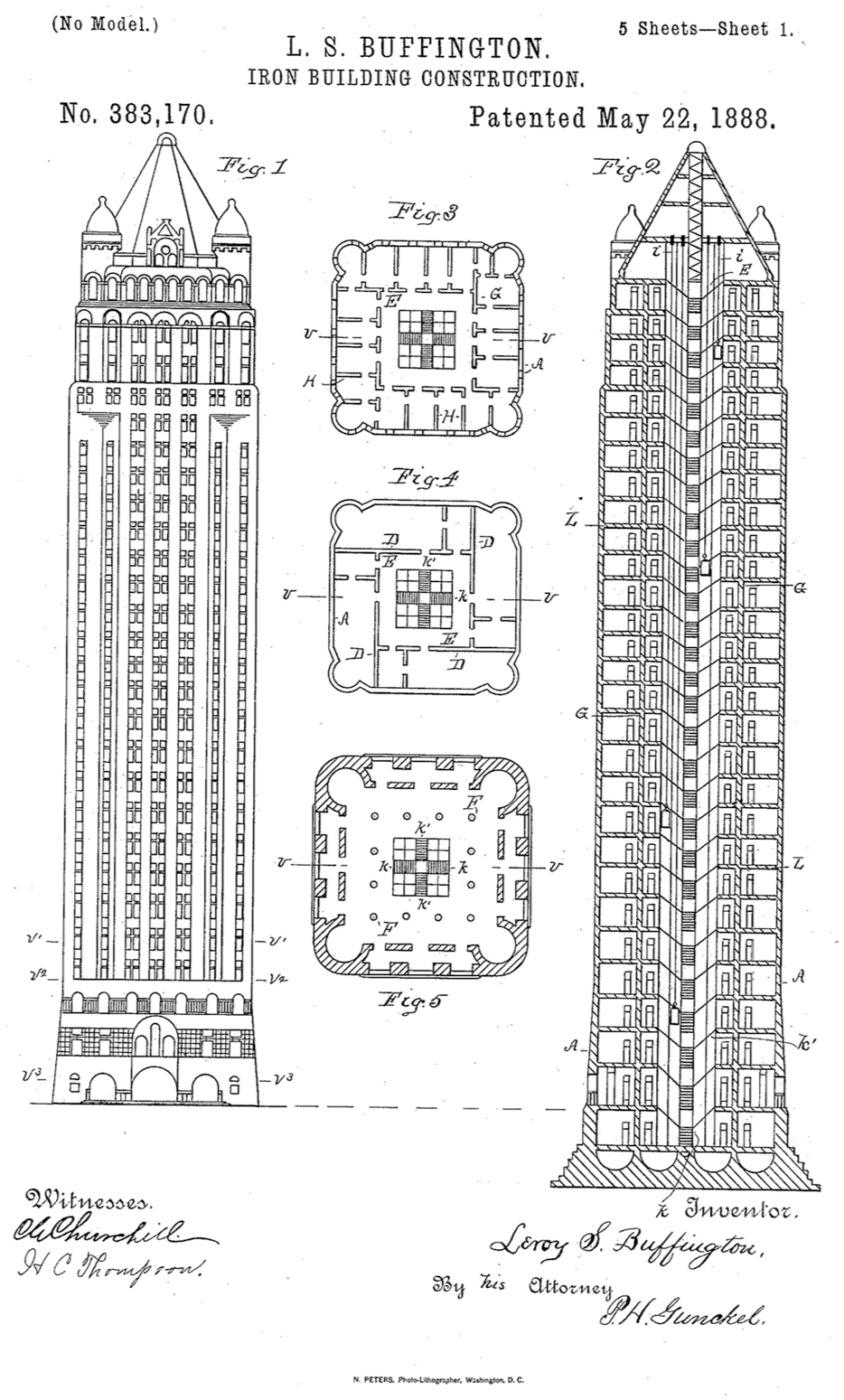
Design for 28-story “Cloud-scraper” by Leroy Buffington (1888).
After forming a company, the Buffington Iron Works, in 1892, Buffington began suing for patent infringement. His first of several unsuccessful cases was against William H. Eustis, a real estate developer and the mayor of Minneapolis. According to E. M. Upjohn (1935), Eustis’s answer to Buffington’s bill of complaint referenced Jenney’s 1885 article in The Sanitary Engineer as proof that the patent had been anticipated. 61
In 1892, Buffington also wrote to Jenney (and likely many others), “I beg to direct your attention to my patent, No. 383,170, issued May 22nd, 1888 for ‘Iron Building Construction,’ and to warn you and others to refrain from infringement of said patent or any of its claims.” 62 Jenney responded by asking for a copy of “said patent.” 63 On May 14, 1892, Buffington honored his request by sending one. 64
In late November 1892, several Midwest and Western newspapers published an article with the headline, “Buffington After Boodle,” which stated that Buffington “is about to begin suite against the owners of all the sky-scraping buildings in Chicago. He claims that the structural iron work has been put in a manner conflicting with patents which he holds. He will claim damages to the extent of 5 percent of the cost of each building. This means that he will claim $4,500,000 from Chicago . . ..” 65 Versions of this article were reprinted around the country during the last week of November and early December, including in the San Francisco Chronicle, the Chicago-based newspaper, The Sunday Inter Ocean, and The Chicago Tribune on December 4.
Buffington’s claims seem extreme today, but when put in the context of Jenney’s private experiences with Buffington and his retainers, such copy, if it reached Jenney—which it likely did—would undoubtedly have contributed to his concern. Jenney’s words in the ER (and Waid’s article) need to be considered in light of Buffington’s actions, and the evidence suggests that Jenney was worried.
In an 1899 letter, Jenney told New York architect William Birkmire that
S. L. Buffington [sic] of Minneapolis, took out a patent May 22, 1888, which I have before me . . .. Buffington formed a company with large capital, supposed to be for the purpose of prosecuting and obtaining money from all those who used the skeleton construction. Parties interviewed me whom I supposed to be Buffington’s attorneys. I showed them that if they could find anyone using that extravagant column [in the patent] they certainly could prosecute them but no architect or engineer of any scientific knowledge would be guilty. That was the last I knew of the patent. He certainly never attempted to interfere in the use of the skeleton construction, which he did not patent.
66
Jenney and his colleagues’ PR can be seen as an attempt by the Chicago group to claim prior art, which is evidence that an invention was already known. 67 If another party can document it, it can invalidate a patent. Jenney’s phrasing such as “radical departure,” “my claim to the invention” and “nothing of the kind had ever been . . . hinted at” were efforts to demonstrate that Buffington’s patent was null and void due to Jenney’s structure, completed at least two or three years before Buffington filed (November 1887) or won (May 1888) his patent.
This “fight” between Buffington and others would continue for many years and was likely an ongoing source of concern for Jenney. In 1904, a Chicago-based attorney, James Raymond, responded to an offer from Jenney to help in Raymond’s legal work for his client, the First National Bank, which Buffington was suing for patent infringement. Raymond expressed his fear, which Jenney shared, when he wrote, “Undoubtedly if Buffington should win either the suit commenced here or the suit commenced in New York, claim would be made against all the skeleton buildings in the country which come within the construction which the Court might thus put upon the Buffington patent.” 68
While Buffington may have represented Jenney’s “left flank,” several New Yorkers who stood on the “right flank” were vying for their trophies. As discussed above, George Post felt he deserved the credit given his accomplishments in New York. Another claimant arrived on the scene in 1889. The architect Bradford Lee Gilbert was awarded a commission by John Noble Stearns, a silk merchant, seeking to erect an office building on an awkwardly shaped lot in Lower Manhattan. The problem was that the Broadway frontage was only 21.5 feet across, though the lot widened toward the rear. Erecting a masonry-bearing structure with very thick walls would have rendered the site unprofitable. 69
Gilbert claimed he devised the idea of turning a railroad bridge truss on its side, although there is some debate about whether the idea was his or that of William Birkmire, who worked for the Jackson Iron Works which supplied the building’s iron. 70 Gilbert framed the exterior walls with iron columns that included diagonal members for wind bracing. The framing freed up significant space on the lower floors. The Tower Building was only eleven stories. 71
Like many buildings of the day, it was a hybrid of masonry and iron. But his building made an impression. Partly for his achievement with the building, Gilbert won a medal at the Chicago World’s Columbian Exposition in 1893 “for a new type of American architecture.” 72 It’s telling that Jenney did not win an award for the Home Insurance Building.
Finally, while less vocal than Buffington or the New York community, some individuals in Chicago felt they deserved more credit than they received. Jenney, Burnham, et al. were constantly interacting with members of the community, and no doubt, from time to time, they would talk with or hear a story about someone who felt denied their acknowledgment.
As Theodore Turak (1985) documents, the Chicago architect Frederick Baumann felt entitled to some credit. In 1884, Baumann wrote a pamphlet outlining the concepts of iron framing. 73 Architect and fireproofing expert Peter Wight agreed with Baumann, to whom he wrote in 1915, “Mr. Jenney’s claim has no foundation in fact. . .. I know more about the Home Insurance Building than any other man living or dead, but did not feel like contraverting Jenney’s claims, as Holabird and Roche never did with any earnestness. George B. Post used cast iron construction in the inner court of the Produce Exchange in that city, just as H and R had done. I am sorry you did not have an opportunity to bring your ideas into effect.” 74
As this letter implies, there was also a movement in Chicago to anoint the Tacoma Building (1889), designed by Holabird & Roche, as the “first skyscraper” since it was the first tall office building to have curtain walls in the street-facing façade (though the wind bracing was done by perpendicular masonry walls and the rear walls were load-bearing brick). 75
Jenney’s Apostles: Mundie and Jensen
Before we turn to the writings of historians and critics of the 20th century, I want to briefly mention the role of Jenney’s business partners, William Bryce Mundie and Elmer C. Jensen. Mundie was a witness to the events of 1884-1885, and therefore his recollections and opinions were frequently requested and cited. Mundie played an important apostolic role in spreading the Jenney Myth.
Jenney hired Mundie in 1884 as a draftsman, and the two became partners in the newly formed Jenney & Mundie from 1891 to 1907. In 1892, Mundie married Jenney’s niece, Bessie Russell Jenney. In 1932, Mundie crafted a manuscript recounting the history of skeleton construction. Although the memoirs have not been published, researchers who have uncovered archival drafts have been quick to quote or cite Mundie. However, his memoir serves as propaganda to maintain Jenney’s legacy as the “inventor of the skyscraper.”
76
Mundie thus cannot be considered a reliable narrator. As he confesses in his memoirs, Up to the time of Mr. Jenney’s death, our relationship was like that of father and son . . .. All that I am I owe to him, and this task that I assume is in grateful remembrance and with the hope that the vast amount of doubt to his part in . . .. skeleton construction, which has existed since his death, may be cleared. “Who’s who” or “Who was” in skeleton construction, the greatest innovation in architecture in the last several centuries, has been so incorrectly represented in the press that it remains vague in the minds of the present generation throughout the world from whence it came or was evolved. The honor of being the birthplace of skeleton construction belongs to the City of Chicago, and that of its former sponsor to Mr. William LeBaron Jenney.
77
This is hardly an unbiased account, and it contradicts the statement quoted at the beginning of this paper (which appears on page 9 of Part II of his manuscript). Like Jenney, he was trying to have it both ways, where, on one hand, he tries to put Jenney’s work in context, but, on the other hand, says that Jenney heroically invented the steel skeleton skyscraper.
In 1905, Elmer C. Jensen was brought in as a partner with Mundie and Jenney. When Jenney died in 1907, the firm became Mundie & Jensen. And as Jensen’s archived files at the Art Institute of Chicago reveal, he continued Mundie’s apostolic role. For example, in 1944, Jensen gave a speech to the Chicago chapter of the Newcomen Society, entitled “The World’s First Skeleton Building,” which documented Jenney’s alleged radical and heroic efforts to construct the Home Insurance Building. 78
The Twentieth Century: The Historians and the Modernists
After Jenney’s death, Chicago boosters and popular historians simply repeated Jenney’s version of events. The public accepted their word because it simplified an otherwise complex engineering debate into a bite-sized, easily understandable slogan. The logic was, in essence, “if the Chicago community of architects and engineers, who built Chicago’s early skyline, say that Jenney invented the skyscraper, then it must be so.” The history was written by the “winners” because they benefited from a coordinated effort of simplicity and repetition and were highly trusted due to their expertise and experiences.
During the decade preceding and following 1900, the debate about Jenney and the Home Insurance Building primarily centered on professional rivalries and city boosterism. However, the myth would propagate and take on a deeper meaning because it became entwined with the historiography of the “Chicago School of Architecture.” Starting in the 1920s, a new generation of architects and architectural historians emerged, arguing that the “Chicago School,” as they defined it, represented a new and unprecedented form of architecture, and which laid the seeds for the International Style of skyscraper.
To many of these writers, the idea of Jenney as the inventor of the skyscraper was integral to their arguments and versions of history. If the Chicago School was to be as pivotal in both world and architectural history as the authors claimed, the skyscraper needed to be “invented” in Chicago. And because of Jenney and his letter-writing campaign, the writers received the “foundation story” required to make their Chicago School arguments consistent. By ignoring New York’s earlier structural experiments, the long global history of iron framing, or all the other ingredients needed to make a tall building functional and profitable, Chicagoans and Modernists could tell their story without disquieting complications.
The line between architectural historian, critic, and booster began to blur as architectural theory and criticism emerged as a significant field in the early 20th century. Arguably, one of the key people who helped blur this line was Thomas E. Tallmadge (1876-1940). After studying architecture at MIT, Tallmadge joined Daniel Burnham’s practice, where he remained for seven years. In 1905, he established an architectural firm with Vernon S. Watson, another former Burnham draftsman.
Tallmadge was killed in a train accident in Arcola, Illinois, on January 1, 1940, at the age of 63. As the Chicago Daily Tribune reported in its obituary, Tallmadge “was one of America’s most widely known architects . . .. Mr. Tallmadge was nurtured in the Louis H. Sullivan architectural tradition. He was considered one of the greatest teachers and historians of architecture.” 79 Reviewing his writings about Jenney throughout his career reveals a key fact: He consistently peddled the Jenney Myth because of his view that Chicago was the center of skyscraper history.
Tallmadge’s earliest claim to fame was that he popularized the term “Chicago School” in his 1908 article, “The ‘Chicago School,’” published in The Architectural Review. 80 In it, he argues that after the 1893 Columbian Exposition, the city’s architects began to embrace a new aesthetic, as embodied by the buildings of Louis Sullivan and Frank Lloyd Wright. Putting the matter in quasi-religious terms, Tallmadge writes, “It is this resolve [among the Chicago architects] to be justified by their works and not by faith that distinguishes the present body of Chicago men whom we have classed together as the ‘Chicago school,’ and such a position should challenge the consideration of the profession the world over.” 81
By providing the term “Chicago School,” Tallmadge argued that a unified group of architects was consciously—and collectively—deriving a new style out on the prairie. He thus laid the groundwork for a decades-long debate that would follow. Later writers would alter the meaning of the “Chicago School” to refer to the architects of the pre-1893 commercial structures in the Loop.
In 1927, Tallmadge published his book, The Story of Architecture in America, which proved popular and influential. It chronicles American architectural styles from the colonial period to the early 1920s. In it, he turns to the issue of the first skyscraper, arguing, “In that year [1884] Colonel Jenney of Chicago, in building the Home Insurance Building, used a true form of skeleton construction for a large portion of the building.” 82 Again, “true form of skeleton construction” in the modern sense is incorrect.
Then he proceeds to quote Mundie, who stated, “The Home Building is skeleton construction in every basic sense of the word (as will be revealed when it is demolished excepting the party walls on the north and east, which are solid).” Tallmadge thus concludes that Mundie provided “strong evidence in favor of the paternity of the Home Insurance Building,” rather than the Tacoma Building. However, he admits, “It is the Tacoma Building, built by Holabird and Roche, architects, and is the first skeleton iron building ever constructed.” 83
The debate about the first skyscraper resurfaced in 1931 when the HIB was demolished to make way for the 46-story Field Building. Marshall Field (1834-1906) was a Chicago-based entrepreneur who founded Marshall Field and Company, a chain of department stores. Field is also known for his philanthropy, providing funds for the Field Museum of Natural History and donating land for the University of Chicago campus. In short, Field was regarded as a significant historical figure in Chicago who contributed to its success and gave back to its institutions.
The Trustees of the Estate of Marshall Field, who were constructing the new tower, created a committee headed by Tallmadge. The committee was charged with inspecting the Home Insurance Building’s structure and reporting on whether it could be considered the first skyscraper. Now that the Field Estate was destroying the HIB, it was important to establish its significance in Chicago’s history. The trustees were not a disinterested party.
As a side note, from the press’s perspective, the impending demolition of the Home Insurance Building was big news. Between late September and early October 1931, many newspapers across North America ran some version of a wire-distributed story with headlines such as “Chicago Sees Passing of First U.S. Skyscraper” (Elmire Star-Gazette, Sept. 28) or “Wreckers are Demolishing World’s First Skyscraper” (Macon Evening News, Sept 28). These articles featured dual images of the Home Insurance Building alongside a rendering of the Field Building. 84
The committee inspected the structure while the HIB was being demolished in October 1931. The committee’s report contained (misleading) phrasing in the vein of Jenney’s PR that suggested the building was technologically more advanced than it was. 85 However, from the public’s perspective, the Tallmadge Report’s technical details were likely too arcane. Instead, all that mattered was the conclusion—confirming what many had already believed: “We are also of the opinion that owing to its priority and its immediate success and renown the Home Insurance Building was in fact the primal influence in the acceptance of skeleton construction; and hence is the true father of the skyscraper.” 86
The phrase “primal influence” is also misleading because the HIB was not, in fact, a primal influence. The report was silent on those presumably influenced by the HIB because there was no straight line from masonry load-bearing structures to the wind-resisting skeleton frame. Between 1870 and the mid-1890s, dozens of structures incorporated experimental designs or technology. The collective knowledge of the building community led to the creation of the skyscraper, not the work of any individual. And just as importantly, no one copied Jenney’s designs, not even Jenney himself. 87
Tallmadge’s final book, Architecture in Old Chicago, was published posthumously in 1941; it continues his cheerleading for Jenney. 88 However, he claims: “The question at issue is not what Major Jenney intended when he built his crude skeleton of iron but what he accomplished thereby. Frankly, I don’t believe he visualized his skeleton as independently supporting the outside facing of the exterior piers, but he knew that most (82%) of the area of the typical pier was supported by his iron frame and that the remains was so bonded and built in that it was perfectly safe.” 89 Again, Tallmadge is trying to have it both ways, saying that though Jenney didn’t know what he was doing, he did it anyway.
Tallmadge also quotes the conclusion of the Marshall Field Report regarding the HIB being the “primal influence” and that Jenney was the “true father of the skyscraper.” Curiously, Tallmadge does not mention that he was chairman of the Marshall Field Trustee’s Committee and the report’s editor. Given that he likely wrote the conclusion, he does nothing to declare his conflict of interest.
Contemporaneously with Tallmadge, a group of writers argued that Chicago builders and architects were responsible for the birth of Modern Architecture. These writers felt that Modernism represented not only the successful abandonment of old styles but also offered the possibility of a new, technology-driven, master-planned utopia—better living through architecture and design.
Henry-Russell Hitchcock (1903-1987) was one person who tied Chicago architects to Modernism. He was an architecture history professor and the author of more than a dozen books on architecture. As Brooks (1966) argues, Hitchcock was the first to suggest the now-used meaning of “Chicago School” to refer to the post-Fire commercial tall buildings, rather than the post-Fair buildings. 90
And Hitchcock promoted Jenney as the creator of the skyscraper. In his 1929 book, Modern Architecture: Romanticism and Reintegration, Hitchcock, echoing Tallmadge, writes, “The year before [architect Henry Hobson] Richardson’s death Colonial Jenney of Chicago introduced the Home Insurance Buildings [sic] the first true skeleton construction in metal which was to make possible the skyscraper.” 91
Just as crucial, Hitchcock collaborated with Philip Johnson (1906-2005) to introduce European modern architecture to American audiences. Johnson was appointed the curator of the Architecture Department at the Museum of Modern Art (MOMA) in New York. He, Hitchcock, and museum director Alfred H. Barr Jr. toured Europe viewing its avant-garde structures. When they returned to New York, they created a show in 1932 called Modern Architecture: International Exhibition, which introduced Americans to the work of Le Corbusier, Walter Gropius, Mies Van der Rohe, and others. Hitchcock and Johnson coined the term “International Style” to describe these new buildings. 92
Based on the show’s success, the pair produced a follow-up exhibition, Early Modern Architecture: Chicago, 1870-1910, which ran in January and February of 1933. 93 The show traveled to Chicago in the summer and was held in the Marshall Field Department Store. 94 In their exhibition, Hitchcock and Johnson did much to cement the notion that Jenney’s Home Insurance Building was the first skyscraper. The show’s publications were polemics that contained many misleading statements about the HIB, as the curators sought to make Chicago pivotal in architectural history. As a result, they drew on Jenney’s PR campaigns.
The press releases made Johnson and Hitchcock’s position crystal clear. One stated, “‘Chicago and not New York is the birthplace of the skyscraper,’ declares Philip Johnson, Director of the Department of Architecture of the Museum of Modern Art, an announcement was made today of the next exhibition, ‘Early Modern Architecture: Chicago, 1870-1910, to open to the public at the Museum of Modern Art . . .. Few People realize that on the ashes of the Chicago fire of 1871, there was built the only architecture that can truly be called American.’” 95
In the mimeographed catalog, they wrote in the Biographies section that Jenney was “Generally considered the first to use steel skeleton construction. A technician rather than a designer.” The source for Jenney’s biography is his obituary in the Architectural Record in 1907, which describes the content of Waid’s 1894 article and includes summaries from the letter-writing campaign. 96 Then in the Timeline Section, the program states, “1884-5 Home Insurance Building, Chicago, by Jenney Demolished, 1931. Usually considered the first skyscraper. Weight carried by framework of cast and wrought iron concealed inside the masonry. Bessemer steel beams first used here above sixth floor.” 97
Subsequently, the program adds that the HIB represented: The crucial step in the creation of the skyscraper. The metal skeleton supports all the weight of the building except the exterior masonry walls which are partially self supporting . . .. In principle the building has ceased to be a crustacean (chief support by masonry shell) and is already implicitly a vertebrate (chief support by skeleton, including support of exterior walls). Jenney did not yet realize the revolutionary quality of the device he had employed above the second floor . . .. The importance of the building lies entirely in the construction, not in the design.
98
The analogy to biology presents Jenney with God-like powers to alter the course of biological evolution. The use of the word “crustacean” is important because it would be repeated by other writers, including Card Condit (discussed below) and Lewis Mumford, who wrote in his 1938 book, The Culture of Cities, “The age of crustacean building has given way to the age of vertebrates, and the wall, no longer a protective shell, has become a skin.” 99
Arguably, however, the most influential architectural critic of the mid-20th century was Sigfried Giedion (1888-1968). Giedion was born in Switzerland, studied history in Munich, and joined the Bauhaus in 1923, where he met Walter Gropius. In 1928, he founded, together with Le Corbusier and Helène de Mandrot, the influential modern architecture organization the International Congresses of Modern Architecture (CIAM), of which he was also the general secretary.
Giedion was invited to lecture at Harvard in 1938-39. His lectures became the basis of a book on the global history of architecture and industrialization. As Brooks (1966) writes, [O]ne book, more than all others, was responsible for recasting the image of the Chicago School. This was Sigfried Giedion’s Space, Time and Architecture of 1941. Giedion constantly reiterated the phrase Chicago School and always with the same implication—the tall commercial buildings of Chicago and the architects who designed them. Because of the extraordinary influence this book was to have, the new interpretation of the term was irrevocably confirmed.
100
Giedion revised his book five times before he died in 1968, with the last version published in 1966. In Space, Time, Giedion does yeoman’s work perpetuating the Jenney Myth.
101
He starts his discussion on Jenney by echoing Tallmadge: It is well known that the first skyscraper actually built (and not merely planned) along modern principles of construction was the ten-story building of the Home Insurance Company of Chicago (1883-85). The commission for its design was given to William Le Baron Jenney in 1883. The Home Insurance Company demanded a new type of office building which would be fireproof and offer the maximum amount of light for every room.
102
In his section called “The Chicago School,” Giedion literally makes Jenney the creator of the “Chicago School.” He writes, The Chicago school is bound up with the creation of the modern office building—in other words, with the creation of an administration center. All sorts of engineering problems entered into the solution reached in the Chicago buildings and the founder of the Chicago school, William Le Baron Jenney (1832-1907), was an engineer before he was an architect . . .. Today William Le Baron Jenney’s imagination and courage are not sufficiently recognized . . ..
103
Giedion’s use of the word “courage” appears to refer to the chestnut that Jenney and colleagues bandied about regarding Ducat sticking up for Jenney at the meeting of the HIB’s Building Committee. Another possible source is the Marshall Field Trustee’s Report, which states, “Major Jenney courageously concluded that by taking the floor loads on the exterior he could reduce his piers to a minimum in width and weight.” 104 Again, phrases like “courageously concluded” and “the building has ceased to be a crustacean” are polemical devices designed to portray Jenney as more heroic than he was, to advance an agenda that Chicago architects laid the seeds for Modernism.
However, vital to Giedion’s arguments were the sources cited in his footnotes. First, Giedion relies heavily on the book Industrial Chicago, which he refers to as the “Vasari of the Chicago school,” and which, as discussed above, was one of the earliest propagators of the idea that Jenney invented the steel framed skyscraper. 105
However, more important is a footnote that provides the source for Jenney’s biography—an article entitled “W. L. B. Jenney and W. B. Mundie,” a journalistic biographical and architectural review of Jenney and Mundie’s works, written by Charles B. Jenkins in February 1897 for Architectural Reviewer. 106
Jenkins takes his reporting from Jenney’s PR, writing, “Mr Jenney’s most important work, and for which he is best known, is the invention and the first application of the Skeleton Construction now in such general use for tall buildings throughout the country.” 107 Jenkins includes Waid’s statements about how Jenney decided against applying for a patent, and that A. C. Ducat stood up for Jenney when the HIB Building Committee allegedly expressed skepticism about Jenney’s designs.
Jenkins then concludes with a series of false statements, stating, The Home Insurance Building was the first of the tall, fire-proof modern office buildings in the West. It not only introduced the Steel Skeleton Construction to the world, and was the first building in America to use steel beams in its construction, but it also added a long list to the requirements of a fine office building, such as wind bracing, thorough fire proofing, rapid running and safe elevators . . .. All these appointments are now common to all good office buildings, where they were first used in the West in the Home Insurance Building, and many of them, like metal elevator cars and the office vaults, were invented by Mr. Jenney for that building.
108
In truth, however, the HIB was not the first tall fireproof office building in the West (in Chicago, the Montauk Block [1883] would be a clear contender). 109 It did not introduce steel skeleton construction to the world. It did not contain metal wind bracing. It was not the first building to have rapid running water, vaults, or safe elevators. In short, Jenney did not “invent” any of the things he’s credited with inventing. Given Giedion’s profound influence on architectural criticism, it’s ironic that he would rely so heavily on a factually incorrect light journalistic piece.
Carl Condit
Following in Giedion’s footsteps was Carl Condit (1917-1997), arguably the most important historian of Chicago’s buildings, technology, and architecture of the mid- to late 20th century. His most well-known and influential work is his 1964 book, The Chicago School of Architecture, but taken together, his oeuvre from the mid-1940s to late 1960s helped perpetuate the Jenney Myth.
Ironically, Condit’s position on Jenney’s role in skyscraper history evolved throughout his career, shifting away from his earlier insistence that Jenney was pivotal (discussed below). However, Condit’s detailed writings and statements, aimed at a relatively larger audience beyond the small circle of architectural critics, including public interviews, quotes, and authored articles in outlets such as the Chicago Tribune, helped to solidify and disseminate the notion that Jenney invented the skyscraper. Unlike Giedion, whose arguments were important mostly within architecture schools and among critics, Condit was much more widely engaged with the public, though he was influential in academic and architecture theory circles.
Condit received a B.S. in Mechanical Engineering from Purdue University in 1936 and then earned his Ph.D. in English Literature from the University of Cincinnati in 1941. After World War II, he was hired to teach at Northwestern, where he remained for his entire career. His writing focused on the history of building technology and architecture. 110
In the 1940s, Condit published two articles about Chicago. They demonstrated his intellectual debt to Giedion and Lewis Mumford and contained his conclusions on Jenney, which he repeated in some form in his books in the 1950s and 1960s. In this sense, his early conclusions displayed remarkable consistency. Just as importantly, these conclusions were made based on the success of the Jenney camp’s PR and letter-writing campaign, either directly or indirectly through Giedion and others.
Condit’s first work regarding the Chicago School appeared in June of 1946 in a student-run journal at Northwestern University, Northwestern Engineer. The article, “Modern Building Construction,” discusses the key technologies used in the post-Fire commercial office buildings. Here, Condit lays out his belief that Chicago architects foreshadowed modern architecture. When he gets to the Home Insurance Building, he provides his first—and highly glorified—statement on Jenney: [T]he engineer and architect, William Le Baron Jenney, began [a new era] with the first use of the steel framework in his Home Insurance Building (1884-85). The date marks the most radical change in the structural art since the development of the Gothic system of construction in the twelfth century. The possibility of dissolving the bearing wall or buttress had now been realized . . .. [with] the full use of the steel skeleton in the Home Insurance Building.
111
Condit’s article lacks citations; however, the wording suggests he relied on the Tallmadge Report or Tallmadge’s conclusion in Architecture in Old Chicago, in addition to Johnson and Hitchcock’s writings.
Condit’s second writing on the Chicago School appeared in the journal Art in America in 1948. Entitled “The Chicago School and the Modern Movement in Architecture,” it expands on the Northwestern Engineer article and frequently reproduces portions word for word, including the statement that Jenney created the most important revolution in the structural arts since Gothic architecture. 112
This article, however, contains a bibliography. It cites Giedion’s Space, Time and Architecture; The Dictionary of American Biography for Jenney; Industrial Chicago; Mumford’s The Brown Decades; The Museum of Modern Art’s program: Early Modern Architecture in Chicago, 1870- 1910; and Tallmadge’s Architecture in Old Chicago. All these sources, except Mumford, use Jenney’s words from the 1890s to argue that the HIB was the first skyscraper.
The Dictionary of American Biography also took Jenney’s history from his PR machine. The biographical entry for 1943 states: For [the HIB] (erected 1884) he devised a skeleton construction in which each story — walls, partition and floors — was carried independently on columns. This proved to be “the first high building to utilize as the basic principle of its design the method known as skeleton construction,” and as such was “the true father of the skyscraper” (The Octagon, January 1932, p. 20). In appreciation of the service he had rendered the industry in this pioneer application of structural steel, the Bessemer Steamship Company of New York later named one of its vessels for him (Brickbuilder, February, 1897).
113
In 1952, Condit expanded upon his ideas and building descriptions in his first book, The Rise of the Skyscraper. In the preface, he continues to acknowledge his debt to Industrial Chicago, Giedion, and Mumford. Also, he states that, “I have made thorough use of a comprehensive directory of buildings in the Loop area compiled by Mr. Frank A. Randall . . .. This work was subsequently published . . . under the title The History of the Development of Buildings Construction in Chicago . . .. I am especially indebted to Mr. Elmer C. Jensen for aid in securing information on William Le Baron Jenney . . ..” 114
Condit discusses the Home Insurance Building in a section called “The True Skeleton: The Home Insurance Building” in Chapter IV, entitled “Jenney and the New Structural Technique.” In it, he echoes the MOMA press release, writing, “The revolution which converted a building from a crustacean with its armor of stone to a vertebrate clothed only in light skin occurred in the two years following 1883, when Jenny received the commission for the Chicago office of the Home Insurance Company . . .. the first true skyscraper, the first complete answer to the problem of large-scale urban construction . . ..” 115 Note here how Condit converts the phrase “true skeleton” from Tallmadge to “true skyscraper.”
Given Randall’s influence on Condit, it’s important to briefly examine his writings before proceeding with Condit’s subsequent works. Randall (1877-1955) was an accomplished structural engineer, Chicago booster, and historian. In the introduction of his book, Randall also cites Industrial Chicago and Giedion as sources. His book (and an updated edition by his son John D. Randall) has been a key resource on Chicago’s tall buildings for many decades.
The early part of the book contains summaries of Chicago buildings. For the HIB, the book cites Mundie’s memoir on Jenney. It recounts Mundie recalling that Jenney got his first idea about skeletal framing from his trip as a youth to Manila, where trees were used as columns and lighter pieces of wood were used for “lateral and diagonal braces, floor supports and partitions, binding them all together at the intersection with thongs and pegs . . .. These buildings survived typhoons and earthquakes with slight damage.” 116 If true, this influence was not evident in the HIB.
Subsequently, Randall describes the HIB in more detail, cherry-picking quotes from Jenney and the historical debate to bolster his claim about Jenney. 117 For example, he reproduces Burnham’s 1896 ER letter and selected parts of the Marshall Field Trustees Committee report. The second edition, updated by his son, John D. Randall, in 1999, remains in print and retains the misleading descriptions of Jenney and the HIB. 118
Condit’s 1964 book, The Chicago School, an expansion of his 1952 book, is arguably his most influential work on Chicago. 119 While he no longer mentions his intellectual debt to Giedion or Mumford, he acknowledges that the “most valuable of all the studies continues to be the exhaustive documentation of Chicago building . . .” in Randall’s book. 120
His chapter on Jenney—still entitled “Jenney and the New Structural Technique—is expanded but maintains the same conclusions as his 1952 book. However, it’s worth summarizing its key points, as they reveal Condit wrestling with Jenney’s place in skyscraper history. His chapter begins with the first Leiter Building, which, as in his 1952 book, he concludes was “very nearly a glass box.”
121
Then he turns to the HIB, writing, The development of cast- and wrought-iron framing shows that skeletal construction had been virtually achieved in several buildings prior to the completion of Jenney’s Home Insurance Building. The decisive step for the tall office building, however, remained to be taken . . .. The Home Insurance Building represented the decisive step in the evolution of iron and steel framing, and a century of experiment and practical achievement lay behind its creation.”
122
Then Condit references Mundie’s suggestion that Jenney was influenced by the huts he saw in Manila. This kind of “Eureka!” type thinking has fueled the Jenney mythology. But Condit also takes pains to stress the history of the braced frame of the traditional New England house and the balloon-framed house. He also discusses the earlier precedents of James Bogardus’s New York shot tower of 1855 and other examples of early iron framing that predated Jenney.
However, like his 1952 book, he concludes that, Whatever the source, the major step in the conversion of a building from a crustacean with its armor of stone to a vertebrate clothed only in a light skin occurred in the two years following 1883, when Jenney received the commission for the Chicago office of the Home Insurance Company . . .. It was the major progenitor of the true skyscraper, the first adequate solution to the problem of large-scale urban construction.
123
Notice how he moves away from “first skyscraper” in his 1952 book to “major progenitor.”
Condit then discusses the larger role of the HIB in skyscraper history by referring to the criteria for defining a skyscraper as set out by Webster (1959) (discussed below). By the technological and height criteria that Webster establishes (i.e., a tall, wind-resisting, steel frame), Condit concludes, “we would be forced to admit that the Home Insurance Building fell far short of maturity in the development of the skyscraper.” 124
Despite Condit’s softening, the more explicit message in his 1964 book was that Jenney’s HIB was the “decisive” structure in skyscraper history—and that message was broadcast to the public. Condit would maintain his position about the HIB for several more years.
The Reversal
Although the Jenney Myth had been “victorious” and its tendrils ran deep, a continuous stream of pushback and rebuttals has existed. During Jenney’s lifetime and just after, those who rebutted Jenney were generally rival architects and engineers who sought to put their innovations or cities in the spotlight, or, in the case of Buffington, to win lawsuits.
In the 1930s, contemporaneous with the Tallmadge Report, the Western Society of Engineers (1931) issued findings based on their inspection of the building. They rejected the notion that the Home Insurance Building was decisive. The authors emphasized that Jenney’s structural methods were considered unoriginal at the time, having decades-old precedents, particularly in New York. 125 And they re-affirmed, as Jenney had indicated in 1885, that the building was a hybrid of masonry and iron, saying that, “It is apparent that the designer of this building was reluctant to give up the known strength and security of heavy masonry walls and piers for the untried curtain walls and steel wind bracing of the modern skeleton building.” 126
In 1934, the Tallmadge Report was reprinted in the Architectural Record, followed by a rebuttal from the architect Irving K. Pond (1857-1939). Pond had worked as a draftsman for Jenney after moving to Chicago in 1879. He went on to be a well-respected architect and was president of the American Institute of Architects in 1910 and 1911. 127
Pond’s analysis was in broad agreement with the Western Report. He concludes, “However, it may be set down with a fair amount of assurance that the structure of the original Home Insurance Building had very little or nothing in common with the modern skeleton construction and had little or no influence on ‘Skyscraper’ design.” 128 Nonetheless, the 1930s dissenters were ignored because of the stronger forces of the pro-Jenney camp.
After World War II, two architectural critics offered pushback, arguing that defining the “first skyscraper” was not a clear-cut concept. In 1953, Winston Weisman, in the Journal of the Society of Architectural Historians (JSAH), rebutted the notion that the skyscraper could be “invented.” Iron framing, he noted, had a long history, with its earliest American precedents dating back to New York before the Civil War. And besides, focusing only on the technology (i.e., skeleton framing): First and foremost, it is too limited in scope to be satisfactory. It does not take into account the entire cultural environment that produced the skyscraper. In emphasizing technique the tendency has been to obscure the economic, sociological and esthetic considerations, all of which were playing prominent roles in the evolution of the skyscraper. Such an interpretation suggests that the skyscraper was a gadget or a mechanical device which a Buffington or a Jenney could invent, when in reality it was a highly expressive symbol manifesting architecturally in an original and creative way a historical totality rather than a relatively narrow section of nineteenth century American life.
129
In Weisman’s conclusion, all these complex elements first manifest themselves in New York after the Civil War, rather than in Chicago in the 1880s. However, Weisman’s “counter-narrative” was largely ignored by the broader public. This was likely for three reasons. First, architecturally speaking, the Modernists saw New York as backwater, clinging to old or ornate styles, long after the vanguard architects declared that “less is more,” and which they perceived as attested in post-Fire Chicago. 130 The second was that Chicago was smaller, and its skyscrapers were concentrated in the Loop, which provided an ideal stage for writers to telescope onto its buildings. Lastly, Weisman’s argument was nuanced and holistic, not easily sellable to a broader public.
In 1959, J. Carson Webster published a follow-up to Weisman’s article in JSAH, focusing on the combination of height and skeletal construction. From his perspective, the HIB did not qualify as a skyscraper (and hence can’t be the first one) because of its limited height and lack of a true skeleton. Instead, he saw it as a “proto-skyscraper.” 131 However, similar to Weisman’s piece, it would remain of interest primarily within the academic community. Their ideas would resurface, however, when the Jenney Myth began to collapse.
By the mid-1970s, the weaknesses of the Modernists’ program became apparent. In his 1977 book The Language of Post-Modern Architecture, theorist Charles Jencks noted that the demolition of the Public Housing Project, Pruitt-Igoe, in St. Louis starting in 1972, was a forceful and symbolic indicator of the failure of Modernist ideals and designs. 132 The Modernists hoped to initiate a social revolution through architecture. However, their “canvases”—older industrial cities—witnessed mass decline and dislocations, partly due to slum clearance and tower-in-the-park planning. And the “less is more” aesthetic appeared to many as simply “less is less.” Seemingly bored by the sterility of modern architecture, even Philip Johnson abandoned the aesthetic for the more playful and ornate styles extolled by postmodernists.
From the 1980s, architectural historians also began to expose the myth of the Chicago School. As Bruegmann (1991) and Merwood-Salisbury (2013a, 2013b) demonstrate, the idea of the Chicago School as the seeds of Modernism was premised on a political and social agenda rather than a careful analysis of architectural history.
133
The extolling of the Chicago School emerged from avant-garde architects and writers, such as Walter Gropius, Le Corbusier, and Sigfried Giedion, along with their American colleagues, including Lewis Mumford and Philip Johnson. As Bruegmann (1991) argues, when these Europeans wrote about Chicago structures in the 1920s and 30s, the descriptions and illustrations were, as often as not, inaccurate and misleading. This did not trouble the authors, because their intent was not to write history but to create a polemic. This polemic was based on a longstanding myth about the United States as a place unfettered by history and the artificial dictates of artistic good taste, a place where the practical demands of modern life could bring into being new and largely unselfconscious cityscapes.
134
As the idea of a “Chicago School” was revealed to be a myth, by extension, the characterizations of architects, such as Jenney, Burnham, John Wellborn Root, and Louis Sullivan, were also shown to be propagandistic.
In parallel with the revised architectural history, an updated analysis of the structural form of the HIB was conducted. In 1987, in JSAH, Gerald Larson and Roula Mouroudellis Gerantiois (L&G) published a detailed forensic analysis of the HIB along with the historical context of iron framing. 135 Their review demonstrated that Jenney’s original description and the critical reviews of Jenney et al.’s PR were correct—the building was not a skeleton but a masonry-iron hybrid. 136 The impact of L&G’s article was to convince scholars in architecture and engineering history that the HIB was in no way “the first skyscraper.” 137
By the early 1980s, even Condit, who had done so much to promote the HIB and the Chicago School, changed his position entirely. In 1984—one hundred years after the HIB was commissioned—a New York Times article by Michael Leapman, the Times of London New York correspondent, penned a piece headlined “The First Building to Scrape the Sky.” 138 He begins by recounting the then-recent rejection among scholars about the HIB’s place in history. He also interviewed Condit, who now, he said, “admits to doubts.”
Condit told Leapman, “‘The view in my [1964] book is out of date . . .. The essential thesis about the skyscraper is untenable. There really is no such thing as the first skyscraper, in the same way that there’s no such thing as the first romantic poem or the first realistic novel.’” Then the journalist reviews the suite of technologies needed to make a skyscraper a “skyscraper” and writes, “Mr. Condit now believes that these earlier elements were present 14 years earlier, not in Chicago but in New York, in the original Equitable Life Assurance Building, on lower Broadway.” 139 Condit, it seems, had finally been convinced by Weisman’s arguments from 1953.
Nonetheless, the article author, despite being a New York resident, was not ready to give up on Chicago, concluding “there seems no logical reason to contest the view of the 1932 [sic] Chicago panel [The Tallmadge Report] that the Home Insurance Building has the best credentials.”
In 1988, in a short article on the history of building technology, Condit stated his revised position in no uncertain terms. The piece opens with words that echo Weisman (1953) and Webster (1959): We can no longer argue that the Home Insurance Building was the first skyscraper. It was not. Then the question is, what was? Part of my purpose is to demonstrate that there is really no such thing as the first skyscraper. My chief argument against the claim for the Home Insurance Building is that it rests on an unacceptably narrow idea of what constitutes a multistory high-rise commercial building. Such a structure is a great deal more complex than what has always been claimed.”
140
Condit’s last major work was the book, The Rise of the New York Skyscraper: 1865-1913, with Sarah Branford Landau. Published in 1996, it focuses on New York, though inter-urban comparisons are peppered throughout. In the preface, they write, “The question of primacy in skyscraper design—Chicago versus New York—was set aside long ago as unresolvable, and in our view is probably not important.”
141
And they offer up the primacy of Post’s Produce Exchange Building over the HIB: The most important technological advance by far of the Produce Exchange was the early use of skeleton, or skyscraper, construction for its inner court walls . . .. By this time, many architects and builders had claimed that distinction, chief among them William LeBaron Jenney. Jenney claimed it for his ten-story Home Insurance Building in Chicago, which was begun two years after the Produce Exchange was started and completed a year later in 1885. Indeed, the partially metal-framed Chicago building is widely regarded as the first instance of skyscraper construction, although recent scholarship has established the building’s ironwork was primitive and based on already established principles.
142
The cited reference of “recent scholarship” is Larson and Geraniotis (1987).
By at least the early 1960s—about two decades before he changed his position—Condit was aware of Weisman and Webster’s articles in JSAH and the Western Society of Engineers report (and likely Pond’s rebuttal).
143
However, the question remains: if Condit knew intimately the history of tall building technology, why was he such a strong advocate for Jenney and the HIB? The answer appears to be due to the multiple roles that Condit saw himself as playing—Chicago historian, devotee of and advocate for Modern Architecture, Chicago booster, and preservationist. As his former student, Share Irish concludes, Condit’s 1964 book, The Chicago School, clearly identified leading designers in Chicago and the varied challenges they faced after the 1871 Chicago fire. Many of the buildings built in the aftermath of the fire that Carl championed in his book were by 1964 dilapidated and/or threatened. Demolishing the urban center at the same time that people were being warehoused in new high-rises gave force to a preservation movement that fought mightily for saving buildings and stories from the past. Carl Condit was a leader in those fights, testifying at hearings and marching on picket lines.
144
Thus, we can infer that, like Giedion, Hitchcock, and Johnson, Jenney’s PR gave Condit a “founding structure” for the formation of the Chicago School, which launched not only the Skyscraper Revolution but also Modernism. However, as the Modernist agenda began to crumble, Condit was compelled to revise his worldview.
Nonetheless, Condit’s change of view and the revisions among architectural and engineering historians have remained largely unknown to the public, as they have been overshadowed by the more vociferous Chicago boosters, who continue to propagate the Jenney Myth. For example, when the Chicago Tribune published Condit’s obituary in 1997, the author, Blair Kamin, the Tribune’s architecture critic, either wasn’t aware of the evolution of Condit’s thinking or chose to ignore it. Recapping Condit’s 1964 book, Kamin states, Describing architect William Le Baron Jenney’s Home Insurance Building completed in 1885 in Chicago and generally regarded as the first skyscraper, Mr. Condit expressed how it marked a transition between buildings with heavy, load-bearing walls and those whose structural frames enabled them to be open and airy. The Home Insurance Building he wrote, was “the major step in the conversion from a building from a crustacean with its armor of stone to a vertebrate clothed only in light skin.”
145
Likely, the problem is that the updated historiography of nuance and multiplicity has been difficult to convey in relatively simple terms. The revisions have been along the lines of “it was not Jenney, but rather many people,” and “the history was messy and full of mistakes and false leads in many cities simultaneously, with numerous variations in building designs.” 146 As a result, the public does not have a new “hero” to glom onto.
In today’s academic circles, few scholars in the vein of Condit have been able to bridge the arcane discussions in the academy with understandable and poetic popular history. Condit was influential due to his compelling arguments that the Chicago School heralded the triumphant merger of architecture and technology and showcased the vitality of the American spirit in the heartland.
This version of the historiography continues to dominate public discourse. For example, the Wikipedia pages on Jenney and the Home Insurance Building are rife with the factual errors that the Jenney Mythologists created. For instance, Jenney’s Wikipedia biography page incorrectly states that the HIB “was the first fully metal-framed building and is considered the first skyscraper.” 147 The Home Insurance Building reveals similar inaccuracies, noting, for instance, “It was the first tall building to be supported both inside and outside by a fireproof structural steel frame, though it also included reinforced concrete. It is considered the world’s first skyscraper.” 148
Jenney’s ongoing “victory” in the public forum is also due to Chicago boosters, who continue propagating the Jenney Myth. A visitor to the Chicago Architecture Center, for example, can see a photograph of the HIB along with a plaque featuring Jenney’s PR (Figure 4), by stating that the HIB “is considered the world’s first skyscraper,” which “represented a radical departure from traditional load-bearing masonry construction.”
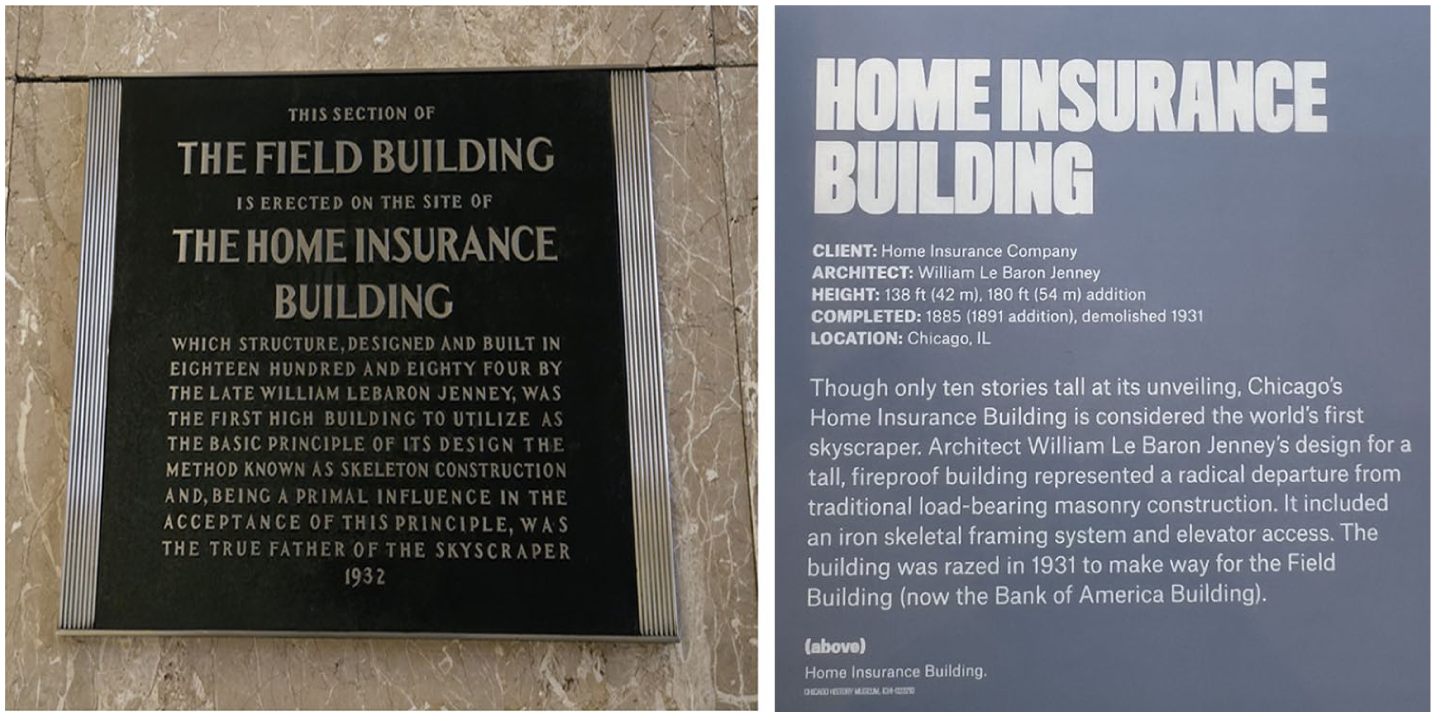
Plaques in the lobby of the Field Building (left) and in the Chicago Architecture Center (right), respectively.
Tourists passing through the lobby of the Field Building in the Loop can also see a plaque claiming that the HIB “was the first high building to utilize as the basic principle of its design the method known as skeleton construction.” This statement, at least, is more equivocal, although it still aims to perpetuate the myth of Jenney’s influence.
Conclusion
When the Home Insurance Building (HIB) was completed in Chicago in 1885, neither its architect, William Le Baron Jenney, nor the architectural community viewed it as revolutionary. Rather, Jenney’s structural methods were seen as an evolutionary iteration. By embedding cast-iron columns into the masonry piers, Jenney created a hybrid masonry-iron structure to satisfy his client’s request for more sunlight in the offices.
However, less than a decade after the opening of the HIB, Jenney and his Chicago colleagues began to reformulate how they described the building. Most notably, in 1896, in a letter-writing “debate” in The Engineering Record, they started using phrases like “radical,” “deserves the entire credit,” and “first steel skeleton construction,” even though none of these claims were true. Thus, via their successful PR campaign, the Chicago architectural community recast the Home Insurance Building as “the first skyscraper” and Jenney as its “inventor.”
Jenney was motivated, in large part, because a rival architect, Leroy Buffington, received a patent for iron-framing and initiated lawsuits for patent infringement. Jenney was warned by Buffington in 1892 to “to refrain from infringement of said patent or any of its claims.” If Jenney and his colleagues could demonstrate prior art—that is, by showing the HIB used iron framing and preceded Buffington’s patent—they could be victorious in any possible lawsuit. Ironically, Buffington’s attempt to claim credit as the “father of the skyscraper” handed the title to Jenney, despite having little basis in truth.
Jenney’s PR victory was carried forward in the 20th century by the “Chicago School” polemists and Modernists, who were driven to connect Chicago’s post-Fire tall office buildings to the ascendant International Style skyscraper. Despite newer research that documents Jenney’s innovations in a more nuanced and less pivotal light, the popular understanding of skyscraper history remains dominated by that which was produced by Jenney’s PR campaign and the Modernists, who needed Jenney’s story to support their arguments about the skyscraper’s architectural history. Chicago institutions and boosters continue to utilize the Jenney Myth to promote Chicago and its history.
Footnotes
Acknowledgements
I’m grateful to Gerald Larson, Tom Leslie, Gail Fenske, Sharon Irish, Richard Condit, Donald Friedman, and Robert Bruegmann for their invaluable discussions. I would also like to thank JT de la Torre at the Art Institute of Chicago, who was very helpful in locating archival documents about William Le Baron Jenney. I’m also grateful to the Council on Tall Buildings and Urban Habitat (recently renamed the Council on Vertical Urbanism), which in 2019 put on a one-day symposium about the “first skyscraper” debate. The discussions there helped to inform this essay. Any errors belong to the author.
Declaration of Conflicting Interests
The author declared no potential conflicts of interest with respect to the research, authorship, and/or publication of this article.
Funding
The author received no financial support for the research, authorship, and/or publication of this article.
