







Abstract
This article investigates the genesis and evolution of the Plaza de Santa Ana in Madrid, emphasizing its interconnection with the neighboring theater, the Teatro Español. The origins of the latter can be traced back to the establishment of the Corral de Comedias del Príncipe in 1583. The work integrates methodologies such as archival documentary research with others conventional to the discipline of Architectural Drawing. For this purpose, the period under discussion is defined beginning in 1808, before the demolition of the Carmelite convent of Santa Ana, and ending in 1943, when the first integral redesign of the garden was carried out. This article concludes that the theater’s presence had a detectable influence on the plaza’s formation and transformation. Likewise, the article graphically determines the evolution of the square from 1808 to 1943 and the transformation of the theater’s façade from 1869, when the definitive opening of the plaza took place.
Keywords
The current Plaza de Santa Ana, opposite the theater, is the result of a fascinating process of urban transformation that began with the confiscation and demolition of the convent of Santa Ana in the time of King José I Bonaparte. The evolutionary process of the square, like so many in Spain and in Madrid, went through different configurations. 1 The square has always been known as Santa Ana, but it has had other official names, being the “Plaza de Santa Ana” from its origin until around 1862, becoming the “Príncipe Alfonso Square”—briefly “Topete” in the revolutionary period (ca. 1869)—and again “Santa Ana” in the second third of the twentieth century. There are numerous studies that deal with the details of the convent and the creation of the first small square with its fountain. Though, there is a certain lack of attention to both the whole process of opening up the square and the morphological aspects directly related to the neighboring theater: the Teatro Español, a building with more than 440 years of practically uninterrupted scenic history since the construction, in 1583, of the Corral de Comedias del Príncipe. Since then, the building underwent continuous transformations, such as the reconstruction as an all’italiana theater in 1745 under the project of the architect Giovanni Battista Sacchetti, the expansion of the building in 1796 with the construction on the adjoining plot where the Café del Príncipe was located, 2 the fire of 1802, and its subsequent reconstruction in 1806 according to the design of the architect Juan de Villanueva. 3 This is the building we found in 1808. That was the date our tour began. At the time, this building was called Coliseo or Teatro del Príncipe. 4
The scarcity of bibliography on the relationship between the opening of the Plaza and the Teatro del Príncipe is accompanied by a lack of information on the architectural form of the building between 1808 and 1869. This is particularly evident in the scarce reference to the reform of the façade of the theater in 1869, when it was definitively known as the Teatro Español. One of the few testimonies to this can be found in the article “La reconstrucción del Español,” written by Julio Romano and published in La Esfera on January 26, 1929. In this article, Romano devotes a section to the façade, stating that the one that existed in 1929 must have been built in 1869, reforming the one built by Villanueva. 5 He also attributed the medallions also placed in 1869 to the master engraver José Esteban Lozano. 6
The renovation of the façade of the theater, which coincided with the definitive opening of the square, and the initiative to open the square during the period of French occupation were not coincidental. The influence of the theater seems to have been the driving force behind many of the decisions to transform the square. Conversely, the changes to the square encouraged some of the external changes to the theater. Taking this idea as our starting hypothesis, we approach the formation of the Plaza de Santa Ana and the resulting urban physiognomy of some of its areas, in order to present an ordered chronology based on some primary sources consulted for this research. Three historical periods marked the development of events: the state of the square prior to the arrival of José Bonaparte—before 1810; the square and its fountain from 1810 to 1868; and the square from its complete opening, including the reform of the façade of the theater in 1869, until the reorganization of the place in the middle of the twentieth century.
Urban Environment in 1808
In 1808, the country was on the eve of the French occupation. Madrid, the capital, maintained a compact urban structure between its two palaces: the Royal Palace to the west and the Buen Retiro Palace to the east. Apart from the prominent Plaza Mayor and the Paseo del Prado, the city lacked large open public spaces within its walls (Figure 1). During the reign of Carlos III, changes were made to the urban fabric. One of these reforms, close to the theater, was the opening of the Plazuela del Ángel after the demolition of the oratory of San Felipe.
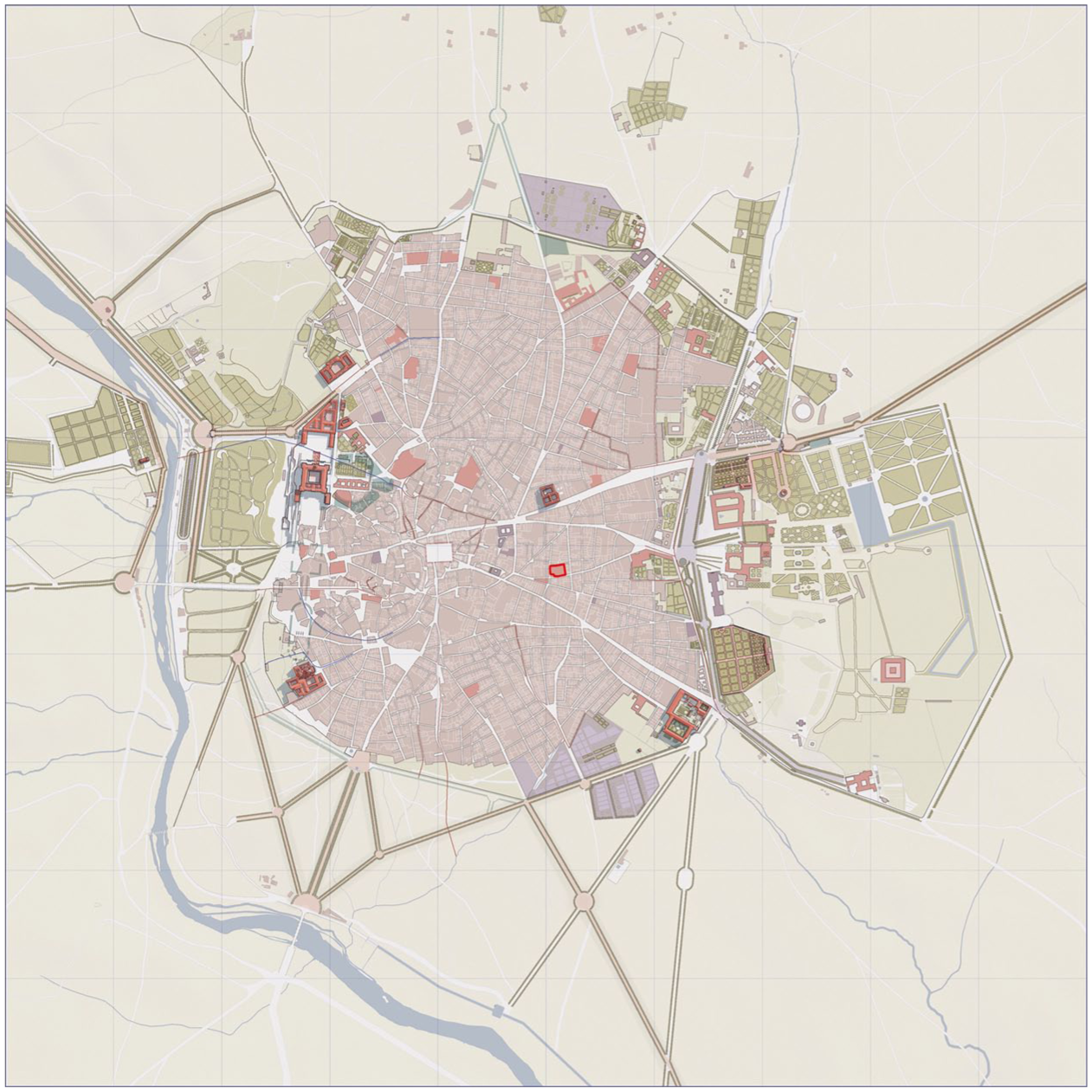
“The Madrid left by Sabatini (around 1800).” Work directed by Ángel Martínez Díaz for the exhibition El Madrid de Sabatini. La construcción de una capital europea (1760-1797) (curated by Sancho, Martínez Díaz, and Vázquez in 2021) and carried out by DNA estudio (Eva María Gil Barrio, Raúl Gómez Escribano, Jara Muñoz Hernández, Javier Rodríguez Callejo and Carlos Villarreal Colunga, with the collaboration of Víctor Amezcua Pajares, Alejandro Castaño Torrijos, and Marta García Maudes). Plan drawn up on the planimetric bases of the Forma de la Villa de Madrid by Ortega Vidal and Marín Perellón, 2006. Buildings intervened by Sabatini appear in volume, among the prominent elements, and other prominent places are shown in pale pink. The plot of the convent of Santa Ana is highlighted here in red.
Directly opposite the theater was block “215” of the Planimetría General de Madrid (1749-1774; Figure 2, left). If we focus only on the urban configuration, the history of the appearance of Plaza de Santa Ana is the history of the elimination of this block and the transformation of the square’s four façades, including that of the theater. Block “215” was bounded by calle del Prado to the south, calle de la Gorguera to the west, calle de la Lechuga to the north, and calle del Príncipe to the east. Inside, the Carmelite convent of Santa Ana stood out, occupying most of the area, as well as a row of buildings along the front of calle del Príncipe. Although Madrid did not have large open public spaces in its urban fabric, it did have numerous private orchards and gardens, supplied by water channels known as “viajes de agua.” The property of the convent of Santa Ana was home to one of these orchards, located in the center of the block, with walls separating it from the adjacent streets.
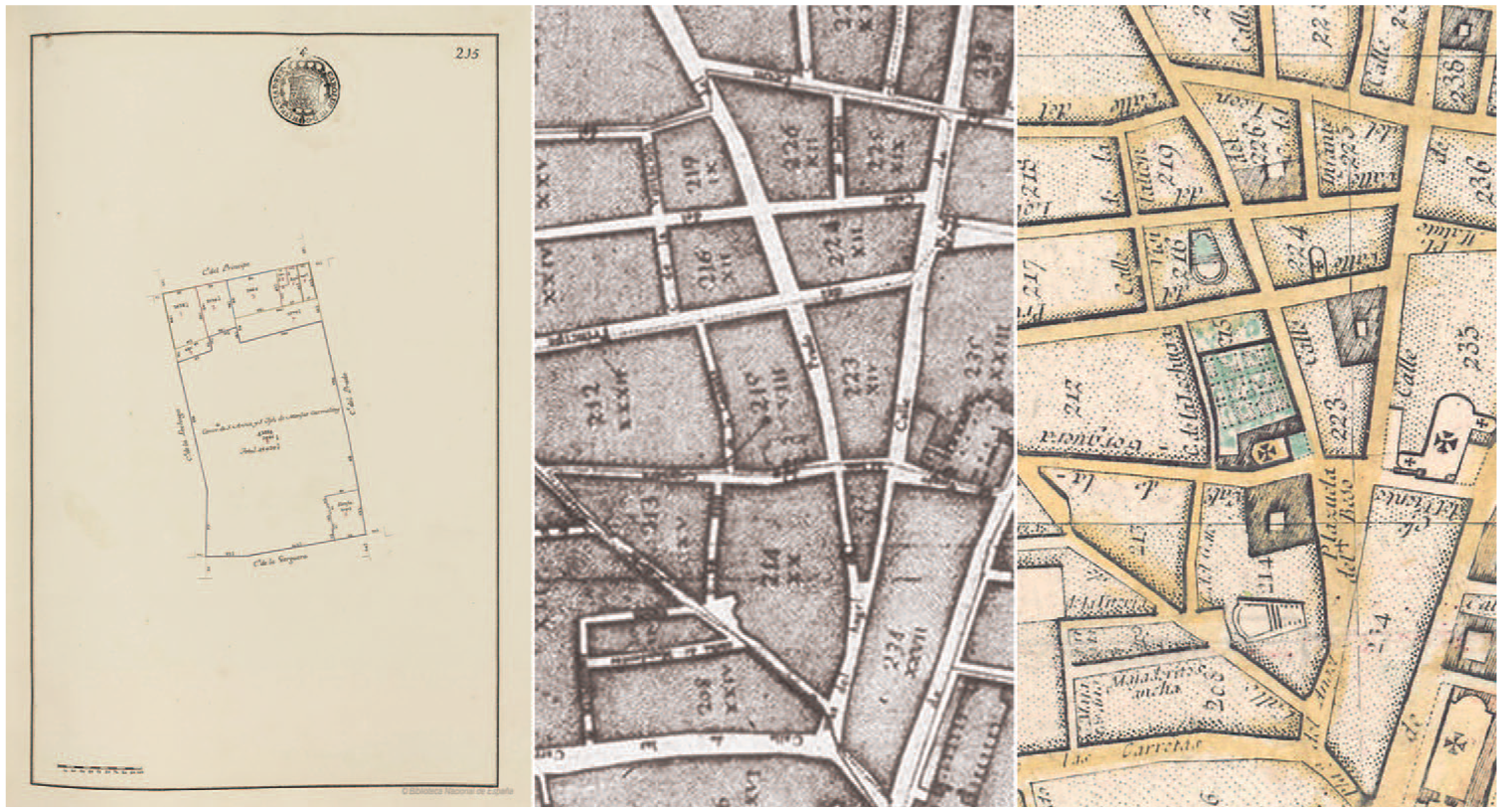
Left: «Block 215» in the Planimetría General de Madrid (1750). ©Biblioteca Nacional de España, BNE. Mss/1665-Mss/Mss/1676. Center: Detail of «Plano topographico de la villa y corte de Madrid». Espinosa de los Monteros, 1769. ©Biblioteca Nacional de España, BNE. MR/81/4; MV/13; GMG/1365. Right: «Plano geométrico de Madrid, dedicado y presentado al Rey Nuestro Señor Don Carlos III de 1785». Tomás López. North is on the left. ©Biblioteca Nacional de España, BNE. MR/2/113/2.
The convent was founded by San Juan de la Cruz in 1586 and was completed in 1611, with a church whose entrance was preceded by a hall set back in the south-west corner. According to Leticia Verdú, 7 the architecture of the convent must have been modest, in keeping with the ideal of construction that could have been derived from the principles of poverty, austerity, and functionality promoted by Saint Teresa, founder of the Order of Discalced Carmelites. The plan by Espinosa de los Monteros provides a sketch of the church’s layout (Figure 2, center), which shows a single nave. Although the representation of the convent in Texeira’s plan 8 reflects the aforementioned principles of simplicity, it cannot be considered an accurate representation of the state of the convent in 1808. According to the volume drawn in Texeira’s plan (1656), the existence of an adjoining cloister, which does not appear in Tomás López’s plan, dated 1785 and closer to 1808, would imply changes to the structure surrounding the church (Figure 2, right).
Throughout its existence, the convent lived side by side with the activity of the corral de comedias de la Cruz, on the opposite side of block “214,” and with the corral of calle del Príncipe, which was later converted into a theater. The façade of the latter was slightly higher than the row of houses bordering the convent, without any widening of the street in front of it.
Opposite the theater, on block “214,” was another notable building: the Palace of the Counts of Montijo y Teba, which was later renovated by the architect Silvestre Pérez in 1810 and played a prominent role in the social life of Madrid throughout the nineteenth century.
The entry of the French army in Madrid took place in March 1808. On July 12, José Bonaparte was proclaimed King of Spain and the Indies.
Plazuela
The Disentailment and Demolition of the Santa Ana Convent
Numerous authors have approached the reign of José I Bonaparte from different ideological perspectives, using a variety of adjectives. In some cases seeking to discredit the monarch’s character—such as the common “intruder king” and “Pepe Botella” [Pepe Bottle, as the gossips said he used to drink]—and, in others to praise him. Certainly, it is difficult to deny that the policies pursued between 1808 and 1813, although in continuity with some of the trends initiated by the Enlightenment reformers, represented a drastic change from previous models. This is not surprising since the French introduced concepts that opposed the Ancien Régime and were the basis of the French Revolution. In the theatrical sphere, this meant, among other things, the abolition of privileges and the opening up of the economy, which was introduced in France on January 13, 1791 and which, a priori, allowed any citizen to set up a theater and perform plays of all kinds. 9 Although this did not occur in Spain until the middle of the century, the government of José Bonaparte seemed to favor theatrical activity. Carlos Cambronero sees the subsidies granted to the Coliseo del Príncipe and the gratuities paid to comedians as a sign of the interest in theater in the Madrid of José I. 10
José Bonaparte’s urban interventions gave him the title of “Rey plazuelas” [King squares]. Although no general plan has been identified to guide them, the interventions may have been inspired by the Plan of the Artists of Paris of 1796, which proposed a series of urban planning aspects aimed, among other things, at improving communications within the city. 11 Among all the cities in Spain, Madrid had the largest number of interventions, mainly through the demolition of religious buildings after their disentailment. These disentailments were not arbitrary, since, according to Mercader, 12 we must understand these policies in the context of the Enlightenment, in a framework that sought both to resolve the problem of “dead hands” and to generate new economic revenues for the State. The disentailments carried out under José Bonaparte were guided by the principles of secularization, hygiene, and the search for monumentality.
In Madrid, between August 1809 and January 1810, more than two hundred and seventy properties were declared National Assets. Several of them were destined to become public squares, such as the Plaza de Oriente, the Plaza de San Miguel, the Plazuela de Santa Ana, and the Plaza de los Mostenses. 13 The demolition of the convent of Santa Ana was based on the improvement of the front of the theater. On June 4, 1810, the Minister of the Interior ordered the valuation of the houses in block “215” and requested a report on the advantages of demolishing them to create a square that would give width and relief to the entrance of the Teatro del Príncipe. 14
The architect in charge of the project was Silvestre Pérez. As a result, the convent was demolished and the nuns moved to the nearby calle del Prado.
The Plazuela, Fountain, and Trees
The demolition of the block was limited to the convent grounds, without affecting the row of houses, leaving a small square with two particular elements: the fountain and the trees, both closely related to water. The convent enjoyed privileges from its earliest years, including the use of water for its own needs. In the summer of 1630, a fountain was installed in calle de la Gorguera, within the walls of the convent. The abundance of water was due to the water course of the Fuente Castellana. 15 The location of the convent coincided with the Prado basin, where the water originally flowed until it joined the stream that crossed the current Paseo del Prado. 16
After the demolition of the convent, on October 21, 1811, Silvestre Pérez was given the task of designing a square, with the express request that the work should be cheap due to the lack of funds from the City Council. 17 One of the first measures was to move the water tank from the fountain in calle de la Gorguera to number 13 in block “212.” The other major intervention was the fountain designed for the center of the square, for which a more attractive element had to be found.
Finally, the sculptural group of Carlos V and the Furor was chosen to crown the fountain. 18 This bronze work, made by Leoni in Milan around 1564, passed through several locations before reaching the Buenavista Palace, including the San Pablo garden in Retiro Park. On the same day, November 3, the Minister of the Interior was informed that the “group will do very well in the aforementioned place, and its placement will demonstrate the Government’s loyal intentions and the protection it provides to the arts; it is also worth noting the savings that would result from this measure.” 19 The choice of such a valuable and representative sculptural group of an emperor like Carlos V was directly linked to the construction of the image of the “Gobierno Intruso.” The consolidation of the power of the new government coincided, in this case, with the use of symbols that reflected certain ideas, defending and acknowledging certain moments of Spanish national identity through its own history. 20 The fountain was also promoted graphically by the engravings of Manuel Salvador Carmona based on the drawings of Silvestre Pérez.
The fountain that was finally built had a circular plan of almost 30 feet in diameter, with a base in the center formed by a pedestal consisting of a first cylindrical body of 9 feet in diameter and about 4.5 feet high from the basin, a second body in the shape of a Greek cross and 1.5 feet high from whose perimeter faces the four water spouts emerged, and a last body of slightly more than 5 feet in height. Above these was the sculptural element (Figure 3). 21
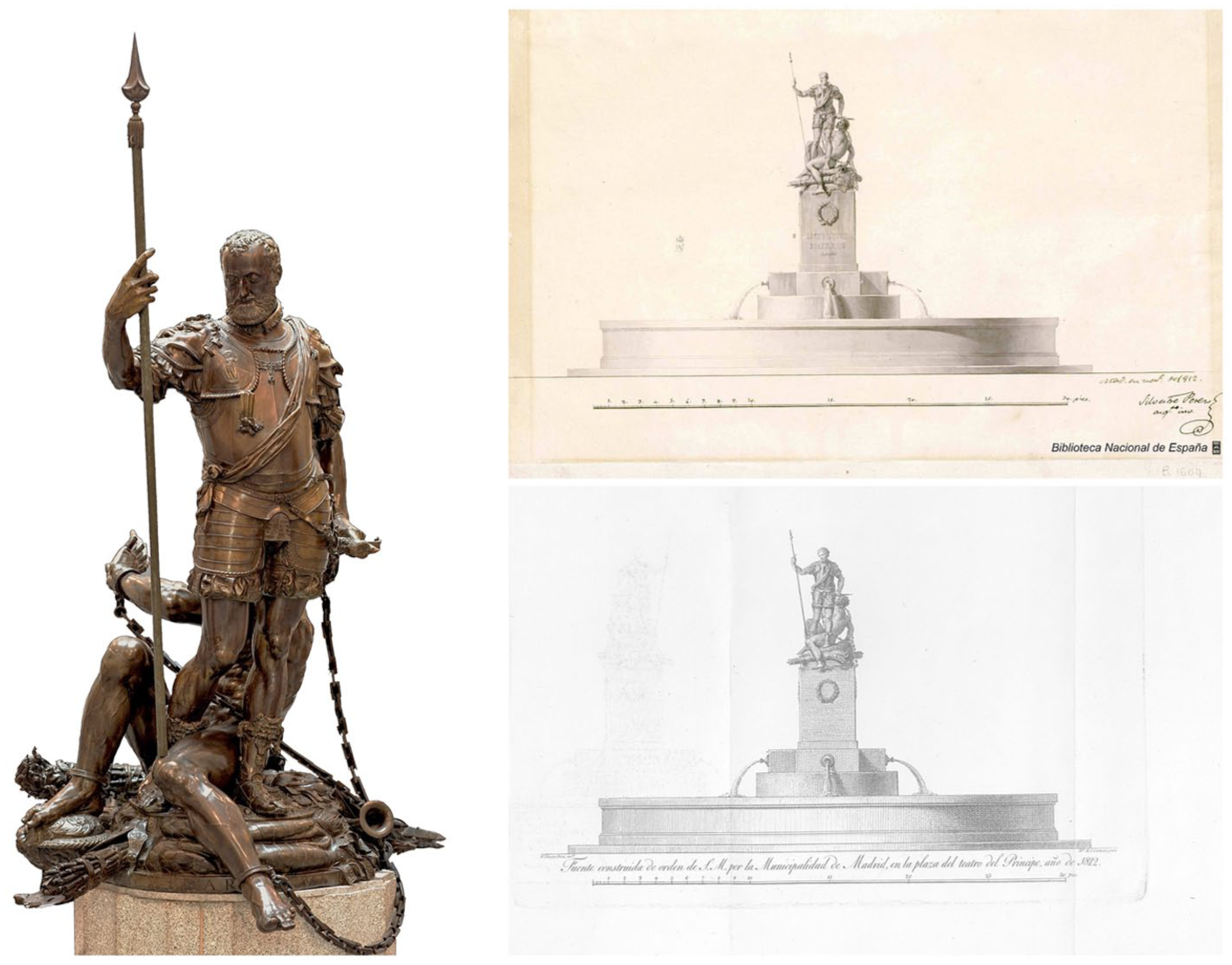
Left: Carlos V and the Furor. Leone Leoni, ca. 1564. ©Museo Nacional del Prado, MNP. E000273. Top right: Project elevation for fountain. Silvestre Pérez, 1812. ©Biblioteca Nacional de España, BNE. Dib/14/27/53. Bottom right: Engraving of the project elevation for fountain. Manuel Salvador Carmona, 1812. ©Archivo de Villa de Madrid, AVM. Secretaría. 1-112-3.
The location of the fountain on the site and the proposed arrangement of the trees brought forward the total demolition of block “215,” placing the fountain in the geometric center of the space between the façades of the surrounding area, without taking into account the row of houses between the theater and the plaza. As these houses were not demolished, the fountain was closer to them than to the façade of the Montijo mansion, and tree-lined paths radiated from it.
In 1811, Madrid was not used to having trees in its squares, so this space became the first tree-lined square among the public areas of the walled city. Although the square was not fully opened, the interior design of the small plaza was completed, something that was not done in many of the interventions of the reign of José I, who left numerous plots of land unfinished. Some of these areas were later used to plant trees and gardens during the reign of Isabel II.
The landscape of Madrid after the return of Fernando VII in 1814 must have been quite daunting. There were plots of land left over from demolitions, unfinished works and urban transformations carried out for military purposes. The King, opposed to the reforms proposed in the Constitution of 1812, restored the absolute monarchy on May 4, 1814 and slowed down the transformations proposed by José Bonapartes’s government.
Urban Environment in 1830
With the restoration of Fernando VII, the ownership of the land in the plazuela was not yet fully resolved. On February 26, 1817, the community of the Discalced Carmelite nuns of Santa Ana asked to be recognized as owners of the land they had left in the square. In response to this, the architect Antonio López Aguado, who had been appointed Master Builder since 1814, argued that it was necessary to buy the land from the community because of the great utility of the plazuela for the city. Almost ten years later, on July 14, 1826, 22 the land was ceded to the Town Hall by deed.
On the other hand, the statue of Carlos V and the Furor encountered political difficulties that ultimately led to the fountain’s removal. In February 1814, a petition was presented to the City Council requesting the statue’s return to its original location. However, the council was warned that “being the public committed to the enjoyment of the fountain and its adornment” 23 the statue should not be removed. During the Liberal Triennium, a period that was only a brief halt to the reversal of liberal policies, some sectors of society considered that this statue symbolized the repression of the Castilian Communities being crushed and chained by the emperor. The meaning of the sculpture was affected by its context, something that, as Carlos Reyero argues with painting, 24 contrasts with the timelessness generally sought with these artistic expressions that refer to specific characters, myths, or historical moments. In February 1822, the municipal alderman Vall y Roca came to fear that the statue would be pulled down and he suggested that it should be considered for removal. 25 The decision became effective three years later, when the king expressed his wish to return the statue to the Buen Retiro, as recorded in the minutes of April 12, 1825. 26
As a replacement, the possibility of the monarchy providing the City Council with a new statue or ornament for the fountain was considered. In the end, the design proposed by Antonio López Aguado was chosen, which consisted of a new top “reduced to a pyramid on a base with the seven stars of Madrid and its arms” (Figure 4). 27 After the construction of a wooden scaffolding for the removal of the statue of Carlos V and the Furor, the pyramid with its molded base was placed on the pedestal. This new ensemble was made of berroqueña stone, with six courses in the pyramid’s trunk.
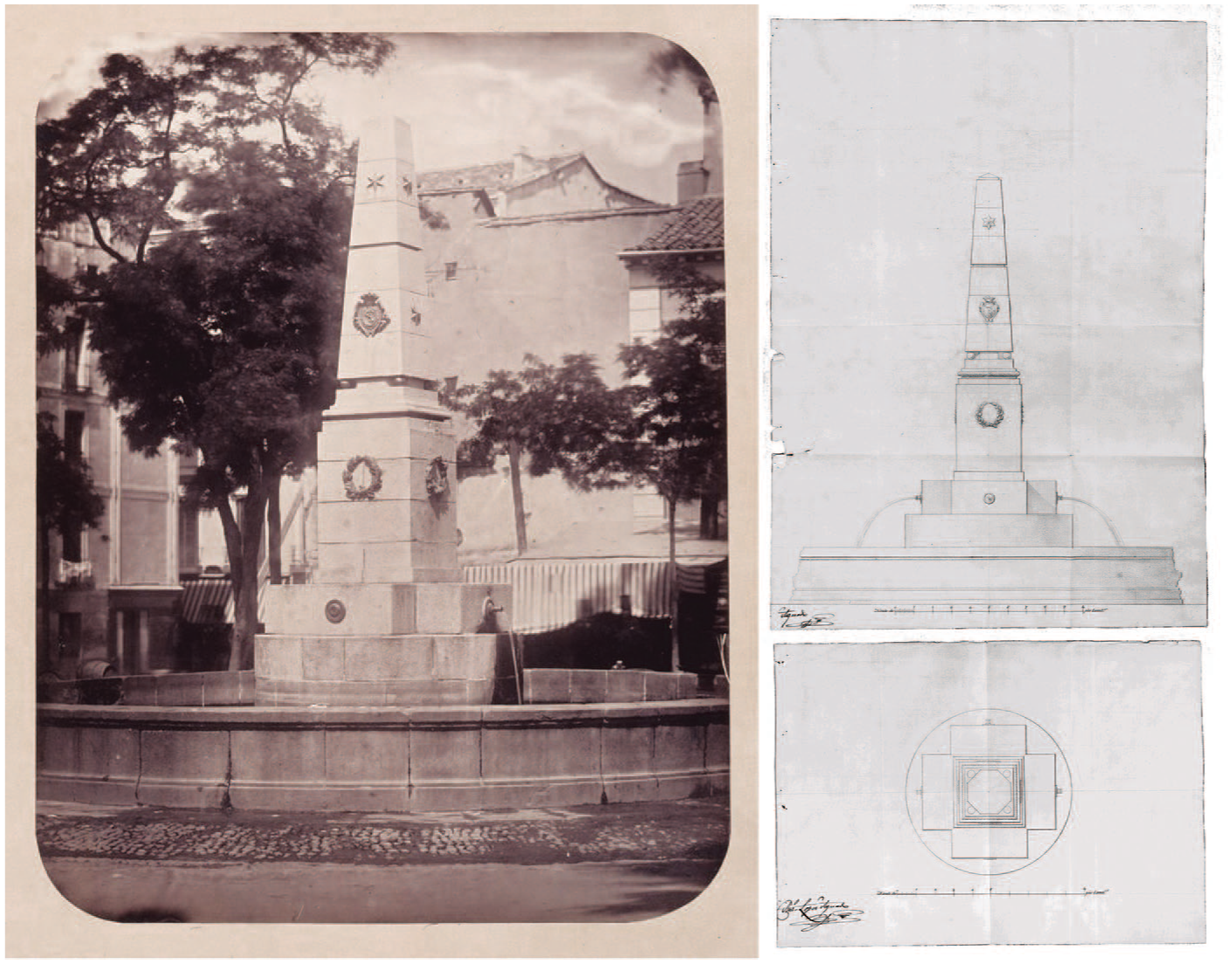
Left: «Neighborhood fountain in Príncipe Alfonso Square». Photograph of Alfonso Begué, 1864. ©Museo de Historia de Madrid, MHM. Inv. 21986-32. Right: Fountain elevation and central body plan. Antonio López Aguado, 1825. ©Archivo de Villa de Madrid, AVM. Secretaría. 1-112-28.
The Plazuela de Santa Ana changed its most prominent ornamental element for a more peaceful one. With the exception of this, and some changes to the façades of some smaller buildings, as well as a few replanted trees, its appearance had hardly changed since its inauguration. The best testimony of what this place looked like after the construction of the pyramid or stone spire is the model by León Gil de Palacio and the Real Gabinete Topográfico (Figure 5).
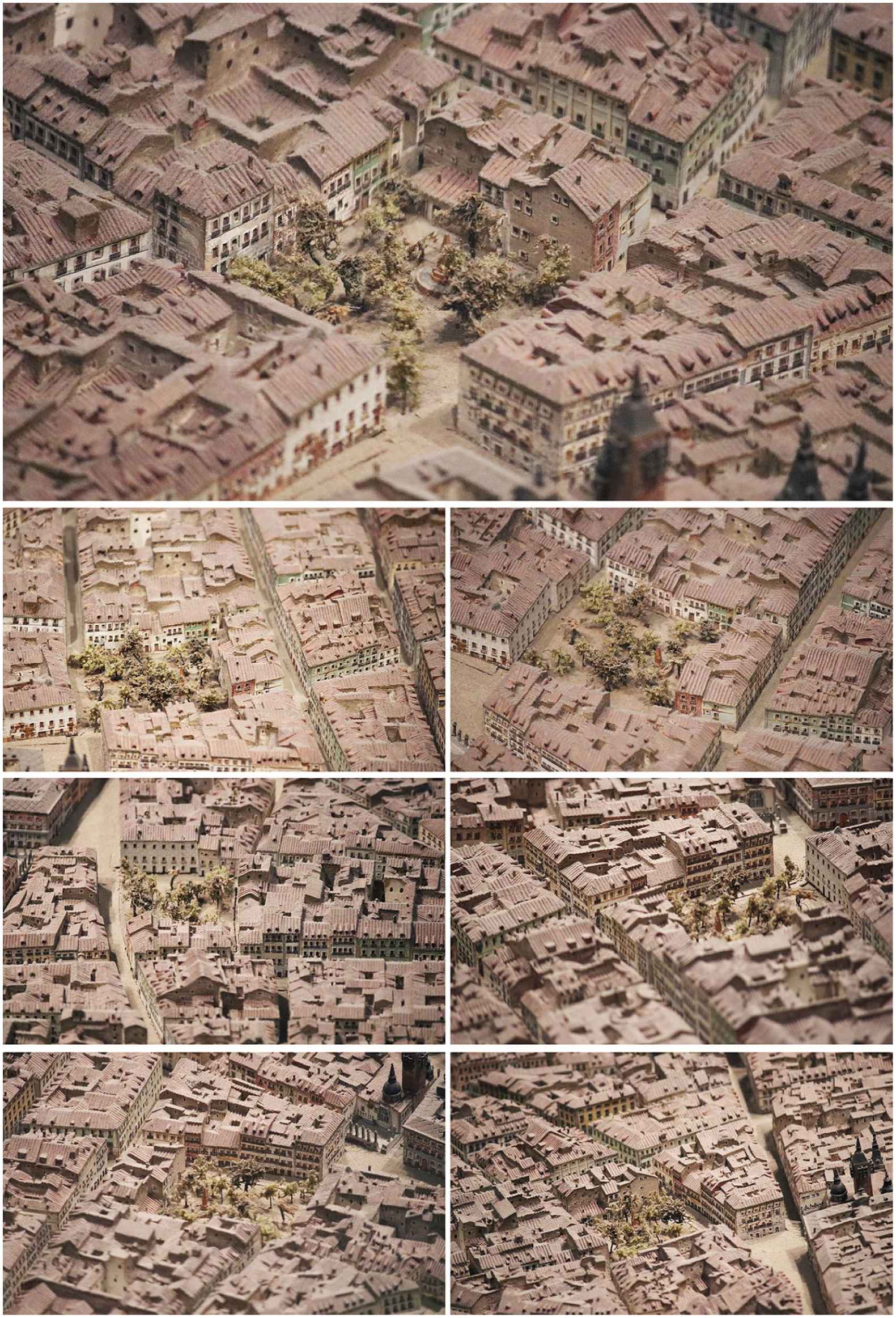
The Plazuela de Santa Ana and its surroundings in León Gil de Palacio’s model, 1830. ©Museo de Historia de Madrid, MHM. Inv. 3334. Photographs by the authors, July 2020.
The model, built between 1828 and 1830, probably used Espinosa de los Monteros’s 1769 plan as a general reference 28 and the blocks of the Planimetría General de Madrid as a specific guideline. The resulting volume would become the image of a city that was still post-war but undergoing change. During this time, the recreational exhibition of models of cities, as well as views in panoramas, dioramas, or neoramas, gained popularity. 29 Mesonero Romanos, for example, expressed his admiration for the accuracy and delicacy with which the city was reproduced with the “most meticulous prolixity, both in its levels and heights, and in the representation of its houses, palaces, grounds and others, without lacking the least for a very exact copy.” 30
As shown in the model, the small square was still separated from the Teatro del Príncipe by the row of houses, some of which had turned their party walls into external façades thanks to the multitude of openings they had. The volume of the theater, now with its adjacent café, still stood out from the neighboring buildings. The façade of the theater, as we know, is the interpretation of the result of the project by Giovanni Battista Sacchetti (1744) and the subsequent intervention of Juan de Villanueva in its reconstruction (1806). 31
The model is an invaluable reference that generally coincides with the appearance of some of the buildings in this area according to other archival graphic documents, such as the façades drawn for renovation or new construction projects for some of its buildings (Figure 6). On its perimeter, in addition to the theater, the palace of Montijo y Teba stood out—as well as some four-story buildings on its north and south façades—in an urban environment that still housed two-story buildings from previous times.
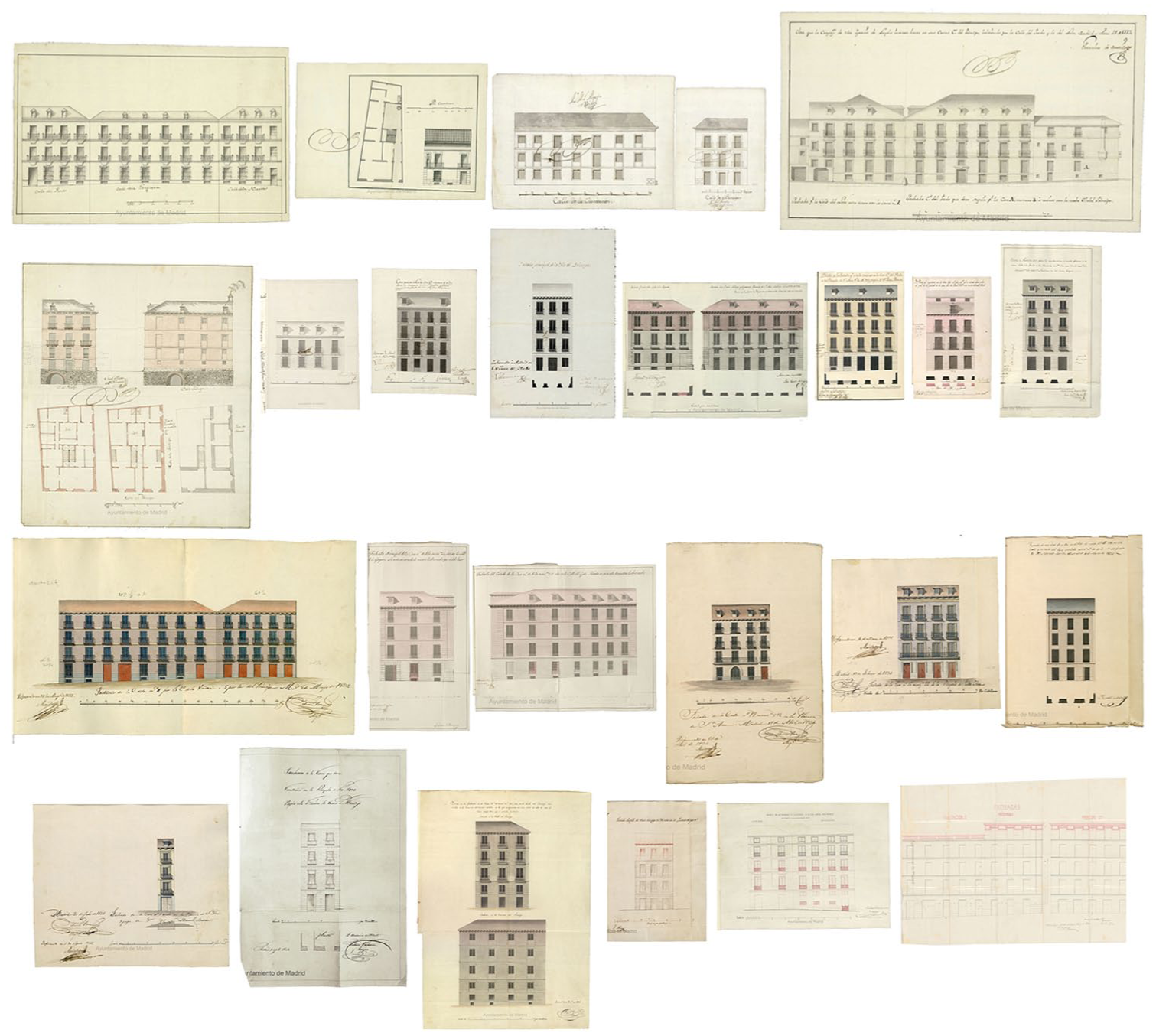
Graphic parallel of the compilation of plans of renovation or new construction projects for buildings in the area around the square and the theater block. ©Archivo de Villa de Madrid. Own elaboration from the next documents (from left to right and top to bottom): AVM. Secretaría. 1-85-2; AVM. Secretaría. 1-45-144; AVM. Secretaría. 1-46-44; AVM. Secretaría. 1-46-44; AVM. Secretaría. 1-47-56; AVM. Secretaría. 1-48-84; AVM. Secretaría. 1-49-124; AVM. Secretaría. 1-52-89; AVM. Secretaría. 1-61-8; AVM. Secretaría. 1-57-65; AVM. Secretaría. 1-58-101; AVM. Secretaría. 1-63-3; AVM. Secretaría. 1-63-64; AVM. Secretaría. 1-63-96; AVM. Secretaría. 1-64-20; AVM. Secretaría. 1-64-20; AVM. Secretaría. 1-64-116; AVM. Secretaría. 1-65-56; AVM. Secretaría. 1-65-60; AVM. Secretaría. 1-65-109; AVM. Secretaría. 4-62-102; AVM. Secretaría. 4-62-102; AVM. Secretaría. 4-63-34; AVM. Secretaría. 4-85-41; AVM. Secretaría. 4-263-33.
Square
Opening Projects and National Theater
Although neither the city of Madrid nor the rest of the Kingdom of Spain was completely isolated from the changes brought about by the emerging industrial and commercial bourgeoisie during the reign of Fernando VII, in the decades following his death, there was a slow yet progressive increase in urban interventions related to this social class. 32
The historic city underwent interventions that defined its current urban structure. Examples include the formalization of the Plaza de Oriente with the Teatro Real, which was completed in 1850. This process began with the demolitions carried out during the reign of José Bonaparte followed by Fernando VII’s commissioning of Isidoro Velázquez to plan the front square in 1817. Another example is the reform of the Puerta del Sol, which began in 1853.
As in the rest of Europe, the great bourgeois cities brought greater prominence to theatrical architecture and public space as a setting for social life. 33 The construction of the margins of the historic center, with the Prado and Recoletos as the main focus, became favorable places for theatrical activity. Similarly, the disentailment processes, which involved the expropriation of various ecclesiastical properties, favored the appearance of some theaters in locations that were, at first, unexpected. For example, the convent of Trinidad Calzada became a theater from 1841 to 1844, and so did the convent of the Vallecas in Calle Alcalá, whose church housed the Teatro Museo (1841-1849). 34 The intention to create a large space in front of the theater stemmed more from the program of the Enlightenment and the desire to symbolically glorify the theater as a temple than from the function of public space as a means of capitalist economic exploitation.
The repeated desire to demolish the row of houses coincided, this time, with the declaration in 1849 of the Teatro del Príncipe as a National Theater, under the name of Teatro Español. 35 The declaration as a National Theater brought with it the reforms introduced by Aníbal Álvarez. Among these were the introduction of gas lighting, the modification of the proscenium arch and the levels of palcos. The great Palco Real built in 1816 by Antonio López Aguado was eliminated, placing the new Palco Real in the first palco (theater box) of entresuelo (mezzanine), with access from calle del Prado. As well, the old cazuela—the upper most level in a theater, usually reserved for women—was removed, extending this low level of palcos in front of the stage with the balconcillo. The front curtain was replaced and the stalls ceiling was painted by Espalter. 36 Nevertheless, the exterior of the theater remained modest; we have no record of major changes to its shell, except for the commemorative plaque added to the façade. 37 In the view made by Eduardo León y Rico (Figure 7), we are able to see the area of the plaza, although with certain dimensional inaccuracies in the proportions and location of the theater in the block, as well as the exaggeration of the spire of the fountain, which looks more like a tall obelisk.
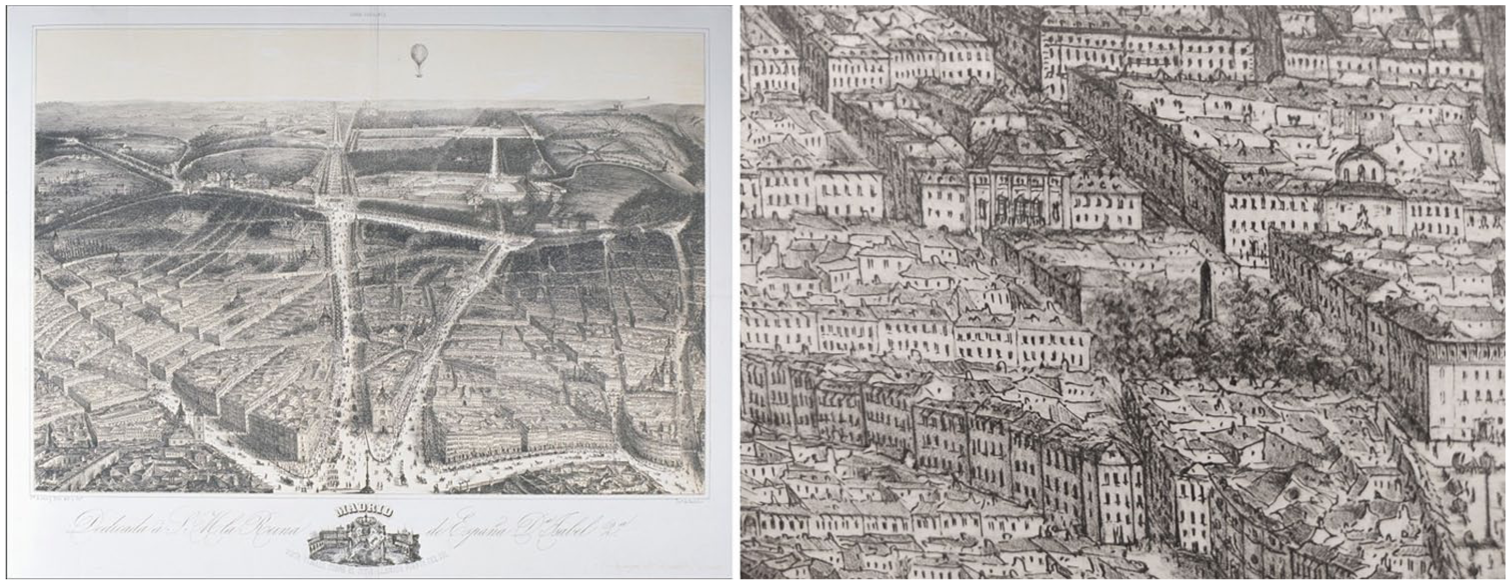
Left: «View taken from the site called Puerta del Sol». Eduardo León y Rico, ca. 1850. ©Museo de Historia de Madrid, MHM. Inv. 1858. Right: Detail of the area of the square.
The new attempt to open up the square was formalized with the proposals of Mesonero Romanos in the Memoria explicativa del plano general de mejoras [Explanatory Report of the General Plan of Improvements]. In it, he proposed the construction of a block on the west side of the small plaza to house the replaced dwellings. The location of the proposed block is shown in a plan drawn up by the architect Juan José Sánchez Pescador, dated December 6, 1850 (Figure 8). In addition to presenting new alignments for the square, to which the block would be adapted, the proposal ignored the previous design of the plaza, which placed the fountain in the geometric center of a large space. Instead, it focused on providing the relief space for the theater, which could also be given greater relevance in terms of volume.
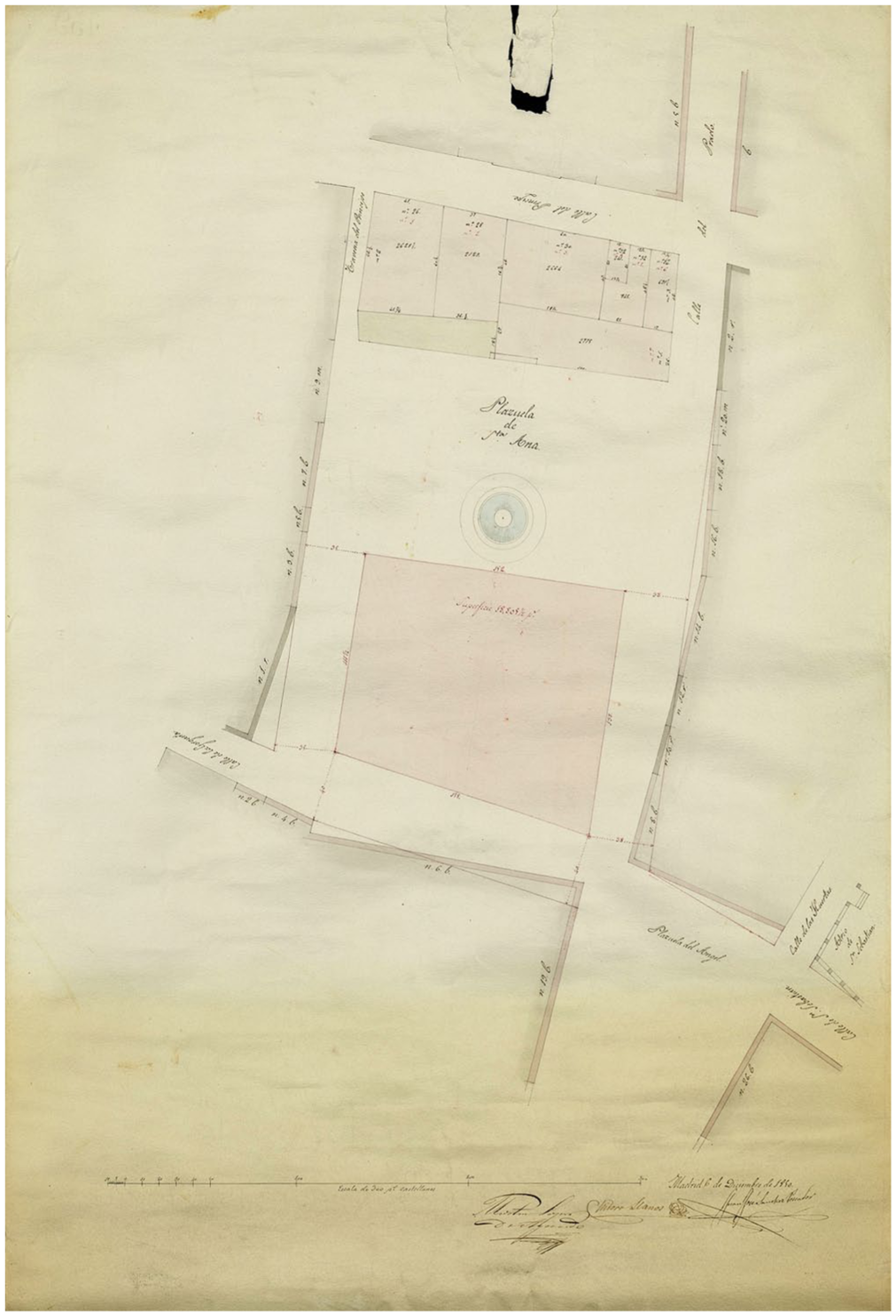
Alignment project of December 6, 1850, Juan José Sánchez Pescador. ©Archivo de Villa de Madrid, AVM. Secretaría. 0’59-12-8.
In the file on the demolition of the row of houses, which is in the Archivo de Villa, one can find an opinion contrary to that of the conservative Ramón Mesonero.
38
While Mesonero advocated for an opening project that maintained the dimensions of the small square with the construction of a block on the opposite front, this other proposal was based on the principles of the original project: [. . .] it would be advantageous for the public ornament and comfort if the block of houses in front of the Teatro Español were to disappear. If this determination is convenient, it is also convenient to leave all the land of the square free and open without taking any part for the construction of houses, based on the fact that the original project was conceived in this way. This is reinforced by the central situation of the fountain, between the Teatro Español and the house of the Countess of Montijo. Also, the more spacious the squares of a town, the better they fulfil their purpose. So the undersigned consider the idea of the demolition of the block to be acceptable and worthy of being carried out, constituting a square on the land occupied by the existing one with the addition of the site of the aforementioned houses.
39
The City Council seemed inclined to this option, but the project was suspended on January 26, 1852 due to lack of funds. Similarly, the National Theater project also failed in 1851, and the Teatro Español was renamed the Teatro del Príncipe, 40 again under municipal control.
Alignment Projects
With the end of the Ancien Régime and the appearance of reference models such as that of Baron Haussman in Paris, openings of urban spaces in the interior of the city increased in the mid-nineteenth century. In addition to those cited, such as the Plaza de Oriente with the Teatro Real and the new Puerta del Sol—accompanied by a series of plans—in the case of the square in question and the adjacent streets, we also have good examples of alignment projects (Figure 9).
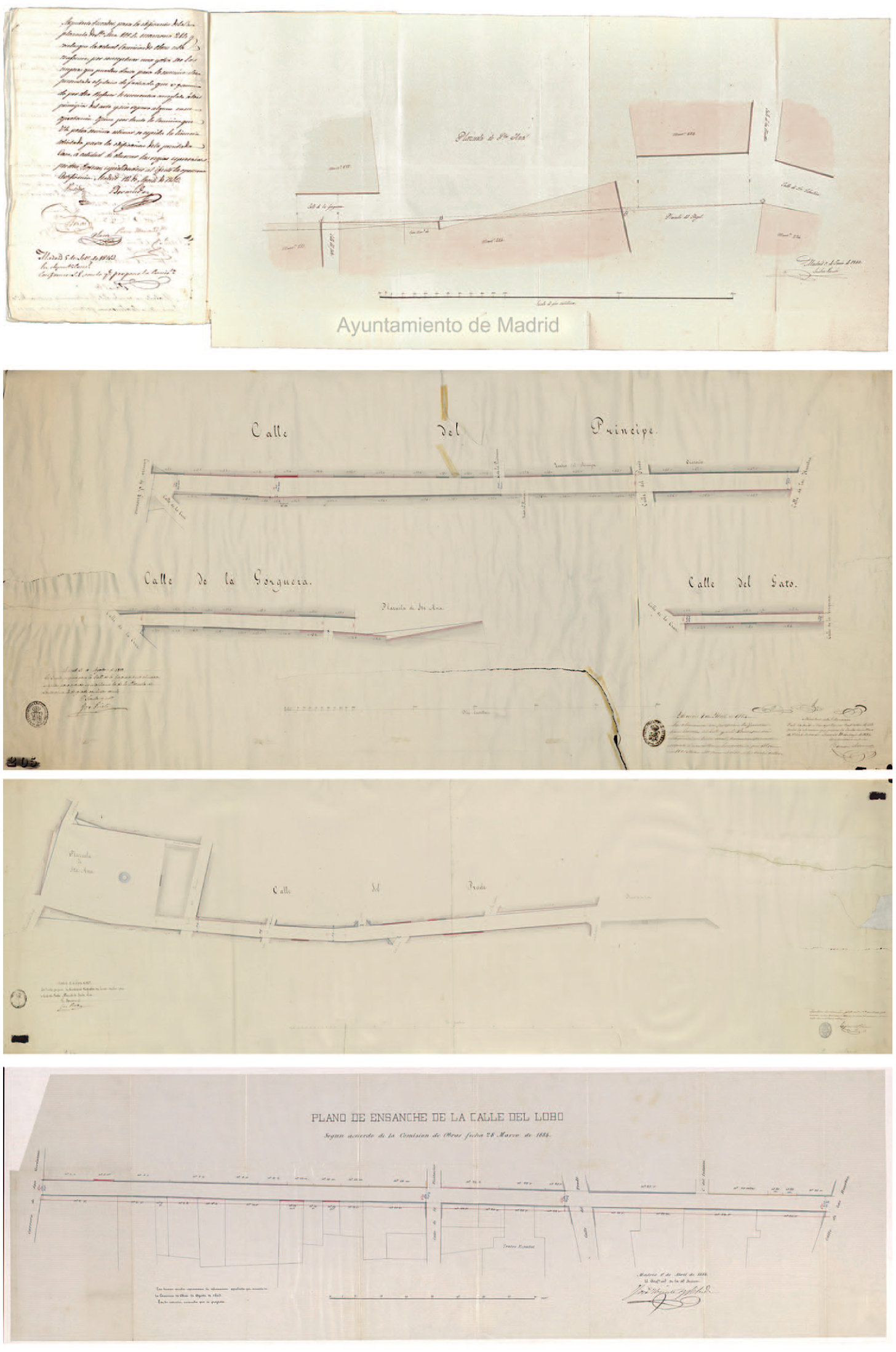
From top to bottom: Alignment for block “212.” Sánchez Pescador, 1843. ©Archivo de Villa de Madrid, AVM. Secretaría. 4-7-95. Alignments of Calle del Príncipe, Calle de la Gorguera, and Calle del Gato, 12 August 1859. ©Archivo de Villa de Madrid, AVM. Secretaría. 0’69-10-2. Alignments of Calle del Prado and Plazuela de Santa Ana, 12 August 1859. ©Archivo de Villa de Madrid, AVM. Secretaría. 0’69-25-2. Plan for the widening of Lobo Street. José Urioste y Velada, 1884. ©Archivo de Villa de Madrid, AVM. Secretaría. 7-6-10.
One of the first plans with marked alignments is found in the request for permission to build at number 4 of block “214,” on the continuation of Calle de la Gorguera (Figure 9, above). 41 The information provided by the architect Sánchez Pescador, dated June 9, 1843, drew a line connecting the corner of block “213” with that of “234,” practically maintaining the alignment of the façade of house number 4 but cutting off the neighboring palacete.
Juan José Sánchez Pescador introduced a variation in the orientation of this façade in the alignment project dated December 6, 1850 (Figure 8). In this plan, he drew a line starting from the corner of house number 4 of block “214,” but which did not continue the façade line of this house and cut the palacete somewhat more subtly than the proposal seen above. Similarly, for house number 1 of block “212,” he presented an alignment on the façade facing toward Plazuela de Santa Ana that continued the line established by the neighboring properties. For the opposite block, number 223, he drew a line joining number 2 with one end of number 12. This extended the area of the block in the foreground and eliminated part of it up to its meeting with Plazuela del Ángel.
On April 7, 1854, the Junta Consultiva de Policía Urbana proposed an alignment for the streets of Gato and del Príncipe, which was approved by royal decree on May 11, 1854. 42 However, these alignments underwent some changes in 1859 (Figure 9, second from top). 43 The new alignment of Calle de la Gorguera connected the beginning of the façade of house number 4 with the corner of the Montijo House, which resulted in an increase in the surface area of the block toward Plazuela de Santa Ana. Curiously, in Calle del Príncipe, the proposal only reduced the façade of the theater by a few centimeters.
Another plan from 1859 sheds more light on the overall alignment of the square (Figure 9, third from top): 44
[. . .] This is not the first time that this Board has dealt with the improvements demanded by this central and interesting site, nor was the most important of them all hidden from the City Council, which is the widening of the square up to calle del Principe, when many years ago it agreed to purchase and demolish the houses that make up the block located between the square and the calle del Prado and del Príncipe lane, and ordered that the current fountain be placed at the future center point of the square. It is indispensable the convenience of the widening, the presence of a theater, and the embellishment of the important street of del Príncipe, as well as the ease of implementation, even if only gradual, taking into account the low value and duration of the houses of the aforementioned block, even if some works are carried out on them. [. . .] With respect to the one that looks to the South, it would be desirable that what is necessary to establish direct communication between the streets of El Gato and La Visitación be remitted, with which not only would these streets gain importance, but the façade of the theater would be presented in the axis of the square and could beautify it with a convenient crowning; not since this improvement can be qualified with foundation of daring and above all of superfluous and burdensome for the municipal funds, this Board abstains of proposing it, establishing two lines for this side, subject the first to the present new façades 3, 5 and 7 prolonged until the calle de la Gorguera, forming a chamfer of five feet in the angle that forms with this one, and the second to the present façade number 9 continuous of until the calle del Príncipe.
45
The intentions expressed in this quote, to leave the theater as the center of this part of the plaza, although not included in the final proposal, reveal to us the existing relationship between the plaza, still a small square, and its theater. The aforementioned plan shows the alignment approved for calle del Prado by the agreement of April 10, 1845, although corrected in 1859, as well as the alignments of calle del Príncipe and the plaza as a whole. From the west, the alignment of block “214” showed the aforementioned shape, in which one end of the house number 4 joined the corner of the palacete. 46 To the north, in block “212,” the alignment was corrected with a chamfer where it meets Calle de la Gorguera. In Travesía del Príncipe—the alley between this block and the row of houses—a new alignment was also proposed, in this case extending it toward the row of houses up to 20 feet wide. The alignment of calle del Principe continued with a reduction of several centimeters on the façade of the theater. Finally, calle del Prado continued with the alignment shown in the 1850 plan (Figure 8), practically maintaining the existing alignment until calle del Lobo. The most notable change was on the façade of block “216,” where the street was widened to 37 feet, thus cutting off this block and the adjacent ones.
In general, the alignment projects were not directly implemented, and the affected buildings were not reconstructed prior to their execution. This is one of the reasons why some of the aforementioned projects were implemented many years later, and others were never carried out.
Demolition of the Row of Houses and the Landscaped Plaza
Despite the suspension of the 1850 dossier, attempts to align, widen and beautify the square were not forgotten. Around 1861, news of an agreement to demolish the block of houses and proposals to improve the square resurfaced.
In 1862, when the demolition of the rest of block “215” was decided, the Countess of Montijo offered to decorate the façade of her mansion overlooking the square, something that was rumored to be done by other neighbors: For in the case that the block of houses that give front to the Teatro del Príncipe is demolished to widen and to beautify the small square of Santa Ana, it seems according to a newspaper, that Countess of Montijo has offered to decorate with a great façade, that gave to the new square, her palace. It is said that many owners of buildings are waiting for this resolution to begin new and beautiful constructions that they project there, and even adds a newspaper that the same City Council has conceived the plan to make a beautiful garden and to raise a statue that remembers some of our national glories.
47
On November 22, 1862, a request was presented to the City Council for the definitive acquisition of the block of houses in front of the theater, the creation of a garden and the replacement of the fountain with “the one that was awarded in the competition that was held for this purpose.” 48 The request was accepted and they were already moving in this direction when Lucas Tornos, director of the City Hall, suggested that it would be a good option to create a semicircle to allow carriages to stop and pass in front of the Teatro del Príncipe, among other issues.
City architect Agustín F. Peró was responsible for the alignment project. In his design, he defined a garden area with 5-m chamfers at the corners, maintaining a distance of twenty meters between the façade of the theater and the garden, and ten meters on the other sides. With these guidelines, Lucas de Tornos presented a budget and a plan for a garden with winding interior paths that could be accessed from the corners or from the center of each side. 49 One of the objectives of the proposal was to leave as many large trees as possible, taking into account the high temperatures that Madrid reached in the summer. The design kept the fountain in the center (Figure 10).
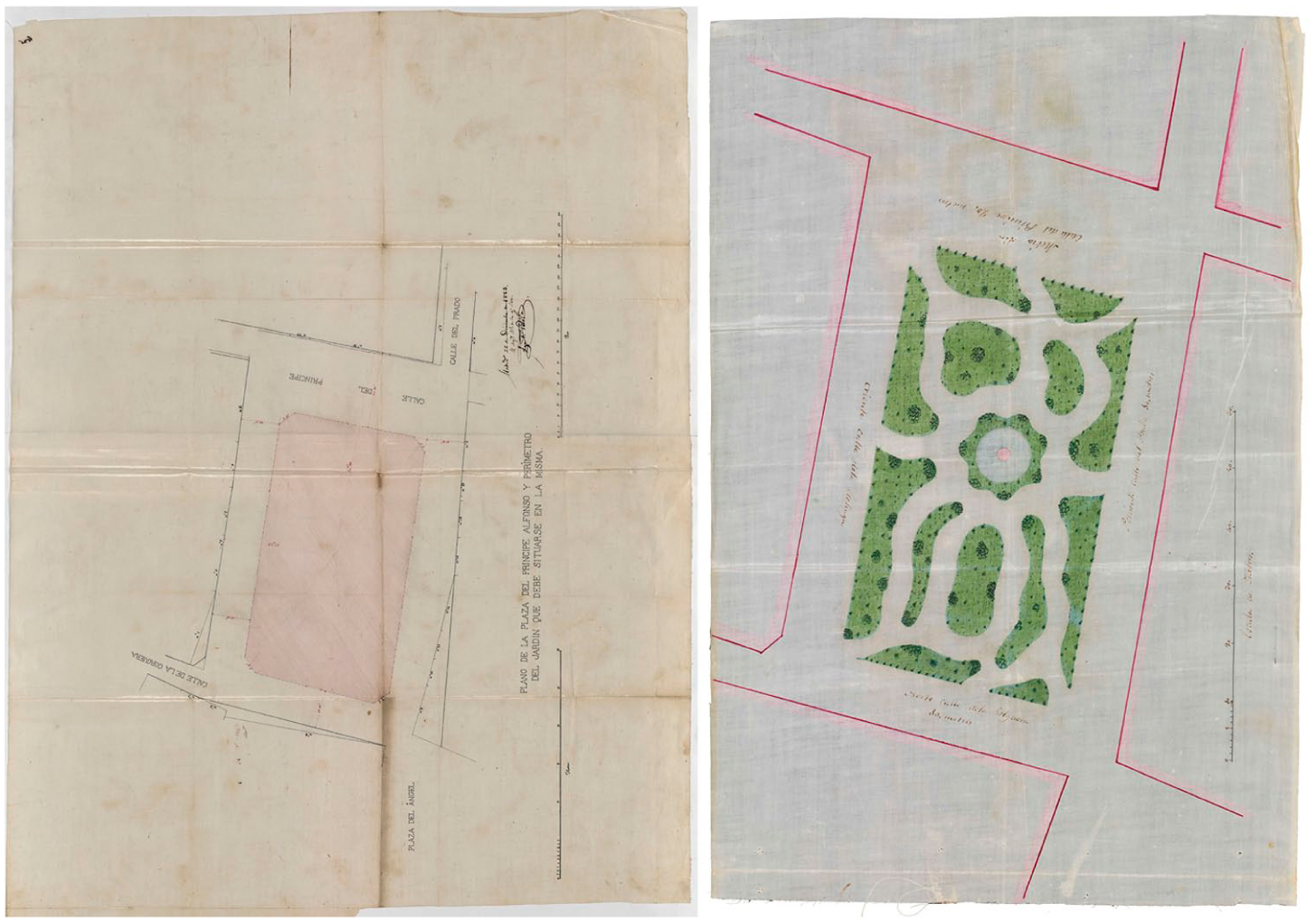
Left: Proposed alignment for landscaping. Agustín F. Peró, 1863. ©Archivo de Villa de Madrid, AVM. Secretaría. 5-86-84. Right: Garden proposal. Lucas de Tornos, 1864. ©Archivo de Villa de Madrid, AVM. Secretaría. 5-86-84.
Tornos’s proposal did not materialize, which is evident in the topographic survey carried out by the Junta General de Estadística. The plan dated August 13, 1868 (Figure 11) shows the layout of the small square that still preserves the row of houses, although with the later note “no longer existing.” In addition, the original layout of the streets and trees is shown, highlighting the presence of numerous kiosks drawn on the plan. As mentioned by Fernández de los Ríos in his work El Futuro Madrid, [. . .] in the small square of Santa Ana a collection of irregular stalls has been forming, not subject to any order or uniformity for the sale of birds and flowers without there being any inconvenience in maintaining them as long as they are subject to a given model and to a determined placement, which does not turn that square into what our markets usually are.
50
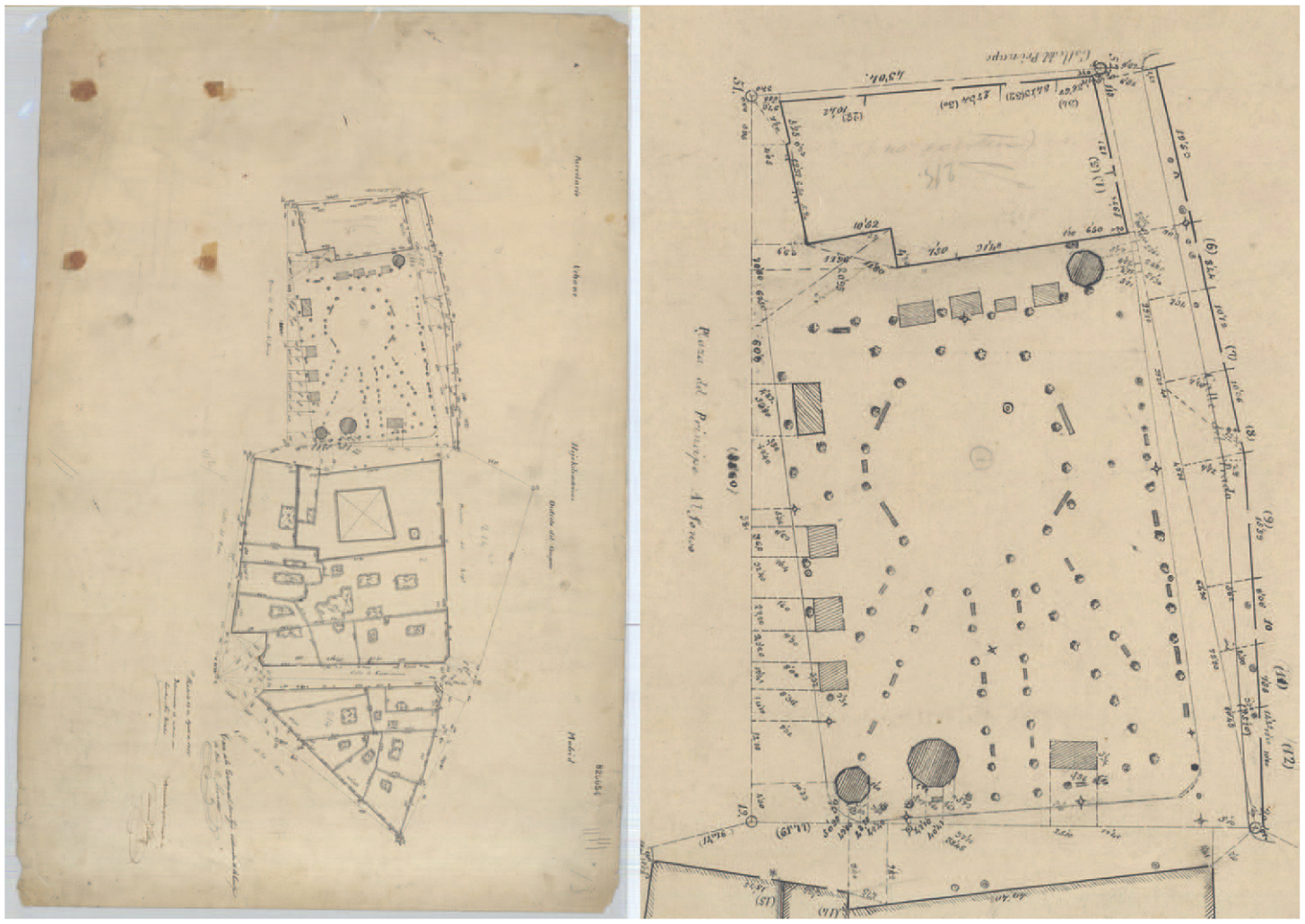
«Parcelario urbano, hoja kilométrica, Madrid, Congreso district: [polygonation and survey of blocks 214-1ª. and 2ª.-, 215 and plaza del príncipe Alfonso]», 13 August 1868. ©Biblioteca del Instituto Geográfico Nacional CC-BY 4.0, IGN. A.T., nº. 820.054.
In April 1868, Enrique Mª Repullés y Vargas, still a student, proposed to the City Council a “Project for Bird and Flower Market.” 51 This proposal was part of an exercise corresponding to his third year at the School of Architecture. The project aimed to create a garden space with places to sell birds and flowers, maintaining a greater separation in front of the theater for the movement of carriages.
The City Council expressed its appreciation for the project presented and praised the professor’s idea of studying proposals that would be useful to the population.
As mentioned above, the sale of birds and flowers, despite its evident state of deterioration, seemed to have a strong connection with the plaza. In this sense, there are some plans for the arrangement of the plaza that contemplated the construction of specific stalls for the sale of these goods (Figure 12).
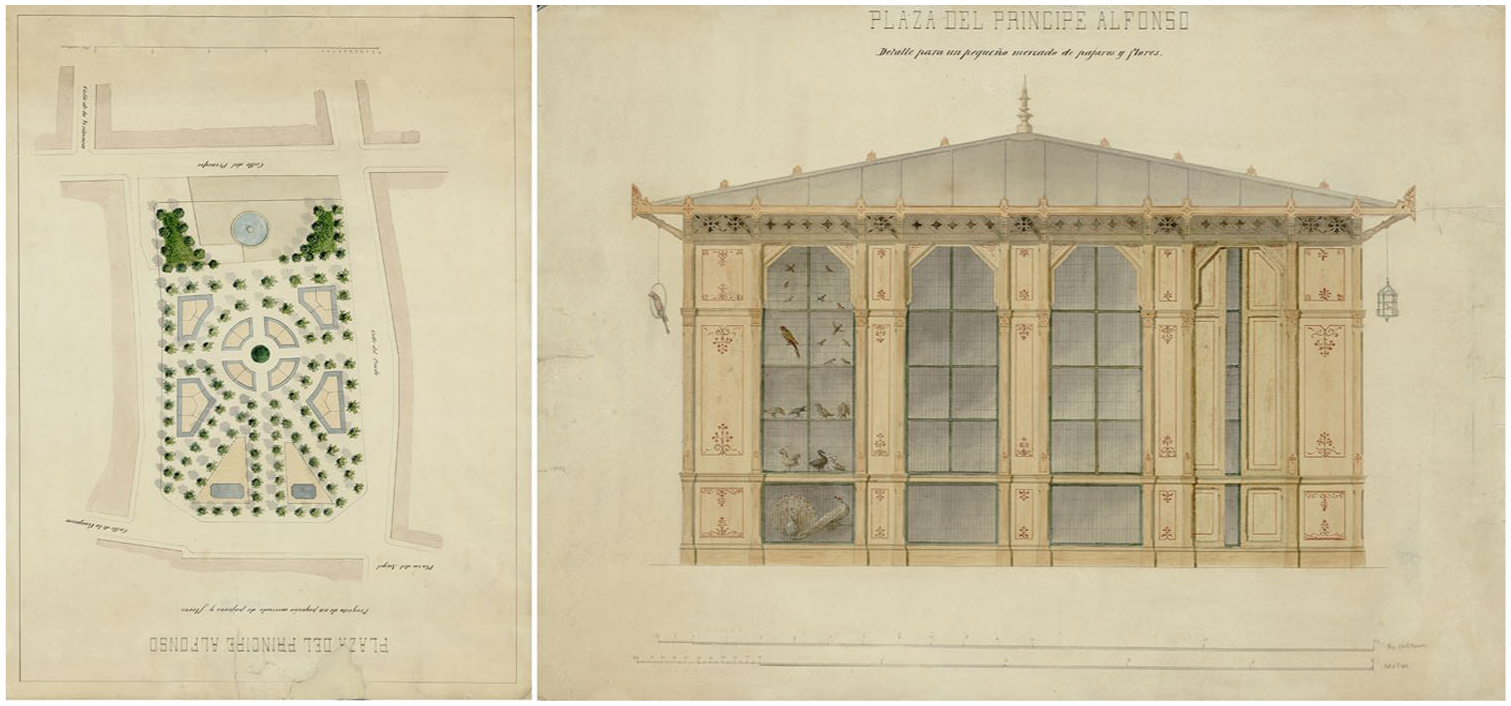
Proposal for a bird and flower market and the development of the square, ca. 1868. ©Archivo de Villa de Madrid, AVM. Secretaría. 0’59-12-12.
While the proposals for the development of the plaza were being presented, the process of expropriating the houses in the row to demolish them was underway.
52
Eulalia Ruiz Palomeque summarizes this long process, which began in 1810 with the decision to open the plaza and identify the owners of the houses, and that lasted until the 1960s: Once the demolition of the rest of block 215 was agreed upon in order to regularize the square, the City Council was authorized to enlarge it. In this state of affairs, the owner of the modern number 26 of Calle del Príncipe (old number 1, block 215) went to the City Hall, in a request dated December 10, 1861, indicating that “since the project to demolish the houses had been pending for many years, the owners could not dispose of their houses,” or else the land occupied by the firehouse would be sold to him to make a façade onto the square, or his property would be bought for 800,000 reales, at a reduced price. He was the first to go to the Town Hall, and in successive years the other owners proposed the purchase of their respective houses, thus facilitating the arrangement of the square as it is seen today.
53
After the definitive demolition of block “215,” certified on May 4, 1868, the construction of the landscaped square began. According to Carmen Ariza Muñoz, in the sixties of that century, the City Council proposed the creation of several landscaped squares in Madrid, many of them following the London style with “an irregularly shaped space, ornamented with a sculpture, benches and a kiosk and delimited by iron gates.” 54
The Plaza del Príncipe Alfonso was adapted to this model, at least in its eastern half (Figure 13). After the Revolution of 1868, it was renamed Plaza de Topete. In the project, the fountain of Silvestre Pérez disappeared from the center of the plaza and a circular fountain was placed closer to the theater. 55 A parterre would remain in the center of the plaza, where it was speculated that a statue in honor of Calderón or Lope de Vega could be placed. 56 In 1861, Mesonero Romanos had proposed moving the statue of Cervantes that stood in the Plaza de las Cortes to this plaza. 57 The idea of dedicating a statue to an illustrious figure was not new to the plaza, although in this case it focused on literary figures of national importance.
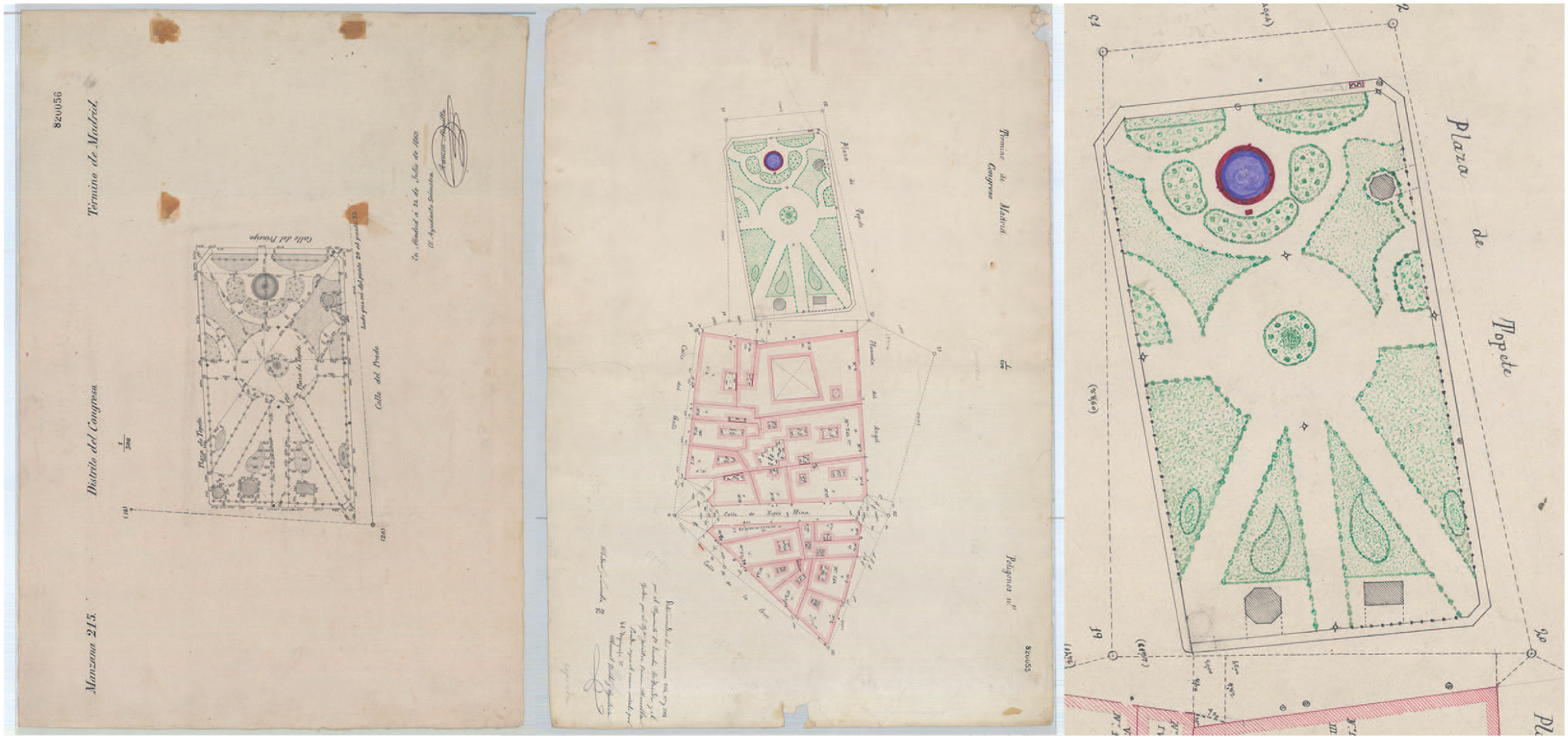
Left: «District of Madrid, district of Congreso: [polygonation and survey of block 215 corresponding to the Plaza de Topete and its landscaping]», 24 July 1869. ©Biblioteca del Instituto Geográfico Nacional CC-BY 4.0, IGN. A.T., nº. 820.056. Center and right: «District of Madrid, [district of the] Congreso: [polygonation and survey of blocks 214 -1st and 2nd blocks—and landscaping of the Plaza de Topete]», 29 November 1870. ©Instituto Geográfico Nacional, IGN. A.T., nº. 820.055.
A small sculptural group attributed to José Tomás was placed in the new fountain. It represented a swan that was being caught by a snake that came from below. The sculptural group was first located in the cloister of San Felipe el Real, then it was moved to the Fuente del Cisne de la Castellana and, finally, it was placed in the Plaza del Príncipe Alfonso. In this square, the sculptural group was placed without the rest of the elements that appear in Begué’s photograph (Figure 14), only with the sculpture and on some artificial rocks, following the styles of the time.
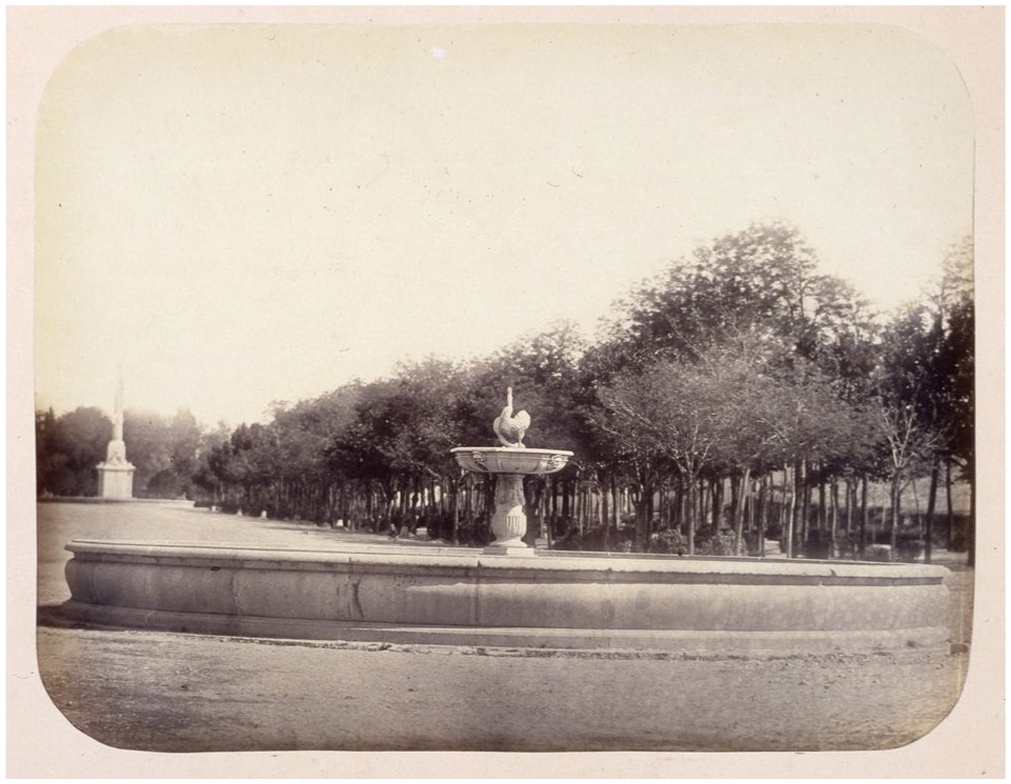
«Fountain of the Swan on the Paseo de la Castellana». Photograph by Alfonso Begué, 1864. ©Museo de Historia de Madrid, MHM. Inv. 21986-7.
Beautification of the Teatro Español
With the opening of the plaza, the idea of building the National Theater on the site of the Teatro del Príncipe was revived. To this end, the purchase of the house on the corner of Calle Prado was even considered. 58
An engraving from 1865 (Figure 15) shows the condition of the façade of the theater three years before its opening. The engraving shows the funeral cortege of the playwright Ventura de la Vega passing by the façade of the Teatro del Príncipe, as was common in the farewell tributes to deceased actors or playwrights associated with the theater. 59 In addition to his work as a playwright, in this case the relevance of the event is justified by the fact that Ventura de la Vega was the Director, known as Comisario Regio, of the first Teatro Español when the Teatro del Príncipe was nationalized in 1849. 60
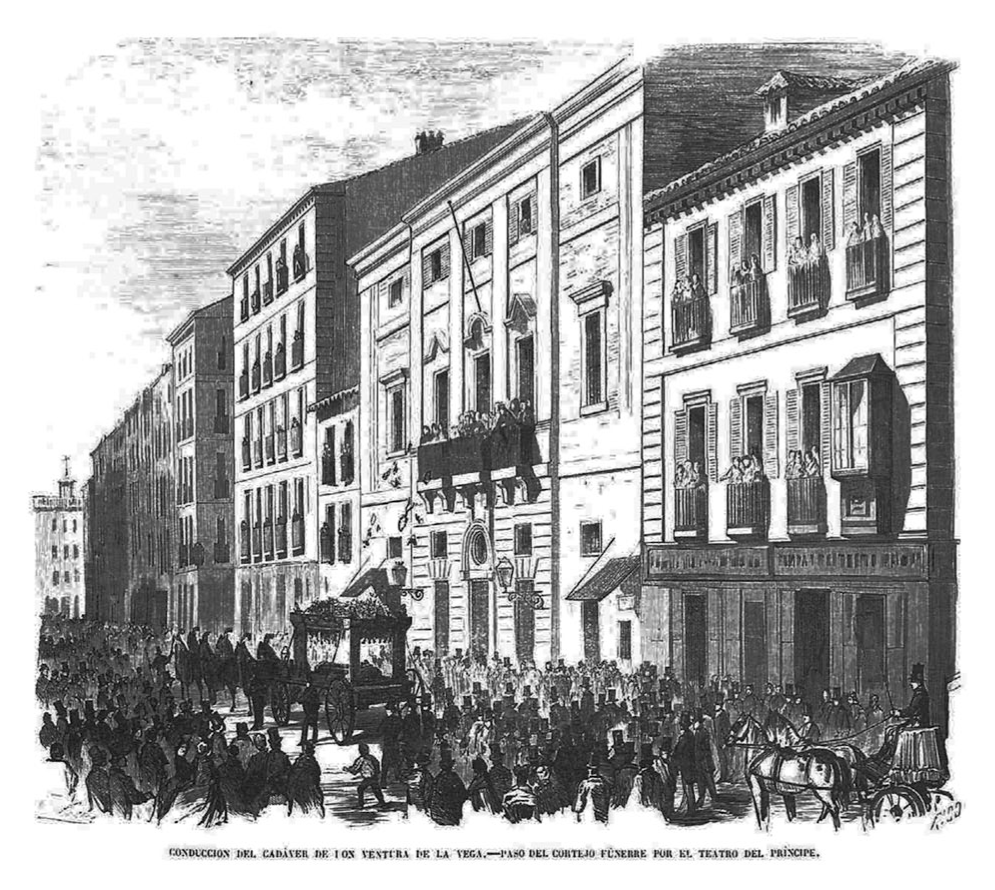
Carrying of the body of Ventura de la Vega—Passage of the funeral cortege through the Teatro del Príncipe. Published in El Museo Universal, No. 50, 10 December 1865. ©Hemeroteca Digital de la Biblioteca Nacional de España.
The opening of the square accelerated the renovation of the façade of the theater, which would be visible from the square. On July 21, it was announced that work would soon begin “on the renovation of the façade of the Teatro del Príncipe, in order to make it as worthy as possible of this central and elegant place, so much reformed at present with the demolition of the houses on the sidewalk in front and the beautiful garden formed in the small square of Príncipe Alfonso” (according to a newspaper of 1868). 61
The municipal architect Agustín Felipe Peró was in charge of the restoration project. The City Council consulted the Royal Academy of Fine Arts of San Fernando, which sent the design of the façade, as well as a graphic description of the state it was in before the intervention.
We can only imagine the project presented by Peró, although we have more information about the final execution. Work began in September, but had to stop briefly due to the Gloriosa, a revolution that took place that same month. They resumed in October, and unforeseen consolidation work had to be carried out, which led to an increase in the agreed budget. The works were finally completed on June 21, 1869.
We can assume that the result resembled that in the photograph by Laurent y Cía (ca. 1870; Figure 16). The façade retained the previous composition, although it was enriched with decorative elements, including a pediment and medallions dedicated to the playwrights Lope de Rueda, Lope de Vega, Calderón de la Barca, Tirso de Molina, and Ruiz de Alarcón.
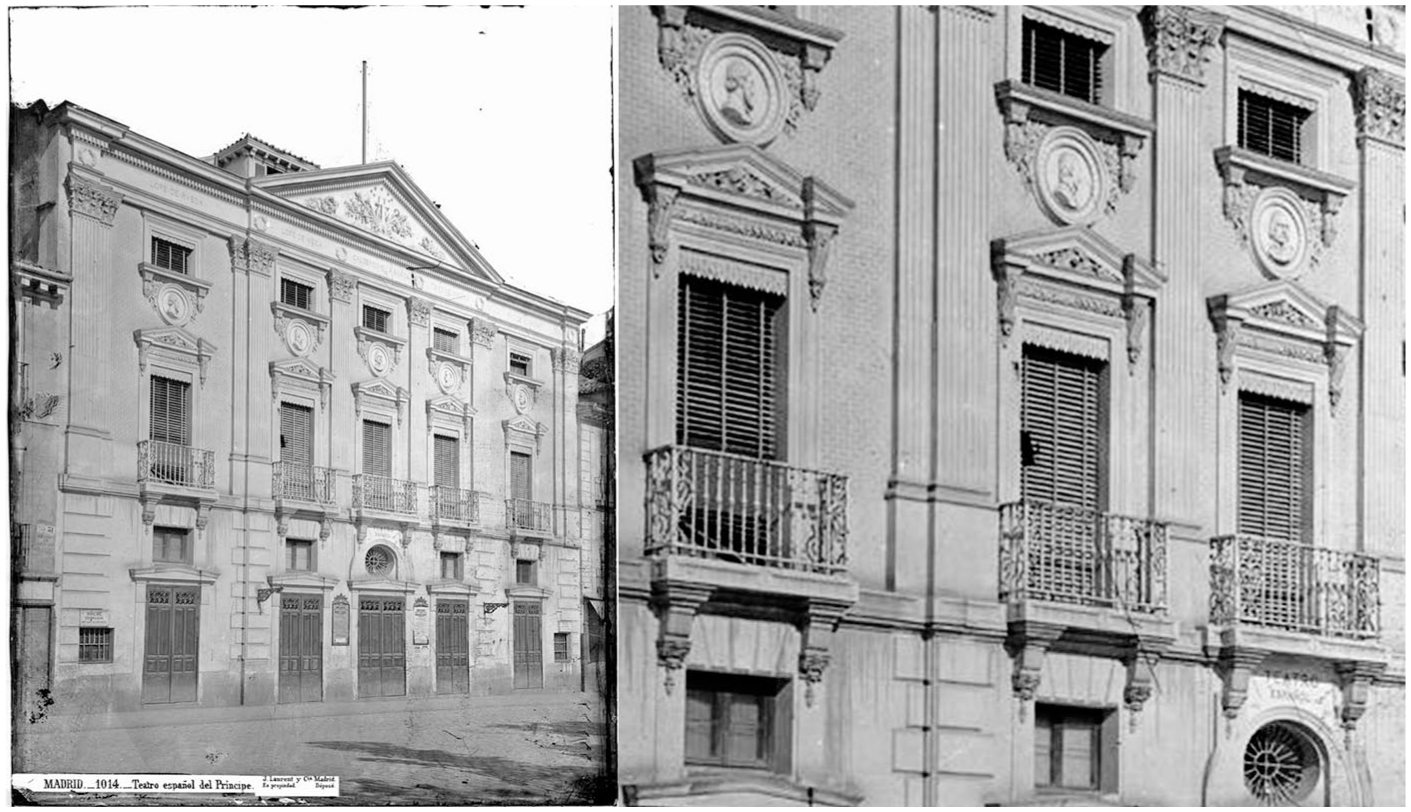
“The Spanish Theatre, or the Prince’s Theatre.” Laurent y Cía, ca. 1870. ©Instituto del Patrimonio Cultural de España, IPCE, MCD. FPH Archivo RUIZ VERNACCI—VN-07030.
The façade of the Teatro del Príncipe, renamed Teatro Español, as shown in the photograph, acquired practically the same appearance, dimensions, and arrangement of the openings, orders, and ornaments that it has today. It is even possible to observe the new plaque placed over the main entrance. 62 The analysis of the picture also reveals other interesting elements, such as the openings in the lower body of the ends and the panels between the pilasters of the upper body. These elements appear to exhibit characteristics of masonry, though probably fake. 63 To complete the restoration of the façade, two iron frames have been installed to place posters. As for the roofs, it can be seen that the volume of the opening protruding from the pediment, as seen in the 1830 model, has been preserved (Figure 16).
In 1869, after almost sixty years, the construction of the square, then called Topete, was finally completed, a significant milestone for the city. This square became an emblematic space, a prelude to the theater with which it was linked from the beginning. The design of the plaza included a garden, a true oasis that was transformed into a place of relaxation and recreation that also served as a visual filter for the new facade of the Teatro Español (Figure 17). The presence of the trees softened the transition between the two spaces, which also physically provided a larger space in front of the theater, a place to relieve the hustle and bustle. The plaza became an ideal box from which to view the theater and where the spectators could be sheltered on performance days.
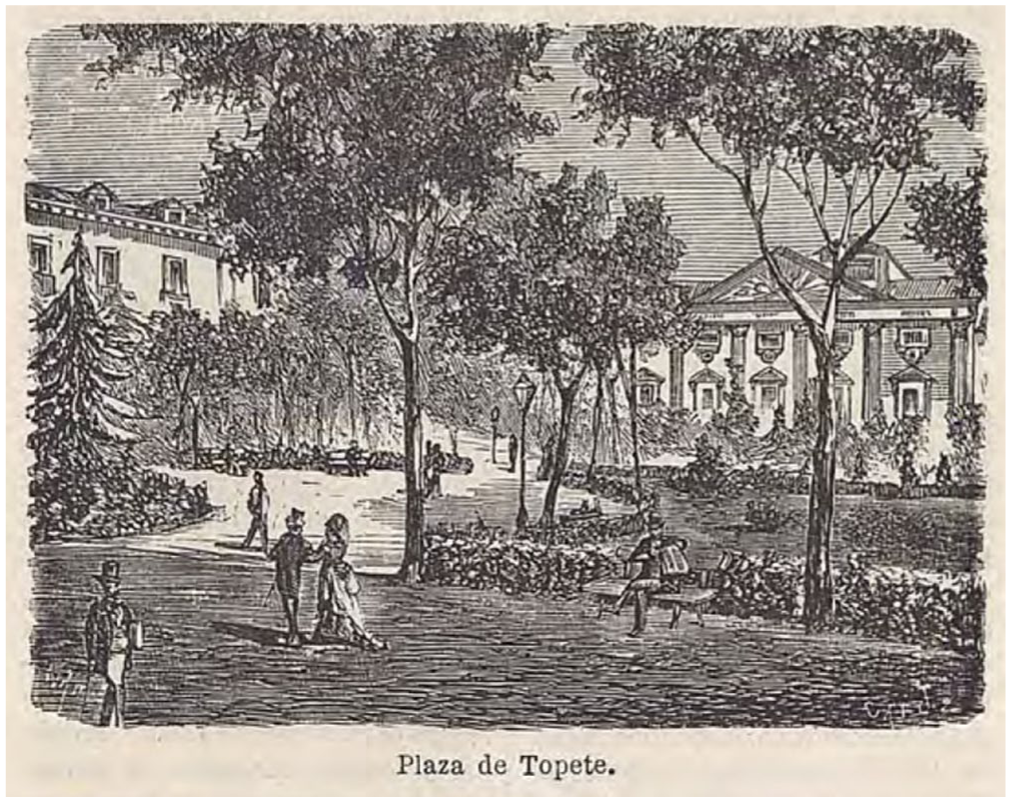
«Plaza de Topete». Engraving included in Guía de Madrid: manual del madrileño y del forastero. Fernández de los Ríos, 1876. ©Biblioteca Nacional de España, BNE. GMM/2162.
Intentional Memorial Value: The Calderón Statue
Before continuing with the process of morphological changes of the plaza, we must relate some changes that the square had undergone since the reform of the façade of the theater. First, the historical vicissitudes of the center of the square, where the fountain of Silvestre Pérez was located.
The plaza was increasingly imbued with devotion to national literary figures. In this context, the theater proudly displayed its five medallions dedicated to playwrights. We recall that, during the opening process, the names of Pedro Calderón de la Barca and Lope de Vega were mentioned as candidates to be immortalized in a statue in the plaza. In 1874, the remains of Calderón de la Barca were transferred from the Church of San Francisco to the Sacramental of San Nicolás and, as a tribute to the poet, the City Council agreed that the procession would pass by the façade of the Teatro Español. 64
In 1877, Juan Figueras, a sculptor on scholarship at the Academy of Rome, completed a marble statue of Calderón de la Barca. 65 After it was successfully exhibited at the 1877 Rome Exposition, 66 Figueras offered to donate the statue free of charge. Such offers were common among pensioners in Rome. In 1867, for example, the sculptor Eugenio Duque exhibited a life-size plaster statue of Calderón de la Barca made during his stay at Rome at the Exposition of Fine Arts. On that occasion, Duque asked the City Council to purchase the statue to place it where they considered appropriate in memory of the poet, but in the reports made for its valuation it was decided not to purchase it.
Unlike the statue of Duque, the statue of Figueras was made of marble, one of the options available to pensioners in Rome. Carlos Reyero points this out: The sculptors on pension at the recently created Spanish Academy in Rome expected the City of Madrid (and no other) to acquire the work done during the last year of their pension, since the plaster was always considered a minor or subsidiary work of the final piece (although, on the contrary, it should be considered, if we are strict, as the truly original one, since it was the one done directly by the artist). In fact, according to the current regulations, these sculptors had two possibilities to fulfill their obligations: either to dedicate themselves to carving a single piece in marble during the years of their pension, or to make a sketch during the third year and the definitive work, in plaster, in the fourth (similar to the history painters). Almost all of them chose this possibility, which meant relying on the casting of the piece by a specialized house.
67
As a condition for handing over the sculpture, Figueras demanded that the City Council pay for the projected pedestal that appeared in the photographs he sent (Figure 18) and that it be placed in a public place in Madrid. The City Council considered the Plaza del Príncipe Alfonso to be the ideal place for the statue. However, several years passed between the proposal and the event. It is better to follow a chronological route to relate them.
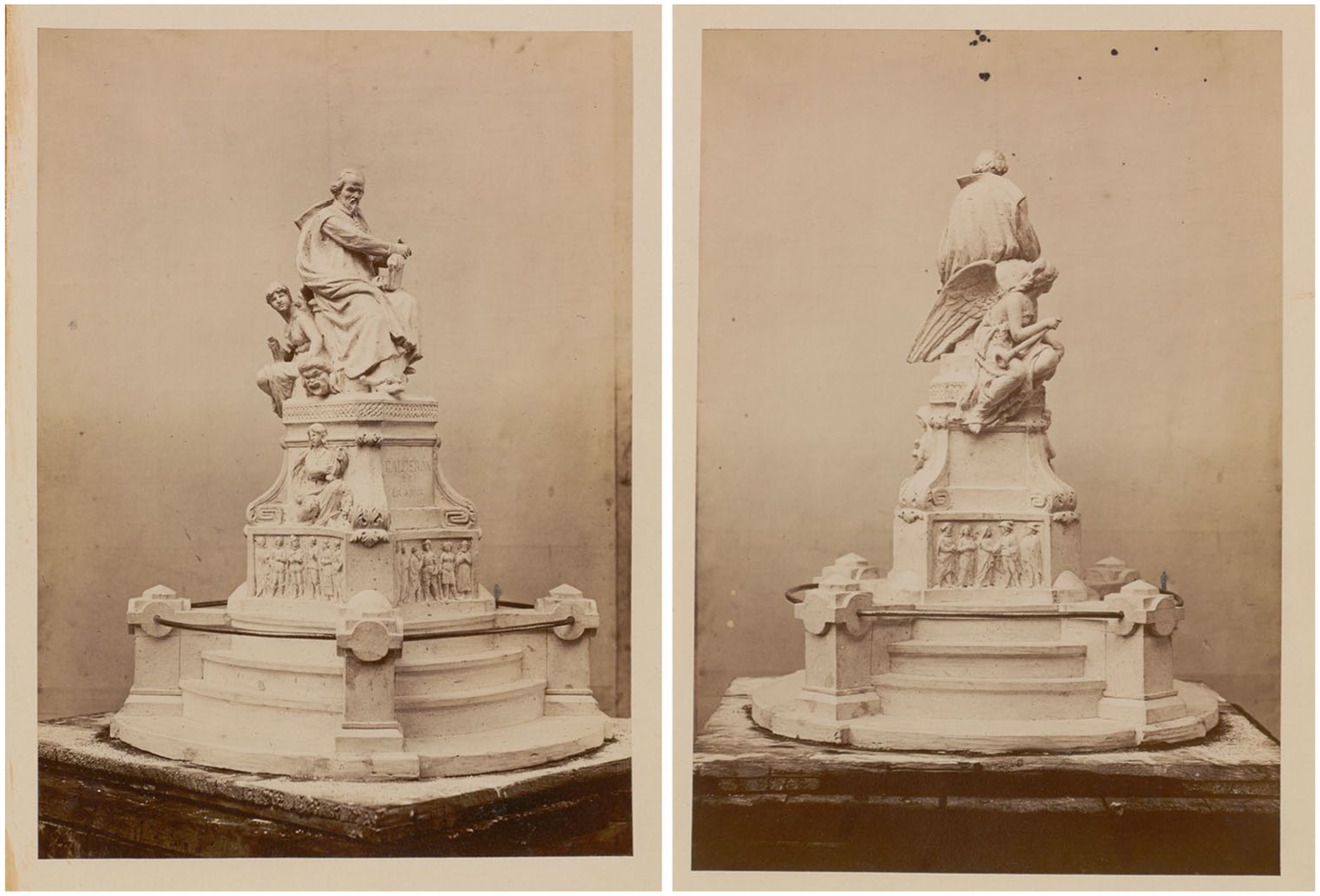
Photographs of the model of the statue of Calderón de la Barca and pedestal. Juan Figueras, ca. 1877. ©Archivo de Villa de Madrid, AVM. Secretaría. 5-493-41.
On January 8, 1877, Figueras’s request was approved by the Commission of Works. A few days later, a telegram from His Majesty’s Minister Plenipotentiary in Rome informed Figueras that the statue would be finished by the end of May. On the same day, the Finance Commission approved the budget for the construction of the pedestal, including the foundation and transportation costs, and it was expected that the statue could be unveiled on May 25, the anniversary of Calderón’s death.
In March 1877, Figueras still had not received approval of the budget and had to wait another month for the City Council to release half of the budget so that he could buy the marble for the pedestal. When May arrived, the sculptor set himself a deadline of eight months to deliver the sculpture and the pedestal.
In August 1878, the pedestal was finished, and Figueras asked what inscription should be on it. The answer came from the Academy of History in February 1879: “On the obverse: Calderón de la Barca. And on the reverse: Life is a dream. But not your glory”: The pedestal seems to me superior to the statue because of the well thought out and executed reliefs. The marble ones on the upper part represent comedy and tragedy and on the other two fronts appear the name of Calderón de la Barca and the inscription approved by the Academy of History “Life is a dream. But not your glory.” As this inscription does not fit on a single line, Mr. Figueras has limited himself to making the letters in the same metal of the bas-reliefs to place them in Madrid in the way he thinks appropriate, the artist having to arrive before his statue. The larger bas-reliefs represent in silver metal Calderón’s productions La vida es sueño, El alcalde de Zalamea, El escondido y la tapada and one of his most famous autos sacramentales.
68
In April, the sculpture and the pedestal were shipped in twenty-one crates to the port of Alicante. From there, they would be transported by train to the capital.
In June, orders were given to raise the existing pylon in the Plaza del Príncipe Alfonso to make room for the sculpture’s foundation. Academic advice was also sought. The Royal Academy of Fine Arts of San Fernando requested drawings and photographs of the plans for the sculpture and its base, as well as a topographical plan of the square, in order to determine the best position for its placement in the square. Thanks to these plans (Figure 19), dated in October 1879, we have a precise graphic definition of the plaza at that time. The plan does not show the pylon, but there is a small one in its place. There is also no fountain shown in the eastern part of the plaza, although the existing roundabout is indicated.
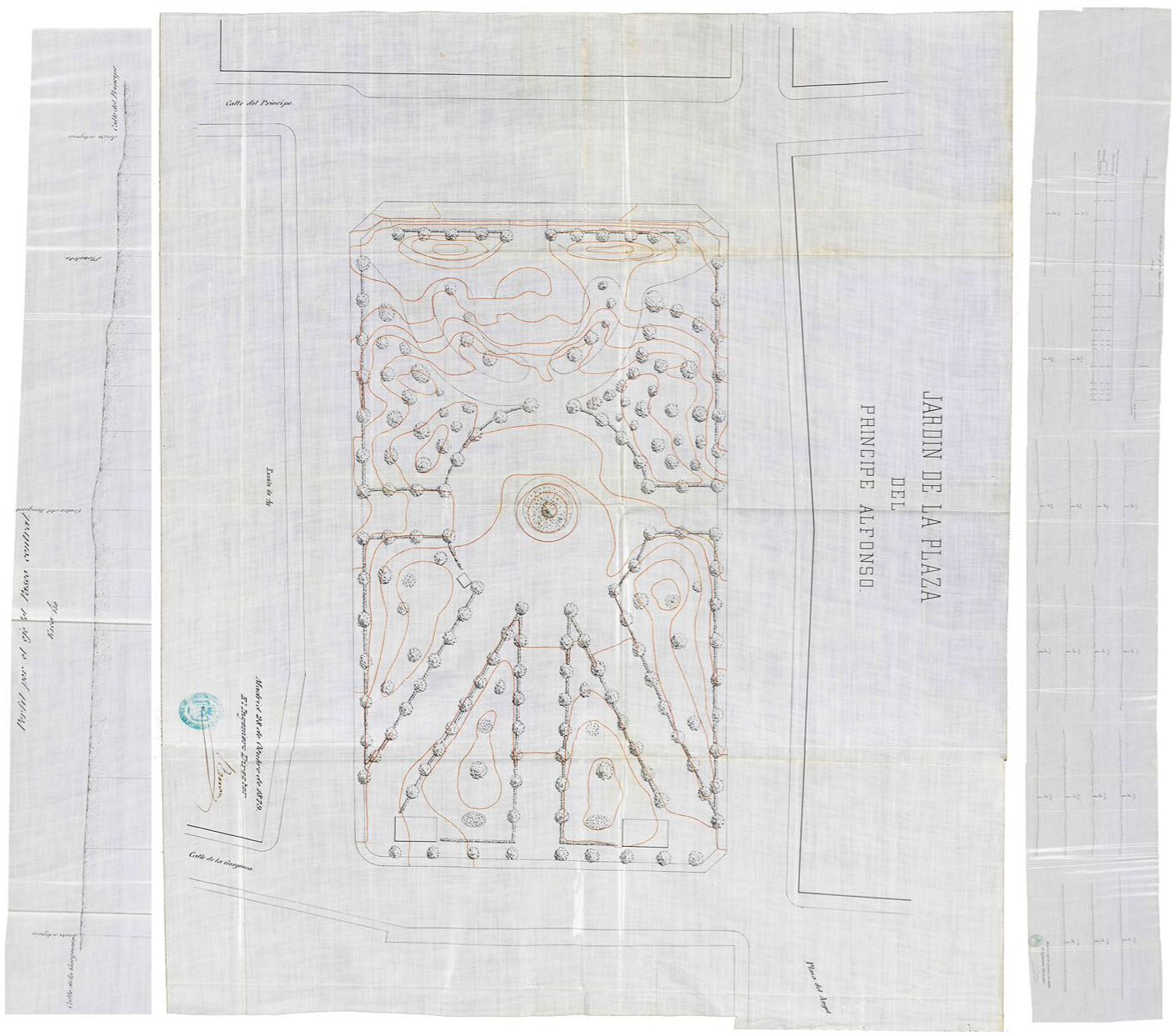
Gardens of the Plaza del Príncipe Alfonso. Longitudinal section, ground plan and systematic sections. 28 October 1879. ©Archivo de Villa de Madrid, AVM. Secretaría. 5-493-41.
With these plans, the Royal Academy of Fine Arts of San Fernando was again consulted to determine the position of the statue. In its opinion, the Academy did not hesitate to point out that the most appropriate location for the statue would be in the center of the plaza, in front of the Teatro Español. In addition, they suggested that it would be convenient to widen the access to the garden in front of the statue, make some modifications to the lighting, and replace the small pond that existed previously, surrounded by bushes and flowers to make it more picturesque.
The necessary preparations were made for the installation of the sculpture, such as the placement of awnings to protect it, following the instructions of the architect José Urioste. According to the news of the time the statue, with its three components, circular steps between four pilasters, pedestal, and statue, was already in place at the beginning of December. 69 Finally, the inauguration took place on January 2, 1880 (Figures 20 and 21), with the statue in the center of the square and facing the theater.
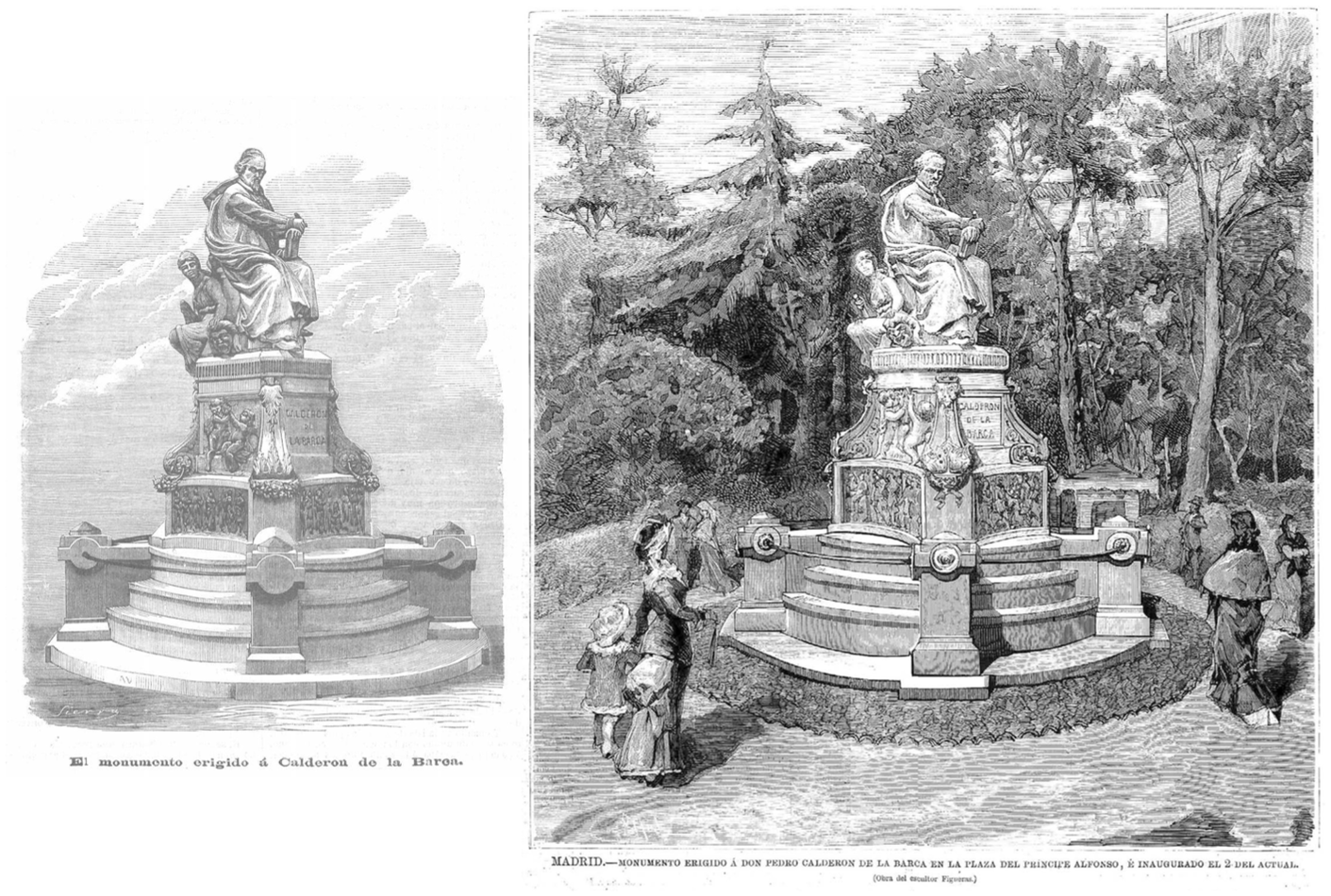
Left: “The monument erected to Calderon de la Barca,” Nuestro grabado, 1880. ©Hemeroteca Digital de la Biblioteca Nacional de España. Right: “Madrid: Monument erected to Don Pedro Calderon de la Barca in the Plaza del Príncipe Alfonso, and inaugurated on the 2nd of the present day (work of the sculptor Figueras),” Monumento Erigido, 1880. ©Hemeroteca Digital de la Biblioteca Nacional de España.
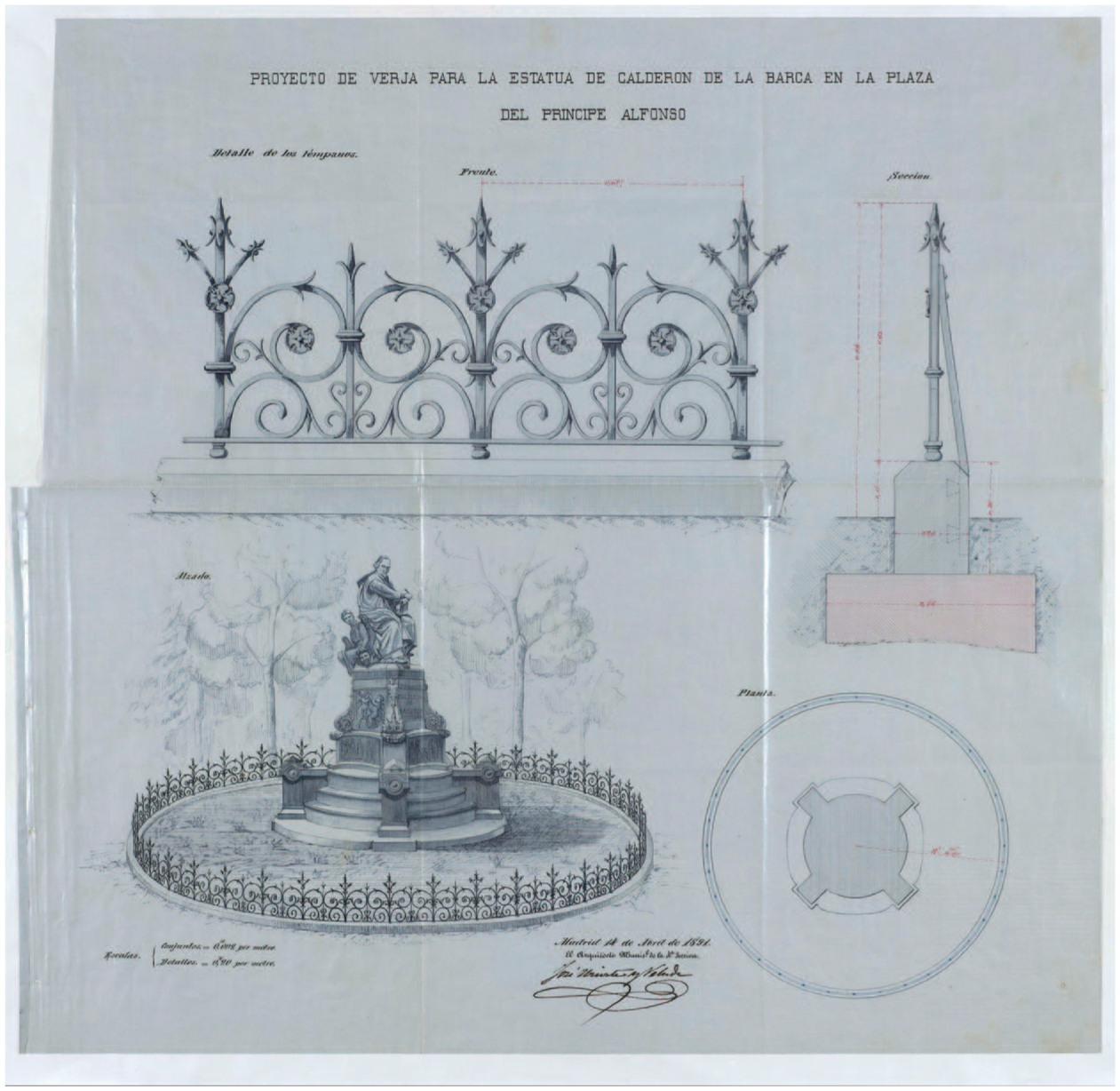
Project for a fence for the statue of Calderón de la Barca in Príncipe Alfonso Square. José Urioste, 1891. ©Archivo de Villa de Madrid, AVM. Secretaría. 9-168-22.
Overlaps and Proposals
In the following years, the interior design of the square was largely maintained, although there were notable changes in its surroundings and appearance, as well as some unimplemented proposals that we will briefly mention. It included part of the garden from the time of José I and part resulting from the enlargement desired in 1869. The main sculptural elements were the statue of Calderón and the Swan fountain.
In the relationship between the theater and the square, the attempts to create a National Theater continued. In 1881, a project was presented to the City Council for a free-standing theater to be placed in the center of the square, occupying its entire surface, and proposing the demolition of the block of the Teatro Español to create a plaza in front of the main façade facing east. The project was signed by Manuel Foronda and Manuel Aníbal Álvarez, but was finally rejected. 70
In 1891, the idea of surrounding the statue of Calderón with an iron fence was proposed. The municipal architect José Urioste, who was in charge of the design, mentioned in internal communications with the City Hall that this possibility had already been considered when the statue was installed in 1879. However, the sculptor, Juan Figueras, preferred not to place the statue so as not to diminish the height of the pedestal, and instead surrounded it with a strip of vegetation. Although Urioste thought that a low fence would not prevent vandalism, he provided the designs that we can consult today (Figure 22). 71
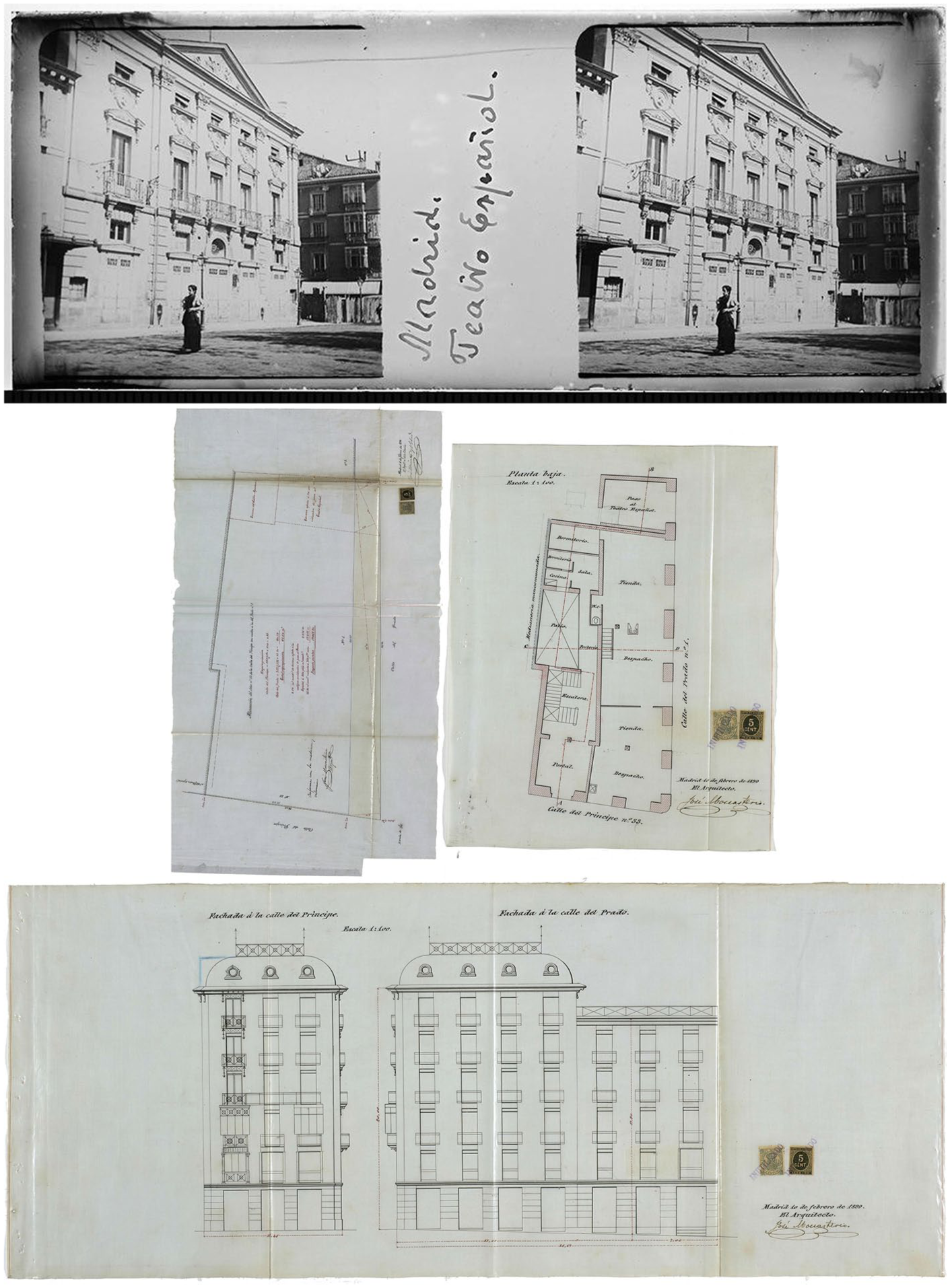
Top: Photograph of Augusto T. Arcimis, ca. 1899. ©Instituto del Patrimonio Cultural de España, IPCE, MCD. Archivo Arcimis. ARC-0402. Bottom: Alignment project, José Urioste, 1899, and building project for plot no. 1 in Calle del Prado with a turn to Calle del Príncipe, José Monasterio, 1899. ©Archivo de Villa de Madrid, AVM. Secretaría. 13-7-3.
The block where the Teatro Español was located continued to undergo changes in its façade facing the plaza. In 1894, José Urioste 72 drew attention to the poor condition of houses 1 and 3 on Calle del Prado, which shared a wall with the Teatro Español. That same year, number 3 was demolished, and number 1 in 1898. In a photograph by Augusto T. Arcimis, the Teatro Español can be seen without its neighboring building (Figure 22, above), which made it possible to set back the volume on the calle del Prado side, using the alignment projected in 1859 as a guide (Figure 9, third from top). The new buildings would therefore shorten the façade of the block facing the plaza (Figure 22, plans).
At the beginning of the twentieth century, commercial buildings such as the Cervecería Alemana (German Brewery) appeared at number 7 of the plaza—it still remains there today—and gas lighting was replaced by incandescent lighting both in the plaza and in the streets of del Príncipe (Figure 23) and del Prado. Some of the newly constructed or renovated buildings exceeded the height of the Teatro Español, although the typological characteristics of their design, with equal and equidistant rhythms of openings on all levels and modest façades, did not overshadow the importance of the theater. All this would change in 1916 with the arrival of the Simeón Building.
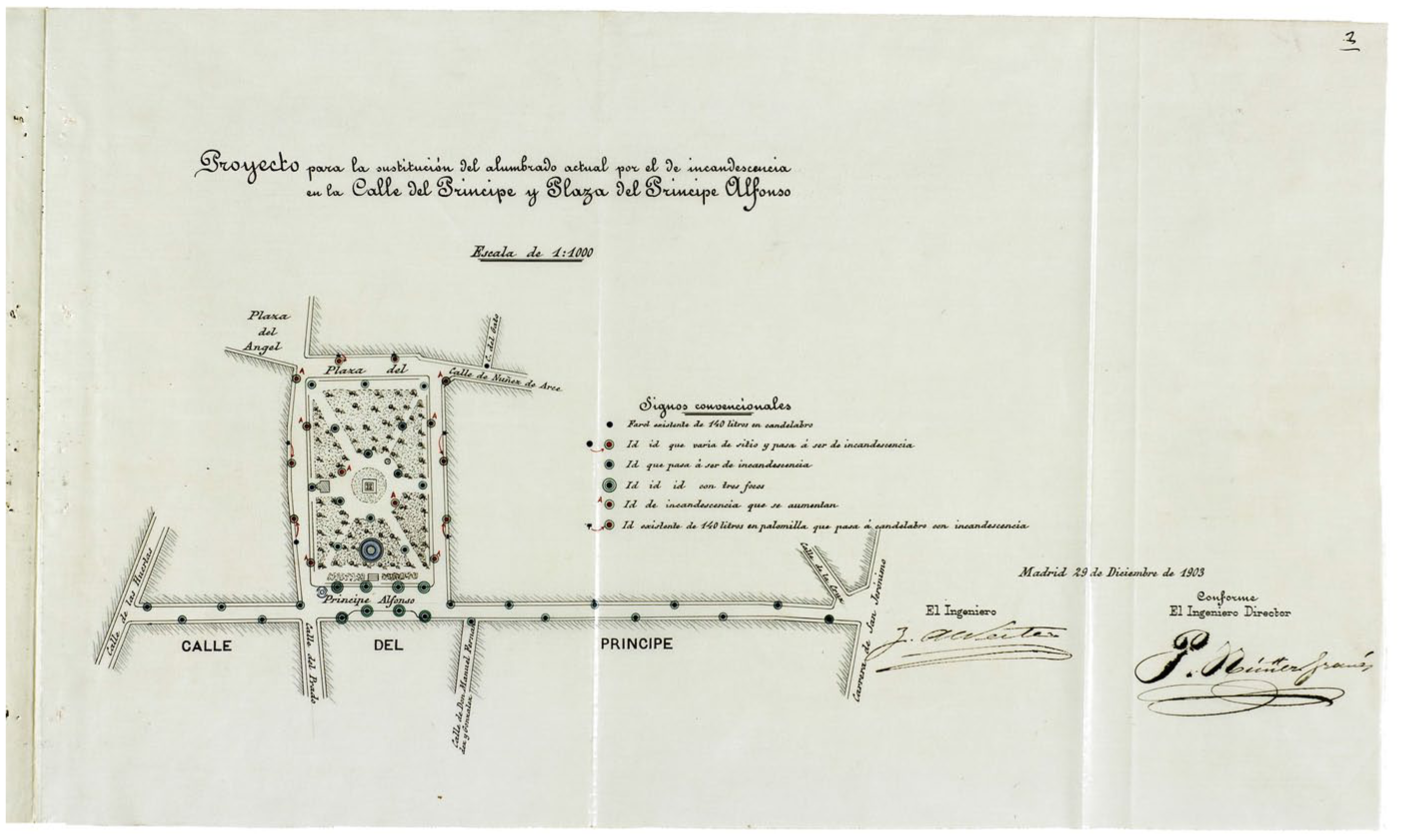
“Project for the replacement of the lighting system . . .,” 29 December 1903. ©Archivo de Villa de Madrid.
The Simeón Building, designed by the architect Jesús Carrasco-Muñoz Encina, was built on the site of the Palace of the Counts of Montijo y Teba, fulfilling the desired alignment of this sector of the plaza. The original project of 1916 proposed a façade composed of modules of belvederes marked by columns and a series of towers at the top (Figure 24, left). During a long construction process, the building underwent some project modifications that partially simplified the proposal without losing its eclectic character. According to the article “Eclecticismo y modernidad en la arquitectura madrileña de principios del siglo XX: el Hotel Reina Victoria-Almacenes Simeón (1916-1923),” 73 the most outstanding element of the finished building was the corner tower, which combined Modernist influences with links to Futurist kineticism and Art Deco technological aesthetics. The tower served as a transition point between the two plazas and acted as a visual beacon.
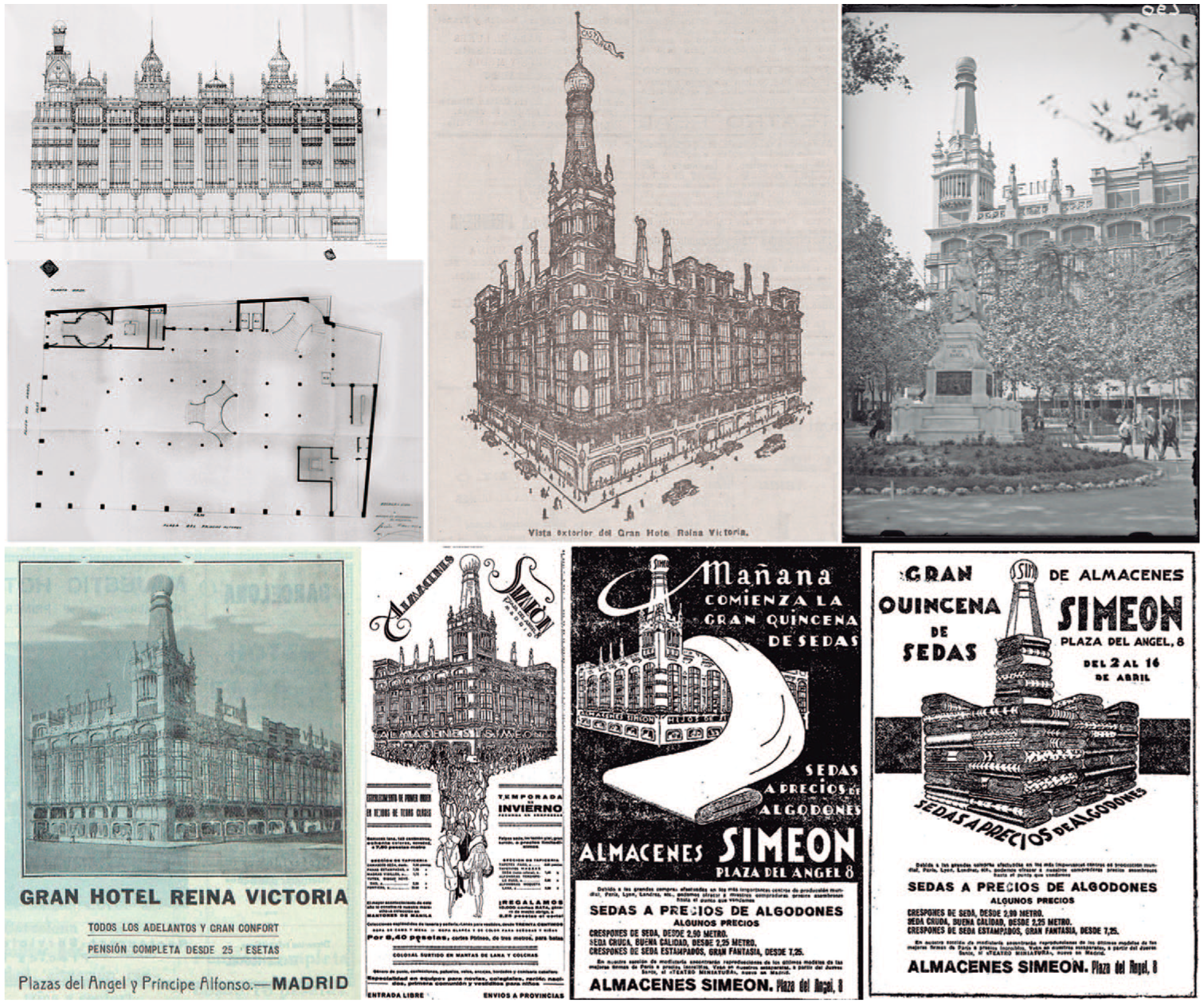
Left: Plan and elevation of the Reina Victoria-Almacenes Simeón Hotel project. ©Archivo de Villa de Madrid, AVM. Secretaría. 27-491-26. Center: Outside view of the Gran Hotel Reina Victoria, 31 March 1923. ©Hemeroteca Digital de la Biblioteca Nacional de España. RIGHT: “Plaza de Santa Ana and monument to Calderón de la Barca.” António Passaporte, ca. 1927-1936. ©Instituto del Patrimonio Cultural de España, IPCE, MCD. Archivo LOTY-00716. Bottom, from left to right: Advertisement in La revista de viajes; Advertisement in La Libertad; Advertisement in La Libertad; Advertisement in La Libertad. ©Hemeroteca Digital de la Biblioteca Nacional de España.
Inside the building were the Gran Hotel Reina Victoria and the Almacenes Simeón (Figure 24, below), accessed from the Plaza del Ángel. In relation to the Plaza de Santa Ana, still Príncipe Alfonso, its large white, glazed façade provided a new modern backdrop that stood out against the surrounding garden (Figure 24, center and right). The modern city had arrived to the plaza.
While renovations were underway on that side of the plaza, architect Pablo Aranda was immersed in his own project to transform the Teatro Español. In 1917, he presented the idea of building a new façade using the Oñate façade, a Baroque façade that he wanted to relocate after saving it from the demolition of the Oñate Palace. 74 However, Aranda’s truly significant reforms were realized in the 1925 project. This project included the demolition of the Casa de la Contaduría of the Teatro Español, the café building, for its subsequent reconstruction. The new façade of the house maintained the aesthetics dictated by the historic façade, both with the continued stone base and a set-back upper body that included a terrace. The set-back façade had a curved pediment in the opening of the main floor, which differed from the design by architect Agustín F. Peró in 1868. The façade of the historic building maintained its protagonist composition, framing the setback of the extension with pilasters that multiplied both in their encounter with the historic façade and with the neighboring building (Figure 25). The proposal for the extension of the Teatro Español appeared with historicist forms, facing those of the new Simeón Building on the opposite side of the plaza.
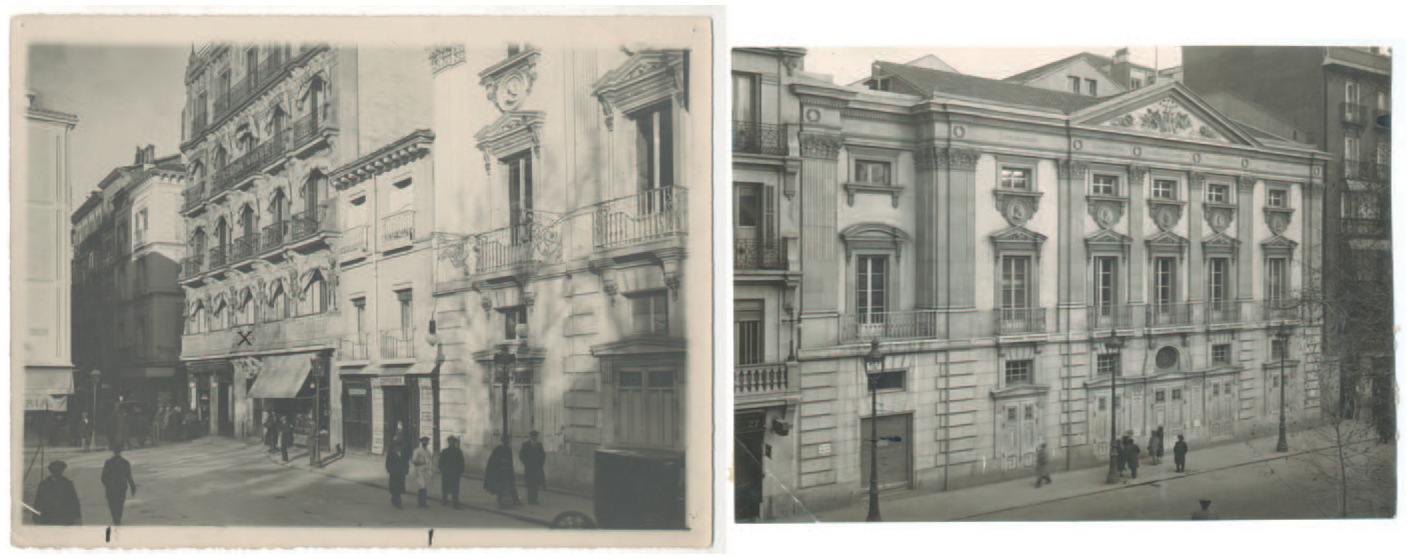
Left: “Society of Authors. Teatro Español.” Photograph by Salazar, ca. 1920. ©España. Ministerio de Cultura. Archivo General de la Administración, AGA. F/02010 048. Caja 905. FN33. Right: Façade of the Teatro Español. Photograph by Cortés, ca. 1930. ©Archivo General de la Administración, AGA. F/02010. 048. Caja 905. FN34.
First Unitary Garden Planning Project
The buildings surrounding the square, as we have seen, also underwent changes, being modified with the superimposition of new levels or even demolished to make way for new constructions that adapted to the limitations of the plot, creating a fragmented common façade. This evolution continued until the arrival of the imposing Simeón Building, which marked a turning point in the area’s transformation.
After the first quarter of a century, the dynamics of the layout of the plaza itself changed. In 1943, it was decided to completely reorganize the square. 75 A unified project had not been achieved despite some attempts, such as the primitive layout, which proposed an arrangement that would continue the straight tree-lined paths, or the irregular layout project by Lucas de Tornos. For the first time, the idea of redesigning the garden as a whole, in this case with a garden more in keeping with the times, was taken forward.
Traffic was a constant challenge in the area due to the influx of spectators on performance days, especially since the inauguration of the neighboring Teatro de la Comedia, located on the first stretch of Calle del Príncipe. First, horse-drawn carriages, and in 1943, automobiles. Technicians looked for solutions to improve circulation and ensure comfort. In this case, car circulation was added around the entire perimeter and parking spaces.
The mention of the theater in the project report evokes the value that this building had in the life of the square. The trees formed rows that surrounded it, but at the same time opened in front of it. Similarly, in the project, the lower gardens opened to the theater, and the slope of the land helped to orient the space.
[. . .] The gardens, with a simple layout, and a traditional Spanish concept, are arranged through cut-out massifs that serve as a framework for the statue of Calderón de la Barca, whose transfer is proposed by moving it away from the Teatro Español and placing it on the axis of the central area of massifs, flanked by two circular fountains with a simple layout.
76
The details of the construction of the plaza revealed some of the planning. The curbs, steps, benches, and fountains were made of stone. The lighting was designed in a simple way, trying to ensure that the plaza was dimly lit while increasing the intensity on the sidewalks.
After the project was approved and the auction details were finalized, construction of the plaza began. Architect Manuel Herrero Palacios supervised the work. As expected with a project of this magnitude, there were price discrepancies and unforeseen additional work, such as demolishing old foundations found in the plaza and constructing circular walls for tree pits. These walls were not initially planned to be maintained.
The notable differences between the previous plaza and the project (Figure 26) reveal some important changes. First, the new plaza no longer had the labyrinthine character of the previous layout. In addition, the arrangement of the trees on the perimeter changed the visual filtering function that the previous trees had. The circular stands of the Calderón statue were also replaced, giving way to a configuration that made it more accessible from the plaza itself, with square steps. The design shows large trees in the central band, a railing on the side of the theater with pedestals and vases, and the areas intended for cars were transformed into sidewalks. In short, the Plaza de Santa Ana, reached after a long process of almost half a century, ceased to exist as such.
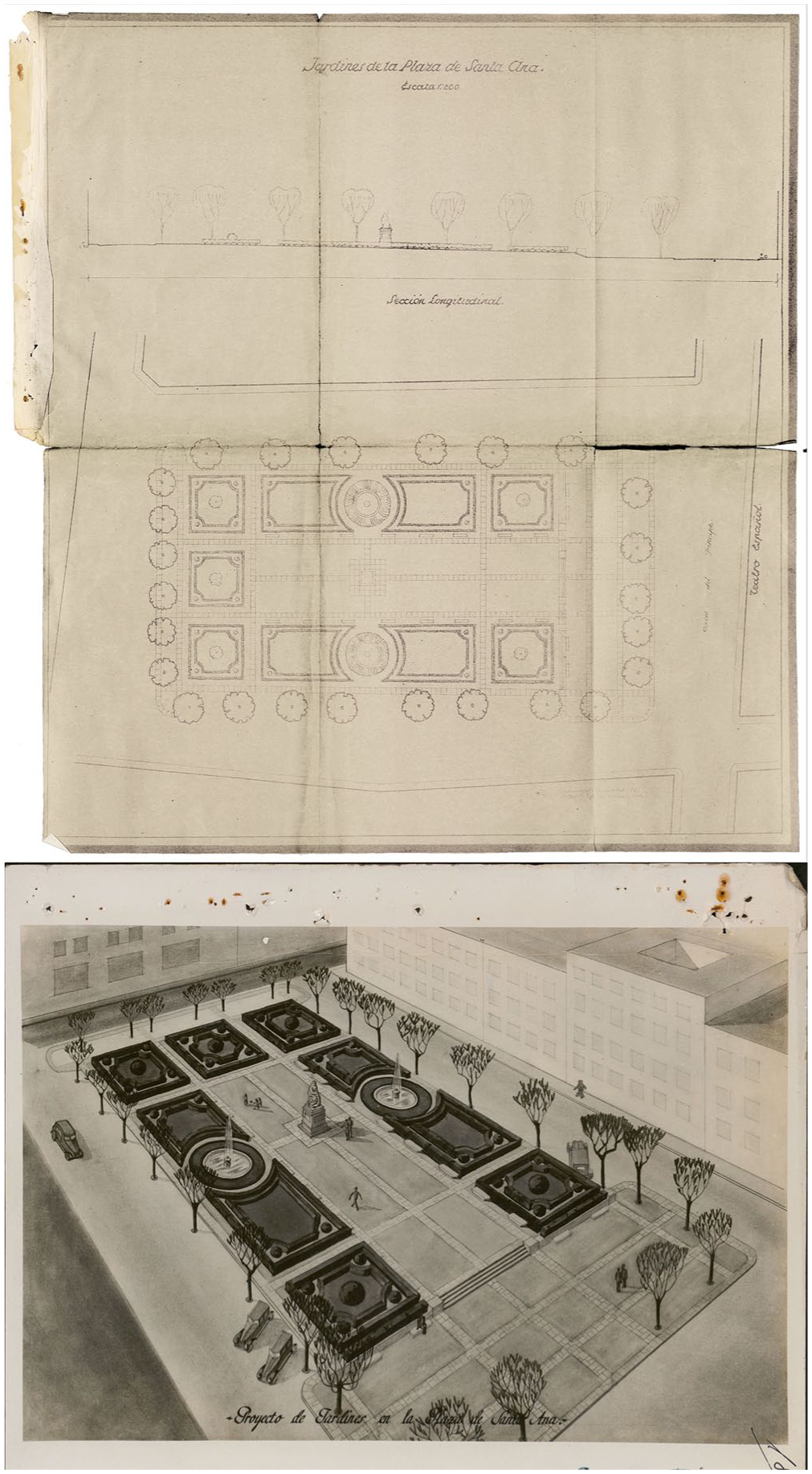
Garden redevelopment project. Manuel Muñoz, 1943. ©Archivo de Villa de Madrid, AVM. Secretaría. 62-480-9.
Conclusions
The history of the formation of the square reflects changes in the city model. These changes are intertwined with the search for a large space in front of the theater, the formal responses of the façades of its perimeter, and the different ideas about how to organize the floor. In the period studied, different conceptions of public space coexist, with the theater exerting a constant influence.
The theater’s impact was evident from its inception and especially throughout the nineteenth century. In 1810, the Minister of the Interior sought to determine the benefits of providing a spacious venue to alleviate congestion at the Teatro del Príncipe. Although the opening could not be completed in its entirety, in the following decades, the intention to provide relief to the theater would persist, with the aim of symbolically extolling it. In the context of the demolition of the row of houses, Mesonero’s proposal from approximately 1850 encompassed not only the establishment of a smaller square in front of the theater, but also the augmentation of its volume on the façade.
In the landscaping project designed by Lucas de Tornos, with alignment proposed by the architect Agustín F. Peró, a greater separation was established between the theater and the drawn garden oasis. This separation was reiterated in the 1865 project and in the plaza that was ultimately constructed following the demolition of the residential buildings. The new swan fountain was situated on the axis that connected the geometric center of the urban void with the entrance to the theater, thereby reorienting the garden at this end. The most notable aspect of the formalization of the square was the reformulation of the façade’s ornamentation, which transformed it into a prominent perspective backdrop for the square, evoking clear scenographic associations.
Since the inauguration of the square, the Teatro Español maintained its prominence, even despite the construction of the imposing Simeón Building, which rather functioned as the public’s back, including that of the Calderón statue. This was further reinforced by the subtle slope of the square, which directed the fall of the terrain toward the theater. Despite the expansion of the building in 1929, which altered the compositional balance of the theater’s historic façade, its prominence in the location remained undiminished. This is corroborated by the final project discussed in our narrative, that of 1943, in which the theater is repeatedly referenced in both the conceptualization and the formal proposal of the drawings, although with uneven results due to the proposed arrangement.
From its origins, the square included a garden design that gave it an intimate atmosphere despite its large dimensions and the activity of the small markets that occupied it. The trees spread across the surface provided shade and functioned as a visual filter that allowed a partial but constant glimpse of the theater. The plaza became an ideal box to protect the audience on performance days. However, the 1943 project modified the foundations of the previous plaza, with lower gardens and trees placed on the sides that, rather than providing shelter, marked the boundaries of the plaza. The statue of Calderón, originally treated as a garden element on a circular step in a flowerbed, was now placed on hard, easily accessible pavement. In short, the square was transformed into a new model, probably more in keeping with the times of the first Franco regime.
The link between the square and the theatrical activity of the place was represented by the Teatro Español, Madrid’s historic theater par excellence. At the end of the nineteenth century, this connection was reinforced with the decision to include artistic representations of literary figures in the square, such as the sculpture of Calderón de la Barca, or with the installation in 1869 of the medallions on the façade of the theater. The link between the place and theatrical activity is repeated in the idea of building a new National Theater in this space, mentioned in 1862 and planned in 1881, although the existing theater was considered to be demolished.
Throughout the twentieth century, the square underwent new interventions. In 1968, an underground parking lot was built and rearranged, and the statue of Calderón was moved to the background. Another notable intervention took place in 1991, under the direction of the architect Andrés Oñoro, 77 who also modified the appearance of the Teatro Español with an extension in 1995. In 1996, another statue of a playwright appeared in the plaza, this time a representative of the dramatic literature of the twentieth century: the statue of Federico García Lorca by Julio López Hernández, created in 1986, was placed in front of the theater.
This article contributes to the existing body of knowledge concerning the formalization of the plaza and its evolutionary process. Despite the radical transformations undergone by the site, the memory of this place acts as a superposition of strata that coexist in the definition of its forms (Figures 27 and 28). Since its inception, the theater has functioned as the primary and enduring protagonist of the performance in this square.
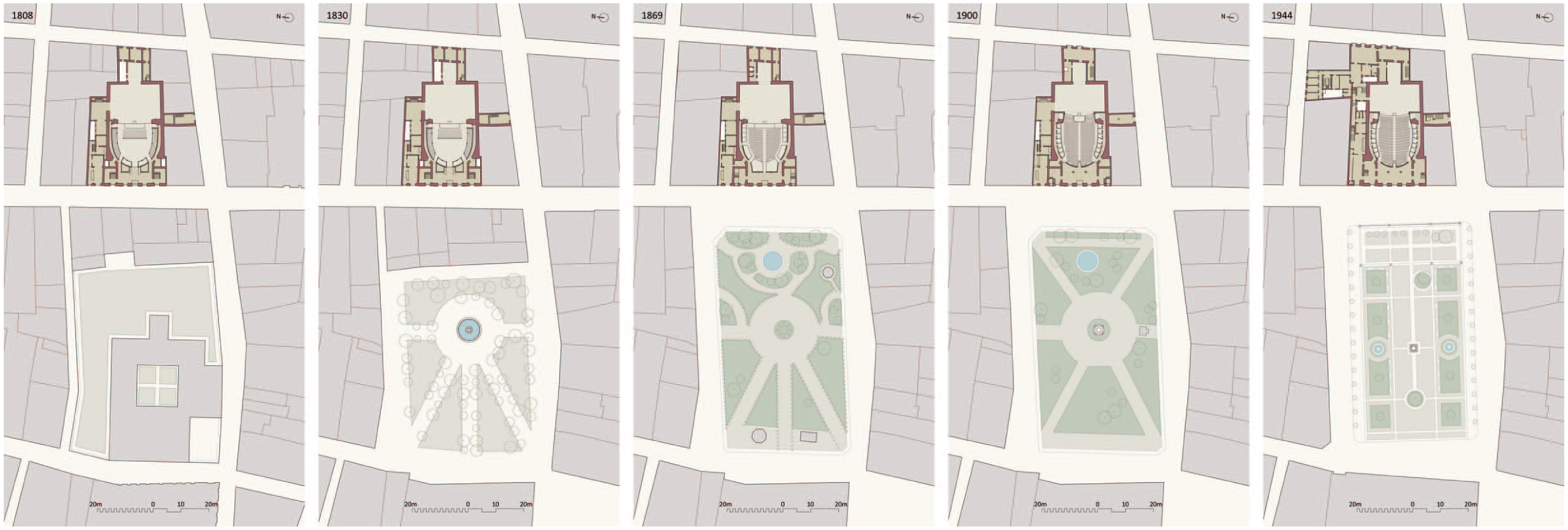
Hypothesis of shape in plan for the years 1808, 1830, 1869, 1900, and 1944. Drawings by Carlos Villarreal Colunga and Jara Muñoz Hernández, 2023.
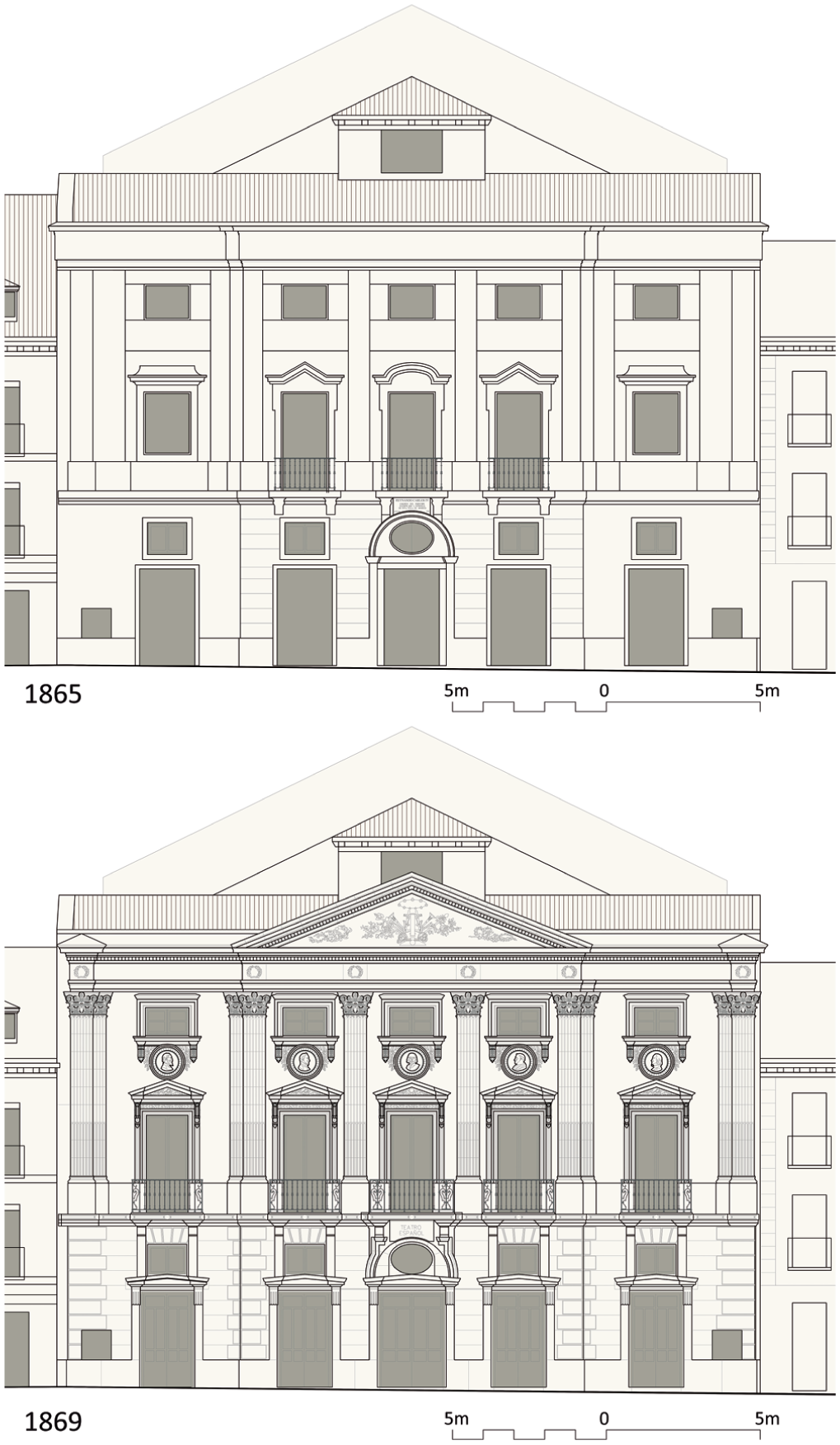
Façade of the historic building of the Teatro Español. Above: drawing by Carlos Villarreal Colunga, 2023. Below: own elaboration from the Planimetric survey of the Teatro Español (Madrid) and all its dependencies. Architects in charge of the survey: Julio César Amores García and Óscar García Mahíllo; Direction and monitoring: Javier Ortega Vidal and Miguel Ángel Alonso Rodríguez; Collaboration: Daniel Aragoneses López.
Footnotes
Authors’ Note
This article focuses on one of the episodes in the life of the Teatro del Príncipe, studied as a whole in the doctoral thesis written by Carlos Villarreal Colunga.
Declaration of Conflicting Interests
The authors declared no potential conflicts of interest with respect to the research, authorship, and/or publication of this article.
Funding
The authors received no financial support for the research, authorship, and/or publication of this article.
