







Abstract
This article examines women’s role as the guardian of family health during the Qing period to uncover a neglected aspect of their transformation into the New Woman of the early twentieth century. Although medicine as a form of specialized knowledge has seldom been related to the tradition of women’s learning, my case studies suggest that gentry women during the Qing period routinely resorted to medical texts to regulate family health. This aspect of women’s learning readily lent itself to the project of national strengthening under new exigencies: as China’s encounter with imperialism during the late Qing period came to include a discourse of hygiene, gentry wives could take a step further to reform the national body and claim their centrality to China’s transformation into a modern nation.
Keywords
Recent studies of Chinese women’s history have called attention to the historical changes of the eighteenth and nineteenth centuries that prepared gentry women for their transformation into the “New Woman” 新女性 of the early twentieth century. Susan Mann, for example, uses women’s poetry that addressed the great turmoil of the latter half of the nineteenth century to illustrate their new political consciousness. For Mann, these women’s concern about their troubled times and the fate of the state, as expressed through poems that linked the “personal” to the “political,” made them precursors to the revolutionary Qiu Jin 秋瑾 (1875–1907) (Mann, 2010: 283–84). In her general remarks on the literary authorship of women during the late imperial period, Maureen Robertson also spots a collective new consciousness among the guixiu 閨秀 (gentry women; or, literally, talents from the inner quarters) that prepared women writers of later generations for participation in China’s modernization during the early twentieth century (Robertson, 2010: 381).
This article draws attention to an unexplored facet of gentry women’s lives that may shed light on this process of women’s transformation into the New Woman, namely their role as guardians of family health. I refer to the new womanhood imagined in late nineteenth and early twentieth centuries as primarily a set of women’s changing roles that expanded from the “inner quarters” to the public space of political engagement. 1 Arising out of China’s need to adapt to “modernity” as a means of surviving its national crisis, this new womanhood suggested that women be liberated from their past oppression so as to provide service to their nation (Mittler, 2003: 218). They should, moreover, abandon the frivolous literary tradition of the cainü 才女 (talented women), which was imagined as a stand-in for all that was wrong with China’s tradition and its enfeebled national fiber. Women’s education should therefore focus on useful knowledge and practical skills that would qualify them for their new roles in nation-building (Hu, 2001: 196–231). The New Woman, in short, became a powerful political symbol in China’s drive toward “modernity.”
As several recent studies have shown, however, this new womanhood in fact figured as a site of great ambiguity and contention that qualified “modernity” itself (Edwards, 2000: 115–47; Mittler, 2003: 219; Stevens, 2003: 82–103; Rosenmeier, 2011: 48–50). In Shanghai’s news media during the late nineteenth and early twentieth centuries, the New Woman could on the one hand suggest a radical breakaway from women’s traditional roles in the inner quarters and their emergence as active participants in public affairs. Yet, on the other hand, crossing of the boundaries also turned the New Woman into an object of satire and even fear (Mittler, 2003: 220–55). There was, above all, a significant difference between the men who largely shaped the New Woman as political imaginary and the women who appropriated the new ideals of womanhood for their own political engagement. A recent study by Nanxiu Qian reveals that, unlike their male counterparts, the female participants in the 1898 reforms had a clear agenda of drawing from the xianyuan 賢媛 (worthy ladies) tradition of the Wei-Jin 魏晉 period (220–420) to promote modern notions of women’s rights. It was in this tradition—as much as in Western feminism—that women reformers found the free spirit and intellectual independence that provided the basis for their own ideal of womanhood (Qian, 2003).
While I draw from the insights of Qian and others, the focus of my study is not so much the tradition of women’s literary talent as that of women’s “practical learning”—specifically, their medical knowledge. Here I do not discuss—as Charlotte Furth has discussed at length—the tradition of female physicians 女醫, which included the very few female physicians who inherited their family occupation (Furth, 1999: 266–300). Nor do I refer to the more mixed group of female healers such as midwives, “medical grannies,” and female shaman healers (Furth, 1999: 266–300; Leung, 1999: 101–34). Rather, I refer to medical knowledge as a practical skill that gentry wives during the late imperial period often resorted to in order to deal with the health issues of their families.
Gentry wives’ access to medical knowledge can be attributed to the boom of commercial printing that made medical texts, along with encyclopedias and guidebooks for everyday use, widely available during this time (Brook, 1998: 167–71; Chia, 2002: 256–57; Brokaw and Chow, 2005; Wu, 2010: 57–59). According to Furth, these texts conferred medical authority and served as a guide to practice. They were so ubiquitous that authors of their prefaces often stated that “ox carts are weighed down” by them. In Furth’s case study of To Benefit Yin 濟陰綱目, a popular late Ming medical treatise on fuke 婦科 (female disorders), the audience of the volume was composed broadly of elite readers and commoners, including women (Furth, 1999: 156–63). For Furth, it was the wide availability of medical books that gave rise to the “diffused nature of medical knowledge,” which in turn allowed women to use it as a “domestic skill” and to participate in the male-dominated medical system (Furth, 1999: 266). Yi-Li Wu, moreover, provides examples of gentry women from the Qing period who used medical texts to help their friends and families or to distribute medicine for charitable purposes. Wu also finds examples of women who paid to have fuke texts published during this time (Wu, 2010: 19, 77).
The following discussion further demonstrates that, since gentry families with an interest in book collecting often had large collections of medical books in their private libraries, medical knowledge could easily be absorbed into the jiaxue 家學 (family learning) of these families, and became part of the education that gentry women could receive in their natal homes (or, after they were married, from their husbands’ families who were interested in medicine). Although we lack data on the exact number of gentry women who obtained medical expertise from texts, as well as the exact nature of their expertise, my case studies suggest it was taken for granted that a gentry wife’s daily chores often involved regulating family health. Much as the late Qing reformer Liang Qichao 梁啟超 (1873–1929) deplored women’s lack of practical learning—so much so that he reserved the label “New Woman” for the first Chinese woman physician trained in Western medicine (Hu, 2001: 201–2)—medical knowledge may have simply been among the daily basics of a gentry woman’s life.
I focus on two cases from the mid-Qing and the late Qing periods, respectively. While “exemplary wife” Chen Ershi 陳爾士 (1785–1821) demonstrates how guarding family health was a daily routine for gentry wives, the woman physician, hygiene advocate, and reformer Zeng Yi 曾懿 (1852–1927) reveals this wifely role to be the very source of inspiration for women of later times to promote themselves as active agents in nation-building.
Chen Ershi and Her Family Letters
Chen Ershi, courtesy name Weiqing 煒卿, style name Jingyou 靜友, was born to a gentry family in Hangzhou. Her father, Chen Shaoxiang 陳紹翔, was an official in the Board of Punishment. She married Qian Yiji 錢儀吉 (1783–1850), who served consecutively in the Boards of Revenue, of Punishment, and of Public Works, and who was also a well-known historian and bibliophile. Her eldest son, Qian Baohui 錢保惠, earned the honorific title of xiaolian 孝廉 (filial and upright). Qian Baohui collected a portion of Chen Ershi’s writings and had them printed posthumously as Tingsonglou yigao 聽松樓遺稿 (Posthumous manuscripts from the Tower for Listening to the Wind through Pine Trees, ca. 1821).
The entry about Chen Ershi in the Hangzhou gazetteer describes her as a woman distinguished by both her talent and her virtue. She studied the classics and history from an early age, excelled in writing poetry, and, after she was married, capably managed her household and personally educated her children (Hangzhou fu zhi, 1993 [1922]: 892). Chen Ershi also had an important family heritage. Her great-grandaunt (on her husband’s side), Chen Shu 陳書 (1660–1736), was among the very few women painters whose works were selected for the imperial collection of art. Chen Shu was, moreover, known as a female moral exemplar who, widowed early in her married life, raised her sons on her own. A portrait of Chen Shu commissioned by one of her sons, Qian Chenqun 錢陳群 (1686–1774), represented this part of her life by featuring her spinning at night while teaching the classics to her children. The portrait was given as a gift to the emperor Qianlong 乾隆 (1735–1795), and inspired a tremendous number of inscriptions, including those by the emperor himself (Weidner, 1990; Li, 2008: 64–69, 127–28). Such imperial attention greatly enhanced the Qian family’s reputation.
Chen Ershi’s writings in honor of Chen Shu—including an epilogue to the latter’s collection of paintings and a brief biography—show how highly she valued this family legacy of virtuous and accomplished women (Chen, 2008 [ca. 1821]: 590–92, 597–98). A quick look at the titles of Chen Ershi’s major works further shows how she used that legacy to establish her own authority to instruct gentry wives on womanly duties and ritual propriety: Tingsonglou nüxun 聽松樓女訓 (Precepts for my daughters, composed from the Tower for Listening to the Wind through Pine Trees); Guimen jili 閨門集禮 (A collection of rites in the inner quarters); Fuzhi jibian 婦職集編 (A collection of wifely duties); and Lidai houfei biao 歷代後妃表 (Charts of empresses and imperial consorts of all dynasties). Although none of these works survived, their titles and a few of their prefaces appear in Tingsonglou yigao. Chen’s preface to Fuzhi jibian, for example, conveys her strong sense of moral authority. She passes harsh judgment on her contemporaries for their moral decline and specifies the purpose of her composition as that of reviving—from the classics—the appropriate rites for women:
Gentleness and submission are particularly valuable among female virtues. . . . Yet due to the decline of the rites . . . whenever a woman and her sister-in-law dislike each other, they engage in bitter disputes. Jealousy also prevails in the inner quarters. Out of jealousy a woman would prefer that the family line be cut off rather than acquire a concubine for her husband. This is all because she did not learn the proper behavior early enough in life. . . . I have therefore selected from the classics and history [teachings on wifely duties] and put them into categories, which are: respecting your parents-in-law, serving your husband, cultivating harmony in your relationship with your sisters-in-law, assisting in ancestral rites, [properly] treating your husband’s concubines, instructing your children, and managing the maids and the servants. (Chen, 2008 [ca. 1821]: 586)
Abstract categories of wifely duties and high-minded moral principles, however, needed to be realized in the mundane details of everyday life and through the innumerable tasks that women handled in satisfying the daily needs of their families. In this sense, the family letters of Chen Ershi provide telling instances of how she personally fulfilled her wifely duties on a day-to-day basis.
The Quotidian Nature of Chen Ershi’s Family Letters
Letters had long been a source of auto/biography in the Chinese literary tradition (Han, 1997). Recent studies on women’s biographies in Chinese history also have drawn attention to letters as valuable records of women’s lives (Waltner, 2011). Most of the family letters 家書—29 in total—in Chen Ershi’s collection of works were addressed to her husband, Qian Yiji, while he was away from their home in Beijing to take care of the funeral of his mother. These letters cover approximately one year, from the eighth lunar month of 1817 to the seventh lunar month of 1818. In content, they served as Chen Ershi’s “reports” to her husband on daily household matters to inform him of how the household was running in his absence. Precisely because of their quotidian nature, the letters provide intimate details of how a gentry woman performed her daily chores—details that are hard to find in other women’s writings such as poetry.
Francesca Bray has written extensively about the canonical meanings of “womanly work” as a moral activity embodied particularly in the weaving of cloth. Her study of the economic expansion during the late imperial period and the consequent marginalization of women’s roles in textile (both silk and cotton) production reveals that “women’s work” in reality involved a variety of productive activities catering to a market economy (Bray, 1997: 183–272). To clarify at the outset, my present discussion concerns neither weaving as a moral symbol nor women’s role in production, but focuses on what Bray describes as women’s duties in running their households (Bray, 1997: 281–82). As the letters of Chen Ershi illustrate, the typical daily work of a gentry wife would include the following items.
First, managing the accounts. This referred not simply to balancing income and expenses but also to the much more complicated task of making ends meet, such as making decisions about what jewelry or household wares could go to pawn shops, which part of household funds should be used to cover living expenses and which part should be sent for Qian Yiji’s needs, and how living expenses could be cut down. Chen Ershi’s accounts go into such detail that they even mention how many winter coats were made for the children as well as the question of whether to use fire for heating in certain rooms.
Second, managing the maids and servants. This included assigning tasks, making sure that jobs were done, and disciplining or dismissing unruly domestics. In the event that valuables in the household went missing, Chen Ershi also needed to do a bit of detective work and decide which servant she should keep an eye on.
Third, educating the children. Chen Ershi personally taught all of her children (two sons and two daughters), assigning readings according to their ages and levels of learning and meticulously recording their progress. She also compiled a collection of her lecture notes, titled Shoujing oubi 授經偶筆 (Noted in random while I taught the classics to my children).
It goes without saying, perhaps, that many other matters that Chen had to deal with cannot be easily categorized. To name but a few: accidents that happened in house construction; a relative who was involved in litigation and needed help; a friend who came to ask for a loan; disputes in the household that had to be resolved, and so on. As can be well imagined, managing the household and promoting harmony among its members required not simply “gentleness and submission” on the part of a gentry wife, but patience, wisdom, energy, and, above all, practical skills.
Guarding Family Health
What most absorbed Chen Ershi’s attention, however, was an even more basic need of the household members, namely, proper medical care. Given the hygienic conditions of the time and the available medical treatments, it may not be surprising to find that illness was a prevailing presence in the Qian household. Susan Mann’s detailed study of the Zhang family in Changzhou draws attention to a variety of diseases that posed a constant threat to that family, ranging from mundane conditions to fatal epidemics, such as cholera, malaria, scarlet fever, typhoid, and measles (Mann, 2007: 183–85). Medical historians have also shown that people paid a great deal of attention to guarding their health throughout Chinese history. Consequently, self-dosing based on medical texts and techniques became common (Furth, 1999: 129, 235–37; Wu, 2010: 18). There existed, moreover, a wide range of practices for weisheng 衛生 (protecting life) and yangsheng 養生 (nurturing life) (Takashima, 2013: 13–14; Hammond, 2013: 153–55; Bray, 2013: 166–67). This larger context helps us to understand why, judging from Chen Ershi’s writings, the health of her household was of intense concern to her and why she had to stay alert to even the slightest signs of its fluctuation. In her letters to her husband, she constantly asks him not to worry, in itself highly indicative of the enormous pressure she was under.
Table 1 lists the illnesses and their frequency of appearance in Chen Ershi’s letters, thus providing a general picture of what she had to handle (bear in mind that these were only what happened within less than a year).
Illnesses in the Qian Household.
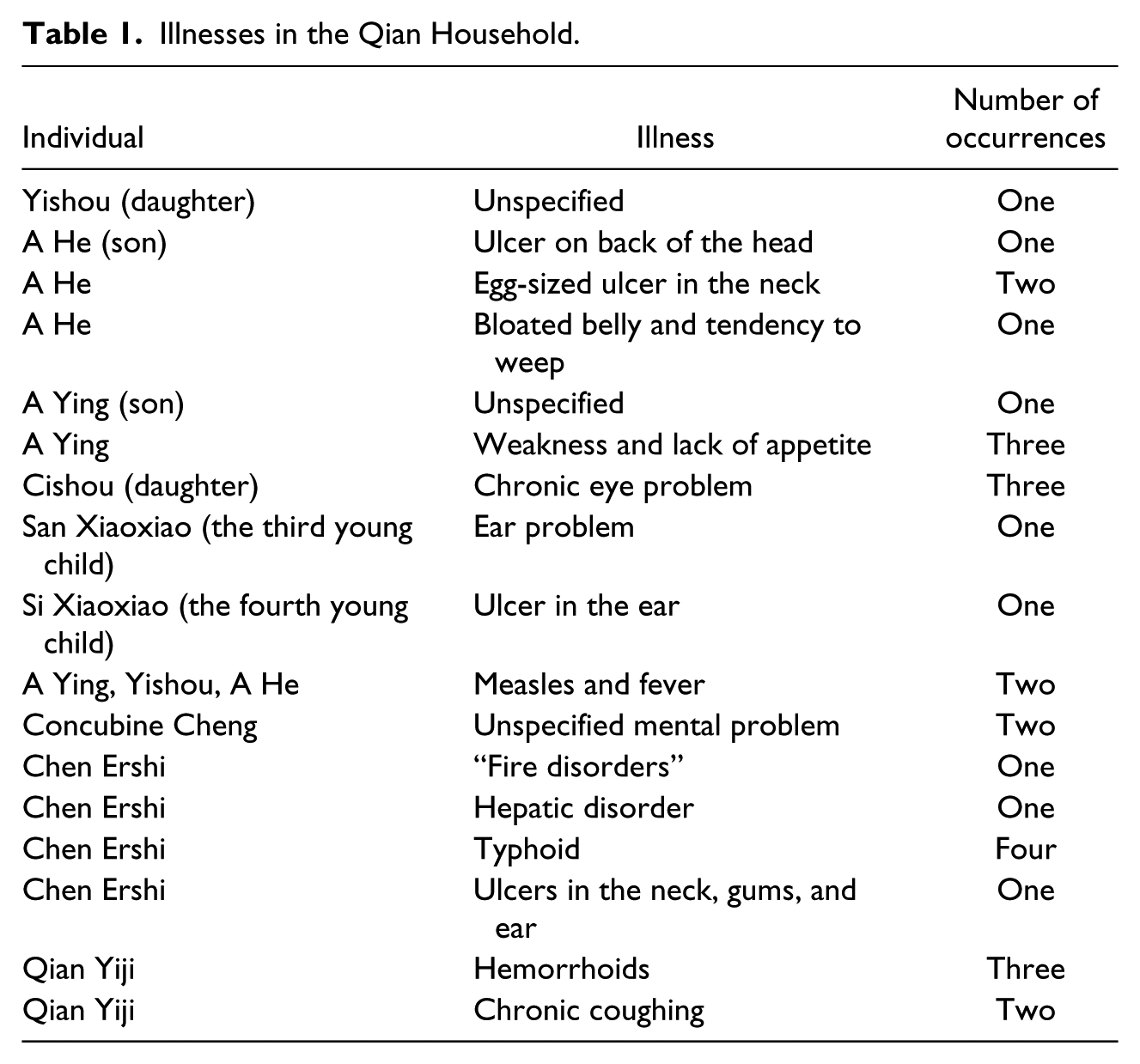
Over a third of the contents of the letters concern the measures Chen Ershi took to treat illnesses, including hiring physicians, considering (and comparing) their prescriptions, discussing treatment methods with her husband, personally selecting medical formulas from medical books, dealing with shortages of certain medicines by concocting replacements, and taking precautions to guard the household against epidemics. Notably, these measures never even entered the categories of wifely duties listed in Chen Ershi’s preface to Fuzhi jibian. It would seem that she simply assumed them to be part of her everyday duty to regulate family health.
The following selection from Chen Ershi’s letter dated the tenth day of the sixth lunar month of 1818 throws more light on her “working pattern,” that is, how she watched over several health issues—including her own—at once:
It is extremely hot this year in the capital, and many epidemics have broken out. A number of people in the household fell ill. Luckily, they recovered within a day or two. To my surprise, our third child has not had another onset of her eye illness—it must be that the folk prescription [that I found for her] has worked. The belly of A He is bloated, and he cries all the time—I wonder whether the following prescription would work for him. I cannot make up my mind on this. Please give me your instructions. A Ying has not been feeling very well since the start of the summer. . . . I am planning to ask Mr. Chungu [a physician] to see him again and to prescribe some energy-nourishing medicine 補氣之藥 for him. I . . . have not been affected by the measles epidemic, and have been taking my normal doses of pills. Please do not feel concerned. Since it is very hot in the south, please take good care of yourself. (Chen, 2008 [ca. 1821]: 611)
This inventory-like account makes it clear that handling health issues in the household was routine for Chen Ershi. Performing this routine, however, presumed that she had relevant medical knowledge as well as common sense. She knew, for example, what folk medicine to use for the eye problem of one of her children. In deciding to seek the physician’s help, she also had a general idea of what type of medicine her son A Ying would need. Moreover, in the case of her other son, A He, we find her consulting her husband on a prescription that she had probably selected from collections of medical formulas. This last fact also suggests that exchange of opinions on medicine was common between the couple, a point I will pursue later in my discussion.
To provide a further sense of the knowledge in Chen’s possession, I quote the following four cases, each of which illuminates a particular aspect of how she incorporated medical knowledge into her routine of treating illness. The first case, dated the twenty-eighth day of the fifth lunar month of 1818, concerns choosing physicians.
Ever since his minor illness early this month, Ying has been feeling fatigued and has lost some of his appetite. I asked Mr. Wen [a physician] to diagnose him. After taking the doses of cold nourishments 涼補 prescribed by Mr. Wen, Ying felt even worse. Yesterday, I took him to another physician, Mr. Chungu, who decided that he should not take cold doses because of the lack of harmony in his pulses. [Instead, Mr. Chungu gave] the following prescription: skin of trichosanthes, stir-fried with bran, three qian; bulbus fritillariae cirrhosae, one qian and a half; citrus aurantium, eight fen; poria, three qian; raw licorice, eight fen; coix seeds, stir-fried, three qian; burned grain shoots, stir-fried with earth, three qian; large white peony, one qian and a half; inula, two qian; wheat, one liang; jujubes, two.
2
The doses worked very well. I am planning to take him to Mr. Chungu again tomorrow for a follow-up. (Chen, 2008 [ca. 1821]: 610)
In making her choice between the two physicians, Chen Ershi did not just consider the factor of efficacy. Rather, her account shows that she was also capable of addressing the different rationales underlying the physicians’ prescriptions—for example, whether to use “cold doses” given the symptom in the pulses. Her full quotation of the latter physician’s prescription suggests that she was giving thought to the concoction of medicine itself and was again seeking her husband’s opinion. As case two (date missing) further demonstrates, Chen was capable of not only reading prescriptions but also revising them when certain ingredients were unavailable:
Mr. Chungu’s prescription has worked very well on me. As I could not find Atractylodes macrocephala koidz, I revised the prescription myself . . . and replaced the item with coix seeds. Having taken doses for a month, I am feeling well now, and both my sleep and my appetite are better than usual. My old symptoms have also been slightly reduced. These are the good effects [of the prescription]. (Chen, 2008 [ca. 1821]: 610)
Case three (dated the tenth day of the eleventh lunar month of 1817) stands as proof that Chen Ershi sometimes made decisions independent of the physicians on what medicine to use. As in the previous two cases, her decision had positive effects.
All have been well, except that our fourth child has an ulcer in one of his ears. It has been causing him great pain. I have therefore chosen the following prescription for him: raw astragalus, two qian; licorice, eight fen; angelica, two qian; honeysuckle, eight fen; radix, two qian; rehmannia glutinosa libosch, two qian; mulberry leaves, two qian; skin of peony root, one qian; campanulaceae, three fen; ligusticum chuanxiong, three fen. I have given him two doses and his pain is gone. There is scab forming on the ulcer. He is in good spirits now. (Chen, 2008 [ca. 1821]: 604)
Although Chen does not specify the source of her prescription—that is, whether she had drafted it herself or had chosen it from the prescriptions available to her—there is no doubt that she had confidence in her own ability to judge what was the appropriate measure to take. Case four (dated the last day of the tenth lunar month of 1817) provides the strongest evidence in this regard.
Cishou has had frequent eye problems. I checked medical books and used a prescription to greatly reduce her hepatic fire 大息肝火. It goes: peony root skin, stir-fried, one qian; frosted mulberry leaves, one qian and a half; white tribulus terrestris, fried, thorns removed, three qian; abalone calcined, three qian; bulbus fritillariae cirrhosae, five fen; north adenophora, three qian; poria, one qian; lotus leaf, one piece. She has taken five or six doses, and both the redness in her eyes and the pain are gone. The white nebula has also become thinner. She is in good spirits now. It has turned out to be very effective. Now I am thinking of following up with her treatment and concocting another prescription to nourish her yin and liver 滋陰養肝. (Chen, 2008 [ca. 1821]: 604)
Here we witness Chen Ershi personally choosing the appropriate treatment and deciding the follow-up treatment based on the progress made. Most significantly, this case points unmistakably to the source of Chen’s medical knowledge, namely, the medical texts available to her. Although Chen Ershi’s writings did not indicate what specific medical books she referred to, nor how they came into her possession, the sense of familiarity in her tone—that she mentions these books only in passing, as a given fact in her life—is in keeping with Charlotte Furth’s observation about the wide availability of medical books as a guide to practice during this time (Furth, 1999: 156–63).
Moreover, Chen’s access to medical books is no doubt attributable to the fact that her husband, Qian Yiji, was a well-known bibliophile and that the couple shared an interest in book collecting (Chen, 2008 [ca. 1821]: 597). Since neither the Qian nor the Chen family was distinguished by a tradition of physicians, the couple’s private collection of medical books was more likely a hobby than a family vocation. This common interest in medicine can indeed explain the lengthy descriptions of prescriptions and treatments in Chen Ershi’s letters: the couple shared a certain amount of medical knowledge and engaged in frequent conversations on the topic. In her elaborate accounts of the health issues in the household, Chen Ershi was both giving her husband an update on household matters—as the letters were meant to do—and seeking his counsel on treatments. 3
More importantly, if we further relate the couple’s collection of medical books to the general trend of book collecting among the elite during this time, it might well be that Chen Ershi was not an isolated instance but a small part of a broader picture of gentry women’s access to medical knowledge. Scholars have identified the Qing period as the height in the history of book collecting in imperial China. Several facts attest to the scope of this trend: first, the number of bibliophiles on record during the Qing period exceeds that of all previous dynasties taken together; second, private libraries expanded during this time from their former centers in the Jiangnan area to all across the country, including such remote areas as Yunnan, Gansu, and Sichuan; and, finally, the books that entered private libraries covered an extremely broad range of topics, among which medical texts were a familiar presence (Tan, 1988: 37–53; Jiao, 1997; Li, 2010: 10–14). With book collecting as one of the distinctive features of Qing elite culture that was widely emulated by gentry families, any type of knowledge conveyed by books had the potential of becoming popularized among the families who owned the books.
Furthermore, as Furth has noted, by the late Ming period, the boundary between “literati physicians” and physicians by vocation had largely disappeared. The flourishing of commercial printing gave rise to “a medical and cultural elite” composed of scholars and physicians alike, who mingled socially and who drew from a common pool of knowledge available in widely circulating medical books (Furth, 1999: 156–61). Furth’s list of these books ranged from the medical classics to case histories, treatises of family medical traditions, collections of prescriptions, pharmacy texts, easy-to-consult handbooks, as well as medical texts printed for charitable purposes (Furth, 1999: 157). In the case of the extremely popular medical treatise To Benefit Yin, Furth finds its selling point to lie in the fact that “not only physicians but . . . ordinary gentlemen can put a copy on the shelf for household use” (Furth, 1999: 163). This diffused nature of medical knowledge during the late Ming became more pronounced during the Qing period because of the continued growth in commercial printing and book collecting. Medical historians in fact specify “self-training” based on private collections of medical books as one of the major forms of medical training during the Qing period (along with training in a family vocation, in government-run schools, and in private schools established by famous physicians) (Liao and Lin, 2011: 35). Furthermore, given the increasing educational opportunities and hence literacy for women in gentry families during this time—now a widely recognized fact (Mann, 1997: 76–120)—we may have good reason to presume that it was a commonplace for these women to refer to medical books whenever they needed to.
Furth has cited several examples of how the “cultured daughters” of physicians assisted their fathers in medical scholarship or practice (Furth, 1999: 284–85). My interest, on the other hand, is not such women in medical lineages but a much broader category of women in gentry families who, as Furth briefly mentions, used medical knowledge as “a domestic skill” (Furth, 1999: 266). By “a much broader category” I by no means want to overstate the numbers of women who could be considered medical experts since we lack statistics of how many “self-trained” women physicians were produced during the Qing period. Instead, I am more interested in gentry wives who did not claim the status of physician and who left very few written records of their medical knowledge and yet who could obtain at least a fair degree of such knowledge from texts. Yi-Li Wu attributes the dearth of extant medical works by women to the probability that women lacked “networks” to help them preserve or reproduce their works (Wu, 2010: 20). The life of Chen Ershi, on the other hand, indicates that a gentry wife’s interest in medicine most likely arose out of her practical need to care for her family rather than any desire to establish a medical reputation through published works.
Wang Zhenyi 王貞儀 (1768–1797), a distinguished woman scholar and poet of a slightly earlier time, bore testimony to this broader picture of women’s medical knowledge by two contradictory statements. On the one hand, Wang bemoaned the fact that anyone who had access to medical books could now easily dispense medical advice and such abuse of medical knowledge “killed people” instead of saving lives. Although her father was well versed in medicine and she herself had the chance to read widely in medical texts and to engage in discussions with her father, 4 she always refrained from treating her own illness since she did not want to boast of her limited knowledge as others did (Wang, 1916: 8.3b–4a). On the other hand, Wang also complained that there were so many quacks that she had to speak up once in a while. She offered to closely examine the prescription that a physician had given to her female cousin Liu Jirong 劉季容. After checking Liu’s pulses and referring to a number of medical texts on female disorders, Wang condemned the physician for using “medicine of a wolf’s or a tiger’s nature” 狼虎之劑 that was utterly unfit for the “fragile frames of women in the inner quarters,” and urged Liu to forward her opinion to someone in the Liu family who also knew about medicine (Wang, 1916: 4.6b–7b).
In Wang’s ambivalence, the diffusion of medical knowledge figured as a double-edged sword. When indiscreetly used, such knowledge had disastrous consequences; yet when applied wisely, it rectified the mistakes made by quacks. Even more pertinent here is the presence of women. As a gentry woman who obtained medical knowledge from her “family learning”—by both reading widely in the medical texts owned by her family and by engaging in discussions with her knowledgeable father—Wang Zhenyi had the confidence to engage with the medical discourse of her time and to dispense her advice to a relative.
As Angela K. C. Leung conjectures, the extent of gentry women’s medical education at home during the Ming and Qing periods can be greatly underestimated since, for the elite, “literary and medical learning were traditionally seen as two compatible intellectual pursuits” (Leung, 1999: 126). Leung cites the example of a late Qing official who compiled a collection of easy-to-remember verses about basic medical principles, and who urged readers to use these verses to acquaint their daughters with knowledge that was “useful” to women’s fulfillment of their wifely roles (Leung, 1999: 126–27). Leung’s example confirms what I have just described about the wifely duties of Chen Ershi, but it is equally relevant to the following discussion of the question of what comprised “useful” knowledge for women of the late Qing period.
Zeng Yi and Her Medical Treatises
Zeng Yi (1852–1927), courtesy name Boyuan 伯淵, otherwise known as Langqiu 朗秋, was a woman physician, hygiene advocate, and reformer in the late Qing period. She hailed from a gentry family in Chengdu, Sichuan. Her father, Zeng Yong 曾詠, served as the prefect of Ji’an 吉安 in Jiangxi. Her mother was the well-known woman poet Zuo Xijia 左錫嘉 (1831–1896) from the illustrious Zuo family of Yanghu 陽湖, Jiangsu. Zeng Yi was married to a maternal cousin, Yuan Xuechang 袁學昌, son of Zuo Xijia’s elder sister Zuo Xixuan 左錫璇 (woman poet, 1829–after 1891) (Lin, 2007). She gave birth to six sons, three of whom held office. She was titled “Grand Lady Zeng” 曾太夫人 when her personal collection, Guhuanshi ji 古歡室集 (Collection from the Studio of Ancient Joy), came out in print in 1907. This voluminous collection includes: Guhuanshi shiciji 古歡室詩詞集 (Collection of poetry and song lyrics from the Studio of Ancient Joy), four juan; Yixue pian 醫學篇 (Treatise on medicine), two juan; Nüxue pian 女學篇 (Treatise on women’s learning), one juan; and, Zhongkui lu 中饋錄 (Records of doing the cooking), one juan.
In another study, I emphasize how Zeng Yi’s life embodied the changes in women’s identities as cainü (talented women) during the late Qing period, particularly in relation to changes in the overarching concept of “illness as metaphor” in the Chinese cultural mentality (Yang, 2008). Here I focus on her medical expertise, which provided the foundation for her redefinition of women’s roles in the new political and national contexts of the late Qing period. I build this part of my discussion primarily on Yixue pian and Nüxue pian. The former volume is composed of numerous essays and prescriptions that deal separately with four categories of ailments: seasonal epidemics and febrile ailments; “warm disease” 溫病, “cold damage” 傷寒, and “wind damage” 傷風; miscellaneous diseases 雜症; female disorders; and children’s diseases. The latter volume is a collection of essays that address the question of “what women should learn,” as defined by their roles as wife, mother, and daughter-in-law. The volume is organized around the different aspects of these womanly roles and divided into nine chapters: “Getting married,” “The husband and the wife,” “Giving birth to a child,” “Nurturing the infant,” “Educating the child in the cradle,” “Educating the young child,” “Caring for the elderly,” “Family economics,” and “Hygiene.” Zhongkui lu, a cookbook, is attached to the end of these chapters as an “appendix.”
Although the two volumes have different focuses, their contents echo each other at significant points. It can even be argued that the medical knowledge provided by Yixue pian formed the basis for an integral part of “what women should learn.” For example, the numerous prescriptions that Zeng Yi made for female disorders and children’s diseases in Yixue pian were precisely what she urged women to learn in chapters 2 and 3 of Nüxue pian, where she elaborates on how to protect the health of pregnant women and how to raise healthy children. Also, her discussion of a woman’s responsibility to safeguard family “hygiene” and the well-being of family members in other parts of Nüxue pian presumed that women would have the relevant medical knowledge. In other words, the two volumes share the same central concern, namely, how to build healthy bodies of the Chinese race as a step toward reinvigorating the nation. Zeng Yi contributed much to this discourse of national strengthening by drawing inspiration from her family heritage of learning.
Family Learning and Self-Training in Medicine
A preface by Zeng Xuchu 曾旭初, a brother of Zeng Yi, represents her as a young prodigy who spent days and nights exploring her father’s collections of books and whose talent always earned the approbation of her family. When she was ten sui, her father died of illness in Jiangxi, and her mother, Zuo Xijia, moved the family back to Chengdu. Zeng Yi then embarked on a full curriculum typical of what a gentry daughter could learn at home: she learned from her mother poetry-writing, calligraphy, painting, needlework, as well as history and the classics. In time she became celebrated all over Sichuan for her literary and artistic achievements. She was especially famous for creating extraordinary embroidered replicas of her own paintings of scenery, flowers, and birds (Zeng Xuchu, 1907: 1a–b). Her poetry, too, won her great acclaim (Yan, 1907: 11a). In addition, she shared her mother’s duty of educating her younger siblings, passing on to them what she had herself learned from her mother (Zeng Xuchu, 1907: 1b). She herself characterized her background of learning as that of cheng muxun 承母訓 (“receiving instructions from my mother”) (Zeng Yi, 1907a: 4a). 5
Later Zeng Yi would speak of this tradition of learning in her family with great pride, and it was not only literary or artistic talent that she claimed to have inherited from her family. Rather, she drew attention to the luster that both her mother, Zuo Xijia, and her aunt/mother-in-law, Zuo Xixuan, had brought to her family by their exemplary conduct. She referred in general terms to their virtue of jiexiao 節孝 (chastity and filial piety). But more specifically, she also referred to a variety of practical skills that they had used—and also taught her to use—in household management, including “specialized categories of learning such as the principles of educating children and regulating hygiene, and also easy-to-learn skills such as needlework and cooking” (Zeng Yi, 1907a: 5b).
I will discuss in detail the transformation of the term “hygiene” and its changing significance to the discourse of national deficiency during the late Qing period, particularly how Zeng Yi’s reformist ideas figured in this discourse. But before that I propose that, as Zeng Yi’s background of muxun indicates, medical knowledge used to regulate family hygiene could be part of the education that a mother gave to her daughter as a practical skill in household management. Implicit in this aspect of the muxun tradition was the assumption that guarding family health, like the “womanly work” of needlework and cooking, was a wifely duty that a gentry woman should be trained to handle even before marriage.
Aside from her background of muxun, there was a significant experience in Zeng Yi’s life that sheds further light on her learning. At the age of fifteen, she started to suffer from an illness that lasted for five years. Several times she suffered high fevers and was on the verge of death, all because of the wrong treatment of quacks. Only by referring to the large collection of medical books owned by her family did she manage to prescribe for herself and recover eventually. Because of that, Zeng Yi developed a strong interest in medicine and, for the next 30 some years, read broadly in medical works, including classical medical texts, case histories by famous physicians, and collections of prescriptions (Zeng Yi, 1907b: 2b, 2.2.3b). By the time she published her own treatise on medicine, she had collected hundreds of prescriptions—including those she made herself—that had proven to be “efficacious” in her actual practice. The purpose of her publication, as she states in her preface, was to ensure that “everyone from a family of educated background would know about medicine and would therefore not be fooled by quacks” (Zeng Yi, 1907b: 3a).
Zeng Yi thus achieved the status of a medical expert primarily through self-training, namely, by reading broadly in the medical texts owned by her family. In this respect, she bore testament to what I have referred to as the expansion of book collecting to more remote areas, such as Sichuan, during the Qing period and the consequent popularization of medical knowledge among gentry families. And conversely, precisely because of these trends, Zeng Yi could expect her own medical works to reach “everyone from a family of educated background” (Zeng Yi, 1907b: 3a).
Here we also see the same criticism of quacks voiced by Wang Zhenyi. In Zeng Yi’s case, this arose out of her personal experience of being ill and led her to privilege medicine as part of elite family learning. At the same time, Zeng Yi did not share Wang Zhenyi’s anxiety about the diffused nature of medical knowledge. Instead, she relied on medical texts as a means of benefiting a broad readership. This reliance on the popularization of medicine—particularly among women, as we shall see below—constitutes the core of Zeng Yi’s reformist scheme.
Finally, it should come as no surprise that these two important aspects of Zeng Yi’s learning, namely the mother-to-daughter transmission of knowledge and mastery of medicine through self-training, were not mutually exclusive but belonged to the same phenomenon of medicine as a domestic skill and women’s increasing access to it. A gentry daughter prepared for her wifely roles by learning from her mother a set of practical skills, including those used to regulate family health. When she desired, she could develop her medical skills into medical expertise through reading. In time she would become a mother herself and continue the process of muxun, ready to acquaint her daughters with the skills and knowledge befitting a gentry wife.
This tradition of women’s learning was part and parcel of the “womanly way” 坤道 that Zeng Yi would in time perceive to be the remedy for China’s ills. In a profuse eulogy 讚 that she authored for her own portrait photograph, attached to the front page of her treatise on women’s learning, she writes that it is up to no one but herself to revive the “womanly way”—by promoting her “illustrious virtue” 崇我文德 and by adhering to her “ideal of wifely exemplarity” 肅我壼範 (Zeng Yi, 1907a: front page).
“What Women Should Learn”: Women as Guardians of Family Health
In her preface to Nüxue pian, Zeng Yi relates in detail what had prompted her to reflect on the question of “what women should learn” in order to serve their country. This is also where we can put her reference to her own background of learning back into its original context.
As I quietly observed the great shifts in China’s governing, and how the dozens of foreign powers plotted together to seize China’s territory, I became deeply concerned, and racked my brain for a plan of national strengthening. . . . We have a great population of female fellow citizens: Why don’t the two hundred million women together compete [with men] to fulfill their heaven-assigned duties? Such as educating the children and sharing responsibilities [with their husbands], which would lay the foundation for the growth of national citizens; using their diligence and frugality to bring about the well-being of their households, which would be the key to their management of their households; and [learning] medicine and hygiene to guard family health, which would be what the [Chinese] race relies on to grow stronger. . . . However, [among women of China today,] the rich pursue an extravagant life style, and the poor are ill-informed and ignorant. Inside their families, they are unable to perform their household duties, and outside their families they are no help [for dealing with] the hardships of the time. As they do not know how to treat the diseases of their children, how can the Chinese race grow stronger? As they do not know how to educate their children, how can education be popularized? The few women who know something about “new learning” only know it superficially and pick up from the West such terms as “free marriage,” “equal rights,” and “independence.” They take the West as a model in food and clothing. They weep as they talk enthusiastically about current events, and all you hear is how the foreign powers are seizing China’s territory. However, they are ignorant of even what their own duties are and do not perform their duties diligently. This is called the mistake of “going beyond the limit is as bad as falling short” 過猶不及之失. . . . I am not a talented person. Fortunately, both my mother and my aunt/mother-in-law were distinguished by their talent and virtue. They were erudite scholars of the classics and history, and were at the same time known for their illustrious virtues of chastity and filial piety. . . . As I realized that the learning of poetry was of no help [in dealing with] the hardships of the time, I . . . selected from the teachings of my mother and my aunt/mother-in-law that I had benefited from in the past and have personally written this treatise on women’s learning. Used outside the family, it can help to promote patriotism; and, used within, it can help to create harmony in the household.
6
[It includes] both specialized categories of learning such as the principles of educating children and regulating hygiene, and easy-to-learn skills such as needlework and cooking 精之及教育衛生之理, 淺之在女紅中饋之方. . . . It can be used as family instructions or precepts for daughters, or as textbooks for women as well. If the conservatives think that it is overstated and abhor it, and if the [radical] reformers dismiss it as trivial and ridicule it—to the extent that there are those who deride my position as being neutral—I would still be happy to face their attacks 至守舊者憎其誇誕, 維新者嗤其瑣屑, 設有以中立相誚者, 懿亦樂而受之. (Zeng Yi, 1907a: 4a–6a).
What Zeng Yi describes above is now a familiar story, namely, China’s rapidly declining state power and control in the face of foreign invasions and efforts at reform in response to this crisis. Her approach to the national project of self-strengthening, however, presents a little-known aspect of the story. Recent scholarship has shed light on the late Qing notions of a dichotomy between the “old” and the “new,” and one of these notions hinged on the equation of a tradition of “talented women” with weakened national fiber. Many reformers, headed by Liang Qichao and his coterie, urged women to abandon their frivolous literary pursuits such as poetry-writing and instead master useful knowledge that would qualify them for their new role in nation-building (Hu, 2001). This radical “erasure of talented women” also led to the rejection of the entire tradition of women’s learning (Zurndorfer, 2008). Liang Qichao’s famous essay “On Women’s Education” 論女學 lays out an exciting future for China that can be realized through the education of women. Yet it is based on a sweeping condemnation of the ignorance of Chinese women and on the very assumption that “through thousands of years, women did not acquire fame in learning because they were never guided to that path” (Liang, 2013 [ca. 1896]: 199).
Zeng Yi, by contrast, bore personal testimony to how a gentry woman like herself could take the initiative in addressing the national crisis rather than waiting to be enlightened. More importantly, she proudly retraced the tradition of women’s learning in her own family and identified precisely this tradition as the foundation for reforms. In other words, the “path” of learning that Liang imagined eluded women throughout Chinese history nonetheless revealed itself clearly in Zeng Yi’s delineation of the mother-to-daughter transmission of knowledge in her family. What she learned through this means—and what she subsequently shenti lixing 身體力行 (personally experienced and diligently practiced) all her life—suggested to her a truly transformative force for China.
Zeng Yi’s crossing of the boundary between the “old” and the “new” aligned her with the group of late Qing women reformers in Nanxiu Qian’s study. According to Qian, these women reformers quickly changed the campaign for women’s education that was originally initiated by men during the Reform Movement of 1898 into an enterprise aimed at fulfilling women’s social and cultural ambitions. Rather than blaming China’s backwardness on women’s lack of “useful knowledge,” these women celebrated the free spirit and intellectual independence found in the xianyuan (worthy ladies) tradition and pointed out that what men were now urging women to learn had always been part of women’s domestic obligations. Xue Shaohui 薛紹徽 (1866–1911), for example, systematically responded to Liang Qichao and his fellow reformers by arguing for an education of women that “aimed not at changing them from useless to useful but at nurturing their long-ignored talents” (Qian, 2003: 424). These included, on the one hand, women’s poetic talent—used for the purposes of character development and moral transformation— and, on the other hand, a variety of traditional virtues ranging from moral fortitude to practical skills in household management. Xue consequently fit a new-style “women’s way” 婦道 into a modern curriculum for women’s education (Qian, 2003: 426–27).
Let us recall Zeng Yi’s eulogy for her own portrait photograph, where she writes that it is up to no one but herself to revive the “womanly way.” Her resort to this “womanly way” reflects precisely her affinity with Xue: both women were bent on fitting the traditional values of wifely exemplarity into a modern curriculum for women’s education. Even though Zeng Yi tended to distinguish women’s practical learning from their poetic talent and, unlike Xue, regarded poetry as “of no help” in China’s crisis, the two women shared a basic strategy of rejecting the sweeping condemnation of women’s learning by their radical male counterparts. This “womanly way,” moreover, carried tremendous moral authority. By appropriating such moral authority, Zeng Yi and her fellow women reformers could claim their centrality to nation-building and, furthermore, reorient women’s pivotal roles in the domestic sphere to this national purpose.
A comparison of Zeng Yi and Chen Ershi is illuminating. Both women passed harsh judgment on their contemporaries and expressed their desire to “revive” a neglected tradition of female virtue. Chen Ershi reflected a concern more common to the “high Qing” period, that is, how to revive appropriate rites from the Confucian classics as a means of forestalling the danger of moral decline in the inner quarters (Mann, 1997: 83–94). Zeng Yi, on the other hand, demonstrated an awareness of the swiftly changing world following the long and peaceful “high Qing” period. Unlike Chen Ershi, who seemed to be addressing broadly women “in the inner quarters,” Zeng Yi divided women into three categories: the “rich,” the “poor,” and the radical advocates of “new learning.” The first two categories conveyed a class distinction. While the former’s negligence of their domestic duties could be attributed to their extravagant lifestyle, the latter’s ignorance arose out of their lack of opportunities for education. Zeng Yi’s curriculum targeted not only the former group of elite women, but she also tried to expand what used to be elite women’s privileged access to knowledge to the “two hundred million women in China” in general, including a great population of non-elite women. It was thanks to efforts like this, by Zeng Yi’s generation of reformers, that women’s education started to be popularized through the newly established women’s schools during this time (Cong, 2008).
The third category of women in Zeng Yi’s mind pointed unmistakably to a late Qing phenomenon, namely, the rise of “new learning” based on the import of a wide variety of Western ideas. Zeng Yi’s sarcastic representation of these women is crucial to our understanding of her proclaimed “neutral” position, which differentiated her from both the conservatives who saw no need for change and the radicals who, in her view, missed the real point of change. That is, any efforts at reform, including winning “equal rights” for women, must go beyond empty talk and superficial knowledge of imported terms. Echoing the women reformers who regarded women’s education as a precondition for equal rights (Xia, 2004: 93), Zeng Yi offered, as I have shown, her family tradition of women’s learning as the basis for a curriculum that would qualify women to compete with men as equals. It was in this sense that she designated her treatise on women’s learning as at once “family instructions,” “precepts for daughters,” and a “textbook.” In other words, what fell within the traditional types of guidebooks for women could also be combined into a “textbook” (a late Qing neologism) catering to new needs.
Among Zeng Yi’s major concerns was women’s fulfillment of their “heaven-assigned duties” of raising a robust Chinese race and educating future citizens. As I have mentioned, the curriculum Zeng Yi offers in Nüxue pian indicates her predominant concern with health issues, especially those related to childbirth and childcare. Each of the chapters in Nüxue pian is further divided into several sections for elaboration. The chapter “Nurturing the infant,” for example, includes ten sections that not only address hygiene related to breastfeeding but also issues concerning the selection of the wet nurse, a mixed diet other than breastfeeding, and vaccination. Likewise, the chapter “Educating the young child” also goes beyond general concerns about children’s health and education to include the highly contentious issue of footbinding, especially its relation to the weakened female frame. Even in the volume Zhongkui lu, which focuses on women’s traditional duty of cooking for the family, Zeng Yi identifies the promotion of hygiene as one of the main purposes of her compilation (Zeng Yi, 1907c: 1a).
A distinct example can be found in the essay “Hygiene”:
Once a woman is married and starts to run her household, she becomes the key to the household’s safety and peace. Therefore, strengthening the nation has to start with strengthening the race, and strengthening the race has to start with [the regulation of] family hygiene. The Japanese woman educator Shimoda Utako once said,
7
even if a family is blessed with wealth and leisure, the happiness of the entire family would be ruined when a member of the family groans and sulks, suffering from illness; and a family brimming with peace and harmony would thus turn into a miserable and dreary world. How true these words are! Therefore, those who shoulder the responsibility of managing their households must pay attention to sleep, food, living conditions, clothes and bedding, cold, heat, dryness and dampness, and so on. They should in fair weather prepare for foul, and properly plan for daily life or travel. They should also be good at protecting themselves and strengthening their own health so that they can handle their workload. . . . This is why women should not only pay special attention to hygiene, but also study medicine. Once the family is strengthened, the nation becomes strengthened; and once the nation is strengthened, the Chinese race will also grow stronger. (Zeng Yi, 1907a: 29a–b, emphasis added)
In this express association of the family with the nation and the race—a variation of the Confucian social scheme that related the individual and the family to the state—Zeng Yi defines women’s role as first and foremost guarding the family’s health, a step toward strengthening the nation. What was among a gentry wife’s daily domestic duties became therefore crucial to the nation, and what women should learn in order to contribute to the nation also came to focus predominantly on medicine and hygienic knowledge. Here again we can spot the historical shift from Chen Ershi’s generation of gentry wives to Zeng Yi’s generation of women reformers. We should recall that Chen Ershi’s preface to Fuzhi jibian does not specifically include women’s daily duty of guarding family health as a wifely obligation. For Chen Ershi, this daily chore—like the other practical aspects of running the household—was taken for granted and hence not worth mentioning. Instead, her view of the ideal woman focused on moral qualities, particularly self-control and self-discipline, which had the capacity of bringing order and “harmony” to the family. By contrast, Zeng Yi showcased household chores, at once promoting them as ideal female virtues (i.e., the “womanly way”) and turning them into a touchpoint for how “modern” and “useful” a woman could be. Her curriculum for women’s education politicized women’s role as the guardian of family health and harnessed this role for reformist purposes, in particular strengthening the Chinese race, which constituted the core of national strengthening. In this respect, she echoed the prevailing concern with the “Chinese race” during her time and anticipated the spread of a eugenic discourse in the Republican period, as described by Frank Dikötter (Dikötter, 1998: 61–118).
“Hygienic Modernity”: The Purpose of Medicine under a National Agenda
In this section I further contextualize Zeng Yi’s concern with health issues within the late Qing discourse of hygiene. Ruth Rogaski (2004) uses the phrase “hygienic modernity” to describe how China’s search for “modernity” in the early twentieth century coalesced around the term “hygiene.” In her book-length study of the transforming meanings of health and disease in the treaty-port city of Tianjin, Rogaski draws a nuanced picture of how the term weisheng gradually lost its original Daoist associations of “guarding life” and became, through the Japanese translation and mediation, synonymous with “public hygiene” as developed in Western countries such as France and England. In the process, weisheng as a set of techniques aimed at improving individual health and longevity, based on Chinese cosmology, was replaced by an all-consuming urge to regulate individual health through state intervention. Accompanying this linguistic shift were the profound social transformations required by “a foreign-defined modernity,” which modernizing elites in China willingly embraced for the purpose of coping with China’s deficiencies, and, ironically, “at the very height of imperialist violence and coercion” (Rogaski, 2004: 13).
Chronology is crucial to my discussion of how Zeng Yi fits into this narrative of weisheng’s transformation into public hygiene. Rogaski identifies the 1860s, namely the decade immediately after the Second Opium War, as the time of the first medical encounters between China and the West (Rogaski, 2004: 73). From the 1880s onward, new treatises on hygiene—especially those translated from English by John Fryer (1839–1928)—appeared in the treaty-port cities and started to provide an alternative set of meanings for the term (Rogaski, 2004: 104–25). It was, however, not until the 1900s, in the aftermath of the Boxer Uprising and the foreign occupation of Tianjin, that the highly interventionist approach to health regulation started to take hold (Rogaski, 2004: 165–92). Before that, although elites in China had internalized a medicalized view of China’s weakness, and although Japan had quickly picked up the interventionist approach to national health regulation and set an example for China, the discourse of hygiene was multi-vocal. That is, no single voice of state regulation dominated; rather, there were competing voices arguing for a variety of means of improving health, including from the perspective of both Chinese medicine and a “Western medicine” that had itself been in the process of transformation (Rogaski, 2004: 125–35, 161–64).
Zeng Yi’s publication of her treatises on medicine and women’s learning in 1907 therefore fell within a period when the Western idea of public hygiene, with its interventionist approach, was taking hold in China and starting to triumph over a more individual approach to health. A look at Yixue pian shows that Zeng Yi frequently drew from both Chinese and Western medical ideas. Yet, in the context of the 1900s, she may be understood not simply as illustrating an eclecticism that characterized many physicians of Chinese medicine during this time (He, 2006: 299–305), but more specifically as presenting a twofold approach to “hygienic modernity.” That is, on the one hand, she tried to improve individual health by popularizing medical knowledge and techniques of “guarding life” (basically from the Chinese medical system), and, on the other, she embraced the concept of hygiene as key to national strengthening and related the individual body to a national purpose.
Thus far, in my discussion, I have translated the term weisheng consistently as “hygiene.” Yet we should bear in mind that the term often carried two levels of meanings for Zeng Yi: the individual and the national. Zeng Yi’s emphasis on exercise and fresh air as key to health illustrates my point. These two concepts appear first in her essay on the etiologies of “cold damage” and “warm disease”:
Although these diseases are triggered by external factors, they most often afflict those who have exhausted their minds/hearts, and those who live in deep, secluded houses where the air does not circulate. . . . In those who exhaust themselves with mental work, their energy of blood 氣血 is often obstructed, and wind, chill, summer heat, and dampness congeal in their bodies and do not disperse. Being absorbed into the main organs over a long time, the aforesaid factors will trigger disease whenever the body is again stricken by external wind, chill, summer heat, and dampness. . . . Within the human body, the lungs are like a canopy. Above them are two pipes; one is the esophagus, which gets food from above, and the other is the windpipe, which lets through the air breathed in and out. Anything that triggers disease gets in through breathing, and, therefore, disease always starts in the channels of the lungs 肺經. If from the start [the doctor knows how to] lighten and disperse the evil in the lungs 肺邪 through the sweat, the sick person will recover and [the disease] will not be transferred to every channel in the body 傳經. Therefore, although Western medicine is not as effective as Chinese medicine as far as the methods for treating diseases are concerned, it indeed has advantages over Chinese medicine as far as the methods for preventing diseases are concerned. As long as a person knows how to save mental labor to protect the brain, often inhales fresh air to protect the energy of the lungs 肺氣, and also exercises to let the blood circulate well, he will be immune to hundreds of diseases and attain longevity. (Zeng Yi, 1907b: 1.1.4b–5a)
In this passage, Zeng Yi engages with the important medical doctrine of warm disease that emerged during the Qing dynasty. According to Marta E. Hanson, this doctrine rejected the earlier classification of warm disease as a variant of cold damage, and regarded it instead as an independent disease that merited specialized study (Hanson, 2013). Zeng Yi followed this doctrine in an earlier essay to distinguish between cold damage, wind damage, and warm disease (Zeng Yi, 1907b: 1.1.3a–4b). Here, she seems to be proposing that—despite their many differences in etiologies and treatments—cold damage and warm disease share a common internal factor, viz., a weakened body that is particularly vulnerable to external pathogens. In addition, her theorization is linked to an influential argument of the warm-disease doctrine, which proposes that pathogens—such as heat, dryness, and dampness—enter the human body through the mouth and nose, reach the lungs, and then descend from the lungs to the stomach and intestines. This path of transmission corresponds with the triple jiao 三焦 schema of the body. Treatments of the disease target different stages of transmission in this schema and involve the application of detoxifying formulas accordingly (Hanson, 2011: 110–17). It is on the basis of this theory that Zeng Yi offers her “fresh air plus exercise” formula to protect the lungs and facilitate the circulation of the blood as a means of preventing disease.
Zeng Yi’s formula figures as a technique of “guarding life,” the focus of which is improving individual health. This is especially evident in her intention to prevent “hundreds of diseases” and help people “attain longevity.” At the same time, she links this technique of “guarding life” to Western methods for preventing disease. She refers to these Western methods in such an offhand way that, clearly, she assumes the reader will know what she has in mind: most likely, then, she refers to the Western public health measures that were starting to take hold in China during this time. The Qing warm-disease theorists already demonstrated an increasing concern with warm diseases’ close connection to epidemics and their transmission through contaminated air and water (Hanson, 2011: 111, 141–42). The physician Wang Shixiong 王士雄 (1808–1864), for example, recommended clean drinking water and ventilation as preventive measures for cholera, which had arrived in China in the early 1820s and caused pandemics in the following decades (Hanson, 2011: 134, 138, 142). After the 1880s, transformations in bacteriology in the West led to discoveries of the causative agents for a range of epidemics, including cholera, and in turn brought about large-scale public health innovations (Hanson, 2011: 151). Zeng Yi’s familiarity with the Qing warm-disease doctrine probably led her to readily embrace the public health measures described by Rogaski and, further, to promote these measures as better options than Chinese medicine in preventing illness.
These concepts of fresh air and exercise appeared again in Zeng Yi’s writings about female disorders and eventually served to link the individual female body to the national body. Let us first turn to how she was bent on treating individual female bodies.
The methods used to treat women’s diseases are exactly the same as those used to treat men’s, except that for women the reproductive system is also involved. In past times, women were confined deep in the inner quarters and could not dispel their unpleasant thoughts in the open air—not only were such unpleasant thoughts pent up in their hearts but also the air was not circulating well [in the inner quarters]. [The traditional view that] women are liable to illness can be attributed to the above reason. The main method to treat women’s illness—if by careful examination it is found that the female patient has not been affected by external factors or other diseases—is to nourish the blood and let the liver perform its dispersing and discharging functions 養血疏肝. Fortunately, in recent years, there has been a gradual tendency toward enlightenment 文明, exercise, and hygiene, and women’s diseases should be reduced accordingly. (Zeng Yi, 1907b: 2.2.1a)
In designating women’s diseases as the same as men’s, Zeng Yi was echoing an important reorientation of the fuke doctrine during the late imperial period. According to Yi-Li Wu, a number of fuke experts from the elite echelons of scholarly medicine challenged the earlier predominant opinion that women were constitutionally different from men. Rather, they proposed that women’s diseases should be treated in exactly the same ways as men’s except when the diseases concerned specifically female conditions, such as irregularity of the menses or postpartum complications. That is, they defined fuke more narrowly as a doctrine treating disorders related to the female reproductive system (Wu, 2010: 42–51). In developing their arguments, these physicians shifted attention away from bodily disposition to social factors—such as women’s seclusion and its contribution to emotional repression—to explain women’s presumed emotionality (Wu, 2010: 47–49). Zeng Yi’s reference to fresh air and exercise reflected precisely this “social” approach to women’s diseases. That is, she attributed women’s presumed susceptibility to illness to their confinement in the inner quarters, which not only pent up their emotions but prevented them from getting fresh air and exercise. Treatments for women’s diseases should thus be formulated separately. Fresh air and exercise, as we have seen, can serve as preventive measures for diseases triggered by external pathogens. If not caused by external factors or other diseases, women’s diseases should be treated by nourishing the blood and adjusting the functions of the liver, the means of treating fuke disorders that can be attributed primarily to emotional factors (Furth, 1999: 171). It can be argued that in these cases fresh air figures again as a preventive measure since it can help women dispel their pent-up “unpleasant thoughts.” Finally, particular attention should be paid to pre-pregnancy and postpartum complications, the more narrowly defined fuke disorders, which the main body of Zeng Yi’s fuke prescriptions targets.
While Zeng Yi was firmly grounded in the new fuke doctrine, her theorization of women’s diseases suggests that her interest lay not merely in drawing from this doctrine to treat individual female bodies. Rather, her reference to women’s confinement deep in the inner quarters as a “past” phenomenon, to be contrasted with the recent trends of “enlightenment, exercise, and hygiene” that can reduce women’s diseases, reflected her awareness of a larger national discourse of health and hygiene in which the female body figured as a site of contention. Recent scholarship has brought alive the heated discussions centering on the female body during this time. Many of these discussions particularly targeted women’s bound feet, a symbol of their confinement, which was viewed as the cause of their weakened body frames and, in turn, of a weakened Chinese race (Xia, 2004: 95–101, 128–42). Zeng Yi, too, participated in these discussions. Her comments on footbinding may reveal what she had in mind in particular when she referred to the recent trends that had the potential of changing women’s lives.
I remember that, in my childhood, I used to see my brothers coming back home from school late in the afternoon. They [ran around] catching butterflies and looking for flowers, enjoying unbounded freedom. I, by contrast, felt that my body was burdened by a tremendously heavy load and that my feet were in fetters. I always touched my feet and wept. Those moments are still vivid in my mind, and I cannot even imagine the torture again. With the reforms going on in China today, I am truly happy to see that women can be free from this torture from now on. Those who have already bound their feet should unbind their feet immediately. Even for the really tiny bound feet, there are still ways to let them grow bigger if truly desired. Gradually switch to larger sizes of stockings and shoes—every time one or two fen bigger—and make the tips of the shoes round, rather than the pointed, then in one year the feet will grow one or two inches, and in two years they will grow back to a normal size. . . .
8
What would be the benefits [of freeing bound feet]? [Women would] walk and digest food with ease, and the hepatic energy disease
Zeng Yi contributed to the discussion on footbinding from two perspectives: first, her personal experience, and, second, her medical expertise. In the first, Zeng Yi joined the ranks of other women reformers who promoted foot-unbinding for women’s own well-being, instead of for a national cause, as their male counterparts did (Yang, 2000: 209–22). The example of Xue Shaohui again offers a useful point of comparison. Xue argued from women’s own bodily experiences that, since footbinding and foot-unbinding were equally painful, men should let women decide what to do with their own bodies (Xue, 1914: 2.22a). Zeng Yi no doubt highlighted such bodily experiences in writing emotionally about her own childhood memories and the “fetters” that footbinding imposed on her body. Her purpose, however, diverged significantly from Xue’s. That is, precisely because footbinding caused women great pain and consequently posed “a huge obstacle to women’s freedom,” it absolutely had to be abandoned.
In this way Zeng Yi links all her major concerns together: freeing bound feet provides the foundation for personal hygiene (e.g., exercise and good digestion) and for the prevention of diseases caused by the dysfunction of the liver. (Here the “hepatic energy disease” can be read as an alternative name for diseases that were perceived to be caused by women’s pent-up emotions, which Zeng Yi discussed in her previous essays on women’s diseases.) The reformed female body, then, provides the foundation for reformed female roles: as household managers, as mothers of a robust race, and, eventually, as citizens of a modern nation.
Conclusion
Gentry families during the Qing period tended to boast of their women who carried on their tradition of learning. In the case of Chen Ershi and Zeng Yi, we spot familiar categories of learning for which women were recognized. Both, for example, excelled in poetry-writing. Also, while Chen Ershi distinguished herself by her knowledge of the classics and of history, Zeng Yi won great acclaim for her artistic achievements. At the same time, however, both reveal medical knowledge—a category of specialized knowledge that has seldom been related to the tradition of women’s learning—to be something that gentry women could take as given and could rely on to perform their daily routine of guarding the family’s health. It is this aspect of gentry women’s lives that serves to correct the modern reformers’ misconception—such as that of Liang Qichao and his coterie—that women in the Qing period lacked “useful” knowledge.
To the extent that they represented different generations of learned women from the Qing dynasty, the two cases delineate an unexplored trajectory of women’s transformation into the New Woman, or what might be called the expansion of women’s roles from the domestic sphere to the political and the national. If it was up to the earlier generations of women to protect the well-being of their families, on a symbolic level it was only one additional step to reinvigorate the entire nation: as China’s pursuit of modernity coalesced around hygiene, the medical skills that gentry wives used to regulate family health could also be used to regulate the national body. Thus we have witnessed the female tradition of domestic caregiving being incorporated into Zeng Yi’s scheme for national strengthening and expanding into prescription after prescription for the Chinese people.
Zeng Yi’s treatises on medicine and hygiene are extremely rich, and it would take further research to place her in the late Qing continuum of medical thought that combined Chinese and Western concepts to varying degrees. Here I have focused primarily on her twofold approach to “hygienic modernity.” Namely, while she relied on her expertise in Chinese medicine and a more individual approach to reform the female body—during a time when the foreign discourse of hygiene as state intervention was taking hold—she also linked the individual body to a national purpose, and found in the popularization of medical knowledge the ultimate solution to China’s weakness. In this way Zeng Yi joined her generation of women reformers in drawing inspiration from the very tradition of women’s learning that was condemned by their male counterparts, so as to redefine women’s roles and to claim their centrality to China’s transformation into a modern nation.
Footnotes
Acknowledgements
I would like to thank the two anonymous referees and Kathryn Bernhardt for their insightful comments, which helped me reformulate some of my main arguments. I presented part of this article at the 2012 Annual Conference of the Association for Asian Studies in Toronto. I would like to thank all the panelists, especially Maureen Robertson and Nanxiu Qian, who acted as the discussants of my paper, for their very helpful comments and suggestions.
Declaration of Conflicting Interests
The author declared no potential conflicts of interest with respect to the research, authorship, and/or publication of this article.
Funding
The author disclosed receipt of the following financial support for the research, authorship, and/or publication of this article: The work described in this article was fully supported by a grant from the Research Grants Council of the Hong Kong Special Administrative Region, China (Project No. HKU 757211). I am grateful for the generous financial support that greatly facilitated my research.