







Abstract
Why have existing developmental strategies failed to promote rural industrial development more effectively in many regions of China? This question cannot be fully answered by prevailing developmental state theory, which emphasizes the institutional conditions of embedded autonomy, market competition, and enterprise investment capacity, while overlooking the influence of informal property relations within industries. This article’s case study of an industrial township in northern China demonstrates that informal property relations, tied to entrepreneurs’ informal access to labor, land, and environmental resources, have been persistently maintained through socially embedded power interactions. These relations have contributed substantial profits to rural industries and greatly alleviated pressure on entrepreneurs, making them unwilling to reinvest profits into development activities. Instead, profits are allocated to simple industrial expansion or personal consumption. As a result, the developmental strategies fail to achieve their intended effects because of a lack of response from enterprises. Furthermore, this study examines two attempts by the government to formalize these property relations—the construction of industrial parks and more stringent environmental governance—and explains how their impact has been constrained. This research provides valuable insights for late-developing regions with lagging political and economic reforms and deepens our understanding of the substantive view of the economy.
Keywords
China’s rural industry has long been a focus of scholarly attention. As early as 1939, Fei Xiaotong 费孝通, one of the most influential sociologists in China, published his groundbreaking book Peasant Life in China, which documented the development of the silk industry in Kaihsienkung Village 开弦弓村 in the Yangtze River Delta (Fei, 1939). In contrast to the debate between the “agriculture-based nation” proponents, who argued that agriculture should be the foundation of China’s development, and the “industry-based nation” proponents, who believed that China should prioritize urban industrialization (Borokh, 2019: 111), Fei argued that rural industrialization was the most appropriate path for China. However, Fei’s idea could not be realized until the reform and opening-up policy was implemented. Only since the 1980s has rural industry been able to develop quickly, successfully addressing the problem of agricultural involution (Huang, 1990: 18).
Scholars have endeavored to interpret China’s rapid rural industrialization from different perspectives, and the statist theoretical perspective has always occupied an important position (Chen Zongshi, 2015: 7; Fligstein and Zhang, 2011; Huang, 2010). For example, the government has been recognized for providing the essential conditions for rural collective industries in the 1980s (Byrd and Gelb, 1990; Jefferson and Rawski, 1994), such as the industrial foundations established by the commune and brigade enterprises (Heston and Sicular, 2008), the promotion of educational popularization (Bramall, 2007: 144), and essential bank loans for initial capital (Huang, 2012). Additionally, the institutional characteristic of the decentralization of governmental power provided enough room for the rapid expansion of private industrial enterprises (Qian and Xu, 1993; Qian and Weingast, 1997). Moreover, as studies have shown, after the mid-1990s, 1 although local governments shifted their focus to land sales to boost revenue, local officials continued to prioritize GDP growth in order to secure promotions, which in turn further fueled the expansion of rural industry (Edin, 2003; Li and Zhou, 2005; Tilt, 2007; Xu, 2011).
However, the aforementioned studies concentrate on the mechanisms that have promoted the “extensive development” of rural industry. Extensive development, unlike intensive development, mainly focuses on the increase of aggregate output (Irmen, 2005; Wilczynski, 1972: 25). The transfer of labor force from agriculture to rural industry after reform and opening up undoubtedly led to a significant one-time increase in income, productivity, and especially industrial economic output value (Peng, 1998; Yueh, 2012: 53). But once the workforce was transferred to the industrial sector, the key indicators of sustained industrial development have become whether productivity within the dominant industrial sector steadily increases and whether newer, more productive industries can replace less productive ones. This process represents the essence of intensive development. From a historical sociological perspective, this type of development has been defined as “self-sustained, self-transforming growth” (Cohen, 2015; Hung, 2008), and more specifically as a “system uniquely driven to improve the productivity of labor by technical means” (Wood, 2017: 2).
According to Statistical Data on Sixty Years of Agriculture in New China 新中国农业60年统计资料, the value-added per capita of all Chinese rural industries steadily increased from 900 yuan in 1978 to nearly 66,000 yuan by 2008 (Ministry of Agriculture of the People’s Republic of China, 2009: 50–52), suggesting an improvement in productivity and a move toward more intensive development. Research from the statist perspective has already focused on this phenomenon and described the process from this viewpoint. For instance, during the era of collective town and village enterprises (TVEs), local governments usually had a strong ability to monitor firms (Walder, 1995). They always provided enterprises with technical advice, which was crucial for raising product quality to acceptable standards (Oi, 1999: 32; Peng, 2001). Then, as local governments reallocated capital and labor through the privatization of state-owned enterprises (SOEs) and collective TVEs, productivity in rural industry continued to rise (Chu and Song, 2015). Moreover, since the mid-1990s, local government has played an increasingly facilitative role in attracting outside investment to stimulate rural industrial development (Huang, 2011). Finally, although government funds were more likely to be obtained by SOEs after the mid-1990s (Nee and Opper, 2012: 198), in recent years, the Chinese government has started financially supporting the technological upgrading of rural private industries in response to the pressure of rising labor costs (Sharif and Huang, 2019; Xu and Ye, 2021).
However, an obvious issue is that most studies focus only on rural industrial enterprises in developed regions such as the Yangtze River Delta or the Pearl River Delta, resulting in an overly optimistic estimate of China’s rural industrial economy. If all rural industrial enterprises in China were taken into account, the comprehensive picture would be different. According to statistics from 2002 to 2010 based on the China Township and Village Enterprises Yearbooks 中国乡镇企业年鉴 and the China Township and Village Enterprises and Agro-processing Industry Yearbooks 中国乡镇企业及农产品加工业年鉴 (see, e.g., China Township and Village Enterprises Yearbook Editorial Committee, 2003: 130, 176; China Township and Village Enterprises and Agro-processing Industry Yearbook Editorial Committee, 2011: 137, 171), the value-added per capita of large enterprises (i.e., “enterprises above designated size” 规模以上企业) increased from 43,500 yuan to 126,200 yuan, while the value-added per capita of small and medium enterprises (i.e., “enterprises below designated size” 规模以下企业) never exceeded 30,000 yuan. 2 Furthermore, even though the share of small and medium enterprises in total value-added of rural industry declined from 61.77 percent to 9.83 percent, their contribution to the total number of rural industries remains substantial, consistently exceeding 90 percent. More importantly, although the workforce in rural enterprises below designated size has experienced a decrease, it consistently remained above 24 million from 2002 to 2010. Additionally, the average number of workers in these enterprises showed minimal variation during this period.
To summarize, a more detailed classification reveals that a significant portion of rural industries in China has struggled to achieve modern, intensive development since around 2000. Moreover, these small and medium industrial enterprises often appear in clusters across most regions of China, a phenomenon distinct from the Yangtze River Delta or the Pearl River Delta, which mainly host dynamic, growth-oriented enterprises. This developmental outcome presents a puzzle given that many local governments in these regions have attempted to promote the development of small and medium enterprises. Over nearly two decades of industrialization, especially after the 2010s, local governments have implemented various developmental strategies similar to those in more developed regions, such as providing financial subsidies for technological improvement, attracting advanced enterprises from outside to promote technological diffusion, or directly inviting technology companies to provide technological assistance. However, the stagnation observed in the industrialization of these regions demonstrates the limited effectiveness of such strategies. This outcome contrasts sharply with the theoretical assumption of the statist perspective, which posits that the state will always play a central role in industrial development.
Given the government’s autonomous decision-making power and its understanding of the industrial realities in implementing strategies, and given that intense market competition also seems to threaten the survival of rural industries, the most straightforward explanation is that widespread low profit levels prevent most rural enterprises from meeting the investment thresholds required by these strategies, rendering them ineffective. However, even within the group of small and medium enterprises, some possess investment potential. When this condition is met, the result should theoretically be that these enterprises autonomously accumulate profits and invest in development activities, thereby forming an effective synergy with the supportive role of developmental strategies, maximizing the latter’s effectiveness, and ultimately breaking away from the group of stagnant industrial enterprises and reducing the trend of divergence. Yet, in reality, why do existing developmental strategies still fail to effectively support these enterprises in achieving greater development?
In this study, I aim to show that the primary reason for the ineffectiveness of existing developmental strategies is that, despite the presence of the necessary conditions highlighted by the existing literature, entrepreneurs still lack proactive responses to these strategies. To explore this issue, this article presents an explanatory framework grounded in the concept of informal property relations. Through a case analysis of an industrial township in northern China, it demonstrates that the maintenance of informal property relations hinders the capacity of market competition to compel relatively profitable enterprises to invest in technological upgrading activities to raise productivity, which undermines the investment cooperation required by the strategies and limits their effectiveness. The empirical section investigates how informal property relations in rural China are constructed and maintained through socially embedded power interactions. More specifically, it describes two attempts by the government to formalize these property relations, including the construction of industrial parks and more stringent environmental governance, and explains how, because of the limitations of state power, their impact has also been limited.
Theoretical Reflection and Explanatory Framework
Reflecting on Developmental State Theory
From the statist theoretical perspective, the state or government can play a vital role in the sustained development of industry. This is particularly important for late-developing countries where society may not have enough resources to initiate industrial production. In such cases, the state can act as a “binding agent” by bringing together all essential elements—especially capital—for enterprises to thrive (Gerschenkron, 1962: 20; Hirschman, 1958: 6). Furthermore, the state can provide economic subsidies to enterprises that actively pursue development, such as by investing in technological upgrading or in risky “sunrise” sectors (Chibber, 2003: 7; Evans, 1995: 80; Johnson, 1982: 28). Enterprises that fail to maintain such efforts will lose government support, reflecting the inherently disciplinary nature of this strategy (Amsden, 1989: 14, 1992; Kim, 1997: 13). Additionally, the state also promotes technological upgrading through other means, such as attracting advanced enterprises from outside to promote technological diffusion or directly introducing technology companies to provide technological assistance.
To successfully create and implement the strategies above, essential institutional elements are required. These elements of state capacity have been conceptualized as “embedded autonomy.” This concept highlights the importance of the state not only in approximating the Weberian bureaucracy but also in being embedded within various ties that bind it to society, thereby establishing institutional channels for the continual negotiation of economic information and policies (Evans, 1995: 12). Moreover, studies have demonstrated that the effectiveness of strategies produced under such conditions is fundamentally determined by the response of entrepreneurs themselves. Theoretically, the supportive elements within developmental strategies usually take effect based on the development activities that entrepreneurs have undertaken or are undertaking, and entrepreneurs truly need the support provided by these strategies only when they have already engaged in or are currently undertaking such development activities.
Furthermore, entrepreneurs’ development activities are directly shaped by their willingness to respond to competitive pressures in the market, whether domestic or international (Chibber, 2005). For example, in his study of Indian industrialization, Vivek Chibber (2003) found that capitalists who had already occupied the domestic market through earlier entry and protectionist policies, such as import substitution, were more likely to prioritize their private interests and resist engaging in development activities, showing little interest in accepting the industrial policy discipline. In contrast, Korean capitalists, facing intense international market competition, proactively sought to invest in development activities. Therefore, they were more receptive to state guidance, viewing it as a means to enhance their production capabilities and directly contributing to the effective implementation of developmental strategies.
Previously, China could not be regarded as a fully developmental state because of its economic characteristics (Hung, 2016: 156; Lee, 2014). For instance, it did not systematically allocate credit to the private sector, which instead relied on informal finance for expansion (Tsai, 2004). However, in recent years, it has become increasingly difficult to deny that the Chinese government is adopting more developmental policies to promote industrial transformation, catch up with more developed countries, and build itself as a developmental state (Fang and Hung, 2019; Lei, 2022). The theoretical shift toward emphasizing the response of entrepreneurs under market competition pressure has gained further evidence in this context. For example, research on Dongguan, a city in the Pearl River Delta, has demonstrated that manufacturing enterprises are highly willing to invest in technological upgrading to remain competitive in the international market. The development activities they have undertaken provide a crucial condition for the successful implementation of local developmental strategies (Sharif and Huang, 2019). However, successful cases like Dongguan are rare in other regions of China. Although the essential institutional conditions conducive to implementing developmental strategies have been established, and market competition has also become very intense, thereby significantly reducing enterprises’ revenues, many local governments still face the problem of the failure of these strategies to take effect.
Undoubtedly, the experiences of Korea and Dongguan imply that, in addition to the expected willingness to engage in development activities under competition, a precondition for such activities is that enterprises must first accumulate the necessary capital for investment. But most rural enterprises are unable to invest in any development activities, mainly because of their lack of basic capital. This means that the existing developmental strategies will inevitably fail to take effect. However, in many regions, even among enterprises below designated size, relatively profitable enterprises still exist, and they have the potential to invest in technological upgrading and other development activities. Thus, according to existing theory, when the institutional conditions of embedded autonomy, market competition pressure, and the investment capacity of enterprises are all present, these enterprises should invest in some essential development activities, thus becoming the target group for which existing developmental strategies are intended to exert their supportive effects and promote further development. Yet why does this expected outcome not occur in reality?
An Explanatory Framework Based on Informal Property Relations
Drawing on the Marxist economic perspective, I propose that informal property relations play a crucial role in preventing market competition from generating among entrepreneurs a willingness to invest in development activities, thereby making it difficult for developmental strategies to identify suitable collaborators and ultimately rendering them ineffective. This explanation directly contradicts the logic discussed above, which assumes that market competition naturally compels entrepreneurs to pursue development. In fact, one of the key preconditions for the explanatory power of the existing theory is precisely the presence of capitalist or formal property relations.
According to Robert Brenner’s (2007: 58) definition, property relations “specify the regular access of individuals and families to the means of production (land, labor, tools) and/or the social product per se.” In a capitalist economy, such relations usually help maintain the pressure of capital reproduction. As Ellen Wood (2017: 2) has pointed out, “capitalism differs from other social forms because producers depend on the market for access to the means of production.” Because production costs increase continuously, capitalists must maximize profits by enhancing productivity and competing successfully in the market, thereby securing access to the means of production (Wood, 2002). This naturally involves investing in development activities such as technological upgrading, specialization, market adaptation, and innovation, which constitute an essential basis for the implementation of developmental strategies. Moreover, in this process, capitalists may lack sufficient capital to allocate toward development activities. Their capacity to develop generally depends on external support, such as loans from banks that are usually established by the state.
Building on this understanding of capitalist property relations, however, it is necessary to further examine how market transactions involving the means of production unfold in practice. Market transactions considered in existing studies are not arbitrary; rather, they are generally governed by certain standards. These standards take into account not only direct economic factors, such as profit-maximizing considerations, but also additional concerns of the parties involved, such as the fair distribution of wealth. 3 Ultimately, they are usually institutionalized through power interactions among different actors and expressed in formal contracts, laws, or policy requirements applied within specific jurisdictions, whether at the township or national level. In this context, capitalist property relations can also be regarded as formal, maintaining production costs at a relatively stable level. In particular, as the demand for production factors increases, costs will continue to rise.
By contrast, in China’s rural industrialization, although rural entrepreneurs also need to purchase production factors from the market, they often acquire the necessary resources at prices significantly below the established transaction standards through various informal means. I define this pattern of acquiring the means of production as the core feature of informal property relations. To a certain extent, the formation of these relations precedes the large-scale implementation of developmental strategies, and their persistence imposes significant constraints on the willingness of rural entrepreneurs to develop.
Based on the concept of informal property relations, a reasonable inference can be made. Even in less developed regions, some enterprises, capitalizing on favorable market opportunities during the early periods and, in particular, the cost advantages derived from informal property relations, have been able to achieve higher profits than others every year. Theoretically, they are in a more favorable position to cooperate with developmental strategies. If entrepreneurs anticipate that production costs will rise significantly in the coming year, they will at least reduce nonproductive consumption of their profits, accumulate them, and invest in development activities in order to survive in the market competition. However, the actual presence of informal property relations has kept the mean cost of production very low. Without concerns over rising costs and the associated pressure to maintain production, even as market competition intensifies, entrepreneurs still lack the willingness to accumulate and invest their profits in development activities, instead allocating them toward simple production expansion or daily consumption. As a result, even those enterprises most likely to achieve development fail to implement the strategies needed to do so.
Social Construction of Informal Property Relations in Rural China
The above theoretical deduction serves as the basis of my explanatory framework. Now, I will further clarify the main dimensions of informal property relations prevalent in rural industries in China. The commodification of labor and land is undoubtedly a fundamental condition for industrialization (Lewis, 1955: 90; Schumpeter, 1949: 17). However, in the rural context, it is common for both labor employment relations and land-leasing arrangements to be informal. This has kept industrial production costs low for a long time. Additionally, although a significant number of environmental resources, besides land, have also been absorbed into the industrial production process (Polanyi, 1944: 73), rural entrepreneurs seldom bear the costs associated with environmental degradation.
More importantly, these informal property relations are not a natural occurrence but can only persist under specific power relations. Theoretically, the state’s coercive power, manifested in political-economic institutions, exerts the most direct influence on property rights transactions. However, in post-socialist China, economic growth forms the basis of the legitimacy of the Chinese Communist Party (Gruin, 2016; Hung, 2016: 176). To promote economic development, the higher-level government has made GDP growth the primary indicator for determining the promotion opportunities of local government leaders (Landry, Lü, and Duan, 2017; Whiting, 2001: 268). In this institutional situation, local government officials often tolerate the existence of informal property relations in order to drive industrial expansion (Huang, 2009, 2011; van der Kamp, Lorentzen, and Mattingly, 2017). Yet in many circumstances, the institutional space cannot fully explain the persistence of such relations. Although local officials have not strictly enforced formal regulations, these regulations have long existed. It remains a puzzle why the groups harmed by these informal relations have not appealed for fairer and more formal relations over such a long period. This requires a focus on the micro-social construction logic of informal property relations, particularly the power interactions between entrepreneurs and the owners of the means of production that are based on the interdependency of resources (Blau, 1964: 117).
In China, the power imbalance underlying employment relations in factories along the southeastern coast has long been a focus in the field of sociology (Lee, 1998; Pun, 2005). Because of their greater power, capitalists often violate the transaction standards outlined in contracts with workers or maintain informal practices from the outset. However, in developed coastal regions, it has been found that the various informal networks within which immigrants are embedded constitute a critical factor in the formation of collective protests against employers’ unfair requirements (Chan, 2009; Chan and Ngai, 2009; Smith and Ngai, 2006). In contrast, although factory workers in other rural regions are generally locals, with more favorable conditions for organizing collective actions, their resistance to informal arrangements is, in fact, rare. Theoretically, this is likely because workers in these areas are more dependent on the economic resources provided by local entrepreneurs to meet their family’s consumption needs rather than just their own individual needs. Specifically, entrepreneurs may provide additional yet limited resources that workers come to depend on, such as cash supplements added to workers’ wages. This deepening dependency enables entrepreneurs to continuously exercise power over workers, constraining their behavior and shaping the terms of transactions. As a result, it becomes difficult for workers to resist informal transaction patterns, such as by reporting them to government authorities. Consequently, rural entrepreneurs are able to maintain workers at labor costs below the expected transaction standards.
Moreover, in rural China, village cadres usually wield significant decision-making authority over the leasing of collectively owned land (Cai, 2003; Chen Huirong, 2015). For example, during the initial period of foreign investment in southeastern coastal areas such as the Pearl River Delta, village cadres usually demanded high land rents, which raised production costs (Cheng, 2008). However, unlike foreign investors, Chinese rural entrepreneurs are usually individuals who live in the same village as the village cadres. This is because only villagers registered under the hukou 户口 system of a specific village can rent land collectively owned by that village. Consequently, entrepreneurs often possess other resources that village cadres need, such as support in village committee elections. This generally gives entrepreneurs the power to prevent village cadres from reclaiming land to which they have gained informal access, thereby disrupting the transaction standards initially set by the village cadres.
Furthermore, in rural China, villagers usually have a clear understanding of their rights to environmental elements such as water, air, and soil. Phrases like “the water in this village” 村里的水, “the air in this village” 村里的空气, and “the soil in this village” 村里的土 reflect a clear cognitive definition of property rights. Based on this understanding, factories would seemingly be required to pay sufficient compensation (e.g., pollution fees) to “purchase” villagers’ rights to these resources in order to maintain their polluting production patterns. However, the social relationships between villagers and rural entrepreneurs usually prevent this ideal formal transaction from being realized. In rural society, openly criticizing entrepreneurs from the same village community and demanding substantial economic compensation for pollution usually leads to the breakdown of personal relationships. This goes against rural moral norms that emphasize reciprocity (Hwang, 1987; Peng, 2004) and makes villagers worry that they may not be able to obtain help from the entrepreneur in the future. As a result, villagers usually refrain from making any claims. Consequently, compared with the standard compensation that some enterprises are required to pay for pollution, most rural entrepreneurs have saved significant production costs over the long term.
In short, informal property relations have been consistently sustained over time through specific power relations, even before the large-scale implementation of developmental strategies. This formation of informal property relations, in turn, further consolidates entrepreneurs’ economic power, reinforcing their control over future property rights transactions. However, in recent years, the government has recognized the need to formalize these property relations. Local government efforts are primarily reflected in the construction of industrial parks. Yet the coercive power of local governments is limited; they can only play a guiding role in mobilizing enterprises to relocate to these parks, resulting in limited effectiveness. At this stage, as a more powerful actor, the central government can enforce the formalization of these relations by employing stringent regulatory methods such as environmental governance, thereby posing a “to be or not to be” dilemma for rural entrepreneurs. Local officials may attempt to shield these informal relations from elimination by the central government, but they often quickly transition from being allies of entrepreneurs to stringent enforcers of policies under political pressure. This shift undoubtedly poses significant challenges to rural industries; however, as I will show, the local government ultimately finds a balance between the strong power of the central government and the preservation of informal property relations, thereby allowing stagnant industries to persist.
The logic outlined above explains why the existing strategies cannot effectively promote the development of more rural industrial enterprises. Figure 1 (with dashed arrows indicating “ineffectiveness”) illustrates this logic more directly. The next section provides an overview of the case and data collection methods.
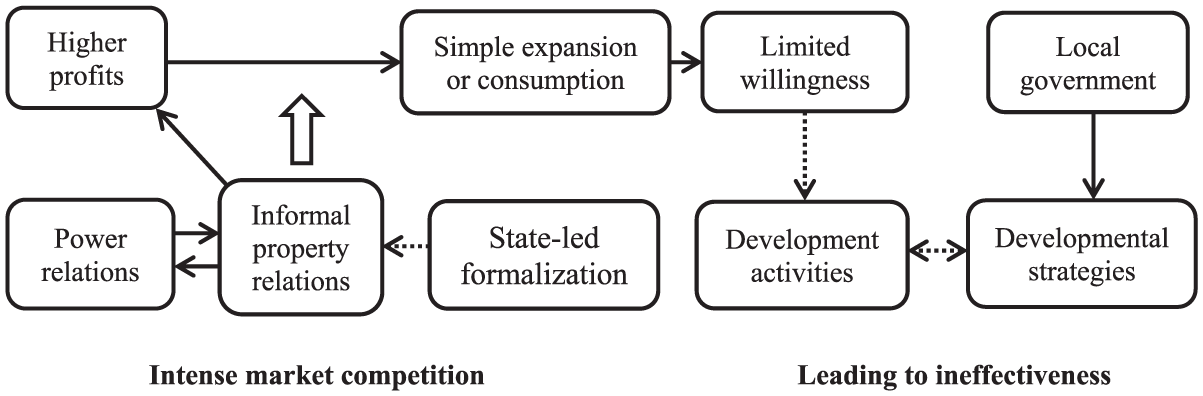
The causes of rural industrial stagnation and the ineffectiveness of existing developmental strategies.
Case Study: Yu Township in Northern China
Yu Township, located in northern China, provides a compelling research case for examining these dynamics. 4 It is close to Zouping county, where scholars have investigated how rural China has been taking off (Oi, 1999; Oi and Goldstein, 2018). Despite initially being dependent on agriculture, like townships in Zouping, it experienced rapid rural industrialization after 1985. Before the 2000s, local industrial factories were mainly established by the township government and village collective organizations. However, after the 2000s, many rural residents left the agricultural fields or collective TVEs and began establishing private factories. Influenced by local industrial tradition, most of them produced basic machinery, such as speed reducers 减速机, pumps 泵, and motor drums 电动滚筒, as well as the castings associated with these products. As a result, Yu Township had become the largest industrial township in the county by the early 2010s. However, what makes Yu Township a particularly intriguing research subject is that its rural industrial development aligns with the underdeveloped state of rural industry at the national level.
Although official statistics do not directly provide data on industrial value-added because of the incomplete statistical system, an economic investigation conducted by the Yu Township government in October 2018 can serve as a valuable reference. These data, obtained through local officials in Yu Township’s economic department, represent the most comprehensive and detailed survey of Yu Township’s rural industry to date (see Table 1). They provide information on the number of workers and sales revenue for 2016, 2017, and January–September 2018 for all industrial enterprises in the township, revealing significant divergence among enterprises.
The Divergence of Rural Industry in Yu Township, 2016–2018.
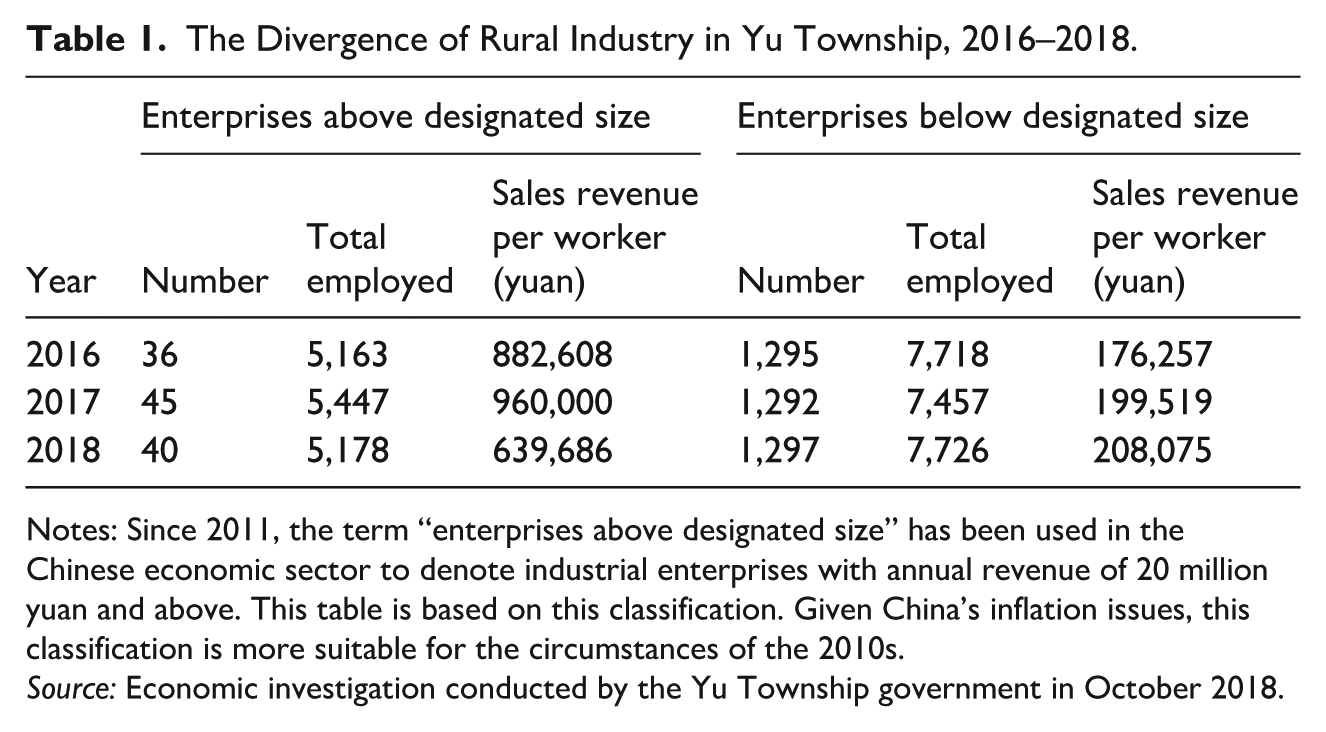
Notes: Since 2011, the term “enterprises above designated size” has been used in the Chinese economic sector to denote industrial enterprises with annual revenue of 20 million yuan and above. This table is based on this classification. Given China’s inflation issues, this classification is more suitable for the circumstances of the 2010s.
Source: Economic investigation conducted by the Yu Township government in October 2018.
Based on these data, Table 1 provides an overview of the numbers of enterprises above and below designated size, as well as their total employment figures and sales revenue per worker during the three periods: 2016, 2017, and January–September 2018. We can directly compare the data for 2018. In 2018, the number of enterprises below designated size was considerably higher than the number above designated size, at 1,297 and 40, respectively. Additionally, small and medium enterprises employed significantly more workers, numbering 7,726, compared to 5,178 in large enterprises. However, sales revenue per worker 5 in large enterprises exceeded 600,000 yuan, whereas in small and medium enterprises, it was approximately 200,000 yuan. Notably, the operating conditions of enterprises above designated size are generally more standardized, leading to more accurate statistics regarding the number of workers. Worker numbers in small and medium enterprises may be underreported, potentially obscuring true employment figures. Therefore, it is likely that the sales revenue per capita of small and medium enterprises would further decline if the number of underreported workers were taken into account. Furthermore, analyzing the data from the three-year period highlights a stable divergence between enterprises above and below designated size. Despite their low sales revenue per worker, small and medium enterprises maintained consistent employment figures over time, suggesting resilience in the face of market competition.
There is another important aspect that cannot be overlooked. Enterprises above designated size may find it challenging to significantly reduce labor costs in the short term, as many production processes still require manual operations. On the other hand, some small industrial enterprises can generate relatively high total sales revenue with a very small workforce if they receive sufficient orders during a certain period and rely on the production support of a local flexible industrial network. Consequently, their sales revenue per worker can also be high. This explains the finding that several small enterprises in Yu Township have had a sales revenue per worker of over 700,000 yuan in some years. However, given the low profit margins of their products, it is not feasible for them to invest in advanced technology to enhance productivity. In contrast, large enterprises, which generally have much higher total profits than small enterprises, are better able to invest in advanced equipment in their future development. Based on this, it can be predicted that although a few small enterprises may currently have a sales revenue per capita comparable to some large enterprises, the development gap between them will widen over time.
To summarize, most industrial enterprises in Yu Township have been locked in an underdeveloped state, and the proportion of small and medium enterprises is very high, approaching 97 percent of the township’s total number of rural industries. Concurrently, the local government has implemented several developmental strategies similar to those adopted in developed regions. However, these efforts have proven less than effective. The few enterprises above designated size in the area have become the main group cooperating with the strategies, and nearly all of them are formerly state-owned or collectively owned. In contrast, all enterprises independently established by rural residents lack the developmental performance to align with such strategies, even though some are profitable. This represents a distinctive phenomenon compared to more developed regions, where advanced enterprises not only result from external investments or the transformation of publicly owned enterprises but also from industries independently established by local people. 6
With the help of the head of the Yu Township government and officials from the township economic office 经委, I conducted a systematic interview study in 2019. Using the 2018 list of tax-paying industrial enterprises in Yu Township, 7 I randomly selected sixty enterprises, each with an annual tax amount below one million yuan. Then, the local officials helped me contact three entrepreneurs each day. When entrepreneurs agreed to the interviews, I traveled to their factory on my electric bicycle. If an entrepreneur refused to be interviewed, I would select another enterprise with a similar tax payment amount as a replacement. Most interviews lasted between one and two hours, primarily because the rural entrepreneurs were extremely busy and would be displeased if the interviews were too time-consuming. However, for those who had the time, I asked more detailed questions, extending some interviews to three or four hours. In the end, I interviewed 59 rural entrepreneurs. In addition to these interviews, I collected a significant amount of economic materials from archives at the township government and conducted over ten interviews with local government officials for a broader understanding of industry in Yu Township. Using these data, I will first analyze the informal property relations within rural industries.
Informal Property Relations in Yu Township
My fieldwork shows that informal property relations have emerged in Yu Township with the expansion of rural industry beginning in the mid-1990s. At that time, the role played by the local government was more non-interventionist. This provided institutional space for the rapid expansion of small and medium enterprises, and at the same time hindered the strict enforcement of institutional requirements regulating property relations. In the absence of state coercive power, property relations were primarily shaped by the power dynamics among local actors, such as entrepreneurs, workers, village cadres, and villagers. This ultimately led to the emergence and stabilization of three main types of informal property relations: informal employment relations, informal land-leasing relations, and informal use of environmental resources. As shown below, although entrepreneurs should ideally acquire the essential means of production through market transactions, these informal relations have allowed them to obtain such means at prices far below the standard market rates, thereby keeping production costs very low.
Informal Employment Relations
From the 1990s to the 2000s, as a large number of people left the agricultural sector, rural entrepreneurs were able to easily hire workers at low wages. In the early 2000s, the annual per capita income of rural residents in Yu Township was only a few thousand yuan. With industrialization, rural workers’ wages have gradually risen. However, their actual earnings have remained significantly lower than those of workers in urban areas. For instance, based on data from interviews conducted in Yu Township, the average monthly income of workers in 2018 was approximately 3,000 to 4,000 yuan. In comparison, the average monthly wage for employees in urban nonprivate manufacturing units within the same prefecture was around 5,600 yuan. But in Yu Township, wages also vary by industry and type of work. For example, in upstream foundries supplying castings to machinery manufacturers, workers are paid on a piece-rate basis, with most earning between 7,000 and 8,000 yuan per month.
How should the wage levels of workers in Yu Township be understood? According to official data from the province where this township is located, as recently as 2018 the monthly minimum wage for workers was set at only 1,730 yuan. From a Marxist perspective, this represents the monetary amount necessary to sustain the reproduction of labor power each month, corresponding to the value of the goods required for subsistence. In contrast, according to the actual situation of the local labor market in 2018, wages have risen well above the cost threshold Marx would have set. To a large extent, this is because competition among entrepreneurs for skilled workers has led to continuous wage growth. Eventually, this wage level becomes institutionalized in labor contracts, forming the transaction standard. 8
However, unlike the competitive fragmentation observed among employers in the market for skilled workers, entrepreneurs in Yu Township still share collective class interests that allow them to violate the established standards. As a base, they possess power in the Marxian sense because they control most means of production. Workers typically face significant challenges in migrating elsewhere, and, unlike young workers in the Pearl River Delta, most are married. With elderly parents and children to support, their family-based consumption needs undoubtedly increase the survival pressure they face and heighten their dependence on entrepreneurs. As a result, entrepreneurs successfully engage in collective actions that deviate from the established transaction standards, including unilaterally extending working hours and maintaining harsh working conditions, providing little or no compensation for these conditions. This is even worse in foundries, where the high-temperature environment causes serious harm to workers’ health. Furthermore, many entrepreneurs attempt to keep employment informal from the outset, without signing any contracts. While workers are aware that these practices are unreasonable, their primary concern is survival rather than contesting the informal employment relations. This aligns with the “subsistence ethic” logic described by James Scott (1976: 6), which makes informal employment relations remarkably persistent.
Beyond the low wages, entrepreneurs’ informal access to labor is further evidenced by their near-total lack of contributions to workers’ social insurance. In China’s current social insurance system, which includes medical care, pension, work injury, maternity, and unemployment insurance, pension insurance is undoubtedly the most important as it directly involves the payment of retirement benefits to workers. The payment for insurance is jointly borne by workers and employers. For example, under the social security policy for Yu Township’s industries in 2018, the monthly minimum contribution base 缴费基数下限 for employees’ pension insurance was set at 60 percent of the province’s average monthly wage in the previous year, amounting to about 3,400 yuan. Most rural private enterprises opted for this minimum base, with workers each contributing the government-mandated 8 percent of the base (roughly 270 yuan), which was deducted from the workers’ wages, and enterprises contributing an additional government-mandated 18 percent of the base (roughly 610 yuan) per worker. The total monthly pension insurance contribution for one worker was therefore about 880 yuan. Consequently, workers become eligible to receive a certain monthly insurance payout upon retirement, provided their total contribution period reaches at least fifteen years.
For a long time, especially before the 2010s, despite the implementation of social security policies, these policies remained unfamiliar to many rural people accustomed to an agricultural society without such institutions. Even when some workers were aware of these policies, employers, who held absolute resource advantages, determined the arrangements and often refused to make social insurance contributions. Workers had little choice but to accept this. Moreover, in order to promote economic expansion, local governments generally did not strictly enforce the policies. Since the 2010s, however, these circumstances have changed, as local governments have begun to enforce the social insurance system more strictly. With state coercive power on their side, even if workers initially complied with the entrepreneurs’ refusal to pay social insurance, they now had the option of reporting the violation to government agencies while on the job. As a result, employers could no longer rely solely on the threat of non-hiring to avoid paying insurance. This strategy did not eliminate the possibility of being penalized by the government and therefore became increasingly risky.
Nevertheless, rural entrepreneurs have found ways to avoid paying pension insurance for most workers. My fieldwork indicates that entrepreneurs typically offer workers an extra two to three hundred yuan per month if they forego social insurance payments. Although this additional salary is less than what social insurance would cost the enterprise, it directly supports workers’ immediate economic needs. In this way, entrepreneurs create new resources on which workers become dependent, thereby consolidating their power and shaping workers’ acceptance of these illegal practices. Consequently, this produces an implicit agreement between entrepreneurs and workers, facilitating the evasion of local labor department inspections. For example, the owner of Shuosheng Machinery Enterprise informed me that he reported only twenty workers as enrolled in pension insurance to the local labor department during inspections, even though there were actually forty workers in his factory. Moreover, the remaining uninsured workers did not attempt to report the entrepreneur’s illegal conduct.
In such circumstances, the workers who resist such arrangements usually face significant pressure from the entrepreneur’s social network, which reinforces the latter’s dominant status in employment relations. During fieldwork, I learned about a notable incident: A female worker, dismissed by a grinding wheel factory, sued the factory for not paying her pension insurance, and the court ultimately ruled that the factory should pay her a significant amount of compensation. However, this was seen as significant news by locals because people rarely pursue their interests through institutional channels such as courts. Adopting such a method means offending the social network formed by local entrepreneurs. As a result, workers may find it hard to secure employment with other entrepreneurs who also prefer to maintain informal property relations. Considering their livelihoods, the best choice for workers remains reaching a compromise with the entrepreneurs.
Informal Land-Leasing Relations
Land ownership in China exhibits a dualistic structure: land in urban districts is under state ownership, while land in rural and peri-urban areas is predominantly owned by rural collectives. The majority of rural collective land has been distributed to villagers for agricultural activities (referred to as cultivated land) and for building houses (known as homesteads). According to the Land Administration Law of the People’s Republic of China 中华人民共和国土地管理法 revised in 1998 (Article 43), construction land for industrial enterprises is generally required to be state-owned land. Therefore, for rural land to be used for industrial purposes, it must first be converted into state-owned land by the local government through a land acquisition and compensation process, and then its use rights can be transferred to enterprises through the auction system. The auction price is usually much higher than the compensation awarded to villagers for relinquishing their cultivated land. Therefore, paying the auction price requires entrepreneurs to have a significant amount of money, making it difficult for them to obtain such construction land for rural factories.
However, aside from the mainstream land-use policies, another system exists that allows a portion of collectively owned rural land to be utilized for industrial development. This land is termed “collective construction land for commercial use” 集体经营性建设用地. Originally intended to bolster the growth of collective TVEs in rural areas, this type of land was made legally available for lease to private entrepreneurs by village collective organizations after numerous collective enterprises closed in the late 1990s. Additionally, in the early 2000s, rural individuals could, with the assistance of village cadres, undergo legal procedures to directly convert existing cultivated land into this type of land, provided it complied with the land-use projects set by the local government. However, since the late 2000s, because of the significant revenue that rural land can generate for local governments through the auction system, it has become nearly impossible for entrepreneurs to acquire the right to use more rural land through this method. As a result, while the majority of rural entrepreneurs are using this type of land, its total area has remained nearly unchanged since then. Nonetheless, rural entrepreneurs have significantly reduced costs through the informal use of this land.
In the early 2000s, most rural areas of Yu Township remained desolate, and the rent for such collectively owned land was extremely low. Some rental contracts were also signed for extended periods, lasting ten years or more. Entrepreneurs could therefore pay the rent in a lump sum, thereby mitigating potential rent increases resulting from economic development and reducing production costs. More commonly, however, many entrepreneurs gradually managed to avoid paying rent altogether, even when formal contracts were in place. Theoretically, in Yu Township, as the number of people seeking to rent land increases, village cadres, the actual controllers of limited land rights, possess the power to establish transaction standards, including the area of land to be rented, the rent amount, and the payment schedule. If entrepreneurs fail to fulfill their contractual obligations, village cadres also have the authority to reclaim the land.
However, in practice, renting collective land in a village requires entrepreneurs to be registered under that village’s hukou system. This gives them the qualification to elect village cadres and provides them with resources that the cadres depend on, making it difficult for the latter to effectively supervise the implementation of land-leasing contracts. For example, the director of Yin Village mentioned that it was challenging to collect rent consistently after leasing land to villagers, who usually viewed past rent payments as equivalent to permanently purchasing the land.
Village cadres also find it difficult to reclaim land through stringent methods. Strictly demanding the rental money may lead to conflicts, posing a threat to the evaluation of village cadres who are responsible for protecting villagers’ interests and thus affecting their positions in subsequent collective elections. Moreover, anticipating potential benefits from entrepreneurs with whom they have close personal ties, village cadres often voluntarily relinquish their power to require entrepreneurs to fulfill contracts or otherwise reclaim the land. Local entrepreneurs also confirmed this informal interaction pattern in the land rental process. One factory owner in Yin Village related that, despite renting collective land, his close personal ties with the village director led the latter to explicitly state that, as long as he maintained a leadership position in Yin Village, the factory owner could continue using the land for free. 9
Additionally, according to the law, all rural entrepreneurs are required to pay a land-use tax. This constitutes another part of their cost expenditure and can be regarded as the initial formalization by the local government of informal land transactions. However, according to interviews, there is a widespread discrepancy between the land area taxed and the actual area specified in the leasing contracts. Typically, local entrepreneurs only need to report the area their factory buildings actually occupy to the local tax department and pay a fixed amount of tax over the long term, without being taxed for the remaining land used for storing raw materials or other purposes. For instance, the owner of Guanhui Machinery Factory leased five mu 亩 of land in a village for 2,500 yuan per mu and paid a lump-sum, ten-year rent totaling 125,000 yuan. However, for tax purposes, he declared and paid tax only on the three mu of land that contained buildings, not on the remaining two mu used solely for storage. For local tax officials, compelling rural entrepreneurs to pay the full land-use tax is challenging because these informal practices have become so widely accepted among them. Attempting to change this situation would likely provoke significant resentment from rural entrepreneurs and require a considerable amount of effort in communication. In other words, the deep social embeddedness of the land-use pattern has left the local tax department too weak to transform this situation.
Informal Use of Environmental Resources
The third cost that local factories save on is the environmental cost. According to the interviews, for manufacturing enterprises such as those producing machinery like speed reducers or pumps, the sources of pollution involve metal chips produced during the processing and assembly of parts, as well as harmful emissions caused by the use of chemical varnish on the machinery’s surface. For a long time, metal chips have been randomly deposited on the ground, and harmful emissions have been released into the atmosphere indiscriminately. Additionally, the presence of numerous casting and parts-processing factories that supply machinery manufacturers with essential parts has resulted in more severe environmental pollution. Especially before the mid-2010s, all casting factories relied on coal to melt steel for casting, generating a great deal of air pollution. However, despite the increasing severity of these pollution issues, few villagers have taken steps to protect their living environment. This contrasts with Karl Polanyi’s prediction that a social protection movement would be invoked to resist the harmful impacts of capitalist economy, which commodifies environmental elements such as soil, water, and air and destroys them (Polanyi, 1944: 150).
The former director of the county economic development bureau told me that the Yu Township government had previously focused on promoting rapid GDP growth and was less strict in enforcing environmental policies. This institutional logic, prioritizing economic growth above all else, undoubtedly exacerbated environmental pollution. However, it does not explain why rural residents, those directly affected by environmental pollution, still choose to turn a blind eye to it. As discussed in the theoretical section, villagers’ cognitive definition of property rights to environmental resources requires that enterprises compensate for their use. By transforming them into polluted air, polluted water, and polluted soil, entrepreneurs are, in fact, using what are originally natural environmental factors as production inputs, much like labor or land. More importantly, when villagers are the original owners of these environmental resources, and when entrepreneurs urgently need them, villagers should in theory hold a dominant position in such transactions and should help to establish the transaction standard.
In reality, however, formal transactions rarely materialize. This is not simply because some villagers fail to recognize the value of their rights to these resources, but more fundamentally because their demands on entrepreneurs are constrained by the entrepreneurs’ power that is derived from control over other resources. Villagers hope to receive assistance from entrepreneurs in the future. Although such assistance is not guaranteed, their dependence on the possibility of receiving it leads them to relinquish the power to establish formal transaction standards. In informal transactions, entrepreneurs are often able to use environmental resources at extremely low prices.
The case of water pollution in Shang Village provides an excellent illustration of this logic. In the western part of the village lies a mountainous area. Initially, with the tacit approval of the village cadres, several villagers occupied this area and began mining stone. Later, after large quantities of stone had been extracted and many deep pits had formed, a chemical factory began paying these villagers some money and dumped chemical waste there. However, as the pollution became increasingly apparent, other villagers organized collective actions to block the trucks transporting the waste. They asserted that the mountain area belonged to the entire village community and demanded that the factory pay fees on their terms; otherwise, it would not be allowed to continue dumping. The factory eventually agreed to make the payments. By contrast, although many people in the same village also built factories and discharged pollutants directly into the air or river, it was rare for villagers to openly criticize them. Even when villagers sometimes requested compensation based on mutual recognition of property ownership, the amount these factories paid them remained far below the compensation standard paid by the chemical factory.
The Limited Willingness of Entrepreneurs to Develop
The power dynamics outlined above have significantly contributed to the stability of informal property relations within rural industries in Yu Township. These informal property relations have, in turn, played a key role in fostering industrial expansion. In the early 2000s, rural residents seeking to establish factories often faced challenges because of insufficient initial capital. In this context, informal property relations effectively reduced the costs of establishing a factory. As a result, the number of industrial enterprises in Yu Township grew rapidly, surpassing 1,200 by 2018. This expansion also led to more intense market competition. Many interviewees highlighted the increasing pressures from competition. For example, Director Wang of Bolaige Factory noted that the price of speed reducers dropped by approximately 30 percent from 2008 to 2018. Similarly, Director Chen of Hengzi Factory reported that annual net profits, which accounted for about 15 percent of total sales in 2008, had declined to around 8 percent by 2018.
It is understandable that, under intense market competition, most small enterprises struggle to earn sufficient profits and must rely on informal property relations to survive. However, by relying on the substantial cost savings afforded by informal property relations, some enterprises have been able to generate significant profits annually over the past ten to fifteen years. Theoretically, intensified market competition appears to increase the likelihood that relatively profitable enterprises will invest in development activities, even though most still need bank loans or require several years to accumulate sufficient capital. However, because of the strong expectation that production costs will remain low for a long time, such enterprises in Yu Township face little pressure to raise productivity to generate higher profits needed to secure production inputs and continue production. As a result, they exhibit limited willingness to invest in development activities, such as technological upgrading, which carry high financial risks.
Instead, annual profits earned by entrepreneurs are primarily allocated toward the simple expansion of production scale or personal consumption. On the one hand, the informal use of production factors enables rural entrepreneurs to increase total profits simply by expanding the scale of production, such as by hiring more workers or constructing additional factory buildings. This makes investments in development activities unnecessary. Some entrepreneurs also choose to expand vertically along the production chain. For instance, a speed reducer manufacturing enterprise invested over one million yuan to establish a foundry after several years of operation. The entrepreneur recognized that, although the foundry required significant investment in fixed costs, such as purchasing the furnace, the variable costs of production were relatively low, yielding high returns. However, these resources could have been allocated to improving the productivity or quality of the core speed reducer manufacturing.
On the other hand, the expectation that the costs of production factors will remain low in the long term also leads entrepreneurs to allocate profits to personal consumption. Undoubtedly, changing consumption attitudes, especially the growing association between social status and material wealth, influence this trend. In rural areas, success is often materialized through assets such as houses and cars. The majority of entrepreneurs I interviewed have purchased houses in urban areas, while those who remain in villages are often admired for their wealth. However, compared to the social consumption demands and the cultural factors behind them, the structural constraints imposed by property relations exert a much stronger influence. Only when costs are maintained at a very low level and entrepreneurs are no longer in a rush to invest in development activities can greater consumption become possible. If the costs of production factors increase too suddenly, or are expected to rise in subsequent production cycles, entrepreneurs would be compelled to prioritize addressing these challenges over personal consumption and would likely choose to accumulate profits for further developmental investment.
Consider a typical case that clearly illustrates this dynamic: Sun’s factory primarily produces cylinder shafts and, compared to other small enterprises, has consistently maintained relatively high annual profits. By 2015, its sales revenue reached 5.4 million yuan, with an annual profit of around 800,000 to 900,000 yuan. By 2018, sales revenue grew to over 8 million yuan, with estimated annual profits of around 900,000 to 1,000,000 yuan. This profit level places the factory near the top of private enterprises in the town. Tax data supports this observation: the factory paid 176,000 yuan in taxes in 2015, placing it in the top 20 percent of all enterprises in the town. By 2018, the total tax paid rose to 497,400 yuan, placing it in the top 10 percent of enterprises in the town, with only about one hundred enterprises reaching this level.
These relatively high profits primarily stem from the low production costs maintained by informal property relations. For instance, the factory employs around twenty-five workers, with an average monthly salary of approximately 4,000 yuan. Except for two employees, who are close relatives of Sun, none of the workers receive paid pension insurance. Sun admitted that labor costs make up a very small proportion of total expenses. If we estimate based on the previously mentioned baseline average monthly wage of 5,190 yuan in 2018 (see note 8) and the insurance contribution standards of the province (more than 600 yuan in 2018), the savings in production costs would amount to at least 500,000 yuan annually. Additionally, the factory occupies four mu of village collective land. The village, being relatively poor, signed a symbolic thirty-year lease agreement with Sun’s factory. This arrangement saves the factory at least 100,000 yuan per year. The factory has also made no investments in environmental protection, further reducing costs. Overall, the factory saves at least 600,000 yuan annually, nearly two-thirds of its total profits.
Furthermore, Sun is confident that such low costs will be maintained. Therefore, even as market competition intensifies, particularly with many workers leaving Sun’s factory to start similar businesses, Sun remains reluctant to invest in technological upgrading. He mentioned that, while he can easily obtain bank loans, he has no plans to do so. If orders increase, his approach is to directly hire more workers, who require only minimal investment. Consequently, Sun maintains sufficient funds for personal expenditures, including purchasing a large villa in the urban area, buying luxury cars, and covering his daughter’s high tuition for pursuing media studies in college.
About 10 to 20 percent of the enterprises in Yu Township are similar to Sun’s factory. They should have been the group of enterprises most capable of developing and overcoming industrial divergence. Yet what hinders them is not a lack of investment capacity but rather a limited willingness to invest and develop. In such cases, market competition can no longer be regarded as the usual incentive described in neoclassical economics, nor even as a Schumpeterian process of creative destruction. It does not translate into real pressure on entrepreneurial decision making. In the ideal neoclassical economic model, market competition ultimately forces some enterprises out of the market. However, the phenomenon observed in Yu Township is precisely the opposite. For most small enterprises, profits indeed continue to decline under competition, but they do not go bankrupt directly. Rather, they persist stubbornly in the market by relying on their informal property relations, a situation that prevents other enterprises from gaining their market share. For other relatively profitable enterprises, such as factories like Sun’s, it is also difficult to classify them as losers in market competition, since market competition hardly exerts any influence on them at all. Their stagnation results instead from their deliberate passivity toward competition.
The Ineffectiveness of Existing Developmental Strategies
Since the mid-1990s, the local government actually has implemented some strategies to enhance the development of rural industries in Yu Township. Notably, in the mid-2010s, the central government of China shifted its focus from prioritizing high-speed growth 高速增长 to emphasizing high-quality development 高质量发展. Under the institutional pressure created by this policy shift, promoting technological upgrading in existing industries and transitioning to new industrial fields has become one of the determinants for local officials to ascend to higher political positions. Proposing developmental projects can also help the local government obtain essential financial support from higher levels, which is especially significant given the tight fiscal conditions at the county and township levels. Meanwhile, as local officials have become increasingly professionalized, they have also acquired the capacity to formulate and implement more reasonable developmental strategies. They often visit developed regions to study and imitate their approaches. Moreover, they recognize the backward state of local industries and regard promoting their development as necessary. Therefore, the local government has since implemented more comprehensive and normative strategies. In addition, these strategies usually have distinctly open characteristics, meaning they are not solely aimed at large enterprises but also seek to promote the development of small and medium enterprises. However, mainly because of the unwillingness of entrepreneurs to engage in development activities described earlier, these strategies, although beneficial to a few large enterprises in Yu Township, have failed to achieve greater effectiveness, resulting in an increase rather than a reduction in the divergence among rural industries in Yu Township.
No One Qualifies for Financial Subsidies
The experiences of many developmental states have proven that providing necessary economic incentives to enterprises with good performance is one of the most effective measures to promote industrial development. For the industries in Yu Township, the government at various levels had formulated such policies even before the 2000s, and most of these policies were still active during the period of my fieldwork. The amounts of these incentives are quite substantial. For instance, according to a document issued by the prefectural government in 2017 to promote the technological upgrading of industry, for investment projects with a scale of over 5 million yuan that meet the designated criteria for technological transformation, the local government will provide a subsidy equal to 10 percent of the equipment expenditure. As another example, according to a provincial document published in 2019, if an enterprise qualifies as a high-tech enterprise 高新技术企业, it can enjoy a 15 percent reduction in income tax and a 50 percent reduction in land-use tax. 10 Governments at different levels will also provide a reward subsidy of 100,000 yuan to those that meet the conditions.
Securing subsidies undoubtedly enhances the competitiveness of enterprises, enabling them to fully transition out of the category of small and medium enterprises. In turn, the government bases its decision to continue providing such subsidies on whether the enterprises maintain their investment efforts, thereby exercising disciplinary power to encourage sustained development. However, to secure the subsidies in the first place, the enterprises must already have invested significantly in development activities. For example, to qualify as high-tech enterprises, eight requirements must be fulfilled, including possessing ownership of intellectual property rights in core technologies and ensuring that the proportion of personnel engaged in research and development (R&D) activities is no less than 10 percent of the total number of employees and that income from high-tech products accounts for at least 60 percent of the total revenue. All these requirements necessitate substantial investments.
Most small and medium enterprises in Yu Township naturally lack the capacity to invest. Yet even those enterprises that have earned substantial profits, such as Sun’s factory, have refrained from investing in development activities because of the influence of informal property relations. Therefore, none of them either need or meet the requirements of the subsidy strategy, and its effectiveness is highly limited. Ultimately, the enterprises that qualify as high-tech enterprises and receive financial support are predominantly just a few above designated size. Most of those were transformed from original local SOEs or large collective TVEs, and their development paths thus differ fundamentally from those of the majority of rural enterprises independently established by local residents. In fact, the main difference between them and other enterprises is that their property relations are usually more formal. Moreover, since all the small and medium enterprises are either unable or reluctant to develop, they cannot contribute more to the fiscal revenue of the local government. Consequently, the local government has been burdened with a significantly high level of debt, as mentioned by Li, who was in charge of the county economic development bureau. This situation has left enterprises that meet the criteria unable to receive timely funding allocations.
After the mid-2010s, the central government enacted an increasing number of policies tailored to small and medium enterprises, and local governments developed corresponding policies. However, even though the requirements for these policies are less stringent than others, such as those for qualifying as a high-tech enterprise, local governments still find it difficult to elicit proactive responses from entrepreneurs. The main reason is still that those enterprises with the greatest potential to develop have abandoned investment.
As a result, it is not the local enterprises but rather some more technologically advanced companies from outside that have benefited from such policies. For instance, during the application process for a technological innovation project for small and medium enterprises initiated by the prefectural government in 2018, not a single enterprise from the local rural industries received a recommendation from the Yu Township government. In the final list of recommended applications, one was a subsidiary of a formerly state-owned enterprise originally located in an urban area, while the other two were small enterprises that had just been attracted from outside. They all possessed independent R&D capability, which is crucial for the application. In short, local industries have been totally excluded from the subsidy strategy.
Separation from Advanced Enterprises
There is no doubt that attracting investment from outside serves as a primary driver of China’s local economic development (Huang, 2011). Its impact is multifaceted. For example, when local enterprises cooperate with advanced enterprises in the same industrial field, they can integrate their products into the higher value-added commodity chains by leveraging the brand reputation or market status of the industrial leaders (Gereffi, 1994). Moreover, external investment in local areas is likely to generate technology spillovers, thereby driving the technological upgrading of local industry (Liu, 2008; Merlevede, Schoors, and Spatareanu, 2013). However, while the majority of rural factories in Yu Township lack capital and have naturally failed to adopt this strategy, even enterprises with potential investment capacity show little interest in upgrading their technologies. This lack of engagement in development activities renders them incapable of assimilating advanced technological knowledge, thereby limiting their ability to collaborate with advanced producers attracted from outside and ultimately causing them to miss better development opportunities.
According to tax records, the leading taxpayer among industrial enterprises in Yu Township is a foreign-invested firm called GD, specializing in high-level speed reducers. Unlike other local enterprises, it received independent investment by German capital in the late 1990s. In its early expansion stages, GD frequently engaged with local factories, assimilating local technical talent and utilizing raw materials and machinery parts from the area. However, as GD developed, it gradually distanced itself from the local industrial chain. Interviewees primarily attributed this to GD’s ongoing efforts to improve product quality and remain competitive in the international market, while the products of local enterprises fell short of its standards. Even worse, some local factories attempted to imitate GD’s products using their own backward technology and to compete with it, disrupting market order and prompting GD to proactively terminate its cooperation with them. In other words, while it initially appeared feasible for local industries to integrate into higher-value-added commodity chains, the slow pace of technological investment, influenced by informal property relations within local industries, has widened the productivity gap between them and GD, making GD’s promotion of local industries impossible; rather, their informal operations have even driven away such supportive forces.
Certainly, after the mid-2010s, the local government has become more diligent in striving to attract sophisticated enterprises from other regions to invest locally. However, as the majority of enterprises drawn from outside have completed their initial capital accumulation and productivity improvements, the aforementioned problem has not diminished but rather has been exacerbated. A typical case is BJ Elevator Company, a subsidiary of a British-invested elevator firm operating in Hangzhou. Throughout its investment process starting in 2017, the Yu Township government extended numerous preferential incentives, including tax concessions, specialized fund assistance, facilitation of state-owned industrial land-use procedures, advantageous land-use pricing, and the free use of factory workshops in the local intelligent manufacturing industrial park. However, according to BJ’s investor, although he chose to invest in Yu Township, his intention was merely to source certified machinery parts from several large enterprises in the periurban area, but not to collaborate with the local small and medium enterprises. In his view, local factories were unable to meet the company’s requirements for product quality, which are crucial for maintaining brand reputation and securing market position. Therefore, the potential for cooperation between the newly introduced external capital and local manufacturing factories was precluded from the outset.
No Interest in New Technologies Provided
Apart from directly attracting advanced enterprises from outside, the local government of Yu Township also actively introduces companies focusing on technological R&D to assist local enterprises in technological upgrading. However, this strategy has not been very effective. Sun, who is in charge of the local intelligent manufacturing industrial park, openly admitted that most local manufacturing enterprises cannot afford the R&D services provided by these companies. Nevertheless, the most serious issue is that even enterprises with the capacity to invest show little interest in raising their technological level. This limits their need for technological assistance and also prevents external technologies from finding suitable adopters. This situation has even led outside companies to cease offering advanced technologies. For instance, the Yu Township government invited Shenyang First Machine Tool Company, renowned for its high-end lathes capable of fabricating intricate components for machinery such as speed reducers, to establish its operations in the intelligent manufacturing industrial park. As a result of this engagement, the company installed a considerable array of its machinery in the park for leasing to local machining factories. However, it turned out that all of the equipment was antiquated. Sun explained that when representatives from Shenyang First Machine Tool Company visited the area for an investigation, they found that the production capabilities of local enterprises were significantly lagging. With most local machining enterprises unable to afford the costs of high-end machinery, the company chose to install outdated lathes that met the local production demand instead.
In summary, developmental strategies resembling those that have propelled sustained economic growth in China’s developed regions have failed to promote rural industrial development effectively in Yu Township. To address this developmental dilemma, formalizing property relations is undoubtedly the most direct option. Doing so would allow market competition to resume its proper function: not only eliminating backward small enterprises but also compelling profitable ones to actively seek new paths for development. However, as will be shown below, such measures have also proven to be far from effective.
The Attempt by Local Government to Formalize Property Relations
My fieldwork revealed that the Yu Township government has recently attempted to implement measures to formalize property relations. In essence, such efforts fall within the scope of developmental strategies, specifically what Chalmers Johnson (1982: 27) terms “industrial rationalization policy.” Among these measures, the construction of industrial parks stands out as the most representative. As a common practice in early developmental countries (Hsueh, Hsu, and Perkins, 1991: 61; Vogel, 1991: 31; Woo, 1991: 129), establishing industrial parks serves as a significant strategy for promoting specialized industrial production, enhancing inter-enterprise technological cooperation, and fostering innovation. However, as a foundation for these objectives, its critical role is to promote the formalization of property relations.
According to economic reports from the local government, over fifty industrial parks were established in Yu Township beginning in the late 1990s. Yet all of them were built voluntarily by rural villages themselves, and the production patterns of the enterprises within them closely mirrored those of local enterprises outside the parks. Thus, these parks merely became spaces for informal property relations and rarely provided the impetus for development. As part of the county government’s economic development plan, after the 2010s, all of these industrial parks were consolidated into the electromechanical pump industrial park, which encompassed the entire area of Yu Township. However, even local officials admitted that this decision made little sense. For instance, Du, the deputy director of the Yu Township people’s congress, directly questioned the effectiveness of this vast industrial park and suggested that its name is misleading. In her view, a genuine industrial park should operate independently and consist of homogeneous enterprises to generate an agglomeration effect.
Only after the mid-2010s did the local government start to construct more formal and specialized industrial parks, including the micro-motor industrial park, the intelligent manufacturing industrial park, and the precision casting industrial park. During my fieldwork, the first two parks, solely invested in by the local government, already had operating enterprises, but all of them were attracted from outside the local area. The only park designed for local industry was the precision casting industrial park, which aimed to concentrate local casting factories to enhance their cooperation and formalize their property relations. Casting factories are located upstream in the manufacturing production chain. Compared with machinery manufacturing enterprises such as Sun’s, some casting enterprises even enjoy higher profits. At the same time, many advanced foundry practices in southern China are available for reference. Therefore, formalization should, in principle, promote their development. In particular, by formalizing their property relations, cost pressures were expected to be transmitted to downstream manufacturers and thereby stimulate their development. However, the outcome ultimately fell short of these expectations.
According to Du, who is directly responsible for the precision casting industrial park, it was a collaborative effort between the local government and a businessman named Zhou. Zhou held the use right to a large area of state-owned land and wanted to capitalize on it by constructing an industrial park to lease workshops to local casting enterprises. This initiative was in line with the development goal of the local government, promoting the swift commencement of the project. However, from the outset, it encountered significant challenges. 11 As the main investor, Zhou aimed to recover his investment and make a profit. He informed me that the rent for the workshops is around 150 yuan per square meter, with a minimum leasing requirement of 1,000 square meters for a single enterprise. Compared to industrial parks in other regions, this price is not high. However, all of the local casting enterprise owners that I interviewed expressed hesitation about this price. This is mainly because they tend to compare the rental cost with their former land-use costs, which were significantly reduced by the informal contracts mentioned earlier. Besides, moving into the industrial park not only increases the cost of utilizing workshops but also raises production costs associated with other formalized property relations. As industrial parks facilitate local government officials’ monitoring of production conditions, entrepreneurs have to allocate additional resources toward workers’ social welfare and environmental protection equipment. In comparison, local foundry owners unequivocally expressed a preference for maintaining operations within their existing factories, where they could effectively maintain informal property relations to mitigate costs.
Environmental Governance Enforced by the Central Government
The above analysis demonstrates that the local government can only guide enterprises toward the formalization of property relations, without the coercive power to enforce it. However, since the late 2010s, another noteworthy shift in China’s development strategy has occurred, with the central government placing greater emphasis on environmental governance as integral to economic growth. As a result, informal property relations, especially those production patterns in rural industries that are detrimental to the environment, have started to experience a profound transformation.
In early 2017, marking the culmination of the Action Plan for Air Pollution Prevention and Control 大气污染防治行动计划 formulated by the central government in 2013, 12 the Ministry of Environmental Protection and other departments issued strict governance measures to ensure the completion of targeted tasks. One of the most significant policies was the crackdown on “small, scattered, and polluting enterprises” 小散乱污企业 in rural areas. In the past, governments at various levels had frequently introduced environmental governance requirements for rural industries. However, the enforcement of such governance measures was often lax, with only a small number of enterprises included in each environmental investigation. This was primarily because coercive policies directly threatened the survival of local industrial groups, potentially leading to conflicts. These conflicts would significantly drain the energy of local government officials, making them reluctant to implement such policies. Moreover, this lenient approach to policy enforcement was tacitly endorsed by higher-level governments. Consequently, by 2017 local government officials generally became accustomed to the prevailing governance model and perceived the environmental governance as more symbolic than substantive. A clear indication of this is that the Yu Township government reported only a scant number of small, scattered, and polluting enterprises to higher authorities—and even then, only the most heavily polluting casting factories.
However, the intensity of the 2017 governance measures swiftly surpassed the expectations of local officials. Through various methods, including rigorous top-down inspections, detailed assessment methods at the prefecture and county levels, financial incentives and rewards linked to assessment results, and penalties for local government officials who fail to complete governance tasks, local officials underwent an immediate transformation from protectors to disruptors of rural industry. Specifically, Yu Township, one of the main industrial centers of the prefecture, underwent an abrupt inspection by the Ministry of Environmental Protection after the governance measures were implemented. The inspection uncovered a substantial backlog of environmental governance problems, resulting not only in prefectural government leaders being summoned by the Ministry of Environmental Protection but also in disciplinary actions against the mayors of the county and township governments. After this, the intensity of environmental governance in Yu Township reached unprecedented levels, with all industrial factories included within its scope. At that time, nearly all factories were abruptly shuttered and unable to resume production until environmental issues were rectified.
In the final phase of this campaign, most surviving enterprises invested substantial sums of money to improve environmental protection and other aspects of their production processes. For example, metal processing enterprises have procured dust-collecting grinding machines and welding-fume extractors to mitigate pollutants generated during grinding and welding operations. Manufacturing enterprises, faced with the necessity of frequent machine painting, have been mandated to establish dedicated spray booths. Although these measures did not require enterprises to compensate for the pollution caused by their previous informal access to use rights over natural resources, the requirement to install environmental protection equipment effectively led to increased production costs for local industries. In addition, as part of the environmental governance measures, further costs emerged. For instance, within factory premises, entrepreneurs have had to partition areas based on different functions and undertake activities such as cement hardening of the ground, wall painting, environmental greening, and posting of necessary regulations. All these endeavors entail significant investment. Moreover, upon completing environmental improvements, each factory had to undergo a conformity evaluation by third-party evaluation organizations designated by the government, with assessment fees from these agencies proving prohibitively high.
These financial burdens were not the only challenges that rural entrepreneurs faced. During the same period, another issue that had long troubled the local tax department also began to be addressed. When governance teams visited factories to inspect the environmental situation, they also surveyed the industrial land actually utilized by entrepreneurs. All enterprises that previously occupied land without paying sufficient taxes were required to make retroactive tax payments for the past three years. According to governance requirements, only by settling these back taxes could the environmental assessment finally be passed. Since operating without passing the assessment could result in substantial fines and even arrest, all entrepreneurs wishing to continue production had to comply with this requirement and pay the additional tax. Finally, according to reports released by the county government, the total amount of taxes that local enterprises needed to settle during the governance actions in 2017 exceeded 50 million yuan, directly increasing the total tax revenue of the county by nearly 11 percent for that year. Even in 2018, enterprises continued to pay tens of millions of yuan in land-use taxes. This has consequently led rural entrepreneurs to forfeit a significant part of the benefits previously gained through maintaining informal property relations.
Of course, as the upstream industries, especially the casting industry, benefited most from polluted production, this governance action impacted them the most. Replacing cupola furnaces 冲天炉 with more environmentally friendly equipment imposed a heavy burden on foundry owners. Some entrepreneurs even reported spending nearly one million yuan, an amount far exceeding the expenditures of most downstream manufacturing enterprises. As for many small machinery parts processing factories, their informal use of land, such as operating within their own homes, directly violated institutional requirements, leading to their immediate closure. Finally, to offset the substantial investment, surviving foundries and machinery processing factories had no choice but to increase the prices of casting and parts processing, thus contributing to the rising costs faced by downstream manufacturing enterprises.
The Survival of Informal Property Relations
The stringent environmental governance campaign promoted by the central government has profoundly reshaped the local industrial production landscape in Yu Township. It mobilized resources from various government departments to achieve a specific development goal, destroyed the institutional clientelism enjoyed by small enterprises (Li and Zhan, 2023), and served as a tangible example of campaign-style governance (Zhou, 2022: 20). However, although this governance campaign ultimately led to the direct closure of between three hundred and five hundred factories, 13 it also had its limitations. It is evident that, in the end, only the informal use of environmental elements and the informal payment of land taxes were transformed, primarily benefiting government officials themselves. In contrast, the formalization of employment and land-leasing relations was largely overlooked, mainly because such formalization would primarily benefit workers or village collectives, making it seem less advantageous to local governments. Additionally, ensuring a survival space for rural industries by not fully transforming informal property relations aligns with the social development objectives of local governments. While informal employment arrangements often lead to lower wages and diminished job security for rural workers, they at least sustain their basic livelihoods. Comprehensive formalization is likely to result in the closure of too many factories, thereby exacerbating unemployment and related social order issues. This also undoubtedly affects the political advancement of local officials. In the end, the remaining enterprises continue to benefit from informal labor and land-leasing relations, leaving them with insufficient pressure to pursue capital accumulation and further development. 14
When might the remaining informal property relations undergo formalization? There actually exist some potential conditions for this process. For instance, many entrepreneurs assert that young workers, deterred by uncomfortable working conditions and limited prospects for career advancement within rural factories, increasingly opt to migrate to urban cores that boast more job opportunities. Additionally, in Yu Township, young women tend to prefer marrying an urbanite, reducing the pool of potential partners for young men of rural villages and compelling them to migrate as well. This demographic shift has gradually created a shortage of young laborers, empowering workers’ negotiation aimed at securing higher wages and better welfare. However, the social networks that connect young workers to business owners, especially the Chinese concept of relationships that emphasize the order between elders and younger people, still largely limit their ability to demand more economic returns. Moreover, the continued presence of a significant number of older workers suggests that a total labor shortage will be delayed for many years. Moreover, changes in village leadership could also influence the formalization of property relations. The election of young leaders with a higher education level in rural villages may lead to a heightened emphasis on enforcing land rental contracts. Nevertheless, it is important to note that many of these newly elected leaders remain deeply embedded within local social networks, potentially limiting their ability to enforce such contracts effectively.
Conclusion
In an extension to existing developmental state theory, this article contends that the ineffectiveness of developmental strategies aimed at promoting the intensive development of small and medium enterprises is primarily attributable to entrepreneurs’ unwillingness to develop, engendered by informal property relations maintained through power mechanisms. This unwillingness, in turn, locks enterprises with investment potential into a stagnant situation. Although both local and central governments have attempted to promote the formalization of these property relations, the effects remain limited. It can thus be anticipated that the great divergence between a few large enterprises and other small and medium enterprises will persist for a long time, with very few of the latter likely to overcome it.
This study provides valuable insights for late-developing regions whose political and economic reforms lag behind the autonomous evolution of property relations. It illustrates the latecomer’s disadvantage from a unique perspective. When investigating why the adoption of a market system does not enable late-developing countries to achieve sustained prosperity, some economists point to the undue influence of existing political power within the market (Acemoglu, Johnson, and Robinson, 2005; Sachs, Woo, and Yang, 2002). In Yu Township, such influences were evident early on, distorting market competition and adversely affecting rural industrial development. For instance, while rural factories struggled to obtain bank loans in the early stages, SOEs in nearby urban areas could easily obtain financial support and were less concerned about profitability. Highlighting this issue, it may seem that the developmental problems could be gradually resolved through political-economic institutional reforms. However, as demonstrated, despite significant efforts by the central and local governments to transform themselves to be more developmental after the 2010s, these changes have not overcome the latecomer’s disadvantage. The primary constraint is precisely the informal property relations that emerged and stabilized during the period when the market was allowed to evolve autonomously.
This study also deepens our understanding of the substantive view of the economy, particularly Polanyi’s perspective on the relationship between the market and society, by analyzing the social construction of informal property relations. Polanyi argued that industrialization would inevitably lead to the commodification of land, labor, and environmental elements. From an economic perspective, the logical solution to the negative impacts of such commodification is to establish a formal property rights system that ensures returns to the owners of production factors within the market. However, the idea of the self-regulating market, disembedded from society and with comprehensive independent regulations, is fundamentally an imagined construct. When production factors are absorbed into the market, transactions involving their property rights remain embedded in society. Contrary to Polanyi’s view that the mechanism of social embeddedness forms the basis for social protection movements, the social construction of property relations instead constitutes the foundational condition under which production-factor owners experience losses in the commodification process. This embeddedness also highlights the distinctiveness of rural industrial development, as it is through the interaction between local rural society and industrial development that we can observe this process. In contrast, in peri-urban areas, the widespread existence of informal property relations among industrial enterprises is rarely observed.
Last but not least, while this study primarily explores the reasons for the ineffectiveness of developmental strategies from the perspective of the entrepreneurs themselves, the issue can also be examined from a different viewpoint. Given that the local government possesses a certain degree of autonomy and is embedded within industrial society, with an understanding of the stagnation in industrial development, why has it been unable to devise strategies better suited to local industries? While such strategies do not currently exist in Yu Township, making it difficult to envision their specific forms, two logical constraints on the local government’s ability to propose alternative developmental strategies can be inferred. First, the existing strategies are clearly legitimate. They can easily secure fiscal subsidies from higher-level governments and align well with the evaluation criteria set by those authorities. Even if industrial development ultimately fails, responsibility does not fall on the local government, which has already attempted reasonable strategies. Conversely, if local governments were to propose innovative strategies and they failed, they would bear the brunt of the criticism. Second, even if local government officials aspire to develop innovative strategies, they face the difficult reality of lacking the necessary funds to support them, which typically require more substantial investments. This creates a paradoxical situation: Developed regions do not need to consider innovative strategies for stagnant enterprises because they can rely on advanced enterprises for growth, while underdeveloped regions, though in need of such strategies, lack the essential conditions to create them. Future empirical research could provide a more comprehensive understanding of this perspective.
Footnotes
Acknowledgements
I would like to sincerely thank the anonymous reviewers for their valuable feedback and especially Professor Kathryn Bernhardt for facilitating the publication of this article. I am also deeply grateful to Professor Mark Cohen for his guidance during my research and to Qingguo Duan for his dedicated efforts in helping me organize the interview materials.
Declaration of Conflicting Interests
The author declared no potential conflicts of interest with respect to the research, authorship, and/or publication of this article.
Funding
The author received no financial support for the research, authorship, and/or publication of this article.
