







Abstract
This study examined the effect of information source on students' estimates of academic dishonesty. Undergraduates read an estimate of the incidence of academic dishonesty. Half of the participants were told that the source was a professor’s study and the other half heard that the source was a student’s study. Participants then estimated the likelihood that they, their friends, and the average college student would plagiarize or cheat on tests. Results indicated that when the source of the statistic was a professor, students were more likely to provide estimates of cheating and plagiarism that more closely approximated the provided statistic. The authors discuss how these findings might be used to enhance social norms campaign efforts.
McCabe and Trevino (1993) surveyed 6,000 undergraduates on 31 campuses concerning their attitudes toward academic dishonesty. Among their findings was that the strongest predictor that students would engage in academically dishonest behavior was students' perception of their peers' likelihood of engaging in these acts. By this account, students cheat because they believe that their peers also cheat. When specifically asked why they would plagiarize, or cheat on an exam, college undergraduates claimed that most of their peers were doing so and that if they did not cheat, then their grades would suffer in comparison to their peers (McCabe & Trevino, 1993). To this point, McCabe (1999) quoted one high school student as saying, “It’s almost a big deal if you don’t cheat” (p. 682).
It is interesting that when students compare their personal cheating habits with their peers, they report that their peers are more likely to engage in academic dishonesty than they are (e.g., Engler, Landau, & Epstein, 2008). Thus, if students believe that cheating levels the playing field (McCabe & Trevino, 1993) and they report that their peers are more likely to cheat and plagiarize, this provides students with their own misguided justification for acting in an academically dishonest manner.
To reduce certain targeted behaviors (e.g., alcohol abuse and substance use), researchers have devised social norms campaigns that directly address student misperceptions of the incidences of these behaviors. During a social norms campaign, campus administrators gather empirical data and then publicize the accurate statistics about the “average” college student’s consumption habits. According to Linkenbach (2002), Social norms theory states that much of people’s behavior is influenced by their perception of how other members of their social group behave. According to social norms theory, people tend to misperceive, i.e., exaggerate, the negative health behavior of their peers. If people think harmful behavior is typical, they are more likely to engage in that type of behavior. (p. 5)
By this logic, the effectiveness of any social norms campaign depends on providing students with accurate information about their peers' behaviors, which allows them to adjust their perceptions and their behaviors to more closely approximate the “average student.” There is an abundance of research showing that the source of a message influences the believability, and subsequent retention and use, of the information (e.g., Bink, Marsh, Hicks, & Howard, 1999; Johnson, Hashtroudi, & Lindsay, 1993). It is important that evidence suggests that students are sensitive to the source of social norms information. For example, Thombs, Dotterer, Olds, Sharp, and Raub (2004) reported that students were highly suspicious of statistics concerning alcohol consumption that emanated from the college administration. Similarly, Campo et al. (2003) found that perceptions of one’s friends' drinking behavior rather than information about the “average” student’s drinking behavior have a greater effect on an individual’s behavior.
This study examined how different information sources (professor vs. student) affected students' estimates of academic dishonesty. If students are more likely to believe (and use) normative information derived from perceptions of friends' or peers' behaviors (Campo et al., 2003), then we would expect estimates of academic dishonesty to more closely approximate the statistic when provided by a peer than by the faculty member. However, if students feel that a professor would be a more credible source with regard to academic dishonesty norms, then their estimates should be closer to the professor’s statistics.
Method
Participant and Institution Characteristics
One hundred twenty-seven undergraduates (59 men and 68 women) enrolled in general psychology courses earned partial course credit in exchange for their participation. Participants were first-years (70.1%), sophomores (19.7%), juniors (6.3%), and seniors (3.1%). The institution is a private liberal arts college that enrolls fewer than 6,000 students.
Materials and Procedure
We randomly assigned participants to either the “professor source” (n = 63) or “student source” (n = 64) conditions. Participants completed a survey assessing their estimates of different cheating behaviors. We introduced the survey with the following information (the term student or professor was randomly determined by group assignment): Recently, a student (professor) at York College of Pennsylvania conducted a study assessing the rate of academic dishonesty on campus. The student (professor) found that approximately 63.7% of YCP students engaged in at least one act of academic dishonesty during their college career. Examples of academic dishonesty include cheating on a test, looking over notes during a test, plagiarizing a paper or document for a class project, or letting others cheat off of you. Based on this information, please answer the following questions. Your survey answers are completely anonymous, so please answer truthfully to the best of your knowledge. If you are unsure of an answer, please generate the best answer you can.
Results
Figure 1 shows student perceptions of the three targets (expressed in mean percentages) of plagiarism and cheating in the two conditions (professor and student). We performed two separate 2 × 3 mixed design analyses of variance (ANOVAs) on plagiarism and cheating estimates to determine if source (professor vs. student) affected the three different target estimates (average student, friend, self). We set the Type I error rate at .05 for all of the analyses.
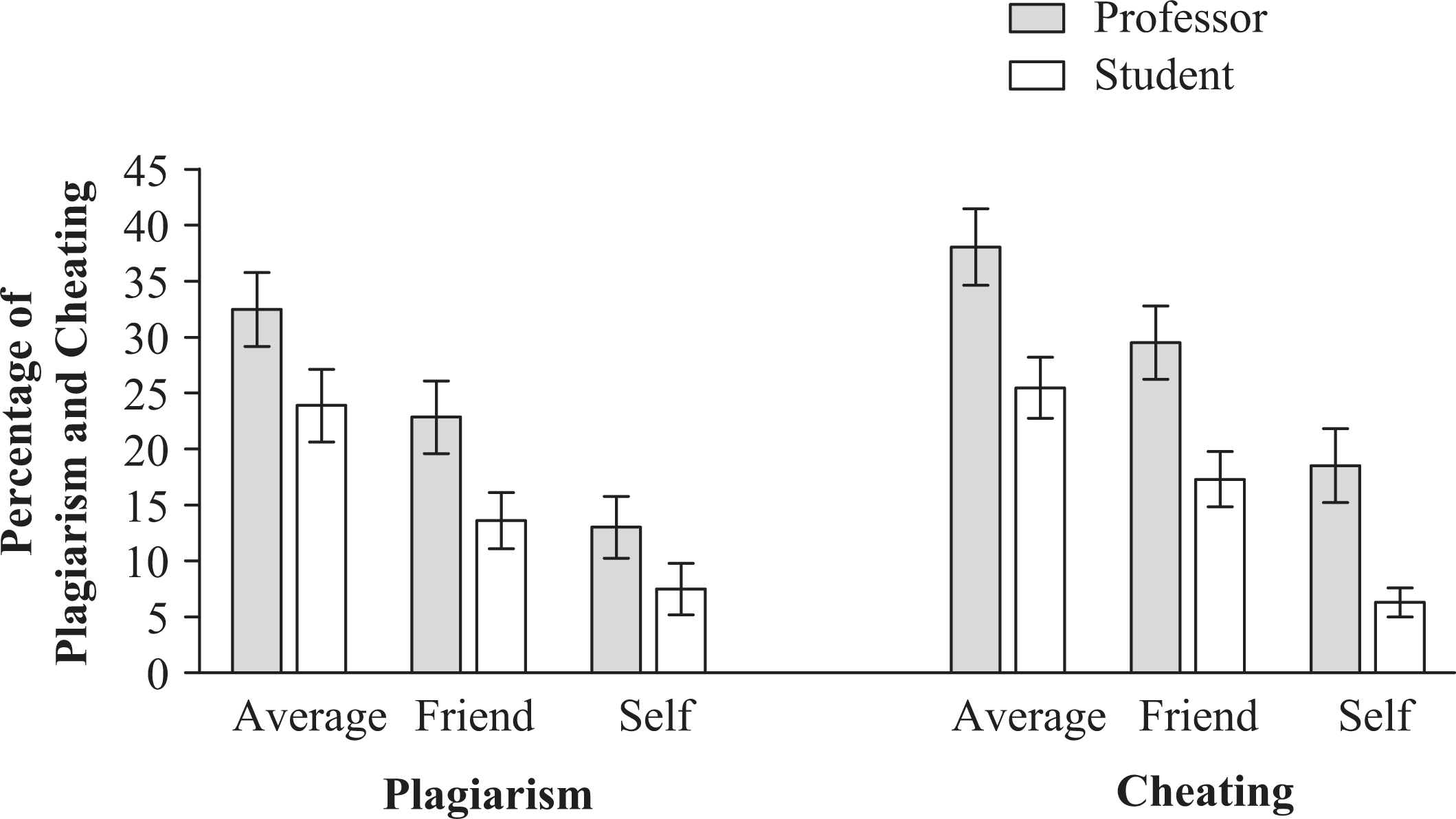
Participant ratings of plagiarism and cheating in the professor and student conditions
The ANOVA for the plagiarism measure revealed a significant main effect of source, F(1, 125) = 4.61, p = .03, η2 = .03, which showed higher estimates in the Professor condition (M = 22.7, SE = 2.75) than the Student condition (M = 14.97, SE = 2.36). The target main effect was also significant such that people showed increasing estimates of plagiarism as they moved from themselves (M = 10.23, SE = 1.77) to their friends (M = 18.21, SE = 2.01) to the average college student (M = 28.17, SE = 2.28), F(2, 250) = 63.21, p < .001, η2 = .33. The source by target interaction was not significant (F < 1).
As with the plagiarism measure, the ANOVA for the cheating measure revealed a significant main effect of source, F(1, 123) = 12.96, p < .001, η2 = .09, where people estimated more cheating in the Professor condition (M = 28.7, SE = 2.93) than in the Student condition (M = 16.35, SE = 1.84). The target main effect was also significant, F(2, 246) = 59.78, p < .001, η2 = .32. Consistent with the plagiarism measure, people showed increasing estimates of cheating as they moved from themselves (M = 12.41, SE = 1.74) to their friends (M = 23.40, SE = 2.03) to the average college student (M = 31.75, SE = 2.18). The source by target interaction was not significant (F < 1).
Both dependent measures showed the same pattern of results. Students provided higher estimates of plagiarism and cheating when a professor was the source of the information. Also, students believed that they would plagiarize and cheat less often than their friends and the average college student (see Engler et al., 2008, for an identical pattern of results).
Discussion
The results from this experiment demonstrated that when the source of a statistic about academic dishonesty was a professor, students were more likely to provide estimates of cheating and plagiarism that more closely approximated the provided statistic compared to when the source was a student. These findings are important because they demonstrate the importance of the source of the message when creating social norms campaigns designed to reduce academic dishonesty.
There are three main points that we wish to emphasize based on our results. First, it is clear that plagiarism and cheating are issues that educational institutions must address. Students admit that they are cheating, and they claim that they feel pressure to violate the academic integrity policies to keep up with their peers. As such, it is important that colleges and universities educate students concerning ethical academic practices. In their recent book examining cheating in schools, Davis, Drinan, and Bertram Gallant (2009) argued that if an institution does not discourage cheating, this corrupts both the individual student and ultimately the institution.
Second, social norms campaigns have successfully reduced the likelihood that students will engage in a variety of troublesome behaviors such as alcohol abuse (see Perkins, 2003, for a collection of individual studies). These campaigns are designed to share accurate statistics with the student body so that each individual student can get a sense of the true campuswide norms instead of relying on their own biased perceptions. This way, students can change their attitudes and behaviors so that they better fit in with the actual campus standards.
The third point is that if a campus decides to address academic dishonesty by creating a social norms campaign, then the campaign must use the most credible source of information. Taken together with previous findings (Thombs et al., 2004), our results indicate that students are attentive to the source of these messages and may use this information, in part, to determine their behavioral response to the normative message they receive. Efforts to identify and use credible sources (perhaps professors) to share messages about the true levels of academic dishonesty will contribute to more successful social norms campaign outcomes.
Footnotes
The authors declared no potential conflicts of interests with respect to the authorship and/or publication of this article.
The authors received no financial support for the research and/or authorship of this article.