






Abstract
This article provides a list of statistical mnemonics for instructor use. This article also reports on the potential for such mnemonics to help students learn, enjoy, and become less apprehensive about statistics. Undergraduates from two sections of a psychology statistics course rated 8 of 11 mnemonics as significantly memorable and helpful in learning statistics. Undergraduates rated the 3 remaining mnemonics as helpful after excluding students who did not recall those mnemonics (beyond scale midpoint). Other measures indicated a relatively high regard for the overall use of statistical mnemonics. In particular, mnemonics were rated as motivating and fun. Students also reported moderate belief that mnemonics could reduce statistics anxiety. The variety of positive findings suggests strong promise for statistical mnemonics.
Statistics is one of the most anxiety-producing subjects for college students, including social science majors (e.g., Kher, Molstad, & Donahue, 1999; Onwuegbuzie & Wilson, 2003). In fact, interest in psychology negatively correlates with interest in math (Stalder, 2002). Finding ways to make statistics material more accessible seems especially important for psychology majors who need statistics to succeed in the research methods course, to conduct independent research, and to understand research articles.
Because statistics and research methods are often core courses in the undergraduate social science curriculum (Perlman & McCann, 2005), improving students' relationship with statistics is a critical first step in improving student engagement across the curriculum. Among helpful learning methods, mnemonics have received support for statistics, research methods, and other material (e.g., Carney & Levin, 2008; Higbee, 1996; Lakin, Giesler, Morris, & Vosmik, 2007; Saber & Johnson, 2008; Stalder, 2005; VanVoorhis, 2002). Unlike other effective strategies in statistics and research methods which require considerable instructor effort (Dunn, Smith, & Beins, 2007), most mnemonics are easily added to existing material. The research-based benefit of mnemonics weighed against this low cost strongly suggests trying mnemonics. To this end, we provide a list of statistical mnemonics, including first-letter mnemonics (e.g., t tests compare two groups; Stalder, 2005) and those involving the keyword method (Carney & Levin, 2008). We also report student ratings on the degree to which such mnemonics might help students learn, enjoy, and feel less anxiety over material.
Method
Sixty-one undergraduates (17 men, 44 women; age M = 22.2, SD = 4.8) completed anonymous semester-end surveys for extra credit from two sections of an introductory psychology statistics course at a Midwestern university. The surveys reviewed 11 mnemonics provided during the semester (see Table 1 ) and asked four questions about each (1 = not at all, 7 = a great degree): “To what degree” (a) “was this mnemonic helpful in learning this information,” (b) “did this mnemonic make learning this information easier or faster,” (c) “did this mnemonic make the information easier to recall during homework or tests,” and (d) “do you recall this mnemonic from the semester?” We averaged the first three items to create one perceived helpfulness measure for each mnemonic (αs ranged from .87 to .98). Then, participants answered 11 questions about their overall perceptions of mnemonics (1 = not at all, 7 = a great degree) (see Table 2 ). Nine of these questions assessed the perceived value of mnemonics, including the degree to which mnemonics increased learning, motivation, and fun, should be used by other instructors, and helped to reduce statistics anxiety. Two other items assessed use of mnemonics by other instructors.
Mean and Median Scores (and Standard Deviations) for Recall and Perceived Helpfulness of Mnemonics
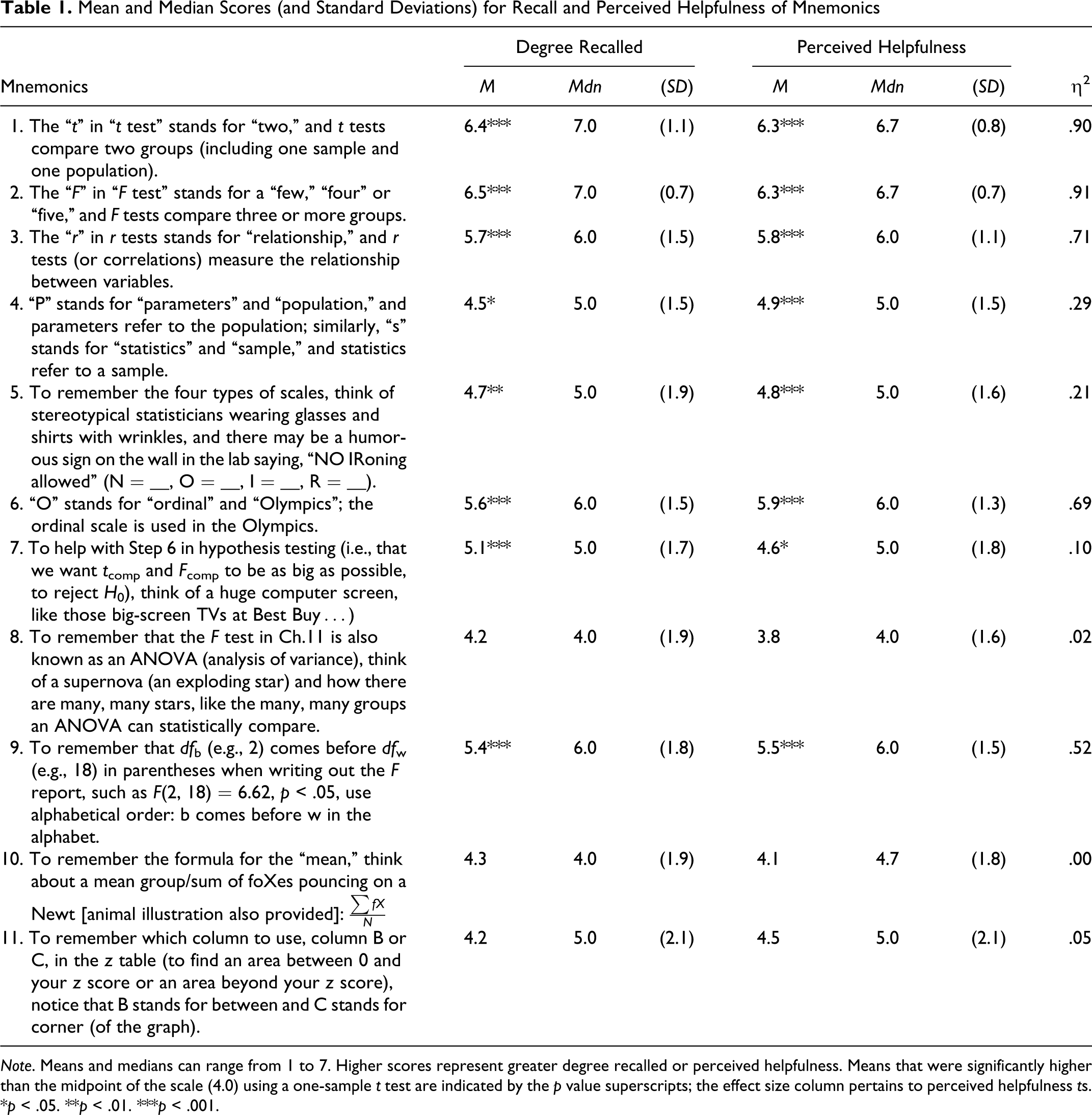
Note. Means and medians can range from 1 to 7. Higher scores represent greater degree recalled or perceived helpfulness. Means that were significantly higher than the midpoint of the scale (4.0) using a one-sample t test are indicated by the p value superscripts; the effect size column pertains to perceived helpfulness ts.
*p < .05.
**p < .01.
***p < .001.
Mean and Median Scores and Standard Deviations for Overall Perceptions of Mnemonics
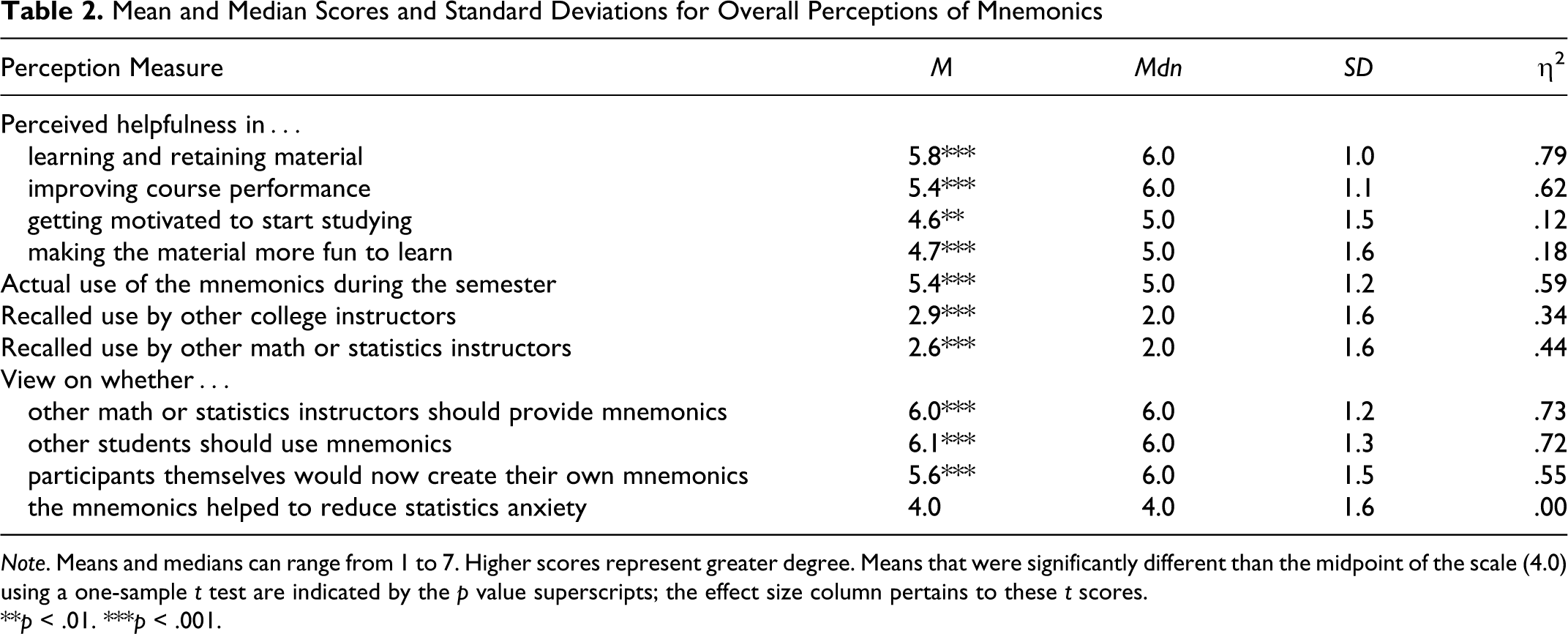
Note. Means and medians can range from 1 to 7. Higher scores represent greater degree. Means that were significantly different than the midpoint of the scale (4.0) using a one-sample t test are indicated by the p value superscripts; the effect size column pertains to these t scores.
**p < .01.
***p < .001.
Results
For each measure, we compared mean student scores against scale midpoints using one-sample t tests. Participants significantly recalled 8 of the 11 mnemonics and rated those same mnemonics as significantly helpful using the three-item helpfulness measure (see Table 1). Considering participants who recalled the 3 remaining mnemonics above the scale midpoint (approximately half the sample), perceived helpfulness ratings significantly (or marginally) exceeded the scale midpoint (ps < .01; p = .079 for the ANOVA mnemonic).
Overall perceptions of mnemonics indicated relatively high regard (see Table 2). In particular, participants generally reported that mnemonics improved learning and motivation (including motivation to create their own mnemonics), made the material more fun, and should be provided more by other instructors. Ratings of mnemonic use by other instructors were relatively low. The mean rating of 4.0 for how much the mnemonics reduced statistics anxiety did not exceed the scale midpoint. However, given the prevalence and degree of statistics anxiety (e.g., Onwuegbuzie & Wilson, 2003), a comparison point on the scale below the midpoint might be more appropriate as the estimate of the population mean for statistics students who did not receive the mnemonics. Comparing the mean rating of 4.0 against even a 3.5 yielded a significant difference, t(60) = 2.24, p < .03, η2 = .08. Considering only the students who recalled (above scale midpoint) all of the eight highly rated mnemonics (n = 16) or all of the three remaining mnemonics (n = 11), anxiety-reduction ratings (Ms = 5.1 and 5.2, respectively) did significantly exceed the 4.0 midpoint (ps < .01).
Discussion
Based on multiple measures, students reported significant regard for most of the specific mnemonics and for mnemonics in general in learning statistics. In particular, students thought that mnemonics increased learning, motivation, and fun and should be provided more by other instructors. Having fun seems particularly important to address statistics anxiety (e.g., Lomax & Moosavi, 2002). Students also reported moderate belief that the provided mnemonics reduced anxiety. Such beliefs strengthened among students who better recalled the mnemonics, possibly lending some validity to such beliefs. Given the prevalence and degree of statistics anxiety (e.g., Onwuegbuzie & Wilson, 2003), a tool that receives even a mid-scale overall rating for reducing anxiety seems worth trying. Students also reported that other instructors, including math and statistics instructors, use mnemonics infrequently. These results might suggest that mnemonics are a relatively untapped resource in current post-secondary education (see also Stalder, 2005). Carney and Levin (2008) suggested that part of this low instructor use might be due to instructors' misconceptions about mnemonics, which Carney and Levin hoped their research could address.
As a limitation, the design was nonexperimental and did not demonstrate actual improvements in performance due to mnemonics. Other research has provided such evidence for statistics, research methods, and other material (e.g., Carney & Levin, 2008; Higbee, 1996; Lakin et al., 2007; Saber & Johnson, 2008; Stalder, 2005; VanVoorhis, 2002), but we did not collect such data in the current work. Feelings of motivation and fun probably need to be self-reported in any case and might play a vital role in reducing statistics anxiety, which would improve performance (Onwuegbuzie & Wilson, 2003). Among benefits of the current design, the real-life classroom context breeds greater validity and generalizability of results, particularly because of the statistics anxiety that might spike during an actual statistics class. Moreover, the effect sizes for many of the students' positive impressions were quite large (see Tables 1 and 2), in some cases over three times the conventional “large” effect size (Vacha-Haase & Thompson, 2004). Taking into account that statistics students are usually not very upbeat about the course, sometimes delaying their enrollment (Kher et al., 1999; Onwuegbuzie & Wilson, 2003) with potential negative consequences (Freng, Webber, Blatter, Wing, & Scott, in press), such large effects become even more meaningful. As recommended by Vacha-Haase and Thompson (2004) in evaluating the meaning of effect sizes, we compared present effect sizes with those of similar self-report measures in previous studies (e.g., Lakin et al., 2007; Stalder, 2005) and found present effect sizes to be much larger.
In sum, the variety and size of positive findings suggest strong potential for mnemonics to improve statistics learning and provide even clearer evidence for improving the overall (subjective) statistics course experience. Nearly all of the 11 mnemonics (Numbers 1-10 in Table 1) also cover material necessary to know for the research methods course that usually directly follows introductory statistics in the social science major. Whatever the cause of the apparent low instructor use of mnemonics, we believe that most of the mnemonics provided in this article can be easily integrated into statistics and research methods courses and will prove useful to instructors.
Footnotes
The authors declared no potential conflicts of interest with respect to the research, authorship, and/or publication of this article.
The authors received no financial support for the research, authorship, and/or publication of this article.
Acknowledgments
We thank Isabel Davis and Kyle Anderson for their valuable assistance.