







Abstract
To determine how topical coverage in introductory textbooks may have changed from the 1980s to the present, the author examined topic coverage in full-length and brief introductory textbooks from this time period. Because 98% of the teachers use textbooks for the introductory course and the majority do not assign reading beyond the textbook, the relationship between the current topical allocation pattern and that in the introductory course was examined by comparing the textbook pattern to the lecture topical allocation pattern derived from syllabi analysis. Several changes were found in textbook topic coverage since the 1980s, with proportional coverage among topics moving toward equality. Lecture topical allocation mirrored that in textbooks, indicating that textbooks strongly impact the structure of the introductory course.
As part of an examination of introductory psychology textbooks from the 1890s to the 1980s, Weiten and Wight (1992) computed the percentages of coverage for 15 topical areas for each decade within that time period. They examined five leading texts from the 1890s and four leading texts from each subsequent decade. Each set of texts constituted a sample of the most popular texts for that decade. Contrary to Matarazzo’s (1987) argument that the core content of introductory texts had remained the same since the late 19th century, Weiten and Wight found that topical coverage in introductory textbooks had changed considerably during this time period. Coverage of sensation/perception, language/thought, and motivation/emotion declined markedly. These topics received about half as much coverage in the 1980s as they did in the 1890s. Coverage of intelligence/testing, psychopathology/psychotherapy, development, and social psychology increased as a group from 3% before 1920 to 38% in the 1980s. Coverage of some topics (introduction/methods, biological bases of behavior, learning, memory, and personality) remained relatively stable over the 100-year period. Consciousness, adjustment, and “other” topics, such as applied psychology, received sporadic coverage during this period. The results observed for topical coverage by Webb (1991) for three editions of the Boring, Langfeld, and Weld introductory text from 1935 to circa 1950 and by Griggs and Jackson (1996) for the first 10 editions of Hilgard et al.’s introductory text from 1950 to circa1990 are generally consistent with the findings of Weiten and Wight.
Weiten and Wight (1992) found some dramatic changes in coverage from the 1960s to the 1980s. For example, sensation/perception decreased from 14% to an average of only 9% over those decades and developmental increased from 7% to an average of 10% during that time period. Thus, it is reasonable to assume that topical coverage has continued to change from the 1980s through the 2000s, the past two decades. Consciousness was an emerging topic in the last two decades of the Weiten and Wight’s study. Similarly, coverage of adjustment was shifting to coverage of stress, coping, and health psychology. It is certainly likely that these trends continued, leading to more coverage of these particular topics.
Cush and Buskist (1997) provided some other possibilities for coverage changes. They surveyed editors from 12 major publishers about the future of introductory psychology textbooks, which included a section on the changing content of introductory textbooks. The editors predicted that biological influences on behavior, cross-cultural psychology, cognitive research, evolutionary theory, neuroscience, and genetics were most likely to influence introductory texts in the next decade. Certainly, given the explosion of research in neuroscience over the past two decades and its spread to almost every area in psychology (and many outside of psychology) and the growing importance of evolutionary psychology and behavioral genetics over the last two decades, increased coverage of the biological area would be a reasonable expectation.
Because coverage analysis is done at the chapter-topic level, topical coverage allocation would be impacted by a decrease in the number of chapters in introductory textbooks, and the average number of chapters in introductory textbooks during the past two decades has decreased from 18.12 (Weiten, 1988) to 16.08 (Griggs & Jackson, 2013b). This decrease in chapter count should lead to a parallel decrease in coverage of many chapter topics. For example, a smaller number of chapters should lead to a lower probability of having chapters on nonstandard topics (topics that do not occur in the majority of introductory textbooks), such as sexuality/gender, applied psychology, industrial–organizational psychology, and cultural diversity, and hence less coverage of these topics. Having fewer chapters should also lower the probability of two-chapter coverage of topics that may have had such coverage in the past (e.g., emotion/motivation) and hence less coverage of these topics. Having fewer chapters should also lead to some chapter topics being merged into one chapter (e.g., language/thought and intelligence), and hence less coverage of these topics. In sum, the decrease in the average number of chapters in introductory textbooks over the past two decades should contribute to changes in topical coverage allocation when assessed at the chapter level.
To determine how topical coverage allocation in introductory textbooks may have changed from the 1980s to the present, I examined such allocation in introductory texts from the 1980s to the present. This examination was accomplished by comparing the topical coverage findings of Griggs, Jackson, Christopher, and Marek (1999) for introductory textbooks from the 1990s and the findings of Griggs and Jackson (2013b) for introductory textbooks from the 2000s to those observed by Weiten and Wight (1992) for the 1980s. 1 Given that Weiten and Wight did not examine topical coverage allocation in brief introductory textbooks, I further extended their work by examining such allocation in brief introductory textbooks from the 1980s to the present. This was accomplished by comparing the topical coverage findings of Griggs, Jackson, and Napolitano (1994) for brief texts from the 1980s, the findings of Griggs and Koenig (2001) for brief texts from the 1990s, and the findings of Griggs and Jackson (2013a) for brief texts from the 2000s.
It was important to examine the topical coverage allocation in brief introductory textbooks because they now comprise an important segment of the introductory textbook market. 2 For example, Griggs and Jackson (2013a) reported that 6 (40%) of the 15 top selling introductory textbooks for the 2011–2012 academic year were brief textbooks. Given that brief texts are almost invariably briefer versions of full-length introductory textbooks (Griggs &Jackson, 2013a), their topical coverage allocation pattern should parallel that of their full-length companion texts. However, given that these briefer textbooks have even fewer chapters than their full-length companion texts, the space available for topical coverage allocation is even further constrained. On average, briefer versions have two fewer chapters, 13.9 versus 16.1 chapters (Griggs & Jackson, 2013a). Thus, the effects of fewer chapters would be greater for brief texts. For example, Griggs and Jackson (2013a) found that none of the brief texts initially published since 2000 contained a chapter on a nonstandard topic. All of the chapters on nonstandard topics in the full-length parent versions were deleted when the briefer versions were created.
Examining topical coverage allocation in introductory textbooks is also important for our understanding of how the introductory course is taught. The introductory course is the most popular course in psychology with an estimated annual enrollment in the United States of 1.2 to 1.6 million students (Steuer & Ham, 2008) and the second most popular college course, after English composition (Landrum & Gurung, 2013). Because 98% of teachers use textbooks for the introductory course and the majority of introductory teachers do not assign reading beyond the textbook (Miller & Gentile, 1998), it would appear that introductory teachers “teach the text.” “Teach the text” in this context means that introductory teachers would allocate the amount of lecture time for the various textbook chapter topics in the same proportions as coverage of these topics in introductory textbooks. Topics receiving more coverage in introductory textbooks should receive more coverage in lecture and so on. If this is the case, then textbooks greatly impact how the introductory course is taught and, hence, how our discipline is defined for students.
To determine whether teachers do indeed teach the text, I examined the relationship between the topical allocation pattern of introductory textbooks for the 2000s and of lectures in the introductory course. That is, I compared the textbook topical allocation findings of Griggs and Jackson (2013a, b) to the lecture topical allocation findings of Homa et al. (2013) based on their analysis of 158 introductory psychology syllabi. I hypothesized that teachers do teach the text—lecture topical allocation parallels textbook topical allocation. If this is the case, then topical coverage allocation in introductory textbooks plays a major role in structuring the introductory course and defining our discipline to students. Thus, as psychology teachers, we should be aware of this topical coverage allocation, so we have a more accurate understanding of how we educate students about our discipline.
Method
I retrieved the topical allocation data from the six relevant introductory textbook studies. Topical coverage analyses were done at the chapter level in all six studies, and the labels used for the chapter topics in these studies were made uniform by using the chapter labels employed in the most recent introductory textbook study, Griggs and Jackson (2013a). These topic labels are given in Table 1. This translation process was fairly straightforward (e.g., aspects of consciousness was changed to states of consciousness), but a few minor adjustments were necessary for the Weiten and Wight labels. We changed the topic label of adjustment in the Weiten and Wight study to stress/health, which is the label used for this type of content in all of the other five textbook studies. Weiten and Wight also included two merged topics, introduction/methods and psychopathology/psychotherapy, which were not merged in the other five studies. Thus, for comparison purposes, we assigned 50% of the overall coverage for a merged topic to each of its component topics. For example, the introduction/methods topic received 8% overall coverage, so we assigned 4% to introduction and 4% to research methods.
Percentage Topical Coverage Allocation in Full-Length Introductory Textbooks for Three Decades: 1980s, 1990s, and 2000s.
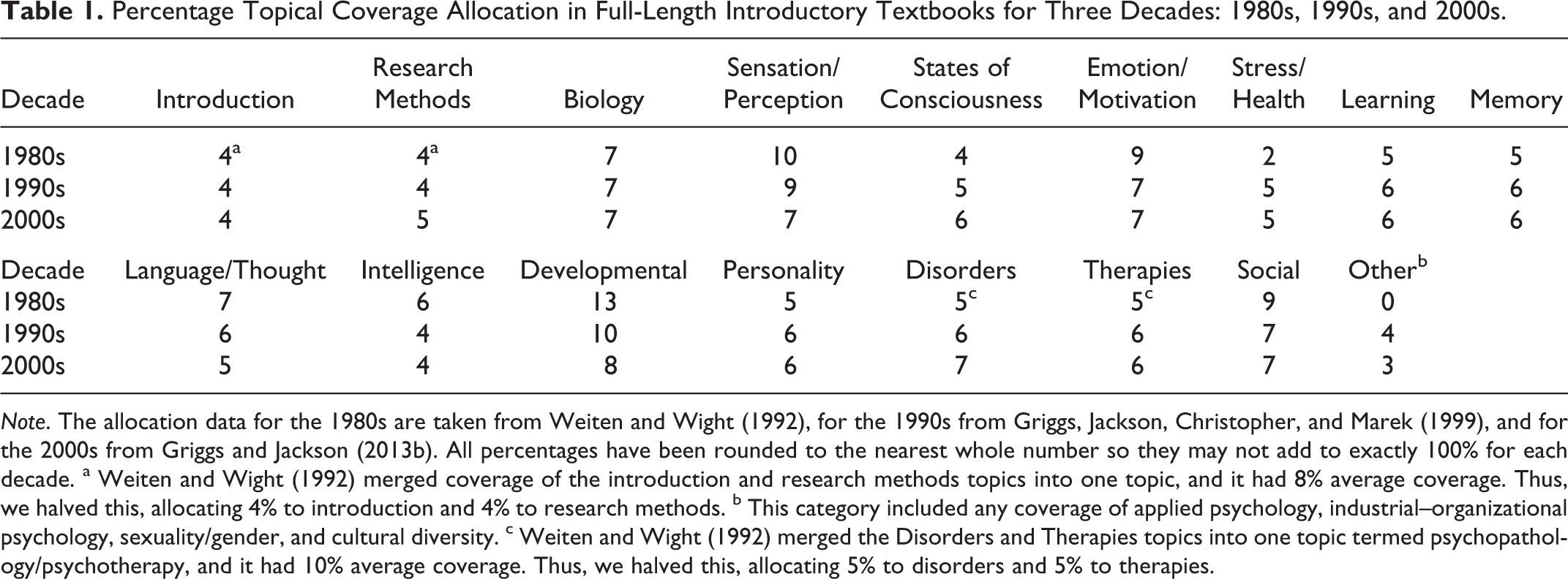
Note. The allocation data for the 1980s are taken from Weiten and Wight (1992), for the 1990s from Griggs, Jackson, Christopher, and Marek (1999), and for the 2000s from Griggs and Jackson (2013b). All percentages have been rounded to the nearest whole number so they may not add to exactly 100% for each decade. a Weiten and Wight (1992) merged coverage of the introduction and research methods topics into one topic, and it had 8% average coverage. Thus, we halved this, allocating 4% to introduction and 4% to research methods. b This category included any coverage of applied psychology, industrial–organizational psychology, sexuality/gender, and cultural diversity. c Weiten and Wight (1992) merged the Disorders and Therapies topics into one topic termed psychopathology/psychotherapy, and it had 10% average coverage. Thus, we halved this, allocating 5% to disorders and 5% to therapies.
To compare textbook topical allocation to lecture topical allocation, we had to group the textbook topics into the categorical groupings of chapter topics used by Homa et al. (2013), because Homa et al. provided data only for these categorical groupings and not for individual chapter topics. Hence, the categorical groupings for this comparison were (a) history and scope of psychology, (b) research methodology, (c) physiological, which included neuroscience, consciousness, sensation, and perception, (d) cognitive, which included learning, memory, thinking, intelligence, and language, (e) clinical, which included psychological disorders and therapies, (f) social, which included social and personality, (g) developmental, and (h) “other,” which included emotion/motivation, stress/health, industrial–organizational, applied psychology, and sexuality/gender. An overall coverage percentage was computed for each of these eight categorical topic groupings for full-length introductory textbooks for the 2000s using the data from Griggs and Jackson (2013b) and for brief introductory textbooks for the 2000s using the data from Griggs and Jackson (2013a).
Results and Discussion
The average topical coverage allocations for full-length introductory textbooks from the 1980s, 1990s, and 2000s are given in Table 1. As predicted, average coverage of both states of consciousness and stress/health increased 4%–6% and 2%–5%, respectively. Since the 1980s, both of these topics have become standard chapter topics in introductory textbooks (Griggs &Marek, 2001). The average coverage of disorders in introductory textbooks also increased by 2%. Strangely, biology did not increase but rather stayed the same across the three decades with an average coverage of 7% in each decade. It is likely that there is more coverage, but because this coverage may be incorporated into other chapters, the chapter-level method of analysis would not include it. Griggs and Jackson (2013b) did find that 2 of the 13 full-length texts that they examined included a new nonstandard biological chapter on behavioral genetics/evolutionary psychology. Thus, it seems plausible that at least some of this material would be distributed across other chapters in the remaining texts.
Mean coverage of six topics (introduction, research methods, learning, memory, personality, and therapies) stayed relatively the same (either no change or a 1% increase or decrease). Mean coverage of sensation/perception, emotion/motivation, developmental, language/thought, intelligence, and social all decreased by 3%, 2%, 5%, 2%, 2%, and 2%, respectively. The major reasons for these decreases are likely that (a) it is no longer the norm for sensation/perception, emotion/motivation, developmental, or social to receive two-chapter coverage and (b) language/thought and intelligence are now often combined into one chapter. Griggs and Jackson (2013b) found that average coverage for both sensation/perception and social is exactly one chapter and for developmental psychology and emotion/motivation, only 1.18 and 1.08, respectively, in full-length introductory textbooks published initially in the 2000s. They also found that the majority of these texts merged language/thought with intelligence into one chapter.
Coverage in the “other” category increased from 0% in the 1980s to 4% in the 1990s and 3% in the 2000s.The most frequent topics in this category for the past two decades were sexuality/gender, applied psychology, and industrial–organizational psychology. However, these are all nonstandard chapter topics in introductory textbooks and only included as chapters in some textbooks, with sexuality/gender being the most frequently occurring topic (Griggs & Jackson, 2013b). Of interest, not one of the textbooks from the analysis of the 2000s texts included a chapter on cross-cultural psychology or cultural diversity. Given that the psychology editors in the 1990s predicted that cross-cultural psychology would have a strong influence on introductory textbooks in the next decade (Cush &Buskist, 1997), this finding of no chapter-level coverage of cross-cultural psychology or cultural diversity is surprising. A few texts, however, do have boxed inserts on cultural diversity throughout the text (Griggs & Jackson, 2013b) and others may have coverage scattered throughout the text. However, cross-cultural issues do not appear to be as influential as the editors predicted (cf. Lonner & Murdock, 2012).
It also appears that since the 1980s, the proportional coverage of the standard chapter topics has moved toward equalization in the 2000s. Consistent with this hypothesis, all of the topical coverage percentages, except for developmental, fall within the small range, 4%–7%. To further examine this decrease in variability, the standard deviations [SDs] for the topical coverage percentages for each decade were computed. The SD decreased across the three decades, from 3.10 for the 1980s data to 1.5 for the 2000s data. This 50% shrinkage in variance for topical coverage is consistent with the hypothesis that coverage has become more equalized for the standard chapter topics. Although the average coverage of developmental has decreased in the past two decades, it is still 8%. It would appear that even though the norm for coverage of this topic is now one chapter (Griggs & Jackson, 2013b), these singular chapters are lengthier than those for the other standard topics, likely because these chapters now have to provide life span coverage of development.
The average topical coverage allocations for the brief introductory textbooks from the 1980s, 1990s, and 2000s are given in Table 2.These percentages mirror the topical coverage allocation pattern for full-length texts, but in a few cases the amount of change is not as great. For example, sensation/perception decreased only 1% from the 1980s to the 2000s compared to a 3% decrease for full-length textbooks, and developmental decreased only from 10% to 9% compared to a decrease of 5% for full-length textbooks. Comparing the average topic allocations for full-length texts and brief texts for the 2000s (given in Tables 1 and 2, respectively) reveals remarkably similar patterns for the average percentages for the two types of textbooks, except for the 0% coverage for “other” in brief texts. This total lack of coverage for “other” topics results from authors deleting all chapters on nonstandard topics when they created the briefer versions included in Griggs and Jackson’s (2013a) analysis. It is worth noting, though, that the variance among topical coverage percentages also appears to be greater for brief texts than for full-length texts. Although 12 of the 17 topics fall in the 4%–7% range, 5 do not. However, of these five, three (biological, sensation/perception, and intelligence) fall just outside this range (8%, 8%, and 3%, respectively). The SDs for the topical coverage percentages for the three decades also indicate lightly greater variability among topics and less change across time. The SD only decreased from 2.4 to 2.2 from the 1980s to the 2000s, respectively.
Percentage Topical Coverage Allocation in Brief Introductory Textbooks for Three Decades: 1980s, 1990s, and 2000s.
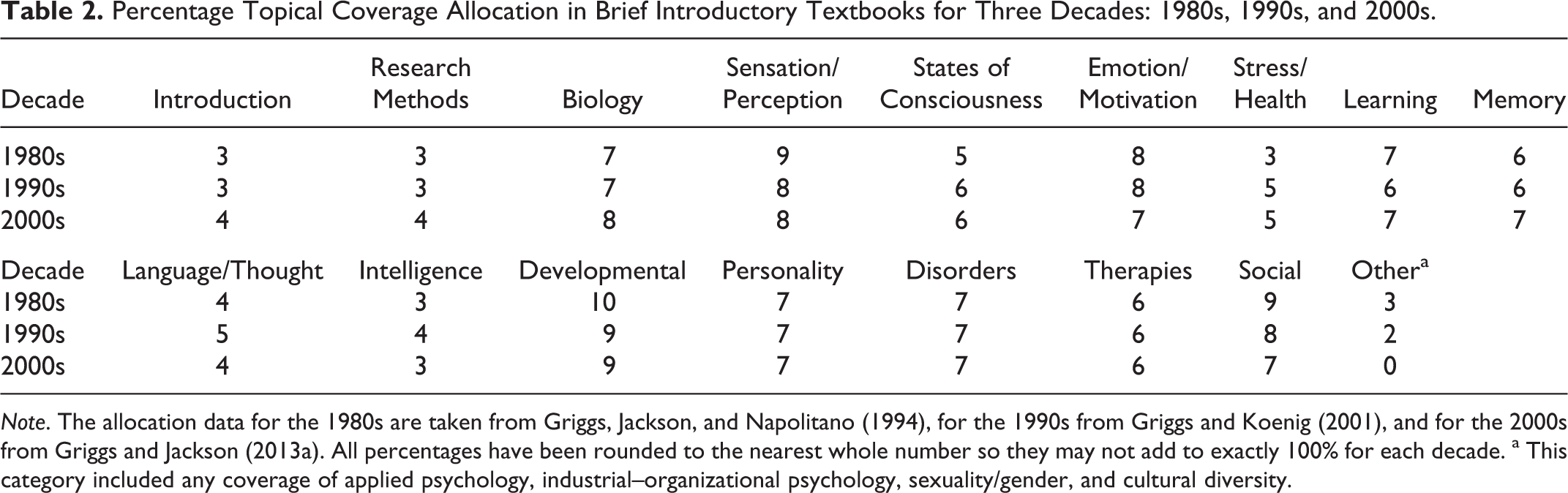
Note. The allocation data for the 1980s are taken from Griggs, Jackson, and Napolitano (1994), for the 1990s from Griggs and Koenig (2001), and for the 2000s from Griggs and Jackson (2013a). All percentages have been rounded to the nearest whole number so they may not add to exactly 100% for each decade. a This category included any coverage of applied psychology, industrial–organizational psychology, sexuality/gender, and cultural diversity.
The average topical coverage allocations for the 2000s full-length and brief textbooks and those for introductory psychology course lectures are given in Table 3. The overall patterns of topical coverage allocation in lecture and in introductory textbooks are very similar. 3 The actual percentages for both patterns are even nearly the same. It is clear that introductory textbooks greatly impact the structure of the introductory course and teachers teach the text (allocate lecture time to topical areas in proportion to the space allocated to them in introductory texts). However, it is highly likely that different teachers vary in exactly which subtopics they cover within a topic and how much time they spend on the various subtopics, but the average overall lecture time spent on the various content areas maps very well onto the average coverage in introductory textbooks, both full length and brief. The textbook and lecture topical allocation patterns might have been even more similar if the Homa et al. data were complete. The topic coverage percentages for class lecture total only to 88% in the Homa et al’s study. Twelve percent of the data are missing (N. Homa, July 11, 2013, personal communication). Not all lecture days could be properly coded into the topical categories that Homa et al. (2013) used. Review days or lecture days when the specific content to be covered were not identified on the syllabus are examples of days that were not codable.
Percentages of Introductory Psychology Full-length, Brief Texts, and Course Lecture Allocated to Various Content Areas.
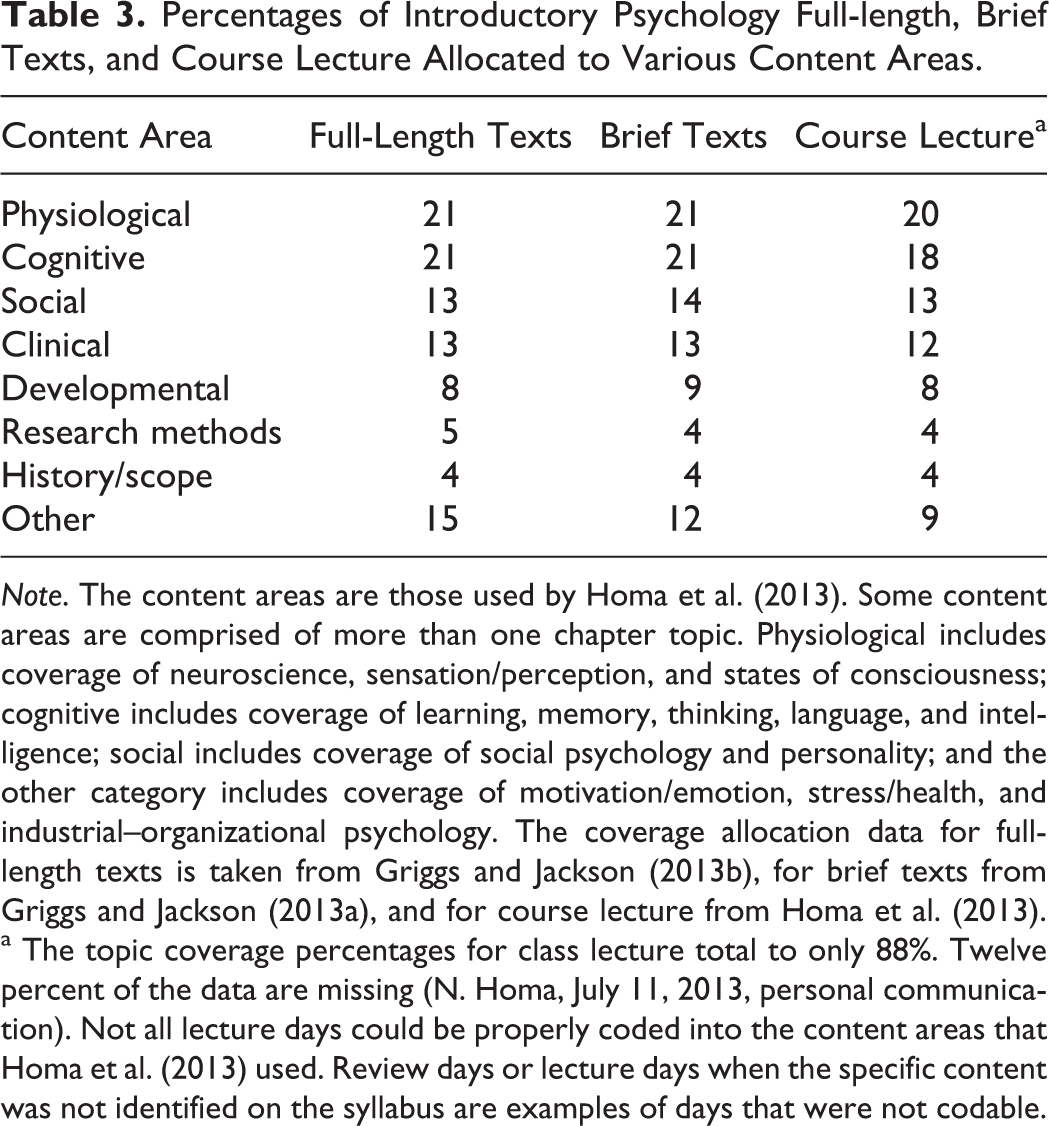
Note. The content areas are those used by Homa et al. (2013). Some content areas are comprised of more than one chapter topic. Physiological includes coverage of neuroscience, sensation/perception, and states of consciousness; cognitive includes coverage of learning, memory, thinking, language, and intelligence; social includes coverage of social psychology and personality; and the other category includes coverage of motivation/emotion, stress/health, and industrial–organizational psychology. The coverage allocation data for full-length texts is taken from Griggs and Jackson (2013b), for brief texts from Griggs and Jackson (2013a), and for course lecture from Homa et al. (2013). a The topic coverage percentages for class lecture total to only 88%. Twelve percent of the data are missing (N. Homa, July 11, 2013, personal communication). Not all lecture days could be properly coded into the content areas that Homa et al. (2013) used. Review days or lecture days when the specific content was not identified on the syllabus are examples of days that were not codable.
Contrary to the conclusions of Homa et al. (2013), developmental psychology is not one of the least lectured-on topics but rather one of the most lectured-on topics. All of the other topic groupings used by Homa et al. in their analysis, except for history/scope and research methods, include two or three chapter topics, thereby confounding the lecture coverage analysis (see Footnote 3). Thus, the average coverage percentages for these topic groupings represent the sum of the average lecture times devoted to two or three different topics (chapters) and not just one as is the case for developmental. Consider the most lectured-on topical grouping, cognitive (comprised of three chapter topics). If its overall average lecture coverage of 20% were divided equally among the three component topics, then each would receive about 7% average coverage. Thus, developmental, with an average of 8% allocated lecture time, is clearly one of the most lectured-on topics, if not the most lectured-on topic, which is consistent with it being the textbook topic receiving the most coverage. However, because Homa et al. did not provide lecture allocation data for individual chapter topics, it is impossible to make direct coverage comparisons between chapter topics. Such data would have also enabled a more informative comparison between textbook topical allocation and lecture topical allocation.
It is also important to note a limitation of all the textbook data used in this study. These data were all collected at the chapter-level analysis. This level of analysis may not be sufficiently accurate to capture true textbook topic coverage, especially for broader chapter topics, such as biological psychology, and nonstandard chapter topics, such as cultural diversity. Discussions of such topics may be embedded throughout the text and not limited to a specified chapter. Thus, future research on topical coverage in introductory psychology textbooks should employ a broader level of analysis, examining topic coverage within the text as a whole and not only at the chapter level.
Summary
In general, topic coverage allocation in introductory psychology textbooks over the past two decades has become more uniform across topics, especially for full-length texts. All 12 of the standard topics that are almost always singular chapter topics in full-length texts received either 6% or 7% coverage, except for stress/health at 5% and development at 8% coverage. The remaining standard topics (introduction, research methods, language/thought, and intelligence) each receive 4% or 5% average coverage, likely due to the fact that they often appear in merged chapters (introduction with research methods and language/thought with intelligence). The topical coverage pattern for brief texts is similar but slightly more variable.
The lecture topical coverage allocation pattern maps well onto the textbook pattern, indicating that introductory teachers tend to allocate their lecture time to the various chapter topics in the same manner as textbook authors allocate their coverage of these topics. 4 In brief, teachers tend to teach the text. This makes sense, given that the vast majority of introductory teachers use textbooks and typically without assigning additional reading. Hence, introductory textbooks provide an excellent window for viewing how the introductory course is typically taught with respect to topic coverage and thereby play a major role in how our discipline is defined for introductory students. This finding also harmonizes with an observation made by Bill McKeachie in his classic book on teaching, Teaching Tips (2002, p. 14)—“research on teaching suggests that the major influence on what students learn is not the teaching method but the textbook.”
Footnotes
Acknowledgment

Declaration of Conflicting Interests
The author declared no potential conflicts of interest with respect to the research, authorship, and/or publication of this article.
Funding
The author received no financial support for the research, authorship, and/or publication of this article.