







Abstract
This study further examined the reliability and validity of the Learning Alliance Inventory (LAI), a self-report measure designed to assess the working alliance between a student and a teacher. The LAI was found to have good internal consistency and test–retest reliability, and it demonstrated the predicted convergence with measures of immediacy and rapport. The LAI enhanced the prediction of student learning beyond that which was possible only using measures of immediacy and rapport. Path analysis provided support for immediacy and rapport indirectly impacting student learning via their effects on the working alliance. Potential uses of the LAI in both research and applied contexts are discussed.
A working alliance occurs when two people engage in collaborative, purposive work where one individual seeks change and another individual serves as an agent of that change (Bordin, 1979). Scholars and practitioners of psychotherapy have given the concept much attention. Although theoretical applications of the concept to teaching and learning exist, empirical studies are lacking, perhaps due to there being no reliable and valid measure of working alliance between students and teachers. In an effort to address this, Rogers (2012) developed the Learning Alliance Inventory (LAI) and provided evidence of its reliability, capacity to distinguish between teachers, and relation to students’ grades. However, further validation of the measure is necessary to ascertain its utility for educational research and applications.
Working Alliance
The working alliance concept emerged from psychotherapy research and theory due to historical interests in the patient–therapist dynamics and contemporary interests in relational features of this interaction. Its broad appeal across theoretical and intervention modalities stems from two causes. First, the working alliance concept provides a coherent, accessible model for understanding patient–therapist interactions and patient change (Castonguay, Constantino, & Holforth, 2006). Second, the strength of the therapist and patient’s working alliance is consistently among the best predictors of treatment outcome (Horvath, Del Re, Flückiger, & Symonds, 2011; Horvath & Symonds, 1991; Martin, Garske, & Davis, 2000).
Because teaching and learning inherently involve collaborative relationships between a student seeking change (i.e., new knowledge and acquired skills) and a teacher who facilitates such change, the working alliance concept has relevance. Scholars have explored these links in diverse teaching contexts (e.g., Koch, 2004; Myers, 2008; Robertson, 2000; Rogers, 2009; Schlosser & Gelso, 2001; Tiberius, Sinai, & Flak, 2002). Growing interest across disciplines in empirically studying teaching and learning processes has also primed investigations of student–teacher interactions for their impact on learning. But studying the role of the working alliance in teaching and learning requires a sound measurement tool. Although multiple measures of the working alliance in psychotherapy exist, their content is not easily translatable to teaching and learning arenas. As a measure of working alliance between student and teacher, the LAI has potential to fill that void.
LAI
The LAI is an 18-item, self-report measure intended to assess the strength and characteristics of the working alliance between student and teacher from the student’s perspective (Rogers, 2012). Of its three scales, the collaborative bond scale examines the quality of the student–teacher relationship (e.g., my teacher genuinely cares about me). The teacher competency scale assesses teacher behaviors relevant to effectively guiding a course (e.g., my teacher is knowledgeable about the course material). The student investment scale evaluates student behaviors indicative of engagement with the course (e.g., this course is worthwhile). In development, the three scale and total scores demonstrated good internal and test–retest reliabilities, and measured levels of working alliance were positively correlated with student grades and distinguished between teachers. However, the LAI requires further validation, particularly additional evidence about the connection of working alliance to student learning. Scholars and teachers considering using the measure could also benefit from a better understanding of how working alliance relates to similar constructs, such as the concepts of immediacy and rapport.
Immediacy and Rapport
Immediacy and rapport are prominent among dyadic constructs investigated in student–teacher interactions. Immediacy is the psychological availability or nearness of the teacher (Mehrabian, 1971). Teachers create immediacy through verbal and nonverbal behaviors that promote students feeling heard, included, valued, and known (McCroskey & Richmond, 1992). Given the difficulties in assessing verbal behavior, immediacy is largely conceptualized and measured through student ratings of instructors’ nonverbal communication behaviors (Richmond, McCroskey, & Johnson, 2003). Immediacy is related to students’ increased compliance (Burroughs, 2007; Kearney, Plax, Smith, & Sorensen, 1988), decreased resistance (Goodboy & Myers, 2009; Kearney, Plax, & Burroughs, 1991), and enhanced motivation (Allen, Witt, & Wheeles, 2006). However, evidence of a relationship between immediacy and student learning is mixed (e.g., Hess & Smyth, 2001; Rodríguez, Plax, & Kearney, 1996).
Rapport involves positive, synchronous interactions that reflect closeness or connectedness in a relationship. In their overview of the literature, Murphy and Rodríguez-Manzanares (2012) described rapport as a harmonious, coordinated interaction based in mutual attention, respect, understanding, and openness. Measures of rapport tend to focus on specific relational contexts of interest, including psychotherapy (Anderson & Anderson, 1962), business (Gremler & Gwinner, 2008), roommates (Carey, Hamilton, & Shanklin, 1986), and medical care (Harrigan & Rosenthal, 1983). Research on student–teacher interactions has yielded evidence that rapport is related to students’ enjoyment of and reported willingness to invest in a course (Benson, Cohen, & Buskist, 2005). Similar findings link rapport to student motivation (Granitz, Koernig, & Harich, 2009) and self-reported learning (Frisby & Martin, 2010).
Previous research on teacher immediacy has at times made reference to its relationship with rapport, and the evidence suggests that both concepts are related to similar academic-supporting student behaviors. However, Wilson, Ryan, and Pugh (2010) argued that rapport is distinct in that it encompasses the entirety of the positive relationship and is often based on the reporter’s general impressions, whereas immediacy is one of many techniques that contribute to rapport and is typically linked to specific teacher behaviors.
Although limited, there is evidence indicating that in the context of student–teacher interactions, immediacy, rapport, and working alliance are related. Wilson et al. (2010) found rapport to be positively correlated with immediacy and determined that in comparison to immediacy alone, rapport improved the prediction of students’ self-reported attitudes, motivation, and learning. Ryan, Wilson, and Pugh (2011) provided evidence that rapport was also positively correlated with working alliance as assessed by a subset of items adapted from a measure of alliance in psychotherapy. Just as Wilson et al. described rapport as a broader concept that immediacy contributes to, working alliance would appear to be the broadest of the three, with immediacy and rapport being most similar to the emotional and relational component of working alliance typically referred to as bond.
Current Study
Given the increasing interest in the nature of dyadic variables in the classroom, and the recent introduction of the LAI as a measure of working alliance in educational contexts, further investigation of the relationships between immediacy, rapport, and working alliance is warranted. The value of further study in this area depends heavily on the relation of these constructs to student learning. As such, in this study, I sought to further validate the LAI as a measure of the working alliance in student–teacher interactions. I investigated its relation to the immediacy and rapport constructs and explored the relationship between the three constructs and student learning in an undergraduate course. Based on the reviewed literature, I hypothesized the following: The LAI will exhibit good internal and test–retest reliability, comparable to existing measures of immediacy and rapport. The LAI will be positively correlated with measures of immediacy and rapport. The LAI will enhance the prediction of student learning beyond that obtained through measures of immediacy and rapport. In addition to any direct effects on learning, immediacy, and rapport may have indirect effects where immediacy fosters elements of rapport and rapport fosters elements of working alliance.
Method
Participants
Participants in the study were 280 undergraduate students (76% female) enrolled in an introductory psychology course at a large, comprehensive university. Participants’ ages ranged from 18 to 66 years (M = 21.32, SD = 5.97). They described their racial or ethnic background as White or European American (74%), Black or African American (11%), Hispanic or Latino or Latina (7%), Korean (1%), Asian Indian (1%), and Other (6%), with the majority of those describing themselves as multiracial. Participants earned credit toward a course research experience requirement, which included participation and alternative options.
Materials
Working alliance
In this study, I measured the working alliance between students and instructors using the LAI (Rogers, 2012). The LAI is an 18-item, self-report instrument in which respondents use a 7-point scale (anchored by not at all and very much) to indicate the frequency with which an item occurs or the level at which it is endorsed. In addition to providing an overall measure of the degree of working alliance present, the LAI has three scales: collaborative bond, teacher competency, and student investment. The LAI has previously demonstrated good internal consistency for the total score (Cronbach’s α = .95) as well as the collaborative bond (α = .94), teacher competency (α = .93), and student investment (α = .93) scales (Rogers, 2012).
Nonverbal immediacy
I assessed instructors’ immediacy behaviors using the Nonverbal Immediacy Scale (NIS; Richmond et al., 2003). The NIS is a 26-item, self-report instrument in which respondents use a 5-point scale (anchored by never and very often) to indicate the frequency with which their instructor uses nonverbal behaviors to convey a sense of immediacy (e.g., my instructor “looks directly at people while talking to them”). The NIS has previously demonstrated good internal consistency (α = .90; Richmond et al., 2003).
Rapport
I measured the rapport between students and instructors using the Professor–Student Rapport Scale (PSRS; Wilson et al., 2010). The PSRS is a 34-item, self-report instrument in which respondents use a 5-point scale (anchored by strongly disagree and strongly agree) to indicate their level of agreement to statements about their instructor’s inclination to establish and maintain rapport with them (e.g., my professor is eager to help students). The PSRS has previously demonstrated good internal consistency (α = .89; Ryan et al., 2011).
Learning
I assessed student learning in three ways. First, participants responded to a single item using a 5-point scale (anchored by very little and a great deal) to indicate how much they thought they had learned in their course so far. Second, I gathered participants’ final, numerical grade (percentage of available points earned) at the end of the course. Third, participants completed a 50-item, multiple-choice pretest during the first week of the semester and a similarly structured posttest during the final week of the semester. Based on these tests, I calculated a normalized gain score (Hake, 1998) for each student, which reflects the proportion of the maximum potential improvement obtained.
Procedure
I recruited introductory psychology students through an online research participation system. Interested students accessed information about the study and, following consent, completed online versions of the LAI, NIS, and PSRS in reference to their introductory psychology instructor. Participants also provided demographic information and responded to the single item about their learning. As part of consent, participants agreed to the release of their numerical course grade and pre- and posttest scores. To ensure that participants felt free to express perceptions of their current instructors, participants’ learned during consent that their responses would not be available to their instructors and would only be identified via a coding system to ensure anonymity.
Given the nature of the self-report measures, participants needed to have sufficient experience with an instructor prior to providing their ratings. In addition, ratings provided near the end of a course could be influenced by students’ certainty of their grade. To address this, I collected data from participants between the sixth and eighth weeks of their 16-week courses. Numerical course grades and pre- and posttests were established components of the introductory psychology course. I retrieved these archival data after the end of the semester.
To evaluate the test–retest reliabilities of the LAI, NIS, and PSRS, I recruited a subset (N = 35) of the participants to complete these measures again between the 10th and 12th weeks of their courses. Participants who completed the original study received an e-mail notifying them that an extension of the study was available if they were interested. Time between completions ranged from 26 to 45 days (M = 35.11, SD = 4.33).
Results
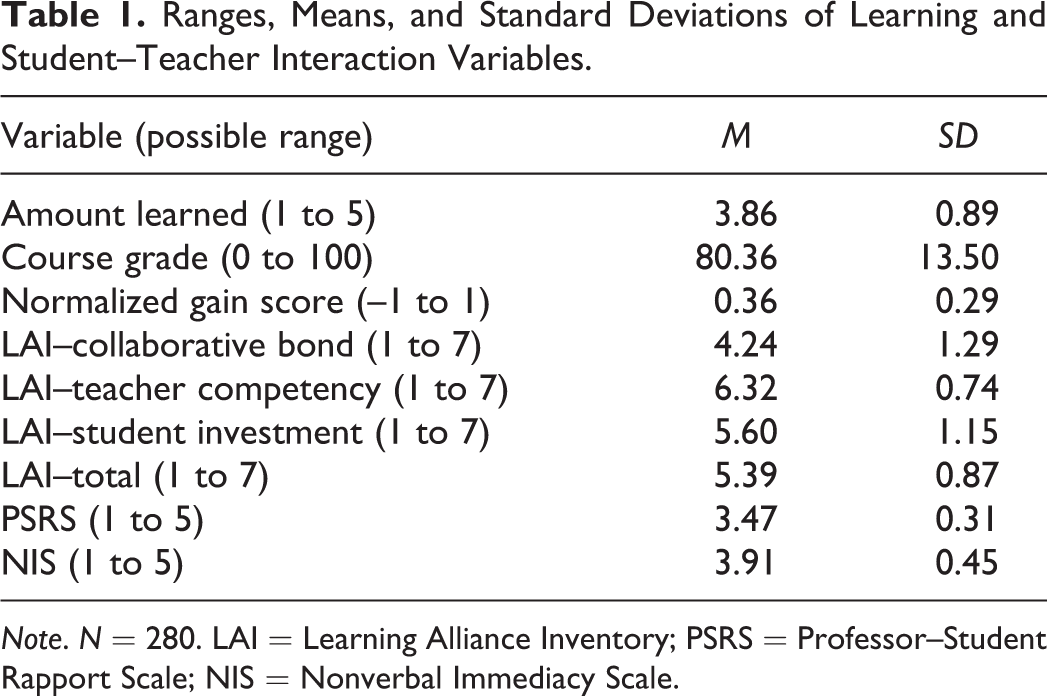
Means and standard deviations for key variables in the analyses are described in Table 1. On average, participants gave general evidence of learning across the three methods of assessment. Participants also indicated moderate to high levels of working alliance, immediacy, and rapport.
Ranges, Means, and Standard Deviations of Learning and Student–Teacher Interaction Variables.
Note. N = 280. LAI = Learning Alliance Inventory; PSRS = Professor–Student Rapport Scale; NIS = Nonverbal Immediacy Scale.
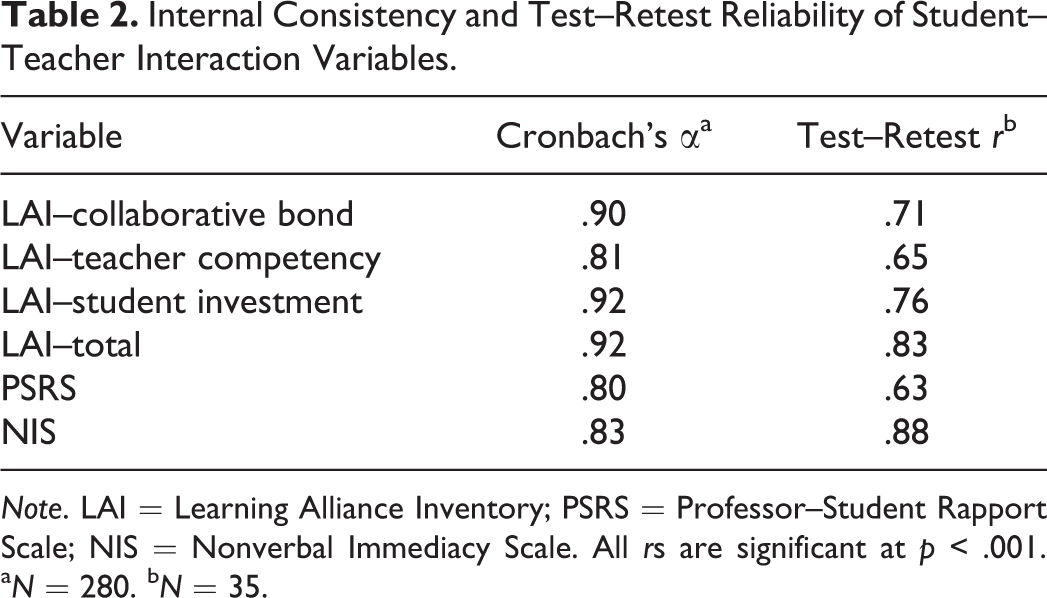
I analyzed the internal consistency of the working alliance, immediacy, and rapport measures using Cronbach’s α and the test–retest reliability of the measures using Pearson’s correlations (Table 2). The internal consistencies were all in the good to excellent range (α ≥ .80). Test–retest reliability coefficients were all statistically significant.
Internal Consistency and Test–Retest Reliability of Student–Teacher Interaction Variables.
Note. LAI = Learning Alliance Inventory; PSRS = Professor–Student Rapport Scale; NIS = Nonverbal Immediacy Scale. All rs are significant at p < .001. a N = 280. b N = 35.
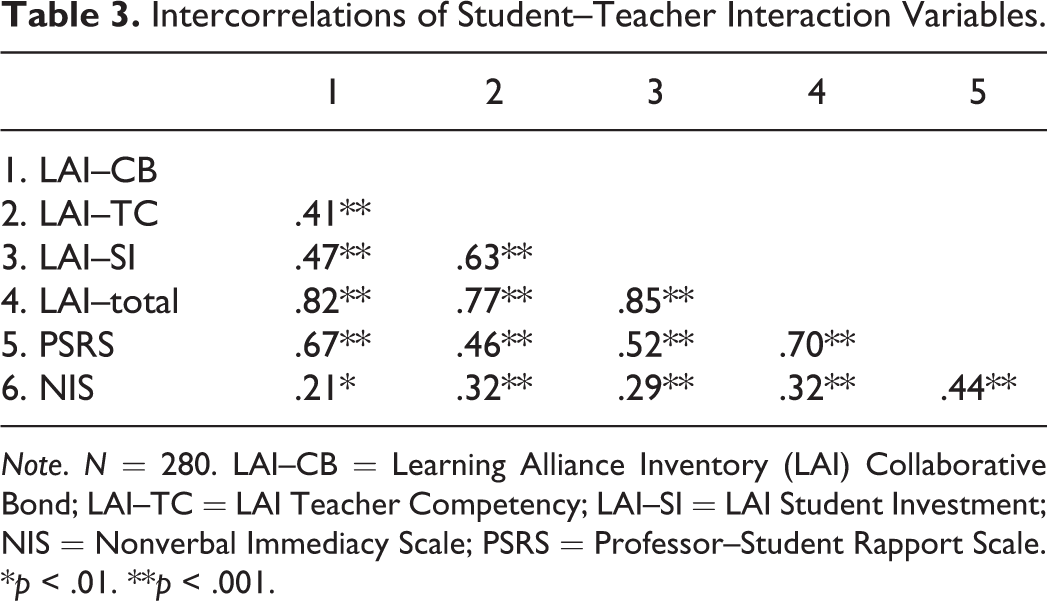
The intercorrelations of the working alliance, immediacy, and rapport measures are reported in Table 3. Although total working alliance was positively correlated with both rapport and immediacy, Steiger’s (1980) Z test for dependent correlations indicated that the correlation between working alliance and rapport was stronger (z = 7.42, p < .001). The LAI scales of collaborative bond (z = 8.82, p < .001), teacher competency (z = 2.57, p = .010), and student investment (z = 4.10, p < .001) all demonstrated stronger correlations with rapport compared to immediacy. Among the scales, collaborative bond showed a stronger correlation with rapport than either teacher competency (z = 4.28, p < .001) or student investment (z = 3.38, p < .001).
Intercorrelations of Student–Teacher Interaction Variables.
Note. N = 280. LAI–CB = Learning Alliance Inventory (LAI) Collaborative Bond; LAI–TC = LAI Teacher Competency; LAI–SI = LAI Student Investment; NIS = Nonverbal Immediacy Scale; PSRS = Professor–Student Rapport Scale.
*p < .01. **p < .001.
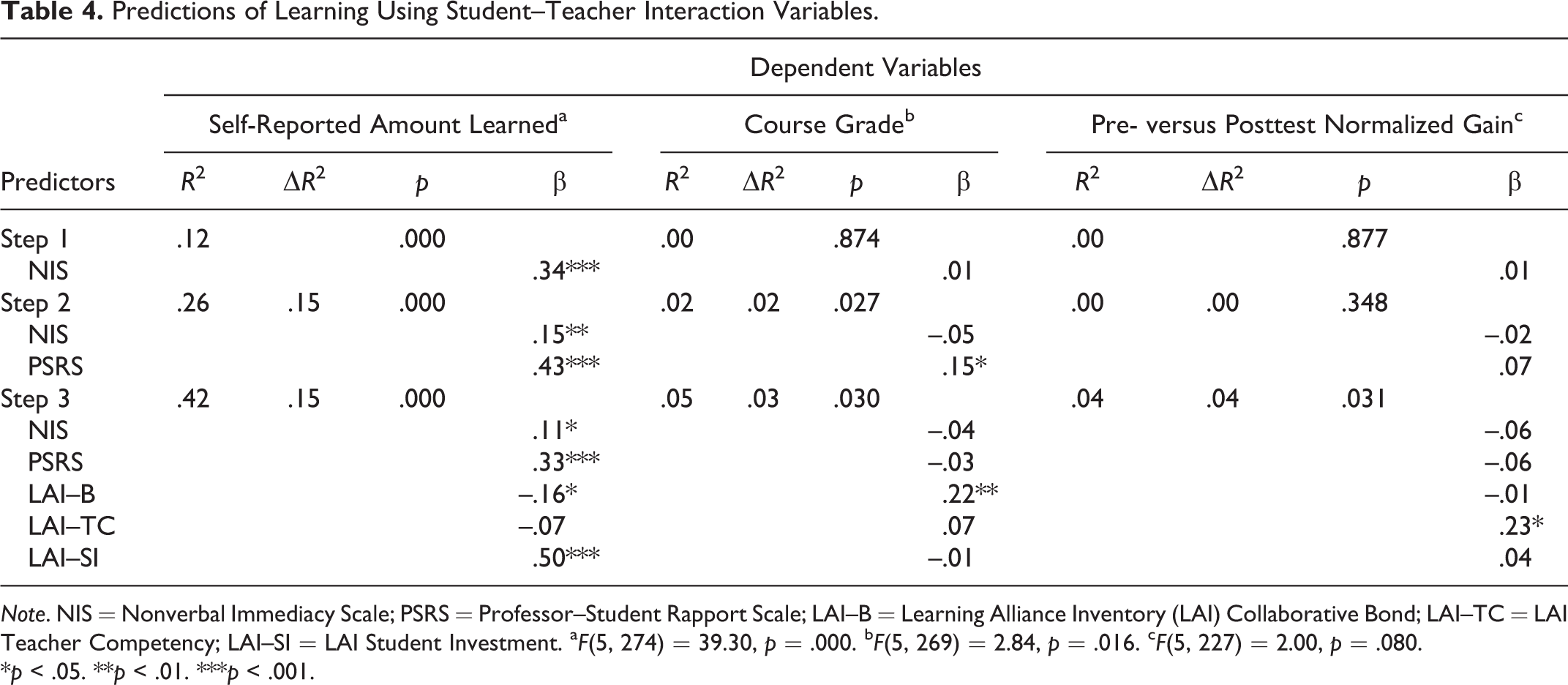
To determine whether participants’ perceptions of the working alliance, immediacy, and rapport were related to their learning, I conducted a series of hierarchical regressions (Table 4). For each analysis, I entered the NIS first, followed by the PSRS, followed by the LAI scales. I chose to use the LAI scales instead of the composite score because the scales proved to be distinct during the LAI development (Rogers, 2012), and the scales accounted for more variance than the composite score alone for all three measures of learning. I selected the sequence for entering the variables based on the order in which the self-report measures were developed as well as the order in the literature that the concepts of immediacy, rapport, and working alliance have been applied to student–teacher interactions. This approach would help distinguish if the newer measures are capable of providing information about student learning beyond that provided by existing measures of related constructs. For each of the three measures of learning, the LAI significantly improved the prediction.
Predictions of Learning Using Student–Teacher Interaction Variables.
Note. NIS = Nonverbal Immediacy Scale; PSRS = Professor–Student Rapport Scale; LAI–B = Learning Alliance Inventory (LAI) Collaborative Bond; LAI–TC = LAI Teacher Competency; LAI–SI = LAI Student Investment. a F(5, 274) = 39.30, p = .000. b F(5, 269) = 2.84, p = .016. c F(5, 227) = 2.00, p = .080.
*p < .05. **p < .01. ***p < .001.
I conducted a path analysis to examine the possibility that in addition to direct effects on learning, immediacy, and rapport may have indirect effects via alliance. The analysis consisted of a series of regressions examining the assumed hierarchical relationships among the three measures. I based these assumptions on the notions that immediacy may help support the broader construct of rapport (Wilson et al., 2010), immediacy and rapport may help support the broader construct of alliance, and alliance may have direct effects on learning. The path diagram in Figure 1 illustrates these relationships for the three measures of learning. The analysis supported the assumption that alliance had direct effects on learning. For immediacy and rapport, direct effects occurred for participants’ self-reported learning but not for course grade or normalized gain. The analysis also supported the assumption that immediacy and rapport have indirect effects on learning, with immediacy impacting rapport and rapport in turn impacting alliance.
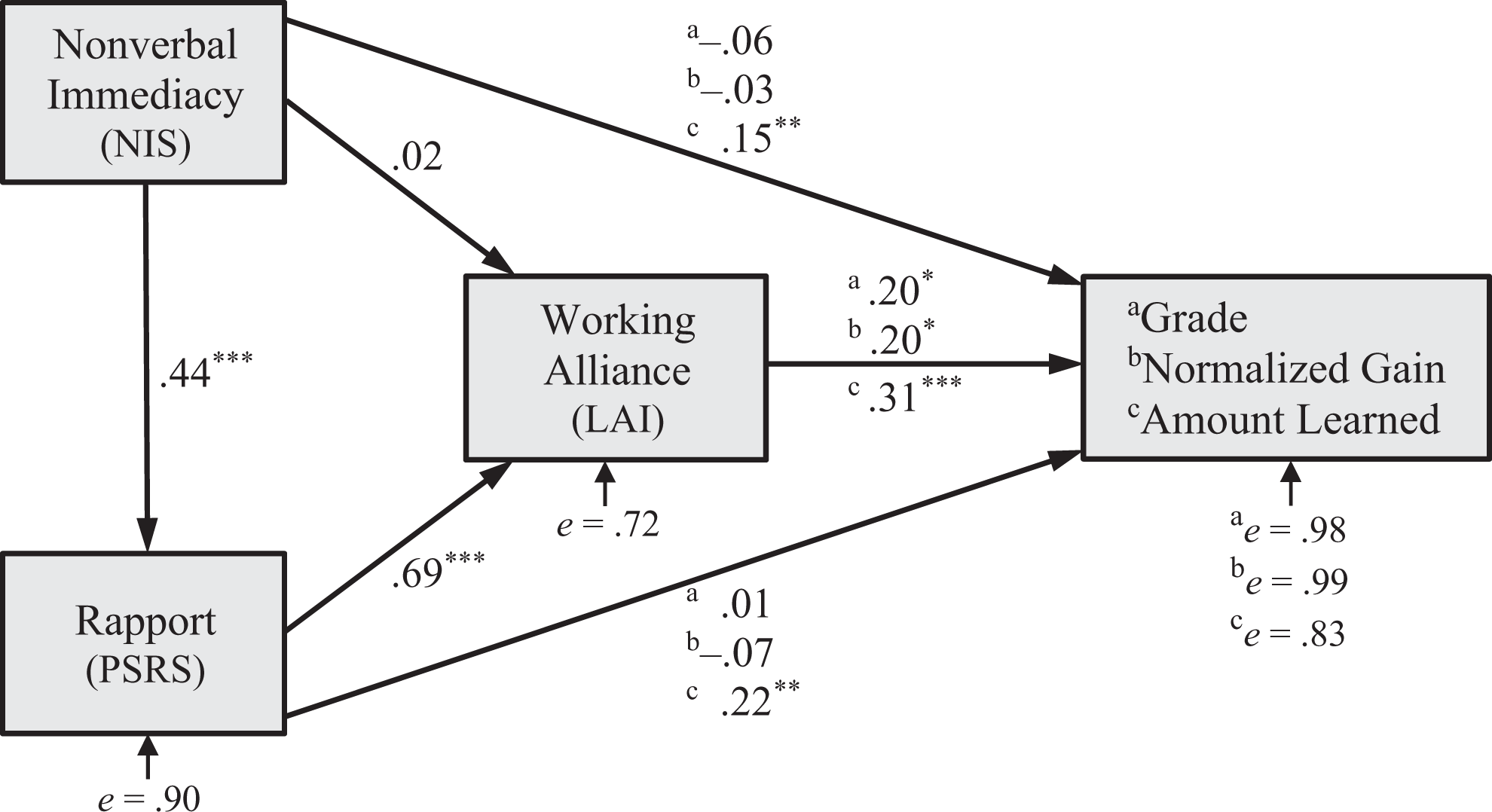
Path analysis illustrating possible direct and indirect effects of immediacy, rapport, and alliance on three measures of learning. Note. NIS = Nonverbal Immediacy Scale; PSRS = Professor–Student Rapport Scale; LAI = Learning Alliance Inventory. *p < .05. **p < .01. ***p < .001.
Discussion
The results lend support to all four hypotheses and further establish the reliability and validity of the LAI as a measure of working alliance in student–teacher interactions. The findings also illustrate the relationships among working alliance, rapport, and immediacy concepts in student–teacher interactions.
The LAI exhibited internal and test–retest reliability, consistent with those reported in its initial development, and these indices were comparable to those observed in measures of immediacy and rapport. Although statistically significant, the test–retest reliability coefficients fell below .70 for the LAI teacher competency scale and the measure of rapport. Because the students’ interactions with the teacher were ongoing during this time, fluctuations in ratings may reflect changes in the underlying constructs, issues with these measures’ reliability over time, or both. The correlations between all measures suggest that the working alliance shares conceptual space with immediacy and, to a greater extent, rapport. But the LAI assesses additional elements of the student–teacher interaction not captured as well by the measures of rapport and immediacy. Although immediacy pertains to teacher nearness and availability, and rapport pertains to a more general sense of positive closeness, working alliance has an even broader definition of collaborative, purposive engagement.
The LAI enhanced the prediction of student learning, beyond what was possible using measures of immediacy and rapport. This was true across all three methods of assessing learning, although the LAI scales differentially contributed to these predictions. Student investment predicted self-reported learning, bond predicted course grade, and teacher competency predicted normalized gain across pre- and posttests. Although the LAI did not have to compete with any other predictor variables to enhance the prediction, the hierarchical regression analysis required it to follow two measures known to relate to student learning. Together, the three measures offered the most utility in predicting self-reported learning. This may have stemmed in part from students’ global impressions of the course having shared influence on their ratings of teacher and learning. This prediction may also have been heightened by measuring the predictor variables and this dependent variable at the same time and by shared method variance in using two self-report measures.
Predicting less subjective measures of learning posed a greater challenge, and previous research provides a limited framework for understanding this finding. Studies of immediacy have largely relied only on participants’ self-reported learning. Studies of rapport are fewer in number but have demonstrated an ability to account for not only self-reported learning and grades (Wilson & Ryan, 2013; Wilson et al., 2010) but also actual course grade (Wilson & Ryan, 2013), although in the latter study participants evaluated rapport near the end of the semester when certainty of their course grade could have impacted their ratings. The ability to predict actual course grade, as well as pre- and posttest performance, will likely vary based on the nature of the course and timing of the predictor variable. For example, courses may be structured in ways that provide more or less leeway for student–teacher interactions to impact student learning. In addition, measurement of working alliance or rapport near the end of a course may be more heavily influenced by a student’s greater certainty of their grade. Course grades and normalized gain scores reflect learning over the length of an entire course. If student perspectives and attitudes regarding immediacy, rapport, and working alliance fluctuate during a course, it may hinder the ability to use single-instance assessments of these constructs to predict more macro-level measures of learning. The test–retest reliability coefficients in this study offer some evidence that even over a span of approximately 5 weeks well into a semester, individual student’s assessments of these concepts change.
The path analysis offers evidence about the possibility of causal relationships between working alliance, immediacy, and rapport that might help account for some of the limitations of using these constructs to predict learning. Immediacy and rapport may only have direct effects on self-reported learning. Their effects on less subjective measures of learning may largely be indirect. In this analysis, immediacy fosters rapport, rapport fosters working alliance, and working alliance fosters student learning across all methods of measurement. This lends further support to the conceptualization of working alliance as the broadest concept of the three, encompassing not only relational (i.e., collaborative bond) but also teacher competency and student investment components.
These results should be considered in light of other potential limitations to the study. As noted, levels of working alliance, immediacy, and rapport are unlikely to be static. Although assessments of these concepts provide useful information about a student–teacher relationship, those measurements will be susceptible to influence from the student’s immediate experiences with the teacher. In addition, all participants were enrolled in an introductory psychology course at the same institution. It seems likely that the nature and roles of the working alliance, as well as that of immediacy and rapport, will vary with course and institutional variables such as class size, difficulty level, instructional methods, and learning objectives. The generalizability of this study is limited accordingly.
The LAI has potential as a measurement tool for investigating the nature of student–teacher interactions. One possible area for future research is examining how student or teacher characteristics that are known to impact teaching effectiveness or student learning might affect the development of the working alliance. Another logical step would be investigating the implications of how the working alliance forms and evolves. For example, in psychotherapy research, the development of the working alliance is increasingly viewed as complex and nonlinear, with variations in the process having implications for patient outcomes (Kramer, de Roten, Beretta, Michel, & Despland, 2009). Patterns in working alliance development, as well as the nature of the alliance at critical time periods, may prove to be better predictors of student outcomes. Additional research will also help illustrate what applications the concept might hold for teachers seeking to improve the quality of their interaction with students. Until then, the scales and items of the LAI provide some insight into the types of teacher behaviors and student experiences that facilitate the development and strengthening of a working alliance. In addition, the LAI provides both researchers and teachers with a tool for assessing these processes in the classroom.
Footnotes
Declaration of Conflicting Interests
The author declared no potential conflicts of interest with respect to the research, authorship, and/or publication of this article.
Funding
The author disclosed receipt of the following financial support for the research, authorship, and/or publication of this article: This research was supported in part by an Incentive Funding Award for Scholarship awarded by the Center for Excellence in Teaching and Learning at Kennesaw State University, GA.