







Abstract
The present study examined the coverage of Stanford prison experiment (SPE), including criticisms of the study, in introductory psychology courses through an online survey of introductory psychology instructors (N = 117). Results largely paralleled those of the recently published textbook analyses with ethical issues garnering the most coverage, but other theoretical and methodological criticisms more sparsely covered by instructors. This resemblance was also true in terms of the use of references critical of the SPE including Carnahan and McFarland’s study and the British Broadcasting Corporation prison study, both of which were cited infrequently in textbook content analyses. Results suggest criticisms of the landmark SPE in the classroom are noted with similar frequency as in introductory psychology textbooks.
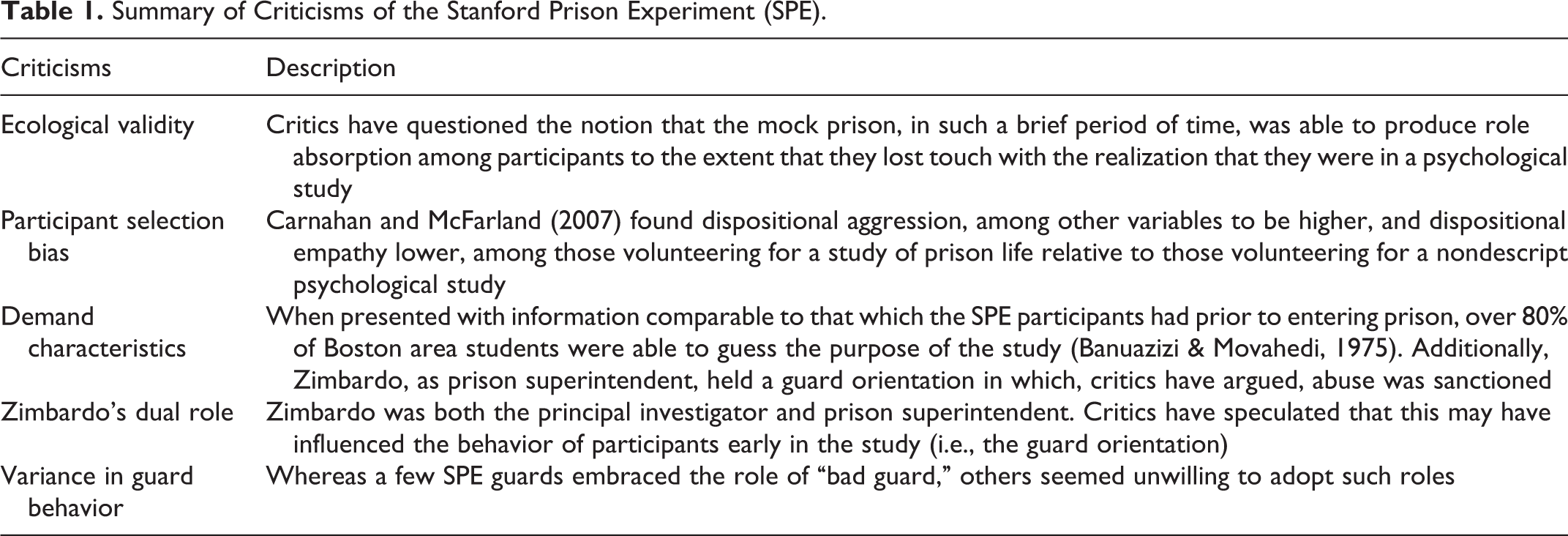
There are few psychological studies as recognizable or as controversial as the Stanford prison experiment (SPE) conducted by Philip Zimbardo and his colleagues in the 1970s. The SPE was designed to demonstrate the ability of situational forces to overpower dispositional tendencies in a prison environment. That is, the extreme asymmetrical power between guards and prisoners in a prison, among other factors, was assumed better predictors of behavior than individual differences in personality traits between guards and prisoners. However, numerous articles critical of the SPE have accumulated over the years since its publication addressing the following issues: the questionable ecological validity of the mock prison, the role of personality in the selection of environments, demand characteristics including the guard orientation, Zimbardo’s dual role as principal investigator and prison superintendent, and the variance in guard behavior. While a thorough description of each is beyond the scope of this article (see Bartels, 2015; Griggs, 2014; Griggs & Whitehead, 2014), a summary of each is provided in Table 1. To better address the factors that influence role adoption in a prison setting and address some of the methodological and theoretical shortcomings of the SPE, Reicher and Haslam (2006) conducted a simulated prison study, the British Broadcasting Corporation (BBC) prison study. Over an 8-day period, participants randomly assigned to prisoner and guard roles did not engage in the type of abusive and submissive behaviors that characterized the SPE participants. Rather, the degree of role adoption depended on the extent to which they identified with the group, those assigned to the role of prisoners being more successful at forming a cohesive group.
Summary of Criticisms of the Stanford Prison Experiment (SPE).
Recently, several authors, as summarized in Table 2, have examined the extent to which SPE criticisms are addressed in introductory psychology textbooks (Bartels, 2015; Bartels & Hernandez, 2013; Bartels, Hernandez, Henning, & Bekovic, 2015; Griggs, 2014; Griggs & Whitehead, 2014) with results suggesting a relative paucity of coverage. Griggs (2014) found SPE criticism mentioned in only 6 of the 11 textbooks, and the coverage was minimal. In a sample of introductory social psychology textbooks, Griggs and Whitehead (2014) found similar coverage with less than half of the textbooks including criticisms of the SPE. Bartels (2015) also conducted an analysis of SPE criticism in introductory psychology books. None of the 14 textbooks in the Bartels’ sample included a mention of replications of the SPE including the BBC prison study; none mentioned ecological validity problems; and there was only a single mention of participant selection bias, demand characteristics, and the guard orientation. Additionally, Bartels (2015) and Bartels, Hernandez, Henning, and Bekovic (2015) assessed the extent to which textbook authors clarified the variance in guard behavior finding only one specific reference to a lack of uniformity in guard behavior in general introductory texts and little more than half of the introductory social psychology textbooks, respectively.
Coverage of Criticisms of the Stanford Prison Experiment (SPE) in Introductory Textbooks and the Introductory Classroom.
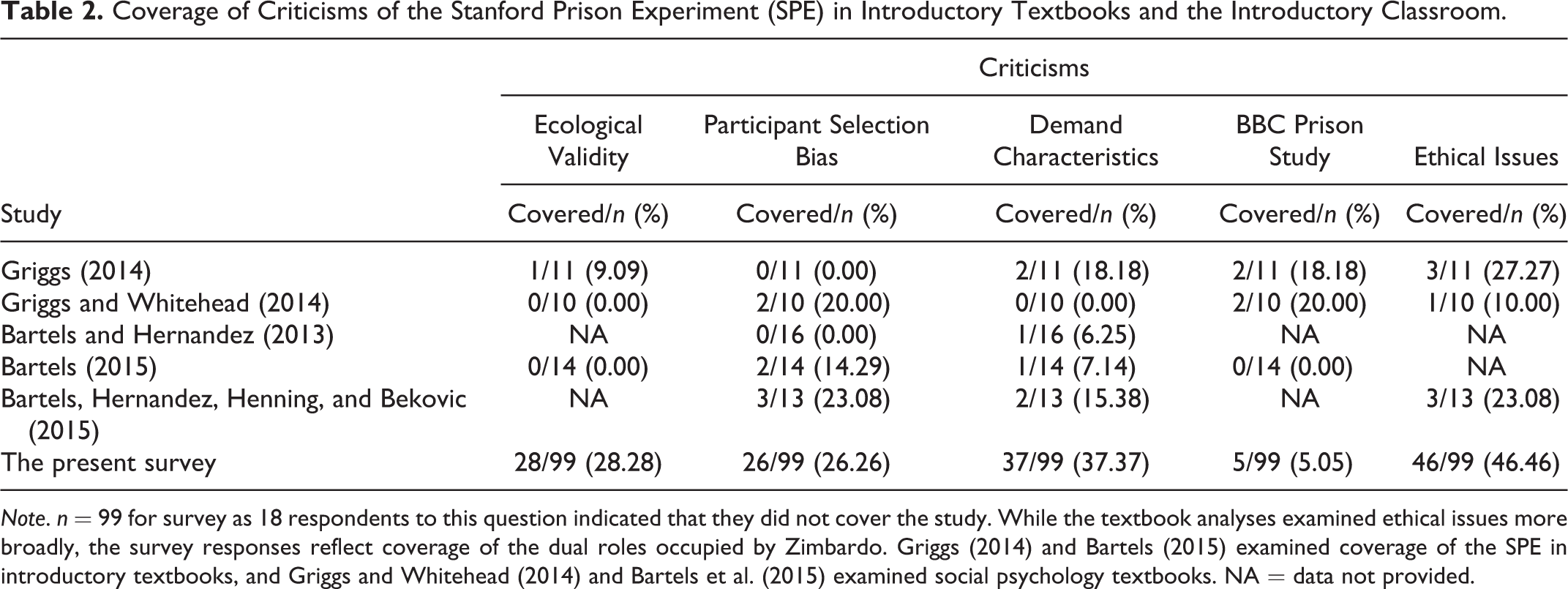
Note. n = 99 for survey as 18 respondents to this question indicated that they did not cover the study. While the textbook analyses examined ethical issues more broadly, the survey responses reflect coverage of the dual roles occupied by Zimbardo. Griggs (2014) and Bartels (2015) examined coverage of the SPE in introductory textbooks, and Griggs and Whitehead (2014) and Bartels et al. (2015) examined social psychology textbooks. NA = data not provided.
Although the content analyses suggest minimal coverage of criticisms of the SPE, the possibility remains that introductory psychology instructors, aware of such criticisms, compensate for the limited coverage in textbooks. Thus, in the present study, we sought to examine the extent of knowledge and coverage of these criticisms and examine the presentation of the SPE more generally.
Method
Participants
One hundred and seventeen instructors completed the survey, resulting in a response rate of 18.00%. Results revealed a range of experience among respondents with 26 of the participants having 20 or more years of teaching experience and 55.26% of the sample having 11 or more years of teaching experience. Nineteen (16.67%) participants had between 1 and 5 years of experience. Twenty-eight of the participants taught at a 2-year college, 37 at a 4-year private institution, and 47 at a 4-year public institution (2 indicated “other”).
Procedure
The present study focused on the presentation of the SPE in introductory general psychology courses. We sought participants from 4-year public, 4-year private, and 2-year colleges and universities. Thus, we compiled a list of institutions located through an online database of college and universities (www.onlinecollegesdatabase.org/) excluding career colleges, for-profit colleges (e.g., Brown Mackie College), and colleges serving a small, select population (e.g., Institute of American Indian and Alaska Native Culture). For each state, a 4-year public and private and 2-year college were selected in a systematic fashion with every first through fourth school (alternating from the top and bottom of the list) selected from the list of institutions by state. Instructors of the selected school’s introductory psychology courses and their e-mail addresses were located through faculty biographies on the program’s webpage, course schedules (fall 2014 and spring 2015), or other information. When no other information was available, the class schedule for the most recent semester or the following semester was consulted for the list of those scheduled to teach introductory psychology courses, and e-mails were found in the school’s directory. Occasionally, information was not available for introductory psychology instructors, and in such cases, another school was selected using the aforementioned procedure. E-mails with a link to the online survey were sent to 660 (10 were returned) instructors in the spring of 2015. Reminder e-mails were sent several days later.
Materials
The survey questions were based on the aforementioned content analyses of the SPE, and thus, questions posed to instructors paralleled those addressed in the content analyses (e.g., do you discuss the role of demand characteristics in your presentation of the SPE?). Participants were asked to indicate their years of experience teaching psychology courses (1–5 years, 6–10 years, etc.) and the type of institution they teach at (2-year public, 4-year public, or 4-year private). In terms of coverage of the study, participants were asked how much class time they devote to the study, whether presentation of the study includes a video and, if so, which one(s), and whether or not additional readings are assigned beyond the textbook and, if so, which one(s) and in which section of the course they cover the study (e.g., social psychology, research methods, etc.). Additionally, participants were asked whether their presentation of the study included coverage of Abu Ghraib and which interpretation(s) of the study are included in their presentation including deindividuation, social roles, banality of evil, power of the situation, or other. Participants were also asked about the references for the study that they use including the original publications and Zimbardo’s (2007) The Lucifer Effect. Participants were also asked about SPE criticisms and the extent to which these are incorporated into their presentation of the study. Specifically, we asked participants about their level of familiarity with criticisms, whether or not they include a discussion of the BBC prison study, and which of the following criticisms are addressed: demand characteristics, ecological validity, participant selection bias, variance in guard behavior, Zimbardo’s dual role, and alternatives to Zimbardo’s interpretation of the results. Lastly, participants were asked about their use of references critical of the SPE (e.g., Banuazizi & Movahedi, 1975).
Results
Coverage of the Stanford Prison Study
Of the 117 respondents, 15.38% indicated that they did not cover the study, while the most frequent response was 1–10 min indicated by 35.35% of the respondents who did cover the SPE. The second most frequent response was between 11 min and 20 min indicated by 29.29% of respondents. Thus, 64.65% of the respondents who covered the SPE did so in 20 min or less. The majority of the participants (74.26%) indicated that they used a video in their presentation of the SPE, the most popular being Quiet Rage, a video produced by Zimbardo (19.78%), followed by The Stanford Prison Experiment produced by the BBC (14.29%). Only 6.93% of participants indicated that they assigned additional readings for the SPE beyond the textbook. Lastly, the vast majority of participants covered the SPE in the social psychology section of the course (77.78%), with only a few covering it in the course introduction (9.09%), personality and individual differences section (2.02%), and research methods section (6.06%).
In terms of SPE resources, the most popular reference from Zimbardo was The Lucifer Effect (2007) utilized by 29.13% of respondents, followed by Zimbardo, Maslach, and Haney (1999) used by 12.62%; Haney, Banks, and Zimbardo (1973a; 8.74%) published in the International Journal of Criminology and Penology; and Haney, Banks, and Zimbardo (1973b; 8.74%) published in Naval Research Reviews. Zimbardo’s (1973) New York Times Magazine was utilized by 5.83% of respondents. Theoretical accounts of the SPE included in the class presentation of instructors were largely consistent with those put forth by the SPE authors, namely, deindividuation (71.13%), social roles (84.54%), and the power of the situation (90.72%). Less frequent was the banality of evil interpretation endorsed by 18.56%. Lastly, 64.00% of participants indicated that they discussed Abu Ghraib when covering the SPE.
Coverage of Stanford Prison Study Criticisms
Results in terms of awareness of SPE criticisms were as follows: 17.09% described themselves as very familiar and only 4.27% described themselves as not at all familiar with SPE criticisms, while the majority of participants were either mostly familiar (34.19%) or somewhat familiar (44.44%). In terms of criticisms covered, the dual roles occupied by Zimbardo and alternative explanations for the results (e.g., obedience to authority) were covered by 46.46% and 47.47% of participants, respectively. Receiving less coverage were demand characteristics (37.37%), the guard orientation (36.36%), ecological validity (28.28%), and participant selection bias (26.26%). Variance in guard behavior was addressed by 39.39% of those who cover the SPE, and only 5.05% indicated that they covered the discrepant findings of the BBC prison study. In general, only 15.38% of participants indicated they covered the BBC prison study in an introductory course. Lastly, 20.20% of participants indicated that they did not address any of these criticisms when presenting the SPE.
With respect to references critical of the study, use among respondents was infrequent, with Carnahan and McFarland (2007) being utilized most often by those indicating they covered the SPE (10.99%), followed by Fromm (1973) at 8.79%, Banuazizi and Movahedi (1975) at 7.69%, and Banyard (2007) at 6.59%. References seldom used by respondents were Reicher and Haslam (2006; BBC prison study) at 4.40%, Haslam and Reicher (2006), Haslam and Reicher (2007), and Haslam and Reicher (2012) at 3.30% and Prescott (2005) utilized by 2.20%.
Lastly, we sought to examine potential differences in coverage of criticism among instructors based on years of experience and the type of institution. Exploratory data analyses indicated small cell size for the levels of years of teaching experience (1–5 years, 6–10 years, 11–15 years, 16–20 years, and more than 20 years), so we recoded this variable to create three group levels (1–10 years, 11–15 years, and 16–more than 20 years), which resulted in increased N in each cell.
Two separate 3 × 4 independent groups factorial analyses of variance (ANOVAs) were conducted with years of teaching experience and the type of institution as the independent variables and the total number of SPE critical references and the total number of SPE theoretical aspects presented in class as the dependent variables. In the first ANOVA, no significant main effects were found for recoded years of teaching experience, F(2, 106) = 2.28, p = .11, and the type of institution, F(3, 106) = 0.68, p = .57, on the total number of references critical of the SPE. The interaction of these two factors was also not significant. For the second factorial ANOVA, we used the total number of SPE theoretical aspects presented in class as the dependent variable and found no significant main effects for either recoded years of teaching experience, F(2, 106) = 2.36, p = .10, or the type of institution, F(3, 106) = 0.69, p = .56, on the total number of SPE theoretical aspects presented in class, and no significant interaction was found for the two factors.
Discussion
Results of the present study indicate that among the majority of survey respondents, 20 min or less of class time is devoted to coverage of the SPE and that the presentation involves the use of a video but seldom an additional reading outside of a textbook chapter. The study was most often covered in a social psychology section of the course with few indicating coverage in a research methods or introductory section. These results appear consistent with those reported by Griggs (2014) in terms of introductory textbook coverage with 9 of the 11 textbooks covering the study in a social psychology chapter and 2 in a research methods chapter. Nine textbooks also included a photograph of the SPE, and the preference for using a video among the present sample supports Griggs’ characterization of the SPE as involving “compelling iconography.”
Publication of the SPE in obscure journals may explain the varied references to the SPE in introductory textbooks (Griggs, 2014). Griggs (2014) reports 6 of the 11 textbooks in his analysis cited the publication in the International Journal of Criminology and Penology. Results of the present study, likewise, suggest instructors in the present sample consult a variety of SPE references. However, those references are most often contemporary summations of the SPE (e.g., Zimbardo, 2007) with less than 10% of respondents referencing the original publications of the study.
Theoretical accounts of the SPE were consistent with the results reported by Griggs (2014) and Bartels (2015). Griggs reports that the majority of the texts he reviewed provided situationist interpretations of the SPE, while Bartels examined specific references to normalcy or indications that the SPE participants and perpetrators of evil more generally are “normal.” While references to normalcy were found in close to half of the texts, implicit references to the power of the situation were found in 12 of the 14 texts analyzed and 1 included an explicit reference. Our results suggest that the interpretation offered by the SPE authors and the majority of textbooks is also the interpretation offered in the introductory psychology course. Specifically, more than 80% of respondents explained the results in terms of social roles and the power of the situation and more than 70% reference deindividuation. However, the banality of evil interpretation, which is implied by references to normalcy, was relatively infrequent. It is not surprising that these interpretations were endorsed, yet numerous arguments have been made for alternative interpretations of the results. Fromm (1973) made the case that, considering that only one third of the guards engaged in sadistic behavior, the SPE actually demonstrated that people cannot be so easily manipulated by a powerful situation. Banuazizi and Movahedi (1975) and Reicher and Haslam (2006) have made the case that results may be attributed to demand characteristics rather than to the power of the situation. Carnahan and McFarland (2007) and McFarland and Carnahan (2009) have argued that in the SPE and in their own study, personality traits were as illuminating as the situation.
With respect to SPE criticisms, the majority of respondents endorsed a “somewhat familiar” option. However, the current survey did not examine familiarity with specific criticisms, so no definitive conclusions can be drawn about the specific criticisms familiar to participants. Textbook analyses have suggested ethical problems have been the most common in terms of textbook coverage, and it may be that ethical issues are the most salient among introductory psychology instructors, perhaps, in part, because of the scrutiny studies of that era, including Milgram’s, received. Ethical problems of the SPE were covered by nearly half of the participants suggesting that instructors are compensating for the lack of coverage in textbooks on this issue. This also appears to be the case for demand characteristics and ecological validity as nearly 40% and 30% of participants indicated that these are covered in their presentations of the SPE, respectively. However, participant selection bias and the BBC prison study coverage mirrored textbook content analyses results. Moreover, in spite of what appears to be greater coverage relative to textbook coverage, none of the criticisms, including ethical ones, were covered by the majority of respondents.
Use of references critical of the SPE was infrequent among respondents. There are several key studies that stand out in terms of their ability to highlight weakness of the SPE, namely, Carnahan and McFarland (2007), Banuazizi and Movahedi (1975), and Reicher and Haslam (2006). The latter, the BBC prison study, highlighted both the methodological and the theoretical shortcomings of the SPE. Rather than suggest social roles are mindlessly adopted, the BBC study demonstrated the importance of group identification in terms of whether or not one would fully adopt such a role. Thus, the BBC study produced dramatically different results from the SPE as BBC study guards failed to form a strong group identity, yet prisoners gradually did. The BBC study also demonstrated the power of the situation to affect personality as the authoritarianism of participants increased during the study. Yet, our results suggest a near-complete absence of coverage among survey respondents.
Perhaps an introductory psychology course is not the most appropriate venue for even a superficial exploration of these criticisms. Although one might assume a social psychology course would be a better fit, neither Griggs and Whitehead (2014) nor Bartels et al. (2015) found more coverage of SPE criticisms in social psychology books than in introductory books. Griggs (2014) has argued that rather than avoiding the study or presenting an unparsed version of it, addressing the study in a research methods section and then again in the social psychology section of an introductory course would allow students an opportunity to integrate methodological and theoretical considerations. An activity used by one of the present authors involves giving students a mock SPE data set with scores on dispositional aggression and abusive behavior in prison for all 75 participants (i.e., the number of people who responded to the SPE ad) and 75 participants who have responded to a generic ad for a psychological study. Students are then asked to perform a number of calculations and consider the role of participant self-selection and restriction of range. The data set also allows for an analysis of demand characteristics as half of the guards have attended a guard orientation and half have not. Students examine differences in abusive behavior among the two groups and address questions about demand characteristics and experimental research. After using the study to explore methodological and ethical issues in research methods, the study is revisited in both the personality and social psychology sections of the course.
In addition to introductory psychology course SPE coverage, students in upper division research methods courses may benefit from more extensive class activities centered on the design of simulation studies and more specifically the criticisms of SPE. The ethical shortcomings of the study would provide a learning opportunity for students to reevaluate the original study design, using the current ethical standards published by the American Psychological Association, including a review of the SPE consent forms, prisoner rules, guard orientation, and the general information provided to SPE participants.
Footnotes
Declaration of Conflicting Interests
The authors declared no potential conflicts of interest with respect to the research, authorship, and/or publication of this article.
Funding
The authors received no financial support for the research, authorship, and/or publication of this article.