







Abstract
This study investigated the accuracy of psychology majors’ expectations regarding careers. Psychology majors, including 101 women and 35 men (M age = 23 years; standard deviationage = 6.25), indicated a desired career and estimated the level of education needed and the expected annual salary for the career. Students’ expectations were compared with Bureau of Labor Statistics data. Students completed the Career Decision-Making Self-Efficacy Scale Short Form to assess the career efficacy and expectations. Students overestimated education needed for a career, but salary estimates did not differ from market statistics. Students’ confidence in career choice and expected income was related to career efficacy. Results highlight the importance of career advising and support for psychology students entering the job market.
Psychology continues to be one of the most popular undergraduate majors in the United States. Recent estimates indicate that more than 114,450 psychology majors graduated during 2012 and 2013 (Number of Degrees Conferred, 2015). One question facing students is what to do following graduation. Whereas approximately 25% go directly into graduate school, the remaining 75% enter the workforce (American Psychological Association [APA] Center for Workforce Studies, 2012). Similar to other students graduating with degrees in liberal arts disciplines, psychology students may struggle to see the direct connection between their academic training and a specific career title (Rajecki & Borden, 2009; Ware, 1986). Additionally, psychology alumni often rate themselves low in preparedness for entering the job market (Borden & Rajecki, 2000) and display the lowest satisfaction ratings for job preparation relative to other aspects of their undergraduate experience (Strapp, Granov, & Dixon, 2011). As many undergraduate institutions feel increased pressure for accountability and assessment (Abel, Deitz, & Su, 2014), psychology departments are developing approaches to support career planning and to provide evidence to counter the myth that one cannot get a job with a bachelor’s degree in psychology (Donaldson & Berger, 2006). Furthermore, the APA has identified career planning and development as an important learning outcome for undergraduate psychology majors (APA, 2013).
Clearly, there is a movement toward helping students with career planning and development. Self-efficacy (Bandura, 1997) may be an important factor to consider for career planning. Self-efficacy may contribute to psychology students’ perceptions about options after graduation and confidence in career planning. According to this theory, beliefs about one’s ability to succeed in certain situations, such as getting a job or gaining admission to graduate school, influence choices, performance, and persistence. Students with higher self-efficacy view challenges as tasks to be mastered tend to develop deeper interest in activities, have a stronger sense of commitment to their interests, and recover more easily from setbacks (Bandura, 1997). Similarly, career maturity theory (Crites, 1978) suggests that good career decisions involve competence in five areas including accurate self-appraisal, gathering occupational information, goal selection, making future plans, and problem-solving. The concept of career decision-making self-efficacy (CDMSE) measured by the CDMSE Scale (Betz & Taylor, 1996) combines Bandura’s ideas about self-efficacy and Crites’s five competency areas. Students with higher CDMSE should feel more prepared for getting a job in the field and have knowledge about that job.
Unfortunately, several studies suggest that psychology majors often lack accurate information important for career development. For example, Gallucci (1997) explored psychology majors’ estimates for time needed to complete a doctoral degree in clinical or counseling psychology and the expected starting salary upon completion of this degree. Student estimates were compared to industry data. Although the article did not contain inferential statistics, Gallucci concluded that students underestimated the time necessary to complete a doctoral degree, and they overestimated the initial salary.
Similarly, Rajecki, Lauer, and Metzner (1998) assessed plans for attending graduate school and knowledge of admission criteria for newly declared psychology majors. They found that the intention to pursue graduate admission was not related to the students’ own grade point average (GPA) or estimates of the GPA required for graduate admission; thus, the authors concluded that students held “uninformed expectations” (p. 629). Additionally, Rajecki et al. found a negative correlation between the amount of psychology coursework completed and plans to attend graduate school, suggesting that beginning students in the field may believe more strongly than advanced students that graduate school is necessary to achieve a career. In a similar vein, Nauta (2000) explored the accuracy of psychology majors’ beliefs regarding time to complete an advanced degree and salaries in the field for graduates with a bachelor’s, master’s, and doctoral degree. Nauta compared students’ responses with industry data and found that students underestimated the time required to complete an advanced degree and overestimated starting salaries for all educational levels.
Expanding on Nauta’s work, Briihl (2001) explored psychology majors’ salary estimates for graduates with a bachelor’s, a master’s, and a doctoral degree in psychology using the same general categories as Nauta. Briihl compared perceptions for sophomore-, junior- and senior-level students with data from APA and the Bureau of Labor Statistics. Many students (approximately 10%) did not respond to the question about salary or wrote “don’t know.” Although Briihl did not present inferential statistics, students generally overestimated starting salaries in the field, but seniors appeared to be more accurate than sophomore and junior students.
It is important to note that Nauta (2000) and Briihl (2001) did not solicit specific career titles from students but instead asked students to estimate the salary for “someone with a bachelor’s (or master’s, or doctoral) degree in psychology.” Students’ perceptions may have differed depending upon career title connected to the degree. For example, salary estimates for a clinical psychologist could differ substantially from a university psychology professor, even though both career titles require a doctoral degree in psychology (National Center for Occupational Information Network [O*NET] Development, n.d.). One goal of the current study is to examine the accuracy of students’ perceptions for salary estimates for a desired career in the field rather than for a general degree.
More recently, Green, McCord, and Westbrooks (2005) explored the accuracy of students’ perceptions regarding the education required for a desired career in the field in two studies. In the first study, students reported the name of the career for which they were preparing and estimated the level of schooling needed for this career on a 4-point scale (1 = BA/BS degree, 2 = postbaccalaureate/career-specific training, 3 = master’s degree, 4 = doctoral degree including MD, PhD, DDS, JS, etc.). Green et al. reasoned that students would not be completing a bachelor’s degree if the career of choice did not require at least a BA/BS degree, so students were not able to indicate schooling lower than a bachelor’s degree. They compared students’ estimates with actual education requirements for specified careers provided in the Occupational Outlook Handbook (OOH) produced by the U.S. Bureau of Labor Statistics. They found that students overestimated the amount of education needed for a desired career in the field, and psychology majors were less accurate than other majors included in the sample. In the second study, Green et al. found that students completing a careers course held more accurate perceptions of educational requirements compared to students who had not completed the course.
Considered together, these studies suggest that more could be done to inform psychology majors’ career planning and correct their misperceptions. Students who lack accurate information may not seek out and acquire skills, experiences, or supporting documents such as recommendation letters needed for admission to graduate school or employment (Nauta, 2000). Students may also discover they lack necessary requirements late in the process (Atchley, Hooker, Kroska, & Gilmour, 2012). Additionally, misperceptions make it difficult for students to accurately gauge whether or not they are qualified to get a specific job or to gain admission to a graduate program. These misperceptions could contribute to experiences of failure for students who apply to a graduate program or job announcement outside of their skill level. As Gardner (2012) noted, “students’ sense of entitlement, expectations, and level of preparedness is totally out of sync with the reality of the workplace” (p. 41). Conversely, lack of knowledge could prohibit qualified applicants from applying in the first place. Accurate salary and job market information is needed for informed career planning. Given the high student debt load for graduating seniors (Reed & Cochrane, 2012) and the prospective costs of graduate tuition (Finno, Wicherski, & Kohout, 2010), psychology majors need to carefully consider their options. Choosing to pursue graduate education or not may be influenced by perceptions of income potential available for an advanced degree (Nauta, 2000). If psychology students hold inaccurate perceptions about earning potential or if an advanced degree is not needed for a desired career in the field, students risk incurring additional debt not commensurate with earning potential in the field (Rajecki, 2008; Vedder, Denhart, & Robe, 2013).
We designed the current study to assess the accuracy of psychology students’ perceptions regarding the education necessary for a desired career in the field as well as the expected annual salary. We hypothesized that psychology students would overestimate the amount of schooling needed for a desired career (Green, McCord, & Westbrooks, 2005) and overestimate income for a specific career title (Briihl, 2001; Gallucci, 1997; Nauta, 2000). Additionally, based on prior research (Briihl, 2001; Rajecki, Lauer, & Metzner, 1998) and career development models (Hartung & Niles, 2000; Kramer, 2000), we expected to see differences in accuracy based on class standing. Specifically, we predicted that first- and second-year students, likely to be engaged in self-assessment and career exploration, would hold less accurate perceptions than junior and senior students, presumed to be more focused on implementing a career plan (Prehar & Ignelzi, 2012). Finally, we expected that students with higher CDMSE, as assessed by the CDMSE (Betz & Taylor, 1996), would be more confident in their knowledge about various careers in the field and hold more accurate perceptions.
Method
Participants
Participants were sampled by convenience from undergraduate psychology classes at Western Oregon University. Majoring in psychology was a requirement for inclusion in the study. Initially, 147 students participated; however, we discarded responses from 11 participants based on data collection errors (e.g., not a psychology major, incomplete responses). Of the remaining 136 students, 101 were women and 35 were men. Participants’ ages ranged from 18 to 48 years (M age = 22.65 years; standard deviation [SD]age = 6.25). Forty-one participants were first years, 17 sophomores, 30 juniors, 46 seniors, and 2 postbaccalaureate students. Postbaccalaureate students were grouped with seniors. Approximately 26% identified themselves as nontraditional students, 51% identified as first-generation students, and approximately 34% had started college at another school. The vast majority of participants were Caucasian (82%) and approximately 18% indicated Hispanic Latino/Latina ethnicity. Participants received course extra credit for participation.
Materials and Procedure
After gaining approval from the Institutional Review Board (IRB), we tested participants in small groups. After being told that the study examined career expectations, all participants provided informed consent. Participants completed a demographics questionnaire, reported a best fit career title, and completed the CDMSE Scale. Each measure is described below. The materials were presented as a paper-and-pencil questionnaire. We debriefed the participants after they completed the questionnaire.
Demographics
Demographic items included sex, age, major, class standing, race, ethnicity, and identity groupings (i.e., nontraditional student, first-generation student).
Best fit career title
Pilot testing indicated that participants experienced difficulty generating a desired career title. Therefore, we used several methods to solicit possible career titles. As in Green et al. (2005), we initially prompted participants with an open-ended question: Please list the name of the career for which you are currently preparing. Additionally, we prompted participants who experienced difficulty naming a specific career title to read a list of 78 psychology career titles and to circle any job title that was similar to the career for which they were preparing. The list of 78 psychology career titles contained seven categories including business/human resources, counselor/therapist, education, health/medicine, legal/law enforcement, psychologist, and social worker/human services. We generated specific categories and career titles from the APA (2011, 2013), the Bureau of Labor Statistics OOH (2013–2014), O*NET (National Center for O*NET development, n.d.), and career titles of psychology graduates from our program (Strapp et al., 2011). 1 The list of 78 career titles was not intended to be an exhaustive list of all possible careers for psychology graduates, but the list did include career titles with diverse educational requirements. Finally, participants compared their responses to the open-ended question, and the list of circled career titles, and selected one best fit career title. Participants rated their confidence in the best fit career title on a 5-point scale (1 = not at all decided to 5 = completely decided). Participants used the best fit career title to answer the remaining questions.
Education and salary estimates for best fit career title
Participants estimated the level of education needed and expected salary for the best fit career title. Although Green et al. (2005) had students estimate education on a 4-point scale (1 = bachelor’s degree, 2 = postbaccalaureate certification, 3 = master’s degree, 4 = doctoral degree), it is possible that a career title may not require a bachelor’s degree (i.e., preschool teacher or law enforcement officer). To allow for more education options in our study, we used a 7-point scale (1 = high school diploma or equivalent, 2 = associates degree, 3 = associates level certification, 4 = bachelor’s degree, 5 = postbaccalaureate certification, 6 = master’s degree, 7 = doctoral degree). Participants also estimated the expected annual salary in U.S. dollars for full-time employment in the best fit career title and rated their confidence in earning the salary on 5-point scale (1 = no confidence at all to 5 = complete confidence).
CDMSE
Participants completed the short form of the CDMSE Scale Short Form (CDMSE-SF, Betz & Taylor, 1996). This scale includes 25 items with five subscales designed to measure (a) self-appraisal, (b) occupational information, (c) goal selection, (d) planning, and (e) problem-solving. For each item, participants rated “how much confidence do you have that you could” (e.g., “determine what your ideal job would be”) on a 5-point scale (1 = no confidence at all to 5 = complete confidence).
Results
Preliminary Results
To assess the accuracy of students’ estimates for required education and salary, we needed students to determine a best fit career title. In response to the open-ended question to list the career for which they were preparing, 29 students left the answer blank or wrote in don’t know. These students were equally distributed across class standing (24% of first years, 18% of sophomores, 20% of juniors, and 21% of seniors left the answer blank). When provided with a list of potential career titles, on average, participants selected five career titles. When asked to select a best fit career title, 136 participants identified 61 different career titles. The three most frequently reported career titles included clinical psychologist, social worker, and school counselor. Confidence ratings for the best fit career title indicated that participants were moderately confident with this choice (M = 3.52; SD = .98). When asked to estimate the annual salary for the best fit career title, approximately 11% of participants left the item blank or wrote don’t know. Participants who provided salary estimates were moderately confident with the salary estimate (M = 3.33; SD = .89).
We consulted the Bureau of Labor Statistics OOH (2013–2014) or O*NET (National Center for O*NET development, n.d.) to determine required education and salary for each best fit career title. The researchers rated education required on the same 7-point scale used by participants (1 = high school diploma or equivalent, 2 = associates degree, 3 = associates level certification, 4 = bachelor’s degree, 5 = postbaccalaureate certification, 6 = master’s degree, 7 = doctoral degree). Additionally, OOH or O*NET provided median salary information for each career title.
Accuracy of Education and Salary Estimates
To determine the accuracy of students’ estimates for level of education, we compared the student estimate of education with the required education for each career title. For example, if a student believed that a career title required a doctoral degree (7), but O*NET showed the career only required a master’s degree (6), there would be a difference score of 1 for this specific career title. A dependent samples t test was conducted comparing estimated education with required education. As predicted, students overestimated the level of education needed relative to industry data (MD = .32; SDD = 1.32), t(135) = 2.79, one-tailed, p < .006, Cohen’s d = .24, 95% confidence interval (CI) [.09, .54]. Similarly, we compared student salary estimates with actual median salaries for each career title with a dependent sample t test. Contrary to predictions, students did not overestimate income relative to industry data (MD = 4,701.15; SDD = 26,983.07), t(121) = 1.92, one-tailed, p = .057, Cohen’s d = .17, 95% CI [−135.28, 9,537.58]. To determine whether students closer to graduation held more accurate perceptions relative to first- and second-year students, we conducted mixed-factors analyses of variance (ANOVAs) for education and salary information. For these analyses, class standing served as the between-subject factor (Junior/Senior [JR/SR] vs. Freshman/Sophomore [FR/SO]), and the discrepancy between the student estimate and the actual data for education or salary served as the within-subject factor. Contrary to predictions, JR/SR students were not more accurate in education estimates relative to FR/SO students; mixed ANOVA, F(1, 134) = .37, p = .54, η2 = .07. Additionally, JR/SR students were not more accurate in salary estimates relative to FR/SO students, F(1, 120) = .47, p = .49, η2 = .09.
Career Self-Efficacy, Confidence, and Accuracy
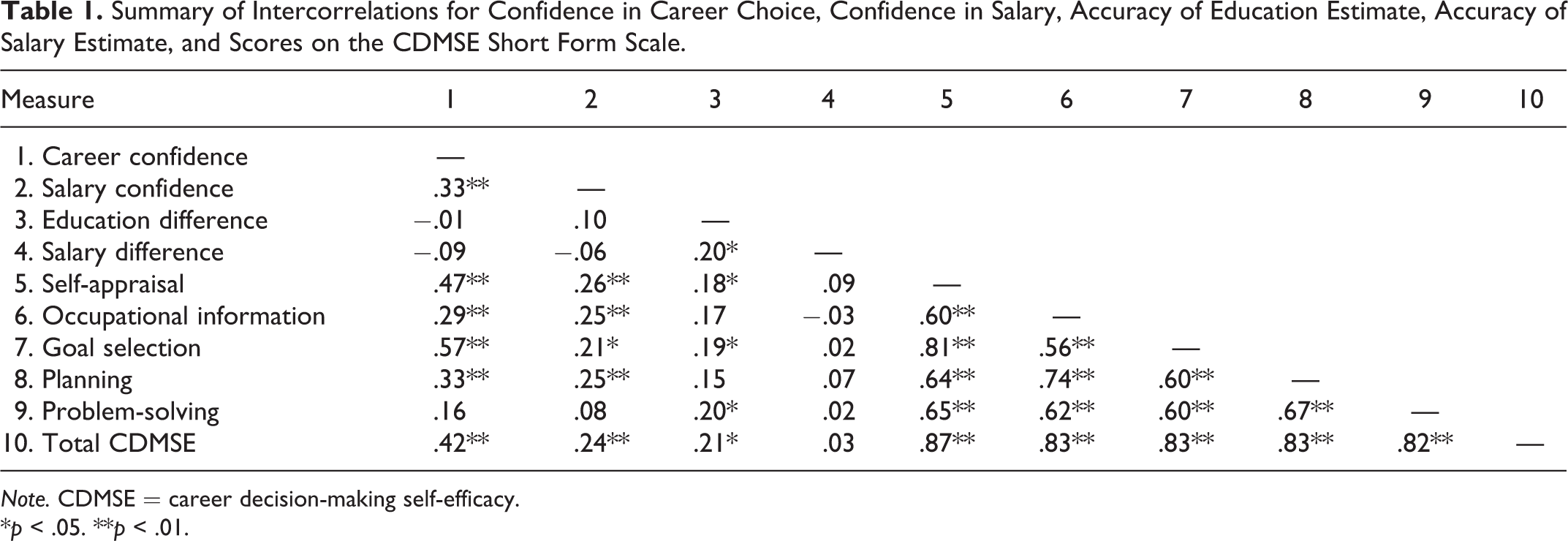
To determine whether CDMSE was related to confidence in career choices and accuracy, we correlated scores on the five CDMSE-SF subscales with decidedness for best fit career title, confidence in salary earnings, and accuracy with respect to education and salary estimates. For accuracy of education and salary estimates, we calculated difference scores for each participant based on the difference between the estimated and required education and estimated and reported salary information. Relatively accurate estimates would produce small difference scores, while inaccurate estimates would produce larger difference scores. Pearson correlations appear in Table 1. As predicted, students with higher CDMSE were more confident in their career choices and salary estimates; however, CDMSE was also related to overestimating the level of education needed for a career in the field.
Summary of Intercorrelations for Confidence in Career Choice, Confidence in Salary, Accuracy of Education Estimate, Accuracy of Salary Estimate, and Scores on the CDMSE Short Form Scale.
Note. CDMSE = career decision-making self-efficacy.
*p < .05. **p < .01.
Discussion
We conducted the current study to extend the literature on psychology students’ expectations about careers in the field. As in prior research, psychology majors experienced difficulty when asked to name the career for which they were currently preparing (Ware, 1986). Given the widespread availability of career information on the Internet, it is disappointing to find that psychology students still struggle to see the direct connection between their academic training and a specific career title. When prompted to name a career for which they were preparing, approximately 20% of participants left the item blank or wrote “do not know.” Seniors were as undecided as first-year psychology majors. When given a list of possible career titles, students selected on average five different career titles. Finally, when asked to select a best fit career title from earlier options, psychology majors indicated that they were moderately confident with their choice. This could mean that psychology majors are considering multiple options in the field but are not completely decided on a specific career title. Of course, it is also possible that psychology majors lack knowledge about career options but can select interesting job titles if given a list. As predicted, students overestimated the amount of schooling needed for their best fit career title. Typically, students anticipated that they would need a master’s degree, when for many positions a postbaccalaureate certification would be the appropriate level of training required for the best fit career title identified. This finding is consistent with the work of Green et al. (2005) and suggests that more needs to be done to help students understand educational requirements for careers of interest. If an advanced degree is not needed for a desired career, students risk incurring additional debt not commensurate with the earning potential in the field (Rajecki, 2008; Vedder et al., 2013).
With respect to salary estimates, approximately 11% of students had no idea about the expected salary associated with a best fit career title. Contrary to predictions, psychology majors did not significantly overestimate salary; however, comparing estimates for specific career titles led to extreme variability in the data. For example, the mean difference between the salary estimate and actual salary based on industry data was US$4,701.15, with an SD of US$26,983.07. For the current study, students estimated the salary associated for a specific career title (i.e., school counselor) rather than the salary for someone with a master’s degree in psychology (Briihl, 2001; Nauta, 2000). Nauta reported a statistically significant difference with respect to salary estimates and industry data; however, other researchers (Briihl, 2001; Gallucci, 1997) reported that psychology majors overestimated salaries, although these researchers did not provide inferential statistics. Our results suggest that psychology majors lack information about salaries for specific careers in the field. Accurate salary and job market information is needed for informed career planning. Given the high student debt load for graduating seniors (Reed & Cochrane, 2012) and the prospective costs of graduate tuition (Finno et al., 2010), psychology majors need to consider their options carefully with accurate salary information to make informed decisions.
We did not find juniors and seniors to be more accurate in estimating education and salary relative to first years and sophomores. Prior research suggested differences based on class standing (Briihl, 2001; Rajecki et al., 1998), and career development models predict that junior- and senior-level students are more focused on implementing a career plan relative to first years and sophomores (Hartung & Niles, 2000; Kramer, 2000; Prehar & Ignelzi, 2012). Conversely, Brewer (2009) observed that students do not become more active in career planning, as assessed by career center usage, as they get closer to graduation. If students are not engaged in exploration and making use of resources such as career centers, additional effort is needed to help students prepare for life following graduation (Brewer, 2009; Nauta, 2000).
Finally, interesting patterns emerged when we considered students’ career self-efficacy as measured by CDMSE-SF scores. We expected that students with higher CDMSE would be more confident about careers in the field and hold more accurate perceptions relative to students with lower self-efficacy. Students who were more confident in selecting a career title and more confident in earning a predicted salary tended to have higher scores on self-appraisal, occupational information, goal selection, planning, and total CDMSE scores. Additionally, students who scored higher in some aspects of career self-efficacy such as self-appraisal, selecting a goal, and problem-solving tended to overestimate the amount of education needed for their careers. In other words, students with higher CDMSE were less accurate with respect to estimating education than students with lower career efficacy. Not surprisingly, students who overestimated the level of education needed for a career also overestimated the income they would earn in this career. It is important to remember that the CDMSE-SF Scale asks students to rate “how much confidence do you have that you could…” (e.g., determine an ideal job, find out about average earnings of people in an occupation). Perhaps students with higher CDMSE are confident that they can engage in these behaviors in the future. They may not see the need for current exploration and may miss out on experiences relevant to future career ambitions.
Synthesis of the findings suggests two interrelated recommendations. First and foremost, if career planning and development are important learning outcomes for undergraduate psychology majors (APA, 2013), we must encourage students to explore career options early, with a focus on researching educational requirements and expected salaries for various careers in the field. With this information, students can take steps to gain relevant experience and implement a career plan prior to graduation (Prehar & Ignelzi, 2012). To this end, online career resources such as OOH and O*NET provide easily accessible data to assist students (Rajecki, 2008). Given that majors often find jobs outside of the field of psychology (Halonen, 2011; Landrum, 2018; Rajecki & Borden, 2009), encouraging exploration of websites such as OOH or O*NET might provide students with options not yet considered (see Golding, Lippert, & Malik, 2018, for more web-based career resource ideas).
Alumni can serve as a valuable resource for advice, career exploration, and mentoring (Brewer, 2009; Lawson, 2018). Recommendations made by alumni to utilize the career center, develop hands-on experience, participate in study abroad experiences to develop cross-cultural skills, consider part-time jobs to facilitate career-related skills, and take courses to foster workplace knowledge (Landrum, Hettich, & Wilner, 2010) may be perceived as more valuable than the same advice provided by faculty (Ware, 1986). Alumni serving as guest speakers in classes or participating in departmental or club-sponsored panels can share information about diverse career options. Additionally, written alumni profiles (e.g., brief summaries showing current job title and advice regarding steps taken to get the job) can be posted in the department to show what alumni are doing with their psychology degrees.
Finally, given that Green et al. (2005) found that participation in a careers course was associated with more accurate estimates of education needed for a career in the field, our results highlight the importance of a required careers course in the undergraduate psychology curriculum (Atchley et al., 2012; Case, Miller, Hensley, & Jackson, 2014; Ciarocco, 2018). Career courses, taken relatively early in the students’ academic career, can prove invaluable in helping students uncover the invisible curriculum (Case et al. 2014), understand different career options available with a degree in psychology (Roscoe & McMahan, 2014), commit to a specific career path (Atchley et al., 2012), or decide that majoring in psychology will not lead to a desired career outcome (Halonen, 2011). However, some students may not recognize the value of career planning in the first few years of college. Career courses with assignments (see Halonen & Dunn, 2018) that require development of a career time line may help students realize the importance of career development across several years. Plans could be adjusted to fit the individual needs of the student (e.g., a 4-year plan for first years or 2-year plan for transfer students), highlighting relevant tasks for each year based on career development models (Hartung & Niles, 2000; Kramer, 2000) and resources provided by the campus career center. For example, the first year could involve plans for self-assessment (e.g., identifying interests, skills, and values through tests at the career center), and the second year could prompt career exploration (e.g., conducting informational interviews). The third year could highlight steps to gain more experience (e.g., seeking out volunteer opportunities or internships in line with career plans), and the fourth year could focus on implementing a plan (e.g., resume refinement, attending job fairs, and practicing interview skills; Prehar & Ignelzi, 2012). If a careers course is not available, career exploration assignments can be integrated into other psychology courses. For example, the introductory psychology course could include a careers unit with assignments to encourage career exploration (e.g., taking a self-assessment at the career center and writing about it). Practicum students can develop a resume and have it reviewed by the career center staff.
Second, beyond encouraging students to explore career options, we recommend that psychology faculty take ownership for career advising to the same extent that they do for graduate school advising (Gardner, 2012). When we presented this research at conferences, colleagues often recommended that we share our data with the career center on campus rather than with psychology faculty. This observation may reflect the belief that psychology faculty provide advice for graduate school, whereas job-focused students should consult with the career center on campus for advising (Halonen, 2011, 2013). However, we counter that faculty are obligated to provide advising relevant to diverse career goals (APA, 2013; Halpern et al., 2010). To that end, we encourage psychology departments to share with faculty and students a listing of job titles and salaries available to graduates with a degree in psychology. A list could be generated from alumni surveys, from employers of recent graduates, or from general listings in other publications (APA; Halonen, 2011; Rajecki, 2008). Additionally, faculty can help students see how skills developed within the psychology major (i.e., listening skills, problem-solving skills, and critical thinking) can be translated into the career-related knowledge, skills, and abilities desired by employers who hire psychology majors (Landrum et al., 2010). Explicitly tying learning outcomes to specific coursework helps students see how their undergraduate experiences as a psychology major can lead to a desired career in the field (Halonen, 2013).
Although some faculty may be hesitant to provide career advising and fear that emphasizing careers will encourage students to adopt a vocational approach to learning (Brewer, 2009), getting a job is important to the 75% of graduating psychology majors who enter the workforce at graduation (APA Center for Workforce Studies, 2012). As Halonen (2011) noted, “workforce prepared students represent the majority of students majoring in psychology, and departments should take their advising and career needs seriously” (p. 18). We are not suggesting that faculty need to act as career counselors, but that having a basic knowledge about career options for psychology majors is essential for advising. Providing psychology faculty with current information about jobs and salaries available to graduates, as well as time lines for career development, may ease apprehension about career advising. Psychology faculty already understand that importance of early advising for helping students gain admission to graduate school (Case et al., 2014). We encourage faculty to consider the same time line when advising students who intend to enter the workforce (Halonen, 2013).
Limitations and Future Directions
The present study examined perceptions of psychology majors from a small liberal arts college in the Pacific Northwest. A large percentage of psychology majors in the current study identified as first-generation college students, and many had transferred from other institutions. Our students may be less familiar with jobs in the field, the level of education required, and the typical salary than psychology majors at other institutions. Replicating this study with diverse samples at other institutions would provide insight into students needing additional support with career development. Additionally, it is possible that students reported education based on personal aspirations (e.g., “I want to earn a PhD”) rather than the actual degree required for a career in the field. Asking students to identify the least amount of education needed for a best fit career title might provide a more accurate estimate of career-specific educational requirements.
Finally, future research should explore the relationship between perceptions regarding undergraduate career aspirations and actual alumni job titles. Given that most graduates will have 3–5 careers and 8–10 jobs, the career ambitions of undergraduate psychology majors may bear little resemblance to the occupational outcomes achieved (Krumboltz, 2009). How many psychology alumni attribute their current occupation to a specific plan formed as an undergraduate student? As Atchley, Hooker, Kroska, and Gilmour (2012) stated, students have a short time in a 4 year program to develop the background, skills, and record necessary to successfully apply for postgraduate training or to make informed decisions about how to select a career with a bachelor’s degree and prepare themselves for a competitive job market once they graduate. (p. 146)
Footnotes
Authors’ Note
Portions of this article were presented at the annual meeting of Western Psychological Association in Las Vegas, NV, and Portland, OR.
Declaration of Conflicting Interests
The authors declared no potential conflicts of interest with respect to the research, authorship, and/or publication of this article.
Funding
The authors received no financial support for the research, authorship, and/or publication of this article.