






Abstract
Students majoring in psychology are often required or encouraged to have hands-on experience in the field. One way to gain experience is through an independent research experience (IRE); however, little is known about what IREs actually entail. In an effort to learn about students’ IREs, we recruited 117 undergraduates from a Research I university and asked them questions about their IREs. Importantly, a faculty mentor may choose to structure their IRE in one of four ways: (a) only a full lab meeting with all research assistants, (b) only one-on-one meetings with the individual student, (c) both full lab meetings and one-on-one meetings, or (d) neither a full lab meeting nor a one-on-one meeting. Descriptive data indicated that most students were involved in both full lab meetings and one-on-one meetings, or just full lab meetings. Exploratory regression analyses indicated that participating in both full lab meetings and one-on-one meetings may be the most effective model for positive perceptions of the IRE.
Although undergraduate students in psychology are required to take many classes throughout their time in higher education, arguably one of the most valuable experiences one can have is hands-on experience in the field they wish to be a part of (Hart Research Associates, 2013; Van Vliet et al., 2013). In psychology, one of the major ways students can have hands-on experience is through an independent research experience (IRE). The focus of the present study is on IREs that correspond to a particular course within the curriculum of a psychology department. The vast majority of colleges and universities have such a course (typically called an “independent study” or “independent research”) that allows students to register for the course with a particular faculty mentor. Serdikoff (2010) noted that some schools require students to complete independent research in the major (e.g., as a capstone course), but in many cases, taking an IRE is optional (Perlman & McCann, 2005). By enrolling in a particular course, students earn credit toward graduation for their work and receive a specific grade (i.e., a letter grade or a pass-fail grade). But what exactly does an IRE entail and how does it affect students? We sought to explore these questions throughout this article.
Despite the fact that many students take an IRE each semester, researchers’ understanding of IREs is limited. There is a general agreement that a student who has an IRE is afforded more intensive and frequent interactions with faculty members (Schwartz et al., 2018). An IRE can help prepare undergraduates for graduate school in psychology by giving them a better understanding of the type of work they will be doing in graduate school, a better understanding of specific research domains in psychology, experience with research methodologies, a letter of recommendation from faculty mentor, and for some even authorship on a conference presentation or publication (Landrum & Nelson, 2002; Michalski et al., 2017; Schwartz et al., 2018). It can also benefit students who wish to enter the workforce, providing them with experience in collaboration, time management, written and oral communication skills, and responding to constructive feedback (Van Vliet et al., 2013). Beyond helping to prepare students for the future, IREs also improve the undergraduate experience for students, and students enrolled in IREs feel greater satisfaction with being a psychology student and are more likely to be retained (Craney et al., 2011; Strapp & Farr, 2010).
In addition to acknowledging the positive impact of an IRE on students, there has been some discussion of how faculty can best structure a successful research experience (e.g., Beins & Wann, 2010; Van Vliet et al., 2013). Some of the recommendations include having regularly scheduled meetings either one-on-one or as a lab, clearly communicating expectations, and scaffolding the research process so that students gradually complete more difficult tasks that require higher order thinking (Detweiler-Bedell et al., 2016; Van Vliet et al., 2013). Yet the discussions of IREs in published articles do not offer any data about the specific models faculty use to teach these courses nor how students perceive their experiences in an IRE. The purpose of the present study is to investigate the nature of IREs, including the models used to implement these IREs, activities that are part of an IRE, the type of supervision offered by faculty, and the perception of students enrolled in an IRE.
In discussing IRE models, we argue that faculty mentors follow two main IRE models: (1) full lab meetings, where faculty meet with all undergraduate students in the lab as one group or (2) one-on-one meetings, where faculty meet with undergraduate students in the lab one-on-one or in small research groups. It is important to note two key points about these two models. First, these models may be used concurrently. For example, a faculty mentor may choose to have a weekly lab meeting with all of their research assistants and also meet on an individual basis with each member of the lab to discuss specific project issues. Second, labs are structured differently as a function of faculty preferences. For example, some lab meetings may be run by faculty themselves, while others may be led by graduate students. In addition, some labs might meet weekly but others might meet every other week or even less often.
Given the variability in how labs are run (and thus how IREs take place), we must discuss the logical costs and benefits associated with each model. However, it is important to first note that the prevalence and impact of these models are not known and thus we intended to explore and document these in our study. One must keep in mind, additionally, that regardless of the model a faculty mentor chooses for their lab, the goal of an IRE is to provide students with hands-on experience in research. It could be the case that it is beneficial for students to be involved in both a group lab meeting and one-on-one meetings but difficult to find the time for multiple meetings both for students and faculty (and/or graduate students who may assist or run group lab meetings). Full lab meetings will involve the discussion of multiple projects, allowing students to work together in a cohesive lab community. In addition, meeting as a group may provide additional comfort and social support for students who are new to the research process and provide a context by which students can collaborate and share their ideas. On the negative side, however, these full lab meetings may run into problems with scheduling a meeting time that works for all lab members. In addition, this model typically leads to each student having fewer opportunities to speak and share their individual ideas, and details that would benefit students’ individual research experiences are likely glossed over. Finally, it is possible that a full lab meeting might be less beneficial because one might hope that students attend to and learn from the discussion of all lab projects, but students may actually be less invested in projects to which they are not assigned; this may result in less involvement with various steps of the research process, from study design to writing manuscripts. 1
IREs that involve meeting with just one or two students (typically working on a single project) also have several benefits. They may foster closer relationships with faculty members and/or graduate students. Furthermore, this model may provide more learning opportunities, as meeting in a small group keeps students from getting lost in the crowd. The absence of a comparatively larger number of lab members allows each student more individualized time with their research mentor, potentially leading to greater interest in and influence on projects. There is a negative side to these smaller lab meetings, however. Meeting with only one or two students may lead to a disjointed lab, with members who do not work together or know each other well. In addition, students (especially those without any prior research experience) may find the idea of individualized time with their research mentor intimidating.
In the present study, we administered a self-designed survey about IREs to undergraduates at a Research I university. The survey addressed several questions about IREs including (1) IRE involvement, (2) IRE activities, (3) weekly lab meetings, (4) one-on-one meetings with a faculty supervisor, (5) contact with graduate students, (6) contact with faculty, and (7) student’s perceptions of IRE. The survey was designed to collect descriptive data on IREs (e.g., area of IRE study, IRE hours per week) and to examine potential relationships between the IRE model used and participants’ ratings of IRE experiences.
Method
Participants
One hundred seventeen undergraduates (36% female, 32% White, M age = 21) who had participated in at least one psychology IRE at a large southeastern U.S. Research I university were recruited online via the psychology department’s listserv. 2 Seventy-seven percent were psychology majors, while the rest listed majors such as biology, communication, marketing, and nursing—students in other majors and double majors can take a psychology IRE. Participants reported completing between three and 132 credit hours (M = 91.69); 52% of participants were seniors, 27% juniors, 18% sophomores, 2% first-years, and 2% other. 3 It should be noted that increased participation in an IRE as students move through their studies is consistent with the curriculum expectations of the university; that is, upperclassmen are typically more prepared for an IRE than are lowerclassmen.
Materials
Demographics
Students first answered demographic questions about their age, gender, ethnicity, major, number of credit hours completed, and year in college.
IRE survey
Participants answered several questions about their IREs. They first indicated how many semesters they had taken an IRE, how many different faculty members they had as a supervisor for their IREs, and whether they had ever taken more than one IRE course in a single semester. After the preliminary questions, participants responded to the following questions specifically about their first IRE: What area of research was conducted (e.g., clinical psychology, social psychology), how many credit hours they signed up for, how many hours per week they worked, what activities they completed (e.g., ran human subjects in a face-to-face session, helped design the study), how often they had a required lab meeting (i.e., full lab meetings; weekly, about every 2 weeks, about once a month, no lab meeting), how often their faculty supervisor attended lab meetings, what took place during lab meetings (e.g., discussed research articles, discussed data issues), how often they met one-on-one with their faculty supervisor (i.e., one-on-one meetings; weekly, about once every 2 weeks, about once a month, less than once a month, never), and what took place during one-on-one meetings (e.g., discussed research articles, discussed data issues). They then indicated how much contact they had with graduate students from 1 (none at all) to 4 (a lot), how well their faculty supervisor knows them after the IRE from 1 (not at all) to 5 (definitely), whether their supervisor would be able to write them a positive letter of recommendation from 1 (not at all) to 5 (definitely), and the overall quality of the IRE and their supervisor from 1 (extremely poor) to 5 (excellent). Students who had multiple IREs repeated the same questions for each individual experience (up to four IREs in total).
Measures
To test potential effects of IRE model, we created multiple dummy variables to indicate which type(s) of meeting participants experienced in their IREs. Specifically, we dichotomized the questions of how often participants had a full lab meeting into whether or not students had a full lab meeting. We did the same with how often participants had a one-on-one lab meeting. We created further variables from these two, breaking participants into four final groups: those who had only a full lab meeting, those who had only a one-on-one meeting, those who had both a full lab meeting and a one-on-one meeting, and those who had neither a full lab meeting nor a one-on-one meeting. However, because of the low sample size for one-on-one meetings and neither meeting type, our regressions only compared both meeting types to only full lab meetings.
Procedure
Participants read and signed an online informed consent form explaining that their responses would be anonymous and they were free to skip questions or exit the survey at any time. They then answered demographic questions, followed by questions about their research experience. If they completed more than one IRE, they answered the same questions about each individual experience (up to four experiences in total). The survey took approximately 15 min to complete.
Results
Descriptive Data
IRE
Of the 117 participants, 42 (35.9%) had more than one IRE (two IREs: 35 participants [29.9%], three IREs: five participants [4.3%], four IREs: two participants [1.7%]), thus resulting in a total of 159 IREs. The first and second IREs revealed a similar pattern of results, and there were too few participants to analyze the third and fourth IREs in a meaningful fashion; thus, for ease of analysis, all presented results used only the first IRE. Participants varied greatly in the number of hours per week that they worked on the IRE (1 to “more than 9” hr; mode = 9). Furthermore, most students were involved in multiple IRE activities (one to seven; M = 3.33, SD = 1.34). These activities included discussing research articles (76%), entering data (68%), running human subjects face-to-face (51%), coding data (50%), analyzing data (47%), designing studies (24%), working with animals (10%), and serving as a confederate (2%).
IRE area
Students were involved in IREs in multiple types of psychology. Most students were involved in social psychology research, including psychology and law (32%), then developmental psychology (22%), clinical psychology (17%), educational psychology (9%), cognitive psychology (6%), and physiological psychology (3%). About 9% of participants were involved in IREs in other areas of research. Overall, more students were involved in experimental (82%) rather than clinical (17%) IREs.
Lab meeting schedules
These were differentiated by whether a lab meeting included all research assistants (i.e., full lab meetings) or were a subset of the lab (i.e., one-on-one meetings). Fifty-four students (46.2%) had only full lab meetings, two students (1.7%) had only one-on-one meetings, 4 58 students (49.6%) had both full and one-on-one meetings, and three students (2.6%) had neither full nor one-on-one meetings (see Table 1 for correlations of meeting schedules and student ratings). Full lab meetings were held weekly (80%), every 2 weeks (12%), or about once a month (3%). They included discussions about research articles (80%), running participants (62%), data issues (63%), designing experiments (57%), and ethical issues (34%). It is important to note that students reported that faculty only attended all lab meetings 65% of the time. Ten percent of students answered that the lab meetings were rarely attended by a faculty supervisor or were never attended (likely indicating that a graduate student lead these meetings, though we cannot tell from our data).
Correlations of Student Ratings of Independent Research Experience 1.
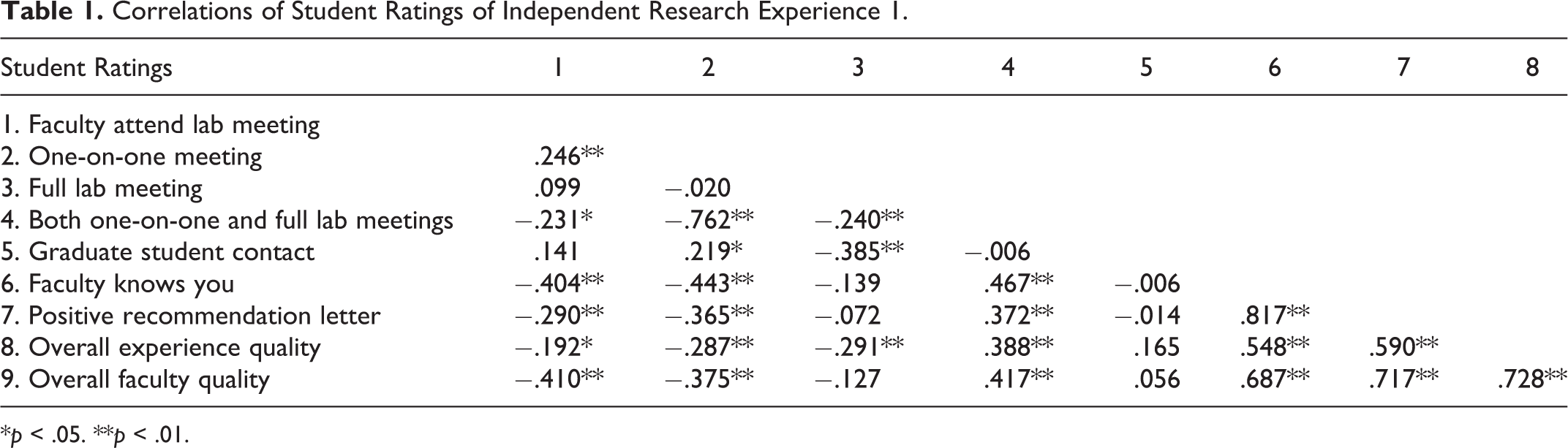
*p < .05. **p < .01.
One-on-one meetings were held weekly (17%), once every 2 weeks (5%), once a month (15%), or less than once a month (13%). It is interesting that the percentage of time certain topics were discussed at these one-on-one meetings was somewhat different than that for lab meetings. Specifically, fewer students in one-on-one meetings participated in all given categories as compared to those in full lab meetings: research articles (20%), running participants (21%), data issues (31%), designing experiments (29%), and ethical issues (12%).
Contact with graduate students
Students reported how much contact they had with graduate students during their IRE: none at all (11%), some (12%), a good amount (16%), or a lot (60%). Thus, the majority (88%) of participants had contact with graduate students during their IRE.
Relationship with faculty
Students rated how well they believed that their faculty knew them: not at all (11%), not much (13%), slightly (16%), pretty well (27%), or definitely (32%). In addition, participants rated how well their faculty supervisor would be able to write them a positive letter of recommendation: not at all (8%), not much (5%), slightly (21%), pretty well (17%), or definitely (49%).
Quality of experience
Participants rated the overall quality of their IRE experience as extremely poor (2%), poor (3%), fair (12%), good (44%), or excellent (40%). Similarly, participants rated the overall quality of their faculty supervisor as extremely poor (3%), poor (3%), fair (14%), good (26%), or excellent (53%).
Exploratory Analyses
To test the potential relationship between IRE model and participant ratings of IRE quality, we ran a series of regressions using IRE type (i.e., only full vs. both) as predictors of participants’ ratings of the overall quality of their IRE, belief that their faculty supervisor knows them well, and whether their faculty supervisor would be able to write them a positive letter of recommendation. It is important to note that while a students’ belief that faculty knows them well and whether the faculty could write a positive letter of recommendation are highly correlated (r = .82), it is possible that a student believes that while a professor knows them well, they would not write a positive letter of recommendation. Thus, we examined these as separate constructs.
Participants’ ratings of the overall quality of the IRE differed significantly between groups and indicated that the predictors explained 15% of the variance, R 2 = .15, F(1, 115) = 20.36, p < .001. Specifically, having both a full lab meeting and a one-on-one meeting was significantly better than having only a full lab meeting, t(115) = 4.51, p < .001.
Ratings of the belief that faculty knows the student were also significant, and the predictors explained 22% of the variance, R 2 = .22, F(1, 114) = 31.81, p < .001, and followed the same pattern. That is, having both a full lab meeting and a one-on-one meeting was significantly better than having only a full lab meeting, t(114) = 5.64, p < .001.
Similarly, the belief that the faculty could write a positive letter of recommendation for the student was also significantly different between groups and the predictors explained 14% of the variance, R 2 = .14, F(1, 115) = 18.45, p < .001. Again, the same pattern emerged, such that having both a full lab meeting and a one-on-one meeting was significantly better than having only a full lab meeting, t(115) = 4.30, p < .001.
Discussion
The present study offers a more detailed investigation of what many (e.g., Ishiyama, 2002; Russell et al., 2007; Seymour et al., 2004) believe is a critical experience for undergraduate psychology majors: an IRE. As stated earlier, an IRE offers students many advantages, ranging from frequent interactions with faculty members to developing a greater understanding of specific research domains in psychology (Schwartz et al., 2018). The present results offered two primary findings. First, IREs typically follow a combination of four general models (full lab meetings, one-on-one meetings, both meeting types, neither meeting type), of which full lab meetings and both meeting types are the most common. However, it is important to note that 80% of students reported having a weekly lab meeting, while only 17% reported having a weekly meeting with their faculty advisor. Thus, full lab meetings may, in fact, be most common. Second, student perceptions of the quality of IRE experiences (i.e., overall IRE quality, belief that their faculty advisor knows them, belief that their faculty advisor could write them a positive letter of recommendation) may vary as a function of the meeting type.
The greater use of full lab meetings by faculty members is likely the result of time considerations. As stated earlier, it is simply easier to schedule a single meeting with all lab members than multiple one-one-one meetings. However, the present results, because we only collected data from students, cannot directly answer why faculty choose full lab meetings. An alternative could be that faculty do not feel undergraduates are capable (either socially or intellectually) to handle a more intense individual meeting that involves greater participation and research background. We hope that future research will survey faculty mentors about IREs to allow a greater understanding of this and other questions about effectively mentoring students in IREs.
Our exploratory findings indicate that using both full lab meetings along with one-on-one meetings seems to be the most effective option for students to feel positive about the overall experience and their relationship with their faculty advisor. While students in our sample rated their experiences more positively when they had a combination of full lab meetings and one-on-one meetings compared to just full lab meetings, it would be beneficial to examine the impact of only one-on-one meetings. To better understand the impact of one-on-one meetings on student experiences, future research would benefit to focus on universities where this meeting style is more common, thus allowing researchers to obtain a larger sample size of students who only meet one-on-one.
In discussing the role that faculty mentors play in IREs, it is also important that mentors reflect on the role they want their students to play in the research process. That is, what activities should an IRE student partake? The present results showed that IRE activities are quite varied and include designing experiments, running participants, and scoring and entering data. It is unclear, however, what the ideal constellation of tasks is for IRE students. For example, should undergraduates be intimately involved in designing and running studies, or should more menial tasks (e.g., copying articles) be assigned? It is likely that the assignment of tasks is a function of several variables (e.g., year in school, lab experience, intellectual abilities). Some might argue that all undergraduates should partake in a wide variety of tasks in order to gain experience in the “nuts and bolts” of research, as well as the deeper intellectual issues involved in research design, analysis, and writing.
Although this study revealed interesting patterns in psychology IREs, there were admittedly some limitations. First, this study was purely exploratory; all results were post hoc. Future research should thus expand upon these preliminary findings, guided by a priori hypotheses. Furthermore, this study only surveyed students from one Research I institution; it is possible that other schools (both other Research I universities and 4-year colleges) have very different expectations and protocols for both IRE students and faculty mentors, resulting in different experiences. Furthermore, it is worth noting that other disciplines may have different protocols as well. Thus, the generalizability of our results may be limited to only psychology programs at Research I universities. Future studies should thus expand to other schools of varying sizes and potentially other disciplines to observe these differences. For example, some small liberal arts schools include IREs in the curriculum, even though the faculty are often not required to be active researchers themselves. How would this distinction change the IRE? Other considerations for future research include students’ expectations before beginning the IRE. Perhaps the overlap (or lack thereof) of expectations and reality could affect students’ perceptions of the experience. Arguably, expectations could be based on the course description but could also be affected by a personal experience with the faculty mentor, contact with students who have already taken the course, and others; thus, future research should include questions about expectations. Another potentially important factor for future research is an objective measure of learning. This was beyond the scope of this research, as we were primarily focused on students’ self-rated perceptions of the IRE, but would be very useful in the future to show whether students’ perceptions fell in line with their actual learning outcomes. We also should note that although we were able to shine a light on some of the activities and interactions that take place in an IRE, we cannot tell in detail what was discussed during the lab meetings, what types of interactions students had with graduate students, or how involved each student was in the decision-making process (as compared to just following instructions). Further research could benefit from asking more open-ended questions to get more descriptive information about students’ experiences.
In closing, the evidence indicates that IREs are particularly beneficial to undergraduate psychology students when both full lab meetings and one-on-one meetings are utilized. Whereas undergraduates may be able to get some similar experiences outside of an IRE, the experience of interacting with faculty and other researchers on an individual level is a unique advantage of including IREs in a curriculum. Although more research is required to understand the best way to run an IRE, the benefits of the experience as a whole are particularly clear when the faculty and students take the process seriously. The future of psychological research starts with the undergraduates we are training now; why not try to give them the most beneficial experience possible?
Footnotes
Declaration of Conflicting Interests
The authors declared no potential conflicts of interest with respect to the research, authorship, and/or publication of this article.
Funding
The authors received no financial support for the research, authorship, and/or publication of this article.