







Abstract
Introduction
Individuals in various career fields will interact with people who have experienced trauma while engaging in their work responsibilities, and many have limited, if any, trauma training. Therefore, there is a need to provide trauma training within undergraduate degree programs.
Statement of Problem
Online learning is a viable method of meeting the need for psychological trauma education for undergraduate students.
Literature Review
Education in the United States has steadily moved toward more online formats, with many students preferring the flexibility of an online course. We discuss the literature on teaching about trauma and considerations for teaching the course online.
Teaching Implications
We outline components of an online undergraduate trauma education course focused on teaching students about psychological trauma. This includes presenting the course objectives, describing course assignments, and discussing considerations for the course which instructors can use in teaching about trauma.
Conclusion
Instructors of higher education can use the activities and considerations discussed in this article as a guide in the development of an online trauma education course.
In 2013, Kilpatrick et al. found 90% of Americans reported exposure to at least one traumatic event. Although many individuals exposed to a traumatic event may not experience symptoms of distress related to the trauma, their exposure may increase the likelihood of trauma-related symptoms, should exposure to additional traumatic events occur (Ackerman et al., 2009; Kilpatrick et al., 2013). Many occupations help individuals, families, groups, and communities in recovery following exposure to traumatic events. Occupations associated with direct or indirect frequent exposure to crisis or traumatic events include emergency medical teams, physicians, paramedics, nurses (Hurley et al., 2019), law enforcement, military (Thompson & Dobbins, 2017), firefighters, emergency first responders, child protection workers, and forensic interviewers (Cieslak et al., 2014). Additional professions associated with exposure to trauma or related information include professional counseling or related mental health professions (Trippany et al., 2004), and crisis phone line operators (Kinzel & Nanson, 2000).
Graduate programs for both non-trauma and trauma-associated vocations are beginning to include trauma education as part of their graduate curriculum (Barlow & Becker-Blease, 2012). However, Carnevale and Rose (2015) found bachelor’s degree workers comprise over 50% of the economic value in the United States, and for occupations that do not require the completion of graduate coursework, individuals may enter the workforce with limited academic education or training on concepts related to trauma and crisis events (Zurbriggen, 2011). This is concerning because these individuals are entering the workforce interacting with traumatized populations, while not having a foundational knowledge of trauma and how it affects people. Therefore, a need for trauma and crisis education is evident for students at the undergraduate level. Course materials may include information on professions associated with trauma work, applying findings that exposure to a larger range of potential career paths is helpful to students in identifying areas of personal interest and career decisions (Conner et al., 2012). Indeed, an undergraduate course on trauma can serve many purposes, including preparing students for challenges they may experience in their personal lives, future academic pursuits, and professional endeavors (Elmhurst et al., 2019).
Despite the need, potential benefits, and call to action to include trauma education (Courtois & Gold, 2009), it remains missing from the undergraduate curriculum at many colleges and universities. Therefore, the purpose of this article is to advocate for trauma and crisis education within undergraduate coursework, specifically within an online format. Traditionally, a face-to-face course is preferred for the delivery of a trauma education due to the sensitivity and intensity of the topic and the potential for triggering material. However, instructors can responsibly provide an online trauma education class to reach more students through thoughtful planning. The article encompasses (a) definitions of trauma and traumatic events, (b) a review of existing research regarding student outcomes of trauma education, (c) integration of trauma education through an online format, (d) course topics and assignments, and (e) benefits and considerations when planning and teaching an undergraduate trauma education course. The focus of this article is on undergraduate education, which could include a bachelor’s or associate degree program. Instructors could also modify the course for a vocational training program. The authors use the terms colleges and universities synonymously for institutions of higher education and post-secondary education.
Trauma and Traumatic Events
For the purposes of this article, trauma is defined as a single or series of events or experiences in which one feels extreme fear of psychological or physical harm and/or loss of life for themselves or loved ones, which results in lasting psychological injury (Substance Abuse and Mental Health Services Administration [SAMHSA], 2014). Traumatic events include situations that can affect an individual, or occurrences resulting in large-scale community or societal effects, including natural disasters (e.g., hurricanes, tsunamis, earthquakes, floods, and fires) or human initiated events, such as terrorist attacks and mass shootings (American Psychological Association [APA], 2017). Additional examples affecting individuals and families include childhood abuse, physical or sexual assault, intimate partner violence, death or loss, and military combat (APA, 2017). Traumatic events can result in many adverse effects for exposed individuals, including short- to long-term psychological effects on an individual’s identity, and social and emotional development (SAMHSA, 2014).
Individuals may also experience symptoms related to the traumatic event either through their relationship to those exposed to the trauma directly (Banyard et al., 2001), or through other methods of exposure, such as hearing about the event in their professional work (International Society for Trauma and Traumatic Stress [ISTSS], 2016), or from exposure to trauma in their personal lives. For trauma to occur, the event is perceived as overwhelming, harmful, or life-threatening (APA, 2013). The personal meaning the individual contributes to the event has a role in whether it leads to their experience of distress (ISTSS, 2016).
We use secondary trauma, reactivity, and response to trauma exposure synonymously in this article to describe adverse or negative responses that result from exposure to others’ trauma. This includes working closely with traumatized individuals and communities, and trauma course material (e.g., potentially distressing or triggering information). These terms are distinguished from symptoms in the diagnostic criteria for post-traumatic stress disorder (PTSD), not in the type of exposure, rather in the intensity and duration of the symptoms experienced in response to the trauma exposure (APA, 2013; Yehuda & Flory, 2007). Notably, individuals with a history of PTSD or a diagnosed trauma-related disorder, as well as those who have experienced symptoms of a trauma-related disorder without a diagnosis, or who have past exposure to trauma, are at greater risk of experiencing adverse reactions to additional trauma exposure (Ackerman et al., 2009). Other characteristics that result in a greater risk of secondary trauma include an individual’s age, personal history, defense style, education, training, and experience with trauma (Adams & Riggs, 2008; Way et al., 2004).
Trauma Education
Trauma education is becoming established as essential for those pursuing education in psychology. In 2015, APA approved the Guidelines on Trauma Competencies for Education and Training. The guidelines include student competencies in listening and empathy with survivors of trauma, as well as obtaining knowledge about the potential challenges for workers in serving trauma survivors. Additionally, the guidelines encompass a focus on awareness, self-appraisal, and self-care strategies (APA, 2015). According to the APA (2011) Principles for Quality Undergraduate Education in Psychology, students are expected to take responsibility for their own learning, as well as focus on becoming a psychologically literate member of society. This includes students developing insight about experiences, behaviors, and psychological processes related to themselves and others (APA, 2011). While not all students taking psychology courses are pursuing degrees in psychology, some of the areas within the guidelines (e.g., self-awareness, self-care, and mental health literacy) are important for students pursuing other degree programs as well. In addition to professional relevance, trauma education is also important for our personal lives as citizens, which includes mental health literacy that may help promote engagement in advocacy activities, such as supporting policies and legislation related to trauma.
Trauma education coursework may also address several expected learning outcomes for undergraduate students pursuing various degrees. Chan (2016) identified themes for college student learning outcomes, including critical thinking skills, self-awareness, decision-making in accordance with personal values, sense of purpose, and taking an active role in society. Additional learning outcomes include enhanced civic engagement with a focus on actions to address real-world problems, moral judgment, global awareness (Hansen, 2011), and the development of well-rounded, caring people (Thompson, 2014). An undergraduate trauma course may address many of these outcomes, including a focus on real-world problems and moral judgement. Trauma education is a valuable avenue for assisting students in developing greater understanding, empathy, and awareness of the effects of trauma for themselves and for those in their community (Elmhurst et al., 2019).
Teaching Models in Trauma Education
As the prevalence of trauma increases (Broman-Fulks et al., 2006; Elliott, 1997), the need for trauma education is becoming more widespread. Scholars have presented various models and teaching approaches educators can use to teach the sensitive material associated with trauma education (Black, 2008; Carello & Butler, 2014; Cless & Goff, 2017). However, most of these models have focused on traditional face-to-face education with graduate students. Nevertheless, these models consistently emphasize the importance of safety, protective factors, self-care, coping, and peer support and interaction (Agllias, 2012; Black, 2008; Carello & Butler, 2014; Cless & Goff, 2017; O’Halloran & O’Halloran, 2001). Self-care is crucial in preventing secondary trauma (Cless & Goff, 2017; O’Halloran & O’Halloran, 2001).
Carello and Butler (2014) highlight differences between teaching trauma-related content and a trauma-informed approach to teaching. A trauma-informed lens requires an understanding from educators about the effects of traumatic experiences, and applying this understanding to be empathic, sensitive, and flexible to meet the needs of trauma survivors (Butler et al., 2011; Carello & Butler, 2014). Learning about trauma content and trauma-informed practices prepares students for work in trauma-informed careers (Rhodes, 2019). Although, educators can revise various coursework to be trauma-informed, coursework focused on trauma has the challenge of meeting trauma-informed standards while purposely addressing content related to trauma (Carello & Butler, 2014). To meet this challenge, Carello and Butler (2014) recommend acknowledging the prevalence of students' trauma histories and establishing safety in learning as essential components to teaching trauma-related content from a trauma-informed perspective. Moreover, in their model for teaching undergraduate trauma education, Cless and Goff (2017) use Herman’s (1997) Triphasic Model, which uses three phases (safety, remembrance and mourning, and reconnection) to describe the process of recovery from trauma. They apply the Triphasic Model as a lens to understand student reactivity to trauma-related content and discuss the need for instructors to increase their understanding of the signs and symptoms of student reactivity to trauma-related course materials. Additionally, it is important for course instructors to not assume the role of the helping professional for students, but to instead provide information about seeking personal mental health services when needed (Cless & Goff, 2017).
Development of an Online Undergraduate Trauma Course
Although limited, there is some literature on using online and hybrid course formats to teach trauma content, specifically use by faculty at Tulane University (Elmhurst et al., 2019). Online learning provides a helpful avenue to improve access to courses for students who may otherwise be unable to physically enter a classroom (El Mansour & Mupinga, 2007). Barriers limiting a student’s ability to attend classes in person may include student and environmental factors (e.g., medical conditions, limited access to transportation, location, and lack of childcare when the student is a parent), or large-scale community circumstances (i.e., quarantine due to a global pandemic). Online learning is also an effective platform for student learning, in addition to being convenient and flexible for students (El Mansour & Mupinga, 2007; Ni, 2013).
As with the development of any new course, there are multiple areas to consider in the development of an undergraduate trauma course. Teaching the course online provides additional areas for consideration. The activities and implications presented in this article are informed through the literature and our development and teaching of an online undergraduate trauma education course.
Learning Objectives and Course Content
In the development of their undergraduate trauma course, Elmhurst et al. (2019) note the use of Figley’s (2012) encyclopedia of trauma as a foundational guide to course structure and content, including an emphasis on the universality of trauma, causes of trauma, and resiliency factors in helping students gain an understanding and empathy for trauma survivors. Student learning objectives may include (a) distinguishing between types of trauma; (b) examining the effects of trauma on individuals, families, groups, and communities; (c) identifying university and community resources that assist in trauma recovery; and (d) exploring careers involving work with trauma and crisis. As an introduction, course content should include an overview of trauma, causes and types of trauma, and the short- and long-term effects of trauma (Elmhurst et al., 2019).
Course Topics
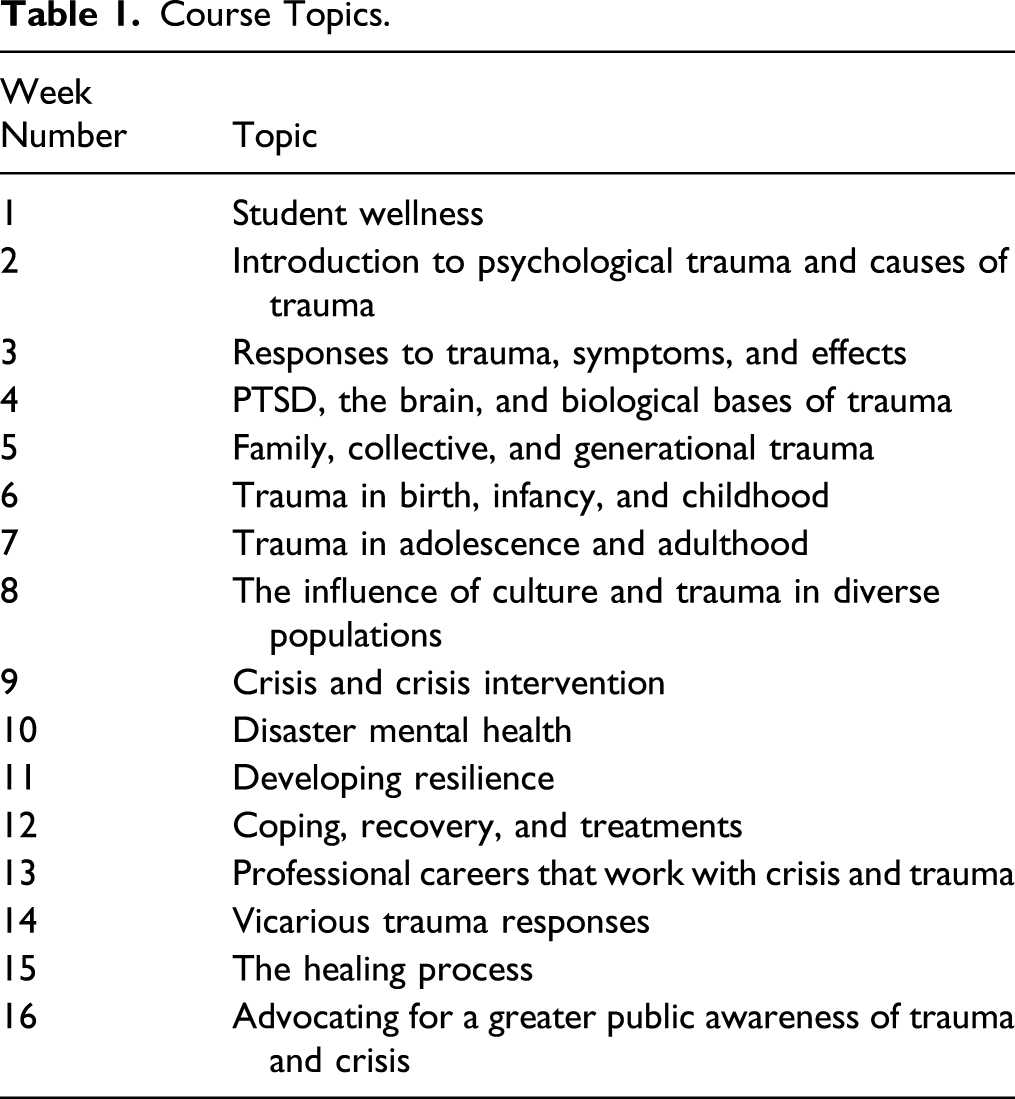
Course Assignments
Instructors should select and scaffold assignments in a trauma course to facilitate student understanding and growth, while also accounting for potential trauma triggers for students. Below, we discuss assignments used in an online trauma education course. Assignments include (a) reflection journals, (b) discussion boards, and (c) culminating final projects.
Reflection Journals
Reflection journals may include specific prompts that ask students to consider their reactions, thoughts, feelings, and experiences in relation to the course content and topics. This type of assignment may encourage students to interact with the topic or prompt questions in a more personal manner and provide opportunities for students to introspect on areas of their lives. In exploring the use of reflective journal writing for students in a first-year course geared toward helping students transition to college, Everett (2013) identified themes regarding the benefits of reflective journal writing, including (a) an outlet for student well-being, (b) opportunities for self-discovery, and (c) a tool for social engagement in communication with the instructor. When incorporating reflection journals, it is important for instructors to explain the role of the journals so that students do not feel pressured to disclosure trauma history, which includes emphasizing the academic focus of the course and providing clear instructions for students (Zurbriggen, 2011). The instructors can discuss the expectation for students and include a rubric that outlines the grading criteria for the assignment.
An example of a reflection journal topic is self-care. This is important to address in the beginning of a course that may contain potentially emotionally charged material. Journal prompts related to self-care may encourage students to reflect on coping skills, evaluate their personal self-care strategies, and identify strategies or a plan that they can use to mitigate the effects of distress related to the material discussed in the course (Zurbriggen, 2011). Some sample prompts are (a) How do you think this course will affect you? Your writing should be informed by what you have learned about what influences your stress. (b) What will help you cope with the material discussed in this course? Discuss your thoughts about any actions you currently use or want to start doing to help you cope with the material discussed while taking this course. (c) Do you believe your current wellness strategies are effective for you in managing stress? Discuss your thoughts about your wellness strategies. What is most helpful for you at this time? If you think your wellness routine needs improvement, then discuss what strategies you need to incorporate into your current wellness strategy to better fit your current wellness needs. If you think your current wellness routine is effective, then discuss your reflections about what makes it most suited to your current needs. Reflect on how you will use this plan for your own wellness in helping you manage stressors or challenges. Instructors can provide information about self-care and examples of wellness strategies to assist student in their reflections and engagement in self-care. This assignment may help students develop a self-care plan to use throughout the course and beyond.
Discussion Boards
Discussion boards involve students responding to a specific prompt provided by the instructor, as well as responding to a few peers’ responses to the prompt. This assignment type provides an opportunity for social learning in an online environment. Additionally, it can help expand a student’s understanding of material and provide more context from peers. Furthermore, it promotes connection and the creation of shared meaning of the material. Within an online trauma education course, an instructor can use discussion forums by giving students an opportunity to discuss their understanding of trauma, share examples of trauma they have seen in real life or media portrayals, and provide feedback on how they can apply the information learned in the class. Below is an example of a discussion board focused on media portrayal of psychological trauma.
In this discussion board, students are asked to identify and discuss media (e.g., television shows and movies) in which an individual, family, or group experiences a potentially traumatizing event. Students then provide their responses to the following questions in writing their initial discussion post: What is the name of the TV show and the character(s) you are discussing? What is the potentially traumatic event they experienced? What was the character’s response to the potentially traumatic event? Did they experience trauma resulting from exposure to the potentially traumatic event? Discuss your thoughts on why or why not. What other characters were affected?
Other discussion board prompts may involve asking students to view a short video on a course topic, such as historical trauma and responding to it. Videos may focus on survivors discussing their experiences of collective, historical, and generational trauma, and the influences of these events in the survivor’s life and culture. Instructors should provide a content warning before students view the videos. Following the viewing of a video, students discuss their thoughts, feelings, and reactions to the video. As an example, after watching a video on historical trauma, students may write a discussion board post to respond to the questions, such as (a) identify and discuss an example of the effects of historical trauma on a community, group, or culture, or discuss a situation relevant to the possible effects of historical, collective, or intergenerational trauma; (b) discuss how an improved understanding of a person’s culture and cultural history may be an important part of understanding their identity, beliefs, values, and norms; and (c) describe essential areas for professionals to be aware of when working with people from the culture or community you choose to discuss.
Instructors should provide students with instructions clarifying the expectations for their responses to their peers’ posts. Instructors ask students to draw on their own perspectives, thoughts, feelings, and reactions in developing their responses. Additionally, students’ responses to peers’ posts should also include introducing and discussing related concepts, and expanding on the perspectives or examples shared by others. Students’ responses need to be specific and demonstrate critical thinking, such as discussing their point of view, including using course materials or assigned readings to provide examples and support.
Final Projects
Final projects are often culminating assignments that require students to apply information they have learned throughout the course. This may include activities focused on helping students understand how the information in a course might apply to the professional world, or other application-of-material final projects. An instructor of a trauma education course can use a final project to help students learn about a specific profession or career path from the broader range of professions who serve survivors of trauma or crisis. Below is an example of a final project that focuses on helping students learn about careers that work with survivors of trauma or crisis.
As an example of a final project, students research a career that works with trauma survivors and/or provides crisis intervention. It is helpful if the instructor provides an overview and list of potential careers and professions. Students may also interview a professional in the field. In including this aspect of the assignment, we recommend the instructor include a list of professionals who volunteer to be interviewed for the assignment. Some professions that students may choose from include crisis response team workers, first responders (law enforcement, firefighters, and EMS), medical professionals, mental health counselors, social workers, social services personnel, Child Protective Services staff, hospital workers, insurance company employees, state mental health providers, crisis counselors/therapists, and mobile crisis workers. Students discuss the roles and responsibilities associated with the job, and outline the required educational background, certifications, and professional training necessary to work in the field. Students also discuss potential advantages and disadvantages of working in the profession. Moreover, students research and discuss methods professionals in the career use to care for themselves in their work. Finally, students reflect on their experiences related to the project and the use of the information in their future personal and professional roles.
Considerations
Instructor Qualifications
In considering the development and implementation of an undergraduate trauma course, as with any course, it is important to consider the qualifications of the instructor. The instructor should have a strong knowledge base about trauma. Additionally, the instructor should have skill in teaching potentially triggering material, as well as know how to respond if a student is triggered by the material. We recommend instructors possess a graduate degree in counseling, psychology, social work, or a related area of study. Furthermore, it may be beneficial for instructors to have field experience serving survivors of trauma. Instructors can draw from their work experience to better inform teaching tasks, such as developing real-world examples for assignments and class discussions.
Mitigate Potential Risk
When considering potentially triggering material, the instructor should be aware of the roles that both individual student factors and course factors have in the risk of students’ experiencing adverse reactions related to trauma course content (Zurbriggen, 2011). Individually, students bring in protective factors for secondary traumatization, and risk factors that may elevate their chance of adverse reactions. Protective factors include the student’s personal history, presence of support systems, coping strategies, cognitive flexibility, and optimism (Haglund et al., 2007). Risk factors include the severity, intensity, and frequency of the trauma exposure (Cless & Goff, 2017). Some student populations (e.g., veterans) may have increased risk of secondary trauma reactions due to prior exposure to trauma (Ackerman et al., 2009), including possible exposure during college (Frazier et al., 2009). Although students may have familiarity with the term trauma, the course may be the first formal exposure to this type of content in an academic or educational setting (Cless & Goff, 2017). Zurbriggen (2011) outlined various structural elements of a trauma education course that instructors can control in working to mitigate potential negative effects of trauma-related course content on students, which can be integrated into the online course format. These include instructor actions focused on promoting student safety, self-care, empowerment, and social support, as well as education on trauma as a normal reaction to a traumatic event (Zurbriggen, 2011). Instructors can create a space for students to share their contact information with their peers if they want to do so, and mention that students sometimes find it useful to meet outside of class. For the online course format, instructors can create a discussion forum in which students can share contact information if interested, and suggest the creation of a class group chat or forum outside of the class platform where they can share ideas and resources with each other (Zurbriggen, 2011).
Instructors likely have limited, if any, prior knowledge of their students' history with trauma (Cless & Goff, 2017). Indeed, instructors should educate students about individual student risk factors early in the course to help mitigate the negative effects of exposure to trauma-related content in a trauma inclusive curriculum (Cless & Goff, 2017; Zurbriggen, 2011). Instructors should also provide students with information about resources they can use if needed to help prevent and mitigate the potential adverse effects of trauma exposure and secondary trauma responses to the course content (Cless & Goff, 2017; Zurbriggen, 2011). Information about secondary trauma and resources should be available for students to access throughout the course (Zurbriggen, 2011). The instructor can also structure the course to minimize adverse reactions, such as scheduling breaks, spacing out the material, providing content warnings, and slowly building up to more distressing material (Zurbriggen, 2011).
Confidentiality
Confidentiality is another area to consider, as instructors cannot ensure confidentiality between students when topics arise within class (Zurbriggen, 2011). To address confidentiality, instructors may include an informed consent statement in their syllabus addressing student disclosures, confidentiality, instructor reporting, and educational and university policy. For example, students choose to share personal experiences at their discretion and understand that confidentiality cannot be guaranteed. Course instructors are obligated to uphold mandatory reporting requirements for educational settings in their state, and act in accordance with educational and university policy. Mandatory reporting includes disclosure of abuse or neglect of a minor or vulnerable adult, and suicidal or homicidal ideation expressed by a student.
Class Size
Another area to consider is the enrollment size of the course, as offering the course online may attract interest among a large group of students. Since piloting the online, asynchronous undergraduate Introduction to Trauma Education course at our university, we have had a relatively large class (up to approximately 80 students). Despite the size, we continue to receive positive feedback from students about the course. In considering class size, we recommend instructors consider instructional approaches and assignments to facilitate an optimal learning environment. This may include, for example, dividing the students into small groups for discussion posts to enable them to get to know a small group of students well, increase comfort with sharing, and to help ensure all students receive peer feedback on their discussion posts.
Student Recruitment
Instructors may market the course to students who may be interested in future careers in trauma work. We created an electronic flyer to market the course and emailed it to department administrators and instructors of undergraduate programs with a connection to trauma material (e.g., psychology, sociology, criminology, anthropology, health sciences, and pre-medical tracks). The flyer may include information about the course, semester(s) offered, delivery platform, and who is eligible to take the course. We specified the introductory trauma education course was 100% online and open to all majors and all levels. The course flyer also included an overview of the topics and the learning objectives. The course instructor’s email addresses were included on the flyer for interested students to contact for additional information. A pre-written prompt with information about the course was also included for instructors to use in sharing the course flyer with students.
University and Student Resources
As students may struggle with their own traumatic experiences working through the course material, instructors should include community resources that assist in trauma recovery. Instructors can also send notifications to students acknowledging the potential triggering material and offer to meet with them throughout the course (Cless & Goff, 2017). Information about available student resources may encourage students in need to seek their own mental health treatment, providing an opportunity to address personal trauma or other mental health concerns prior to entering the workforce or a graduate program. University resource lists should include information about academic support, counseling, and wellness, as well as emergency resources on campus. Furthermore, we recommend the instructor provide a list of additional resources within the community that are focused on addressing trauma and crisis, including a local or national suicide crisis hotline number, local crisis response agencies, and veteran services. This resource list could be included in the course syllabus.
Student and Instructor Wellness
In promoting student wellness, instructors may integrate student self-check-ins and remind students to use self-care time and strategies, during which they can provide a distracting picture, such as a positive image or funny meme, to help students in promoting the development of their own personal wellness techniques. We recommend activities focused on encouraging student wellness be integrated into the online course structure within the PowerPoints and video lectures for each week. Instructors can work to mitigate student exposure to trauma-related content and provide more instructor control by varying the intensity of the course content (Zurbriggen, 2011). In a traditional classroom setting, instructors can use positive messages at the end of each class to mitigate the negative effects of student exposure to potentially triggering content (O’Halloran & O’Halloran, 2001; Zurbriggen, 2011).
Online course instructors can provide breaks in course PowerPoints and online voice lectures to encourage students to check-in with themselves emotionally, mentally, and physically, and to take a break if needed. Online course instructors may also consider incorporating additional suggestions for promoting self-care and personal wellness, such as including links to mindful meditations, providing focused breathing activities, and showing a funny animal picture or meme. We received positive student feedback regarding the inclusion of calming and uplifting activities and pictures at the end of each online course PowerPoint. Instructors can also note that students are not asked to disclose their personal experiences, but rather demonstrate that they are reflecting on them to inform their writing.
It is also important that instructors consider their own wellness and self-care in teaching this course. Instructors should practice their own self-care strategies and engage in reflection exercises. They may meet with colleagues to process their own experiences with the course, as well as consult about the course. Additionally, universities often have employee assistance programs (EAP) that provide faculty access to counseling services. Faculty can also access community resources that they also share with students.
Conclusion
Graduate programs associated with trauma exposure have emphasized the inclusion of trauma education into the curriculum to prepare students for entry into a counseling or related mental health discipline. However, undergraduate students may have limited, if any, education on trauma, including causes of trauma, and the effects of trauma on individuals, families, groups, and communities (Cless & Goff, 2017). A trauma education course presents opportunities for student learning and growth, personally and professionally. It can provide students with knowledge about the effects of trauma, understanding for trauma survivors, and coping skills to address stressors (Elmhurst et al., 2019). Thus, the course may help prepare students to serve traumatized individuals and negate their own future traumatic experiences. However, future research is needed on examining the effectiveness of the course.
Engaging in an undergraduate course on trauma may be particularly helpful for students in understanding the effects of these events as they are happening. Additionally, in response to the recent global pandemic, online learning has been an essential element of many institutions of higher education. Thus, we outlined an online, asynchronous 16-week undergraduate trauma education course. Through the implementation of this course, students may have increased understanding of psychological trauma, which may better prepare them for the workforce. To obtain more information about the course discussed in this article, including the syllabus, please email the first author.
Footnotes
Declaration of Conflicting Interests
The author(s) declared no potential conflicts of interest with respect to the research, authorship, and/or publication of this article.
Funding
The author(s) received no financial support for the research, authorship, and/or publication of this article.
