







Abstract
Background
The flipped classroom method requires that students engage with homework before coming to the classroom so that class time can be spent on active and collaborative learning exercises. Research has demonstrated that this can improve student performance versus traditional lecturer-led teaching methods.
Objective
During the COVID-19 pandemic, the vast majority of teaching has been entirely online such that even ‘in-class’ time has been virtual. The current article examined whether online-only delivery affects the efficacy of the flipped classroom approach.
Method
Grades for a research methods and statistics module and a statistics portfolio assignment were compared across consecutive cohorts of undergraduate psychology students taught by different methods.
Results
Overall grades on the module did not differ significantly across teaching methods but student performance on statistics tests did. Flipped classrooms, whether accompanied by on-campus or synchronous online classes, led to significantly better performance than traditional methods. No detriment was observed by teaching entirely online.
Conclusion
The key advantages of the flipped classroom method appear driven by active learning which can occur irrespective of classroom context.
Teaching Implications
Using flipped classrooms can be a useful tool, particularly in subjects where students may otherwise be less engaged with the content.
A flipped classroom approach to teaching in higher education has become increasingly popular in recent years (Strayer, 2012). In a flipped classroom model, the didactic information-transmission components of a course occur outside of the lecture hall which affords the opportunity to bring the practical exercises and experiential learning components into the classroom instead (Abeysekera & Dawson, 2015; Lage et al., 2000). There is a suggestion that the adoption of a flipped classroom delivery has a beneficial impact on student satisfaction (Strelan et al., 2020) and student performance (Shi et al., 2020) though this is far from universal and the effect on both of these dependent variables seems to be moderated by the subject being studied (see El-Banna et al., 2017; Krahenbuhl, 2017; O’Flaherty & Phillips, 2015). In spite of the suggestion that the flipped classroom may be more or less effective in some disciplines than in others, there are very few meta-analyses examining this issue. Strelan et al. (2020), however, examined the findings of 198 studies of the effect of flipped classroom instruction on student performance. The effect size was the greatest in humanities subjects and far weaker in mathematics and information technology. The authors suggested that the impact of flipping the classroom may be less in disciplines where students were required to work through problems that had a single, well-defined solution such as mathematics. The nature of these courses might be such that students are well scaffolded even in traditional delivery formats. In this article, I will be describing a study of the efficacy of the flipped classroom approach in a statistics course for psychology undergraduates. Based on Strelan et al.’s (2020) meta-analysis, this might appear to be a course where the effect size is likely to be relatively small. However, the statistics component of a psychology degree is considered to be the least interesting or relevant by students (Ruggieri et al., 2008) and is also considerably different from the remainder of the programme in its approach. For undergraduates, therefore, the ability to study at their own pace, to pause and review the taught content, and to have opportunities to practice their skills is likely to be helpful in avoiding the disengagement that might occur in a traditional statistics lecture. Furthermore, given that students often report anxiety about learning statistics (e.g. Chew & Dillon, 2014), it is likely that many students would avoid completing anxiety-provoking homework. By moving these activities to the classroom, there is likely to be a greater engagement with the active learning components that foster improvements in performance, even among those students who suffer statistics anxiety.
The mechanism by which the flipped classroom approach has its effect is not entirely clear, though the principle that teaching is more student-centred in this method appears key (Koh, 2019). The student-centred classroom fosters learning practices which support students in constructing deep knowledge and understanding (Tangney, 2014) by requiring greater agency from the students (Taylor, 2013) and encouraging both student–teacher and student–student partnerships (Howland et al., 2013; Neumann, 2013). Student-centred learning is usually ‘active learning’, and active participation in learning has been consistently shown to be beneficial to student performance (e.g. Freeman et al., 2014). Prince (2004) defined active learning as any instructional method which requires students to think about what they are doing in order to complete the task that has been set. In other words, the student has to apply or extend their knowledge constructively and with effort. In the past, active learning exercises have largely been set as homework. The flipped classroom approach deliberately emphasises active learning by bringing these activities into class time, but it is not the only method for encouraging active learning. For example, a study by Jensen et al. (2015) compared flipped classroom delivery with non-flipped delivery of the same material and activities. In the flipped classroom, the students were introduced to content before class and engaged in learning activities to elaborate on or apply the content during class time. The non-flipped group received the content in class and were asked to complete the elaborative exercises as homework. The examination performance of the two groups was not significantly different. Jensen et al. (2015) therefore argued that it is the active component of flipped classrooms that is important rather than the order in which the sessions are delivered.
In March 2020, COVID-19 was declared a pandemic. This resulted in university education in the United Kingdom being delivered almost entirely online. The shift to online-only instruction has provided an opportunity to disentangle independent active learning, student-to-student collaboration and the accessibility of staff to ask specific questions and receive tailored support in flipped classrooms. In this article, I report the comparative performance of consecutive cohorts of students on the same statistics module taught as part of an undergraduate psychology degree using (a) the traditional method, (b) a flipped classroom approach where online video lectures preceded on-campus lab classes and (c) a flipped classroom where online video lectures preceded synchronous online classes. Based on the meta-analysis provided by Shi et al. (2020), the performance of students should be better in the flipped classes than the traditional classes, although the traditional method in this study did employ active learning and the potential for peer collaboration which may result in a null effect (see Jensen et al., 2015). It has been demonstrated that student performance is positively influenced by peer group collaboration in a flipped classroom (e.g. Chis et al., 2018). The availability of peer-to-peer interaction is reduced to an entirely remote delivery. It is possible that this could lead to poorer performance in the online synchronous flipped classroom than the on-campus flipped classroom. If, on the other hand, the catalyst for improved student performance is increasing agency and the adoption of active learning strategies fostered by a flipped classroom structure, then online-only instruction should not have a detrimental effect on student performance versus those who attended on-campus workshops (see Stohr et al., 2020 for empirical data on online-only delivery).
Method
Participants
Demographic Characteristics of the Participant Samples in Each Cohort
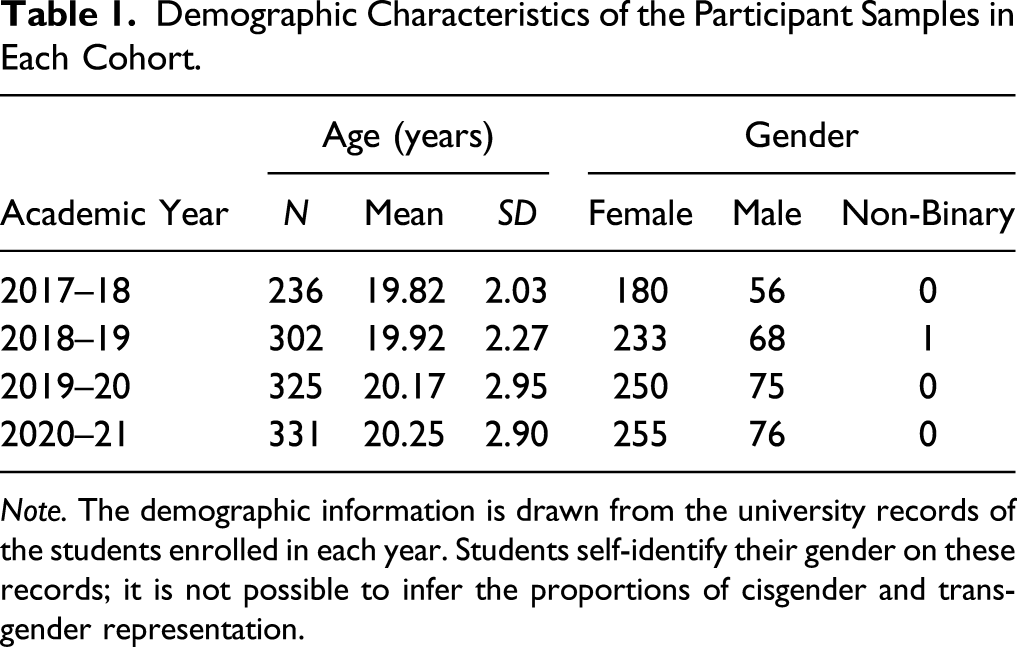
Note. The demographic information is drawn from the university records of the students enrolled in each year. Students self-identify their gender on these records; it is not possible to infer the proportions of cisgender and transgender representation.
Design
Two dependent variables were considered for analysis. The first was the overall module grade. This was made up of the marks for two written journal article reports (35% of the grade each) and a portfolio of statistics exercises and tests (the remaining 30%). Portfolio grades were the percentage of correct answers accrued over the module (10 questions per week for 11 weeks) and included both multiple-choice statistical theory questions and fill-in-the-blank questions requiring that the students entered values calculated during the completion of statistical analyses. The second dependent variable considered performance on the statistics exercises and tests only. Grades for the written reports, which contribute to overall module performance scores, would reflect differences in ability in non-statistical aspects of the assignment (e.g. argument construction and critical evaluation) which were not the topic of the video lectures on this course and hence not taught using a flipped classroom approach. Therefore, the statistics portfolio scores were also considered separately so as to give a purer measure of student performance on the material taught using the flipped classroom approach. The between-participants’ independent variable was the teaching method (traditional, flipped with on-campus classes and flipped with online classes).
Module Content and Teaching Methods
The module introduced students to frequentist analytical techniques such as t-tests, Analysis of Variance, correlation and regression, and the method by which to conduct these analyses in statistical software. In the traditional format of the module delivery (2017/18), the statistics theory was delivered in a 1-hour in-person chalk-and-talk lecture, followed by a 2-hour workshop in the same week in which there was a demonstration of how to conduct the analysis in the software programme and an opportunity for the students to complete exercises on their own with staff on hand to answer questions and give guidance. In the flipped classroom with on-campus workshop format (2018/19 and 2019/20), both the statistical theory lecture and the demonstration were replaced by a series of online video lectures. These covered essentially the same content as in the traditional format, but were broken into smaller chunks. Each week, all taught content was made available on the virtual learning environment at the same time, so students were able to watch all videos one after the other if they so wished but were encouraged to take breaks to consolidate their learning. The 2-hour workshop was delivered in computer labs on campus but contained only practice exercises and problem-based learning, again with staff on hand to offer support if needed. This meant that students spent less time per week in a classroom than in the previous year, but that a greater proportion of that time was now spent completing hands-on exercises. In 2020–21, online video lectures again covered theory and instantiation in the software, but this time, the 2-hour workshops were administered via Zoom with staff replying to questions in the chat or offering assistance in breakout rooms. The ratio of workshop staff to students in any year was between 1:30 and 1:25. The traditional version of this course was taught by a instructor different from that of the flipped classroom versions of the course. The structure and nature of the assessments was the same across all three versions, though the precise questions also changed from the traditional to the flipped classroom. All flipped classroom content, including video lectures, was created by the same instructor who also taught in the lab sessions, supported by a small team of junior staff.
Results
Descriptive Statistics for Student Performance Metrics Per Teaching Method
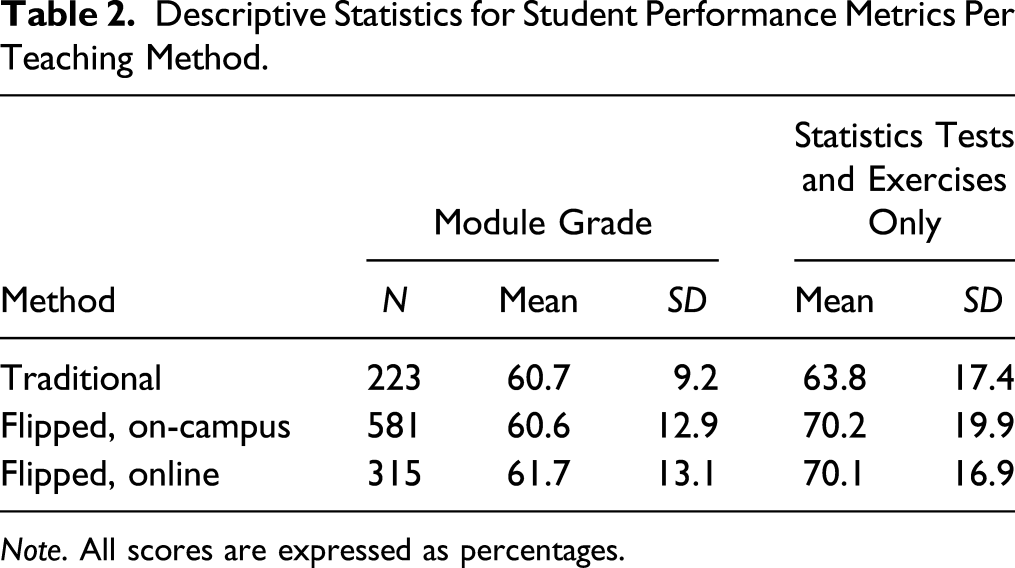
Note. All scores are expressed as percentages.
In order to examine these patterns formally, the data were subjected to a pair of one-way between-participant ANOVAs, one per dependent variable. The homogeneity of variance assumption was violated in both analyses, so the Brown–Forsythe correction (Brown & Forsythe, 1974) was applied to the findings reported here. This correction is generally considered conservative (Field, 2013). There was no significant effect of teaching method on the overall grade (F (2, 1116) = 0.92, p = .400, η 2 = .001). The effect of teaching method on statistics test performance was significant (F (2, 1116) = 11.37, p < .001, η 2 = .018). Post-hoc t-tests (Bonferroni correction applied) indicated that performance was significantly poorer for students taught by the traditional method than either the flipped classroom with on-campus or online workshops (both ps < .001). There was no significant difference between the two flipped classroom methods (p = 1.00).
In order to confirm the findings of the ANOVA analyses, Bayes factors were computed to evaluate the evidence for (or against) the experimental hypotheses that the teaching method would influence student attainment. There was very strong evidence in favour of the null hypothesis in the analysis of the total module grade (BF10 = 0.026), and decisive evidence in favour of the effect of teaching method in the analysis of statistics portfolio grades (BF10 = 260.12).
Discussion
The findings of this article demonstrated that adopting a flipped classroom approach improved student performance (in line with Shi et al., 2020) and that presenting a flipped approach solely online, with asynchronous theoretical lectures and synchronous online workshops, did not have a detrimental effect on student performance (mirroring Stohr et al., 2020). It is interesting to note that even in the ‘traditional’ method of delivery, students had active learning sessions each week. According to Jensen et al. (2015), the active learning aspect of the flipped classroom is the most important. In the current study, student performance improved simply by moving from a traditional lecture to an online video lecture. There are a number of possibilities as to why this improvement may occur. An obvious contender is that the instructor changed concomitant with the change in delivery. Indeed, Strelan et al. (2020) demonstrated that effect sizes relating to the efficacy of flipped classrooms were greater when the instructor also changed possibly, they argued, because faculty who adopt the flipped classroom approach are already more engaging than those who do not – that the instructor’s enthusiasm enhances the effect. It is not possible to rule this out in the current study. Another option is that the video lectures were split into shorter chunks which allowed students to watch and re-watch them as they needed to, allowing them to take even greater agency over their own learning and to work within the time and attentional resources that they had available. A third option is that student performance increased because of more active learning time (i.e. a change from 60 to 90 mins/week in the traditional format where the lab included both instruction and practice to 120+ mins/week in the flipped approach, where the lab was entirely devoted to practical exercises). All of these possibilities are easily testable in future research and would provide useful insights into the keys to successful flipped classroom design.
Whatever the reason for the success of the flipped classroom in this study, the important finding is that student performance in the course was not adversely affected by teaching entirely remotely. In this case, the structure of the course was kept consistent between the academic years before and during the COVID-19 pandemic, but the delivery method changed. The lecture content was presented as asynchronous videos in both versions of the flipped classroom. The exercises that the students completed in lab classes were identical from year to year, but in 20/21, these classes were synchronous online sessions rather than in-person. Students are likely to benefit from being able to ask questions of the instructors while completing the exercises in a lab class and from being scaffolded as they reach the solution (e.g. Howland et al., 2013). On the basis of the data collected here, whether student–teacher interactions are the result of a raised hand in a physical classroom or an online chat message during a virtual meeting appears relatively unimportant. Although this interpretation makes intuitive sense and remains focused on the theoretical reason for adopting a flipped classroom at all (i.e. increasing active learning time in class), it is possible that there would be performance advantages observed even if all course content was asynchronous. In my view, an entirely asynchronous delivery of a statistics course such as this one is likely to benefit only the students who are the most diligent, conscientious or adept at statistics in the first place. Active learning is, by definition, more effortful than passively receiving information from a lecture, and there is a danger that students will not engage with course materials if there is no synchronous component where the instructor is present particularly when the topic is viewed as difficult, irrelevant or anxiety-provoking (e.g. Gordon, 2004; Ruggeri et al., 2008). At the moment, the data to assess this hypothesis are not available, but it is an interesting empirical question that could be considered in future research.
Another interesting finding of the current analysis is that the adoption of the flipped classroom resulted in significant improvements in the statistics test grades of the students, but not the overall module marks. This could be because the overall module mark was ‘contaminated’ by broader academic skills like argument structure and critical evaluation that are practiced across the whole degree programme and not explicitly taught as part of the flipped classroom. It could also be, however, that the flipped classroom approach has particular utility in teaching subjects that are unpopular, have progressive content structures or that students find particularly difficult to understand (like undergraduate statistics for psychology students). Allowing students to engage with video lectures and other online material in advance of class may reduce the likelihood of missing lecture content entirely and not, therefore, having the foundation on which to build knowledge from the next phase of the course. Alternatively, the provision of shorter chunks of recorded lecture content might make it easier for students to maintain focus or allow them to revisit the material whenever they need to. In other words, the flipped classroom is not simply a more active learning experience, but a more flexible one and one that is easier to recap and revise for the students. Unfortunately, data that would have allowed the assessment of how the video lectures were used by the students were not available. In future research concerning flipped classroom delivery, the number and distribution of times that a given student viewed a video lecture or the amount of time spent viewing the material in total would be a useful addition. Future research could also contrast flipped classrooms using video lectures with traditional lectures that are recorded, split into smaller videos and posted after the fact. This would disentangle the flexibility aspect of flipped classrooms from the active learning practices that are fostered.
Overall, then, the evidence from the current study suggests that flipped classrooms can be delivered using synchronous online sessions just as effectively as they can on campus and have positive impacts on student performance in some, but not all, assignment types.
Footnotes
Declaration of Conflicting Interests
The author declared no potential conflicts of interest with respect to the research, authorship, and/or publication of this article.
Funding
The author received no financial support for the research, authorship, and/or publication of this article.