







Abstract
Background
Previous research has indicated positive changes in student perceptions of primary literature using the CREATE primary literature approach (a collection of guide tools for reading primary literature).
Objective
The objective of this research was to examine how a modification of the CREATE approach relates to student perceptions of primary literature and STEM career interest in psychological sciences courses.
Method
The CREATE approach was modified for use as a one-time project and assessed in (a) two course levels (introductory-level and senior level) and (b) two course deliveries (face-to-face and online). Participants filled out a survey with six factor perceptions of primary literature and STEM careers before and after project administration.
Results
After project completion, there was a significant increase in perceptions of primary literature (five of the six factors), but not STEM career interest.
Conclusion
There were significant increases over time (pre- to post-survey) in five of the six factors of perceptions of primary literature, but there was no change in the “thinking like a scientist” factor or STEM career interest.
Teaching Implications
This one-time project can concurrently be administered with textbook-based curriculum in online or face-to-face psychological sciences courses to introduce students to primary literature.
While STEM fields advance expeditiously, undergraduate students are often taught using textbooks that omit current advances, serendipitous or unexpected findings, and occlude much of the scientific process (Hoskins & Stevens, 2009; Hoskins et al., 2007; Willard & Brasier, 2014). Most undergraduate students do not have the opportunity to gain first-hand experience to understand the research process that they will use in their careers (Hartman et al., 2017; Hoskins & Krufka, 2015). Yet, many STEM undergraduates advance to graduate school or careers where an understanding of primary literature is an expectation (Hartman et al., 2017; Hoskins & Krufka, 2015).
The Consider, Read, Elucidate the hypotheses, Analyze and interpret the data, and Think of the next Experiment (CREATE) approach was originally designed for upper level face-to-face cell biology courses to demystify and humanize primary literature (Hoskins et al., 2007). The approach includes a toolset that guides students through the critical examination of a series of primary literature pieces using six steps: Consider (students read the introduction to the article, generate concept maps, and identify key terms), Read (students review the methods and results sections and complete activities including determining how the data were obtained, diagramming the methods, and proposing descriptions of figures), Elucidate the hypotheses, Analyze and interpret the data (students complete tasks such as relating the results back to hypotheses and draw their own conclusions about the data), and Think of the next Experiment (requiring students to imagine that they were the article authors and propose a novel experiment; Hoskins & Krufka, 2015; Hoskins et al., 2007). The steps require students to critically examine each portion of the article, decode the information, and think critically about how the experiment was designed. Previous studies have indicated that the CREATE approach has yielded positive outcomes for critical thinking, confidence in understanding primary literature, and more, as measured by the CREATE Survey, which was created specifically for the CREATE approach (Hoskins et al., 2011).
Since its inception, CREATE has been successfully expanded beyond the 4-year institution (Kenyon et al., 2016) and the cell biology classroom into a myriad of STEM courses at various course levels (Gottesman & Hoskins, 2013), including undergraduate neuroscience courses as a semester-long approach, or series of projects (Bodnar et al., 2016; Hoskins, 2008; Willard & Brasier, 2014). Infusing primary literature into undergraduate STEM courses as an entire course approach, or as a series of projects humanizes the literature, results in positive gains in student abilities to read and analyze primary literature and understand scientific processes, sparks interest in research careers, and facilitates transitions to doctoral programs (Cook-Snyder, 2017; Hartman et al., 2017; Hoskins, 2008; Kozeracki et al., 2006; O’Keeffe & McCarthy, 2017; Willard & Brasier, 2014).
Current Study
Some courses are linked to textbook requirements as part of institutional or departmental requirements, and the implementation of a full semester or series of projects relying on primary literature only is not practical. Recently, a short-term CREATE exposure in a genetics course led to gains in self-efficacy and views of science (Krufka et al., 2020). It is unknown if positive changes to perceptions of primary literature can be achieved with a one-time project in psychological sciences courses. The course delivery type and level may factor into the success of a short-term project. Therefore, the CREATE approach was modified for this study to be used as a one-time project in an introductory-level and senior level and a face-to-face and online (delivery type) psychological sciences neuroscience courses. The hypothesis was that introducing CREATE into psychological sciences courses would result in an increase in positive perceptions of primary literature, indicated by increases in CREATE survey scores. Additionally, the science portion of the STEM Career Interest Questionnaire was administered to measure interest in careers in science and perceived importance of careers (Kier et al., 2014).
Method
Participants
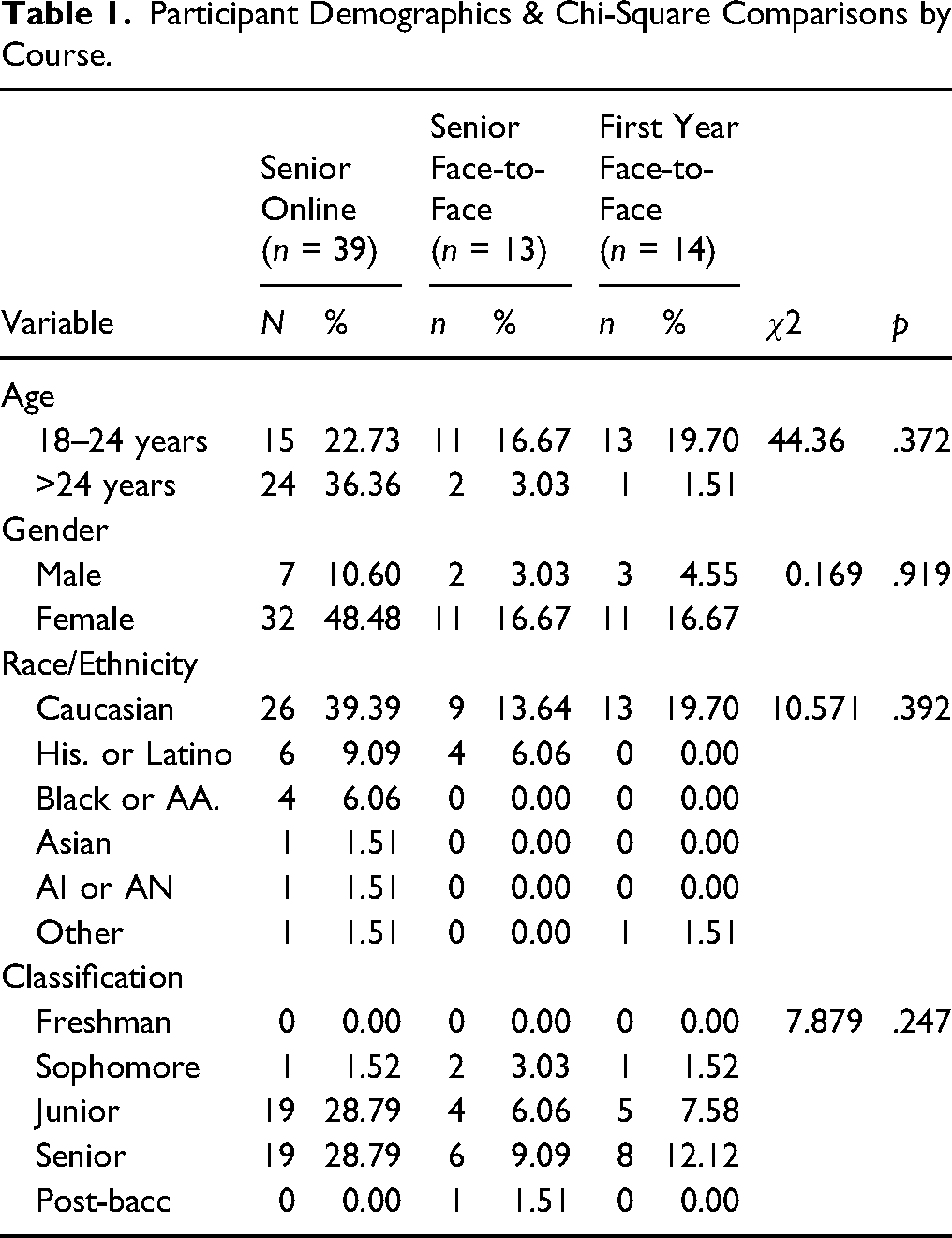
Institutional Review Board approval was obtained prior to the study. Participants were students in psychological sciences neuroscience courses taught by the same instructor at a medium-sized university during the spring 2020 semester: three senior level Animal Behavior courses offered online (n = 42, n = 45, n = 47), a senior level Animal Behavior course offered face-to-face (n = 24), and an introductory-level Biological Psychology course (n = 25) that was offered face-to-face. Face-to-face courses met twice weekly for a total of 3 hours per week. Online courses were taught fully in the learning management system (LMS) and face-to-face courses were taught partially in the LMS (for materials access and assignment submissions). Data were collected prior to the date that the 2020 COVID-19 pandemic changed course planning. Participants were required to be older than 18 years and supplied informed consent. Cases were excluded if they contained missing pre-or post-survey data (n = 12) or if they had previously used CREATE (n = 3), leaving a total of 66 participants. Participants were 81.82% (n = 54) female and 18.18% (n = 12) male, 59.10% (n = 39) students were aged 18–24 years, and 40.90% (n = 27) were aged >24 years. Participants were 72.73% Caucasian (n = 48), 15.15% Hispanic or Latino (n = 10), 6.06% Black or African American (n = 4), 1.51% Asian (n = 1), 1.51% American Indian or Alaskan Native (n = 1), and 3.03% other (n = 2).
Instruments
The self-report survey included demographic questions: gender, age (continuous), race/ethnicity, year classification (e.g., freshman, sophomore, etc.), a question about which course they were currently taking, course delivery mode (online or face-to-face), if they had previously used CREATE, and how many points they received on the assignment.
The survey included the CREATE survey items, created by Hoskins and colleagues (2011). The survey was originally generated for the CREATE approach and initially included 52 items. Following inspection, principal component analysis, and varimax rotation, Hoskins et al. proposed 24 items that culminate into six factors: decoding primary literature (five questions), interpreting the data (four questions), active reading (four questions), visualization (four questions), thinking like a scientist (four questions), and research in context (three questions) (2011). The 24 questions suggested by Hoskins and colleagues (2011) were presented in the current study in Likert format (1 = I strongly disagree to 5 = I strongly agree). Scores were summed for items in each factor, creating six sum scores for each participant as in Hoskins et al. (2011). Higher scores on the self-report CREATE survey indicate increased positive perceptions of primary literature within that factor. Maximum scores within each factor are 15 for the factor with three questions (research in context), 20 for factors with four questions (interpreting data, active reading, visualization, and thinking like a scientist), and 25 for the factor with five questions (decoding primary literature). Survey questions are available in Hoskins et al. (2011).
At both pre- and post-administrations in the current study, the scale exhibited moderate to good reliability: decoding primary literature (pre-α = 0.85, 95% CI = 0.79–0.90; post-α = 0.76, 95% CI = 0.65–0.83), interpreting the data (pre-α= 0.75, 95% CI = 0.62–0.82; post-α= 0.73, 95% CI = 0.63–0.81), active reading (pre-α = 0.68, 95% CI = 0.54–0.78; post-α = 0.61, 95% CI = 0.45–0.74), visualization (pre-α = 0.65, 95% CI = 0.50–0.77; post-α = 0.84, 95% CI = 0.77–0.89), thinking like a scientist (pre-α = 0.71, 95% CI = 0.58–0.80; post-α = 0.51, 95% CI = 0.29–0.67), and research in context (pre-α = 0.46, 95% CI = 0.21–0.64; post-α = 0.66, 95% CI = 0.50–0.77).
The STEM Career Interest Survey contains items that measure interest in careers in science and perceived importance of careers (Kier et al., 2014). As an ancillary measure of interest in STEM careers, the science portions of the “STEM Career Interest Questionnaire” were administered (Kier et al., 2014) in the current study. At both pre- and post-administrations, the scale exhibited good reliability (pre-α = 0.81, 95% CI = 0.74–0.87; post-α = 0.82, 95% CI = 0.75–0.87). Participants are asked to rate statements such as “To me, science is” on various seven point Likert scales such as (1 = fascinating to 7 = mundane or 1 = exciting to 7 = unexciting).
Modified CREATE Project
The CREATE project was adapted from Hoskins et al. (2011) for use in an online or face-to-face course and as a one-time project. Students were supplied with a peer-reviewed article pertaining to course content and the integrated project instructions/rubric/answer form file, which is freely available on Open Science Framework (Harris Bozer, 2021). Students were instructed to put their answers directly in the file. Quotes were not allowed, and students were asked to submit the work using APA in-text citations and references. Steps 1–5 were similar to the previous CREATE research (see Hoskins et al., 2007, for examples). In step one (Consider), students read the introduction section of the article, generated a concept map to summarize the introduction, key variables, new issues, and novelty of the research. Students made a note of unfamiliar concepts. In step two (Read), students read the methods, described how the data were obtained, generated a simple visual depiction (i.e., flowchart, diagram, etc.) of the methods, and defined unfamiliar words. In step three (Elucidate), students elucidated the hypotheses and central ideas, and created their own titles for figures. In step four (Analyze), students provided their interpretation of the data. They determined what the data meant by reading the results section, related the results to the hypothesis and purpose, made four bullet points to summarize the conclusions that they would make before reading the published conclusions, and identified at least one difference between their conclusions and those published. In step five (Think of the next Experiment), students imagined that they were the author of the article, and designed a unique, original, and thoughtful study as a follow-up. Students were instructed that they may not create the same study as a classmate. Simple manipulations such as changing the sample size, age or other demographics, or length of the study were not permitted. They described the purpose and hypothesis(es) of the study, and described the methods or made a methods flowchart.
Step six was a novel adaptation to the CREATE approach. In this step, students used the LMS to engage in asynchronous discussion about their post. After posting their proposed experiment to a discussion thread, they evaluated and contributed to at least one other student’s proposed experiment. They were asked to focus on the scientific content of the experiment, expand the research question, help develop a new hypothesis, and supply additional information from peer-reviewed sources. Students received up to 10 points for the assignment (10% of the course grade), which was scored by the instructor using the embedded rubric.
Procedure
Participants voluntarily completed informed consent and the survey during the first week of the course. All questions on the survey were required to eliminate the possibility of missing data on individual questions. Then, the modified CREATE project was administered (Harris Bozer, 2021). Once the project was submitted by students in the LMS at mid-semester and grades for the CREATE projects were computed, participants completed the survey a second time. Participants provided their student ID number to allow linking of the pre- and post-surveys. Online students completed the survey in Google Forms. Face-to-face students had the choice to complete the survey in Google Forms or by using pen and paper. Participants were awarded a small amount of extra credit for their participation.
Data Analyses
A priori power analyses were conducted using G*Power software to determine the necessary sample size for the largest model at an alpha criterion level of .05, .80 power (probability of finding significance), and an expected effect size of 0.25, based on pilot studies and previously published studies (Cohen, 1988; Faul et al., 2007; Lakens, 2013). Data are presented as mean ± SEM and pairwise comparisons were only presented where there was a significant effect. Pearson’s chi-square analyses were run to compare course type (senior level online, senior level face-to-face, and introductory-level face-to-face) by age, gender, ethnicity, and classification. A one-way ANOVA was run to compare grades on the project (up to 10 points) by course type (senior level online, senior level face-to-face, and introductory-level face-to-face).
After reverse coding of five items (detailed in Hoskins et al., 2011), data for each of the CREATE survey factors were summed for each participant in Excel. To test the hypothesis that introducing CREATE into psychological sciences courses would result in an increase in positive perceptions of primary literature, mixed ANOVAs were run to compare course type as the between subject factor (senior level online, senior level face-to-face, and introductory-level face-to-face) and CREATE outcome as the within subjects factors over time (pre- and post-survey scores for each of the CREATE factors: decoding primary literature, interpreting data, active reading, visualization, thinking like a scientist, and research in context.
A mixed ANOVA was run to compare STEM Career Interest Questionnaire scores over time by course type (senior level online, senior level face-to-face, and introductory-level face-to-face). Pearson’s correlations were run to assess the relationship between the CREATE survey factors (pre- and post-difference scores) and project grades (student performance). Difference scores were computed by subtracting the pre-score of each CREATE factor from the post-score.
Results
Course Type Comparisons
Participant Demographics & Chi-Square Comparisons by Course
CREATE Results
CREATE Survey Outcomes over Time (n = 66)
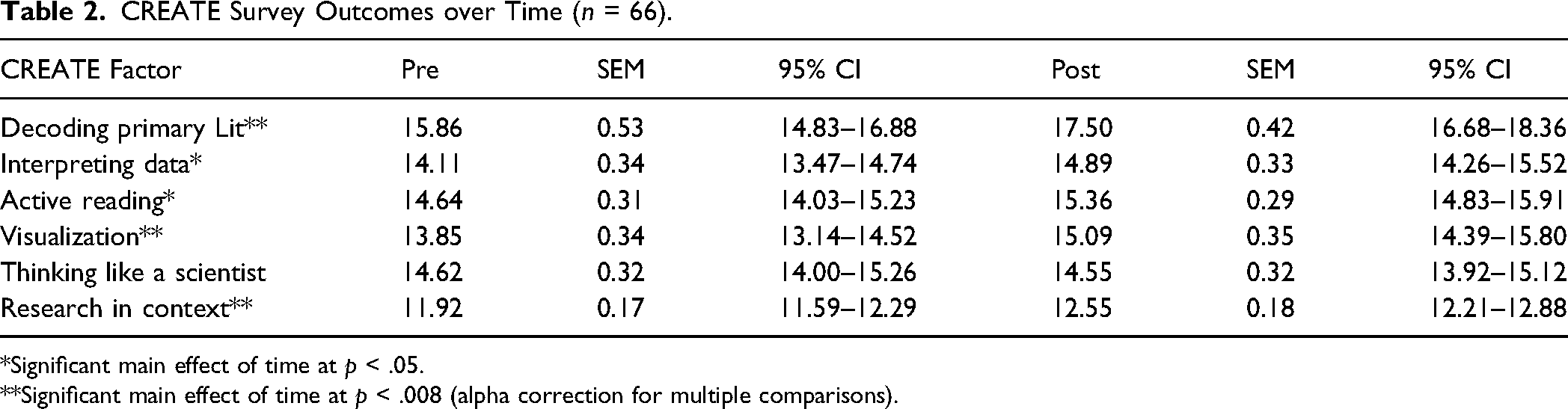
*Significant main effect of time at p < .05.
**Significant main effect of time at p < .008 (alpha correction for multiple comparisons).
STEM Career Interest Questionnaire Results
The mixed ANOVA to compare STEM Career Interest Questionnaire (science questions) scores over time by course type (senior level online, senior level face-to-face, and introductory-level face-to-face) indicated that there was no main effect of time, F(1, 63) = 0.002, p = 0.969,
Relationship Between CREATE Perceptions and Performance
Pearson’s correlations were run to assess the relationship between the CREATE survey factors (pre- and post-difference scores) and project grades (student performance). There were no significant positive correlations between grades and CREATE perceptions for any of the six CREATE survey factors: decoding primary literature (r = 0.158, p = 0.206, 95% CI = −0.09 to 0.39), interpreting data (r = 0.110, p = 0.380, 95% CI = −0.14 to 0.34), active reading (r = 0.201, p = 0.105, 95% CI = −0.04 to 0.42), visualization (r = −0.085, p = 0.497, 95% CI = −0.32 to 1.60), thinking like a scientist (r = 0.230, p = 0.063, 95% CI = −0.01 to 0.45), and research in context (r = 0.075, p = 0.552, 95% CI = −0.17 to 0.31).
Discussion
The purpose of this research was to examine how a modification of the CREATE approach relates to student perceptions of primary literature and STEM career interest in psychological sciences courses offered both face-to-face and online. The CREATE approach was modified for use as a one-time project and assessed in (a) two course levels (introductory-level and senior level) and (b) two course deliveries (face-to-face and online). Before examination of the impacts of the CREATE implementation as a one-time project, comparisons of course types were conducted. There were no differences in demographic variables (age, gender, ethnicity, and classification) across course type (senior level online, senior level face-to-face, and introductory-level face-to-face), so there was no cause for concern about demographic variables influencing comparisons of CREATE survey scores across course types. Additionally, there were no significant differences in project grades (up to 10 points) across course types, indicating that there were no significant differences in performance on the CREATE project that would influence comparisons of CREATE survey scores across course types.
The hypothesis for the current study was that introducing CREATE into psychological sciences courses would result in an increase in positive perceptions of primary literature, indicated by increases in CREATE survey scores. While one could reasonably surmise that a primary literature project could be more successful in a particular level or course delivery, the data in the present study indicated no main effect of course type (senior level online, senior level face-to-face, and introductory-level face-to-face) or interaction between course type and time (pre- and post-CREATE survey scores). In other words, there were no differences in self-reported perceptions of primary literature by course level or delivery type. However, although the courses in the current study included introductory-level and senior level courses, there were no first-year students in the sample, and sophomore students only comprised 6.06% of the sample. This could explain the lack of course level effect. Additionally, it may also explain the lack of a significant difference in project grades across course levels.
In line with previous research (Beck, 2019; Gottesman & Hoskins, 2013; Hoskins et al., 2011), there were significant increases over time (pre- to post-survey) in self-reported student perceptions of primary literature regarding the CREATE factors decoding primary literature, interpreting data, active reading, visualization, and research in context. However, in contrast with previous research (Gottesman & Hoskins, 2013; Hoskins et al., 2011), there were no significant increases in the self-reports of “thinking like a scientist” over time. One potential explanation is that the one-time project is not enough to inspire students to consider thinking of themselves as a scientist.
Results of the STEM Career Interest Questionnaire (science questions) supplement this explanation, as there was no significant change in STEM Career Interest Scores over time (pre- and post-survey scores), and no interaction between time and course type. Despite the CREATE approach being introduced into the courses, scores on the STEM Career Interest Questionnaire did not significantly change over time. It should be noted that because this is the first time that the CREATE survey and the STEM Career Interests Questionnaire have been administered together, it is not clear if STEM career interests can be altered by the original CREATE approach. In previous studies utilizing the CREATE approach for a whole semester or including a series of articles, there were positive gains in the “thinking like a scientist” factor. However, Beck recently modified the CREATE approach for one-time use with a small jigsaw activity and found gains in the reading and interpretation of primary literature, but not beliefs about scientists (Beck, 2019). It is possible that the one-time application of the CREATE approach is not impactful enough to change perceptions of STEM careers and activate thinking like a scientist.
Difference scores reflected the change over time in the CREATE survey scores which indicate perceptions of primary literature. There were no significant correlations between the CREATE survey factors difference scores and project grades (student performance). In the current study, performance on the CREATE project does not map onto student perceptions of primary literature. In other words, student performance on the project is independent of their perceptions of primary literature in the six CREATE factors. A future study could be designed to investigate if overall course grades are impacted over time in students that are using the modified CREATE approach.
Future research could investigate the use of the CREATE approach in other psychological sciences neuroscience courses. An examination of the CREATE approach in introductory-level courses that contain primarily first-year students would be pertinent before infusing into lower level psychology curriculum, because the lack of first-year student presence in the introductory courses in the current study precludes researchers from making a judgment if this project is appropriate for first-year students. Future research could also be conducted to examine the reliability of project scoring by adding multiple raters and assessing inter-rater reliability.
In the current study, demand characteristics are possible, and refer to the participant desire to present a “socially desirable” response for what they perceive that the researcher is trying to confirm. The nature of the repeated measure design necessitated that students provide an ID number to link pre- and post-survey data. But, students completing the survey may have altered their responses to provide what they believe the instructor/researcher wanted them to provide in order to be perceived as a good participant and student. Another limitation of the current study is the possibility that changes in perceptions of primary literature may be due to pedagogical factors outside of the CREATE project toolset. In other words, there may have been extraneous variables not measured that contributed to the enhancement of perceptions of primary literature. Additionally, there was no control condition in the current study. The pre-test and post-test design was selected rather than a between subjects design with a control group because of the existing literature that demonstrates that the CREATE approach benefits students. Withholding that benefit from some students while offering it to others on a graded assignment would be ethically questionable, given the previous literature that the CREATE approach is helpful for students.
Lastly, it should be noted that the modified CREATE project in this study was due to the instructor several weeks before the course was modified due to the COVID-19 pandemic, and only 4 weeks before the first case of the coronavirus was present in the university community. It is possible that student performance or perceptions could have been impacted by media coverage of the pandemic, changes in job requirements, or family member illnesses in other parts of the world that were affected by positive cases. Since the study was designed and released prior to the start of the global pandemic, no measure on pandemic perceptions was included in the study.
Conclusion
Like other CREATE approaches, benefits of the current project include the unrestricted literature design, leaving the faculty member the ability to choose the literature that best maps onto course content. Harrington et al. (2015) have proposed a list of foundational neuroscience papers and the journal Nature has a list of their top 100 downloaded neuroscience papers (Scientific Reports, 2020), and these sources can be used to choose current and engaging pieces of literature. Benefits unique to the current project design are that instructors can expose students to primary literature using a one-time project which can be appended to the current curriculum. The 2020 COVID-19 global pandemic has resulted in changes to instruction including an increase in courses taught online, and the current project can be used in the online classroom to preserve student access to engaging conversations about primary literature in psychology. Integrating primary literature into the undergraduate STEM classroom has a positive impact on the pipeline to graduate school (Kozeracki et al., 2006), enhanced confidence in scientific literacy (Willard & Brasier, 2014), and increased student engagement with the literature (Hoskins et al., 2007).
Footnotes
Acknowledgments
I thank Braden Bozer, M.S., for assistance with the design for methods and recruitment, Abby Hartman, and all of the faculty, teaching fellows, and directors in the 2016–2017 Scholarship of Teaching and Learning (SOTL) program at Tarleton State University for comments and involvement on previous CREATE research studies.
Declaration of Conflicting Interests
The author(s) declared no potential conflicts of interest with respect to the research, authorship, and/or publication of this article.
Funding
The author(s) received no financial support for the research, authorship, and/or publication of this article.
