







Abstract

The rise of the consumer-driven approach to higher education, the accountability movement, and technological innovation have fostered curricular reform endeavors in US higher education (Boud, 2007; Nelson, 2014). Undergraduate psychology education has also faced the fact that two thirds of its graduates immediately apply for jobs in the private or public sector rather than pursuing master’s studies (see Norcross et al., 2016). In this context, faculty members of psychology departments deliberated at an American Psychological Association (APA) conference in 2008 about the prospects of undergraduate education and also recommended a core curriculum in introductory psychology that encourages a better integration of students’ knowledge and experience as well as allowing them to apply psychological knowledge in their own fields (Dunn et al., 2009). Sometime later, a working group of the APA Board of Educational Affairs (BEA) provided recommendations for strengthening the common core of introductory psychology. The working group also acknowledged the general education orientation of the course as it is part of the liberal arts curriculum and asserted that introductory psychology course structures “may not accurately reflect the discipline as it stands today” and that most textbooks “still treat different areas of psychology (e.g., social, personality) as if they are distinct and studied in isolation of other areas.” (American Psychological Association, 2014, p. 6). Thereafter, the APA’s BEA established an Introductory Psychology Initiative (IPI) steering committee which proposed recommendations in the areas of student learning outcomes and assessments, course models and designs, teacher-training and development, and student success and transformation (American Psychological Association Introductory Psychology Initiative (IPI), 2021).
The working group’s assessment of introductory psychology critically evaluates the established structure of conventional textbooks based on a sequence of roughly 16 topical chapters including sections such as an introduction, research methods, biological processes (biopsychology, sensation-perception, and consciousness), developmental psychology, learning and cognitive processes (learning, memory, thinking, language, intelligence), emotion, motivation, clinical and health psychology (personality, disorders, and therapy, health), and social psychology (Griggs & Marek, 2001; Griggs & Jackson, 2013). As 98% of the lecturers use textbooks for the course, the textbook structure highly influences the selection of course content and the way how psychological content is presented to students (Griggs, 2014). This conventional textbook structure was promoted by publishers interested in marketing textbooks to a diverse readership and serving the diverse needs of course teachers. Publishers also strengthened the topical structure, demanding that textbook authors overlap up to 85% of book content with previous textbooks (Charles, 2008, p. 14). Historical scholarship on introductory textbooks has shown that this highly standardized topical structure of chapters has developed only since the 1970s after the emergence of larger markets for textbooks (Weiten & Wight, 1992).
Concurrently with this mainstream development, teachers of introductory psychology also began to speak about the challenges of the course: the problem of “inert knowledge,” that is, students do not apply knowledge to practical cases (Sternberg, 1999), students have no “big picture” of the field (e.g., Jhangiani & Hardin, 2015), textbooks share few established findings (Griggs & Marek, 2001) and textbooks lack conceptual consistency (Medcof & Roth, 1979). Thus, teachers of psychology started to propose ways of reconceptualizing the course. Whereas the approaches of critical thinking (Halpern, 2003) and triarchic thinking (Sternberg, 1999) which often accompanied the use of conventional textbooks are relevant in all scientific fields, Medcof and colleagues proposed a special psychology-related approach by presenting five major theoretical perspectives of the field (biological, behaviorist, cognitive, psychoanalytic, and humanistic) and their applications in psychotherapy (Medcof & Roth, 1979). This approach was developed for a second time in the USA (California) by Tavris and Wade (1995) and for a third time by Fernald (2008) at Harvard University. Subsequently, it was invented independently for a fourth time by Günter Sämmer (1996, 1999) in Germany for teaching high school psychology (Geiss & Searight, 2021). In its background section about alternatives to the established topical textbook structure, the APA working group on introductory psychology referred to Tavris and Wade’s textbook as an “early approach for reconceptualizing psychology, organizing the content of psychology around five major approaches” (American Psychological Association, 2014, p. 9).
Soon after, the APA working group suggested a new conceptualization of the course that aims at greater commonality of content, specifying that at least two topics from each of the five domains or pillars (biological, cognitive, development, social and personality, and mental health) should be covered in a course. It also proposed treating big problems (e.g., pollution, global warming, etc.) as explicit examples to show how different pillars of psychology are integrated and how they could be linked with issues of ethics, cultural and social diversity and the application of psychology to real-world cases (American Psychological Association, 2014, pp. 16–19). This integrative model for teaching psychology was elaborated by some members of the working group in a more scholarly way (Gurung et al., 2016).
These suggestions are narrowly focused on the disciplinary structure of psychology which shapes research fields and academic specialization. We propose a different kind of integration which gives special prominence to the structure of the subject matter: the mental-behavioral system.
A Fundamental Structure as a Guide for Organizing Psychological Knowledge
Whereas most introductory courses and textbooks pay attention to different topics and/or different theoretical perspectives, the integrative system-related approach (Nolting, 1985, 1987; Nolting & Paulus 1985, 2018) emphasizes: • The common aspects of what psychology is about. • A structure representing the interconnections of these aspects in a coherent system.
In the beginning, this approach was motivated by shortcomings in students’learning outcomes, such as additive and topic-bound rather than interconnected knowledge and poor competence in transferring basic knowledge to real-world cases. It was also motivated by dissatisfaction with the numerous textbooks presenting unconnected topics only.
It is a simple fact that the scientific field of psychology can be divided into domains and topics, but this is not the case for psychology’s subject matter—mind and behavior—which has to be regarded as a coherent system or organism. Therefore, when structuring a course or textbook, some kind of integration or synopsis is necessary, too. This is the primary purpose of the integrative approach.
The approach drew inspiration from Ausubel’s theory (1969) of a hierarchical structure of knowledge with anchoring ideas on top and more specific knowledge at lower levels as well as Bruner’s notion (1970) of a “spiral curriculum” with a structure of fundamental aspects in the center. These authors, however, did not specify how these principles could be applied to teaching psychology.
What are common fundamental aspects of the subject matter? Psychology is about behavior and mental processes—this is the core. Moreover, psychology is about persons and how they develop, about situational influences, and about relations between persons. Whenever we explain some kind of behavior—aggressive, reluctant, helpful, eager, etc.—we draw upon these fundamental aspects. We mention mental processes (emotions, intentions, etc.), personal factors (temperament, abilities, etc.), developmental factors (genome, family, etc.), situational factors (incentives, environment, etc.), and/or interpersonal aspects (social relationships, communication, group dynamics, etc.).
In textbooks, these common basic aspects are usually presented one by one (i.e., in a serial order of domains and topics). However, for explaining the behavior of a real individual in a real-life situation these aspects have to be regarded as components of a coherent system. Therefore, they should be tied together in a structure indicating their interrelatedness.
How can such a fundamental structure be conceived? The starting point of the present model is the well-known, simple, and far-reaching statement that behavior is always determined by the person and the situation (e.g., Lewin 1936). Figure 1 depicts this statement and the other common aspects mentioned above as a structure. The structure is two-dimensional, with the horizontal level comprising current processes as well as current personal and contextual factors. The vertical direction represents personal change in the course of time, attributing personal factors to the developmental background. Explaining behavior by 4 + 1 fundamental aspects. Note. Current processes (fundamental aspect 1) include overt behavior and mental processes. On the one hand, these processes are determined by personal factors (2), which, in turn, are the result of developmental factors (3). On the other hand they are determined by the current context which comprises external situational factors in all cases (4) and interpersonal aspects in most cases (+1).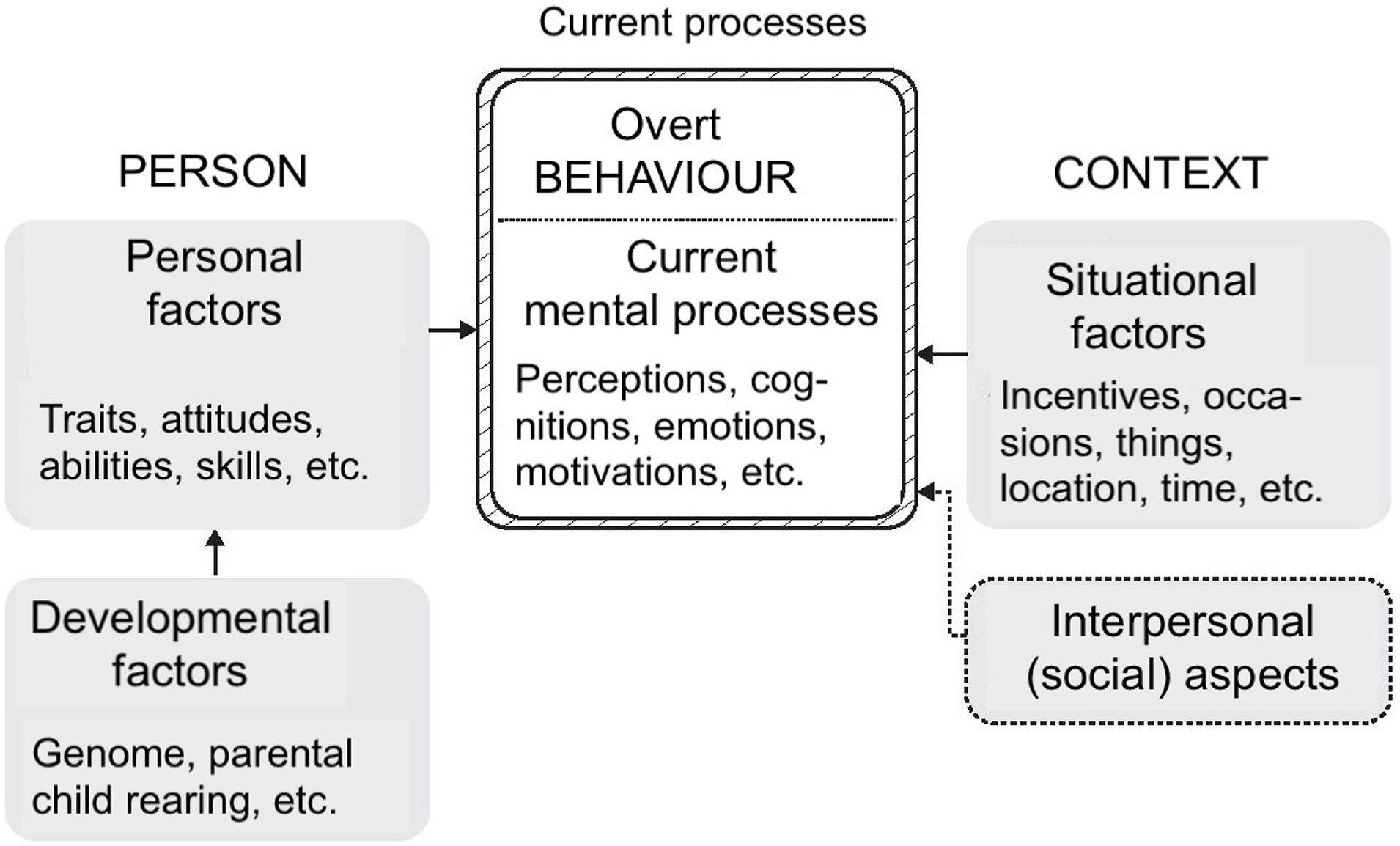
With regard to current processes, internal processes are usually conceived as underlying overt behavior and thus explaining it (“I am singing, because I feel so happy”), although sometimes internal processes can be explained by behavior (“Singing makes me feel happy”). All current processes, whether mental or behavioral, are determined by personal („I like singing”) and contextual factors (“… when taking a shower”). In other words, the content and “color” of these processes, for example, the type of perceptions, thoughts, feelings, etc., differ from person to person and differ in the same person according to the current context.
For example, anxious feelings may arise in person A when confronted with an exam (situational context) or with teacher X (interpersonal context). If they do not arise in person B in the same context, this can be attributed to different levels of anxiety (personal factor). This trait, in turn, may be explained by different developmental backgrounds (genome, experience in the family or school): personal factors result from previous development (see Appendix A in the OSF Materials for more examples; Nolting & Geiss, 2021).
With regard to the context, Figure 1 includes interpersonal aspects in addition to situational factors. Considering other persons merely as a situational element neglects the dynamics between persons such as communication, reciprocity and relationships. They are often crucial aspects for understanding the behavior of the persons involved. In Figure 1, they play a minor, supplementary role for two reasons: they are irrelevant in non-social situations, and the diagram would have to be doubled or multiplied, if “inter-phenomena” between two or more persons were graphically depicted. Compared to Myers’ (2014) additive model comprising biological, psychological, and even societal influences on behavior and mental processes, Figure 1 focuses on psychological aspects and their interrelatedness as one system.
It is important to note that the model is neutral, as it is not committed to a specific theoretical perspective such as behaviorism, psychoanalysis, and cognitive psychology. It is comprised of concepts designating phenomena which are not controversial (“process, development,” etc.). Theoretical perspectives differ only when it comes to interpreting and conceptualizing these phenomena.
There is one thing which Figure 1 fails to present: behavior is not only a product but also the cause of effects. It influences the context. Thus, it is an element of a continuous flow of processes. Therefore, the fundamental structure should also be transformed into a dynamic version which leads us to process-related concepts such as cognition, motivation, etc. They are major topics of general psychology and of introductory psychology, too. Figure 2 attempts to integrate them. The current processes are arranged in two lines or directions: some processes are primarily receiving, while others are primarily influencing; behavior is the final element of the influencing line. Cognitive processes are involved in both lines. In the receiving direction, cognition has the meaning of interpreting, understanding. In the influencing direction, cognitive processes may include mental acts (e.g., planning, deciding) which regulate behavior. Emotion is placed among receiving processes, whereas motivation is directed towards effects. Of course, all concepts designate facets rather than separate elements. Inside the mind there is no “one-way-traffic” from perception to behavior, and several processes may happen simultaneously. Learning, a major concept of general psychology, is integrated into the figure as the after-effect of current processes and as having an impact on the development of the individual (together with biological growth and maturation); therefore, it moves from the horizontal to the vertical dimension. A dynamic version of fundamental aspects. Note. The figure focuses on the individual (without interpersonal processes). Horizontal: Current processes in two lines (receiving and influencing). The processes are facets, not a chain of elements. Vertical: developmental processes with learning being an after-effect of current processes, while maturation is genetically regulated.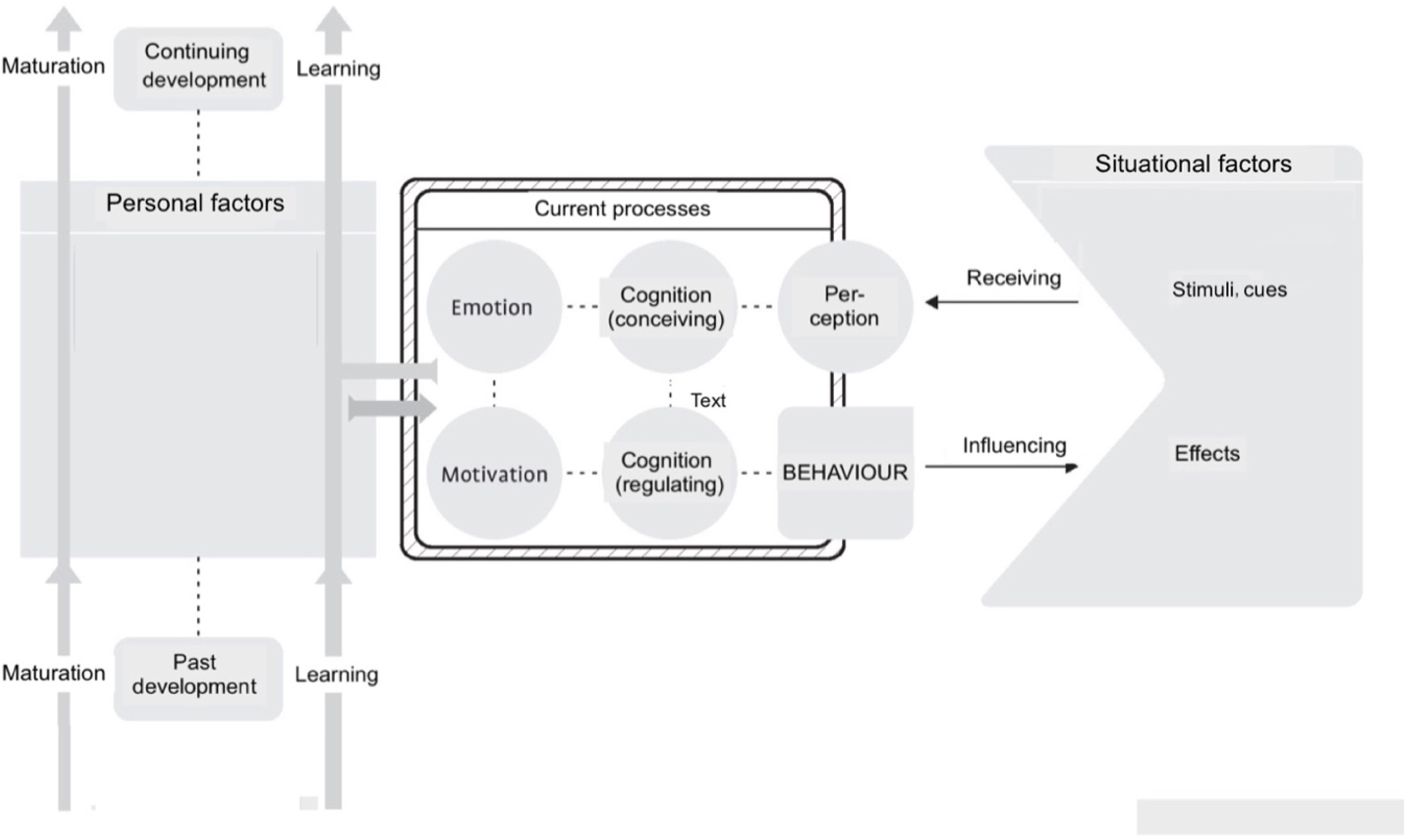
Many phenomena can be related to Figure 2. Here are some examples: (1) Reading a letter (= the stimulus) includes visual perception, understanding the message (cognition), and often emotional responses such as joy or anger. (2) Emotions may affect perceptions (e.g., a person in an anxious state perceives a threat in the darkness where there is none). (3) A student aims at passing an exam (motivation towards an effect) and therefore regulates (cognition) his/her behavior for effective studying. (4) A very excited person (emotion) hits (behavior) and hurts (effect) another person impulsively (i.e., without a real motivation to hurt and without cognitive regulation). (5) Classical conditioning is a phenomenon in the receiving line. It may create new stimulus-emotion connections, such as fearful reactions in Watson’s famous experiment with poor little Albert. (6) Operant conditioning can be attached to the influencing line. A child’s aggressive behavior, intentional or impulsive, may be reinforced (effect) by a parent’s indulgent response. (7) A physical reflex is like a shortcut from sensory perception to behavior.
The dynamic model may unintentionally suggest theoretical assumptions about the variety and the sequential order of mental processes. Since there is no “natural” classification of mental events, Figure 2 is not supposed to describe a theory of mental processes. It is just a heuristic tool for linking and relating major concepts which all students have to reflect about and which are presented as isolated chapters in many textbooks.
Implications for Teaching
Structuring a course or textbook strictly according to the integrative approach is possible (Nolting & Paulus, 2018), but it is not the only way to be “integrative.” Teachers may use integrative figures and comments as supplements to the course or textbook they are familiar with, or they may invent similar tools for the same purpose. We think the integrative approach is compatible with any content coverage and lesson-plan as well as with other kinds of integration such as the five pillars proposed for US introductory psychology courses (American Psychological Association, 2014; Gurung et al., 2016). It focuses on system-related integration of psychological aspects. Everything else, including the teaching of biological or cultural aspects and of research methods may remain the same as before. As to assessment, the approach suggests case analyses as an additional option.
With regard to student learning outcomes (American Psychological Association (IPI), 2021), the approach primarily contributes to explaining general principles that govern behavior while recognizing individual differences, and to applying these principles in everyday life. This can also be regarded as an important contribution to psychological literacy (Geiss, 2019; McGovern et al., 2010). The special benefits of the integrative pattern are (1) making the general principles more coherent, and (2) facilitating transfer to a vast range of human behavior. Beyond the two figures—what else can be done for these goals?
Fostering Coherence in Psychological Thinking
“Integrative” means keeping the entire mental-behavioral system in mind and referring to it, no matter which chapter of the syllabus is currently being discussed. In accordance with Gurung et al. (2016, p. 119) the overarching aim is to facilitate holistic understanding. Students should learn to look at more than one aspect and at interconnections when explaining behavior:
Introducing the structure of fundamental aspects in a course is easy by giving an example of behavior and asking students, “Which factors determine whether or not, e.g., a student raises his/her hand in class or seminar?” (see Appendix A in OSF Materials; Nolting & Geiss, 2021). Usually, the answers can clearly be classified as representing a mental process, a situational factor etc. The structure, however, which can be built from these categories is not easily recognized by students. As a rule, students distinguish internal and external aspects but do not differentiate processes from personal factors. Thus, the teacher’s support is needed to make a structure such as Figure 1 from their answers. If students do not mention developmental aspects, the teacher may ask for ideas concerning “past experience.”
The fundamental structure can serve as an advance organizer which may then accompany traditional domains and topics. To preserve overarching integration the teacher should recurrently ask: “Where are we now with regard to the system?” In so doing, the structure should also be used to clarify the different “natures” of topics and domains in order to understand how they are interrelated: • Type 1: Development, personality, and social psychology are domains which focus on one of the fundamental systemic aspects, with social psychology comprising processes and relations between two or more individuals. • Type 2: Topics such as perception, cognition, memory, learning, emotion, motivation, etc. may be termed “component topics,” since the primary focus is on subsystems, although they are not isolated elements. Figure 2 can be helpful in lessons about these mental processes. It is important to distinguish current processes (state anxiety, reasoning etc.) from personal factors (trait anxiety, intelligence etc.). • Type 3: Clinical and health psychology as well as other kinds of applied psychology have to be regarded as “holistic” topics, as looking at the entire system from the standpoint of a special purpose (e.g., with the eyes of a therapist). Generally, all topics about some kind of behavior are holistic: prosocial as well as antisocial behavior, behavior related to studying, working, mental and physical health, etc. All of them refer to real persons in real contexts, and therefore they have to include all systemic aspects, albeit in somewhat different ways depending on the special content coverage.
When it comes to theoretical perspectives such as behaviorism, cognitive psychology, etc., they may be described as viewing the entire system through different theoretical “glasses.” They differ in their assumptions of how to conceive motivation, personality, development, etc. They differ in what they investigate in the first place (behavior, cognition, emotion, genetic factors, etc.), and in how much significance they give to the person, to the situation or to interpersonal processes in explaining behavior.
Fostering Transfer of Fundamental Aspects
Knowledge of fundamental aspects is transferable knowledge. This can be demonstrated and practiced with the students in several ways:
Transfer I: Considering Fundamental Aspects in Unknown Topics
Students should understand that the fundamental aspects are not just a “topic” like many other topics but “above” all topics, on top of the knowledge hierarchy, as they can be transferred to a large variety of psychological issues. For example, given that students are not familiar with the topic of prosocial behavior, they might think about this issue by considering the fundamental aspects (e.g., easy and difficult situations for helping others, individual differences of altruism, family background, and relationship with the person who needs help). Figure 2 can also be transferred to this topic: considering which processes may be involved when someone, say, hears a cry for help.
Another example is the subsystem “motivation.” The teacher may ask: “Can you imagine how your current motivation for reading a book depends on personal and situational factors?” Or: “Which personal, situational and interpersonal aspects may determine motivation for attacking someone verbally?” Transfer to an unknown topic means conjecturing what this topic is like with respect to the fundamental aspects without having particular knowledge. This is a useful exercise for applying basic knowledge.
Transfer II: Understanding Real Examples of Behavior
The fundamental aspects can be used as a diagnostic guide by transforming them into questions (see Appendix B in the OSF Materials for more examples; Nolting & Geiss, 2021). Students should practice asking such questions with real-life examples given by other students or the teacher. Taking systemic aspects as a guide can help counteract the widespread tendency to explain behavior in a monocausal manner—in particular, to focus on the person only while neglecting contextual factors (Nisbett, 2015). The first author’s experience with teacher-training students (with psychological knowledge at an introductory level) has given evidence that this small guide is easy to learn, and it is helpful for understanding real cases of disruptive behavior in schools and other problems. As a part of their course exam, 160 students wrote an analysis (three pages) of a real case they had experienced.
Transfer III: Looking for Change
Understanding the problem may be complemented by considering how to solve it. The fundamental aspects suggest three approaches of producing change: (1) personal change—for example, by means of individual therapy, training, and education, (2) situational change, such as better incentives, challenges, equipment, etc., (3) interpersonal change (e.g., by means of family therapy, group supervision, and classroom management).
The integrative system-related approach is a guide to holistic psychological thinking and to transferring fundamental aspects for various purposes. Thus, it strengthens the common core of introductory psychology.
Footnotes
Declaration of Conflicting Interests
The author(s) declared no potential conflicts of interest with respect to the research, authorship, and/or publication of this article.
Funding
The author(s) received no financial support for the research, authorship, and/or publication of this article.