







Abstract
Background
While capstone courses are popular among psychology programs, the capstone course design at a small private Midwestern university seems less conventional.
Objective
Along with meeting five course objectives, the course addresses understanding vocation, identifying academic and career strengths and weaknesses, identifying talents and gifts, articulating goals, defining servant leadership, knowing what it takes to persist in college and what career to pursue, and understanding purpose and calling.
Method
Students completed a 10-item questionnaire addressing the aforementioned items on the first and last days of class during four consecutive fall offerings of the Senior Capstone in Psychology course.
Results
Analysis of pre and posttest data revealed high confidence in positive change from the beginning to the end of the semester on every item measured.
Conclusion
Significant perceived student growth among each of the 10 questionnaire items was evident.
Teaching Implications
Institutions that wish to aid in the development of students related to vocation, servant leadership, and calling may want to consider the course design.
While capstone courses are popular among psychology programs, the structure of a capstone course at a small, private Midwestern university might be less conventional. In a 2014 redesign of the psychology major at the university under study, a capstone course was added to the required curriculum. The broad focus was on helping psychology majors discern and prepare for a future beyond their undergraduate major. The first offering of the course occurred during fall 2016 as a one-credit course. The faculty soon realized that was not enough time to accomplish the objectives for the course. Beginning fall 2017 it was offered as a three-credit course and has been offered every fall since then as a seated class limited to psychology majors of senior credit status (completed at least 90 credits). Although beginning spring 2019 it was offered as an online course for online psychology majors, due to the creation of a completely online psychology major, the data and course activities included in this article reflect only the fall seated versions of the course. The data reflect student survey responses from fall 2018 through fall 2021.
Grahe and Hauhart (2013) reported that common capstone courses in psychology include a major research project. While many capstone courses focus on a research project or thesis, our capstone course includes several smaller assignments to help prepare students to recognize their calling, establish action plans, and consider network connections that may help them move forward after graduation (whether that includes graduate school or entering the workforce). While enrolled in the capstone course, students contribute to their community through service work, prepare for job and graduate school interviews, and look back at their psychology major coursework and consider how it aligned with the APA Goals for Undergraduate Psychology Majors (American Psychological Association, 2013).
During the 2017–2018 academic year, the lead author of this study participated in Network for Vocation in Undergraduate Education (NetVUE) grant activities aimed at helping faculty and staff improve their ability to guide students as they discern their vocation and calling. Many of the activities faculty and staff participated in centered around discussions of common readings. During spring 2018, faculty and staff participants in NetVUE were invited to apply for a small stipend for summer work related to improvement of advising for vocation. During that summer, the lead author, who served as the instructor for the Senior Capstone in Psychology, revised the course slated for fall 2018. This revision included adding several of the readings and discussion questions related to vocation and calling that NetVUE faculty and staff members contemplated (Hardy, 2006; Organ, 2017; Sayers, 2006). The revision also included use of a survey assessing student perceptions of constructs such as vocation and what it means to be called.
Why might we bring the idea of calling into a capstone in psychology course? A substantial research base is being created as authors examine work identity and calling and how people who view their work as a calling experience higher well-being (Reed et al., 2022). Dik and Shimizu (2019) discuss the multiple meanings of calling and report that “lack of consensus regarding the construct's definition presents key challenges to researchers” (p. 323). One definition of calling, proposed by Dik and Duffy (2009) is as follows: A calling is a transcendent summons, experienced as originating beyond the self, to approach a particular life role in a manner oriented toward demonstrating or deriving a sense of purpose or meaningfulness and that holds other-oriented values and goals as primary sources of motivation. (p. 427)
The extent of the presence of calling relates positively to career planning and self-efficacy and may motivate students to find ways to make plans for their careers and actualize their callings in their work (Hirschi & Herrmann, 2013). How can educators help students perceive a calling, such that they can live a calling? Carpenter (2021), in a letter to his law school students, provides a reflection that can be applied to students at both the graduate and undergraduate levels. He states, “The difficulty for most of us, however, is how to know what your calling is” (p. 5).
While participants in this study did not explicitly define calling, nor review the multitude of definitions available for the word, they provided a rating on the extent they know what it means to be called. Reed et al. (2022) suggested a need for future research that focuses on specific interventions that help people better perceive their calling. While not considered interventions per se, assignments and activities included in this senior capstone course focused on guiding students’ exploration of calling.
Calling was not the only item addressed in the course. To facilitate students’ learning related to course objectives and questionnaire items during the semester-long course, the course syllabus included several assignments and in-class activities. Students completed out-of-class readings by Hardy (2006), Organ (2017), and Sayers (2006) and participated in guided small group discussions in class. Additionally, students viewed two videos related to service and servant leadership and developed and executed both individual and small group service projects to aid in their growth in understanding servant leadership. The service projects ranged in length from 4 to 6 hours each.
In part, service was a focus of this course because servant leadership is the university's chosen model of leadership and is a component of the mission and identity of the university. Fields et al. (2015) describe servant leadership as a humanistic approach and “ideal model for helping professions because of the inherent selflessness and the giving away of oneself that it embodies” (p. 102). Integrating service into a course provides an opportunity for generating ideas, reflective assignments, and discussion. Bringle et al. (2016) note that “service learning involves community service that is integrated into academic courses, unlike volunteering which is co-curricular” (p. 295). Service can provide a variety of benefits to students as they develop their understanding of their own calling and grow as people. Abouras (2021) found that civic engagement predicted a sense of calling, at least among first-year college students. Anooshian and Pritchard (2006) found that service-learning fostered personal insights and growth in senior capstone students.
Students enrolled in the capstone course described in this study completed both a group and an individual service-learning project. Students considered, and then shared with the class, their ideas for how a group of their senior capstone classmates could serve. Students formed small groups of 3–6 people based on common interests. Ideas generated included serving those experiencing homelessness or victims of human trafficking, helping feed and clothe formerly incarcerated individuals, crocheting hats for babies in neonatal intensive care units, and walking and playing with dogs and cats at local animal shelters or making homemade treats for them, among many others.
In addition to readings, discussion, and engaging in service activities, students created professional development plans related to goal articulation and knowing what career to pursue. The professional development plans included specific, measurable, attainable, relevant, and timely (SMART) goals (Doran, 1981). To move forward in achieving their goals, oftentimes students need a resume and cover letter or letter of application for graduate school. One course assignment was the creation of a resume and cover letter, or letter of application for graduate school, and peer review took place during class. In addition to having the Director of Career Services visit with the students about resume and cover letter preparation, students heard from a variety of speakers to help facilitate growth related to knowing what career to pursue. The speakers used their major in psychology in careers that involved training beyond the bachelor's degree, as well as some that did not require advanced training. Additionally, each semester the course activities included a graduate school discussion led by a panel of five people. Panelists were either currently attending graduate school or completed graduate education. It is noteworthy that all panel speakers did not have psychology backgrounds. Students often appreciated the diverse perspectives as evidenced by comments in the reflection assignment that was tied to the guest panel class event.
While students gained potential connections through class guest speakers, a related assignment involved students considering where they would like to live after they graduate, and identification of potential contacts in that geographical area where they may want to pursue employment. Students developed a list of a minimum of five potential contacts, preferably people they did not know. The networking list included the potential connection's name and contact information, as well as a description of how the student thought that connection could be helpful to them in the future. Appendix B includes assignment descriptions for this networking assignment as well as the service learning and professional development plan assignments (see Bitz, 2024).
The completion of course activities and assignments helped students meet course objectives, including integrating academic content of the psychology major with future goals (e.g., career, graduate school, etc.), learning the importance of professional networking and engaging in networking activities, improving group communication skills through peer evaluations and group collaboration activities, participating in service-learning projects, and enhancing oral communication skills through class discussions and a final presentation that synthesizes their learning. Each course objective aligned with one or more APA Goals for the Undergraduate Psychology Major (American Psychological Association, 2013).
While many of the assignments included in our capstone course are common, course activities related to understanding calling and vocation may not be. To examine change in students’ perception related to calling and vocation, along with the other survey items, the lead author obtained permission from the university's Institutional Review Board to use the existing survey data collected after four completed courses, from fall 2018 through fall 2021. We hypothesized finding significant positive change over the course of the semester for most items included in the survey.
Method
Participants
Participants were 120 undergraduate psychology majors. All students were in their senior year (fall, spring, or summer graduates) and enrolled in a required Senior Capstone in Psychology course. The course is only offered to seated students in the fall semester. In cases where there were not both pre and post data available, results were not used. A total of six cases removed for incomplete data left a total of 114 useable cases to analyze. Usable cases included 92 women and 22 men. We did not collect demographic data on race or identity, however, during the time of data collection the university reported undergraduate race/ethnicity as 3.4% Hispanic of any race, 4.7% American Indian or Alaska Native, 1% Asian, 3% Black or African American, 0.3% Native Hawaiian or Other Pacific Islander, 65% White, 2.4% two or more races, and 20.1% Race and Ethnicity unknown.
Instrument
The instrument used to evaluate the occurrence of change in students’ feelings and beliefs was a 10-item, Likert-style survey on which the scale for each item ranged from 1 (low confidence) to 5 (high confidence). This instrument development took place within the university as a product of NetVUE grant activities (see Appendix A in Bitz, 2024). It was a home-grown instrument provided by the NetVUE grant chair (Litton, 2017–2019) as a means of assessing student perception. A calculation of Cronbach's alpha for all 10 items and 114 responses revealed pretest reliability of .71 and posttest reliability of .78.
Procedure
Distribution of the questionnaire (see Appendix A in Bitz, 2024) to all students took place on the first day of the semester. Directions were basic and included asking students to simply place their name and the date on the survey and complete the questionnaire and return it to the instructor. Students who missed the first day or two of class had an opportunity within the first week of class to complete it. Students received their completed questionnaire from the beginning of the course, after completing the same questionnaire at the conclusion of the class. Originally, the intent of comparison was solely for student and instructor review.
Students compared their beginning-of-class results with end-of-term results and participated in whole class discussion related to areas of growth and decline in scores on individual items during the final class period. The instructor collected both questionnaires. Prior to the beginning of formal analysis of data, transfer of the student's pre and post numerical value responses to an excel spreadsheet took place. The transfer of student names did not take place to assure confidentiality.
After 2 years of data collection, the instructor joined with another faculty member and analyzed the data for the purpose of course improvement. That data reflected growth in all areas. After 4 years of data collection the lead author/course instructor decided to approach the university's Institutional Review Board for permission to use 4 years of existing data and further analyze them. The board approved this project.
Analysis
Using SPSS, we completed a pre and post score analysis of each item. We also computed an overall composite score change. Composite scores had a possible range of 10–50. A Bonferroni adjustment was utilized. We examined skewness and kurtosis to determine the distribution of data and if the data were normally distributed and appropriate for parametric analysis. Data were normally distributed and appropriate for a paired sample t-test.
We used paired samples t-tests with a Bonferroni correction to compare the means of a summative score for pre- and post-tests as well as for each individual item. According to Armstrong (2014), “the Bonferroni correction adjusts probability (p) values because of the increased risk of type I error when making multiple statistical tests” (p 502). The Bonferroni correction had a minor effect on the p values, with all items remaining significant at the .001 level except for items 5 and 10. These two items, with the Bonferroni correction, displayed (p) values of .008 and .009, respectively.
Results
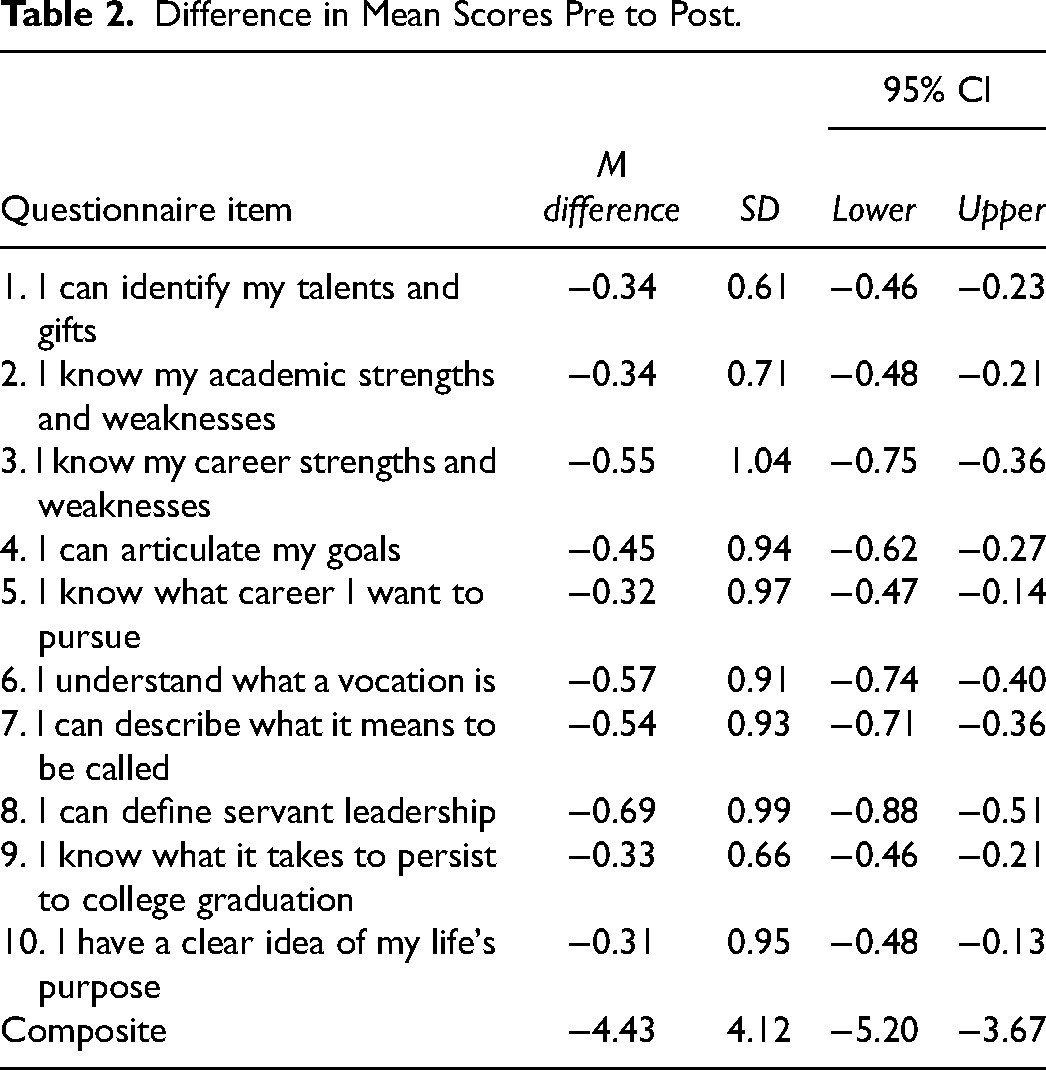
The results of the paired samples t-test comparing pretest and posttest individual items and composite scores revealed significant change in student ratings on every item measured between the beginning and end of the semester (see Table 1). The Cohens d is a standardized effect size for measuring the difference between two group means (Field, 2013). When examining the effect size using the Cohen's d, eight of 10 pairs show a medium to large effect (0.47–0.79). Therefore, in addition to the results being statistically significant, they are of practical importance and meaningful. Notable change took place in student perceptions of themselves from the beginning to the end of the course. Table 2 provides the differences between the pre- and post-mean scores. For the item analysis, the average mean change is −0.46 on a 5-point scale, so nearly the equivalent of a half point in growth on a 5-point scale, within 15 weeks.
Paired Samples t-Test for the Difference Between Pretest-Item and Posttest-Item Scores.
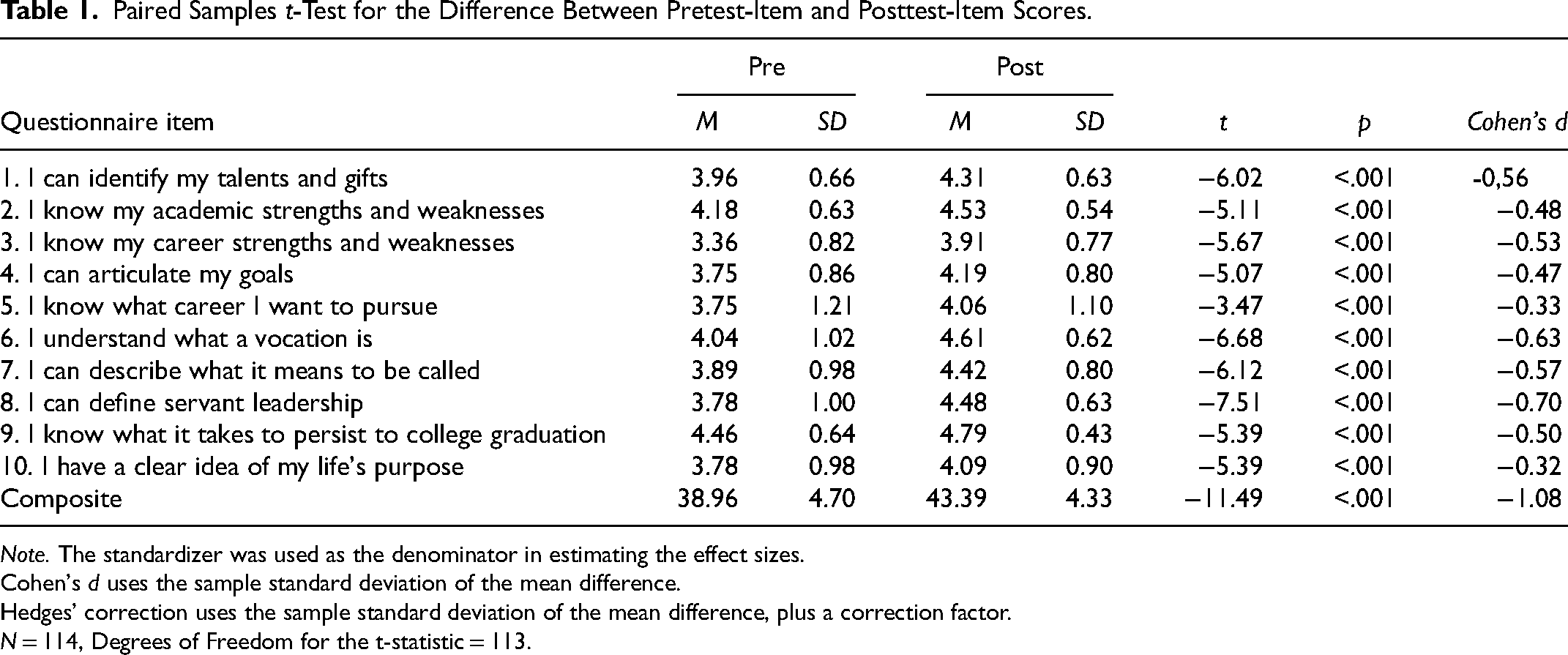
Note. The standardizer was used as the denominator in estimating the effect sizes.
Cohen's d uses the sample standard deviation of the mean difference.
Hedges’ correction uses the sample standard deviation of the mean difference, plus a correction factor.
N = 114, Degrees of Freedom for the t-statistic = 113.
Difference in Mean Scores Pre to Post.
Discussion
The data collected during four consecutive fall semesters included nearly every student enrolled in a senior capstone psychology course and revealed significant perceived growth for each of the 10 items students responded to at the beginning and end of the course. Assignments targeted both the course objectives and questionnaire items, with the intent of facilitating growth in students over the course of the semester. Perhaps many of the activities included in this course are common to other capstone courses, but the readings and guided discussions related to service learning, vocation, and calling may be an innovative component of this course. Dik et al. (2020) identified a positive relationship between perceived calling and work satisfaction, commitment, and meaning in life. This relationship supports including an exploration of work-as-calling in the capstone curriculum along with more common assignments related to preparing for life after graduation. Although it is possible that without participation in this capstone course students could perceive significant growth over the course of several months related to the questionnaire items, further research might infer a clearer relationship by including a control group.
With the psychology major at the participants’ university enrolling mostly female students (92 of 114 respondents were women) and having limited diversity within the major, generalizability of findings to diverse populations is questionable. Although psychology is one of the larger majors at the university under study, the total number of students is still small. It is not known whether this growth would take place without the capstone course, or it was unique to students majoring in psychology. The results are not necessarily generalizable to students in other regions, or those pursuing other majors or attending larger and/or public universities. Additionally, further analysis of the measure itself used in the study may contribute to confidence in the validity and reliability of the assessment tool we utilized.
Other limitations worth considering are related to potential demand characteristics and researcher bias. While initially the intent of collecting pre and post data was exploratory and the data were not first analyzed until after 2 years of collection, it is possible the instructor for the course influenced the results in ways other than intended. The instructor had access to student responses and was present while they completed the questionnaires. The repeated-measures approach used in this study also may have influenced participants’ behavior. While several course activities were designed to target growth related to items included on the questionnaire, that is where explicit influence ended. When the students received the questionnaire at the beginning of the semester it was not indicated that the students would receive it again at the end of the semester, and no mention of it was made during the semester. Distribution of the questionnaire took place on the last day of class again, without mentioning that the students completed the same questionnaire previously. After completion of the questionnaire on the last day of class, students received their initial questionnaire and could compare results from the end of the semester with those from the beginning of the semester. At that point, occasionally students mentioned that they thought it looked familiar. While there are limitations to this study, they contribute to suggestions for further research.
Suggestions for further research are related to limitations in this study and include increasing the sample size and providing a control group replication. The model developed for delivery of the capstone course could be repeated at larger, public, and more diverse institutions and at similar small private institutions. Removing instructor access to the instrument results by providing a blind distribution and collection of data may reduce concerns surrounding demand characteristics or student privacy. Additional assessment could be incorporated into the curriculum such as the Work Volition Scale – Student Version (Duffy et al., 2012) to assess students’ perceived ability to make occupational choices given potential restraints. Another instrument that could be incorporated into the class is the Work Locus of Control Scale (Spector, 1988). A comparison of work locus of control and this study's questionnaire item responses could be used to examine the relationship between locus of control and the items on our questionnaire.
Conclusion
The growth seen on each questionnaire item reported from the beginning of the course compared to the end, over four consecutive offerings of the course, seems to indicate that what took place in the capstone course contributed to significant student perceived growth in all areas measured by the questionnaire. Changes in perception took place during just a few short months while students were enrolled in a psychology capstone course at a small private midwestern university. Overall, at the conclusion of the course, students indicated a better ability to identify their talents and gifts and articulate their goals. They perceived an increase in knowledge of their academic and career strengths and weaknesses and what career they want to pursue. They developed a greater understanding of vocation, calling, life's purpose, servant leadership and what it takes to persist in college. The curriculum may be one deserving of further study and worth emulating in programs where goals for students are consistent with those identified in this study.
Footnotes
Declaration of Conflicting Interests
The authors declared no potential conflicts of interest with respect to the research, authorship, and/or publication of this article.
Funding
The authors received no financial support for the research, authorship, and/or publication of this article.
