







Abstract
Background
Despite the increased popularity of inquiry-based instruction, there is a paucity of research that directly compares the impacts of inquiry-based approaches on student learning outcomes.
Objective
The present field study examined the impact of two types of inquiry-based learning on performance in a research-oriented assignment.
Method
In an introductory psychology course, the assignment was presented through either a partially student-directed learning (SDL) approach (serving as the control condition) or a SDL approach (serving as the treatment condition). Students were first-year students with a didactic instructional past.
Results
Student-directed learning, which was characterized by a high degree of SDL and a limited contribution by the instructor, was found to yield higher performance. Although there were no prior differences in self-efficacy and assignment performance between the two groups, SDL also yielded higher final test performance.
Conclusion
These findings suggest that students can benefit from being challenged, and that initial apprehension may be a motivator for peer cohesiveness and ultimately exerted effort.
Teaching Implications
The SDL approach may be further investigated as a viable instructional method to enrich students’ learning opportunities as well as reinforce their sense of agency.
Learning in introductory psychology is not an easy task to do given the breadth of the material and the depth at which it is to be processed. It is particularly challenging for female students of a rigidly patriarchal society (Saudi Arabia) that has only recently given them autonomy rights as well as educational and professional opportunities equal to those granted to men. These women have been rather abruptly catapulted into a world that expects them to contribute to the restructuring of the economy of their country (Yusuf, 2016). Thus, they are under intense pressure to succeed (Pilotti & Elmoussa, 2022). Yet, their earlier educational experiences have often been limited to didactic approaches (Pilotti et al., 2019). Such approaches are based on an information dissemination framework, according to which the goal of instruction is to promote conceptual understanding of explicit forms of knowledge (Rittle-Johnson et al., 2001). In such a framework, standardized testing is often used to measure performance conceptualized as the ability of learners to produce prescribed answers (Hmelo-Silver et al., 2007). As a byproduct, students come to practice memorization instead of problem-solving skills. In contrast, the situated learning framework (Brown et al., 1989) advocates for learners to understand ill-structured problems and generate solutions. In this framework, learners are not viewed as passive recipients of information, but rather as active agents. The instructor serves as the facilitator who may offer marginal guidance to learners if they encounter problems in selecting information, defining concepts and facts, identifying critical variables, assessing hypotheses, making inferences, etc.
Most of the extant literature on inquiry-based learning has compared it with didactic approaches (Hung et al., 2019; Lippmann, 2021). In it, inquiry-based instruction has been shown to offer gains in students’ confidence in their abilities (i.e., self-efficacy; Brown et al., 2013), conceptual knowledge, critical thinking (e.g., Kong et al., 2014; Shin & Kim, 2013), problem-solving, and self-study skills (Lazonder & Harmsen, 2016; Liu et al., 2019). Furthermore, during inquiry-based learning instruction, learners who exhibit a preference for direct instruction have been found to display lower performance than those who prefer a student-centered approach (Cooper et al., 2017).
Within inquiry-based learning, however, a clear distinction exists between a student-directed learning (SDL) approach and a partially SDL (PSDL) approach. Student-directed learning cannot be characterized as unguided discovery learning. Rather, it can be differentiated from PSDL by the minimal amount of scaffolding (i.e., guided instruction) it affords (Lippmann, 2021). Specifically, in PSDL, a short benchmark lecture precedes learners’ actual work on solving a problem (Lazonder & Harmsen, 2016). The lecture is intended to offer an overview of the critical concepts, facts, and issues of the problem that learners are expected to solve. In the SDL approach, the instructor does not cover key concepts, facts, and issues before learners begin to work on solving an ill-structured problem (Barrows & Tamblyn, 1980). Not much research, however, exists to determine whether these two approaches have a different impact on measurable aspects of learning. An exception is the work of Tawfik et al. (2020) who reported no differences in learners’ self-efficacy (Wang et al., 2016), but greater conceptual knowledge and causal reasoning competencies in junior-level marketing students exposed to the SDL approach.
The Current Study
As part of the quality assessment protocol of the institution where the present study took place, instructors of general education courses are periodically surveyed about what they consider “good teaching.” The most cited instructional method is inquiry-based learning, and the most mentioned property of good teaching is students’ active participation in the learning process. This outcome is not surprising given that the institution advocates a student-centered pedagogy at the undergraduate and graduate levels. Yet, among female first-year students enrolled in such courses, a preference for didactic (i.e., traditional) instruction and memorization is known, which makes inquiry-based learning particularly unfamiliar and challenging (Pilotti et al., 2019). Didactic instruction is identified with first-year students’ expectation that the instructor (i.e., “the sage on the stage”) presents facts, concepts, and procedures to students and that students’ primary task consists of absorbing this information. In contrast, inquiry-based instruction is seen as a pedagogy that fosters the development and practice of problem-solving competencies (Lazonder & Harmsen, 2016; Loyens et al., 2015). Compared with inquiry-based instruction, didactic instruction is thought to be viewed by students as requiring less effort for conceptual understanding and thus being overall less demanding (Bookman & Friedman, 1998; Cooper et al., 2017). Thus, resistance to inquiry learning is generally expected (Cooper et al., 2017).
In our research, we compared the relative impact of an SDL approach and a PSDL approach on students’ ability to complete an introductory psychology assignment. The assignment required them to critically review the literature on a study in the history of psychology that contained ethical violations. Of interest was how female students with a didactic educational past might respond to the challenges of the two types of inquiry-based learning instruction.
Our research was guided by the acknowledgment that the fundamental difference between a PSDL approach and an SDL approach is the degree of uncertainty that is present in the task given to learners. There are two ways of thinking about uncertainty (i.e., not knowing what to think, feel, or do; Lee et al., 2023). On one side, uncertainty may evoke concerns about one's competency and negative emotions such as anxiety (Moran, 2016), at least at the time when the task is first presented. Such thoughts and feelings clutter working memory, the limited-resource device that learners rely upon to update, manipulate, and use materials that are currently under attentional focus. Information processing may then be impaired. However, in the sample selected for our study, uncertainty may be an effective motivator to demonstrate competence in the face of otherwise negative expectations (i.e., gender biases; Breinlinger & Kelly, 1994). H1: If uncertainty is ultimately distracting, performance should be poorer under an SDL approach. Alternatively, if uncertainty motivates learners to devote extra effort to the task at hand, higher performance under an SDL approach should be observed.
Of course, whether uncertainty is detrimental or beneficial to performance may also depend on the type of task to be carried out. In our study, the task that learners are given involves several subroutines, each linked to a particular learning outcome: (a) define and explain basic concepts, facts, and motives of the selected empirical study; (b) describe the research method used; (c) report and interpret findings; and (d) evaluate research based on the ethical principles to which it should abide, including principles that were violated and those that were followed. According to Bloom's taxonomy (Sobral, 2021), learning outcomes (a), (b), and (c) would require the learner to understand and analyze (e.g., select, summarize, and organize) facts, concepts, and issues that are reported in the literature to be reviewed by students. Instead, learning outcome (d) would mostly rely on the application of norms and evaluation, which require students to go beyond the information reported in such literature to develop personal viewpoints. H2: Differences in the demands placed on students’ cognition by a task should be reflected in performance differences. Namely, the more demanding learning outcomes, the more likely the task is to differentiate the two instructional methods.
Method
Participants
The participants were 718 female undergraduate students of Middle Eastern descent who were enrolled in an introductory psychology course. The university that hosted the course follows a US curriculum and student-centered instruction, both of which rely on English as the primary mode of communication. Introductory psychology is part of its general education curriculum. Ages ranged from 18 to 25 years. Students were bilingual speakers with Arabic as their first language and English as their second language. Before admission, scores on the Aptis Placement Test (Shin et al., 2022) assessed their English proficiency to range from modest to competent in grammar and vocabulary, reading, listening, writing, and speaking. Participants were first-year students whose majors included engineering, computer science, architecture, law, business, and interior design.
Procedure
At the selected university, introductory psychology is a three-credit course that meets three times a week. It requires a midterm exam (formative assessment measure), a final exam (summative assessment measure), and five take-home assignments (formative assessment measures). During our research, Assignment 5 (A5), which was administered approximately 6 weeks before the end of the semester, entailed the assessment of student learning outcomes related to research activities. It was entitled “Analyze a Famous Experiment.” In A5, students were asked to review the literature on a study in the history of psychology that suffered from ethical violations. Each study was illustrated in the students’ introductory psychology textbook and had been discussed in class during the first weeks of the semester. The assignment was divided into four conceptual domains, each corresponding to a learning outcome. The guidelines of the Introductory Psychology Initiative of the American Psychological Association (Richmond et al., 2021) were considered to identify the following learning outcomes: (a) define and explain basic concepts that drive the selected study (introduction); (b) describe the research method used (methodology); (c) report and interpret findings (results); and (d) evaluate research based on the ethical principles to which it should abide, including principles that were violated and those that were followed (discussion).
Two weeks were given to students to complete the assignment. Submitted assignments were reviewed for plagiarism through SafeAssign. For each learning outcome, a 0–100 scale was used to evaluate the extent to which the learning outcome was met. The interrater reliability of two independent raters was 0.93. A participation score (i.e., engagement index) was also computed that would measure class attendance and the frequency of weekly online and in-person inquiries during office hours from the time A5 was administered. The number of class meetings (18) was added to the number of offered office hours (6) to illustrate the maximum number of student–instructor meetings (24). For a student, her participation score (0–100 range) was equal to the number of class meetings and office hours attended multiplied by 100 and divided by 24. Examinations covered different conceptual areas of the course. In the middle of the semester, students completed the New General Self-Efficacy questionnaire (Chen et al., 2001) to assess whether the two groups differed in self-efficacy (i.e., confidence in one's abilities) before the intervention was administered. Responses to statements of confidence were produced on a 5-point scale from strongly disagree (−2) to strongly agree (+2) with 0 as the neutral point.
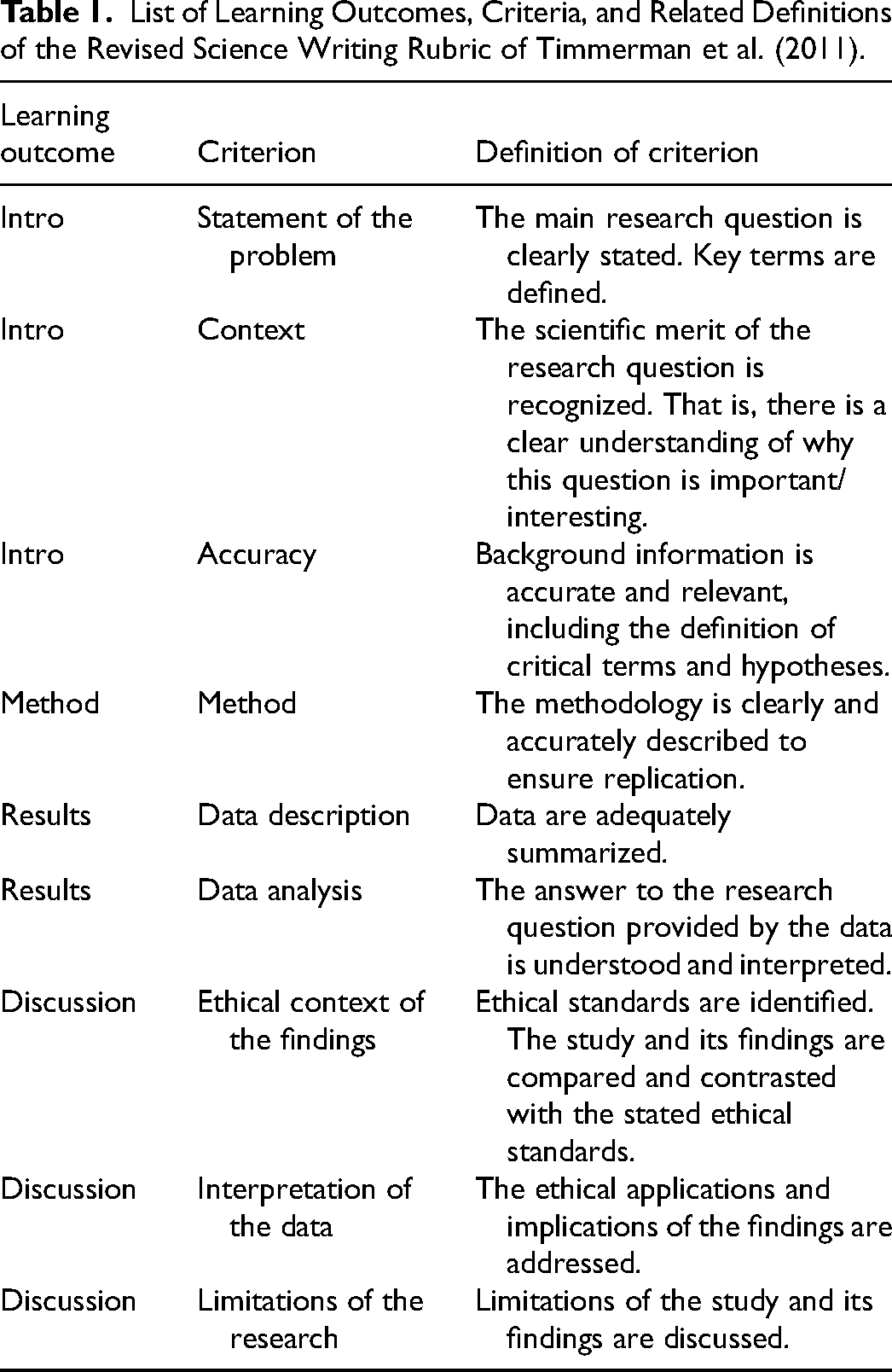
Instruction regarding the assignment varied between two modes of inquiry learning: a PSDL approach (serving as the control condition) and an SDL approach (serving as the treatment condition). In the PSDL condition, the instructor started the assignment with a benchmark lesson (Lazonder & Harmsen, 2016) on each of the components of A5. In this lecture, students were given an overview of each of the ethically flawed studies. They were also directed to several websites and library resources that could be used to gather additional information about each study. At the end of the class, students were shown a page of their Blackboard account, where the assignment was succinctly described through a rubric (see Table 1), and a template with the different parts of the assignment was posted. Questions were answered about the assignment at the end of the class and, afterward, during office hours. In the SDL condition, the assignment was presented to students as a problem to solve largely by themselves. Students were directed to the same Blackboard page where the assignment was described through a rubric (see Table 1), and the template with the different parts of the assignment was posted. Their task was to figure out where to find the necessary information, without any prior overview by the instructor (Barrows & Tamblyn, 1980). At the end of the class and during office hours, students were encouraged to have confidence in their skills if concerns about the task were expressed. Minimal scaffolds (e.g., explanations or directions on how to carry out aspects of the assignment) were offered, often limited to pointing out relevant parts of the rubric. Scaffolds depended on explicit requests and involved learners who appeared to be unable at the time of the assignment to perform a given action independently (Lippmann, 2021).
List of Learning Outcomes, Criteria, and Related Definitions of the Revised Science Writing Rubric of Timmerman et al. (2011).
The two instructional approaches were assigned randomly to each of four consecutive semesters and were taught by the same instructional staff. There were 387 students in the treatment condition and 331 in the control condition. The assignment of conditions to the fall and spring semesters was counterbalanced over academic years with the first order being randomly selected. Each semester had two sections. Debriefing sessions, including class sections or subgroups, were intended to gauge students’ feelings about the approach under which A5 was completed. Notes of the debriefing sessions were anonymized and organized into thematic categories. The guidelines of thematic analysis (Braun & Clarke, 2021) based on a coding reliability approach (see Braun & Clarke, 2021) were followed. Coding was intended to merely summarize as much as possible participants’ comments. Interrater reliability was 88%, which reflected two independent raters who had expertise in social and behavioral science research. As customary, disagreement was addressed by a third independent rater who made the final decision on coding discrepancies.
Materials
The options for the selected assignment available to students ensured the exploration of diverse ethical issues: Milgram's experiments on obedience (1963, 1965, 1974); Zimbardo's Stanford prison experiment (Zimbardo et al., 2000); Watson's fear conditioning experiments focusing on the case of Little Albert (Watson & Rayner, 1920); Harlow's studies on Rhesus monkeys (Harlow & Zimmermann, 1959; Seay et al., 1962); and Pavlov's classical conditioning experiments (Dickinson & Mackintosh, 1978; Lavond & Steinmetz, 2012).
New General Self-Efficacy (see Chen et al., 2001) assessed students’ self-efficacy (i.e., confidence in one's abilities). The questionnaire entailed eight statements of confidence to be expressed on a 5-point scale from strongly disagree (−2) to strongly agree (+2) with 0 as the neutral point.
Results
Students’ A5 compositions were submitted to the Science Writing Rubric of Timmerman et al. (2011), which was appropriately revised for the current task (see Table 1). For simplicity, each rubric item was initially assigned 0–10 points. The total points of each learning outcome were then translated into a percentage representing a student's grade for that learning outcome.
Descriptive statistics are presented in Table 2. The quantitative data were submitted to an independent-samples Mann–Whitney U test. Nonparametric (i.e., distribution-free) analyses were selected (a) to guarantee uniformity in the analyses of different measures, which could be assumed to be at either the ordinal (e.g., self-efficacy) or the interval level (e.g., grades), as well as (b) to circumvent data transformations required to satisfy the normality assumption (Cohen, 2008). The Wendt test was utilized to compute the rank-biserial correlation from U (Wendt, 1972). In this formula, 1 is the maximum value when U is 0. Testing of H1 and H2 concerned A5 performance. Student-directed learning students displayed higher performance in the introduction, U = 56,931.50, p = .010, r = 0.11, result, U = 56,260.50, p = .005, r = 0.12, and discussion, U = 49,414.50, p < .001, r = 0.23 sections. There were no group differences in the methodology section, U = 62,093.50, p = .48, r = 0.03. One of the reasons might be that the method section mostly required students to extract technical information from the selected literature and paraphrase it. Thus, the task might not have sufficiently challenged students’ information-processing abilities.
Mean (M) Rank, Arithmetic Mean, and Standard Error of the Mean (SEM) of Each Assessment Measure as a Function of Condition.
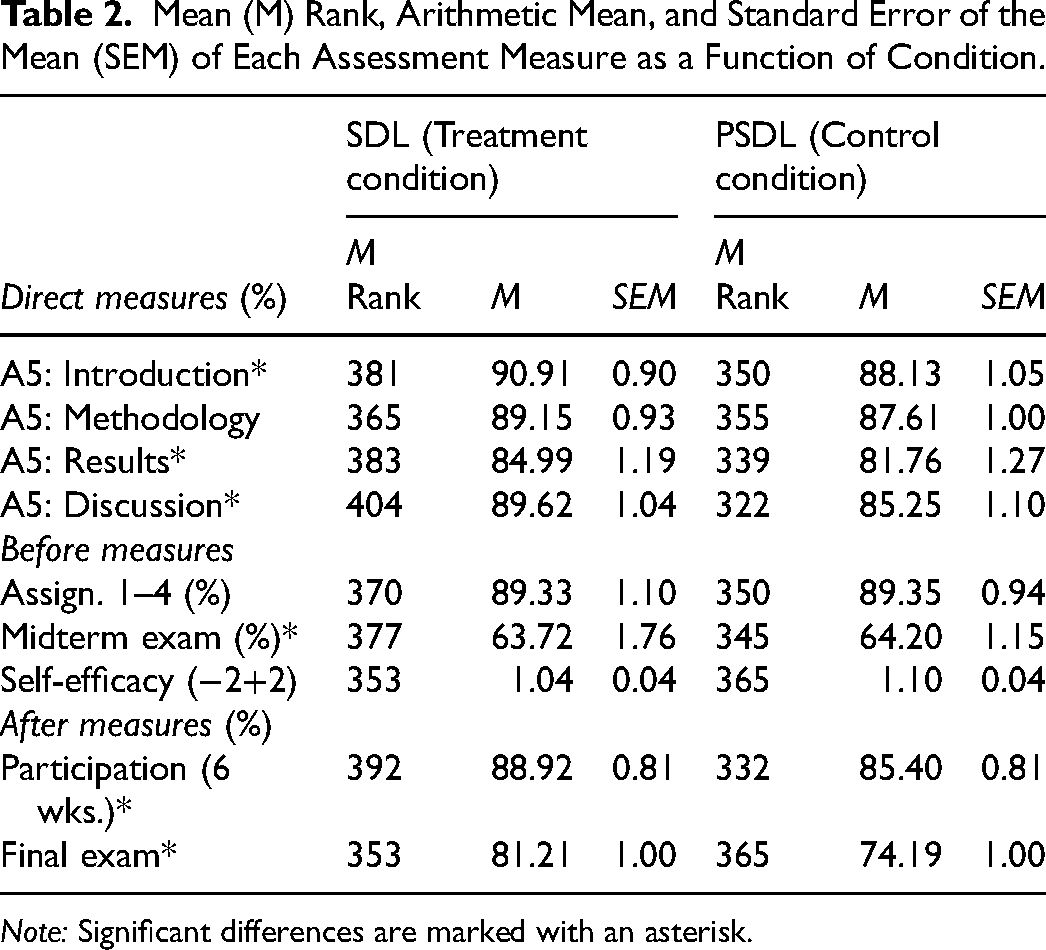
Note: Significant differences are marked with an asterisk.
H1 predicted differences between SDL and PSDL performance based on the impact of task uncertainty. Student-directed learning yielded greater performance but not for all tasks, partially supporting H1. H2 predicted selective performance differences between SDL and PSDL due to the cognitive demands of the A5 tasks. According to Bloom's taxonomy, the discussion section would be more cognitively demanding than the other sections. The greater SDL performance in the discussion section supported H2, but only partially as differences also emerged in other tasks.
Self-efficacy, assignments 1–4, and the midterm exam were administered before A5, thereby each serving as a baseline against which to understand the results of the intervention performed. No differences were found in self-efficacy, U = 66,224.50, p = .43, r = 0.03, making the two groups comparable. Although the midterm performance was rather low, it was slightly higher in the PSDL condition, U = 58,430.50, p = .043, r = 0.09. After the intervention, the final exam grades of the SDL condition were higher than those of the PSDL condition, U = 48,731.00, p < .001, r = 0.24. The engagement scores in the last 6 weeks of the course were also higher, U = 53,325.00, p < .001, r = 0.17. These two assessment measures might be described as simply exhibiting an overflow of the intervention performed on A5. Yet, when only the number of office visits [range = 0–2] was submitted to a Cramér's V Test, no relationship between method and number of office visits was obtained, V = 0.03, p = .745. This finding indicated that differences in engagement entailed primarily class attendance.
The qualitative responses collected during debriefings were organized into themes regarding current and past instructional methods by an independent evaluator who used an inductive (data-driven) approach to develop a codebook (Azungah, 2018). The codebook included three themes: (a) cognitions, (b) emotive responses (including evaluative judgments), and (c) reported behavioral responses. The type of thematic analysis used complied with the coding reliability approach to qualitative data (Braun & Clarke, 2021). A theme (i.e., topic summary) included responses that were mentioned by at least 20% of the participants. The term “many” referred to a theme upon which more than 40% of respondents agreed by a show of hands, whereas “some” referred to a theme upon which 20–40% of respondents agreed by a show of hands. During debriefings, all students acknowledged familiarity with didactic instruction, which was nurtured in elementary and high school, and a preference for it, which was conceptualized as representing less demanding tasks. Not surprisingly, many students in the SDL condition admitted that A5 was initially perceived with a mixture of apprehension and curiosity. Apprehension led students to increase interactions with each other, exchanging information and strategies on how to carry out the assignment. Small communities of learners were born out of necessity. According to some students, as the deadline for the submission of the assignment approached, feelings of trepidation became less intense. Feelings of solidarity increased, cultivated by a sense of peer support that had developed among students. In the PSDL condition, students admitted to having perceived the assignment with apprehension, whereas others classified it with nonchalance as “one of the things to do in college.” Interactions with other students were reported to be infrequent and minimal, usually reserved to verify one's understanding of the requirements of the assignment via email or WhatsApp. None reported that interactions were more frequent or intense for A5 than for previous assignments. In the PSDL condition, often students stated that they chose to contact the instructor if they had a question.
All students admitted some resistance to both inquiry-based instruction methods. Initially, feelings were reported to be much more negative in SDL than in PSDL due to the uncertainty that A5 instructions generated. “Where do I find information? How do I process it?” were typical expressions of emotive reactions. Students admitted that their feelings became progressively less so by working together with classmates, even though they recognized that the SDL approach was very demanding from start to finish.
Irrespective of the condition to which they were assigned, students noted that the most challenging part of the assignment was reporting, analyzing, and evaluating research findings. Another challenge was to ensure coherence among the different sections of their report. Student-directed learning participants initially found it difficult to evaluate the ethical principles that were specifically violated or abided by the selected study. The distinction between short-term and long-term aversive effects was reported to be particularly troublesome, requiring additional sources above and beyond those already used. Yet, students exposed to SDL indicated that interacting with classmates helped them to overcome initial obstacles and improved their understanding of ethical principles. They spontaneously illustrated such principles during debriefing sessions. No similar comments were recorded in the PSDL group.
Discussion
The results of the present field experiment can be summarized into three key points. Students’ performance on a selected assignment benefited from an SDL approach compared with a PSDL approach, thereby supporting H1. The SDL approach particularly benefited students’ ability to define and explain basic concepts of a published study (introduction), and to report, interpret, and evaluate research findings (results and discussion), partially supporting H2. At the time of the presentation of the assignment, students’ emotive resistance to the assignment was much more intense in SDL. In the SDL condition, feelings were ameliorated by working together with other students. Yet, the assignment administered under an SDL approach was recognized as being much more demanding than what students had ever experienced before. Yet, their final exam performance, which illustrates a summative assessment outcome, was higher. The difference between the two conditions might reflect a change in students’ approach to class materials in preparation for the final exam. A review of the comments made by students in debriefings suggested that differences were likely to embody a more active, information-seeking approach to class materials in the SDL condition. The latter might reflect a greater willingness and ability to connect concepts (i.e., greater use of conceptual combinations; Bechberger et al., 2021), ideas, and events, leading to a deeper knowledge of the test materials.
Overall, the findings of our research agree with those of empirical and review studies of inquiry learning demonstrating that this type of instruction is largely beneficial to skill learning, knowledge acquisition, and emotional regulation (e.g., Andrini, 2016; Shi et al., 2020). Our findings are also in agreement with studies reporting that a critical factor of instruction is the degree of guidance given to students in class activities (Lazonder & Harmsen, 2016; Sun et al., 2022).
Implications for Instruction
In the extant literature, there has been disagreement about the extent to which students should be provided with problem-solving practice within the classroom. There has also been disagreement on the extent to which SDL is to be implemented to enable students to independently recognize their learning needs and goals, and seek the necessary resources to complete academic tasks (Law et al., 2016; Tawfik et al., 2020). Our findings are consistent with those of the extant literature advocating for the use of inquiry-based learning in a variety of subject matters. As reported by Tawfik et al. (2020), inquiry-based learning, which minimizes the instructor's contribution to the learning process and enhances that of students, can be beneficial to the acquisition of conceptual knowledge and execution of logical reasoning. Furthermore, the initial resistance of students to methods other than the traditional lecture approach is consistent with that reported in other studies (Bookman & Friedman, 1998; Cooper et al., 2017; Tawfik et al., 2020). Thus, resistance may be a widespread phenomenon among students across educational backgrounds. However, Tawfik et al. (2020) found no difference in self-efficacy between PSDL and SDL. We treated self-efficacy as a control variable. However, if the comments made by participants were regarded as indices of self-efficacy, self-confidence could be described as higher among SDL students.
Limitations and Future Research
The limitations of this study reflect the need for further research. First, the exclusively female sample of participants may prevent us from generalizing to male students. In a society that has only recently granted women rights equal to those of men, women may be more motivated to face challenges to demonstrate competency and determination to get things done in a world once dominated by men. Thus, men, who have been accustomed to privileges, may deal with the uncertainties that surround an SDL approach differently. Second, it is unclear whether the attitudinal changes of the SDL group may generalize to other course activities outside of introductory psychology. Notwithstanding the issue of transfer, our research encourages further study of SDL as an instructional method that can not only enrich the learning opportunities of female students but also reinforce their sense of agency.
Footnotes
Authors’ Note
All authors contributed equally. The data-collection process was approved by the Deanship of Research of the hosting institution to comply with the guidelines of the Office for Human Research Protections of the U.S. Department of Health and Human Services.
Declaration of Conflicting Interests
The authors declared no potential conflicts of interest with respect to the research, authorship, and/or publication of this article.
Funding
The authors received no financial support for the research, authorship, and/or publication of this article.
