






Abstract
Introduction
Early career teachers of psychology face substantial challenges navigating competing demands across the domains of teaching, research, and service.
Statement of the Problem
Although there has been extensive discussion of these issues, faculty—especially those early in their careers—are rarely given explicit, practical instruction on how to mitigate burnout while promoting personal fulfillment and professional success.
Literature Review
Many faculty experience role ambiguity (unclear expectations of their appointment) and role conflict (tension from competing responsibilities), both strong predictors of burnout; recent reports suggest that 64% of U.S. faculty are experiencing burnout.
Teaching Implications
We present a structured framework and practical tools grounded in person–environment fit theory and industrial–organizational psychology, including a process for evaluating needs and values, aligning them with institutional priorities, and translating that clarity into actionable goals. This approach should ease the burden on teachers of psychology and provide a focused, intentional strategy for professional growth.
Conclusion
Together, this framework, reflective activities, and freely available resources support intentional alignment of daily activities with sustainable, values-aligned career goals.
Keywords
Teachers of psychology juggle many responsibilities across teaching, research, and service, with expectations that vary widely across institutions and contexts. Faculty often consider such details to judge institutional fit from interviews and recruitment to retention over time (McFadden & Perlman, 1989). This ongoing reflective process of evaluating fit and deciding how to allocate time is critical for professional success and well-being, yet faculty—especially early career faculty—are rarely given explicit instruction on how to do so effectively. The present work provides a framework for making such decisions.
Although departments set internal goals for progression and success, individual faculty members should also set goals to ensure that their position remains a good fit, and the environment matches what they find professionally fulfilling. Teachers of psychology early in their careers often struggle to balance competing roles and responsibilities, as they navigate a never-ending bombardment of opportunities to say “yes” to additional work (e.g., Good et al., 2013). Although it is important for hiring, contract renewal, and promotion to take on some of these opportunities, faculty should be strategic and discuss workload expectations with their supervisor—typically the Department Chair—before doing so. Faculty who commit to too many additional projects and service opportunities risk experiencing burnout, which is a “physical, emotional, or mental exhaustion accompanied by decreased motivation, lowered performance, and negative attitudes toward oneself and others” (APA, n.d.). Indeed, recent reports suggest that 64% of U.S. faculty across disciplines report burnout, with 34% reporting “high” or “very high” levels of burnout (APA, 2024; Tapio, 2025). A meta-analysis of 20 cross-cultural studies reported a moderate correlation (r = .45) between job stress and burnout among university lecturers (Yingying et al., 2025). Workload in particular strongly predicts faculty burnout (e.g., McClenahan et al., 2007), as do “role conflict” (misaligned expectations resulting from competing demands from multiple roles) and “role ambiguity” (unclear expectations regarding what is required to successfully execute the demands of the job; Ghorpade et al., 2011). Role conflict is especially important and predictive of faculty turnover, with emotional exhaustion mediating this relationship (Ahmed & Asfahani, 2022). Thus, the connections between conflicting and ambiguous roles, faculty well-being, and long-term retention are robust and well worth exploring.
Furthermore, these challenges coexist against the backdrop of a more limited and competitive job market, due to factors such as fewer opportunities for tenure-track positions (Stein, 2022; Whitford, 2026) and the closures of colleges and universities (Moody, 2025). In this landscape, understanding how to intentionally evaluate professional fit and make strategic decisions about what to take on is particularly critical, especially for early career teachers of psychology (EC-ToPs) who may feel pressure to accept every opportunity.
The Challenges of Early Career
The American Psychological Association (APA) defines an early career psychologist as any psychologist in the first 10 years of their career (APA, 2025). APA Division 2, the Society for the Teaching of Psychology (STP), narrows the scope of this definition, describing EC-ToPs as any nonstudent who began teaching psychology within the last 10 years (STP, 2025). Regardless of the definition, EC-ToPs face unique challenges and obstacles as they seek to establish a successful career in psychology, such as the need to demonstrate competitive qualifications (e.g., prior teaching experience and publications) to obtain a faculty appointment (Boysen, 2020). Moreover, doctoral programs vary in the training they provide to students. Although some require extensive training for Graduate Teaching Assistants (GTAs) and offer opportunities to independently teach courses, for example, many restrict GTAs largely to grading. EC-ToPs may thus enter faculty positions with varying levels of preparedness.
One of the first comprehensive investigations into the experiences of early career faculty noted that they work very hard to balance designing and teaching new courses, publishing scholarly work, and providing service to the department, institution, and profession (Good et al., 2013). In a sample of 85 faculty members, EC-ToPs worked an average of 46.95 h per week, with approximately 12% of the sample working over 60 h per week (Good et al., 2013). The chief concerns reported by EC-ToPs involved balancing job responsibilities, balancing work and home life, and the disproportionate time required to design new courses. Indeed, balance is a concern that is sure to come up in just about any discussion of early career academic life (Austin et al., 2007; Green & Hawley, 2009; Hollywood et al., 2020; Lee et al., 2009; Solem & Foote, 2006). Concerns about balance and burnout have grown, given the backdrop of work demands, social tension, political strife, and unanticipated global events such as the COVID-19 pandemic. These conditions have translated into heavier workloads, rapid instructional changes, increased student support needs, and greater emotional labor. Collectively, these pressures can erode boundaries between work and personal life, further contributing to burnout.
Building on several years of work done by STP's Early Career Psychology (ECP) Committee, we provide a holistic resource for EC-ToPs navigating the early stages of their careers. Although we tailor these resources to EC-ToPs, we hope that they will be useful for anyone seeking to establish a more intentional, focused, and successful career in the field of psychology.
Our Objective
How can EC-ToPs establish better work–life balance and careers that are both successful and sustainable? Here, we address these questions from multiple perspectives, providing thought exercises, activities, and recommendations for best practices. We first draw on techniques from industrial–organizational psychology to provide recommendations for an intentional approach to crafting a career aligned with explicitly defined values. We then highlight a framework for developing goals that are specific, measurable, ambitious, realistic, time-bound, inclusive, and equitable (SMARTIE).
We would like to note that EC-ToPs hold complex, multifaceted positions, and “one size” will not “fit all.” Although we discuss EC-ToPs as a broad group, it is important to recognize that their experiences are not uniform. Indeed, individual characteristics (e.g., career aspirations, family responsibilities, health status, and identity) and contextual factors (e.g., teaching load, research expectations, and resource and mentorship availability) can shape how faculty experience work–life balance and evaluate career success. Disparities in workload also arise as a function of social identity. Women and faculty from historically marginalized groups, for example, are often expected to perform disproportionate amounts of service, mentoring, advising, and other forms of invisible labor that may not be fully recognized in evaluation and promotion processes (e.g., Misra et al., 2021). We recognize that these additional responsibilities can limit the amount of flexibility faculty have to pursue personally meaningful goals and may further increase workload strain. Our goal is to provide resources and highlight frameworks of thinking that will benefit as many professionals as possible, and we encourage readers to adapt these ideas to their own context and situation while considering the broader institutional and cultural factors that shape faculty workload.
Needs Assessment
One benefit of academia is that it often offers flexibility in the types of opportunities available to faculty. At the same time, EC-ToPs regularly are offered more opportunities than they feasibly have time for (Good et al., 2013), which makes it important to decide which opportunities are worth pursuing and which should be (politely) declined. However, how does one determine which opportunities they should pursue? To guide EC-ToPs through this decision-making process, we adapt a technique from industrial–organizational psychology called a “needs assessment” (Goldstein, 1993; Witkin & Altschuld, 1995). Needs assessments involve identifying the gap between current values and performance on the one hand, and the desired outcomes of different stakeholders, including colleagues and supervisors, on the other hand. In some cases, the desired outcomes are complementary (e.g., when both faculty and institution want to prioritize undergraduate research), but in other cases, they are competing (e.g., when the institution prioritizes grants, but a faculty member prioritizes teaching). By identifying the landscape in which EC-ToPs work, EC-ToPs can begin to make strategic choices about how to allocate time in ways that promote professional growth and buffer against burnout. The needs assessment approach aligns well with classic person–environment fit literature, emphasizing that congruence between individual values and organizational demands predicts well-being, performance, and retention (Edwards, 1991; French et al., 1974), and is a useful tool for faculty at any stage to adopt into their regular reflective practices. Below, we outline the steps for conducting a needs assessment, and we provide a summary in Table 1.
Guided Reflection for EC-ToPs by Level of Analysis.
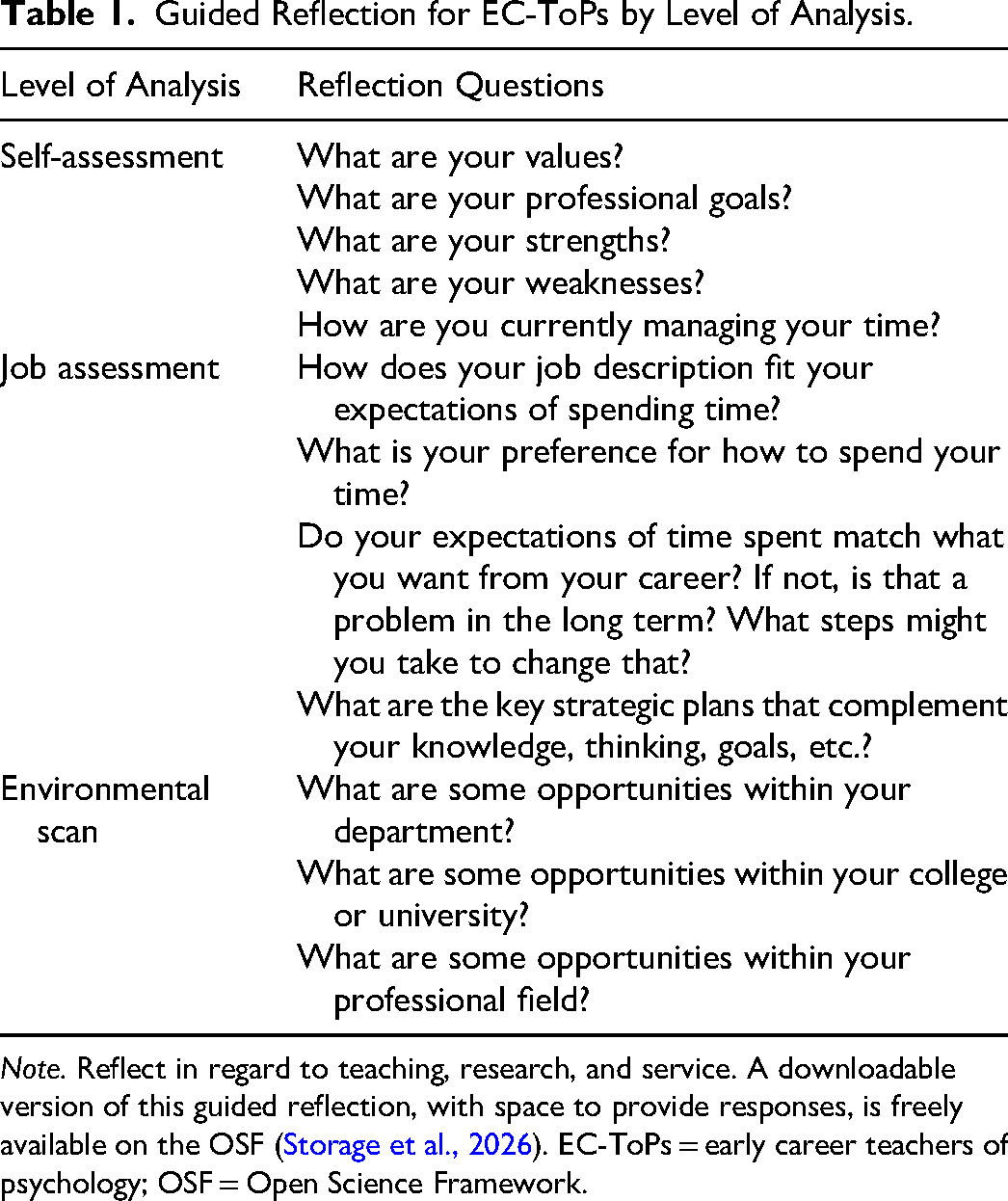
Note. Reflect in regard to teaching, research, and service. A downloadable version of this guided reflection, with space to provide responses, is freely available on the OSF (Storage et al., 2026). EC-ToPs = early career teachers of psychology; OSF = Open Science Framework.
Step 1: Center Values and Needs
EC-ToPs might be tempted to begin with external values or needs (e.g., an invitation to join a new Provost-led task force) because these are salient and reinforced, but these can overshadow internal priorities. Although external values and needs should of course be considered (we discuss how and when below), EC-ToPs should start by independently clarifying what work they personally want to accomplish. This exercise can quickly identify role conflicts. For example, someone who is most passionate about educating undergraduates may experience a conflict between the desire to innovate or redesign a course and the pressure for increased research output. Recognizing value conflicts may create dissonance, but they should not be avoided. If left unaddressed, these sorts of conflicts may lead to burnout and turnover (Ahmed & Asfahani, 2022; Ghorpade et al., 2011; Homayed et al., 2025).
Faculty should also consider which kinds of tasks leave them energized or drained, and their nonnegotiables (boundaries that protect physical health, mental well-being, research obligations, or family time). This reflection allows EC-ToPs to explicitly evaluate the alignment and gaps between themselves and their work context, which can help identify potential predictors of burnout and well-being.
Step 2: Conduct a Job Assessment
Once EC-ToPs have determined what they want from their career, they can begin to compare these values with the expectations of their appointment. Understanding formal expectations is important not only for promotion and tenure, as applicable, but also for allowing EC-ToPs to consider and potentially adjust the alignment between these institutional expectations and their own values and goals.
There are multiple methods for conducting a job assessment. For example, translate the position's offer letter, the department and institution's promotion and tenure criteria (typically found in governing documents with titles such as “Faculty Statutes” or “Promotion and Tenure Guidelines”), and unit norms (discuss with colleagues, Department Chair) into a concrete list of role requirements. It is more concrete and therefore helpful to list “produce two peer-reviewed publications per academic year” than “demonstrate scholarly productivity.” Because EC-ToPs tend to value mentorship from senior faculty (Troisi et al., 2015), another avenue for obtaining useful information about job expectations is mentorship from colleagues further along in their professional trajectories.
After creating a concrete list of role expectations, consider when performance will be reviewed and what information will be used in those reviews. It is here that EC-ToPs can begin to consider how the activities that currently dominate their time align or misalign with the expectations for their appointment. In the case of misalignment, faculty might consider reprioritizing job duties (e.g., shifting which courses they typically teach and spending more or less time on undergraduate mentorship), finding creative ways to make duties more manageable (e.g., leveraging collaboration opportunities in research), seeking support and resources to help navigate misalignment, or exploring career opportunities beyond the institution.
Step 3: Conduct an Environmental Scan
Whereas a job assessment focuses on understanding the expectations of the specific role, an environmental scan focuses on the broader context in which that role exists (SHRM, 2025). For an EC-ToP, this is the process of identifying the strategic goals of the department, the college, the institution, higher education, and the field of psychology in general. EC-ToPs should ask themselves: “In what areas do my current (or desired) tasks advance these priorities?” Answers can often be obtained by talking with administrators (e.g., the Department Chair or Dean) and using existing resources, such as departmental and institutional websites that provide information on mission, goals, and strategic plans.
The next step is to attempt to identify two or three concrete institutional priorities that can be advanced in some way within the next year. For example, the institution may emphasize experiential learning or high-impact practices (Kuh, 2009). If an EC-ToP already mentors students informally, perhaps they can consider more formal mentorship in the form of taking on undergraduate research assistants (RAs; Whiteside et al., 2007) or teaching assistants (Weidert et al., 2012). This formalizes the work EC-ToPs are already doing in ways that directly tie into institutional initiatives and can be quantified for advancement.
Being able to identify and understand where the EC-ToP's goals coalesce with the broader goals of their department, college, and institution is a key strategy for success. Creating a needs assessment plan can help EC-ToPs determine when to say “no”—a skill integral for healthy work–life balance (Hinton et al., 2020)—and build their own brand as emerging faculty members. The needs assessment exists at a macro level, as these are the building blocks of EC-ToPs’ careers, the concepts that guide high-level decision making. To translate these overarching principles into actionable behavior, we suggest breaking them down into smaller, more manageable chunks of short-term, mid-term, and long-term goals. For this, we recommend the SMARTIE approach to goal setting.
Setting SMARTIE Goals
Setting goals is an effective practice because goals direct energy, increase persistence, and facilitate the development of creative and effective strategies (Locke & Latham, 2002). However, to maximize the utility of goals, they should be specific, measurable, ambitious/achievable, realistic, and time-bound goals (i.e., Locke & Latham, 1990). Goals that are specific and measurable capture a narrow range of behavior and provide clear, unambiguous criteria for success. Additionally, goals must balance ambition with realism. Identifying challenging goals facilitates the attainment of new knowledge, skills, and abilities, but those goals must be realistic; otherwise, failure is likely and may be discouraging. Finally, the most effective goals are time-based: Deadlines are an effective motivator and create a cycle of feedback for progress toward goals.
More recently, there have been considerations for adding inclusion and equity to the framework, dubbing them SMARTIE goals (The Management Center, 2021a). Inclusive goals consider those who belong to social groups that are typically marginalized and ensure their representation in decision-making processes. Equitable goals include justice and ethics to address systemic inequities (The Management Center, 2021b). For example, an instructor may identify a need to update aging course materials. A SMARTIE goal might involve reviewing one course during the next academic year and making intentional updates to increase the representation of scholars and perspectives from historically marginalized groups.
Most institutions require an annual evaluation process and some form of goal setting for the upcoming academic year. This is a wonderful opportunity for EC-ToPs to explicitly use SMARTIE goals to create specific, actionable steps to accomplish goals aligning with institutional values. Instead of simply trying to “increase research opportunities for students,” the SMARTIE framework might encourage an EC-ToP to “work with three undergraduate RAs that reflect the demographics of our student population and have them present their work at the undergraduate research symposium at the end of the semester.”
Completing a needs assessment and using that feedback to develop SMARTIE goals may help EC-ToPs intentionally develop and prioritize obligations, setting them on a clear career trajectory that is both personally fulfilling and professionally successful. Several resources (e.g., a needs assessment handout, an activity to help EC-ToPs determine when to say “no,” and a SMARTIE goal-setting handout) as well as relevant past presentations by the STP ECP Committee are available on Open Science Framework (OSF; Storage et al., 2026).
Conclusion
In sum, faculty—especially early career faculty—face a complex, challenging landscape of competing demands and ongoing pressures on their time and emotional well-being. We provide a structured needs assessment to clarify values, determine the expectations of the position, understand the priorities of the institution, and recommend translating that clarity into SMARTIE goals. This strategy allows faculty to make more informed decisions about which opportunities to pursue, how to allocate limited time and energy, and how to document their activities in ways that support advancement. Although no single framework can capture the full range of institutional contexts in which EC-ToPs work, we hope the tools, examples, and resources provided here, along with those housed on OSF, empower faculty to build sustainable, values-aligned, and rewarding academic lives.
Footnotes
Acknowledgements
Aspects of this paper were presented as workshops by various combinations of authors at the 2020 Southwestern Psychological Association Meeting, as well as the Annual Conference on Teaching in 2020 (Crafting Your Career: Developing a Plan for Success as an ECP) and 2021 (The Holistic ECP: Centering Values, Boundaries, and Equity as Cornerstones of Career Decisions).
ORCID iDs

Ethical Approval
No ethical approvals were needed for this manuscript, and thus, were not obtained.
Funding
The authors received no financial support for the research, authorship, and/or publication of this article.
Declaration of Conflicting Interest
The authors declared the following potential conflicts of interest with respect to the research, authorship, and/or publication of this article: Vishal Thakkar is a consulting editor at Teaching of Psychology.
Data Availability Statement
Not applicable.