






Abstract
Background
Research finds that leisure is bidirectionally related to wellbeing, but only if people are satisfied with their leisure. Despite this, many students report engaging in passive activities they do not find enjoyable.
Objective
The current study explored college students’ experiences with a class activity designed to help students create and engage in beneficial rest periods.
Method
Forty-two undergraduates participated in an activity where they read about, engaged in, and reflected on a deliberate rest period. Raters coded responses from open-ended questions to explore how students rested and whether they reported changes in mood and shifts in thinking about rest.
Results
All students reported engaging in active rest periods, 81% reported feeling better afterward, and most students reported that it changed how they thought about rest periods.
Conclusion
This proof-of-concept study finds initial support that the activity can encourage engagement in more active forms of rest that can benefit student mood and attitudes.
Teaching Implications
Instructors can use the current activity to teach students how to design higher-quality rest periods—possibly changing attitudes toward rest in the process.
Humans need time to rest. Periods of downtime, free time, or personal days serve important psychological functions, including problem-solving (Liu et al., 2024), stress recovery (Sonnentag et al., 2022), and wellbeing (Doerksen et al., 2014; Sonnentag, 2001). Yet not all rest periods are created equal. In a meta-analysis, Kuykendall et al. (2015) found that engagement in leisure is bidirectionally related to subjective wellbeing, but only if individuals feel their leisure activities are satisfying. This stands in contrast to past research that has found the most common way people spend their free time is watching TV, which they also report to be the least enjoyable of all the activities they engage in during their free time (Kubey & Csikszentmihalyi, 2002). Perceptions of leisure as being wasteful predict lower levels of happiness and higher levels of depression, anxiety, and stress (Tonietto et al., 2021). Differences in the quality of rest periods have invigorated debates about what constitutes good rest, leading to greater calls to avoid passive activities that only serve as distractions (e.g., social media and TV) in favor of more active periods of rest, such as socializing, exercising, or engaging in creative hobbies (Özkara et al., 2024; Pang, 2016; Pastor-Vicedo et al., 2021).
Prior research has identified critical connections between quality rest and mental recovery from work during nonwork time (Sonnentag, 2001; Sonnentag et al., 2022). According to the Effort Recovery Model, people must set aside work demands during nonwork time to optimize recovery (Meijman & Mulder, 1998), thereby allowing emotional, cognitive, and behavioral resources to be replenished (Van Veldhoven & Dorenbosch, 2008). For college students, failure to recover over longer periods of time can result in worsened states of fatigue and burnout, which is associated with lower engagement and motivation (Cazan, 2015), which negatively predicts academic performance (May et al., 2015). Failure to detach from work demands after hours may also result in work spillover, or intrusive concerns about work during rest time, which is associated with higher stress and depression (Wallace, 2001). Not surprisingly, activities that create psychological detachment from work are associated with higher life satisfaction, less exhaustion, and greater positive affect (Sonnentag, 2012; Wendsche & Lohmann-Haislah, 2017). Research also shows that active recovery activities, such as physical, social, and creative activities, are associated with greater mental detachment (Luta et al., 2021) and predicts stronger recovery (Sonnentag, 2001; Sonnentag & Fritz, 2007).
Quality rest periods play a role not only in helping individuals recover from the stress of the day but also in protecting and promoting mental health. One example of this application is pleasant activity scheduling, an aspect of cognitive behavioral therapy, which involves scheduling pleasant hobbies, activities, or other events and then reflecting on one's mood (Lewinsohn & Libet, 1972). Many of the most highly rated pleasant activities are active leisure activities, such as playing games, reading, making crafts, and doing yoga or meditation (Roozen et al., 2008). Critically, people then reflect on how the various activities may have affected their mood with a therapist, helping them distinguish between activities they believe will improve their mood and those that actually do (Martell et al., 2021). Such rest reflections can help people identify activities that facilitate stronger feelings of relaxation, restoration, and psychological detachment from work, which supports mental health (Kanter et al., 2010) and wellbeing (Mazzucchelli et al., 2010).
College Students and Rest Periods
Unfortunately, many people do not think about how to optimize their free time, let alone experiment and reflect on these periods (Shaw et al., 2025a). Recent research has found that college students largely report using social media during breaks, but they do not report feeling restored or energized afterward (Shaw et al., 2025b). Further, college students report that feelings of guilt and pressures to do work prevent them from engaging in more rest periods (Koo, 2023; Maynard et al., 2025; Shaw et al., 2025b; Wladis et al., 2018). These findings warrant further concern as the 2021 Healthy Minds survey of college students found that students reported the highest rates of anxiety and depression in the survey's history (Alonso, 2023; Eisenberg et al., 2023). Other recent polls found that 60% of college students reported acute stress levels and 56% reported chronic stress (Flaherty, 2023). With higher stress and less efficacious recovery activities, college students would likely benefit from learning how to design and engage in more effective rest and recovery experiences.
This article describes a class activity in which students learned about deliberate rest, a term coined by Pang (2016) to describe more intentional and active rest periods that are distinct from passive distraction (e.g., TV and social media). After learning about deliberate rest, students created and engaged in a deliberate rest period, then reported if they felt any different afterward and if it changed how they thought about rest. The deliberate rest activity was informed by broader findings from psychological and educational research that behavior changes can be more powerful for changing attitudes than changing attitudes to change behavior (Guskey, 2002; Martell et al., 2021). Simply put, to understand the benefits of deliberate rest and how to optimize it, students may need to experience them for themselves. The current study explored (1) what activities students chose to do for their deliberate rest activity; (2) whether they reported feeling better, worse, or the same after; and (3) if they reported that the deliberate rest activity changed how they thought about rest. If the class activity was successful, students would report more active, deliberate rest activities rather than passive distractions (e.g., social media), a positive shift in mood afterward, and that the experience changed how they thought about rest. However, it was anticipated that some students would likely engage in a rest period that did not go as planned, or the deliberate rest period might have been affected by negative emotions (e.g., guilt) and intrusive thoughts of work, resulting in a minority of students reporting a worse mood.
Method
This study collected qualitative data through an open-ended survey and used latent thematic content analysis to quantify the types of rest activities students engaged in, whether and how their mood changed, and possible shifts in their thinking about rest. Using thematic content analysis allows for open-ended responses to be not only reviewed and coded but also quantified to generate descriptive statistics about common experiences (Fakis et al., 2014). The advantage of using this methodological approach is that open-ended responses can contain richer information that provides greater nuance of findings. It also allows greater flexibility for raters to identify possible emergent findings that were not anticipated or hypothesized (DeJonckheere et al., 2024). The study was approved by the institution's Institutional Review Board (IRB) before data collection under exemption 1 (#25-0364), and students were given the option at the end of the reflection assignment to exclude their responses from the current research study.
Participants
A total of 42 undergraduate students enrolled in a Psychology of Education class at a small, private university participated in the deliberate rest class activity and consented for their responses to be used in research. I did not collect demographic information about participants. The demographic makeup of students at the university are 67% male-identifying, with 63% of students identifying as White, 12% as Asian, 8% as Hispanic/Latino, 4% as two or more races, 3% as Black/African American, 0.1% as American Indian/Alaskan Native, less than 0.1% as Native Hawaiian/Other Pacific Islander, and 6% as U.S. nonresidents (with 3% of students not reporting their race).
Measures
Rest Activities
After completing the deliberate rest assignment, students reported their activities through the open-ended question, “What did you do for your deliberate rest activity?” These responses were then categorized by two raters using an existing list of activities (Shaw et al., 2025b) and distinguished between activities that would be considered distractions (e.g., phone use and social media) and those that would be considered deliberate rest (e.g., walking and creative hobbies).
Change in Mood
After students reported what they did for the deliberate rest activity, they were asked, “Did you feel better, worse, or the same after? Please explain.” Raters coded their responses to identify perceived changes in mood.
Shifts in Perspectives About Rest
Students were asked, “Has this activity changed how you think about rest?” at the end of the survey to assess whether the activity shifted students’ thinking about rest. Raters coded students’ open-ended responses to examine not only whether their thinking about rest changed, but also how it changed for students who reported more information.
Procedure
The deliberate rest activity began with an assigned popular-press reading on deliberate rest and the difference between active and passive rest (MacKay, 2020). Students answered questions about the reading (Figure 1) and were then asked to create a deliberate rest plan for themselves lasting at least 2 hours. At the end of this homework, students were asked to reflect on what, if anything, prevented them from engaging in such deliberate rest periods.

Overview of the deliberate rest activity timeline.
During the following class period, the instructor summarized the main barriers students reported on their homework before announcing that for the next scheduled class, students were not to come to the lecture but instead use the class time to carry out their deliberate rest plan. The use of class time and the assignment of deliberate rest as coursework eliminated the three major barriers to rest students have consistently reported through pilot studies: (1) the lack of time, as students could then use class time to complete it; (2) guilt about rest, because it was now required homework; and (3) hesitation to get their work completed, because this was now part of their coursework. After completing their deliberate rest plan, students answered a set of reflection questions that were used in the data analysis for the current study. Students were informed that they would receive a course credit for completion of the reflection survey, but their responses would be anonymized and not be reviewed by the instructor until after the term had ended and grades were submitted.
Coding and Analytic Approach
Rater 1 is a female professor who has been trained in qualitative data analysis and uses thematic content analysis to understand college student experiences with rest and leisure. Rater 2 is a male graduate student who has been trained in thematic content analysis and has experience analyzing qualitative data on college students’ rest and leisure. To best analyze how students spent their time during deliberate rest, the two raters used a latent theoretical thematic content analysis (Braun & Clarke, 2022) to code for the existence of preidentified themes among responses, using a list of the 18 most reported rest activity categories among undergraduates (Shaw et al., 2025b). The raters subsequently used a latent theoretical thematic content analysis approach to assess self-reported changes in mood, whereby raters coded for students reporting feeling better, feeling worse, or no change. Lastly, raters adopted a latent inductive thematic content analysis to analyze if students reported changes in how they thought about rest, such that there were no a priori themes. Raters independently rated all responses and then met to resolve any discrepancies and reached consensus, resulting in descriptive statistics for each theme and category.
Results
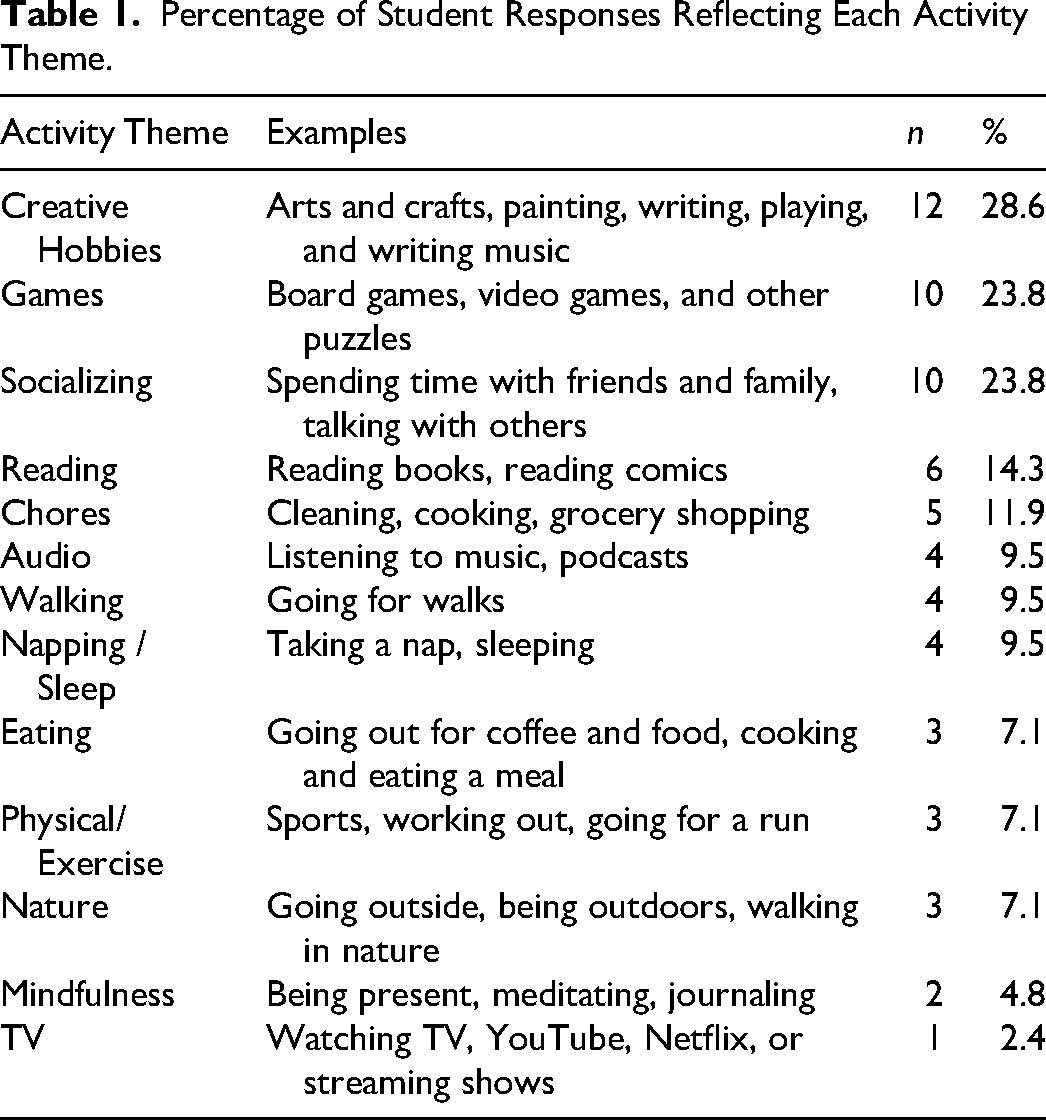
The first research question asked whether students engaged in active rest periods for their deliberate rest and avoided passive distractions. Results show that the most common activities students engaged in were creative hobbies, socializing, playing games, reading, and completing chores (Table 1). Two prevalent themes identified in previous research, social media use and phone use, were not present in student responses. One student's rest activity was coded as TV use, but this student's response was also coded as socializing, as they went to the movies with friends. This suggests that the class activity encouraged students to engage in active rest periods rather than passive distractions.
Percentage of Student Responses Reflecting Each Activity Theme.
To answer the second research question, raters reviewed student responses to the question, “Did you feel better, worse, or the same after? Please explain.” Raters coded for general themes of feeling better, feeling worse, or no change. Overall, 81% (n = 34) reported feeling better, 2.4% (n = 1) reported feeling worse, and 4.8% (n = 2) reported feeling no difference. Interestingly, 11.9% (n = 5) provided responses that were coded as both feeling better and worse, a result that was not anticipated, but was captured through the coding of students’ open-ended responses. Of the five students who reported both positive and negative changes, three of them described feeling both better and worse because their rest periods were accompanied by stress from other work. One student explained, “Initially, I felt better, however, as I started getting back into doing my schoolwork, I started to get stressed thinking about everything I had to do.” The remaining two students described instances where their rest activity was enjoyable but also frustrating (“… it involved a lot of failure from imperfect knowledge and mechanics”) and rest guilt impeding their deliberate rest activity (“… since it was a Monday on a school day, I should have been working”). These findings demonstrate that although the majority of students reported feeling more positive, some did not due to work spillover, guilt, and other pressures that intruded into their rest periods. For the sole student who reported feeling worse, they shared that their rest activity of walking around their neighborhood “felt like a waste of time” because “it was freezing outside” and they also feared someone was following them, suggesting that the rest period did not go as intended.
The third research question asked if the deliberate rest activity was associated with changes in how students thought about rest. Overall, raters found that student responses fell into four categories: students who reported changes in how they thought about rest, students who reported no changes, students who reported already engaging in deliberate rest, and students whose responses were unclear (Figure 2). Subthemes of change and no change categories emerged, and raters coded for the presence of these subthemes in each response (thus, subthemes were not mutually exclusive and will sum to over 100%).
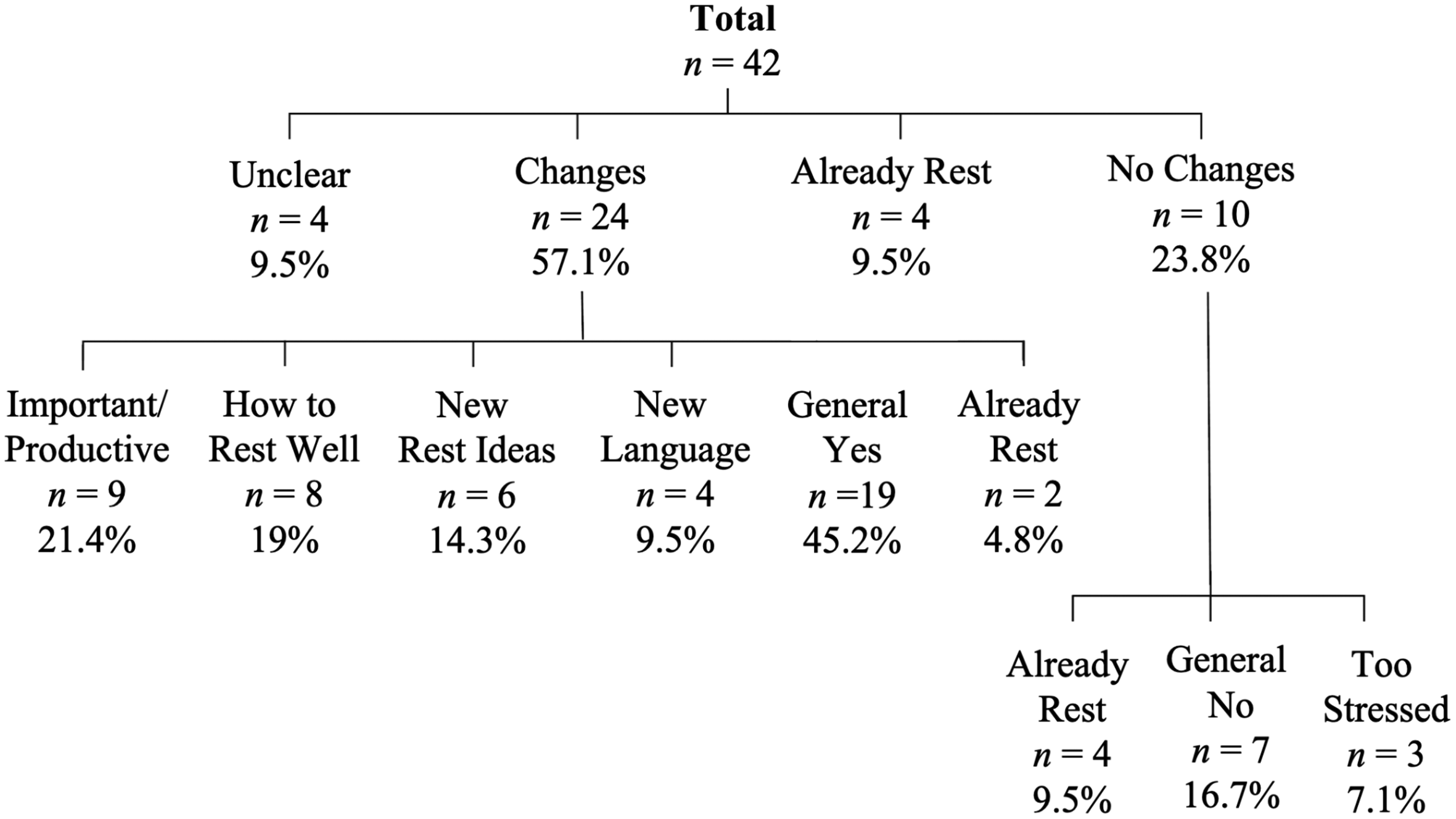
Codes of whether students reported shifts in thinking about rest.
In total, 57.1% (n = 24) of students reported changes in how they thought about rest. More nuanced themes emerged, including 21.4% (n = 9) of students who reported it helped them realize rest is important and can be productive and helpful (“I never realized how helpful deliberate rest really is”), as well as 19% (n = 8) of students who reported that they learned how to rest better (“Thinking about doing intentional things to rest as opposed to just scrolling social media or procrastinating has helped me reframe how to put rest time into my busy schedule”). Additionally, 14.3% (n = 6) of students reportedly found new ways to rest (“…this activity re-shaped my definition of rest and gave me an idea of things that I could do when I feel that I need rest”). Two students reported that they already engaged in these forms of rest, but that this activity still shifted their perspective. Of note, one student reported that the activity made them appreciate their deliberate rest hobbies even more, and another student reported that the activity made them realize that the hobbies they already engaged in were forms of deliberate rest, expanding their conceptualization of the forms rest can take.
Alternatively, 23.8% (n = 10) of students reported that their thinking did not change. The most prominent subtheme was a general no-change statement (16.7%) (n = 7), but four of the seven students in this subtheme reported it was because they already engaged in deliberate rest (“I have always been a believer in rest periods to improve attitude and work production, so in a good way it did not change my beliefs about rest”). Of the remaining three students, two simply reported their thinking had not changed, with one stating, “I feel better on a personal level, sure, but the time cost isn’t necessarily ‘worth it’.” Among the ten students in this larger theme of no changes, three additionally expressed that stressors made it difficult to mentally detach during their rest period. One student shared, “Not entirely because I did find my mind still wandering and going back to thoughts related to schoolwork while I was reading.” In addition to these larger themes, 9.5% (n = 4) of student responses did not fit into a category as they were too vague to determine (e.g., “It had definitely provided something to think about”), while another 9.5% (n = 4) provided general statements that they had already engaged in deliberate rest.
Discussion
The current study explored college students’ experiences with a class activity in which they read about intentional and active rest periods, designed a deliberate rest period for themselves, and then carried out their rest plans. Afterward, students reflected on how their activity made them feel and whether the activity changed their perspectives about rest periods. Their responses indicated that the class activity successfully prompted students to forgo common distraction-based activities (e.g., social media) in favor of more deliberate and active forms of rest, such as creative hobbies, exercise, and socializing. This stands in contrast to research that finds that, after hours, people often turn to TV (Kubey & Csikszentmihalyi, 2002) or mindless distractions (Shaw et al., 2025a) with little perceived psychological benefit. This suggests that the classroom activity can be a helpful tool to encourage students to design and engage in more active rest activities.
The majority of students reported feeling better after their deliberate rest period. However, a smaller subset of students reported feeling worse because of experiencing feelings of stress and the pressure of work either during or immediately after their rest period. The results of this study corroborate research that finds not only active rest periods are associated with improved mood (Martell et al., 2021) but also align with research that finds one of the greatest challenges to recovery periods is work spillover (Shaw et al., 2025b; Wallace, 2001), and increased stress and pressure to work predict lower benefits of rest periods (Sonnentag, 2012). Thus, while the class activity benefited most students, some students may still need support in learning how to mentally detach during nonworking hours. For example, new research provides initial evidence that when students spend time making meaning and reflecting during rest periods, this can reaffirm their values and shift their goals, thereby decreasing stress and contributing to greater wellbeing (Kitchen et al., 2024). As people who experience work spillover are often the ones who stand to benefit the most from rest periods (Sonnentag, 2012), the current deliberate rest activity will not be enough for some students who need more support.
Lastly, over half of the students reported that they thought about rest differently after the activity, including that it helped them realize how important and productive rest is, taught them how to rest better, and provided language to describe and talk about rest. As students can be resistant to changes in attitudes and perspectives (Dembo & Seli, 2004), this demonstrates that the classroom activity may provide a powerful experiential learning opportunity for students. Although it was beyond the scope of this study to longitudinally follow students over time to measure further engagement in rest periods, research shows people are more likely to engage in behaviors they have practiced (Gardner et al., 2012) and that align with their values (Lake et al., 2025). Thus, a shift in thinking about rest may prompt behavioral change. More research is needed to establish how much support students will need to engage in deliberate rest regularly, but the implications of the larger findings suggest that this classroom activity offers a strong starting point to help students better optimize their rest and recovery periods.
Limitations and Future Directions
This study has several limitations and opportunities for future follow up. First, this study was conducted in a single class with only 42 students. A much larger sample size collected across multiple classrooms and universities would bolster the current findings. A second limitation is that students engaged in deliberate rest for homework and in place of their normal lecture time. This extra time given back to students may be responsible for the reports of improved mood. A third limitation of this study is that it used qualitative data to explore student experiences, which inherently limits generalizability to other samples and can be susceptible to rater bias. Moreover, the survey questions were open-ended questions developed for this study, preventing them from capturing the magnitude of change on emotions and mood, but also other important outcomes such as stress levels, and intention to use deliberate rest periods in the future. Lastly, it is possible that participants responded favorably to the activity to please the instructor, even though students were encouraged to answer honestly and were informed that their instructor would only view anonymized responses after the class ended. Future research can build on the current findings by recruiting a larger sample, adopting an experimental paradigm to isolate the effects of the rest activity, utilizing the strengths of quantitative data to capture effect sizes on attitude change, and extending to focus on subsequent behavioral follow-through.
Teaching Implications
Instructors interested in adopting this activity should keep in mind that what students do before and after their rest periods likely supports the success of this activity. Specifically, one key to this activity is that students design and submit their rest plans before the instructor discloses that students will be asked to follow through on their rest plans for course credit. This was an intentional decision to remove the possible bias of students viewing this rest activity as homework that could be completed with minimal effort. By planning for a hypothetical rest period, students can focus on designing rest periods for their needs, as opposed to creating plans shaped by upcoming demands for the week. Requiring students to turn in their rest plans before this announcement may also remove the temptation for students to change their plans and engage in passive activities that feel less effortful in the moment.
Additionally, reflection is a core component of this activity. Asking students to reflect on whether they feel different after their rest period can help them notice possible connections between their deliberate rest period and changes in mood they might otherwise miss. Instructors interested in taking this one step further can assign students weekly deliberate rest homework to participate in deliberate rest activities and keep a log of the activity, their mood over the next few days, and note any possible improvement for the next deliberate rest period. At the end of the course, instructors can assign students to review their logs across the term to identify patterns between types of rest and subsequent changes to mood. When integrated into psychology courses for credit, these activities can constitute a meaningful learning activity for students, especially for those who might otherwise not prioritize their rest experiences outside the classroom.
Conclusion
College students stand to benefit from designing and engaging in quality rest periods but receive little to no guidance on how to do this effectively. When students are provided with support in designing more intentional rest periods and asked to experiment with them as a class activity, they report engaging in active recovery and thinking differently about rest. Empowering students to reflect on their needs and be intentional about how they spend their time can be an effective tool to support students’ emotional wellbeing. As students spearheaded their own rest efforts through this activity, which took place outside of class as homework and in lieu of a lecture, this classroom activity can be easily incorporated into existing psychology courses.
Footnotes
Acknowledgements
Thank you to the student participants for sharing your experiences for this study, and to the anonymous peer reviewers who provided helpful feedback to improve this paper. Thank you to Andrew McReynolds for support in coding, as well as Karen Givvin, Emily Neer, Kaitlyn Schneider, Rich Lopez, and Joey Essoe for piloting this activity in your classes and sharing your experiences and your support for this manuscript.

Ethical Considerations
This study was approved by the participating institution's IRB under exemption 1 (IRB-25-0364).
Consent to Participate
Consent was not needed due to the exemption status of the IRB; however, students were asked to consent through the following prompt at the end of their reflection (used for data analysis).
I am working to improve our class assignments and am interested in sharing what we learn from these assignments with other instructors to contribute to broader teaching practices on rest periods. To do this, I hoping to use some of the classes’ responses to this assignment
[ ]Yes, you can use my responses in your research
[ ]No, please leave my responses out of your research
Funding
The author received no financial support for the research, authorship, and/or publication of this article.
Declaration of Conflicting Interests
The author declared no potential conflicts of interest with respect to the research, authorship, and/or publication of this article.