







Abstract
There is widespread recognition of the employment problems facing skilled immigrants in Canada. As a result, research reports high levels of frustration and anger over immigrants’ failed attempts to secure employment in Canada that is commensurate with their foreign-earned credentials and experience. Furthermore, research suggests that these employment problems are largely unanticipated by immigrants. As these employment difficulties have been observed for at least a decade, our study asks why immigrants are surprised by the difficulties they face in Canada. Our research questions focus on the sources of information being used by future migrants living in India. We wondered whether the information sources being used by future migrants are informing them of these employment struggles. To investigate, we surveyed 500 university students in India who plan to emigrate. Our findings confirm the pervasiveness of a reliance on informal migrant networks among future migrants in India, but also reveal how there is a discrepancy between the expected use of formal information sources, and the actual use of these sources. We conclude that the knowledge transfer of migration information is problematic, and we challenge the mainstream account of migrant social capital as a resource that minimizes the costs and risks of migration. Some policy suggestions are provided.
Introduction
Standard models of the migration decision-making process assume potential migrants are well informed of the employment opportunities in the receiving society, and make migration decisions on this basis. We would suspect that in our globalized world, migrations become less risky; the possibilities of gathering information about the opportunities and challenges in the receiving society (including labor market expectations) should be higher than ever before.
International movements of people should be based on increasingly informed decisions, thus decreasing the risks and costs involved in such moves. In other words, more than ever before, future migrants have more information to make informed decisions. But hidden within this idea is the assumption that the sources of information available to future migrants provide accurate information.
This paper uses new survey data collected by the authors in India to assess the information channels future migrants from India use in their migration decisions. These findings are based on a survey conducted with 500 post-graduate students in India who expressed a desire to emigrate out of India, with Canada being one of potentially many possible destinations. Our research focus goes beyond the desire to emigrate, investigating the factors influencing the intention to emigrate, the networks used to obtain information, and the resulting perceptions of opportunities abroad.
The following article argues that in the case of Canada, where economic struggles have plagued migrants for over a decade, we should assume that accurate information about these struggles is reaching future migrants in the major Indian cities through advanced communication technologies. We find that in accordance with migration scholars, the main source of migration information is interpersonal migrant networks, and the least used source is official government websites. These informal networks, however, do not appear to be accurately disseminating information. Therefore, the employment struggles of migrants, which were identified a decade ago, do not appear to be known by future migrants in India, despite increased access to information in our globalized world. As a result, despite the underemployment of many skilled migrants in Canada, future migrants in major Indian cities remain optimistic about their employment opportunities abroad. This points to the limitations of social capital’s facilitation of migration, since information in these networks may be perpetuating the barriers to full information. We suggest that improvements need to be made in the information available to future migrants, especially with regard to official Government of Canada websites. We also recommend scholars work with migrant communities in the destination country, and especially in the source country, to provide more accurate representations of life abroad.
Literature review
Employment experiences of skilled migrant workers
The employment success of immigrants has been a focus of immigrant integration research in Canada for over a decade. There is widespread evidence of skill underutilization or ‘brain waste’ of skilled migrant workers in Canada. Despite being selected to enter Canada as a direct result of their skills and experiences, many immigrants’ skills are underutilized in Canada, and they are employed in occupations far below their educational levels (Boyd and Schellenberg, 2007; Boyd and Thomas, 2001, 2002; Reitz, 2007a, 2007b; Reitz et al., 2014; Wayland, 2006). This underemployment is compounded by higher rates of unemployment, lower earnings and lower labor force participation among skilled migrants (Alboim et al., 2005; Aydemir and Skuterud, 2005; Galarneau and Morissette, 2008; Grant and Sweetman, 2004; Picot and Sweetman, 2012; Plante, 2010). Research using the Longitudinal Survey of Immigrants to Canada (LSIC) indicates that the major difficulties faced by skilled workers are employment related (Schellenberg and Maheux, 2007) due to the lack of recognition of their foreign earned credentials, accreditations, and work experience (Li, 2001; Reitz, 2001).
Percentage distribution of immigrant and Canadian-born populations by educational attainment and unemployment.
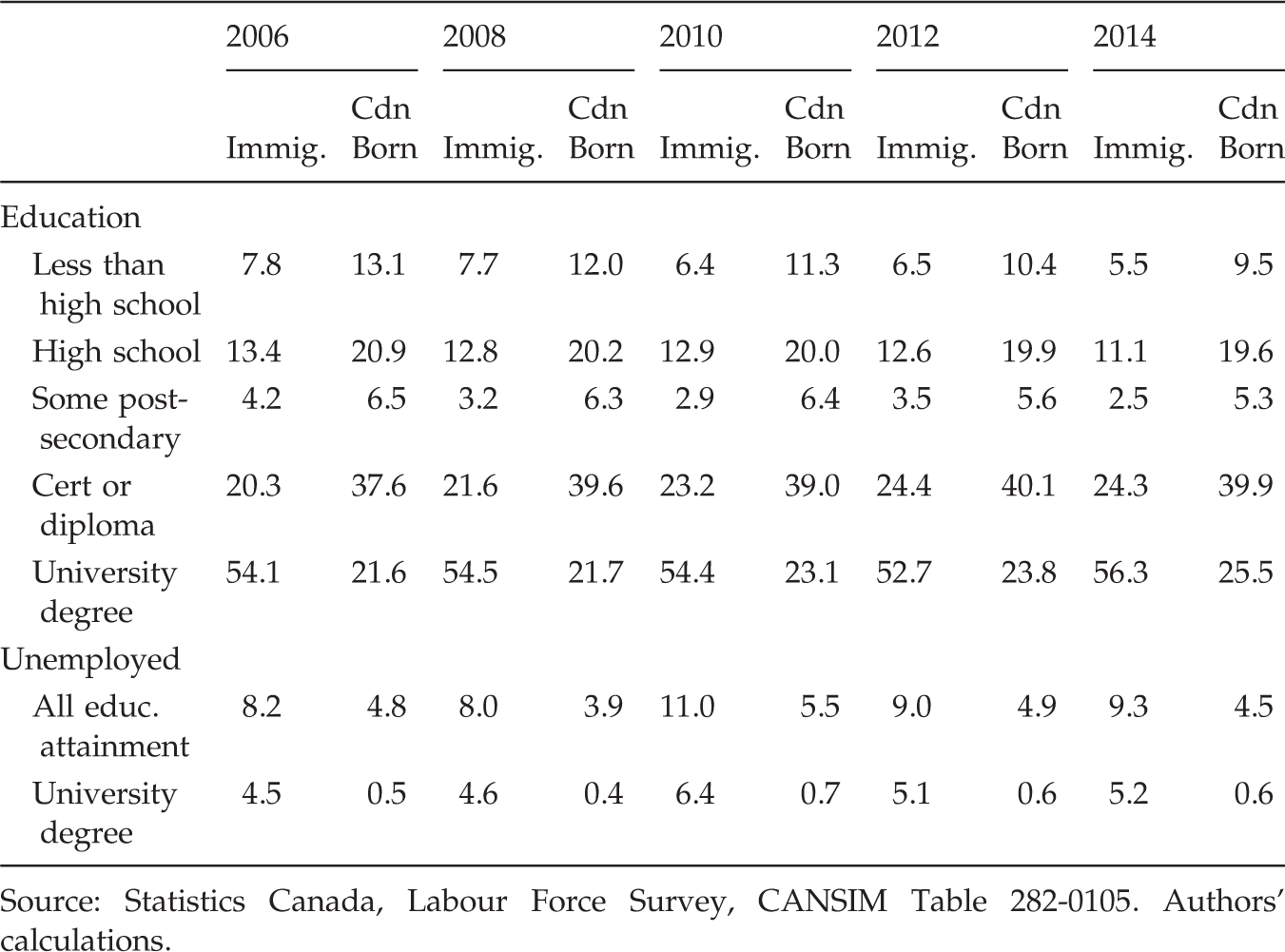
Source: Statistics Canada, Labour Force Survey, CANSIM Table 282-0105. Authors’ calculations.
Recent research by Frank (2013: 93) concludes that immigrants who seek high-status occupations obtain job matches at slower rates than those seeking lower-status occupations, suggesting that those who are most highly skilled may be more at risk of not finding adequate employment in Canada. An analysis of the 2006 Census data shows that just under one-quarter (24 percent) of employed foreign-educated, university-level immigrants were working in a regulated occupation that matched their field of study, compared with 62 percent of their Canadian-born counterparts (Zietsma, 2010). Similarly, a recent Statistics Canada publication found that among newcomers who landed in Canada from late 2000 to late 2001, approximately one-quarter obtained recognition for their education credentials within 4 years after landing, which equates to three-quarters who did not (Houle and Yssaad, 2010).
Median income (CAD) of Canadian population and immigrants (Skilled Worker Program, Principal Applicant) by years since landing.
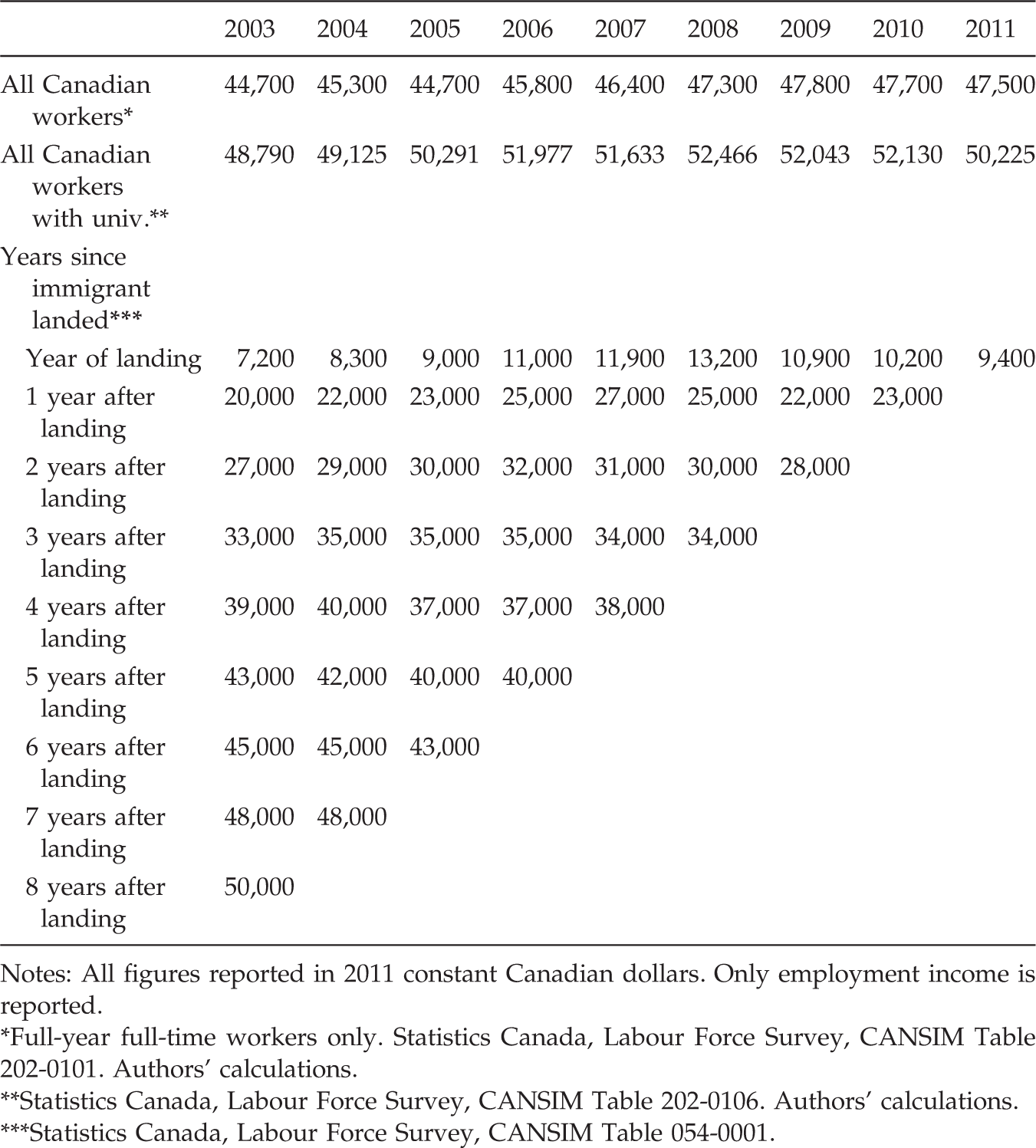
Notes: All figures reported in 2011 constant Canadian dollars. Only employment income is reported.
Full-year full-time workers only. Statistics Canada, Labour Force Survey, CANSIM Table 202-0101. Authors’ calculations.
Statistics Canada, Labour Force Survey, CANSIM Table 202-0106. Authors’ calculations.
Statistics Canada, Labour Force Survey, CANSIM Table 054-0001.
Turning to the immigrant population, Table 2 provides two observations. First, looking at the data across columns it is evident that immigrants earn very little when they first arrive in Canada (CAD7,200 in 2003), but begin to catch up with other Canadians (for instance, three years after landing, immigrants earned CAD33,000 in 2003), and by the eighth year, they are earning CAD50,000 (in 2003) and have achieved the same earnings as the similarly educated Canadian-born population (CAD48,790 in 2003). Therefore, skilled immigrants do eventually catch up to their Canadian-born counterparts; however, they must first endure eight years of lower wages, of which the first three years are below the Canadian poverty line of CAD30,017 2 (Statistics Canada, 2013).
The second observation from the immigrant population in Table 2 requires readers to examine the data by rows. By making comparisons within rows we can see if immigrants are making less or more in various years, keeping the period since landing constant. A similar trend as observed in the Canadian-born population is apparent—moderate growth up to the financial meltdown of 2007/2008, followed by a gradual decline. For example, two years after landing immigrants earned CAD27,000 in 2003; in 2004, two years after landing, immigrants earned slightly more (CAD29,000), and even more in 2005 and 2006 (CAD30,000 and CAD32,000, respectively), and then saw a reduction in earnings in 2007 (CAD31,000) to a low of CAD28,000 in 2009. It appears that the earnings pattern of the immigrant population in the years immediately following landing do not depart drastically from the earnings trend observed in the Canadian-born population. The catch-up period is not getting shorter; indeed, the data suggest that skilled immigrants who arrive in 2014 will not surpass the poverty line until 2017, and will not achieve the Canadian median until 2022.
According to Reitz (2011), the problem of immigrant employment in Canada has grown, and is more serious today than it was when it was first identified. The magnitude of immigrant skill underutilization in Canada is “twice what it was in the mid 1990’s” (Reitz et al., 2014: 19) and “has become one of the most significant disappointments for immigrants settling in Canada” (p. 2). This raises important questions about why this long-term trend is not anticipated by newer waves of migrants. Understanding this question requires a brief summary of research on migrant network and information flows.
Migrant networks and information flows
Human agency is prominent in migration studies where social networks are seen as indispensable for understanding migration routes, adaptation and integration. A fundamental assumption of the migration network approach is that a flow of information lies at the basis of every migratory process. Migration studies widely acknowledge the role of these migrant networks in reducing the social, economic and emotional costs of migration (Boyd, 1989; George and Chaze, 2009; Massey and Espinosa, 1997; Massey and García-España, 1987; Massey and Zenteno, 1999; Massey et al., 1994; McDonald et al., 2001; Rashid, 2012). As Boyd (1989) shows, networks are crucial at various stages in the migration process (departure, arrival, circulation and return). These networks provide a valuable form of social capital. Social capital is understood in the migration literature as the network of connections, loyalties, and mutual obligations which transform people into members of communities (see Portes, 1998), and which generally result in benefits to members. It induces people to extend favors, preferential treatment, and to act in each other’s best interests (Gold, 1995). Social capital can accrue from both formal and informal networks. Literature on migration has shown how migrants rely heavily on informal networks in their migration decisions and settlement opportunities. Social capital is looked upon by researchers to explain migration flows, immigrant access to the labor market, and economic mobility (Boyd, 1989; Grieco, 1987; Massey et al., 1987; Portes and Bach, 1985).
Network and information access has been identified as a key factor in the settlement and integration of newcomers. George and Chaze (2009) argue that for the South Asian migrant women they studied in Toronto, Canada, information was the most important settlement need. In addition, McDonald et al.’s (2001) report on the settlement-related needs of newly arrived immigrant seniors in Ontario identified access to relevant information on life in Canada as their first recommendation for settlement improvements.
Because of their usefulness in settlement and integration, it has been argued that having migrant networks in destination countries substantially lowers the costs of migration because of the information and assistance they provide. The “networks make international migration extremely attractive as a strategy for risk diversification … eventually making it virtually risk-free and costless” (Massey et al., 1993: 449). The assumption within this literature is that these networks develop and are sustained because they relay helpful information. Researchers, however, are now commenting on the fact that social networks can be highly contested social resources (Pessar, 1999: 61). Researchers have begun to challenge the theorizing on social networks to include discussions of gender and its effects on network structure and access (Hondagneu-Sotelo, 1994), as well as the ways networks can be used for socioeconomic exploitation (Zhou, 1992). Portes (1998) summarizes four negative consequences of social capital: exclusion of outsiders, excess claims on group members, restrictions on individual freedom, and downward-leveling norms.
In addition to these potential downsides of social capital, informal networks can also be contested as sources of accurate information. It is possible that the information received through migrant networks is inaccurate, inadvertently increasing the risks involved in migration. A limited body of research developing within migration studies, specifically within globalization and transnationalism, looks specifically at the inaccuracies of migratory flows (for example, see Levitt, 1998). Some networks are more prone to “sloppiness” (Levitt, 1998: 938) and more interference than others, which impacts the nature of what gets transferred.
In her analysis of social remittances, or the ideas, behaviors, identities and social capital flowing between sending and receiving countries, Levitt (1998) breaks down the factors that determine the nature and magnitude of the impact of social remittances. 3 Based on her study of the Boston-Dominican transnational religious system, Levitt (1998: 938) argues that “because these transnational ties grew out of interpersonal connections, communication tended to be more circuitous, unsystematic, and leaky.” This recognition of the “sloppy” or “leaky” nature of interpersonal networks has not been adequately researched by migration scholars. An important exception is the small body of literature on inflated migrant expectations.
Inflated employment expectations
Researchers have argued that migrants may experience surprise and disappointment in the social and/or economic realities of the receiving country (Howenstine, 1996; Levitt, 2001; Mahler, 1999; Schellenberg and Maheux, 2007; Somerville, 2011; Trlin, 2012). Schellenberg and Maheux (2007: 13) conducted a study with a sample of approximately 7,700 new immigrants that were interviewed longitudinally in 2001, 2003, and 2005. They found that skilled migrants are more likely than other types of migrants to feel that their expectations have not been met. They argue this may be the result of having higher expectations than others regarding their employment opportunities, and their subsequent inability to accomplish these expectations. Similarly, a study by Yap et al., (2013) found that immigrants in Canada experience lower career satisfaction than native-borns, and visible minority immigrants have lower career satisfaction than non-visible minority immigrants. There are, of course, many reasons why skilled migrants may be disappointed and experience some dissatisfaction with the reality they face upon their arrival in Canada. Non-recognition of foreign skills and education, discrimination, and problems accessing housing, healthcare or education/training, among others, have been reported on by researchers focused on the integration and satisfaction of immigrants in Canada (see for example, Houle and Schellenberg, 2010). This paper argues that another possible reason for dissatisfaction is that employment expectations may have been artificially inflated as information flows through social networks and reaches potential migrants.
Somerville (2011) studied skilled migrants from India who were living in Toronto, Canada. She investigated the migration information these migrants share with friends and family living in India. She found that edited narratives, which include omissions, modifications and/or fabrications, are common. Migrants report a pressure to protect their social status, not worry loved ones and meet (even if falsely) the high expectations placed on voluntary migrants. These pressures lead to miscommunication about life in Canada flowing back to friends and relatives in India. In other words, her research argues that informal migrant networks often convey inaccurate information.
Similarly, Howenstine (1996) conducted research on Mexican immigrants to Washington State. He argues that earlier migrants may have exaggerated the benefits of their own move either to justify it to themselves, to impress others, or to convince friends to follow. These Mexican migrants had limited knowledge about their destination country before arrival. They knew jobs were available, winters were cold, and that there may be difficulties with language or homesickness. Despite these general notions of life in Washington State, Howenstine argues that neither wages nor the cost of living was known in advance. In the absence of full information, the economic expectations of these Mexican migrants were unrealistically high.
All of the above studies on the unrealized expectations of employment opportunities and the role of informal networks focus on migrants in the receiving society. Interviews and surveys are conducted with migrants after they migrate. In contrast, our research speaks to future migrants before they embark on a migration journey. There are potential limitations in asking respondents to recall their motivations and expectations before migrating. We want to understand migrants’ expectations and information sources at the time that they are making their migratory decisions, not after these decisions have been acted on, justified and possibly forgotten. Our current study does not attempt to survey migrants about their experiences in Canada. These previous studies with migrants in the receiving society have achieved this goal, and persuasively argued that: 1) skill underutilization is prevalent (Boyd and Schellenberg, 2007; Reitz, et al., 2014; Zietsma, 2010), and 2) employment expectations are not being met (Schellenberg and Maheux, 2007; Somerville, 2011; Somerville and Walsworth, 2010). Building on the above research, in this article, we focus our inquiry on the sources of information future migrants have already begun using, and the sources they intend to use, in an attempt to determine which information sources may be contributing to these inflated expectations.
Context: Indian immigration to Canada
A total of 1,567,400 individuals in Canada identify themselves as South Asian, representing one-quarter of the total visible minority population. South Asians were the largest visible minority group recorded in the 2006 and 2011 Censuses (Statistics Canada, 2011)
Top five Canadian immigrant source countries/regions, annual counts and percentage of annual intake.
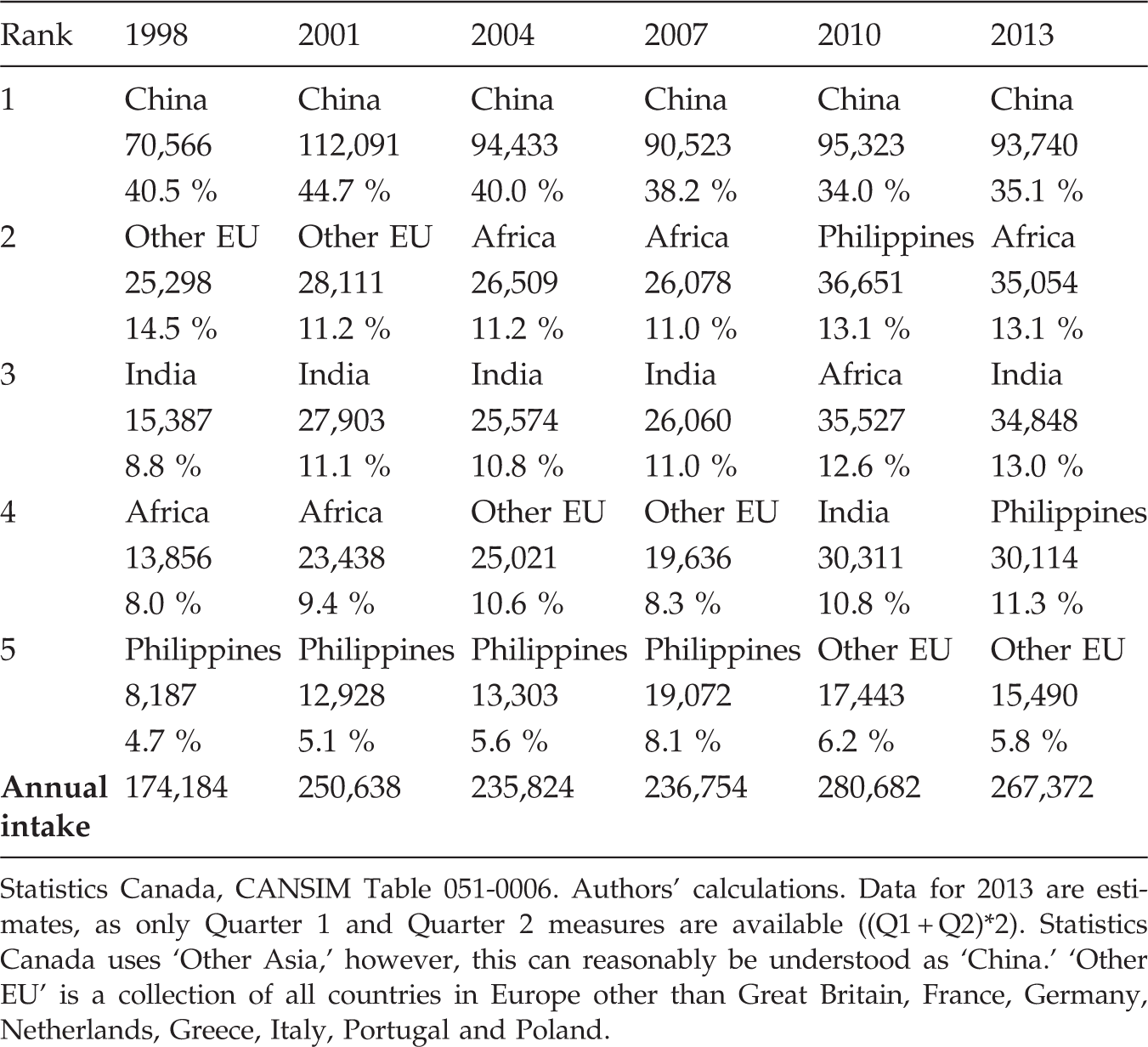
Statistics Canada, CANSIM Table 051-0006. Authors’ calculations. Data for 2013 are estimates, as only Quarter 1 and Quarter 2 measures are available ((Q1 + Q2)*2). Statistics Canada uses ‘Other Asia,’ however, this can reasonably be understood as ‘China.’ ‘Other EU' is a collection of all countries in Europe other than Great Britain, France, Germany, Netherlands, Greece, Italy, Portugal and Poland.
Methodology
This study is based on surveys conducted with post-secondary students living in India. As a way of locating students with migration aspirations and the best chance of successfully gaining access to Canada, we targeted universities in large metropolitan centers, we then targeted students enrolled in programs commonly recognized by Canadian immigration regulations, such as commerce, engineering and medical sciences, among others. We did not recruit students from institutions deemed to provide training specific to the Indian labor market context, such as government studies or law. Specifically, between January and April of 2012, we traveled to the cities of Trivandrum, Bangalore, Panaji (Goa), Delhi, Chennai, and Mumbai where we visited 18 campuses, and surveyed 500 post-secondary students. Eligibility requirements were that the students could read English, 5 and had plans to emigrate out of India. After obtaining permission to enter the campus and speak with students, we approached students leaving large lecture rooms and began a conversation by asking about their plans after university graduation. If they signaled an intention to emigrate out of India, and Canada was a possible destination, we then asked the participant to complete a self-administered paper survey that took approximately 25 minutes to complete. Initially, the study was designed to limit participation to individuals wanting to migrate to Canada; however, this plan was naïve because it over-simplified the process of migration. Participants desired to emigrate, but few were committed to a particular country. These participants were open to multiple countries, with Canada being one of several top choices. Discussions with these future migrants made us realize that as they navigate through available information they slowly settle on a choice destination country in which to apply for migration. As a result of needing to accommodate the various stages of migratory decision-making, most questions in this survey were broadly answered about destination countries (plural). One important exception was a question we asked about their perception of Indians who had immigrated to Canada. We wanted to confirm whether these students perceived Indian immigrants in Canada as successful. Details are provided in the findings section.
Before proceeding further, it is important to note two important limitations of this study. The research only determines the source of information of prospective migrants; it does not investigate the content of the information. For instance, we did not measure the accuracy of the information provided on government websites nor did we ask participants for the specific details of the information they received from personal networks, such as a family member already living in Canada. This limitation is further discussed in the conclusion. Secondly, this study does not provide a profile of the social networks the participants used to gather information from. It might be important to know who these family and friends are, how long they been abroad, and what jobs they have, for example. Future work could segment social networks with the intent of determining types of people who provide more accurate information; for instance siblings who have been abroad for an extended time with a high income professional career may or may not provide more accurate information about the settlement process.
In terms of the gender of our 500 participants, 59 percent of the sample are men and 41 percent are women. The majority of the population sampled is Hindu, at 62 percent. Other major religions among participants were Christian (21 percent), Buddhist (six percent), and Muslim (six percent). The average age of participants is 21 years.
As research targeted post-secondary institutions, this sample is highly educated. Specifically, 58 percent of the sample was pursuing an undergraduate degree in a university, 17 percent were enrolled in a college or trade school, 12 percent were pursuing a master’s degree, eight percent were working towards a professional designation, one percent were enrolled in a doctoral program, and four percent were in other programs.
The disciplinary focus of the sample was diverse, as indicated in Figure 1.
Disciplines of study.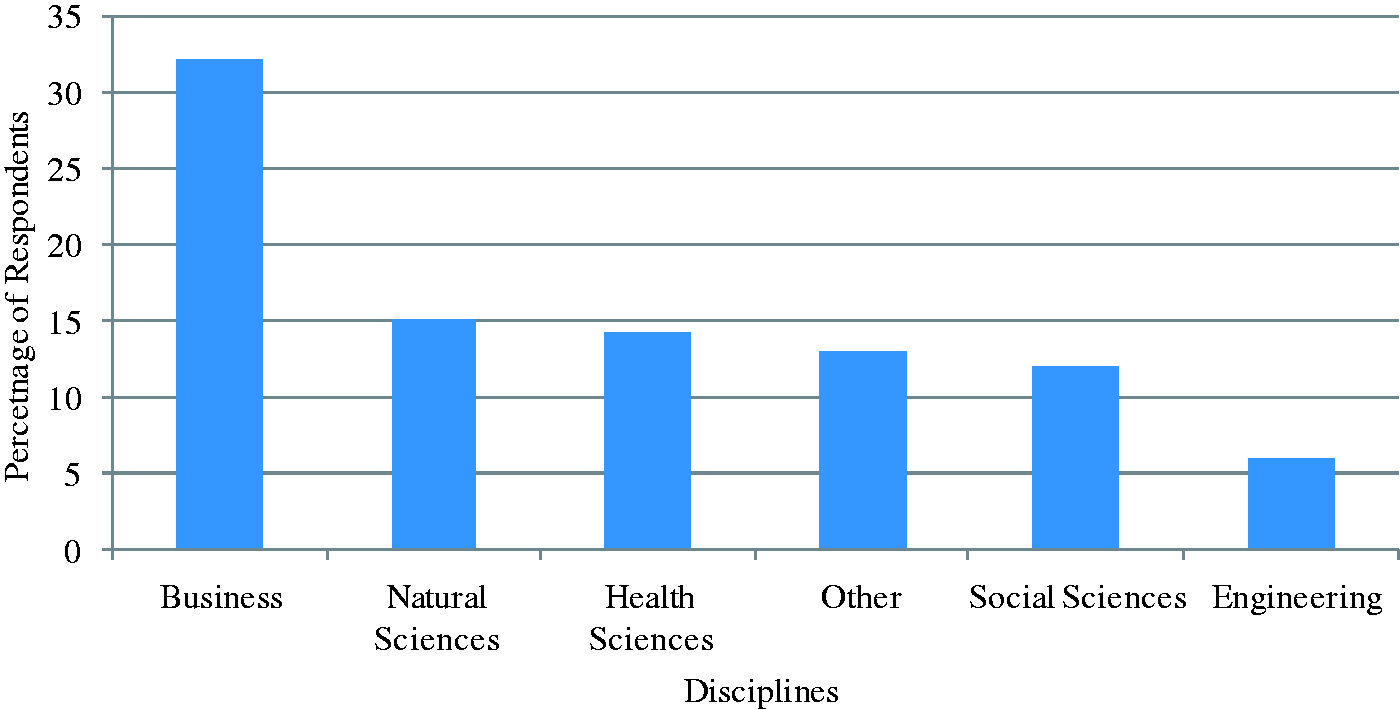
Some 32 percent of participants were enrolled in a business program, 15 percent in the natural sciences, 14 percent in the health sciences, 12 percent in the social sciences, six percent in engineering and 21 percent in other disciplines.
Findings
Reasons for migration are embedded in a complex process involving not only the migrants themselves, but also the networks through which they give and receive information. These individuals are part of a larger informal network that spans national borders, and which link pre-migratory individuals to other migrants and non-migrants in an intricate system of information flows. Consequently, the networks in which individuals are embedded heavily influence migration decisions. Personal informal networks serve as conduits of information, which shape migration decisions. Networks transmit information about possible countries of destination, and opportunities for success. The majority of respondents (85 percent) in this sample had never lived in another country; so their perceptions of life abroad are based almost exclusively on the information they receive in India.
Respondents indicate that communication with a friend or family member who has emigrated causes them to rethink their attitudes about immigration and employment. More specifically, 72 percent of respondents indicate that communication with a family or friend living abroad has made them rethink their desire to live in India and their subsequent desire to emigrate. This new desire to engage in migration is primarily driven by financial and employment decisions. As Figure 2 indicates, the overwhelming reasons for a future migration are career advancement and greater income. These reasons do not differ significantly by gender.
Reasons for migration intentions.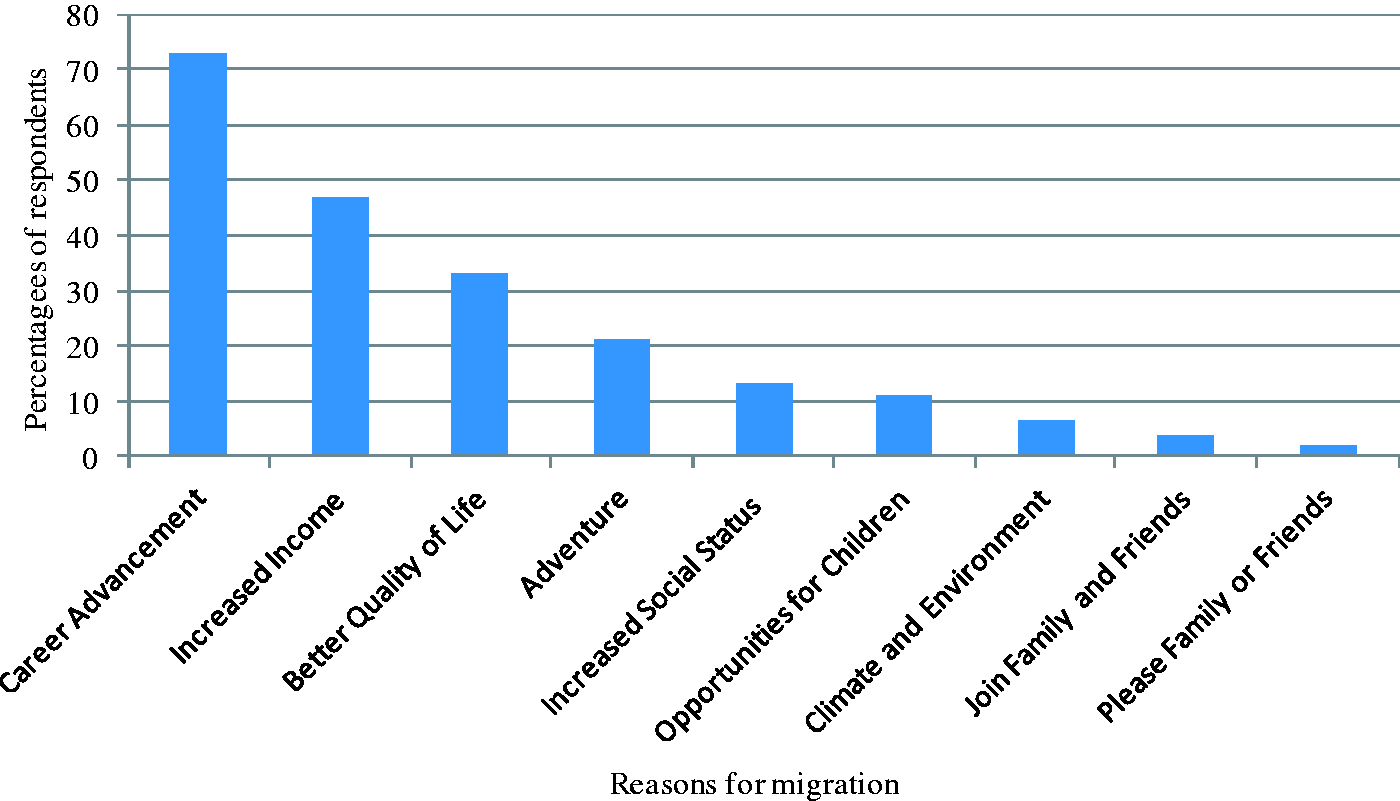
This suggests that information reaching these young people in India is saturated with stories of economic success. If they wish to migrate, and they wish to do so for career advancement and income, then they must be getting information that tells them there are good career opportunities and incomes abroad. This, in fact, is the case when we look more closely at the survey responses.
Specifically, when asked to comment on the perceptions people in India have about young people who immigrate to Canada, results indicate that there was a discourse of success: 98 percent of respondents perceive young Indian people who migrate to Canada as successful professionals. 6 This is an interesting assessment since Table 1 indicates that immigrants in Canada are under- or unemployed. Other national data from Statistics Canada paint a similar picture when looking specifically at the South Asian population. 7 It is important to note, however, that these national employment data do not distinguish between immigrant and Canadian-born South Asians. Our finding that university students in India desire to migrate for employment and financial reasons, and perceive Indian immigrants in Canada as successful professionals, does not tally with the evidence that immigrants are under- or unemployed in Canada. This suggests that the representation of successful Indian professionals in Canada that is being relayed through informal social networks is inaccurate or, at the very least, inflated.
This begs the question: where are potential migrants getting this information? As discussed in the previous literature section, there is widespread recognition of the employment problems facing skilled migrants in Canada, which have been observed for at least a decade; should we not expect future migrants to be reporting on these struggles? Why does there remain an overwhelming perception that Indian migrants abroad are successful professionals, as opposed to cashiers, office cleaners, taxi drivers, or other occupations that underutilize their skills?
This study found that the majority of future migrants get their information from family and friends living abroad, followed by family and friends living in India. Therefore informal social networks are the leading source of migrant information flowing into India. Information predominantly flows between individuals via email and phone calls. Networks have to be maintained through multiple forms of interactions between members, in order to produce and reproduce useful and lasting relations and access to resources. Looking at the frequency of communication among our participants, we find that these are not fleeting but regular, sustained communications across borders, suggesting ample opportunities to discuss important concerns, issues, aspirations, and other issues. Specifically, 81 percent of the sample regularly communicates abroad via email, 8 another 10 percent communicate yearly, and the remaining nine percent do not maintain communications across borders. Phone calls were equally as prevalent with 80 percent regularly talking with friends and family living abroad, 9 and another six percent phoning once a year. Thus, communication opportunities for information access and knowledge transfer should be quite high among this sample.
Looking more closely at the process of information gathering, we find that 43 percent of the future migrants in this sample have already begun the process of acquiring detailed migration information. We refer to these migrants as being in the ‘late-information stage’ of migration. The remaining 57 percent know what sources they plan to use, have begun asking basic questions, but have not yet inquired seriously about migration; these migrants we refer to as being on the ‘early-information stage.’ Overwhelmingly, future migrants in the early or late stages of information gathering, rely on family or friends living abroad. It is important to note that migrants use multiple sources, so results do not add up to 100 percent. As shown in Figure 3, 37 percent of all migrants, those in both the early and late phases of information gathering, rely on family or friends living abroad, and 25 percent rely on family or friends living in India, as one of their key sources of information. In total, 62 percent of migrants rely on family/friends in India or abroad as a key source of migration information.
Obtained and future sources of information.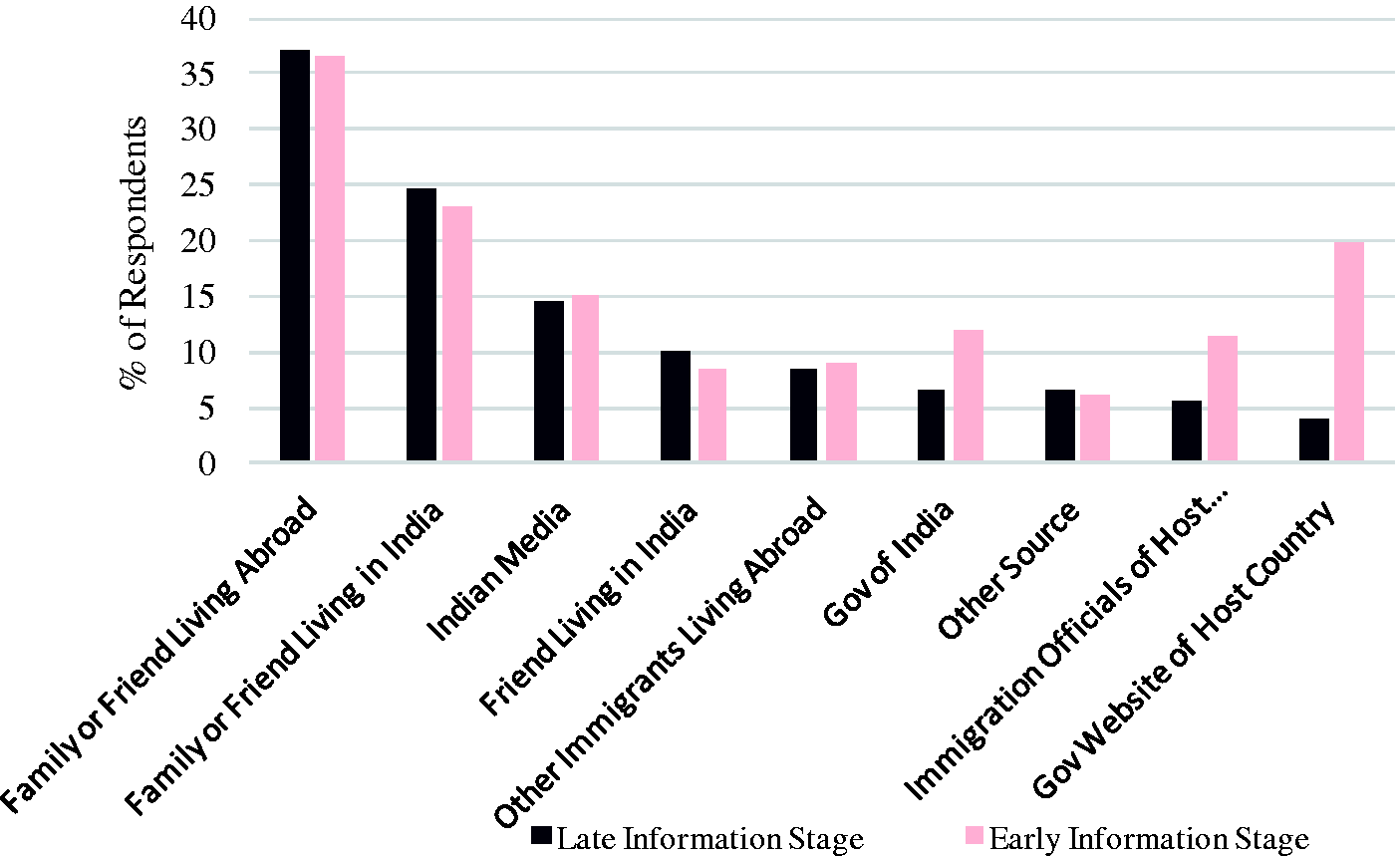
It is important to note that in most categories there was a high level of congruence between migrants in the early and later stages of information gathering. In other words, the sources future migrants think they will use, turn out to be the ones that are most highly used. The one category with significant differences between the two groups was the use of government websites in the host country. Although 20 percent of future migrants in the early stages of data gathering indicated intentions to use this information source, only four percent of migrants in the later stages had used it. In fact, this was the least used source of information among participants. This discrepancy raises important questions about the usefulness of the information provided on the government websites.
Detailed answers to questions about government information sources and access to information are beyond the scope of this paper; however, speculations can be made. Perhaps, after an initial perusal of the government websites, future migrants conclude that there is inadequate information available; or perhaps the desired information is too difficult to find; or maybe, the information is available and migrants locate it on the government websites, but feel it is not relevant or useful. 10 Future in-depth studies on this incongruence could yield rich data and help make recommendations on the ways government websites in receiving societies could better serve the interests of future migrants.
Conclusions
This research confirms the findings made by other researchers (such as Somerville, 2011 and Howenstine, 1996) that information flowing through informal networks may inflate expectations of job success following immigration. It also moves beyond these studies by surveying potential immigrants before they leave their country of origin, thus tapping into the role of social networks as they are being activated. It provides an opportunity to see that the intended information sources and the sources actually being used are not necessarily the same, suggesting that future studies need to be cognizant of the time at which social networks are analyzed; researchers may find different responses at pre, during and post-migration.
This research also alerts us to the limitations of informal social networks, and challenges the mainstream account of migrant social capital as a resource that minimizes the costs and risks of migration. The experiences of study participants illustrate that while informal, personal social networks have the potential to be an important resource, they are not flawless and may be ill-equipped to assist potential immigrants in navigating migration decisions and providing accurate information about job opportunities abroad. Furthermore, our study finds that despite immigrants’ widespread underemployment and disappointment with their employment prospects in Canada, potential migrants who are using informal networks remain optimistic about their employment opportunities in Canada. This suggests that the buffering capacity of social networks may be overstated. There is a need to further investigate the functionality of social networks for knowledge transfer.
The findings highlight the need for accurate information to be disseminated to source countries in a way that is accessible for future migrants. More effort should be taken to ensure that the information needs of future migrants are addressed before their migration decisions are finalized. It stresses the important roles played by networks, particularly friends and relatives, in addressing these needs. Since future migrants are relying heavily on these informal networks, the destination countries may need to work with the immigrant communities to help disseminate information through their existing networks.
Future research should try to uncover the factors that can accentuate knowledge gaps in order to better understand how information flows which are circulated by different networks influence immigrants’ integration processes. Most research on social networks focuses on their benefits to communities or individual immigrants; this study challenges us to consider the possibility that there are informational disparities that exist in these informal social networks. More studies focusing on the limitations of social networks are encouraged. The social capital lens can become significantly more useful in understanding migration expectations if we do away with the hidden assumption that the information flowing through social networks is accurate.
In addition, future lines of research inquiry could use smaller qualitative samples to delve more deeply into the types of information obtained from the various information sources. For example, understanding the types of information provided by immigration consultants or government websites would be a worthwhile endeavor.
This paper has reviewed the current literature and presented the most recent data from Statistics Canada to highlight the settlement challenges faced by skilled workers in Canada. There is a need to increase immigrant awareness of job prospects in Canada. We recommend that official Government of Canada websites be more user-friendly and realistic in order to facilitate accurate knowledge transfer to prospective immigrants. More comprehensive information will allow some people considering migration to self-select out of the migration process, and for those still committed, it will allow them to better prepare, emotionally and financially. Researchers must also play a larger role in engaging with groups in the destination and source countries to provide accurate portrayals of settlement challenges. More empirical work is needed, but so too is a better presentation of the existing research to non-academic audiences. We need an increased collaboration between scholars, government and migrant communities to ensure knowledge is successfully and accurately transferred to these future migrants.
Footnotes
Acknowledgments
The authors wish to thank their participants.
Declaration of Conflicting Interests
The author(s) declared no potential conflicts of interest with respect to the research, authorship, and/or publication of this article.
Funding
This research was supported by the Shastri Indo-Canadian Institute, the Social Sciences and Humanities Research Council and a Hanlon Scholar position from the Edwards School of Business.
1
Canada’s current immigration policy is referred to as the ‘points-system.’ Introduced in 1967, this system selects immigrants based on points awarded for characteristics indicative of employment success such as education, work experience and knowledge of one of Canada’s two official languages.
2
Statistics Canada relies on an after-tax Low Income Cut-Off (LICO) for an average family. Taxes for this level of income are negligible in Canada’s system of graduated income tax.
3
These include the remittance itself, the transnational system, the messenger, the target audience, differences between sending and receiving societies, and the transmission process.
4
South Asians include individuals from Bangladesh, Bhutan, India, Maldives, Nepal, Pakistan and Sri Lanka.
5
Meeting this English language proficiency requirement was not difficult. As a result of the history of British colonial rule in India, English is widely spoken among educated Indians. Students often learn English as a second language in school, thus university graduates are fairly proficient in English.
6
This question specifically asks about Canada.
7
In 2006, despite higher levels of education, 54 percent of South Asians in Canada worked in semi-skilled and low-skilled occupations compared with 44 percent of non-visible minority workers, and among South Asians who held a degree, the unemployment rate was 7.5 percent compared with only 3.7 percent for non-visible minority members (Government of Canada, 2006).
8
Regular email communication includes daily (23.4 percent), weekly (30 percent), monthly (18.3 percent) and bi-monthly (nine percent).
9
Regular phone communication includes daily (24.9 percent), weekly (21.4 percent), monthly (17.9 percent) and bi-monthly (16.1 percent).
