







Abstract
This paper focuses on how Japanese immigrants who settled in Spain and Scotland are building new social networks and questions how this process changes the way they relate to Japan and their Japanese identities. A grounded theory approach was used to gather data for the study. The sample is composed of 14 immigrants interviewed in Scotland and 17 in Spain. Based on content analysis, the study found that both groups of immigrants emphasized five key elements in developing their new sense of belonging. These are: having a local partner; interest in the host country; workplace experiences; number of local and/or Japanese friends in their social network; and foreign language proficiency. Immigrant identity development is a dynamic process of construction in which both personal behavior and social aspects are involved.
Introduction
This article presents findings from a study which sought to analyze how two groups of Japanese immigrants in Scotland and Spain are developing a new sense of belonging, and to what extent intrinsic elements from the host society, such as culture, practices and language, among others, have an impact on how Japanese immigrants see themselves and how they express this new sense of Japaneseness abroad. Scotland and Spain represent old and new destinations for immigrants from Japan.
As destinations, European countries, such as France, Germany and the United Kingdom, have traditionally attracted many types of labor migrants, including both blue and white collar workers (White et al., 2006). Countries such as Spain, Portugal or Italy, which used to send workers to northern countries on the continent, have become countries of destination. In the case of Spain, this change became notable at the beginning of the 21st century when it turned into one of the main host countries for South American, North African and Eastern European migrants. Nevertheless, the influx of immigrants decreased slightly toward the end of the first decade because of the voluntary return migration policies adopted by the Spanish Government. According to Cuadrado (2017), foreigners represent 9.5 percent of the Spanish population. Most of them come from Europe (49.7 percent), followed by those from the Americas (21.7 percent) and Africa (20.8 percent), mainly from Ecuador and Morocco, respectively. There is a gradual increase in the share of foreigners coming from Asia, especially China, whose share reached 4 percent. In 2016, some 5,766 Japanese were living in Spain. Thirty-five percent of the foreign population were in the age range 30–44 years. Although there has been some decline in the foreign population of Spain since 2008, it is expected that there will be an annual inflow of 343,614 foreigners up to 2023 (Cuadrado, 2017).
Scotland has also undergone a shift in migratory patterns. Scots traditionally migrated to England, Ireland and the United States, but from 2000 onwards, the number of Scottish emigrants has fallen and is outweighed by immigrants coming from East Asia and Eastern European countries. Data from the National Records of Scotland (2016) indicate that the number of immigrants was 26,600 in 2012/2013, 31,400 in 2013/2014 and 35,900 in 2014/2015. Concerning the Japanese community in Scotland, Scotland’s Census 2011 (National Records of Scotland, 2016), estimates a total of 1,245 Japanese immigrants residing in the country. The Japanese community in Scotland is mainly composed of students (42.9 percent entered the UK using a student visa), followed by workers (18 percent) (National Records of Scotland, 2016).
Literature review
Adaptation and sense of belonging
The adjustment of migrants to their new environment has been viewed as a dynamic process that involves the host society, the migrant’s home society, and personal and socio-cultural background (Chou, 2009). Finding reliable indicators of integration has become a major task in order to know how migrants make their way into the host society. Perhaps one of the most reliable indicators of social integration is the feeling of belonging to a certain group or community (De Miguel and Trammer, 2010; Lueck and Wilson, 2010; Pantelidou and Craig, 2006).
Developing a sense of belonging within a group is a complex and subjective process in which individuals make decisions and choices about their identity based on their own personal experiences (Ahnellen et al., 2006). Nevertheless, identity formation is not a one-way road involving only interpersonal elements. Thus far, ethnic identification has been frequently analyzed in terms of intergroup relations rather than from an intragroup point of view. Research has focused on how (immigrant) minority groups relate to the (receiving) dominant majority. However, treating relations with the dominant majority as the only significant “other” for minority groups ignores the importance of within-group interactions. Moreover, while research on intergroup relations often focuses on societal level relations, intergroup relations in more local situations may operate very differently (Verkuyten, 2005). Local level interactions with out-group members could provide material for negotiating identities (Prins et al., 2013). The way the group acts and treats its members also has a direct impact on them. Betrisey (2009) gave the example of the segregated communities of Japanese overseas, where the lack of interaction between temporary migrants and permanent residents leads to a closed community in which support networks are built based on seniority or time of residence thus, reinforcing traditional Japanese values. Several studies have been conducted involving second-generation migrants to determine how they have developed different ways of belonging to certain groups from both inside and outside their own ethnic community (such as classmates, co-workers or sports team members) in contrast to pioneers who have no such interactions (Checa and Arjona, 2009; Portes, 2006; Portes and Rumbaut, 2001).
Social networks play an important role in developing a sense of belonging, especially for those immigrants who arrive at a host society as part of an individual migratory project, for example, as pioneers or lifestyle migrants (Maya, 2004). According to Maya (2002), the formation of social networks among migrants is based either on racial and ethnic identity or their community’s structure and composition. For example, coming from the same place of origin or having good communication channels in the community or organization promotes network building among its members. The existence of several ethnic clusters (or multi-ethnic clusters) can foster the dissemination of information on job opportunities and leisure and can also reduce interethnic-group pressure. Each of these has a direct implication on how the sense of belonging to a group is developed during the post-migratory phase.
Focusing on the importance of belonging and on social networks among international migrants, Molina et al. (2008) said that this process should not be seen only as a means of joining a group, but also as a strategy to enhance the success of the migratory project. According to Kurien (2012), these strategies have undergone changes from the classical theories of assimilation to more pluralistic models of immigrant incorporation.
Molina et al. (2008) identify four basic strategies migrants employ to form support networks: (1) assimilation, a strategy based on learning and adapting to the practices and values of the destination society; (2) formation of ethnic enclaves, whereby migrants form their own groups or communities; (3) formation of transnational networks composed of members from origin countries; and (4) formation of multi-ethnic groups in the destination country where relations among migrants emphasize their shared sense of being part of a “migrant” community, and thus members focus more on their similarities rather than their differences.
The different strategies are linked to varying modes of immigrant incorporation in destination countries. Kurien (2012) points out that those expressions of identity and belonging have changed regarding those aspects which should or should not be maintained. In the past, the children of European immigrants to the United States were expected to assimilate by becoming de-ethnicized and individualized in the secular and public sphere while retaining their ethnic communities, language and traditions in the sphere of religion. The members of present-day second-generation communities in US society maintain their ethnic identities in a secular context alongside de-ethnicized, individualized, religious identities and practices. Belonging to more than one group is common, that is, identifying with one’s own culture and that of the host country (Portes, 2006; Prins et al., 2013). In the same way, belonging would also be multivariable, operating in and through everyday life and influenced and driven by individual circumstances and contexts (being simultaneously national, local and multiple in its formation) (Jackson, 2014).
An overview of Japanese emigration
Japanese emigration has a long history. Japanese migration to South America started toward the end of the 19th century. Japanese migrants there developed a sense of belonging by combining traditional Japanese values and new elements from the host country (Suzuki, 2006; Tsuda, 1999). Thus, descendants of Japanese migrants who later migrated to Japan discovered that they have developed a specific way of being Japanese. However, this sense of belonging has given birth to several cultural expressions. For example, in fashion, the Latin style is popular among Japanese–Brazilians and other Japanese who are part of their social networks. In Spain, Japanese promote seiwataiko (Japanese traditional drum influenced by western rhythm) and taiko (traditional Japanese percussion) combined with Spanish rhythm. In many cases, the sense of belonging to one place or another is an ambivalent process (Domínguez-Mujica and Avila-Tàpies, 2013). The process of identity negotiation by Japanese immigrants in the Canaries is also a reflection of their personal experience in the island’s milieu (Domínguez-Mujica and Avila-Tàpies, 2013).
Japanese immigrants in Europe are mostly white-collar professionals (Beltrán, 2005; Beltrán and Sáiz, 2004; White, 2003), and as such, they may be perceived as spared from difficulties often faced by less-skilled immigrants. Studies such as those conducted by Goodman et al. (2003), Avila-Tàpies (2008) or Fujita (2009) indicate that the Japanese living abroad also experience dealing with adaptation and identity issues. Japanese who migrate to countries like the UK in the hope of pursuing a career or other personal goals which might be difficult to achieve in Japan, sometimes have to cope with racism and experience being treated as second class citizens outside of Japan. In the UK, the Japanese community tries to find a way of adapting to the host society by assimilating and reproducing certain Japanese cultural patterns in the destination or by joining Japanese clubs or associations (Fujita, 2009). In Spain, Valls (1998) highlights that the Japanese community has a considerably higher educational and occupational status than other immigrant communities. Japanese immigrants in the US and England can be categorized into the following groups: cultural migrants (i.e., those migrating to learn about foreign cultures); businessmen, students, freelancers (i.e., those who do not have regular work hours and/or those who work on their own, such as writers); and lifestyle migrants (Fujita, 2009). With the exception of businessmen, the other categories share a common element: their migratory project is motivated by the search for personal fulfillment. Those who migrate to learn about Western music or enroll in language academies overseas also acquire important cultural capital. Migrants engaging in these activities develop flexible cultural codes which can help them in engaging in inter- and intra-ethnic relations, enabling them to access social networks and fostering the sharing of knowledge and experiences in the community (Lu, 2013). The diverse immigrant profiles of Japanese immigrants in Europe suggest possible new models of adaptation and identity formation as they draw from different social and cultural capital as well as differentiation or identification within Japanese immigrant communities.
Methodological approach
The focus of this research—exploring the sense of belonging of Japanese immigrants—is a phenomenon that is affected by environmental aspects and individual characteristics and perceptions. Therefore, an ecological perspective (Bronfenbrenner, 1976) was used to observe how the interaction of the microsystem, mesosystem and macrosystem affects how Japanese immigrants develop a sense of belonging outside Japan and how individuals perceive themselves as members of a new society. Interviews with migrants were gathered and analyzed together with official statistics.
Selection of participants
The study compared Japanese immigrants in two countries with different migration histories and characteristics. The Japanese community in Scotland has had a longer history and is well settled. The first Japanese migrants arrived in Scotland around the first half of the 20th century (White, 2003), established industries and social organizations (such as the Japan Society of Scotland, Japanese Church, Japanese Embassy and Japan Society of Scotland, among others). On the other hand, the Japanese community in Spain is relatively new (Valls, 1998) and despite having several Japanese associations, the number of Japanese belonging to Japanese associations is rather small. This may be due to an individual migratory project pattern that is not linked or sponsored by any official institution like local councils or Japanese overseas institutions, such as the Japan Foundation and the Japanese Consulate.
There were two main criteria for the selection of research participants: they must have resided in the host country continuously for at least a year; and they must have intentions of staying in the host country for at least two years. The latter criterion allowed for the inclusion in the sample of immigrants who legalized their stay, those looking for work, and those who married or were in a partnership with nationals of the host country. Japanese nationals who were living in Scotland and Spain on a temporary basis (e.g., those taking a gap year, short stay for research purpose, or workers temporarily transferred abroad) were excluded from the sample because their short-term stay does not allow for forming close relationships with locals and the local society (Beltrán and Sáiz, 2004; Shiobara, 2005).
Data collection and analysis
The data collection process consisted of three stages conducted between December 2012 and May 2013. In cooperation with Aragón-Japón, Kimono Club Barcelona and The School of Literatures, Languages and Cultures of the University of Edinburgh, an online questionnaire was disseminated to Japanese members of these institutions. Those who responded were requested to share the questionnaire with other Japanese acquaintances residing in Scotland or Spain. The online survey sought to obtain basic information about the arrival and settlement of Japanese immigrants. A total of 134 questionnaires were sent out and 51 were returned, of which 12 were excluded because the respondents did not meet the selection criteria.
In the second stage, those who met the criteria (n = 39) were asked if they can be interviewed; eventually, 31 agreed. Prior to the meeting, the respondents were informed of the aim of the project and that the questions would be focused on their migratory project and the settlement stage and, in particular, on their personal experience and motivations.
The third stage of the data collecting process consisted of two discussion groups, one involving six Japanese immigrants living in the Glasgow area, and a second one comprising five Japanese immigrants who lived in the metropolitan area of Madrid.
The in-depth interviews with 31 respondents had an average duration of 60–90 minutes. The interviews were conducted in English and Spanish. For respondents who were not fluent in either language, the interviews were conducted by the researcher with a native Japanese assisting as translator. These interviews focused on the pre-migratory process; the early stage of the post-migratory process and the first encounter with both the host community and the Japanese community abroad; and the duality of being Japanese in a foreign country. Based on quantitative and qualitative techniques, five profiles of immigrants were identified: (1) students; (2) labor migrants; (3) migrants who moved to Scotland and Spain to join their partners; (4) family migrants, that is, those who are migrating for permanent settlement as a family; and (5) migrants on a tourist or student visa but with the intent to settle or find a permanent job in the host country. As tourists or students, they cannot work, thus, they are pushed to work in the informal economy in jobs such as Japanese language teachers, translators, floral arrangers and the like.
The whole sample comprised 26 women (11 from Scotland and 15 from Spain) and five men (three from Scotland and two from Spain). The interviews were conducted in the cities of Edinburgh and Glasgow in Scotland, and in Barcelona, Madrid and Zaragoza in Spain. These cities hosted long-term Japanese immigrants. Cities such as Seville and Valencia in Spain or Dundee in Scotland were excluded because most of the Japanese immigrants in these areas were students, many of whom are likely to return to Japan after completing their studies. Very few Japanese live in small countryside towns (Instituto Nacional de Estadistica (Spain), 2014; National Records of Scotland, 2014), thus, these sites were not considered in the recruitment of research participants.
Composition of the sample.
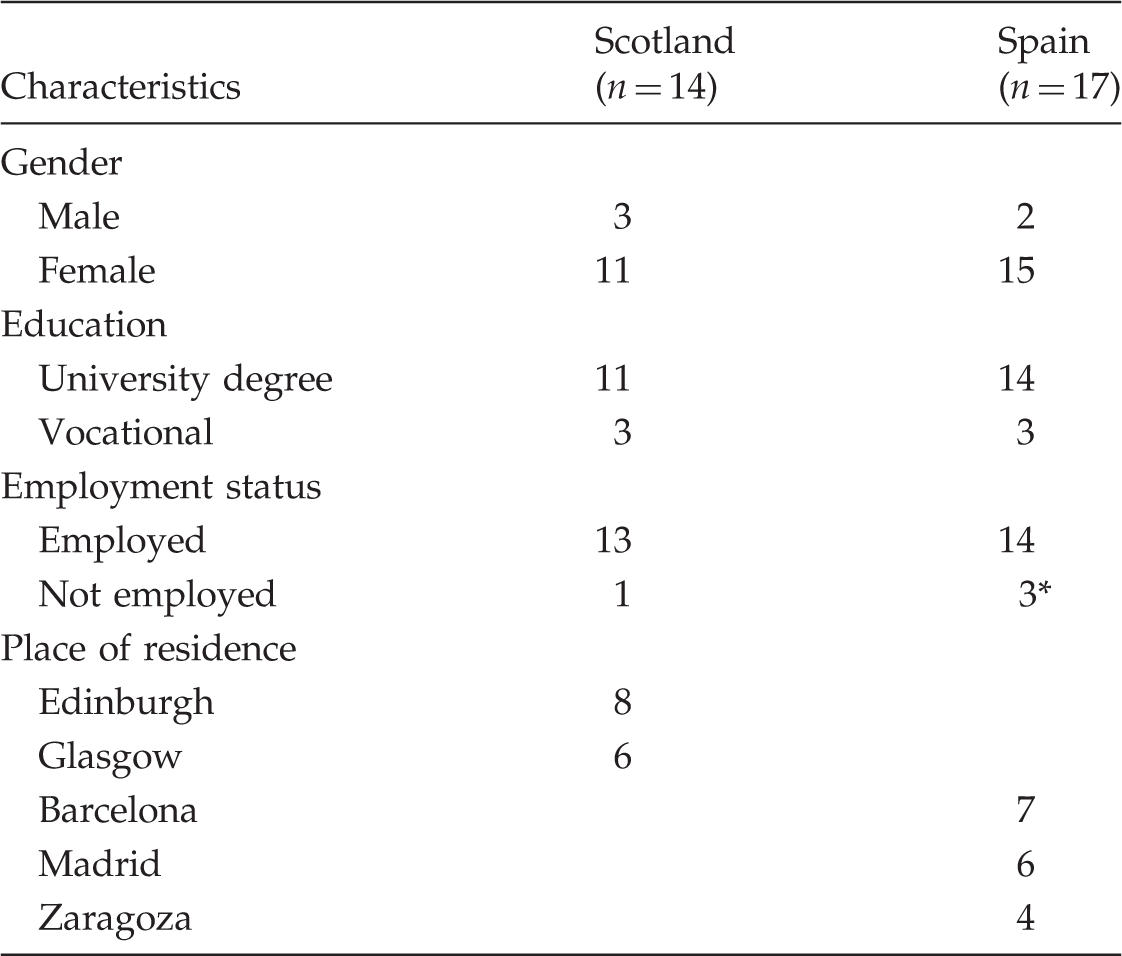
Note: *includes one retiree.
Nine of the 31 respondents (4 in Scotland, 5 in Spain) were considered as key informants because they supplied valuable information about the Japanese community apart from sharing information about their personal experiences. This group included two social workers, two sociologists and a PhD holder in Spanish language, one university professor, one lawyer and two economists. In addition, six of them held posts which gave them firsthand information about the Japanese community in Scotland or Spain (two were heads of Japanese cultural associations, two were teachers in Japanese schools, one was an au pair 2 and one was a translator).
The participation and support of the Japanese community was critical in carrying out the data collection. To contact potential participants, the assistance of Japanese cultural associations was most helpful. The recruitment of research participants was greatly aided by referrals. Furthermore, some of those interviewed offered to act as translators for participants who did not feel comfortable with English or Spanish. In the presentation of the findings, the names of research participants have been changed to protect their identity.
Results
Based on data gathered by the study, five dimensions were important in how Japanese immigrants developed a sense of belonging in Scotland and Spain. As shown in Figure 1, these are: (A) having a local partner; (B) interest in the host country; (C) work experience; (D) number of local and/or Japanese friends in their social network; and (E) foreign language proficiency. Those dimensions were evaluated on a scale of 1 to 5 (with one being the lowest level and five, the highest). As discussed below, these key elements have a different impact in each community and destination.
Comparison of sense of belonging.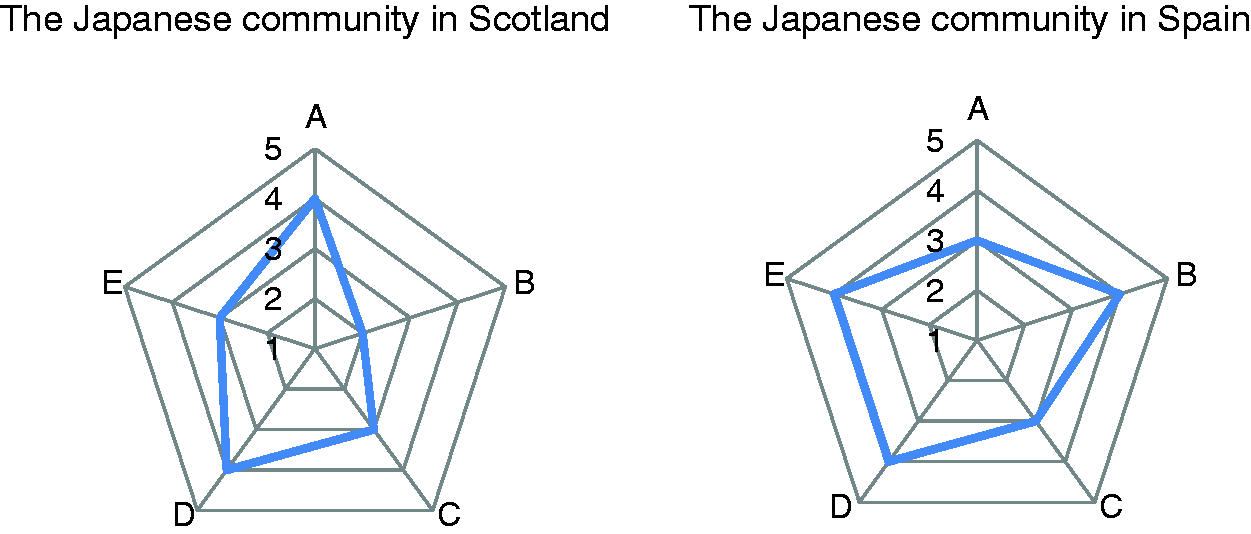
The Japanese in Scotland
Prior to migrating to Scotland, 14 out of the 16 informants were in a relationship with a Scot national (six of whom got married) who was a previous migrant in Japan; for these immigrants, migrating to Scotland was motivated by their marriage or relationship with a Scot national. The others had ties with Scot nationals such as university professors, company managers or host families. Having these links played an important factor in deciding to come to Scotland.
Initially, immigrants experienced culture shock or a possible internal conflict between their own culture and that of the host society. Mayumi, who arrived in Edinburgh with her Scottish fiancé in 2011(two years before the date of interview), described this conflict: Because I came here with my fiancé, things have gone pretty well. He studied Japanese here in Edinburgh, so he introduced me to a few Japanese friends and he helped me to get a job here too. I have been here for two years and I have a part-time job, which is OK for a Japanese woman. However, I envy other migrant women or Scottish women who are working full-time. I think the Western thinking about pursuing a career is better.
This lack of interest in Scotland reinforced some immigrants’ identification with Japan. Sayuri, who has been living in Glasgow since June 2006, shared the following: I used to think I was not very Japanese when I was in Japan. I did not act like many other women. I wanted to work and have my own income. I do not like to be dependent on my husband or family all the time. Back then, I always thought if only I could work, I would be able to afford a house and all that. But after moving to Glasgow, I changed my mind. I feel I am more Japanese than I thought. I must work very hard and deal with the language and all that. I have some Japanese friends who encourage me to take up some activities like playing golf or visiting old castles. But I am not really interested in any Scottish things and I do not want to be outside all day, doing things because the weather here is awful.
First of all, the difference between the Scottish and Japanese way of working was the most relevant. Japanese who work for Western companies or with Western co-workers experienced changing their way of working and the way they feel towards the company.
Secondly, the relationship between co-workers and Japanese colleagues affected the way their sense of belonging developed. While other factors, such as having a local partner or a multi-ethnic network, foster in them an appreciation of or identification with Scottish culture, differences in relation with their co-workers highlight cultural differences, especially during the first stages of the post-migratory process. Yuko, who works for a local company, said: My co-worker sometimes thinks I am stupid because I do things too slowly. She does not seem to understand that some things take time. For example, sometimes she tries to do my job, or if someone asks me to do something, she will jump and say she will do it … I do not see it as racism or anything like that … Since I am teaching Japanese language to students who will eventually end up working for Japanese companies or even for the Japanese government, I must try to teach them everything I know about Japan and its culture. Sometimes, this means that I have to stay up until late, but somehow, this makes me feel more Japanese … sometimes students come up with questions that I cannot answer and I think, I am Japanese, shouldn’t I know this? After a few months here, I was not able to find a job so I was kind of depressed. My fiancé asked some friends and a few weeks later, I got my first job … He is really important and having Scottish friends makes me feel more Scottish, but I also need my Japanese friends. For example, I admire Yuko so much. She is a kind of a senpai (senior) to me. She tells me lots of things that none of my Scottish friends or family could even understand … Sometimes, in chatting with her, I realize even though we are both Japanese and agree we should do things in a Japanese way, we just do not do them and we get very surprised.
During the post-migratory process, the correlation between HLP and the sense of belonging is reversed. In Japan, having enough language skills to communicate with others made the informants feel more attached to British culture. However, once in the host country and realizing that the language gap was wider than they expected, their sense of being Japanese became stronger than they had previously thought. In addition, comparing themselves to other migrants who had more opportunities to increase their language and social abilities also influenced their sense of Japaneseness. As Yuko commented, being proficient in the host country language can affect a person’s view of herself/himself: I studied Business Management in Tokyo, and English was a compulsory subject, so I thought my English was good. Besides, I had a Scottish boyfriend and my Japanese friends envy me because of my English … My first 5–6 months here were very difficult for me. I couldn’t understand the accent, people talk so quickly, etc. The worse thing was that I met a Greek woman who had never studied English before, but she was able to learn faster than me and to understand more things than I did.
However, the lowest rated dimension (B) interest in the host country, must not be overlooked. Developing a new sense of belonging in a host country is not necessarily related to a loss or increase of national identity, but can also lead to a new perception of one’s own national identity. None of the informants mentioned that they have lost their Japanese identity during the migratory process. However, despite maintaining some Japanese values, the attitude they showed toward friends, work or family in Scotland would be different if they were living in Japan. Rather than developing a hybrid sense of belonging, immigrants in Scotland see themselves as Westernized Japanese. Mariko, who lived in Glasgow and Edinburgh, explained this idea as follows: We are not Scottish. It does not matter how long we stay here or how good our English becomes. We look different, we think differently and maybe we act differently. We have been raised in Japan under Japanese values, and we cannot deny we get surprised by things that locals do not even care about … In my opinion, we are Westernized Japanese because our attitude has been westernized, but our way of thinking about things remains Japanese.
The Japanese in Spain
Among the Japanese in Spain, the local partner is also important (a rating of 3) in the immigrant’s social network, although to a lesser degree when compared to the Japanese in Scotland. Fewer informants were in a relationship with a Spanish partner before their migration to Spain; after migration to Spain though, the number of Japanese–Spanish marriages increased.
Even though partners are a key element in the development of a new sense of belonging in the host country, that is, due to the guiding role they play during the settlement stage, many informants in Spain commented that their pre-migratory training raised awareness about socio-cultural matters, such as where to find language schools or other resources to begin to develop their migratory project. In Spain, the partner’s role seems to be more about providing emotional support and affection rather than providing practical assistance. Forty-two-year-old Reiko described the role of her local partner as follows: I had many Spanish friends in Japan, so I knew a few things about the country and the way people act and so on. Besides, since I was studying Spanish, I checked hundreds of travel guides, watched documentaries and so on, so I had an idea about what things would be like. However, I was not able to find a job or a way to get some income to live on until I met my husband. He introduced me to some company managers and I got a job. I guess he has been very helpful when it comes to understanding several things you cannot find in books, but without him, I think I could have managed as well. Maybe it would have taken me longer to find a job or to understand some Spanish jokes. I always felt attracted to Spain. I liked their lifestyle and their customs, so I wanted to study that at university. Unfortunately, Spanish was not a very common language to study, so I studied English at university and went to a language school … I have also been interested in music and dancing, so I try to translate and understand the lyrics from my favorite Spanish band … I always wanted to work for a company which employed Spanish people; that way, I would have the chance to practice more Spanish and learn more about pop culture.
In their work, most Japanese immigrants encounter locals who have an interest in Japan and its culture. In turn, this positive regard for Japan affects the way their sense of belonging develops; Japanese immigrants perceive locals as being kind and friendly. As a consequence of this mutual regard for each other, Japanese immigrants have more chances of establishing close relationships with locals and they feel more accepted in the host society.
As Figure 1 indicates, besides the important role of the local partner, the Japanese social networks in Spain comprise several multi-ethnic clusters providing informal support. It is also important to note that there is a balance between those clusters made up of locals that are linked to the partner and those that are not. Although more evidence will be needed, this pattern may suggest that the Japanese community in Spain does not depend so much on their partners (compared to the Scottish sample) when it comes to building new relationships in the host society.
Because of the cultural orientation of their migratory project, informants participate actively in socio-cultural activities: many studied Spanish and/or regularly attended cultural activities or courses in Spain. These cultural activities and their ties with other people (migrants or locals) with whom they share common interests have made them feel more comfortable in Spanish society. Many of the Japanese immigrants in Spain have studied the Spanish language for 4.5 years, on average, before arriving in Spain. In addition, many continued studying the language for a further two years in Spain. As many informants commented, since Spanish was not the most commonly studied foreign language in Japan (especially during the decades of the 1970s and 1980s), studying Spanish in Japan distinguished them from other peers or friends. For most of the sample, learning Spanish was a leisure activity rather than an obligation. Therefore, being able to progress was perceived as a personal achievement and not as something imposed by a company or society.
Other than their personal interest in studying Spanish, some of the informants also pointed out that because of the similar phonological system between Japanese and Spanish, they found it easier to understand and learn Spanish compared to other Western languages. This was a similarity that made them feel more attached to Spain. During the discussion group, it was pointed out that becoming fluent in Spanish had a direct impact on how their sense of belonging changes once they have settled in Spain. Hideo, a 31-year-old salary man, said: In the beginning, it was hard to make really good friends here. When I arrived, people did not want to talk to me, and I was disappointed. My friend (Japanese) told me to take the first step and talk to my Spanish co-workers and classmates. At the beginning, they could not understand me very well, but as I was getting more fluent in Spanish, I felt Spaniards were nicer and friendlier to me.
Their positive migration and settlement experiences and their willingness to adapt to Spanish practices have created a sense of belonging among the Japanese. However, this does not mean that the Japanese have identified more with Spain than with Japan. Participants commented that even though they felt close to Spain, there remain some cultural matters that they find difficult to cope with or practices that they do not wish to adapt to. Their membership in multi-ethnic clusters and the frequency with which informants switch from one to another may help explain why Japanese migrants in Spain are negotiating and readjusting their self identity. Ria referred to this hybrid identity dilemma as follows: I feel Japanese, but I am aware many things about me have changed. Unconsciously and on purpose, I have given up the Japanese way of acting or behaving because I think the Spanish way makes more sense or just make things easier … When I visit my friends or family in Japan, they always tell me I am becoming more and more Spanish, so I guess I can say I am Japanese on the outside but kind of Spanish on the inside.
Conclusions
The findings of the study support Magat’s hypothesis (1999) that the essence of being Japanese does not rest on one’s place of birth but on the socialization process. Even though Japanese in Scotland and Spain have followed different paths, especially as regards their pre-migratory project, neither of them have disowned their sense of being Japanese.
For both Japanese communities, regardless of their length of residence, their social networks have been the most relevant dimension in developing their new sense of belonging in their destination countries. However, as Molina et al. (2008) suggest, different ways of using these networks as strategies to accomplish migratory goals lead to different ways of developing one’s identity.
The migratory project and the way in which social networks have been built and used can partially explain why the Japanese in Scotland see themselves as Westernized Japanese, and why those in Spain consider themselves as having a hybrid identity. In the first place, migrants in Scotland did not show a clear migratory objective. For most of them, having a Scottish partner and certain level of English fluency were the main reasons to migrate. For this group, their partner is the center of their social network (which consists mostly of locals) and this creates a certain level of dependence on him/her. This finding coincides with that of other studies carried out especially those concerning female Japanese immigrants in other western or more developed countries (e.g., the work of Shiobara (2005) in Australia). The negotiation of identity ends up affecting how they define maternity, their relationship as a couple and their own nationality (Hamano, 2014; Igarashi and Yasumoto, 2014).
As for the Japanese in Spain, their migratory project was more defined, hence, their post-migratory process was smoother. Nevertheless, a well-planned pre-migratory phase does not guarantee a successful integration process. Several informants reported that they had many stereotypes and misconceptions about Spain and the local population, and these notions resulted in anxiety and disappointment. However, enrolling in language schools, art academies or universities prior to their arrival provided them with a source of formal support, and allowed them to establish links with other migrants and locals with whom they share common interests. These nodes are spaces/platforms where participants experience a sense of membership and social integration that enables them to engage in local communities (Staton-Salazar and Spina, 2003). By using community institutions, they accumulate skills to navigate local bureaucracy and to transform their human capital into social and cultural capital (Lu, 2013). As Lu (2013) points out, from a community perspective, local institutions can support the identity formation of a minority or immigrant group and can assist immigrants as they negotiate their identity.
This helps explain why the Japanese in Spain show more tendency to be part of multi-ethnic clusters, and why the local partner plays a secondary role in developing their new sense of belonging. Those in Scotland, due to a migratory process focused on their personal relationship with a local partner and/or developing a professional career, tend to have a more heterogeneous social network (compared to other migrants who tend to establish social networks with other co-ethnics) along with a sense of Japaneseness which emphasizes differences between communities rather than shared elements.
The identity formation of Japanese immigrants in the two countries occurs at three levels. At the macro-level, regardless of their identification with the host society, immigrants often referred to immigration laws and their legal status in confirming their Japaneseness. Being legally Japanese was especially important for those who are living in Scotland because of the immigration policy in the UK. Japanese citizens need to apply for a re-entry visa every time they wish to travel outside the UK. Immigrants in both countries mentioned that social values such as gender equality, job opportunities and access to social services were also important factors in developing their sense of belonging in the new society.
As Figure 1 shows, the meso-level (friends, work colleagues, etc.) operates in the same way in both groups. In both destinations, informants pointed out that almost all of the members of their social network were “interested” or “very interested” in some aspect of Japan’s culture. This may suggest that their social networks tend to be developed around others (especially locals) with whom they share interests. This coexistence reinforces and affirms the newcomers’ ideas about locals, the host country or their own migratory project.
At the micro-level, the fact that most of the informants were married or were in a relationship with a local partner does have some implications on how Japanese immigrants navigate their sense of belonging, Japanese identity, and in the case of women, how they see themselves as Japanese women vis-à-vis their peers and friends who live in Japan. Initially, the women worked at jobs which were related to Japanese culture—for example, teaching Japanese language, ikebana or sumie (ink painting). The women were more exposed to cultural clashes than men since the women’s jobs entailed dealing with locals or other migrants (for instance, as teachers of Japanese language) while the men were more likely to work in Japanese companies. Therefore, Japanese immigrants’ sense of belonging is the result of internal conflict involving three elements: (1) what is expected of them by other Japanese residents living in the same society; (2) the collective imagery that locals have of the Japanese; and (3) the immigrant’s own personality.
In conclusion, developing a sense of belonging to a given society is a combination of cognitive and volitional processes. Findings from the study suggest that this subjectivity does not only derive from how immigrants perceive their experiences, but is also conditioned by external elements over which they do not have a direct control (such as immigration laws and the global economy) that affect their interpersonal relations and personal goals. Future research could examine how immigrant characteristics by gender, socio-economic background and time of migration impact on immigrants’ social networks, sense of belonging and identity.
Due to the small scale of the present study, the outcomes may be considered tentative and would benefit from further research. The basic elements that influence the process of developing a sense of belonging, identity formation and social networks are dynamic and are linked to changes over time. A longitudinal approach may be needed to determine whether the outcomes are maintained as the settlement process continues or new outcomes arise over time. The use of other techniques, such as life stories and autobiographical narratives, may shed new light on this phenomenon (Avila-Tàpies and Domínguez-Mujica, 2014). The research can also be undertaken in other Japanese immigrant destinations, such as Peru and North America, to examine and compare the sense of belonging and Japanese identity development in other contexts.
Footnotes
Declaration of conflicting interests
The authors declared no potential conflicts of interest with respect to the research, authorship, and/or publication of this paper.
Funding
This research received no specific grant from any funding agency in the public, commercial, or not-for-profit sectors.
1
The recruitment of many women interviewees reflects the pattern of Japanese migration. Ono and Piper (2004) suggest that more Japanese women migrate to Western countries to have more access to high position jobs and to escape social pressures in their home country. It has also been noted that while most Japanese who work for Japanese companies abroad are men, women predominate among local companies where they work as teachers or translators (Beltrán, 2005; Beltrán and Sáiz, 2004).
2
This informant wanted to enroll in a vocational training course and was hoping to stay in Scotland for some time. At the time of the study, she needed to improve her English language, thus she decided to become an au pair for a Scottish family.