







Abstract
This article investigates the impact of migration on parent-child ties. It draws upon in-depth interviews with 15 Vietnamese mothers and 20 children (ages 16–25) who either migrated to or were born in the Czech Republic. It asks: How do first-generation mothers and second-generation children make sense of their parents’ migration in terms of their relationships with each other? What is the meaning of migration for mothers’ and children’s comprehension of parenthood and motherhood? The analysis of the interviews illuminates the tensions and ambivalences in narratives about migration and post-migratory situations. The article benefits from the inclusion of two perspectives—mothers’ and children’s—and contributes to scholarship on family migration, migrant childhood and migrant parenthood.
Introduction
Vietnamese immigrants are one of the largest groups of non-European immigrants in the Czech Republic. Vietnamese migration to the former Czechoslovakia started as part of the “fraternal” cooperation between the two socialist countries in the 1970s and was supported by several agreements. These geopolitical and historical circumstances have shaped the formation of the Vietnamese community in the Czech Republic and significantly affected its contemporary character (Baláž and Williams, 2007; Szymanska-Matusiewicz, 2016), despite the shift from state-managed migration to economic migration after the fall of Communism in 1989. The Czech Republic currently has 10.6 million inhabitants, of which 500,000 are immigrants. The Vietnamese population reached almost 60,000, the third largest group after Slovaks and Ukrainians (Czech Statistical Office, 2018).
This article investigates the impact of Vietnamese migration in the 1970s on parent-child ties. It draws upon in-depth interviews with 15 Vietnamese mothers and 20 children (aged 16–25) who either migrated to or were born in the Czech Republic. It addresses the following questions: How do first-generation mothers and second-generation children make sense of their parents’ migration in terms of their relationships with each other? What is the meaning of migration for mothers’ and children’s comprehension of parenthood and motherhood? In answering these questions, I argue that the migration project of the first generation is defined by and defines the parental role and the ideals of parenthood and motherhood. I address these issues from the perspectives of both the first and the second generation 1 in order to capture the emic perspectives of the concerned actors—mothers and children. The article analyzes data collected from families with a particular post-migratory childcare arrangement, i.e., Vietnamese immigrant families that hired local Czech nannies to care for their children. It is a care arrangement that radically challenges and changes the family structure. It fosters kin-like relationships between the child and the nanny: the nanny becomes an aunt or grandmother and the child becomes a nephew, niece or grandchild.
Several scholars have focused on the parent-child ties in immigrant families (Kibria, 1993; Foner, 2009), arguing that these may change over the life cycle (Foner and Dreby, 2011). Migration affects intergenerational relationships. However, as Cook and Waite (2016) argue, in the literature, “there has been too much emphasis on the divisions between “‘traditional’ parents and ‘modern’ children at the expense of examining the ways in which both generations change and adapt” (Cook and Waite, 2016: 1389). Post-migratory intergenerational relationships are far more complex than those simple divisions, and the perception and experience of migration vary from one generation to another, as previous research has demonstrated (Attias-Donfut and Cook, 2017; Foner and Dreby, 2011).
The article contributes to the growing literature while investigating views on parenthood and parenting after migration, as it is perceived by the first-generation migrant mothers and their second-generation children. The article is organized as follows. First, I present an overview of the existing scholarship on intergenerational relations in migrant families and provide information about the methodology of my research. Then, I explain the history of Vietnamese immigration to the Czech Republic, paying attention to how the second generation interprets this history. The third section presents the results of the analysis, investigating three topics around which parenthood is narrated: parenthood and the delegation of care, parenthood oriented to educational achievements, and parenthood and expectations about ethnic identity and belonging. The analysis of the interviews illuminates the tensions and ambivalences in narratives about migration and post-migratory situations as they are perceived by the two generations. The article benefits from the inclusion of two perspectives—mothers’ and children’s—and contributes to scholarship on family migration, migrant childhood, and migrant parenthood.
Conceptual background: Parent-child relationships in the post-migratory context
This section provides a brief review of literature covering two issues that are essential for the contextualization of my findings. First, I will present the main works focused on intergenerational relationships between migrants and children in general and in the context of Vietnam. I will then briefly overview the Vietnamese migration to the Czech Republic and its specific characteristics.
In their review article on research on intergenerational relationships in immigrant families, especially between immigrant parents and their children, Foner and Dreby (2011: 547) argued: The common image of children of immigrants engaged in pitched battles against tradition-bound parents from the old country is a partial, and often misleading, view. A more nuanced approach requires analyzing the sources of strife and strain, as well as cooperation, caring and accommodation, and taking into account how intergenerational relations change over time.
Another strand of studies that is relevant to the present article is the role of parents in supporting the education of their children and the importance of education in the post-migratory context (Kao, 1995) and for the position of the whole family (Kibria, 1993). Supporting children’s educational achievements is, as Liamputtong (2006) shows, an essential part of being a “good mother.” Ensuring good education means enabling children to obtain better positions in a society full of social and economic constraints. In many cases, though, it means that the first-generation migrant parents must dedicate much more time to working and generating the economic capital that the children could turn into cultural capital. And here lies the contradiction of the concept of good motherhood: “Good mothering needs time and energy to care for children. Due to the physically demanding nature of their work, it is difficult, or even impossible, to be a ‘good mother’” (Liamputtong, 2006: 45). Anderson (2000: 118) reaches the same conclusion: Migrant women can have little emotional and moral input into the upbringing of their children. They do not enjoy care as emotion freed from physical labour. Instead the opposite applies: their care for their children is demonstrated in the fruits of hard labour, in remittances, rather than in cuddles and “quality time” that provide so much of the satisfaction of care.
As many scholars argue, it is essential to position the relationships between children and migrant parents in the social, economic, and political context of migration (Foner and Dreby, 2011: 559) while bearing in mind the influence of the past situation of the family. Such an approach taking into account intersubjective, intercontextual and intertemporal aspects appears useful to shed light on the subjectivities and agency of the first and 1.5 migrant generations as well as on their connections with their social world and with their past. (Fresnoza-Flot, 2015: 1153)
Several quantitative and qualitative studies have addressed the intergenerational and family relationships in Vietnamese migrant families. Frequently, the studies focused on the clashes between parents and children in relation to the differences in cultural values (Rosenthal et al., 1996; Phinney et al., 2000; Choi et al., 2008) or the influence of acculturation on the parent-child relationships (Vu and Rook, 2013). Choi et al. (2008) explored intergenerational cultural dissonance. The authors looked into how immigrant and refugee families face “the challenges to re-establish family roles and patterns in an unfamiliar society with a new language and socio-cultural environment” (Choi et al., 2008: 93). They concluded that these challenges may lead to parent-child conflict and weaken positive parent-child bonding. Similarly, Vu and Rook (2013) argued that different acculturation between two generations leads to increased intergenerational conflict. Important studies by Tingvold et al. (2012a, 2012b) highlighted the key role of extended family networks of Vietnamese refugee parents. Their study “indicates the importance of broadening the scope of investigation to include extended family members in understanding acculturation processes and intergenerational relationships among Vietnamese refugee families” (Tingvold et al., 2012a: 267). They show that despite the geographical distance, extended family members play important roles in the lives of refugee families.
Vietnamese immigration to the Czech Republic goes back to the state-socialist period of these two countries. The particular geopolitical and historical circumstances have shaped the Vietnamese community and significantly affected its contemporary character. In the 1950s, several bilateral agreements were signed between these two countries, all meant to support a Vietnam destroyed by war, all formulated under the idea(l) of fraternal help between two socialist countries. There were agreements on: economic-cultural cooperation (1955), scientific-technological cooperation (1956) and cultural cooperation (1957). These agreements allowed students to come to Czechoslovakia from Vietnam in the 1960s. After spending one year in Czech language school, they were enrolled in study programs chosen by the Vietnamese side—the majority of which were technical programs, although a few of the students started to study Czech language, literature or puppetry (Martínková, 2006). However, the most important point was in 1973, when Vietnam displayed an increased interest in communication with Czechoslovakia and requested the admission of a labor force in various occupations, both for training and for employment. Economic and political cooperation increased after Vietnam’s reunification in 1975, and “Agreements on Mutual Assistance” were signed between Vietnam and several Central and Eastern European states over the next two years (Williams and Baláž, 2005). In 1978, Vietnam became a member of the Council for Mutual Economic Assistance, and its “integration into the Soviet bloc was completed” (Williams and Baláž, 2005: 536).
The situation radically changed in 1989 with the fall of Communism, when the previously signed agreements were no longer valid; migrants who were in Czechoslovakia during these times had to legalize their stay in a different way or leave. Some migrated to Western Europe; others returned to Vietnam. For those who wanted to stay in Czechoslovakia, one of the easiest ways to legalize their stay was to apply for a business license, which was also the best solution in terms of the new labor market situation and the disappearance of the jobs that the Vietnamese migrants had worked in before 1989 (Hofírek and Nekorjak, 2009). Starting wholesale and retail businesses, i.e., becoming owners of small shops and/or open-air markets, the Vietnamese immigrants identified and filled the newly emerging gap in the market. They became “early winners” in globalization (Williams and Baláž, 2005: 540). However, starting new businesses and achieving success require huge efforts and investments of time that affect the work-life balance and the organization of childcare.
The migration from Vietnam to the Czech Republic as well as to other post-Communist countries did not stop after 1989. Szymanska-Matusiewicz (2016: 281) describes the situation in Poland, stating that the continuation of the migration flow “can be perceived as a manifestation of the importance of migration networks established in the Communist era, which enabled mobility to become a self-perpetuating phenomenon.” Currently, Vietnamese people are the largest migrant community originating from Asia in several (Central) Eastern European countries, including the Czech Republic, Poland, and Russia (Szymanska-Matusiewicz, 2016).
Study design
This article follows the previous research outlined in this section while particularly addressing the issue of parenthood and its perception by second-generation youth and mothers. It pays attention to the agency of the interviewees while at the same time connecting them to the social and cultural context, both before and after migration, in which the parenthood is performed.
The data for this article were collected as part of a larger project on Vietnamese families in the Czech Republic hiring Czech nannies between 2010 and 2012. The aim of this research was to understand the delegation of care at the nexus of different dependencies involving parents, nannies and children. Altogether, I conducted 50 interviews: 15 with Vietnamese first-generation mothers, 15 with Czech nannies, and 20 with second-generation children. The sampling was driven by the aim to understand the relationships between the concerned actors.
In the Czech Republic, delegated childcare does not have a big tradition. According to statistics, less than 3 percent of the population employ private childcare (Höhne et al., 2010). This is in sharp contrast with the responses of my interviewees that indicate that delegated childcare is a common phenomenon within the Vietnamese community. The nannies are usually retired or unemployed women (in rare cases, women on parental leave) for whom working as a nanny is not the main source of income. All of the nannies receive social support from the state, and working as nannies is a way to fill their time rather than a pure breadwinning activity (Souralová, 2015). At the same time, hiring a nanny is not a marker of the socio-economic status of Vietnamese families, but rather a necessity shaped by the work situation of parents, as will be discussed later in the article.
This article presents the findings of the analysis of the interviews with mothers and with children. One of the original aims of the broader research project was to investigate the relationship between nannies and mothers. For this reason, fathers were not interviewed. This was a decision made a priori at the beginning of the research, in keeping with the research questions. However, in the interviews, fathers played an important part in family dynamics. Also, in the interviews with mothers and children, I asked about parenting in general, rather than about motherhood and mothering. Thus, I use the terms “parenthood” and “parenting” in the disussion: because they spring from the emic definition and meanings of the research participants. The interviews with the second generation focused on recollections of their childhood and their current relationships with their parents and their nannies. In the selection of second-generation interviewees, I considered three criteria. The first criterion was that the children were still in touch with their nannies. The sample included children whose ties with their nannies had varying intensities—from almost daily contact to occasional visits. One interviewee maintained ties with her nanny until the latter passed away. The second was their age, which I limited to 16 to 25 years in view of the interest of the research, i.e., to capture the long-term aspect of the entire relationship. I am not considering children as an age category, but as a role in the mother-nanny-child relationship. The third criterion was place of birth. My goal was to carry out interviews with children who were born in the Czech Republic (10 interviewees), as well as with children who came with or reunited with their parents in the Czech Republic at the age of seven or before (10 interviewees). The interviews with children (all conducted in Czech) were 70 to 120 minutes long.
The sample of mothers included those who were employing nannies at the time of interview, as well as mothers who had employed nannies in the past. The mothers or their children had to have been in touch at least with one of the nannies (if they had more than one nanny). The mothers I interviewed arrived between the 1980s and 2005. A large proportion of my interviewees came to the Czech Republic because they already had some relatives here. A common pattern was that a man came in the 1980s to study, returned to Vietnam where he married, and then returned to the Czech Republic with his wife (and children). The status of the parents depends on when they arrived: most of them have permanent residence; temporary residence is an exception. None of the mother-interviewees had Czech citizenship because they expected to return to Vietnam after their children were grown and financially secure. The children’s ages ranged from two to 25 years. The interviews with mothers were conducted either in Czech or in Vietnamese, with the help of an interpreter, and were around 60 minutes long. The cooperation with the interpreter followed the principles of established praxis (see e.g., Temple and Edwards, 2002).
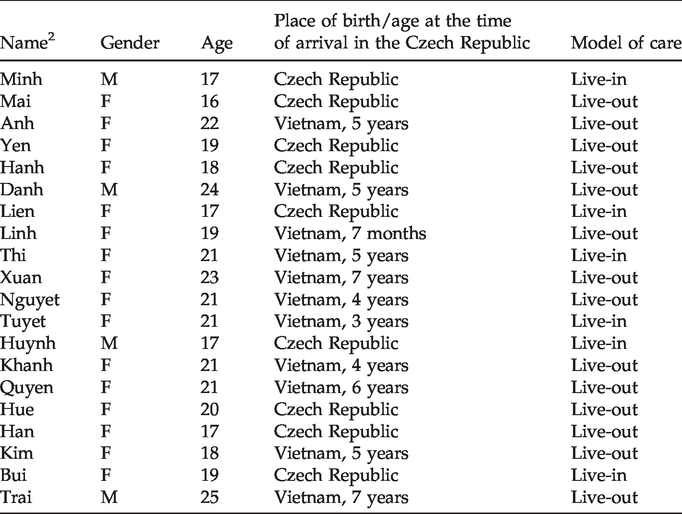
The profiles of the interviewees are presented in Tables 1 and 2. Table 1 shows that 11 of the 15 children interviewees were female; their ages ranged from 16 to 25 years old; nine were born in the Czech Republic while six were born in Vietnam and arrived in the country when they were between three and seven years old. The two models of care are either live-in or live-out. In the former, the child lives in the nanny’s place and the nanny thus becomes the main caregiver for a considerable period of the child’s life. In the latter model of care, the child spends time with the nanny only when the parents are at work. The child may spend the time in the nanny’s place, or the nanny goes to the home of the Vietnamese family. In the sample, the children were almost evenly divided between the two models of care.
Profile of the children.
Profile of the mothers.
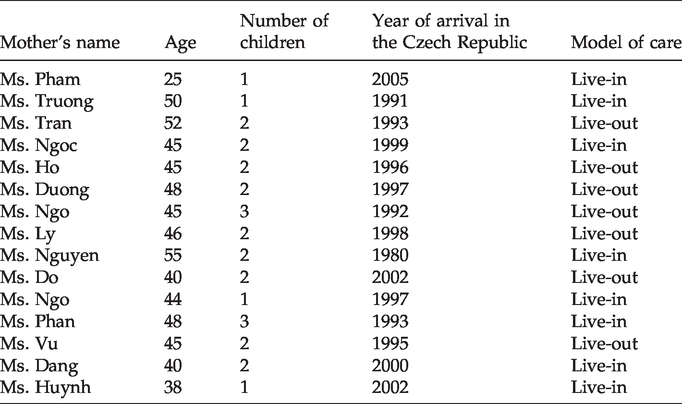
For the sample of mothers (Table 2), most of them had either one or two children; two had three children. They arrived in the Czech Republic between 1980 and 2005. The information on the model of care either refers to having a nanny employed at the time of interview or had previously employed a nanny.
The interviews covered several topics. I started with the very general question “Can you tell me anything about yourself?” This initial question allowed room for my interviewees to construct their stories concerning their experiences, ideas, and the issues they found important in relation to the topic of paid childcare. All the interviews were, with the informed consent of interviewees, recorded and transcribed. The interviews with children covered both their recollections of childhood and their present interpretations of their relationships with their nannies and parents. I asked the children about their relations with their parents, their relations with their nanny/nannies, and their reflections on how they were brought up and the roles of their nanny and their parents in that upbringing. The interviews with mothers, similarly, dealt with many issues, especially the migration trajectory—work and family life in the Czech Republic, ideas about caregiving, the sense of belonging in the Czech Republic, and plans for future migration.
The analysis concentrated on the link between parents’ migration and the notion of parenthood. I traced the links children and mothers make between the past (and future) migration and the way they understand parenthood. I compared the children’s statements with those of the mothers in order to explore the differences between second-generation and first-generation viewpoints. This comparison between two generations with different past experiences and future aspirations uncovered some tensions and ambivalences of parenthood. The analysis presented below focuses on a particular group of Vietnamese immigrants (first-generation parents and second-generation children) that employs a specific model of childcare, and this must be kept in mind when reading the research findings.
Parents’ migration to the Czech Republic: The children’s perspective
The interviews with second-generation immigrant Vietnamese children include reflections on the particular migration scheme and on their parents’ pre-migratory and migratory experiences, suggesting that the topic is discussed in the family arena. The children articulated two particular topics: the “tough life” of their parents before migration and their parents’ migration trajectory. The first topic concerns particularly references to war and the poverty under which the parents lived. This came up in the interviews along with admiration for how their parents were able to get out of bad conditions and make a living elsewhere. For instance, Lien, a 17-year-old girl born in the Czech Republic, talked about her father as her role model. She admired his efforts and the hard work that enabled his success in a new country. She said, “My father was one of nine siblings, my mother one of five, and they hardly had anything to eat and worked every day from morning to evening.” All the interviewees saw their parents’ migration as child-oriented, acknowledging that their parents left Vietnam in order to ensure a better future for the children and a better life than they themselves could ever have.
The other topic that the second generation reflected upon was the history of Vietnamese migration to the Czech Republic. The account of Thi, a 22-year-old university student who was born in Vietnam and came to the Czech Republic at the age of three, was a common pattern of Vietnamese migration: My father studied here in the 1980s, then he went back to Vietnam. In the 1990s, the big boom of Vietnamese markets started, so he decided to return here. At that time, it was Czechoslovakia. And me and my mother, we joined him in 1994, thanks to family reunification.
Between admiration and rejection: Children’s and mothers’ accounts of parenthood
Several scholars researching the dynamics of migrant families argue that families are not battlefields between generations. Rather, the family is the arena where strains and conflicts meet with caring, loyalty, gratitude and affection (Foner and Dreby, 2011). The analysis of children’s and mothers’ perceptions of parenthood, intergenerational relations, and child-parent relationships capture this range of emotions. The analysis revealed three key issues concerning the notion of parenthood and the emic definitions around it: (a) “education-oriented parenthood,” in which both the performance of parenthood toward children and the main aims of parenthood are oriented to educational efforts and the achievements of the second generation; (b) the praxis of “proxy parenthood,” which relies on the presence of the nanny and the distribution of care responsibilities between parents and the nanny; and (c) discrepant parental expectations around ethnic identity and the sense of belonging of the second generation. All three aspects are negotiated on the subjective level, but they are shaped by the social and cultural context and pre-migration experiences.
Social mobility: Working parents, educated children
One of the main issues articulated by both the first and the second generation is the work life of the first-generation Vietnamese immigrants generally, and their parents in particular. As noted above, ethnic entrepreneurship developed after 1989 and to this day, self-employment is still the main work strategy of the first generation (see Hofírek and Nekorjak, 2009; for similar situation in Slovakia, Williams and Baláž, 2005; in Poland, Szymanska-Matusiewicz, 2016). However, it is not expected (by either the first or the second generation) that the family business will be passed on to future generations. On the contrary, ethnic entrepreneurship—which includes downward professional mobility in the post-migratory phase and requires long working hours and the extension of work life over family life—is interpreted as the mechanism used by the first generation to provide upward social mobility for the second generation. This argument appears across the sample, as suggested by the following: The aim of our childrearing is to encourage them to do well […] in everything. We are foreigners and so it will be very hard for them to show that they are as good as anyone else. We want them to have a better life than we currently have. (Ms. Ho, mother of two children) They [parents] came here for a better life. And I know that they would like to return back [to Vietnam] as soon as possible. They are here only so that I could have quality studies, the right to a quality life, to which they did not have the right because they did not have choices. It is a kind of engine, when the Vietnamese students are very diligent, so they are motivated by this, by the consciousness about what life their parents had. And they did not have a choice. And the parents keep on hammering it in their [children’s] head how it used to be. The parents know well that if the children behave well, they just understand why the parents had to go through so many things—for the better future of their kids. So, I do realize that my parents sacrificed all their lives for us. And it is a huge sacrifice because it is a strange world here for them. It will always be and they can never integrate. It is hard, well, they will never integrate, no matter how much they would like to. So, it is a motivation for us when we know what they did for us. So that we could study. That is why we are not the kind of kids that have to go to school, but that want to go to school. (Hanh, 18 years old, female, born in the Czech Republic) My parents want to return, 100 percent. My mother told me that once I have my own family, my own husband, and maybe my own children, she will say to herself “my daughter has her own life.” And once she says this to herself, she will leave because, in fact, she will have completed her work here and she would have nothing more to do here in the Czech Republic. (Lien, 17 years old, female, born in the Czech Republic)
The third aspect concerns the idea of a “better life” or “better future” that is mentioned in all interviews. Living a better life is not a promise but rather an imperative for children who know about their parents’ sacrifices. The social mobility of these children is derived from their parents’ sacrifice of their own social mobility and the intense work life in the immigrant economy. The “better life” rests on the economic capital of the parents that the children must transform into cultural capital to succeed in the labor market. As the narrative of Ms. Ho suggests, the children’s success will come about when the children are “better than the best.”
Migration, thus, makes possible the performance of good parenthood which means creating life conditions for the children that allow them to live better lives than they could ever have in Vietnam, overcome the stigma of being foreign through investments in education (e.g., paying for extra courses, private teachers and others), and promote integration in the labor market and Czech society. In sum, the relationship between mother and child is negotiated against the background of the migratory experience that children inherit from their parents. The children, consequently, find themselves under pressure to avail the opportunities made possible by their parents’ migration. The children’s success validates that the parents’ sacrifices are worth it while freeing themselves from the stigma of foreignness. Education is the pathway to be free from this stigma and is the reason why education is central to the notion of parenthood.
Parenting by proxy: Czech nannies in Vietnamese families
Delegation of care is one of the key aspects of parenting in many Vietnamese immigrant families. Although there are no official statistical data about the frequency of the delegation, the interviewees I spoke with reported that it is a “normal thing” in Vietnamese families. According to them, many Vietnamese families hire nannies to take care of their children. 3
The need for nannies emerges in the context of post-migratory life conditions (the particular constellation of work life, parenthood and separation from the extended family) and the different cultures of care and definitions of parenthood that Vietnamese parents bring with them from their native country. The work life of first-generation Vietnamese immigrants is characterized by engagement in the immigrant economy and by self-employment. The mothers I interviewed were entrepreneurs or self-employed businesspeople running clothing stores, nail studios, fast food outlets and restaurants, and recently, convenience stores. Either they were part of a family business or, more frequently, they ran their own business. Self-employment exacts significant time demands on parents—usually at the expense of the time spent with children, as both the mothers and children reported. For example, Ms. Duong, a mother of two children, reported that Vietnamese immigrants work more than their Czech counterparts. She said that if she were in Vietnam, she would work less than she does in the Czech Republic. The extended work hours were therefore seen as related to the immigrant life. However, work was not seen as a means of accumulating money per se. The money is earned to ensure a “better tomorrow” for the children, very often through education that is viewed as key to the second generation’s successful integration in the labor market. As mentioned earlier, Ms. Ho, a mother of two children, returned to work a few months after the birth of her children—ten months after her first child was born and two months after giving birth to her second child—to ensure that her children can get a good education. She and the other parents see education as a means to ensure that they children find highly skilled jobs in Czech society. Elsewhere, I have argued that: The work ethic of Vietnamese mothers is not based on the ideas of self-realization, but on providing children with the economic capital that the children are supposed to then turn into cultural capital. The family is primarily an economic unit meant to support social upward mobility for the next generation, and to ensure prosperous post-migratory lives. That is why it is more important for mothers to work and earn money for the future of their children than to be socially and emotionally present in their children’s everyday lives. (Souralová, 2015: 63)
The second reason it is difficult to maintain a traditional Vietnamese work ethic in the Czech Republic is the missing kin network, particularly the absence of grandmothers to whom childcare is traditionally delegated both in Vietnam and in the Czech Republic. The Vietnamese immigrants whose parents live in Vietnam cannot access caregiving by grandmothers, unless they hire other children’s grandmothers. The Czech nannies therefore supplement the care provided by the mother and supplant the Vietnamese grandmother (see also Nelson, 1990). In many cases (when the nanny is the age of a typical grandmother), this is how the relationship between the children and the nannies is framed—as an intergenerational grandmother-grandchild relationship (Souralová, 2019).
In sum, although it could seem that hiring a Czech nanny is the parents’ strategy for integrating the children into Czech society, the motivations originate in their definition of parenthood and the preferable ideals for work and family life reconciliation. The promotion of the integration of the children through the Czech nannies is a by-product of this model. As the next section will show, this integration and outcomes for parent-child relationship has both positive and negative aspects.
Transmission of cultural capital in caregiving
Growing up with Czech nannies, the children develop close ties with them and learn the nanny’s culture which is transmitted in the process of caring (see Macdonald, 2010; Bourdieu, 2001). In their reflections about their childhood, they contrasted the upbringing they received from their parents with that received from their nannies. They emphasized the “active time” spent with their nannies and the “passive time” (e.g., sleeping at night) spent with their parents. In the narratives, there was an implicit critique of the parents who “did everything for us, but nothing with us,” as one interviewee put it. At the same time, they explicitly expressed gratitude to their parents and admiration of their sacrifice for the children. In other words, the interviews were filled with deep ambivalence between the children’s comprehension of their parents’ parenting (“they did everything for us”) on the one hand, and dissatisfaction with the little time spent together and the lack of depth of the ties with parents.
By delegating childcare to Czech nannies, the children learn the Czech language, but they forget Vietnamese, an important marker of ethnic identity. This is expressed by the following testimonies: Having a Vietnamese nanny would have been the best way to teach the kids our language [Vietnamese] from early childhood. Later, in kindergarten, they could have learned the second [Czech] language. They would have been fluent in two languages and their Vietnamese would have been better. (Ms. Duong, mother of two children) I think that most Vietnamese parents send their children to Czech families not only because they want their kids to learn the language, but so the children are later able to help them, their parents, with the Czech language, the Czech community, and just to understand the problems that they themselves do not understand very well (like laws, education, economy, contracts, administrative issues, etc.). And on the other hand, they never thought about the fact that this way, the children would forget the Vietnamese language. So, when my father gave me a contract [in Czech], I understood but I could not explain it to him [in Vietnamese]. So, then he scolded me for attending school and being unable to explain it to him. My parents thought I would not forget Vietnamese. (Quyen, 21 years old, female, born in Vietnam)
First, the children describe their nannies as mediating “authentic” Czech culture to them. The emphasis on authenticity was evident in the following interview: Without my aunt, I would not learn that much. Like the Czech customs. When I was with my aunt, I saw pig-slaughtering and how everything is done—meat jelly or blood sausage. I would not know these rituals. Or how the typical Czech Christmas and Easter are celebrated. Or Advent. Every year, my aunt gave me an Advent calendar. It is not common in our culture […] I could get to know the culture even better. Of course, I attended Czech schools and they told us that the first candle is lit for the first Sunday of Advent. So, I knew it from school. I would know it without my aunt, but with her, I could experience it authentically. (Bui, 19 years old, female, born in the Czech Republic) My only problem was that I did not speak Vietnamese very well. Fortunately, my father speaks Czech, so it was not such a problem to speak with him. But with my mother, it was worse, we could not speak much; that is a pity. And it is still true today that I cannot chat with my mother because of this language barrier […] I think my parents did not expect that I would forget Vietnamese so quickly and that I would adopt the Czech mentality. But recently, they started realising that I feel Czech. And they know that I will stay here [in the Czech Republic] and they will return [to Vietnam]. (Thi, 21 years old, born in Vietnam)
Conclusion
This article dealt with several aspects of the parent-child relationship in Vietnamese immigrant families, in which childcare is delegated to Czech nannies. This relationship is often marked by ambivalence between parents’ efforts to provide everything that will promote their children’s integration and success in the Czech society and the misunderstandings and gaps between parents and children. Most of these misunderstandings derive from the lack of time spent between parents and children during the latter’s childhood when caregiving responsibilities were performed by nannies. The parent-child relations are highly influenced by the migratory experience of parents and their post-migratory (work) situation. Parenthood ideals, such as the goal to provide children with a better future in Europe, shaped the parents’ decision to migrate. Following their migration to the Czech Republic, the performance of parenthood was affected by work-life balance, the delegation of care to nannies, and the emphasis on the children’s success.
The children’s interpretations of their ties with their parents balance between criticisms of the emotional distance from their parents and the recognition of their parents’ parenting strategies, including the recognition of the sacrifice for the children’s better future. The distance appears in the narratives in two forms: it is the reflection of the distance between children and parents caused, above all, by the language barriers; and at the same time, it is the cultural distance from the Vietnamese-ness. Such distance is the unintended consequence of the delegation of care when the child spends much more time with the nanny’s Czech family than with the Vietnamese parents. In their narratives, the nanny’s family was described as the most important fact shaping their cultural distance—even more important than educational institutions or peers. As children, they were sad that they were not able to spend more time with their parents, go for holidays, or just sit and talk. However, as they became adults, they were able to see the positive sides of the parents’ parenting. Apparently, the understandings of parenthood vary through and over time: the second-generation immigrants say that now they understand that the parents did everything for them, although in their childhood they felt that parents did nothing with them.
The research concerning how parents and children link past migration, future migration aspirations, and parenthood strategies illuminates the active daily negotiations of what it means to be a migrant parent and a child of migrant parents. At the core of these negotiations are ambivalence, different generational viewpoints, and misunderstandings as well as recognition, appreciation, and admiration. The parent-child ties are complex and embed both micro practices and macro processes of the past and future of the parents’ migration and post-migratory employment. Studying these particular parenting strategies and experiences sheds light on the process of Asian-European migration, its roots, routes and general characteristics.
Footnotes
Declaration of conflicting interests
The author declared no conflicts with respect to the research, authorship and/or publication of this paper.
Funding
The author disclosed receipt of the following financial support for the research, authorship and/or publication of this article: This research was financially supported by research project number MUNI/A/1158/2019 at Masarykova Univerzita (Masaryk University).

1
In this study, I use the term “second generation” to include the 1.5 generation––those who were born in Vietnam, grew up there, and migrated to the Czech Republic with their parents (see also the section on the study design).
2
All names have been changed.
3
Vietnamese families could afford to hire nannies, who were mostly paid a token fee. The nannies were not dependent on their wages as they were either receiving a state pension or maternity benefits.