







Abstract
This paper explores the “sporadic hyper-precarity” encountered by migrant domestic workers in Hong Kong when the city was hit by the Omicron outbreaks in early 2022. Migrant workers have long been suffering from job insecurity and structural vulnerability due to the contractization and flexibilization of work. The paper discusses how this structural vulnerability came to intersect with the health risks induced by the COVID pandemic. Adding to the debates of the structural precarity characterizing migrant work, we will further interrogate how workers are also susceptible to “sporadic hyper-precarity” – the kind of sporadic risks, uncertainty, vulnerabilities and stigmatization at times of crisis. The paper will elaborate on the “sanitized divide” and “care divide” between local families and domestic workers that has resulted in the unequal treatment of workers.
Keywords
Introduction
Hong Kong encountered its fifth COVID-19 wave on 26 December 2021, induced by the spread of the Omicron variant. Cases climbed from a few tens in mid-January 2022 to more than 50,000 a day in early March. By late March 2022, the total number of infected people was over one million, one-seventh of the total population, with a record-high death toll of more than 7,000 by April 2022, resulting in Hong Kong recording the highest death rate as the result of Omicron in the world (Lee, 2022). 1 Among the one million positive cases, many involved households that employed foreign domestic workers (FDWs). Although there is no way to identify exactly how many workers became infected, as part of the densely populated urban community, they had the same high chance of catching the fast-spreading Omicron virus. However, some of these infected cases came to international attention because their post-infection plights were particularly appalling (Reuters, 2022; Wang, 2022). These included cases of foreign domestic workers who were abandoned by their employers and left to cope with illness, distress and hunger on their own on the streets (Carvalho, 2022). They obtained shelter only when non-governmental organizations (NGOs), labor groups and volunteers came to their rescue (SCMP, 2022).
This paper explores the appalling plight of some domestic workers during the Omicron wave, and the general sanitized divide between the employer family and worker in times of crisis. Despite the fact that Hong Kong society as a whole had not experienced any internal lockdown, it was common to find employers setting up new rules at home to disallow or discourage workers from going out on their days off. Domestic workers were the frontline sanitary workers keeping employers’ homes clean during the COVID crisis; however, they were considered “dirtier,” and public officials often described them as high-risk groups prone to infection (Wang, 2021; Wong, 2021). 2 The Hong Kong government also singled out foreign domestic workers (FDWs) for mandatory COVID testing (HKSAR, 2020)—the only mandatory testing imposed on a particular profession (Lau, 2021). Workers also generally worried that if they caught COVID from outside, they would be blamed or punished by their employer. Thus, the “politics of sanitization” illustrated here entails state-endorsed stigmatization against migrant domestic workers and a sanitized divide (see the introduction in this Special Issue).
We interrogate this form of precariousness with the concept of “sporadic hyper-precarity” in relation to the specific context of a sudden emergency situation. While FDWs had already been facing precarious life worlds in pre-COVID time, “sporadic hyper-precarity” occurred when the hosting society encountered a life-threatening public health crisis. The scholarship on workers’ precariousness has stressed how neoliberal capitalism and the global job market have created unfavorable conditions for workers (Silvey and Parreñas, 2020; Piper et al., 2017; Paret and Gleeson, 2016; Hewison and Kalleberg, 2012). Subject to the contractization and flexibilization of work and the lack of legal protection of worker rights, the precariat (a new underclass) has long been suffering from job insecurity and structural vulnerabilities (Standing 2011; Milkman 2020). Lewis et al. (2015: 580) further develop this debate by using the concept of “hyper-precarity” to stress the notion of forced labor and a “continuum of unfreedom” that workers experience.
Building on the previous debates of the precarity literature, we analyze how workers are also susceptible to “sporadic hyper-precarity”—the kind of sporadic risks, uncertainties and vulnerabilities encountered amid the fast-changing and unpredictable situations in a pandemic crisis. This notion highlights the porous and fluid situations that migrant workers slip in and out of in the face of such a risky time as a virulent pandemic. Similar situations and precarity may occur at other “risk” moments, since migrant workers, the precariat, are often the last to be cared for when social resources become scarce. This concept provides a nuanced perspective and alternative framework in analyzing the “situational” plights of these workers and the exploitation they face in specific moments of crisis.
Methodology
For this research, we conducted 15 semi-structured phone interviews with domestic workers, 3 including those who were terminated or abandoned by their employers after they were infected. Some of these workers were referred to us by domestic workers’ organizations, while others were identified through snowball sampling. We also interviewed two NGO workers and three activists from labor groups who provided accommodations and medical and other assistance to the sick workers. There were two interviews with employment agency workers who had daily contact with workers. To supplement the analysis, we also collected news reports from the media (both local and international) on the plight of Hong Kong migrant domestic workers during the Omicron outbreaks. All interviews were conducted by phone in Cantonese or English between mid-February and mid-April 2022.
In the following, we first provide a general overview of the development of the domestic care industry in Hong Kong and the recent decline in the number of workers. We explain the nuanced conceptualization of the precariousness that workers encountered recently in Hong Kong as a result of the pandemic. Based on the data provided by labor activists and NGO workers, and the narratives of domestic workers, we further interrogate the notion of sporadic hyper-precarity to highlight how frontline care workers lack care when the hosting society is in crisis. Finally, we recommend a more long-term policy for providing the needed care to migrant domestic workers.
Domestic work in Asia: A view from Hong Kong
Domestic work is one of the largest work sectors in the world. According to International Labour Organization (ILO) statistics (2020), around 67 million people in the world are employed as domestic workers, both within and across national boundaries. It is predominately a female-dominated sector in which 80–83 percent are female (Simonovsky and Luebker, 2011). Migrant women are often frontline workers providing care for families in high-income countries facing a “care deficit” (Datta et al., 2010). Many have pointed out the problematic and unfair treatment that migrant care workers have been receiving and the unsustainable development of the care infrastructure (Bélanger and Silvey, 2020; Huang et al., 2012). The pandemic has shined spotlight on the essential nature of care and domestic work, at the same time exposing the lack of care for migrant workers.
Asia is the region producing as well as hosting the largest numbers of domestic workers (ILO, 2020). A basic reason for these women to go abroad and work for other people’s family is to earn a higher income and send remittances back home to their families. The remittance economy has expanded rapidly over the past few decades, exceeding the volume of official development aid (ODA) and approaching the level of foreign direct investment (FDI) flows in 2018 (KNOMAD, 2019). Exporting human labor has been an important strategy of many developing countries in Asia, such as the Philippines and Indonesia, the two major sending countries of domestic workers. Despite the economic benefits that overseas workers have brought to their countries of origin, some have argued that an overdependence on labor export will not be a sustainable development strategy (Ebeke, 2012).
Foreign domestic workers (FDWs) in Hong Kong, 2016–2021.
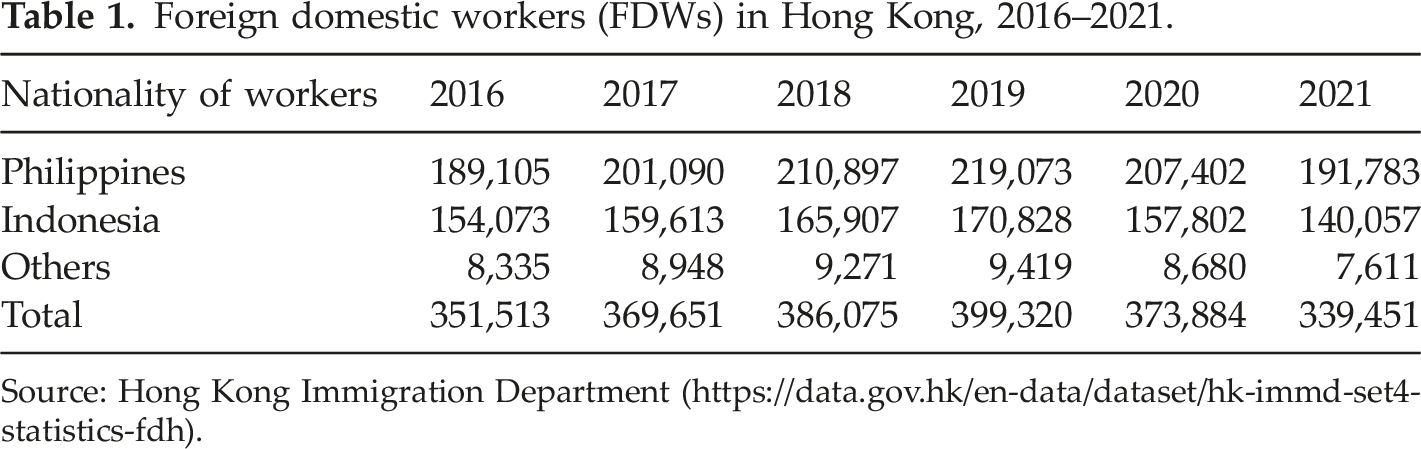
Source: Hong Kong Immigration Department (https://data.gov.hk/en-data/dataset/hk-immd-set4-statistics-fdh).
Ever since the coronavirus outbreak in January 2020, the Hong Kong government has not abandoned its border closure and quarantine policies. Accustomed to being one of the busiest international airports in the world, the Hong Kong airport witnessed a decline of 61.3 percent in 2020 and of 65.5 percent in 2021, when compared with the year 2019 (Civil Aviation Department, 2022). Hong Kong has also installed the “fuse mechanism” in July 2020, to impose flight suspension and to place a total ban on flights from “high-risk” countries. 4 For example, flights from the two most important labor-source countries, the Philippines and Indonesia, were called off from time to time. Incoming workers had to go through 14-day quarantine. All these measures imposed huge economic pressures on the employers and stresses on the workers. While applications for domestic workers had become most costly and time-consuming, workers who continued to work for Hong Kong families also felt pressures they had not experienced before. For example, they received constant instructions from employers on sanitizing the home space, washing and cleaning more frequently and refraining from seeing their friends.
The Omicron scares in Hong Kong hit a nerve among employers, who became even stricter than before about controlling their workers and therefore imposed more rules. The Hong Kong government also picked on FDWs who had gatherings on the streets. A few government departments joined forces to crack down on workers’ social gatherings and imposed fines on them (Grundy, 2022; The Standard, 2022). In the following section, we show how labor and labor migration scholars have explored workers’ precariousness in relation to the new situation posed by the pandemic.
Precariousness, domestic workers and new crises
“Precarity” has been a catchphrase used in labor studies for analyzing the contractization and flexibilization of work in late capitalism. With the retraction of governments’ roles in regulating global capital and providing social welfare, many workers are left on their own to face such situations as low benefits, short-term and flexible work and work without retirement schemes (Cruz-Del Rosario and Rigg, 2019; Paret and Gleeson, 2016). The flexible deployment of global capital in neoliberalism and the availability of overseas contracts have reinforced these situations. The emergence of a new low-end working class, the precariat, as described by Standing (2011, 2012, 2014), points to the fact that globalization and neoliberal capitalism have joined forces to create workers’ vulnerabilities. The opening of borders and the liberation of the global job market help global capitalists and employers obtain labor at the lowest possible cost. As Hewison and Kalleberg (2012: 396) point out, “The resulting global marketization of the economy and society has provided a platform that has permitted capitalism to free itself of the ‘spatial locks’ that had come to constrain its mobility and profitability.”
Contemporary conditions of precarious work often imply uncertainty, instability, and insecurity [emphasis added] (Vosko, 2010). Indeed, because work is a core activity of contemporary life, such uncertainty and job insecurity result in the overall marginalization and social exclusion of the precariat. Furthermore, with the advance of the global care supply chain, migrant women from the South have come to the forefront of care work. The lack of job opportunities and low income at home force them to go overseas. Such “involuntary migration” has become one development solution for both high-income and low-income countries (Piper and Withers, 2018). The former need labor, and the latter need jobs. Labor export policies and the transnationalization of female labor have precipitated a process of proletarianization and precarization of women in which multiple forces are at work to subordinate and marginalize female migrant workers (Rosewarne, 2014). Like any other precariats, these women are situated at subordinate positions in the global labor market, subject to employment uncertainty and the lack of work rights protection. Thus, they are particularly vulnerable to workplace abuses. Besides falling prey to the global structural coercion and economic development in the origin country, migrant workers usually lack free choices to enter alternative employment relationships. As pointed out by Lewis at al. (2015), deregulated labor markets, short-term contracts and indebtedness in the formal or informal economy have rendered many as unfree workers, who face hyper-precarity in many situations. This is especially true for those in dangerous jobs and with serious health issues.
Within the global care supply chain, Asia has been the location witnessing vibrant labor exchange for domestic workers. Countries in both South and Southeast Asia are major source countries of such labor supply to the richer parts of Asia. Yet even though domestic workers are essential workers who are at the frontier of safeguarding the social reproduction of Asian families, border-crossing domestic work has been one of the most precarious work sectors (Piper et al., 2017). Contracted workers usually have little bargaining power in securing working terms and conditions, while employers have the upper hand in determining the continuation or discontinuation of employment. In Hong Kong, even though migrant domestic workers’ rights are protected by labor laws and an employment contract with the guarantee of a minimum wage, statutory holidays, free food and severance and long service payments (Hong Kong Immigration, 2022; Wang et al., 2018), cases depriving workers of these lawful rights do exist. It is not rare to find workers being forced to pay excessive agency fees and endure unreasonable work demands and harsh living and work conditions (Lai and Fong, 2020; Wang et al., 2018; ILO, 2014). Thus, many workers must rely on both formal and informal support networks to handle adversities in their overseas work life (Baig and Chang, 2020).
In Asia, ever since the outbreak of the coronavirus, many domestic workers have been reported to have been locked up or dumped by their employers, and to have suffered extra abuses, regardless whether they had caught COVID (Chandran, 2020; Vilog and Piocos, 2021). In Hong Kong, while we acknowledge the fact that the shortage of labor supply during COVID times has in some ways enhanced the bargaining power of domestic workers, such as in terms of increased pay (see Chan and Lan in the introduction of this Special Issue), similar stories of abandonment brought the city into the headlines of the international media when it encountered the explosive blows of the Omicrons outbreak in early 2022. Such stories included the extreme cases of infected workers being asked by their employers to wait outside the public hospitals even when there was no hope of their obtaining a hospital bed space, 5 to “quarantine” themselves inside the employer’s private car, or simply to go onto the street when they fell extremely sick (Magramo, 2022). Infected workers were being treated like dirt and ordered to separate themselves from the family for which they were working. Even though it is unlawful in Hong Kong to terminate workers when they are sick and employers have the legal responsibility to provide accommodations to contracted domestic workers, some employers still responded irresponsibly and unethically when their employees were infected with Omicron. 6 In the following, we use the notion of “sporadic hyper-precarity” to examine how workers are susceptible to conditional vulnerability and deprivation at a time of uncertainty and crisis. Besides the cases of abandonment, we also elaborate on the mobility control imposed on the workers and the excessive stigmatization they experienced.
Sanitized homes, sanitized boundaries: A new divide between workers and the family
During the COVID-19 pandemic, although there has been a shortage of labor due to border closure and other COVID protocols, this did not automatically result in employers treating their workers better. Amid the two years of COVID scares, many Hong Kong families were under great pressure. It was quite common to see employers becoming extremely nervous about their workers’ weekend activities and attempting to put limitations and restrictions on them. One employment agent in Hong Kong said, “If domestic workers fetched infection from outside, they would likely be blamed by the employer.” This experienced agent told us that in spite of the close relationships between some employers and workers in Hong Kong, employers do not really see workers as part of the family. This could be tested when there was a highly contagious, life-threatening disease. Moreover, due to the small size of most Hong Kong families’ home space, employers would worry that other family members (especially children and the elderly) would be infected. In Hong Kong, many employers would say that they treat the worker as a part of the family. However, at a time of crisis, the divide became clear.
“Infections only happen on Sundays!”
The pandemic added to the physical and mental burdens of FDWs. Many workers have indicated that they felt the burdens of sanitizing their workplaces (i.e. employers’ home), keeping employers’ families from infection and doing more work than before because their employers and other family members were now working or studying from home. Extra sanitizing work and the frequent use of bleach at home created skin problems for some. The “sanitization” of the home space became one of the most basic duties of domestic helpers during the pandemic. Household cleanliness was stressed, and cleaning was carried out more frequently than before. Workers told us that they had become frontline workers to keep the virus down and ensure the sanitization of Hong Kong home spaces.
Despite being essential workers for sanitizing home spaces, domestic workers are paradoxically often considered a high-risk group, prone to catching the virus. During the first four waves of COVID spread in Hong Kong, the government discouraged workers from gathering on their days off. A state-endorsed discourse that stigmatized migrant workers and their gatherings on the weekends in the city’s open spaces was publicized and popularized throughout the pandemic. Before the pandemic outbreak, many of these open spaces adorning the cityscape (on flyovers, under bridges, in public parks, etc.) hosted small groups of domestic workers who met to enjoy food, music and prayers together on their holidays (Law, 2001). However, the pandemic and the government discourses suddenly painted these commonplace scenes as “dirt dens” and potential mini-epicenters of the coronavirus. Hong Kong government officials often reinforced the idea that the weekend social gatherings of domestic workers at outdoor spaces could constitute a dangerous/contagious space-time. Although most workers would follow the social distancing rule of not having more than two or four in a group,
7
they faced constant police crackdowns and were under the threat of steep fines (Sun et al., 2022). Thus, one could easily spot the bizarre sight of pairs or small groups of maids surrounding themselves with pieces of cardboard in public areas. One NGO worker commented, “It seems like infections would only happen on Sundays!” A labor unionist who was also a domestic worker herself summed up the situation as follows: We are treated like rubbish, the government from the beginning told the public that we are the high-risk ones, we are dirty, we are the virus, and we bring virus to the family if we go to the gatherings. The government mobilized one thousand police to check on the workers. But we do not go out just on Sundays, we go to the market every day ... people take MTR [Mass Transit Railway] every day, the employers go to work every day. There is no way to avoid the crowds in Hong Kong. ... But the government just set up that mindset [that domestic workers are the high-risk group] ... that helps justify employers’ wrongdoings.
With the advance of the more contagious Omicron variant, the government became more desperate in asserting control over the domestic workers. The Secretary for Labour and Welfare, Dr. Law Chi-kwong, reiterated the idea that “FDW [s] are a high-risk group,” and even suggested that employers should keep their workers at home on their days off by paying them.
8
Because of these state-sponsored stereotypes, Hong Kong employers generally held the idea that if workers attended gatherings, they were likely to contract the virus. Yet, the employers themselves went out for work five or six days a week, and also enjoyed meals at restaurants or invited friends home for fun. These social gatherings seemed to not bother Hong Kong people as much. For example, one worker said: “Employers brought people home to play mahjong, [and] we have to serve them [refreshments].” A divide was clearly set up between domestic workers and local Hong Kongers. While Hong Kongers’ communities were not less prone to the contagion, domestic workers’ communities were often singled out as the high-risk groups. NGO workers and labor activists informed us that there were pandemic-induced, newly imposed home rules at the workplace, which included the following consequences for workers: • Pay reduction if workers went outside on their weekly day off • Pay reduction if workers get infected with coronavirus from outside • Workers assume responsibility of they get infected with coronavirus from outside • Termination of contract if workers get infected with coronavirus • Termination of contract if workers do not stay at home on holidays
Besides these warnings, employers’ great concerns about their workers’ proneness to infection also led to new mobility control on the workers at home.
Mobility control imposed on workers at home
Employers would constantly remind workers to stay home or not go out for too long on holidays and their days off. For example, one worker was only allowed to attend church service for two hours, and was told not to take off her face mask or eat with any companions. Another worker was not allowed to take off her mask after she came home from outside. One worker mainly stayed in her employer’s house during the pandemic and had to ask for permission to buy her favorite snacks at the supermarket across the street. Another worker was not allowed to go close to the baby after she went out on Sundays. One worker, after catching the virus, was not allowed to use the toilet at home and was asked by her employer to use the public toilet.
One typical feeling among migrant domestic workers whom we interviewed was that they were at the brunt of the COVID spread. On the one hand, if they introduced the virus from outside, they would likely face their employers’ blame and/or punishment. On the other hand, if it was the employer who passed the disease to the worker, the worker would not be able to blame the employer. In other words, workers were not allowed to catch the disease “on their own.” The way of interpreting the activities of workers, the spreading pathways of the coronavirus, and the new “home rules” at the workplace clearly revealed these kinds of sanitized boundaries, informed and aggravated by state-endorsed discourses and misinformed stereotypes. These perceptions were being used to differentiate locals from migrant workers, and employers’ families from foreign workers in the home space. The worst plights of these workers during the Omicron outbreaks were “abandonment” and work termination. In the next section, we illustrate these situations through individual workers’ stories.
Termination, abandonment, despair: Hyper-precarity
Nadia
Nadia 9 had gotten a new employer through her employment agency after her contract ended in February 2022. The employer arranged for her to stay in a hotel to await her polymerase chain reaction (PCR) test results. While waiting, she was looking forward to having a new work life with a better employer. However, the nightmare began when she received a message stating that she had tested positive for COVID. Nadia immediately told her new employer and the agency about the news. Two days later, she got a message from the agency that she had been terminated by the new employer, who wanted the agency to pay for all the hotel costs and return the agency fees.
The employer told her that she was afraid that Nadia would bring the Omicron virus into the family. “I have no place to go,” Nadia told us. “A friend told me to get in touch with the HELP
10
center; that is how I get into the boarding house.” Nadia continued: I am sad and feel very stressed. Because I want to work. The employer terminated me because I am positive. But many workers were infected by the employers. A friend of mine got the virus from the employer family. The whole family was infected. She told me she had fever and running nose, but still needed to serve the sick family. During the past two years, the old employer couple asked me not to go out or go near other people during holidays. I followed. It is good for me, too. They were afraid that I would bring the virus to the family, and the old grandma will die. But sometimes they brought friends back home for gatherings. That was bad for me, because I needed to serve them and was not sure if they had virus or not.
Nicole
Nicole was driven away from her employer’s place after testing positive. Her employer kept asking her to stay and wait outside the hospital for a bed, but there was no place for her. That was a very cold winter day, but she kept waiting while having a bad fever. She used WhatsApp to contact her employer in order to beg her to let her return. But the employer said, “No, I cannot, it is the government’s responsibility to provide a quarantine place.”
Nicole tried to tell her employer that she was still under her employment, and it was the employer’s responsibility to take care of a sick worker. She kept sending the message to her employer, “Please tell me what I should do now … can I come back home?” But her boss just asked her to wait for a bed at the hospital. In the end, Nicole had no choice but to go back to her employer’s place, who kept her downstairs and refused to let her in. She said, “That night was really cold, I had no food and not enough clothing.” Luckily, Nicole received assistance from an NGO and was provided a bed space at a boarding shelter. She stayed there and was later transferred to a government-run quarantine center. After she recovered, she went back to the employer’s house. She said: I am not angry at her, but just very disappointed. I still have three months’ contract with her, but I will not continue after that. I told my employer, I am afraid next time if I test positive, you will ask me to go outside again. I heard from my agency, some employers took care of their workers, even a worker who had worked for only one month. The employers kept them at home and let them recover. I am disappointed. If Hong Kong is like this, like my employer, I would rather return to my own country.
Sally
Sally had finished her contract and was about to return to the Philippines for good when her former employer informed her that he was positive and was afraid that he had infected her. Sally got herself tested and the result was a bad blow to her. She was positive, and her friend could not let her stay at her place. She called a labor group and was assisted in going to a boarding center. “There were already around 20 workers when I got there. All were positive.”
Sally had been a domestic worker for 17 years. She was grateful for the work opportunities and good payment. She had raised her kids with the income from the work, and all of them went to university. Her two older children were now working and earning a good salary. Sally believed that she had a good relationship with her previous employer, who apologized to her because he had infected her at the last moment of the contract. She still kept in close contact with the family and let them know her plight. However, Sally believed that even with a good employer-employee relationship, 99 percent of the employers would not let workers stay in their home if the worker had become infected from outside. She said: Even with a good relationship like mine, employers will not keep their workers at home if they got infected. Actually, many workers were disappointed. A friend poured her feelings out to me, she was very disappointed. She desperately wanted to go back to the Philippines to meet her family and boyfriend. We saw so many workers being abandoned by the employers. We care for these Hong Kong families, but who care for us?
Penny
Penny was terminated by her employer after she tested positive. She stayed alone in a small room and had no water or blanket. After getting in touch with the Christian Action’s domestic worker group, she finally was given water and medicine, and was able to go to a shelter for temporary accommodation. She told us that she had been serving a British Indian family before she was terminated. She had no proper day off and was asked to clean every single corner of the house. “I had to work any time,” she said. “Now I am hoping to get a new job, but it is hard … I can’t just return to Sri Lanka because the situation [there] is very bad. We do not have enough medicine and vaccines there. ... I will need to work till I die.“ 11
Civil society activism and emergency rescue at a time of crisis
A charity organization, MercyHK,
12
led by Father John, has been providing emergency shelter for COVID-positive domestic workers. Father John told us that during the Omicron outbreak from February to late March 2022, the center accommodated around a hundred workers who had tested positive and had no place to stay. One-third of these workers had been dismissed by their employers after testing positive. Another one-third had been in between contracts, waiting at a guest house for their new contract, when they found they had contracted Omicron. The remaining one-third had been stranded at the airport after testing positive as they were about to board a plane back to their home country. “Many of these workers were in great trauma as they felt badly treated by the employers,” Father John said. One especially severe case was that of a worker who, after testing positive, was not allowed inside her employer’s home but slept at the back door of the house, next to a big trash bin, for a whole week. Father John stressed that although these unethical deeds were drawn from fewer than 1 percent of Hong Kong employers, he hoped that society could learn a lesson from such incidents. The Omicron wave had overwhelmed the hospital system and the government’s capacity. The large numbers of infections had caught everyone by surprise: We could respond to the urgent needs of the workers immediately and provide a shelter for the infected. We also take calls for help 24 hours a day. For example, many who tested positive and were stranded at the airport called us after midnight. They desperately needed a place to stay. We hope that we can learn a lesson from these. There is not yet a structure to deal with such an emergency situation. We now work in partnership with the government, we hope that in the future there will be a structure to deal with these problems.
Tania Sim, who runs the program for domestic workers for Christian Action, told us that this was the first time the organization had to deal with such difficult situations: We usually picked up the girls from the MTR [Mass Transit Railway] station. Many had tested positive at the airport and could not get on the plane to return home. They were left to roam around the city while they were positive. This is dangerous for everyone. When we saw them, they were in very bad situations, sick, sad, feeling abandoned, and didn’t know what would happen to them. They do not have family around them, and some worried whether they would die. So, when we pick them up, we need to show support, we cannot dress in full medical gear. I wore double masks, carry their luggage for them ... we have to assure them that they would be okay ...... We brought those who are recovering to get the PCR test, bought tickets for those who are ready to return home, and registered the infected ones with the government. You know what, even though the government already provides websites in their languages, many still had difficulties in filling in those websites or putting in information in the LEAVE HOME SAFE App.
14
When the girls said they could not do that, I said okay, I do it for you. Usually, we have to make videos to teach the workers step by step. Many sick workers did not get proper food and medicine from the employer. Some survived only on instant noodles. But when they were sick and had a high fever, they could not take that. We sent them oat milk and food for easy digestion. We sent medicine, too, including Indonesian and Chinese herbal medicine, Panadol, Vitamin C, etc. In some cases, we had to send underwear and [feminine] napkins because their employer locked them in the room and did not provide these. Some employers did not know what to do after the workers were found positive. They said their home was very small and there were babies and elderlies, and thus, they could not keep the sick worker at home. So, we had to help take the workers to shelters. We worked together with the Mission for Migrant Workers [MFMW] and the Bethune House to accommodate the workers.
16
It was the NGOs and labor groups which rushed to take care of these deserted workers. We joined hands to provide emergency responses. We raised funds and collected medicines and other donations. In a crisis situation like that, migrant domestic workers were particularly left alone and abandoned. It should be for the government to address such crises, but it responded only two weeks after NGOs started to help. If it had not been for the quick responses of the migrant NGOs, there could have been many more sick workers sleeping on the streets of Hong Kong. The NGOs’ work has prevented a human catastrophe.
Concluding remarks: Sporadic hyper-precarity and care divide
FDWs are the frontline workers ensuring a sanitized home for many Hong Kong families. They are essential for safeguarding normal household functioning and social reproduction. Ironically, they were deemed a high-risk group. The cases and situations we studied in this article reveal the huge divide between migrant workers from resource-poor countries and citizens in resource-rich countries, and the limits to the concept of “essential worker.” As migrants from the South, even essential workers are subject to sporadic hyper-precarity when the going gets tough. FDWs are those who provide care for families, but paradoxically they are often the last to receive care for themselves.
The pandemic has indeed exacerbated FDWs’ situational vulnerability. As one worker proclaimed, “We take care of them when they are sick, but who will take care of us when we are sick?” In the cases cited above, we have elaborated on the various situations in which employers can deprive workers of their lawful salaries, basic health care, accommodations and/or simply their jobs in the face of a threatening contagion. Some studies have examined the situation of the shortage of care that migrant workers and their families have been suffering from (Hennebry and Walton-Roberts, 2019; Bélanger and Candiz, 2020). Over the course of the various COVID waves in Hong Kong, it became clear that many employers would guard against domestic workers as “contagion sources” because they mingled with their peers. Such stigmatization and the structural secondary status of migrant workers have brought further deprivation. These also became the “excuse” for employers to impose excessive control on the workers, and rendered some ruthless after a worker tested positive.
The pandemic scares have also revealed the “care divide” between employers’ families and workers at a time when caring resources have become scarce. In moments of adversity and crisis during the COVID pandemic, we have witnessed how migrant workers fell into the many traps of “sporadic hyper-precarity.” They were generally stigmatized by the hosting society, and their lawful rights were taken away by some employers. The adverse social situations brought about by the pandemic outbreaks rendered these workers sporadically hyper-precarious. “Sporadic hyper-precarity” thus sheds light on the unpredictability and fluidity of the precarious situations that migrant workers can slip into and out of at specific moments of a crisis.
In terms of policy change, the Omicron crisis showed that labor organizations and the civil society were the most reliable supports that distressed workers could turn to. Their assistance constitutes important emergency relief. However, despite its high value, such interventions cannot replace medium-to long-term solutions to the need to provide care for foreign care workers. There is an urgent need for policy-makers to recognize the importance of a new emergency mechanism in times of crisis. Most importantly, relevant government units must consider ways to enhance their coordination with the civil groups and the civil society. In the long term, the Hong Kong government should take the lead in the establishment of a full-fledged social care policy and emergency care mechanism for migrant domestic workers, especially when there is a general social crisis.
Footnotes
Acknowledgments
The work described in this paper was partially supported by a grant from the Research Grants Council of the Hong Kong Special Administrative Region, China. We thank the two anonymous reviewers for their useful comments.
Declaration of conflicting interests
The author(s) declared no potential conflicts of interest with respect to the research, authorship, and/or publication of this article.
Funding
The author(s) disclosed receipt of the following financial support for the research, authorship, and/or publication of this article: This work was funded by a General Research Fund from the Hong Kong University Grants Committee (Project No. CityU 11604121).
