







Abstract

Keywords
Introduction
Since the last decade, the six countries composing the Gulf Cooperation Council (GCC) (i.e., Bahrain, Kuwait, Oman, Qatar, Saudi Arabia and the United Arab Emirates (UAE)) have implemented significant reforms aiming to transition from hydrocarbon-based, rentier economies to knowledge-based, high-value-added, and diversified industrial development economies, to lower the dependency of the region’s citizens on public spending. Past labor, and migration dynamics and policies, among which is the kafala (sponsorship) rule that binds foreign workers to their employers, are being overhauled to increase opportunities for Gulf citizens in private sectors, as well as to upgrade the migrant, and national or citizen workforces’ skill level. Governmental statements also advocate for reducing employers’ reliance on foreign workers, yet some restrictions to the socio-economic integration of foreign residents are progressively lifted, and some pathways to long-term stay and naturalizations are opening.
The articles composing the Special Issue were first presented during a conference workshop entitled, “Recent Labor and Migration Reforms and Policies in the Gulf: Impact on Economies and Societies.” 1 Contributors to the issue assess the perceived and actual outcomes of the reforms in labor and migration policies since 2010—such as the localization of labor in many economic sectors and professions (e.g., Saudization and Kuwaitization), and reforms to the residency rules—on Gulf labor markets and societies. This introduction sketches the background and context of the reforms. From the standpoint of various disciplines of the social sciences (economics, political sciences, political economy, sociology and anthropology) and relying on a diversity of methodologies including in-depth fieldwork, the eight contributions then critically examine issues, such as the differentials in the perception of migrant workers between Gulf states and structural reasons behind changes in migration policies, foreign migrants’ evolving patterns of employment and socio-economic inclusion, prospects for skills transfers between foreign and national students, tensions between states and “traditional” business classes, and Gulf citizens’ perception of the changes in the “rentier social contract.”
Mass immigration, exclusion and the rentier social contract
Total population and percentage of nationals and non-nationals in GCC countries (mid-2022).
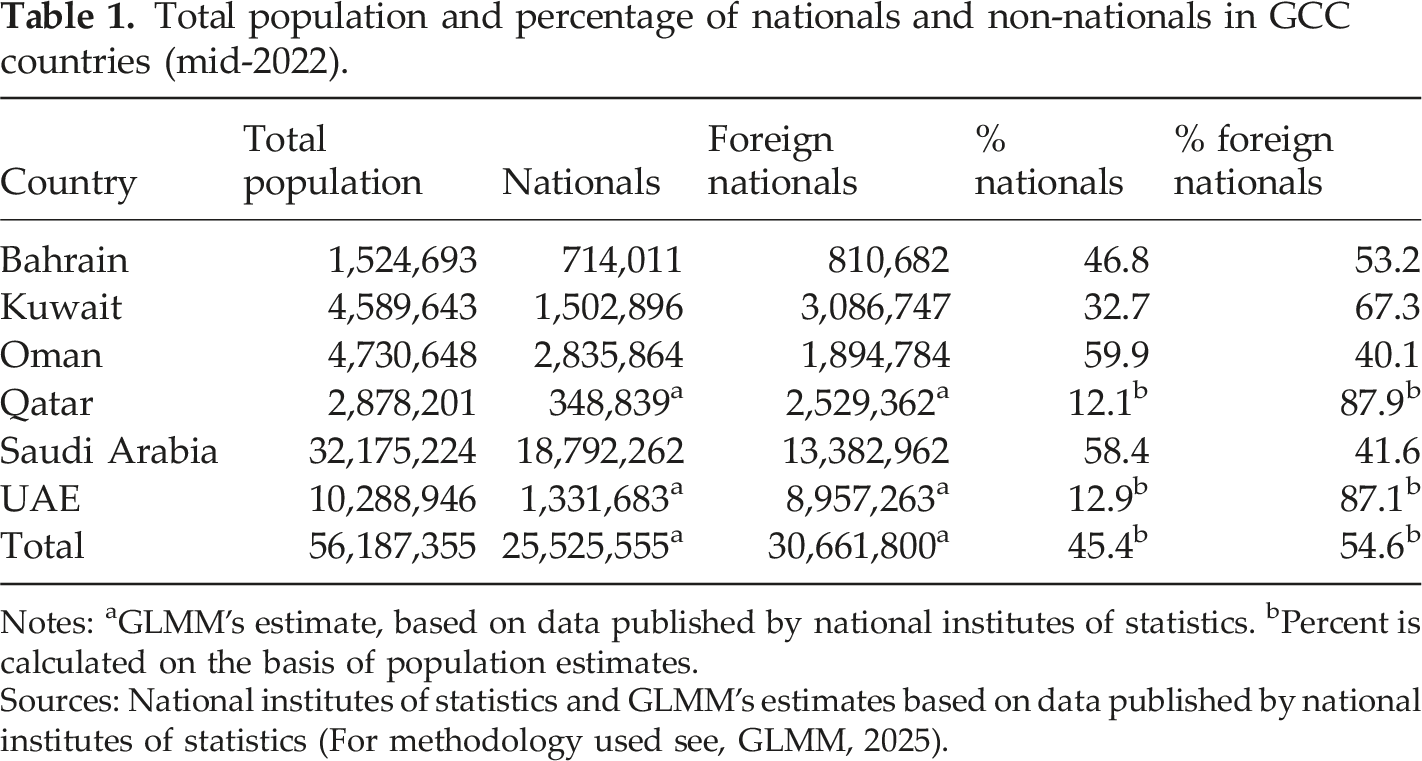
Notes: aGLMM’s estimate, based on data published by national institutes of statistics. bPercent is calculated on the basis of population estimates.
Sources: National institutes of statistics and GLMM’s estimates based on data published by national institutes of statistics (For methodology used see, GLMM, 2025).
Such exceptional levels of immigration, however, are combined with an exceptional exclusion of foreign migrants from local societies and citizenries (Fargues, 2011). Until recently, the Gulf states did not conceive of themselves as immigration countries and still designate non-citizens as temporary contract workers or “guests” (wafidîn). The policy of non-integration of foreign migrants into Gulf societies and citizenries is rooted in the political economy and nation-building processes in the region: The constructed categories of “nationals” or “citizens,” as opposed to the “foreigners,” define who is entitled to a share of the oil rent (Fargues and De Bel-Air, 2015). This “rentier social contract” 2 was thus endowing citizens with socio-political distinction and material privileges, namely, a share of the hydrocarbon wealth in the form of guaranteed income—especially governmental employment and access to various subsidies. Furthermore, by delegating to citizens the management of the workforce through the kafala (sponsorship) system, which placed foreign laborers in a position of “structural dependence” vis-à-vis nationals or sponsors (Longva, 1999), the “rentier social contract” also offered opportunities of “monetis[ing] one’s citizenship” as “Arbab” entrepreneur, that is, generating income from selling sponsorship to foreign workers or companies (Al Hussein, 2025). In the context of large-scale immigration, from the late 1970s on, access to citizenship was thus progressively restrained to protect its value (Beaugrand, 2017; Lori, 2019), subsequently creating “dual societies” in the region. Notwithstanding their “everyday integration practices” and perceived experience, as highlighted by Gennaro Errichiello (2025) in this issue, from a legal point of view non-citizens are considered temporary contract laborers and have little social and no political membership in the region.
“Time to update the social contract”
Dual labor markets (Fargues, 2011; Fargues and De Bel-Air, 2015) also characterized Gulf states, whereby male expatriates dominated the private sector and foreign females staffed (and still do) the household-bound, domestic services sector, while nationals mostly occupied governmental jobs. As a citizenship-based privilege, nationals also enjoyed precedence in employment over foreign workers in the private sector, entitlement to welfare packages and salaries higher than those granted to most foreign professionals, for shorter work hours (GLMM, 2018).
However, as high fertility levels expanded the number of young job applicants, citizens’ unemployment also grew. In the 2010s, unstable oil prices forced Gulf governments to significantly reduce public expenditures and governmental jobs (Herb, 2017). The globalization of Gulf economies, the contraction of oil wealth and the economic unsustainability of the kafala-based dual labor markets compelled Gulf regimes to engage in economic diversification. The conundrum was thus to “update the social contracts” (Forstenlechner and Rutledge, 2011) in the region, that is, shift from redistributing the oil rent through governmental employment and subsidies in return for political allegiance, to channeling nationals to productive employment in the private sector without jeopardizing the regimes’ stability. Gulf states’ policymakers were faced with a triple challenge: Create employment opportunities to alleviate nationals’ unemployment, make them attractive and rewarding to young nationals, and ensure that the nationals acquire the necessary skills to perform the required tasks.
The socio-economic reform process: Setting up knowledge-based economies
Improving the human capital and, more generally, fostering sustainable growth through high value-added, service-oriented and high-tech industries across the GCC emerged as the only way to resolve the dilemma of attracting Gulf nationals to productive activities to increase low activity rates and counter the “welfare-state ethos,” 3 while at the same time enhancing the status of local workers.
Ambitious reform masterplans were launched during the 2010s (e.g., Qatar National Vision 2030, Saudi Arabia Vision 2030, Kuwait Vision 2035, Oman Vision 2040 and We the UAE 2031, for instance). Like in other Gulf states, the Saudi Arabia Vision 2030 set goal is to create a knowledge-based economy in the Kingdom through investing in education and fostering innovative, high-value-added industries, especially in information technologies (ICTs). Improving education systems and their countries’ “human capital” are among the top priorities of Gulf policymakers. Qatar, the UAE and the other Gulf states streamlined the opening of branches of prominent Western universities on their soil and actively promoted the study of STEM (sciences, technology, engineering and mathematics) subjects, especially among women.
Labor nationalization policies
As a prime focus of the socio-economic reform process, these policies aim to create more jobs for nationals, among other means through partially or completely phasing out expatriates from positions and activity sectors likely to absorb nationals. For instance, mid-level clerical positions and industries, especially in the retail, hospitality and tourism sectors, were primarily targeted in Saudi Arabia’s Nitaqat program launched in 2011. With the exception of the UAE and Qatar where citizens are too few to replace all expatriates, government sectors are nearly reserved for nationals. Policies combine incentives to hire more nationals with sanctions for non-compliant companies, and quotas of Saudization, Omanization, etc., vary according to profession, sector and size of the company, while nationalization targets are constantly readjusted. Saudi Arabia’s Nitaqat program also set a minimum wage for nationals in the private sector, which increased to 4,000 Saudi riyal (SAR) (approximately USD 1,066) in April 2021.
One of the objectives of recent changes in labor laws, and the introduction of social security provisions and mandatory health insurance schemes for both local and foreign workers (ISSA, 2024), is also to reduce the labor cost gap between national and foreign workers. This aims to balance employers’ preferences and promote the employment of citizens, while also enhancing compliance with international workers’ rights regulations (Hertog, 2018).
While the economic rationality of labor nationalization policies in the Gulf is not yet proven, due to remaining differences in labor costs and rights between citizens and foreign workers which lead employers to prefer the latter (Hertog, 2018), labor nationalization policies play a political role: First, they permit governments to gain some control over the management of the workforce, previously often in the hands of employers and business owners; and secondly, job localization policies foster the political inclusion of young Gulf nationals by making private sector employment a citizenship-based entitlement, which strengthens the regimes’ wavering base of popular support.
Reforming the kafala to improve labor markets’ flexibility and productivity
Accommodating the ever-growing numbers of young nationals in governmental, largely unproductive jobs became too costly. Besides this, the segregation between foreign workers and citizens, and the latter’s entitlement to better salaries, keep nationals out of a functioning labor market and away from any direct competition with expatriates. This situation impairs labor productivity and sustains employers’ preference for foreign workers. Furthermore, as it delegates the management of the workforce to citizens or employers, the kafala system also contradicts governments’ ambitions to take control of the economic development and the management of the workforce.
In the aftermath of the COVID-19 pandemic and subsequent economic downturn, workforce nationalization and other reform policies have notably accelerated: Reforming Gulf countries “from the top” through promoting technological innovation, regional and international competition for achieving the most ambitious and prestigious projects striving to stimulate a sustained growth, and a culture of entrepreneurship among nationals and their engagement in the development process. The sponsorship system and No Objection Certificate (NOC) on entry, exit, and changes of job or sponsor became targeted in reforms, to enhance job mobility and flexibility guaranteeing the availability of the workforce, and boosting the productivity of the private sector. Following Bahrain’s initiative to delegate the monitoring of migrant flows to a new public body, the Labour Market Regulation Authority (LMRA) in 2009, the mandatory NOC on entry, exit and changes of job was canceled in Bahrain and the UAE, and eventually in Qatar, with Laws No. 21 of 2015 and No. 19 of 2020. These reforms apply to all workers in Qatar, including those in the domestic and agricultural sectors, who are not covered by labor laws in the region (Ministry of Labor, n.d.). Saudi Arabia’s Labour Market Initiative, which came into effect in March 2021, claims to have provisioned free exit, re-entry and final exit for the worker. The law provisions a contractual relationship between the employer and the employee, with a work contract certified by the government, to replace the kafala-based dependency relationship (AlShammari, 2020). The UAE also introduced a “job seeker visit visa,” allowing entry into the UAE to look for a job without depending on a host or sponsor in the country (The Official Portal of the UAE Government, 2024).
Attracting foreign wealth and talents to create growth
The upgrading and upskilling of the human capital inscribed in the Gulf states’ development masterplans for economic diversification theoretically entail a policy switch, from “importing” large numbers of low-skilled, low-paid workers in labor-intensive activities to attracting smaller numbers of high-value-added foreign expatriates. However, adjusting to lower oil revenues means finding alternative income, when resorting to taxation would endanger the social pact of citizens’ allegiance to regimes. This is why attracting and retaining increasing numbers of “high-value-added” expatriates is now perceived by Gulf policymakers as an opportunity to expand foreign direct investment (FDI), research and development (R&D), and entrepreneurship. World-class, innovative culture and entertainment, architecture and transportation, infrastructure, and housing schemes and urban development mega-projects have transformed territories and societies to lure in foreign tourists, residents and businesses to the region, such as NEOM in Saudi Arabia.
The highly connected UAE and Saudi Arabia, the emerging “financial hub” in the Middle East, compete to offer competitive salaries and an expanding range of employment opportunities to attract highly skilled professionals, as well as investment opportunities to multinational businesses. Dubai, for example, attracted record numbers of Russian businesspeople since 2022 (Karolak, 2023). Improving the overall lifestyle, and guaranteeing a high standard of living and services also aims to attract professionals and their families. The Saudi capital of Riyadh is poised to remain among the top 15 fastest-growing cities over the next 10 years.
Long-term residency and naturalization schemes: Toward multicultural societies in the Gulf states?
To better attract “high potential” expatriates, Gulf countries have also revised decades-old policies of socio-political closure and now offer avenues for long-term residence and even naturalization to selected expatriates, wealthy investors, and individuals with unique skills and experiences, who can contribute to knowledge and technology transfers.
Among other initiatives, long-term and permanent residency schemes were launched in Qatar and the UAE in 2018. UAE Cabinet Resolution No. 56 of 2018 grants golden visas issued for five or 10 years, renewed automatically to specific categories of applicants: Investors, entrepreneurs, specialized talents, and researchers in various fields of science and knowledge, as well as exceptional students with promising scientific capabilities. Saudi Arabia introduced the sponsor-free Premium Residency Card (PRC) in 2019, whereby permanent residency may be granted for SAR 800,000 (USD 213,000) or a one-year renewable permit for SAR 100,000 (USD 26,665). In 2023, five new categories were added to the Premium Residency scheme. The Special Talent Residency targets professionals in executive leadership, healthcare, science and research. The Saudi Arabian Premium Residency program also offers opportunities for settling in Saudi Arabia to the “gifted” (sports, cultural and artistic talents), to investor, entrepreneur and real estate owner categories. 4
In 2019, Saudi Arabia announced naturalization schemes for distinguished scientists, innovators and cultural professionals. On 30 January 2021, the UAE approved amendments to the 1972 citizenship law, allowing investors, professionals, and special talents and their families to acquire Emirati nationality and passport, under certain conditions. Acquiring Emirati citizenship is done through nominations from Rulers’ and Crown Princes’ Courts, Executive Councils and the Cabinet based on nominations from federal entities. Foreign nominees for naturalization can retain their original nationality (Emirates News Agency-WAM, 2021). However, the absolute discretion of the rulers in granting citizenship suggests it may not concern large numbers of residents.
Securitization of migration policies
Such schemes may overturn, to some extent, the rule theoretically forbidding the settlement of non-nationals in Gulf countries and open opportunities for a kind of economic membership to beneficiaries of these new policies, or a “comfortable transience” (Paul and Rabel, 2024: 1) in the Gulf if acquiring the citizenship is not an issue. The UAE and Saudi Arabia, especially, lay claim to their cosmopolitanism, openness and peaceful coexistence of diverse communities, though partly as exercises of self-branding (Thiollet and Assaf, 2021). However, in parallel, the securitization of migration policies was aimed at nationals from countries undergoing regime changes and wars in the aftermath of the Arab uprisings (De Bel-Air, 2018) and at those voicing opposition against foreign regimes (The Daily Sun, 2024). Undocumented residents, most of them in low-skilled, low-pay activities, are targeted in routine police roundups and deportations, especially from Saudi Arabia, Oman and Kuwait. The increase in the costs of employing foreign workers and accommodating family members also contributed to a drop in the number of foreign residents (GLMM, 2023), even before the outbreak of the COVID-19 crisis. Since then, inflows have resumed, but their skills and socio-demographic structure are beginning to change.
Contributions to the special issue
In this context of fluctuating and seemingly conflicting policy trends, the Special Issue uncovers structural and other factors that directly and indirectly influence policies and perceptions of migrants and migration, and their outcomes on Gulf labor markets and societies. In evaluating the evolving views of Gulf states regarding the role of migrants in their economic development, Justin Alexander highlights the varied approaches taken within different national contexts, between the two extremes of “reducing migrants because of demographic balance, security, congestion and other non-economic concerns,” and “increasing migrant numbers to drive consumption and investment.” It is important to note that in today’s context, the “demographic imbalance” (Forstenlechner and Rutledge, 2010: 25) or skewing of the ratio of nationals (citizens) to non-nationals (expatriate workers and their dependents) in favor of the latter seems no longer to be an issue, except in Kuwait (The Times Kuwait, 2020). Dalia Abdelnabi’s political economy analysis highlights the “structural impediments” to the “Kuwaitization” of the workforce in Kuwait. The historically grounded model of “ethnocratic governance,” which defines national identity through tribal ancestry, largely restricts access to resources to Kuwaiti citizens, thus reinforcing non-citizens’ temporary and replaceable status. Kuwaitization policies, including quotas for employing nationals in the private sector and wage subsidies, failed to challenge the oil-based, rentier state model and to enhance the competitiveness of the national workforce.
This assessment of Kuwait’s currently unsuccessful private sector nationalization measures is shared by Nejla Ben Mimoune and Nader Kabbani, in their comparison of the skills composition of workforces in Oman and Kuwait, and policy approaches in response to the COVID-19 pandemic. Both countries faced difficulties in filling private sector vacancies due to a lack of skilled candidates, unappealing wages and working conditions, and entry restrictions for foreign workers. However, Oman made significant progress in incorporating nationals in the private sector, particularly during the COVID-19 pandemic. The country focused on replacing foreign workers with nationals in various sectors—including delivery services, and technical and managerial positions—while Kuwait absorbed nationals into the public sector. Discussing the impact of Saudization policies in Saudi Arabia, especially the Nitaqat policy launched in 2011 and its effects on both citizen and expatriate employment, Andrew Leber argues that these policies have generated jobs for Saudi citizens, especially for women in the private sector due to changing social norms, reduced requirements for gender segregation and expanded service-sector jobs. However, they have also imposed significant costs on expatriate workers. Many lost their jobs, were deported during successive “corrective campaigns,” or faced reduced opportunities. The quota-based program also led to increased competition in the labor market, particularly in lower-skill sectors.
Bilesha Weeraratne assesses the possible impacts of the presence of foreign children on the educational performance and future aspirations of national children. Using aggregate level student performance data from the Program for International Student Assessment (PISA) for Saudi Arabia, Qatar and the UAE, she highlights that foreign-born students outperform national students in reading, science and mathematics scores, and in the completion of tertiary education, possibly due to the higher socio-economic status and educational background of migrant workers who are allowed to bring their families to the Gulf. Integration of high-performing foreign students could thus be harnessed to improve the performance of national students.
Building on revisions of the migration state theory within “the growing literature on how host states’ international politics manipulate cross-border mobility flows of high-skilled migrants within the South-South migration context,” Froilan Malit Jr. and Yusra al-Shanqityi analyze highly skilled residents’ reactions to the “hard” (legal and institutional reforms) and “soft” (socio-cultural and infrastructural reforms) strategies implemented by Saudi Arabia and the UAE to maximize their domestic migration rent-seeking approach and geopolitical positioning. The middle-class Pakistanis interviewed by Gennaro Errichiello in Dubai are not oblivious to such shifts in policies and politics, but most of them claim that new visa schemes do not change their basic feeling of temporariness. Though affected by class and social status, migrants’ practices and experience of “everyday integration” “exemplify how forms of belonging and integration occur even in contexts where there are no policies aimed at integrating migrants.” Rules and laws of the country, and the Emiratization policy especially, create barriers to integration in the labor market by giving citizens precedence over non-citizens in the competition for jobs, however. The perception of recent policy shifts is just the opposite among middle-class Emirati citizens interviewed by Mira Al Hussein, who “report anxieties owing to a decline in material government benefits, a push out of secure public sector employment into precarious private sector jobs, and the termination of ‘Arbab’ entrepreneurship.” However, the perceived erosion of ruling bargain and the citizen/non-citizen differential points to another divide. Sought-after public-sector jobs, carrying opportunities to “accumulate wealth and climb up the social hierarchy,” are said to be accessible only to citizens from wealthy and well-connected families. Middle-class Emiratis with less social capital thus construe governmental efforts to channel them to the private sector as “callous gatekeeping.” Outcomes, real and perceived, of recent migration policies in the region thus span much beyond the issue of streamlining labor markets and creating job opportunities for nationals. Policy shifts reproduce, exacerbate, create, and transform old and new patterns of “tiering” Gulf societies.
Footnotes
Declaration of conflicting interests
The author(s) declared no potential conflicts of interest with respect to the research, authorship and/or publication of this article.
Funding
The author(s) received no financial support for the research, authorship and/or publication of this article.