







Abstract
This paper analyzes South Korea’s pilot foreign caregiver project from the perspective of the sending country, the Philippines—an angle often less visible in existing debates. Drawing on Migration Infrastructure and Relational Inequality theories, the study argues that labor precarity in the pilot project is a structural outcome co-produced by the institutional reclassification of domestic work as “professional caregiving” and the social closure through visa regulation and labor governance. Based on a focus group discussion and semi-structured interviews with Philippine stakeholders and an analysis of the Korean service mobile apps, Daeri Jubu (Proxy Homemaker) and Dolbom Plus (Care Plus), and an unpublished report from the Korea Federation of Small and Medium Business (KBIZ), the study examines how care workers are constructed and governed within transnational migration infrastructures. The findings indicate that the state-led professional narrative is often misaligned with the material conditions under the pilot project. This study conceptualizes “floating care” as a structural positioning where workers are symbolically elevated as professionals yet remain situated in devalued domestic labor. By foregrounding the sending-country perspective, this study contributes to discussions on transnational migration governance by demonstrating how sending states reproduce and negotiate inequality within bilateral labor arrangements.
Keywords
Introduction
Care work migration has become central to global labor markets, particularly in the aging societies and declining fertility rates in East Asia (Asato, 2021). The Pilot Foreign Caregiver Project, 1 employing 100 Filipino women in South Korea (hereinafter Korea), marked the country’s first formal recruitment of foreign care workers. These women, known as caregivers in the Philippines and gasa gwanlisa (domestic service worker/household manager) 2 in Korea, were deployed to provide care services in Seoul’s affluent Gangnam district. Initially planned for 6 months (August 2024 to February 2025), the project was extended indefinitely, but active workers dwindled from 100 to 83 due to contract non-renewals and voluntary withdrawals for personal reasons (Park, 2025). Although care workers hold E-9 (non-professional employment) visas under Korea’s Employment Permit System (EPS), which typically grants a 3-year work permit, actual employment remains uncertain. Contract durations contribute to job insecurity, as frequent short-term renewals leave some workers unemployed (Eo, 2025).
This pilot project originated from political proposals for “low-wage” migrant care labor to address Korea’s low birth rate (Kim, 2023; Yang, 2023). From its inception, the pilot project sat on an unstable foundation and received criticism for the proposed exclusion of migrant care workers from the minimum wage (Ahn, 2024). Since 2023, civil society organizations in Korea have opposed it, arguing that as an International Labour Organization (ILO) signatory, Korea should not employ migrant care workers below the country’s minimum wage (Bae, 2024). In 2026, Korea’s statutory minimum wage of 10,320 Korean Won (seven US dollars) per hour or 2,156,880 KRW (1,455 USD) monthly—applies universally across all workplaces 3 (Minimum Wage Commission, 2026). Building on these initial concerns, the analysis examines how Philippine stakeholders, within the same transnational infrastructure, evaluated the pilot project.
Understanding migration entails examining the entire process linking sending and receiving countries, and the interactions among actors shaping its outcomes. Hence, this study analyzes how the Philippine government and civil society, including migrant rights advocacy and protection organizations, respond to the pilot project. Specifically, this paper examines how the meaning, characteristics, and distinct nature of care—elements the Philippine government and civil society organizations should prioritize—remain largely invisible in discussions of the pilot project. By doing so, it demonstrates the problematic circumstances that arise when care is symbolically elevated for market entry but materially devalued in practice. This institutional mismatch leaves workers in what this paper conceptualizes as “floating care,” where professional status is disconnected from daily labor, reinforcing structural inequalities in transnational governance.
Literature review
Understanding migrant care work requires examining how care labor is defined, organized, and governed across national contexts. Lan (2022) argues that states and intermediary actors co-produce care migration skill regimes, where migrant skills function as a political language of governance, socially constructed, and shaped through recruitment and training infrastructures. Care work is constituted through institutional processes that define and regulate migrant labor, requiring examination of both receiving contexts and how care labor is constructed in sending countries.
However, most studies focus on migrant-receiving countries, overlooking how care labor is produced and shaped in sending countries. Studies on Korea’s caregiver pilot project focus on domestic debates and criticisms, giving limited attention to the sending-country perspective. Korean studies argue that, given poor conditions of the care labor market, Korea should cautiously introduce foreign workers into the care service industry (Ju, 2023; Lee, 2023). As argued, introducing foreign workers without first improving Korea’s poor care labor conditions could further undermine the entire sector. High-quality care requires protected worker rights, making “low-wage foreign labor” operationally unfeasible.
Choi (2023) argues that before recruiting foreign care labor, Korea must stably implement the “Act on the Employment Improvement of Domestic Workers” (effective June 2022). Beyond being against the ILO’s anti-discrimination conventions, low-wage labor was viewed as further degrading the social value of care work. Studies also emphasize that policies must prioritize protecting workers’ labor rights (Lee, 2025; Yi, 2024).
Studies also raised concerns regarding working conditions, communication, commuting, and social integration (Cho, 2023; Jang, 2023). Furthermore, critics argue that the pilot project reinforces racial capitalism and neo-racism by not addressing Korea’s entrenched gendered division of labor (Kim et al., 2024). It offloads care responsibilities onto women from developing countries, reproducing racialized gender hierarchies and enabling exploitation and discrimination (Guevarra, 2024; Hwang et al., 2025; Kim, 2024; Kim and Lee, 2024).
Existing scholarship overlooks how sending states participate in producing, training, and framing care workers, or how they construct migration as an opportunity and national development before deployment. While identifying the Philippines as a suitable sending country, the study conducted by Kim et al. (2023) remains Korea-centric, evaluating suitability primarily from the receiving-country perspective. Similarly, research on the Philippines’ labor export system (Kim et al., 2024) describes deployment and qualification without engaging the sending-country perspective. Recent research on Filipino care workers (Lim, 2025) highlights a contradiction: Redefining care work as skilled while positioning it as gendered and racialized low-skilled labor reveals the limits of the skill regime across sending and receiving contexts.
Scholarship in Asia and the Pacific demonstrates that states and intermediaries fundamentally organize care migration (Chen et al., 2023; Lan, 2022; Liang, 2014; Liu-Farrer et al., 2023). Across these contexts, skill hierarchies and gendered constructions of care work reproduce structural inequalities—patterns similar to Korea’s pilot project. While scholarship often examines how receiving states institutionalize care skill regimes, this study examines how migrant-sending states construct professionalization narratives within government-to-government (G2G) arrangements. By foregrounding the Philippine state and civil society actors, this study shifts the analytical lens to the sending-country institutional labor.
Moving beyond the receiving-state scholarship, this study integrates Migration Infrastructure and Relational Inequality theories to analyze the pilot project from the perspectives of the Philippine stakeholders. Migration Infrastructure Theory (Xiang and Lindquist, 2014) argues that the interconnected system of institutions, actors, and technologies mediates and regulates migration. Meanwhile, Relational Inequality Theory (Tomaskovic-Devey and Avent-Holt, 2019) explains how the three mechanisms operate within the pilot project: Exploitation (how powerful actors extract value from less powerful ones), social closure (how access to opportunities and resources is restricted by categorical distinctions), and claims-making (how actors contest or negotiate for resources, respect, or rights).
In this pilot project, infrastructure is not merely administrative; it functions through relational mechanisms that structure inequality. For instance, distinctions between “caregiver” and “domestic worker” are administrative classifications that influence wage expectations, contractual arrangements, and legal positioning within the migration regime. These categories operate through social closure and valuation, shaping how care labor is recognized and regulated across institutional settings. Integrating these frameworks, this study conceptualizes “floating care” as the unstable institutional positioning of care work within migration governance. Rather than viewing precarity solely as an outcome of host-country incorporation, this integrated lens highlights how sending-state infrastructures and classifications co-produce the transnational suspension of care labor. By foregrounding Philippine stakeholders, this study demonstrates how institutional design and professionalization narratives within labor-export governance shape transnational care hierarchies.
Methodology
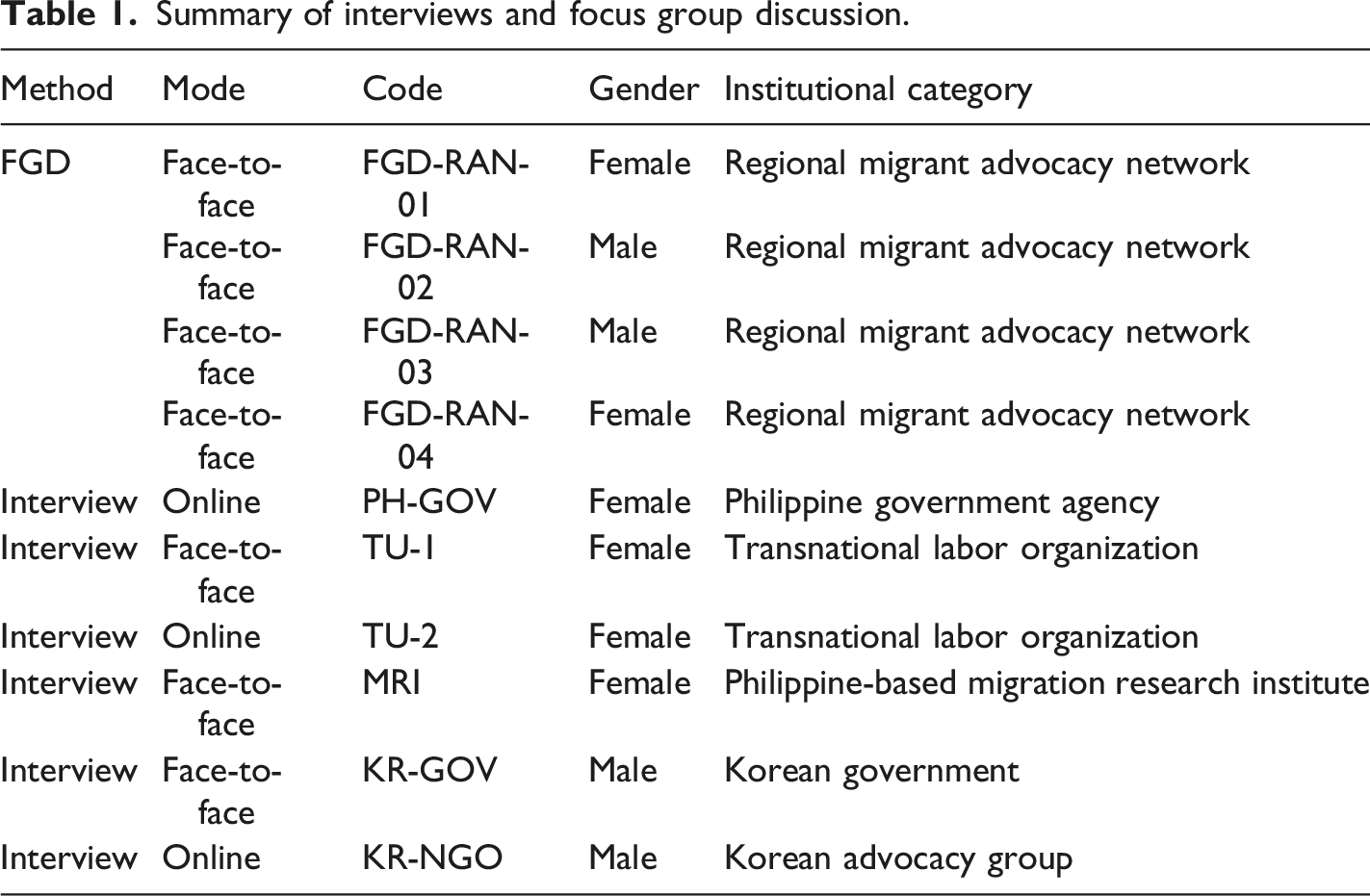
This study utilizes a qualitative approach to examine the pilot project from the perspective of the sending state. Data collection was conducted from September 2024 to May 2025, combining the focus group discussion (FGD), semi-structured interviews with key stakeholders, analysis of the mobile apps (Daeri Jubu and Dolbom Plus), 4 and an unpublished survey report done by the Korea Federation of Small and Medium Business (KBIZ).
Summary of interviews and focus group discussion.
Direct interviews with care workers were not conducted. Although attempts were made, prospective participants declined due to concerns regarding potential risks and institutional constraints. Accordingly, the analysis focuses on how their conditions are constructed and represented across institutional, platform-based, and secondary sources.
Specifically, this study examines care workers’ digital labor profiles, service descriptions, and reviews on Daeri Jubu and Dolbom Plus, posted by households that employed gasa gwanlisa. This analysis is supplemented by an unpublished labor condition survey report done by KBIZ and accessed through the stakeholder channels engaged in the project’s media and policy monitoring. This approach enables an analysis of how migrant care labor is institutionally framed and mediated, rather than directly experienced.
Face-to-face interviews and the FGD were conducted during the field visits in Metro Manila, Philippines, in April 2025. Online interviews were conducted via Zoom and lasted approximately 1.5–2 hours.
To examine how Philippine government and civil society actors respond to and position the pilot project within broader migration governance, audio recordings were transcribed and analyzed using thematic analysis. The analysis focused on how institutional infrastructure and relational mechanisms sustain forms of transnational care labor within the pilot project, as perceived by the Philippine stakeholders.
Contextual overview: Filipino care workers and the Korean pilot caregiver project
The Philippine government has deployed workers worldwide since the 1970s, contributing to economic growth (Opiniano and Ang, 2024) and fostering a culture of migration where Filipinos aspire to work abroad despite risks and vulnerabilities (Asis, 2006). Overseas labor migration has been institutionalized as a state strategy shaped by political and economic structures (Oh, 2016), reinforcing the centrality of labor export within the Philippine development model. Remittances from Overseas Filipino Workers (OFWs) constitute a significant share of the national economy, sustaining the state’s reliance on labor export. Since the 1980s, Filipino women have migrated to over 160 countries, primarily for domestic and care work (Parreñas, 2015). Domestic workers serve in Hong Kong, Singapore, and Malaysia, while nurses work in Saudi Arabia, the UK, and Germany (Balita, 2024a; 2024b). Alongside its economic role, migration is discursively framed as a national contribution, with migrant workers often valorized as “modern-day heroes” (Oh, 2016). As Encinas-Franco (2013) argues, this “bagong bayani” discourse functions as a strategic linguistic tool that naturalizes the state-sponsored labor out-migration. By framing migrants as national saviors, the state normalizes labor export and reinforces a migration-led development model (Encinas-Franco, 2013; Oh, 2016).
However, Philippine labor migration to Korea is male-dominated. In 2018, men comprised 87.9% (4,267) of newly employed Filipino workers, a proportion that remained high at 86.3% (7,465) in 2023. 5 In 2024, Filipino workers in Korea on E-9 (non-professional) visas under the EPS numbered 17,728 (1,524 women and 16,204 men), the largest share among all working visa categories (Ministry of Justice, 2025). This was followed by the Seasonal Worker program (E-8), with 8,890 workers (2,367 women and 6,523 men). Unlike the E-9 and E-8 visas, the Arts and Entertainment visa (E-6) shows an overwhelming female majority (690 women of 869 individuals). These figures show Filipino migration to Korea is structured across manufacturing (E-9), seasonal agriculture (E-8), and entertainment (E-6), each with distinct gender compositions and labor conditions. While Filipino men dominate the Korean corridor, as of September 2023, 55.6% (1.2 million) of the 2.16 million global OFWs are women (Philippine Statistics Authority, 2024). In 2024, through the pilot project, Korea opened its borders to 100 Filipino women care workers, making Filipino women newly visible in Korea’s care sector.
According to a Philippine government representative (PH-GOV), prospective care workers must obtain a Caregiving NC II certificate, pass the Employment Permit System-Test of Proficiency in Korean (EPS-TOPIK), complete a physical examination, and undergo a Korean-English interview. These requirements are not merely technical but also function as a governance structure in which recruitment and training infrastructures strategically position migrant workers as “skilled” for global markets (Lan, 2022). However, this formal classification often fails to translate into labor market mobility, creating a mismatch between workers’ “professional status” and their actual working conditions.
As per the PH-GOV, of 610 registrants, 468 took the exam, 141 passed, and 100 were deployed to Korea in August 2024, leaving 41 on reserve. She added that the pilot project was perceived as popular, given the high number of registrants, whereas the Korean government representative (KR-GOV) viewed this figure as lower than expected. Nevertheless, the Ministry of Employment and Labor (MOEL) was reluctant to formalize the pilot project into a regular program due to high costs, despite the Seoul Mayor’s push (Seol, 2025). Following leadership changes, plans for a full-scale program were abandoned. The pilot project will conclude upon contract expiration, with reserve applicants excluded.
The Philippine government’s construction of care as labor mobility: The symbolic “professionalization” disconnected from reality
Constructing professionalism: How institutionalized migration channels rebrand care work
According to PH-GOV, aside from Korea, the Philippines deploys care-related personnel to Taiwan, Saudi Arabia, Israel, Germany, Japan, and the United Arab Emirates (UAE). The Pre-Employment and Government Placement Bureau (PEGPB), a sub-unit under the Department of Migrant Workers (DMW) responsible for overseeing G2G hiring and the deployment of OFWs, manages the recruitment, final selection, and deployment for the Korea pilot project.
Official documents (Ministry of Employment and Labor, 2024, Ministry of Employment and Labor and Human Resources and Development Service of Korea, 2024) defined care as a “service provided to children, infants, and pregnant women,” which also includes some “light household work,” such as cleaning, laundry, and kitchen tasks that assist them in daily life. 6 While the Philippines and Korea discussed the deployment of caregivers, in Korea, these workers are employed as “gasa gwanlisa.” In Taiwan, Israel, and Japan, Filipino care workers are employed as nursing aides (or carers), primarily providing care for the elderly and the sick rather than children (Kim, 2020; Lim, 2018). However, gasa gwanlisa in Korea are comparable to domestic helpers in Hong Kong and the migrant domestic workers in Singapore. Initially, according to PH-GOV, Korea sought to hire domestic workers (household helpers). However, the Philippines does not permit the deployment of domestic workers through G2G arrangements. Although not explicitly stated in the interview, the non-deployment may be understood in relation to economic and strategic considerations. Domestic work, as a highly vulnerable sector requiring case-by-case protection, is instead channeled through private recruitment agencies to minimize state diplomatic risks. Moreover, Republic Act No. 8042 or the “Migrant Workers and Overseas Filipino Act of 1995,” mandates the deployment of skilled workers, positioning skills as the primary form of protection (Ogaya, 2020). The closest category eligible for deployment under the G2G agreement is that of caregivers. As a result, the final agreement formalized the deployment of caregivers, aligning with the G2G framework under the EPS. This decision demonstrates how migration categories are adjusted to reconcile regulatory inconsistencies between the two countries. In this sense, the category of caregiver functions less as an occupational distinction than as a bureaucratic strategy, integrating the deployment of care workers into the operational mechanics of the migration system.
Filipino care workers working in Korea hold the Caregiving NC II certificate issued by the Technical Education and Skills Development Authority (TESDA) in the Philippines, which oversees skill standards and training programs. This certificate validates competencies in providing care for infants, children, the elderly, and individuals with special needs. In Korea, the required competencies include promoting the child’s physical, social, intellectual, creative, and emotional development. The certificate requires completion of at least 786 hours of training and serves as evidence of the professionalization of care from the Philippine perspective. PH-GOV also noted that while potential concerns regarding job expectations were raised during negotiations, these were addressed by defining the scope of light household work in the guidelines. However, the limited attention to how care work is practiced on the ground simplified these distinctions.
The mismatch between institutional procedures and actual practices reveals the symbolic construction of migration categories, through which administrative and regulatory systems produce the very classifications that organize labor mobility. By redefining domestic work as caregiving, the Philippine government demonstrates a bureaucratic branding of labor mobility—a symbolic professionalization in which it adjusts labor categories to fit Korea’s requirements, reflecting unequal negotiating power. However, this attempt to elevate the status of labor ultimately reinforces ambiguity and undervaluation, illustrating how care labor is shaped and stratified by transnational bureaucracies.
Issues in the pilot project: Language over wage and living conditions
The Philippine government’s interpretation of the concerns reported by care workers during its internal assessment in 2024 is reflected in how these are categorized as administrative issues rather than welfare or exploitation concerns: It is not like maltreatment […] their only problem, so to speak, is the long traveling hours [and] the high cost of accommodation […] It’s not [about] exploitation. No issue on that […] There are no welfare issues. (PH-GOV, female)
The Seoul Metropolitan Government’s promotional materials highlighted proficiency in English and Korean. Although the workers met the required Korean language standards, their limited proficiency caused communication difficulties. Despite assurances that participating Korean households could communicate in English and high expectations that English-speaking Filipino care workers would support children’s English education, household communication was primarily in Korean. 7 The limited use of English highlighted a misalignment between promotional framing and reality. Since the Marcos regime, export-oriented policies and language proficiency (i.e., English) have symbolized the “excellence” of Filipino workers (Lorente, 2012). However, training in the languages of receiving countries (e.g., English) aimed at increasing Filipinos’ employability abroad has often been criticized, as such initiatives demonstrate how the government treats its people as globally exportable human resources (Lorente, 2012).
Housing conditions emerged as another point of contention. Korean institutional arrangements placed care workers in agency-provided dormitories, thereby limiting residential autonomy. PH-GOV viewed this set-up as satisfactory, citing the presence of basic amenities, as she shared: We also visited their [care workers] dormitories. We saw that there are free modest snacks and breakfast, free coffee, and rice. And there are some appliances like [a] water dispenser, [a] washing machine—those are provided for free, included in their accommodation. (PH-GOV, female)
PH-GOV noted that the care workers’ salaries in Korea were relatively high compared to those in other countries. 8 However, management agencies deducted approximately 530,000 KRW (351 USD) monthly for accommodation and communication fees (Lim, 2024a). For workers on 30–40 hours per week, rent of 470,000–520,000 KRW (317-350 USD) became a burden (Jang, 2025a; 2025b).
While the minimum wage remained contentious, PH-GOV expressed that the agreement to uphold it would be honored. This stance reflects the state’s positioning of the care workers as professionally trained care workers, rather than “unskilled,” entitling them to the government-regulated wages and benefits. She clarified: […] our reply to that [wage debate] is that we did not deploy [a] domestic helper. We emphasized that we deployed Filipino workers who are certified as caregivers, professionals, and with NC II training. So, that’s the difference. (PH-GOV, female)
What the belief and expectation in the professionalization of care reveal
PH-GOV attributed the positive assessment of the program to perceived worker performance, favorable evaluations from Korea, relatively high wages, and the absence of reported welfare cases: […] They [care workers] are doing good […] they are being paid high. There are no welfare cases. This is also a good project for us. (PH-GOV, female)
Despite being recruited as certified caregivers, Filipino care workers were tasked with domestic work (Cho, 2026). This mismatch—sending Caregiving NC II certificate holders (akin to nursing aides) for domestic work—implies two things: First, limited administrative alignment, as the Philippine government conventionally chose the existing G2G method without devising a framework for domestic deployment to Korea; and second, weak differentiation between care sub-areas: domestic work, childcare, and nursing care. This reflects a perception that care-trained nursing aides can cover distinct areas like domestic work—an understanding contradicting the very professionalization of care they have insisted on. These dynamics reveal the Philippine government’s limited understanding of the essence and valuation of care work. Although professionalizing domestic work, the Philippines appears to be solely focused on cultivating care workers as exportable labor instead of a socially revalued occupation.
The Philippines’ push to professionalize care work emerged from reforms linking training and certification to labor export. In 2007, the government reformed “professionalizing” household service workers via education and training programs aimed at protecting workers and raising minimum wages (Lorente, 2012). However, recruitment agencies and migrant workers' organizations opposed the reform, citing reduced competitiveness from wage increases, vocational education and language training costs, and doubts about the practical influence of the wage guideline (Lorente, 2012). This same logic now underpins framing care work as a professional and exportable occupation. While domestic work was formalized within TESDA’s training framework as a recognized “skill,” this primarily standardized labor without substantially improving regulatory protection or wages (Lim, 2025).
The “Supermaid” program integrated household management, customer service, and emotional labor, producing flexible care workers who are emotionally compliant and reframe instability as a self-development opportunity (Chee, 2020; Lagman, 2015). Consequently, the unstable working environment and forced emotional labor of care workers are concealed beneath the veneer of professionalization.
In the pilot project, professionalization legitimized deployment, though detached from local realities. In Korea, domestic work remains low-wage and low-skilled, exemplified by the “Supermaid” program, which rebrands the Filipino woman’s body as elite labor to hide the “economic strangulation” driving her migration (Francisco, 2009). A similar contradiction exists in the Philippines. While the government promotes female migrant care workers as professionals abroad, they are often regarded domestically as a “national shame” for abandoning traditional Filipino womanhood—being at home (Encinas-Franco, 2020). Professionalization thus functions as a symbolic narrative, reproducing the gendered and moral hierarchies in transnational care migration.
These tensions question whether the Philippine training system or standardized education alone can institutionalize care as a professional occupation. Defining care as “labor of love” suggests that “care well done is always an act of creation, involving innovation, adaptability, and inventiveness” (Bunting, 2022: 76), and those methods are developed through processes of acting, observing, and reflecting. However, certification training centers on mechanical memorization and obedience, treating emotional control as a marker of professionalism (Lagman, 2015). Thus, the government overlooks the practice, performance, and inherent meaning of care. In the domain of care where emotional and affective engagement are central, standardized education alone cannot guarantee professionalism. Rather, professionalism is cultivated through practice and refined in the relational encounter between the care provider and the recipient. Ultimately, the Philippine government’s emphasis on professionalization reflects an effort to rebrand women’s labor within the logic of export and efficiency—where care remains disciplined and marketable, rather than substantively revalued.
Reframing empowerment: Civil society critiques of the pilot project
From transparency to exclusion: Limited civil society engagement
Initially, the Philippine government projected transparency and inclusivity by inviting researchers and civic groups to engage with the pilot project. However, this openness diminished post-implementation. Regional migrant advocacy network and transnational labor organization representatives reported restricted access, limited coordination, and a lack of follow-up engagement. Although civil society actors were initially included, consultations ceased post-deployment. As one representative shared: We [with DMW] agreed together that after 3 months we have to meet again […] So honestly we don’t have any updates now what’s going on [with] the pilot program, if this is effective or not. (TU-2, female) Actually, a lot of the information comes from the Korean side. We don’t have access to the workers. We don’t know a lot about the program itself. So, we needed so much context settings. And that was given by [Korean Trade Union]. (TU-1, female) What is the legal status of these bilateral agreements? Can you really legally cite them in some cases? That is our big question mark. (FGD-RAN-03, male)
Professionalization as rebranding and market repositioning
Civil society organizations highlighted the rebranding of domestic work as “care work” operates more as a market-access strategy than a genuine improvement. A representative from a regional migrant advocacy network described the Philippine state as “pushy” in securing overseas employment opportunities, noting that the shift from “domestic worker” to “caregiver” facilitates entry rather than transforming labor value: Even when [the] South Korean market opens, and the Philippines says they are not interested [in] sending out domestic workers, they just rebranded it as caregivers because they really want to send out workers. (FGD-RAN-01, female)
Another representative of the regional migrant advocacy network pointed out that the Philippine government seeks new markets to offset the loss caused by the Middle East crisis, using the pilot project to repackage domestic labor as care work for market diversification: The Philippine government is also looking for new markets […] it is still domestic work, but they are happy to repackage domestic workers, caregivers, and deploy and find new markets. (FGD-RAN-02, male) Wages for this kind of work [are] low because it’s not seen as valuable, as productive work, because it’s only reproductive […] society in general is patriarchal, meaning to say the work that is often relegated to women is seen as an extension of their duty. (TU-1, female)
For civil society, therefore, professionalization remains confined to documentation rather than substantive improvements in labor conditions. Renaming domestic work as “care work” operates as a market-making strategy that facilitates new bilateral arrangements while maintaining existing deployment structures. Simultaneously, certification and labeling serve as categorical differentiators that symbolically elevate occupational status without addressing the underlying inequalities of migrant care labor.
Conceptual ambiguity and policy contradictions
A representative from a migration research institute highlighted that conceptual ambiguity remains central to the pilot project, particularly the lack of a clear definition of “care work,” blurring the line between domestic and caregiving responsibilities: From the Philippine side, especially from an advocacy point of view, the language is not clear. When you include “light housework,” then that already [takes you] into domestic work […] that kind of language makes things blurred. (MRI, female) By only saying this is a high level of certification does not mean you are not doing domestic work anymore. It is interesting that on the Korean side, it is translated as household manager […] But here it is clear that you will be doing [the] work of a caregiver. There will be slippage into domestic work. (FGD-RAN-02, male) The contracts could state […] they’re there for childcare […]. But we have a concern that they might be made to do other tasks like domestic work or elderly care or cleaning. (TU-2, female)
Symbolic success, material precarity
A representative from a regional migrant advocacy network observed that the Philippine government promoted the pilot project as a success, emphasizing positive outcomes over transparent evaluation. The participant noted that 11 of the 100 caregivers had already returned home, a significant dropout rate: […] 11 is a significant number considering it is more than 10% […] within six months, and yet 11% fall out. There is something. (FGD-RAN-04, female) Because maybe if they were doing domestic work, and they are expecting care work, and they have been caregivers before in other countries, then now they are doing a lot of household work. That could be one of the reasons. Especially if they came from other countries. (FGD-RAN-01, female)
Representatives of the transnational labor organization and the migration research institute emphasized that a live-out setup can empower care workers by granting them greater independence and control. However, they stressed that such autonomy is meaningful only when accompanied by adequate material support; otherwise, it becomes an added financial burden. Live-in or dormitory arrangements may reduce financial strain by covering meals and accommodation, but they can also lead to overwork and blurred personal boundaries if not properly regulated. As the migration research institute representative noted: One of the merits of this [pilot] program, they don’t need to live with their employer […] there are merits also to living with employers. But the big IF is […] if the employers stick to the terms of the contract […] The thing about the live-in arrangement is that if the boundaries are not clear, it’s like you’re 24/7 available to your employers. (MRI, female) It’s mostly hours of work […] [and] if the workers have any sort of social protection. Do they have health care? Do they have [a] transportation allowance? Health insurance? Things like that. I’m not sure, actually, if they have that. (TU-1, female)
Structural inequality and the symbolic reform
A representative from a regional migrant advocacy network explained that the conceptual ambiguity of “care work” reflects a broader institutional culture in the Philippines, where labor migration is normalized and rarely subjected to policy scrutiny or ethical reflection. As one participant described, labor export is “ingrained into the market.” […] it’s […] rare now that you will get academia […] journalists covering that. It’s so ingrained [in] the market. The Philippines is kind of deploying people […] it’s as simple as [the] government putting it out in the newspaper and people are applying for it. That’s it. Nobody is criticizing […] asking, “‘Is this the right thing?” (FGD-RAN-02, male)
Representatives from transnational labor organizations stressed that labor export functions as a permanent state strategy rather than a path to decent work, normalizing precarity while diverting attention from domestic job creation. Participants noted that even the Batas Kasambahay (Domestic Workers Act)
9
remains weakly implemented, leaving protection aspirational. They added that bilateral agreements offer only symbolic protection, limited by the receiving countries’ domestic labor laws and rarely monitored. Highlighting this shared concern, a representative from a transnational labor organization emphasized that labor laws in the receiving country are also instrumental: Even the Philippine government says you must protect the Filipino migrants […] if they are excluded in their [receiving country] national laws […] the government cannot do anything […] then it’s useless. (TU-1, female) One of the more frustrating things […] is that it’s a pilot program. You need to expect errors. For me, you’re speaking of people’s welfare. Why did we not conduct the necessary precautions before we even set this up? (TU-1, female)
Contradictory representations of care workers within institutional mismatches
This subsection examines care workers’ representations on mobile platforms, specifically Daeri Jubu and Dolbom Plus, and the unpublished KBIZ report. Rather than capturing direct lived experiences, this study analyzes how labor conditions are institutionalized and represented through platform-based and secondary sources.
Constructing the “ideal” care workers through digital profiles
Self-introductions on Daeri Jubu and Dolbom Plus construct the “desirable” care worker, designed to persuade Korean households to select the “ideal” candidate from the digital marketplace.
The profiles describe the diverse educational and professional experiences of the care workers. For example, a care worker who majored in computer science and worked as a secretary and cashier is narrativized as finding meaning in elderly care after obtaining a caregiving certificate. A case of studying health sciences, completing an integrated health education program, and working as a call center agent highlights the relevance to induce household choice. The narrative of migrating to Korea to build a house in the Philippines or start a business reinforces the image of a diligent and sincere worker who dreams and comes to Korea to fulfill it. Other profiles in the apps reveal a professional shift where many worked in fields unrelated to care, such as quality control or electronics manufacturing, before being designated as care experts via accredited certifications for their deployment to Korea. They are represented as “ideal” care workers in their profiles posted on the mobile apps, Daeri Jubu and Dolbom Plus. However, the program’s task structure, which emphasizes housekeeping and childcare, suggests a misalignment between the professional credentials highlighted in profiles and the domestic labor expectations embedded in the service model.
The gap between bureaucratic definitions and market reality
The Philippine government claimed to have resolved concerns regarding job expectations by defining “light household work.” However, specific guidelines where the content of household tasks changes according to the working hours per household added to the confusion.
Families employing a gasa gwanlisa receive text message guidelines specifying tasks (e.g., laundry, kitchen and bathroom cleaning, room organization, and meal preparation) adjusted to working hours (Jiyeoniel, 2024). For a four-hour shift, the care worker handles child-related housework, including laundry, dishwashing, and tidying up play and sleeping areas. For shifts of six hours or more, tasks expand to include adult laundry, cleaning, and managing shared spaces like the bathroom and the living room.
Households employing gasa gwanlisa provided reviews on Daeri Jubu and Dolbom Plus, suggesting a “dual-value” perception of care workers, valued for both housework efficiency and relational exposure (child care). While some cited childcare, reviews commonly focused on housekeeping (Lee, 2025: 41–42). Reviews included: She is kind to the child and quietly and diligently does the housework well. (Review 1, Daeri Jubu) She is smart and treats the child warmly. She also did the housework very neatly. (Review 2, Daeri Jubu) She […] made sure the nursery was extra dust-free. You can feel that she sincerely loves and likes the baby. (Review 4, Dolbom Plus). She managed to finish the laundry, kitchen cleaning, and bathroom scrubbing within the 4-hour window. (Review 5, Dolbom Plus)
The structural devaluation of care
The KBIZ survey, conducted from 4-10 October 2024, reveals structural confusion regarding job roles. Many care workers reported a disconnect between their professional training and their actual treatment, noting that the official title, “gasa gwanlisa” (household manager), did not match the professional caregiving duties promised during recruitment. As one respondent stated: We understood ourselves to be trained professionals for the sick, disabled, or elderly. (KBIZ report, 2024)
The inclusion of “light household work” blurs the boundary between professionalized care and domestic labor. Even though nursing care and domestic work occupy the same domain of care, hierarchies are reinforced within global care chains (Parreñas, 2015). Consequently, Filipino care workers who are trained and credentialed as professionals are subjected to the structural devaluation of women’s labor, and this hierarchy is exacerbated by the conceptual ambiguity regarding “care.”
Ultimately, the pilot project reproduces the global hierarchies that rank women’s labor according to its proximity to the private sphere. Within the pilot program, Filipino care workers are institutionally positioned in an in-between category: credentialed as professionals yet organized through a labor arrangement that aligns more closely with domestic service. Platform-based selection mechanisms and task expectations further reinforce this ambiguity within the care market.
Conclusion
The Pilot Foreign Caregiver Project reveals how inequality is reproduced through the very infrastructures that claim to empower migrant workers. Applying the Relational Inequality Theory, the findings show that inequality operates through relational mechanisms embedded in transnational labor governance—particularly through institutionalized certification, bilateral agreements, and bureaucratic classifications that define and control care work. Drawing on Migration Infrastructure Theory, these mechanisms are situated within regulatory and bureaucratic infrastructures that organize, classify, and legitimize migrant care labor across sending and receiving contexts. These infrastructures construct care as an exportable commodity and treat professionalization as a symbolic achievement between sending and receiving states, and between “skilled” and “unskilled” forms of women’s labor.
The Philippine government’s discourse of “upskilling” functions as a technocratic response to structural dependency on labor export, sustained by the economic significance of remittances and the institutionalization of overseas employment as a long-term development strategy of the Philippine state. Civil society perspectives provide counter-narratives revealing how the states obscure persistent gendered and class-based inequalities, limited transparency, and the absence of rights-based monitoring. The blurred boundary between “care” and “domestic work,” coupled with the state’s reliance on retention rates and training certificates as indicators of success, demonstrates how bureaucratic infrastructures reinforce relational inequality while appearing progressive.
Ultimately, the pilot project exemplifies how migration infrastructures shape not only the movement of workers but also the moral and institutional terms of labor valuation. Professionalization, when grounded in administrative recognition rather than social protection, remains symbolic rather than materially transformative. In this sense, migrant care workers remain floating within the migration system—formally recognized as professionals yet materially situated in precarious conditions. As long as care migration continues to be governed by market logic rather than relational justice, the promise of empowerment will reproduce the very inequalities it claims to resolve.
Footnotes
Acknowledgments
The authors are thankful to the participants for sharing their experiences, insights, and perspectives, which were central to this research. This paper was also supported by the BK21 FOUR program funded by the Ministry of Education (MOE) and the National Research Foundation (NRF) of Korea.

Ethical considerations
Ethical considerations were observed throughout the conduct of this study. Formal ethics review was not required for this study under the applicable institutional guidelines.
Consent to participate
Prior to participation, all participants were informed of the study’s objectives, procedures, and ethical safeguards. Participation was voluntary, and verbal informed consent was obtained.
Funding
The authors disclosed receipt of the following financial support for the research, authorship, and/or publication of this article: This work was supported by the Ministry of Education of the Republic of Korea and the National Research Foundation of Korea (NRF-2022S1A5C2A01092544).
Declaration of conflicting interests
The authors declared no potential conflicts of interest with respect to the research, authorship, and/or publication of this article.
Data Availability Statement
The data used in this study are not publicly available due to ethical and confidentiality considerations involving research participants. Data may be available from the corresponding author upon reasonable request.
Artificial intelligence (AI) usage declaration
The authors acknowledge the use of