






Abstract
Background
The placebo effect has traditionally been defined as a positive health outcome resulting from inert treatments, driven by neuropsychological factors. More recently, the concept has been broadened to include active interventions, referring to the portion of a genuine treatment effect that arises from expectations, hope and positive patient–clinician interactions.1,2 Accordingly, the placebo effect is no longer limited to placebo-controlled trials but is increasingly recognised as a fundamental contributor to therapeutic outcomes across diverse areas of medical practice.
A growing body of research shows that patients’ beliefs – conceived as learned, often implicit expectations that guide perception – may strongly influence clinical responses to established treatments, including migraine medications, 3 muscle relaxants, 4 post-operative analgesics 5 and anxiolytics. 6 Similar effects are observed in healthy individuals exposed to acute pain.7–10 Conversely, negative expectations can reduce or even reverse drug efficacy, producing nocebo effects.4,8,10 These findings highlight the influential role of expectancy, sometimes referred to as non-conscious predictive processes,11,12 in shaping the response to the same pharmacological substance – mirroring belief and thus reflecting the malleable neurochemistry of the human brain.
The effects of expectation in a religious context
In an earlier era, the differential effects of expectations on a person’s response to treatment was a matter of much concern to practitioners of a different stamp. Medieval priests held the view that the power of holy communion depended on the inner disposition of those who received it (p. 174). 13 The holy communion is a Christian sacrament in which the priest consecrates a wafer of bread (the host), which according to medieval doctrine becomes the true body of Christ; an unconsecrated host remains ordinary bread. Because the consecrated bread was believed to bring Christ’s healing power to those who consumed it, it was widely associated with spiritual – and sometimes physical – healing when received with faith. It was sometimes called medicina corporis Domini, that is ‘the medicine of the Lord’, for instance in a medicalised model of pastoral care written by a bishop in the first decade after 1000 (Wormatiensis, Decretum V, 18: 756A–B). 14 Medicine is primarily spiritual medicine here. Nonetheless, the communion is considered a form of ‘treatment,’ believed to have healing power. It was thought to bring about ‘a fundamental change in the nature of things’, transforming ‘sickness into health, well-being into misfortune’ (p. 334). 15 Underlying this doctrine was the idea that, if used wrongly or with malicious intent, the powerful consecrated host could cause actual harm.
Generally, there was little doubt that the consecrated host constituted the true body of Christ 16 and fostered the restoration of both spiritual and physical health. But these religious healers – priests wearing robes that signified their authority, much like the white coats of modern physicians (see Figure 1) – worried that consuming the host in the wrong framework of belief might be no different from eating an ordinary piece of bread shaped like a host and such recipients might even be damned. In fact, many of those who rejected the idea that Christ was bodily present in the host were considered heretics (p. 217, 222–224). 17 The Franciscan theologian Bonaventure (c. 1217/21–1274) explains the importance of the mental state of the person receiving holy communion when he says that ‘whoever receives it worthily, consuming not merely in fact but also spiritually through faith and love, is more fully incorporated into the mystical body of Christ, being also refreshed and cleansed in himself’ (Breviloquium, VI, 9: 230). 18 Yet, ‘the one who receives with a lukewarm, irreverent, and careless heart’ consumes ‘judgment to himself, because he offends such a great sacrament’ (Breviloquium, VI, 9: 234). 18 It was thus clear that the healing power of the host needed to be potentiated in the individual recipient by belief.
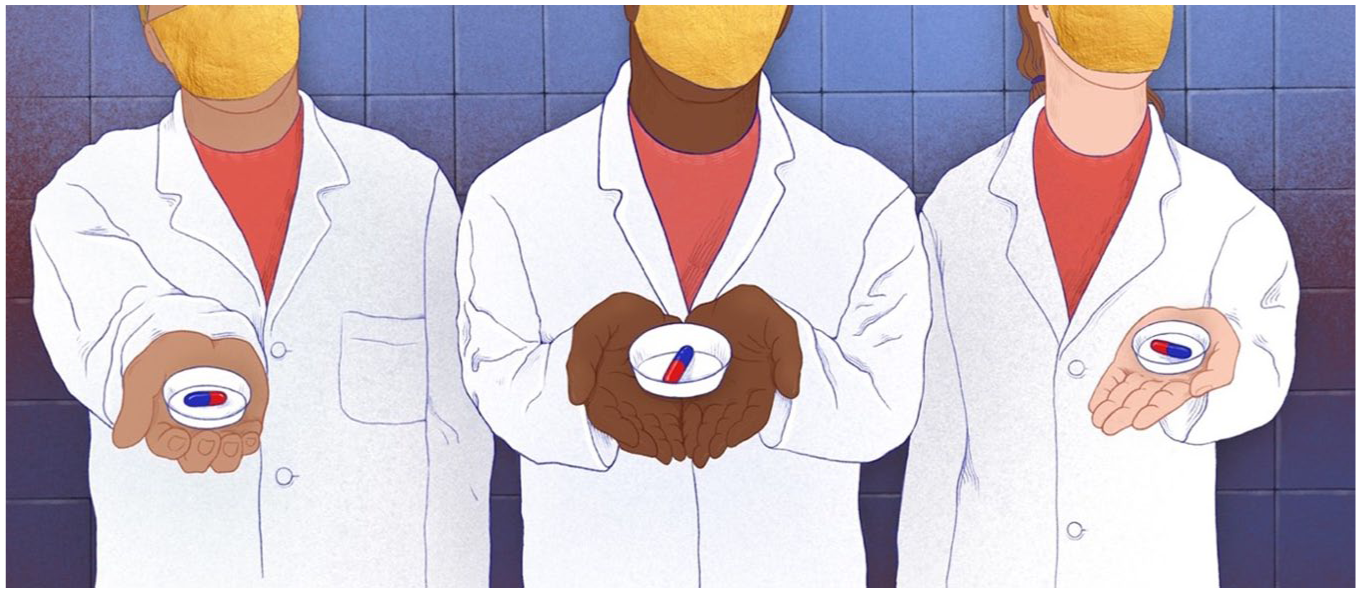
Modern treatment in medical context. Image created by Varduhi Antonyan, 2025.
But how was belief defined, and how was it inculcated in the person receiving the communion? Medieval theorists understood belief as distinct from mere hope or expectation; it was considered a habit acquired through training the mind (habitus fidei) and repeatedly practising standardised rituals of the Church. Thomas Aquinas (c. 1225–1274), 19 for example, stated that ‘faith is a habit of the mind’ (Summa theologiae II-II, q. 4, a. 1) 19 and Bonaventure, though allowing for a multitude of definitions of belief, generally treats faith as a habit that shapes cognition and enables the recognition of things beyond the reach of the senses (In Tertium Librum Sententiarum, dist. 23–24). 20 For Jean Gerson (1363–1429), 21 faith must be instilled from an early age through regular instruction – a process embedded in repeated participation in ritualistic practices (De parvulis ad Christum trahendis). 21 The product of this training was faith, a virtue that enabled the believer to view the world in a certain way, particularly to accept invisible powers, like that of the healing power of the consecrated host to be at work. We can speculate that this aligns with contemporary theories of the mind, in particular predictive coding, where beliefs (formed through learning) function as non-conscious predictions that guide sensory perception and can affect health.22,23
The influence of belief (or the lack thereof) on the effectiveness of ‘treatment’ is uniquely portrayed in an image from a late-medieval prayer book (Figure 2) that belonged to the first Grand Master of the Austrian Military Order of St Georg, Johann Siebenhirter († 1508).13,24,25,26
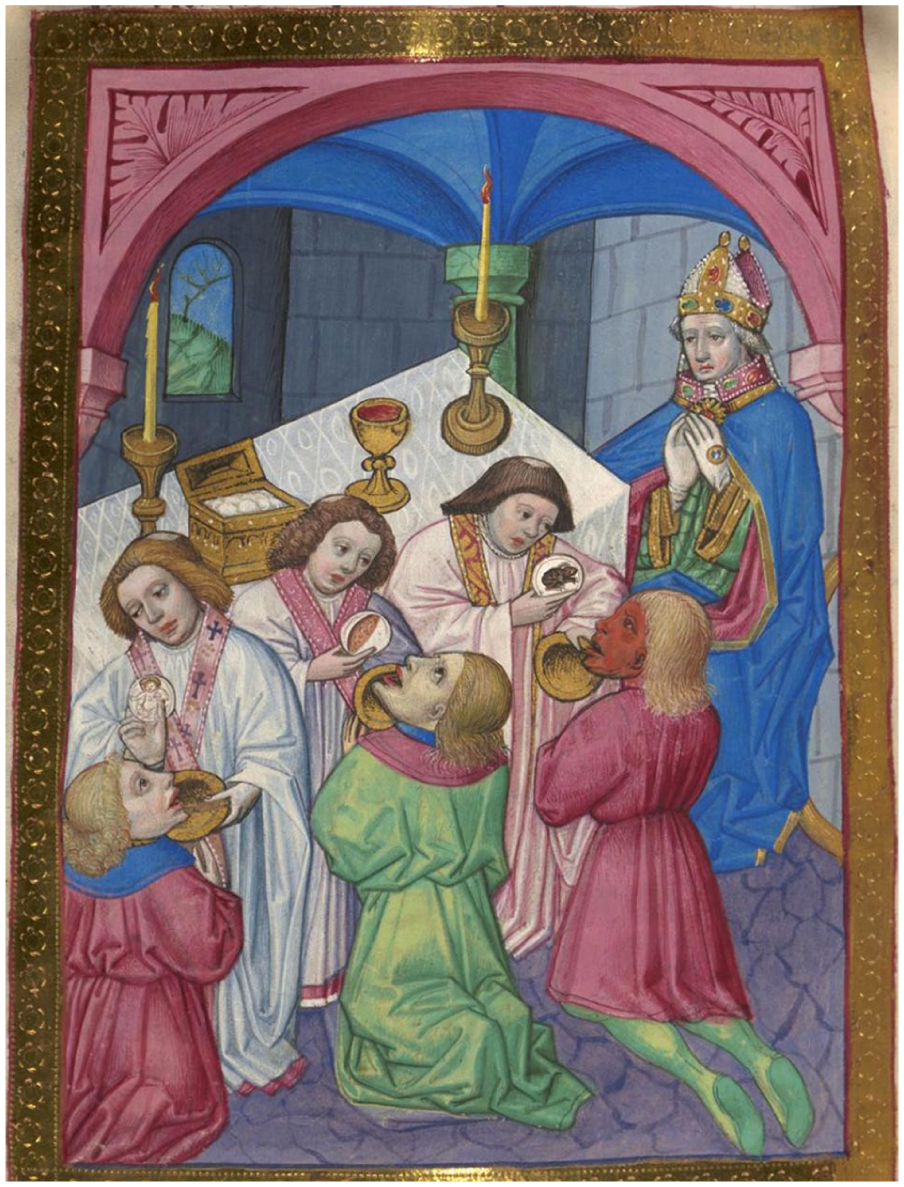
Medieval image of the holy communion. Stockholm, National Library (Kungliga biblioteket), Shelf mark: A 225. Siebenhirter Hours. Page opened: Folio 158 verso. Dimensions: 240 × 170 mm. Date: 1470s. Anonymous artist known as the ‘Lehrbüchermeister’. Produced in Kärnten/Carinthia, Austria, for the first Grand Master of the Order of St George, Johann Siebenhirter.
The image depicts the ritual of holy communion: A bishop in a blue and gold robe watches over three priests as they administer the host to three kneeling men. In the prayer book illumination, the consecrated hosts appear identical in the box on the altar. But once offered, their content is depicted differently for each recipient. In effect, each of the men receives something unique.
Artists of the period did not strive for a natural rendering of the world; rather, they sought to convey meaning that was hidden from the eye, by using colour, proportion or even object depiction. Such is the case here. Historians have interpreted the discrepancy between the three hosts in the illustration, and their differences as they are distributed to the three worshippers, as representing ‘the progression from orthodoxy to heresy’ (p. 13), 27 or as portraying a ‘range of belief’ (p. 217). 18 The person kneeling on the left receives the body of Christ (here in the shape of the Christ child) and is thus a believer. The non-believer in the middle gets nothing other than an ordinary piece of bread. The man with bad character, a sinner or possibly a heretic, will ingest a toad, symbolic of the devil; his red face is an additional indication that he approaches the altar lacking belief. For this last recipient, the host is neither what it could be (body of Christ) nor what it seems to be (bread) but rather something repellent, and potentially poisonous. With the three figures, the image reflects the importance of the recipient’s own belief to the actualisation of the host’s divine power.
The Siebenhirter artist has isolated the contribution of belief from other variables, in line with the rationale behind controlled conditions in modern clinical trials. Like today, medieval theologians were fascinated by, and struggled with, the ‘impossibility of distinguishing a consecrated host from an unconsecrated host (equal to a piece of regular bread) by the testimony of the senses alone’ (p. 65). 27 They grappled with the human inability to recognise deception across multiple domains: to separate true relics from counterfeit ones; to distinguish between divine visions and hallucinatory experiences or diabolical deceit and to differentiate genuinely consecrated hosts from unconsecrated ones in the hands of priests during the holy communion. 28 In the fifteenth-century image, the artist has integrated a form of quality control into the composition in the form of the bishop who superintends the activities of the three priests. The priests’ robes, without the bishop’s distinctive outer garment called a chasuble, indicate that they are only assisting the ceremony. The three priests appear to evince the same degree of concern for the recipients of the communion. Nothing in the priests’ appearances suggest that they have any foreknowledge of the beliefs of the three men or that they are attempting to influence them in any way other than through the very offer of the host. The bishop, wearing the chasuble, is the one officiating. The circle on his hand symbolises his ordination as a priest. As the highest-ranking cleric present, he has the authority to consecrate the host. Placing the authority of consecration in the bishop alone eliminates any risk of bias in the treatment itself, that is, that the wafers would differ from one another through variation in the consecration or that they are unconsecrated, counterfeit or even abused or manipulated by the devil’s influence. The artist leaves no doubt that each of the kneeling men is at least being offered the chance to consume the true body of Christ. This parallels the development of modern clinical trials during the first half of the 20th century,29,30,31 where strict protocols prevent variations in the intervention or manipulation that could affect outcomes.
What counts as belief, and to what extent it matters when the believing person interacts with the world, has its own dynamic history, embedded in multiple and constantly shifting contexts. The Siebenhirter image is a critical part of this history and an important inflection point. It portrays a deep sense of understanding of the habit of belief, illustrating a long history of an appreciation of its importance on therapeutic outcomes.
For more information on how a lack of blinding can affect the results of clinical trials, see this entry in the Catalogue of Bias: Catalogue of Bias Collaboration, Nunan D, Heneghan C (2018). Lack of blinding (with https://catalogofbias.org/biases/lack-of-blinding/behindLINK).
Footnotes
Acknowledgements
The authors wish to thank the History and Philosophy of Sciences Group 2024/2025 at the Wissenschaftskolleg zu Berlin for productive discussions and Lorraine Daston for helpful comments on the manuscript.