







Abstract
Based on the internal evidence of the letters to Philemon and to the Colossians (Col. 1.1-2; 4.7-18), this article contends that there have been logical errors in how we have correlated the data between the two letters. Arguing that the two letters were not written to be sent simultaneously, this article demonstrates that syllogistic fallacies have shaped scholarly assumptions, leading to the view that the overlapping data necessarily indicate that Philemon, Apphia and the church in Philemon’s house were located in Colossae. Once the logical fallacies in correlating the data are recognized, the apparent problem of the lack of greeting to Philemon in Colossians is in fact no problem at all: Philemon and his house-church were located in Italy, possibly in Rome itself.
Every scholar who studies the Pauline letters – their chronology, their provenance, questions of authorship and readership – necessarily correlates the similarities and differences between the letters to Philemon (Phlm) and Colossians (Col). What if this correlation has been subject to a logical flaw? That is the case that this article makes. 1
The people and circumstances named in Phlm on the one hand and Col on the other together form a plinth upon which every reconstruction rests. Phlm is almost universally held to be genuine Paul, whereas Col is widely held to be pseudepigraphic. Whether one takes Col to have been written by Paul, 2 whether one takes it as pseudepigraphic, 3 or whether one takes a mediating position, 4 the importance of the overlap between these letters is widely recognized. Each scholar has been working with essentially the same data, though giving it a different weighting.
However, despite the scholarly attention given to these issues, my contention is that we have not viewed the evidence clearly enough. In this article I propose that there has been a logical error in how we have correlated the data between Phlm and Col – particularly in relation to the location of Philemon and his house-church. I contend that there is something new to be said about the relationship between these writings. Based on the internal evidence of the two letters, there is no necessary or logical requirement to locate Philemon, Apphia and the house-church referred to in Phlm. 2 in Colossae. Once the logical fallacy in correlating the data is recognized, the apparent problem of Philemon’s absence from Colossae in Col is in fact no problem at all: Philemon, Apphia and their house-church were located in Italy, possibly in Rome itself.
My approach is to begin with an examination of the overlapping material, initially setting aside questions of authorship and taking Col. 4 at face value. I will then articulate how the overlaps have been correlated and demonstrate that this correlation is neither the only, nor the best way of interpreting the data. I will demonstrate that, in correlating this material, interpreters across the scholarly spectrum have succumbed to a logical fallacy. Once the fallacy in correlating the data is recognized, the case that the Col greetings are best explained as a later forgery made up of references from Philemon is reopened. In the final section of this article, I will make a case for a Roman provenance for both Phlm and Col.
The methodology used in this article is both logical and philological. It examines widely held scholarly conclusions according to their logical coherence, and uses literary and historical factors drawn from the letters to demonstrate the plausibility of alternative conclusions. This article does not claim to prove the authenticity of Col. 4.7-18 (as this rests on multiple factors), but it demonstrates that one of the intractable problems in correlating Phlm and Col – which has led many scholars to conclude that Col. 4 is necessarily wholly pseudepigraphic – can profitably be revisited.
Overlapping Material: Similarities and Differences
The connections between Phlm and Col. 1.1-2 and 4.7-18 are striking. They are set out in the summary table below, in order to highlight both the similarities and differences.
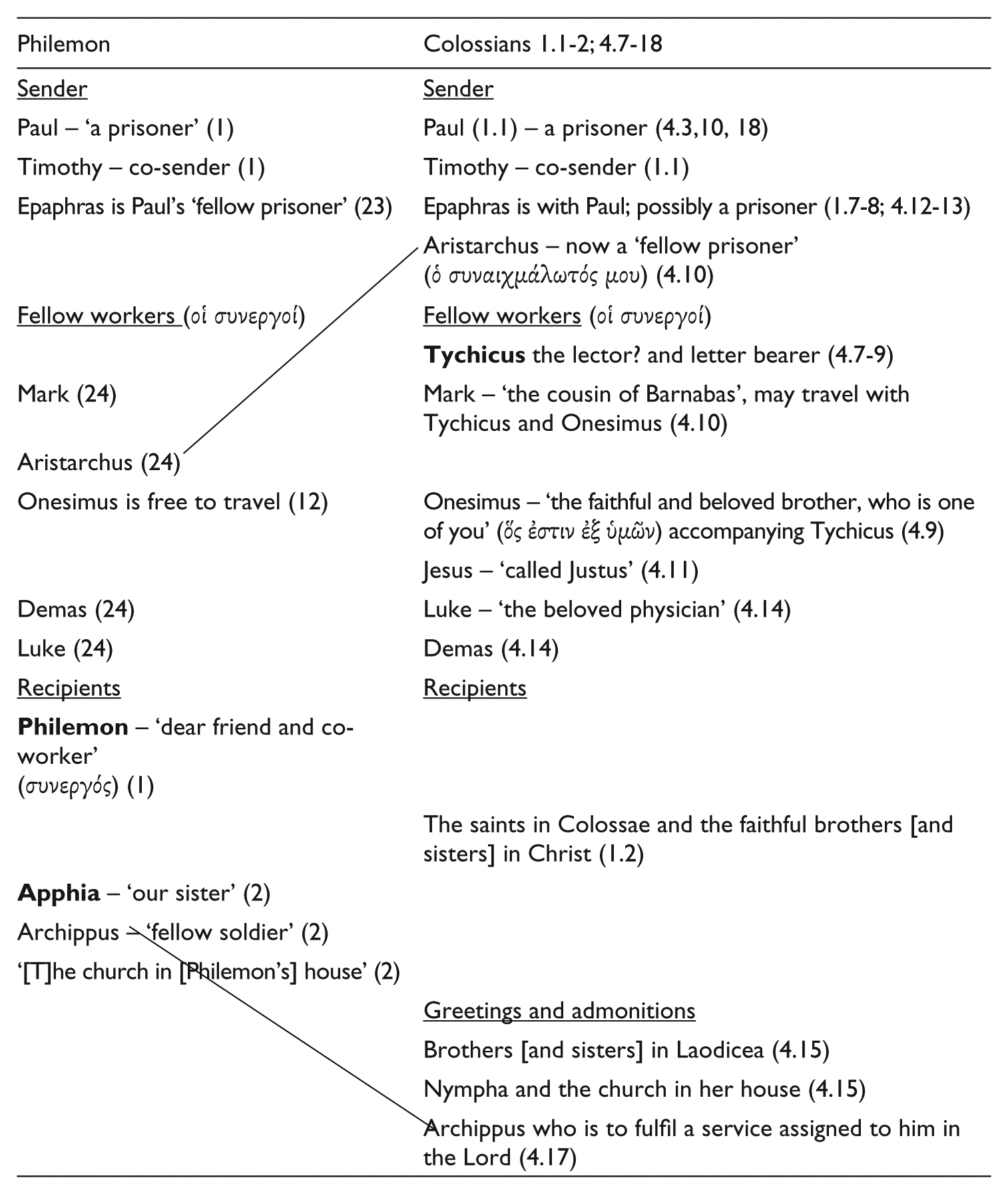
Those names emphasized in bold print are not present in both Phlm and Col. The diagonal lines indicate a difference in role or location of certain people in Phlm and Col. There are nine explicit parallels in personae between these two letters, an overlap which exceeds any other in the Pauline corpus. Six of the names in Phlm are otherwise known to us only in the disputed Pauline letters and Acts, 5 and one of them, Archippus, is known only from Phlm and Col. Such a line-up may suggest that Phlm provided a useful source of names for subsequent pseudepigraphers. But if that were the case in Col, no other pseudepigrapher used them in quite this way. Certainly it suggests that Phlm and Col. 4 reflect (or are intended to reflect) a close connection between these two letters.
There are, however, various differences between the two scenarios, both in terms of personae and in terms of the roles and locations of certain people. There is an absence of greeting to Philemon in Col, and also an absence of greeting to Apphia. These absences are notable because, in an otherwise closely parallel scenario, they would seem to downplay Philemon’s and Apphia’s significance publicly. If Philemon were the patron of the Colossian house-church, why would Paul – or a pseudepigraphical author of the greetings we find in Col. 4 – fail to include greetings in Col. 4 to Philemon, and also Apphia? 6 Even if ‘the saints in Colossae and the faithful brothers [and sisters] in Christ’ (Col. 1.2) were another way of addressing the assembly (ἐκκλησίᾳ) that met in Philemon’s house, one would still expect a greeting to Philemon, and also to Apphia. This courtesy is extended to Nympha and the assembly (ἐκκλησίαν) in her house in Col. 4.15. Similarly, in Rom. 16.3 there is a greeting to Prisca and Aquila followed by a greeting to the assembly (ἐκκλησίαν) which meets in their house (Rom. 16.5). Therefore, this absence of a greeting to Philemon in Col is explicitly recognized as surprising by scholars such as James Dunn (1996: 38), who suggests that Philemon may be away on business (1996: 284). 7 If this were the case, and Paul and his associates were aware of this, one would still expect a greeting to Apphia, if the greetings are authentic. It remains a puzzle even if the greetings are pseudepigraphic: one might have expected a post-Pauline author seeking to recommend the letter as apostolic to have ensured the mention of Philemon (rather than Onesimus!). 8
There is also the absence of any mention in Phlm of such a central worker as Tychicus, who is described in Col. 2.7b as ‘a beloved brother, a faithful minister, and a fellow servant in the Lord’, and who is Paul’s envoy. This absence is more difficult to explain for those who argue for authenticity and see Phlm and Col as sent simultaneously than for those who see the greetings as pseudepigraphy. This will be discussed further below.
The differences in roles and locations are indicated by the connecting, diagonal lines in the table above. Aristarchus, as a fellow worker, appears to be free to move about in Phlm. 24, whereas in Col. 4.10 he is a fellow prisoner. Archippus is among the recipients of Phlm (Phlm. 2), whereas he is not expected to be among the direct recipients of Col (Col. 4.17). Other differences are less remarkable: Jesus called Justus is not mentioned in Phlm although he is grouped together with Mark in Col. 4.11b as ‘of the circumcision’, and Mark is mentioned as sending greetings in Phlm. 24. Demas preceded Luke in Phlm. 24, but comes after Luke in Col. 4.14.
In addition to these differences, one can add that there is an important difference in the tone of what is said about Onesimus in these letters. In the 25 verses of Phlm, 11 of them are devoted explicitly to exhorting Paul’s beloved brother and co-worker to deal favourably and generously with Onesimus, showing this to be a very delicate and live issue in Phlm. By contrast, in Col. 4.9 the passing mention of Onesimus as ‘the faithful and beloved brother, who is one of you’ seems to assume that this view will readily be shared by the recipients of the letter. Finally, there are no wider greetings, admonitions or instructions in Phlm; this may of course reflect the more specific nature of the business which is being addressed in this letter. 9
Different Letters – Different Scenarios – a Different Time
As we have seen, the scenarios which are implied by Phlm and Col are not identical. While this will not surprise anyone already convinced that Col. 4 is pseudepigraphy, some scholars who argue for the authenticity of Col. 4 have not given sufficient weight to the differences. Douglas Moo (2008: 363), for instance, argues that Paul ‘has written a general letter to the church at Colossae along with this “private” note to Philemon at the same time, sending both of them with Tychicus, who is accompanied by Onesimus (Col. 4:7-9)’. This does not match the evidence of the letters. I will now set out some reasons to distinguish the two writings chronologically and show that Phlm predates Col. The chronological difference between them is crucial for the argument which will then follow.
The first difference is the position of Aristarchus. In Phlm. 24, as a ‘fellow worker’ (συνεργός), Aristarchus is free to move about, whereas in Col. 4.10 he is described as Paul’s ‘fellow prisoner’ (ὁ συναιχμάλωτός μου) and can only send his greetings. Colossians 4.10-11 goes on to mention ‘fellow workers’, probably including Mark, Barnabas and Jesus called Justus, indicating that a distinction between these terms was intended. 10 Apart from Phlm. 1 and 24, ‘fellow workers’ – οἱ συνεργοί – are also mentioned in 1 Thess. 3.2, 1 Cor. 3.9, 2 Cor. 1.24, 8.23, Phil. 2.25, Rom. 16.3-5, 9, 21 and Col. 4.11. The references in 1 Thessalonians and Philippians explicitly refer to the sending of the fellow workers, which indicates that they are free to move about. 11 Hence there does indeed appear to be a shift in Aristarchus’s circumstances between these letters; whereas in Phlm Aristarchus is a fellow worker, able to tackle work outside the bounds of the house, in Col he is, like Paul, under arrest. If this is so, we can infer that the letters were not written and sent simultaneously.
A second indication that these letters were not written and sent together is the different position of Onesimus implied in the two writings. As mentioned above, during the composition of Phlm, the reception of Onesimus is precarious, but in Col. 4.9 it does not appear to be controversial to call him ‘faithful, beloved, one of you’. The term ‘faithful’ is also used in Col of Epaphras (1.7), Tychicus (4.7) and the believers generally in Col. 1.2, while the term ‘beloved’ is used of Epaphras (1.7), Tychicus (4.7), Luke (4.14) and of the believers in Col. 3.12. No special pleading for Onesimus seems to be involved here. This indicates a difference in the implied scenarios between Phlm and Col, and also implies that Col is the later writing, as the delicate situation with regard to Onesimus has been resolved in the meantime.
A third indication that these letters were not drafted to be sent simultaneously is the lack of reference to Tychicus in Phlm. If these letters had been drafted and sent together, one would expect some words about Tychicus as the letter bearer and as the one responsible for the return of Onesimus. There is no indication that Tychicus is with Paul when Phlm is written. This also implies a difference in the timing of when Phlm and Col were written. Again, the uncontroversial fact of Tychicus being accompanied and supported by Onesimus shows that Col is the later writing.
Drawing these various indications together, we can infer that the two letters were not written and sent simultaneously, despite the close correlation of personae in them, and that Phlm predates Col.
Logically Correlating the Data
There are two key correlations between Phlm and Col that have led scholars almost universally to locate Philemon, Apphia and Philemon’s house-church in Colossae. The first concerns Archippus, and the second concerns Onesimus who is described as ‘one of you’ (Col. 4.9b). I will set out the way that the data has been understood.
1. Archippus
A In Phlm, Archippus is in the same location as Philemon.
B In Col, Archippus is in or near Colossae.
Linking these two pieces of information and assuming that the two letters were written and sent at the same time and so reflect exactly the same configuration of people and places, scholars have come to conclude that
C Philemon and his house-church are located in Colossae.
The correlation between Phlm and Col which leads us to assume that Philemon is in Colossae is very well established. But it is founded on a syllogistic argument. If Archippus is with Philemon in one letter, and Archippus is in or near Colossae in the other letter, we need not assume that Philemon is located in Colossae: A + B ⊬ C. 12
C is only possible, but not necessary. There are two separate documents involved, and, as I have argued, they are separated in time. It is reasonable to conclude that Philemon may not be in Colossae. To conclude that Philemon must be in Colossae is a syllogistic fallacy resulting from the assumption that the two letters were written at the same time and therefore reflect exactly the same configuration of people and places. The assumption that both letters have Archippus in the same location has appeared to confirm the location of Philemon, Apphia and the house-church at Colossae.
As the table above indicates by means of a diagonal line, there is a difference between Phlm and Col in the expected location of Archippus. Archippus is described in Phlm. 2 as ὁ συστρατιώτης ἡμῶν, our fellow soldier. Depending on the referent intended by ἡμῶν, this phrase either connects Archippus with Paul and Timothy in v. 1, or with the wider grouping of Paul, Timothy, Philemon and Apphia in vv. 1 and 2. The former is more likely, as Paul does not use military language elsewhere in Phlm. If the ‘our’ connects Archippus with Paul and Timothy, he is probably not attached by family ties to Philemon and Apphia. 13 ὁ συστρατιώτης is also a term used in Phil. 2.25, where it refers to Epaphroditus and is correlated with συνεργός ‘fellow worker’. In that context, Epaphroditus, as fellow soldier and fellow worker, has been sent to Paul by the Philippians, and is in turn being sent by Paul to them. This suggests that fellow soldiers are those who are given strategic assignments which take them between communities. 14 The fact that, in Col. 4.17, Archippus is named immediately after the salutation to the Laodiceans and the directions affecting that church is a further piece of evidence that Archippus as a fellow soldier is mobile between communities. 15
As a ‘fellow soldier’, Archippus (who is addressed directly in Phlm and sent an admonition at one remove in Col) can have been redeployed. Archippus’s presence with Philemon (A) and the greeting sent to him at Colossae (B) does not necessarily indicate that Philemon is in Colossae (C). Consequently, Archippus is not necessarily located in Colossae permanently either. At the time Phlm was written, he can have been located in or near Rome. At the time Col was written, he can have been performing an assignment in the vicinity of Colossae and Laodicea.
The assumption that A and B necessarily lead to C has led scholars to wonder why Philemon (and Apphia) are not greeted in Col – as we have seen. But the absence of greetings to them both is necessary if indeed they are not located in Colossae at all.
We now turn to the second correlation that has led scholars to locate Philemon, Apphia and Philemon’s house church in Colossae.
2. Onesimus is ‘one of you’
The other reason why scholars have assumed that Philemon was based in Colossae is his connection with Onesimus. 16
A In Phlm, Onesimus is to be sent back to his master Philemon.
B In Col, Onesimus is to accompany Tychicus to Colossae, and is described to the Colossians in 4.9 as ‘one of you’ (ὅς ἐστιν ἐξ ὑμῶν).
Again, this appears to be grounds to assume that
C Philemon, Onesimus’s master, is located in Colossae.
Yet again, we need to be aware of the syllogistic argument. If we accept that the description of Onesimus as ὅς ἐστιν ἐξ ὑμῶν is meant in a geographical sense, Onesimus must at some time have been one of them, that is, a native of the Lycus Valley, or Colossae specifically. But the fact that a slave comes originally from Colossae does not require that the slave owner must be a resident of Colossae. Slaves were drawn from various parts of the empire and were readily movable. Where Onesimus originally comes from does not logically determine where his master resides. Again: A + B ⊬ C.
This is both a logical and a philological issue. Issues of time and chronology are also raised by this correlation, though in a different way from the earlier correlation. Once we notice that there is no other reason compelling Philemon, Apphia and this house-church to be located in Colossae, we can see that this phrase in fact makes more sense if Onesimus is being sent to Asia Minor – the place of his birth or childhood – after a long absence. In fact ὅς ἐστιν ἐξ ὑμῶν here implicitly signals that Philemon did not live in Colossae. If the recipients of Col were directly involved with the situation reflected in Phlm, they would hardly need ὅς ἐστιν ἐξ ὑμῶν to identify Onesimus. Colossians 4.7-9 recommends the letter bearers – Tychicus and Onesimus – to the recipients at Colossae, ensuring their reception and welcome. If Onesimus had lived most of his life in Philemon’s household, and Philemon’s household was located at Colossae, it would be redundant to reiterate this to the Colossians. And conversely, it would also be inadequate as a means of commending him, had he lived there, as they would almost certainly have been aware of the circumstances reflected in Phlm.
In this regard, it is also significant that the commendation of Onesimus in Col. 4.9 does not appear to be more emphatic than the commendation of Tychicus, who is also described as a beloved brother, as well as a faithful servant and fellow-slave in the Lord (Col. 4.7). Again, this underlines how unlikely it is that the believers at Colossae knew about Onesimus’s past actions or about the process of his reconciliation with Philemon. Until he arrived with Tychicus, bearing the letter to the Colossians with its recommendations of both Tychicus and himself, the Colossians probably knew nothing about Onesimus’s recent history, his conflict with his master or his embracing of the Christian faith.
In the light of these considerations, there is no necessity to take the phrase ὅς ἐστιν ἐξ ὑμῶν (Col. 4.9) as indicating that Philemon, Apphia and the house-church are resident in Colossae. Rather, this phrase actually indicates that they do not live there. It is much more plausible that Onesimus, who was originally from Colossae, has been the slave of Philemon somewhere else for a long time.
Something similar is said shortly afterwards about Epaphras: Ἐπαφρᾶς ὁ ἐξ ὑμῶν (4.12). Of the three references we have to Epaphras (Phlm. 23; Col. 1.7; 4.12), it is clear that he has a long-standing connection with the Colossians, as the one who brought them the gospel, but not that he was necessarily a resident of Colossae. The most straightforward sense of the phrase Ἐπαφρᾶς ὁ ἐξ ὑμῶν is that it specifies the Epaphras to whom reference is being made: ‘Epaphras, who is one of you’ (
Nevertheless, the fact that there is no sense in which Epaphras is able to do anything other than intercede for the Colossians implies that he is not free to travel. 18 The Colossians’ evangelist is now resident with Paul, and is particularly concerned for them.
As we return to the question of Onesimus, who is described as ὅς ἐστιν ἐξ ὑμῶν (Col. 4.9), we have seen that the phrase does not require Onesimus’s master (or former master) Philemon to be a resident of Colossae. Both Onesimus and Epaphras are mentioned as having a connection with the Colossians: Onesimus as the one accompanying Tychicus, the letter bearer and lector, and originally from their area, and Epaphras as the one ministering to Paul on their behalf (Col. 1.7), praying for them and working hard for them (Col. 4.12-13).
Onesimus’s recommendation is not linked with Philemon in Col, and it is important not to conflate Phlm and Col. It is also important not to conflate the connection that Onesimus and Epaphras have with the Colossians: Epaphras is well known to them; Onesimus, though one of them originally, requires the same sort of recommendation as Tychicus.
It has been important to revisit the greetings, as they have shaped scholarly hypotheses about the date and provenance of Col and Phlm. We have assumed that the references to Archippus (Phlm. 2; Col. 4.17) and the one to Onesimus as ‘one of you’ (Col. 4.9b) require that Philemon and his house-church could only have been in Colossae. In turn, this has made squaring the details with Paul’s chronology very difficult. Scholars are aware of just how difficult it is to develop a strong hypothesis as to the date and location of the writing of both Phlm and Col, as the details do not seem to tally. If Phlm were written during Paul’s Roman imprisonment, Paul’s intention to send Onesimus back to Philemon and his hope that Philemon might shortly send Onesimus back to him again speak against a location of Philemon, Apphia and their house-church in Colossae. As many scholars have observed, the distances and travelling time from Rome to Colossae make this scenario unlikely. Land and sea travel would be involved, and seasons would make the one-way distance of over 1,000 miles difficult for two consecutive journeys for Onesimus. Paul seems to envisage a much shorter journey for Onesimus and projects one for himself too when he asks Philemon to prepare a guest room for him (Phlm. 22). 19
As we have seen, nothing within Phlm ties Philemon, Apphia and their house-church to Asia Minor. Once the logical fallacies in correlating the data between Phlm and Col are recognized, the apparent problem of Philemon’s (and Apphia’s) absence from Colossae in Col is in fact no problem at all; it is probable that Philemon, Apphia and their house-church were not located in Colossae, but in a location much closer to Paul’s imprisonment.
Reconsidering Philemon’s Location
If it is accepted as possible, or even probable, that Philemon, Apphia and their house-church were not located in Colossae, what evidence do we have for their location? In order to answer that question, I will first consider the evidence from Phlm, and then turn to the evidence from Col.
First, the imprisonment reflected in Phlm is of some duration. There has been time for Onesimus to seek Paul out, to come to faith, and to make himself useful to Paul. Nevertheless, the imprisonment is also envisaged as coming to an end in the foreseeable future, allowing Paul to request a guest room. Both these factors are compatible with either an Ephesian or a Roman imprisonment. If Roman, the hope of release articulated in Phlm. 22 might suggest a relatively early period in the imprisonment. 20
Second, Paul makes a passing reference to his old age in Phlm. 9. Peter Arzt-Grabner has reviewed what ‘old age’ might mean, and has concluded that it is not necessary to take this as evidence for Paul’s Roman imprisonment. 21 Nevertheless, this reference in Phlm. 9 does make a Roman provenance for Phlm somewhat more plausible than an earlier imprisonment.
The internal evidence in Phlm as to Paul’s location is not decisive. Some scholars have supported Rome as the provenance of Phlm, 22 not least because there is no concrete evidence for an Ephesian imprisonment. 23 Others have argued against a Roman imprisonment in favour of an Ephesian or a Caesarean imprisonment on the basis of Phlm. 22, which seems to require a short travelling distance between Paul’s imprisonment and Philemon’s location, and has therefore seemed to necessitate somewhere near Colossae. 24 However, once the logical fallacy is recognized, the travelling time between Rome and Colossae is no longer an issue and the Ephesian (or Caesarean) hypotheses are less persuasive.
Only one scholar to my knowledge has argued in favour not only of locating the writing of Phlm in Rome, but also of locating Philemon, Apphia and their house-church in Rome, namely Martin Ebner. Ebner (2013: 409) takes the greetings in Col. 4 as pseudepigraphy dated between 70 and 80
Key to Ebner’s case is the Roman legal distinction between a slave who has absconded and is therefore a fugitive (fugitivus) and a slave who, in a conflict with his/her owner, has gone to seek out a mediator (2013: 407). This latter category of slave is away without permission and therefore errant (erro). If Onesimus had sought Paul out as mediator, this is much more plausible within Rome than it would be between Colossae and Rome or even between Colossae and Ephesus (2013: 410). 25 This is a further substantial consideration in locating Philemon, Apphia and their house-church in or near Rome, rather than in Colossae.
Despite the methodological attractiveness of quarantining Phlm from Col as one seeks to determine the most probable scenario for Phlm, the close similarities between them require a convincing context for Col as well. Ulrich Luz (1998: 189) sets out vividly the very real disadvantages of finding a plausible context for Col if the relationship between Phlm and Col is taken as artful fiction.
Ernst Käsemann’s dictum (1959: 1728) is therefore still pertinent: ‘Dating the Letter of Colossians has the following alternatives: if authentic, the content and style require it to be as late as possible, if inauthentic, as early as possible’ (my translation). The two letters’ shared configuration of people makes it unlikely that one could stem from an earlier imprisonment and the other from a Roman one; they suggest the same imprisonment, and that Col is the later writing. Whether we take Col. 4 to be ‘as late as possible’ or ‘as early as possible’, the scenario fits well into a Roman provenance.
As we turn to Col, we find some further evidence. Although the length of the journey envisaged in Col. 4 is not specified, there are indications that it is of greater duration than within Western Asia Minor. One can glean a hint of this in Col. 4.7-9, as these verses emphasize just how distant the recipients are from the author/s:
7
The repetition of passing on all the news, and particularly the need to convey verbally everything that is going on here (9), does indicate a more substantial distance and a greater isolation from one another than between Ephesus and Colossae. If Col indicates that Laodicea is considered ‘nearby’ Colossae (allowing for ready exchange of letters and information), then the imprisonment of Paul and his fellow prisoners does not appear to have been in Ephesus, also relatively ‘nearby’.
There is also external evidence for locating the writing of Col in Rome. Many manuscripts include a subscription after Col. 4.18. There are several variants which associate Col with Rome, some in a shorter version – πρὸς Κολασσαεῖς (sic) ἐγράφη ἀπὸ Ῥώμης, 26 and others in a longer one – πρὸς Κολοσσαεῖς ἐγράφη ἀπὸ Ῥώμης διὰ Τυχικοῦ καὶ Ὀνησίμου. 27 Both Codex B (Vaticanus, fourth century) and Codex A (Alexandrinus, fifth century) have a version of the shorter subscription mentioning Rome as the place of origin. Scholars who mention the subscription at all tend to describe it as an ‘interpolation’, 28 but this is not strictly accurate. In the case of Vaticanus, the subscription has been retraced, but the underlying original is contemporary with the manuscript production, and in the case of Alexandrinus there is no manuscript evidence for a different hand. The subscription is therefore not an interpolation into these manuscripts – it is part of the earliest church tradition as they have received it.
Given that these two important early manuscripts of Col include a subscription naming Rome, it is surprising that the subscription has been discounted so readily. 29 The absence of the subscription in P46 shows that the connection with Rome does not form part of the tradition universally, but as the subscription is attested widely in the later Byzantine tradition and as early as the fourth/fifth centuries in the non-Byzantine tradition, it cannot be discarded as ‘late’. 30 This subscription forms a further piece of evidence that supports the memory which has entered the tradition of a Rome-based imprisonment.
The close similarities between Phlm and Col in both prisoners and fellow workers suggest a Roman house imprisonment such as is described in Acts 28.16-31. This Roman imprisonment has become a strategic missional centre for the Gospel, enabling Paul and/or his fellow workers to oversee the ‘work of the Gospel’ (Phil. 2.22; 4.3).
My own view is to contemplate Paul in his old age of being genuinely willing to allow and endorse the ministry of his fellow workers, including the writing of such a strategic letter as Col. Timothy is named as the co-author, and his long-standing ministry alongside Paul makes this likely. 31 While the stylistic reasons that speak against the writing of Col as a whole by Paul himself are strong, 32 there is no reason based on internal logic or correlation of Phlm and Col to discount Col. 4.7-18 as genuine Paul. Ed Sanders (1966: 45) has already demonstrated that there is no stylistic reason to conclude that Col. 4.7-18 could not have been written by Paul, and Walter Bujard (1973: 233) found no reason to contradict this. 33
A More Plausible Location for Philemon and his House-Church
On the basis of the evidence set out above, I propose that we can postulate a scenario that accounts for the difficulties more logically than has been done to date. Phlm was written by Paul during the early period of his Roman imprisonment, perhaps in 60
Col was written later in the imprisonment, perhaps a year or two later than Phlm. I suggest an interval of one to two years between Phlm and Col on the basis that Archippus has had to travel to Asia Minor since the writing of Phlm and undertake a task that may have included various cities; news seems to have arrived to suggest that his task remained undone. The ‘rehabilitation’ of Onesimus also suggests a lapse of some time between the letters. 34
Col was written by one of Paul’s co-workers, probably Timothy. Paul’s hoped-for release has not taken place. Aristarchus is now also under arrest. Since the sending of Phlm, Archippus had been redeployed as a ‘fellow soldier’ from his base with Philemon in Italy to the Lycus Valley in Asia Minor, with a specific task to accomplish. 35 Paul and Timothy, together with Epaphras and Aristarchus, have the opportunity from their Roman imprisonment to send a letter with Tychicus, accompanied by Onesimus and possibly Mark, the cousin of Barnabas (Col. 4.10). 36 The saints in Colossae, though not known personally to Paul, are of great concern to Epaphras (Col. 4.12).
Paul takes the chance to exhort Archippus publicly to complete the task for which he was redeployed (Col. 4.17). When compared with the greetings in Rom. 16, it is striking that Archippus is not sent a greeting before these words of exhortation are publicly pronounced. This may suggest a measure of concern or dissatisfaction with Archippus’s performance, or the time that has elapsed since he was given the task. The fact that Archippus is not addressed directly implies that Paul and his co-authors assume that it is likely that he is not there, or no longer there, but that the believers in Colossae will have contact with him. I am taking the tone of the words to Archippus as fairly stern on the basis of the use of βλέπε as a ‘watchword’ or warning, 37 as well as the invocation of his service as something he received ‘in the Lord’, which must therefore be fulfilled. Paul and his co-workers in Rome seem to have formed the impression that Archippus needs such a public exhortation, and the exchange of letters between Colossae and Laodicea can potentially offer a timely prompt to Archippus. If the greetings in Col are genuine, the believers at both Colossae and Laodicea are being publicly enlisted to lend their support to Archippus in completing his task. 38
A further reason for questioning the historical plausibility of Col is the question of whether Colossae was habitable following the earthquake that took place there around 60
The hypothesis locating Paul in Rome and also Philemon, Apphia and their house church in Italy, possibly also in Rome, has the following advantages over previous ones:
It enables both Phlm and Col to have been written during Paul’s imprisonment in Rome, without requiring any of the internal evidence to be disregarded or minimized.
It accounts for the request in Phlm. 22 concerning a guest room, which would only require a matter of days to prepare.
It does not require Paul to have changed his plans/hopes to travel from Rome to Spain. 39
It accounts for the differences between Phlm and Col in the implied scenarios: Aristarchus has been imprisoned in the intervening time; Onesimus has returned to Philemon, has been reconciled with him, and has now been restored to Paul as Paul requested; Onesimus has gained sufficient honour and trust in the intervening time to be sent together with Tychicus on the journey to Colossae; Jesus called Justus has joined the group of ‘fellow workers’ gathered around Paul in his lengthy house arrest.
It accounts for the apparent ‘omission’ of Philemon’s and Apphia’s names in the final greetings of Col: there is no ‘omission’, as Philemon, Apphia and their house church are not the recipients of the letter to Colossae.
This scenario makes sense of the need to distinguish Epaphras (Col. 4.12; cf. also Col. 1.7 and Phlm. 23) from Epaphroditus (Phil. 2.25), as they can both be associated with Paul in his imprisonment in Rome.
It suggests a plausible context for the references to Archippus, who was previously based with Philemon, not a great distance from Paul, and has, since the writing of Phlm, been redeployed to the Lycus valley region, with a specific task to do, which is not yet complete.
It suggests a logical reason why both the Colossians and the Laodiceans needed to hear Col.
Conclusion
The contribution of this article has been to revisit the logical pillars upon which the conviction rests that Philemon, Apphia, Archippus and Philemon’s house-church must have been located in Colossae. By revisiting the logic of how we correlate the information in Phlm and Col, we have seen that there is no requirement to see Col as addressed to Philemon, Apphia and the church that meets in Philemon’s house. Placing the recipients of Phlm in or not far from Rome accounts for all the evidence. This contribution supports the case for seeing Col as written by Paul’s co-worker/s towards the end of Paul’s life, though with actual Pauline greetings in Col. 4.7-18, and gives a more plausible historical context for Phlm and Col than has been advanced to date.
Footnotes
1.
At the outset I would like to acknowledge my gratitude to Professor Ulrich Luz for his critical and insightful feedback on this article.
2.
E.g., Martin 1981: 30-40; Arnold 1995: 7; Thompson 2005: 4; Witherington 2007: 19; Moo 2008: 41. For an extensive recent list that includes scholars not directly engaged with in his article, see  : 174 n. 2.
3.
E.g., Lohse 1971: 177-83; MacDonald 2000: 6-9; Leppä 2003: 9-15; Ebner 2013: 403-13. Again, for a fuller list, see Grindheim 2013: 173-74 n. 1; and for an overview of the arguments in favour of Col as pseudepigrapha, see : 174-78.
4.
Such as that of Ollrog 1979: 219-42; Schweizer 1982: 15-24; Dunn 1996: 35-39; Luz 1998: 185-90; Holladay 2005: 394-96. Again, for a fuller list, see Grindheim 2013: 175 n. 3. Another approach supporting partial Pauline authorship is to propose an Ur-Colossians and identify authentic fragments. See : 125-26.
5.
Epaphras, Mark, Aristarchus, Demas, Luke and Archippus.
6.
Apphia is often taken to be Philemon’s wife or sister. However, the greeting in Phlm. 2 is to the assembly (ἐκκλησίᾳ) that meets in his house, not their house. Had Philemon and Apphia been married or been siblings, one would have expected ‘their house’ as a matter of courtesy to Apphia’s status. Romans 16.3-5 refers to Prisca and Aquila and the assembly which meets in their house. This may indicate that Apphia is a significant leader in this house-church, but not a family member. I am grateful to Professor Steve Walton, Research Fellow at Tyndale House, Cambridge, UK, for this observation.
7.
8.
9.
The business of the letter to Philemon is not strictly ‘private’, in our modern sense, as the letter is addressed not only to Philemon, but to Apphia, Archippus and the whole of the house-church. Note that both the opening greeting (Phlm. 3) and the final word of blessing in Phlm. 25 are plural, and therefore address all those named in Phlm. 1-2.
10.
While one cannot exclude the possibility that Col. 4.10-11 means to include Aristarchus as both fellow prisoner and fellow worker, the use of these two terms seems to distinguish Aristarchus from the others.
11.
12.
The logical symbol ⊬ means ‘does not prove’.
13.
J.B. Lightfoot (1897: 306-307) suggested that there is a reasonable degree of probability that Archippus is Philemon’s and Apphia’s son. However, : 312) points out the lack of evidence for this.
14.
The term is also used in 2 Tim. 2.3. The focus there is not on ready deployment, but on sharing suffering, and pleasing one’s enlisting officer.
16.
17.
19.
20.
By contrast with Phil. 1.12-26, especially v. 19, in which we see no tangible expectation of imminent release.
21.
23.
Lampe (1998: 205) has listed these passages as indicating an Ephesian imprisonment: 2 Cor. 1.8-10, Phil. 1.7, 13-25, 2.23, Col. 4.18, Phlm. 23 and possibly 2 Cor. 11.23.
24.
Fitzmyer (2000: 9-11) lists arguments and proponents for each of the three positions – Rome, Caesarea and Ephesus. His list of those who opt for Rome ends chronologically with F.F. Bruce in 1984; he omits the well-argued case offered by Daniel Furter in 1987. Fitzmyer’s extensive lists of scholars illustrate the recent, steady move towards the Ephesian hypothesis. Fitzmyer himself adopts an Ephesian imprisonment in preference to a Roman one, ‘although … that locale remains problematic’ (p. 11) owing to the difficulty of the journey to Rome (pp. 10-11). Dunn (1996: 307-8) cannot ultimately decide between Ephesus and Rome. Michael Bird (2009), like Fitzmyer, draws in material relating to the possible provenance of Philippians as a help to his decision. Yet he acknowledges that his decision is ultimately based on evidence so tightly balanced that he ‘changed [his] mind a number of times’ (p. 13) before opting for the ‘marginally less problematic’ Ephesus (p. 15). There are some recent supporters of a Roman provenance for Phlm, such as Todd Still in .
25.
On the question of the legal status of fugitive or errant slaves, Ebner joins those who build on the ground-breaking article of Peter Lampe (1985). Many before and since have contributed to this insight: see Tolmie 2010: 3 n. 12. In the same volume, further nuances this distinction in his section IV, pp. 133-35.
28.
So, for example, Barth and Blanke 1994: 133. : 10) states that ‘the later manuscript tradition includes the subscript that Colossians was written from Rome’ (emphasis mine).
29.
30.
I am grateful to Dr Dirk Jongkind, Research Fellow in NT Text and Language at Tyndale House and Fellow of St Edmund’s College, Cambridge, UK for his insights on the manuscript tradition.
31.
The trust implied by this dates back to the earlier teamwork of Paul, Silas and Timothy reflected in 1 Thess. 1.1 and 3.2-6, which shows Paul’s trust in Timothy, as do the references in 1 Cor. 4.17, 16.10, 2 Cor. 1.1, 19, Phil. 1.1, 2.19 and Rom. 16.21, to name just the undisputed letters. Ollrog made the case for this type of relationship between Paul and his co-workers (1979: 162-235). He argued that Paul had a theologically motivated and strategic view of the shared work of the gospel, including the concept of co-workers as theologians in their own right. Many scholars have not been persuaded by Ollrog’s proposal that Paul’s co-workers included Pauline community ‘delegates’ who worked for limited periods alongside Paul, Paul’s long-term missional colleagues (particularly Timothy) and a group of independent fellow workers – Apollos, Prisca, Aquila, Titus (1979: 106-108). Nevertheless, Ollrog’s exposition of ‘co-worker’ (συνεργός) as one who shares together with Paul in the missional proclamation (Missionsverkündigung) (1979: 63-72) remains persuasive. To discount Paul’s ability to entrust the drafting of Col to Timothy appears to me to devalue Paul’s ability to work as a team-leader and team-member.
32.
The foundational issue with regard to the authorship of Col as a whole is whether the language and theology of Col, though distinctive, is distinctive enough to indicate an author other than Paul. Dunn (1996: 35) states that in Col, ‘at point after point there are features characteristic of flow of thought and rhetorical technique that are consistently and markedly different from those of the undisputed Paulines’. The differences do not simply reflect a different amanuensis (assistant or secretary). As Dunn puts it, ‘The differences come at the authorial level – the “fingerprint” differences of (unconscious) speech mannerisms and (second nature) patterns of composition’ (1996: 36). : 10) reaches the same conclusion, though via different argumentation.
33.
35.
He may also have been a letter bearer to the Laodiceans on this assignment (Col. 4.16) if the greetings and instructions in Col. 4 are genuine. This letter may have referred to the assignment with which he was entrusted.
36.
This reference to Mark, the cousin of Barnabas, appears to contradict the claim made in Acts 15.39 that there was a permanent falling out between Paul, Barnabas and Mark (see : 47-49). However, note the intriguing uncertainty of Mark’s travel plans in Col. 4.10 and the implied reserve on the part of recipients towards him.
37.
This is the only instance of the imperative singular of this verb in the Pauline corpus. But the plural occurs fairly frequently, and certain instances are clearly weighted in the direction of a warning (Gal. 5.15; Phil. 3.2; Col. 2.8). This reading of Col. 4.17 affirms the more severe tone of the
38.
The instruction to have the letter read out in Laodicea (Col. 4.16) has been viewed as the ‘kingpin’ that Col is a pseudonymous, post-Pauline epistle. So Andreas Lindemann (1983: 36 and 77) who sees Col as actually addressed to Laodicea on the basis of Col. 2.1 and 4.16. Lindemann’s thesis continues to be influential; see : 13.