







Abstract
2 Peter typically does not receive much attention within the study of early canon development. This article, however, focuses on the term ἀπόστολοι in 2 Pet. 3.2 and examines whether it points beyond historical followers of Jesus so as to implicitly include the written legacy produced by them or by their close associates. My inquiry consists of three components: (a) a survey of Justin Martyr’s use of ἀπόστολοι in his stock phrase ‘memoirs of the apostles’ as a roughly contemporaneous analogue to 2 Peter, (b) a study of the juxtaposition ‘apostles’ and ‘prophets’ in 2 Pet. 3.2 and (c) an inquiry into 2 Peter’s literary dependence on the canonical gospels.
In his essay on the apostolate in the Ignatian corpus, Charles Hill (2001) advances a persuasive argument that for Ignatius apostolic writings held a high status of authority equivalent to scripture. Acknowledging that a clear case of Ignatius’s textual dependence on any New Testament 1 text is difficult to determine, Hill (2001: 228-29) nevertheless draws attention to the lofty status of apostles and apostolic authority in the Ignatian letters. So, for instance, in Magn. 13.1 Ignatius exhorts his addressees to be ‘confirmed in the decrees of the Lord and of the apostles’ 2 (βεβαιωθῆναι ἐν τοῖς δόγμασιν τοῦ κυρίου καὶ τῶν ἀποστόλων) in order that they might prosper in all things that they do (cf. τῶν διαταγμάτων τῶν ἀποστόλων in Ign., Trall. 7.1). The notion that keeping the decrees of the Lord engenders blessing is common to the Hebrew scriptures (e.g., Ps. 1). Note, however, that here the decrees of both the Lord and the apostles produce such positive outcome. The promise that traditionally has to do with keeping the OT commandments is here applied to keeping of apostolic decrees. 3 In short, Hill (2001: 234) suggests that Ignatius’s portrayal of the apostles as literary conduits of the Lord’s teaching ‘reveal[s] theological ideas which were central to the emergence of a Christian Scripture to function alongside the Hebrew Scripture’. Arguably, comparable literary connotations in the term ἀπόστολοι can be perceived in Did. 1.1, Polycarp, Phil. 6.3, Diogn. 11.6 and 2 Clem. 14.2. Given such a widespread pattern in the AF, the use of ἀπόστολοι throughout the later writings of the NT also warrants a closer look.
In this article I focus on the pseudonymous 4 letter of 2 Peter (c. 90–150 ce), examining whether its use of the term ἀπόστολοι in 3.2 points beyond historical followers of Jesus so as to implicitly include written legacy produced by them or by their close associates. 5 My inquiry proceeds in three main stages that consider external and internal evidence for the proposed thesis: (1) a survey of Justin Martyr’s use of ἀπόστολοι in his stock phrase ‘memoirs of the apostles’ as a roughly contemporaneous 6 analogue to 2 Peter, (2) a study of the juxtaposition ‘apostles’ and ‘prophets’ in 2 Pet. 3.2 and (3) an inquiry into 2 Peter’s literary dependence on the canonical gospels.
Here a brief word of clarification is necessary. First, although it has been suggested by some that the possessive pronoun in τῶν ἀποστόλων ὑμῶν (2 Pet. 3.2) points to the wider circle of Christian apostles (who probably founded the congregation being addressed 7 ), two factors exclude this reading. Both the authorial self-identification as ‘Simeon Peter, slave and apostle of Jesus Christ’ in 2 Pet. 1.1 and the emphasis on eyewitness testimony in 1.16 leave no room for doubt that the apostles mentioned in 3.2 also belong to Jesus’ immediate, historical circle of disciples. 8 The phrasing of a parallel passage in Jude 17 confirms this reading by omitting the possessive pronoun ὑμῶν and simply speaking of the ‘apostles of our Lord Jesus Christ’.
Second, when arguing for literary dependence of one text upon another, it is necessary to account for the possibility of alternative explanations, such as secondary orality (understood as the knowledge of a text via its oral recollections).
9
To be sure, strict orality and strict textuality are not the only options for how ancient authors came to know, recall and deploy traditions. However, the idea of secondary orality does not overcome the binary division of ‘written’ and ‘spoken’ and therefore is not nuanced enough to reflect the complex interweaving of text and oral tradition in the ancient world. As Mark Goodacre (2012: 139) points out, Traditions crystallize in texts, and texts stimulate the tradition. When Luke sets out to write an account of the things that have been fulfilled among the early Christians (Luke 1:1-4), he self-consciously claims to have knowledge of both texts and traditions, of other narratives and of the things that have been passed on by eyewitnesses.
10
In arguing for Justin Martyr and 2 Peter’s literary dependence on (later canonical) gospels, I do not exclude the possibility that their knowledge of these texts may derive from oral recollections, i.e., from secondary orality. Nevertheless, even if this is the case, it still means that such written gospels existed somewhere out there and they were worthy of remembering, recalling and even reciting.
The Precedent: Justin Martyr and the ‘Memoirs of the Apostles’
As early as the writings of Justin Martyr (c. 100–165 ce), we find good evidence for the existence of written apostolic memoirs, which are furthermore identified as ‘gospels’: For the apostles (ἀπόστολοι), in the memoirs which they caused to be made (ἐν τοῖς γενομένοις ὑπ’ αὐτῶν ἀπομνημονεύμασιν) and which are called gospels (ἃ καλεῖται εὐαγγέλια), handed down (παρέδωκαν) in this way what Jesus has commanded them. Taking bread (λαβόντα ἄρτον) and giving thanks (εὐχαριστήσαντα), he said: ‘Do this in memory of me, this is my body (Τοῦτο ποιεῖτε εἰς τὴν ἀνάμνησίν μου· τοῦτ’ ἐστι τὸ σῶμά μου),’ and taking the cup similarly and eucharistizing it (τὸ ποτήριον ὁμοίως λαβόντα καὶ εὐχαριστήσαντα) he said: ‘This is my blood (τοῦτό ἐστι τὸ αἷμά μου),’ and he shared it with them. (1 Apol. 66.3)
11
Observe the substantive correspondence between Justin’s quotation from the apostolic memoirs and the texts of the synoptic gospels (Mt. 26.26-28//Mk 14.22-24//Lk. 22.19-20), as well as the received tradition recounted by Paul in 1 Cor. 11.23-25. 12 Here we find not only explicit equation between Justin’s preferred designation ‘memoirs’ (ἀπομνημονεύμασιν) and the subsequently more common title ‘gospels’ (εὐαγγέλια), but also the conformity of content between these memoirs and the gospels as we know them. The choice of plural εὐαγγέλια further confirms Justin’s knowledge of more than one gospel text. That apostolic memoirs known to Justin are written in form is made clear in multiple passages (e.g., ἔγραψαν in Dial. 88.3, γεγραμμένον in Dial. 100.4, γέγραπται in Dial. 104.1, γεγράϕθαι and γέγραπται in Dial. 106). It follows, therefore, that the contextual meaning of παραδίδωμι here refers to the handing down of apostolic tradition through the written medium of the gospels.
Numerous other passages from Justin’s writings provide further proof that his ‘memoirs of the apostles’ are unequivocally written in nature and overlap in content with the (now canonical) gospels, especially the Gospel of Matthew: Dial. 101.3 (cf. Mt. 27.39-40, 43); Dial. 102.5 (cf. Mt. 27.11-14); Dial. 103.6 (cf. Mt. 4.9-10); Dial. 103.8 (cf. Mt. 26.39); Dial. 105.6 (cf. Mt. 5.20). For the purposes of this study, one example will suffice to demonstrate the larger pattern. Consider Justin’s quotation from ‘the gospel’ in Dial. 100.1, which is almost identical with the Matthaean text: Dial. 100.1: Also in the Gospel it is written (ἐν τῷ εὐαγγελίῳ δὲ γέγραπται) that he said: ‘All things have been handed over to me by my Father (Πάντα μοι παραδέδοται ὑπὸ τοῦ πατρός) and no one knows the Father except the Son (καὶ οὐδεὶς γινώσκει τὸν πατέρα εἰ μὴ ὁ υἱός); nor the Son except the Father and to whomever the Son might reveal [him] (οὐδὲ τὸν υἱὸν εἰ μὴ ὁ πατὴρ καὶ οἷς ἂν ὁ υἱὸς ἀποκαλύψῃ).’
13
(cf. 1 Apol. 63.3, 13) Mt. 11.27: All things have been handed over to me by my Father (Πάντα μοι παρεδόθη ὑπὸ τοῦ πατρός μου); and no one knows the Son except the Father (καὶ οὐδεὶς ἐπιγινώσκει τὸν υἱὸν εἰ μὴ ὁ πατήρ), and no one knows the Father except the Son and anyone to whom the Son chooses to reveal [him] (οὐδὲ τὸν πατέρα τις ἐπιγινώσκει εἰ μὴ ὁ υἱὸς καὶ ᾧ ἐὰν βούληται ὁ υἱὸς ἀποκαλύψαι).
On the whole, the comparison between the content of Justin’s memoirs and the four gospels points to the clear predominance of (a version of) Matthew as Justin’s written source. 14
What is even more remarkable, these written memoirs or gospels already at this point possess an authoritative status in the church. Not only does Justin use them for rhetorical purposes throughout his writings, but they also perform an etiological function for the practice of the Eucharist, as is evident in 1 Apol. 66.3 quoted above. There the institution narrative is linked to the original words of Jesus not through oral tradition, but through the literary records of apostolic memoirs. 15 Moreover, in 1 Apol. 67.3 Justin claims that on Sundays the ‘memoirs of the apostles’ (τὰ ἀπομνημονεύματα τῶν ἀποστόλων) were read interchangeably with the writings of the prophets (τὰ συγγράμματα τῶν προϕητῶν) (see also juxtaposition ‘apostles’ and ‘prophets’ in Dial. 119.6), thereby placing apostolic memoirs on par with the Hebrew scriptures as authoritative sources of ecclesial teaching. 16
The import of the above survey for my overall argument is twofold. First, we observe that as early as the mid-second century apostolic witness about Jesus was circulating in the written form under the designation ‘memoirs of the apostles’. Furthermore, both the explicit reference to εὐαγγέλια 1 Apol. 66.3 and a careful examination of the content of Justin’s ‘memoirs of the apostles’ reveal that they are none other than (later canonical) gospels, or perhaps a harmony thereof, with Matthew as the predominant source. 17 Second, already by the mid-second century these written memoirs or gospels came to possess an authoritative status akin to OT scriptures within the Christian community. These two conclusions, in turn, have significant implications for the interpretation of 2 Peter. Given that this epistle is chronologically proximate to Justin’s writings (within a few decades), we have an external precedent for the possibility that the ‘commandment of the Lord [transmitted] through the apostles’ in 2 Pet. 3.2 implicitly refers to their literary legacy, i.e., the written gospels, and that these writings are already considered authoritative by the author of 2 Peter.
‘Apostles and Prophets’
Having considered the literary legacy linked to the term ἀπόστολοι within the external precedent of Justin Martyr’s writings, we must now examine whether the internal evidence of 2 Peter itself supports a similar ‘textualizing’ of apostolic commandment in 3.2.
The pairing of ‘apostles’ (τῶν ἀποστόλων) with ‘prophets’ (τῶν ἁγίων προϕητῶν) in 3.2 is perhaps the most explicit indicator of the literary connotation in the term ἀπόστολοι. 18 Undoubtedly, much argumentative weight hinges on how one interprets προϕῆται, since the two terms go hand-in-hand and are placed in parallel. Two factors indicate that epistle’s author intends to speak of the OT rather than NT prophets. 19 First, earlier in 1.21 he indirectly mentions the OT prophets – a meaning that is made clear by 2.1, where the rise of false prophets in Israel is paralleled to the rise of false teachers among the believers. Second, the prophets are identified as ‘holy’ in 3.2 – a modifier that is never applied to the prophets of the early church but in fact often describes the OT prophets (Lk. 1.70; Acts 3.21; and possibly Rom. 1.2; Eph. 3.5).
Furthermore, the descriptive phrase ‘holy prophets’ (ἁγίων προϕητῶν) suggests that the author of 2 Peter has in mind not merely historical figures of the OT, but also their correspondent writings, which had already acquired an authoritative ‘holy’ status as God’s word by the time of the letter’s composition. 20 Indeed, earlier in the letter the author defends this elevated status of the prophetic writings by claiming that ‘no prophecy ever came by human will, but men and women moved by the Holy Spirit spoke from God’ (1.21). Yet particularly important is the fact that the author of 2 Peter exhorts his addressees to ‘remember the words spoken in the past (μνησθῆναι τῶν προειρημένων ῥημάτων) by the holy prophets’ (3.2). What is at stake here is not the historical persons, but their prophetic words – utterances that were preserved primarily in the written records of the Hebrew scriptures (cf. Acts 1.16; Rom. 9.29; Heb. 4.7). Taken together, all of these factors suggest that in 2 Pet. 3.2 προϕῆται is a reference not merely to historical figures, but also to their authoritative literary legacy preserved in the Hebrew scriptures. And since the author of 2 Peter places ‘apostles’ and ‘prophets’ on a par as something to be remembered, it is reasonable to suspect that the term ἀπόστολοι also points beyond historical followers of Jesus to their correspondent literary legacy. 21
Interestingly, the author of Jude gives a similar connotation to his use of ἀπόστολοι in v. 17: ‘But you, beloved, must remember the words spoken in the past by the apostles of our Lord Jesus Christ …’ (my translation). By altogether omitting the mention of the prophets, Jude appeals directly to the apostolic ‘words spoken in the past’ (τῶν ῥημάτων τῶν προειρημένων).
22
Here the appeal is made not only to the apostolic persons themselves, but first and foremost to their words (ῥημάτων). This is likely the case for 2 Peter as well, since both authors exhort their addressees to remember the apostolic teaching that is nearly identical in content: 2 Pet. 3.3: First of all you must understand this, that in the last days (ἐπ᾽ ἐσχάτων τῶν ἡμερῶν) scoffers (ἐμπαῖκται) will come, scoffing and indulging their own lusts (κατὰ τὰς ἰδίας ἐπιθυμίας αὐτῶν πορευόμενοι) Jude 18: for they said to you, ‘In the last time (ἐπ᾽ ἐσχάτου χρόνου) there will be scoffers (ἐμπαῖκται), indulging their own ungodly lusts (κατὰ τὰς ἑαυτῶν ἐπιθυμίας πορευόμενοι).’
Whatever the direction of influence, the two authors evoke the exact same apostolic tradition, while the very process of copying from one another points to the tradition’s textual form. Again, Jesus’ apostles are evoked not merely as authoritative historical figures, but also as sources and conduits of written traditions about Jesus.
The ‘Commandment’
Thus, a fusion of human and textual referents seems to take place in the author’s call to remember ‘the commandment of the Lord and Savior [transmitted] through your apostles’ (τῆς τῶν ἀποστόλων ὑμῶν ἐντολῆς τοῦ κυρίου καὶ σωτῆρος) in 3.2. Although it is not self-evident whether this commandment was handed down orally or through apostolic writings, the nature of the term ‘commandment’ elsewhere in the NT suggests the latter scenario. All three synoptic gospels implicitly embrace the traditional understanding of commandments as something issued by Israel’s God (Lk. 1.6) and recorded in written form in the Hebrew scriptures. This same understanding of the term ἐντολή is shared by several NT epistles (Rom. 7.8-13; 13.9; Eph. 2.15; 6.2; Heb. 7.5, 16, 18; 9.19). Only in the Fourth Gospel does Jesus himself issue a new commandment to his disciples: to love one another (13.34; cf. 14.21). This same commandment is then handed down in the Johannine epistles, where the author assures the addressees that he is not writing a new commandment but is passing on something they have had from the beginning (2 Jn 1.5-6). Paul also purports to be writing a commandment of the Lord in 1 Cor. 14.37, but there the phrase seems to play a polemical role of validating Paul’s instructions rather than presenting any substantive tradition of Jesus’ words. It is noteworthy, however, that in all of these instances the ‘commandment’ is something being actively passed on in written form. Given this evidence, it is reasonable to expect that 2 Peter’s use of this term should conform to the wider pattern.
The term ‘commandment’ occurs only twice in the second Petrine epistle, but both instances are illuminative. In his denunciation of the false teachers, or perhaps their followers in 2.21, the author of 2 Peter says that ‘it would have been better for them never to have known the way of righteousness than, after knowing it, to turn back from the holy commandment that was passed on to them’ (παραδοθείσης αὐτοῖς ἁγίας ἐντολῆς). Here the ‘commandment’ is synonymous with the ‘way of righteousness’, and so refers broadly to a set of teachings rather than to any one commandment in particular. 23 But a more important observation is that the ‘commandment’ has been passed on (παραδοθείσης), though it is unclear whether it was passed on orally or through writing. The modifier ‘holy’, however, suggests that this tradition has already acquired an elevated status among the believers and, therefore, was probably solidified in writing like the ‘holy commandments’ of the Hebrew scriptures (Rom. 7.6, 12).
Given their locative proximity and similarity of context, the meaning of ἐντολή in 3.2 must be at the very least partially determined by its earlier occurrence in 2.21. As in 2.21, the commandment in 3.2 is something being actively passed on. The genitive form of τῶν ἀποστόλων ὑμῶν is instrumental and describes precisely this process of handing down the tradition. That this apostolic handing down occurs through the process of writing is evident in the very fact that the implied author of 2 Peter, apostle Peter, writes an epistle; writes to ensure continual remembrance of ‘these things’ (1.13-15; 3.1). 24 Thus, the literary connotation in the term ἀπόστολοι is ‘performed’ by the implied author, Peter. Moreover, by virtue of writing in Peter’s name, the real author of 2 Peter situates his letter both within the apostolic commandment mentioned in 3.2 and within the written Petrine tradition represented by 1 Peter. 25 This is why in 3.1 he says: ‘this is now the second letter that I am writing to you … in them I …’ 26 Far from offering an alien innovation, our author seeks to preserve and reinforce Peter’s written apostolic legacy, and he does so by employing the word-root *μνη* (1.12, 13, 15; 3.1, 2), whose primary meaning has to do with ‘remembering’ or ‘reminder’ of what was written before. 27
Both the contextual meaning of the term ἐντολή and the nature of its handing down suggest that ‘commandment’ in 3.2 is of written rather than oral nature. The placement of this command in parallel with the prophetic words, which were indeed preserved through the literary medium of the Hebrew scriptures, reinforces this conclusion. 28 The reference to ἀπόστολοι, therefore, is not limited to historical followers of Jesus but also implicitly includes their literary legacy, herein called the ‘commandment’.
‘Prophetic Word’
In order to highlight the credibility of the tradition recalled in the letter, the implied author, Peter, emphasizes his direct participation in Jesus’ life, his eyewitness (ἐπόπται γενηθέντες) account of Jesus’ power and splendour (2 Pet. 1.16, 18). 29 Yet, the main concern in this passage is once again not the person of Peter, but his apostolic testimony or tradition, which is called ‘the prophetic word’ (τὸν προϕητικὸν λόγον) in 2 Pet. 1.19, and whose memory the author is at pains to preserve (2 Pet. 1.12-15). 30 Although some perceive in 1.19 a reference to the OT prophecies, context clarifies that it is not the prophets but the apostolic ‘we’ that possess (ἔχομεν) ‘the more sure prophetic word’ (βεβαιότερον τὸν προϕητικὸν λόγον). 31 Furthermore, the primary referent of the phrase ‘the more sure prophetic word’ is the apostles’ own message recounted in the immediately preceding vv. 16-18 – the event of Jesus’ transfiguration and the promise of his return in power (δύναμιν καὶ παρουσίαν in 1.16). 32
The only other NT instance of the adjective ‘prophetic’ is used by Paul in Rom. 16.26, where he mentions ‘prophetic writings’ (γραϕῶν προϕητικῶν) through which the mystery kept for ages, the gospel and preaching of Jesus Christ, were made known to all the nations. While in the NT γραϕή almost ubiquitously refers to the Hebrew scriptures, the content that the ‘prophetic writings’ are said to disclose in Rom. 16.26, i.e., ‘gospel and preaching of Jesus Christ’, surprisingly suggests that these writings belong to the NT rather than OT age. It is worthy of note that the only occurrence of the phrase ‘the prophetic word’ (ὁ προϕητικὸς λόγος) in the AF introduces a non-OT quotation thought to belong to a lost apocryphon (2 Clem. 11.2), and this same quotation is also introduced as ‘scripture’ (ἡ γραϕή) (1 Clem. 23.3). 33 This evidence, however, is inconclusive and requires further investigation which would require a separate article. Suffice it to note that even this scarce amount of ‘prophetic word’ terminology all across the board points to its authoritative status.
In 2 Pet. 1.19 in particular the very identification of the apostles’ ‘more sure prophetic word’ as prophetic (προϕητικός) alludes to its divine origin, for the author explains further in v. 21 that ‘no prophecy ever came by human will’. Even as the former prophets spoke under the influence of the Holy Spirit rather than being guided by their own will (2 Pet. 1.20-21), so too, by implication, the origin of the ‘more sure prophetic word’ of the apostles (2 Pet. 1.19) lies ultimately with God. 34 This is why the affirmation of Jesus’ identity at the transfiguration is made by God himself – ‘the majestic glory’ (2 Pet. 1.17). In 2 Pet. 1.19 the ‘more sure prophetic word’ of the apostles is also compared to ‘a lamp shining in a dark place’ (λύχνῳ ϕαίνοντι ἐν αὐχμηρῷ τόπω). This language echoes at least two OT passages where the Hebrew scriptures are likened to a shining lamp. One of them states: ‘Your word is a lamp (λύχνος) to my feet and a light (ϕῶς) to my path’ (Ps. 119.105), while the other claims that ‘the commandment of the law is a lamp (λύχνος) and the teaching a light (ϕῶς) …’ (Prov. 6.23). 35 Through these subtle intertextual allusions, the author of 2 Peter compares the guiding potential of the apostolic testimony to that of the OT itself, and thereby highlights the authority of the apostolic witness recounted in ch. 1.
Thus, already in the beginning of his epistle, the author of 2 Peter establishes the authoritative nature of the apostolic tradition – their ‘more sure prophetic word’ (1.19) – to which he will appeal throughout and especially in 3.2. The credibility of such tradition is important because, by writing in the name of the apostle Peter, the real author locates his own letter in the same stream of written apostolic (specifically Petrine) tradition. 36
The ‘Rest of the Scriptures’: 2 Peter and Pauline Writings
Finally, my rendering of the term ἀπόστολοι in 2 Pet. 3.2 as implicitly textual becomes even more compelling in light of 2 Pet. 3.16, where a parallel is drawn between the Hebrew scriptures (γραϕάς) and Paul’s epistles (ἐπιστολαῖς). 37 According to 2 Peter, both groups of writings are being distorted by those who are ignorant and unstable in faith. That the author of 2 Peter understands Paul’s teaching to belong to the category of ‘scripture’ is indicated explicitly by the phrase ‘as also the rest of the scriptures’ (ὡς καὶ τὰς λοιπὰς γραϕάς). More remarkably, it is Paul’s written legacy, which is so highly deemed (see ἔγραψεν ὑμῖν in v. 15 and ἐν πάσαις ταῖς ἐπιστολαῖς in v. 16).
The content of 2 Peter also reveals that its author had access to Pauline writings. The strongest literary connection is found in 2 Pet. 3.15, where the author exhorts his addressees to ‘regard the patience (μακροθυμίαν) of our Lord as salvation (σωτηρίαν)’ even as their beloved brother Paul also wrote to them. This is the same point as in 3.9: ‘The Lord is not slow about His promise, as some count slowness, but is patient (μακροθυμεῖ) toward you, not wishing for any to perish but for all to come to repentance (μετάνοιαν)’. Quite possibly then, the author of 2 Peter was alluding to Pauline teaching as early as v. 9. This construal of the Lord’s delay as patience (μακροθυμία) and the further understanding of his patience as an opportunity for repentance (μετάνοια) and salvation (σωτηρία) in 2 Pet. 3.9, 15 are developed extensively in Paul’s letter to the Romans. For instance, in Rom. 2.4 Paul poses this rhetorical question: ‘Or do you despise the riches of his kindness and forbearance and patience (μακροθυμίας)? Do you not realize that God’s kindness is meant to lead you to repentance (μετάνοιάν)?’ Thus, the category of people opposed here is very much akin to the scoffers criticized in 2 Peter. Both complicitly think to escape the judgment of God and both fail to understand God’s patience (μακροθυμίας) as an opportunity for repentance (μετάνοιαν). Thus, the author of 2 Peter employs characteristically Pauline teaching in 3.15, instructing his addressees to conceive of the Lord’s patience (μακροθυμίαν) as salvation.
Furthermore, the groups criticized by Paul and 2 Peter also share in ignorance or failure to understand and seem to have the same disrespectful attitude towards their superiors. In Rom. 2.4 they are said to despise (καταϕρονεῖς) the riches of God’s forbearance with them and fail to understand (ἀγνοῶν) that God’s kindness should lead them to repentance; and according to Rom. 2.24 their foolish behaviour causes God’s name to be blasphemed (βλασϕημεῖται) among the nations. Similarly, in 2 Pet. 2.10, 12 the opponents are said to despise (καταϕρονοῦντας) authority by blaspheming (βλασϕημοῦντες; see also βλασϕημηθήσεται in 2.2) the glories, all the while failing to understand (ἀγνοοῦσιν) that which they blaspheme (βλασϕημοῦντες). Admittedly, the meaning of this Petrine passage is difficult to decipher, but the use of the same verbs as in Rom. 2 (which are rare outside of Paul’s writings) undoubtedly creates a literary link to this Pauline epistle. 38 The possibility of such a link is further confirmed by the fact that Petrine legacy has traditionally been associated with the church of Rome, 39 thus creating a connection from Romans to 2 Peter via its implied author Peter.
Given 2 Peter’s exalted view of Pauline writings and his literary use of them, one might rightly wonder whether the same is true of the other ‘apostles’ and their literary legacy. 40 Considering the degree of importance given to Paul’s writings by pairing them with the Hebrew scriptures, the placement of apostolic testimony alongside prophetic words in 3.2 would also endow the former with much authority. In other words, just as Paul’s writings in 3.16, so too the ‘commandment [transmitted] through the apostles’ in 3.2 are likely to be both written and authoritative.
Textual Resonance between 2 Peter and the Written Apostolic Accounts
I have now generally outlined the tradition that the author of 2 Peter asks his addressees to remember: it is an authoritative eyewitness testimony, it has been passed down through the apostles, it can be placed on a par with the words of the prophets recorded in the Hebrew scriptures, and it is similar to the OT in its ability to illumine one’s life. 41 Moreover, like the Hebrew scriptures, this apostolic tradition is not static but is being actively handed down through the written medium as a ‘commandment’.
The more precise content of the apostolic tradition or ‘commandment’ referenced in 3.2 is elaborated in the verses that immediately follow, as the transitional ‘knowing that …’ (γινώσκοντες ὅτι) in 3.3 suggests. This phrase introduces exactly what the author wants his addressees to remember, though it is debatable whether the content of the reminder ends in v. 7, v. 10 or v. 13. That the material following v. 3 represents the content of the apostolic ‘commandment’ is made even clearer in the parallel passage in Jude 17-18, where the author introduces the same material with ‘they [i.e., the apostles] said to you’ (ἔλεγον ὑμῖν in v. 18). If my argument so far is correct and the apostolic commandment in 3.2 is written in nature, then it is fair to expect that much of the content of this commandment will resonate with the written apostolic traditions found in the gospels. 42 In other words, if we can demonstrate a certain level of textual dependence of 2 Peter on the gospels, it would strengthen the overall argument that the term ἀπόστολοι refers beyond historical persons to their literary legacy.
Since the author’s reminder in 3.2 consists of both the words of the prophets and the commandment of the apostles, it is not surprising to find that much of the material following v. 3 draws on the prophetic texts. So, for example, the doubting taunt described in 3.4 may originate in texts like Isa. 5.19; Jer. 5.12-13; 17.15; Ezek. 8.12; 9.9; 12.27; and Mal. 2.17 – all of which denounce those who scoff at the Lord’s delay to execute judgment or bring about vindication. 43 While much more can be said about the author’s dependence on the prophetic words from the Hebrew scriptures, we must proceed to the more crucial question of his dependence on early apostolic writings.
2 Peter and the Gospels
Although the author’s exhortation in ch. 3 strongly resonates with the OT prophecies, there are several reasons to believe that the apocalyptic sections from the synoptic gospels are a stronger candidate for the tradition evoked in 2 Pet. 3. The scoffers denounced by the OT prophets are primarily concerned with the Lord’s delay in retribution, whereas the scoffers of 2 Peter question the Lord’s return in general, the Parousia (παρουσία in 3.4, 12; cf. 1.16). It must be noted that all three synoptics include Jesus’ discourse about his return and the distinctive marks of the last time, though only Matthew uses the term παρουσία (Mt. 24.3, 27, 37, 39). All emphasize the need to ‘stay awake’ or ‘watch’ so as to be prepared for the Lord’s return, but only Matthew and Luke compare Jesus’ return to a coming of a thief (κλέπτης) in the night (Mt. 24.42-44//Lk. 12.39). The dangers associated with the loosening of one’s eschatological expectation are described in a parable about the faithful and the unfaithful slaves (Mt. 24.45-51//Lk. 12.42-46). The faithful slave is the one found at work during his master’s return, while the unfaithful slave exploits his master’s delay as an opportunity for mistreatment of others and debauchery. Thus, according to Matthew and Luke, there exists a direct link between one’s readiness for the Lord’s coming and one’s ethics.
This teaching speaks well to the problem encountered by the author of 2 Peter, who exhorts his addressees not to count the Lord’s delay as slowness, because ‘with the Lord one day is like a thousand years, and a thousand years are like one day’ (3.8). 44 For this reason he forewarns them to remain alert (3.17) and, like Matthew and Luke, claims that ‘the day of the Lord will come like a thief (κλέπτης)’ (3.10). 45 With Matthew and Luke, the author of 2 Peter perceives a connection between one’s readiness for the Lord’s return and one’s ethics. 46 This is why the bulk of ch. 2 describes the false teachers’ errant behaviour and the consequent punishments. 47 This is also why the author of 2 Peter claims that those who desire to soberly await the Lord’s return must maintain their godly conduct in 3.11-12: ‘Since all these things are to be dissolved in this way, what sort of persons ought you to be in leading lives of holiness and godliness, waiting for and hastening the coming of the day of God …?’ Thus, 2 Peter’s moral exhortation is rooted in the synoptic teaching on the Lord’s return, specifically the connection between one’s readiness for the Parousia and one’s ethics.
Also noteworthy is the emphasis on the predictive character of Jesus’ discourse in the synoptics (Mt. 24.25//Mk 13.23): ‘Take note, I have told you beforehand (προείρηκα)’, which seems to be picked up by the author of 2 Peter in 3.2 (cf. Jude 17). The author of 2 Peter exhorts his addressees to remember the ‘spoken beforehand’ (προειρημένων) words of the prophets and the commandment of the Lord through the apostles. Though προειρημένων is grammatically attached to ‘words of the prophets’, its position in the sentence does not exclude the possibility that it also secondarily modifies the ‘commandment of the Lord’. That this term is not used in any of the prophecies about the last days or about eschatological matters in any of the other NT authors 48 but only in Matthew and Mark strengthens the probability of 2 Peter’s literary link to apostolic tradition found in these gospels. 49
Besides the author of 2 Peter, Matthew and Luke are the only NT writers who include the example of the flood in Jesus’ apocalyptic discourse, though they employ the same events to stress a slightly different aspect of the Parousia than 2 Peter. 50 The events of Sodom and Gomorrah’s destruction are also included by both Matthew and Luke and 2 Peter. For Matthew and Luke, the punishment of Sodom is mainly exemplary as a kind of punishment that awaits those who rejects the gospel message (Mt. 10.15//Lk. 10.12; Mt. 11.24). 2 Peter follows their suit when he identifies Sodom and Gomorrah’s destruction as ‘an example of what is coming to the ungodly’ (2.6; cf. Jude 7). Thus, 2 Peter’s use of flood and Lot traditions goes hand in hand with the evangelists’, reinforcing 2 Peter’s dependence on the synoptic gospels. 51
One can go a step further to suggest that 2 Peter drew primarily on Matthew and that similarities with Mark and Luke are incidental: since Matthew is dependent on Mark, and Luke is dependent on Matthew or vice versa. Reasons for singling out Matthew as 2 Peter’s primary source are few. Matthew’s apocalyptic section is the most developed and spatially concentrated, as opposed to Lukan material which is spread out between various narrative episodes. Matthew is the only synoptic author who uses the same term as 2 Peter, παρουσία, in his apocalyptic discourse. And finally, as we shall see below, we find other literary connections to Matthew in 2 Peter.
The strongest case for literary dependence on this gospel is found in 2 Peter’s transfiguration account. The heavenly message, which the implied author Peter claims to have heard, resembles the voice of the Matthaean transfiguration more closely than other synoptics:
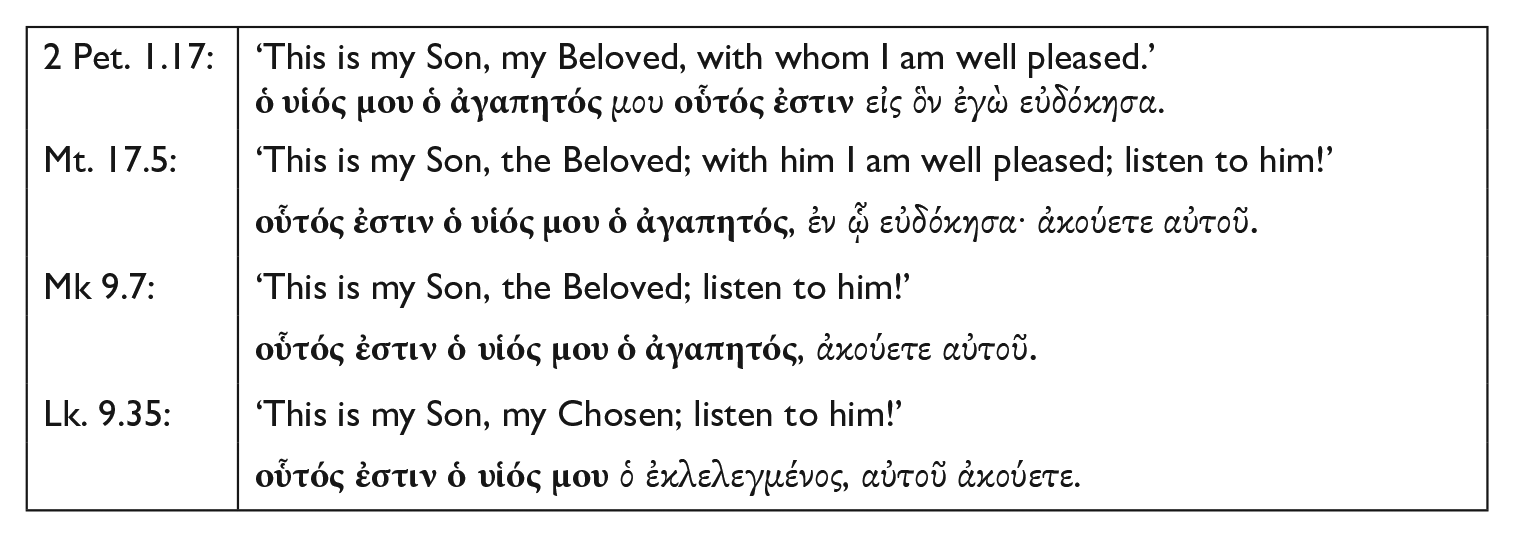
Interestingly, 2 Peter does not include the command to ‘listen to him’ shared by all three synoptics. And, assuming Markan priority, we may observe that he does not follow Lukan redaction of Mark but reiterates the material shared by Mark and Matthew, namely ‘this is my beloved son.’ 52 More importantly, it is specifically Matthaean redaction about being pleasing (εὐδοκέω) to the Father that 2 Peter adopts with minor modification. Both Mk 1.11 and Lk. 3.22 also claim that the Son is pleasing (εὐδοκέω) to the Father, albeit in the context of Jesus’ baptism. Matthew does likewise, but he is the only evangelist who carries this theme throughout the gospel (12.18) and includes it in the transfiguration (17.5). Thus, we have good reason to believe that 2 Peter’s transfiguration account is dependent on Matthew’s gospel. 53 That a citation identical to this Matthaean text crops up in the Clementine Homilies 3.53 (Οὗτός ἐστίν μου ὁ υἱὸς ὁ ἀγαπητός, εἰς ὃν εὐδόκησα, τούτου ἀκούετε) suggests that this gospel or this particular portion of it was widely known from the second century on and bolsters the likelihood of 2 Peter’s knowledge of it too.
Another possible connection to Matthew strengthens the argument of this section. In all three synoptics, Jesus’ transfiguration is immediately preceded by a promise of his return within the lifespan of his generation: Mt. 16.28: Truly I tell you, there are some standing here who will not taste death before they see the Son of Man coming in his kingdom. Mk 9.1: Truly I tell you, there are some standing here who will not taste death until they see that the kingdom of God has come with power. Lk. 9.27: But truly I tell you, there are some standing here who will not taste death before they see the kingdom of God.
Interestingly, the scoffers’ taunt in 2 Pet. 3.4 also has to do with the Lord’s return, or rather failure to return: ‘Where is the promise of his coming? For ever since our ancestors (οἱ πατέρες) died, all things continue as they were from the beginning of creation!’ NRSV’s translation of οἱ πατέρες as ‘ancestors’ is somewhat misleading, since the English term ‘ancestors’ refers broadly to previous generations, usually those long gone. However, the Greek term employed here may well refer to the immediately preceding generation. Indeed, the context seems to demand this latter meaning, since the scoffers’ concern is precisely with the generation(s) that died in the decades after Jesus’ promise without ever seeing his return. In other words, Jesus’ promise of return in the synoptics probably serves as foundation for the scoffer’ complaints in 2 Pet. 3.4 – a likely connection given 2 Peter’s earlier use of transfiguration, which immediately follows this promise of return. 54 What makes this connection particularly Matthaean is the wording of Jesus’ promise. Whereas in both Mark and Luke the kingdom itself comes, in Matthew Jesus speaks of his coming as the Son of Man. This more personalized promise coheres well with the scoffers’ expectation of Jesus’ personal appearance (ἡ ἐπαγγελία τῆς παρουσίας αὐτοῦ) in 2 Pet. 3.4.
In short, a number of factors lead one to believe that the author of 2 Peter used the text of, or a version closely resembling, Matthew’s gospel in the written form: (1) quantity of connections, (2) clustering or concentration of these connections in proximity to each other and (3) the similarity of context in which the material shared by the two authors appears. 55 That the manner of 2 Peter’s use of the gospel texts closely resembles that of Justin Martyr both favor Matthew as their source further shows that this epistle belongs to the wider second-century pattern and is not an outlier.
Portrayal of Peter in 2 Peter
Finally, while the author of 2 Peter was almost certainly not Peter himself, he faithfully embodies Peter’s narrative persona presented in the gospels and Acts. In Mt. 16.19 Peter is given authority over the entrance into the kingdom of God: ‘I will give you the keys of the kingdom of heaven, and whatever you bind on earth will be bound in heaven, and whatever you loose on earth will be loosed in heaven’. This same authority seems to be reflected in 2 Pet. 1.11-12, where the author gives advice concerning ‘the entrance into the eternal kingdom’ (ἡ εἴσοδος εἰς τὴν αἰώνιον βασιλείαν). Similarly, in Jn 21.15-17 Peter is told to shepherd the flock of God and in Lk. 22.32 ‘to strengthen the brothers once he has turned back’ – commissions which are consonant with the author’s self-portrayal in 2 Peter as someone seeking to strengthen the stability of believers and reinforce the Christian teaching in which his addressees were instructed (1.10, 12-13, 15; 3.1, 17). 56 And, lastly, Lukan presentation of Peter as interpreter of Hebrew scriptures in Acts 2.14-36 and 3.18-26 is confirmed by the widespread use of the OT traditions in both 1 and 2 Peter. 57 Granted that we cannot claim with absolute certainty that the author of 2 Peter had access to these early Christian texts, the cumulative evidence of the author’s self-portrayal in the image of the synoptic Peter and Acts enhances the overall argument of this article that he knew some of these writings in the written form.
Conclusion
In this article I have argued that the term ἀπόστολοι in 2 Pet. 3.2 points beyond the historical circle of Jesus’ disciples so as to implicitly include texts produced by them or in their name. My inquiry proceeded in three main stages. First, I briefly surveyed Justin Martyr’s use of ἀπόστολοι in his stock phrase ‘memoirs of the apostles’. Both the immediate context of Justin’s discourse and a close comparison with the four canonical gospels revealed that these memoirs are (a) written in form, and (b) nearly identical in content to our gospels, especially the Gospel of Matthew. The implications for the ensuing argument were significant. This external evidence gave us warrant for suspecting that the ‘commandment of the Lord [transmitted] through the apostles’ in 2 Pet. 3.2 is a possible reference to the written apostolic tradition, or a kind of Petrine equivalent to Justin’s phrase ‘memoirs of the apostles’. Indeed, since the letter of 2 Peter is chronologically proximate to Justin’s writings (within a few decades), we have obtained a clear precedent for thinking that the referent of the term ἀπόστολοι in 2 Pet. 3.2 is not limited to the historical persons but also includes their literary records. I then proceeded to argue my case on the internal grounds of context. The placement of ‘apostles’ on a par with the ‘prophets’ and the use of the term ‘commandment’ to describe the tradition transmitted by them point to the written nature and authoritative status of the apostolic legacy evoked in 2 Pet. 3.2. The analogous placement of Paul’s letters on a par with the ‘scriptures’ (3.16) corroborates this conclusion. Finally, I inquired whether there are any intertextual links between 2 Peter and the canonical gospels and concluded that the strongest case for 2 Peter’s literary dependence can be made with the Gospel of Matthew, particularly the account of Jesus’ transfiguration and his apocalyptic discourse. Thus, the internal evidence of the epistle itself confirms the conjecture made on the grounds of external precedent: the term ἀπόστολοι in 2 Pet. 3.2 points beyond historical followers of Jesus so as to implicitly include their literary legacy.
Footnotes
1.
It must be acknowledged that during the time period under consideration in this article (early second century), the categories of New Testament (NT) and Old Testament (OT), as well as the corpus of Apostolic Fathers (AF), were not yet in existence, strictly speaking. For the sake of simplicity, I will continue to use this shorthand when referring to the texts that would eventually comprise such authoritative collections.
2.
3.
The use of the term δόγμασιν may further support the implied correspondence between the OT and apostolic (NT) scriptures. So, for example, in the Epistle of Barnabas the term δόγμα is used interchangeably to designate the teachings of the Lord/Jesus (1.6), spiritual interpretation of the OT (9.7) and teachings of the Mosaic Law (10.1, 9-10). And further in Didache, the term’s textual nature is signalled by the phrase τὸ δόγμα τοῦ εὐαγγελίου (11.3), where εὐαγγελίου seems to no longer designate good news broadly speaking, but rather specific teachings found in the gospels. For the use of δόγμα as official, and in most cases written decrees, see LXX Est. 3.9; Dan. 2.13; 3.10, 12; 4.6; 6.9-11, 13-14, 16, 27; 4 Macc. 4.23-24, 26; Lk. 2.1; Acts 16.4; 17.7. For δόγμα as Jewish law/traditions and therefore as written decrees, see 3 Macc. 1.3; 4 Macc. 10.2; Eph. 2.15; Col. 2.14, 20.
4.
In this article I subscribe to the scholarly consensus that authentic Petrine authorship of 2 Peter is unlikely due to the stylistic differences of Greek vocabulary and divergent theological emphases between 1 and 2 Peter. The high concentration of Hellenistic concepts and rhetoric, the likely Gnostic identity of the opponents, as well as the possible dependence on Jude, also undermine Petrine authorship. Cf. discussion in  : 158-62. While Petrine authorship of 1 Peter was almost ubiquitously accepted by the church fathers, many of them questioned the authenticity of 2 Peter. Consider, for example, Origen’s comment preserved by Eusebius: ‘And Peter, on whom the Church of Christ is built, ‘against which the gates of hell shall not prevail’ (Mt. 16.18), has left one acknowledged Epistle; possibly also a second, but this is disputed’ (H.E. 6.25.8). Eusebius himself ranks 2 Peter along with James, 2 and 3 John, and Jude as a collection of ‘catholic epistles’ (2.23.25), but identifies them as ‘disputed books … known to most’ (3.25.3), ‘non-canonical’ (3.25.6) ‘but useful to many and studied along with other Scriptures’ (3.3.1).
5.
See also a similar study published recently by . Kruger argues that the juxtaposition of the terms ‘prophets’ and ‘apostles’ anticipates the bi-covenantal nature of the Christian canon or, more precisely, forms a two-part revelatory infrastructure of Christian theology from the start. Although my research has been done independently and grows out of a thesis completed in 2018, one would benefit greatly from comparing and contrasting the conclusions both of our studies come to. One major difference is that Kruger foregrounds the terms ‘apostles’ and ‘prophets’ from 2 Pet. 3.2 while offering a sweeping overview of various texts (from both NT, AF and Patristic sources) which assume this twofold revelatory structure. In contrast, my study focuses in greater detail on the text of 2 Pet. 3.2 and goes a step further to argue for the literary connotation in the term ‘apostles’.
6.
7.
So Davids 2006: 262; Schreiner 2003: 322; Horrell 1998: 175; : 287.
9.
I do not think straightforward orality is a viable explanation for either Justin or 2 Peter’s knowledge of Matthaean material.
12.
Justin’s Eucharistic formula can be broken down into five main elements: (1) taking of the bread and thanksgiving, (2) the stated purpose of remembrance, (3) identification of bread with the body, (4) taking of the cup and thanksgiving and (5) identification of the cup (or rather its contents) with Jesus’ blood. Luke and Paul’s versions conform most closely to Justin’s by sharing all elements, albeit lacking the second thanksgiving and modifying ‘my blood’ to ‘new covenant in my blood’. Matthew and Mark are further removed, as they both replace the first ‘thanksgiving’ with ‘blessing’, lack the purpose of remembrance and also modify the fifth element to ‘blood of the covenant’.
13.
ANF: 667.
14.
Skarsaune (1982: 132-33, 234, 415) comes to a similar conclusion concerning Justin’s use of Jesus tradition, postulating that Justin probably knew some kind of testimony source containing Matthaean material and occasionally borrowed directly from Matthew and Luke. As Verheyden (2012) shows, though a direct link between Justin’s citations and the gospels is difficult to establish due to multiple discrepancies between them, it is nevertheless possible to postulate, especially when we consider how Justin’s own authorial intent and purposes might have reshaped his sources. Similarly, : 280, writes: ‘Christian writers inherited from Greco-Roman and from Jewish culture an approach to literary borrowing which did not prize exact replication of the text in the new setting as its chief ideal … This means that attempts to extract an underlying text from those who participated in such a literary culture should accept that what appear to be minor additions to the text, minor or major omissions, substitutions of synonymous or interpretive words, variations of word order, adaptations of syntactic or stylistic features to the new literary setting, conflations of parallel materials, and possibly other changes, cannot be assumed to reflect accurately an author’s exemplar.’
15.
So McGowan 1999: 81-82. Cf. : 210: ‘Justin here inextricably links the liturgy of the Christian assembly to the literate medium of memoirs …’
16.
But see : 212), who reach a different conclusion: ‘[T]he authority Justin attributes to the ἀπομνημονεύματα does not derive, at least primarily, from their status as “scripture” in the early church but rather from Justin’s linking of them to the elite social status associated with the cultural relevance of literacy and literate media. Nowhere does Justin describe the ἀπομνημονεύματα as divinely inspired scripture as he does the Jewish writings (cf. Dial. 55.3). Rather, he uses the Memoirs to valorize the apostles, the Gospel tradition, and the readers of that tradition …’ Personally, I agree with Cirafesi and Fewster that the reference to ‘memoirs’ serves a rhetorical function by elevating Justin, apostles and Christianity itself to the elite social status of literati, but I do not think their literary authority is mutually exclusive with the theological one.
17.
So also Koester 1990: 37-40 and Allert 2002: 193. The latter believes the probability that the ‘memoirs’ are the synoptic gospels is high, albeit claiming that Justin used a harmony rather than separate gospels (2002: 219). Skarsaune 2007: 64-68 holds a similar position but detects echoes of Johannine material in Justin’s 1 Apol. 35.5-8 and 52.10-12. For an extensive defence of Justin’s dependence on John, see .
18.
19.
So also Donelson 2010: 266; Schreiner 2003: 321; : 287.
20.
Cf. Lk. 1.70; Acts 3.21; 28.25; Eph. 3.5, where prophetic words are portrayed as God’s own.
22.
Admittedly, the direction of the literary relationship between 2 Peter and Jude is difficult to determine. : 90 n. 146) argues that 2 Peter exhibits a likely literary dependence on the epistle of Jude, particularly in its polemic against the false teachers: 2 Pet. 2.1 = Jude 4; 2 Pet. 2.10-11 = Jude 8-9; 2 Pet. 2.17 = Jude 12-13; 2 Pet. 2.18 = Jude 16.
23.
So also Donelson 2010: 266: ‘“commandment” probably does not refer to a particular commandment or even to the general proclamation of the lordship of Jesus but to the call for obedience to the ethical demands of the Christian life’. Cf. : 321.
24.
For a helpful overview of the early Christian tradition of Peter’s literacy, see Adams 2015. Cf. : 155, who also ascribes the existence of Petrine literature to the precedent of 1 Peter: ‘With the reception of 1 Peter, the apostle Peter effectively became a letter writer.’
25.
For studies that explore 2 Peter’s function as ‘theological complement’ or perhaps theological clarification to 1 Peter, see Wall 2001 and .
26.
Against the majority position that the preceding letter is indeed 1 Peter (so Bauckham 1983: 285-86; Horrell 1998: 174-75; Schreiner 2003: 320-21), some have argued that the epistle of Jude is a better candidate for the letter in question, while others believe it was lost to us entirely (so Green 2009: 146). The attribution to the same author and the overlap in theological emphases between the two Petrines outweighs the differences and strengthens the likelihood of their literary connection in 3.1. Close textual relationship between 2 Peter and Jude would place that latter in the same stream of Petrine tradition. In his argument for the existence of a Petrine school of writings (1, 2 Peter and Jude), singles out four features shared by the three epistles: (1) the Spirit’s work in tradition, (2) the unity of truth and righteousness (1 Pet. 1.11-12; 2 Pet. 1.21), (3) a direct relationship between ethics, sanctification and eschatology, (4) the dangers of ungodliness and infidelity lurking within the fold. I find (1) to be the most persuasive link between 1 and 2 Peter.
28.
29.
The implied author identifies himself as ‘Simon Peter, servant/slave and apostle of Jesus Christ’ (2 Pet. 1.1) and eyewitness of the Lord’s transfiguration (‘we were eyewitnesses’, ‘we ourselves heard’, ‘we were with him’ in 2 Pet. 1.16-18) – a member of the inner circle of the disciples Peter, James and John and therefore a trustworthy witness to Jesus tradition (Mk 9.2//Mt. 17.1 transfiguration; Mk 14.33 Gethsemane). Furthermore, in 2 Pet. 1.14 the implied author claims to have received personal revelation from Jesus concerning his impending death. : 173), among others, takes this reference to Peter’s death to be dependent on Jn 21.18.
30.
31.
32.
So also Neyrey 2004: 179. But see Justin Martyr’s Dial. 27.1; 39.5; 56.6; 77.2; 92.4, 6; 110.3; 129.1, where ‘prophetic word’ refers to the OT prophecy. Hence, : 223-24) takes Justin’s use of the term as evidence that it is synonymous with the OT scriptures and cannot refer to the NT.
33.
Remarkably, the author of 2 Peter may show familiarity with this unknown work in 3.4, whose meaning (though not wording) closely resembles the two quotations in the Clementines. Indeed, : 284) concludes that 2 Peter and the Clementines must have originated from the same milieu of the Roman church in the first century.
34.
Grammatically, v. 20 allows for two different interpretations: (1) prophecy of scripture is not a matter of private interpretation (i.e., hermeneutics); (2) prophecy of scripture has not originated from a prophet’s own interpretation (i.e., inspiration of scripture). However, the author’s further elaboration in v. 21 strongly supports the second meaning (so Bauckham 1983: 229-33; : 159).
35.
Cf. Wis. 18.4. The language of the commandment, which we encounter in this second passage, may well serve as yet another intertextual link to 2 Peter.
36.
Perhaps this is why in 3.2 the author highlights the immediate relevancy of apostolic tradition by the use of the possessive pronoun ‘your’ in τῶν ἀποστόλων ὑμῶν. The commandment that the addressees are called to recollect has been handed down not from some unknown persons, but from Jesus’ disciples who are also ‘your apostles’, not least of whom is Peter himself (1.1) – the implied author of the letter.
37.
Given that γραϕάς elsewhere in the NT (Mt. 21.42; 22.29; 26.54, 56; Mk 12.10, 24; 14.49; Lk. 4.21; 24.27, 32, 45; Jn 2.22; 5.39; 7.38, 42; 10.35; 13.18; 17.12; 19.24, 28, 36-37; 20.9; Acts 1.16; 8.32, 35; 17.2, 11; 18.24, 28; Rom. 1.2; 4.3; 9.17; 10.11; 11.2; 15.4; 1 Cor. 15.3-4; Gal. 3.8, 22; 4.30; 1 Tim. 5.18; Jas 2.8, 23; 4.5; 1 Pet. 2.6; 2 Pet. 1.20) refers to the OT scriptures (with two ambiguous exceptions: Rom. 16.26; 2 Tim. 3.16), the same meaning is certainly adopted here.
38.
Consider also 2 Peter’s use of the term ἐπίγνωσις (knowledge, insight) in 1.2, 3, 8 and 2.20, which elsewhere in the NT (with the exception of Heb. 10.26) occurs only in the collection of authentic and deutero-Paulines (Rom. 1.28; 3.20; 10.2; Eph. 1.17; 4.13; Phil. 1.9; Col. 1.9-10; 2.2; 3.10; 1 Tim. 2.4; 2 Tim. 2.25; 3.7; Tit. 1.1; Phlm. 6). Among other possibly Pauline ideas in 2 Peter is the concept of the ‘flesh’ (σάρξ). Unlike the other NT authors who use this term primarily in the sense of embodiment (so Mt. 24.22; Mk 10.8; Lk. 3.6; Jn 6.51; Acts 2.31; 1 Pet. 1.24), Paul is the earliest and indeed the only NT author who extensively develops the portrayal of the flesh as a substance subject to various passions (Rom. 7.5, 14, 18, 25; 13.14; 1 Cor. 3.3; Gal. 5.19-21, 24; Col. 2.23; cf. Eph. 2.3) and in constant tension with the S/spirit (Rom. 8.4-13; 1 Cor. 3.1; Gal. 5.16-17). This same understanding of the flesh briefly crops up only in the later Johannine (1 Jn 2.16) and Petrine (1 Pet. 2.11; 2 Pet. 2.10, 18) writings, whose authors may have quite plausibly borrowed this concept from Paul. The specific constellation of σάρξ (‘flesh’) and ἐπιθυμία (desire) that occurs in Petrine and Johannine letters is shared only by Paul in the entire NT (Rom. 13.14; Gal. 5.16-17, 24; Eph. 2.3 and 1 Pet. 2.11; 2 Pet. 2.10; 18; 1 Jn 2.16). For a helpful outline of Pauline traces in 2 Peter, see : 223-28.
39.
So, e.g., : 114-32. But see Grünstäudl 2013, for a recent work locating 2 Peter in Alexandria. The final greeting of 1 Peter makes clear that it has been written from Rome – ‘your sister church in Babylon’ (5.13) – and locates one of Paul’s associates from Acts, Mark, in close affiliation with the author of 1 Peter; hence his description of Mark as ‘my son’. It may also be worth mentioning here Mark’s role as the interpreter of Peter according to Papias Frag. 2.15, where he employs ἀπομνημονεύω to designate Mark’s remembering and writing down (γράψας ὡς ἀπεμνημόνευσεν) of Peter’s witness. The identification between Peter’s memoirs and the Gospel of Mark can also be made on the basis of Justin’s Dial. 106.2; so Bockmuehl 2010: 85-86.
40.
Paul probably ought to be included in the apostolic group mentioned in 3.2, not least due to his persistent self-identification as an ‘apostle’ (Rom. 1.1; 11.13; 1 Cor. 1.1; 4.9; 9.1-2, 5; 15.9; 2 Cor. 1.1; 12.11-12; Gal. 1.1; Col. 1.1; 1 Thess. 2.7) and Luke’s corroboration of this claim in Acts 14.4, 14. Irenaeus also mentions Paul alongside the twelve when discussing written apostolic records (Haer. 3.1.1; 3.16). See also : 44 n. 35), who believes that the apostolic teaching in 2 Pet. 3.2 includes not only oral traditions, but also Paul’s letters along with the two Petrines.
41.
42.
On the question of 2 Peter’s relationship to the NT as a whole, one may wish to consult Grünstäudl, Poplutz and Nicklas 2018.
43.
Note here the accompanying theme of doubting the credibility of the prophetic words (Jer. 5.13; Ezek. 12.22, 27) – something that the author of 2 Peter may be trying to overcome by emphasizing the divine origin of all prophecy in 1.20-21.
44.
This teaching may constitute yet another example of content drawn from the OT since it closely resembles Ps. 90.4.
45.
Paul also likens the coming of the Lord’s day to ‘a thief in the night’ in 1 Thess. 5.2 – a letter extensively concerned with the question of the Parousia (see παρουσία in 2.19; 3.13; 4.15; 5.23; cf. 2 Pet. 1.16; 3.4, 12). While it is not impossible that 2 Peter drew on Paul rather than Matthew, the reappearance of the same ‘thief’ imagery in Rev. 3.3 and 16.15 suggests that it may have been a widely known tradition, and therefore a connection to any one author is inconclusive.
46.
Even : 226) notes the tight connection between false teaching and immorality that undergirds 2 Peter’s polemic, to which the author’s ‘antidote’ is holy conduct and correct eschatology (3.11-13). The primary issue at stake in 2 Peter is ethics and, only secondarily, eschatology, insofar as it affects one’s ethical posture. Surprisingly, however, Ehrman (2013: 228) portrays the author of 2 Peter as defending the imminent Parousia and casts Petrine opponents as the more sober readers of Paul, who reinterpreted him to show that he did not expect the literal Parousia – the view which later becomes the accepted norm. Such a conclusion is indeed jarring since, according to 2 Peter, the denial of the literal Parousia is precisely the root cause of the ethical failure of the opponents.
47.
In my view, it is reasonable to assume that the false teachers of ch. 2 are the same group that doubts the Lord’s return in 3.4, 9. That 2 Peter’s author confronts the same opponents throughout the entire letter is also assumed in the introductory sections of Davids 2006: 132-36 and : 154-57, among others.
48.
Though Paul uses this phraseology quite extensively, he does so to describe his own instructions/claims (2 Cor. 7.3; 13.2; Gal. 1.9; 5.21; 1 Thess. 3.4; 4.6), but never in connection to Jesus’ predictions.
49.
Another possible connection to Matthew’s apocalyptic discourse is the mention of the angels’ punishment. In Mt. 25.41 the evangelist speaks of the eternal fire reserved for the devil and his angels, while in 2.4 the author of 2 Peter mentions the angels that sinned and are imprisoned in hell until the day of judgment (cf. Jude 6). Both authors, then, are the only two NT writers that explicitly anticipate eschatological punishment reserved for the angels that fell away, though it is also possible that 1 En. 10.11-14 stands in the background of this Petrine imagery.
50.
In line with their prominent theme of urgency, Matthew and Luke mention the events of the flood as yet another example of the suddenness of Jesus’ coming. Just as in the days of Noah people carried on as usual until Noah entered the ark and then were suddenly swept away, so too will be the coming of the Son of Man (Mt. 24.37-38//Lk. 17.26-27). In 2 Peter, however, the events of the flood serve as an example of God’s unfailing faithfulness to save the righteous and punish the evildoers (2 Pet. 2.5, 9; but cf. 1 Pet. 3.20, where the story is used in a different context) and serves as a precedent for the future destruction by fire on the day of judgment (2 Pet. 3.6-7, 10, 12).
51.
2 Peter’s description of the false teachers (or their followers) also draws on Jesus’ teaching in the synoptic gospels. Having escaped the defilements of the world, they are again entangled in them, and their latter state is worse than the first (τὰ ἔσχατα χείρονα τῶν πρώτων) (2 Pet. 2.20). Matthew and Luke employ the exact same language to describe a cleansed demoniac who becomes possessed again: τὰ ἔσχατα τοῦ ἀνθρώπου ἐκείνου χείρονα τῶν πρώτων (Mt. 12.45//Lk. 11.26). This resemblance suggests, at the very least, a use of common tradition but may also point to literary dependence.
52.
Lukan influence may be seen in the description of the author’s death as departure (ἔξοδος in 1.15), which elsewhere occurs only in Lk. 9.31 and is applied to Jesus’ death.
53.
Similarly, Schreiner 2003: 273; Gilmour 2002: 96-97; : 620-25.
54.
It is also possible that the author of 2 Peter drew on a similar promise about Jesus’ return within a generation in Mt. 24.34//Mk 13.30//Lk. 21.32. The textual shape of this promise is almost identical between the three synoptics, so a connection to any particular gospel is difficult to make. But, as : 134) points out, the language of power (ἐν δυνάμει) in the Markan version may be echoed in 2 Pet. 1.16: ‘we made known to you the power (δύναμιν) and coming of our Lord Jesus Christ’.