







Abstract
The hypothetical phenomenon known as Luke’s ‘unpicking’ of some of Matthew’s Markan material has occupied the attention of synoptic problem specialists since the seminal article by F. Gerald Downing (1965). The discussion has received a number of contributions in recent years, first with an exchange between Christopher M. Tuckett and Francis Watson (both essays published in 2018) and now with a separate analysis by Eric Eve (2021). A comprehensive tabulation of the phenomenon, however, is still lacking, with the authors selectively focusing on some of the data. Eve concludes his discussion by suggesting that he has explained the phenomenon for the Farrer Hypothesis. However, Eve’s analysis does not include a number of the instances tabulated just a few years earlier by Watson. Moreover, Watson’s tabulation itself is need of an update, being unnecessarily narrow. In this article, I analyze Watson’s contribution to the discussion, developing his recognition of the phenomenon of unpicking and adjusting several aspects of his analysis. Assessment of the procedure’s difficulty does not belong to the article’s scope. Rather, this article aims to provide a comprehensive tabulation of Farrer Luke’s unpicking that can be utilized by synoptic specialists on all sides of the current discussion.
Introduction
The current leading solutions to the synoptic problem are the Two-Document Hypothesis (= 2DH), the Farrer Hypothesis (= FH) and the Matthean Posteriority Hypothesis (= MPH). These three synoptic theories share the fundamental premise of Markan priority, which today forms a near-universal consensus in synoptic criticism. 1 The key point of disagreement between these three theories is the character of so-called double synoptic tradition: on the FH, it is explained as Luke’s use of Matthew, 2 on the MPH, as Matthew’s use of Luke, 3 and on the 2DH, as Matthew’s and Luke’s independent use of the hypothetical source Q (on some variations of the 2DH, with subsidiary use of the other gospel or in combination with an alternative recension of Mark’s gospel). 4 The discussion covers many different phenomena, one of which, ex hypothesi, is FH Luke’s frequent selection of Matthew’s non-Markan material and concurrent omission of some or all of the Markan material in Matthew’s Mt./Mk. conflations. 5 This hypothetical phenomenon has been labeled as ‘unpicking’ in synoptic criticism. 6 Its analysis began with F. Gerald Downing’s seminal 1965 study of the phenomenon. In this article, I would like to engage a more recent exchange in the discussion, occasioned by Christopher M. Tuckett’s (2018: 134-37) reprise of his earlier treatment of unpicking as part of an assessment of Francis Watson’s work on the FH (cf. Tuckett 1996: 31-34). Watson’s response to Tuckett was published in the same volume, also dedicating a section to FH Luke’s unpicking (2018: 143-44). In his response to Tuckett on this particular issue, Watson makes a number of observations that require further attention. My discussion will proceed in two stages. First, I would like to highlight and develop Watson’s positive contribution to the recognition of the phenomenon of unpicking, which is not shared by those of his FH colleagues who also have spoken on this issue (Olson 2004; Eve 2021: 131-43). 7 Secondly, I will seek to correct some aspects of Watson’s analysis, which produces a narrower tabulation of the phenomenon than should be the case.
Watson and FH Luke’s unpicking
In order to more fully take stock of Watson’s contribution, we need to survey the study of the phenomenon of unpicking prior to and after his engagement of it. As noted earlier, the discussion began with Downing’s 1965 article, while the term ‘unpicking’ was introduced by Downing in 1988. In 1965, Downing examined the phenomenon across four test cases. 8 On the 2DH, all four texts are typically classified as Mark–Q overlaps. 9 In 1996, Downing’s texts were referenced by Tuckett, who now explicitly situated the phenomenon in the context of Mark–Q overlaps, 10 in some of which ‘Luke must have decided to use only those parts of Matthew which Matthew added to Mark and to exclude all the elements where Matthew has used Mark directly’ (Tuckett 1996: 32). Tuckett revisited the phenomenon on two other occasions, including his engagement of Watson in 2018. On both occasions (2011: 42-45; 2018: 134-37), as previously in 1996, Tuckett continued to reference FH Luke’s unpicking in the context of Mark–Q overlaps. Given this recurring emphasis, it is perhaps not surprising that Eric Eve (2021: 132) has now followed suit on the FH’s side: ‘The passages where [unpicking] is most likely to favour the 2DH are the so-called “Mark–Q overlaps”’. Tuckett’s student Alan Garrow (2016a: 221), an MPH proponent, similarly has referenced the phenomenon (ex hypothesi) in the context of Mark–Q overlaps.
Watson formulates no such restriction. Indeed, eight of the twelve texts that for Watson (2018: 144) ‘have genuinely been “unpicked” from a Markan context’ 11 cannot be classified as Mark–Q overlaps (cf. CEQ; Fleddermann 1995). 12 This is significant because, if Watson is correct and these eight instances illustrate the phenomenon of unpicking, then Eve, who only discusses one of the eight texts in his book’s subsection on unpicking (2021: 131-43), and even this partially (137-38), cannot simultaneously be correct that the discussion of the phenomenon is closed (143). 13 In fact, we shall see that the phenomenon of unpicking is at least twice as extensive as Watson’s ‘genuine’ instances, whose number already exceeds Eve’s more restrictive list. 14 If correct, Watson’s analysis also calls for a clarification of Eve’s (2021: 132) statement quoted in the previous paragraph, indicating that one does not need a Mark–Q overlap to establish multiple instances of unpicking by FH Luke (whether the phenomenon of unpicking itself is problematic for the FH is not a question that will be addressed in this article; cf. Downing 1980a, 1980b, 1988).
Watson has an unexpected ally in the father of this entire discussion, Downing, who himself revisited the phenomenon in 2004 (464-68). In this reprise, Downing (2004: 464-65) expanded his previous (1965; 1988: 83) catalogue of FH Luke’s unpicking, including multiple texts not classified as Mark–Q overlaps by the CEQ, Fleddermann 1995, Neirynck 2001a and the majority of 2DH-based scholarship. Most of Downing’s additions to the tabulation of the phenomenon, however, reference passages in which FH Luke’s Hauptquelle is either Mark or Luke’s Sondergut rather than Matthew (or passages falling under Luke’s Great and Minor Omissions). 15 These particular passages do not document the procedure that retains our interest: FH Luke’s frequent unpicking of Matthew’s Markan material. 16 Nevertheless, on four occasions Downing’s 2004 list supplies new instances of unpicking that meet the condition just mentioned and are not classified as Mark–Q overlaps by the usual 2DH authorities. 17 These instances lend support to Watson’s more extensive tabulation of the phenomenon outside the boundaries of the 2DH’s Mark–Q overlap texts.
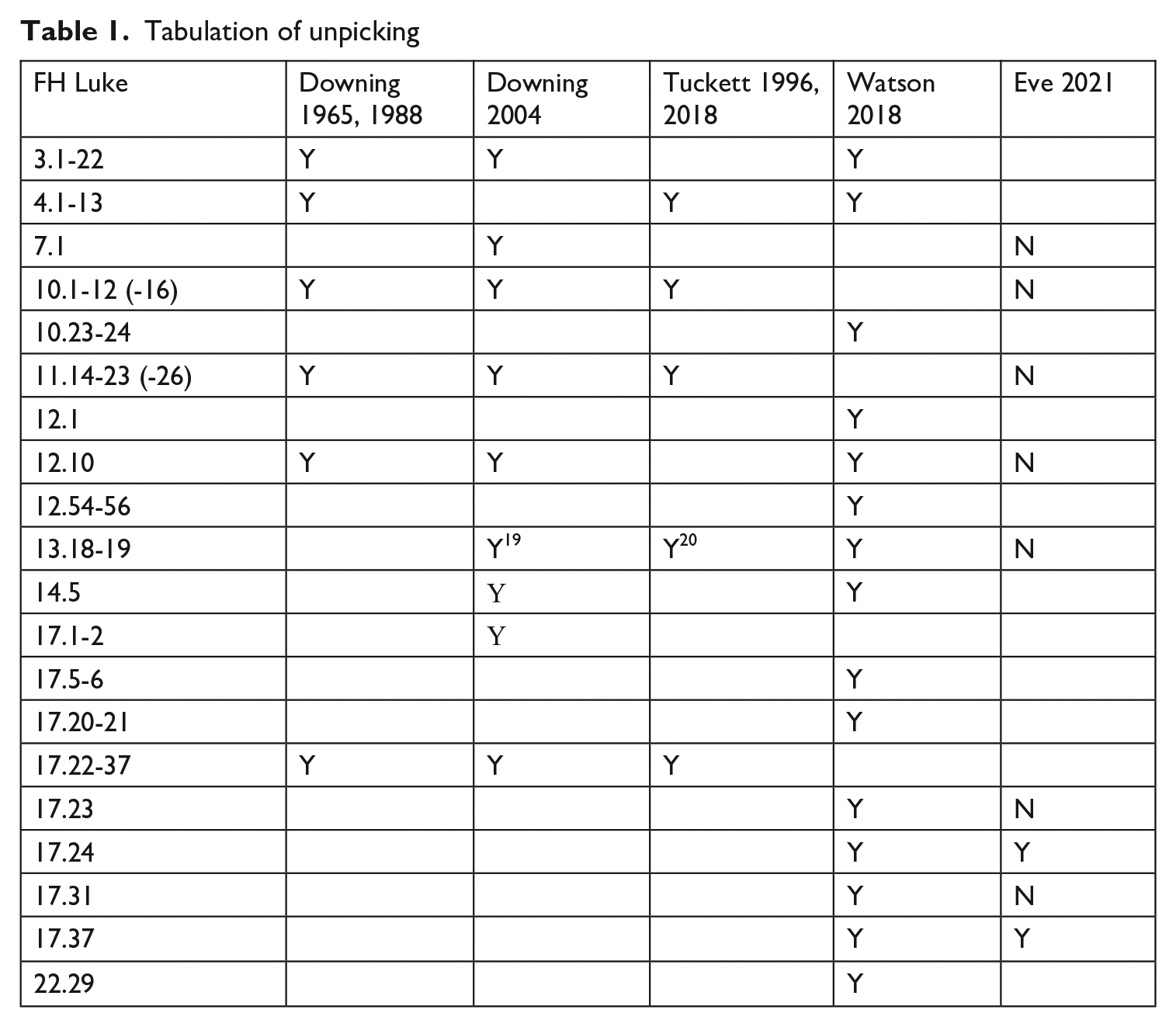
A comparative list of the phenomenon’s tabulation by Downing, Tuckett, Watson and Eve is found in Table 1. 18
Tabulation of unpicking
If under discussion is FH Luke’s frequent omission of Matthew’s Markan material when selecting non-Markan elements in Mt./Mk. conflations (and the examples listed by Downing, Tuckett and Watson certainly meet this definition), the phenomenon cannot be limited to the 2DH’s Mark–Q overlaps. In fact, the scope of the phenomenon is arguably more complex than any of the currently available definitions have expressed. A more effective way of approaching it may be to define unpicking as an umbrella phenomenon encompassing three interconnected procedure types. It is possible first of all to identify FH Luke’s omission of some of Matthew’s Markan text in Mt./Mk. conflations while retaining the non-Markan material in the Markan context assigned to it by Matthew (e.g., FH Luke omits Matthew’s agreements with Mark in Mt. 3.5-6, retaining Mt. 3.7-10; cf. Lk. 3.1-9). 21 The second type of unpicking is what John S. Kloppenborg (2019: 640) has recently described as ‘[FH] Luke’s disarticulation of Matthew’s additions to Mark from their Markan contexts and relocating them elsewhere’ (emphasis mine), which, as we shall see, is the definition agreed to by Watson 22 (Downing and Tuckett are not unaware of it either). 23 In these cases, FH Luke once again selects some or all of Matthew’s non-Markan (or, occasionally, redacted Markan) material in a Mt./Mk. conflation (e.g., Lk. 9.57-60 // Mt. 8.19-22), with the difference being that he now disarticulates such material from Matthew’s Markan context (Mt. 8.18, 23-27). 24 The example just given shows that this aspect of the phenomenon is not limited to the 2DH’s Mark–Q overlaps. Finally, the third type of unpicking is when FH Luke selects some of Matthew’s non-Markan material in a Mt./Mk. conflation (e.g., Lk. 11.2-4 // Mt. 6.9-13), disarticulating such material from Matthew’s adjacent Markan material (Mt. 6.14) in a non-Markan context (Mt. 6.5-15). 25 All three procedures qualify as unpicking (omission) of Matthew’s Markan material in Mt./Mk. conflations by FH Luke.
With this in mind, we can now return to the recent Tuckett–Watson exchange. In his 2018 response to Tuckett, Watson echoed the general thrust of Olson’s 2004 essay and anticipated Eve’s more recent 2021 verdict by suggesting that the extent of unpicking has been overstated by the FH’s critics. But Watson (2018: 144) takes a somewhat different position than Olson or Eve with regard to the texts themselves:
Of the seventy such passages from Matt 5–25 listed in my book, fifty-eight are taken from more extensive Matthean contexts and require no ‘unpicking’ from Mark.
26
Of the twelve Matthean passages that have genuinely been ‘unpicked’ from a Markan context, seven are easily recognizable additions to their Markan context. The remaining five are passages where Luke has selected a Matthean version of a Markan passage in preference or in addition to a Markan version.
The split in the Eve–Watson FH team is evident from Watson’s list of the ‘genuine’ passages. 27 Watson’s instance of unpicking involves a relocated passage that has been disarticulated by FH Luke from Matthew’s Markan context, whereas Olson and Eve do not study this procedure in their discussions of unpicking at all. 28 This lack of discussion could be a product of a more reductive definition of the phenomenon. 29 It can be no coincidence, for example, that Eve (2021: 136-40) now excludes FH Luke’s unpicking at Mt. 12.31-32 (Lk. 12.10) and Mt. 13.31-33 (Lk. 13.18-21), while Watson (2018: 144) recognizes both of these instances (see Table 1). However, Watson’s definition and tabulation of the phenomenon still require further adjustment, to which we now turn.
An adjustment of Watson’s data
The Tuckett–Watson exchange centers on Watson’s 2013 monograph, in which Watson (168-216) outlined FH Luke’s source utilization procedure in the Travel Narrative (= TN; conventionally, Lk. 9.51–19.27/28). 30 It should be noted that Watson’s utilization model is visual: FH Luke creates a notebook consisting of the excised Matthean material, which he subsequently utilizes in composing the TN (Watson 2009: 406; 2013: 170; 2018: 144-45; cf. Tuckett 2018: 131). Goulder’s complicated scrolling procedure – on which FH Luke navigates a scroll of Matthew – is thereby avoided. 31 In his response to Tuckett, Watson (2018: 144) references his earlier tabulation of FH Luke’s excision of Matthew’s material for the composition of the TN (2013: 185-87). This category is defined by Watson (2013: 181) as L/Mres or ‘material Luke extracts from its Matthean context and reserves for incorporation elsewhere’.
In Table 2, I reproduce Watson’s (2013: 185-87) L/Mres table with some modifications. Columns 1-4 are Watson’s; for cross-referencing purposes, his numbering (column 1), titles (column 2), and versification (columns 3-4) are reproduced exactly. 32 The additions include my bold highlights (indicating unpicking by FH Luke) and a further five passages meeting the definition of unpicking given above. To preserve Watson’s numbering, the five added passages are left blank in column 1. Column 5 forms another addition to Watson’s table, showing Matthew’s Markan material omitted (= unpicked) by FH Luke, who selects the non-Markan material identified in columns 3 and 4. Finally, material assigned by Watson (2018: 144) to each of the four ‘large blocks of Matthean material’ is placed within an emboldened border. 33
Watson’s L/Mres table, edited and expanded
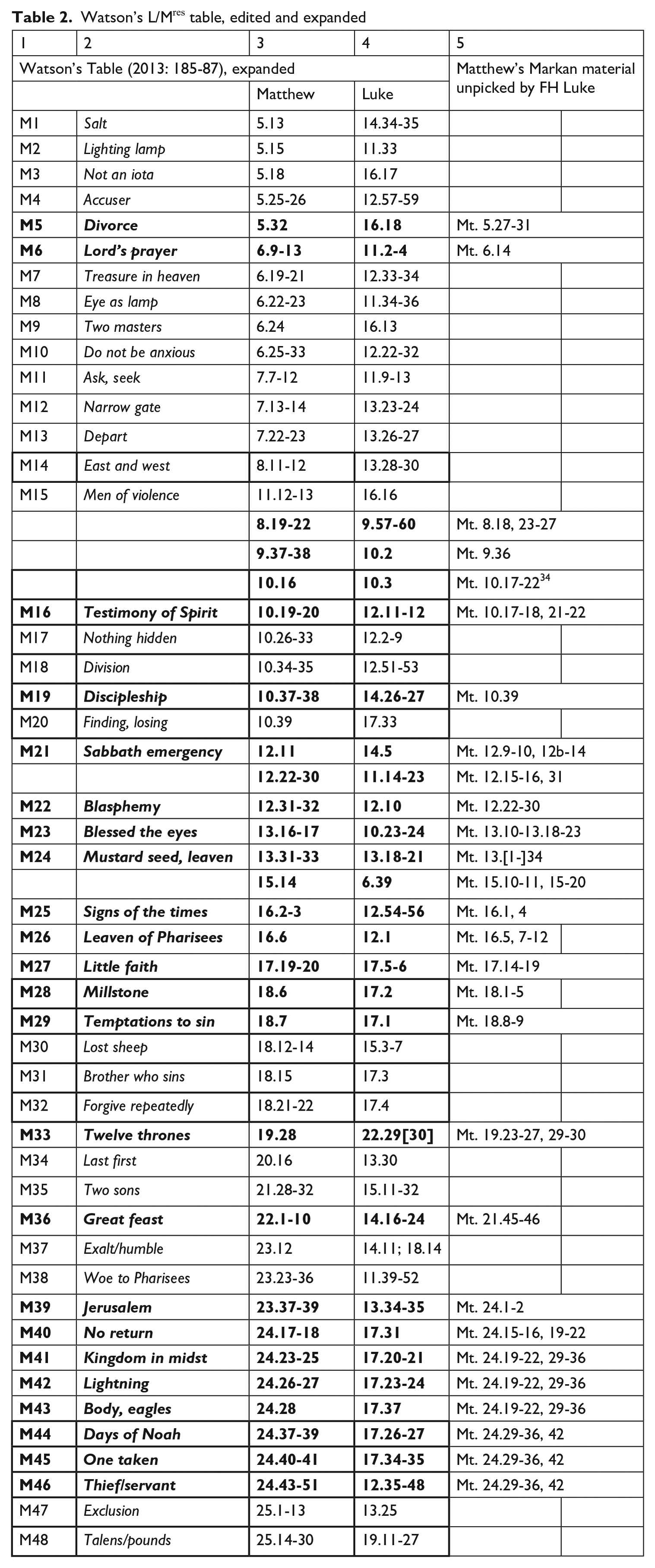
The adjustments made to Watson’s table are necessitated by several considerations. My first question concerns the category used by Watson to reduce the number of unpicked passages. Watson (2018: 144) assigns a sizeable number of his L/Mres passages to ‘large blocks of Matthean material easily identifiable as such by anyone familiar with Mark – as Luke certainly was’ (2018: 144). These blocks include Mt. 8.5-13; 10.16-39; 18.6-21; 24.37-25.30 (144 n. 5; see Table 2). Watson (144) states that the passages falling into ‘extensive Matthean contexts’ such as these ‘require no “unpicking” from Mark’. The principal question, however, is how FH Luke would have viewed Matthew’s Markan material even in these ‘large blocks of Matthean material’. For example, FH Lk. 12.11-12 (see Table 2, M16) selects from Mt. 10.16-23 what appears to be a Lukan doublet of a triple-tradition text (Mt. 10.19-20 // Mk. 13.11 // Lk. 12.11-12; 21.14-15). 35 How might FH Luke have viewed Mt. 10.16-23? Presumably he would have noticed what the modern specialist also sees, namely that Mt. 10.17-22 is highly reminiscent of Mk 13.9-13 and that it is framed by non-Markan material (Mt. 10.16, 23). 36 This non-Markan material has been conflated by Matthew with the Markan instruction concerning the disciples’ persecution. In Mt. 10.16-23, FH Luke can therefore be said to have disarticulated Mt. 10.16 from 10.17-22 (par. Mk. 13.9-13) and Mt. 10.19-20 from 10.17-18, 21-22 (par. Mk. 13.9, 12-13), moving both Mt. 10.16 and 10.19-20 to separate new locations (Lk. 10.3; 12.11-12). Watson’s ‘large blocks of Matthean material’ would only be unsuitable for instantiating unpicking if FH Luke were unable to recognize Matthew’s Markan material, which, as Watson himself admits, runs counter to the FH’s logic.
As shown in Table 2 (marked in bold type), similar examples occur on Watson’s list in three of the four ‘large blocks of Matthean material’, as well as outside those blocks in passages not conceded as instances of unpicking by Watson. 37 It is difficult to imagine that FH Luke would not have recognized the Markan material in Mt. 10.39 (par. Mk. 8.35, which Luke reproduces in Lk. 9.24), Mt. 18.1-5 (par. Mk. 9.33-37, which Luke reproduces in Lk. 9.46-48), Mt. 18.8-9 (par. Mk. 9.43-47, which FH Luke doggedly avoids on three separate occasions – once in Mark and twice in Matthew) or Mt. 24.29-36 (par. Mk. 13.24-32, which Luke reproduces in Lk. 21.25-33). 38 Acknowledging these instances should not be confused with assessing whether FH Luke’s procedure in these instances was simple or not. 39 At issue, rather, is FH Luke’s utilization procedure in reproducing the Matthean source and accurate tabulation of the phenomenon of unpicking.
My second question concerns some of the potential Matthew–Luke parallels, more specifically, the Markan elements exclusive to Luke therein. As we have seen, Watson (2018: 144) concedes twelve instances of unpicking. He proposes (2018: 144 n. 6) that seven of those would be especially obvious to FH Luke. 40 For the remaining five instances (2018: 144 n. 7), Watson suggests that FH Luke has preferred or added Matthew’s versions to Mark’s versions. 41 However, two of these Luke-pleasing versions, Watson’s M26 and M40, along with his M28 (which, as argued above, does instantiate unpicking), present an interesting phenomenon (see Table 3). Namely, if one approaches the data neutrally and presupposes only the Markan priority, then in all three instances Luke’s utilization of the text printed in Matthew is not certain, and in all of them Luke may have utilized Mark’s gospel instead.
Watson’s M26, M28, M40
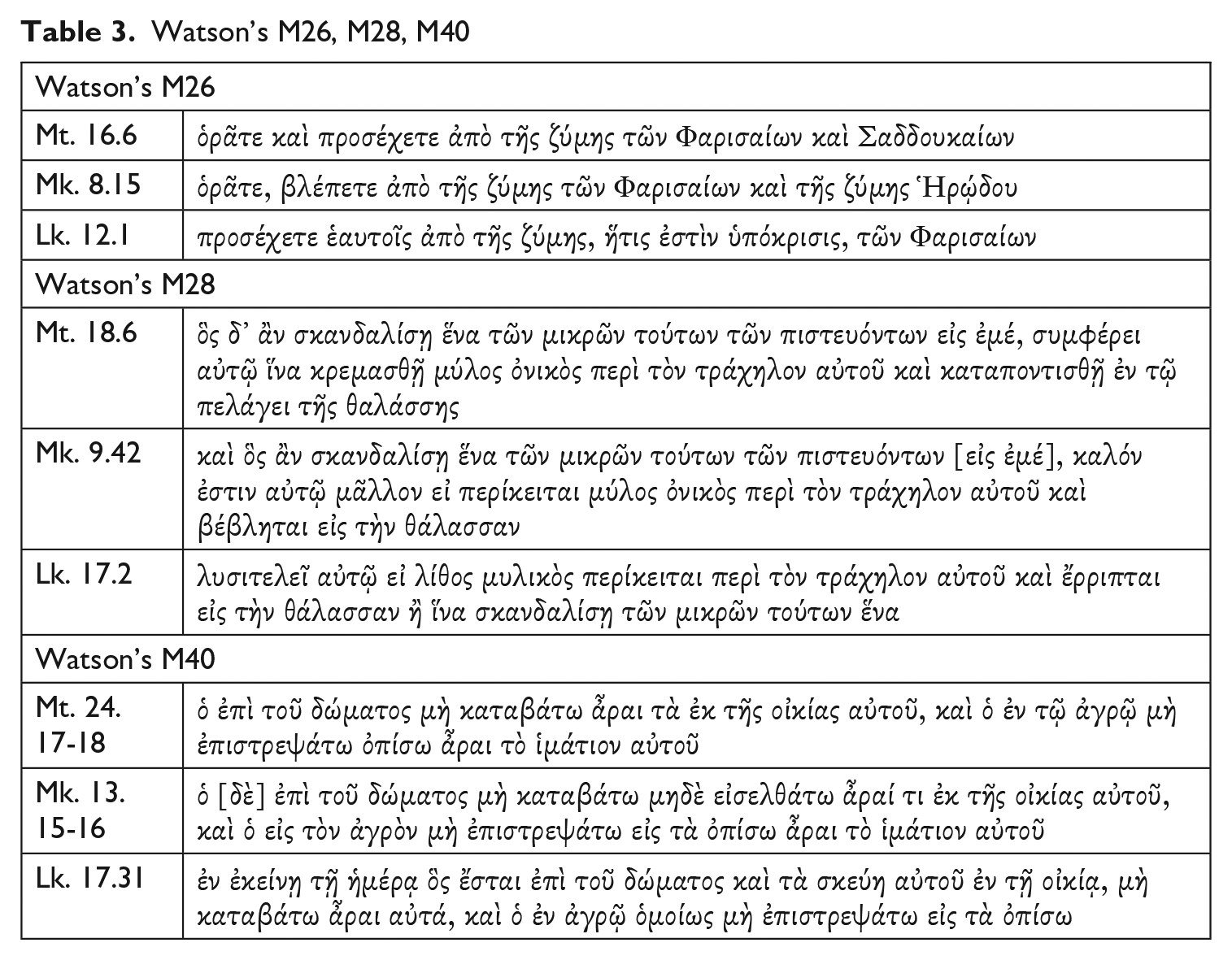
(1) Luke 12.1 (Watson’s M26) is not in Q according to the CEQ and most authors (Kloppenborg 1988: 118). The 2DH’s analysis works here also for the FH, both hypotheses being based on the Matthew–Luke parallels. The agreements in Mt. 16.6 // Lk. 12.1 are limited to the word προσέχετε and the omission of τῆς ζύμης Ἡρῴδου. While the FH may be inclined to see both agreements as supporting Luke’s utilization of Matthew, ‘προσέχετε ἑαυτοῖς is Lukan usage: Lk 17,3; 21,34; Acts 5,35; 20,28’ (Neirynck 1995a: 60). 42 Moreover, the verse occurs away from its Matthean context (Mt. 16.5-12) and is in reasonably close proximity to other potential Markan echoes from the Great Omission material: Lk. 11.16 // Mk. 8.11; Lk. 11.37-38 // Mk. 7.1-5 (Neirynck 1982: 48). 43 A reliance on Mt. 16.6 is therefore not necessary.
(2) Luke 17.2 (Watson’s M28) features some dependence on Mark (εἰ … περίκειται … εἰς τὴν θάλασσαν) and ‘no specific similarity with Mt 18:6’ (Neirynck 1995a: 57). 44 On the Matthean side, Mt. 18.6 is typically seen as based on Mark, not Q (e.g., Konradt 2020: 275, ‘still following Mark 9:42-48’). Because Mt. 18.6-7 forms a unity also in Lk. 17.1-2 (albeit in a reverse order), the FH is virtually forced to view Lk. 17.2 as based on Mt 18.6 in the absence of any indication in the text itself and relying on the text’s occurrence in combination with Lk. 17.1.
(3) In Mt. 24.17-18 // Lk. 17.31 (Watson’s M40), the only exclusive similarity between Matthew and Luke is the use of ἐν ἀγρῷ (contra Mk. 13.16: εἰς τὸν ἀγρὸν; note that Lk. 17.31 does not have Matthew’s τῷ). However, Mt. 24.17-18 and Mk. 13.15-16 are generally much closer to one another than to Lk. 17.31. On its part, Lk. 17.31 has mostly unique phrasing but agrees with Mk. 13.16 against Mt. 24.18 in writing εἰς τὰ ὀπίσω. 45 Similar to Lk. 12.1, the Lukan verse is omitted by the CEQ (cf. Kloppenborg 1988: 194). The FH is technically not required to derive Lk 17.31 from Matthew; proponents of all Markan priority-based hypotheses can presumably agree that Luke utilizes Mark at least in Lk. 17.25. However, Lk 17.31 also being based on Mark introduces some dichotomy into FH Luke’s procedure, who in Lk. 17.20-37 mostly works with Mt. 24.15-41. As a result, one can justifiably inquire about the manner in which Luke utilizes the Markan material in 17.25, 31, as well as about Luke’s Markan ἰδ[οὺ] ἐκεῖ // ὧδε in 17.21a, 23. 46
The significance of these three instances on Watson’s list resides in the fact that, collectively, they suggest an alternative to the visual source-utilization model proposed by Watson (2009: 406; 2013: 170; 2018: 144-45; cf. Poirier 2012), whose FH Luke relies on a physical notebook to excerpt and subsequently redeploy Matthean materials. In all three instances FH Luke will have decided to depart from the wording of his Matthean source for reasons that are unclear, especially if FH Luke has copied Mt. 16.6, 18.6 and 24.17-18 to a notebook that is being utilized throughout the TN. In all three cases, Luke’s procedure might arguably be better explained as memory-based utilization of Mk. 8.15, 9.42 and 13.15-16. 47 This would account for the occasional agreements with Mark against Matthew’s text (Lk. 17.2 εἰ … περίκειται … εἰς τὴν θάλασσαν; Lk. 17.31 εἰς τὰ ὀπίσω) within a general framework of being at variance with Matthew. The question of FH Luke’s source-utilization procedure may therefore need to be revisited. 48
In the end, Watson’s twelve instances of unpicking 49 can be combined with the ten passages on Watson’s list that he contests or does not recognize as unpicking 50 and the five that were added to his list in Table 2. 51 The end result is 27 instances of FH Luke’s unpicking in Table 2, twice the number allowed by Watson and a frequent enough phenomenon to warrant its classification as an aspect of FH Luke’s source-utilization procedure.
Conclusion
Luke’s frequent unpicking of Matthew’s Mt./Mk. conflations forms a feature of the FH. The procedural aspect of this phenomenon (that is, its execution by FH Luke) may be simple, complex or a combination of both; the purpose of the present article was to bring some clarity to the phenomenon’s tabulation, leaving the assessment of the procedure’s difficulty to others. The fact that Olson (2004), Watson (2018) and now Eve (2021) have found it necessary to address this phenomenon on the FH’s side perhaps underscores its force. Watson, whose recent contribution to the discussion is the focus of this article, seeks to integrate the phenomenon with FH Luke’s systematic utilization of Matthew (Watson’s L/Mres category). He acknowledges 12 instances of unpicking but either overlooks or dismisses on the basis of a less than optimal criterion (extensive Matthean contexts) at least a further 15 instances. In light of the adjusted tabulation, Eve’s (2021: 143) recent claim to have disentangled FH Luke from the phenomenon of unpicking may be seen as premature. Eve’s (132) claim that the 2DH’s Mark–Q overlaps offer the best support for Downing’s conclusions likewise needs to be reevaluated; the overlap texts offer some support, but the phenomenon extends far beyond this narrow category – and it is the phenomenon itself that scholars like Downing (1980a, 1980b, 1988) have found to be problematic. Updating Watson’s tabulation, it was possible to identify in this article at least 27 instances of unpicking in FH Luke’s utilization of Matthew’s Mt./Mk. conflations. Only nine of those instances are classified as Mark–Q overlaps by the 2DH. 52 It is to be hoped that these data will be of use to all participants in the synoptic problem discussion.
Footnotes
1.
Notable studies presenting arguments in support of the Markan priority in the last two decades include: Goodacre 2002; Derrenbacker 2005;  . The vast majority of synoptic studies and commentaries today simply presuppose it, relying on the results of the discussion conducted in the previous centuries.
2.
Since 2000, notable publications dedicated to demonstrating and developing the FH include: Goodacre 2002, 2017, 2018; Goodacre and Perrin 2004; Watson 2009, 2013, 2018; Poirier 2012; Poirier and Peterson 2015 (with the exception of Kloppenborg’s essay); Barker 2016; Müller and Nielsen 2016 (the majority of enclosed essays); Kahl 2018; .
3.
Since 2000, notable publications dedicated to demonstrating and developing (or otherwise contributing to) the MPH include: Hengel 2000; Blair 2003; Edwards 2009 (as one of the options); ; Garrow 2016a, 2016b, 2020. One could also mention Adamczewski 2010, but this study has received generally poor reviews and should not be taken as indicative of the MPH’s potential strengths or weaknesses (e.g., Foster 2010; MacEwen 2015: 19-24).
4.
The number of studies simply presupposing the 2DH remains very high. Here, I list only the notable post-2000 publications dedicated to demonstrating and developing the hypothesis: Foster 2003; Kloppenborg 2003, 2007, 2015, 2019; Downing 2004, 2017; Derrenbacker 2005, 2011; Burkett 2009; Kirk 2011a, 2011b, 2016, 2017; Tuckett 2018; .
5.
The phenomenon is referenced and/or analyzed in Downing 1965, 1988, 2004: 464-68; Tuckett 1996: 31-34; 2011: 44-45; 2018: 134-37; Foster 2003: 319; Olson 2004; Ebner and Schreiber 2008: 82; Kirk 2011a: 476-77; Garrow 2016a: 221; Watson 2018: 143-44; : 131-43. The FH proponents have argued that Luke’s omission of non-Markan materials in Mt./Mk. conflations (e.g., Weiss 1889: 540-41; Davies and Allison 1988–1997: I, 116; Kloppenborg 2003: 219-22) is not a problem for their hypothesis. E.g., Goodacre 2002: 49-59; Watson 2013: 174 n. 32; Eve 2021: 126-31.
6.
The term is used in Downing 1980a, 1988; Tuckett 1996: 32-33; 2011: 44-45; 2018: 135-37; Foster 2003: 319; Olson 2004; Kirk 2011a: 476; Garrow 2016a: 221; Watson 2018: 143-44; : 131-43.
7.
A detailed engagement with the arguments of Olson and Eve requires a separate study and will not be endeavored here. However, this article will inevitably touch on some of their statements and can serve as an initial (albeit not full) response. My comments will mostly be limited to the points where Eve’s discussion touches on issues also analyzed by Watson, highlighting the differences between the two authors as far as our subject is concerned.
8.
: 171-79; versification from 1988: 83: (1) Mt. 12.22-45 // Mk. 3.20-29 // Lk. 11.14-26; 12.10; 6.43-45; (2) Mt. 3.1–4.11 // Mk. 1.[2]-13 // Lk. 3.1-22; 4.1-13; (3) Mt. 9.35–10.6 // Mk. 3.13-19; 6.6-11 // Lk. 9.1-5; 6.13-16; 10.1-12; (4) Mt. 24.4-26[51] // Mk. 13.5-37 // Lk. 21.8-36[17.22-37]. Notes on my square brackets: I correct Downing’s (1988: 83) versification of Mk. 1.12-13 to Mk. 1.2-13, which is what Downing actually engages with; I extend his versification in Mt. 24 to v. 51 in light of his analysis (1965: 177-79), which engages all of Mt. 24; and I supplement his Lk. 21.8-36 with 17.22-37, engaged in the same analysis (1965: 177-79).
9.
This is not a neutral label. E.g., Goodacre 2018. Because the term is widely used in synoptic criticism, I retain it as a manner of convention and in recognition of the difficulties it generates. For Q’s reconstruction, the reader may be referred to Robinson, Hoffmann and Kloppenborg 2000 (= CEQ). While all of my references to Mark–Q overlaps in this article are based on the CEQ (see nn. 12-13, 52 below), some of the overlap texts are debatable on the 2DH and may represent the evangelists’ independent use of Mark rather than Q (Neirynck 1995a, 1995b, ). This possibility will be noted when necessary (see nn. 43-45 below).
10.
11.
12.
The following texts have no Markan parallel: Mt. 12.11 // Lk. 14.5; Mt. 13.16-17 // Lk. 10.23-24; Mt. 16.2-3 // Lk. 12.54-56; Mt. 19.28 // Lk. 22.29[30]; Mt. 24.27 // Lk. 17.24; Mt. 24.28 // Lk. 17.37. The following texts could potentially qualify as Mark–Q overlaps but are (rightly, in my view) excluded from Q by the CEQ: Mt. 16.6 // Lk. 12.1; Mt. 24.17-18 // Lk. 17.31. Cf. Neirynck 1995a: 54-56, 60-61. Note that : 144 n. 6) lists as one of his texts Mt. 24.26-27 // Lk. 17.23-24, in which Mt. 24.26 // Lk. 17.23 is a 2DH Mark–Q overlap and Mt. 24.27 // Lk. 17.24 is not. See n. 13 below.
13.
The one text from Watson’s eight non-overlap instances discussed by Eve (2021: 137-38, reacting to Downing rather than Watson) is the overlap portion of Watson’s Mt. 24.26-27 // Lk. 17.23-24, namely, Lk. 17.23 (see n. 12 above). Eve (2021: 138) lists the Matthean parallel as Mt. 24.23, whereas Watson (2018: 144 n. 6) offers the more conventional Mt. 24.26. See No. 8 in Van Oyen 1997: 283; Grünstäudl 2021: 219. Cf. Davies and Allison 1988–1997: III, 353; Neirynck 2001a: 58-59; Nolland 2005: 979; Wolter 2008: 579; Konradt 2020: 361. : 137-38) argument is that FH Lk. 17.23 adapts Matthew’s Markan material, and Eve rests this on the fact that Mt. 24.23 and Lk. 17.23 both contain elements from Mk. 13.21. However, Mt. 24.23 // Lk. 17.23 disagree with respect to the duplication of ἰδοὺ (Mt. 24.23 ἰδοὺ … ἤ· // Lk. 17.23 ἰδοὺ … [ἤ] ἰδοὺ) and with respect to the negation (single negation in Mt. 24.23; double negation in Lk 17.23). Meanwhile, Mt. 24.26 // Lk. 17.23 feature a double ἰδοὺ, a double negation (Mt. 24.26 μὴ … μὴ // Lk. 17.23 μὴ … μηδὲ), in addition to ὑμῖν and variants of ἐξέρχομαι. The clearer parallel is thus between Mt. 24.26 and Lk. 17.23, as the majority of scholars have also recognized. The fact that Mt. 24.23 and Lk. 17.23 both contain elements from Mk. 13.21 needs to be qualified. Mt. 24.23 copies Mark’s τότε ἐάν τις ὑμῖν εἴπῃ, ὧδε ὁ χριστός, and μὴ πιστεύ[ση]τε (contra Lk. 17.23). By contrast, Lk. 17.23 (similar to Lk. 17.21) features Mark’s ἐκεῖ and ὧδε (contra Mt. 24.23 ὧδε … ὧδε) as the utterances introduced by ἰδοὺ, which is Luke’s counterpart of Mark’s ἴδε. It is then not Mt. 24.23’s ὧδε that FH Lk. 17.23 reproduces, much less ἐκεῖ. As for ἰδοὺ, we have seen that FH Luke would have derived it (in duplicated form) from Mt. 24.26, along with ὑμῖν, a variant of ἐξέρχομαι, and (the duplicated) μὴ. Watson’s conventional Mt. 24.26-27 // Lk. 17.23-24 parallel is therefore to be preferred to Eve’s more recent proposal.
15.
: 464-65. When FH Luke’s Hauptquelle is Mark: Downing’s xvii, xxiv, xxxiii, xxxv, xlix, lv; and the third ‘not noted above’ entry (Mt. 14.14; cf. Lk. 9.10-11). When FH Luke’s Hauptquelle is Lk. Sondergut: Downing’s second ‘not noted above’ entry (Mt. 4.18-22; cf. Lk. 5.1-11). Luke’s Great/Minor Omission material: Downing’s xliv, xlvii.
16.
In other words, passages in which FH Luke’s Hauptquelle is Matthew.
17.
: 464-65: xi (Mt. 7.29, which I emend to Mt. 7.28b-29, omitted by FH Luke who abbreviates and reproduces Mt. 5–7 [Lk. 6.20–7.1; cf. Lk. 4.32]), xxiii (Mt. 12.14, part of Matthew’s Markan material omitted by FH Luke who reproduces Mt. 12.11 [Lk. 14.5]), xxxvii (Mt. 13.34b, which I emend to Mt. 13.34, disarticulated in its entirety by FH Luke from Mt. 13.31-33 [Lk. 13.18-21]), Downing’s fourth ‘not noted above’ entry (Mt. 18.6a, 9, which I emend to Mt. 18.8-9, omitted by FH Luke who reproduces Mt. 18.6-7 [Lk. 17.1-2]).
18.
Downing 1965; 1988: see n. 8 above. Downing 2004: excluding the passages referenced in n. 15 above; Tuckett 1996: see n. 10 above (Tuckett 2018 uses two examples from the 1996 list); Watson 2018: 144; : 131-43.
19.
Downing’s (2004: 465) attention is directed to the parable’s disarticulation from its Markan context in Matthew rather than in-parable unpicking (contra : 136-37).
20.
Tuckett’s (2018: 136-37) attention is directed to in-parable unpicking rather than the parable’s disarticulation from its Markan context in Matthew (contra : 465).
21.
22.
23.
Downing 1965: 177-79; : 135.
24.
In Table 2 below: Watson’s M16*, M21-23, M24*, M25, M26*, M27, M28*, M29, M33, M36, M39, M40*, M41-46. In addition to Watson’s entries: Mt. 8.19-22; 9.37-38; 10.16; 12.22-30; 15.14. Watson’s entries marked by an asterisk form too close an overlap with Mark to be described as Matthew’s non-Markan material; it is the minor agreements in M16, M24, M26, M40 (although the last two examples are rather weak – see and the discussion below) and the joint relocation of M28-29 by FH Luke that suggest his utilization of Matthew in these instances.
26.
Watson 2018: 144 n. 5: ‘Details in Gospel Writing, 186-7’. However, in : 185-87 are listed only 48 passages. Somewhat convoluted presentation aside, Watson’s point seems clear enough.
27.
: 144 n. 6: Mt. 12.11 // Lk. 14.5 (disarticulated from Mt. 12.9-10, 12-14 and relocated to a new context forming a doublet of Mt. 12.9-14 // Lk. 6.6-11); Mt. 13.16-17 // Lk. 10.23-24 (disarticulated from Mt. 13.10-15, 18-23 and relocated to a new context corresponding to Mt. 11.25-27; 22.34-40); Mt. 16.2-3 // Lk. 12.54-56 (disarticulated from Mt. 16.1, 4 and relocated to a new context corresponding to Mt. 10.34-36; 5.25-26); Mt. 17.19-20 // Lk. 17.5-6 (disarticulated from Mt. 17.14-19, 22-23 and relocated to a new context corresponding to Mt. 18.6-7, 21-22); Mt. 19.28 // Lk. 22.29[30] (disarticulated from Mt. 19.23-27, 29-30 and relocated to a new context corresponding to Mt. 20.24-28; 26.20-29); Mt. 24.27 // Lk. 17.24 (disarticulated along with Mt. 24.17-18, 23, 26, 28 from Mt. 24.15-36 and relocated to a new context forming a doublet of Mt. 24 // Lk. 21); Mt. 24.28 // Lk. 17.37 (disarticulated along with Mt. 24.17-18, 23, 26-27 from Mt. 24.15-36 and relocated to a new context forming a doublet of Mt. 24 // Lk. 21). Watson 2018: 144 n. 7: Mt. 12.31-32 // Lk. 12.10 (disarticulated from Mt. 12.22-30 and relocated to a new context corresponding to Mt. 10.26-33); Mt. 13.31-32 // Lk. 13.18-19 (disarticulated from Mt. 13.[1-]34 and relocated to a new context forming a doublet of Mt. 12.9-14 // Lk. 6.6-11); Mt. 16.6 // Lk. 12.1 (disarticulated from Mt. 16.5, 7-12 and relocated to a new context corresponding to Mt. 10.26-33); Mt. 24.23-25 // Lk. 17.20-21 (disarticulated along with Mt. 24.17-18, 26-28 from Mt. 24.15-36 and relocated to a new context forming a doublet of Mt. 24 // Lk. 21); Mt. 24.17-18 // Lk. 17.31 (disarticulated along with Mt. 24.23, 26-28 from Mt. 24.15-36 and relocated to a new context forming a doublet of Mt. 24 // Lk. 21).
28.
Olson (2004) and Eve (2021: 131-38) concentrate on the degree to which FH Luke follows Matthew in Downing’s four examples (see n. 8 above). Eve (2021: 139-40) further engages Lk. 13.18-19, which, incidentally, demonstrates the difference between his and Watson’s understanding of the phenomenon: Eve attends only to the potential unpicking performed by FH Luke in disarticulating the wording of Mt. 13.31-32 from the wording of Mk. 4.30-32, as opposed to the disarticulation of Mt. 13.31-32 from its Markan context Mt. 13.[1-]34 and relocation to a new context. Eve (2021: 141) also overlooks what I have earlier described as the third type of unpicking, as he discusses Downing’s (2004: 464) No. xi (see n. 17 above). Namely, Eve argues that FH Luke does not here reject Matthew’s Markan material (Mt. 7.28b-29) ‘in its Markan context’ and therefore ‘no unpicking has taken place’. This is a curious argument, because Matthew’s Markan material is plainly omitted/unpicked, only this time in a non-Markan context of the Sermon on the Mount. It is, of course, true that FH Luke ‘partially rewrites his version [of this material] in his own words’ in Lk. 4.32. However, FH Luke’s procedure in Lk. 4.32, where he utilizes Mk. 1.21-28, is separate from his procedure in Lk. 6.46-7.10, where he utilizes Matthew. In the latter procedure, several segments of Matthew’s Markan material (Mt. 7.28b-29; 8.2-4) are omitted/unpicked, and Luke’s earlier utilization of that material (Lk. 4.32; 5.12-16) does not dismiss this fact. Put differently, if an instance of unpicking can be explained, this still does not make it any less of an instance of unpicking (not that the explanation for the omission of Mt. 7.28b-29 is altogether simple – FH Luke is no stranger to source doublets; cf. Van Oyen 1997: 283-85; : 219-21). Eve therefore appears to confuse two separate utilization sequences, in addition to limiting FH Luke’s unpicking of Matthean conflations to Matthew’s Markan contexts. Watson’s response to Tuckett with its more extensive tabulation of the phenomenon is referenced in Eve’s bibliography but not in his book’s section on unpicking.
29.
Eve’s definition of unpicking (2021: 131) is almost a point-by-point recapitulation of : 172-75) analysis of FH Luke’s frequently selective reproduction of the Matthean conflations. We saw already, however, that FH Luke’s disarticulation and relocation of the excised Matthean materials away from their Markan contexts in Matthew cannot be excluded from the phenomenon, since it frequently accompanies the procedure analyzed by Downing (see n. 24 above).
30.
There are many different delimitations of the TN’s endpoint: Lk. 18.30; 18.34; 19.10; 19.27; 19.28; 19.44; 19.46; 19.48; 21.38. See the discussion in Wolter 2008: 365-66. I adopt Lk. 19.27/28 as the section’s conclusion as a manner of convention; it has no bearing on the ensuing analysis. Cf. .
31.
See the discussion of Goulder’s (1984: 111-30) procedure in, e.g., Derrenbacker 2005: 192-200; Kirk 2011a: 474-75. Cf. .
32.
Watson’s proposed synoptic parallels are retained here ex hypothesi. One may (1) question his M35, in which Watson attempts to ground Luke’s Prodigal Son parable in Matthean material (cf. Tuckett 2018: 133). (2) Watson’s M41 is also not traditionally seen as a Matthew–Luke parallel. As summarized by Wolter 2008: 575: ‘Überliefert ist das Gespräch nur bei Lukas’. It is customary to identify the Matthew–Luke parallel as Mt. 24.26-27 // Lk. 17.23-24 (Watson’s M42; No. 8 in Van Oyen 1997: 283; Grünstäudl 2021: 219; cf. Davies and Allison 1988–1997: III, 353; Neirynck 2001a: 58-59; Nolland 2005: 979; Wolter 2008: 579; Konradt 2020: 361). Therefore, when : 144) identifies M41 as a passage ‘where Luke has selected a Matthean version of a Markan passage in preference or in addition to a Markan version’ and (2018: 144 n. 7) as ‘Matthean rendering preferred’, this does not form a neutral description of the data. The FH’s inference whereby the duplication of the ἰδοὺ-sayings in Mt. 24.23, 26 and Lk. 17.21, 23 cannot be independent is an a priori proposition. While admissible within the confines of the FH (a hypothesis predicated upon explaining Matthew–Luke parallels in terms of a direct dependence), this proposition becomes less relevant outside those confines and especially in a case like Mt. 24.23-25 // Lk. 17.20-21, where the textual evidence is not favorable and substantial differences in content are present. Watson himself shows some hesitation (2013: 212-13), describing the proposed parallel as ‘not certain’ and noting that ‘Luke [17.20-21] here rewrites’ Mt. 24.23-25. (3) A number of other parallels are similarly less than certain: M26, M28, M40 (see the discussion below).
34.
See n. 24 above and the discussion below on Watson’s M16.
35.
Watson 2013: 186; No. 43 in Van Oyen 1997: 284; : 220.
36.
No. 6 in Van Oyen 1997: 283; Grünstäudl 2021: 219. FH proponents typically presuppose Luke’s long-standing familiarity with Mark. E.g., Goodacre 2002: 51-52: ‘that very familiarity with Mark might have made the Matthean additions clear to [Luke]’. Cf. Watson 2018: 144; : 138.
38.
39.
40.
Watson’s M21, M23, M25, M27, M33, M42-43.
41.
Watson’s M22, M24, M26, M40-41.
42.
Regarding the negative agreement (the omission of τῆς ζύμης Ἡρῴδου), it should be noted that FH Luke limits the leaven to the Pharisees, omitting Matthew’s Sadducees. By contrast, Matthew and Mark feature two groups, even if they disagree on the identity of the second one. The negative agreement of Matthew and Luke is therefore not identical; Luke’s is properly an omission, whereas Matthew’s omission is a substitution.
45.
See the analysis in Neirynck 1995a: 54-56; : 824-25.
46.
See n. 13 above.
47.
This is a neutral assessment of the data, presupposing only the Markan priority. As noted earlier, on the FH, Luke’s utilization of Mt. 18.6 is virtually a foregone conclusion.
48.
As Eve (2021) has now done for the FH. For the role played by memory in ancient source-utilization and in relation to the synoptic problem debate, see especially Derrenbacker 2011; Kirk 2011a, 2016, 2017, 2018; Goodacre 2017; Chang 2019; .
51.
Mt. 8.19-22; 9.37-38; 10.16; 12.22-30; 15.14.
52.
In : Watson’s M5, M16, M19 (Mt. 10.38 // Lk. 14.27 only), M22, M24 (Mt. 13.31-32 // Lk. 13.18-19 only), M27, M42 (Mt. 24.26 // Lk. 17.23 only), M46, along with Mt. 12.22-30. For Mark–Q overlaps, see n. 9 above. Note that Watson’s M19 consists of two sayings (Mt. 10.37-38 // Lk. 14.26-27), in which Mt. 10.38 // Lk. 14.27 is a 2DH Mark–Q overlap and Mt. 10.37 // Lk. 14.26 is not. Similarly, Watson’s M24, M42.