






Abstract
The quotation of Jer. 31:15 in Mt. 2:18 has proven to be an interpretive puzzle through its otherwise unattested form of Jer. 31:15 and the seemingly unclear relationship of the quotation to its context in Matthew. Marten J. J. Menken has argued that Matthew quotes a text of Jer. 31:15 that is combined with Gen. 37:35 but that this composite citation does not have interpretive significance for Matthew. When viewed in the context of a series of lexical and thematic parallels between Matthew’s nativity and the Joseph story, it may be understood, however, as a composite citation occurring in the composition of Matthew for christological purposes. These may include presenting Jesus as participating in his people’s history, implicit response to expectations of a Josephite messiah, and portraying Jesus as saving his people by giving them life. Such use in Matthew of the Joseph story through Jeremiah suggests further need for the study of multilayered use of texts in the New Testament and related literature.
Introduction
The quotation of Jer. 31.15 in Mt. 2.18 has proven to be a puzzle for interpretation. Brian M. Nolan (1979: 136) summarizes, ‘no exegete has satisfactorily elucidated Matthew’s intention in 2.18’, while M. D. Goulder (1974: 239–40) evaluates, ‘of all the citations in the Gospel, this is the most clearly artificial’, and that the quotation is the result of forcing correspondence with a synagogue reading cycle. Mt. 2.18 is a puzzle for two reasons. First, the quotation differs from all forms of Jer. 31.15 otherwise attested. Second, the logic identifying the Slaughter of the Innocents as fulfillment of Rachel’s weeping for her children is difficult to follow. Hebrew Bible scholarship has generally recognized the use of the Joseph story of Gen. 37–50 in Jeremiah 31, including specifically of Gen. 37.35 in Jer. 31.15 (e.g., Brown-Gutoff 1991: 184–85; Brueggemann 1997: 184; Lundbom 2004: 438; Mastnjak 2016: 54; Wanke 2003: 287; Doane and Mastnjak 2019: 421–22; and, most thoroughly, Teeter 2021: 443–87). 1 Might the use of one scriptural text by means of another be a key to a fuller understanding of Mt. 2.18? This paper proposes that Matthew 2 shows awareness of Jeremiah 31’s use of the Joseph story, including through a possible composite citation of Jer. 31.15 and Gen. 37.35, and thereby simultaneously alludes to Jeremiah 31 and the Joseph story for christological purposes. 2
Overview of Previous Interpretations of Mt. 2.18
Four main approaches to the interpretation of Mt. 2:18 appear in previous research. First, some interpreters opine that the Slaughter of the Innocents is not a direct fulfillment of Jer. 31.15, but that Jeremiah 31 is cited as a corresponding scriptural text in which mourning leads to hope, or in which suffering leads to deliverance, and in which some themes in common with Matthew appear (Hill 1978: 86; France 1985: 87; Davies 1993: 38; Keener 1999: 111–12; Ritter 2003: 122–23; Gibbs 2006: 143–44; Turner 2008: 94–95). 3 Second, some interpreters consider the quotation to be a reference to an anticipated new exodus in Jeremiah and connect this exodus with Jesus’s descent into Egypt, the place from which the first Exodus occurred (Bourke 1960: 171–72; Lohmeyer 1967: 30; France 1981: 233–51; Brown 1993: 216–17; Blomberg 2008: 10). 4 Third, many note Bethlehem as the place of Rachel’s burial in Gen. 35.19 (sometimes also noting Gen 48.7) but without reference to the Joseph story (Klostermann 1927: 18; Lohmeyer 1967: 29–30; France 1985: 87; Wiefel 1998: 45; Keener 1999: 111; Ritter 2003: 122–23; Mazurel 2004: 182–83; Park 2013: 482 n. 37). 5 Jer. 31.15 thereby connects Bethlehem and weeping in Matthew with Bethlehem and weeping in Genesis 35 through Rachel. Rachel is the object of weeping in Genesis 35 and the subject of weeping in Matthew’s quotation of Jeremiah. Fourth, the quotation is a nonspecific means for providing purpose or meaning to a horrible event difficult to understand (France 1981: 244, 246; Bruner 1987: 54–55; Knowles 1993: 52; Varner 2007: 226; see also Plummer 1928: 18). 6
Besides these approaches, a small number of studies mention Genesis 37, sometimes with additional parts of the Joseph story, in the interpretation of Matthew’s nativity. These studies do not develop the Joseph story’s interpretive significance for Mt. 2.18 and only mention the Joseph story briefly. 7 In this category are the studies by Morton S. Enslin (1940: 332 n. 51), Brian M. Nolan (1979: 21–38), Michael Knowles (1993: 47 n. 4), and Elaine Wainwright (2001: 452–69).
Enslin (1940: 332 n. 51) proposes that the story in Matthew alternates patterning after the Joseph story and the story of Moses. Joseph flees with the family to Egypt, returning after those seeking the child’s life have died, just as Moses fled from Pharaoh and returned after those seeking his life had died. Enslin’s observations, although perceptive, are brief, appearing in a single footnote. Enslin does not discuss Mt. 2.18 as part of this patterning after the two stories. I agree with Enslin but view the patterning as more extensive and more compositionally significant for Matthew.
Second, Wainwright (2001: 464) notes a figure named Joseph in both narratives and that these two Josephs have dreams before salvation of a people through birth of a liberator occurs. According to Wainwright, the purpose of connecting the two narratives is to present Jesus as a liberator like Moses. She does not mention the quotation in Mt. 2.18 as part of the connection to the Joseph narrative (2001: 467–69).
Third, Nolan (1979: 35) intuits a possible connection of Matthew’s nativity to Genesis 37 through the star, dream, descent into Egypt, and a person named Joseph ‘who brings the heir of the promise to safety in Egypt’. He suggests that Rachel’s weeping in Matthew 2.18 may also recall the Joseph story but he seems to view Mt. 2.18 as primarily relating to a new exodus theme (1979: 21, 38). Finally, Knowles’s (1993: 47 n. 4) discussion of the Joseph story’s relevance for the interpretation of Matthew 2 is limited to a single footnote. He states that others have perceived a typological relationship between Joseph in Genesis and Joseph in Matthew. He specifically mentions dreams, Joseph, descent into Egypt, and refuge in Egypt. Knowles does not specify the interpreters to whom he refers, but, because the connections he notes are those mentioned by Nolan, this footnote may draw from Nolan.
Mt. 2.18 and the Text of Jer. 31.15
The first point to consider as potential support for the interpretive significance of the Joseph story in Genesis for Matthew 2 is the form of the quotation in Mt. 2.18. Through a consideration of a multiplicity of correspondences between the Joseph story, Jeremiah 31, and Matthew’s nativity, I hope to demonstrate the use of the Joseph story in Matthew’s nativity beyond the form of the quotation. The form requires consideration, however, because of its uniqueness and because Maarten J. J. Menken (2004) has proposed that the form may be explained as a combination of Jer. 31(38).15 and Gen. 37.35.
As already noted, the form of Jer. 31.15 in Mt. 2.18 does not match attested Hebrew or LXX texts. The MT form of Jer. 31.15 is as follows: כה אמר יהוה קול ברמה נשמע נהי בכי תמרורים רחל מבכה על־בניה מאנה להנחם על־בניה כי איננו׃
Jer. 31.15 has not survived in any manuscripts from the Dead Sea Scrolls, although Jer. 31.1–9, 11–14, 19–23, 25–26 appear in 4QJerc (Tov and Ulrich 2002: 194). In comparison, the quotation in Mt. 2.18 is as follows: φωνὴ ἐν Ῥαμὰ ἠκούσθη, κλαυθμὸς καὶ ὀδυρμὸς πολύς· Ῥαχὴλ κλαίουσα τὰ τέκνα αὐτῆς, καὶ οὐκ ἤθελεν παρακληθῆναι, ὅτι οὐκ εἰσίν.
The form of Mt. 2.18 is stable, showing little variation in manuscripts.
8
The LXXB text of Jer. 31(38).15, which appears as the main text in Ziegler (1957: 358), reads as follows (major differences from Matthew’s text are underlined): Οὕτως εἶπε κύριος φωνὴ ἐν Ραμα ἠκούσθη Ραχηλ
The form of Jer. 31(38).15 in the LXXA text notably differs from the LXXB text and appears as follows: Οὕτως εἶπεν κύριος φωνὴ ἐν Ῥαχὴλ
Greek Jeremiah is generally recognized as secondary to proto-MT. 11 Most research on Matthew only considers LXXB, usually referred to simply as ‘LXX’. Justin’s Dialogue with Trypho ( ch. 78) quotes Jer. 31(38).15 in the same form as it appears in Matthew (PG 6.660b). 12 Rather than additional attestation of Matthew’s form of Jer. 31(38).15, however, Justin’s form likely is a quote of Mt. 2.18, labeled as a quote from Jeremiah, both because of the identical form and because Justin mentions the Slaughter of the Innocents shortly prior to the quote. 13
Various reasons have been offered for the form of the quotation in Matthew. These include inexact quotation from memory (Allen 1977: 16), independent translation (Beare 1981: 83; France 1981: 245; 1985: 87; Knowles 1993: 38; Wiefel 1998: 46), 14 combination of LXX and independent translation (Goulder 1974: 240 n. 40), translation from an unattested Hebrew version (Lohmeyer 1967: 28–29), influence of a Greek version when following a tradition like MT (Nolland 2005: 124), combination and modification of Greek and Hebrew to emphasize sorrow and make τέκνα in Mt. 2.18 correspond with the same word in 27.25 (Gundry 1982: 36), 15 Matthaean ‘adaption’ according to common Jewish citation practice (although without this practice explained) (Keener 1999: 111 n. 113), and an otherwise unattested form in Matthew’s Vorlage (without specifying its language) (Albright and Mann 1978: 19; Luz 1985: 127; Ritter 2003: 119–20). Some writers note the difference and form without attempting an explanation and suggest little or no exegetical significance of the unique form in Matthew (Turner 2008: 94). Finally, some writers believe that no firm conclusion is possible, and ‘one may surmise that Matthew felt a great deal of freedom in his choice and use of Old Testament texts’ (Newman and Stine 1988: 50). 16 Erich Klostermann (1927: 18), comparing the form in Mt. 2.18 with LXXA, suggests the Hebrew form or citation from memory as explanations for the form of the quotation.
Of interest for the present proposal, Menken (2004: 143–59, esp. 152–55) argues that the quotation in Mt. 2.18 is a composite citation, specifically one that combines Jer. 31(38).15 and καὶ οὐκ ἤθελεν παρακαλεῖσθαι . . . καὶ ἔκλαυσεν αὐτὸν ὁ πατὴρ αὐτοῦ from LXX Gen. 37.35. 17 The MT of Gen. 37.35 is as follows: ויקמו כל־בניו וכל־בנתיו לנחמו וימאן להתנחם ויאמר כי־ארד אל־בני אבל שאלה ויבך
אתו אביו׃ .
Menken’s argument reasons primarily from the form of the quotation in Mt. 2.18 being modified from an LXX form. The reason for Menken viewing the form of the quotation in Mt. 2.18 as modified from a LXX form is that, in his view, Mt. 2.18 shares some unusual translation choices with the LXX forms over against MT. Menken offers the following points of support. (1) The aorist ἠκούσθη, rather than a present indicative as in Ps. 18(19).4 and Eccl. 9.17, renders niphal predicate participle נשמה, although Menken (2004: 148) also notes aorist indicatives in Jer. 3.21 and Nehemiah 6.6. (2) ὀδυρμός appears in Mt. 2.18, LXXA and LXXB but is an unusual rendering of תמרורים (2004: 148). In Matthew, in contrast to LXXA and LXXB, the phrase ὀδυρμὸς πολύς appears in place of בכי תמרורים and is not so unnatural as a rendering of the phrase in that it communicates its meaning through different expression. Menken explains πολύς in Matthew, however, as inserted to compensate for the reduction of three terms for weeping or mourning in the LXX forms to two in Matthew (2004: 150). (3) καί appears between expressions of sorrow in the second line where no conjunction appears in MT. (4) נהי is rendered as κλαυθμός and בכי as ὀδυρμός, while ὀδυρμός would be the more usual rendering for בכי (2004: 150). Menken refers to ὀδυρμός (2 and 4) and the presence of καί (3) in particular as ‘clear signs of dependence on the LXX’ (2004: 149). Although the form in Mt. 2.18, like LXXB, differs from LXXA in rendering ברמה with ἐν Ῥαμά, Menken suggests that ἐν Ῥαμά may be the original LXX rendering and LXXA’s ἐν τῇ ὑψηλῇ, equivalent to the rendering in other early versions, may be a hexaplaric revision, although he allows that it may also have come from independent translation (2004: 148–49).
Without providing a comprehensive examination of the forms of scriptural quotations in Matthew, it should be noted that Matthew’s quotations do not consistently follow one known form, such as proto-MT or attested Greek forms. Consistent use of one such form throughout the entirety of a text should not necessarily be expected, especially in view of the translation of incorporated material. Some quotations in Matthew match attested Greek forms exactly or nearly exactly (e.g., Isa. 40.3 in Mt. 3.3; Deut. 8.3 in Mt. 4.4; Ps. 91.11–12 [LXX 90.11–12] in Mt. 4.6; Ps. 8.3 in Mt. 21.16). Such use of Greek forms in Matthew demonstrates the possibility that Menken proposes the form of the quotation in Mt. 2.18, reflecting features of LXX Jer. 31(38).15.
On the similarity of Gen. 37.35 and Jer. 31(38).15, Menken notes, ‘The two verses share (in mt and lxx) the words מאן/οὐ θέλειν, נחם/παρακαλεῖν (lxx A) and בכה/κλαίειν, ἀποκλαίεσθαι. In addition, the texts share common themes: Gen. 37.35 is about the mourning of Jacob, Rachel’s husband, for their son Joseph; Jer. 31(38).15 is about the mourning of Rachel, Jacob’s wife, on the tribe of Ephraim (see Jer. 31.6, 9, 18, 20), and Ephraim was Joseph’s son’ (2004: 153). He then explains the difference in the form of the quotation in Mt. 2.18 as ‘apparently a revised LXX text, influenced by Gen. 37.35’ by noting how such a combination may explain the form of the quotation in Mt. 2.18 (2004: 153–55, quotation from 155).
First, Menken suggests that the grammatical awkwardness that he perceives concerning καί in the second line of the second bicolon may be the result of the phrase καὶ οὐκ ἤθελεν being inserted from LXX Gen. 37.37 (2004: 153). The identical phrase also appears in the LXXA form of Jer. 31(38).15, so the appeal to Gen. 37.35 may not be necessary to explain the form of Mt. 2.18. In Jeremiah 31, however, it is less grammatically awkward due to genitive Ῥαχὴλ ἀποκλαιομένης rather than the nominative phrase in Mt. 2.18. Second, Menken observes that a direct object after a word for weeping, rather than a prepositional phrase as in MT and LXX forms of Jer. 31(38).15, appears in both MT and LXX forms of Gen. 37.35, and also in Mt. 2.18 (2004: 153). Third, Menken considers τὰ τέκνα αὐτῆς only once in Mt. 2.18 where על־בניה occurs the first time in MT Jer. 31.15, rather than in the place of the second or both of the occurrences in MT, a possible indication of influence from Gen. 37.35 in which, similarly, no prepositional phrase or direct object follows the refusal of comfort (2004: 153). Although, as Menken notes, this removes any prepositional phrase from the statement concerning the refusal of comfort, a single occurrence of ἐπὶ τῶν υἱῶν αὐτῆς in the same place appears in the LXXA text. Fourth, Menken notes κλαίουσα in Mt. 2.18, corresponding to ἔκλαυσεν in Gen. 37.35, rather than a form of ἀποκλαίω, which appears in LXXA and LXXB (2004: 153). Fifth, Menken considers παρακληθῆναι in Mt. 2.18 to possibly result from influence of the same word in LXX Gen. 37.35 (2004: 154). LXXA shares the word, but Menken suggests that the word in LXXA, which also appears in Aquilla, may come from either Matthaean or Hexaplaric influence (2004: 154).
Although not noted by Menken, the form of Mt. 2.18 may reflect use not only of Gen. 37.35, but also another part of the Joseph story. The only place in either the Old Testament or apocrypha of the LXX (through performing a search in Rahlfs) in which κλαίω or a related verb occurs in the same verse with πολύς expressing the extent of weeping is in Gen. 46.29: καὶ ὀφθεὶς αὐτῷ ἐπέπεσεν ἐπὶ τὸν τράχηλον αὐτοῦ καὶ ἔκλαυσεν κλαυθμῷ πλείονι. This is also the only verse in which πολύς occurs modifying κλαυθμός. In the LXX, πολύς does not occur in any verses together with θρῆνος.
Menken does not view the change of the form of the quotation as due to use of Gen. 37.35 in the composition of Matthew (2004: 157). In his view, Matthew uses a revised LXX text of Jeremiah unavailable to us in which Gen. 37.35 influenced the form of Jer. 31(38).15 through a process of bringing together two texts sharing words (2004: 158–59). Menken does not view Jer. 31.15 as originally using Gen. 37.35 nor does he discuss interpretive significance of the form of the quotation for Matthew. 18
What if, however, the setting of the quotation in Matthew does indeed reflect Matthean awareness of the similarity between Jer. 31.15 and Gen. 37.35? And what if awareness of a relationship between Jeremiah 31 and the Joseph story more widely in Matthew’s nativity points toward interpretive significance for a deliberate allusion to the Joseph story through Jeremiah?
Although one could object that Matthew specifically labels the source of the quotation in 2.18 as from Jeremiah, the use of a composite quotation here at Matthew’s compositional stage need not come as a surprise. Matthew’s other citation of Jeremiah in 27.9–10 quotes texts other than Jeremiah at least more than Jeremiah itself. 19 The essays in Sean A. Adams and Seth M. Ehorn’s volumes (2018a; 2018b; 2020) demonstrate the common use of composite citations in Greek educational texts, Plutarch, Roman epistolary writing, Philo, the Damascus Document, Septuagint Apocrypha, and Justin Martyr in addition to throughout the New Testament. Menken’s (2020: 34–61) essay in the second of these two volumes observes Matthew’s practice of combining quotations to make dual allusions. He lists Mt. 2.6; 5.21, 33, 43; 11.5, 10; 21.5; 24.29; and 26.64 as combined citations and 2.23; 13.35; 22.24; and 28.9–10 as conflated citations (2020: 37). 20 Writing prior to this essay by Menken, R. T. France (1985: 13) notes Matthew’s practice of combining quotations to make dual allusions. Richard Hays (2016: 186–87) observes multiple instances in which Matthew combines two texts in scriptural citations and allusions. 21
Correspondence between Genesis 37, Jeremiah 31, and Matthew’s Nativity
The previous textual discussion reaffirms Menken’s demonstration of the possibility of explaining the form of the quotation in Mt. 2.18 as a combination of Jer. 31.15 and Gen. 37.35. For Menken, this correspondence is coincidental for the composition of Matthew; Matthew quotes a form of Jer. 31.15 that incorporated the wording of Gen. 37.35, but this does not have any further significance for the interpretation of Matthew. This section analyzes the Joseph story, Jeremiah 31, and Matthew’s nativity to demonstrate that the Joseph story and Matthew’s nativity uniquely share several points of correspondence. These points of correspondence indicate that allusion to the Joseph story through Jeremiah 31 is part of a larger compositional patterning of Matthew’s nativity according to the Joseph story. Below I list four categories of correspondence: (1) correspondence between all three texts, (2) correspondence between Genesis and Jeremiah not shared with Matthew, (3) correspondence between Jeremiah and Matthew not shared with Genesis, and (4) correspondence between Genesis and Matthew not shared with Jeremiah. This list is not exhaustive, and additional points of correspondence, particularly thematic ones such as attribution of the outcome of narrative events to God, could be added. While some of the following points concern themes that may be found in other texts (such as departure from the land of Israel and return to it), I have attempted to focus primarily on distinctive points of correspondence. Where I have included wider thematic correspondence, I have done so to demonstrate a distinctive narrative progression through the collection of correspondences.
In the first category, that of correspondence between all three texts is first (1a) apparent death of a child or children (Gen. 37.33–35; Jer. 31.15; Mt. 2.16–18). In the Joseph story, no person has died, but Jacob, as a result of his sons’ trickery, perceives that his son Joseph has died. In the case of Jeremiah, the loss of children mourned is not primarily over death that has occurred but due to separation through deportation, likely with the assumption that death of the children will occur in a foreign land. The narrative of Matthew 2 contains both perceived death and actual death, although the mourning of Mt. 2.18 primarily concerns actual death. Matthew does not specify people aside from Herod, the Magi, and Jesus’s immediate family knowing of Jesus’s presence in Bethlehem. 22 That Herod takes no further action would suggest that the audience of Matthew is expected to understand Herod as perceiving his attempt at assassinating the messiah in infancy as successful. The narrative thereby includes perceived death in addition to actual death.
The second correspondence between the three texts is (1b), a son or sons who ‘is/are no more’. This is a lexical correspondence between the three texts, specifically איננו (οὐκ ἔστιν) in Gen. 42.36, איננו in Jer. 31.15 (οὐκ εἰσίν in LXX Jer. 38.15), and οὐκ εἰσίν in Mt. 2.18. The statement ‘he is not’ occurs repeatedly as a distinctive phrase in the Joseph story. איננו occurs 36 times in the MT. Most often, in 19 of these cases, it is accompanied by a participle or adjective to negate a condition or the occurrence/performance of an action. 23 In two cases, the antecedent of the pronominal suffix is impersonal, and איננו is modified by a prepositional phrase as an idiom (Gen. 31.2, 5). Its nonpersonal use with no modifiers also occurs one time (Job 8.22). This leaves 14 occurrences of איננו in the MT where it has the meaning ‘he is not’. It occurs with this usage with a prepositional phrase six times. It occurs with prepositional phrases with the meanings ‘with us’ (Gen. 44.26, 30, 34; Deut. 29.14), ‘with David’ (1 Sam. 3.22), and ‘before morning’ (Isa. 17.14). Notably, of these six, three occur in the Joseph story, all referring to the unrealized situation of Benjamin not being with his brothers. The only remaining use of איננו in the MT is its personal use with no modifiers, the simple statement, ‘he is not’. This use appears eight times in the MT (Gen. 37.30; 42.13, 32, 36 [2x]; 1 Kgs 20.40; Ps. 37.36; Jer. 31.15), of which five appear in the Joseph story, four times referring to Joseph and once to Simeon in parallel to Joseph, and once in Jer. 31.15, demonstrating that, although it occurs elsewhere, it is particularly characteristic of the Joseph story.
Third, the three narratives feature (1c) departure of a son or sons from the land of Israel (Gen. 37.28; Jer. 31.10; Mt. 2.13–14). This is a conceptual correspondence rather than a lexical one. Although Mt. 2.13, 14 and LXX Gen. 37.25, 28, 36 share the phrase εἰς Αἴγυπτον, this does not appear to be unique enough to be clearly significant as a lexical correspondence. ἀναχωρέω, which accompanies εἰς Αἴγυπτον in Mt. 2.14, occurs nowhere with εἰς Αἴγυπτον in the LXX as represented by Rahlfs’s edition. 24 In the case of Jeremiah, the departure is not to Egypt, but rather to Babylon, but it is still a departure from the land of Israel.
Fourth and as already mentioned in the description of Menken’s work, the three narratives feature (1d) refusal to accept comfort. Like 1b, this is a lexical correspondence between the three narratives: וימאן להתנחם (καὶ οὐκ ἤθελεν παρακαλεῖσθαι) in Gen. 37.35, מאנה להנחם in Jer. 31.15 (οὐκ ἤθελεν παύσασθαι in LXX Jer. 38.15), and καὶ οὐκ ἤθελεν παρακληθῆναι in Mt. 2.18. This aspect of the Joseph story receives specific mention in Josephus’s retelling of the story in Antiquities 2.37–38 (see also Ant. 2.147 in Judah’s speech to Joseph), providing an example of this element being considered a prominent part of the Joseph story in a work contemporary with Matthew.
Fifth, all three narratives feature (1e) a return to the ‘land’ of Israel. The Joseph story does not itself include the occurrence of this return, but it anticipates it. For example, Jacob, called ‘Israel’, says of God in Gen. 48.21, והשיב אתכם אל־ארץ אבתיכם (καὶ ἀποστρέψει ὑμᾶς εἰς τὴν γῆν τῶν πατέρων ὑμῶν), and Joseph similarly says of God in Gen. 50.24, אשר נשבע לאברהם ליצחק וליעקב והעלה אתכם מן־הארץ הזאת אל־הארץ (καὶ ἀνάξει ὑμᾶς ἐκ τῆς γῆς ταύτης εἰς τὴν γῆν ἣν ὤμοσεν ὁ θεὸς τοῖς πατράσιν ἡμῶν Αβρααµ καὶ Ισαακ καὶ Ιακωβ). 25 Immediately following Jer. 31.15, the verse quoted in Mt. 2.18, Jer. 31.16–17 describes return to the land with the words ושבו מארץ אויב (καὶ ἐπιστρέψουσιν ἐκ γῆς ἐχθρῶν, LXX Jer. 38.16) and ושבו בנים לגבולם (abbreviated to μόνιμον τοῖς σοῖς τέκνοις in LXX Jer. 38.17). In Matthew, this return to the land of Israel receives emphasis through πορεύου εἰς γῆν Ἰσραήλ in 2.20 and εἰσῆλθεν εἰς γῆν Ἰσραήλ in 2.21. These are the only two occurrences of the phrase γῆ Ἰσραήλ not only in Matthew, but in any New Testament texts. Philo and Josephus never use the phrase. 26 This suggests that the return to the land of Israel is emphasized because of its thematic significance.
Sixth and finally, in all three texts, the narratives lead to (1f) later salvation of a ‘people’. The Joseph story leads to a narrative high point in Gen. 50.20 that provides an interpretation of what has preceded. 27 What occurred throughout was for the purpose of the preservation of the lives of Joseph’s family as a ‘people’: להחית עם־רב. 28 Jer. 31.15, despite its statement of mourning, appears within affirmations of Yahweh bringing his ‘people’ back to the land from which they are departing into exile. Note in particular the affirmations of Israel as his ‘people’, particularly in 31.1 (לעם יהיו־לי), 7 (הושע יהוה את־עמך את שארית ישראל), 14 (ועמי את־טובי ישבעו), and 33 (לי לעם והייתי להם לאלהים והמה יהיו־לי). The Slaughter of the Innocents in Matthew 2 does not state this significance for Jesus, yet the audience of the book has already been prepared by Mt. 1.21 for salvation of Jesus’s ‘people’: τέξεται δὲ υἱόν, καὶ καλέσεις τὸ ὄνομα αὐτοῦ Ἰησοῦν· αὐτὸς γὰρ σώσει τὸν λαὸν αὐτοῦ ἀπὸ τῶν ἁμαρτιῶν αὐτῶν.
A secondary category of correspondence, that between Genesis and Jeremiah not shared by Matthew, includes one additional point: (2a) son(s) of Rachel, that is, Joseph the son of Rachel in Genesis, and Ephraim, the grandson of Rachel, in Jeremiah. Matthew, by means of the quote, refers to the young boys of Bethlehem as sons of Rachel, but the audience of Matthew would likely think of at least most of them, like Jesus, as Judahite.
In the third category, the first unique correspondence between Jeremiah and Matthew’s nativity is (3a) the quotation of Jer. 31.15 itself (although combined with Genesis, as discussed previously). The labeling of the quotation by τὸ ῥηθὲν διὰ Ἰερεμίου τοῦ προφήτου in Mt. 2.17 leaves this correspondence beyond dispute. (3b) Although moving backward in Matthew and forward in Jeremiah, in both, the salvation is associated particularly with the forgiveness of sin. In Mt. 1.21, the angel states καλέσεις τὸ ὄνομα αὐτοῦ Ἰησοῦν· αὐτὸς γὰρ σώσει τὸν λαὸν αὐτοῦ ἀπὸ τῶν ἁμαρτιῶν αὐτῶν, whereas the New Covenant promise of Jeremiah 31 includes in verse 34, אסלח לעונם ולחטאתם לא אזכר־עוד. Although forgiveness of sin may be conceptually present in the Joseph story through Joseph’s forgiveness of his brothers, it is not stated with the same verbal explicitness.
The fourth category of correspondence is that between the Joseph story and Matthew that Jeremiah does not share. The significance of these correspondences is that they contribute to establishing that the correspondence between Matthew and Genesis is not only due to Matthew’s use of Jeremiah but rather that Matthew is shaped by the Joseph story itself. I note ten points of correspondence. Both texts feature (4a) a prophetic dream or prophetic dreams of (4b) a person named Joseph leading to (4c) departure of a family (4d) to reside in Egypt (Gen. 37.5–10, 19–20; 45.9–47.6; Mt. 2.13–15). 29 The nature of the dreams in the two texts differ; in Genesis, Joseph receives prophetic dreams of his ascendancy over his brothers, resulting in their jealousy and subsequent sale of him into slavery in Egypt, while in Matthew, Joseph receives instruction from an angel to leave for Egypt. Nevertheless, a person with the same name (Joseph) goes to the same place (Egypt) because of receiving revelation in the same form (dream). By contrast, חלום appears nowhere in the near context of Jeremiah 31 and, where it does appear in Jeremiah (Jer. 23.27, 28 [2x], 32; 27.9; 29.8), it is always negative.
Fifth, both texts feature (4e) a son who is the firstborn of his mother, Joseph as the firstborn of Rachel in Genesis and Jesus as the firstborn of Mary in Matthew. 30 Further, a revelatory dream, distinct from the earlier dream, understood by a person named Joseph at the narrative point of reversal in Egypt, occurs in both narratives (Genesis 41; Mt. 2.19–20). Corresponding subpoints are (4f) a dream as the means of revelation, (4g) Joseph as the name of the person who understands the dream, (4h) Egypt as the place of occurrence, and (4i) occurrence at a narrative point of reversal. The two texts differ in that a person named Joseph sees the dream himself in Matthew whereas the person named Joseph interprets the dream of another person, pharaoh, in Genesis 41. Finally, as already observed, both texts appear to (4j) share words in the quotation (Gen. 37.35; Mt. 2.18), differing from the MT and LXX forms of Jer. 31.15.
The correspondences between the three texts may be seen in the Table 1 that follows. 31
Correspondences between the Joseph Story, Jeremiah 31 and Matthew’s Nativity.
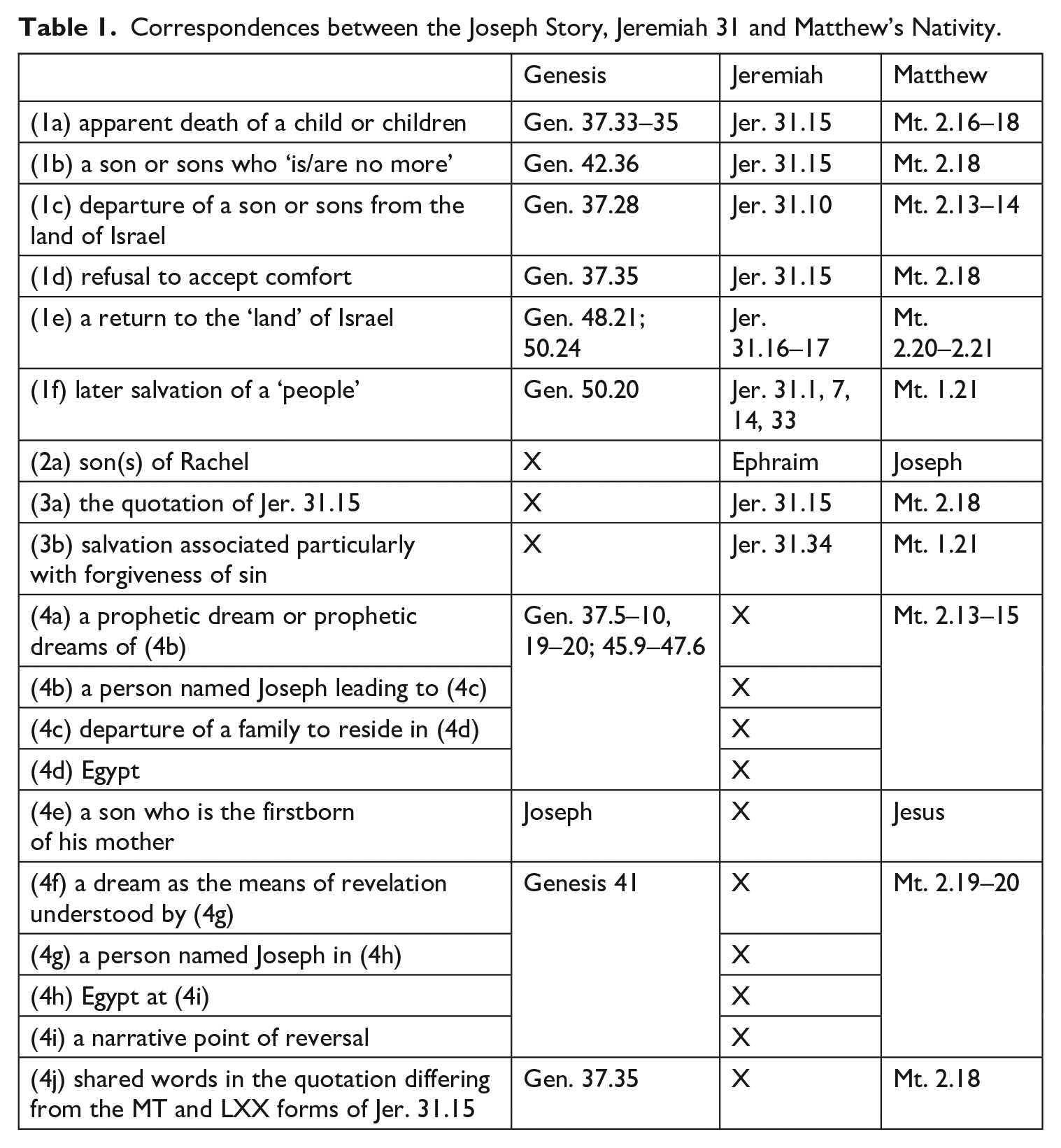
Although this list is not exhaustive, it demonstrates that the three texts share extensive correspondence. Furthermore, correspondence uniquely between the Joseph story and Matthew 2 is more extensive than between the other two pairs of texts (Joseph story and Jeremiah 31; Jeremiah 31 and Matthew 2). This distinctiveness and multiplicity in the correspondence between the Joseph story and Matthew 2 argues for what William A. Tooman (2011: 27–31) labels ‘deliberate literary borrowing’ or, more precisely in this case, the deliberate compositional shaping of Matthew 2 according to the Joseph story. 32 The quotation in Mt. 2.18 functions, therefore, not merely to allude to Jeremiah 31 but also to allude through Jeremiah 31 to the Joseph story as part of this patterning. From an audience-oriented perspective, the Joseph story would be prominent in the minds of an audience of Matthew 1–2 familiar with Genesis through their ‘encyclopedia’. 33
Interpretive Significance
The correspondence between the Joseph story, Jeremiah 31, and Matthew’s nativity observed in the previous section suggest literary patterning of Matthew 2 after the Joseph story in addition to allusion to Jeremiah 31. This raises the question of what function this patterning serves in Matthew. In this section I propose three possible points of significance for the patterning of Matthew 2 after the Joseph story: (1) participation of the messiah in his people’s history, (2) implicit response to expectations of a messiah of Joseph, and (3) anticipation of Jesus as the means for his people’s salvation.
Jesus’s Participation in Israel’s History
The observation that the early chapters of Matthew present Jesus as participating in the history of Israel is not new, but use of the Joseph story in Matthew 2 is a further example of what others have previously observed. The quotation of Hos. 11.1 highlights that Jesus would come out of Egypt as Israel, as God’s son was also called out of Egypt. Jesus encounters temptation in the wilderness for forty days, corresponding to the forty years of Israel’s testing in the wilderness. The correspondence with the Joseph story and of Joseph as a character here highlight another example of this recapitulation of Israel’s history in Jesus.
Recollection of the Joseph story to speak of the birth of Jesus appears in one other New Testament text. In Rev. 12.1–9, the sun, moon, and twelve stars in the vision of the woman recall the sun, moon, and stars that bow down to Joseph in his dream in Gen. 37.9, identified in Gen. 37.10 as symbolic of the family that will become the nation of Israel. Rev. 12.5 identifies the child to whom the woman gives birth as Jesus by alluding to Ps. 2.9. This use of Genesis 37 in Revelation provides an example of early Christian use of the Joseph story to speak about the birth of Jesus, showing further the plausibility of a similar association in Matthew.
Jesus and the Messiah of Joseph
Another possible significance of the allusion to the Joseph story by means of Mt. 2.18 is to provide an implicit response to expectations of a Josephite messiah. Although dating later than Matthew, several texts attest to expectations of a messiah of Joseph or of Ephraim, including Genesis Rabbah 99.2, b. Sukkah 52a, Targum Pseudo-Jonathan Exodus 40.11, Targum Ketuvim Canticles 4.5, Sefer Zerubbabel, and the margin of Targum Nebiʿim Zechariah 12.10 in Codex Reuchlinianus. 34 The address of the messiah as ‘Ephraim’ in Pesiqta Rabbati likely also reflects a Ephraimite messianism.
While not using the word ‘messiah’ for Joseph, some other texts display a tendency in Jewish reception of Joseph emphasizing Joseph’s royal, or royal-like, status. In the History of Joseph, he is referred to as ‘king’ three times (A verso 26 [2x]; A recto 16). 35 Likewise, in Joseph and Asenath, he is called ‘king’ in 25.5(6) and 29.9(11), portrayed with a ‘royal staff’ in 5.5(6), and inherits Pharaoh’s crown after the death of Pharaoh in 29.8(10). 36 The description of Asenath’s angelic visitor in 14.9(8) says that he is like Joseph in that he wears a crown and holds a royal staff.
Furthermore, Joseph and Asenath, although not using the word ‘messiah’ for Joseph, uses other terms that refer to Jesus in his messianic role in Matthew and other early Christian texts. Specifically, he is referred to as God’s son in 6.3(6), 5(2); and 13.13(10)(two times); as God’s firstborn son in 21.4(3) and 23.11(11) (also as ‘like the firstborn son of God’ in 23.11[11]); and savior in 25.5(6). 37 The significance of the repeated designation of ‘the Powerful One of God’ (3.6; 4.7(8); 18.1, 2; 21.21) is unclear, but at least attributes to Joseph a distinctive and unique position. G. T. Zervos (1985: 469) perceives reference to Joseph as ‘king’ or ‘ruler’ shared with Joseph and Asenath and the History of Joseph in Targum Onqelos on Genesis 41–42 and Targum Pseudo-Jonathan on Genesis 41–42. Targum Onqelos does not in fact use the word ‘king’ of Joseph. In Gen. 41.43, however, the designation of Joseph as ‘father of the king’ in the proclamation made before Joseph, appears throughout the targumim, either as the statement דין אבא למלכא (‘this is the father of the king’) in Targum Onqelos and Targum Pseudo-Jonathan or the blessing for long life יחי אבוי דמלכא (‘may the father of the king live!’) in Targum Neofiti, Fragmentary Targum P (with the variant יהי and אבא instead of אבוי), Fragmentary Targum V (with למלכה), and it seems also in the Fragmentary Genizah Targum (again with למלכה). Targum Onqelos and Targum Pseudo-Jonathan also add שליט (‘rule’) where ויצא (‘go out’) appears in the MT of 41.45 (Targum Neofiti and Genizah Targum, similar to MT, have ונפק; the relevant part of the text does not appear in Fragmentary Targum P). Targum Pseudo-Jonathan adds שליט (‘rule’) again in 41.46. I do not see any feature of Targum Onqelos of Gen. 42 that increases the image of Joseph as king beyond the MT, but in Targum Pseudo-Jonathan of Gen. 42.36, Jacob, talking with his sons in Canaan, refers to Joseph as מלכא דארעא (‘king of the land’).
These texts date later than Matthew, and, admittedly, the extent to which anticipation of a messiah of Joseph was present at the time of Matthew’s composition is difficult to establish. To the extent that some Jewish people did anticipate a messiah of Joseph at the time of Matthew’s composition, however, the creative use of the Joseph story in Matthew’s nativity may have been one effort to demonstrate Jesus’s likeness to Joseph (even affirming him as the son of a man named ‘Joseph’) despite his well-known Judahite ancestry. Matthew’s nativity may have thus affirmed the suitability of Jesus as the messiah in view of such expectations both by the recapitulation of the Joseph story in the events of Matthew’s nativity but also, in so far as it recalls the entire Joseph narrative, recalling the affirmation of a king from Judah at the end of that story in Gen. 49.10.
Salvation of a People through Jesus as through Joseph
Finally, as the Joseph story concludes, Joseph says God sent him לשום לכם שארית בארץ ולהחיות לכם לפליטה גדלה (Gen. 45.7), and again states the reason for his entrance to Egypt through his brother’s evil intentions and God’s good intentions as להחית עם־רב (50.20). Matthew’s nativity does not articulate the reason for Jesus’s birth using the language of giving life. Rather, it says that σώσει τὸν λαὸν αὐτοῦ ἀπὸ τῶν ἁμαρτιῶν αὐτῶν (Mt. 1.21). The following narrative, however, shows Jesus as instructing about entering future life (7.14; 19.16–17, 29; 22.32; 25.46) while stating the purpose of his own death as for the forgiveness of sins of those who will be with him in the father’s kingdom (26.28–29), following after his affirmation of forgiveness of sins earlier in the book (6.14; 9.2, 5, 6; 12.31). The continuation of Jer. 31.15 into the promise of the New Covenant that likewise states והמה יהיו־לי לעם in 31.33 and אסלח לעונם ולחטאתם לא אזכר־עוד in 31.34 combines with these two texts to anticipate that salvation of a ‘people’. In Matthew and Jeremiah, this salvation of a people is specifically tied to the forgiveness of sin.
Conclusions and Further Implications
Several implications follow from the proposal I have offered. (1) The quotation in Mt. 2.18 is not a result of careless quotation with unclear meaning but rather a deliberate multilayered allusion with narratological and theological significance. (2) Menken’s hypothesized revised LXX form of Jer. 31.15 is no longer needed. That such a hypothesized revised LXX form was used in the composition of Matthew is possible, but I wish to argue that, even if such a form was used, it was used with awareness of how it combined language from the Joseph story with Jer. 31.15 for the purposes of making larger thematic connections between Matthew and the Joseph story. (3) A further implication is that the formula quotations in Matthew are not redactional insertions but rather deliberate and integrated for the presentation of Matthew’s theological message. The blended quotation of Jer. 31.15 and Gen. 37.35 is an integral part of the panel in the nativity in which they appear and contributes to its logic. (4) The question stopping at Matthew’s use of Jeremiah has opened additional questions without answers. New Testament research must consider not simply ‘New Testament use of the Old Testament’, but also multilayered allusion, that is, New Testament’s use of the Old Testament’s use of the Old Testament.
New Testament texts and related literature may contain many examples of such multilayered use of texts besides that in Mt. 2.18. Consideration may need to be given not only to ancient authors’ association of texts through common words, etc., but also to how these authors themselves may have been aware of the use of texts in other texts and how that knowledge may be reflected in the composition of their own work. Readers in the twenty-first century consider how texts use previous texts; the possibility of ancient authors’ awareness of how previous texts were used within other texts (such as Matthew’s awareness of use of Genesis in Jeremiah) need not be denied. Such authorial awareness of texts’ use of other texts may even be reflected through other quotations in the same part of Matthew. Although space precludes elaboration here, the use of Hosea 11 in Jeremiah 31, and specifically in 31.15–16, has been noted in research of Jeremiah (e.g., Lindars 1979: 47–62; Holladay 1989: 45–47). Might this have led to the quotation of Hosea 11.1 along with Jer. 31.15 and Gen. 37.35 in Matthew’s nativity? A similar possibility may have led to the combination of Micah 5.1 and 2 Sam. 5.2, where again use of the earlier text is apparent in the later text, in Mt. 2.6. Each of these instances of use of texts in Matthew’s nativity function to advance a theology of scriptural fulfillment, whether through Davidic descent and birth in Bethlehem, divine sonship, or participation in Israel’s history according to the pattern of Joseph for the salvation of a people. Beyond this christological significance, however, these instances of using texts together suggest that the recognition of a text’s use of a previous text may have played a role in Matthew’s exegetical method. Considering such possibilities opens the potential for further studies reconsidering composite citations as well as quotations and allusions in close proximity not only in New Testament texts but also in other related literature.
Recapitulating the beginning of Israel’s history, when a father mourned over a son whom he seemed to have lost, and as at the time of Jeremiah, when a matriarch of Israel figuratively mourned over her children as they left for Babylon, seeming that they would never return, so Matthew shows at Bethlehem, where again mothers mourned over their children, one child going back to the land of Israel’s slavery. Yet, like Joseph, he enters Egypt in order for God to save a people for himself, and what others meant for evil, God meant for good to give life to many. Although it appears in the form of a Jeremiah quotation, Mt. 2.18 is indeed a Joseph reference.
Footnotes
Acknowledgements
I like to thank those who attended my paper presented at the British New Testament Conference as well as the anonymous JSNT reviewers for their feedback. I would also like to thank Herald Gandi and Kazusa Okaya for their assistance in obtaining resources requested.
Author’s Note
This article is developed from research presented at the British New Testament Conference as ‘Is That a Joseph Reference?: Gen. 37, Jer. 31, and Chain Allusion in Mt. 2.18’ at Durham University (online) on August 20, 2021.
1
Doane and Mastnjak, for example, arguing for the presence of an allusion to Gen. 37.35 in Jer. 31.15 note, in addition to the shared lexemes in the two verses, a patriarch/matriarch mourning for a child/children who are not actually dead and who are living in a foreign land before returning. I had made a list of correspondences prior to reading Doane and Mastnjak’s article, and their similar observations support the validity of the proposed correspondences.  was published after the initial composition of this article and so could not be engaged in detail. It provides substantial demonstration of the use of the Joseph story in the part of Jeremiah considered here.
2
My use of the term ‘composite citation’ follows that of Adams and Ehorn (2018a; 2020). In . 4), they define a ‘composite citation’ as follows: ‘a text may be considered a composite citation when literary borrowing occurs in a manner that includes two or more passages (from the same or different authors) fused together and conveyed as though they are only one.’
3
Keener specifies not just a general correspondence of a move from sorrow to hope but specifically ‘the hope of the new covenant to be accomplished through Jesus.’ (: 111–12) The works listed contain no mention of the Joseph story aside from Ritter mentioning the place of Rachel’s burial at Bethlehem.
4
Blomberg (2008. 9) notes the commonality of ‘refusing to be comforted’ in Gen. 37.35 and Jeremiah 31 when discussing the context of the source of the quotation in Mt. 2.18, but he does not state any significance of this for Matthew. Brown emphasizes the theme of exile along with that of exodus; he also mentions Gen. 35.19 and 48.7 on 205, but only to explain mention of Ramah in the quotation and not to explain how and why Matthew uses this quotation. According to Lohmeyer, the mention of Egypt recalls Moses and Pharaoh’s murder of the Hebrew children, and Moses was the first redeemer of Israel and a model of the Messiah, which linked to a messianic interpretation of Jeremiah 31. France (1981. 245–46) instead speaks of Jesus going into exile in Egypt corresponding to the exile of the people addressed in Jeremiah 31. . 115–16) similarly says that Matthew ‘renarrates’ ‘the story of Israel’ while anticipating the new covenant and restoration of exile from Jeremiah 31.
5
This approach is sometimes combined with one of the others. Mazurel notes Genesis 37 in his discussion of the original context of the quotation in Jeremiah, but he does not relate it to the interpretation of Matthew.
6
France’s discussion of this text combines multiple emphases, as indicated by the preceding references.
7
In addition to these main approaches, Luz (1985. 130) proposes that the quotation shows Herod’s illegitimacy as king of Israel because he has killed the children of its matriarch, and .16) sees the use of Jer. 31.15 as presenting the Slaughter of the Innocents as divine judgment against Israel while also presenting Jesus as sent to end rebellion against God and saving by mercy.
8
C D K L W Γ Δ f 13 33, the majority text, and several other minuscules include θρηνος και before κλαυθμός. This is likely the result of harmonization of Mt. 2.18 toward LXXA, as suggested by Knowles (1993. 33 n. 3) and . 143).
9
Manuscript 239 adds πολυς, probably through the influence of Mt. 2.18. No other variants listed in Ziegler display an adjectival rendering of a word of Rachel’s sorrow. Instead of ἀποκλαιομένη, 407, 26, and 316 have κλαιομενη, επικλαιομενη, and κλαιουσα, respectively. The first and third of these are closer to Mt. 2.18, but whether they are independent renderings of the Hebrew or harmonizations with Mt. 2.18 is not possible to determine. παρακληθηναι for παύσασθαι has wider attestation. Ziegler lists Bmg A-410 V-233 36-311-l C’-239-613 Bo Arab Cyr. Tht. The LXX B text may be viewed in the photographs of Codex Vaticanus on Vatican Library, DigiVatLib, (accessed 4 Aug 2021).
10
The text may be viewed from the Center for New Testament Manuscripts, ‘GA 02’, https.//manuscripts.csntm.org/manuscript/Group/GA_02 (accessed 4 Aug 2021). See also : 144).
11
This secondary nature of Greek Jer. has been further established by : 37–48). Fischer, using Jeremiah 52 as a test case since it may be compared with its Vorlage in 2 Kings 24–25, demonstrates the secondary nature of Greek Jer. 52 in comparison with MT Jeremiah 52 and suggests that, due to the similarity in the differences between other parts of Greek Jeremiah and MT Jeremiah, Greek Jeremiah as a whole is secondary to MT Jeremiah.
12
The text in PG differs from the text of Matthew in NA28 only through the spelling of ἤθελεν and εἰσίν as ἤθελε and εἰσί respectively.
13
Although less pertinent for the present discussion, the form of Jer. 31.15 in the Vulgate and Peshiṭta, both of which appear to closely follow a proto-MT text, may also be noted. The Vulgate is as follows. haec dicit Dominus vox in excelso audita est lamentationis fletus et luctus Rachel plorantis filios suos et nolentis consolari super eis quia non sunt (: 1210). The Peshiṭta shares with Mt. 2.18, against MT and other versions, the presence of a conjunction before the refusal of comfort. ܗܟܢܐ ܐܡ݁ܪ ܡܪܝܐ. ܩܠܐ݁ ܒܪܡܬܐ ܐܫܬ݂ܡܥ. ܐܠܝܐ݂ ܘܒܟܬܐ ܡܪܝܪܬܐ. ܪܚܝܠ ܒܟܝܐ ܥܠ ܒܢ̈ܝܗ݂݁. ܘܠܐ ܨܒܝܐ ܠܡܬܒ݁ܝܐܘ݂ ܡܛܠ ܕܠܝܬ ܐܢܘܢ.. Notably, both Vulgate and Peshiṭta do not contain an equivalent of the second occurrence of MT’s על־בניה.
14
Beare mentions the form may also be influenced by a Greek version, and Knowles specifies the involvements of redaction.
15
Gundry does not explain what texts he thinks were available in the composition of Matthew, but he refers e.g, to Matthew ‘lopping off θρῆνου from the LXX’ and says that ‘Matthew then turns תַמְרוּרִים, “bitterness”, into his favorite πολύς (23,1) for modification of ὀδυρμός.’
16
17
Gen. 37.35 appears the same in LXXA and LXXB as follows. συνήχθησαν δὲ πάντες οἱ υἱοὶ αὐτοῦ καὶ αἱ θυγατέρες, καὶ ἦλθον παρακαλέσαι αὐτόν, καὶ οὐκ ἤθελεν παρακαλεῖσθαι λέγων ὅτι Καταβήσομαι πρὸς τὸν υἱόν μου πενθῶν εἰς ᾅδου. καὶ ἔκλαυσεν αὐτὸν ὁ πατὴρ αὐτοῦ. :361) notes the variant παρακαληθηναι in 961 15-58-72-376′-oI–64mg C′’–128 125 53′ 121-318-527 Chr VIII 559. This variant may have resulted from harmonization with Mt. 2.18.
18
. 124 n. 169) notes Menken’s observation and allows for deliberate allusion to the Joseph story but does not expand on its possible significance beyond stating, ‘If he is right, then Matthew may be making a minor investment in a Joseph typology here: both Joseph and Jesus seem to have been done away with.’ Nolland himself views the primary significance of the quotation to be presenting that ‘the recapitulation of the life of the nation in the life of Jesus is in some way, for Matthew, foundational for Jesus’ significance in the purposes of God’ (quote from 125).
19
: 513–27, esp. 519–26) argues that Mt. 19.9–10 uses Lam. 4.1–2 as a text of Jeremiah with Zech. 11.12–13, which, if correct, would demonstrate greater similarity between Mt. 2.18 and Mt. 19.9–10: both texts cite Jeremiah by name for quotations that combine a Jeremian text with another non-Jeremian scriptural text. Thanks to Carmen Palmer for obtaining Quesnel’s article for me.
20
Menken here uses the taxonomy from . 204), which distinguishes between two types of ‘composite citation’, specifically ‘combined citations’ and ‘conflated citations’. Stanley explains as follows. ‘“Combined citations” occur when two or more excerpts are joined back-to-back under a single citations formula or other explicit marker to form a verbal unit that an uninformed audience would take as coming from a single source. “Conflated citations” are characterized by the insertion of a word or phrase from one passage into a quotation from another passage with no signal to the audience that such a commingling of texts has taken place.’
21
The examples Hays cites are Mic. 5.1–3 and 2 Sam. 5.2 in Mt. 2.6; Isa. 9.1–2 and 42.6–7 in Mt. 4.14–16; Sir. 51.27 and Jer. 6.16 in Mt. 11.29; Isa. 62.11 and Zech. 9.9 in Mt. 21.5; and Ps. 22.7 and Lam. 2.15 in Mt. 27.39.
22
Gen. 30.33; 39.9; Exod. 3.2; Lev. 11.4; 13.34; Deut. 21.18, 20; Judg. 3.25; 1 Sam. 11.7; 2 Chron. 18.7; Est. 5.13; Eccl. 1.7; 5.11; 8.7, 13, 16; 9.2; Jer. 38.4; 44.16.
23
Matthew differs from Luke in this respect. In Luke, Mary’s relative Elizabeth (and presumably her husband), the shepherds around Bethlehem, and others to whom the shepherds spoke (Lk. 2.17–18) are informed of Jesus’s birth and presence in Bethlehem. Simeon and Anna also appear in Luke’s nativity narrative, but without specifying that they were told anything about the location of Jesus and his family’s residence.
24
ἀναχωρέω appears to be characteristic of Matthew’s style, occurring in Mt. 2.12, 13, 14, 22; 4.12; 9.24; 12.15; 14.13; 15.21; 27.5 but only rarely in LXX (Exod. 2.15; Num. 16.24; Josh. 8.15; Aquilla Judg. 4.17; 1 Sam. 19.10; 25.10; 2 Sam. 4.4; Tob. 1.19; 2 Macc. 5.27; 10.13; Ps. 113.5; Prov. 25.9; Hos. 12.13; Jer. 4.29) and other NT texts (Mk. 3.7; Jn. 6.15; Acts 23.19; 26.31).
25
Note also פקד יפקד אלהים אתכם והעלתם את־עצמתי מזה (ἐν τῇ ἐπισκοπῇ ᾗ ἐπισκέψεται ὑμᾶς ὁ θεός καὶ συνανοίσετε τὰ ὀστᾶ μου ἐντεῦθεν μεθ᾽ ὑμῶν) in Gen. 50.25, although without a word for ‘land.’
26
The closest Josephus comes to this phrase is τὴν τῶν Ἰσραηλιτῶν γῆν in Ant. 8.204 and 9.254.
27
On the narrative significance of Gen. 50.20 within the Joseph story, : 205), for example, states, ‘Joseph’s explanation, concentrated into a single sentence, embraces God’s action in the two circles of the Joseph narrative; it joins simultaneously God’s universal, life-preserving action with his forgiving action within a small group of people, the family of Jacob. This heavily weighted key sentence brings out the meaning of the Joseph story so clearly that one can understand this concluding appendage, vv. 15–21.’
28
This element of the Joseph story also receives emphasis in Josephus’s reception of the story. Ant. 2.174 speaks of God’s providential preservation of the whole people through his position in Egypt in contrast to Joseph’s supposed death (παρέμεινέ τέ σοι γενεὰ πᾶσα προνοίᾳ τῇ ἐμῇ καὶ ὃν ἀπολωλέναι τῶν υἱῶν ἐδόκεις Ἰώσηπον εἰς ἀπόλαυσιν μειζόνων ἀγαθῶν ήγαγον καὶ τῆς Αἰγύπτου κύριον ὡς ὀλίγῳ διαφέρειν τοῦ βασιλέως ἐποίησα). An equivalent for this does not appear in the corresponding part of Genesis (Gen. 46.3–4), although it may use Gen. 50.20, which does not have an equivalent in Antiquities. Along with this is the anticipated fulfillment of divine promise in 2.175, which elaborates the short ואנכי אעלך גם־עלה ויוסף ישית ידו על־עיניך in Gen. 46.4. This reception of the Joseph story contemporary with Matthew strengthens the plausibility that the audience of Matthew could remember the theme of salvation of a people through an allusion to the Joseph story.
29
Admittedly, ἐνύπνιον appears in LXX Gen. 37.5, 6, 8, 9 (2x), 10, 20 while ὄναρ occurs in Mt. 2.13. What form of text was used in the composition of this part of Matthew is unclear, and ὄναρ would also be an acceptable translation of חלום. Even without the same word, the conceptual correspondence is clear. ὄναρ appears to be the preferred word in Matthew (1.20; 2.12, 13, 19, 22; 27.19). A departure to Egypt also occurs at the end of Jeremiah, but not in the immediate setting of Jeremiah 31, nor does a dream lead to this departure. The Joseph story and Matthew 2 therefore correspond more closely.
30
Yahweh calls Ephraim his firstborn in Jer. 31.9, which itself recalls Yahweh calling the people of Israel his firstborn in Exod. 4.22–23. In Gen. 48.13–20, Jacob blesses Ephraim with his right hand, as expected for blessing a firstborn. Jeremiah 31 may therefore also correspond with this point through the firstborn status given to Ephraim, even though he is the second son of Joseph and Asenath.
31
To avoid cluttering the table, only the MT versification of Jeremiah is included in the table.
32
Tooman describes five indicators of ‘deliberate literary borrowing’: of uniqueness, distinctiveness, multiplicity, thematic correspondence, and inversion (Tooman, 2011: 27–31).
37
Burchard (1985: 191–92) notes that the plural ‘sons of God’ also occurs in 16.14(8); 19.8 and suggests that, when used individually of Joseph, ‘son of God’ ‘may also mean that Joseph is an example of the just man in whom God can be recognized’. In combination with the other terms, however, the term may also have messianic resonances, even while not presenting Joseph himself as a/the messiah. The plural ‘all the sons of the Most High’ in 16.14(8) may refer to angels. Joseph also appears to be told to ‘save’ by Pharaoh in History of Joseph A recto 10 in the reconstruction in : 473). The object of the verb, however, is a single individual, most likely Pharaoh, and is in any case not a designation for Joseph in the way that ‘savior’ is in Jos. Asen. 25.5(6). Zervos (1985: 469) suggests the word may come from Gen. 47.25. Joseph is also referred to as ‘blessed by the Most High lord’ in 8.2, a phrase which may come from Gen. 14.19–20.