







Abstract
Did Paul intend for Philemon to manumit Onesimus? This article aims to present evidence in support of a manumissive view of Paul’s communicative intent to Philemon. Through a cognitive functional approach to discourse analysis, the sentence comprising vv. 15–16 is proposed to represent the peak of the epistle. Coincidingly, this central statement of the letter is precisely where Paul discusses the enslavement of Onesimus. There, through his linguistic choices, Paul construes emphatic discontinuity in Onesimus’s status, resulting in the most salient change in Philemon’s mental representation: Onesimus is no longer a slave, but beyond a slave, a beloved brother.
Introduction
What exactly did Paul want Philemon to do? 1 This represents a perennial interpretive question of Paul’s epistle to Philemon. For readers, especially those after the period of American chattel enslavement, Paul’s communicative intent is frustratingly concealed. At times in the short letter, he seems to want to say and request more than what he explicitly says (e.g., Phlm. 8, 21). This concealed nature of Paul’s discourse has led to a division among interpreters as to whether Paul intended Philemon to manumit Onesimus or not. Of course, some argue that although it is not explicitly stated, the rhetorical force of Paul generally indicates his desire for Onesimus’s release (e.g., Wright 2008: 171; Moo 2008: 436; Pao 2012: 420; Witherington 2007: 80). Others are not convinced and opt for a view of forgiveness (e.g., McKnight 2017: 5; Nordling 2004: 281). 2 Still others conclude that we cannot be certain of Paul’s request (e.g., Dunn 1996: 334; Barclay 1991: 161–86). Those in the latter category include James Dunn, who, amidst his uncertainty, notes that ‘Perhaps Philemon knew well enough [his exact request]; there may be hints and allusions in the language of which the modern commentator is completely ignorant’ (Dunn 1996: 334). Dunn, while humble in this assertion, motivated this article with its rather modest aim. I will attempt to demonstrate that a discourse analysis (DA) from a cognitive functional approach yields evidence that can be marshalled in support of a manumissive view of Paul’s communicative intent to Philemon. Importantly, I do not claim to definitively settle the interpretive dilemma, since such a determination would require a much more comprehensive analysis than what I offer here. Rather, I merely aim to offer linguistic evidence that could be integrated into a more comprehensive case for Onesimus’s manumission.
The article has three main sections. The first section provides a brief survey of two formal DAs of Philemon from David Allen and A. H. Snyman in order to demonstrate the ways the current project extends the contributions of these two authors. As many have noted, the interdisciplinary field of DA is notoriously ill-defined. Not only are there several schools of analysis, but it is often unclear as to what the procedure of analysis entails. For this reason, I will spend some space in the second section outlining my method. Through the orientation of the reader to my method, I hope to elucidate the analysis of Philemon in the third section. A final brief conclusion will summarize the elements produced by the analysis that can be marshalled as support for a manumissive position on Paul’s communicative intent.
At this juncture, it could be useful to provide a preliminary understanding of ‘discourse’ and the ‘analysis’ thereof in order to track the trajectory of the arguments and subsequent conclusions more clearly. ‘Discourse’, as used in this article, is more than just a textual artifact and includes the author’s ‘communicative purposes intended to be achieved through a text or utterance’ (Scacewater 2020: 2). Discourse analysis thus seeks to determine more precisely the purposes of the author through examining the linguistic features employed to achieve those purposes (Brown and Yule 1983: 26). Barbara Johnstone offers a simple but apt definition of the discipline: ‘The basic question a discourse analyst asks is “Why is this stretch of discourse the way it is? Why is it no other way? Why these particular words in this particular order?”’ (Johnstone 2008: 9). Johnstone’s statement successfully highlights the significance of an author’s choices in composing a discourse as inherently indicative of their communicative intent. Central to the analysis is the notion of mental representation, a term originally derived from cognitive science to designate the way content is stored in the mind (Krcmar and Haberkorn 2020: 2). Foundational for this study is the assumption that authors attempt to direct their addressee’s mental representations in accordance with their communicative goals, and it is the task of the analyst to determine more precisely those communicative goals through an analysis of the author’s choices in constructing a discourse.
Discourse could be taxonomized in a number of ways. This project focuses on three essential aspects: coherence, or the semantic comprehensibility of the discourse; cohesion, or the textual realization of coherence; and prominence, or the information of the discourse that ‘sticks out’. When applying DA to a particular interpretive question, such as the manumission of Onesimus, some aspects of discourse will inevitably be more relevant than others. In this project, prominence is the most relevant aspect since it reflects the most important (i.e., salient) information for the author’s communicative intent. However, the analyses of these various aspects are necessarily mutually informing. For example, the analysis of coherence in the current project determines the letter to be ‘behavioural hortatory’, intended to evoke some change in the addressee, and an analysis of the cohesion identifies the way the discourse is segmented and ‘tied’ together textually. Thus, considering coherence and cohesion, one expects the ‘peak’ of the prominent aspect to correspond to some change or discontinuity in the attempted direction of the addressee’s mental representation.
As will be demonstrated below, the distinct contribution of this article is an identification of the discourse’s peak (Phlm. 15–16). If my analysis is correct, then the discerned peak represents the most salient information for Paul’s communicative intent, which not coincidentally represents Paul’s most explicit discussion of Onesimus’s enslavement. There, Paul construes emphatic discontinuity in Onesimus’s status resulting in the most salient change in Philemon’s mental representation: Onesimus is no longer a slave but beyond a slave, a beloved brother (v. 16).
Literature Review
David Allen
David L. Allen’s essay in Discourse Analysis of the New Testament Writings applies a tagmemic model of discourse analysis to Philemon (Allen 2020). 3 This model follows the approach of Robert Longacre as articulated most comprehensively in Grammar of Discourse (Longacre 1996). Foundationally, the model rests on two principles. First, there is a distinction between function-slot and filler-set, and second, both combine into a tagmeme known as the smallest meaningful grammatical unit. 4
From these foundational principles, Longacre developed a model of DA aiming to evaluate the three aspects necessary for discourse: constituency structure, texture, and macrostructure. Constituency structure concerns the components of a discourse, including paragraphs, sentences, clauses, and phrases (Longacre 1996: 271–72). 5 Texture entails analysing the ‘cline’ (i.e., prominence) of information flow (Allen 2020: 524). 6 Important to the analysis of this aspect is the text type (i.e., genre) of the discourse. Based on the text type (e.g., narrative, expository), Longacre posits that verb forms and clauses can be hierarchically ranked according to their relevance of the information to the theme line (i.e., backgrounded, foregrounded) (Allen 2020: 524). A final aspect of Longacre’s model is macrostructure, which refers to the theme or main point of the discourse (Allen 2020: 525). 7 For Longacre and Allen, who follows him, the macrostructure can be determined through analysing how the constituency and texture of the discourse interplay.
Reflecting his method, Allen’s conclusions from his DA can be organized according to his three aspects of DA. First, in regard to constituency, Allen segments the discourse into 22 sentences and 6 paragraphs (Allen 2020: 527). As for texture, the verb and clausal scheme is consistent with that of hortatory discourse, which entails imperatival clauses being the most salient since they directly reflect the communicative goals of the author (Allen 2020: 524). Given this consideration, Allen finds the fourth paragraph (Phlm. 17–20) to be the peak of the discourse since this unit contains a concentration of imperatival forms (Allen 2020: 534–36). Coincidingly, Allen considers the main verb of verse 17, προσλαβοῦ, to be the most salient verb in the epistle (Allen 2020: 534). Lastly, from the constituency and texture, Allen deduces the macrostructure of the discourse to be concisely captured in verse 17, ‘receive him as you would receive me’. It is important for Allen that Paul ‘mitigates’ his exhortation through indirect (i.e., non-imperatival) commands in the grounding paragraphs, paragraphs 2 (Phlm. 4–7) and 3 (Phlm. 8–16) (Allen 2020: 538). This mitigation ends with the peak exhortation paragraph 4 (Phlm. 17–20). Paragraph 5 (Phlm. 21–22) summarizes the exhortation, adds a secondary request (Phlm. 22), and closes the body of the letter (Phlm. 23–25).
Allen provides a viable DA of Philemon, yet fails to sufficiently account for features below the sentential level, leaving some important aspects of the discourse unanalysed. Employing the method, Allen elucidates the structure of Philemon; yet to support his conclusion, he over-relies on the semantic weight of the verbal hierarchy in hortatory discourse. While verbs indeed carry important semantic information that moves the discourse forward, communication is inherently a complex phenomenon, and verbal expressions occur not in isolation but in a discourse context with many features combining to create meaningful communication. Attention to discourse features below the sentential level could more sufficiently support and expand his conclusions. Thus, attention to discourse features below the sentential level of the discourse will be further explored in the DA method applied in this article.
A. H. Snyman
While Allen provided a DA of Philemon inspired by Longacre, A. H. Snyman applies an approach from the South African School of Linguistics. The development of this approach was heavily inspired by Eugene Nida and his method as articulated in various articles and most completely in Style and Discourse: With Special Reference to the Text of the Greek New Testament (Nida 1991). This particular method of DA is known as colon analysis. A foundational principle for this method, as arguably for all methods of DA, is a close link between a text’s structure and semantic meaning (Snyman 1991). Since the approach is especially concerned with the end goal of translation, the method focuses nearly exclusively on the cohesive aspect of a discourse.
The centralized element of Snyman’s method is the colon. A colon is a syntactic unit with clearly marked external dependencies (Snyman 1991: 90). In other words, a colon is composed of a verbal (i.e., predicate) and nominal element that both have the possibility of extended features (Snyman 1991: 90). Additionally, the colon represents the smallest unit of meaning beyond a single word. Procedurally, Snyman begins his analysis by identifying each colon in the discourse. Then, following the syntactic analysis, the cola are grouped based on semantic criteria into clusters corresponding to paragraphs and pericopes. This grouping, and in consequence the cohesion of the discourse, is determined by two criteria of structural markers. The first criterion is words belonging to the same semantic domains as categorized by J.P. Louw and Nida in Greek-English Lexicon of the New Testament Based on Semantic Domains (Louw and Nida 1989). The semantic relations can be analysed based on multiple levels of the discourse, including cola, sentences, pericopes, and chapters. The second criterion includes transition markers, especially conjunctions, along with changes in mood or person in verbal constituents (Snyman 1991: 90). Together, both semantic domains and transition markers form the criteria for determining the structure of cola in a discourse.
In the application of his method, Snyman divides Philemon into 25 cola grouped into six pericopes corresponding to six paragraphs (Snyman 1991: 92). Snyman demarcates cola 1–2 (Phlm. 1–3) and cola 20–25 (Phlm. 21–25) as the introduction and conclusion, focusing his analysis on the four pericopes composing the body. Snyman sees a reason-result relation in Philemon, dividing the pericope into two sets of basis and inference (Snyman 1991: 97). Cola 3–5 (Phlm. 4–7) form a basis of Philemon’s love and faith, on which Paul beseeches Philemon on behalf of Onesimus in cola 6–9 (Phlm. 8–11). Next, Snyman suggests that cola 10–14 (Phlm. 12–16) are the basis for the inference of cola 15–19 (Phlm. 17–20). Coincidingly, the theme of cola 10–14 (Phlm. 12–16) is Paul sending Onesimus back as a brother, and the theme of 15–19 (Phlm. 17–20) is Philemon receiving him ‘as you would receive me’.
A. H. Snyman provides a well-informed structural DA of Philemon, but one that is limited in scope. Snyman effectively demonstrates the cohesiveness of the discourse through a colon analysis. Beginning with a syntactical analysis, Snyman demonstrates how Paul weaves his discourse together by using words within overlapping semantic domains. Additionally, Snyman also demonstrates how the author creates cohesion through features such as conjunctions, verb feature shifts, and rhetorical devices (e.g., chiasmus, inclusio). Yet, there are more aspects of a discourse than its cohesion (e.g., prominence). Significantly, Snyman himself understands this method’s limitations because of its focus on the cohesion aspect of the discourse and notes that this method should be used only to describe the structure of a text (Snyman 1991: 90). However, this statement also seems to contradict his assertion that there is a close link between a text’s structure and its meaning (Snyman 1991: 89).
Interestingly, neither of the analyses surveyed connect their analysis too strongly to Paul’s communicative intent and the authors certainly make no suggestion as to how their analyses might help inform the interpretive issue of Onesimus’s manumission. Perhaps this is the greatest distinction between the analyses surveyed and the one following here. My hope is to build on these two analyses to demonstrate how DA can provide support for a manumissive position of Paul’s communicative intent.
Cognitive Functional Discourse Method
The following section will outline in sufficient detail a cognitive and functional approach to DA. First and foundationally, I will give brief explanations of the descriptors ‘cognitive’ and ‘functional’ to expound the core characteristics and foundational principles of the approach. Then I will explain the three essential aspects of discourse—coherence, cohesion, and prominence. 8
The two descriptors ‘cognitive’ and ‘functional’ characteristically reflect the essence of the method. The method is cognitive since it holds to the general commitments and tenets of viewing language from the enterprise of cognitive linguistics (see Evans 2019: 25–54). Moreover, the method is ‘cognitive’ in that it is committed to interfacing findings from adjacent cognitive disciplines (e.g., neuroscience) into applied linguistics. ‘Functional’, as aptly described by Stephen Levinsohn, indicates an aim ‘to discover and describe what linguistic structures are used for: the functions they serve, the factors that condition their use’ (Levinsohn 2020: 97). 9 Together, the two characteristics reflect the goal of the approach to determine the author’s communicative intent more precisely through attention to the ways the textual realizations of the discourse function to create meaning in the mind of the addressee. In this way, too, the method aims to reflect the way that communication is actually produced and processed (Brown and Yule 1983). 10
A single foundational principle undergirds a cognitive functional approach: choice implies meaning (Runge 2010: 5–7). Fundamentally, when an author communicates, she or he is presented with a range of choices. Primarily, the author must choose what information to include, what information to exclude, and how to represent and sequence the information (Runge 2010: 5). Thus, these choices, while constrained grammatically, function to actualize the author’s communicative intent. In consequence, based on the communication principle of relevance, the addressee presumes that the message has been constructed intentionally to accomplish its communicative goals (Mazzone 2020: 436; Sperber and Wilson 1995). In essence, it is the goal of DA to discern the communicative intent through the mind of the addressee and, in our case, through the character of Philemon. The semantic implications of the various choices entailed in discourse production will be elaborated upon in the three essential aspects of discourse below.
Coherence
The first essential aspect of discourse concerns the semantic comprehensibility of a discourse. It could be said that coherence is the aspect of discourse that distinguishes well-formed texts from texts that are not well formed (Hellman 2011: 198). 11 Addressees have an assumptive bias towards coherence, which includes the relevance of a text. Thus, in this way, the standard and realization of coherence rests in the processing of the addressee. Following Levinsohn, a discourse is said to be coherent if ‘for a certain hearing/reading, she or he is able to fit its different elements into a single overall mental representation’ (Dooley and Levinsohn 2001: 23). A single mental representation is the necessary and sufficient condition for coherence.
A functional cognitive approach to coherence centres on the concept of mental representation. This notion presupposes that addressees do not simply receive information. Rather, addressees extrapolate ideas and concepts from discourse and metaphorically file them away into various structures of meaning called mental representations (Lambrecht 1994: 74–113). The file cabinet is an apt metaphor for this process since it reflects the way human cognition engages information based on topic or category. For example, critical to the analysis of this project is the ‘entity’ of Onesimus in Philemon’s mental representation. Philemon’s mental representation includes a profile of Onesimus characterized by an undetermined number of semantic properties (Dooley and Levinsohn 2001: 51). 12 Throughout the discourse, properties can be added, changed, or removed based on the author’s choices in describing Onesimus’s entity (e.g., the status of enslavement). From the author’s perspective, the goal is to direct addressees in constructing their mental representation in accordance with the author’s communicative intent. From the addressee’s perspective, she or he progressively attempts to construct a viable and coherent mental representation based on internal and external contextualization. Internal contextualization refers to the text itself, while external contextualization concerns the world and relevant circumstances in which the discourse is embedded (Dooley and Levinsohn 2001: 25). 13
Given the conceptual nature of coherence, the discovery of a discourse’s coherence occurs intuitively by attempting to mimic the processing of the addressee. Thus, in application, one can begin with an identification of the broad genre of the discourse specific to a given culture. Secondarily, the genre can be more universally classified according to Robert Longacre’s plus/minus criteria for agent orientation and contingent temporal succession (Longacre 1996: 8–11). After identifying genre, one simply reads the discourse, attempting to offer an initial identification of the discourse topic and sub-topics. 14 Lastly, noting potential topic shifts provides a working macrostructure which can be affirmed or adjusted by surface markers of cohesion (Dooley and Levinsohn 2020: 99).
Cohesion
The second essential aspect of discourse is cohesion. Cohesion refers to the textual realisation of coherence in surface features. That is, whereas coherence concerns conceptual comprehensibility, cohesion concerns linguistic features that help signal coherence to the addressee (Dooley and Levinsohn 2001: 27). These signals of coherence can be referred to as cohesive ties (Dooley and Levinsohn 2001: 27). Put simply, cohesion refers to the way the discourse is ‘tied’ together textually. It is the aim of DA to discover the ways an author employs cohesive ties to structure a discourse and, subsequently, to aid in discerning his or her communicative intent.
Authors have an array of cohesive ties available to employ when creating cohesion in a discourse. While an exhaustive treatment of cohesive ties is beyond the scope and space of this paper, the following is a brief categorization of types of cohesive ties that generally appear cross-linguistically. First, the category of identity refers to the way authors create chains of reference to various entities throughout a discourse (e.g., lexical repetition, pronouns) (Dooley and Levinsohn 2001: 29). 15 Second, cohesion can be created through lexical relations (e.g., hyponymy) (Dooley and Levinsohn 2001: 30). A third category involves morphosyntactic patterns (e.g., tense/aspect/person). Relations between clauses represents a fourth and significant category to be expanded upon below (i.e., conjunctions) (Dooley and Levinsohn 2001: 31). A final category and sometimes neglected cohesive tie is intonation patterns. While obviously more prominent in spoken discourse, an author can also use intonation in written discourse (Dooley and Levinsohn 2001: 32). Perhaps surprisingly, a feature of intonation will come into play in the analysis of Philemon below.
A particularly significant cohesive tie an author can employ to help guide the mental representation of the addressee is conjunctions (Category 4). Linguistically, conjunctions indicate explicit relations between adjacent clauses that otherwise would remain implicit. The fact that an author has an array of options to indicate an explicit relationship between clauses renders the choice to use a specific conjunction a significant intentional attempt to direct the reader in accordance with the author’s communicative intent. Each conjunction specifically constrains the addressee in a certain way to process the marked sentence in relation to its adjacent context (Reboul and Moeschler 1988: 77). As for the unique functional constraints of each conjunction, this article will follow the attested constraints of Steven Runge (Runge 2010: 17–55).
In application, attention to cohesive ties identifies topical shifts in the discourse, resulting in a clearer division of the macro and microstructures (i.e., boundaries) of a discourse. That is, a shift in topic typically concurs with disruptions and changes in cohesive ties. After a proposed macrostructure is established (see ‘Coherence’ above), one seeks to identify cohesive ties in affirmation or adjustment of the proposed macrostructure (Levinsohn 2020: 99–100). 16 Given the discussion above, morphosyntactic patterns will be attributed the most interpretive weight when determining boundaries. One will expect to find two or more morphosyntactic shifts (e.g., tense, aspect, mood, fronted constituents) corresponding to boundaries in the discourse. Overall, the divisions resulting from an analysis of cohesion demarcate the boundaries for the final aspect of discourse to realize: prominence.
Prominence
The third and most interpretively significant aspect of discourse concerns the parts of a discourse that ‘stick out’. In more precise linguistic terms, prominence concerns the varying saliency of focal information in a discourse. An apt description of prominence comes from Longacre, who notes that ‘Discourse without prominence would be like pointing to a piece of black cardboard and insisting that it was a picture of black camels crossing black sands at midnight’ (Longacre 1985: 83). Thus, prominence inherently concerns contrast as created by the foregrounding and backgrounding of information. A similar illustration of prominence comes from Runge, who uses several photos of Mount Shuskan as an analogy. Through the photographer’s choices (e.g., framing, colour contrast), the photographer effectively draws attention to various aspects in the photo (e.g., mountain or lake) (Runge 2010: 13–16). In a likewise manner, authors of written discourse can choose to employ discourse features to draw attention to desired elements in an addressee’s mental representation.
The most prominent section of a discourse is referred to as the discourse’s ‘peak’ (Longacre 1996: 33). As has repeatedly been emphasized throughout this summary of method, the addressee assumes that communication has been intentionally composed to accomplish its communicative goals (communicative principle of relevance). It follows that a well-formed discourse is going somewhere and progresses toward climactic development (Longacre 1996: 33). Thus in consideration of this principle, ‘peak’ refers to the climax or most salient section of a discourse for the author’s communicative intent. Processing the peak results in the greatest change or update in the mental representation of the addressee. Correspondingly, the peak of a discourse presents as a well-intended ‘zone of turbulence’ (Longacre 1996: 33).
There is a range of choices an author can make to indicate prominence in the mental representation of the addressee (Mathewson 2016: 277–85). 17 Generally, an author will break default (i.e., unmarked) linguistic patterns to create discontinuity (i.e., turbulence), resulting in a directing of attention through more focused and less autonomous processing. While a plethora of discourse devices can be used to create such prominence, this project will focus on those expounded by Steven Runge (2010).
Although space does not allow an exhaustive exploration of available discourse devices, a brief explanation of four categories of devices will suffice for the purpose of summarization. First, forward-pointing devices function to direct addressees’ attention to a significant element in the context (Runge 2010: 59). 18 Second, the category of information structuring devices include the ways that an author chooses to pragmatically direct attention through information positioning (Runge 2010: 185). 19 A third category includes thematic highlighting devices. While the other two categories generally create prominence by breaking expected linguistic patterns, the devices in this third category function to draw attention through redundant information, helping the addressee to construct his or her mental representation (Runge 2010: 315). Devices from each category play a role in the method’s application to Philemon below.
In application, one proceeds through the discourse with attention to discourse devices that function to create prominence. In the turbulence of a peak, there are a few features we can expect to find. First, a concentration and increase in frequency of discourse devices, especially forward-pointing and information-structuring devices, is expected. Generally, this increase in frequency of discourse devices functions to slow down the processing of the addressee, ensuring that the addressee does not miss the most salient information contained in the peak. Second, depending on the text type’s general aims (e.g., hortatory), one can expect an element of discontinuity or change. In sum, these discourse features correspond to the most important intended change in the mental representation of the addressee (Dooley and Levinsohn 2001: 62). Exegetically, an identification of the peak serves to constrain the efforts of the interpreter since the peak ideally corresponds to the most significant information for discerning the communicative intent of the author. The fruits of identifying the peak in a discourse will be demonstrated in the analysis of Philemon below.
This section of the article has outlined a cognitive-functional approach to DA. Overall, the approach seeks to better determine the author’s communicative intent through attention to the ways the textual realisations of a discourse function to create meaning in the mind of the addressee.
Before turning our attention to Philemon, a final note on the method will help clarify its procedural application. Both the explanation of the method and its application to Philemon below are presented according to the three aspects of discourse. However, procedurally, the analysis progresses linearly and sequentially through the discourse since this best reflects the way communication is naturally produced and processed. With this understanding, we now turn to Philemon to see how a cognitive functional approach to discourse analysis supports the manumission of Onesimus.
Analysis of Philemon
Coherence
Support for a manumissive view of Paul’s communicative intent begins with coherence. The analysis below begins to develop the expectations of Philemon as he receives the letter through an analysis of the linguistic structure of the discourse. To establish coherence, first an external contextualization of the discourse will be briefly explored. Then the analysis will proceed with a discussion of genre before identifying the discourse topic and sub-topics of the letter. Finally, a proposed macrostructure of the discourse will be presented before moving the analysis into the aspect of cohesion.
Although this project is focused on the internal contextualization (i.e., the text itself) of the discourse, a brief consideration of the external contextualization or Sitz im Leben of the discourse frames Philemon’s expectations as he receives the letter (Dooley and Levinsohn 2001: 25). While it is clear that Paul wrote his letter to Philemon from imprisonment, a full exploration of the possibilities of the location of the imprisonment is both beyond the scope of this article and makes little difference in a DA (cf. Phlm. 1, 9–10, 13; Acts 23.23, 33; 28.16). Additionally, while it is necessary to posit general elements of the external contextualization for the purposes of DA, the socio-historical circumstances are not as critical as they would be if the article were aiming to offer a more comprehensive case for Onesimus’s manumission. I concur with Stephen E. Young, who demonstrates that a common problem in the interpretation history of Philemon has been an approach that presupposes a background story beforehand and then seeks to fit the contents of the text into that story (Young 2021: 25–58). Instead, Young suggests an approach that concurs with the one in this article: ‘It will seek first to identify the purpose of the letter by an analysis of its contents and only then to reconstruct the story the letter presupposes in reference to this purpose’ (Young 2021: 59). In contrast to Young, this project constrains focus to the question of manumission and stops short of reconstructing a full background story of the letter, both for the sake of space and scope. However, it will be essential, if one is to arrive at a full reading of the letter, to determine whether the linguistic evidence for manumission presented in this article is congruent with the full complexities of one’s adopted background story. 20
With these considerations in mind, some general external contextualization can be put forth without suggesting much elaboration beyond what can be deduced from the text itself. In the letter, Paul primarily addresses Philemon, with whom he has an established relationship (Phlm. 1). Philemon is seemingly an influential and perhaps wealthy person, based on the attribution of a house church to him (σου) (Phlm. 2). The inclusion of others in the greeting (e.g., Apphia and Archippus) indicates that the letter was likely to be read aloud and, by implication, situates the message within a relational and communal context (Phlm. 2). Paul, as mentioned, is in prison (e.g., Phlm. 1,9,10,13,23), and Onesimus is enslaved to Philemon (e.g., Phlm. 16). Onesimus has been in contact with Paul, who has ‘begotten’ (ἐγέννησα) him, presumably referencing Onesimus’s conversion to Christianity through Paul (Phlm. 10, 12; cf. 1 Cor. 4.14–15). Now, Paul has sent Onesimus back to Philemon despite Paul’s desire to keep him for himself in gospel ministry (Phlm. 13). It is important to note with respect to Onesimus’s relationship to Philemon that no linguistic evidence indicates that the separation was due to any enmity or strife. 21 Overall, for the purposes of DA, the external contextualization frames Philemon’s expectations as he is delivered a letter from Paul. He perhaps anticipates or, at the very least, would not be surprised to find that the letter concerns Onesimus since Onesimus himself has been sent to him. However, perhaps he does not expect the most distinct change to come in his mental representation concerning his perception of his enslaved.
According to Longacre’s broad linguistic classification, the genre is hortatory and behavioural, as deduced through his criteria. The letter is obviously positive for agent orientation since it primarily addresses Philemon along with others in his church (Phlm. 1). Yet, the discourse lacks contingent temporal succession as in narrative (Longacre 1996: 9). Thus, the positivity of agent orientation and negativity of contingent temporal succession indicates the discourse to be foundationally hortatory and behavioural. Additionally, Longacre’s secondary criterion of projection offers additional insight into the communicative nature of the discourse. The discourse is positive for projection since it anticipates an action that has yet to be realized (e.g., Onesimus’s manumission). 22 Overall, the genre of the discourse is behavioural hortatory with an additional notion of projection. For communicative intent, Paul is aiming to evoke some change in Philemon’s behaviour that he expects to be realized in action.
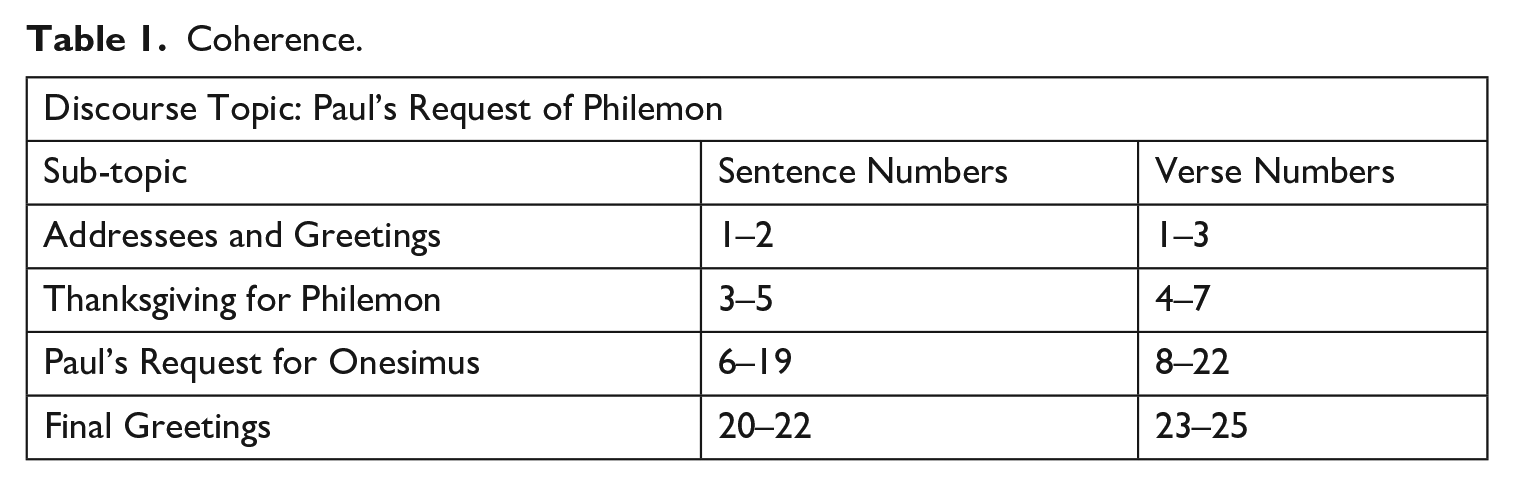
A reading of the letter reveals a discourse topic and sub-topics yielding a proposed macrostructure (see Table 1). As will be affirmed through an analysis of cohesion and prominence, the discourse topic is Paul’s request of Philemon. Paul’s request of Philemon is the generative communicative idea. Stemming from this communicative idea, the letter develops through four sub-topics corresponding to major divisions in the discourse. The sub-topics in order of sequence are ‘Addressees and Greeting’ (Phlm. 1–3), ‘Thanksgiving for Philemon’ (Phlm. 4–7), ‘Paul’s Request for Onesimus’ (Phlm. 8–22), and ‘Final Greetings’ (Phlm. 23–25). These major divisions along with subsequent microstructures (i.e., paragraphs) are realized in the cohesion of the discourse analysed below. Overall, attention to the coherence of the discourse begins to reveal Paul’s communicative intent. The external contextualization and broad structure of the letter indicate to Philemon that Paul’s intent is to make a request of him regarding his enslaved, Onesimus.
Coherence.
Cohesion
An analysis of the cohesion further elucidates Paul’s communicative intent through demonstrating the textual realization of the discourse’s coherence, particularly as generated by his request. Attention to cohesive ties further develops the linguistic structure of the discourse, resulting in an affirmation of the proposed macrostructure above and a division of the discourse into five paragraphs. Below, the analysis will proceed sequentially through the paragraphs focusing especially on morphosyntactic features. The analysis will also exclude the salutatory paragraph (Phlm. 1–3) and the final paragraph (Phlm. 23–25) to focus on the most relevant units of the discourse for communicative intent.
The second paragraph (Phlm. 4–7) expounds Paul’s thanksgiving for Philemon’s character. The appearance of the first finite verb in the discourse (Εὐχαριστῶ) marks a distinct morphosyntactic change that indicates a new paragraph unit. In addition, the new topic of the paragraph is indicated in the first sentence by the semantic content expressed by the verb in the initial position (Phlm. 4–5). That is, the topic of the paragraph is Thanksgiving for Philemon. Paul profiles Philemon as having love (ἀγάπην) and faith (πίστιν) (Phlm. 5; cf. Phlm. 1). Elaborating on the thanksgiving in the final two sentences of the paragraph, Paul again draws on the faithfulness (τῆς πίστεώς) of Philemon, this time in reference to his partnership (κοινωνία), a lexical marking that will create cohesion through its repetition later in the discourse (e.g., Phlm. 17). In the final sentence of the paragraph, Paul once again references Philemon’s love (τῇ ἀγάπῃ σου). Overall, the cohesion of the paragraph is primarily realized through the repetition of the lexical markings of ἀγάπη, πίστις, Ἰησοῦς Χρίστος, and άγίοι.
The third paragraph (Phlm. 8–16) expounds Paul’s request for Onesimus. Significant for the division of this paragraph is the inferential conjunction Διὸ corresponding to a change in topic. The clause introduced by Διὸ (πολλὴν ἐν Χριστῷ παρρησίαν) functions as a comparative frame drawing attention to Paul’s choice to appeal based on love rather than his authority (Phlm. 8–9). There is also a morphosyntactic change in the aspect of the main verbs in verses 7–8 (i.e., ἔσχον, παρακαλῶ). Together, these features indicate a new boundary unit that corresponds to the change in topic from thanksgiving for Philemon’s character to Paul’s request for Onesimus. Within the paragraph, cohesion is indicated through the lexical repetition of request (παρακαλῶ, Phlm. 9–10) and subsequently through elaboration on the subject of his request: Onesimus (Phlm. 10). Amidst Paul’s extensive profiling of Onesimus, the referential pronouns serve as cohesive ties in the paragraph (e.g., ὃν, Phlm. 12–13). Overall, Paul, having developed a rather favourable mental representation of Philemon (i.e., loving and faithful) in the previous paragraph, transitions to make his request, grounding his request in Philemon’s own character.
The most salient boundary in the discourse occurs between paragraphs 3 (Phlm. 8–16) and 4 (Phlm. 17–22). Of the frequented Greek New Testament critical texts, only the Nestle-Aland Greek New Testament 28th Edition (NA28) fails to demarcate a boundary at verse 17. Instead, the NA28 demarcates the fourth paragraph at verse 15 (cf. UBS5, SBLGNT). However, of formal linguistic DAs, both Allen and Snyman perceive a boundary at verse 17, testifying not only to the boundary’s viability but also its saliency (Allen 2020: 521–38; Snyman 1991: 97). The boundary is indicated by two features. First, the inferential οὖν is semantically marked for continuity and development, signalling to Philemon to anticipate a new development in Paul’s request (Runge 2010: 43). Second, the core constituent of the new development (προσλαβοῦ) represents a change in four verbal features (i.e., person, mood, voice, aspect) from the main verb of the previous sentence (ἐχωρίσθη). Significantly, there is no other boundary unit that has a change in more than three verbal features, and this is the first imperative mood verb in a hortatory discourse. For these reasons, Allen suggests that the fourth paragraph is the most salient of the discourse; in contrast, it will be argued below that the peak of the discourse occurs just before in verses 15–16 since the focal information of that sentence corresponds to the most salient update in Philemon’s mental representation (Allen 2020: 534).
The topic continued from paragraph 3 into paragraph 4 (Phlm. 17–22) is Paul’s request for Onesimus. The development indicated by οὖν is not that of topic but of the mood of the request. Here, at the beginning of paragraph 4, the hortatory and behavioural nature of the discourse is more explicitly realized in the choice and frequency of the imperative mood in this paragraph. Four imperative mood forms appear all in primary clauses whereas in the preceding three paragraphs none appeared (προσλαβοῦ, ἐλλόγα, ἀνάπαυσόν, ἑτοίμαζέ). Thus, the morphosyntactic imperative marker creates cohesion in reflection of Paul’s more explicit directions. Additionally, there is also a concentrated increase in finite verb forms in this paragraph. 18 finite verb forms appear in this paragraph compared to a total of 17 in the rest of the letter. In effect, an oral reading of the staccato-like shorter clauses would have resulted in an intonation spoken pattern that creates cohesion for this paragraph unit (Allen 2020: 535).
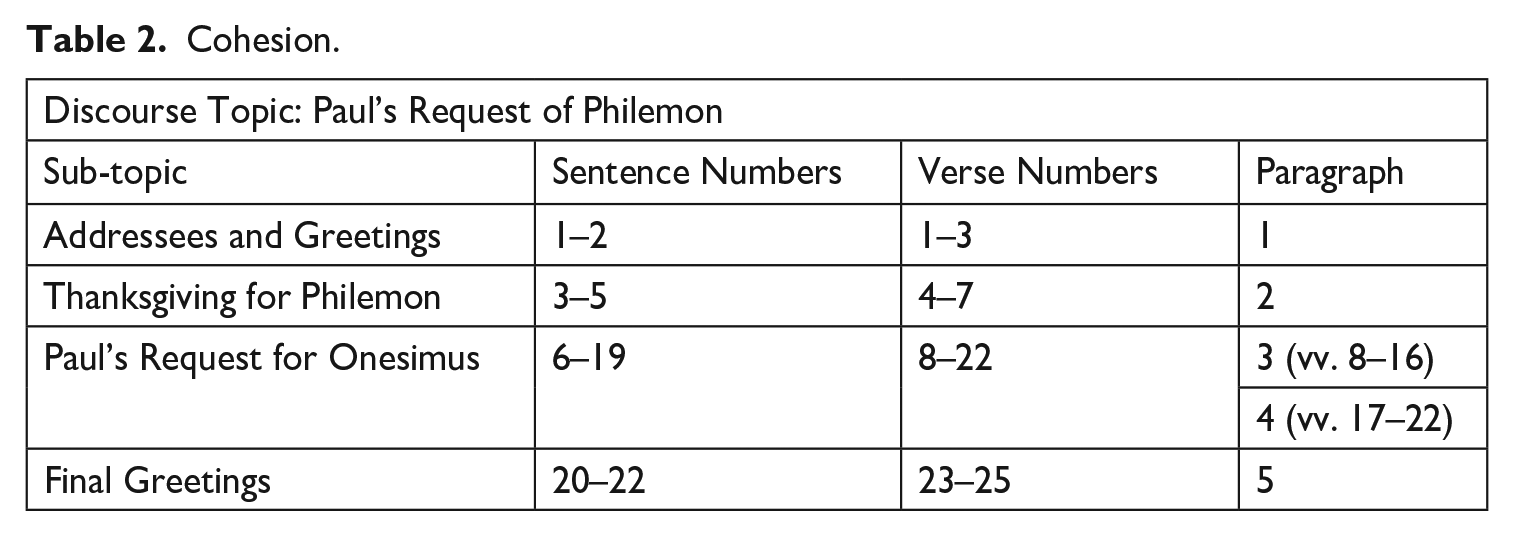
The analysis of cohesion moves the analysis forward by elucidating the discourse structure. Affirming the proposed macrostructure above, the discourse progresses through four topics: ‘Addressees and Greetings’ (Phlm. 1–3), ‘Thanksgiving for Philemon’ (Phlm. 4–7), ‘Paul’s Request for Onesimus’ (Phlm. 8–22), and ‘Final Greetings’ (Phlm. 23–25) corresponding to five paragraphs (see Table 2). Generally, cohesion is realized in the discourse through consistent reference to the main entities (i.e., Paul, Philemon, and Onesimus). Additionally, the profiling of the main entities create cohesion through repetition of lexical markings. Those lexical markings that transcend boundary units include especially ἀγάπη, πίστις, κοινωνία, δέσμιος, Ἰησοῦς Χρίστος, κύριος, and ἀδελφέ (e.g., Phlm. 1,2, 5, 6, 9, 10, 20). While an analysis of coherence establishes Philemon’s expectation for Paul to make a request, an analysis of the cohesion establishes the primary characterizations used to create discontinuity in Philemon’s mental representation of Onesimus. Most notably, the lexical marker δοῦλον does not transcend the boundaries of the discourse since it no longer accurately profiles Onesimus after the peak.
Cohesion.
Prominence
The analysis of both coherence and cohesion set the stage for the most interpretively significant aspect of discourse for supporting the manumission of Onesimus: prominence. Below, the analysis will proceed sequentially through the discourse, highlighting the most prominent elements of the discourse and those discourse features that result in those elements ‘sticking out’. 23 The salutation (Phlm. 1–3) and closing (Phlm. 23–25) will again be excluded, not because no such prominent elements exist within these sections but rather to concentrate our analysis on the more relevant body of the discourse (Phlm. 8–22). Within the body, our analysis will concentrate and expand on the peak (Phlm. 15–16), demonstrating how Paul construes emphatic discontinuity with respect to Onesimus’s status as enslaved.
The second paragraph (Phlm. 4–7) of the discourse is not particularly prominent in the full scope of the discourse; however, the profiling of Philemon builds a mental representation of him that will be transferred to Onesimus in the peak. The most prominent information in the second paragraph (Phlm. 4–7) concerns Paul’s joy and confidence in Philemon’s love. Of the three sentences composing the paragraph, the final sentence contains three discourse devices, whereas the previous two sentences contain one and two, respectively. There, in the final explanatory sentence, Paul chooses to front the focal information (i.e., newest, unknowable) of the main clause. There, he draws attention to the joy and confidence (χαρὰν πολλὴν καὶ παράκλησιν) he has because of Philemon’s love through information structuring. The subordinate clause offers the reason for his confidence: the hearts of the saints have been refreshed through him (ὅτι τὰ σπλάγχνα τῶν ἁγίων ἀναπέπαυται διὰ σοῦ, ἀδελφέ). The final clause contains the discourse features of a topical frame (τὰ σπλάγχνα τῶν ἁγίων) and a thematic address (ἀδελφέ). Overall, in giving thanks, Paul draws attention to his joy and confidence in Philemon’s love, his brother.
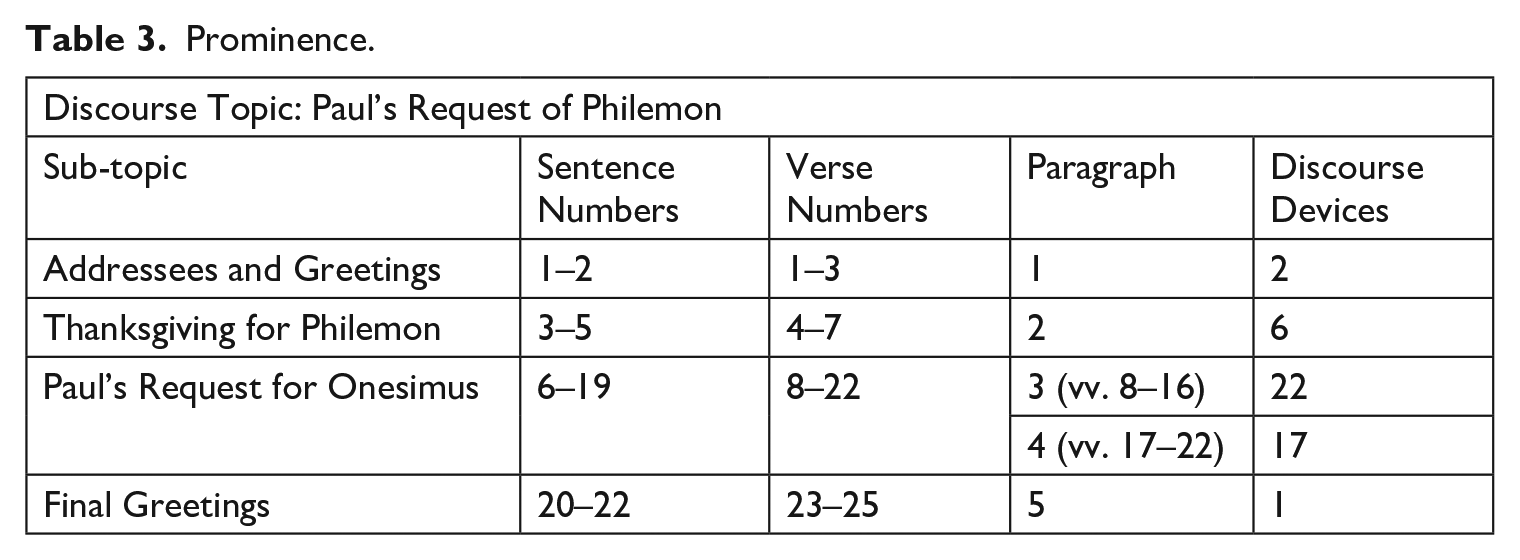
The most salient unit of the discourse is the third paragraph (Phlm. 8–16), containing the highest concentration of discourse devices in the epistle. The paragraph exhibits 22 discourse devices, 12 of which occur in the first and final sentences of the six-sentence paragraph corresponding to the most prominent information of the paragraph unit. In the first sentence, the most focal information is fronted just before the primary verb παρακαλῶ (i.e., διὰ τὴν ἀγάπην μᾶλλον). Moreover, the processing of this information is delayed in the mind of the addressee as a pragmatic effect of the preceding reason/circumstantial frame (Διὸ πολλὴν ἐν Χριστῷ παρρησίαν ἔχων ἐπιτάσσειν σοι τὸ ἀνῆκον). The less salient information contained in the reason/circumstantial clause draws the addressee’s attention to the assertion that Paul has chosen to make his request based on love rather than his authority. In a similar pragmatic sense, there is a concentration of three overspecifications surrounding the introduction of Onesimus (v. 10) into the discourse. The first overspecification (τοῦ ἐμοῦ τέκνου, ὃν ἐγέννησα ἐν τοῖς δεσμοῖς) pragmatically functions to delay the introduction of Onesimus while the second (τόν ποτέ σοι ἄχρηστον νυνὶ δὲ καὶ σοὶ καὶ ἐμοὶ εὔχρηστον) and third (τὰ ἐμὰ σπλάγχνα) elaborate on Onesimus. In this way, both through anticipation and expansion the author directs the addressee’s attention to the specific characterizations of the profile of Onesimus. Paul is appealing based on love for his dear child, his very heart.
The final sentence of the third paragraph (Phlm. 15–16) represents the peak of the discourse for at least two reasons. First, the sentence contains—along with verse 8—the most discourse devices (i.e., six) of any other sentence in the discourse (see Table 3). Second, this concentration and increase of frequency in discourse devices satisfies Longacre’s criterion of a ‘zone of turbulence’ in the surface structure (Longacre 1996: 38). However, it is very important to note, lest one suspect that the sum of DA is counting devices, that it is not only the uptick in frequency of devices that creates turbulence but the processing effect of these devices that establishes its prominence. As will be demonstrated below, most of the devices are semantically non-essential. The author uses non-essential forward-pointing devices to slow down processing, ensuring that Philemon does not miss the most important update in his mental representation. Third, as hinted, the focal information of this sentence corresponds to the most discontinuous change in the profile of Onesimus. That is, Onesimus is no longer a slave but Philemon’s beloved brother (Phlm. 16). In Allen’s aforementioned DA, he misidentifies the peak as verse 17, whereby the first imperative appears correspondingly, viewing the subsequent change in intonation pattern (see ‘Cohesion’ above) as the peak zone of turbulence. However, since his analysis self-admittedly does not move below the sentential level of the discourse, he seemingly overlooks the pragmatic effect of the discourse features identified here (Allen 2020: 534). Altogether, at the peak, Paul slows down the processing of the discourse through expansions so as not to allow Philemon to miss the most important information for his communicative intent.
Prominence.
The significance of the peak for communicative intent warrants a focused outline of the discourse features. Of the six total devices, four devices precede Paul’s crucial update of Onesimus as a beloved brother. First, the sentence begins with an attention getter (Τάχα) embedded within a metacomment (τάχα γὰρ διὰ τοῦτο). Together, these two devices function to point forward to the target and focal information of Onesimus’s reception (ἵνα αἰώνιον αὐτὸν ἀπέχῃς). Third, αἰώνιον (i.e., forever) is fronted in the subordinate clause. Fourth, the characterization of Onesimus as a beloved brother is set as the counterpoint of a point/counterpoint highlighting the counterpoint (οὐκέτι ὡς δοῦλον ἀλλʼ ὑπὲρ δοῦλον, ἀδελφὸν ἀγαπητόν). Onesimus is no longer a slave but a beloved brother. What Philemon is to Paul, Onesimus is now to Philemon (cf. Phlm. 1, 7). The final two devices of the sentence elaborate on Onesimus once more through another point/counterpoint set and thematic addition indicated by an intensive και (μάλιστα ἐμοί, πόσῳ δὲ μᾶλλον σοὶ καὶ ἐν σαρκὶ καὶ ἐν κυρίῳ). He is a beloved brother to Paul, but more to Philemon, both in the flesh (i.e., worldly reality) and in the Lord (i.e., spiritual reality). The pragmatic effect of all the devices can be illustrated through a contrast of simplicity and complexity. Without losing any essential content, the sentence could have been written as simply as ἐχωρίσθη πρὸς ὥραν ἵνα αἰώνιον αὐτὸν ἀπέχῃς (i.e., ‘He was separated [from you] for a time so that you might have him back forever’). Yet, the choice to not write so simply and to expand indicates Paul’s intention to create an important change in Philemon’s mental representation.
Two marked linguistic choices beyond those that create prominence serve to reveal Paul’s discontinuous construal of Onesimus’s previous status as enslaved. First, several have noticed the choice to use οὐκέτι in adverbial constituent negation to ἀπέχῃς despite the mismatch in appropriate grammatical form, sometimes leading to a suggestion that Paul had a ‘grammatical blunder’ (Nordling 2004: 247). Here, Paul used the indicative negating form in a grammatically dependent subjunctive construction. However, rather than relegating this grammatical happenstance to a marginal footnote, this choice should be seen as significant to revealing Paul’s intent. The indicative mood makes an assertion concerning reality (Mathewson 2021: 100). Of course, whether the assertion actualizes is another matter altogether, but what is clear is that Paul intended for Philemon to no longer conceive of Onesimus as enslaved in his mental representation. More than that, since the choice occurs in the peak of the discourse, the non-default choice is especially salient. The second choice concerns the prepositional phrase, ὑπὲρ δοῦλον. Although translations can sometimes skew the meaning of the preposition by suggesting continuity, from a cognitive linguistic framework, the meaning is developed spatially (e.g., ‘more’; cf. LEB, ESV, NASB95, NRSV). The trajector (i.e., Onesimus) has moved ‘beyond’ the landmark (i.e., slave) (cf. Mt. 10.24; Lk. 6.40; Phil. 2.9) (Aubrey and Aubrey 2020). 24 Paul has chosen to construe Onesimus as moving beyond that of the status of a slave in a discontinuous sense. This is further indicated through the conjunction ἀλλὰ, which is marked for sharp contrast in point/counterpoint constructions (Runge 2010: 56). These two salient choices within the peak indicate that, while Paul does not explicitly request Onesimus’s release, he emphatically leaves no doubt about his status: beyond a slave, a brother beloved.
Some may consider this last assertion—my reading of ὑπὲρ δοῦλον as beyond a slave—an overinterpretation of the preposition ὑπὲρ, since Greek prepositions notoriously occur with such frequency that they develop a network of various meanings. While it is true that prepositions can have a wide range of senses, the argument here is that the profiled relationship between Onesimus and his status within the context of the discourse entails such a reading. It is the precise syntactical construction of preposition (i.e., ὑπὲρ) with an accusative (i.e., δοῦλον) set within a frame of discontinuous change that reveals such meaning. Paul has constructed the discourse for this moment of disruption in the mental representation of Philemon—to reveal how Onesimus has changed. It is not that there is no continuity at all with respect to Onesimus, but Paul is drawing attention to what has changed. If Paul desired to express continuity, even in the slightest sense, he had the linguistic means available to do so. He could have indicated continuity in Philemon’s status by using the adverb μόνον (i.e., not only a slave) (39x in undisputed letters) or a similar construction. However, for Paul, and now for Philemon, Onesimus is to be conceived of not only a slave, but as no longer a slave. Additionally, such construction of preposition with accusative in reference to a status is not without parallel in the Pauline corpus. In the Christ Poem of Philippians, for example, Paul poetically and beautifully construes Jesus’s name as, in almost every translation, ‘above’ every name (prep. + acc.) (Phil. 2.9; cf. NIV, ESV, NASB95). Here too, a relationship between a person and an abstract entity (Jesus’ name and status) is profiled within a frame of discontinuous change. Paul has been reflecting on Christ’s incarnation, and now he identifies something that has changed in the status change of his exaltation (διὸ καὶ ὁ θεὸς αὐτὸν ὑπερύψωσεν, Phil. 2.9). Is Jesus’ name ‘more’ than every other name? Sure, but that fails to capture the semantic scope of the construal. Jesus’ name (the trajector) has moved beyond the landmark of every other name. Continuity is not being construed. Likewise, continuity is not construed in Onesimus’s status. Thus, if one holds that Paul did not intend Onesimus’s manumission, then one must explain why the linguistic evidence construes discontinuity and not continuity.
Before moving on from the peak, it is also pertinent to highlight that Paul’s construal of Onesimus’s status does not end in discontinuity; rather, Onesimus, the ‘trajector’, has moved beyond the status of ‘slave’ and into the status of ‘beloved brother’ (ἀδελφὸν ἀγαπητόν). From a discourse perspective, the profile of a ‘beloved brother’ has been constructed through Philemon’s characterization (Phlm. 4–7). Philemon was first addressed as a ‘beloved brother’ and a ‘fellow worker’ and was subsequently characterized as loving and faithful in the second paragraph (Phlm. 1, 4–7). As evidenced in the discussion of this paragraph above (Phlm. 4–7), Paul explicitly grounds his thanksgiving for Philemon’s love on the basis of his refreshing of the saints (ὅτι τὰ σπλάγχνα τῶν ἁγίων ἀναπέπαυται διὰ σοῦ, ἀδελφέ, Phlm. 7). Now, at the peak, the profile and its characterizations of a ‘beloved brother’ have been transferred onto Onesimus. Now, Onesimus too is loving and faithful, and Onesimus too is a fellow worker with respect to the saints. As a corollary, this reality, coupled with Paul’s comment that he desired to keep Onesimus to serve with him in the chains of the gospel (Phlm. 13), indicates that Onesimus is now to be conceived of as a full partner (κοινωνόν) in the ministry of the gospel (Phlm. 6,17). Altogether, after the peak, what Philemon is to Paul, Onesimus is now to Paul and Philemon through his new status as beloved brother.
The fourth paragraph is the second-most prominent paragraph in the letter, containing 17 discourse devices. As noted above, here the clauses become shortened and expansive features such as forward-pointing devices are not as prevalent. Coincidingly, five of the 17 features in this unit are topical frames that function to shift the clausal level topics in the staccato-like sentences. Although a similar degree of saliency appears in the eight sentences of this paragraph, the first three sentences are the most prominent. The initial sentence (Phlm. 17) is marked since it contains the first imperative mood verb in a hortatory discourse. Following this, the next two sentences (Phlm. 18–19) contain four devices each. Both sentences concern the resolution of any potential debt on Onesimus’s behalf. In the first sentence, Paul delays the processing of the focal information (i.e., ἐμοὶ ἐλλόγα) through a left dislocation and fronts the object of the imperative verb (ἐμοὶ). In the following sentence, Paul says that he will repay if need be. The most prominent elements of this paragraph reflect Paul’s communicative intent. The update of Onesimus as a beloved brother has already been made in Philemon’s mental representation, and now Paul excludes any potential reason for Onesimus to remain Philemon’s enslaved.
Although verse 21 is not as prominent as the preceding sentences, the summarizing statement does contain significant elements for reinforcing Paul’s communicative intent. Many commentators view Paul’s comment that Philemon will do even more than what he says as suggesting Onesimus’s manumission (e.g., Wright 2008: 196; Moo 2008: 436). This position is bolstered for two reasons. First, the prepositional phrase is fronted before the verb (ὑπὲρ ἃ) for clausal focus. Second, this lexical marking (ὑπὲρ) cohesively ties this choice to the peak of the discourse, rendering the choice more salient than if it was otherwise so. The preposition ὑπὲρ occurs three times in the epistle (Phlm. 13, 16, 21). However, this syntactical construction (prep. + acc.) is elsewhere reflected only in the peak (i.e., ὑπὲρ δοῦλον). Thus, it could be that through this distinct choice, Paul subtly reinforces his communicative intent. Philemon will do beyond what he merely says.
If an analysis of coherence establishes Philemon’s expectation of request and cohesion establishes the profiles used to disrupt Philemon’s mental representation of Onesimus, then attention to prominence highlights which information is most important for Paul’s communicative intent. A concentration of discourse devices in the peak (Phlm. 15–16) slows down the processing of the discourse and creates turbulence. Here, the most salient change in Philemon’s mental representation is made. Paul construes emphatic discontinuity, Onesimus is no longer a slave and is now beyond (ὑπὲρ) a slave, a brother beloved. Although Paul does not explicitly reveal the full extent of his communicative intent, he construes a discontinuity with Onesimus’s previous status as enslaved. He has intently composed a discourse so as not to allow Philemon to miss this most central point, the peak of his communicative goal. And he expects Philemon to do beyond what he says.
Conclusion
By explicating a cognitive function approach to DA and subsequently applying the method to Philemon, I have modestly aimed to yield evidence through my analysis that could be marshalled in support of a manumissive view of Paul’s communicative intent to Philemon. As noted at the outset, I do not claim to have definitively settled the interpretive dilemma but merely to have helped elucidate Paul’s admittedly concealed request through a distinctly linguistic perspective. I recognize a more comprehensive analysis is needed to fully determine the matter. Nonetheless, a DA of coherence, cohesion, and prominence yields evidence that can be marshalled in support of a manumissive position. Many of the linguistic observations above are not novel, but the distinct contribution of this article is to frame such observations in relation to the discourse’s peak. If one accepts that the epistle has a peak and that the peak of the discourse represents the most salient information for the addressee, then the author’s choices in the peak have significant implications for determining her or his communicative intent. If my analysis is correct, then the content of verses 15–16 represents the central statement for Paul, which not coincidentally corresponds to the most explicit discussion of Onesimus’s enslavement. Paul does not say that Onesimus remained a slave, but he construes Onesimus as no longer a slave at all. Instead, Paul, with linguistic precision, declares Onesimus to be beyond (ὑπὲρ) a slave, a beloved brother, and certainly, Paul anticipates Philemon to do beyond what he asks.
