







Abstract
Ancient Mediterranean literature and artistic depictions portray enslaved persons as diminutive, marginal, and non-descript—when they are portrayed at all. In this article, we ask how scholars of the New Testament and early Christianity might navigate texts that deal with enslavement and/or enslaved persons, and offer a guide to ethical translational theory pertaining to ancient slavery. We begin by offering an overview of key theoretical and methodological innovations from scholarship on slavery in the Atlantic World that might be applied to enslavement in the ancient Mediterranean. We then turn to four Greek terms—doulos/doulē, pais, paidiskē, and kurios—both to show how scholars have typically translated these words and to suggest how a ‘agency-centered’ translational approach might help validate the humanity of enslaved persons in antiquity as well as more accurately describe their experience of enslavement.
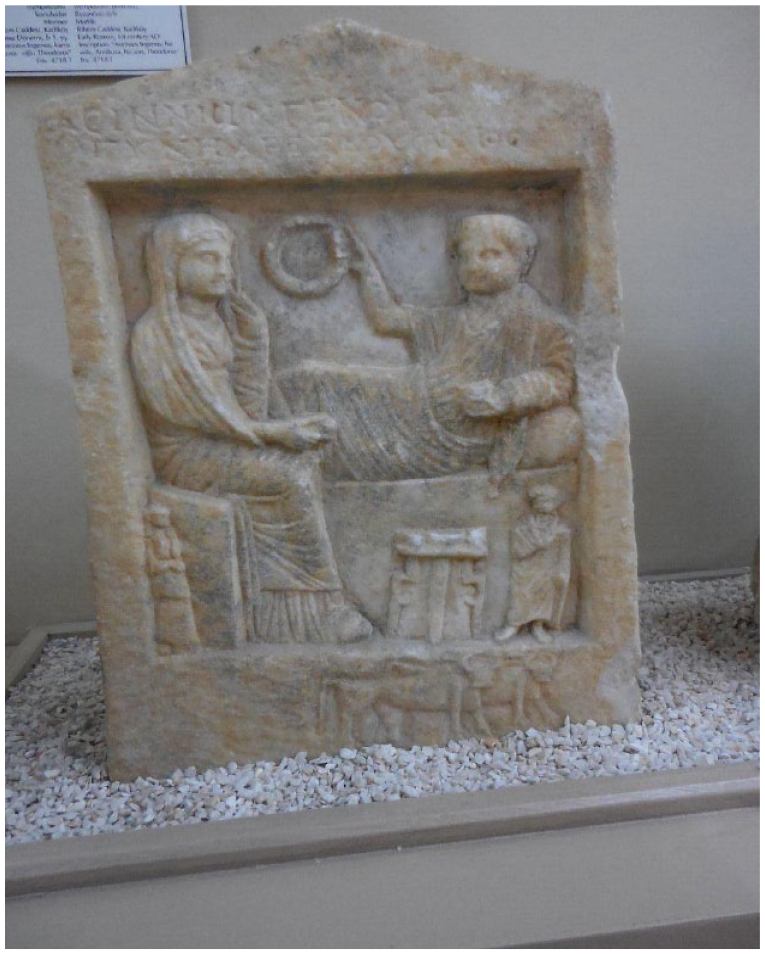
In the National Archaeological Museum in Istanbul, Turkey, an ancient funerary monument labeled ‘Family Tombstone’ is on display. 1 Carved in the first century CE, the inscription describes the family pictured: ‘Assinius Ingenus, his wife Areskusa, his son, Theodoros’. Depicted is a symposium scene, commonly found on ancient Roman gravestones that reminds the viewer of a funerary banquet held after death. The two larger figures pictured are Assinius Ingenus and his wife, Areskusa. However, two smaller figures carved at the bottom are representative of a technique called hierarchical scaling, used by the artist to depict figures viewed as less important. In the case of this gravestone, on the right side of the relief is a male figure. We believe this to be representing Assinius Ingenus’s son, Theodoros, a free person, because of the long flowing toga he is wearing, his bodily position, and his name mentioned in the inscription. Additionally, on the left lower corner of the monument there is a small female figure depicted, arms folded in grief. We believe this to be representative of an enslaved person, included on this funerary monument in order to enhance the reputation of the family who were enslavers.
Through this family tombstone, we see a number of notable features. There is a potential slippage between the depiction of free and enslaved persons, with the child Theodoros portrayed as the same size as the enslaved woman or girl. What sets Theodoros apart from the enslaved woman is his posture and dress. Additionally, we find an example of enslaved persons’ simultaneous hypervisibility and invisibility in the Roman Mediterranean: three people are named on the funerary monument, but four are depicted. Enslaved persons like the unnamed woman on this stele are central to the daily maintenance and social status of Roman familia, and yet are not given the full presence granted to free counterparts. The enslaved woman also lacks the artistic detail granted to the free members of the family, suggesting a lack of attention on the part of the stele’s commissioner and/or artist to the way that her visage would be memorialized. Much like how Seth Estrin (2023: 123) describes the depiction of an enslaved woman on the stele of Pheidylla from classical Athens, she is ‘almost assimilated into the monument’s frame … (the carving) of this other woman seems determined to make her eternally unrecognizable’. 2 Just as in ancient literary accounts, the enslaved woman portrayed on this funerary monument is less well defined and spatially marginalized compared to those who are free.
This archaeological example provides a starting point for this essay, which focuses on the language of slavery within New Testament and Early Christian Studies. In this monument, the enslaved person is practically invisible. She is aligned with the frame of the relief, carved as if she is leaning against it. She is not mentioned on the sign of the museum, nor is she represented within the inscription. She is intentionally portrayed smaller than the elite enslavers, representing the infantilization that was so common when ancient persons discussed enslaved workers. The enslaved woman, like many enslaved workers in antiquity, is used on this monument to exemplify the wealth, virtue, and power of the elite.
Enslaved persons were depicted as physically smaller than free persons in much of the art of the Hellenistic and Roman periods. Scholars of classical art have long debated how to securely identify depictions of enslaved persons, since ‘the criteria for identifying them as such have never been securely or consistently defined’ (Estrin 2023: 126). 3 Often, scholars have looked for characteristics like cropped hair for women, the act of holding or presenting objects to other figures, differences in dress/clothing or lack of clothing, ethnically distinct bodily features, or the size of artistic figures to hypothesize whether a particular figure is presented as enslaved. While there is no hermeneutical key for identifying enslaved persons in ancient art, size and posture tend to be two of the most agreed-upon indicators. Matthew Roller (2017: 26) coined the term hierarchical scaling to explain how enslaved persons are often depicted as physically smaller than their enslavers and other free persons, as well as are often shown on their feet and ready to work—in contrast to free persons lounging on a couch during banquet scenes on many ancient funerary monuments. 4 In her analysis of Greek representations of enslaved persons, Kelly Wrenhaven suggests not only that enslaved persons are depicted ‘as smaller than free persons’ as a somatic portrayal of their social status, but that other studies about children in ancient art have at times confused enslaved persons with children because of their comparable sizes (2011: 105–7). 5
Within ancient texts, language about enslavement mimics what we find in archaeological evidence and preserved artwork. Most literary references to enslaved persons are anonymized, invisible, and dehumanizing (Fitzgerald 2000; Joshel 2011; Bodel 2011). In the New Testament, enslaved persons are often included to add humor (Harrill 2000), metaphorically in parables (Glancy 2000; Smith 2017), or as a part of the household to control (Martin 1991). While ancient writers intentionally devalue the importance of enslaved persons, a number of biblical scholars have demonstrated the value of highlighting enslaved workers within texts and scholarship (Glancy, 2002, 2011; Aymer 2016; Shaner 2018; Cobb 2019; Bonar 2023; Williams 2023; Moss 2024). Further, scholars have interrogated issues of translation with regard to enslaved persons (Martin 1990; Parker 2021) and through language that refers to enslavers (McCaulley 2020). 6 Yet, there is not a clear scholarly consensus on how to write and teach about enslaved persons in antiquity. Using the work of previous scholars, this article offers a guide—an ethic—for scholars in biblical studies of how to translate and represent enslaved persons.
Like these scholars, we want to recognize the humanity of enslaved persons throughout history and value their importance to texts, history, and culture. How, then, should we translate words that represent enslavement and/or enslaved persons? 7 How do we ethically write about and describe enslavement within biblical texts when those texts are embedded in Greek and Roman cultures of enslavement? This article addresses these vital questions and proposes solutions for the translation and discussion of enslavement within antiquity.
In order to answer these questions, we will first turn to scholarship from scholars of slavery within the Atlantic World. This field of study is replete with scholars addressing these important questions and elevating the voices and experiences of enslaved persons from this era. Scholars such as Walter Johnson, Saidiya Hartman, and Marisa Fuentes provide theoretical and methodological foundations upon which we base our argument in this article. Then, we will provide a brief overview of the ways that scholars in classics and biblical studies are addressing agency and humanity in regards to ancient slavery. We then examine four Greek words—doulos/doulē, pais, paidiskē, and kurios—and outline the various ways that some major translations of the Bible (RSV, NRSV, ESV, and NRSVue) have translated these words, most of which minimize the effect of enslavement and reduce the agency of enslaved persons. We argue for agency-centered translations for each of these words such as enslaved worker, enslaved person, enslaved man/woman, and enslaver. This choice for the translator and scholar validates the humanity of enslaved persons in antiquity as well as more accurately describes the experience of enslavement, in line with previous scholarship in both biblical studies and Atlantic slavery studies (Martin 1990; Foreman et al., n.d.). We also incorporate two examples from material culture in the form of funerary monuments that include representations of enslaved persons on them. The addition of funerary monuments alongside our textual evidence provides material evidence of the dehumanization, infantilization, and invisibility of enslaved persons in antiquity. 8
Numerous scholars address these aspects of enslavement in antiquity. For example, Page duBois’s definition of an enslaved person illustrates this invisibility: The slave is a sort of uncanny object, standing at a blind spot of modernity where the place of the subject and that of the object intersect. The slave is a-topic, eccentric, out of place, unnervingly both ubiquitous and invisible. And as such, the slave can and should destabilize, undo, unnerve the certainties of our knowledges about the ancient world. The slave pops up to defy the idealization of antiquity which has defined modernity’s relationship to ancient Greece. (2003: 30)
The work of duBois has been foundational to the study of slavery in classics. 9 Within classics, several scholars are using language that resists centering the enslaver and values the humanity of enslaved persons (e.g., the ‘Introduction’ in Kamen and Marshall 2021: 12 n. 1). Similarly, the work of Jennifer Glancy (2002, 2010, 2011) has been invaluable within our own fields, New Testament and early Christianity. Recently, the work of Candida Moss has demonstrated the important contributions that enslaved workers made to the creation of our Bible itself (Moss 2024). 10 We have found, though, that there is not yet a consensus on the ways to write about or speak of enslaved persons in biblical texts; there is also not yet a guide for how to translate words and passages that include enslaved persons, especially within New Testament Studies.
To begin, we propose that language discussing enslaved persons should be focused on agency and humanity. In our discussion of language and agency below, we aim to acknowledge the various rationales that scholars offer for different approaches to ‘agency-centered’ language pertaining to enslavement (e.g., ‘enslaved persons’, ‘persons experiencing enslavement’, and so on). We advocate for a continued movement away from language that treats enslavement as the central identity marker by which to talk about enslaved persons (e.g., ‘slave’), and instead understand enslavement as a condition under which some people were continually subjected. For example, Daina Ramey Berry, a historian who studies slavery and gender, writes: ‘Referring to bondpeople as “enslaved” emphasizes the reality that enslavement was an action—a verb enacted on individual(s) rather than a noun, “slave”, that describes a social position these individuals presumably accepted’ (2012: xxi). Indeed, we see this as a more historically accurate and ethical way of describing the lives and experiences of enslaved persons, in comparison to what might be called ‘object-first’ or ‘enslaver-first’ language. We suggest that modern academic language ought to differ from the language that ancient enslavers used to describe enslaved persons, because we do not share enslavers’ goals for why and how we represent such people.
Finally, one caveat: While our objects of analyses in this article are depictions of enslaved persons in New Testament literature and on funerary monuments, we do not want to give the impression that such representations fail to correspond with some of the lived experiences of enslaved persons in the ancient Mediterranean. We state this because it has been posited in some cases that ‘fictional’ literature such as novels and plays portray only stereotypical or exaggerated portrayals of enslaved persons and not real persons. 11 Our own project is likewise attentive to the difficulty of reconstructing the lived experiences of enslaved persons from literary and artistic media. Accordingly, we focus heavily on how modern scholars might make the presence of enslaved persons more visible to other readers/viewers, as well as might make recognizable such persons as living under and within the conditions of enslavement.
Insights From Slavery Studies In The Atlantic World
As scholars trained primarily in biblical studies, we often turn to the work of colleagues who research slavery in the Atlantic World for theoretical and methodological tools that might help us better understand the lives of enslaved persons in the ancient Mediterranean. 12 The goal of such interdisciplinary reading is not to wholeheartedly borrow methods or to produce contrived comparisons, but rather to learn from this field which has a wealth of knowledge and sources about enslaved persons who were living in enslavement in our not too distant past. In particular, we aim to highlight two aspects of recent scholarship on slavery in the Atlantic World that we believe might continue to shape academic approaches to slavery in the New Testament and the ancient Mediterranean more broadly: agency and language. Theoretical interventions about these two topics complicate wholehearted application of modern liberal notions of freedom onto ancient historical actors, as well as advocate for more specific terminology that takes into account the experiences of enslaved persons.
Enslavement, Agency, and Autonomy
Scholarship on slavery in the Atlantic World has taken a particular interest in the difficulty of describing and delimiting agency among enslaved persons. Contemporary scholarship often reacts to the intervention that historian Walter Johnson offered in ‘On Agency’ (2003). In this brief article, Johnson argues that social historians have too quickly conflated an enslaved person’s agency with modern liberal notions of humanity, as well as to instances of resistance. In other words: One was only a human agent if one expressed free will within a modern liberal paradigm of what counts as ‘agency’—that is, through resistance, rebellion, and revolt.
13
As an alternative approach, Johnson argues that we need new models for understanding the concept of agency that detangle it from modern liberal notions of freedom/autonomy and humanity: For enslaved people the most basic features of their lives—feeling hungry, cold, tired, needing to go to the bathroom—revealed the extent to which even the bare life sensations of their physical bodies were sedimented with their enslavement. So, too, with sadness and humor and love and fear. And yet those things were never reducible to simple features of slavery. They cannot simply be reformatted as resistance in a liberatory gesture which paradoxically reduces even the most intimate actions of human beings to (resistant) features of the system that enslaved them. (2003: 115–16)
Johnson notes that his goal is not to de-romanticize enslaved persons’ acts of resistance, but to recognize and more fully account for how enslaved persons were human beings whose actions, agency, and lifeways extended beyond resistance and beyond their enslavers’ often-limited notions of the human.
A good example of this challenge to Western liberal notions of agency can be seen in Marisa Fuentes’s Dispossessed Lives: Enslaved Women, Violence, and the Archive. Fuentes centers the experiences of enslaved women in her historical analysis of slavery in Bridgetown, Barbados. An example of this centering is her narration of the life of Rachael Pringle Polgreen, an 18th-century formerly enslaved Afro-Caribbean woman and brothel owner in Bridgetown, Barbados (Fuentes 2016: 46–69). She interrogates how an enslaved woman could, post-manumission, end up enslaving other African and Afro-Caribbean women in ways that perpetuated sexual violence and fail to demonstrate ‘agency’ vis-à-vis resistance. Rachael’s ‘success’ comes not from escaping the system of enslavement, but by being ensconced in it and navigating it for her own survival. As Fuentes puts it: ‘If “freedom” meant being free from bondage but not from social, economic, and political degradation, what did it mean to survive under such conditions? … Their core experiences, shaped by sexual violence and impossible choices, are not fully elucidated by progressive notions of agency’ (2016: 49, 69).
Biblical scholars may continue to learn from and participate in such conversations regarding the limits and cultural specificity of our own notions of agency, freedom, autonomy, and humanity. Such scholarship urges not only considering the ‘small’ acts of resistance to enslavers (e.g., self-emancipation through flight, refusal to work, sabotage of equipment), but to explore more robustly how enslaved persons survived and navigated a world shaped so profoundly by the practices and logics of enslavement in ways that we might not classify as ‘resistance’ (McKeown 2019; Hunt 2021).
In addition to agency and autonomy, another scholar of slavery in the Atlantic World, Saidiya Hartman, offers a strategy of reading texts against the grain. This is a strategy already familiar to the world of biblical studies, but Hartman specifically applies this strategy to texts about enslavement. In Hartman’s own context, the texts which she analyzes represent ‘hierarchical relations between mostly white interviewers and black interviewees’ (2022: 10). Because of this, Hartman notes that her method when writing about such sources is to both expose the violence of slavery represented in these texts and also reclaim the stories of enslaved persons. She writes: ‘I have tried to read them against the grain in order to write a different account of the past, while realizing the limits imposed by employing these sources, the impossibility of fully recovering the experience of the enslaved and the emancipated, and the risk of reinforcing the authority of these documents even as I try to use them for contrary purposes’ (2022: 10–11). This quote is especially useful to our project as ancient sources are written in similar ways; enslavement is also aligned with violence and most of our texts are written from the perspective of the enslaver. Like Hartman, we want to expose the violence of the language of slavery while also attempting to recover the experiences of enslaved persons that are represented within ancient texts.
Language and Terminology of Enslavement
Along with discussion of slavery and agency, scholars of slavery in the Atlantic World have taken particular interest in the language and terminology pertaining to enslavement. Perhaps the most accessible discussion is P. Gabrielle Foreman’s compiled ‘Writing About “Slavery”? This Might Help’ (n.d.), which brings together lingual and translational suggestions from ‘senior slavery scholars of color’ in an attempt to complicate received and popular terminology. Such scholars suggest language that highlights the power imbalance between enslaved persons and enslavers, as well as urge against using terminology that presumes the legality or normalcy of enslaving humans (e.g., master/mistress, owner) and that implicitly critique the actions of enslaved persons from the enslaver’s point of view (e.g., runaway). This community-sourced document guides our approach to language of slavery in the New Testament and ancient Mediterranean world, in which we also seek to avoid translating in ways that normalize ancient enslavers’ underlying presumptions about enslaved persons or their legal/natural right to enslave.
Calls by scholars of slavery in the Atlantic World have been answered by United States governmental entities in an attempt to account for subject-centered approaches to enslaved persons. For example, the Underground Railroad webpage run by the National Park Service contains a ‘Language of Slavery’ section dedicated to explaining and clarifying what language is recommended regarding enslavement today. Last updated in January 2022, the NPS recommends language of enslaved person rather than slave to emphasize ‘the humanity of an individual within a slaveholding society over their condition of involuntary servitude’ (2022: n.p.), in addition to serving as a more descriptive term of the ongoing conditions that kept a person enslaved. The National Archives and Records Administration (NARA), similarly, encourages use of enslaved person and enslaver based on an understanding that archivists and historians have ‘a responsibility to repair inequities through our archival descriptive practices’ (2023: n.p.). Importantly, NARA lists a range of principles by which this descriptive work takes place, including seeking input and collaboration from marginalized people and colleagues, as well as recognizing that reparative description is ‘an ongoing, iterative process, not a one-time project’ (2023: n.p.). More scholars of the Bible and early Christianity ought, we suggest, to follow suit through more thorough self-examination and self-critique of the terminology we (both individually and as a field) use to describe enslaved persons in our scholarship.
Of course, not all scholars agree on the best approach to (re)considering our terminology (Burns 2023). For example, scholar of Black literature and Atlantic slavery Nicholas Rinehart (2022) has argued that other scholars have not yet deeply examined their calls for ‘reparative semantics’—particularly regarding whether the shift from slave to enslaved person actually does any work in restoring humanity or personhood to the enslaved. 14 Much like how historian Walter Johnson has critiqued the notion that ‘the task of the social historian is to “give the slaves back their agency”’ (2003: 114) in a manner that assuages white guilt instead of more deeply investigating notions of agency, Rinehart worries that scholars (of the Atlantic World in particular) have rushed to shift terminology without considering how enslavers depended upon the humanity of enslaved persons to exploit them. As Rinehart puts it, such work puts the historian ‘in an almost heroic position’ (2022: n.p.) of recovering personhood and giving it back to historical figures who had been enslaved, rather than recognizing that their humanity was already there and was assumed as such by enslavers. 15
We recognize the force of Rinehart’s critique and the importance of offering historically-contextualized and self-critical justifications for the terminology we use. Additionally, Rinehart’s critique of reparative semantics emerges from the assumptions of research on slavery in the Atlantic World—particularly the widespread characterization of enslaved people as non-human or needing to be re-humanized. 16 His point holds for the study of the ancient Mediterranean as well: enslaved persons were conceptualized by enslavers as objects and humans, often simultaneously or to varying degrees depending on the rhetorical goal(s) of the writer. 17 The category of humanity could be selectively applied or removed by enslavers depending on their rhetorical, legal, or cultural goals. We do not wish to treat language of objectification, commodification, or dehumanization as antithetical or contradictory to the ever-present humanity of enslaved persons. Rather, we want to highlight that our main concern is how translational decisions often work to erase or euphemize the status or condition of enslavement experienced by millions of ancient Mediterranean persons.
Additionally, we want to recognize that not all scholars agree on how much one should impose modern terminological choices wholeheartedly on ancient texts, or if one should use them exclusively in academic discussion of those texts. For example, this could manifest as using the term slave when translating a Greek or Latin text, but enslaved person when writing about enslaved persons. Such a choice often works to highlight the horrific treatment of enslaved persons by particular authors or writers, while distinguishing the scholar from these logics. We find this approach helpful, but ultimately agree with feminist biblical scholar Tina Pippin that ‘focus on gender, race and class takes the translation act out of the scientific and technical realm: translation affects real human lives … the translator has an ethical responsibility to what she is making accessible’ 1998: 167). 18 We suggest that it is still possible to highlight the atrocious actions, logics, and discourses perpetuated by enslavers in any historical time period while simultaneously attending to the terminological representation of those affected by slavery, its afterlives, and its continuance in the 21st century.
Lingual and Material Characterizations Of Enslavement
Having discussed how scholarship on slavery in the Atlantic World already does and might continue to shape our approach to ancient Mediterranean slavery, we now turn to Greek terminology, biblical translations, and contemporaneous material culture. Our goals in this section include: (1) demonstrating how recent biblical translations reveal a move toward ‘agency-centered’ language but have important caveats or hesitancies against applying this approach universally, and (2) exploring how funerary monuments reveal the pervasiveness of ancient Mediterranean assumptions about enslaved agency and representation in both literary and material contexts.
To limit our discussion, we want to focus on three Greek terms used to denote enslaved persons: δοῦλος/δούλη (doulos/doulē), παιδίσκη (paidiskē), and παῖς (pais). Each of these terms has a complex range of translational options and historical debate regarding their meaning. Our goal is to elucidate how attention to language, agency and its limits, and gender might impact the way that these terms are translated and New Testament narratives are treated. Finally, we focus on κύριος (kurios), the word often used in the New Testament to indicate an enslaver but one that could also mean Lord. For each of these examples, we suggest leaning into agency-centered language such as enslaved person and enslaver. Similarly, Kostas Vlassopoulos suggests this in his discussion of agency with regard to ancient slavery. He writes, ‘I have employed the term enslaved persons in order to capture these disjunctures and gaps and avoid reducing slaves to a single and monolithic slave identity’ (2021: 191). In addition to this reduction of the enslaved experience, we want to remind the reader of the very real experience of enslavement, even when texts are discussing metaphorical slavery. Further, we want to resist the dehumanizing and infantilizing language used in ancient texts to refer to enslaved persons.
Δοῦλος/Δούλη
Δοῦλος/Δούλη (doulos/doulē) is the most common term for an enslaved person in the New Testament and early Christian literature. Nevertheless, this term carries plenty of translational and interpretative baggage. Nineteenth-century abolitionist writers in the United States, in an effort to combat pro-slavery claims that biblical history or language could be used as a justification for enslavement, often argued that δοῦλος referred to (indentured) servants or forms of labor other than chattel slavery (Bourne 1845; Brisbane 1851; Barnes 1857: 64–70; Noll 2006). The abolitionist argument persisted in biblical translations well into the 20th (and 21st) century, until scholarship on ancient slavery that demonstrated the harshness of enslavement in the Roman world became more widely accepted. Consequently, womanist biblical scholar Clarice Martin (1990) made a convincing argument that the Greek term δοῦλος should be translated as ‘slave’ instead of the more typically used ‘servant’. Prior to Martin’s work, there was a conversation occurring about the use of the word ‘slave’ in the biblical texts, especially considering the legacy of slavery in the Americas. She asks: ‘Would it not be better, people ask, to translate doulos regularly as the more euphemistic “servant”? This writer personally responds with a resounding No!’ (1990: 45). In light of her own positionality as a Black woman in the United States, Martin argues that: For the womanist theologian and biblical interpreter whose experience of oppression includes the intrinsically linked aspects of gender, race, and class, critical analyses of patriarchal assumptions and paradigms in both the ancient and modern worlds must include a focus on all historically marginalized persons, women and men, who have been victimized by patriarchal dominance (1990: 53).
19
Accordingly, recent New Testament translations have begun the work of making enslaved persons more visible in the text through translational choices that foreground them. The choice to translate doulos as slave rather than servant often creates a clearer association between the forms of bondage experienced by some inhabitants of the Roman world with forms of bondage more familiar to 21st-century readers in the aftermath of slavery in the Atlantic world.
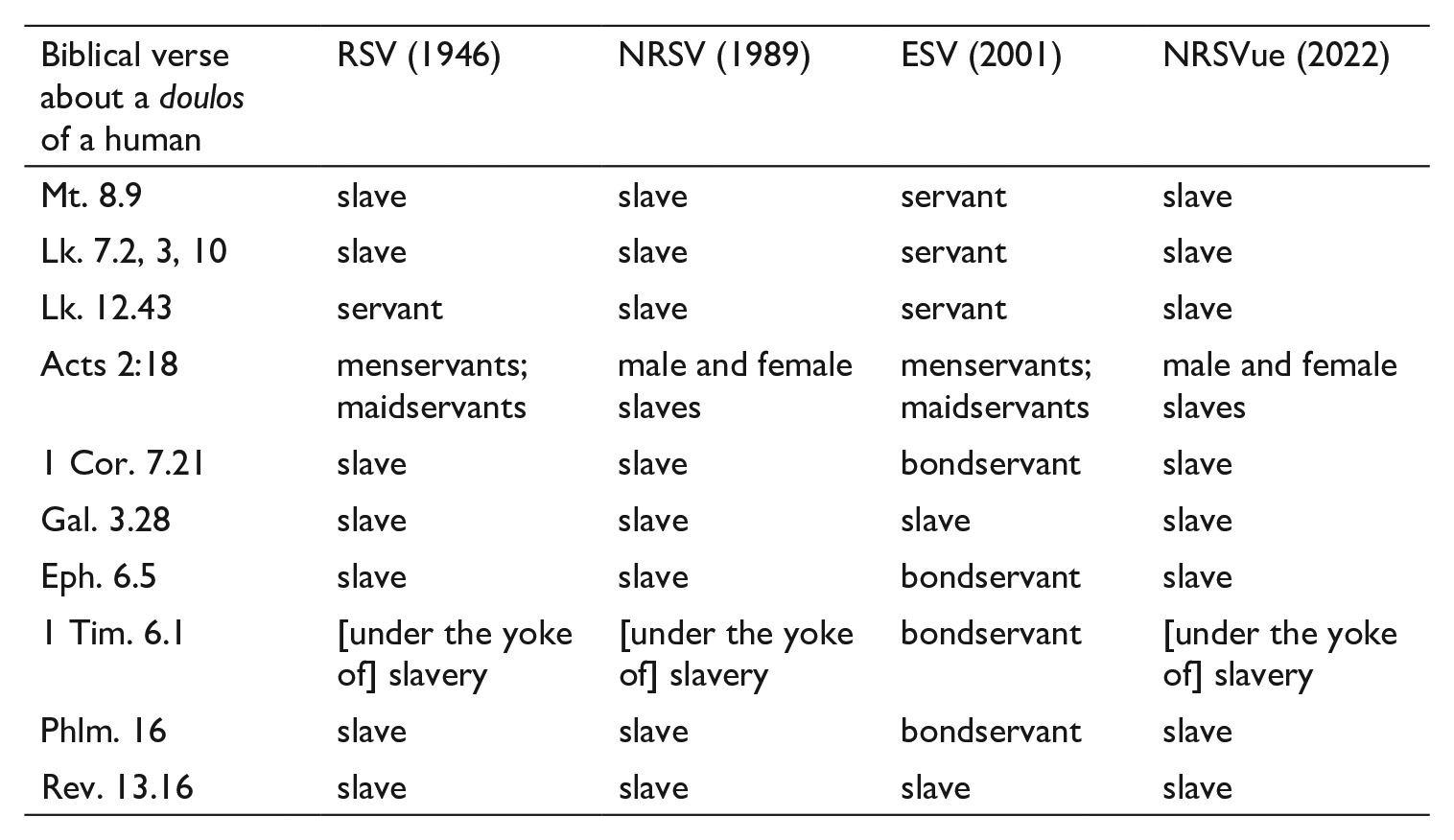
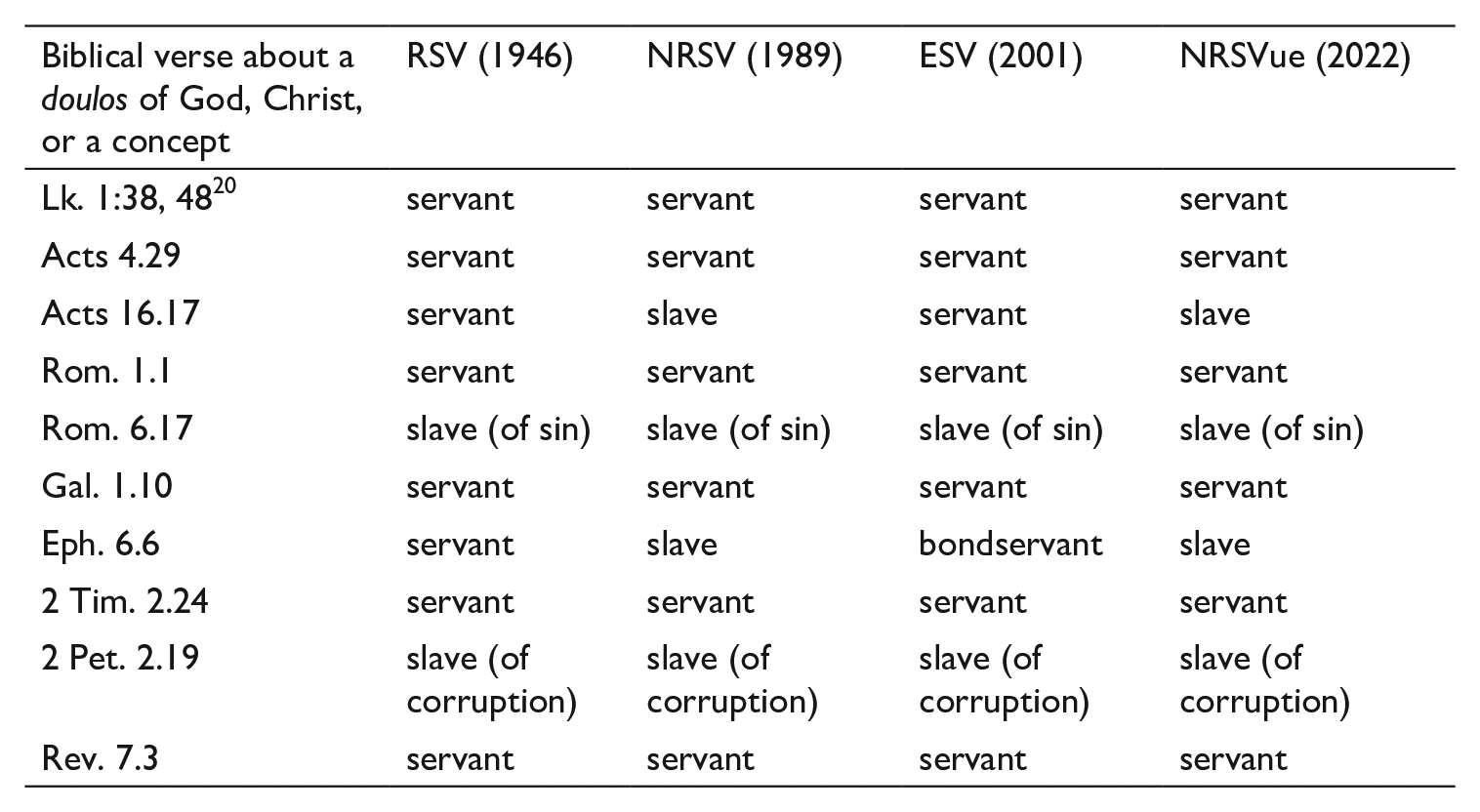
Nevertheless, translations of doulos are often context-specific and occasionally work to obscure the logics of enslavement beyond particular verses. This is perhaps most notable in how many contemporary English translations differentiate between a doulos enslaved to a human and a doulos enslaved to God, Christ, or a concept like sin or corruption: the former is often a slave and the latter a servant. Through a comparison of one strand of Bible translations—the Revised Standard Versions and its successors (the New Revised Standard Version, English Standard Version, and New Revised Standard Version updated edition), we see some translational shifts from the mid-20th century to 2022. Whether in reference to a doulos of a human or non-human, translations in these versions used heavily by biblical scholars have moved from servant to slave over time to varying degrees.
There are three notes to make here. The first is that, as Samuel Perry rightly argues (2021: 625–32), printings of the ESV between 2001 and 2016 have euphemized the condition of enslavement through language of bondservant(s) and servant(s), often reversing translational decisions of the NRSV and RSV in ways that may work to obscure enslaved persons in the text. The second is that there are different rates of transition from servant to slave: translators are quicker to reconceptualize a doulos as a slave for Anglophone readers in verses where their enslavement is to humans rather than to God, Christ, sin, or corruption. Here, we see an implicit divide between ‘real’ and ‘metaphorical/spiritual’ slavery that some recent scholarship in early Christian studies has critiqued (de Wet 2018; Bonar 2023). Third, we see a translational distinction made between being a doulos of God/Christ or a doulos of malevolent spiritual forces, like sin (Rom. 6.17) or corruption (2 Pet. 2.19). The translation of the former as servant and the latter as slave may suggest to Anglophone readers a qualitative (and theological) difference between these two forms of bondage: to be a doulos of God is deemed mere servitude, whereas to be a doulos of corruption is enslavement. The former allows for the interpretative possibility that such servitude is voluntary or less harsh than chattel slavery, whereas the latter retains the conceptual baggage of involuntary chattel slavery.
Παῖς 20
Pais is an important word to discuss in the context of slavery in antiquity as it can mean child or it could be used to indicate an enslaved person, regardless of age. Thus, the translator must consider the context in which the word is used to determine the meaning, especially as related to status. But there are a few things in common between children and enslaved persons, as Mark Golden points out. For example, both children and enslaved persons were susceptible to corporal punishment and many would experience it regularly (1985: 101). Golden, in his analysis on the word, notes the similarities between the word pais and the word for strike, or to beat, paideuō. As he writes, ‘I do not mean that pais came to mean “slave” because it resembled a word for “strike”. But the coincidence was noticed, and was telling enough to be used on the popular stage’ (1985: 103–4).
Pais, translated as child, also indicates the lower social status that was often ascribed to children in antiquity; children were also often referred to using diminutive language. This is exemplified through the funerary monument in the opening section of this article. On the monument, Theodorus is named in the inscription as the free son of the deceased, yet he is depicted in the familiar hierarchical scaling technique, indicating his reduced status. Yet, this pais is standing tall, dressed in elite clothes, and staring at the viewer. This is in contrast to the enslaved female figure who is portrayed on the left side of the monument, also a pais but clearly enslaved due to her clothes and stature. Thus, the funerary monument exemplifies the slippage that occurs between enslaved persons and children in antiquity, found both in archaeological data and in literary texts.
Used to indicate an enslaved person, pais is diminutive and reveals the dehumanization of enslaved persons which is inherent even in the language and also evident in archaeological data. As Rachel Zelnick-Abramovitz writes: ‘Slaves were often called pais (“boy”/“girl”) and its diminutives paidon, paidarion and paidiskē. These words express paternalistic views of slaves and their equivalence to minors in the family, but the slaves thus described are not necessarily children’ (2018). When considering the work of scholars of slavery in the Atlantic World, it is clear that a similar form of diminutive language is used in both eras. For example, white enslavers from the American south often referred to enslaved men, regardless of age, as boy (Dean 2000). Writers in antiquity used similar dehumanizing language in their use of pais. Just as pais can refer to a boy or an enslaved person, the slippage between enslaved person and child affects the diminutive depiction of enslaved persons in ancient art; both are conceptualized as existing in a subordinate position within the enslaver’s familia. 21
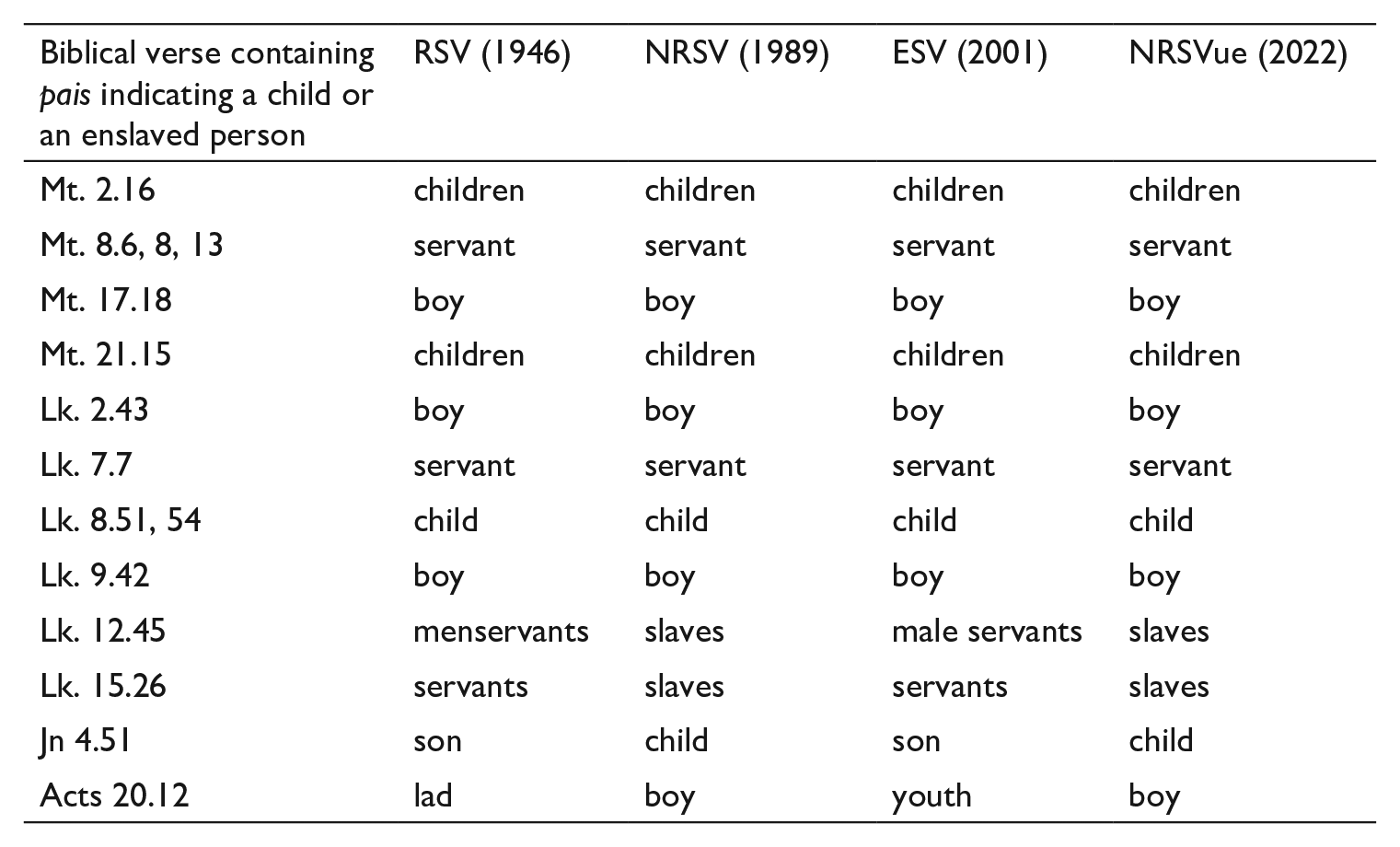
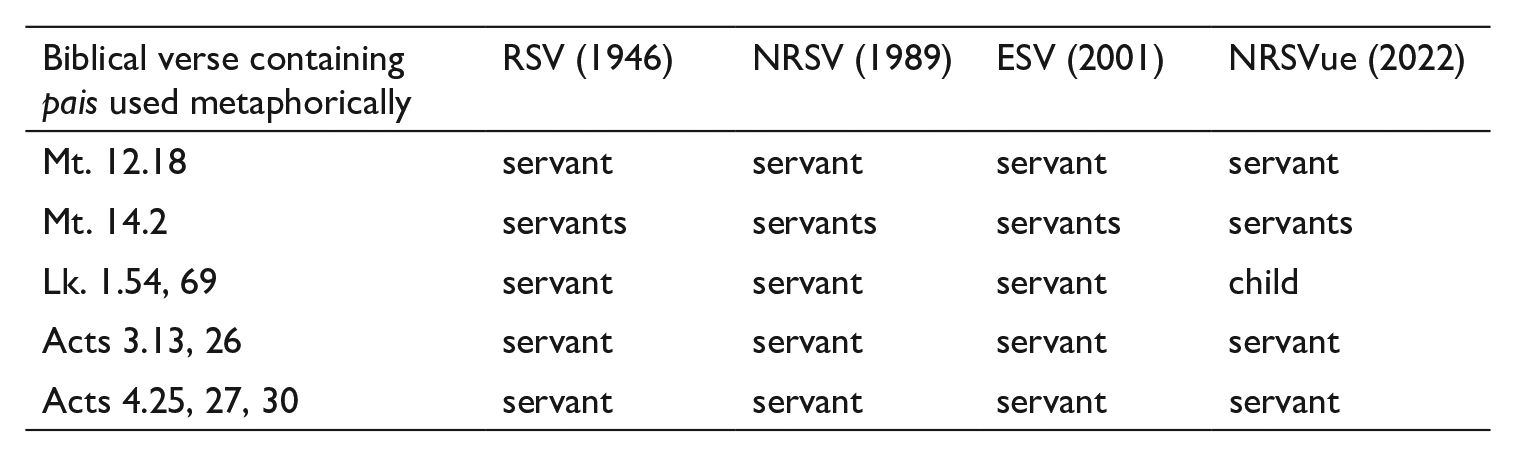
In the New Testament, several passages that include the word pais clearly refer to an enslaved person. For example, consider the story of the centurion—found in both Matthew and Luke—who comes to Jesus in order to find healing for his pais (Mt. 8.5–13; Lk. 7.1–10). The centurion, who would have been a recognized figure of wealth and status, asks for Jesus to heal his pais, which could mean either the centurion’s child or his enslaved worker. In Matthew’s version, the person being healed is always referred to as pais (vs. 6, 8, 13). However, in Luke’s version of this story the healed person is only designated as a pais one time (Lk. 7.7); in the rest of the story this person is designated as a doulos (vs. 2, 3, 10). Thus, it is often concluded that the person healed is the centurion’s enslaved worker. This story illustrates the slippage between doulos and pais in the ancient world (Zeichmann 2022). Moreover, as the chart below indicates, translators chose ‘servant’ for the translation of pais in this healing story in both Matthew and Luke, while choosing ‘slave’ for the verses that designate this same character as a doulos in Luke.
Similar to doulos, pais could refer to a person who is viewed as metaphorically enslaved to God; in these cases most translators choose to translate pais as ‘servant’ instead of ‘boy’, ‘child’, ‘slave’, or ‘enslaved’, as is clear in the chart below. In our view, the use of ‘servant’ softens the meaning and does not accurately reflect enslavement in antiquity (Martin 1990). Even when used metaphorically, enslaved persons who read or heard these texts would be able to recognize the realities of slavery within the metaphor. The below chart illustrates the consistency with which pais is disconnected to slavery in modern translations of the New Testament.
Ultimately, we suggest that when the word pais is found in the New Testament, the translator should carefully consider if this passage is indicating an enslaved person or a child. Usually, through context, it is clear as shown above in the healing of the centurion’s enslaved worker. If evidence of slavery is found, translators should translate pais as ‘enslaved worker/person’. For metaphorical use of pais, we also suggest leaning into the language of enslavement to represent the world in which these texts were written which was a culture infiltrated by slavery.
Παιδίσκη
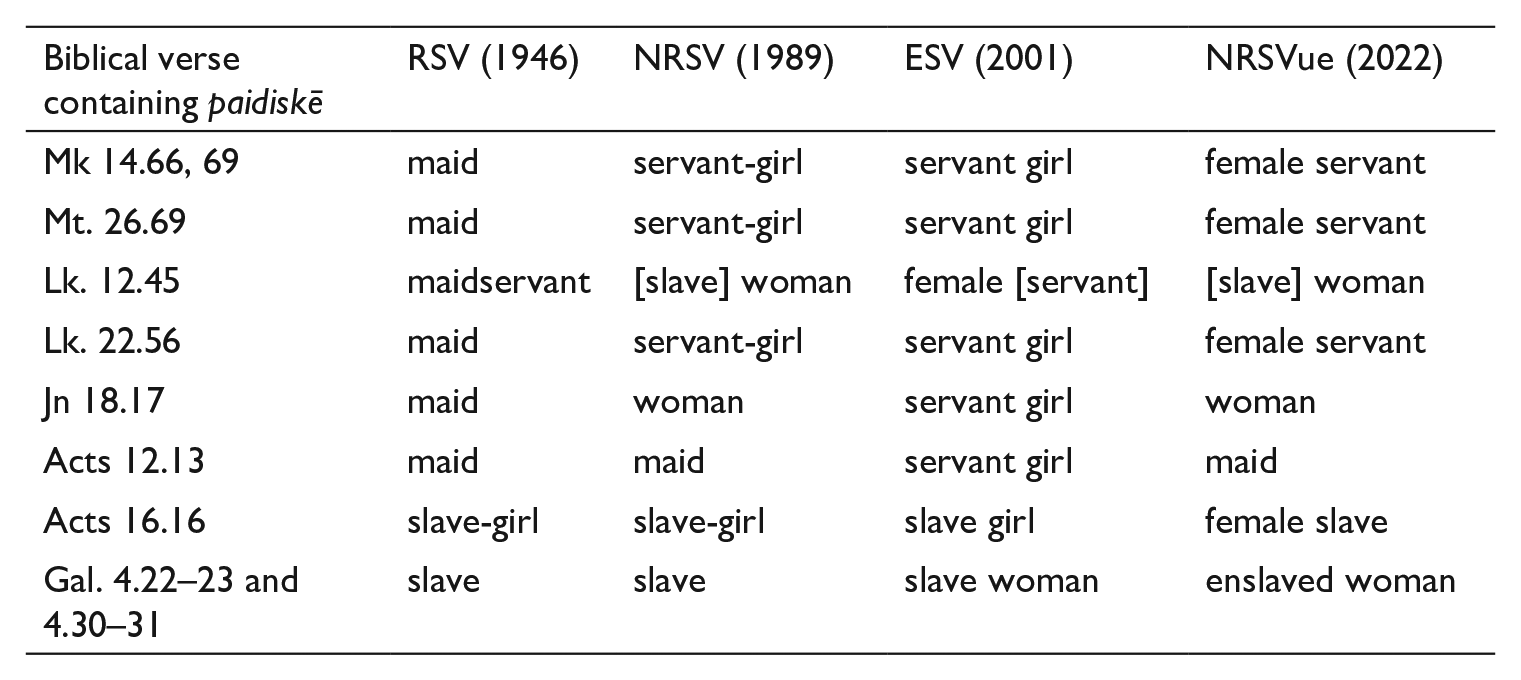
The NRSVue is also a helpful starting point to explore how enslaved women are characterized or euphemized through translational decisions. The term παιδίσκη (paidiskē)—a diminutive form of παῖς (pais)—refers to young female children and enslaved women of any age. Enslaved women were marginalized within the Roman world due to their gender; the infantilization inherent within the word paidiskē reveals the invisibility and mistreatment of enslaved women in antiquity. 22 NRSVue translators took a range of translational and interpretative approaches to the term. Some, for example, made clear that the women being discussed are enslaved. In Acts 16, the enslaved woman with a divinatory spirit who confronts Paul and Silas is called a ‘female slave’ (16.16); one of Jesus’s parables describes an unfaithful enslaved manager beating ‘the other slaves, men and women’ (Lk. 12.45) while the enslaver is absent; Paul’s allegory of Hagar and Sarah describes how Jesus-adherents are not children of the ‘enslaved woman’ (Gal. 4.22–23, 30–31). There is a critical distance and narrative dichotomy between the protagonists and the enslaved women depicted in these cases, which we believe makes it easier for translators to treat paidiskē more explicitly as enslaved (Cobb 2024). Paul and Silas are depicted as ‘slaves of the Most High God’ (Acts 16.17) in contrast to the enslaved woman who was possessed by a spirit and laboring for her enslavers as a fortune-teller, while Paul’s allegory in Galatians contrasts Sarah and Hagar to make an argument about the relationship between flesh and spirit (Valentine 2018). Labeling enslaved women as enslaved seems to come easier when a contrast is made with other enslaved or free persons.
However, this translational choice is not always the case for the NRSVue. The enslaved woman (or women) who confront Peter in the courtyard of the high priest during Jesus’s trial in the Synoptic gospels is described as a ‘female servant’ (Mk 14.66, 69; Mt. 26.60; Lk. 22.56), yet the paidiskē who functions as a gatekeeper in John’s account of this narrative is merely translated as a ‘woman’. Perhaps most glaringly, the paidiskē doorkeeper Rhoda—who is enslaved to Mary and answers the door when Peter escapes from prison and comes to Mary’s house—is described as a ‘maid’ (Acts 12.13; cf. Aymer 2016).
Generally, we see a move away from diminutive or infantilizing language that presumes that the enslaved woman is a girl. Alongside Samuel Perry’s important critiques mentioned above (2021: 625–32), the ESV moves one step closer than the NRSVue to recognizing that the enslaved doorkeeper in John 18 and Rhoda in Acts 12 do, in fact, experience enslavement. Nevertheless, women like Rhoda continually have their condition and experience of enslavement euphemized or disguised in ways that suggest a discomfort with explicitly admitting that early Jesus-adherents enslaved people.
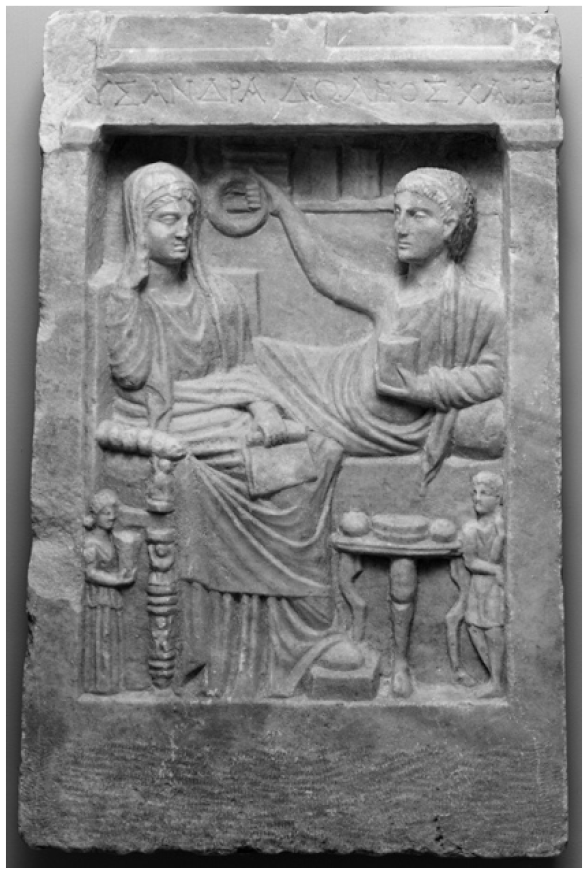
Just as the words pais and paidiskē reveal the marginalization and dehumanization that enslaved persons experienced in antiquity, this can also be seen through artistic depictions. For example, consider the below funerary Monument for an elite woman named Lysandra from the 1st century BCE or 1st century CE. 23 Featured on the monument is the deceased elite woman, Lysandra, alongside her husband. The two are pictured in a symposium scene, with food and wine around them. In the lower right corner, we find an enslaved male figure, depicted significantly smaller than the two elite figures. He is wearing a chiton and is portrayed in a stance of grief with his hand touching his face. Opposite him is a small enslaved female figure who is carrying a basket in her hands. Both enslaved figures are smaller due to hierarchical scaling, mentioned above. Relating to the current section, these two enslaved figures might be called a pais and a paidiskē. Their diminutive size is exaggerated in this monument, as they are both barely taller than the table and almost disappear into the corners of the frieze.
Κύριος
Along with terms for enslaved persons are terms used to identify enslavers. Most prominent are Greek terms like κύριος (kurios) and δεσποτής (despotēs), which are often translated as Lord/lord or Master/master in New Testament literature, depending on whether a human or divine being has the term applied to them. These two terms have a range of possible meanings, ranging from referring to political leadership to functioning as a title of difference comparable to sir. At the same time, contemporaneous texts like Julius Pollux’s 2nd-century CE thesaurus, the Onomasticon (3.73–83), demonstrate that kurios and despotēs were part of a larger web of terms associated with enslavement during the composition of New Testament texts. We would suggest that in historical and literary contexts in which enslavement is central, translations such as enslaver more explicitly help English readers understand the role of extreme power imbalance between a kurios and a doulos. Translations such as Lord/lord, at least in the Anglophone world, have the capacity to mask how the contextual residue of enslavement sticks to the term even when—or perhaps especially when—applied to figures like God or Jesus. As both Chris de Wet (2018) and Chance Bonar (2023) have argued, enslavement to God is an important aspect of early Christian literature and history that shaped Christian subjectivity, ethics, and notions of relationship with God.
To provide a New Testament example: Matthew 24.36–51 contains two brief stories from Jesus, one about the necessity of watching for the coming of the Son of Man, and a parable about a disloyal enslaved person. In the former, Jesus warns that no one but the Father knows when the Son will come, and accordingly his disciples need to ‘keep aware, therefore, for you do not know on what day your Lord (kurios) is coming’ (Mt. 24.42, NRSVue). A few verses later, Jesus tells a story about two enslaved persons, in which one is rewarded for loyally and efficiently tending to the household during his enslaver’s absence and the other is dismembered for beating other enslaved persons during the enslaver’s delayed arrival, since ‘the master (kurios) of that slave will come on a day when he does not expect him and at an hour that he does not know’ (Mt. 24.50, NRSVue). Both of Jesus’s narratives use the same Greek term, but are treated differently by the NRSVue translation when applied to the Son of Man and the parabolic enslaver. Consequently, readers who do not know Greek might miss the lexical relationship between the two: both are conceptualized as absentee enslavers with the power to reward or punish their enslaved persons upon their return (Smith 2017).
It is worth noting that the term enslaver is still debated among scholars of slavery. Enslaver better captures the constant and processual enslavement of humans done by those who purchased and exploited enslaved persons, unlike the term master that accepts the premise of the enslaver’s claim to mastery over enslaved persons. 24 There is also a case to make, however, that enslaver functions as a synonym of trafficker or slave-trader in some instances, and refers to those who are actively involved in the process of kidnapping and trafficking humans (Bodel 2005). In these cases, we suggest that the translator/scholar be clear if the kurios is a trafficker and distinguish that from the large number of ancient persons who were enslavers, that is, they enslaved other humans to work in their homes, businesses, or organizations.
Conclusion
In this article, we have carefully shown that ancient texts and artifacts represent enslaved persons in ways that are dehumanizing and infantilizing. Further, these texts and artifacts marginalize enslaved persons through object-focused language and tactics such as hierarchical scaling. In the field of New Testament Studies, a number of scholars as well as popular versions of the Bible (RSV, ESV, NRSV, and NRSVue) have followed this trend and continue to use object/enslaver-focused language when translating and writing about enslaved persons; this furthers the dehumanization of enslaved persons and perpetuates harmful ideas about enslaved persons, both in antiquity and today. As a number of scholars have shown, ancient ideas about slavery continue to persist in our contemporary society (duBois 2010; Glancy 2011; Cobb 2024). For these reasons, we suggest following the examples from scholars writing about slavery in the Atlantic World who argue that using agency-centered language is the most ethical way to write and teach about slavery. In response, we want to suggest the following for all scholars writing about the New Testament and early Christianity, regardless if their writing or work focuses on topics related to slavery:
1) Scholars and translators use agency-centered language when writing or speaking about an enslaved person, character, or figure. Thus, doulos/doulē should be translated as enslaved person or enslaved worker. For words such as pais and paidiskē, we suggest that writers read the context closely to determine if the word is in reference to an enslaved person or a child. If it is clearly an enslaved worker (such as Rhoda, the doorkeeper in Acts 12), the translation should lean into agency-centered language when possible (i.e., enslaved woman, enslaved man, enslaved worker/person).
2) Scholars also use agency-centered language when writing or speaking about a person who enslaves other people. The words kurios can mean both enslaver and Lord; the power dynamics of enslavement are a part of the meaning of these words. Thus, scholars/translators should consider the passage and context and translate kurios and despotēs as enslaver when appropriate; we discourage translations such as master, mistress, slave owner, and slave holder, as these are object-focused words that suggest and reify the idea that an enslaved person can be ‘owned’ by another person. For this reason, we argue for the use of enslaver and note that even when kurios is used for a deity that ancient persons would have recognized the relationship as one that incorporates slavery.
3) Scholars and translators use agency-centered language when writing about metaphors, analogies, and parables that include reference to enslaved persons. For example, when Paul uses the language ‘δοῦλοι Χριστοῦ Ἰησοῦ’ (Phil. 1.1) we suggest this be translated ‘enslaved to Christ Jesus’ or ‘enslaved persons of Christ Jesus’. Similarly, in parables or other metaphorical references to enslaved persons, we suggest that the scholar/translator use language that acknowledges the realities of ancient slavery that shape the writer’s decision to describe a given relationship as one of enslavement.
In conclusion, this article has provided justification and suggestions for scholars in New Testament and early Christian Studies to incorporate agency-centered language in translations and discussions of ancient texts. We also urge scholars to follow the examples set by a number of colleagues in our field and highlight enslaved persons within texts and acknowledge the harsh reality of ancient slavery in scholarship and teaching. This is important not only for scholars who focus on slavery, but for all scholars, as slavery permeated the ancient world and is present within biblical texts whether directly or indirectly. To return to the opening funerary monument depicting ‘Assinius Ingenus, his wife Areskusa, his son, Theodoros’, we are reminded of the fourth person represented on this monument but who is not named in the inscription. Thus, we revise the description of this monument—as we suggest with texts—to read: ‘Assinius Ingenus, his wife Areskusa, his son, Theodoros [and an enslaved worker]’. Given the erasure and minimization of enslaved persons in ancient literature and artistic depictions, scholars have the opportunity to shine light on narrative gaps, translational choices, and writers’/artists’ foci in light of the field of slavery studies.
Footnotes
1.
Inv. 4718 T, Istanbul Archaeological Museum, Turkey. Photo by Christy Cobb 2015.
2.
Estrin here discusses the early fourth century BCE funerary stele of Pheidylla (Ephorate of Antiquities, Academy of Plato, Athens, M 672), but the description is apt for our first century CE stele as well.
3.
See Estrin 2023: 123–54 more broadly on the depiction of enslaved persons. See also  : 81 on a trend of squatting/sitting enslaved persons in classical and Hellenistic Greek pottery, as well as his claim that representations of nude or fettered persons in classical art likely represents enslavement.
4.
See also Shaner 2018: 73–86, esp. 85 on the common erasure of enslaved persons in ancient art history through the presumption that those depicted on funerary monuments are free. Similarly, see ; Joshel and Petersen 2014 on the architectural and spatial invisibility of Roman enslaved persons.
6.
7.
On the history of European translations of terminology referring to enslaved persons in the Bible, particularly in Norwegian and Dutch contexts, see Martinsen 2018; .
8.
For the value and importance of using material culture in biblical studies, classics, and the study of ancient slavery see: Johnson-DeBaufre 2010; Joshel and Peterson 2014; .
9.
For other work by duBois that informs our study of slavery in antiquity, see DuBois 1991, 2010, .
10.
11.
See the conversation between Glancy 2007 and .
12.
For example, see the recent review of Harrison 2021 by .
13.
15.
See also on the assumption made in Atlantic history that commodification results in or is intertwined with dehumanization. As above, Rinehart calls for more robust descriptions of the processes of commodification and questions what theoretical approaches make this description legible in the modern academy.
16.
On debates over the category of the human, particularly in relation to Blackness and the legacies of enslavement, see Wynter 2003; .
17.
19.
See also Parker 2021: 64–74, who builds especially upon Pippin 1998 and in her discussion of the importance of ‘embrac[ing] the cultural boundedness of the bible text and of the people I preach to and teach’ (66). Translation and interpretation not only are influenced by one’s positionality, but also make one accountable to one’s communities and can function as a form of activism.
20.
There have been recent arguments made that Mary’s status as a doulē refers to her legal enslaved status (Smith 2021, building upon ). We, however, tend to understand this passage as referring to Mary’s status as God’s enslaved person, and thus categorize it accordingly.
21.
22.
For more on gender and slavery in antiquity, see Briggs 2004; Perry 2013; Glazebrook 2017; .
23.
24.
This approach emerges in conversation with Miller 2012: 18–24, who urges a move away from approaches to slavery as an institution, or by sociological means that impute enslaved persons with modern liberal notions of the individual. Instead, he proposes slaving as a historical strategy and ‘motivated human action’ used by slavers to obtain and protect socioeconomic resources (: 23).