






Abstract
Elemental imagery, Stoic physics, and Jewish cosmogony converge in 2 Peter 3 to create a rhetorically sophisticated vision of apocalyptic renewal. The repeated invocation of elemental terms in 2 Pet. 3 serves both as vivid imagery and as synecdoche, inviting the audience to visualize the dissolution and recreation of the cosmos. Applying conceptual blending theory to 2 Pet. 3 can describe how the author of 2 Peter brings together widespread Stoic ideas about elemental physics (fire, water, earth, air) with biblical motifs of creation and divine intervention, which allows the author to make a distinctive apocalyptic argument to a broad audience, not merely those familiar with Jewish cosmogony. Ultimately, 2 Peter’s rhetorical sophistication challenges the audience to contemplate the implications of the coming ‘day of the Lord’ for ethical living, bridging diverse cosmological traditions within early Christian thought.
Keywords
Largely neglected by the early church as well as modern biblical interpreters, the letter of 2 Peter is currently experiencing a small renaissance of renewed interest and appreciation (Frey 2017: 451; Horrell 1998: 135). Starting in the second century, the text is only known by possible allusion and was omitted from the Muratorian canon (Bauckham 1983: 162–63), even as it was accepted as Petrine by Origen (ca. 185–254) (Riesner 1984: 125). Writing in the early fourth century, Eusebius (Hist. eccl. 3.25) views the text as numbered among the disputed works. By the late fourth century, Jerome includes 2 Peter in the Vulgate, finalizing its place in the canon. Second Peter attracted little attention in the early modern period, with Ernst Käsemann (1964) expressing the dim thoughts representative of scholarly perspectives on the text at the time. Attitudes toward 2 Peter have begun to shift, however, and much of this renewed interest in 2 Peter is credited to the works of Wolfgang Grünstäudl (2013) and Jörg Frey (2019), among others.
Second Peter stands apart from the rest of the New Testament texts not only due to its canonical evolution but also due to more elementary aspects such as style and register.
1
At times, readers are not sure what to make of 2 Peter; it is not clear whether the author applied an ‘Asiatic’,
2
high Hellenistic, neo-Attic, or faddish Roman coloring to what is otherwise a text full of unusual verbosity. What we can say is that 2 Peter possesses a ‘grand style’, weighty of thought and expression, no matter to whom the style is indebted (Watson 1988: 144). Frey (2019: 12–13) explains further that Second Peter’s style is more elaborate than any other New Testament writing. It has a unique density of hapax legomena and other rare words, some of which are also unattested in the LXX and other Hellenistic Jewish texts. Its syntax is complicated and sometimes even ambiguous, and its elaborate style is closer to classical texts than to the earliest Christian tradition. … 2 Peter is the only New Testament document to refer to a cosmic conflagration, a burning of the world in fire, which is a well-known element of Greco-Roman, particularly Stoic cosmology, but almost completely unattested in ancient Judaism, with the notable exception of the Sibylline Oracles.
3
It is not unusual to expect that a text that focuses a third of its interest on the end of the world would be written in a dramatic or dynamic key; Longinus (Subl. 9) observes that ‘a grand style is the natural product of those whose ideas are weighty’.
Not only does 2 Peter contain an unequaled number of unique words among Greek biblical texts; it is also full of figures of speech (Watson 1988: 144; Witherington 2009: 228). Examples include repetition of words and motifs (e.g., righteousness), hendiadys in 1.3 and 1.16, litotes in 1.8, metonymy in 1.17 and 2.14, enargeia in 2.14, synecdoche in 2.14, metaphor in 2.15 and 2.19, antonomasia in 2.17, antimetabole in 3.8, and simile as well as onomatopoeia in 3.10. In addition, Terrance Callan (2020) and Duane Watson (1988) have surveyed numerous examples of figurative language in 2 Peter. 4 The inclusion of these rhetorical figures was intentional on the part of the author in his creation of an unusually worded yet highly stylized text (Knight 1995: 71). These figures of speech also allow for a complex argumentation structure (see, e.g., Dvorak 2022).
The sum of the observations about 2 Peter’s style strongly suggests a text written to receivers of the faith (2 Pet. 1.1), but with a dissemination to a highly cosmopolitan audience in mind. Within 2 Peter, the thorniest part of the text is the third chapter (Frey 2017: 467; cf. Kelly 1969: 357). The writer of 2 Peter is aware of this, introducing the phatic greeting ἀγαπητοί (‘dear friends’) four times in close proximity in order to build rapport with his audience to convince them of what is surely a difficult message (Estes 2027). In this section there is a complex figurative language combination that the author uses to pull together two dissimilar cosmological views: Stoic and Jewish.
Elemental Theories
The grandest and most exceptional idea of 2 Peter comes in the final third of the work—a depiction of the coming cosmic conflagration. After the author reminds the audience of past encouragement, the author prophesies that there is a future day when mockers—emboldened by their vicious lifestyles—will come and ridicule the idea that there will be a divine reconciliation (2 Pet. 3.3). Their argument will be that days, years, and centuries come and go and there is no justice beyond what humans can deliver (3.4).
This was not only the view of the mockers; it also meshes with the standard (such as it was) cosmological model of an eternal universe advanced by Aristotle (Phys. 251a–252b). The view of the mockers is also similar to the view of Celsus (late 2nd century), at least according to Origen (Cels. 1.19; 4.13). Thus, while the mockers may scoff at the idea of God’s return for spiritual reasons (e.g., God is not an immanent/relational being, or Jesus is not the Messiah), they may also scoff for scientific reasons (e.g., it is a direct rejection of Aristotelian cosmology). 5
The author of 2 Peter then rebuts this view, arguing that it is by the word of God that the heavens exist and the earth was created from water and by water (2 Pet. 3.5). Although this reference is primarily allusive to the biblical creation story (Gen. 1.2, 6, 7, 9), Tord Fornberg (1977: 67) points out that the author’s choice of verb also alludes to Greek cosmogony. Yet it is Jewish cosmology that emphasizes the word and wisdom of God; one can only understand the ‘structure of the world and the activity of the elements’, as well as how time, space, and nature function by close connection to God (Wis. 7.17, NRSV). From this reference to creation, 2 Peter reminds his readers that God has already destroyed the world once, flooding it with water (2 Pet. 3.6). 6 Even as God’s word was integral to the creation, so too will this word bring justice by way of fire to the heavens and the earth (3.7). Through the ages, God is patient, not wanting his judgement to come prematurely (3.8–9). Then the author warns the audience: When God does sound the end of the age, he will do so with quickness and stealth—like a thief (3.10). On that day the heavens will roast with crackle and roar, the elements will melt away, and the earth and all its activities will be consumed as if by fire (3.10). All of those who serve God are challenged to live lives of holiness and godliness (3.11), both waiting for and hurrying the coming of God, which will set the heavens on fire and melt the elements (3.12). As a result, those faithful to Jesus can expect new heavens and a new earth, a place where righteousness lives (3.13).
Readers of 2 Peter are immediately struck by the incredible imagery of the coming judgment and the end of the universe (2 Pet. 3.10, 12). To make the vision stick the author delivers to his audience both visual and aural clues. The visual imagery begins with the depiction of creation and destruction (3.5–7) and continues to God’s immanent arrival, using the simile ‘like a thief’ (ὡς κλέπτης) to equate God’s divine reconciliation to the coming of one who surprises, grabs, and flees. Linguistically, this simile evokes a vivid frame that all hearers can visualize. In fact, it is so dissimilar to what the audience may expect of a divine epiphany that the simile could encourage the opposite visualization on the part of the hearer, meaning that the coming of God when it occurs will be plainly obvious and out in the open. 7 Either way, the audience imagines a thief and connects this image to the textual figure of speech of God’s coming.
Next the author paints the coming destruction as the heavens and earth roasting alive with crackle and roar (ῥοιζηδόν). This is the imagery of the ekpyrosis, an idea about the end of the world promoted in Stoic thought (Origen, Cels. 5.20). 8 Undoubtedly in the ancient world this visual would have tied together urban (or possibly forest) fires with times of red skies and burning sunsets (e.g., Seneca, Nat. 2.14; 2.21). 9
Finally, the author adds to the visual imagery of fiery destruction with a description of the dissolution of the elements (στοιχεῖα) from heat and the incineration of the universe and all that it represents (3.10, 12).
Taken together, the author embellishes his warning of God’s coming with enargeia, a rhetorical device where the writer wants what he is describing ‘to pass vividly before our eyes’ (Rhet. Her. 4.55, LCL). The writer’s goal succeeds in this when ‘something from the past or future is made present and, as it were, visibly exhibited’ (Plett 2012: 8). The purpose of the enargeia is to make the author’s warning stick forcefully in the ears, eyes, and mind of the letter’s audience. Enargeia creates for the hearer the illusion of being present to the event described when they are not (Webb 2016: 103–4). To add to this is the author’s onomatopoeic use of ‘roar’ (ῥοιζηδόν) to bring the image to life in the hopes that the hearer will not forget the promises of God (3.4, 9, 13) amidst the repetitious and relentless drumbeat of the coming destruction (λυθήσεται, 3.10; λυομένων, 3.11; λυθήσονται, 3.12) (Watson 1988: 133). 10 Because the author’s style, register, and motifs are unique, the visual rhetoric of the consummation of the ages at first appears more allusive to Stoic cosmology than Jewish cosmology.
From this we turn to a narrower topic in the interpretation of 2 Peter’s ekpyrosis—the στοιχεῖα, which are most commonly glossed as ‘elements’. 11 Recent scholarship has concluded that there are three possible options for what 2 Peter means when he says that on the day of the Lord the στοιχεῖα will melt and be destroyed:
1) The first option is that στοιχεῖα refers to the physical elements from which all things are made. Proponents of this position point to the cosmological perspectives held by popular philosophers. This option tends to be slightly out of favor with scholars in the last century, though it reflects the traditional rendering of translations from Jerome to Luther to the mid-twentieth century, and Christian thinkers including Thomas Aquinas. 12 Among the modern commentators, it is the view of Terrance Callan (2010: 84), Edward Adams (2007: 223–24), Thomas Schreiner (2003: 384), Gene Green (2008: 330), Ruth Anne Reese (2007: 171), and, to some degree, Jerome Neyrey (1993: 243), among others.
2) The second option is that στοιχεῖα refers to the objects in the heavens—the sun, the moon, the stars, not to mention other atmospheric and heavenly objects. Proponents of this position point to an evolution in the semantic range of στοιχεῖον beginning in the 2nd century (e.g., Justin, 2 Apol. 5.2; and Dial. 23.2), and possibly even to the view of Paul in Galatians (Wasserman 2018: 152–54). This option tends to be the one more favored by scholars throughout the last century. It is the view of Richard Bauckham (1983: 316), Jörg Frey (2018: 409), Charles Bigg (1901: 297), J. N. D. Kelly (1969: 364), Peter H. Davids (2006: 286), Daniel Keating (2011), Richard F. Wilson (2010: 354), Walter Grundmann (1974: 117), Lewis R. Donelson (2010: 277) and Martin Ruf (2011: 518), among others. 13
3) (or 2b) The third option is that στοιχεῖα refers to angelic or demonic powers that have existed from the creation of the world. This option leans heavily on interpreting the concept through a Pauline lens (note the use of στοιχεῖον in Gal. 4.3; Col. 2.8, 20). 14 It is the view of a number of scholars such as Friedrich Spitta (1885, 259–275) and Ernest Lucas (1999: 93–99), and was popular among nineteenth-century scholars, such as Ernst Kühl (1897: 451), among others. In light of the relationship between heavenly bodies and supernatural beings in first or second century culture, Bauckham (1983: 316) argues that this position should probably be considered a subset of option two (cf. Grundmann 1974: 117; Juza 2020). 15
In sum, a predominant number of scholars who take a position argue for option 2/3 over option 1. (A number of scholars do not take a position; they point to the Hellenistic background in general). The prime difficulty in choosing between the positions is that all three enjoy solid circumstantial support from ancient literature; one can make a reasonable case for each position with an appeal to the use of στοιχεῖον in ancient works. However, in this case, circumstantial support is unneeded, as the most important clue to 2 Peter’s specific use of στοιχεῖον occurs within the text of 2 Peter itself.
The Four Elements
By the Hellenistic period στοιχεῖον possessed a wide semantic range similar to words such as λόγος (Wasserman 2018: 152–53; cf. Crowley 2021: 366–67). Στοιχεῖον could refer to the elementary matter of the universe (e.g., Diogenes Laertius, Lives 1.10; cf. in Latin, Pliny, Nat. 2.4.10), heavenly objects (e.g., Justin, 2 Apol. 5), 16 spirits or daemons (e.g., Gal. 4.3; Col. 2.8, 20), basic principles (e.g., Heb. 5.12; Diogenes Laertius, Lives 8.11), musical notes and rests (e.g., Philo, Her. 210), letters of the alphabet (e.g., Diogenes Laertius, Lives 7.56; Philo, Mut. 61; Philo, Leg. 1.14), vowels (e.g., Philo, Opif. 126), or grammatical units in sentences (e.g., Philo, Her. 282), and perhaps more. Ancient writers also employed the word as a euphemism, such as in the depiction of cosmological events (e.g., Plutarch, Arist. 6.3) or to describe the human body and its relationship to other humans (e.g., 4 Macc. 12.13; Philo, Aet. 29).
However, the most characteristic use of the word was to refer to the basic building blocks of all that is created (Forbes 2002: 55). Philosophers and scientists greatly debated the creation and sustainment of the universe, including what things were made from. In Greek literature, luminaries such as Anaximenes (fl. 546–525 BCE), Empedocles of Acragas (ca. 492–432 BCE), Anaxagoras (ca. 500–428 BCE), Zeno (fl. early fifth century BCE), Parmenides (fl. mid-fifth century BCE), Plato (ca. 429–347 BCE), Aristotle (384–322 BCE), Chrysippus (ca. 280–207 BCE), and Galen (129–199/216 CE), to name a few, contributed their distinctive take to the discussion. The resulting conclusion, credited first to Empedocles, that became the norm throughout the Greek-speaking world was that there are four primeval elements: ὕδωρ, γῆ, ἀήρ, πῦρ (‘water’, ‘earth’, ‘air’, ‘fire’) (Aristotle, Metaph. 984a, Top. 105b12–18; Gregory 2008: xliii; Crowley 2021). 17 Timothy Crowley (2021: 357) suggests that it is not the selection of the elements themselves that Aristotle emphasizes, but that there are ‘four, and only four, of them’. These four elements are the indivisible building blocks of the earth, the stars, animals, and people. Though scientific debate continued into the Hellenistic period, the fourfold element scheme was considered ‘accepted science’ by the average thinker (Hine 2010: 7). Several Hellenistic writers even summarized the debate for their readers. 18 By the time of the writing of 2 Peter, the Greek speaking world was extremely familiar with the basic elements such that they occur regularly throughout extant scientific, poetic, and religious literature.
Although the debate and discussion over the science of the elements in the ancient world is both extensive, technical, and, by modern expectations, obscure, and therefore beyond the scope of this essay, there are a few critical details germane to this discussion. 19
First, the fourfold element concept was a truism by the Hellenistic period, but due to popular recitations of the debates in Diogenes Laertius, Plutarch, and Philo (ca. 20 BCE–50 CE), some in a first or second century audience would be aware that there were many variations out there. For example, Aristotle famously held that there were five elements, not four—the fifth was αἰθήρ (‘aether’) (Aristotle, Cael. 270b). Aether was similar to air, but distinct, belonging to the higher realm above air, and in some theories, more related to fire than air.
Second, while ancient philosophers had a simple and straightforward understanding of the physical properties of two of the elements (water and earth), the other two (air and fire) were far less understood. Thus, when discussions turned to air and fire the consequence was frequently metaphysical ruminations that drifted into other topics such as the sun, moon, and planets; a possible aether; a possible primordial or consummative element (fire); and the connections to divine beings, the gods, or the demiurge. As a result, air and fire (and aether, when included) tended to have a much wider range of ideas associated with them than water and earth.
Third, because ancient philosophers really did not understand air or fire at all and their discussion drifted into ruminations, they tended to create metaphysical associations with both of these elements in an attempt to explain the element and its purpose in the world. In this way philosophers often linked air to πνεῦμα (in the sense of both ‘breath’ and ‘spirit’) (e.g., Philo, Gig. 22; cf. Pliny, Nat. 2.38.102–103), for example.
Fourth, because the concept of the four elements became a truism, it was not uncommon to see the elements embedded figuratively into stories and events. A great example of this is that both Philo and Josephus (fl. first century CE) claim that the four colors of the tabernacle’s curtains are due to their representation of the four elements (Philo, Mos. 2.88; Josephus, Ant. 3.183; cf. Exod. 26.1). 20 The Gospel of Philip uses the four elements to depict spiritual formation (NHC II 3, 79.18–33).
Last, one of the main philosophical implications of the discussion over the nature of the physical elements was whether the universe was essentially eternal (Plato, Aristotle), or whether the universe had beginnings and ends and was re-creatable (Stoics, possibly 2 Peter). As noted above, the destruction that 2 Peter depicts seems at first hearing as much Stoic as Jewish—perhaps this is because the author chooses a ‘fight fire with fire’ tactic; if the mockers have a scientific rationale, then the author may believe that contesting an Aristotelian view would be easier from a Stoic position than a Jewish one (cf. Adams 2007: 217; and Origen, Cels. 1.19; 5.15).
We are now ready to look again at the στοιχεῖα in 2 Peter. The best evidence that the author uses στοιχεῖον to refer to the fundamental elements (option one above) is that the author explicitly mentions all four elements multiple times in close proximity to στοιχεῖον (while using οὐρανός as a metonym for ἀήρ): ὅτι Ἥξει δὲ ἡμέρα κυρίου ὡς κλέπτης, ἐν ᾗ οἱ διʼ ἣν
Five times the author mentions the οὐρανοί (‘heavens’), four times the author mentions γῆ (‘earth’), three times the author mentions ὕδωρ (‘water’), and two times the author mentions πῦρ (‘fire’), all within a short space of text where στοιχεῖα (‘elements’) appear twice. 21
The frequent repetition of the elements not only enhances visual imagery for the audience (enargeia); it also is a creative form of synecdoche. Synecdoche, a type of metonymy, is ‘a figure of speech in which an expression referring to a part of some entity is used to refer to the whole entity’ (Brown and Miller 2013: 430). Synecdoche, as a specific form of metonymy, ‘has primarily a referential function’, (Lakoff and Johnson 1980: 36) and in the case of 2 Peter, the author uses the individual elements (γῆ, ὕδωρ, πῦρ, οὐρανοί) to create an image of, while standing in the place of, the whole (στοιχεῖα). Quintilian notes that synecdoche is most useful when it uses a singular to stand in for a plural (Quintilian, Inst. 8.6.19–23). Thus, the author of 2 Peter repeatedly uses γῆ (‘earth’), ὕδωρ (‘water’), and πῦρ (‘fire’) to help the audience refer to (synecdoche [pars pro toto]) and visualize (enargeia) the elements (στοιχεῖα) to which the writer refers—with οὐρανοί (‘heavens’) performing a dual function, discussed below.
In 2 Peter’s day, the truism was that ὕδωρ, γῆ, ἀήρ, πῦρ (‘water’, ‘earth’, ‘air’, ‘fire’) are each a στοιχεῖον. In 2 Pet. 3, we read of ὕδωρ, γῆ, οὐρανοί, πῦρ (‘water’, ‘earth’, ‘heavens’ [as metonym for ἀήρ], ‘fire’), all four elements grouped together with a little poetic reimagining of their meaning and role. In 3.5–6, the author mentions οὐρανοί (‘heavens’), γῆ (‘earth’), and ὕδωρ (‘water’) as part of his creation cosmogony. He leaves out only one element, fire, which is the consummative element in his cosmogony. In 3.7, the author now brings in the fourth element, πῦρ (‘fire’), to explain its special place among the four elements. Thus, 2 Peter primes the hearer with the four elements (meronyms) so that, after passing through the caveat about the Lord’s timing, in the very next sentence comes the mention of the στοιχεῖα (holonym), which the hearer realizes are the four elements just mentioned: water, earth, fire, and heavens (air).
There are three objections one may pose with regard to this insight. The first objection is that 2 Peter does not list the elements in the typical manner of many writers in both Hellenistic and Classical Greek literature. The second is that 2 Peter mentions only three of the four elements (as οὐρανός is not an element). The third is that 2 Peter uses heavens (plural) whereas other writers use heaven (singular). Before proceeding, we will examine each of these objections:
Objection One: Creative License
The first objection is that 2 Peter does not mention the elements in the way most common in ancient literature—as a list introduced by the word στοιχεῖα. As we have seen in the examples above, the further away one gets from scientific texts the more likely it is that the writer takes creative license with how the elements appear together in the text. 2 Peter does, however, follow what is typical for ancient writers who allude to the physical elements by signaling this intent to the audience with the word στοιχεῖον.
Given the high polish of the prose of 2 Peter (Knight 1995: 71), it would be inartful for 2 Peter to list the elements not only for reasons of style and genre but also for reasons of enargeia. In order to create imagery in the minds of the audience, the writer of 2 Peter must creatively insert elements without drawing too much attention to the elements themselves. The audience must hear the elements as they develop within the rhetoric and then reconstruct the image in their mind without feeling that the author is planting the image. This meets an important rhetorical and theological goal for the author: The audience must understand that when God returns, he will purify all creation (Wolters 1987; cf. Origen, Cels. 4.12), down to the four basic components that God used to create the cosmos and all within it, and he will establish a new creation. 22 In the Stoic view, God created everything with earth, air, fire, and water; therefore, he will reduce everything to earth, air, fire, and water (cf. 2 Pet. 3.12). While a reading of one of Plato’s or Philo’s lists of the elements does evoke some visual image for each element, only 2 Peter (and the Sibylline) are able to create an eschatological scene that envisions the destruction of the world through the dissolution of the elements, all captured as if in a Hieronymus Bosch triptych.
Objection Two: Οὐρανός as Element
The second objection is that οὐρανός is not a στοιχεῖον. In texts ranging from the post-Socratic to 2 Peter, ὕδωρ, γῆ, and πῦρ are the standard and widely accepted names for each of these three elements. 23 If a writer mentioned any of these three words by themselves, each of these words would possess their normal, mundane meaning. Alone, it is possible but not necessary that a hearer could associate any one of these words with one of the στοιχεῖα. When the three are grouped closely together in discourse, however, their proximity cannot help but to arouse suspicions and signal the group meaning through synecdoche. In an ancient world context, placing these three words together would bring to mind the four elements for ancient hearers—even with one of the four missing. 24
For example, at one point in Plato’s Phaedo Socrates argues that ‘things like air and aether and water’ cannot be first causes, a list that signals to his readers not just that he is referring to individual elements but that all of the elements themselves cannot be first causes (Plato, Phaed. 98c). 25 Socrates does not need to include fire or earth because the hearer understands his point. While ancient philosophical and scientific texts do not typically use οὐρανός to mean ἀήρ, the same cannot be said for poetic and religious texts. Even without ἀήρ, the ancient hearer of 2 Peter who encounters ὕδωρ, γῆ, and πῦρ and then moments later στοιχεῖον would recognize this as a metonymic reference to the physical elements first. Yet the author of 2 Peter does intend οὐρανός to suggest ἀήρ, the fourth element. We can illustrate this with a case study from Philo plus a few examples.
The discussion about the elements, as well as related topics such as how the universe was formed and how long the universe would last, was complex, lasted centuries, and became popularized through culture in less rigorous ways (as science always does). Philo followed in this tradition and writes about στοιχεῖα frequently. In most cases, Philo uses στοιχεῖον in the sense of physical elements, only occasionally with one of the other senses, and apparently never to indicate daemonic powers or heavenly objects (options two and three above). 26 Sometimes he uses στοιχεῖον as physical elements literally and sometimes figuratively. At least once he connects the elements to the Jewish creation story in Genesis. 27 Normally, Philo describes the elements as four: water, earth, air, and fire (e.g., Philo, Mos. 2.88; Philo, Decal. 8.31;). 28 However, Philo sometimes suggests that there are five elements: water, earth, air, fire, and aether (e.g., Philo, Her. 283; Philo, Plant. 3; Philo, Abr. 162). He does so without acknowledging his inconsistency. Further, at least twice Philo (Mos. 2.37; Somn. 1.16) argues that the four elements are earth, water, air, and heaven (also noted in Steyn 2013: a699). This is possible because Philo (Conf. 156–57; cf. Somn. 1.145) believes that heaven is predominantly made of aether, and aether is connected first to fire and second to air. 29
Still, if Philo can euphemistically refer to the four elements as earth, water, air, and heaven (fire), another writer such as the author of 2 Peter could refer to the four elements as earth, water, fire, and heavens (air), since heaven(s) connects to air in a simpler way than it connects to fire. Socrates makes this very point in Plato’s Phaedo, when he explains that people often mistakenly call the air ‘heaven’ (καὶ τὸν ἀέρα οὐρανὸν καλεῖν), even though heaven is actually far above the air (Plato, Phaed. 109d–e). Socrates does this to defend his theory of αἰθήρ, but he proves the point that many people think of heaven as in the air. Possibly Socrates was already aware that Empedocles substitutes αἰθήρ for ἀήρ (Empedocles, B109), or that in Greek poetry ‘αἰθήρ is used indiscriminately in the sense “air”, “sky” or “heavens”’ (Kouremenos 2018: 87n13). Closer to the timeframe of 2 Peter than Plato is Pliny the Elder (Nat. 2.38.102–103), who reminds his readers that previous generations called the heaven ‘air’ (‘namque et hoc caelum appellavere maiores quod alio nomine aera’). Plato, Pliny, and Philo all bear witness that ancient writers with poetic or religious bent regularly substituted ‘heaven’ for ‘air’ metonymically.
In fact, Philo (Aet. 29) once seemingly refers to the four elements as earth, air, fire, and heaven. Unlike fire and air, there is no significant connection between water and heaven in Greek thought. As a result, modern translations of Philo tend to brazenly ‘fix’ the sentence and often add ὕδωρ to the list (e.g., Philo 1985: 204 n. 4). 30 Yet variations in the listing of the elements were not unusual, especially in texts with interest in the heaven(s). As we know from Plato and Aristotle, it was the discussion of heaven and its implications for our planet that tended to create challenges with the theory of the elements and necessitate the invention of aether.
This challenge was true for Philo, but it was also true for other writers as well—including Jewish writers whose cultural and scriptural commitments encouraged them to unite Hebraic creation myths with Greek cosmology. For example, the writer of the Testament of Abraham (T. Ab. 9) works aether into his description of heaven, εἰς τὸν αἰθέρα τοῦ οὐρανοῦ, in a way that would have greatly pleased Socrates.
31
But simpler descriptions often prevailed: 4 Esdras 8.20 describes God’s dwelling place as in aerem (‘in the air’). The Sibylline Oracles use poetic versions of all four elements—including heaven for fire—to describe God’s mastery over the world: ‘I am robed with heaven (οὐρανός), draped around with sea (θάλασσα), the earth (γαῖα) is the support of my feet, around my body is poured the air (ἀήρ)’ (Sib. Or. 1.138–40, Collins; with θάλασσα as a metonym for ὕδωρ). Here the author uses multiple layers of imagery in conjunction with a metonymy of the elements. A later oracle extols the leadership of God, starting with the four elements (στοιχεῖα) in a list: οὐρανὸς ἀὴρ πῦρ χθών (‘heaven, air, fire, earth’), and then continuing to list numerous other primary aspects of the world.
32
Perhaps the clearest description of the elements in eschatological discourse outside of 2 Peter occurs in the third Sibylline oracle, where the seer (Sib. Or. 3.80–87) claims then all the elements (στοιχεῖον) of the universe will be bereft, when God who dwells in the sky rolls up the heaven as a scroll is rolled, and the whole variegated vault of heaven (πόλος) falls on the wondrous earth (χθών) and ocean (πέλαγος). An undying cataract of raging fire (πῦρ) will flow, and burn earth (γαῖα), burn sea (θάλασσα), and melt the heavenly vault (πόλος οὐράνιος) and days and creation itself into one. (Collins, emphasis mine)
In fact, the third oracle uses not just the same topic—end of the world—but the same poetic motif of elemental imagery as occurs in 2 Pet. 3.
Objection Three: Οὐρανός as Plural
A third objection that readers may raise to this proposal is the use of the plural ‘heavens’ in 2 Peter (3.5, 7, 10, 12, 13). 33 In Stoic physics and general Greek philosophy, as well as in 2 Peter, the standard listing of the elements is in the singular. If this proposal is correct, and οὐρανός is meant to refer metonymically to ἀήρ, why did the author of 2 Peter consistently use the plural form of οὐρανός? The answer is that in the grand style of 2 Peter, οὐρανός performs a dual function in 2 Pet. 3. On the one hand, heavens is a stand-in reference to the fourth element, air, as explained above. On the other hand, even with its references to Greek philosophy and Stoic physics, the author of 2 Peter is still steeped in the language and thought of Judaism. In biblical literature, ‘the heavens [plural] and the earth [singular]’ (ץרֶאָֽהָ תאֵ֥וְ םיִמַ֖שָּׁהַ; but τὸν οὐρανὸν καὶ τὴν γῆν in the LXX) is an eminent motif (e.g., Gen. 1.1; 2.1, 4; 14.19; Deut. 30.19; 1 Chron. 29.11; Ps. 113.6; Jer. 10.11; 32.17; 51.48; and in the NT, Eph. 1.10; Col. 1.16). The author of 2 Peter’s choice of the plural form of the motif could suggest a reliance on Hebrew OT texts, rejecting the LXX’s singular form, but it is more likely that the author of 2 Peter prefers the early Christian or Pauline form of this motif (Eph. 1.10; Col. 1.16; cf. Jdt. 13.18) (Werse 2016: 111–30), since the author of 2 Peter clearly has read some of Paul’s letters (2 Pet. 3.15–16). 34 The author of 2 Peter first creatively restates the heavens and earth motif, employing Jewish not Greek cosmogony to explain the creation of the world (2 Pet. 3.5; cf. Gen. 1.2, 6–7). After this, the author oscillates between the expected form and creatively restated forms of the motif (2 Pet. 3.7, 13; and 3.10, 12, respectively). Adams (2007: 216) observes that there is a quantitative balance in 2 Peter 3 between the presentation of Stoic and biblical cosmogonic views.
Finally, we can clearly identify what the author of 2 Peter attempts, and how the author attempts it: The author of 2 Peter uses figurative language (esp. enargeia and synecdoche) to employ motifs from both Stoic physics—the ‘elements’—and Jewish cosmogony—the ‘heavens and the earth’—in order to refute the scoffers and create the broadest boldest possible vision of the coming judgement of God.
Blending Stoic and Jewish Input Spaces
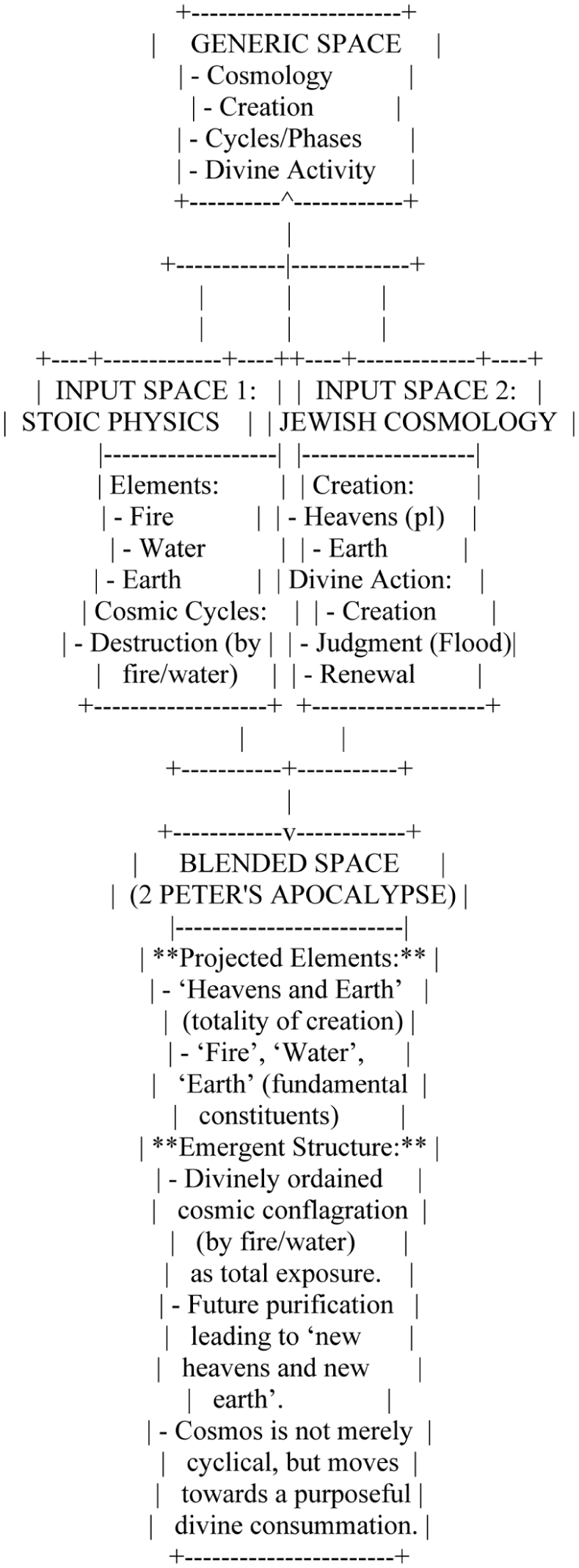
Blending ideas from two different thought worlds is a common human practice, observable in the earliest human writings (e.g., metaphors in The Epic of Gilgamesh). In the late twentieth century, Gilles Fauconnier and Mark Turner made strides in explaining how blending occurs as part of the human cognitive process, proposing Conceptual Blending Theory (CBT). 35 Recent attempts to apply CBT to biblical texts have proven beneficial (e.g., Sylva 2010: 91–118; Howe 2006; Wassell and Llewelyn 2014). CBT can describe how the author of 2 Peter brings together two different thought worlds to create a vision of the apocalypse that is meaningful to both Greek and Jewish members of the author’s audience (see Figure 1):
Mapping Spaces
The author of 2 Peter explains the impetus for an apocalyptic pronouncement: in the last days scoffers will come, scoffing and indulging their own lusts and saying, ‘Where is the promise of his coming? For ever since our ancestors died, all things continue as they were from the beginning of creation’! (2 Pet. 3.3–4, NRSV)
From this, the generic space implied by the author and shared by the scoffers includes the how and when of Jesus’ return, coupled with the cycle of life (including the death of the ancestors) and the telos of the divine creative action. In order to rebut the scoffers, the implied author exhibits two input spaces: Stoic physics and Jewish cosmology. As noted above, the author seems to believe that a dual Stoic- and biblical-powered critique of the scoffers is more potent than any singular critique. The author reconciles these two mental spaces in a blended space that emphasizes that Jesus’ return will result in the dissolution and renewal of both the heavens and the earth (the visible world) and its individual elements (the invisible world). 36 This destruction is better understood as a cosmic purification, where everything will be burned up/melted down to expose its most basic nature (2 Pet. 3.10; cf. Isa. 13.9–10, 13; 2 Clem. 16.3), and rebuilt into a new heavens and a new earth (2 Pet. 3.13; cf. Isa. 66.22).
Conceptual Blending and the Crux Interpretum
In 2 Pet. 3, the author uses figurative language (enargeia and synecdoche) to depict the στοιχεῖα (‘elements’) of popular Greek understanding and then aligns them with the biblical ‘heavens and the earth’ that obeys the will of the Word of God (2 Pet. 3.5). Yet, at the end of this part of 2 Peter lies truly dangerous interpretive waters—the crux interpretum of the conflagration itself (2 Pet. 3.10–13). The text critical issues in 2 Pet. 3.10 alone are so significant as to feel unfathomable.
37
While we cannot solve the interpretive difficulty here, we can propose a few ideas based on the figurative language and the mental spaces that the author of 2 Peter brings into this part of the text. The text reads, with emphasis on the dual motifs: But the day of the Lord will come like a thief, and then the
As the author draws his apocalyptic ideas to a close, some of the synecdochic meronyms (air, water) disappear, leaving only the holonym ‘elements’ to represent the Stoic input space, the ‘heavens and the earth’ motif to represent the biblical input space, and fire, the ekpyrotic element that the author understands—both substantively and verbally—as the means of transformation in both spaces during the day of the Lord. If we accept that the best possible reading in 3.10 is, following Christian Blumenthal (2007) and Jörg Frey (2008), εὑρεθήσεται (‘will be exposed’), with οὐχ εὑρεθήσεται, κατακαήσεται, and other options more likely to be scribal interpolations, then based on the contours of the mental spaces a more nuanced translation would be: But the day of the Lord will sneak up like a thief, in which the (but the and So, all of these things are being destroyed! What kind of people must you be in a holy and godly way of life, expecting and hastening the advent of the day of God—because of which the heavens—burning—will be destroyed and the elements—also burning—are dissolved? But we long for new heavens and a new earth, according to his promise, in which righteousness lives!
In this rendering, the δέ in 3.10 returns to its slightly contrastive sense as a coordinating conjunction (note Jerome’s similar use of vero in his Vulgate), thereby juxtaposing the biblical view of the end of time (the heavens pass) with the Stoic view of the end of time (the ekpyrotic fire) for the author’s diverse audience. From this, the author implies that whichever view a hearer holds to—whether ‘heavens’ or ‘elements’—both will burn and be remade in a purifying fire (cf. 1 Cor. 3.12–15), leading to a new heavens and a new earth (2 Pet. 3.12–13). 38
To restate the Petrine author’s argument: Whether one takes a traditional Jewish perspective on the end of time, or the popular Greek philosophical take on the end of time (as echoed in Jewish thinkers such as Philo), or some mixture of the two, the result will be the same: The cosmos will be ‘destroyed’. However, what this destruction intends is another matter; the reception history of 2 Peter includes those who believe this ‘destruction’ is not the end, but the beginning of something new that God has promised for quite some time (e.g., Origen, Eusebius of Emesa [300–359], Oecumenius [6th century], Thomas Aquinas, and Martin Luther; cf. Rev. 21.5). 39 It will destroy the old way of things, and bring about a new way of things (cf. Rev. 21.3–4). Perhaps this is what 2 Peter hints at when he writes, τούτων οὕτως πάντων λυομένων (‘these things—in this way—all are being destroyed’). This fire is not one of annihilation but purification. Whether accurate or not, what the text does make explicit is that mixed in with all of these apocalyptic figures is the author’s challenging question of how believers in Jesus should live knowing as they do that a new way of life is quickly approaching. It is likely that this question is the rhetorical peak of the argument (cf. Estes 2017: 19–20). While the author’s use of enargeia and synecdoche causes the audience to focus at first on the destruction, to see and put their hope in the future renewal, the purpose is to lead the audience back to the formative question: ‘What kind of people must you be in a holy and godly way of life’?
Conclusion
Second Peter’s grand style and unusual register result in a text with unexpected ideas and motifs when compared to other canonical texts. Near the end of the letter, the author rebuts the arguments of those mocking the idea that Jesus will one day return. To do this the author tries to build social rapport with his audience through phatic language even as he describes what the day of Jesus’ return will look like. This suggests that the eschatological ideas that Peter puts forward may not be well received by his intended audience—or that they will need assurances in the face of a grim idea.
To make the indescribable future describable for the audience, and to convince as wide an audience as possible, the author brings in two different cultural ideas in which to interact. The first idea is the fiery conflagration that represents the end of the world—an end promoted by Stoic physics and accepted to some degree throughout the Hellenistic world. To do this the author of 2 Peter introduces the four-element motif, each element of which contributes to the makeup of the world that God created, and all four together will be witness to the recreation when he returns. The author employs the motif by placing each of the four elements in close proximity as if they are each unrelated parts of the text, but uses synecdoche to allude to their combined role as στοιχεῖα.
The second idea is a take on the Jewish idea of the end of the world, based on creation and its renewal of that creation, the ‘heavens and the earth’. Even as the author portrays air metonymically as the heavens, to fit Jewish-Christian cosmogonic expectations, the author includes the plural form of heavens to fit the standard form of the biblical motif. Perhaps the author did not want to risk hearers’ unfamiliarity with Jewish cosmogony, and therefore have them miss the urgency with which the author wrote.
Thus, no matter which way the letter’s audience imagines the end of the world, they must reject the scoffers who believe it will never happen (cf. Callan 2010: 83). Peter’s rhetoric pushes the audience into visualizing the recreation, which helps to ignore the mockers (2 Pet. 3.3), and thereby listening to what the author wants the audience to hear about the coming day of the Lord, which ultimately is to prod them to think through the answer to the wide-open question, ‘What kind of people must you be in a holy and godly way of life’? (2 Pet. 3.11). 2 Peter’s approach is rhetorically sophisticated, whether or not his command of cosmology was; certainly, it was not ‘simpleminded’ in the way critics suggest other early Christians were (Lapidge 1973: 240–78). As Frey (2017: 457) admits: Perhaps the author of 2 Peter is not an anachronistic apologist of a dogmatized view of earliest Christianity, but rather a creative author who was aware of current discourses and found his own way to transfer early Christian apocalyptic motifs into his context and time and to phrase the eschatological expectation in a manner that is unprecedented in any other New Testament writing.
2 Peter’s ‘own way’ was to use figurative language and motifs from both Stoic physics and Jewish cosmology so that with either view the hearer held, they would come to realize that the day of the Lord is coming, and evaluate the path of their life, striving to be found pure of character and at peace.
Footnotes
1.
Perhaps authorship as well; for contrasting views, see Frey 2009 and  .
.
4.
Cf. Bauckham 1983. In these lists, some of the examples provided seem to be debatable, and others are missing (though the quantity remains unmatched among NT texts). In addition, its overall potential pseudepigraphy is a device unto itself; see .
5.
6.
A rather obvious allusion to the flood of Noah (Gen. 6.17; cf. Gen. 9.11, 15; Isa. 54.9; Wis. 10.4; Sir. 40.10; 44.18; 2 Esd. 3.9; Mt. 24.39).
8.
As noted by many; see for example, Frey 2017: 454; and also Pearson 2001: 536–45 and Harrill 2010. For general discussion, see : 187–202.
9.
The author of 2 Peter implies that the letter originates in Rome, a city that experienced its own conflagration under Nero in 64 CE. Pliny the Elder refers to it as the incendia of Nero (Nat. 17.1.5; plus see Tacitus, Ann. 15.38–41). : 177) notes that ‘urban fires were certainly endemic in the ancient world’. For example, the Stoic Seneca (4 BCE–65 CE) linked the urban inferno at Lyons with ekpyrosis (Seneca, Ep. 91). In addition, the eruption of Vesuvius in 79 CE would create a second example of conflagration in living memory of the creation of this letter.
10.
11.
Exceptions include recent translations such as the LEB, which glosses στοιχεῖα as ‘celestial bodies’. For extensive discussion of the root and usage, see TDNT, 7:670–87.
12.
For example, this was the position of the Venerable Bede, as cited in Bray 2000: 159. : 518 n. 783) suggests that advocates of this position are merely ‘wollen festhalten’ (‘hanging on’) to an outdated reading.
14.
16.
Though Justin writes, τὰ οὐράνια στοιχεῖα.
17.
Pre-Socratic philosophers such as Empedocles (fifth century BCE) did utilize a variety of words and concepts to express their cosmological views; for an example of these variations, see Empedocles 1981: 22–23.
18.
E.g., key ideas throughout the Lives of Diogenes Laertius.
19.
20.
Of course, the biblical text makes no explicit mention of the elements in connection with the veil’s colors.
21.
Plato based his theory of the elements on ‘the construction of the regular solids which are taken as the figures of the four primary bodies’, which we today refer to as the Platonic solids. Fortunately, there appears no numerical rationale that ties the occurrences of the elements in 2 Peter with Plato’s mathematical musings; see : 210.
22.
Philo (Mos. 1 96) believes that the four elements were the means by which God brought judgment to the Egyptians. For example, the turning of the Nile to blood is a plague of elemental water; the hailstorm is a plague of elemental air.
23.
24.
A modern parallel: ‘I am from the north, but I went south, yet my heart lies in the east’; hearing this, one cannot but help think of or wonder about ‘west’ in this scenario. In his commentary on 2 Esdras, : 173) argues that two elements fire and wind are probably enough to ‘be reference here to the four primordial elements’.
26.
In fact, at several points Philo (Decal. 53; Contempl. 5) clearly distinguishes the elements from the heavenly bodies. Further, I take στοιχεῖον in Spec. 2.151 to refer to the four elements that God put in order before the creation of the heavenly bodies mentioned in the subsequent sentence.
27.
Philo (Opif. 39) makes a connection between στοιχεῖον and two elements of Genesis, earth and water (Gen. 1.10 LXX).
28.
Philo (Aet. 29) writes of τῶν τεττάρων στοιχείων (‘the four elements’).
29.
However, Philo (Somn. 1.30–34) claims heaven represents the incomprehensibility factor of the elements (instead of aether).
30.
Further, there is some debate as to whether Philo even wrote Eternity, but that debate does not bear on the argument here.
31.
Similarly, so does Philo; see Philo, Deus 78.
32.
Sib. Or. 8.447–49 (Collins). This oracle oddly omits water, just as Philo also does once.
33.
In 2 Pet. 1.18, οὐρανός occurs in the singular—because here the author refers literally to that which is above (though cf. Mt. 3.16–17; Mk 1.10–11), not to the Jewish cosmological motif, ‘the heavens and the earth’.
34.
37.
For the most extensive discussion, see Blumenthal 2007, and for a brief overview, .
38.
The genitive construction that fronts 3.11 separates it from the previous clause and frames the rest of the statement; see Dvorak 2022: 69–70. Also, : 228) is surely correct to suggest that earth in 2 Pet. 3.10 is meant as a reference to all human activity.