This paper is concerned with the exponential stability analysis for a class of discrete-time switched non-linear systems with time-varying delays. By constructing an appropriate Lyapunov–Krasovskii function, a new criterion for checking the exponential stability of the addressed switched systems is established and then formulated in terms of linear matrix inequalities. It is shown that this new criterion can provide less conservative results than some existing ones. Two numerical examples are given to illustrate the effectiveness of the proposed results.
In many physical phenomena and practical applications, such as autonomous transmission systems, computer disc drivers, room temperature control, power electronics and chaos generators (Branicky, 1998; Du et al., 2007; Hespanha and Morse, 1999; Liberzon, 2003; Lu and Wu, 2004), they are governed by more than one dynamical system (differential or difference equations) governed by switching laws to determine which subsystem will be activated on a certain time interval. Such systems are called switched systems. It is commonly agreed that there are three basic problems in stability analysis and the design of switched systems (Liberzon and Morse, 1999): 1) finding the conditions for stability under arbitrary switching; 2) identifying the limited but useful class of stabilizing switching signals; and 3) constructing a stabilizing switching signal. In the past few decades, the stability analysis of switched systems has been extensively investigated (e.g. Agrachev and Liberzon, 2001; Sun and Ge, 2005; Lin and Antsaklis, 2009; Sun, 2004; Xiang and Wang, 2009a, 2009b, and references cited therein). Many existing studies approached the problem by searching for a switching strategy and a Lyapunov or Lyapunov-like function with decreasing values along the closed-loop system trajectory. See, for example, the multiple Lyapunov function approach (Branicky, 1998; EI-Farral NH, 2005), the piecewise Lyapunov function approach (Johansson and Rantzer, 1998; Wicks et al., 1994), the switched Lyapunov function approach (Daafouz et al., 2002; Du et al., 2007), and the dwell-time or average dwell-time scheme (Song et al., 2008; Xiang and Chen, 2010; Xiang et al., 2011; Zhai, 2002).
On the other hand, time-delay phenomena are very common in practical systems. A switched system with time-delay individual subsystems is called a switched time-delay system; in particular, when the subsystems are linear, it is then called a switched time-delay linear system. Switched time-delay systems have various applications in practical engineering systems, such as power systems and power electronics (Meyer et al., 2004; Sun and Ge, 2004), time-delay systems with controller or actuator failure (Sun et al., 2007), and networked control systems (Kim et al., 2004). Discrete-time switched systems have received increasing attention in recent years, and a large amount of results have been reported (Du et al., 2006; Sun et al., 2006; Tipcha et al., 2011; Wang and Zhao, 2007; Zhang et al., 2008; Zhang et al., 2009; Zhang and Yu, 2009). In particular, Zhang and Yu (2009) investigated the stability analysis for discrete-time switched time-delay systems. Zhang et al. (2009) considered the exponential stabilization of discrete-time switched linear systems. Wang and Zhao (2007) focused on the problem of stability for a class of discrete-time switched linear systems with time-delay by using the average dwell time method. Tipcha et al. (2011) studied the exponential stability of discrete switched delay system via new discrete type inequality by using results on the asymptotic behaviour of difference equations. Zhang et al. (2008) investigated the exponential H∞ filtering for uncertain discrete-time switched linear systems with average dwell time by the µ-dependent approach. Du et al. (2006) considered the generalized H2 output feedback controller design for uncertain discrete-time switched systems via switched Lyapunov functions. Sun et al. (2006) investigated the delay-dependent robust stability and stabilization problems for discrete-time switched systems with mode-dependent time-varying delays.
In this paper, we are interested in investigating the exponential stability analysis for a class of discrete-time switched non-linear systems with time-varying delay. Based on the average dwell time method, an improved sufficient condition for the discrete time-varying delay switched non-linear systems to be exponentially stable is derived, then a corresponding switching law is designed. To obtain less conservative exponential stability criteria, we propose a modified Lyapunov–Krasovskii function. We also adopt an appropriate free-weighting matrix method suitable for the derivation of the main results for our considered problem. The present work also implies a less conservative method for the exponential stability test.
The rest of the paper is organized as follows. Next, problem formulation and some necessary lemmas are given. Then, based on the average dwell time approach and an inequality analysis technique, an exponential stability criterion is derived in terms of matrix inequalities. Two numerical examples illustrate the effectiveness of the proposed approach, followed by concluding remarks.
Notations
Throughout this paper, the superscript ‘T’ denotes the transpose, and the symmetric terms in a matrices are denoted by *. The notation means that X is a positive definite (positive semi-definite, negative definite, negative semi-definite, respectively). Rn denotes the n-dimensional Euclidean space. denotes the Euclidean norm. and denote the maximum and minimum eigenvalues of matrix P, respectively. I is an identity matrix with appropriate dimension. Matrices, if not explicitly stated, are assumed to have compatible dimensions.
Problem formulation and preliminaries
Consider the following discrete-time switched non-linear systems with time-varying delay
where is the state vector, is the initial state function, is the control input and denotes the state time-varying delay satisfying , where and are constant positive scalars representing the minimum and maximum delays, respectively. is the constant delay. The function is the switching signal. is the corresponding switching signal to , where is the initial time and denotes the ith switching instant, means that the ith subsystem is activated. are real-valued matrices with appropriate dimensions. In addition, is a non-linear function satisfying
where M1 and M2 are known real constant matrices.
Remark 1. It is customary that the non-linear functions are said to belong to sectors (e.g. Khalil, 2002, Han, 2005). The non-linear description in (3) is quite general and includes the usual Lipschitz conditions as a special case. Note that both the control analysis and model reduction problems for systems with sector non-linearities have been intensively studied (Han, 2005).
Remark 2. It is worth mentioning that the time delay in this paper is a time-varying function belonging to a given interval, in which the lower bound of delay is not restricted to zero.
For the switching signal , we revisit the average dwell time property from the following definition.
Definition 1. For any switching signal and let denotes the number of switching of over . If
holds for and , then is called the average dwell time, and the chatter bound.
Remark 3. The concept of average dwell time was originally proposed for continuous-time switched systems in Hespanha and Morse (1999), and it has been modified to fit the discrete-time ones in some existing literature (Song et al., 2008). As commonly used in the literature, we choose in this paper.
The following definition and lemma also will be used in the derivation of the main results.
Definition 2. System (1)–(2) is said to be exponentially stable under switching signal , if there exist some scalars and , such that the solution of system (1) satisfies
where , and .
Lemma 1 (Sugiyama, 1969). Let and be non-negative sequences and is a non-negative constant. If
holds for , then
Main results
In this section, we focus on the problem of stability analysis for discrete-time switched system (1)–(2).
Theorem 1. Consider system (1)–(2), for a constant , if there exist positive definite matrices and matrices , such that the following matrix inequality holds for
Then, system (1)–(2) is exponentially stable for any switching signal with average dwell time
where ceil( ) represents the smallest integer not less than
and satisfies
Proof. Choose a Lyapunov–Krasovskii function of the form for ith subsystems
where ,
which are positive definite matrices since are positive definite matrices, and .
For , we define , thus with
On the other hand, the Newton–Leibniz formula gives
Then, for any appropriately dimensional matrices , we have
where .
From inequality (3), we know
Considering (10)–(16), (18) and (19), we have
where
and
Note that
By the Schur complement, (7) implies
Thus, it follows from (20)–(22) that
According to (9), we have that
Denote the switching instants, and
From (23)–(25), for any , we have that
According to definition 1 and lemma 1, we obtain that
Moreover, we can obtain that
where
Therefore
By definition 2, we know that system (1)–(2) is exponentially stable. This completes the proof.
Remark 4. It can be seen from Theorem 1 that the exponential stability of system is dependent on for a given . Specifically, if , i.e. , the switching signal can be arbitrary, and if , then , namely, there is no switching. However, for these two kind of different cases, the corresponding switched system might be stable and unstable, respectively. That is to say, the stability of system can be ensured at the expense of increasing .
Remark 5. The exponential stability criteria of discrete-time switched non-linear systems with time-varying delay are given in Theorem 1. When , system (1) will degenerate to the following discrete-time switched linear system with time-varying delay
Then we have the following corollary.
Corollary 1. Consider system (30), for a given constant , suppose that there exist positive definite matrices and matrices , such that the following matrix inequality holds for
Then, system (30) is exponentially stable for any switching signal with average dwell time satisfying (8), where
and satisfies
Proof. Similar to the proof line of Theorem 1, we can prove it. The detailed proof is omitted here.
Remark 6. If the time-varying delay in (30) is a constant delay, namely
which is considered in Zhang and Yu (2009), where constant delay satisfies .
From the results of Zhang and Yu (2009), we know that system (33) is exponentially stable for any switching signal with average dwell time satisfying (8) if the following inequalities hold
where
and satisfies
However, according to our approach, we construct the following Lyapunov–Krasovskii function for the ith subsystem
where , and .
Using Lemma 1, we can show that system (33) is exponentially stable for any switching signal with average dwell time satisfying (8) if the following inequalities hold
From (34) and (36), we know
where
For any and , we have . Thus, if , then we can obtain , but, if , we cannot obtain . This implies that the exponential stability criterion proposed in this paper is less conservative than the existing results.
Remark 7. System (33) has also been considered in Wang and Zhao (2007). According to the result in Wang and Zhao (2007), system (33) is exponentially stable under arbitrary switching signal with the average dwell time satisfying (8) if the following inequalities hold
which is equivalent to
On the other hand, according to our approach, we construct the following Lyapunov–Krasovskii function for the switched system (33)
Then, system (33) is exponentially stable if the following inequalities hold
For any , if (39) is satisfied, then (40) holds. However, we would not obtain (39) from (40). This implies that the exponential stability criterion proposed in this paper is less conservative than the result in Wang and Zhao (2007).
Numerical examples
In this section, we present some examples to illustrate our main results.
Example 1. Consider switched system (33) with the following parameters
Subsystem 1
Subsystem 2
and . Solving the linear matrix inequality (LMI) (36), we can obtain
Then, according to (8), we can obtain ; thus , which means that the above switched system is exponentially stable. In order to illustrate that the exponential stability criterion proposed in this paper is less conservative than the existing results, we consider the switched system with same parameters as above, and then we find that the LMIs (34) have no feasible solutions. That is to say, using the method proposed in Zhang and Yu (2009), we cannot draw the conclusion that system (33) is exponentially stable. This demonstrates that our result is less conservative than the existing ones.
Example 2. Consider switched system (1) with the following parameters
with
It is easy to verify that
Let , by solving the matrix inequalities in Theorem 1; we obtain
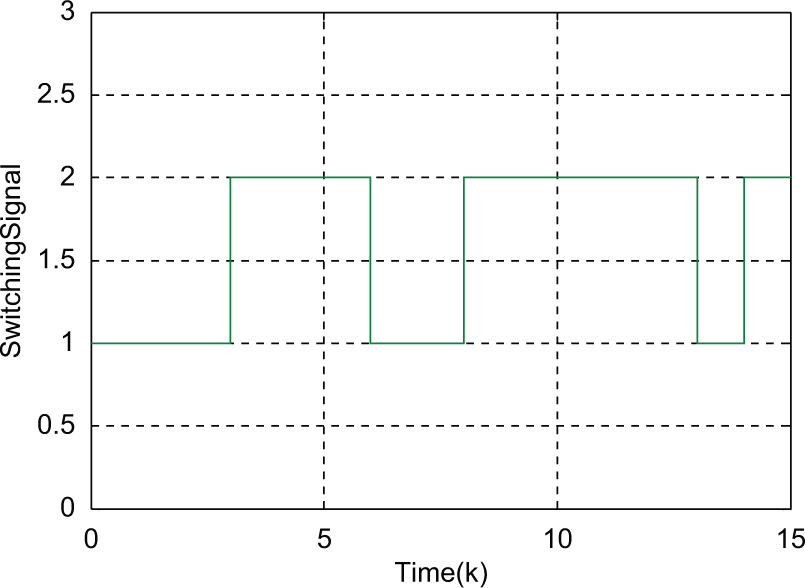
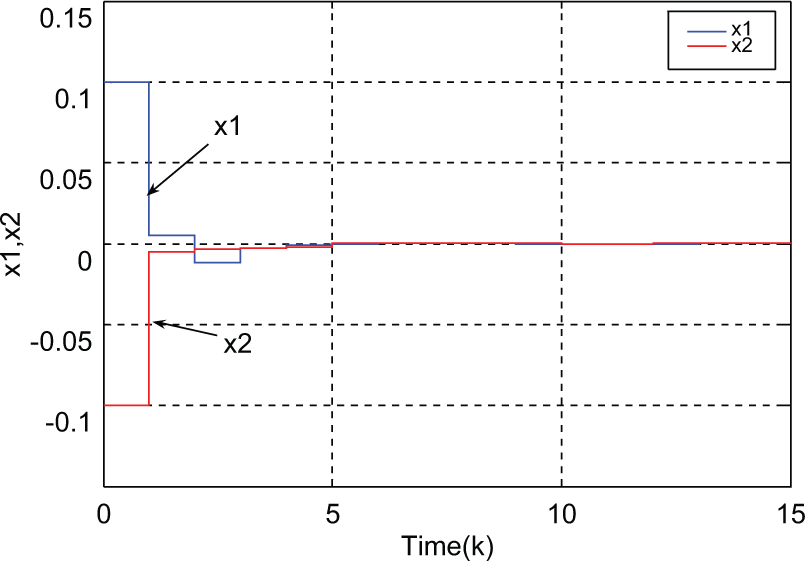
Then, according to (8), we can obtain , thus . The switching signal and state trajectories of the system are shown in Figures 1 and 2, where the initial state for , .
Switching signal.
State trajectories of the switched system.
Conclusions
In this paper, the problem of exponential stability analysis of discrete-time switched non-linear systems with time-varying delay has been addressed. A new exponential stability criterion has been obtained, and the conservatism found in the literature can be reduced. Two illustrative examples have demonstrated the effectiveness of the proposed approach.
Footnotes
Funding
This work was supported by the National Natural Science Foundation of China under Grant No. 60974027 and NUST Research Funding (2011YBXM26).
References
1.
AgrachevAALiberzonD (2001) Lie-algebraic stability criteria for switched systems. SIAM Journal on Control and Optimization40(1): 253–269.
2.
BranickyMS (1998) Multiple Lyapunov functions and other analysis tools for switched and hybrid systems. IEEE Transactions on Automatic Control43(4): 475–482.
3.
DaafouzJRiedingerPIungC (2002) Stability analysis and control synthesis for switched systems: a switched Lyapunov function approach. IEEE Transactions on Automatic Control47(11): 1883–1887.
4.
DuDJiangBShiPZhouS (2007) H∞ filtering of discrete-time switched systems with state delays via switched Lyapunov function approach. IEEE Transactions on Automatic Control52(8): 1520–1525.
5.
DuDZhouSZhangB (2006) Generalized H2 output feedback controller design for uncertain discrete-time switched systems via switched Lyapunov functions. Nonlinear Analysis: Theory, Methods & Applications65(11): 2135–2146.
6.
EI-FarralNHMhaskarPChristofidesPD (2005) Output feedback control of switched nonlinear systems using multiple Lyapunov functions. Systems and Control Letters54(1): 1163–1182.
7.
HanQL (2005) Absolute stability of time-delay systems with sector-bounded nonlinearity. Automatica41(12): 2171–2176.
8.
HespanhaJPMorseAS (1999) Stability of switched systems with average dwell time. Proceedings of the 38th IEEE Conference on Decision and Control, Phoenix, AZ, pp. 2655–2660.
9.
JohanssonMRantzerA (1998) Computation of piecewise quadratic Lyapunov functions for hybrid systems. IEEE Transactions on Automatic Control43(4): 555–559.
KimDKParkPGKoJW (2004) Output feedback control of systems with communication networks using a deterministic switching system approach. Automatica40(7): 1205–1212.
12.
LiberzonD (2003) Switching in Systems and Control. Basel: Birkhäuser-Verlag.
13.
LiberzonDMorseAS (1999) Basic problems in stability and design of switched systems. IEEE Control Systems Magazine19(5): 59–70.
14.
LinHAntsaklisPJ (2009) Stability and stabilizability of switched linear systems: a survey of recent results. IEEE Transactions on Automatic Control54(2): 308–322.
15.
LuBWuF (2004) Switching LPV control designs using multiple parameter-dependent Lyapunov functions. Automatica40(11): 1973–1980.
16.
MeyerCSchroderSDe DonckerRW(2004) Solid-state circuit breakers and current limiters for medium-voltage systems having distributed power systems. IEEE Transactions on Power Electronics19(5): 1333–1340.
17.
SongYFanJFeiMYangT (2008) Robust H∞ control of discrete switched system with time delay. Applied Mathematics and Computation205(1): 159–169.
18.
SugiyamaS (1969) On the stability problems of difference equations. Bulletin of Science and Engineering Research Laboratory45: 140–144.
19.
SunXMLiuGPReesDWangW (2007) Controller or actuator failure analysis for systems with time-varying delays. Proceedings of the 46th IEEE conference on decision and control, New Orleans, LA, pp. 3233–3238.
20.
SunYGWangLXieG (2006) Delay-dependent robust stability and stabilization problems for discrete-time switched systems with mode-dependent time-varying delays. Applied Mathematics and Computation180(2): 428–435.
21.
SunZ (2004) A robust stabilizing law for switched linear systems. International Journal of Control77(4): 389–398.
22.
SunZGeSS (2004) Switched Linear Systems: Control and Design. New York: Springer Press.
23.
SunZGeSS (2005) Analysis and synthesis of switched linear control systems. Automatica41(2): 181–195.
24.
TipchaJNiamsupPRojsiraphaisalT (2011) Exponential stability of discrete switched delay system via new discrete type inequality. Proceedings of the Chinese Control and Decision Conference, Mianyang, pp. 3102–3106.
25.
WangRZhaoJ (2007) Exponential stability analysis for discrete-time switched linear systems with time-delay. International Journal of Innovative Computing, Information and Control3(6B): 1557–1564.
26.
WicksMAPeletiesPDe CarloRA (1994) Construction of piecewise Lyapunov functions for stabilizing switched systems. Proceedings of the 33rd IEEE Conference on Decision and Control, Lake Buena Vista, FL, pp. 3492–3497.
27.
XiangZRChenQW (2010) Robust reliable control for uncertain switched nonlinear systems with time delay under asynchronous switching. Applied Mathematics and Computation216(3): 800–811.
28.
XiangZRWangRH (2009a) Robust control for uncertain switched non-linear systems with time delay under asynchronous switching. IET Control Theory and Applications3(8): 1041–1050.
29.
XiangZRWangRH (2009b) Robust L∞ reliable control for uncertain nonlinear switched systems with time delay. Applied Mathematics and Computation210(1): 202–210.
30.
XiangZRWangRHChenQW (2011) Robust stabilization of uncertain stochastic switched non-linear systems under asynchronous switching. Proceedings of the Institution of Mechanical Engineers, Part I: Journal of Systems and Control Engineering225(1): 8–20.
31.
ZhaiGHuBYasudaKMichelAN (2002) Qualitative analysis of discrete-time switched systems. Proceedings of the 2002 American Control Conference, Anchorage, AK, pp. 1880–1885.
32.
ZhangLBoukasEKShiP (2008) Exponential H∞ filtering for uncertain discrete-time switched linear systems with average dwell time: a µ-dependent approach. International Journal of Robust and Nonlinear Control18(11): 1188–1207.
33.
ZhangWAbateAHuJVitusMP (2009) Exponential stabilization of discrete-time switched linear systems. Automatica45(11): 2526–2536.