We address stabilization problems of networked control systems in the presence of bounded packet losses and time-varying network-induced delays. When the delay is less than the transmission interval, we prove that the stability of the closed-loop system is implied by that of a switched system. Based on theories on switched systems, we present stabilizing conditions by using packet-loss-dependent Lyapunov functions, and design multiple controllers depending on the packet loss and the network-induced delay. Furthermore, based on the stabilizing conditions, we discuss the robustness of the stabilization against the packet loss and the network-induced delay. Several numerical examples and simulations are worked out to demonstrate the effectiveness of the proposed design approach.
Networked control systems (NCSs) are a class of feedback control system in which actuators, controllers and sensors are connected over network channels. That feature makes NCSs find broad application in industrial areas, such as large-scale distributed industrial processes, fieldbus systems and intelligent traffic systems, etc. Consequently, NCSs have received increasing attention (Wong and Brockett, 1999; Zhang et al., 2001; Montestruque and Antsaklis, 2003) in recent years. However, the existence of communication networks brings NCSs many new issues such as networked-induced delays, packet losses and multiple-packet transmissions which usually make the analysis and design for NCSs complex. Here, we focus our attention on modeling and controller design for NCSs in the presence of both packet losses and network-induced delays. The issue of multiple-packet transmission usually is used to deal with the network where the bandwidth and packet size are restricted (Wong and Brockett, 1999; Matveev and Savkin, 2006), and will be a further object of our study.
Generally speaking, packet losses result from transmission errors in physical network links or from buffer overflows due to congestion. Moreover, long transmission delays sometimes result in packet reordering, which would reduce to packet losses if the receiver discards outdated arrivals. Many studies have studied some control problems of NCSs in the presence of packet losses (Yu et al., 2004; Xiong and Lam, 2007; Gao et al., 2008). To the best of the authors’ knowledge, there are two effective approaches to deal with this issue in the existing results: one is a delayed system approach (Gao et al., 2008) where delayed systems are used to describe the NCSs with packet losses, and the other is a switched system approach (Yu et al., 2004; Xiong and Lam, 2007) where switched systems are obtained by the lifting technique.
Network-induced delays occur when sensors, actuators and controllers exchange data over the communication network. According to the network protocols and the hardware adopted, these delays could be constant, time-varying, or random. Many results have concerned the effects of the network-induced delay against the stability and stabilization of NCSs such as those of Wu and Chen (2007), Hu and Yan (2007), and Gao et al. (2008). Based on the properties of the delay, two typical approaches have been used to describe the time delay in the existing literature. The first regards the delay as a deterministic variable, and models the closed-loop NCSs as a class of delayed systems (Wu and Chen, 2007; Gao et al., 2008). It is suitable for the case that the delay is constant or time-varying. The other assumes that the delay abides by certain probability distributions such as a Markovian process and a Bernoulli process, and models the closed-loop NCSs as a class of stochastic models (Hu and Yan, 2007). It is applied to the case that the delay is random.
The advantage of the switched system approach is that the controllers can make full use of the previous information to stabilize NCSs when the current state measurements are not available from the network. Moreover, rich theories on switched systems (see, e.g., Daafouz et al., 2002; Liberzon, 2003; Zong et al., 2011, 2012; Hou et al., 2012) can be used to discuss the control problems of NCSs. Under the assumption that the sensor is time-driven, and the controller and the actuator are event-driven, Yu et al. (2004) and Xiong and Lam (2007) have addressed the stabilization problem of NCSs, and sufficient conditions for the stabilization have been established. Recently, more and more attention has been concentrated on control and design problems of NCSs. By using the average dwell-time method, Zhang and Yu (2007) studied the output stabilization problem of NCSs with time-driven sensors, controllers and actuators; Lin et al. (2006) considered stability and disturbance attenuation issues for NCSs under uncertain access delay and packet dropout effects by the switched system approach; based on the theories on switched systems, Wang and Yang (2007) studied an control problem of NCSs with packet loss and network-induced delay; a mean square stabilization problem was investigated for discrete-time networked control systems over fading channels by Xiao et al. (2012); Guan et al. (2012) studied a optimal tracking problem for discrete-time systems with communication constraints in the feedback path; and Xue et al. (2012) discussed moving horizon state estimation for networked control systems with multiple packet dropouts.
In the field of control, if a single controller fails to solve a control problem, multiple controllers might be used in the hope that the problem may be solved by switching among these controllers. Hence, it is necessary to study the design problem of multiple controllers. In this paper, enlightened by all of the analysis above, we discuss the modeling and the design of multiple controllers for NCSs by using the switched system approach. The work is mainly based on the results of Yu et al. (2004) and Xiong and Lam (2007). Compared with the existing results, the main contributions are as follows. First, for the NCSs with bounded packet losses and time-varying network-induced delays, we propose a novel mathematical modeling. Second, we present the design of multiple controllers which depend on the packet losses and the delays for the NCSs under study. Last, we discuss the robustness of the stabilization against the packet loss and the network-induced delay, and propose a search algorithm to find the largest values of the packet losses and network-induced delays which preserve the stabilization of the systems.
This paper is organized as follows. Section 2 introduces the mathematical modeling of NCSs under study, and some definitions and lemmas are also presented in this section. Section 3 deals with the stabilization problem for NCSs. Section 4 discusses the robustness of design for NCSs against the packet loss and the network-induced delay. Some numerical examples are given to demonstrate the effectiveness of the proposed design technique in Section 5. The conclusion is provided in Section 6.
Notation
Throughout this paper, the following notation is used: refers to the Euclidean norm for vectors and induced 2-norm for matrix; for any two positive integers and satisfying , ; in symmetric block matrices, “” represents an ellipsis for the term introduced by symmetry.
Mathematical modeling
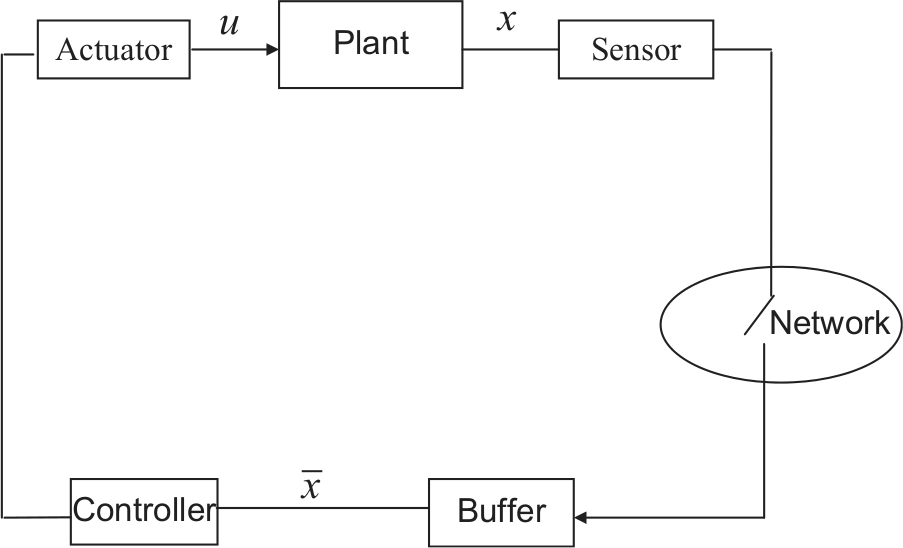
Consider an NCS with packet losses and network-induced delays illustrated in Figure 1, where the sensor is clock-driven, the controller and the actuator are event-driven, and the packet loss and network-induced delay only occur in the channel between the sensor and controller (S/C channel). The plant and the time-varying controller are described as
Structure of a NCS.
where , is the plant state vector, is the plant input vector, and is the state measurement that is successfully transmitted to the buffer over the network. Here , are known real constant matrices with proper dimensions, and is the state feedback gain matrix to be designed.
For any , the sensor will read the state information and transmit it to the buffer over the network channel. We suppose that the newest state data transmitted successfully will substitute the old ones. The updated data is denoted as , and will be utilized to compute the new control input by the controller. Since a NCS operates over a network channel, data transfers between the controller and the remote system will induce network delays (sensor-to-controller delays or controller-to-actuator delays) in addition to the controller processing delay. Hence, we also suppose that there exists time-varying delay before state information is transmitted to the buffer. Then can be described as
Furthermore, we denote the set of successive update time instants of as which is a subset of . We refer to the time interval as one transmission interval, and denote . Yu et al. (2004) and Xiong and Lam (2007) have considered the stabilization problem for such NCSs with , however, the case that is very different and the corresponding results could not obtained by the direct use of the design methods presented in (Yu et al., 2004) and Xiong and Lam (2007). Note that the latter still contains two special situations. The first is , and the other is which is more complex. Here, we assume that , that is, there is no disordered transmission. Without loss of generality, we assume that the maximum delay is , and that the maximum transmission interval is which means that the upper bound of the packet loss is . Thus, we have .
Here, we consider NCS (1) by using the switched system approach, and in what follows we propose an explicit description for the modeling. We assume that the time-varying gain is a piecewise function, and takes its value in a finite set . Thus, with the set of candidate gains to be established, we propose the following design scheduling to stabilize NCS (1).
Design Scheduling 1
For any , assuming that there are two counters which record the length of the transmission interval and the value of delay respectively, then we adopt the following controller to stabilize NCS (1)
Without loss of generality, we suppose that is transmitted successfully to the controller over the network channel, and let . Then the states of the closed-loop system in any transmission interval can be described as follows:
In this pattern of transmission, we can get the state evolution of the closed-loop system at any successive update time instant as follows:
Define
and
we have
Without loss of generality, let . Note that (6) contains several subsystems, and every of them is characterized by two indices and . Let be a switching signal, and then (6) will be a switched system with an unit delay. One can see that (6) presents the state evolution of the closed-loop system at the update time instants. Thus, up to now, we obtain switched system (6) from NCS (1) by the lifting technique. In the following section, we will show that the stability of switched system (6) implies that of the closed-loop system (1) with controller (4).
Dai (1989) has proved the result that the stabilization of delayed singular control systems was equivalent to the stabilization of an augment system without delays. Here, based on the result, we augment the state of delayed system (6) as , and then obtain an augment system
where
Without loss of generality, let satisfying , , and , and then based on (6) and (7) separately, we can obtain the following two switched systems
where
and
where
Remark 1. Note that (8) and (9) are equivalent to (6) and (7), respectively. Moreover, system (9) can be obtained from (8) by augmenting the state.
Now, for controller (4), we propose some discussions as follows:
(1) Only packet loss occurs. Since there is no delay occurring, controller (4) reduces to the following one which only depends on the packet loss
The case is suitable for the network where the network-induced delay is so small that one can ignore its effects, and think that the state information is transmitted to the buffer instantly.
(2) No packet loss occurs. Controller (4) reduces to
Note that when there is no packet loss occurring. Owing to the assumption that , we have . Thus, in the case that no packet loss occurs in S/C channel, controller (4) will be which means that there is no network-induced delay occurring. In the case that there is no packet disordering, one can think that the network is very smooth or even think that there is no network when no packet loss occurs. Hence, the stabilization problem reduces to a normal LQR problem.
Remark 2. Note that controller (4) depends not only on the packet loss but also the time delay. As a result, in a transmission interval , there still exist two different controller gains and . Let and , and then (6) would reduce to Equation (6) of Yu et al. (2004); let and , and then (6) would reduce to Equation (4) of Xiong and Lam (2007). Thus, the stabilization problems addressed here contain those discussed by both Yu et al. (2004) and Xiong and Lam (2007) as two special cases.
Remark 3. Here, time-varying delays are described as for simplicity. This description makes the system modeling and theoretical proofs simple to a certain degree, and the description still demonstrates the main contribution of this paper. It should be pointed out that all of the design methods are still applied to this expanded time-varying delay in the form of as studied by Phat and Ratchagit (2011).
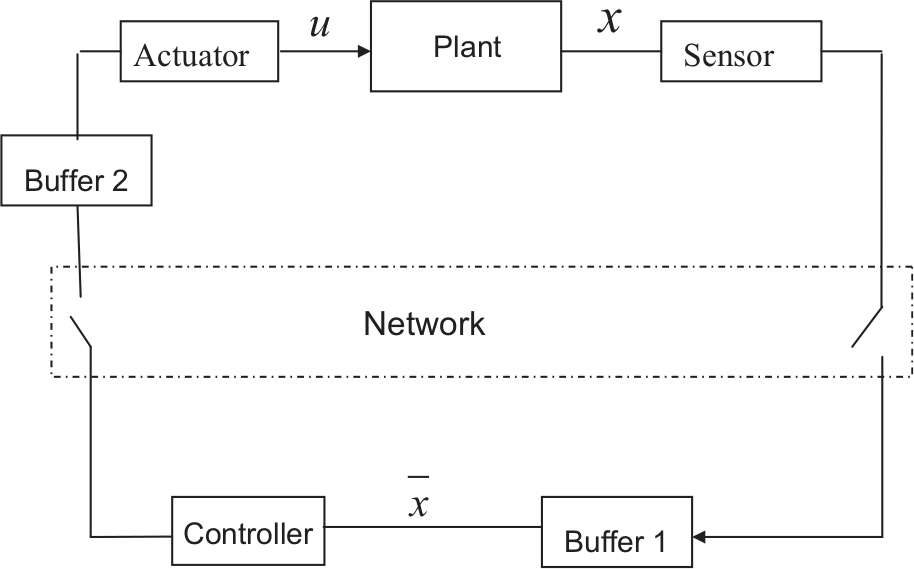
Now, we show that the modeling approach above is also suitable for NCSs with packet losses and network-induced delays in both S/C channel and C/A channel (the channel between the controller and the actuator). A NCS with bounded packet losses and network-induced delays in both the S/C channel and C/A channel are illustrated in Figure 2, where the sensor is time-driven, the controller and the actuator are event-driven. We suppose that the set of successive update time instants of is which is a subset of . We combine the packet loss occurring in the two network channels as one measurement , and the network-induced delay as one . It should be pointed out that the control gain will depend on (or ) instead of (or ) since we do not know the exact (or ) when the control action is calculated. Consequently, the controller can be designed as
Structure of a NCS with delays and packet losses.
Hence, we only discuss the stabilization problem for NCSs where the delay and packet loss only occur in S/C channel in the following. The corresponding results for NCSs with the delays and packet losses occurring both in S/C and C/A channels can be obtained easily using a similar approach.
Now, we present the following definitions and technical lemmas for later use.
Definition 1. The delay and packet loss are said to be allowable, if takes its values in the limit set arbitrarily, takes its values in the limit set arbitrarily, and for all .
Definition 2. Let be the trajectory of the closed-loop system (1) with switched controller (4), then the closed-loop system is said to be uniformly stable under any allowable packet loss and network-induced delay, if for any , there exists a number such that implies for all . Furthermore, it is said to be uniformly asymptotically stable if it is stable and for any initial state .
Lemma 1. (Sun and Liu, 2006) Assume that , and then for any matrices , and a scalar function , the following inequality holds:
where
Stabilization via state feedback
In this section, under the assumption that the packet loss and network-induced delay are allowable as defined in Definition 1, we discuss the stabilization of NCS (1) via state feedback. Without loss of generality, we assume that is a unique equilibrium of NCS (1), and the state response starts at with an initial condition . The following result shows that the uniformly asymptotic stability of (6) implies that of the closed-loop system (1) with (4).
Lemma 2. The uniformly asymptotically stability of the closed-loop system (1) with (4) is guaranteed by that of (6).
Proof. From (5), for any , we have
Hence, it is easy to obtain that the state between and satisfies
where
or
where and By Definition 2, we know that the uniformly asymptotical stability of (6) implies that of the closed-loop system. Thus, this completes the proof.
Theorem 1. If there exist symmetric positive-definite matrices and matrices such that
then NCS (1) is uniformly stabilizable via the state feedback control law (4) with
Proof. Based on Lemma 2 and Remark 1, we only need to prove that there exists a feedback gain set guaranteeing the uniformly asymptotical stability of switched system (9) for arbitrary switching.
Note that (9) is a delay-free system and can be represented equivalently by
where , .
Based on (17), we know that every number array denotes one subsystem, and if the subsystem is active and zero otherwise. Now, for (17), we adopt the following switched Lyapunov function
where is the parameter to be designed.
The difference of (18) along the trajectory of (17) is
Thus, the uniformly asymptotical stability is proved by the Lyapunov function (18) if and only if
which is, according to Schur complements, equivalent to
By post- and pre-multiplying both sides of (19) using matrix , and letting , , , , we have equivalently
where
which is exactly (16). Thus, this completes the proof. □
Remark 4. Switched Lyapunov function (18) implies a packet-loss-dependent Lyapunov function for NCS (1). In fact, based on the analysis in Section 2, applying Design Scheduling 1 to NCS (1), we can get the state evolution of the closed-loop system as (13), for which we adopt the following Lyapunov function
which depends on the packet-loss measurement . Moreover, from the proof of Theorem 1, we know that the difference of (20) along the trajectory of (1) is not necessary negative at any instant time .
Remark 5. Let , that is, there is no network-induced delay occurring, stabilizing condition (16) reduces to the following linear matrix inequalities (LMIs)
Remark 6. Let , that is, there exists an unit delay. This case has been considered by Yu et al. (2004) where a single controller has been designed. The stabilizing condition (16) reduces to the following LMIs
Up to now, based on augment system (9), we have obtained the stabilizing conditions in the form of LMIs for NCS (1). However, the augment system approach is only suitable for delayed systems with the constant delays and the delays with known upper bounds. As a more comprehensive approach, the Lyapunov–Krasovskii function approach as well as augment Lyapunov–Krasovskii function approach has been used extensively in many results on delayed systems (Fridman, 2001; Phat and Ratchagit, 2011). Based on the Lyapunov–Krasovskii function approach, one can deal with not only the constant delays but also the time-varying delays. Moreover, by this approach, one also can obtain the delay-dependent stabilizing conditions which is less conservative than delay-independent conditions. In what follows, we will adopt the Lyapunov–Krasovskii function approach to study the stabilization of delayed system (8), and this approach has been used to deal with the control problems of NCSs in Xiong and Lam (2007) and Wang and Yang (2007).
Theorem 2. If there exist symmetric positive-definite matrices and matrices , such that
where , then NCS (1) is uniformly stabilizable via controller (4).
Proof. For delayed system (8), defining and taking the switched Lyapunov–Krasovskii function
the difference of is
By Lemma 1, we have
where
Hence, (8) is stabilizable if the following matrix inequality holds
which is, by Schur complements, equivalent to (23). This completes the proof. □
Note that condition (23) is a nonconvex inequality due to containing . We can obtain its solutions by the following cone complementarity linearization problem (Ghaoui et al., 1997)
Furthermore, in order to design a stabilizing controller like (4), we present a iteration algorithm as presented by Ghaoui et al. (1997).
Step 1. For (26), find a feasible point , and let .
Step 2. Let , and solve the following optimal problem
Step 3. If a stopping criterion given in advance is satisfied, exit. Otherwise, go to Step 2.
Robustness analysis
Owing to the use of the communication network, the packet losses and network-induced delays are two potential sources of instability and poor performance in NCSs. In this section, we discuss the robustness of NCS (1) against both the packet losses and time delays.
In practical, we always hope that a NCS possesses good robustness of the stabilization against the packet loss (respectively, the network-induced delay), that is, the NCS can tolerate a large enough upper bound of the packet loss (respectively, the network-induced delay) before becoming unstable. However, when the number of the packet loss (respectively, the network-induced delay) is large enough, the system can be looked as an open-loop system in a certain way, which is dangerous for unstable or oscillating systems. Thus, the problem that how such packet losses (respectively, network-induced delays) affect the performance of a NCS must be considered.
Generally speaking, the larger the packet loss (respectively, the network-induced delay) that a NCS can tolerate before becoming unstable, the less sensitive the NCS to the packet loss (respectively, the network-induced delay). Robustness analysis of NCSs has been considered by Branicky et al. (2000), Walsh et al. (2002), and Hu and Yan (2007). Among them, Hu and Yan (2007) let zero be fed into the controller when the state information at the instant fails to access the controller over the communication channel. By modeling the behavior of the packet loss as an independent and identically distributed (i.i.d.) Bernoulli process, they proposed an estimation for the maximum packet dropping probability which preserves the uniform stabilization of NCSs. Walsh et al. (2002) considered a NCS where the communication network only exists between the sensor and the controller. It assumed that the successive sensor messages were separated by at most seconds and proposed the method to find the value of which preserved the desired property of a NCS. The maximum allowable delay bound has been considered in Branicky et al. (2000).
To the best of the authors’ knowledge, few results have been concerned with the influences in the presence of the packet loss and network-induced delay simultaneously. Here, we use the largest values of the packet loss (respectively, the network-induced delay) that a NCS can tolerate to quantitatively measure the degree of stability robustness. Thus, there are two indicators, the largest values of the packet loss and the network-induced delay, evaluate the robustness of NCSs.
For NCS (1), we adopt a buffer before the controller to hold the data packets that are transmitted successfully over the communication network. We always utilize the newest state information transmitted successfully to compensate for the packet loss and the time delay as proposed in (3). Based on the analysis in Section 3, we can find the maximum allowable bound of the packet loss (respectively, the network-induced delay) for any given number (respectively, ) by solving the following optimal problem
or
Furthermore, from (16), we see that if there exists a number (respectively, a number ) such that LMI (16) is solvable, that is, the NCS is uniformly stabilizable, it is still solvable for any number (respectively, any number ) satisfying (respectively, ). Thus, we can obtain the optimal solutions as well as optimal value (respectively, optimal value ) for optimal problem (27) (respectively, optimal problem (28)) by using some search algorithm such as linear search method and the binary search algorithm. Based on the linear search method, we present the following two algorithms to find the optimal values for optimal problems (27) and (28) separately.
Algorithm 1. For any given number denote LMIs (16) with as simply, and then we present the following linear search method to find the optimal value by starting search at a small number :
Step 1: Initialize. Letting is solvable.
Step 2: Design iterations. Repeat letting , solve . Until is unsolvable.
Algorithm 2. For any given number denote LMI (16) with as simply, and then we present the linear search method to find the optimal value by starting search at a small number :
Step 1: Initialize. Letting is solvable.
Step 2: Design iterations. Repeat letting , solve . Until is unsolvable or .
Remark 8. The general iteration principle is to perturb the system from shorter delays to longer delays or from shorter transmission intervals to longer transmission intervals, that is, for each succeeding iteration step we add one to or . When (A, B) is stabilizable, for small enough, Steps 1 and 2 will always be feasible.
Numerical examples
In this section, two numerical examples are given to demonstrate the effectiveness of the proposed design technique.
Example 1. Consider the cart and inverted pendulum problem of Lin et al. (2006) and Hu and Yan (2007), and the linearized state-space model is described as
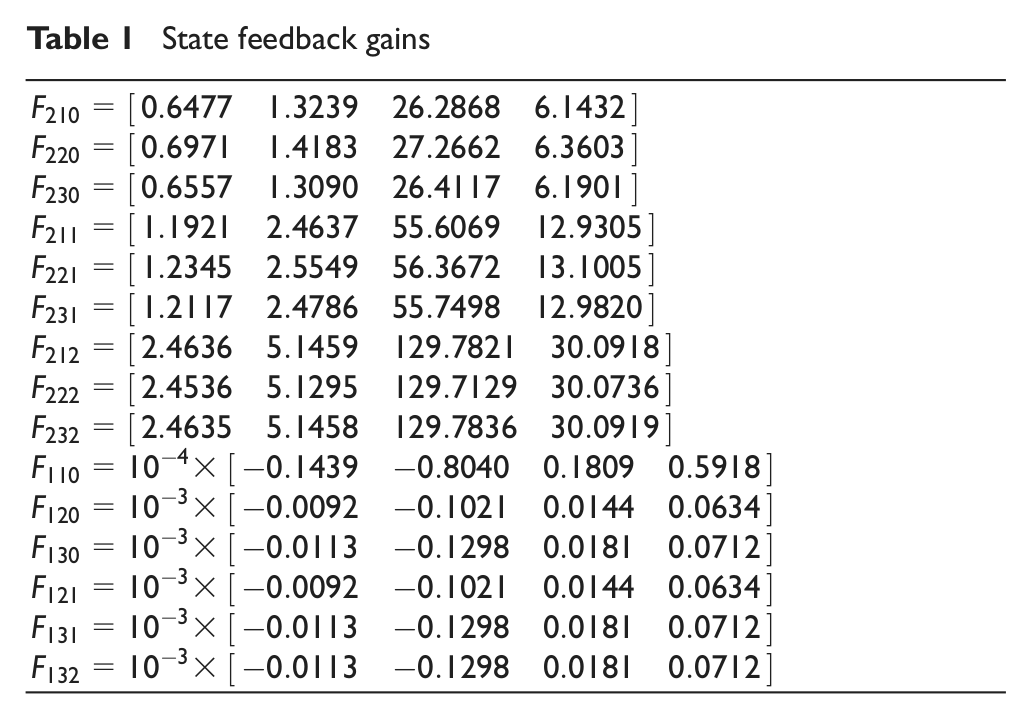
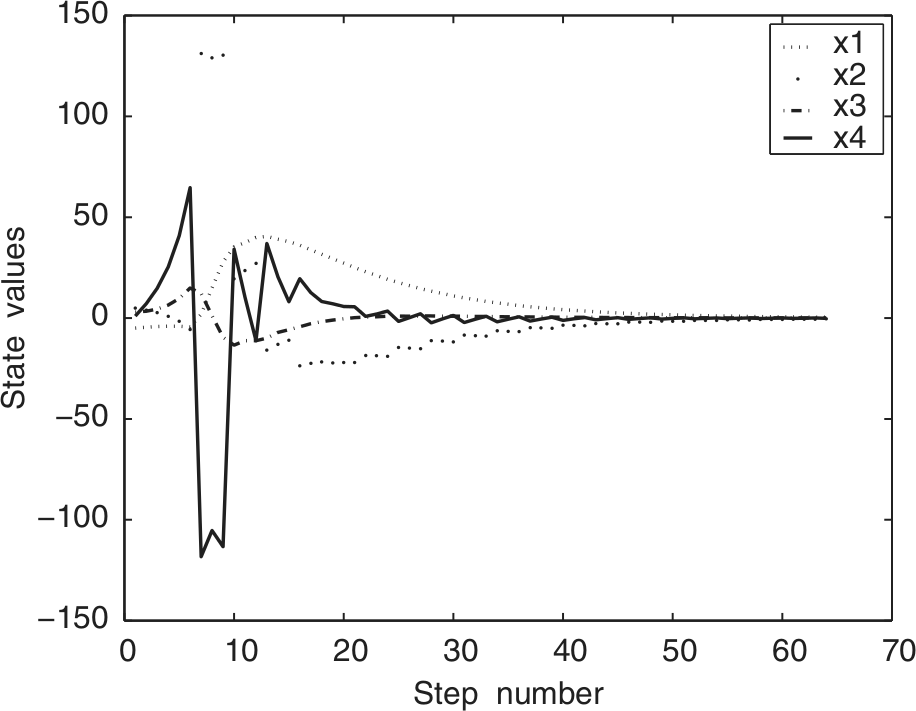
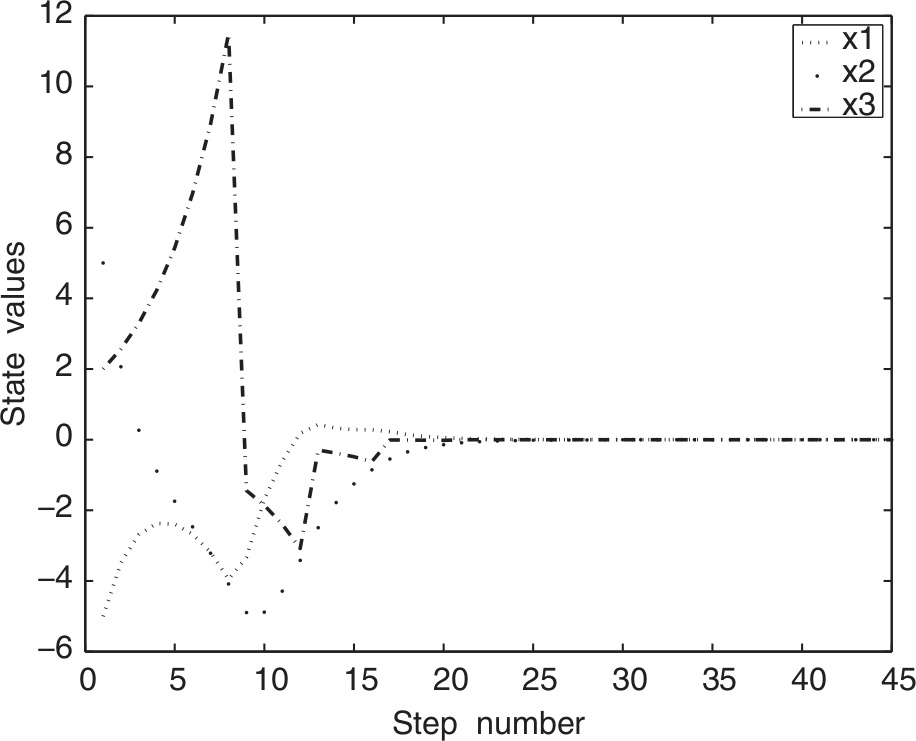
When that is, there is no network-induced delay. In that case, control law (4) only depends on the packet loss, and reduces to the controller , with the state feedback gains to be designed. By Algorithm 1, we obtain that the NCS is uniformly stabilizable when the transmission interval . Moreover, by Algorithm 1, we can also find that the allowable transmission internal when , and when ; by Algorithm 2, we can find the allowable delay when , when , and when . Taking , for example, we solve LMIs (16) by using the Matlab LMI Toolbox, and obtain the feedback gains as presented in Table 1. For the case that the allowable sequence is , the sate responses are shown in Figure 3. Under this situation we only need to design controllers to control subsystems , and due to the special sequence. Note that has an unstable pole , and has three unstable poles , and where . However, the system can still be stabilized by the multiple controllers as shown in Figure 3.
for which Xiong and Lam (2007) has designed a single controller for the special case that , . Here, we discuss the general case that the delay is time varying. By Algorithm 2, we find that when . Thus, we know that when , when , and when by the property of the linear search method. Taking the worst case that for example, we solve LMIs (16) by using the Matlab LMI Toolbox, and obtain the feedback gains as presented in Table 2.
State feedback gains
For the case that the allowable sequence is , the sate responses are shown in Figure 4. Note that both and are unstable since they have unstable poles and separately. However, Figure 4 shows that the system still can be stabilized effectively by the multiple controllers.
State responses.
Conclusions
We have studied the stabilization problem of NCSs with packet losses and time-varying network-induced delays. We focused our attention on the modeling and controller design for the NCSs under study. By a lifting technique, we obtained switched systems with an unit delay and further obtained augment switched systems without delays using an augment system approach. We first proved that the stabilization of the NCSs is implied by that of the two classes of switched systems. Furthermore, based on theories on switched Lyapunov functions, we derived the stabilizing conditions in the form of LMIs and designed the packet-loss and delay-dependent controllers by solving these LMIs. Moreover, based on the stabilizing conditions, we discussed the robustness of the stabilization against the packet loss and network-induced delay. A search algorithm has been presented to determine the largest values of the packet loss and network-induced delay which preserved the stabilization of the NCSs under study. Two examples have been worked out to demonstrate the effectiveness of the proposed design approach. So far control and design of NCSs have attracted many attentions due to its wide applications. Here, we focused on the modeling and controller design problems for general NCSs. However, following on from research into those basic control problems, some further research will be interesting and also part of our future work, such as optimization problems for a certain quality of service-based communications networks, and modeling and controller design for a class of NCSs with some specific engineering backgrounds.
Footnotes
Acknowledgements
The authors are very grateful to the reviewers and the editor for their valuable comments that helped improve the presentation of the article.
Funding
This work was supported by NSFC (grant numbers 61104141, 61004031 and 61203150), the Tianyuan Funds (grant number 11126102) and the Fundamental Research Funds for the Central Universities (grant number ZYGX2010J108 and ZYGX2011J104).
References
1.
BranickyMSPhillipsSRZhangW (2000) Stability of networked control systems: Explicit analysis of delay. In: Proceedings of the American Control Conference, Chicago, IL, pp. 2352–2357.
2.
DaafouzJRiedingerPIungC (2002) Stability analysis and control synthesis for switched systems: A switched Lyapunov function approach. IEEE Transactions on Automatic Control47: 1883–1887.
3.
DaiL (1989) Singular Control Systems (Lecture Notes in Control and Information Sciences). Berlin: Springer-Verlag.
4.
FridmanE (2001) New Lyapunov–Krasovskii functionals for stability of linear retarded and neutral type systems. Systems Control Letters43: 309–319.
5.
GaoHChenTLamJ (2008) A new delay system approach to network-based control. Automatica44: 39–52.
6.
GhaouiLEOustryFRamiMA (1997) A cone complementarity linearization algorithm for static output-feedback and related problems. IEEE Transactions on Automatic Control42: 1171–1176.
7.
GuanZZhanXFengG (2012) Optimal tracking performance of MIMO discrete-time systems with communication constraints, International Journal of Robust and Nonlinear Control22: 1429–1439.
8.
HouLZongGWuY (2012) Exponential I2 − I∞ output tracking control for discrete-time switched system with time-varying delay. International Journal of Robust and Nonlinear Control22: 1175–1194.
9.
HuSYanW (2007) Stability robustness of networked control systems with respect to packet loss. Automatica43: 1243–1248.
10.
LiberzonD (2003) Switching in Systems and Control. Boston, MA: Birkhäuser.
11.
LinHZhaiGAntsaklisPJ (2006) Asymptotic stability and disturbance attenuation properties for a class of networked control systems. Journal of Control Theory and Applications1: 76–85.
12.
MatveevASSavkinAV (2006) Multirate stabilisation of linear multiple sensor systems via limited capacity communication channels, SIAM Journal on Control and Optimization, 44(2): 584–617.
13.
MontestruqueLAAntsaklisPJ (2003) On the model-based control of networked systems. Automatica39: 1837–1843.
14.
PhatVNRatchagitK (2011) Stability and stabilization of switched linear discrete-time systems with interval time-varying delay. Nonlinear Analysis: Hybrid Systems5: 605–612.
15.
SunJLiuG (2006) State feedback control of networked systems-an LMI approach. In: Proceedings IEEE International Conference on Networking, Sensing and Control, Ft Lauderdale, FL, pp. 637–642.
16.
WalshGCHongYBushnellLG (2002) Stability analysis of networked control systems. IEEE Transactions on Control Systems Technology10: 438–446.
17.
WangYYangG (2007) H∞ control of networked control systems with time delay and packet disordering. IET Control Theory and Applications1: 1344–1354.
18.
WongWSBrockettRW (1999) Systems with finite communication bandwidth constraints–-II. Stabilization with limited information feedback. IEEE Transactions on Automatic Control44: 1049–1053.
19.
WuJChenT (2007) Design of networked control systems with packet dropouts. IEEE Transactions on Automatic Control52: 1314–1319.
20.
XiaoNXieLQiuL (2012) Feedback stabilization of discrete-time networked systems over fading channels. IEEE Transactions on Automatic Control57: 2176–2189.
21.
XiongJLamJ (2007) Stabilisation of linear systems over networks with bounded packet loss. Automatica43: 80–87.
22.
XueBLiSZhuQ (2012) Moving horizon state estimation for networked control systems with multiple packet dropouts. IEEE Transactions on Automatic Control57: 2360–2366.
23.
YuMWangLChuTXieG (2004) Stabilisation of networked control systems with data packet dropout and network delays via switching system approach. In: Proceedings 43rd IEEE Conference on Decision and Control, Nassau, Bahamas, pp. 3539–3544.
24.
ZhangWBranickyMSPhillipsSM (2001) Stability of networked control systems. IEEE Control Systems Magazine21: 84–99.
25.
ZhangWYuL (2007) Output feedback stabilization of networked control systems with packet dropouts. IEEE Transactions on Automatic Control52: 1705–1710.
26.
ZongGHouLLiJ (2011) A descriptor system approach to filtering for uncertain discrete-time switched system with mode-dependent time-varying delays. International Journal of Innovative Computing, Information and Control 7(5A): 2213–2224.
27.
ZongGHouLWuY (2012) Exponential I2 − I∞ filtering for discrete-time switched systems under a new framework. Journal of Adaptive Control and Signal Processing26: 124–137.