






Abstract
This paper studies the tracking control of unicycle-type mobile robots with bounded velocities and torques. A simple tracking controller, incorporating amplitude and rate-bounded feedback signals generated from two first-order filters, is proposed. A set of four linear inequality constraints on the control design parameters is derived from the bound estimations of velocities and torques to guarantee the compliance with velocity and torque constraints. The introduction of filters facilitates the bound estimations of velocities and torques as well as the computation of control design parameters. Simulation and experimental results are provided to verify the effectiveness of the proposed tracking controller.
Keywords
Introduction
Wheeled mobile robots are subject to input constraints due to limited actuator performance. In the literature, input constraints have been taken into consideration for wheeled mobile robots in path planning (Ruiz et al., 2013), navigation (Loizou and Kyriakopoulos, 2008), flocking (Gu and Wang, 2009), formation (Consolini et al., 2008), stabilization (Wang, 2008) and tracking control. In particular, tracking control attracts much attention since it is a fundamental problem in the control community. In the absence of input constraints, many tracking controllers have been proposed using techniques such as sliding mode control (Chwa, 2004), fuzzy logic control (Das and Kar, 2006; Hou et al., 2009), feedback linearization (Chwa, 2010; Kim and Oh, 1999), etc. Given the input constraints, the normalization technique (Jiang et al., 2001), backstepping method (Lee et al., 2001), control Lyapunov function approach (Ren et al., 2005) and model predictive control strategy (Gu and Hu, 2006) have been employed to design velocity-constrained tracking controllers based on the kinematic models of mobile robots.
Considering the fact that the actuators cannot track velocity commands changing fast, we should take into consideration the dynamics of wheeled mobile robots, of which the control torques are bounded. In Chen et al. (2009), a moving horizon
Practically, both torques and velocities of the wheeled mobile robots should be restricted for safety purposes and slippage avoidance. This observation leads us to study the tracking control problem of unicycle-type mobile robots in the presence of velocity and torque constraints. In this paper, two first-order filters are designed to produce bounded and uniformly continuous feedback signals for the virtual kinematic tracking controller, guaranteeing tracking stability. Then, a simple dynamic controller is proposed to ensure that the robot velocities can converge to the virtual velocity commands in finite time. A set of four inequality constraints on the control design parameters is derived to ensure the compliance with the velocity and torque constraints. The introduction of filters facilitates the bound estimations of the velocities and torque inputs, which are required to prove the compliance with velocity and torque constraints. Moreover, the special form of filters leads to the inequality constraints on the control design parameters being linear, so that these parameters can be readily computed.
To summarize, the strong points in this paper compared to existing work are threefold. Firstly, in addition to torque constraints, the velocity constraints are explicitly considered, which is more practical to ensure safety and avoid slippage. Secondly, the control design parameters can be easily computed for given velocity and torque constraints. Thirdly, the proposed controller is of less conservativeness so that the robot manoeuvrability can be fully exploited.
The rest of this paper is structured as follows. Section 2 states the tracking control problem of unicycle-type mobile robots subject to velocity and torque constraints. Section 3 presents the main results of controller design. Simulation and experimental results are provided in Section 4, and concluding remarks are given in Section 5.
Problem statement
The unicycle-type mobile robot is of the kinematics

where

where

where

where
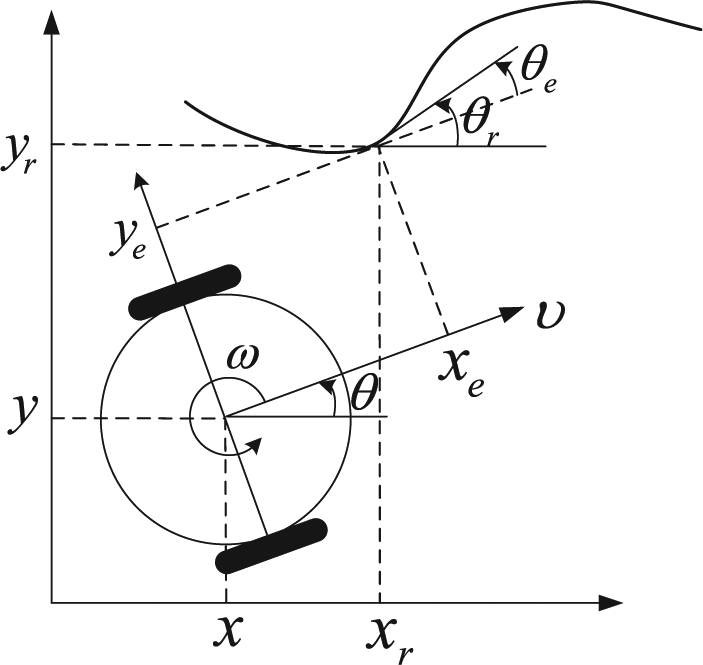
Trajectory tracking configuration of a unicycle-type mobile robot.

with the constraints

where
We aim to design the control inputs
Main results
In view of (1) and (5), defining the tracking errors (see Figure 1)

yields the tracking error system

Design the virtual controller

where

where

we design the torque controller

where


then the torque constraints (3) and the velocity constraints (4) are satisfied,

Then we have from (6), (9), (14a) and (14b) that

According to (8) and (9)

with

In view of (6) and (18)

Thus we have from (6), (15) and (17) that

Now, we prove that the torque constraints (3) and the velocity constraints (4) are satisfied. Assume that

where

In view of (12) and (21),

as well as for

since

where

Similar to the analysis of
Next, we analyse the system stability. Defining the Lyapunov function

If

For

which indicates that
Since

which is uniformly continuous by the above analysis and the uniform continuity of
Simulation and experimental results
Simulation results
We compare the performance between the controller used in the simulation of Chen et al. (2012) (referred to as Controller 1) and our controller (referred to as Controller 2). The simulation configuration is the same as that in Chen et al. (2012); that is, the reference trajectory is a circle with
Figure 2 shows the tracking trajectories of the first 10 seconds. It is observed that only Controller 2 drives the robot on the reference trajectory by
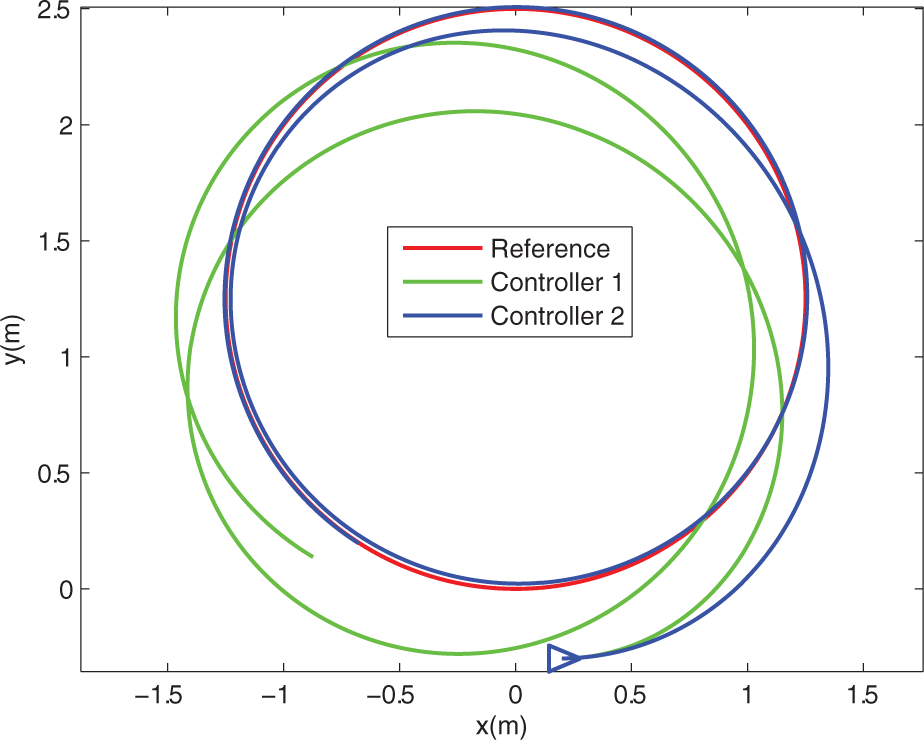
Simulation results: reference and tracking trajectories for
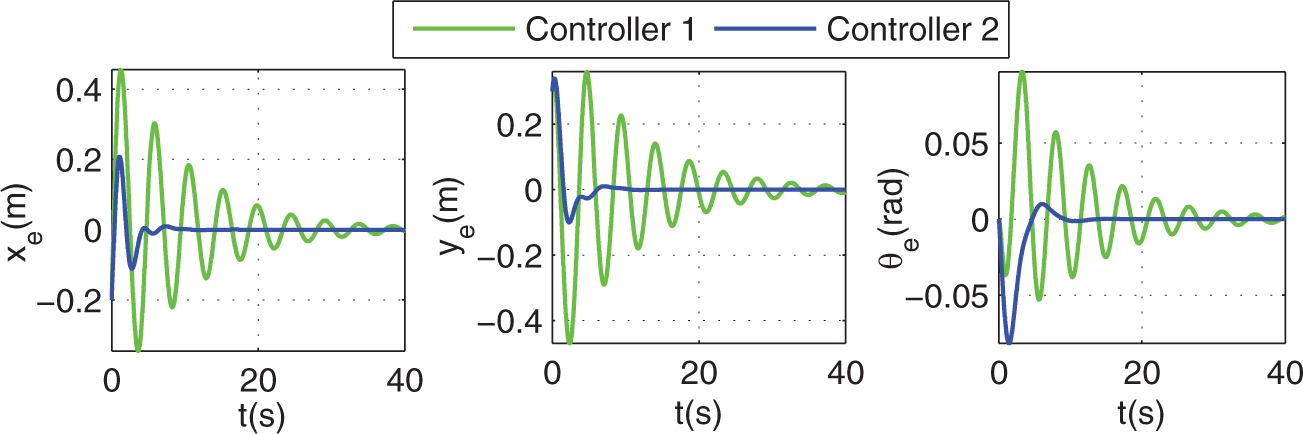
Simulation results: tracking errors.
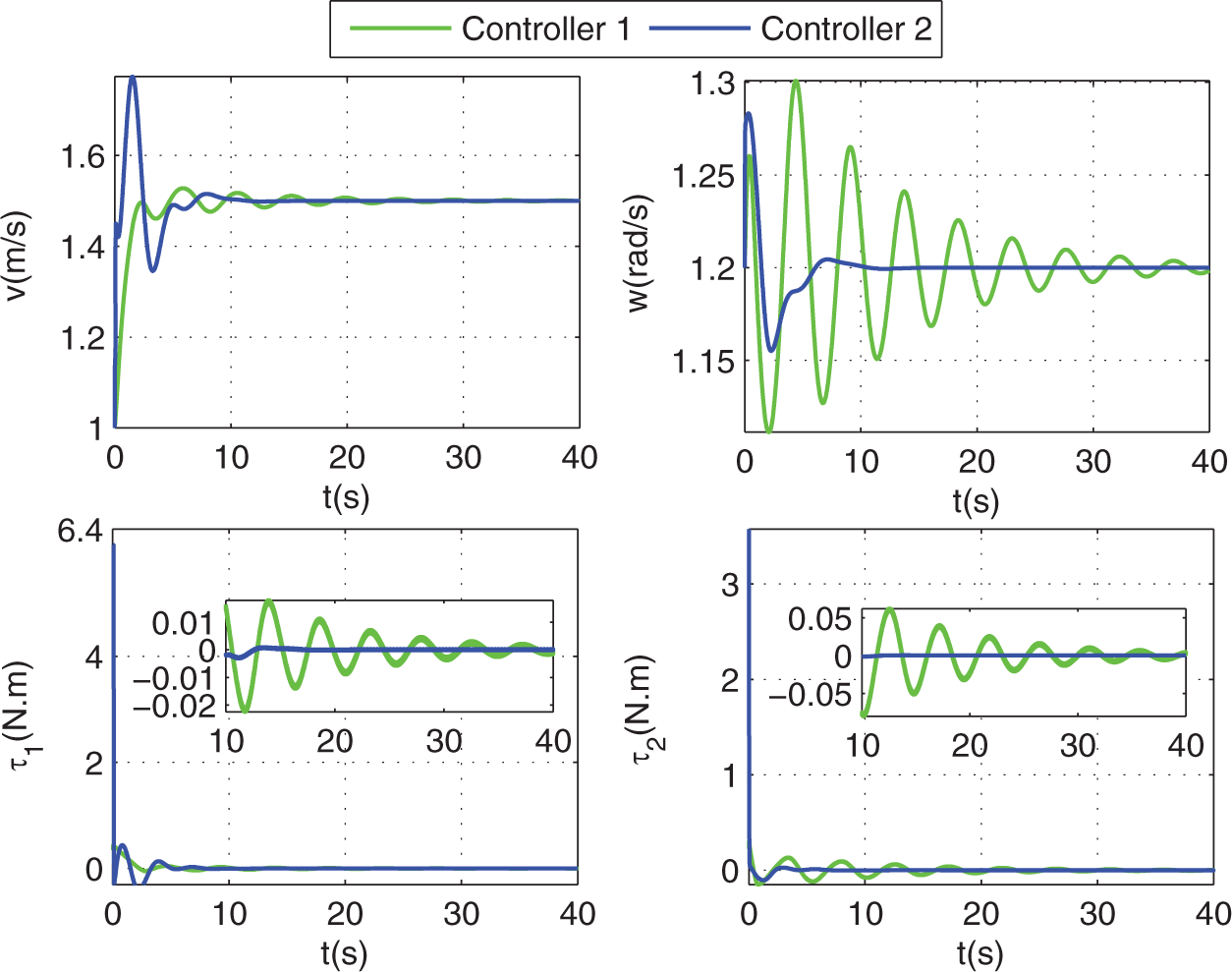
Simulation results: velocities and torque inputs.
Experimental results
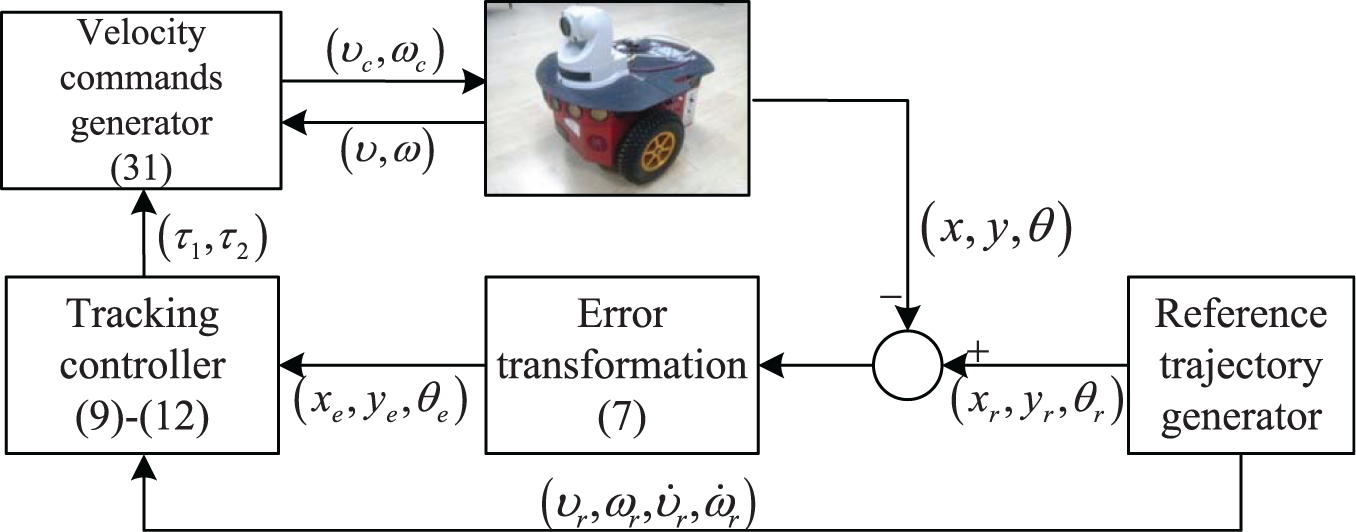
The experimental system is a Pioneer 3-DX differential-drive mobile robot manufactured by Adept Inc. Optical encoders are installed on the driving motor axes. The encoder reading is used to measure the robot velocities. The robot position and orientation are measured by fusing the encoder reading and the gyro measurement. Figure 5 shows the tracking control scheme. The reference trajectory generator produces the realtime reference pose for the mobile robot. The differences between the measured and reference poses are passed to the tracking controller after error transformation. The tracking controller uses the information of tracking errors, reference velocities and reference accelerations to generate torque control commands. Since the Pioneer 3-DX robot only provides the velocity control interface, the velocity command generator is employed to produce the velocity commands

where
Tracking control scheme of the Pioneer 3-DX mobile robot.
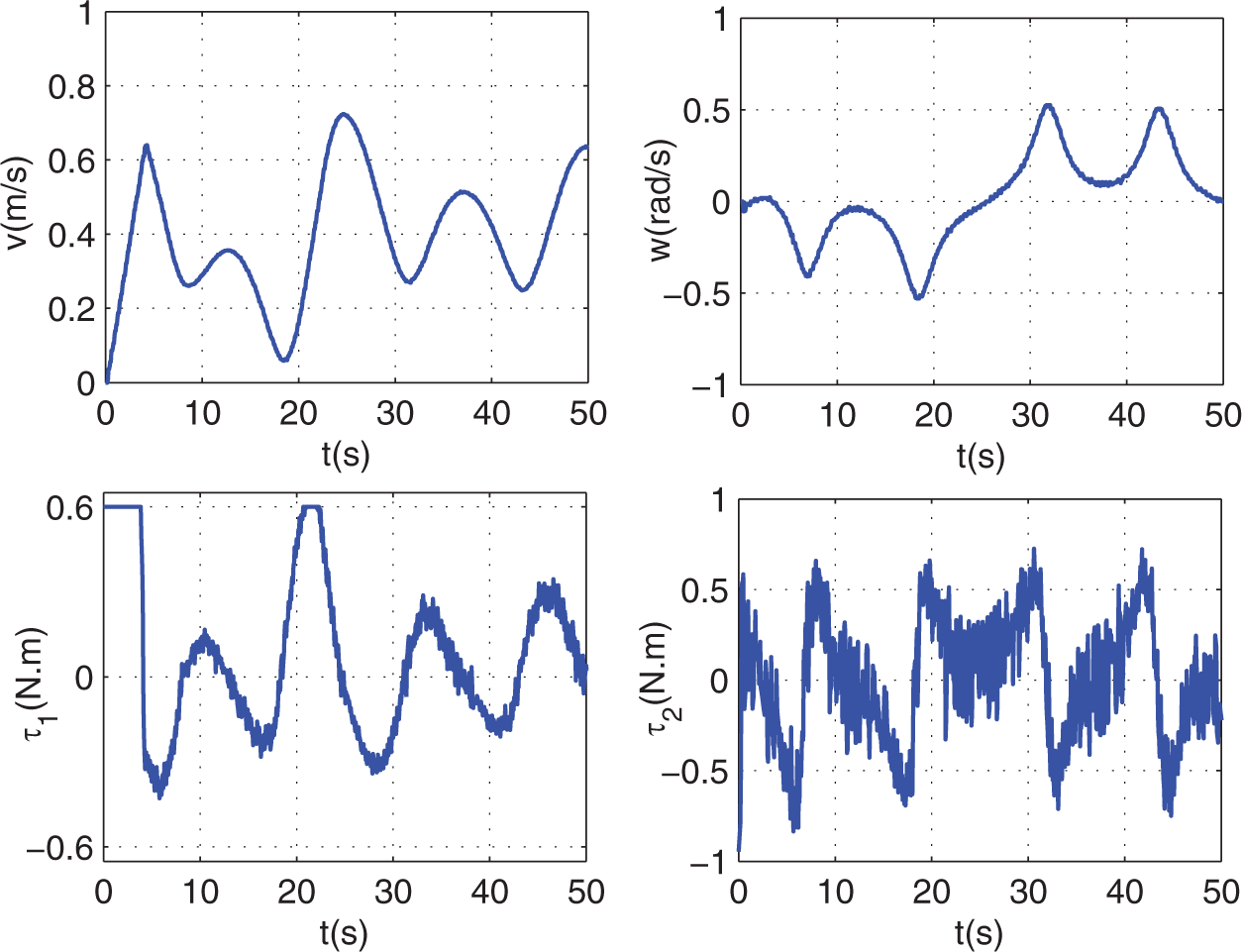
In the experiment, the torque and velocity bounds of the mobile robot are set as

of which
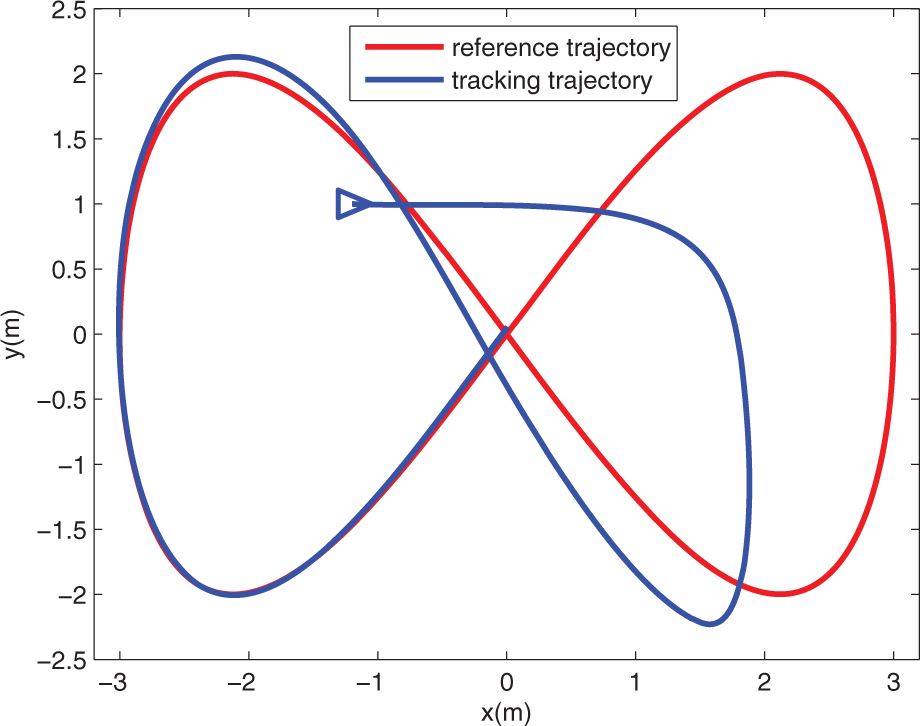
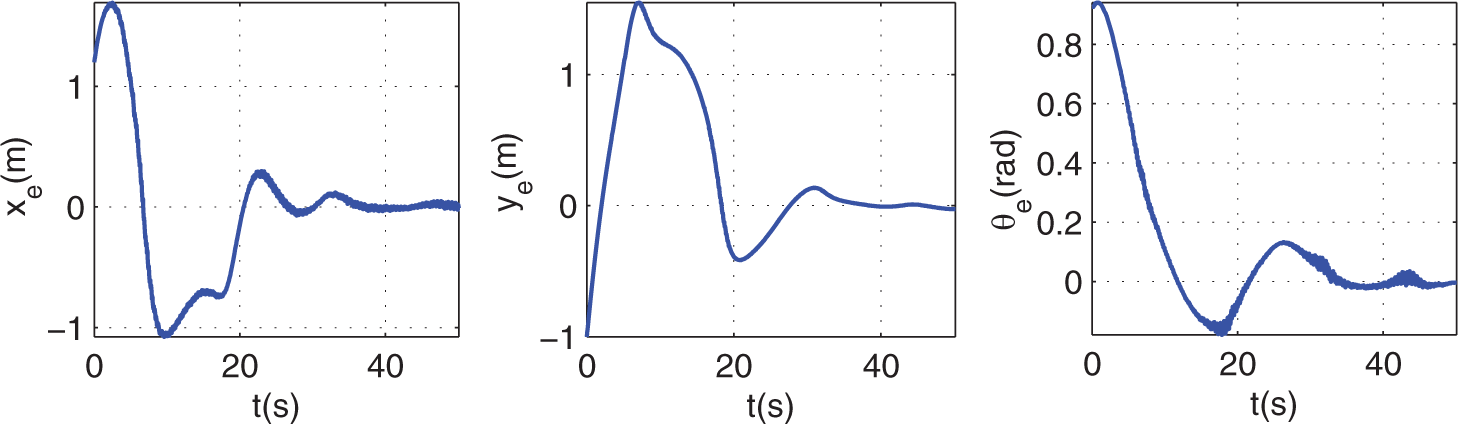
It is observed from Figure 6 that the mobile robot gradually converges to the reference trajectory and finally travels along it. The tracking errors presented in Figure 7 approach small neighbourhoods of zero. Figure 8 shows that the torques and velocities are restricted in preset bounds. At the initial four seconds,
Experimental results: reference and tracking trajectories.
Experimental results: tracking errors.
Experimental results: velocities and torques.
Conclusions
We addressed the constrained tracking control problem of unicycle-type mobile robots. In addition to the torque constraints, the velocity constraints were explicitly taken into consideration. A simple tracking controller incorporating two first-order filters was proposed. The use of filters greatly simplified the bound estimations of velocities and torques, and yielded the relaxed inequality constraints on the control design parameters compared to existing work. The simulation comparison showed better performance and less conservativeness of our controller, and the experimental results demonstrated the practical use of the proposed controller.
Footnotes
Funding
This work was supported by the National Basic Research Program of China (973 Program: 2012CB821200, 2012CB821201) and the NSFC (61134005, 61221061, 61327807).