






Abstract
In this paper, an adaptive neural network (NN)-based supply air temperature controller is proposed for an air handling unit (AHU) in heating, ventilation and air conditioning (HVAC) systems. The heat exchange dynamics within an AHU is complicated and almost impossible to model exactly. Moreover, it is subject to multiple external disturbance variables. To accommodate such uncertainties, a direct adaptive controller based on a two-layer NN is introduced to maintain the desired supply air temperature under varying operating conditions. To verify the performance of the proposed scheme, extensive experiments have been conducted on a pilot HVAC system. The experimental results substantiate that our method outperforms a conventional proportional–integral–derivative controller in terms of promptness to changing working conditions and robustness to external disturbances.
List of symbols
Subscripts
Introduction
At present, variable air volume (VAV) air conditioning systems are becoming widely used in commercial buildings and other facilities to supply air with a comfortable temperature and humidity. In VAV systems, a cooling coil unit (CCU) transfers the cooling load from an air loop to a chilled water loop, which directly impacts the indoor air quality, system efficiency, setting time, etc. Efficient and optimal operation of a VAV air handling unit (AHU) could save up to 23% of the energy compared with a constant air volume AHU (Kusiak et al., 2013).
In order to achieve efficient control performance, in early stages, modelling techniques have been extensively studied to describe the dynamic behaviour of an AHU. By simplifying the complex heat transfer behaviour in a CCU with an energy and mass balance law, Jin et al. (2006) and Salsbury T (1998) developed a simple mechanical model. The model demonstrates good approximation ability in comparison with the actual system output, but it requires exact knowledge of all component parameters, which are usually unavailable in practice. Thus, its applicability is highly limited. Moreover, the mechanism models are based on differential equations, which will result in huge computation load in designing the controller. In addition, Shin et al. (2002) proposed a data-driven linear model to represent the dynamic response of the AHU hot section. However, the linear model is obtained around a specific working condition and thereby cannot guarantee a satisfactory approximation performance under a varying working environments. To overcome the disadvantages of simple linear models, He et al. (2005) attempted to build a non-linear model of the entire system by fuzzy integration of a set of T-S models. However, this method demands the construction of a membership function of uncontrolled variables, such as the air mass flow rate and entering air temperature, for all operating conditions. As a result, it involves a lot of data collection and modelling effort. Furthermore, for those conventional model-based control strategies, an initial system dynamic model is required and the performance of controller relies deeply on the accuracy of the model. A mismatched model or external disturbance may lead to degraded control performance, or even unstable output.
On the other hand, artificial neural networks (ANNs) have been widely utilized for their outstanding approximation ability of non-linear mapping along with online learning (Jagannathan and Lewis, 1996). In recent years, a direct adaptive ANN controller has been developed (Ge and Wang, 2002; Ge et al., 2004; Noriega and Wang, 1998; Sanner and Slotine, 1992; Wang et al., 2004a), relaxing the requirements of initial learning phase, so that control action is immediate. In other words, the ANN controller exhibits a learning-while-functioning feature instead of a learning-then-control feature. Therefore, the ANN unit can be directly integrated into the controller to form a closed-loop system. Usually, the error between the desired output and the actual one is fed back to update the ANN weights. The relaxation of an a priori model of the system renders the controller very easy to design and implement.
Therefore, in this paper, an adaptive ANN controller is proposed to handle the complex heat transfer in an AHU without explicitly building an accurate model of its dynamics. By analysing the heat transfer behaviour from a mechanism perspective, variables that dominate the heat transfer process are first located and the chilled water pump speed is chosen as the control input signal to maintain the supply air temperature. The non-linearity and system uncertainty caused by the external environment and uncontrolled variables are accommodated via a neural network (NN) online updating algorithm. Furthermore, to verify the feasibility of the proposed controller, real-time experiments have been conducted on a pilot heating, ventilation and air conditioning (HVAC) system. The results substantiate that the proposed scheme is able to deliver a better performance in maintaining the supply air temperature even under varying working conditions and external disturbances when compared with a conventional proportional–integral–derivative (PID) controller.
The rest of this paper is organized as follows: the next section delivers detailed information on the system setup of our HVAC system. Then problem formulation is given, based on which an ANN controller design is introduced. A real-time experiment of the proposed method and conventional PID controller is conducted with comparison results shown. Finally, some conclusions are presented.
System setup
The diagram of a typical VAV air conditioning system is shown in Figure 1. Before entering the CCU, fresh air is mixed with some of the returned air from the conditioned space. Subsequently, the air mixture flows over the CCU forced by the supply fan. At the same time, chilled water flows into the CCU to absorb the thermal load in the air mixture and lower its temperature to a proper point. All fans and pumps are driven by variable speed drivers (VSDs), so that the air/water flow can be conveniently adjusted to suit all working conditions. In addition, all VSDs are connected to a PC through an RS232 protocol in such a way that the speed of the fans and pumps can be read and manoeuvred in a real-time fashion. To complete a closed control loop, resistance temperature detectors (RTDs) are installed in the inlet and outlet of the cooling coil to measure the temperature of chilled water, entering air and supply air. All temperature signals are collected by a slave processor and are subsequently transmitted to the PC via an RS232 protocol.

Schematic diagram of typical air handling unit (AHU) of heating, ventilation and air conditioning (HVAC) pilot plant.
Problem formulation
The heat transfer process taking place in the AHU involves two loops: a chilled water loop and an air loop, as shown in Figure 2. Forced by the chilled water pump, chilled water flows into the cooling coil from the inlet with water flow rate

Diagram of heat transfer within cooling coil unit.
The objective of this article is to design a robust controller to maintain the air temperature under varying working conditions in the presence of unknown system dynamics and external disturbance. Therefore, the supply air temperature
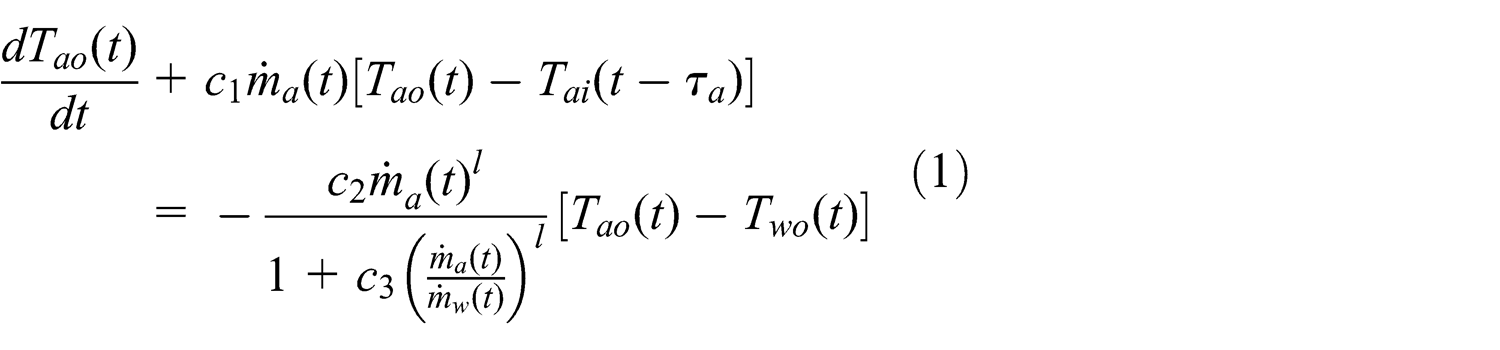
where

where

Meanwhile, as the controller is implemented on a digital processor, the continuous-time system (3) has to be further transformed into a discrete-time system via a Euler equation:

where

Function
Moreover, since the mass flow rate is manipulated by the frequency of the air fan,

Apparently, it is a typical non-linear non-affine-in-control system with unknown dynamics.
By recalling (4), it is evident that the control direction in terms of the control signal

where

Diagram of the air handling unit (AHU) closed-loop feedback control system.
Controller design
Firstly, rewrite the system dynamics (7) as below:

where
By assuming the desired supply air temperature is

Thus, the dynamics in term of the tracking error can be written as:

If functions

where

As

where
Considering that the ideal weight


Structure of two-layer neural network.
where


Transfer characteristic of the activation function.
As

Hence, objective of the proposed NN controller is to reduce the error of

where
Finally, the architecture of the whole system including controller design is shown in Figure 6, where
Step 1. Collect the values of current supply air temperature and the disturbance signals defined in (8) to form the NN input vector
Step 2. Calculate the control signal based on the controller of (14) with current weight vector
Step 3. Wait for the next control interval, compute the error between the actual air temperature and the desired value, update the NN weight vector based on (17) and make the time index
Step 4. Go back to Step 1.

The diagram of the neural network controller system.
Experimental test
To illustrate further the performance of the proposed controller, real-time experiments have been conducted on a pilot HVAC system built in our lab. The chiller in the system is driven by a Siemens Micromaster 440 VSD with maximum cooling capacity of 3.2 kW. The chilled water pump and supply air fan are both driven by Siemens Micromaster 420 VSDs with maximum power of 0.37 and 0.145 kW, respectively. All the signals are collected by an Advantech Adam 5000E slave processor and transmitted to an Advantech UNO-2178A industrial computer, where the control law is implemented. ForceControl software is installed in the computer to record the data information during the experiment in a real-time manner and Matlab software is used to run the control algorithm. Furthermore, the entire experimental platform is shown in Figure 7.

Experimental system setup: (1) cooling coil; (2) supply air fan; (3) conditioned room; (4) chilled water pump; (5) chiller; (6) industrial computer; (7) slave processors; (8) variable speed driver (VSD).
A conventional PID controller has also been employed to maintain the desired supply air temperature for comparison purposes. The function of an AHU is to maintain the indoor air temperature (to cover the cooling load in the conditioned space) with a constant supply air temperature by manipulating the air fan speed. The supply air temperature is expected to be maintained at the set point as steadily as possible. When the load of the AHU varies, the controller is expected to provide a quick response, so that the supply air temperature can be maintained to the desired value. Thus, the following tests have been carried out and the performance results of the controllers are compared in terms of settling time and overshoot (Zhou and Claridge, 2012):
Command following test: the output variable can track changes of its set point with stability. When the desired supply air temperature is changed, the controller should react promptly so that output can be regulated to its new set point.
Disturbance rejection: Air mass flow rate accounts for much of the non-linearity and time varying characteristics in VAV scheme (He et al., 2005). Therefore, air fan frequency has been altered deliberately to imitate the varying external environment. The objective of the controller is to maintain the supply air temperature at the set point, even when it is subject to varying air mass flow rate.
In our controller implementation, the number of neurons of the NN is selected to be 30. Weights of the NN hidden layer
Controller parameters.

Command following capacity test
During the command following test, it was expected that when there was a change in set point, the controller could react promptly so that the output can still be properly regulated at the desired value.
During the test, after the system is stabilized at 20°C, the set point was lowered to 19°C at 50 s. Figure 8 shows the trajectories of the output for two controller designs respectively. From the results, both of PID controller and NN controller were able to respond to the set point change. With the help of properly selected parameters, the PID controller has handled the inherent non-linearity of the process and the supply air temperature was maintained to its new set point 19°C at about 350 s. By contrast, without a priori information of the system, the NN controller has learned the internal dynamics via real-time feedback signal and subsequently compensated for it by tuning the NN weight vector online. Consequently, it has managed to achieve the control objective by 300 s.

Results of command following test: (a) control result of neural network (NN) controller and proportional–integral–derivative (PID) controller; (b) chilled water pump frequency during the experiment; (c) NN weight vector during the experiment.
Disturbance rejection test results
For this test, the supply air temperature was initially stabilized at 19°C and the air flow rate was altered to test the controller performance. In Figure 9(a), the supply fan running frequency was increased from 15 to 25 Hz at 100 s, which involved more heat load to the heat exchange process within AHU. As a result, the supply air temperature rose promptly after then. Subsequently, both NN and PID controllers reacted to the disturbance by varying the frequency of chilled water pump. Since the supply air fan frequency was integrated into the NN input vector, the NN controller was more sensitive to its variation. Therefore, maximum tracking error of 0.68°C is achieved for the NN controller, while it is 0.8°C for the PID controller. Besides, the NN controller outperformed the PID counterpart in terms of settling time, which is 230 and 360 s, respectively.

(a) Supply air fan frequency; (b) control results of both proportional–integral–derivative (PID) controller and neural network (NN) controller; (c) chilled water pump frequency during experiment; (d) NN weight vector during the experiment.
Moreover, as shown in Figure 10, in the supply fan deceleration experiment, after the supply fan frequency decelerated from 25 to 16.5 Hz, the NN controller exhibited a quicker response than the PID controller. The learning-while-functioning feature of NN is capable of reacting to the varied heat transfer characteristics by tuning the weight vector via the new data information. Thus, the NN controller has achieved better settling time and output overshoot comparatively.

(a) Supply air fan frequency; (b) control results of proportional–integral–derivative (PID) controller and neural network (NN) controller; (c) chilled water pump frequency during experiment; (d) NN weight vector during experiment.
Discussion
The PID controller with well selected parameters can give a satisfactory performance near specific operating conditions. When the frequency of supply air fan changes, the process dynamic characteristics are changed. The performance of the fixed PID controller declines under different operating conditions. That is to say, the PID controller is not capable of capturing the change of system dynamic characteristics. As to the adaptive NN controller, by adding the disturbance signal into the NN input, the controller was more sensitive to the operating condition variations and could respond quicker than PID. By tuning the weight vector of NN online using new data information collected from the experiment, the controller can compensate for the non-linearity aroused by changing the operating conditions. Therefore, the proposed controller has shown more robustness with respect to external disturbance and promptness to flexible working conditions.
Conclusion
This paper has proposed a direct adaptive NN controller for supply air temperature regulation, which can accommodate the unknown dynamic of heat transfer process in an AHU. Through problem formulation, factors influencing the heat transfer behaviour have been taken into the NN controller. With an effective online NN weights updating law, the NN controller is able to handle the system non-linearities and uncertainties. Both command following and disturbance rejection tests have been conducted on an experimental platform to verify the feasibility of the scheme. Comparative results demonstrate that the proposed NN controller outperforms the conventional PID counterpart.
Footnotes
Conflict of interest
The authors declare that there is no conflict of interest.
Funding
This work was partially supported by the National Natural Science Foundation of China (NSFC) (grant numbers 21076179 and 61104008).