






Abstract
The problem of adaptive finite-time control is addressed in this paper for a class of non-linear delay systems. First, the concepts of adaptive finite-time stability and adaptive finite-time boundedness are defined, respectively. Then, by resorting to the Lyapunov–Krasovskii functional technique, some new delay-dependent criteria guaranteeing adaptive finite-time boundedness and adaptive finite-time stability are developed, respectively. An explicit expression for the desired non-fragile state feedback controller is also presented. Finally, a numerical example is provided to demonstrate the effectiveness of the proposed results.
Keywords
Introduction
The concept of finite-time stability, which was first introduced to the control field in the 1960s (Dorato,1961), is that, given a bound on the initial condition, the system’s state does not exceed a certain threshold during a specified time interval. Unlike Lyapunov asymptotical stability defined on an infinite time interval, finite-time stability shows the behaviour of the system over a fixed finite-time interval. In fact, in many practical applications, such as chemical processes, manufacturing systems, and power systems, the main concern is the transient response of system states over a finite-time horizon. In Amato et al. (1999), the authors further extended the definition of finite-time stability to the concept of finite-time boundedness. Since then, the problems of finite-time stability and finite-time boundedness have been extensively studied for various systems (Amato et al., 2001, 2006; Du et al., 2009; Feng et al., 2005). Note that many meaningful results on finite-time stability and finite-time boundedness have been developed in the past decade. However, it should be pointed out that, to date, the systems considered in the previous references do not refer to unknown parameters. When the systems contain unknown parameters, the above-mentioned methods may not guarantee system finite-time stability and finite-time boundedness. Hence, it is necessary to develop some new conditions to solve the problem of finite-time stability and finite-time boundedness for systems with unknown parameters.
In addition, time delays often present in many practical systems such as chemical processes and networked control systems as well as long transmission lines in pneumatic systems. The existence of time delays may degrade the system performance, cause oscillations, and lead to instability. In the field of engineering, in the past several decades, considerable attention has been paid to the study of the stability and finite-time stability of time-delay systems. Some useful results have been reported in the literature (Hou et al., 2012a, 2012b; Wang et al., 2009a, 2009b, 2009c; Wu et al., 2009; Zhang and Yu, 2009; Zong et al., 2008, 2011).
In the above references, there is an assumption that the controller will be implemented exactly. However, in practice, the controller exhibits a certain degree of fragility due to inaccuracies or uncertainties in the implementation of a controller design. Hence, some researchers have developed non-fragile controller design algorithms in common linear or non-linear uncertain systems (Hu et al., 2013; Liu et al., 2014). To date, to the best of the authors’ knowledge, the problems of adaptive finite-time control for non-linear delay systems have not been fully investigated, which motivated us to carry out the present study.
In this paper, attention is focused on solving the adaptive finite-time control problem for a class of non-linear delay systems. Because of the existence of time delays and unknown parameters, this problem is apparently hard to tackle. The main contributions in this paper can be illustrated from the following three aspects. First, the definitions of adaptive finite-time boundedness and adaptive finite-time stability are expanded for the considered systems, respectively. Second, a new non-fragile adaptive finite-time controller is proposed for the controlled plant with uncertain parameters and external disturbances. Third, on the basis of this non-fragile adaptive controller, some new delay-dependent criteria guaranteeing adaptive finite-time boundedness and adaptive finite-time stability are developed for the non-linear delay systems. By virtue of the cone complementary linearization (CCL) technique and the linear matrix inequality approach, the gain of the desired non-fragile adaptive controller can be obtained. Finally, a numerical example is proposed to demonstrate the effectiveness of the obtained results.
Notation. The notation of this paper is standard. For symmetric matrices P, the notation
Problem formulation and preliminaries
Consider the following non-linear delay system
where
where U is a given constant weighting matrix.
For system (1a) with
where
The general idea of finite-time boundedness presents the boundedness of the state of systems over a finite-time interval given both some initial conditions and an external disturbance working on the systems (Amato and Ariola 2005; Amato et al., 1999, 2001, 2006). With the aid of these definitions, in the sequel, we present the definition of adaptive finite-time boundedness for the case of non-linear delay systems.
where
for all F satisfying
The non-fragile adaptive controller is designed as
where
where
Given six positive scalars
Main results
Adaptive finite-time boundedness and stability
In the sequel, the adaptive finite-time boundedness and finite-time stabilization (
where
and
where
Calculating the derivative of
Note that
Combining equations (8c) and (9), yields
In view of equations (5a), (8), and (10), there holds
where
Solving the inequality (11), we obtain
For any
By equation (7), we derive
and
Then, from equations (13)–(15), the following inequality holds
which, combining with equation (5b), further implies that
This completes the proof of Theorem 1.□
When
For system (1a) with
where
Non-fragile adaptive finite-time controller design
Now, we are in a position to present a solution to the problem of non-fragile adaptive finite-time control for system (4). By Theorem 1, we can derive the following result.
where
and
where
Based on the Schur complement formula, the following inequality holds
where
Using Lemma 1 and the Schur complement formula, equation (19) can be obtained. Replacing
It is noted that equation (19) is not a linear matrix inequality due to the existence of the terms
We introduce the new variable
Moreover, the non-fragile adaptive controller gain is given by equation (3) with
The inequality (24) shows that the conditions in Theorem 4 are not strict linear matrix inequalities. With the help of the CCL method, the non-convex feasibility problem formulated by equations (20), (23), and (24) can be transformed into the following non-linear minimization problem
Minimize
subject to equations (20) and (23) and
If the solution of the above minimization problem is
Based on Theorems 2 and 4, we have the following result.
Moreover, the non-fragile adaptive controller gain is given by equation (3) with equation (25).
A numerical example
In this section, an example is presented to show the effectiveness of the main results in this paper.
Consider system (1) with the following parameters
Let
Then, applying Theorem 4 and solving the corresponding matrix inequalities, we can obtain the parameters of the non-fragile adaptive controller (3) as follows
We choose the initial functions
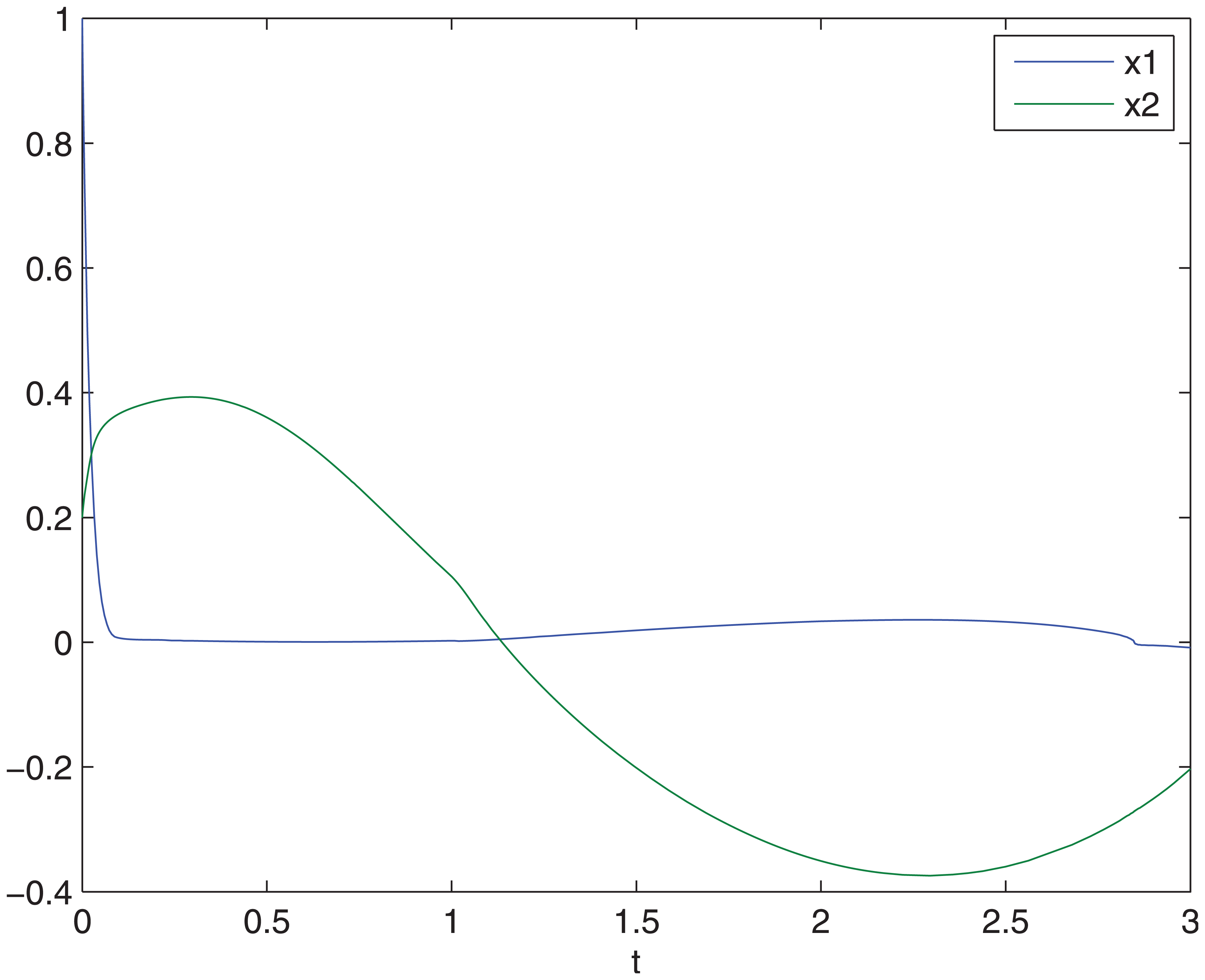
The state of
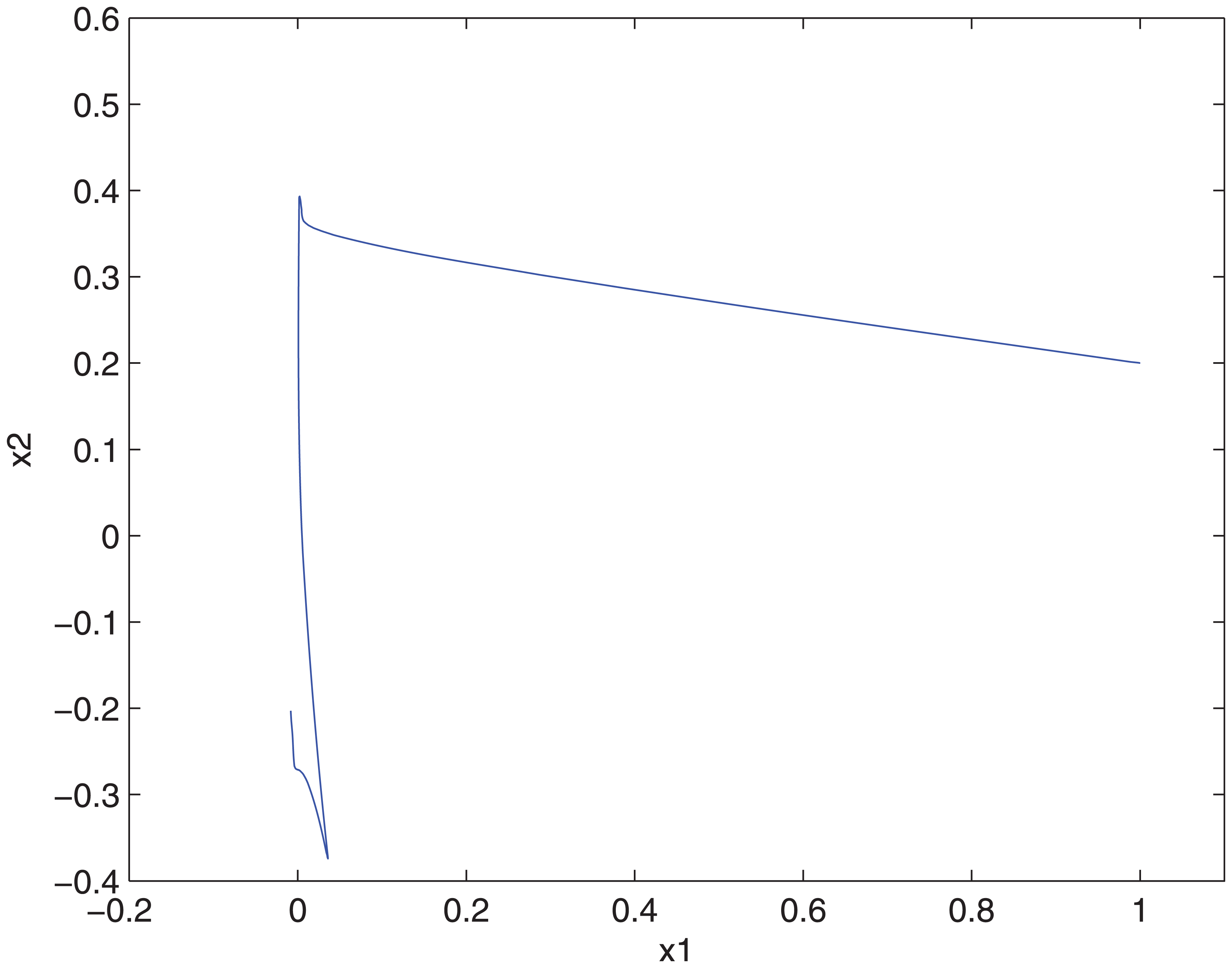
The plot of state
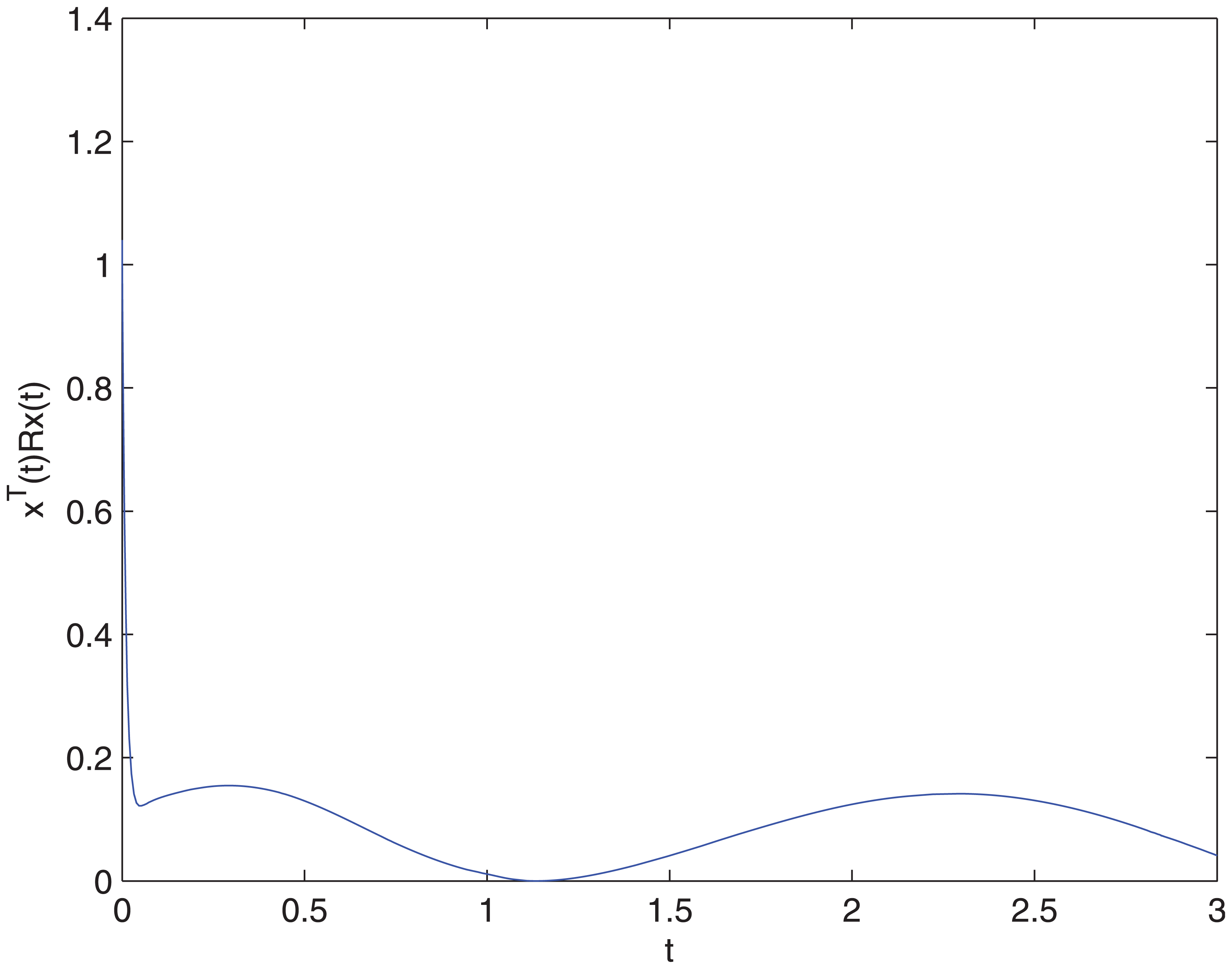
Time history of
Conclusions
In this paper, the problem of adaptive finite-time control via non-fragile state feedback has been studied for a class of delay systems. The concepts of adaptive finite-time stability and adaptive finite-time boundedness have been defined, respectively. Some sufficient criteria have been developed to solve the problem of adaptive finite-time boundedness, adaptive finite-time stability and adaptive finite-time non-fragile state feedback control. A feasible non-fragile state feedback controller has also been given. Finally, a numerical example has been provided to show the effectiveness of the results.
Footnotes
Funding
This work was supported in part by the National Natural Science Foundation of China (grant numbers 61304059, 61304153, and 61403227), the Natural Science Foundation of Shandong Province (grant number ZR2013FQ016), the Specialized Research Fund for the Doctoral Program of Higher Education (grant number 20133705120004), and the Dr startup funds of Qufu Normal University (grant number 2012024), the Youth Foundation of Humanities and Social Sciences from the Ministry of Education of China (No. (15YJCZH204)) and the Tianjin City High School Science and Technology Fund Planning Project (No. (20141001)).