In this paper, an adaptive neural network (NN) control method is proposed for the problem of nonlinear course control of ships with input constraints and unknown direction control gains. Specifically, dynamic surface control is used to overcome the problem of explosion of complexity inherent in the backstepping technique, and the Nussbaum function is employed to deal with the unknown signs of control gains. It is proved that the proposed adaptive NN control method, which is composed of dynamic surface control and a backstepping technique with the Nussbaum gain function, is able to guarantee uniform ultimate boundedness of all the signals in the controlled system. In addition, the tracking error between the output of the controlled system and a desired trajectory is shown to converge to a small neighbourhood of the origin. Finally, one example is introduced to illustrate the proposed theoretical results.
Recently, many researchers have focused their attention on the course control problem of ships (Fossen, 2000), which is known to be a difficult problem. Much work has been done with regard to this topic, and some modern control methods have been proposed (Mei et al., 2015; Sun et al., 2016, 2017a,b); see for example adaptive fuzzy control (Yang et al., 2003), backstepping control (Du et al., 2007), dynamic surface control (Du et al., 2014; Hou and Duan, 2011) and adaptive neural network (NN) control (Luo et al., 2009).
It has been observed that the adaptive NN control method has proved to be particularly effective for nonlinear uncertain systems of ships with unknown nonlinear functions. By employing the approximation property of NNs, it is very accurately estimate the unknown nonlinear part of systems, which will not make much effort on system modelling. There exist some real applications. For example, a back propagation NN model was proposed in Wang et al. (2017) by using solar radiation as the input parameter to establish the relationship between solar radiation and air temperature. In Gu et al. (2015), two finite mixture models to capture the structural information of the data from binary classification were used with a nonlinear model by exploiting kernelization techniques. A self-adaptive algorithm which is based on the global best candidate for global optimization was proposed in Xue et al. (2017) for some complex strategies. Different from earlier NN control methods using optimization techniques, where analytical results may be not obtained, several adaptive NN control methods have been proposed with Lyapunov stability (Lewis et al., 1996; Sanner and Slotine, 1992; Zhang et al., 1999). Specifically, the NN controller was proposed in Zhang et al. (2000b) for a class of unknown and minimum phase nonlinear systems. In Zhang et al. (2000a), an adaptive NN controller with backstepping technology was proposed by using an integral-type Lyapunov function, which overcomes the controller singularity problem. A direct adaptive NN controller was presented in Ge and Wang (2002) for a class of affine nonlinear systems with unknown nonlinearities, which avoids the singularity problem of the controller using a special property of the affine term.
Note that in the above-mentioned works input constraints are not considered, which a crucial issue for energy balance. For example, in the work of Zhang et al. (2017), an optimal cluster-based mechanism was proposed to load balancing with multiple mobile sinks for these problems by using a modified multi-hop layered model. In Zhang et al. (2016), the two problems of the relocation of sensors with the minimum number of mobile sensors and formation with minimum energy cost were studied. In fact, input constraints have been extensively studied due to their universal existence in real applications (Chen et al., 2010). For example, the controller design has been given for ocean surface vessels subject to input saturation in Chen et al. (2009) with an adaptive NN control method. Considering the tracking error dynamic systems of underactuated ships with input saturation, two finite-time controllers were designed in Huang et al. (2015) with the backstepping technique. By using a gain scheduled control method, the rudder roll stabilization problem of ships with input rate saturation has been studied in Lauvdal and Fossen (1998) in a computationally effective way. It is known that the uncertainty usually causes performance degradation (Xiao and Yin, 2016; Xiao et al., 2016, 2017). In Li et al. (2011b), an adaptive backstepping control algorithm is proposed for the course autopilot of ships with parameter uncertainty and input saturation. In Li et al. (2011a), a new adaptive NN controller was proposed for the course autopilot of ships with input saturation, where an auxiliary system is introduced to deal with the input constraints of ships. However, the signs of control gains in Li et al. (2011a) are known a priori, and, in general, the directions of control gains of ships are unknown.
In this paper, we will propose a new adaptive NN controller to solve the course-keeping problem of ships with input constraints. Specifically, the dynamic surface control is used to overcome the problem of explosion of complexity inherent in the backstepping technique, and the Nussbaum function is employed to deal with the unknown signs of control gains. To deal with the input constraints, a smooth function is introduced to approximate the saturation function, which is motivated by Wen et al. (2011). It is shown that the proposed adaptive NN control method, which is composed of dynamic surface control and a backstepping technique with the Nussbaum gain function, is able to guarantee uniform ultimate boundedness of all the signals in the controlled system. In addition, the tracking error between the output of the controlled system and a desired trajectory is shown to converge to a small neighbourhood of the origin. The main challenge of this work is how to deal with input constraints to make use of the backstepping technique.
The rest of this paper is organized as follows. In ‘Problem formulation’, the course-keeping problem of ships is formulated. ‘Main results’ presents the design procedure and its stability analysis. In ‘Simulation’, a simulation example is given to show the performance of the controller. The final section concludes this paper.
Problem formulation
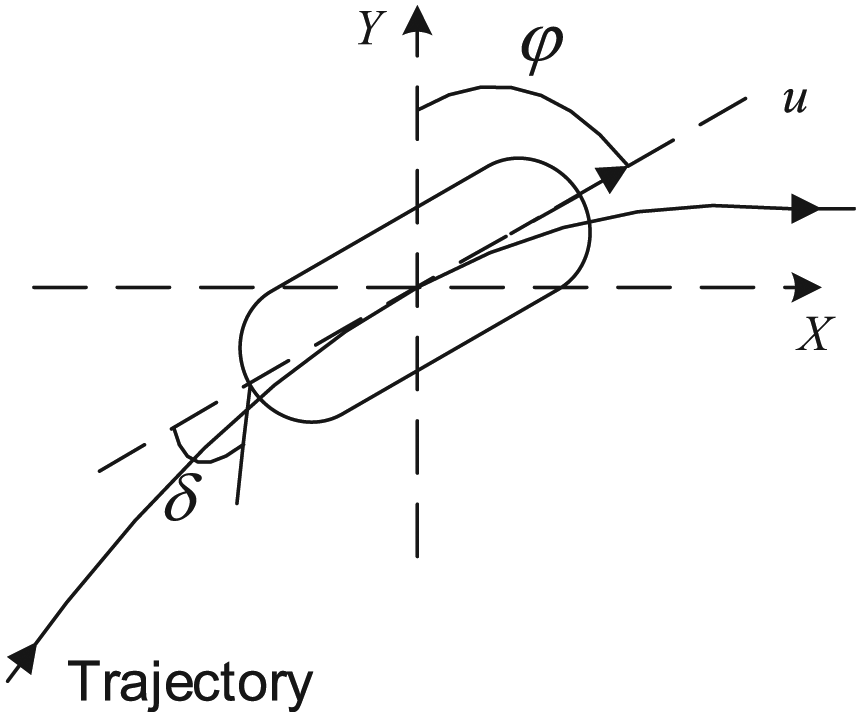
In this study, we consider the model of ship steering introduced by Jia and Yang (1999), whose physical steering model is shown in Figure 1, and whose mathematical model is in the following form:
where is the rate of the heading angle of the ship, that is, , and is the rudder angle. The parameters and represent the gain constant and the time constant, respectively. represents an unknown nonlinear function, which is given as where , are all constants. In this paper, we assume that the parameters , and are unknown constants.
The horizontal motion of the physical model of the ship.
Defining and , the nonlinear model of (1) can be transformed into
where , , is the bounded disturbance, and is the output of the control input with saturation constraints, and is defined as follows:
where is a known bound of , and are the standard sign and saturation functions, and is the designed control input.
The control objective is to design an adaptive NN control law for system (2) with input constraints such that all the signals in the closed-loop systems remain uniformly ultimately bounded, and the tracking error between the output and a desired trajectory converges to a small neighbourhood of the origin.
To design the control law of (2) with input saturation, we consider a general class of second-order nonlinear systems
where and are the states and output of the system, respectively; and , , are unknown smooth functions; and , , are the bounded disturbances.
In what follows, some useful definitions and lemmas will be introduced.
A radial basis function NN (RBFNN) is usually adopted to approximate any continuous nonlinear functions, and can be regarded as a two-layer network including the hidden layer and the output layer. In this study, we select the following RBFNN (Haykin, 1999) to approximate a continuous function :
where is the input vector, is the weight vector, is the NN node number, and , with , being chosen as the Gaussian functions:
where is the centre of the receptive field and is the width of the Gaussian function. It has been proved (Sanner and Slotine, 1992) that if is chosen to be sufficiently large the network (5) can approximate any continuous nonlinear functions over a compact set to any arbitrary accuracy as
where are the ideal constant weights and is the approximation error.
Assumption 1.There exist ideal constant weights such that with constant for all .
Remark 1.The ideal constant weights can be regarded as an artificial quantity required for analytical purposes, which is defined as the value of that minimizes for all , that is,
Furthermore, we let be the estimate of , and the weight estimation error is .
Definition 1.(
Ye and Jiang, 1998
) The function is of Nussbaum type if it has the following properties:
Lemma 2.(
Ge et al., 2004
) Let and be smooth functions defined on with , and be an even smooth Nussbaum-type function. If the following inequality holds:
where and are some suitable constants, is a time-varying parameter with values in the unknown closed intervals and , then and must be bounded on .
It is noted that the saturation model (3) is non-smooth, that is, compared with there is a sharp corner in control input . Therefore, the backstepping method cannot be directly used. In order to apply this method, we define a smooth function to approximate the saturation function as follows:
Then we can obtain
where and is a constant. Substituting the approximated saturation function (13) into (4), we can obtain
In order to design the control laws of (14), the following assumptions are reasonable and needed.
Assumption 2.The parameters , and , , are all bounded such that and , respectively.
Assumption 3.The desired trajectory is a smooth function, and and are bounded.
Assumption 4.The signs of the unknown control gains and are unknown, but the control gains are bounded such that and , where and .
Main results
In this section, we will design an adaptive NN control law which is composed of dynamic surface control and the backstepping method. The design procedure can be divided into two steps, and in each step we construct an appropriate Lyapunov function for the stabilization problem of the system. The detailed design procedure is given as follows.
Step 1
Define , and the error variables and , where is the output of a first-order filter with as a virtual control law for the first subsystem. We also define the notation . In view of (14), the derivative of is
Since the condition is that is unknown, the feedback control law cannot be implemented in practice. As we see, the unknown part is a smooth function of and , where . Therefore, we should use an RBFNN to approximate , such that
It follows from (15) that
Since we have defined , there exists a desired feedback control law
where is the design parameter, is the adaptive gain matrix, is a small constant, and the term is introduced to improve the robustness with the NN approximation error . It has been proved in Ge and Wang (2002) that without such a term, the NN weight estimate may lead to very large values and result in a variation of high-gain control laws.
Consider the Lyapunov function
Then the time derivative of is
where we have defined . According to Lemma 1, we have
It follows from (22) that
Since is the output of a first-order filter with as a virtual control law for the first subsystem, we can obtain
where is the time constant of the first-order filter, and . Since , we have
Therefore, we obtain
which implies
where is a positive continuous function associated with parameters and . Again, with Lemma 1 we have
Consider the following Lyapunov function:
Its time derivative is
where . By using completion of squares, we obtain
It follows from (32) that
Step 2
In this step, we will design the control input in (14). Since we have defined , the time derivative of is
Similarly, we construct a Lyapunov function
and its derivative is
where , and we have used an RBFNN to approximate , such that
The following feedback control laws are proposed for the control input :
where is the design parameter, is the adaptive gain, is a small constant, and the term is introduced to improve the robustness with the NN approximation error .
It follows from (37) that
where we have defined . Using Young’s inequality, we have
Consider the following Lyapunov function:
Then we have
Based on the above design procedure, the main result can be summarized as follows.
Theorem 1.Consider the system (4) with input saturation (13) under Assumptions 1 to 4. If the initial conditions of the system are bounded, all signals of the closed-loop system remain bounded with the designed control laws (18) and (39) and the updating laws (19), (20), (40) and (41). Meanwhile, by properly choosing design parameters, the tracking error between the output and the desired trajectory converges to a small neighbourhood of the origin.
Proof. To prove the signals of the closed-loop system are bounded with the designed control laws, we first consider the Lyapunov function (31). We have
where the parameters and are chosen as
Then, multiplying on both sides of (46) and integrating it on the interval , we have
According to Assumption 4, we have
Consequently, if is bounded on the interval , we find that the term is bounded, and (49) can be written as
where we have defined
In view of Lemma 2, it is shown that and are all bounded on the interval . Moreover, since is bounded, it is easy to know that is bounded.
In what follows, we consider the Lyapunov function (44). We have
where we have defined
Similarly, multiplying on both sides of (52) and integrating it on the interval , we have
where
In view of Lemma 2 and Assumption 2, it can be proved that and are all bounded on the interval . Moreover, since is bounded, it is easy to know that is bounded.
Finally, we consider the following Lyapunov function:
Substituting (46) and (52) into the time derivative of (57), we can obtain that
where we have defined ,
and
Multiplying on both sides of (58) and integrating it on the interval , we have
where
By using Lemma 2, it is easy to see that and are all bounded on the interval . Therefore, all the signals of the controlled system are bounded. In addition, the tracking error between the output and the desired trajectory converges to a small neighbourhood of the origin. This completes the proof. □
Simulation
In this section, an example is presented to demonstrate the effectiveness of the proposed adaptive NN control for the course-keeping of ships with input constraints. Consider the following model of ships:
where , and the input saturation is with and , where is the designed control input. The control objective is to guarantee that all the signals of the system (63) with the proposed controllers are bounded, and that the output can track the following desired trajectory:
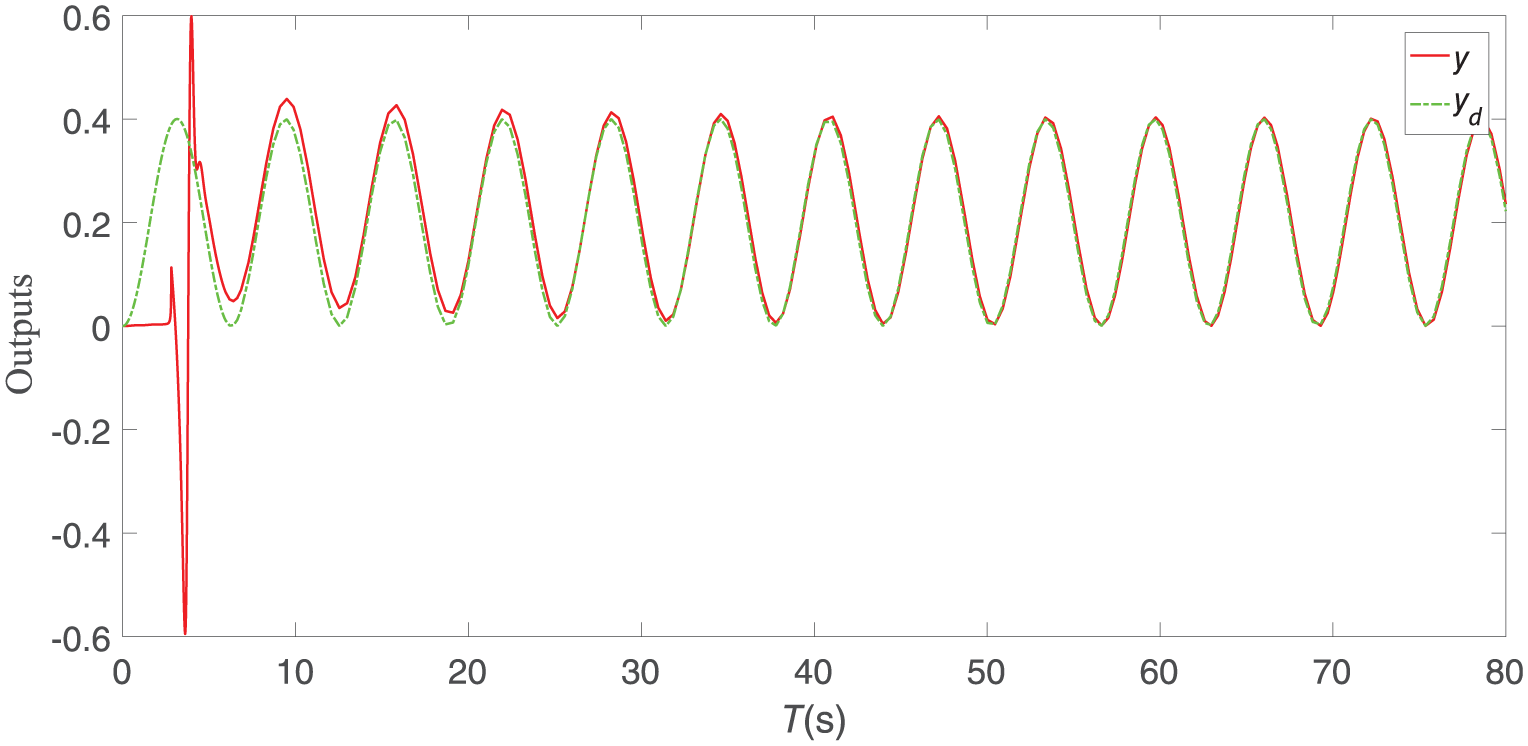
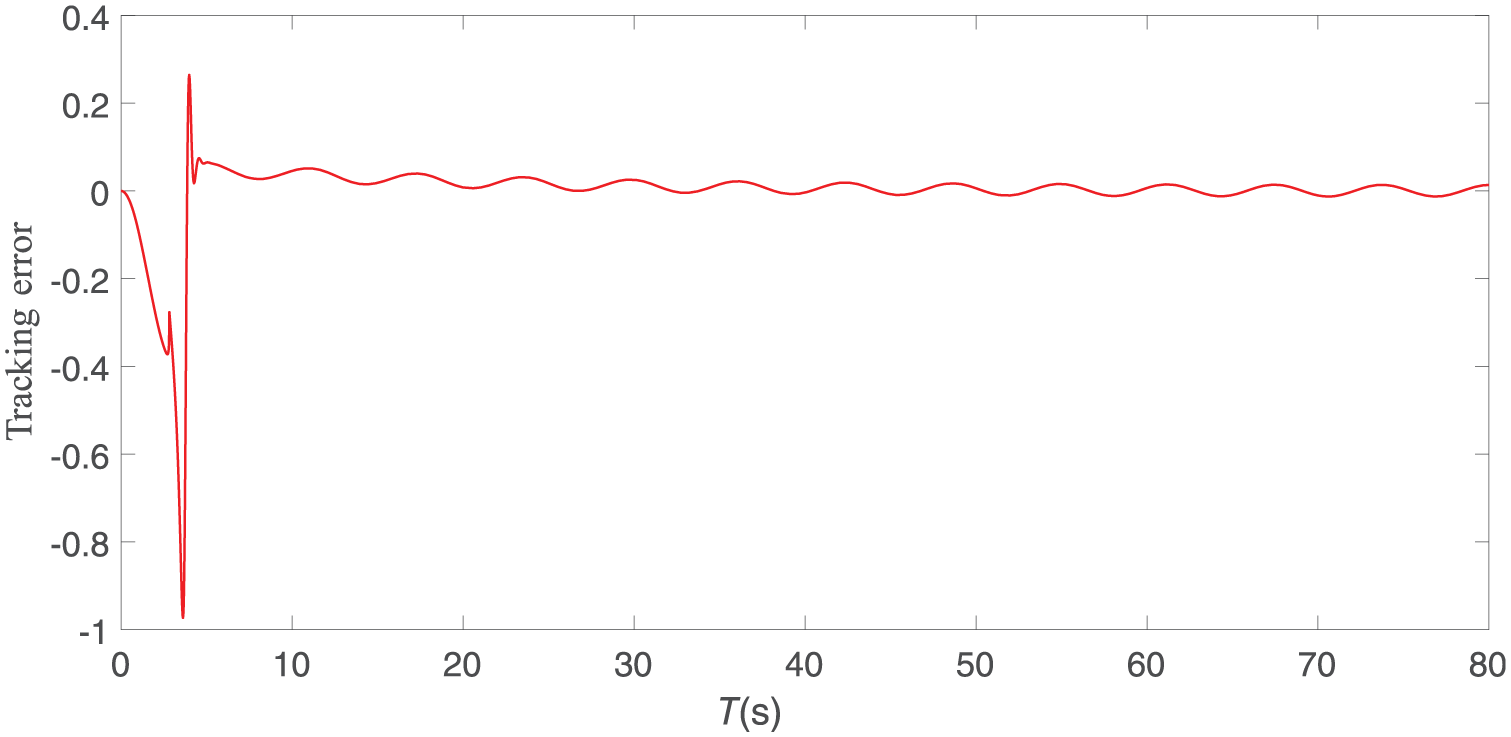
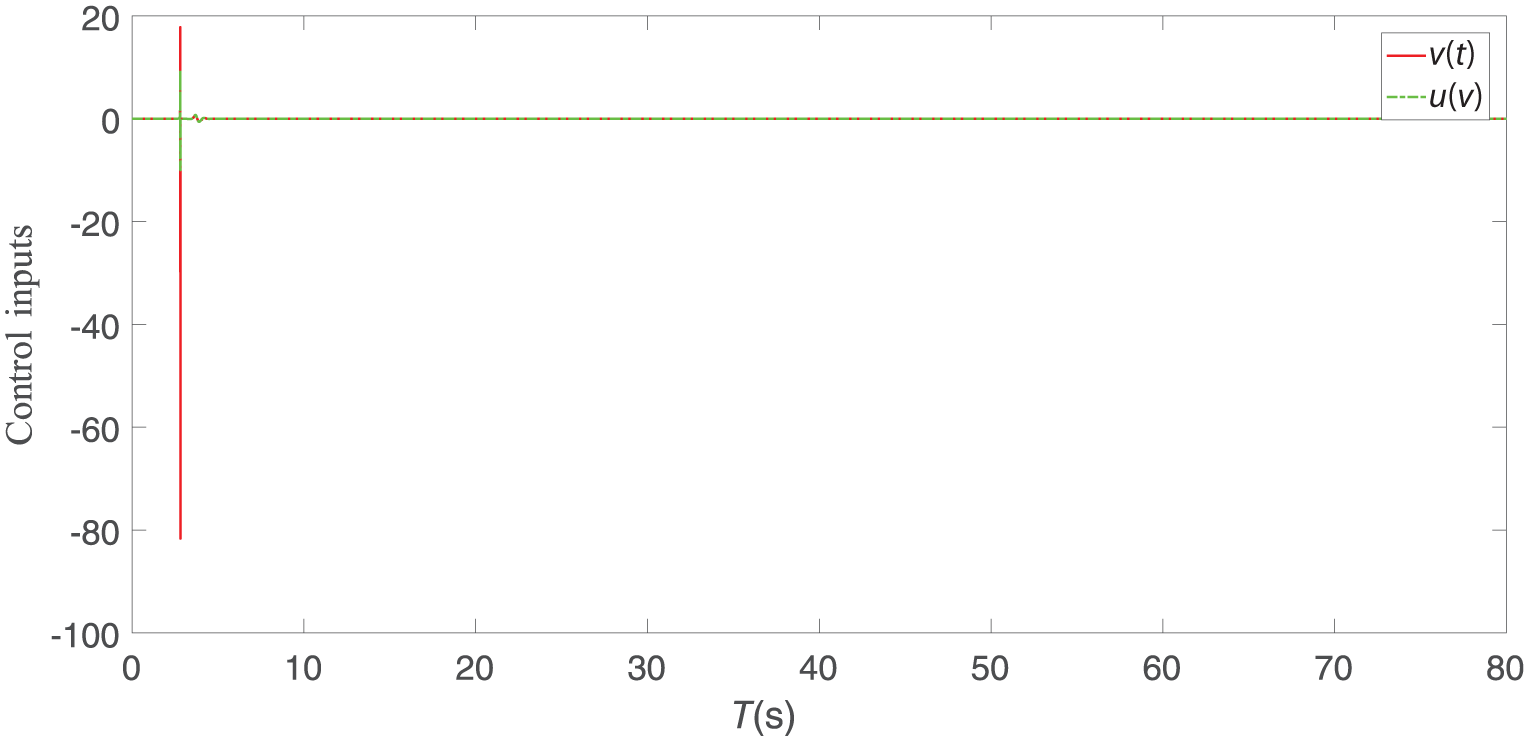
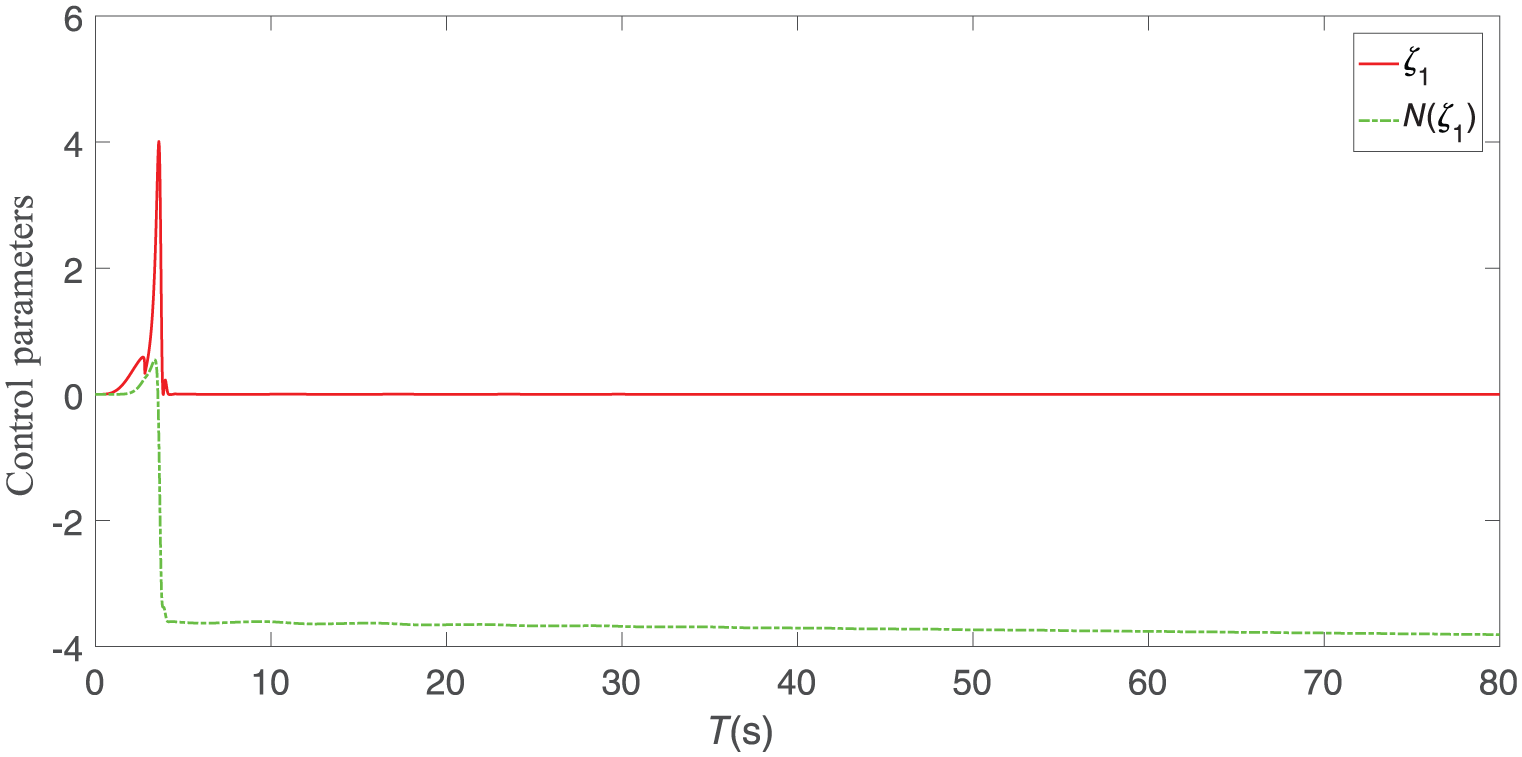
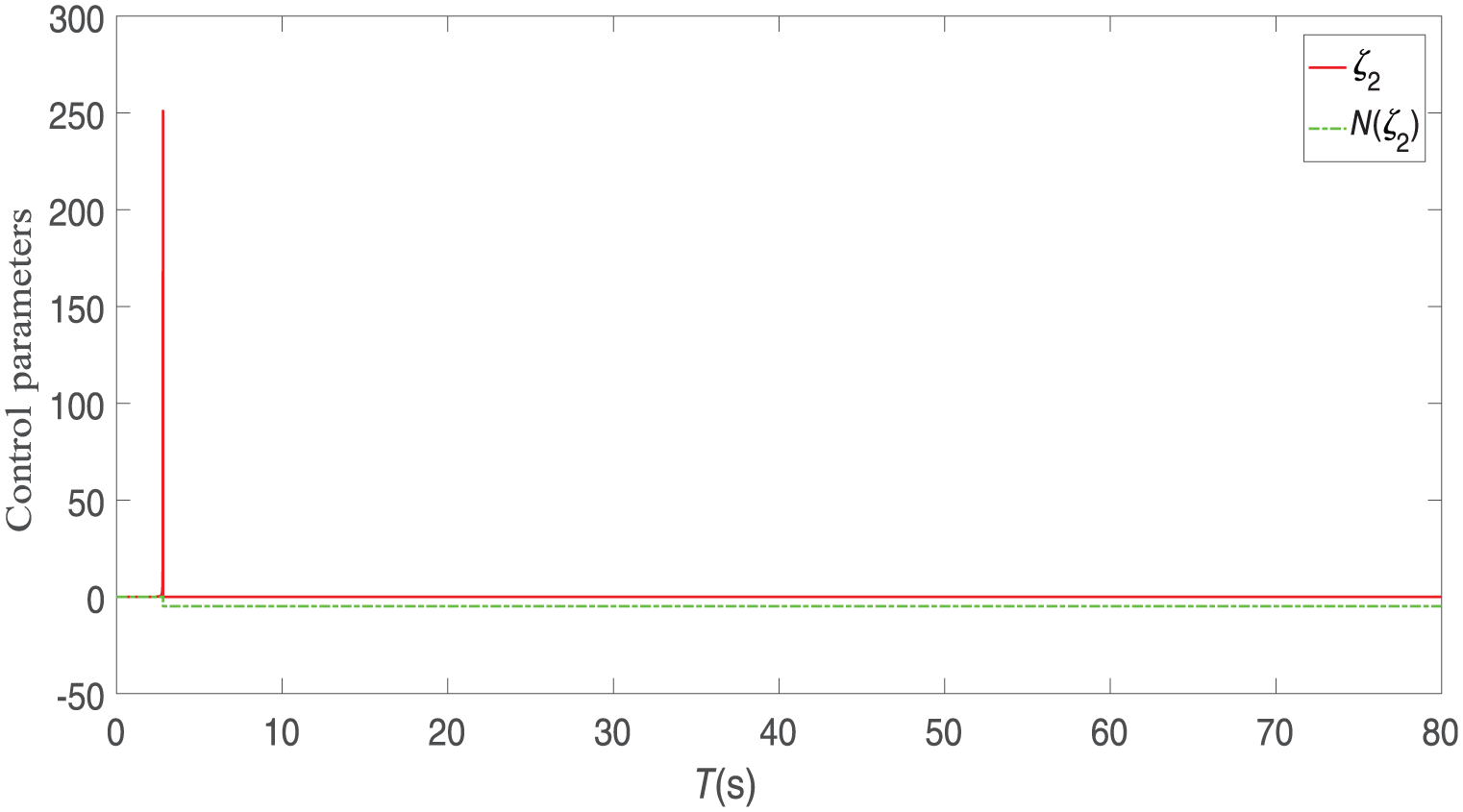
In this simulation, we choose and , and the simulation time is s. The NN term with input vector contains nodes with centres , , evenly spaced in , and widths . The NN term with input vector contains nodes with centres , , evenly spaced in , and widths . The initial conditions are chosen as , and the control parameters are , and the function . The simulation results are shown in Figures 2 to 6. It is seen from Figures 2 and 3 that the tracking performance is achieved in less than s’. That is, the output can track the desired trajectory in less than s’. Furthermore, due to the unknown control directions, some large control inputs are shown from s to s; see Figure 4. Figures 5 and 6 show the process of Nussbaum gains and .
The trajectories of the system output and the desired output.
The trajectory of the tracking error.
The trajectories of the control inputs with and without input constraints.
The trajectories of Nussbaum gains and .
The trajectories of Nussbaum gains and .
Conclusions
In this paper, we have studied the course-keeping problem of ships with input constraints, and an adaptive NN control method has been proposed based on dynamic surface control and the backstepping technique with Nussbaum functions. To deal with the input constraints, a smooth function has been introduced to approximate the saturation function. The proposed adaptive NN control method has been proved able to guarantee uniform ultimate boundedness of all the signals in the controlled system. In addition, the tracking error between the output of the controlled system and a desired trajectory can converge to a small neighbourhood of the origin.
Footnotes
Declaration of conflicting interests
The author(s) declared no potential conflicts of interest with respect to the research, authorship, and/or publication of this article.
Funding
The author(s) disclosed receipt of the following financial support for the research, authorship, and/or publication of this article: This work was partially supported by the National Natural Science Foundation of China (61503079, 61520106009, 61533008 and 61673106), by the Jiangsu Natural Science Foundation (BK20150625 and BK20171362), by the Fundamental Research Funds for the Central Universities, and was a project funded by the Priority Academic Program Development of Jiangsu Higher Education Institutions.
References
1.
ChenJCaoXChengPet al. (2010) Distributed collaborative control for industrial automation with wireless sensor and actuator networks. IEEE Transactions on Industrial Electronics57(12): 4219–4230.
2.
ChenMGeSChooY (2009) Neural network tracking control of ocean surface vessels with input saturation. In: Proceedings of the 2009 IEEE international conference on automation and logistics, Shenyang, China, 5–7 August 2009, pp. 85–89. US: IEEE.
3.
DengHKrstićM (1997) Stochastic nonlinear stabilization: A backstepping design. Systems & Control Letters32(3): 143–150.
4.
DuJAbrahamAYuSet al. (2014) Adaptive dynamic surface control with Nussbaum gain for course-keeping of ships. Engineering Applications of Artificial Intelligence27: 236–240.
5.
DuJGuoCYuS (2007) Adaptive robust nonlinear ship course control based on backstepping and Nussbaum gain. Intelligent Automation and Soft Computing13(3): 263–272.
6.
FossenT (2000) A survey on nonlinear ship control: From theory to practice. IFAC Proceedings Volumes33(21): 1–16.
7.
GeSWangC (2002) Direct adaptive NN control of a class of nonlinear systems. IEEE Transactions on Neural Networks13(1): 214–221.
8.
GeSHongFLeeT (2004) Adaptive neural control of nonlinear time-delay systems with unknown virtual control coefficients. IEEE Transactions on Systems, Man and Cybernetics – Part B34(1): 499–516.
9.
GuBShengVTayKet al. (2015) Incremental support vector learning for ordinal regression. IEEE Transactions on Neural Networks and Learning Systems26(7): 1403–1416.
10.
HaykinS (1999) Neural Networks: A Comprehensive Foundation. Upper Saddle River, NJ: Prentice-Hall.
11.
HouMDuanG (2011) Adaptive dynamic surface control for integrated missile guidance and autopilot. International Journal of Automation and Computing8(1): 122–127.
12.
HuangJWenCWangWet al. (2015) Global stable tracking control of underactuated ships with input saturation. Systems & Control Letters85: 1–7.
LauvdalTFossenT (1998) Rudder roll stabilization of ships subject to input rate saturation using a gain scheduled control law. IFAC Proceedings Volumes31(30): 111–116.
15.
LewisFYesildirekALiuK (1996) Multilayer neural-net robot controller with guaranteed tracking performance. IEEE Transactions on Neural Networks7(2): 388–399.
16.
LiJLiTFanZet al. (2011a) Direct adaptive NN control of ship course autopilot with input saturation. In: Proceedings of the 2011 international workshop on advanced computational intelligence, Wuhan, China, 19–21 October 2011, pp. 655–661. US: IEEE.
17.
LiJLiTFanZet al. (2011b) Robust adaptive backstepping design for course-keeping control of ship with parameter uncertainty and input saturation. In: Proceedings of the 2011 international conference of soft computing and pattern recognition, Dalian, China, 14–16 October 2011, pp. 63–67. US: IEEE.
18.
LuoWZouZLiT (2009) Robust tracking control of nonlinear ship steering. Control Theory and Applications26(8): 893–895.
19.
MeiJRenWLiBet al. (2015) Distributed containment control for multiple unknown second-order nonlinear systems with application to networked Lagrangian systems. IEEE Transactions on Neural Networks and Learning Systems26(9): 1885–1899.
20.
SannerRSlotineJ (1992) Gaussian networks for direct adaptive control. IEEE Transactions on Neural Networks3(6): 837–863.
21.
SunYChenLMaGet al. (2017a) Adaptive neural network tracking control for multiple uncertain Euler-Lagrange systems with communication delays. Journal of the Franklin Institute354(7): 2677–2698.
22.
SunYMaGChenLet al. (2017b) Neural network-based distributed adaptive configuration containment control for satellite formations. Proceedings of the Institution of Mechanical Engineers, Part G: Journal of Aerospace Engineering. DOI: 10.1177/0954410017714008.
23.
SunYWangWMaGet al. (2016) Backstepping-based distributed coordinated tracking for multiple uncertain Euler-Lagrange systems. Journal of Systems Engineering and Electronics27(5): 1083–1095.
24.
WangBGuXMaLet al. (2017) Temperature error correction based on BP neural network in meteorological wireless sensor network. International Journal of Sensor Networks23(4): 265–278.
25.
WenCZhouJLiuZet al. (2011) Robust adaptive control of uncertain nonlinear systems in the presence of input saturation and external disturbance. IEEE Transactions on Automatic Control56(7): 1672–1678.
26.
XiaoBYinS (2016) Velocity-free fault-tolerant and uncertainty attenuation control for a class of nonlinear systems. IEEE Transactions on Industrial Electronics63(7): 4400–4411.
27.
XiaoBYinSKaynakO (2016) Tracking control of robotic manipulators with uncertain kinematics and dynamics. IEEE Transactions on Industrial Electronics63(10): 6439–6449.
28.
XiaoBYinSWuL (2017) A structure simple controller for satellite attitude tracking maneuver. IEEE Transactions on Industrial Electronics64(2): 1436–1446.
29.
XueYJiangJZhaoBet al. (2017) A self-adaptive artificial bee colony algorithm based on global best for global optimization. Soft Computing1–18. DOI: 10.1007/s00500-017-2547-1
30.
YangYZhouCRenJ (2003) Model reference adaptive robust fuzzy control for ship steering autopilot with uncertain nonlinear systems. Applied Soft Computing3(4): 305–316.
31.
YeXJiangJ (1998) Adaptive nonlinear design without a priori knowledge of control directions. IEEE Transactions on Automatic Control43(11): 1617–1621.
32.
ZhangJTangJWangTet al. (2017) Energy-efficient data-gathering rendezvous algorithms with mobile sinks for wireless sensor networks. International Journal of Sensor Networks23(4): 248–257.
33.
ZhangTGeSHangC (1999) Design and performance analysis of a direct adaptive controller for nonlinear systems. Automatica35(11): 1809–1817.
34.
ZhangTGeSHangC (2000a) Adaptive neural network control for strict-feedback nonlinear systems using backstepping design. Automatica36(12): 1835–1846.
35.
ZhangYPengPJiangZ (2000b) Stable neural controller design for unknown nonlinear systems using backstepping. IEEE Transactions on Neural Networks11(6): 1347–1360.
36.
ZhangYSunXWangB (2016) Efficient algorithm for k-barrier coverage based on integer linear programming. China Communications13(7): 16–23.