






Abstract
In this paper, a new backstepping type 2 fuzzy control is developed for a class of uncertain multi-inputs multi-outputs (MIMO) chaotic systems, with a complicate of uncertainties and external disturbances. The system consists of interconnected subsystems that are duffing equation. In the control design, type 2 fuzzy logic systems are used to approximate the unknown functions. Hybrid adaptive robust tracking control schemes that are based upon a combination of bounds of type 2 fuzzy approximation parameters and the backstepping design are developed such that all the states and signals are bounded and the proposed approach alleviate the online computation burden and improves the robustness to dynamic uncertainties and external disturbances. Finally, the control of chaotic duffing systems with unknown parameters is given as example to verify the effectiveness of the proposed approach.
Keywords
Introduction
A chaotic system has complex dynamical behaviors that possess some special features, such as excessive sensitivity to initial conditions; a small change in the initial conditions can drastically change the long-term behavior of a system (Branislav, 2011). Chaotic phenomena can be found in many engineering systems such as biological systems, circuit systems, power converters, chemical reactions and physical systems (Chen, 1999). In the past decades, there has been a rapid growth of research efforts aiming at the development of systematic design methods for control of chaotic dynamical systems. Successful methods and techniques have been reviewed in Wang and Ip (2005), Hugues-Salas et al. (2008), Zribi et al. (2009) and Wong and Kakmeni (2004). In such schemes, it is assumed that an accurate model of the plant is available, and the unknown parameters are assumed to appear linearly with respect to known nonlinear functions. This assumption is not sufficient for many practical situations because it is difficult to describe a nonlinear plant by known nonlinear functions precisely. Fuzzy systems are usually used to controlling uncertain nonlinear functions owing to their inherent capabilities in function approximation (Lee and Chung, 2012; Ozbek, 2015; Yang and Zhou, 2005; Yoshimura, 2012). Several approximation based adaptive neural /fuzzy control approaches have been successfully applied for the control of uncertain chaotic systems (for synchronization, tracking, or stabilization purposes), and lots of significant results have been reported, such that the synchronization of uncertain chaotic systems with random-varying parameters (Lin and Wang, 2011), fuzzy logic controller is designed for controlling non-linear behaviors in a rod-type plasma torch system (Khari et al., 2015); nonlinear and chaos control of a micro-electro-mechanical system by using second order fast terminal sliding mode control (Zhankui and Sun, 2013); second order terminal sliding mode control for a class of chaotic systems with unmatched uncertainties (Xiang and Huangpu, 2010); chaos synchronization of nonlinear gyros using self-learning PID control approach (Hsu et al., 2012); robust ISS-satisfying variable universe indirect fuzzy control for chaotic systems (Wang et al., 2009); a fuzzy adaptive variable structure control scheme for uncertain chaotic multi-inputs multi-outputs (MIMO) systems with sector nonlinearities and dead zones applied for duffing chaotic systems (Boulkroune and M’Saad, 2011); and observer-based decentralized fuzzy neural sliding mode control for interconnected unknown MIMO chaotic systems via network structure adaptation (Lin and Wang, 2010). In the systems that have spatial form (strict feedback form), the difficulties encountered in handing chaotic systems have posed a real need for using some kind of intelligent approach. To overcome these drawbacks, the backstepping design method for the chaotic dynamic systems has been designed (Lin and Li, 2013; Peng and Hsu, 2009; Lin et al., 2010). In these schemes, the adaptive laws were obtained by adjusting the estimation vectors of the optimal parameters vectors. These proposed schemes suffered the well-known “curse of dimensionality”, that is, to achieve a better approximation result, the number of parameters to be adjusted online is very large, in particular for high dimensional systems, and the learning time tends to become unacceptably long during the implementation. This problem was solved in Liu et al. (2010), Li et al. (2010) and Liu and Wang (2007). In those approaches, fuzzy systems are used to approximate the unknown functions and it is assumed that the norms of optimal vectors and the fuzzy approximation errors are bounded by unknown bounds. By only adjusting estimations of unknown bounds, this problem is solved.
The type 1 fuzzy logic systems (T1FLSs) employed in Doudou and Khaber (2012), Khaber et al. 2006, Pourkargar and Shahrokhi (2011) and Yin et al. (2016) are developed using type 1 membership functions that are unable to handle directly the uncertainties. To take care of these uncertainties, type 2 fuzzy logic systems (T2FLS) have been used. Many research show that the T2FLS are better able to handle uncertainties than their T1FLS (Biglarbegian et al., 2010; Lam and Seneviratne, 2008; Shahnazi, 2016; Manceur et al., 2013).
Type 2 fuzzy adaptive backstepping control schemes can provide a systematic framework for the design of synchronization or stabilization of chaotic systems, in which the FLS are used to approximate the unknown nonlinear functions, and an adaptive fuzzy controller is constructed recursively (Lin et al., 2011).
In this paper, motivated by above-mentioned works in literature, a novel adaptive fuzzy control approach based on type 2 fuzzy systems is proposed and developed for MIMO chaotic systems with modeling complicated uncertainties and external disturbances. The chaotic MIMO systems are composed of interconnected subsystems, where the system state interconnections appear in every equation of each subsystem. The Lyapunov analysis method is employed to construct the control inputs and the adaptation laws without the requirement of integral type Lyapunov functions. The use of type 2 fuzzy systems can fully handle the uncertainties, and achieve higher performances. In the controller design, it is assumed that the norms of the optimal type 2 fuzzy basic functions and the fuzzy approximation errors vectors are bounded by unknown bounds. By only adjusting estimations of unknown bounds, the developed control approach alleviates the online computation burden and improves the robustness to dynamic uncertainties and external disturbances. The proposed backstepping type 2 fuzzy method can solve the control problem of duffing chaotic system under appropriate assumptions and assures the stability of the resulting closed loop and the tracking errors converge to a small neighborhood around zero.
The paper is organized as follows. First, a model description and the mathematics lemmas of the studied class systems are presented in section 2. The backstepping controller design using interval type 2 fuzzy systems is designed in section 3. In section 4, simulation example under matlab environment is given. Finally, the obtained results are summarized in section 5.
Models descriptions and mathematics lemmas
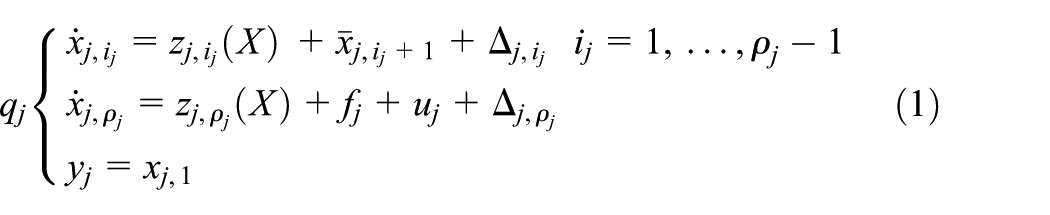
Consider a large-scale system Q that is composed of m interconnected chaotic subsystems
where
The control objective is to construct a robust adaptive fuzzy controller for the system (1) such that all the signals of the resulting closed-loop system are uniformly bounded and the tracking error
Backstepping controller design using interval type 2 fuzzy system
Interval type 2 fuzzy system description
Consider a T2FLS having p inputs

The inference engine combines rules and gives a mapping from T2FSs input to T2FSs output. To achieve this process, we have to compute unions and intersections of type 2 sets, as well as compositions of type 2 relations. The output inference engine block is a type 2 set. By using the extension principle of type 1 defuzzification method, type reduction process takes us from type 2 output sets to a type 1 set called the “type reduced set”. This set may then be defuzzified to obtain a single crisp value.
In Figure 1, we only consider singleton input fuzzification throughout this paper. Similar to T1FLS, the firing set in (2) can be obtained by the following inference process:

where

Structure of T2FLS.
The result of the JOIN operation is an interval type 1 set defined by

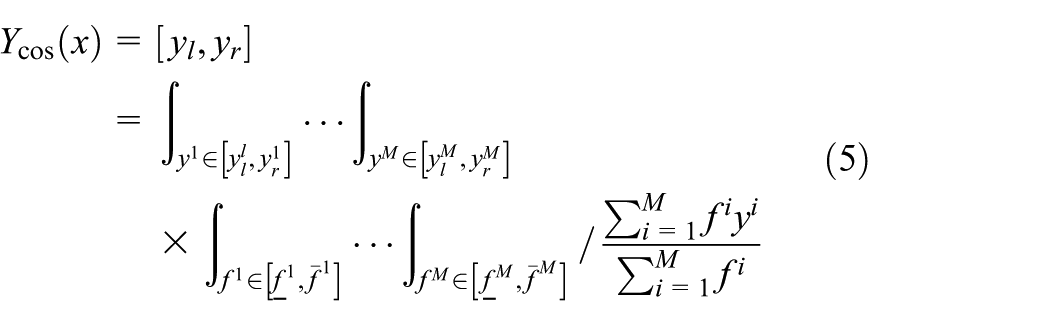
There are many kinds of type reduction method, such as centroid, height, modified weight and center of sets. The center-of-sets type reduction will be used in this paper and can be expressed as
Note that


For illustrative purposes, we briefly provide the computation procedure for
Step 1: Compute
Step 2: Find R
Step 3: Compute
Step 4: If
Step 5: Set
The
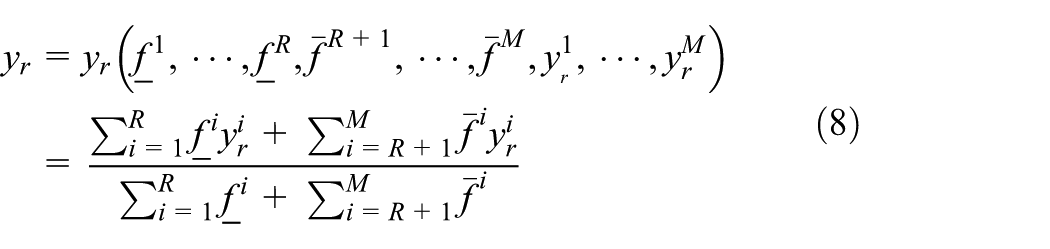
The same procedure is used to compute
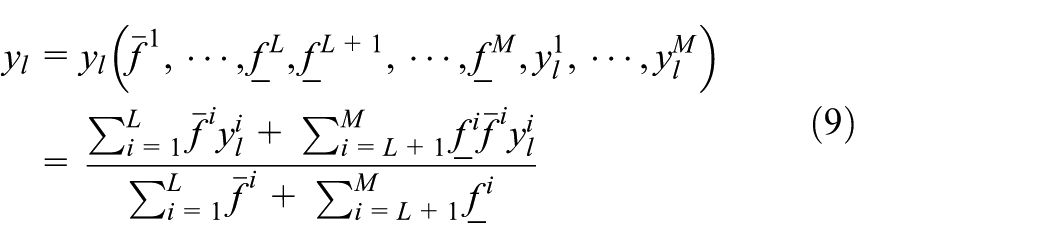
The defuzzified crisp output from T2FLS is the average of

Adaptive backstepping type 2 fuzzy controller design
The backstepping procedure is an effective design approach for strict feedback nonlinear systems. For the jth subsystem of the systems (1), the design procedure contains

Define the unknown function as follows

We employ the approximation property of T2FLS to approximate

where
Let
By substituting (12) and (13) into (11) and introducing the error variable

where
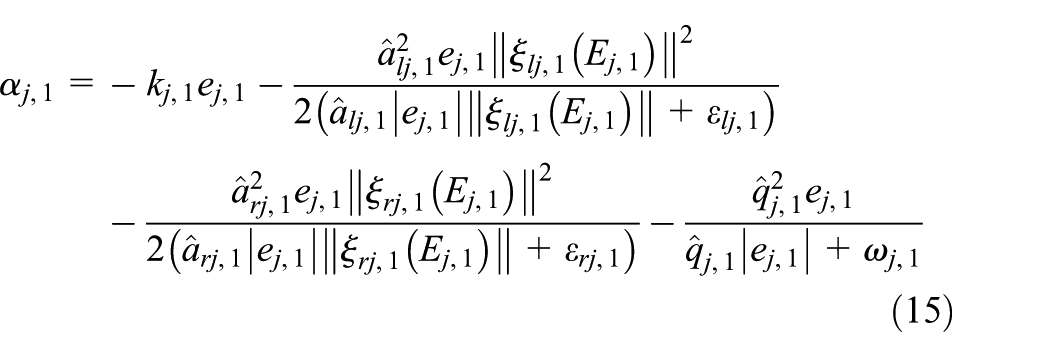
is chosen as the virtual control input of the subsystem (11), with design parameters
Consider the Lyapunov function candidate

where
The time derivative of

By substituting (14) and (15) into



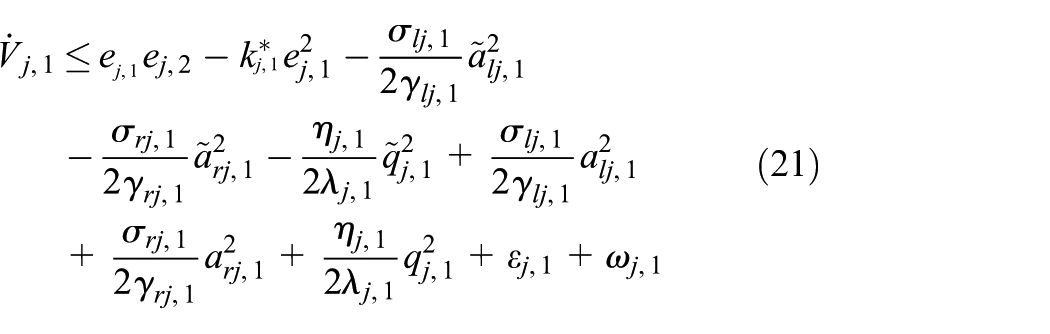
where the coupling term
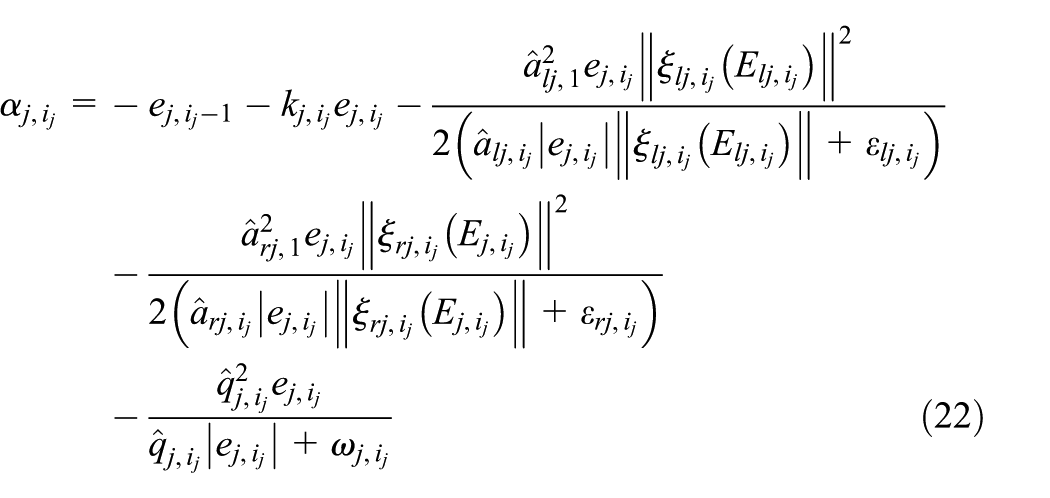
of the subsystems with small design parameters
Consider the Lyapunov function candidate

where
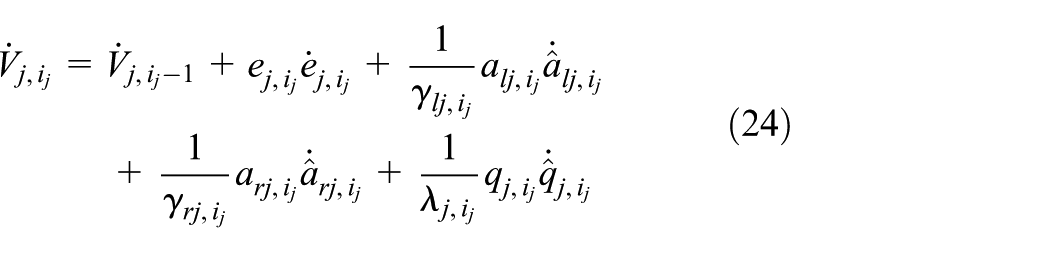
Select the following adaptation laws



where
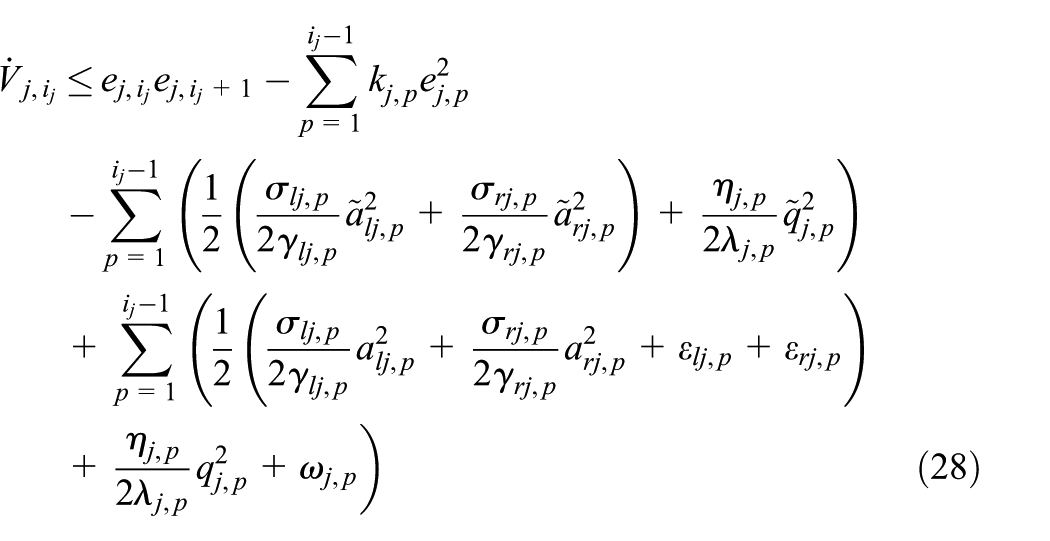
where the coupling term
Step

where

Define the unknown function

where
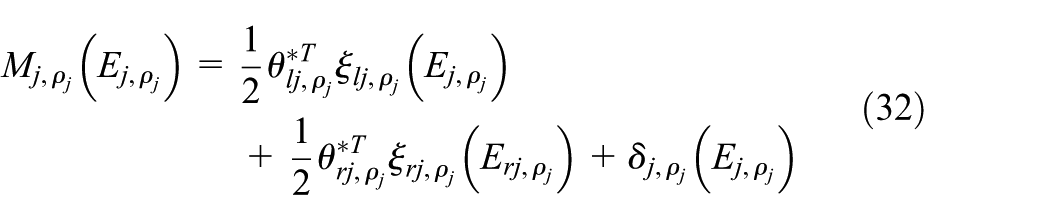
where
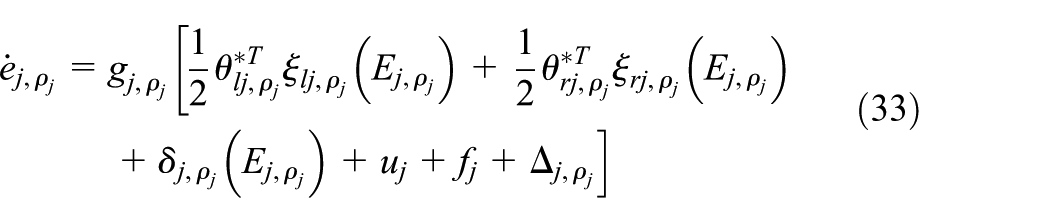
In similar way, we define the control input
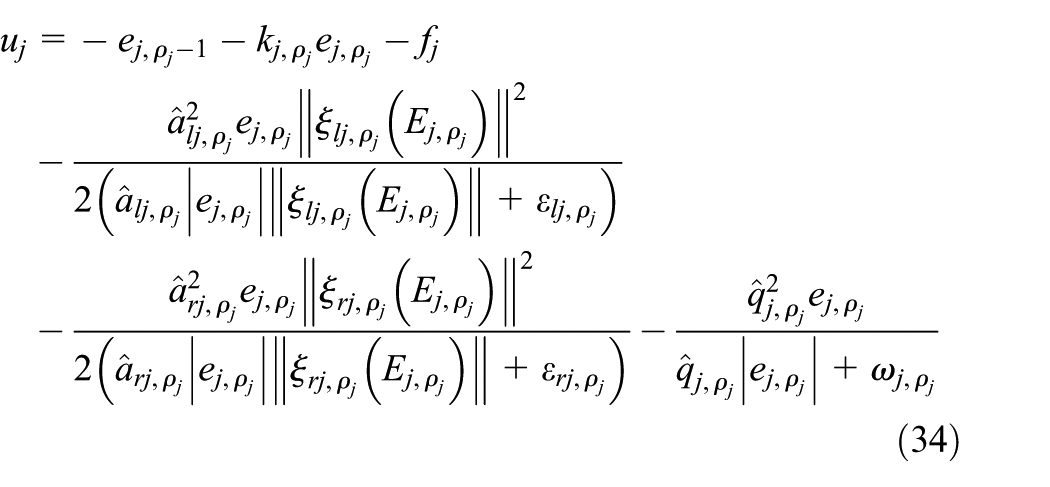
Consider the Lyapunov function candidate
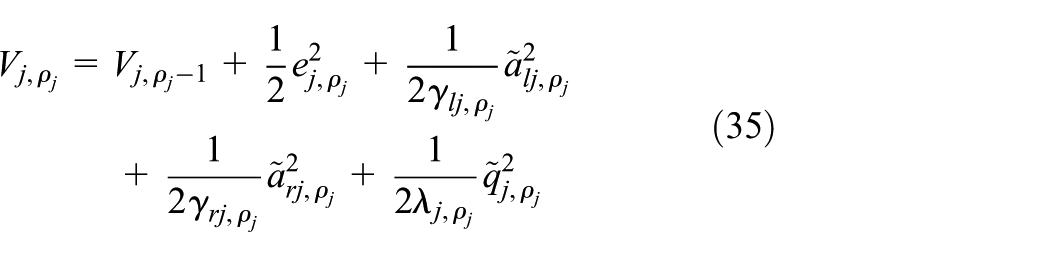
According to (17) and (25), (35) can be rewritten as
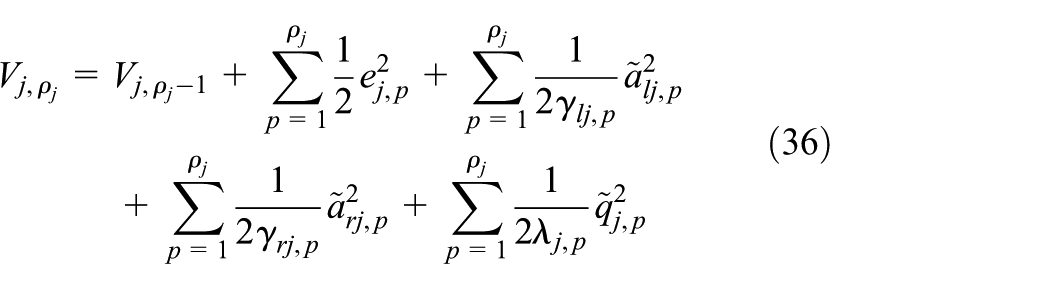
The time derivative of
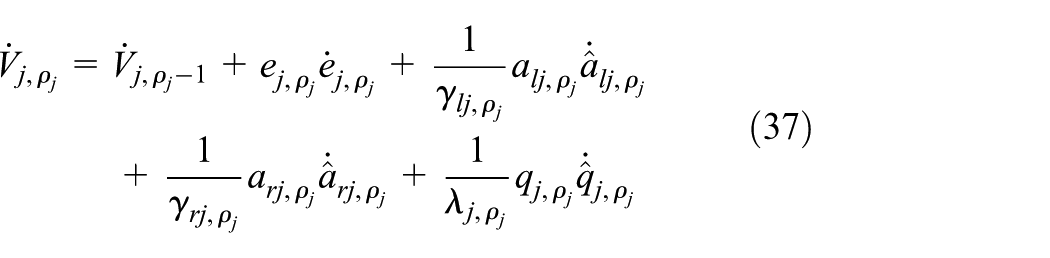
By substituting (33) and (34) into (37), we have
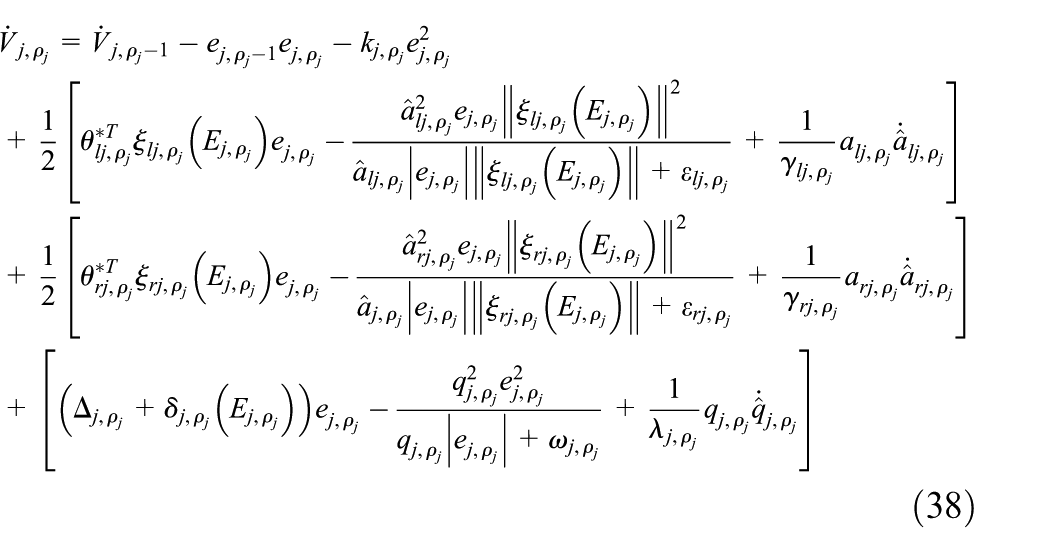
Select the following adaptation laws



where
Then we have
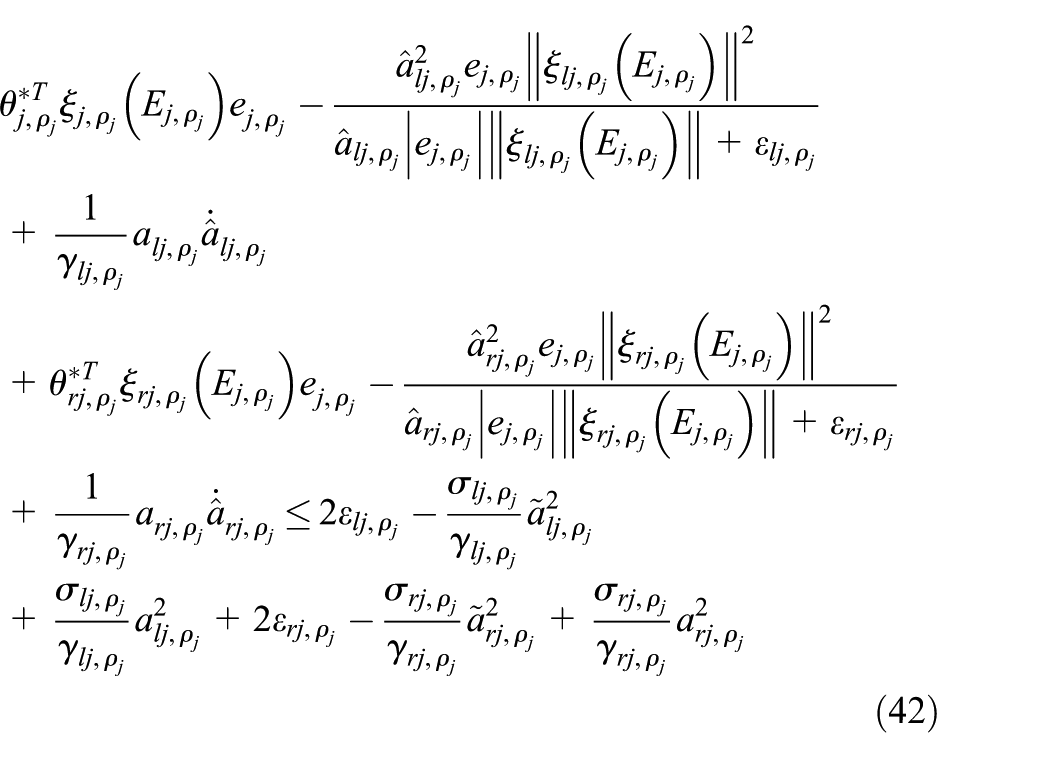

In step
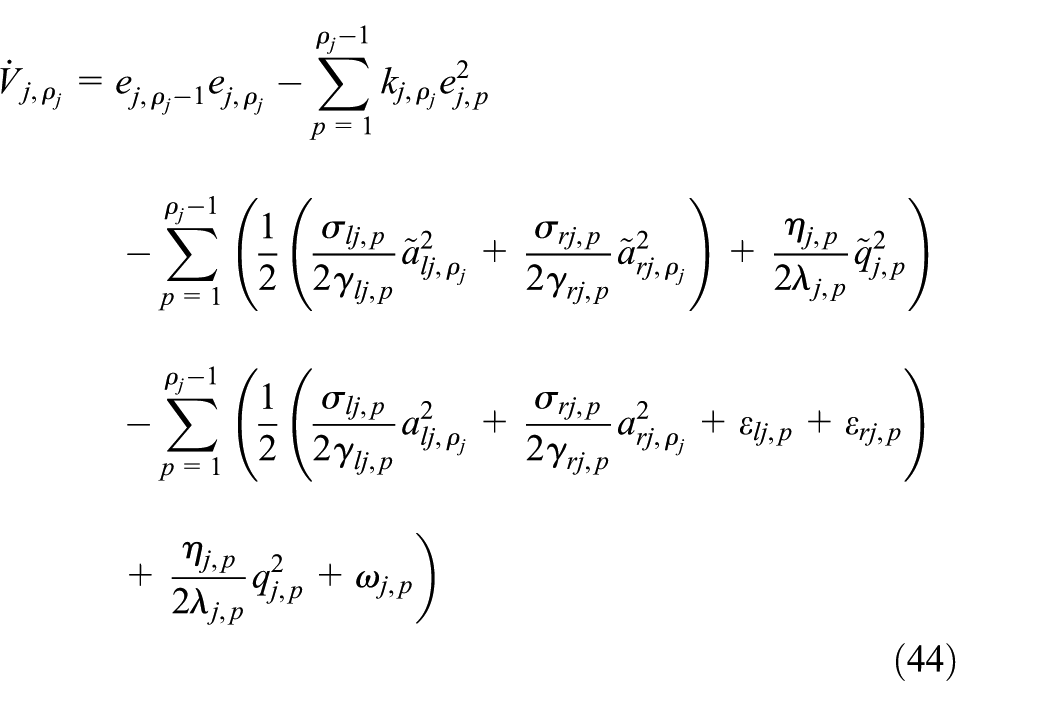
By substituting (42), (43) and (44) into (38), we obtain
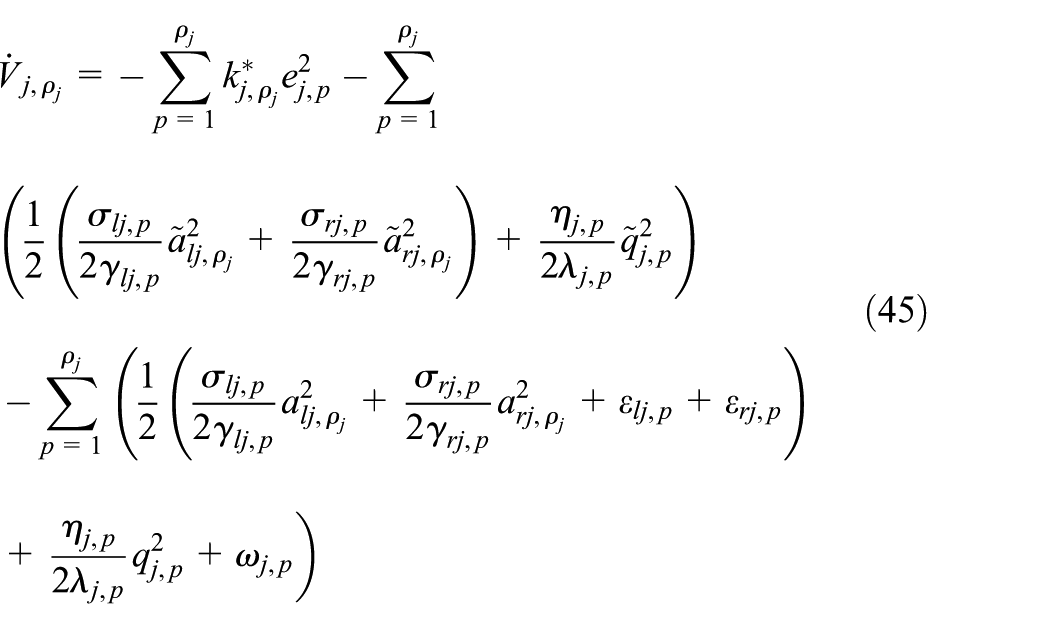
Let
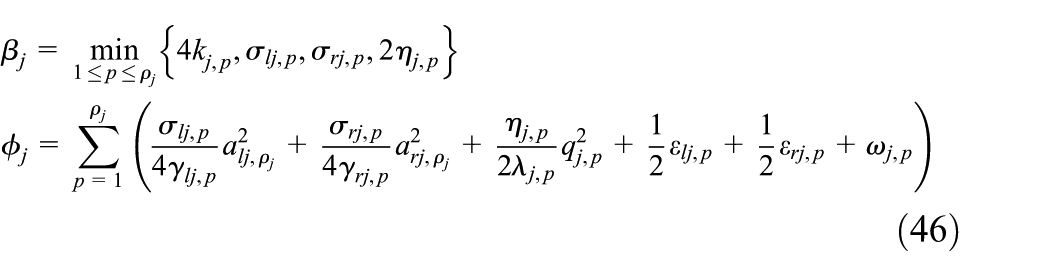
Following (44) yields
Let

where

The design procedure of the controller can be visualized from the block diagram shown in Figure 2.

Schematic diagram of fuzzy type 2 backstepping controller.
The following theorem guarantees the stability of the closed loop system.
There exist sufficiently large compact sets
The tracking error variable

Increasing
Both decreasing

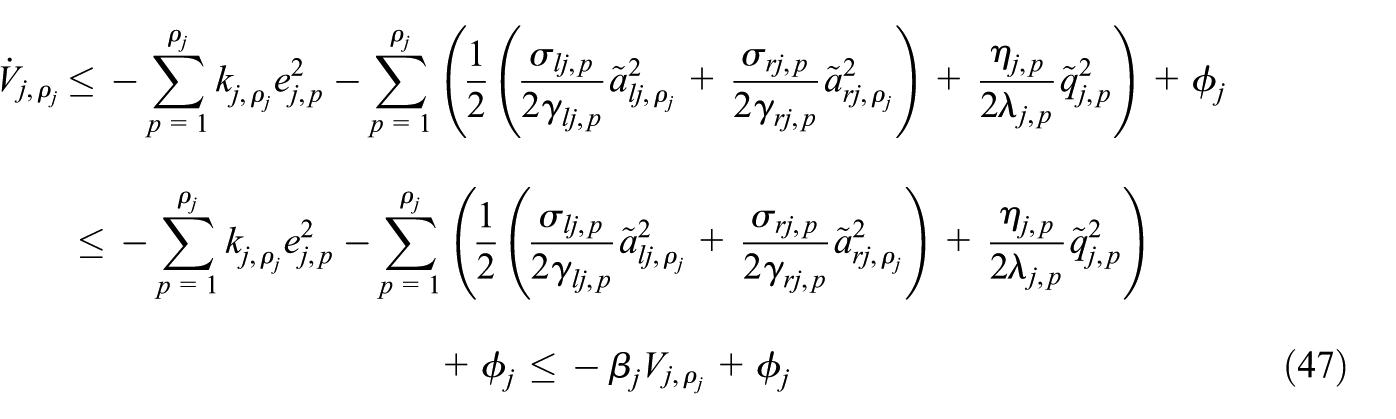
Integrating (51) over [0, t] leads to

Since

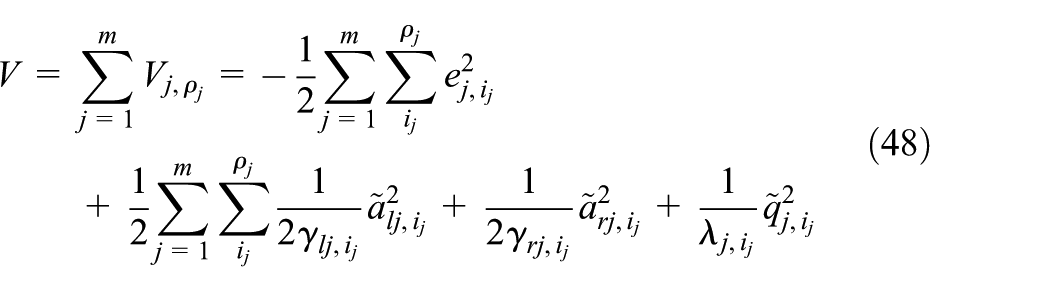
From (47), we can see that




By making use of (53) and assumption 2, we obtain

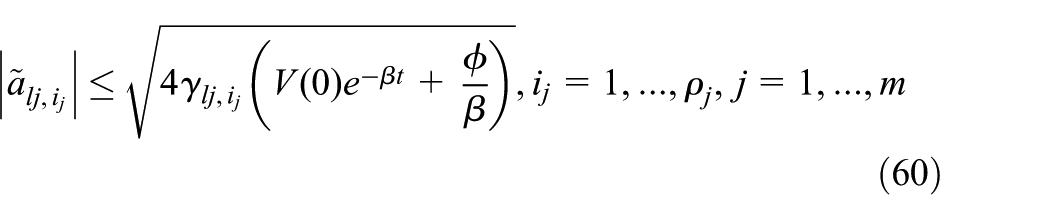
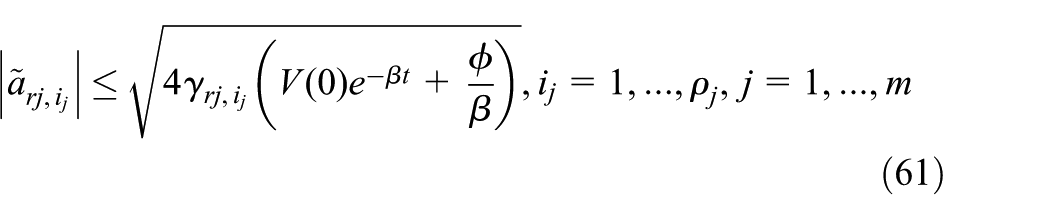
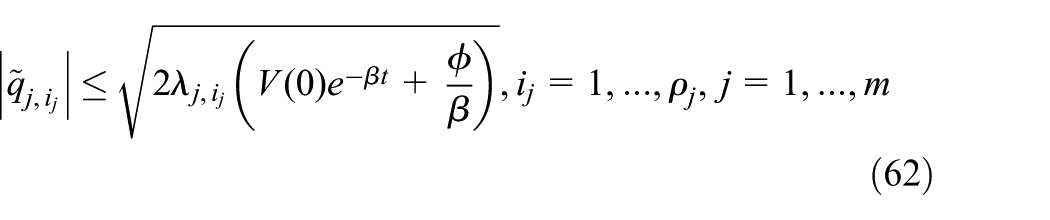
Since
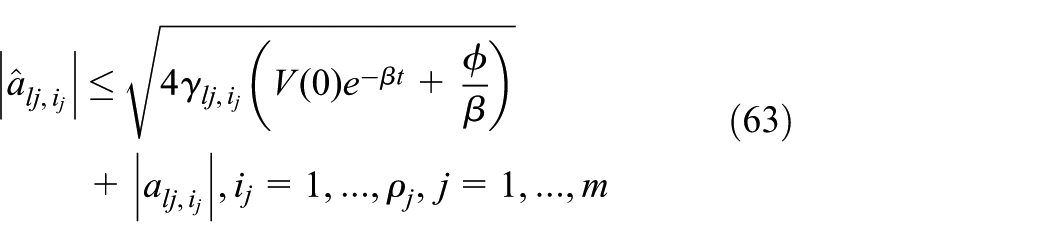
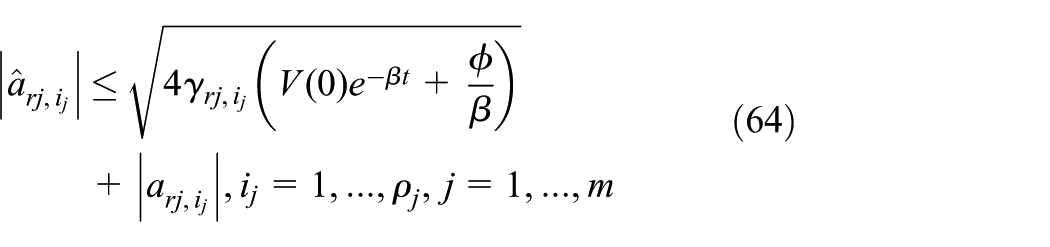
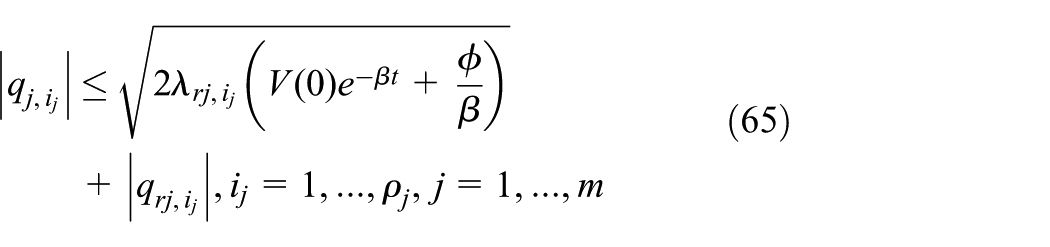
Therefore, from (59), (63), (64) and (65), we can conclude that all signals in the resulting closed loop system are uniformly bounded. From (53) and (55), we have

If

If
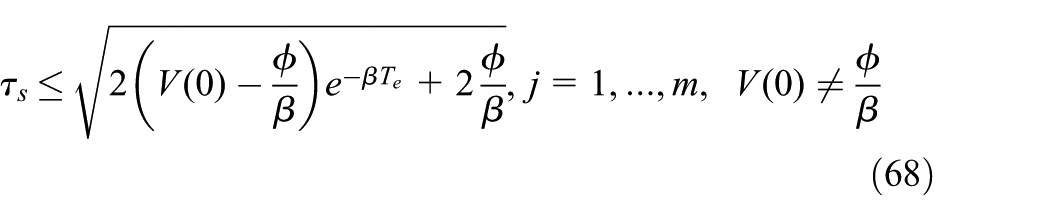
and by taking

It can be then concluded that all the signals in the closed-loop system remain bounded and the tracking errors can be made arbitrarily small if the design parameters are chosen appropriately. The proof is thus completed.
Simulation example
Consider a second order chaotic system such as the well-known duffing’s equation describing a special nonlinear circuit or a pendulum moving in a viscous medium under control (Loria et al., 1998)

where
It can be shown that without control, that is,

Chaotic attractor of duffing system.
We apply the proposed controller to control the three interconnected chaotic systems, where each subsystem is duffing chaotic system.
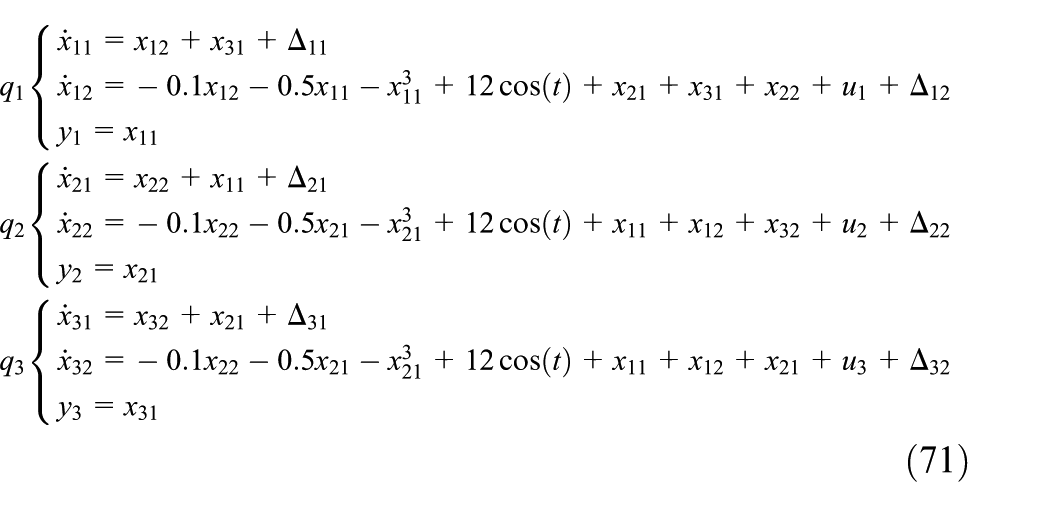
where

The control objective is to design an adaptive backstepping type 2 fuzzy controller such that the outputs
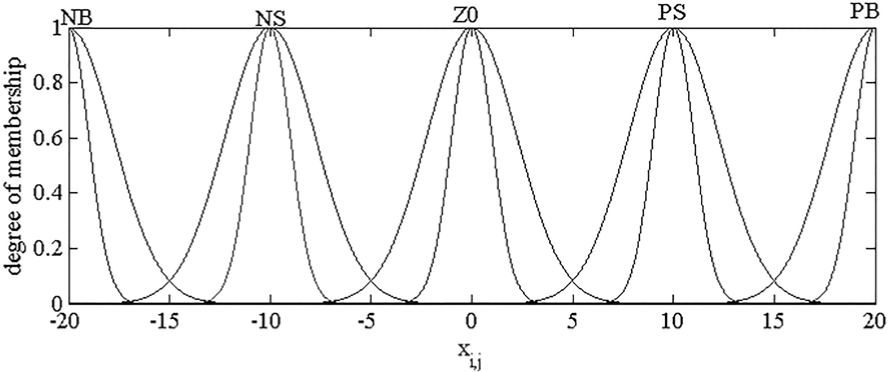
Interval type 2 membership functions.
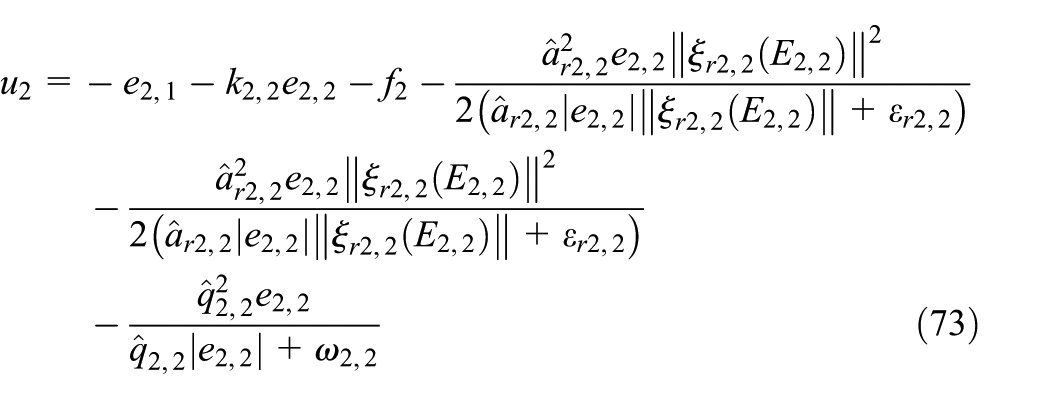
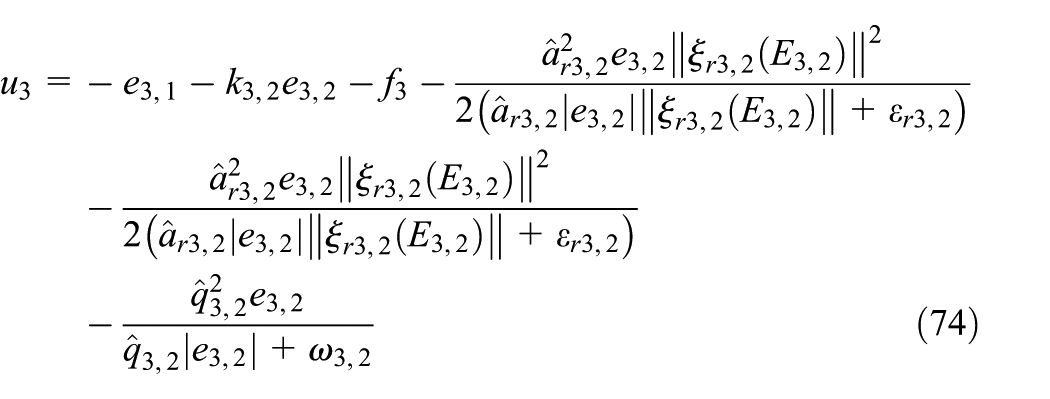
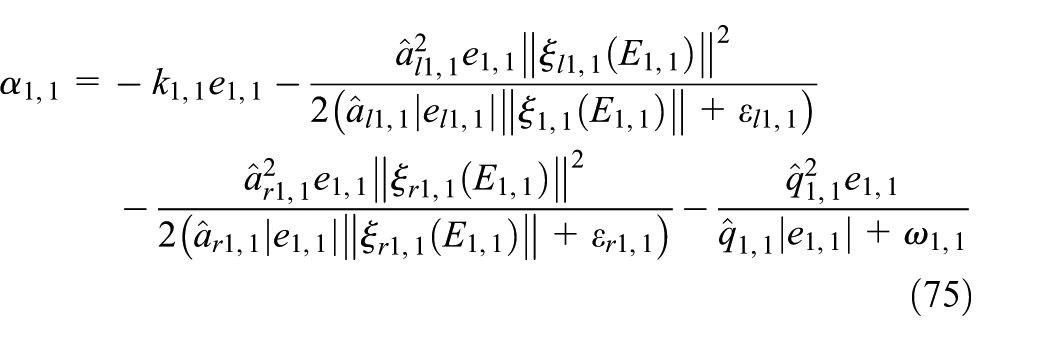
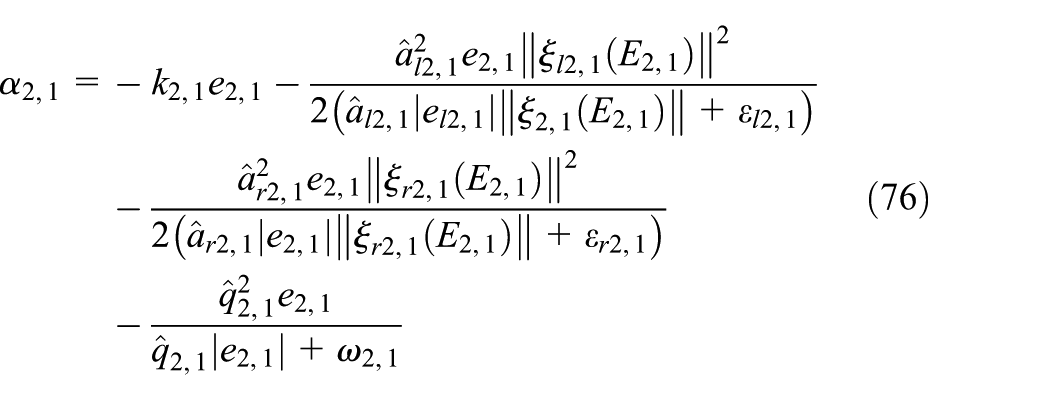
According to the proposed method, the controller law, virtual controller and the adaptive laws are defined as follows
The control inputs
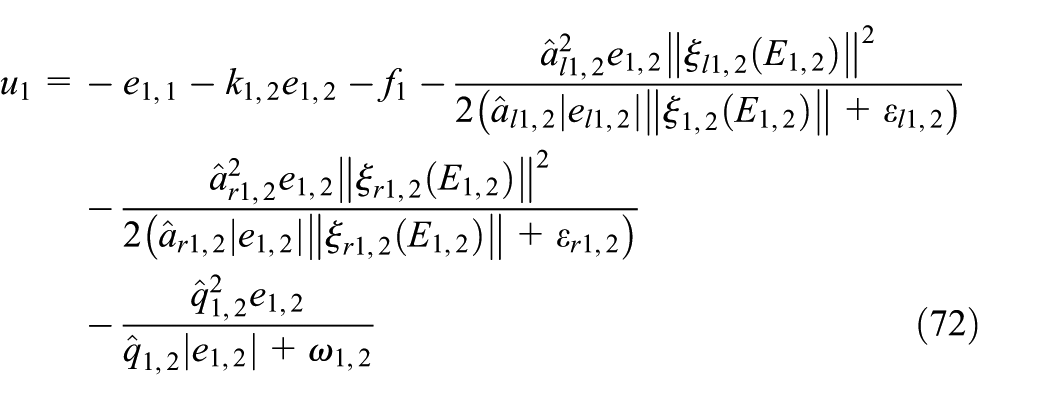
The virtual control inputs
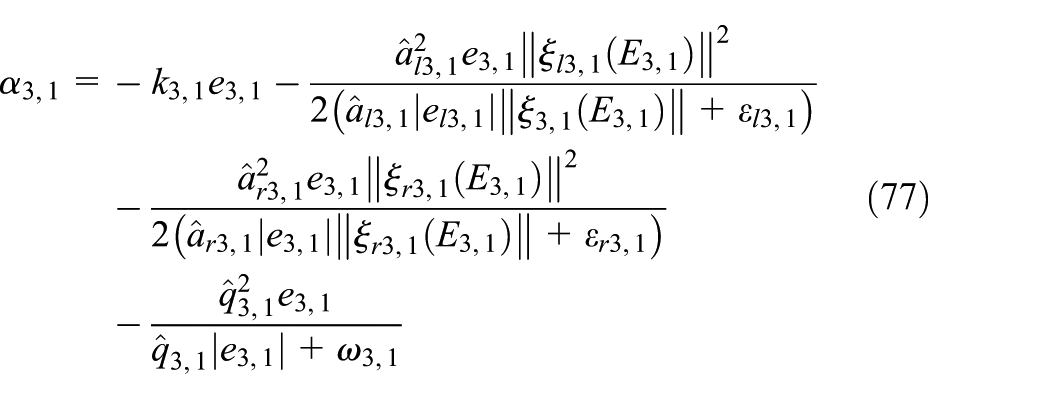
Also, the adaptive laws



In this simulation, the initial conditions are chosen as
To investigate the effectiveness of the proposed backstepping controller, a comparison between a traditional adaptive backstepping controller (T. B. C) and the proposed approach is made. Table 1 shows the performance obtained.
Performance comparison of the proposed approach and the traditional adaptive backstepping controller.

It can be seen that the proposed method has better tracking error performance with less control effort.
Figure 5 shows the evolution of outputs

Output trajectories (a)
Figure 6 shows that even in the presence of external disturbances (Gaussian noise) in the time interval

Output trajectories of the (a)

Control inputs (a)
The simulation results show that the favorable tracking performance can be achieved by applying the proposed approach.
Figure 8 shows that the type 2 fuzzy controller eliminates the chaotic motion and takes the system response to a stable orbit.

Chaotic attractor of duffing system under control.
Performance comparison of the proposed method using type 1 and type 2 fuzzy systems.

It can be seen that the proposed method with interval type 2 fuzzy systems has better tracking error performance with less control effort.
Conclusion
In this paper, an adaptive fuzzy robust control approach based on backstepping design is proposed for uncertain MIMO chaotic system. The type 2 fuzzy systems are used to approximate unknown nonlinear functions (interconnections between the chaotic subsystems and derivative of the virtual control). By only adjusting estimations of unknown bounds, the proposed control approach reduced computation burden. This method has been applied to control the interconnected duffing chaotic system to track a reference trajectory. The proposed scheme can guarantee that all the close loop signals are bounded and that the outputs of the system converge to a small neighborhood of the desired trajectory. Simulations results show that the proposed method is very effective and robust against system uncertainty.
Footnotes
Declaration of conflicting interests
The author(s) declared no potential conflicts of interest with respect to the research, authorship, and/or publication of this article.
Funding
The author(s) received no financial support for the research, authorship, and/or publication of this article.