In this paper, we consider the asymptotic stability of solutions to impulsive multi-delayed differential equations with linear parts defined by pairwise permutable matrices. First, we introduce the concept for an impulsive multi-delayed Cauchy matrix and then use it to obtain the representation of solutions to linear impulsive Cauchy problems via the variation of constants principle. Next, we give a norm estimate of the impulsive multi-delayed Cauchy matrix and establish sufficient conditions to guarantee that the trivial solutions are asymptotically stable when the nonlinear terms satisfy appropriate conditions. Finally, two numerical examples are given to illustrate the effectiveness of the results.
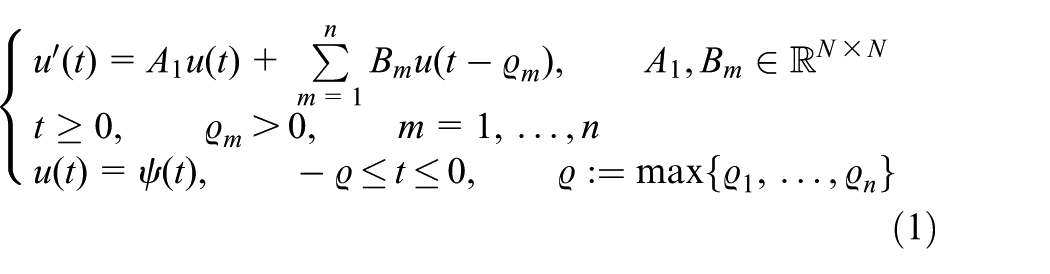
Medveď and Pospíšil (2012) gave the representation of solutions of Cauchy initial value problems for the following linear multi-delay differential equations
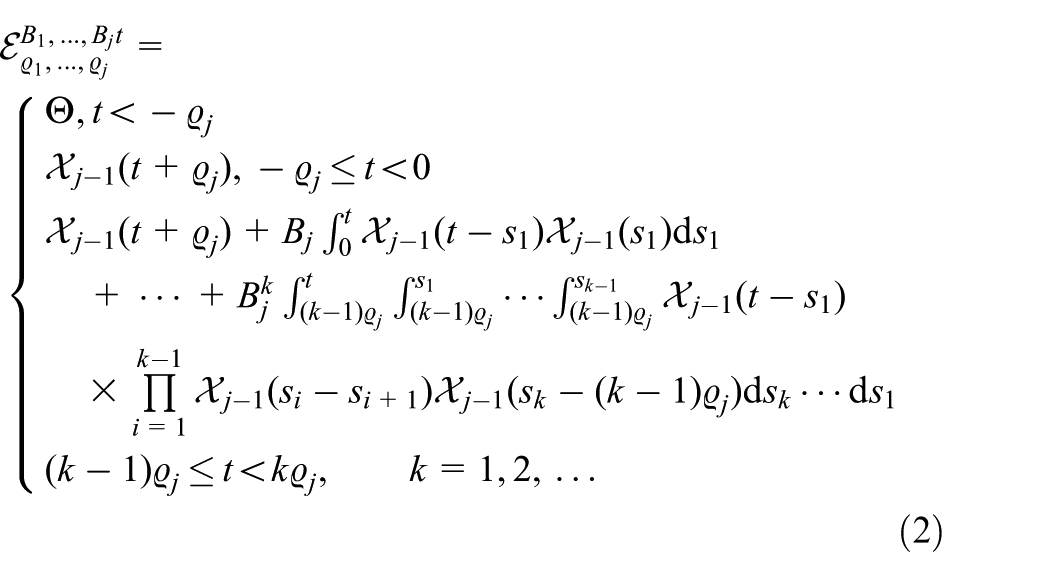
with the linear parts and . In regards to equation (1), a concept of multi-delayed matrix exponential (Medveď and Pospíšil, 2012: Corollary 9) is introduced, which has the form
where , and is the zero matrix.
Many processes and phenomena are characterized by rapid changes in state; the duration of these changes is relatively short compared with the overall duration of the whole process. For the theory of impulsive differential equations, we refer the reader to the monographs of Bainov and Simeonov (1993) and Samoilenko et al. (1995) and for applications to the works of Benchohra et al. (2006) and Ivanov and Slyn’ko (2009) and the references therein. You and Wang (2016) introduced the notation of an impulsive delayed matrix function and used the variation of constants method to obtain the representation of solutions to linear impulsive delay differential equations. However, there are only a few papers in the literature seeking the explicit solution of linear impulsive multi-delay differential equations with permutable matrices. Because of the double impact from the impulsive perturbation and the multi-time delay it is a challenge to obtain the presentation of the solution. The topic of control of impulsive multi-delayed differential equations has attracted some attention. In the literature, related control and estimation issues are considered under a model-driven framework, such as an adaptive neural-network-based approach for fault-tolerant control of nonlinear time-varying delay systems with unmodelled dynamics (Yin et al., 2017) and adaptive fuzzy control of strict-feedback nonlinear time-delay systems with unmodelled dynamics (Yin et al., 2016). We note that impulsive multi-delayed differential equations can describe a model of living organism dynamics involving delayed birthrates and delayed logistic terms under impulsive perturbation.
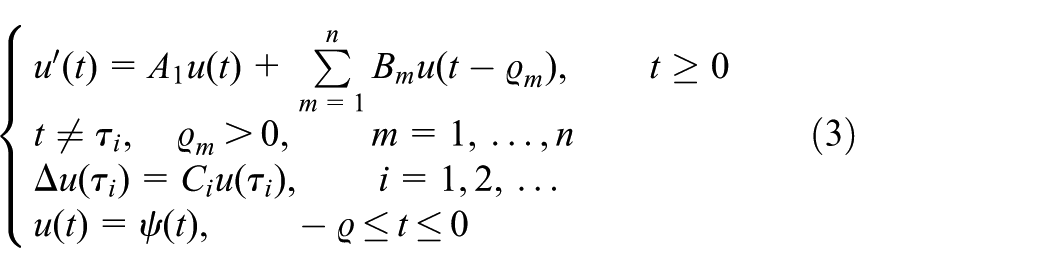
In this paper, we consider the representation of solutions of Cauchy initial value problems and asymptotic stability for the following linear impulsive multi-delay differential equations
where are constant matrices, , , and for each , , , , and the time sequences satisfy , the impulsive conditions , and represent the right and left limits of at and .
We note that the assumptions , , and are not too strong for many matrices, e.g. the normal matrix or the diagonal matrix. For more details on finding commutable matrices, we refer the reader to Arnold (1988: Section 30, Lemma 4) or Chow et al. (1994: Corollary 9.8, p. 152).
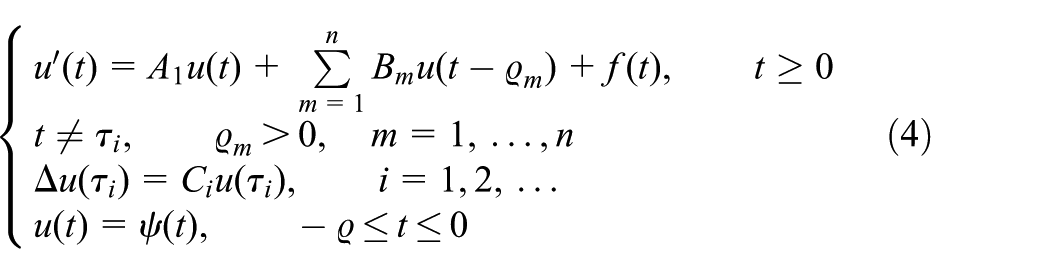
using the new impulsive multi-delayed Cauchy matrix via the variation of constants principle.
We study local asymptotic stability of solutions to equation (3) and local asymptotic stability of solutions to impulsive multi-delay differential equations with nonlinear terms of the form
where
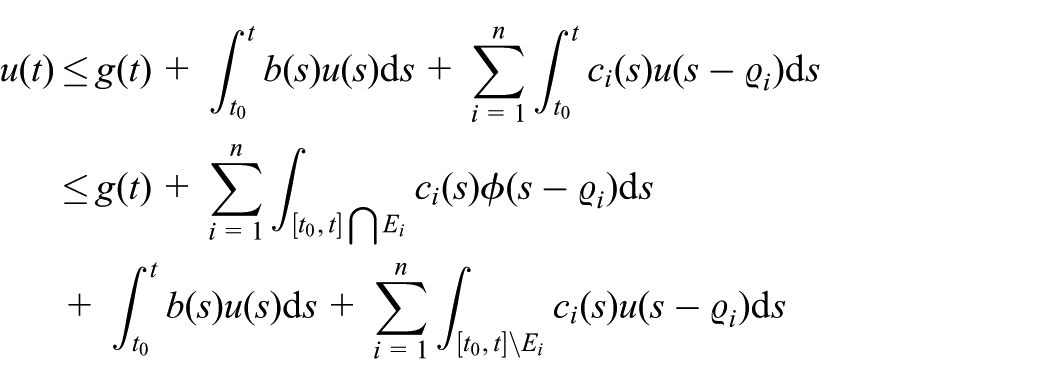
The main innovation is to derive the impulsive multi-delayed Cauchy matrix for equation (3) and give its norm estimate. Based on the impulsive multi-delayed Cauchy matrix via the variation of constants principle, we obtain an explicit formula for solutions to equations (3) and (4). Deriving properties of defined in equation (6), and putting mild conditions on impulsive terms, we present sufficient conditions to guarantee that the trivial solution to equation (3) is locally asymptotically stable. We also show that the trivial solution to equation (5) is locally asymptotically stable by using a modified integral Grönwall inequality with delay.
The main contributions are as follows:
We give the explicit solution of impulsive multi-delayed Cauchy problems with linear parts defined by pairwise permutable matrices, using a new concept for the impulsive multi-delayed Cauchy matrix and the variation of constants principle.
Based on the presentation of solutions and a norm estimate of the impulsive multi-delayed Cauchy matrix, we apply the multi-delayed Grönwall inequality to establish some asymptotic stability results for trivial solutions.
In the next section, we recall some notation and properties for multi-delayed exponential matrices. Then we introduce the impulsive multi-delayed Cauchy matrix and its norm estimate, and verify that it is the fundamental matrix for linear impulsive multi-delay differential equations. After this, we give explicit formulae for solutions to linear impulsive homogeneous or nonhomogeneous multi-delay differential equations via an impulsive multi-delayed Cauchy matrix associated with the variation of constants approach. Next, sufficient conditions ensuring local asymptotic stability of solutions are presented. Two examples are given to illustrate our theoretical results in the final section.
Preliminaries
For and , we introduce the vector norm and the matrix norm
respectively, where and are the elements of the vector and the matrix . Let be the space of bounded linear operators in . Denote by the Banach space of vector-value bounded continuous functions from endowed with the norm . We introduce a space . Denote ; there exist and with for any and .
We need the following basic definitions and lemmas.
Definition 2. The trivial solution of equation (3) is called locally asymptotically stable, if there exists such that , holds, where the solution is generated by . If can be arbitrary, then is globally asymptotically stable.
It is well known that local and global asymptotic stabilities are coincident for equation (3).
Now we recall a Grönwall inequality with time multi-delays.
Impulsive multi-delayed Cauchy matrix and its property
We now introduce a concept of impulsive multi-delay matrix function, an extension of the multi-delay matrix function for linear multi-delay differential equations, which helps us to seek explicit formulae of solutions to impulsive multi-delay differential equations.
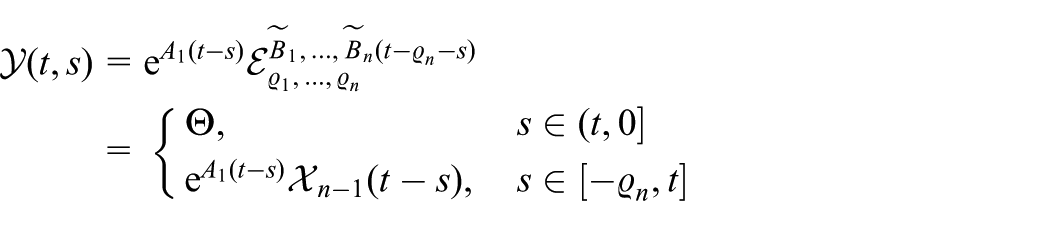
Using the multi-delayed matrix exponential (equation (2)), we define and
where
and
Here, we call the impulsive multi-delayed Cauchy matrix associated with equation (3). Note that and where is an identity matrix.
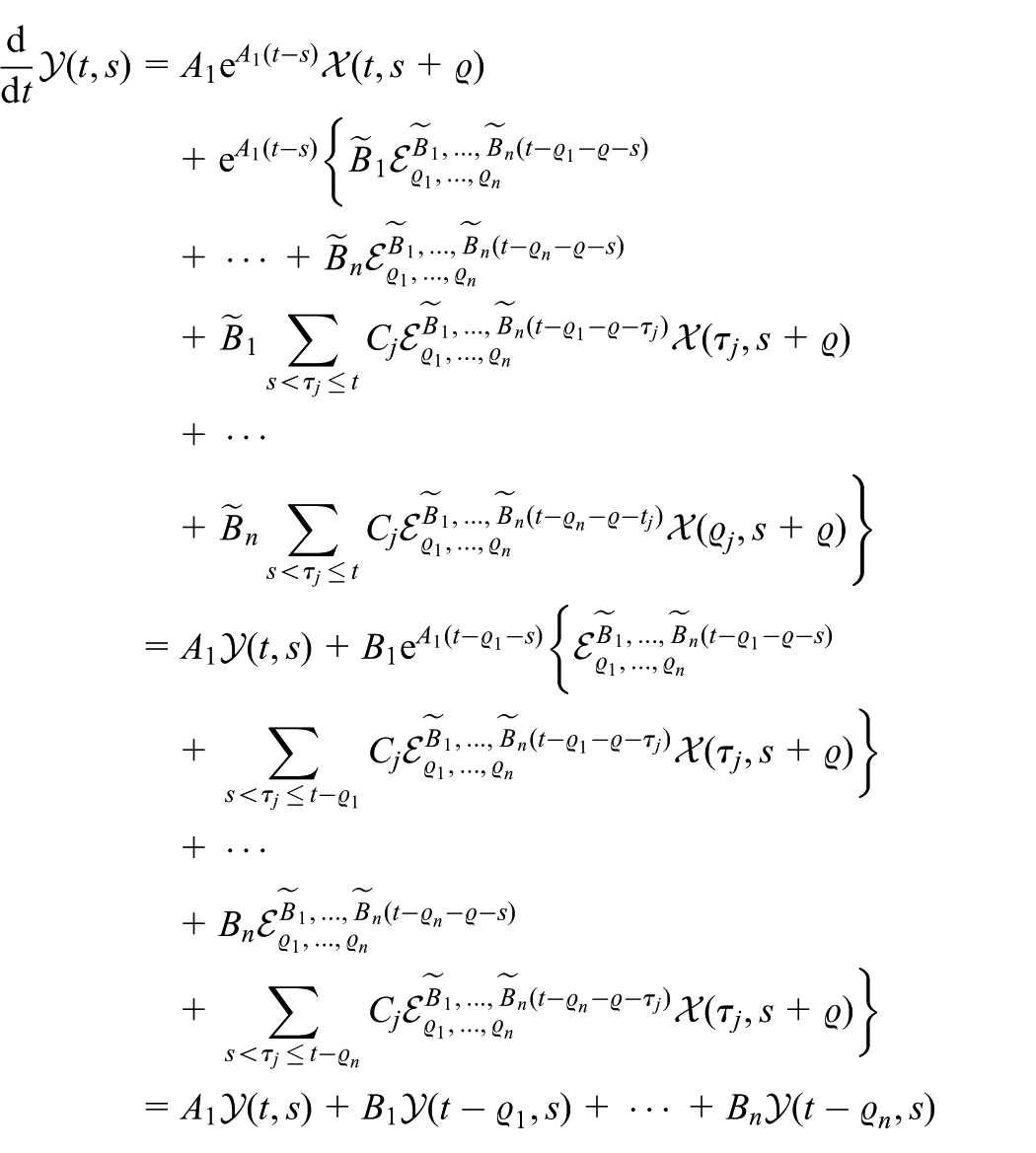
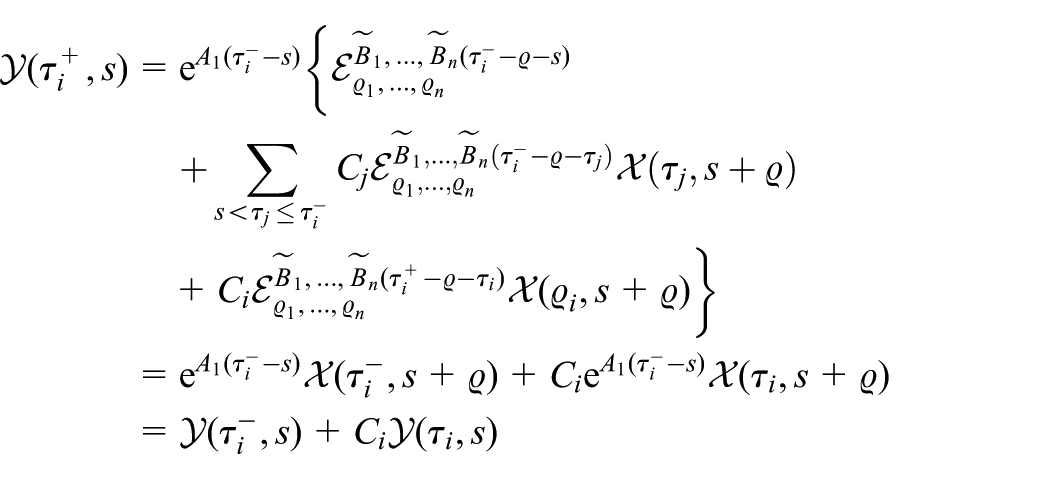
Lemma 2.The impulsive multi-delayed Cauchy matrix is the fundamental matrix of equation (3).
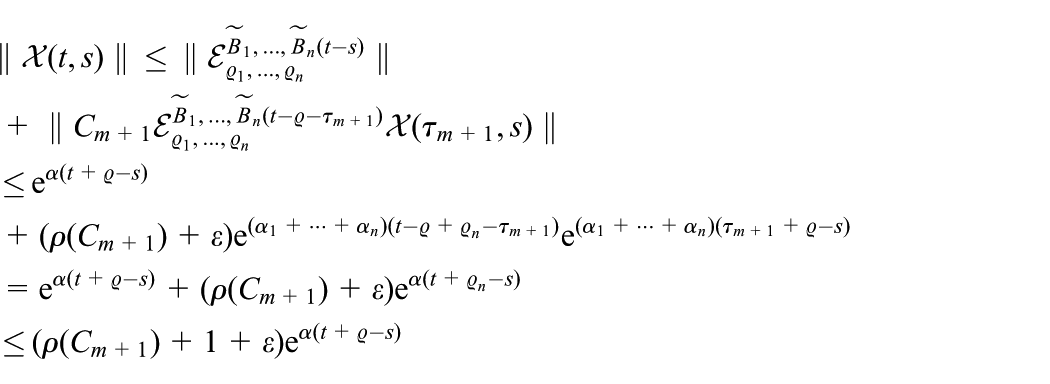
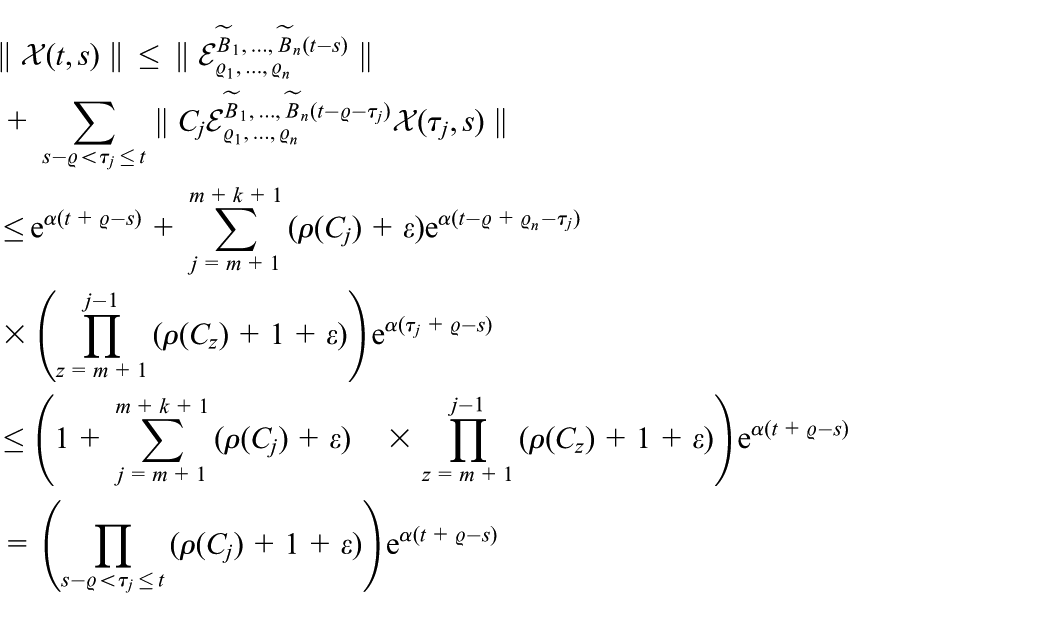
Step 2. Let be the number of impulsive points that belong to . Note that for all (see You and Wang, 2017: Lemma 2.4), and then
This ends the proof.
Now we introduce the following condition.
. Let be the eigenvalues of with i.e. there exist such that
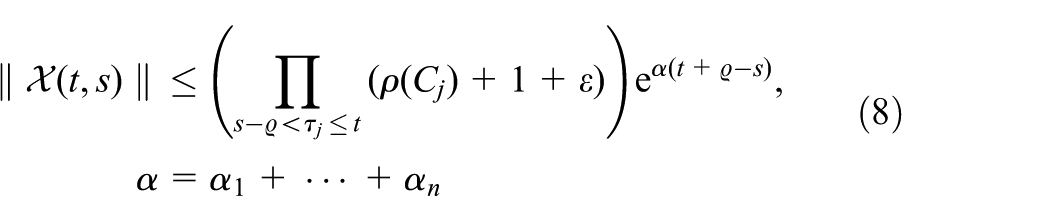
To estimate , we consider the norm estimate on . For given there exists , such that . From Ortega and Rheinboldt (1970: Chapter 2) and , we have . Choosing , then .
The following property is very useful for our next stability results.
Lemma 3.Assume is satisfied. For any , we have
and
Proof. Without loss of generality, we suppose that and We will use mathematical induction.
In this section, we seek an explicit formula of solutions to linear impulsive nonhomogeneous multi-delay differential equations by adopting similar ideas to those presented by You and Wang (2016).
Firstly, we drive an explicit formula of solutions to linear impulsive homogeneous multi-delay differential equations.
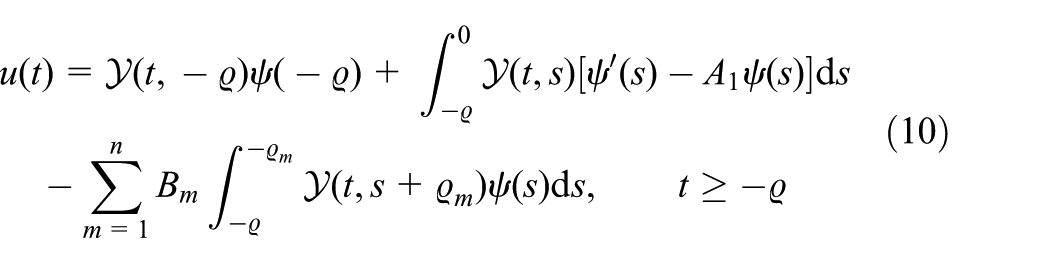
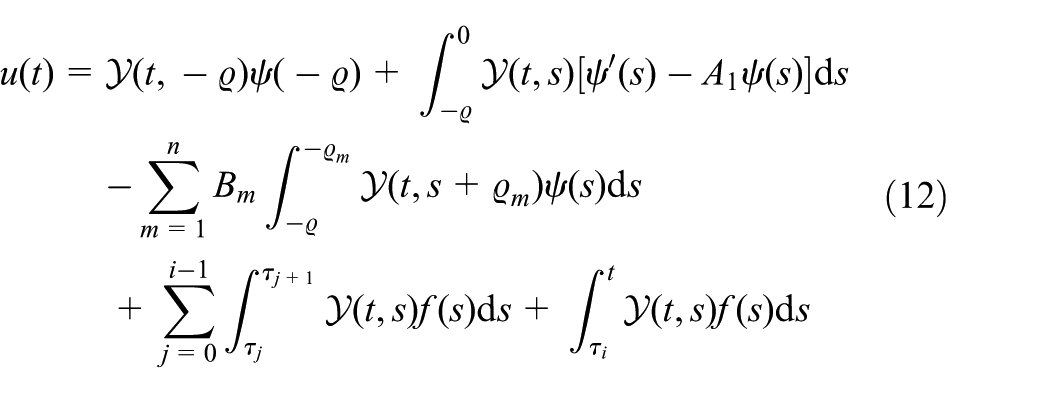
Theorem 1.The solution of equation (3) has the form
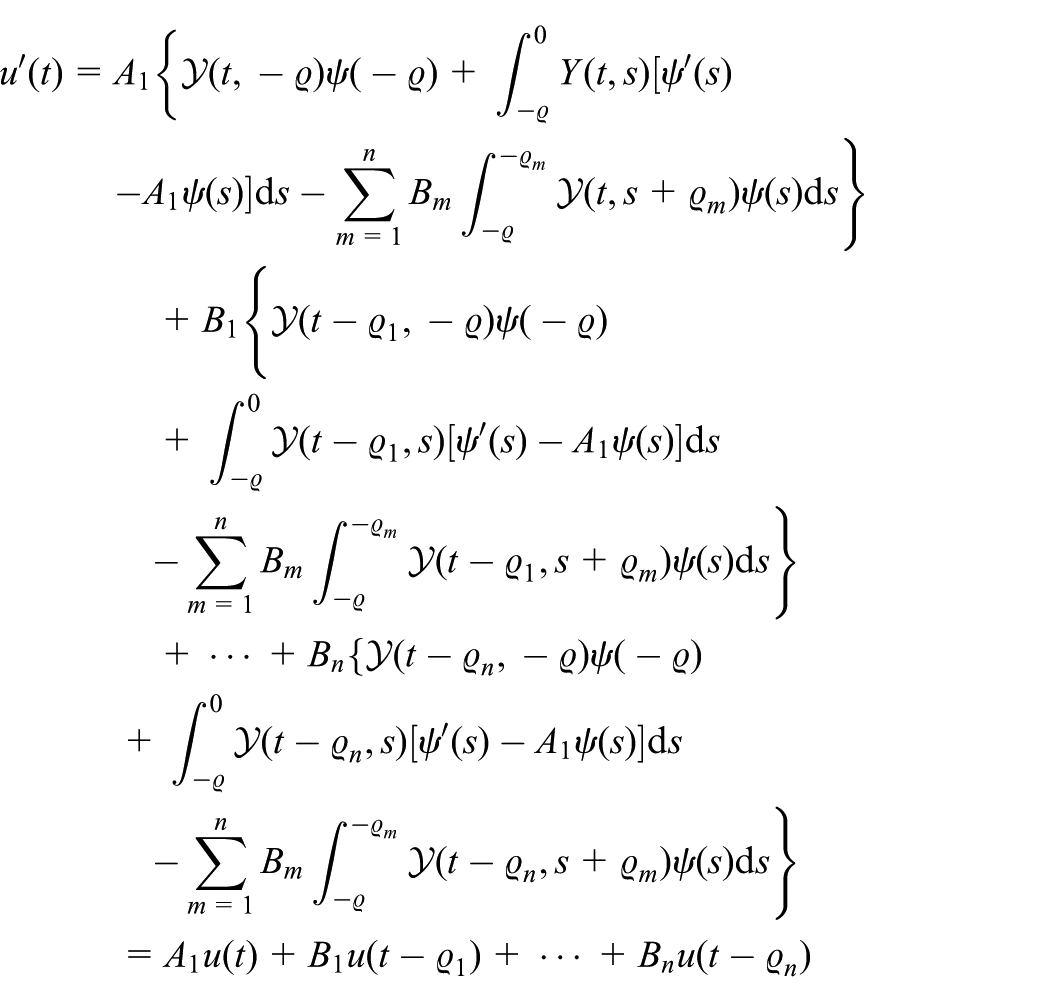
Proof. We will divide the proof into the following three steps:
Step 1. For , note
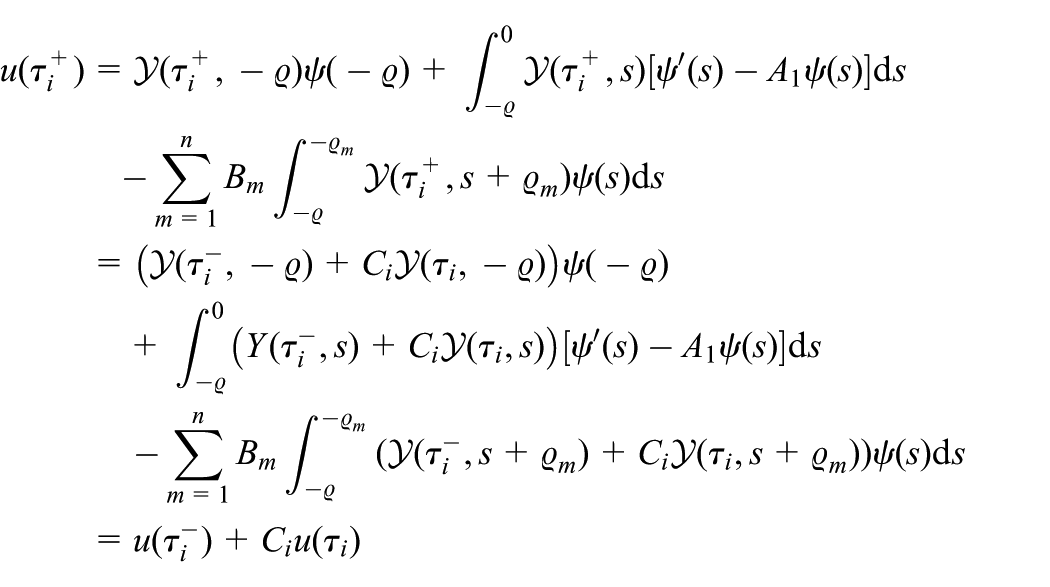
Step 2. Without loss of generality, we suppose that . For , we have
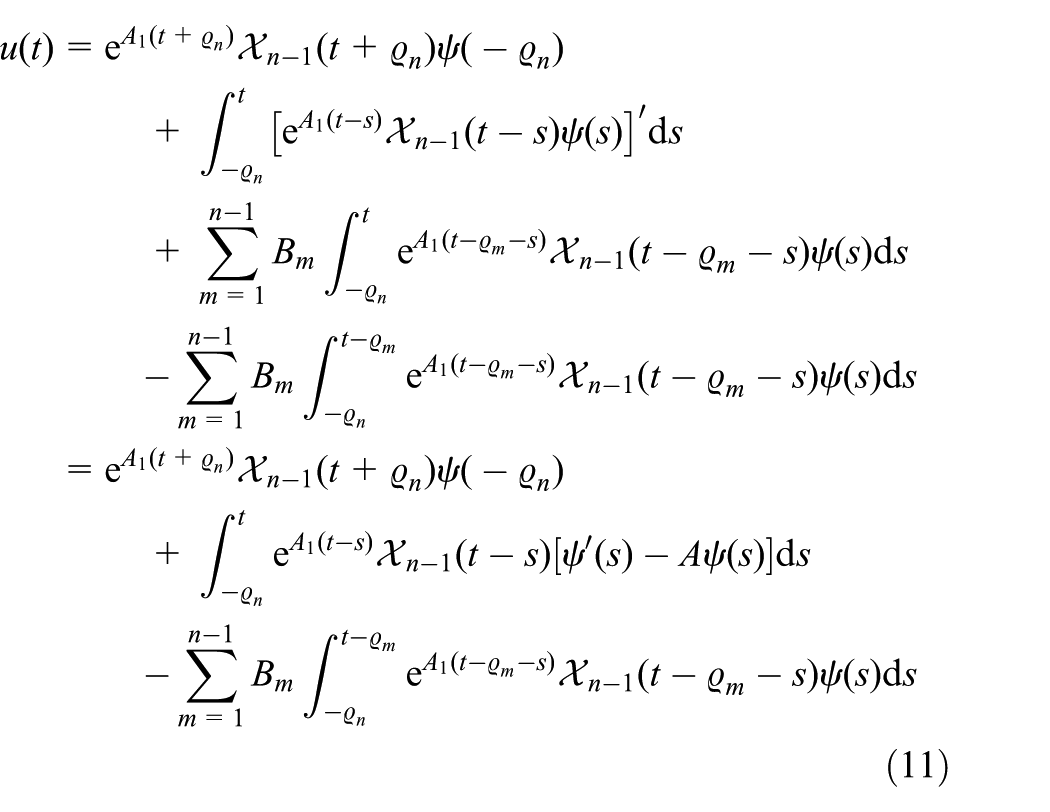
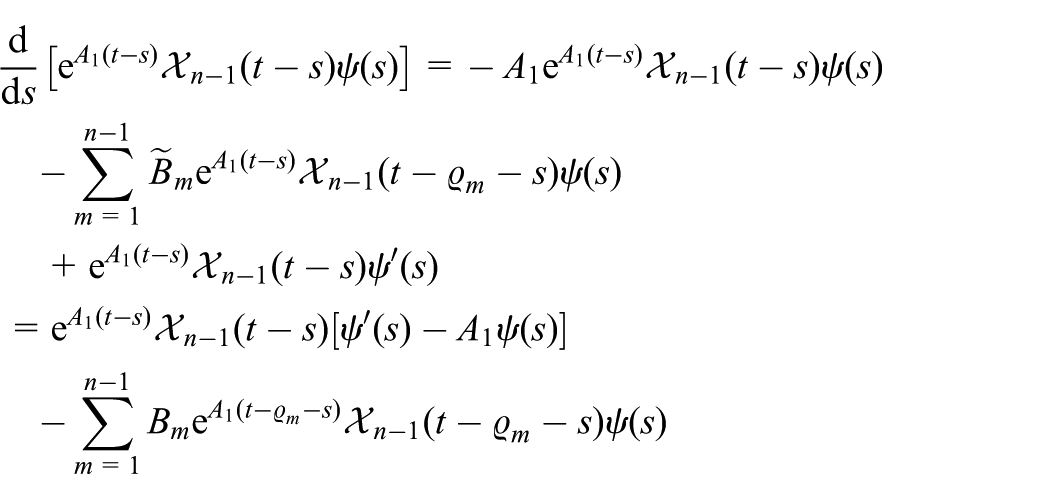
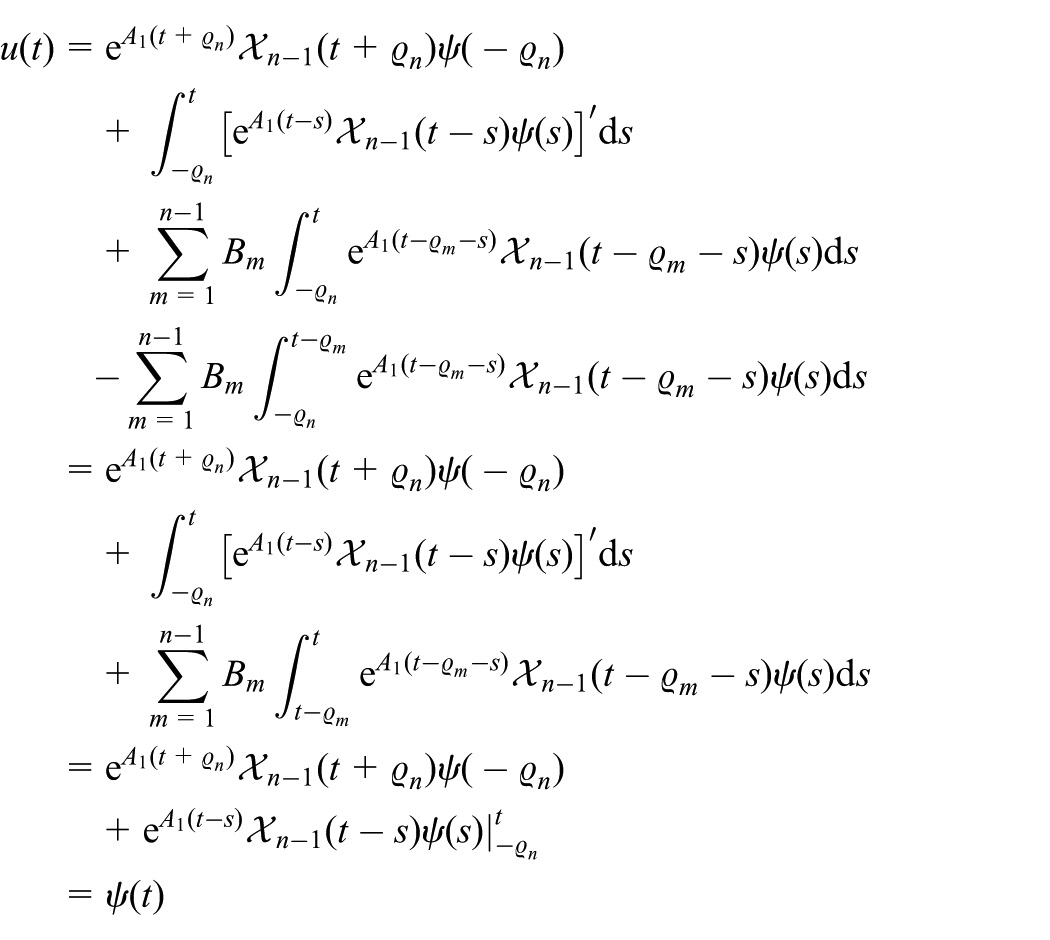
Next, one can repeat the proof in Lemma 1 to drive an explicit formula of solutions to linear impulsive nonhomogeneous multi-delay differential equations (we omit the details).
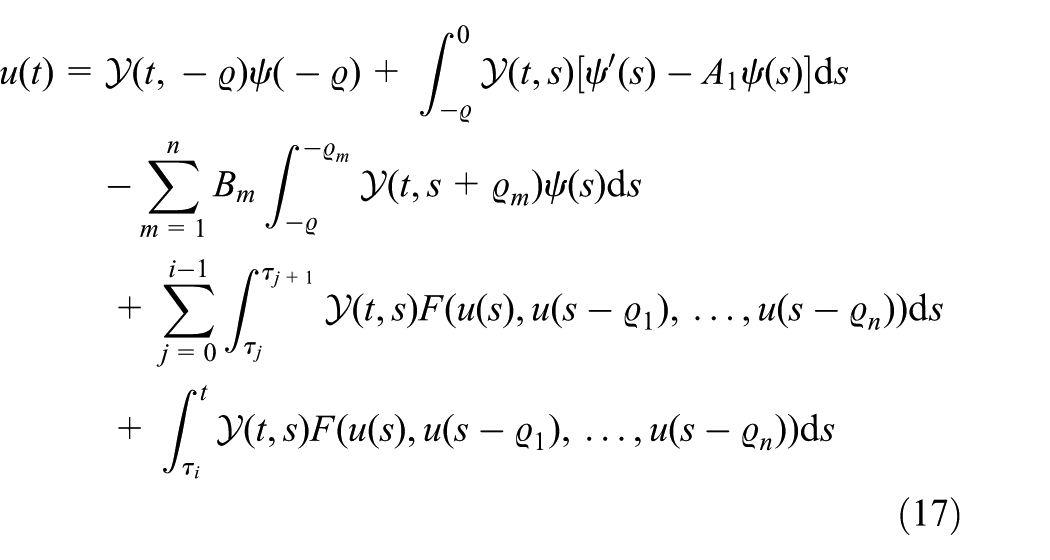
Lemma 4.The solution of equation (4) has the form
Asymptotic stability
Local asymptotic stability of the trivial solution to equation (3)
To prove our main results on the stability of the trivial solution, we introduce the following conditions:
(H1) Suppose that and set
(H2) Suppose that
where is a finite number.
(H3) Assume
where
(H4) Suppose that , where
Now we are ready to state our stability result for the trivial solution of equation (3).
Theorem 2.If , and are satisfied, then the trivial solution of equation (3) is locally asymptotically stable.
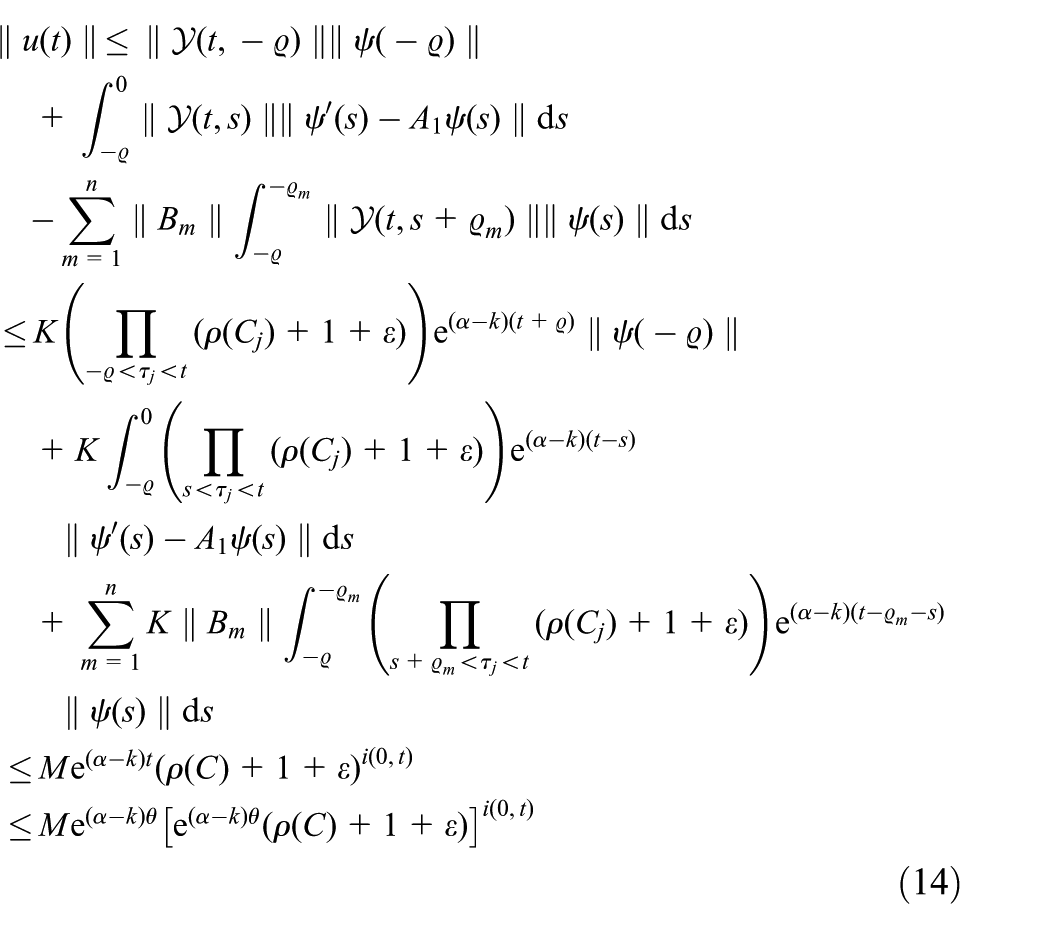
Proof. Using Lemma 3 and Theorem 1, we have
where
It follows from condition that one can choose such that
Then equation (14) gives
The proof is complete.
Next, we give a second stability result for the trivial solution of equation (3).
Theorem 3.If , and are satisfied, then the trivial solution of equation (3) is locally asymptotically stable.
Proof. The proof is similar to Theorem 2, so we only give details of the main differences. Note, from , we have , where is arbitrarily small. From equation (14) one has
By virtue of , we can find such that
and thus the proof is finished.
Local asymptotic stability of trivial solution to equation (5)
We need the following additional assumptions:
(H5) There exists . such that
(H6) Suppose , where is defined in equation (13).
(H7) There exists such that
(H8) Suppose
where is defined in equation (13).
Case 1
.
Theorem 4.Assume that , , and are satisfied. Then the trivial solution of equation (5) is locally asymptotically stable.
From we can find a sufficiently small such that and then we have
The proof is finished.
Case 2
depends on .
Theorem 5.Assume that , , and are satisfied. Then the trivial solution of equation (5) is locally asymptotically stable.
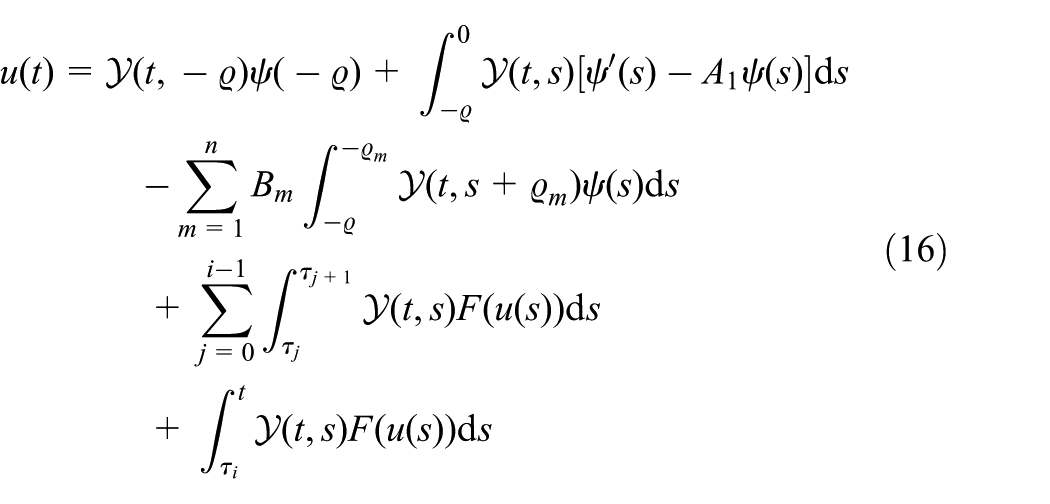
Proof. From the variation of constants formula (see Lemma 4), the solution of equation (5) has the form
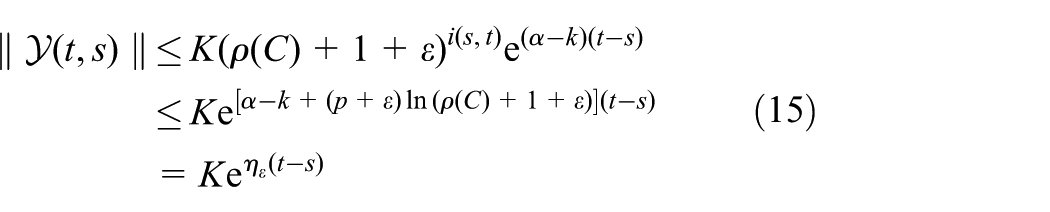
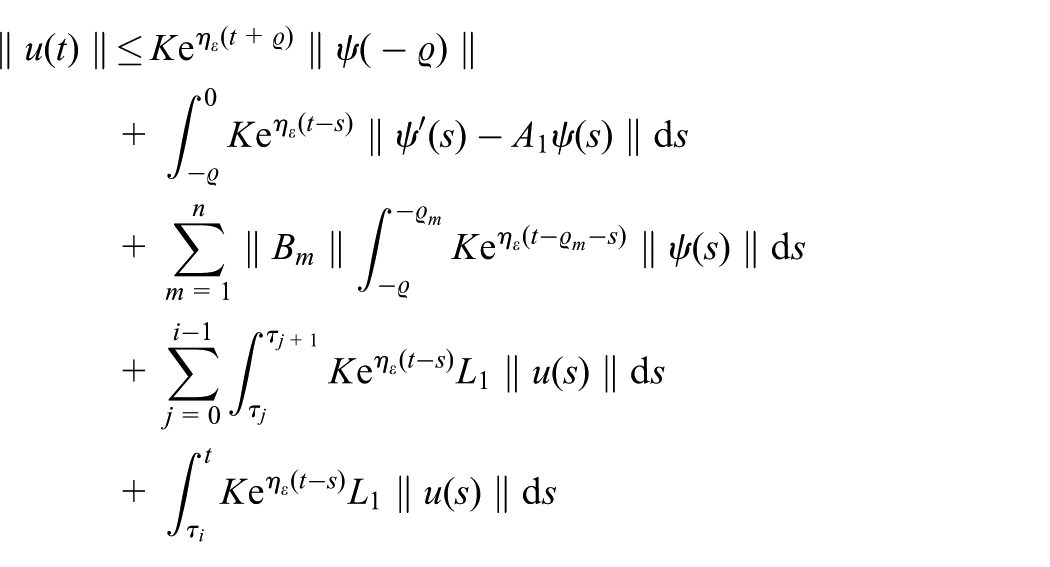
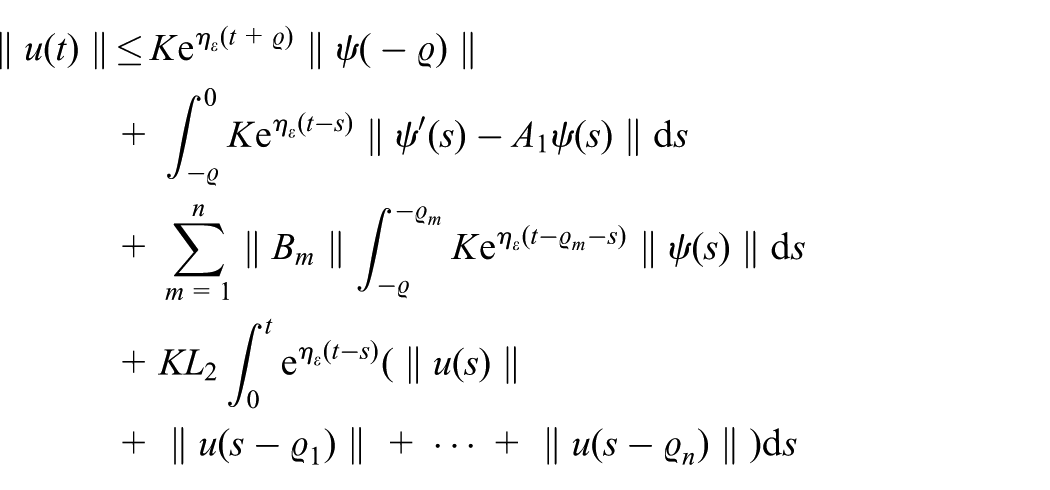
Taking the norm on two sides of equation (16) via equation (15) and , one has
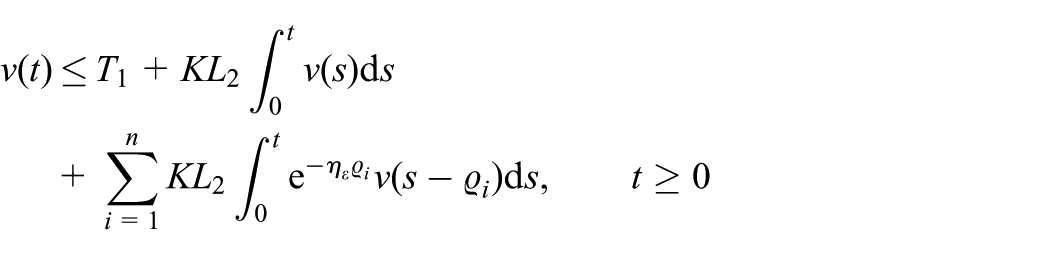
Set . Then
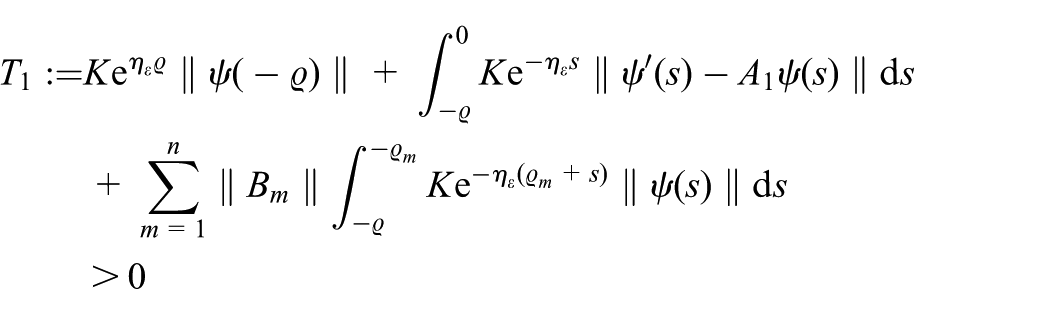
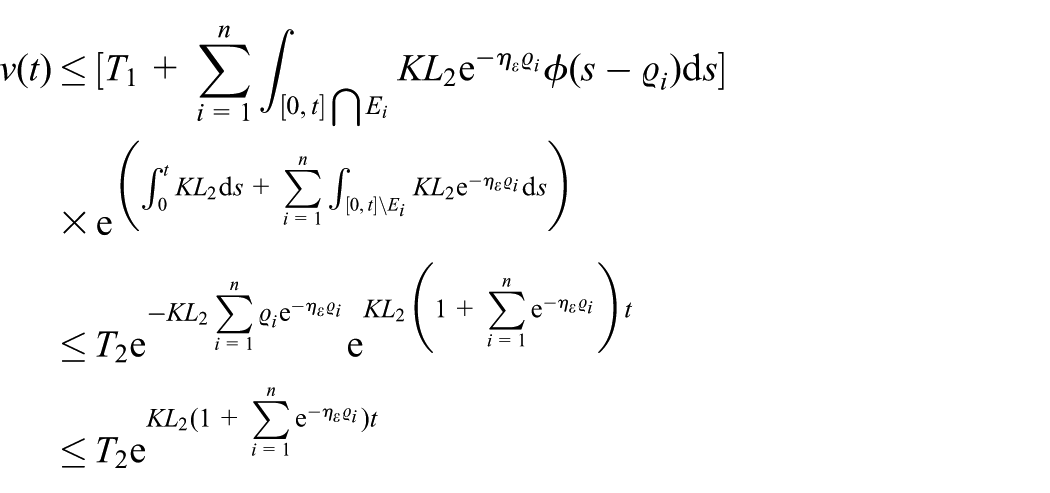
where and are defined in Theorem 4, and as . Using Remark 1, for any , one has
where , and
which yields
For sufficiently small
so then
as . The proof is complete.
Numerical examples
In this section, we give numerical examples to demonstrate the effectiveness of our method. Here, we use MATLAB software to compute some parameters and draw the figures for the examples.
Let be the largest integer less than .
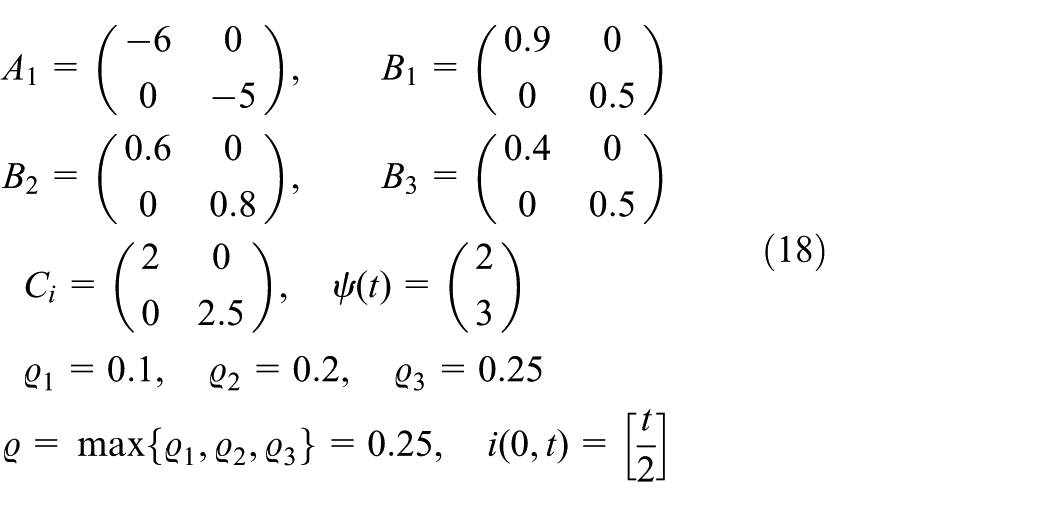
Example 1. Consider equation (3) associated with
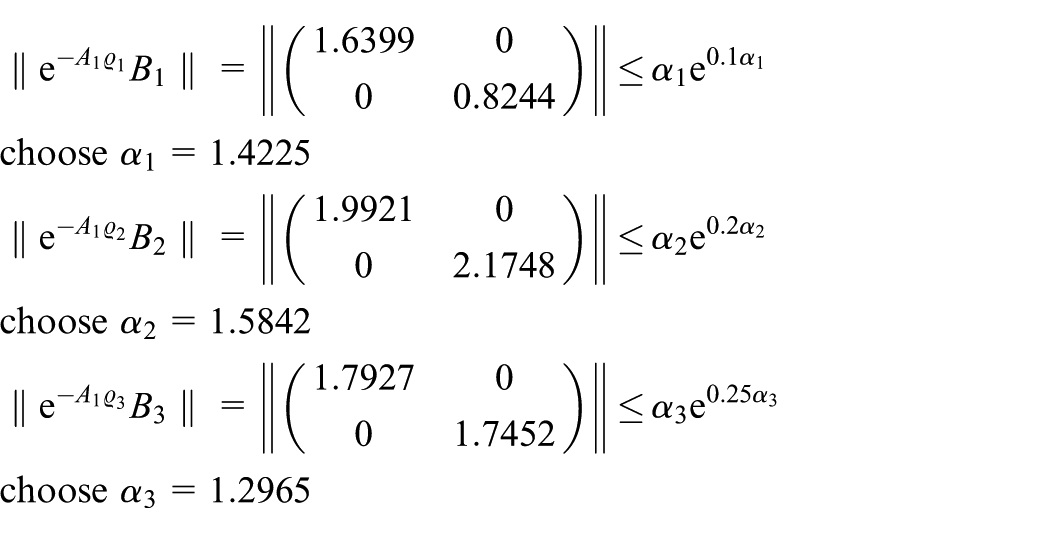
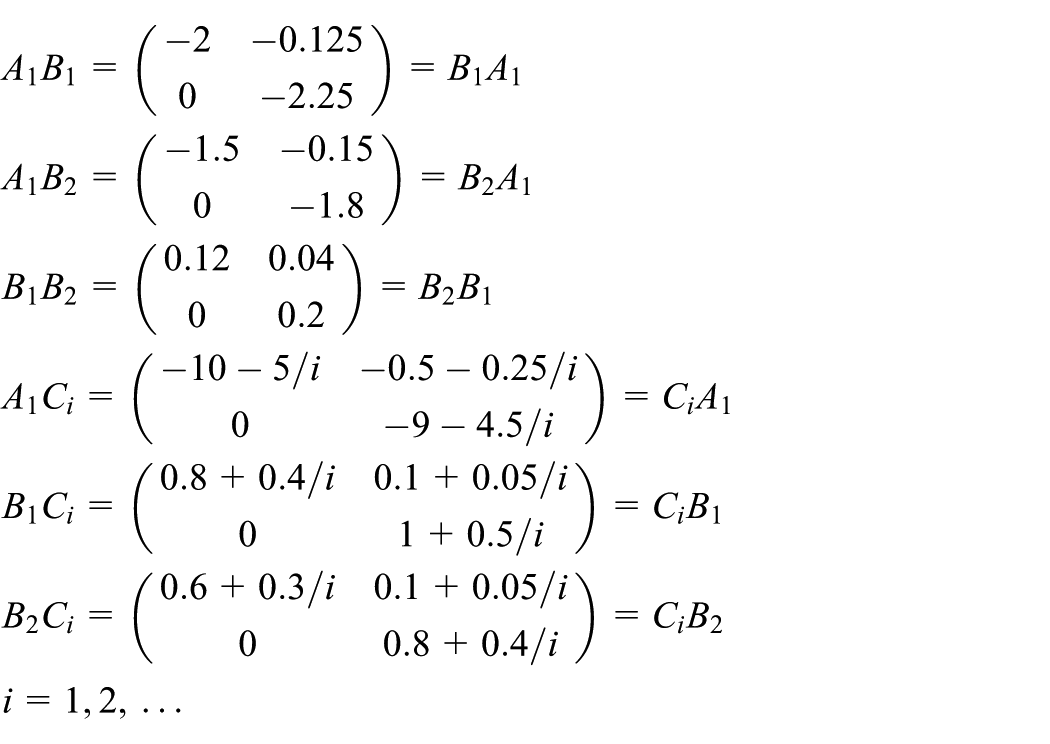
Clearly, , , and for , . Set and , where choosing , and and setting so . Next
and implies that , and
Now all the conditions of Theorem 2 are satisfied. Then
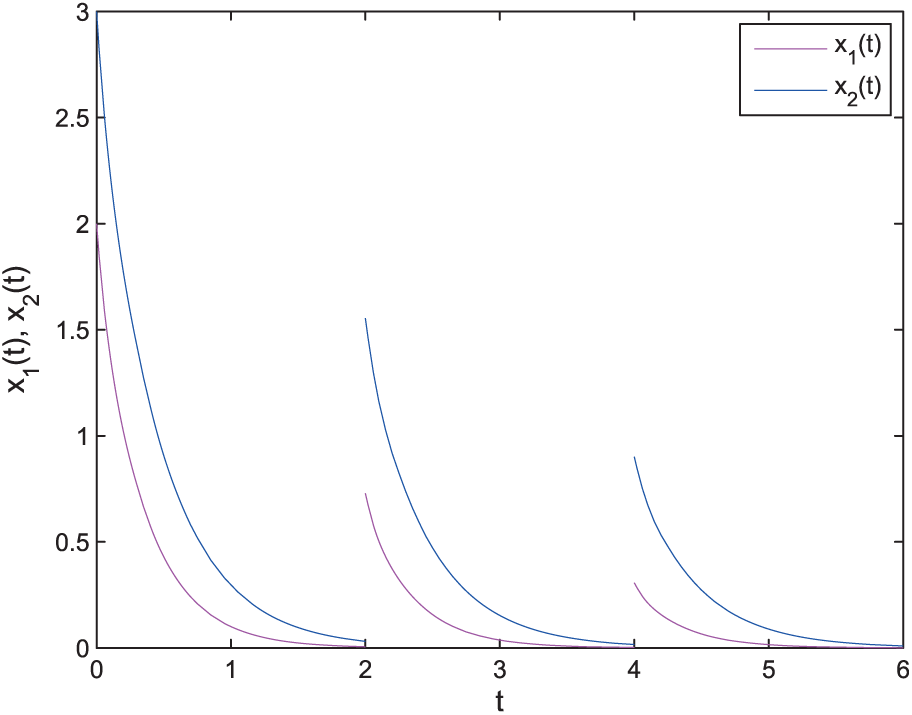
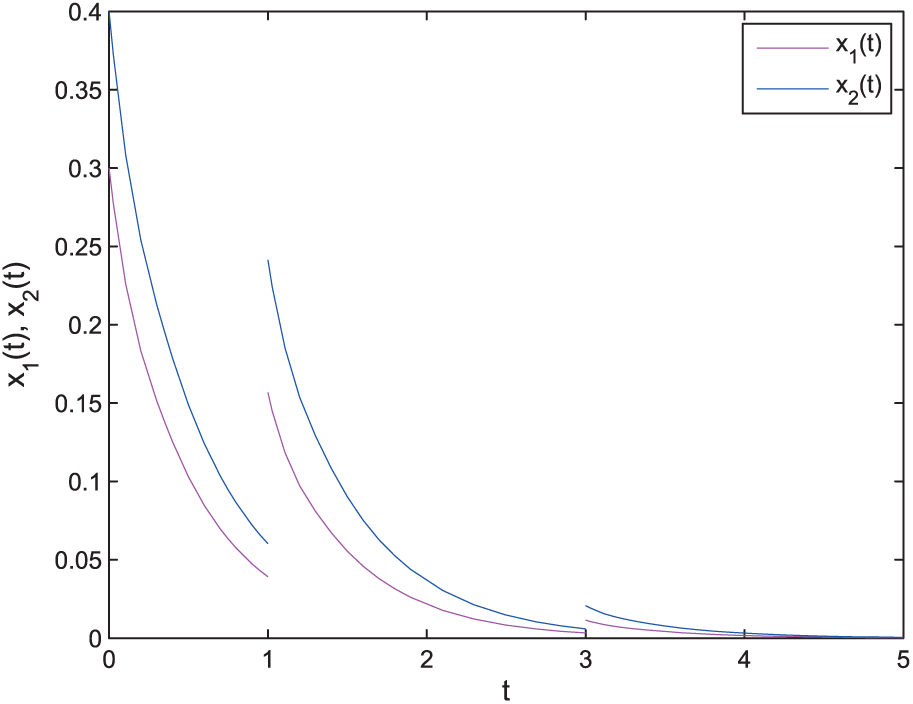
for , since as , i.e. the trivial solution of equations (3) and (1) is locally asymptotically stable (see Figure 1).
State response of equations (3) and (18).
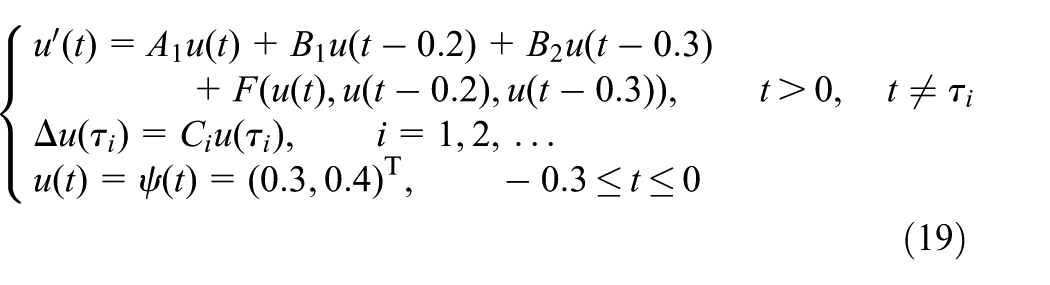
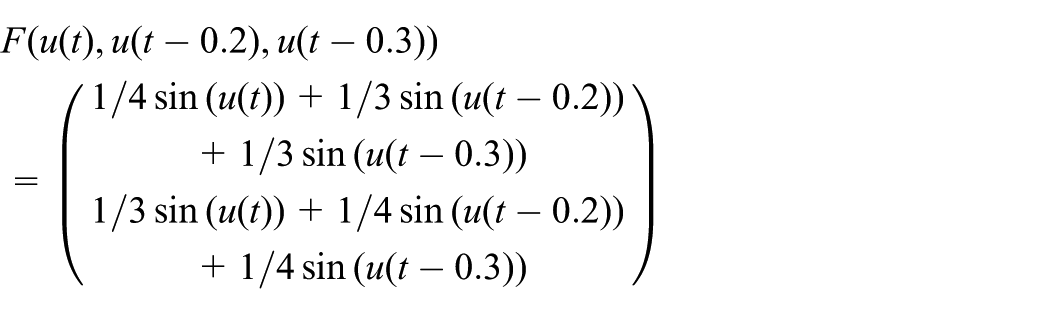
Example 2. Consider the equation originated from the impulsive two-species competition system
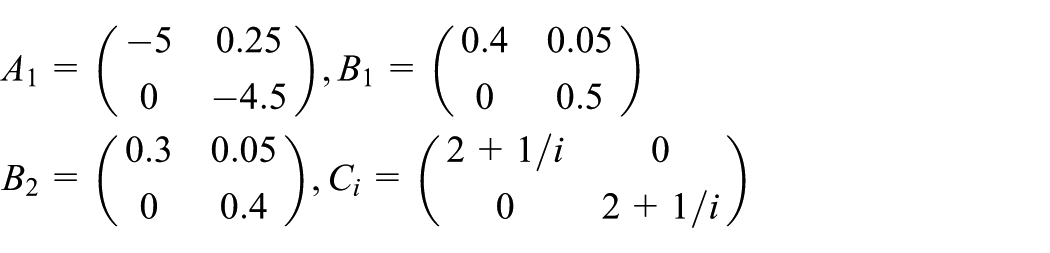
where we set
, ; then and
and
Now
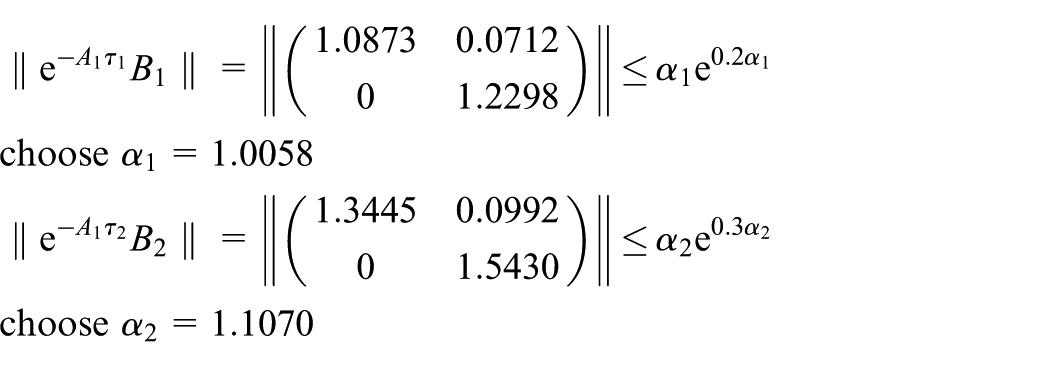
It is clear that , then . Set and , where choosing . By computation,
and we can choose . Next
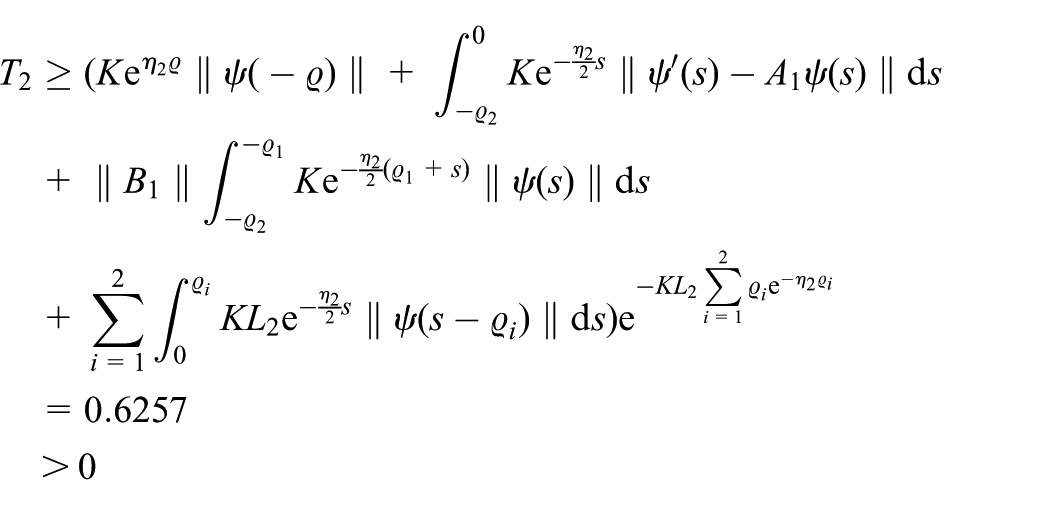
By calculation, ,
and
Now all the conditions of Theorem 5 are satisfied. Then
Then the trivial solution of equation (19) is locally asymptotically stable (see Figure 2).
State response of equation (19).
Conclusions
This paper introduces a new concept of an impulsive multi-delayed Cauchy matrix, which is then used to obtain the explicit solution to linear impulsive multi-delayed differential equations using the variation of constants principle. With the help of the representation of solutions, we apply the multi-delayed Grönwall inequality to establish the asymptotic stability of trivial solutions.
Footnotes
Acknowledgements
The authors are grateful to the referees for their careful reading of the manuscript and their valuable comments.
Declaration of conflicting interests
The author(s) declared no potential conflicts of interest with respect to the research, authorship, and/or publication of this article.
Funding
The author(s) disclosed receipt of the following financial support for the research, authorship, and/or publication of this article: This work was supported by the National Natural Science Foundation of China (grant number 11661016), the Training Object of High Level and Innovative Talents of Guizhou Province (grant number (2016)4006), the Unite Foundation of Guizhou Province (grant number [2015]7640), and Graduate ZDKC (grant number [2015]003).
References
1.
ArnoldVI (1988) Geometrical Methods in the Theory of Ordinary Differential Equations. New York: Springer.
2.
BainovDSimeonovP (1992) Integral Inequalities and Applications. Alphen aan den Rijn, Netherlands: Kluwer Academic Publishers.
BenchohraMHendersonJNtouyasSK (2006) Impulsive Differential Equations and Inclusions. New York: Hindawi Publishing Corporation.
5.
BoichukADiblíkJKhusainovYDet al. (2010) Fredholm’s boundary-value problems for differential systems with a single delay. Nonlinear Analysis: Theory, Methods and Applications72(5): 2251–2258.
6.
ChowSNLiChWangD (1994) Normal Forms and Bifurcations of Planar Vector Fields. Cambridge, UK: Cambridge University Press.
7.
DiblíkJKhusainovDY (2006a) Representation of solutions of discrete delayed system x(k+1) = Ax(k) + Bx(k−m) + f(k) with commutative matrices. Journal of Mathematical Analysis and Applications318(1): 63–76.
8.
DiblíkJKhusainovDY (2006b) Representation of solutions of linear discrete systems with constant coefficients and pure delay. Advances in Difference Equations2006: 0808253.
9.
DiblíkJMorávkováB (2013) Discrete matrix delayed exponential for two delays and its property. Advances in Difference Equations2013: 139.
10.
DiblíkJFečkanMPospíšilM (2014) On the new control functions for linear discrete delay systems. SIAM Journal on Control and Optimization52(3): 1745–1760.
11.
DiblíkJKhusainovDYBaštinecJet al. (2016) Exponential stability of linear discrete systems with constant coefficients and single delay. Applied Mathematics Letters51: 68–73.
12.
DiblíkJKhusainovDYLukáčováJet al. (2010) Control of oscillating systems with a single delay. Advances in Difference Equations2010: 108218.
13.
DiblíkJKhusainovDYRůžičkováM (2008) Controllability of linear discrete systems with constant coefficients and pure delay. SIAM Journal on Control and Optimization47(3): 1140–1149.
14.
IvanovILSlyn’koBI (2009) Conditions for the stability of an impulsive linear equation with pure delay. Ukrainian Mathematical Journal61(9): 1417–1427.
15.
KhusainovDYShuklinGV (2003) Linear autonomous time-delay system with permutation matrices solving. Studies of the University of Zilina, Mathematical Series17(1): 101–108.
16.
KhusainovDYShuklinGV (2005) Relative controllability in systems with pure delay. International Applied Mechanics41(2): 210–221.
17.
KhusainovDYDiblíkJRůžičkováMet al. (2008) Representation of a solution of the Cauchy problem for an oscillating system with pure delay. Nonlinear Oscillations11(2): 276–285.
18.
MedveďMPospíšilM (2012) Sufficient conditions for the asymptotic stability of nonlinear multidelay differential equations with linear parts defined by pairwise permutable matrices. Nonlinear Analysis: Theory, Methods and Applications75(7): 3348–3363.
19.
MedveďMPospíšilMŠkripkováL (2011) Stability and the nonexistence of blowing-up solutions of nonlinear delay systems with linear parts defined by permutable matrices. Nonlinear Analysis: Theory, Methods and Applications74(12): 3903–3911.
20.
OrtegaJMRheinboldtWC (1970) Iterative Solution of Nonlinear Equations in Several Variables. San Diego, CA: Academic Press.
21.
PospíšilM (2012) Representation and stability of solutions of systems of functional differential equations with multiple delays. Electronic Journal of Qualitative Theory of Differential Equations2012: 54.
22.
SamoilenkoAMPerestyukNAChapovskyY (1995) Impulsive Differential Equations: Asymptotic Properties of the Solutions. Singapore: World Scientific.
23.
YinSShiPYangH (2016) Adaptive fuzzy control of strict-feedback nonlinear time-delay systems with unmodeled dynamics. IEEE Transactions on Cybernetics46: 1926–1938.
24.
YinSYangHGaoHet al. (2017) An adaptive NN-based approach for fault-tolerant control of nonlinear time-varying delay systems with unmodeled dynamics. IEEE Transactions on Neural Networks and Learning Systems28: 1902–1913.
25.
YouZWangJ (2016) Stability of impulsive delay differential equations. Journal of Applied Mathematics and Computing Epub ahead of print 28November2016. DOI: 10.1007/s12190-016-1072-1.
26.
YouZWangJ (2017) On the exponential stability of nonlinear delay systems with impulses. IMA Journal of Mathematical Control and Information Epub ahead of print 06February2017. DOI: 10.1093/imamci/dnw077.