







Abstract
Nonlinear loads and grid side disturbances in the power distribution network cause harmonic rich currents and voltage perturbations such as voltage harmonics, voltage sags and voltage swells. The unified power quality conditioner (UPQC) with shunt inverter and series inverter are usually employed for elimination of current and voltage related power quality issues. However, elimination of voltage and current quality issues in a grid connected Photovoltaic (PV) system is essential. Therefore, PV integrated UPQC topology is proposed in this paper with a novel controller for power quality improvement. The control algorithm based on notch filter Phase Locked Loop (PLL) is utilized for proper phase detection and elimination of voltage and current disturbances. PV tied UPQC controller based on notch filter PLL has the capability to avoid multiple zero crossing during highly distorted grid voltage condition. Conventional control algorithms such as synchronous reference frame theory, unit vector controller based on traditional PLL are also analyzed for the control of PV tied UPQC. The proposed system is developed in Matlab/Simulink and the results obtained are evaluated to measure the performance. A real-time hardware prototype is developed using dSPACE processor. The obtained experimental results validate the efficiency of the proposed controller for PV tied UPQC.
Introduction
Power quality disturbances in power system have increased the difficulties of the consumer by affecting to the sensitive loads. Issues related to power quality such as voltage and current quality issues have been focused on by Subjak and Mcquilkin (1990), Salmeron and Litran (2010) and Tey et al. (2005). In addition to this, non-conventional energy sources such as solar power and wind generated electrical power have shown their effectiveness over conventional energy sources. Thereby, solar as well as wind energy sources have been adopted at the distribution level for clean energy generation. However, there is requirement of power electronic converters/inverters for the grid penetration of renewable energy system (Hamid et al., 2014; Mishra and Ray, 2016; Tuyen and Fujita, 2015).
The literature survey report about the presence of voltage and current quality issues in the grid connected systems. The power quality issues are desired to be eliminated for the regulation of power quality at the consumer end. Sensitive loads at various levels of distribution system behave abnormally in presence of voltage and current distortions. For the mitigation of power quality based issues power electronics based conditioners have been installed at various levels of distribution system. These power conditioners are allowed to operate in a controlled manner for elimination of voltage and current power quality issues. Power conditioners development in various categories such as shunt active power filter, series active power filter and hybrid active power filters have been widely studied and implemented in the literature (Corasaniti VF et al., 2009; Dash and Ray, 2017a; Fallah et al., 2017; Garnayak and Panda, 2016, 2018; Panda et al., 2013) to prove the effectiveness. The aforementioned power conditioners have been used specifically for various nature of power quality means used separately for voltage and current quality issues. Estimation of parameters before elimination of power quality issues have been also widely investigated in literature, which play a significant role (Subudhi et al., 2008, 2009) The combination of series active power filter and shunt active power filter of Photovoltaic (PV) tied Unified Power Quality Conditioner (UPQC) are connected back to back through dc-link capacitor and have been reported for simultaneous mitigation of both current related and voltage based power quality issues. The combine operation of series and shunt inverter is known as UPQC (Dash and Ray, 2017b; Paul et al., 2011; Trinh and Lee, 2014). The single phase system as well as three phase systems require UPQC as power conditioner. The issues related to voltage and current such as voltage sags, swells, unbalances and current harmonics are more significant in single phase systems (Khadkikar et. al., 2011). Although UPQC is not a new topic, PV fed UPQC has not gained saturation among researchers, as in India there are very few working in this field and until now it has not been in practical implementation or commercially used for the power network. As PV grid integration has gained its popularity based on various innovative topologies associated with it are only concentrate on elimination of current quality issues. Therefore, PV fed UPQC system has been selected by the authors of the paper to evaluate the performance based on a new controller under highly distorted grid condition. Furthermore, various single phase grid connected PV systems have been studied, which are dedicatedly operated for current quality issues elimination (Tuyen and Fujita, 2015). Various innovative topologies have been reported for PV grid integration with single phase system, but PV grid integration through UPQC for single phase systems have not been studied and implemented so far. Therefore, the authors have proposed single phase system where PV has been connected to the grid through UPQC in the present paper. Depending upon the location of the series active filter part and shunt active filter part of UPQC, it has been classified into different categories: in UPQC-L topology (left shunt connected UPQC), where shunt inverter is present at grid side and UPQC-R topology (right shunt connected UPQC), where shunt active filter of UPQC is found to be present at load terminal (Ghosh and Ledwich, 2002). The mechanism of voltage injection angle for UPQC also presents classification of UPQC, such as UPQC-Q, UPQC-S and UPQC-P. The requirement of quadrature component and its injection to the grid is handled by UPQC-Q topology. The UPQC-P type of conditioner has a characteristic; where the series inverter provides voltage signal in phase with grid voltage signal (Khadkikar, 2012). The fault ride through operation along with voltage and current quality issues have been discussed in Devassy and Singh (2015, 2016a). Efficient controllers for grid connected PV systems have been studied and utilized in Mishra and Ray (2016) and Tuyen and Fujita (2015), developed specially for elimination of current quality issues. Thereby simultaneous mitigation of voltage and current issues are focused on in this paper by the implementation of
Grid synchronization of PV system is much important for the stability and efficiency of the controller as phase and frequency detection is required for computation of system controller. Therefore, PLL schemes are necessary for the system. Various conventional PLL schemes have been developed and implemented such as enhanced PLL (EPLL) and synchronous reference frame (SRF PLL). In a highly distorted grid condition, conventional PLL fail to operate. Multiple zero crossing is the major issue during highly distorted grid conditions. For the elimination of the above problem, innovative PLL schemes have been developed gradually. The development and implementation of EPLL scheme and SRF PLL scheme are reported in Ghartemani et al. (2011), Lee et al. (2014) and Rasheduzzaman et al. (2016). The problems associated with conventional PLLs have been overcome with notch filter PLL scheme. In the present paper, notch filter PLL scheme is adopted for detection of desired phase and to maintain grid synchronization. Therefore, phase detection of the grid by low pass filter based on notch filter has been implemented in Rasheduzzaman et al. (2016) and Devassy and Singh (2016b). The performance and efficiency for notch filter implementation are taken into account in the previous studies. Notch filter based PLL have not been reported yet for the use of UPQC or PV fed UPQC system. Thereby the authors of the paper have proposed unit vector template generation controller with notch filter PLL scheme for PV fed UPQC topology.
The limitations associated with conventional control methodologies and PLL schemes have been considered in the present paper. Elimination of limitations of conventional schemes and adaptation of new features based controller for single phase PV fed UPQC has been proposed. The controllers based on notch filter based PLL have been developed and discussed for shunt inverter and series inverter of PV tied UPQC system. In section 2, the configuration of proposed PV tied UPQC system is discussed. A comprehensive review on conventional PLL schemes to maintain grid synchronization has been included in Section 3. The proposed notch filter PLL scheme is derived in Section 4. Simulation and experimental results are analyzed in Section 5 and Section 6, respectively. An overall conclusion is presented in Section 7.
Configuration of the PV tied UPQC system
The PV fed UPQC topology for single phase system is presented in Figure 1. The present scheme shows the shunt and series inverter share a common dc-link. The series inverter part of UPQC is placed at the grid side whereas the shunt inverter part of UPQC is present at the load side of the network. The shunt inverter of PV tied UPQC is developed to mitigate current quality issues. The series inverter of PV tied UPQC is employed for mitigation of grid side voltage disturbances. The PV is connected to the UPQC system through the common dc-link. The DC-DC converter of PV system is controlled by the MPPT algorithm for the extraction of maximum power. The shunt inverter part and series inverter part of the discussed system are coupled with the network by interfacing inductors, while for the elimination of higher order harmonics components a ripple filter is also used at series inverter side.
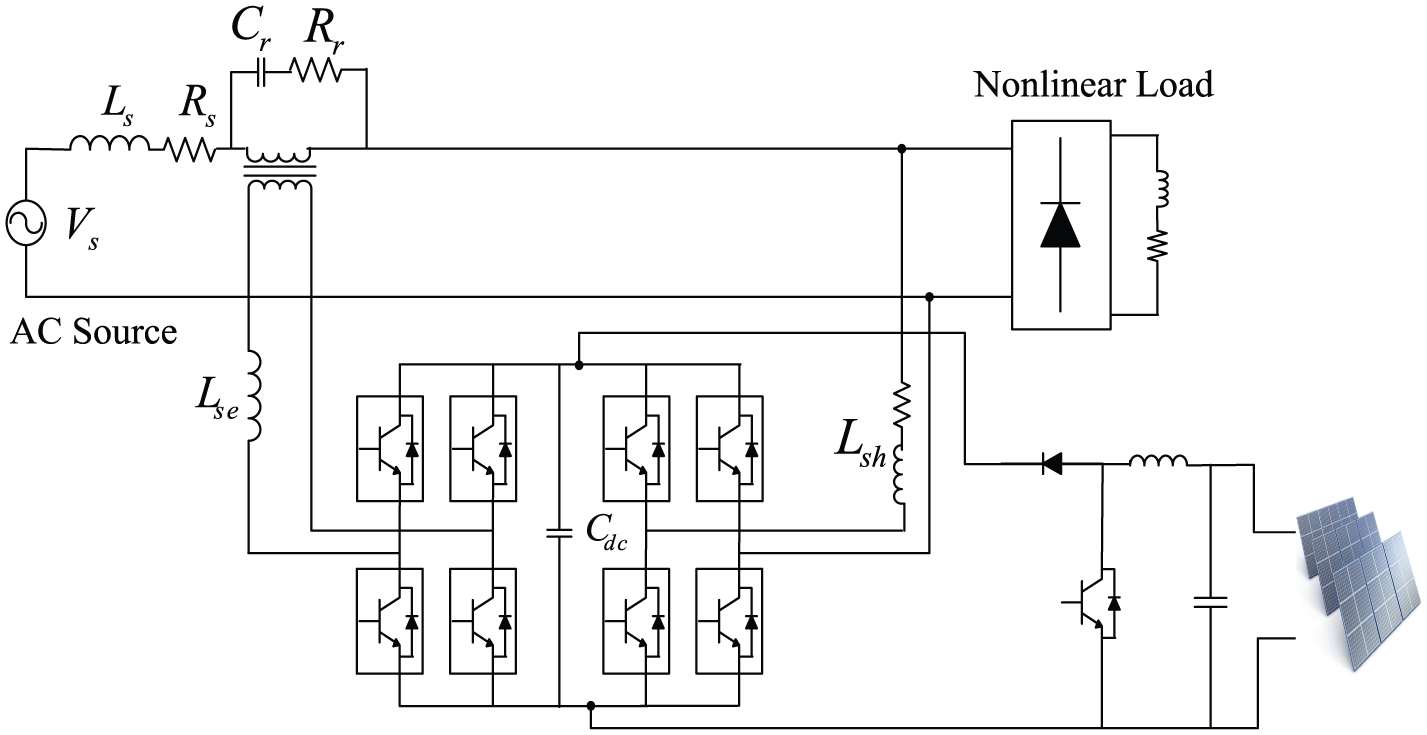
Block diagram of approximate PV tied UPQC configuration.
A brief review on PLL Schemes
Various types of PLL mechanisms have been explored and adopted for proper phase detection and frequency for grid synchronization purpose. EPLL scheme and SRF PLL methodologies are studied and explored in this section. Proposed notch filter PLL scheme is presented in this paper, which is utilized for the control algorithm of PV tied UPQC system.
EPLL
EPLL for the single phase systems have been proposed and examined for power quality improvement in Ghartemani and Iravani (2002). The block diagram of EPLL has been presented in Figure 2, which is described in Ghartemani and Iravani (2002) and Ghartemani et al. (2011). The present PLL senses the input component for the detection of amplitude and phase of the respective captured signal. The EPLL concept is introduced corresponding to the variation in load conditions for variation in amplitude, phase and frequency. Although the structure of EPLL provides an easy platform for implementation in a real-time platform, grid voltage distortions make the system unstable.
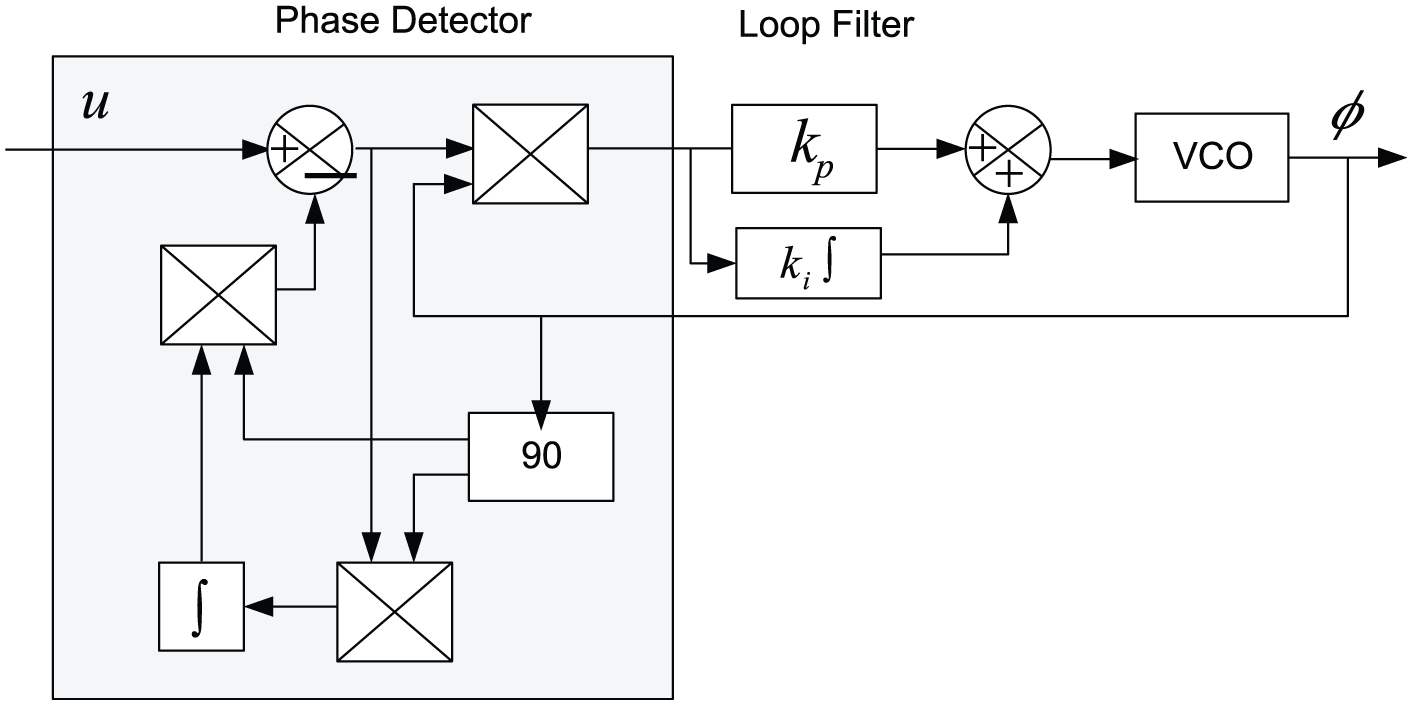
Enhanced PLL block diagram.
SRF PLL
Methodologies adopted for estimating the frequency and phase angle of voltage is necessary for the controller of single phase PV tied UPQC at the time of voltage pertubations. Various schemes for grid synchronisation have been introduced and implimented for power conditioners. Synchronous reference frame PLL scheme (Rasheduzzaman et al., 2016) includes a park transformation for the sensed voltage signal and a 900 delayed vertion of the sensed signal. The detail diagram of SRF based PLL is given in Figure 3, which shows the q-axis voltage component of the sensed voltage is prossesed through a PI controller to measure the frequency. The measured frequency is passed through an integrator to detect the phase.
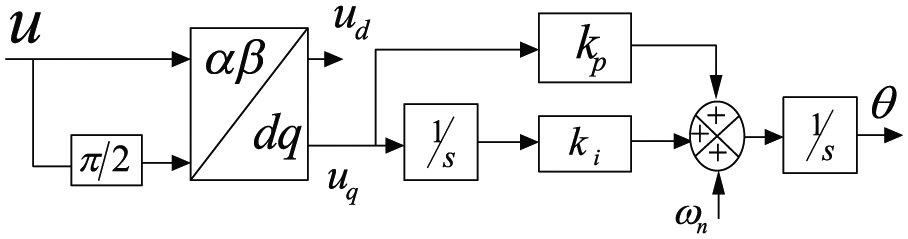
SRF PLL block diagram.
The single phase grid voltage can be represented as

The 900 delayed signal of grid voltage is presented as

The

The

It is considered that for a visible change in value of
It is assumed that


The presence of a double frequency component in the q-axis of the sensed voltage directly results from the variable frequency of source.
Notch filter based PLL
The PV tied UPQC system is synchronized with the grid with an efficient PLL scheme, as discussed in the present paper. The proposed scheme eliminates the drawbacks of SRF PLL and EPLL. The proposed approximate schematic diagram of the selected low pass notch filter PLL is shown in Figure 4. The single phase grid voltage is measured and sent to

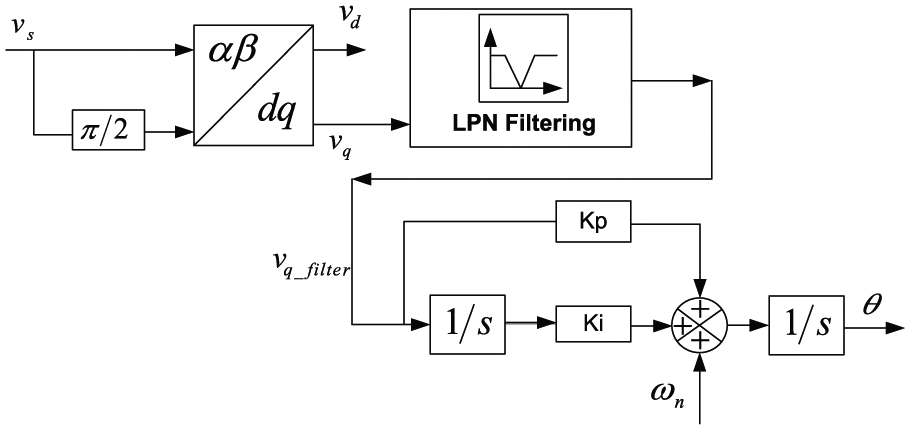
Approximate block diagram of notch filter and proposed PLL scheme.
The location of the zero and pole of the above transfer function employs the developed filter in different ways. It can be considered and utilized as a basic notch filter. Simultaneously, it can also be treated as low pass notch filter. Therefore, for notch filter two considerable states are assumed such as

The obtained resultant component of the low pass notch filter component can be presented as the filteres voltage

Selection of parameter for proposed notch filter
The considered low pass notch filter for PV tied UPQC is employed on meeting the criteria presented as

The presence of the notch filter PLL is utilized in the present work to eliminate the double frequency harmonics components. Thereby the centre frequency is set as twice that of grid frequency. As the present system has the frequency of 50Hz, the tunning of notch filter is regulated at
The

The PV tied UPQC system is employed with notch filter PLL in presence of a notch Q, which is considered as 0.5. The stability analysis of the filter is presented in plotted bode diagram in Figure 5. The evaluated open loop transfer fuction of the proposed PLL scheme is presented as


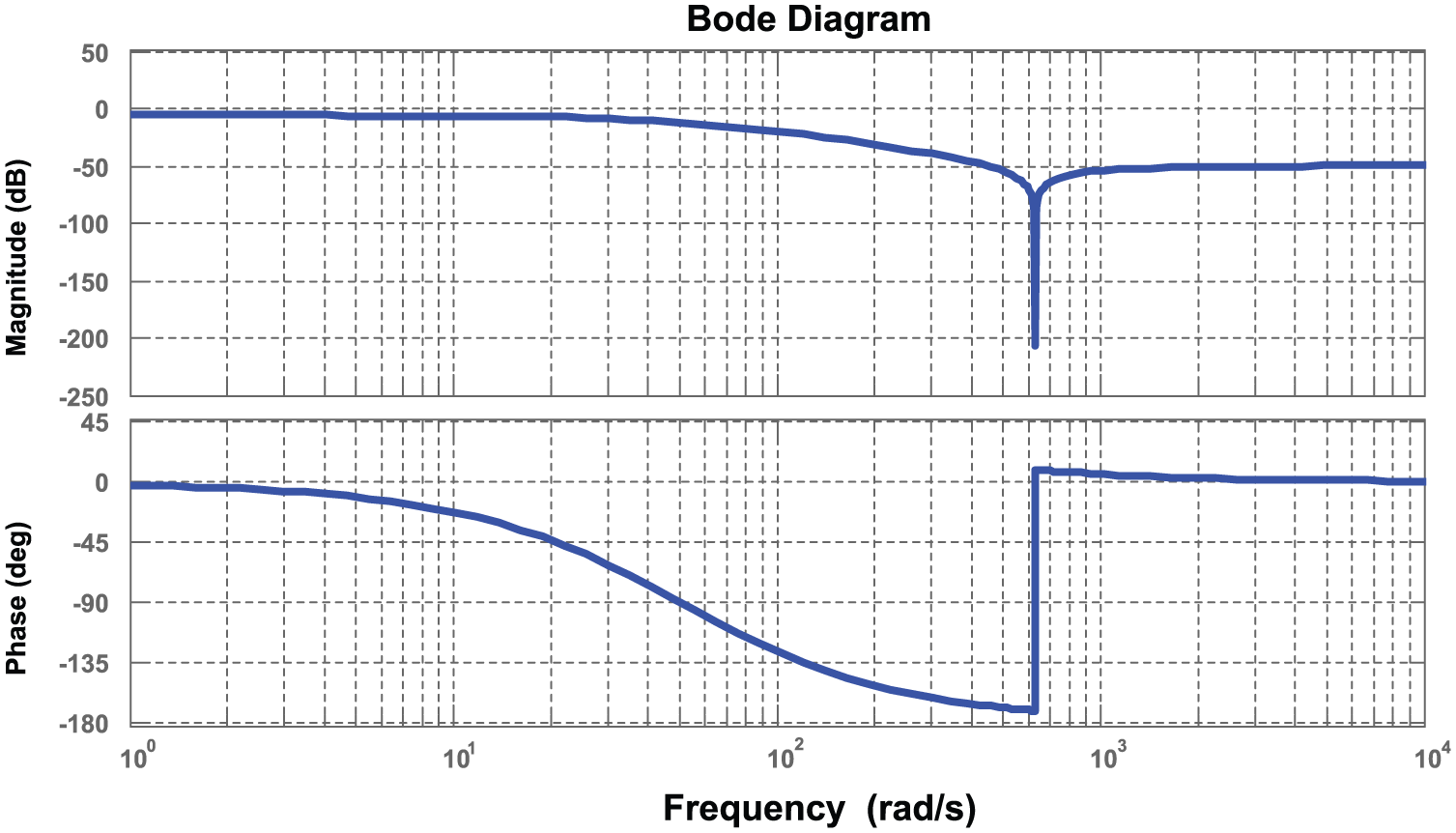
Bode plot for the proposed notch filter.
The notch filter based PLL for PV tied UPQC system dynamics is regulated by the design of gain through simulated root locus plot. The obtained overshoot section of 10% and 5% are evaluated with the presence of damping ratio of 0.59 and 0.69. The root locus plot of
Control scheme of PV tied UPQC
To measure controller performance for single phase PV tied UPQC, the proposed method is analysed and compared with the conventional unit vector templet generation method. The controller applied is discussed in detail as follows.
Proposed controller for PV tied UPQC
The distorted voltage of the grid at the point of common coupling is given as

Where

The measured peak amplitute of the load voltage at nominal condition can be presented as

Where

In the present paper, notch filter PLL mechanism is utilized along with the controller of PV tied UPQC. Power quality issues related to voltage profile caused by grid voltage disturbances usually affect the load, which is eliminated by series inverter part of PV integrated UPQC topology. The obtained load voltage is measured and multiplied by unit template of fundamental component of grid voltage to evaluate the reference load voltage. The error is calculated upon comparison of grid voltage with the measured load voltage.
The generated voltage error is subtracted from generated signal of reference series inverter, which is fed to the PI based controller. Voltage controlled PWM generator is utilized to provide desired gate pulses for the series inverter. The detail block diagram of the controller is presented in Figure 6.
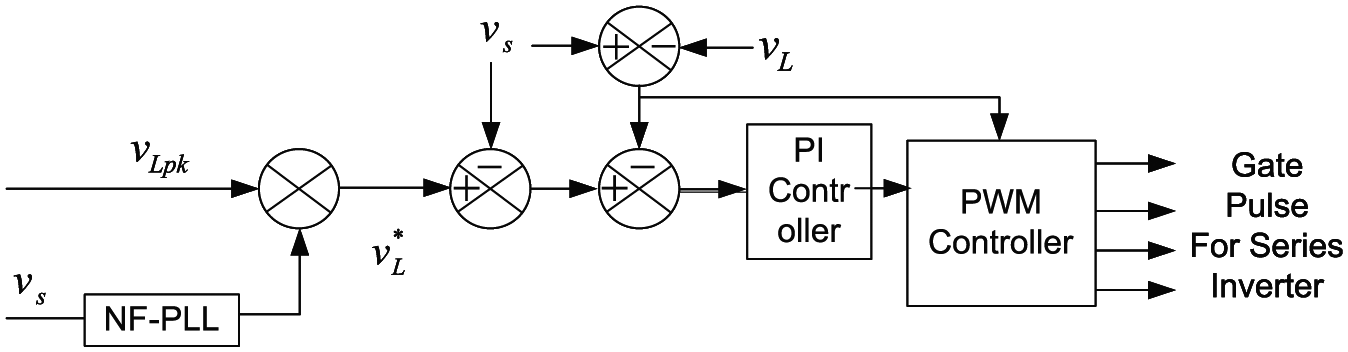
Detail control structure of series APF controller of PV tied UPQC.
The presence of current harmonics in the system is eliminated through shunt inverter part. The Perturb and Observe MPPT technique (Devassy and Singh, 2016b) is applied for extraction of maximum power from the PV system. The grid synchronization is achieved by the proposed methodology. The reference dc-link voltage and the actual dc link voltage of the PV tied UPQC system are compared; the obtained error is fed to the PI controller responsible for generation of equivalent current. The obtained equivalent current is exactly equal to the power loss component that regulates the dc-link voltage. The rest of the shunt inverter controller is similar to the conventional method as presented above. The detail control structure is presented in Figure 7.
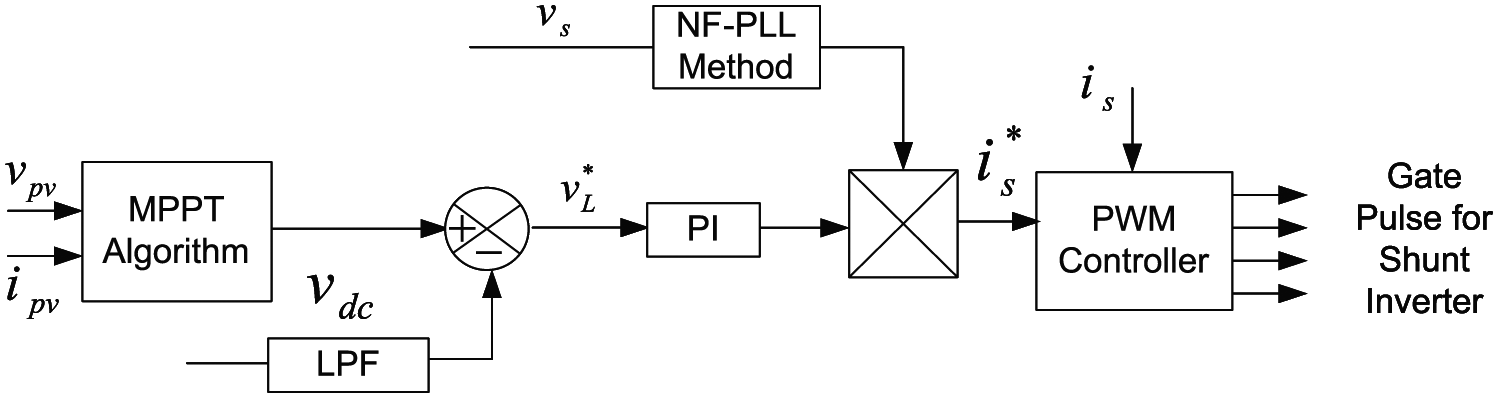
Shunt APF controller of PV tied UPQC.
The MPPT algorithm is associated with the shunt inverter part of PV fed UPQC, which deals with current quality issues; therefore, during voltage sags/swells it will not impact MPPT. For the protection of PV inverter, a blocking diode is attracted with PV system that blocks any reverse flow.
Simulation results for considered PV tied UPQC system
The present study includes the development of proposed notchfilter based control scheme for PV tied UPQC. The control scheme for PV tied UPQC is analyzed by Matlab/Simulink under various voltage and current conditions. In the evaluation process, the results obtained and analyzed for before PV tied UPQC operation and after the implimentation of PV tied UPQC system with proposed control method. The simulation based results for conventional PLL based UVT Controller and notch filter based proposed controller has been evaluated. The voltage sag present in grid voltage compensation capability of PV tied UPQC is presented in Figure 8. The grid voltage with sag is presented in Figure 8(a). The voltage sag compensation by conventional UVT controller is given in Figure 8(b), which reveals that grid voltage sag is not completely eliminated. Therefore, the PV tied UPQC with proposed controller is implemented and the obtained result is shown in Figure 8(c) in presence of PV with 1000W/m2 Irradiation. It is clearly analyzed from Figure 8(c) that the proposed notch filter based scheme is efficient in comparision to conventional methodologies. The grid voltage with swell is shown in Figure 9(a). After elimination of voltage swell with UVT controller based PV tied UPQC is presented in Figure 9(b). Figure 9(c) shows the complete elimination of swell by proposed controller. Grid voltage harmonics are shown in Figure 10. The voltage harmonic elimination by UVT controller and proposed controller are shown in Figure 10(b) and 10(c), respectively. Presence of nonlinear load in the system is the major cause of current harmonics shown in Figure 11. The load current rich in harmonics is shown in Figure 11(a). The source current harmonics elimination by UVT controller is given in Figure 11(b). However, the proposed controller has more efficiency in comparison to the previously mentioned controller for current harmonics elimination, as shown in Figure 11(c).
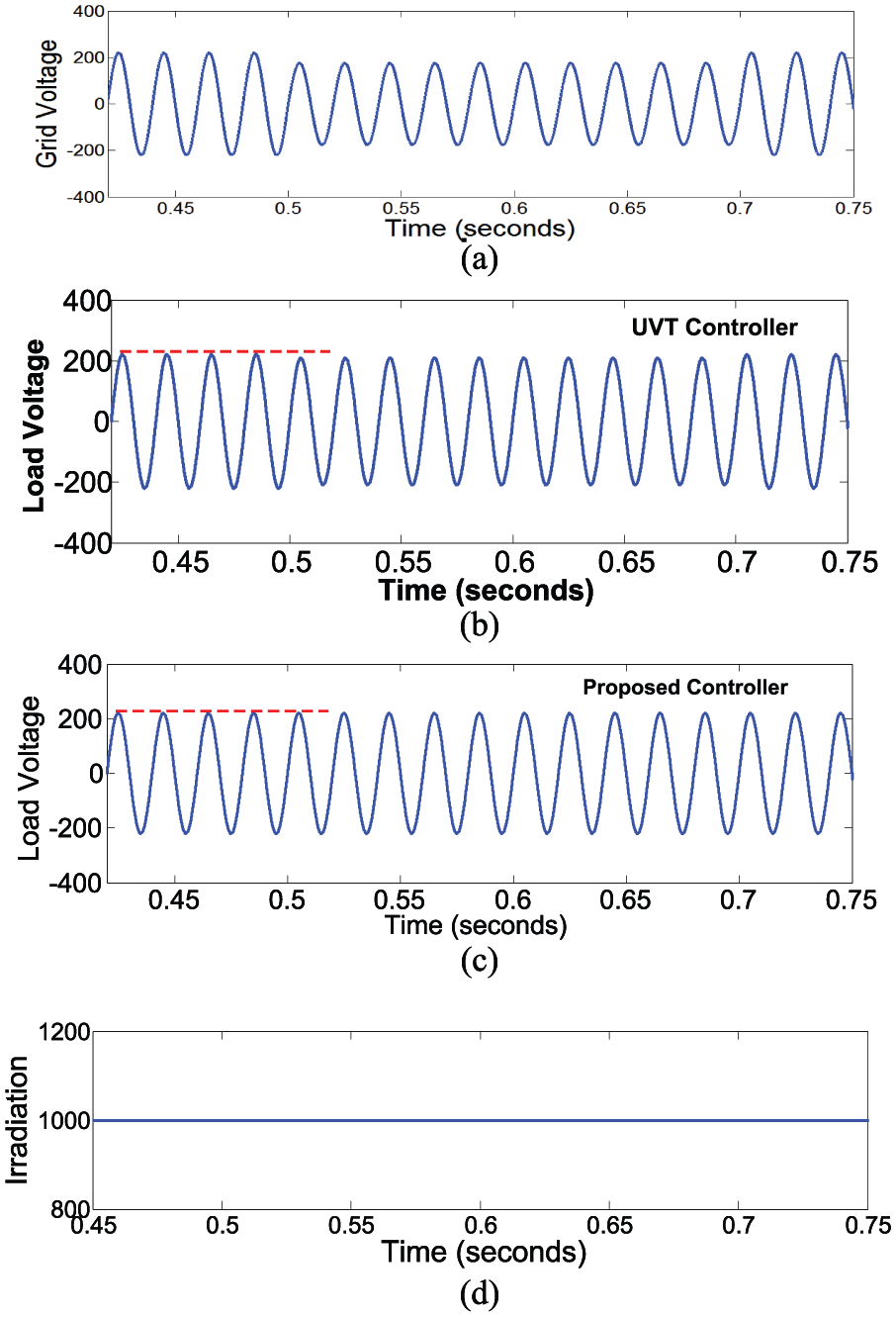
Grid voltage sag elimination: (a) measured grid voltage with sag, (b) measured load voltage with UVT controller, (c) desired load voltage developed controller, (d) PV irradiation of 1000W/m2.
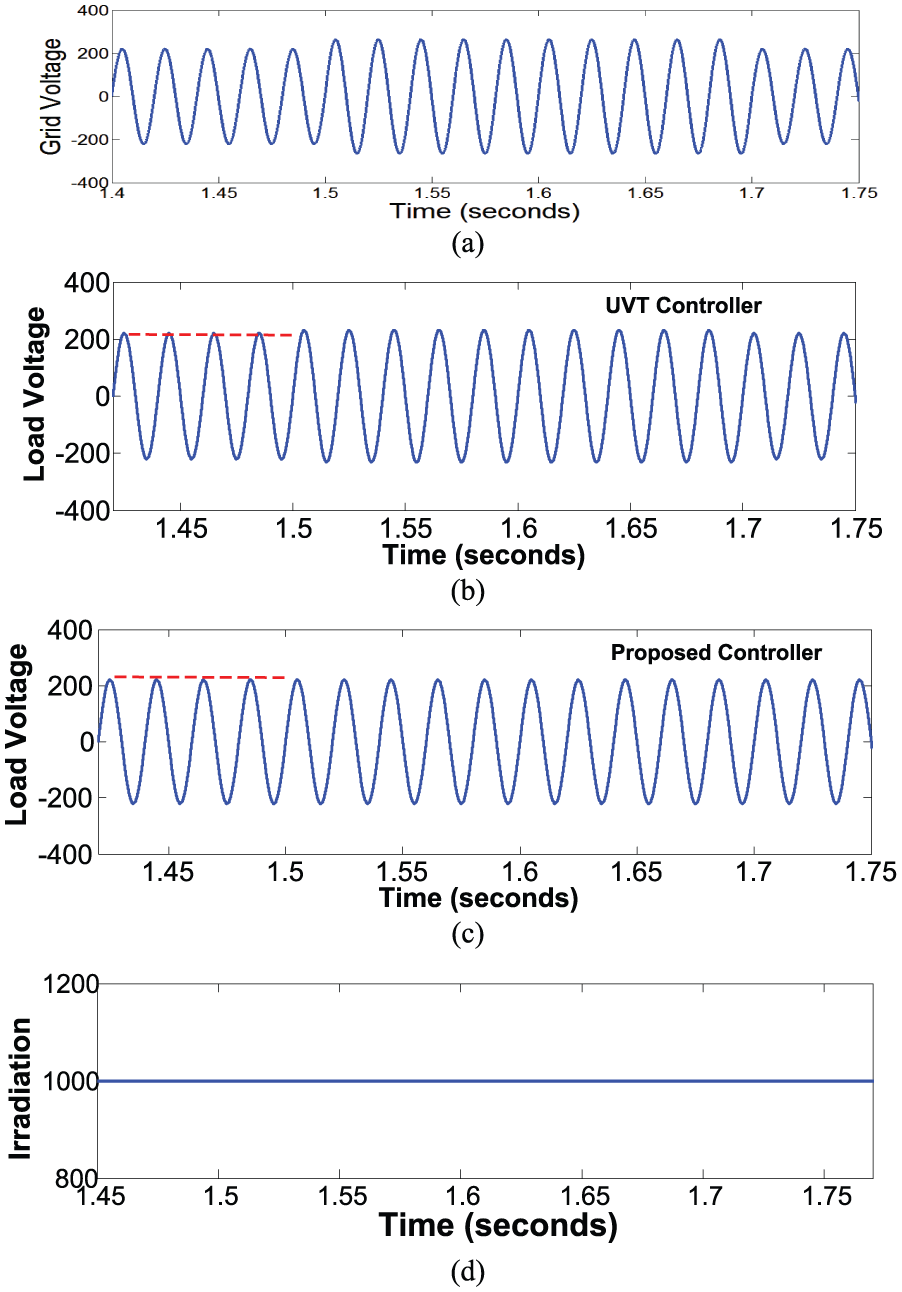
Grid voltage swell mitigation: (a) measured grid voltage in presence swell, (b) measured load voltage with UVT controller, (c) desired load voltage developed controller, (d) PV irradiation of 1000W/m2.
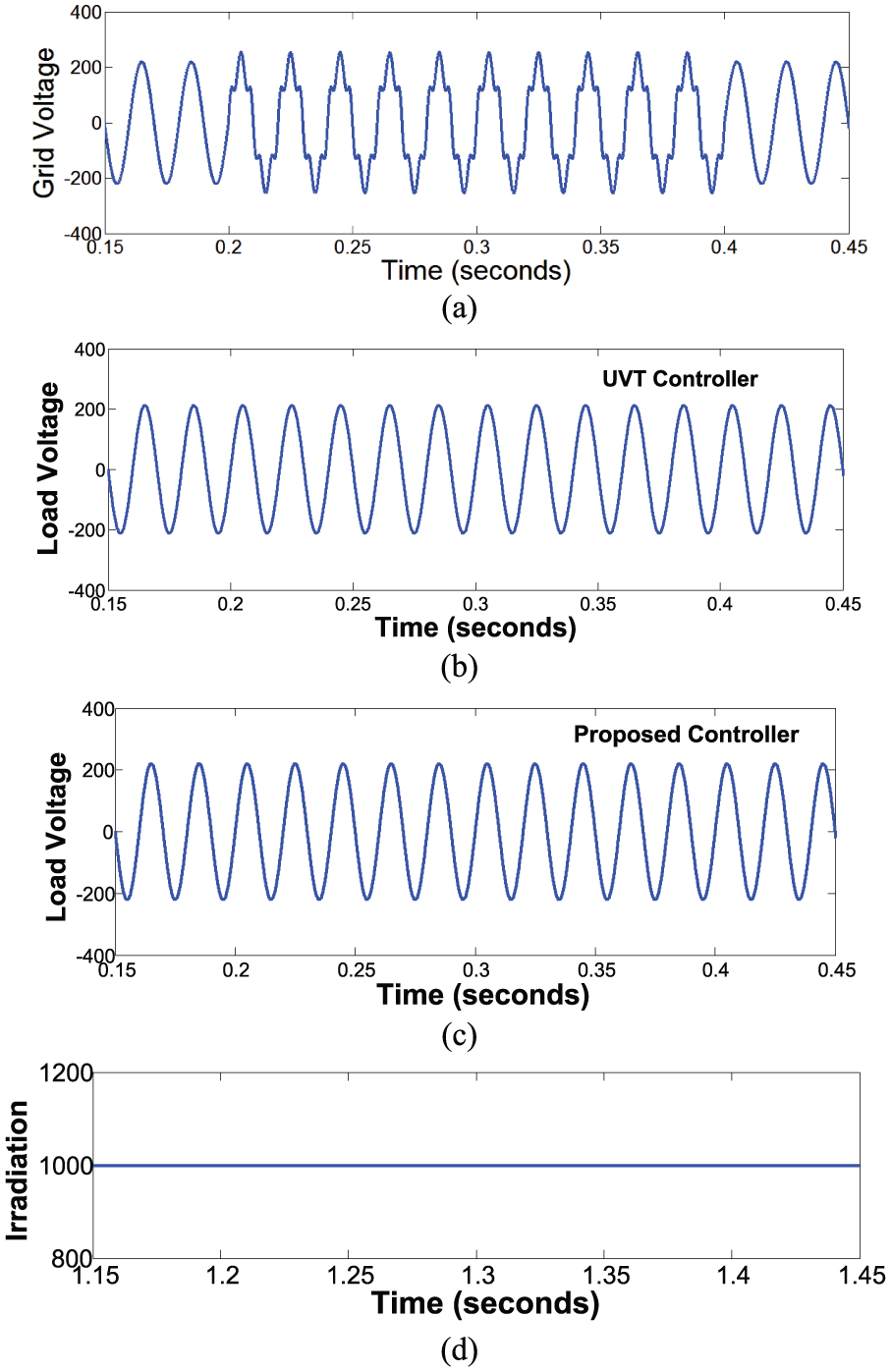
Grid voltage harmonics mitigation (a) simulated grid voltage with harmonics, (b) simulated load voltage with UVT controller, (c) desired load voltage developed controller, (d) PV irradiation of 1000W/m2.
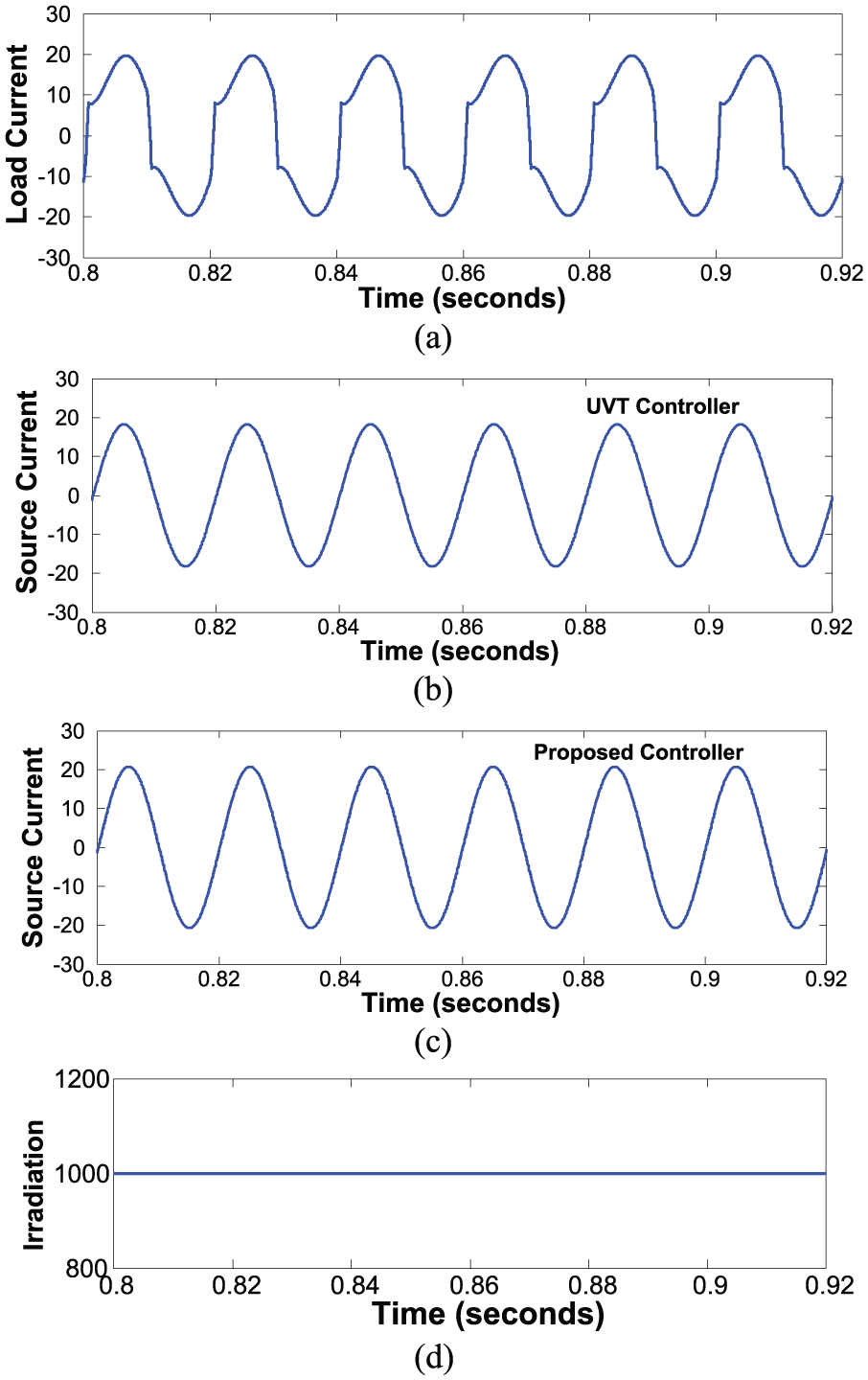
Source current harmonics mitigation (a) measured load current harmonics, (b) measured grid current with UVT controller, (c) measured grid current, (d) PV irradiation of 1000W/m2.
Experimental prototype and discussion on results
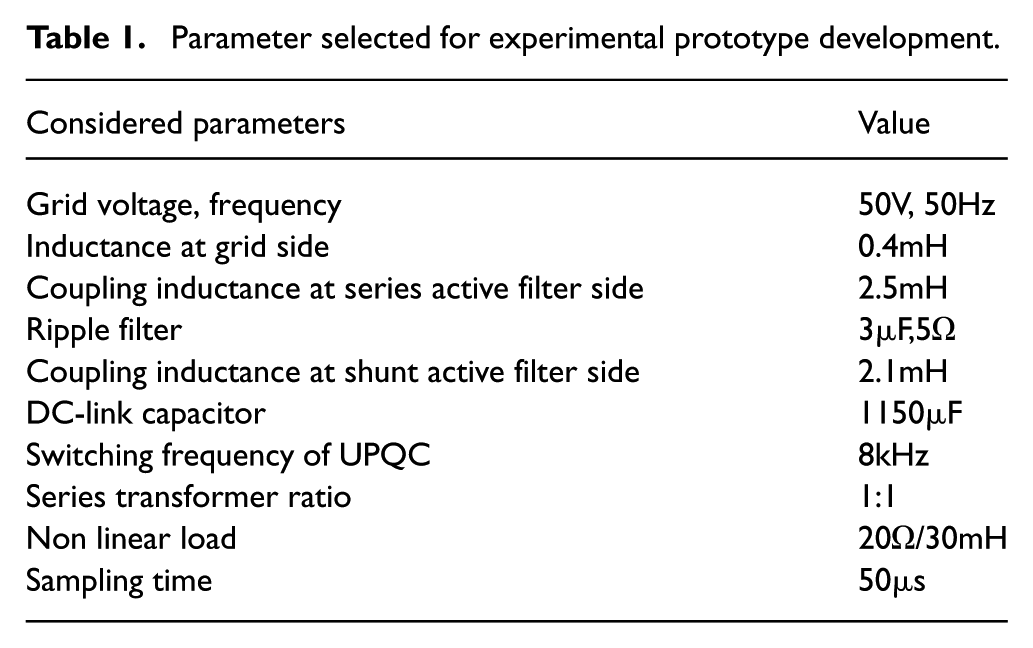
The developed system for considered topology of PV tied UPQC is present in the power system laboratory of the institute. The requirements for experimental prototype development are programable AC supply, series transfermer, back to back inverter, DS1103, current sensor, voltage sensor, host computer, PV system, and so forth; the prototype developed for PV tied UPQC is experimented with scaled down voltage level of 50V. The parameters selected for the developed system are given in Table 1 and a detailed photograph of the developed prototype is shown in Figure 12.
Parameter selected for experimental prototype development.
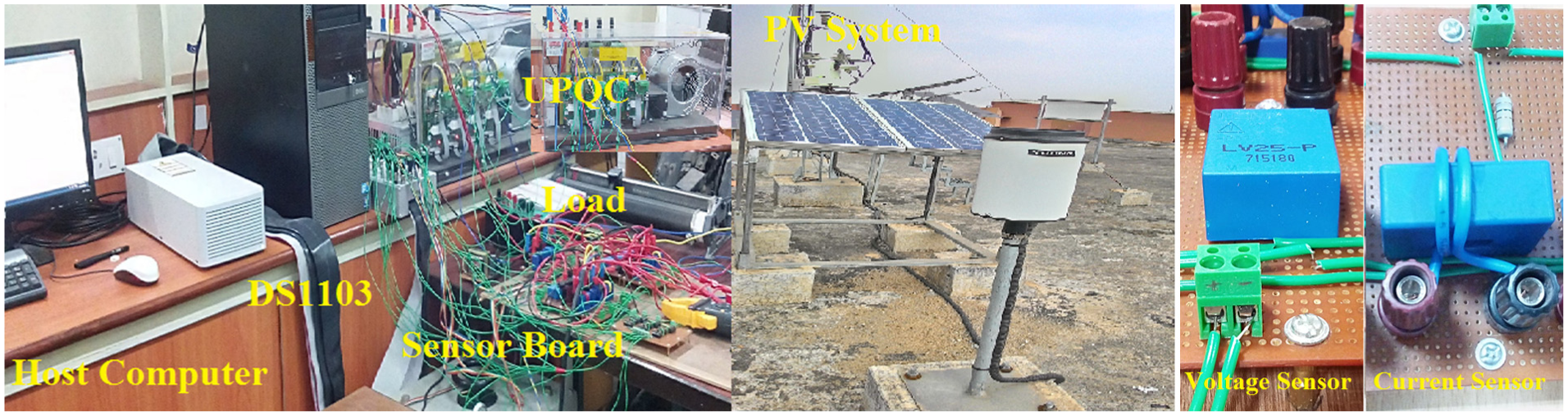
Experimental prototype developed for PV tied UPQC in the laboratory.
The comparative experimental results for PLL techniques are presented in Figure 13. It is clearly shown in Figure 13 that in presence of highly distorted grid voltage, the conventional PLL technique has oscillations, whereas in Figure 13(b) the proposed PLL technique shows improved results with zero ossilations. Presence of sag in the measured grid voltage is given in Figure 14(a), which is eliminated by the notch filter based controller of PV tied UPQC, as presented in Figure 14(b). Voltage swell in grid can affect the sensitive load to operate abnormally. The voltage swell in grid is shown in Figure 15(a) and load voltage after compensation is given in Figure 15(b). Figure 16(a) shows the grid voltage harmonics, which is perfectly eliminated by notch filter based proposed controller for series APF part given in Figure 16(b). The presence of nonlinear load in the system injects harmonics to the load current, as shown in Figure 17(a) with 28.57% THD shown in Figure 17(b). The source current after elimination of harmonics by proposed controller is presented in Figure 17(a) with 2.8% THD. The experimental results obtained from the developed prototype validates the efficiency of the proposed notch filter based controller in presence of highly distorted conditions of the grid.
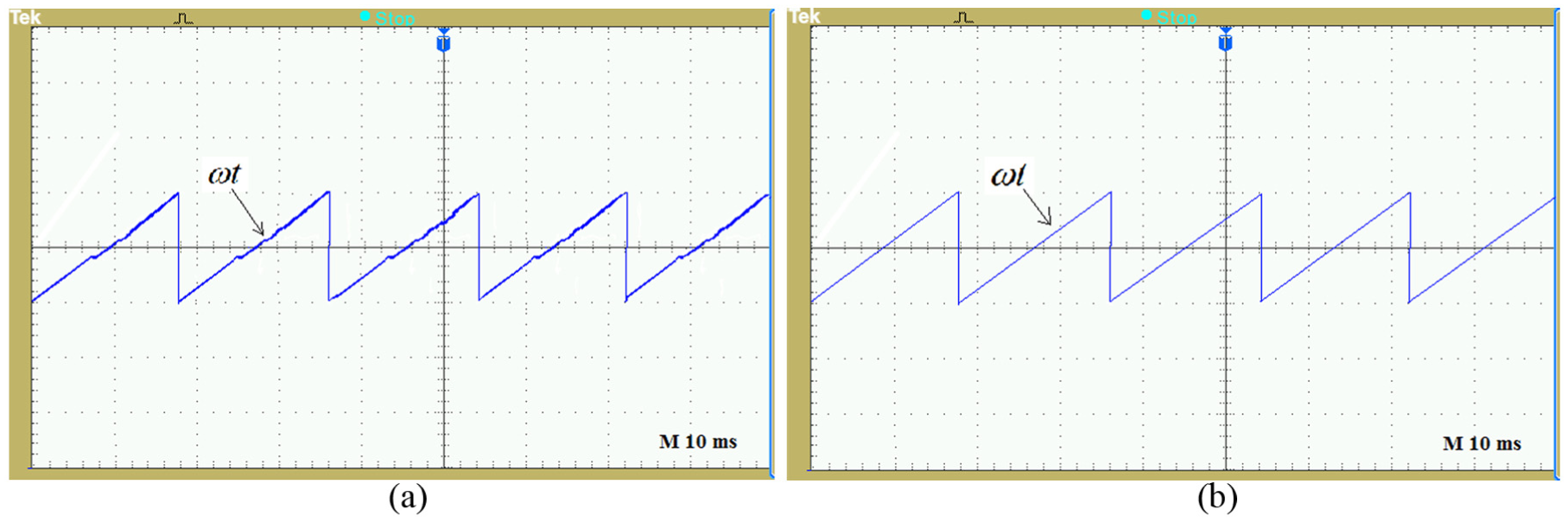
Experimental results of PLL: (a) conventional PLL, (b) proposed Notch filter based PLL.
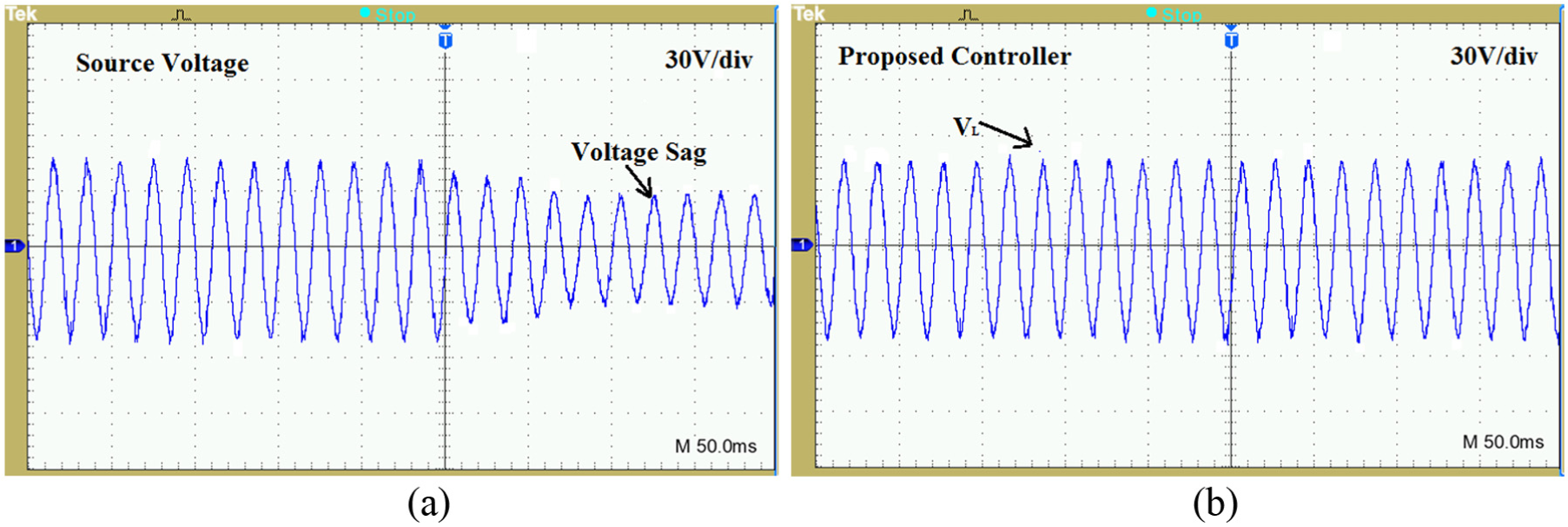
Results of grid voltage sag mitigation (50V/div): (a) measured grid voltage in sag condition, (b) measured load voltage with proposed controller.
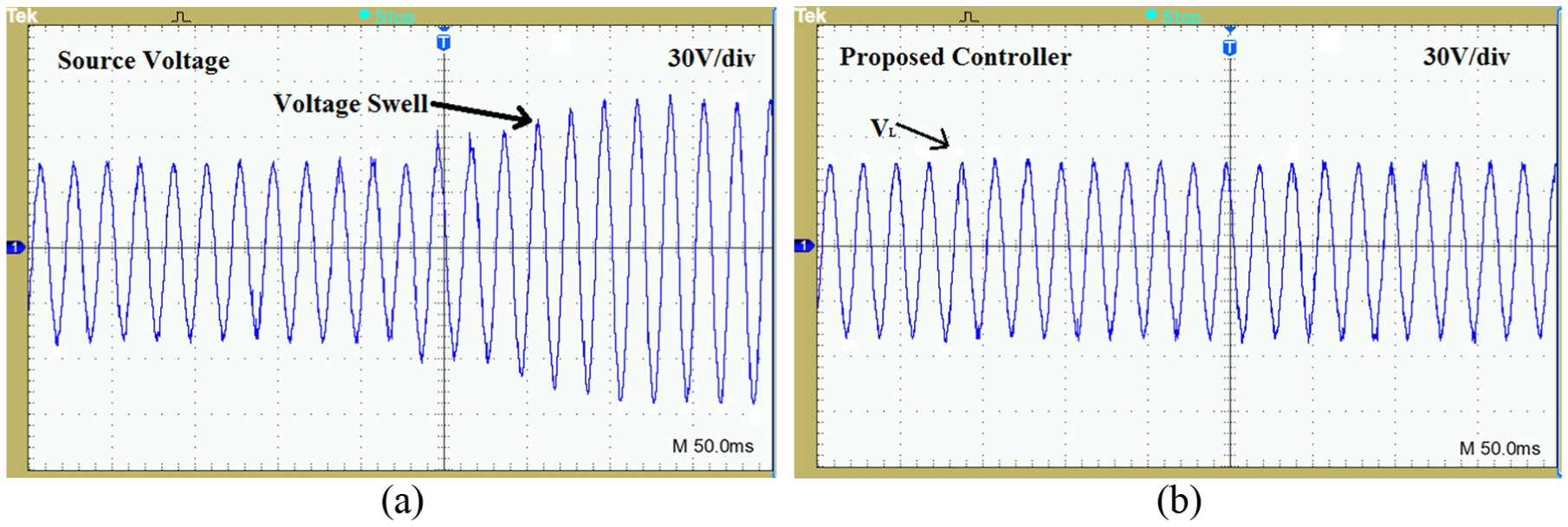
Results of grid voltage swell mitigation: (a) measured grid voltage during in swell condition (50V/div), (b) measured load voltage with proposed controller (50V/div).
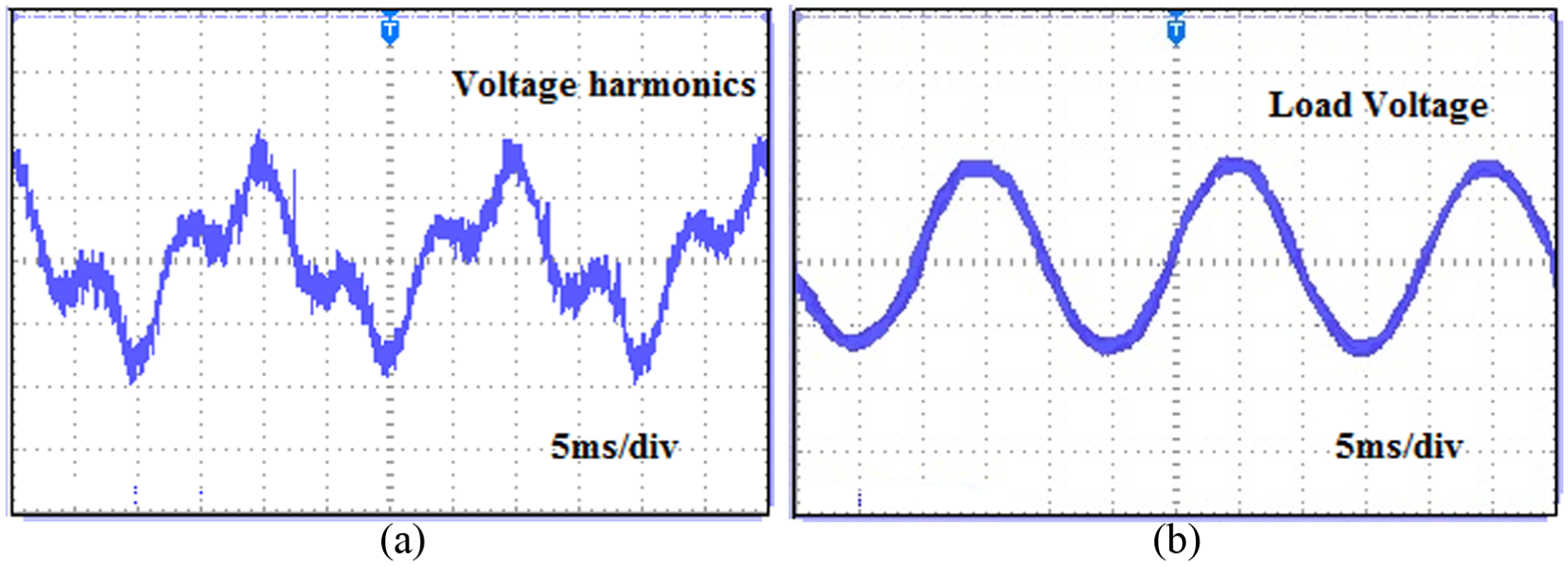
Elimination of voltage harmonics: (a) measured grid voltage in presence of harmonics (30V/div), (b) measured load voltage with proposed controller (30V/div).
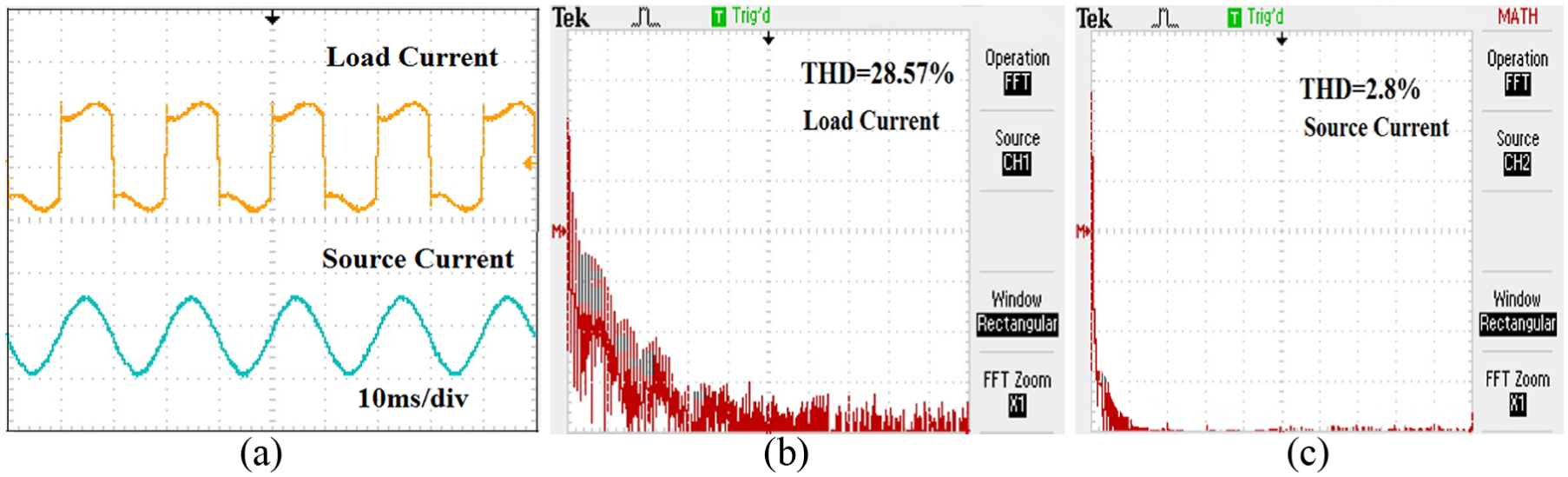
Current harmonics elimination: (a) measured load current, source current (5A/div), (b) THD of measured load current before compensation, (c) THD of source current after compensation.
Conclusion
The present paper describes a system in which PV is interfaced to grid through UPQC for the mitigation of various current and voltage perturbations. The role of the sensed grid voltage and detection of the phase become more important for computation of the system controller and performance. In a highly distorted grid, the issues related to grid synchronization and mitigation of disturbances in the power system related to power quality are noticed to be difficult in the mitigation process in the presence of the conventional PLL based controller. In accordance with the aforementioned limitations, this paper introduces a novel controller by utilizing notch filter-PLL mechanism to avoid multiple zero crossing as well as voltage and current quality issues. The conceptual design of notch filter based PLL and proposed controller based on systematically developed notch filter PLL is presented here. The system named PV fed UPQC is developed and simulated for elimination of various power quality issues such as current harmonics, voltage harmonics, voltage swell and voltage sags. The proposed controller increases the performance and efficiency of PV tied UPQC system as compared with conventional PLL based on UVT controller. Finally, the developed controller is implemented with the laboratory developed prototype of PV fed UPQC. The experimental results obtained validate the efficiency of proposed controller for PV tied UPQC system.
