






Abstract
Model order reduction (MOR) is a process of finding a lower order model for the original high order system with reasonable accuracy in order to simplify analysis, design, modeling and simulation for large complex systems. It is desirable that the reduced order model preserves the fundamental properties of the original system. This paper presents a new MOR technique of multi-input multi-output systems utilizing the firefly algorithm (FA) as an artificial intelligence technique. The reduction operation is proposed to maintain the exact dominant dynamics in the reduced order model with the advantage of substructure preservation. This is mainly possible for systems that are characterized as multi-time scale systems. Obtaining the reduced order model is achieved by minimizing the fitness function that is related to the error between the full and reduced order models’ responses. The new approach is compared with recently published work on firefly optimization for MOR, in addition to three other artificial intelligence techniques; namely, invasive weed optimization, particle swarm optimization and genetic algorithm. As a result, simulations show the potential of the FA for the process of MOR.
Keywords
Introduction
For the purpose of analysis and design, physical systems are mathematically modeled. The main objective of such analysis and design is for controlling the process and or enhancing its performance (Alsmadi et al., 2011a, 2011b, 2016; Antoulas et al., 2001; Yadav et el., 2012). For some practical systems, mathematical modeling using higher order differential equations yields complex large order multi-time scale systems. To reduce the complexity of such systems, it is desirable to obtain a fairly accurate lower order approximation of the original system while keeping the dominant behavior of the original system. This reduction will result in reducing the hardware complexity and thus simplifying the controller design (Alsmadi et al., 2014a).
Model order reduction (MOR) has played a significant role in control systems (Benner et al., 2015; Chen and Shieh, 1968; Davison, 1966; Gugercin and Antoulas, 2004). It focuses on the properties of dynamical systems in application to reduce their complexity, while their input-output fundamental properties of original system such as stability and dominant dynamics are preserved as much as possible. MOR aims to simplify analysis, design, modeling and simulation of such large complex systems. Moreover, the error between original and reduced order system is required to be as small as possible.
Due to complexity and large system dimension, most of the modern numerical models of real-life processes face difficulties when used in numerical simulations. Hence, MOR becomes necessary to reduce the computational complexity in such cases. For MOR, there are many scenarios that can be applied. One produces reduced order models that are new and not related to the original models, in terms of their critical frequencies for either single-input single-output (SISO) or multi-input multi-output (MIMO) systems. Another scenario that achieves model reduction is the one that tries to keep the original system’s important features regardless of its critical frequencies. Due to meaningful physical interpretation in obtaining similar models and due to minimum changes in the original system, it was noted that the second scenario is more preferable, if possible (Alsmadi et al., 2011a, 2014).
For MOR, there are several optimization methods that provide different solutions (Alsmadi et al., 2016; Chidambara, 1967; Chen and Shieh, 1968; Davison, 1966; Mukherjee et al., 2005; Salimbahrami and Lohmann, 2006; Wilson, 1970; Yadav et al., 2012). One of the recently developed evolutionary techniques is the firefly algorithm (FA) optimization method, which was developed by Yang (2009). This optimization method was described as a stochastic, nature-inspired, meta-heuristic algorithm that can be used to solve difficult optimization problems (Fister et al., 2013). Heuristic operation is referred to as discovering solutions by trial and error in a reasonable amount of time and that there is no guarantee that optimal solutions are reached. Stochastic is described as it uses some kind of randomization in searching for a set of solutions. The FA is inspired by the flashing behavior of fireflies as they search for their targets. In which it attracts other fireflies formatting. The idea of attractiveness and information passing is what leads to the FA inspiration (Fister et al., 2013).
In this paper, the ability of the FA technique to produce relatively acceptable reduced order models while maintaining the system’s main characteristics will be investigated. The idea has been motivated by the singular perturbation approximation (SPA) (Alsmadi et al., 2014a). The paper proposes a new MOR technique of MIMO systems utilizing the firefly optimization method. The reduction process is performed in two parts; the first one uses the dominant pole method, while the second utilizes the firefly optimization method. The reduction operation is proposed to maintain the exact dominant dynamics in the reduced order model with the advantage of substructure preservation (SP). This is mainly possible for systems that are characterized as multi-time scale systems. Obtaining the reduced order model is achieved by minimizing the fitness function that is related to the error between the full and reduced order models’ responses. Simulation results show the potential of the FA as an artificial intelligence technique for the process of MOR. The new technique is compared with recently published work on firefly for MOR. The results presented in this paper show the superiority of the proposed FA method over the other methods. In addition, the work presented will compare the results of the proposed FA reduction technique with some other artificial intelligence optimization techniques; namely, invasive weed optimization (IWO) (Mehrabian and Lucas, 2006), particle swarm optimization (PSO) (Kennedy and Eberhart, 1995) and genetic algorithm (GA) (Abo-Hammour et al., 2011; Alsmadi et al., 2011c).
The paper is organized as follows. In Section 2, we present the mathematical framework for developing the MOR model parameters estimation method. In Section 3, we present simulation results. In Section 4, a discussion is presented. Finally, we give some concluding remarks in Section 5.
Problem formulation
Background
Consider the following
where
The reduced order model, on the other hand, is obtained as
where
where the original system dominant eigenvalues (real and/or complex) are preserved in the diagonal, with time scale arrangement set as λi, i = 1, 2, …
where all of the elements in (5) are considered as dominant dynamics (the real and complex distinct eigenvalues). The modal form is chosen, as given in (4), which implies that the elements as
For proper reduced order modeling, the order of the reduced model can be obtained as the difference between the value of the full model order, n, and the number of non-dominant dynamics
FA
FA is one of the recent swarm intelligence methods developed by Yang (2009) and is a stochastic, nature-inspired, meta-heuristic algorithm that can be used to solve difficult optimization problems. Fireflies use a system of flashes to communicate. They use their light to attract others. A firefly emits light from a tiny organ called a lantern, where a biochemical reaction takes place. The reaction releases energy in the form of light. Every species of flashing firefly has its own pattern. These unique patterns let males and females of the same species recognize one another in the dark (Fister et al., 2013).
To govern the algorithm and create a modeled firefly’s behavior, there are three notes to be taken. Firstly, the fireflies are unisex; therefore, any firefly could be attracted to any of the other fireflies. Secondly, the attractiveness is determined by their brightness, where a less bright firefly will move towards a brighter one. Finally, the brightness of a firefly is proportional to the value of the function being minimized (Fister et al., 2013).
The locations of the fireflies must be considered when comparing the brightness of any two fireflies. In the real world, if a firefly is searching for another, it can only see so far (Fister et al., 2013). The farther another firefly, the less bright it will be to the vision of the first firefly. This is due to the light intensity decreasing under the inverse square law. That is, the light intensity of a firefly with “r” distance between any two fireflies will be reduced by a factor of
where I0 denotes the light intensity of the source,
The attractiveness,
where
To start the search operation algorithm, the fireflies are placed in random locations. The location of a firefly corresponds to the values of the parameters for the objective function to be solved (Rahkar-Farshi and Behjat-Jamal, 2016). For any two flashing fireflies, as seen in Figure (1), the less bright firefly (FFi) moves toward the brighter one (FFj) according to the attractiveness
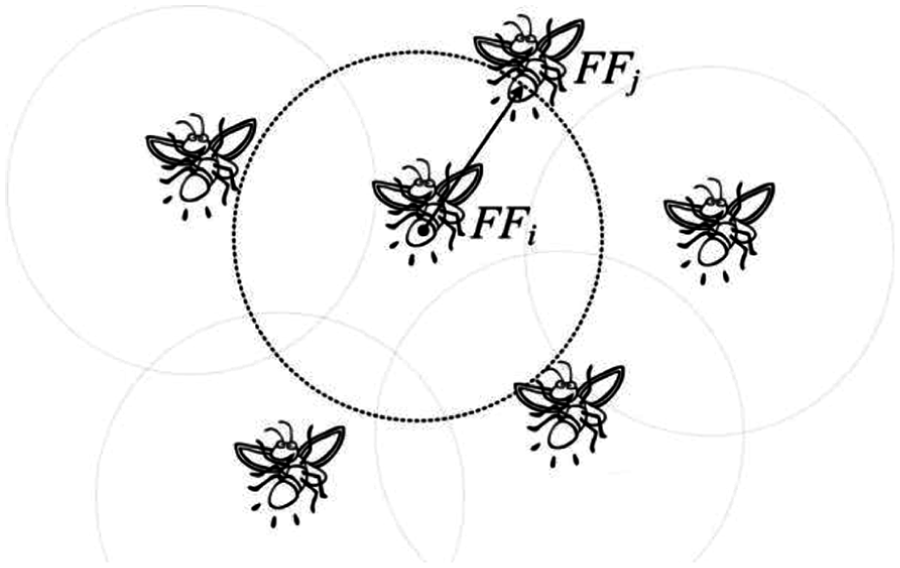
Fireflies formatting search process.
The FA consists of only the basic arithmetic operations and does not require complicated coding and genetic operations such as crossovers and mutations of the GA. In addition, the performance and computational cost of the FA are shown to be better than those of other population-based algorithms such as the GA and the POS (Lohrer, 2013). These advantages suggest the use of the FA to increase the efficiency without deterioration of approximation accuracy for model reduction.
After initialization, each firefly is compared against all of the other fireflies, and will move towards every brighter firefly encountered. Once a bright firefly is found, the distance between the fireflies, has to be calculated. Different forms of distance calculation can be used; however, in general the Cartesian distance is appropriate. The Cartesian distance between two fireflies in D-dimensional space can be calculated as follows (Alsmadi et al., 2016)
where
where
Notice that rand (a MATLAB Command) is a uniformly distributed random number, in which
FA optimization approach
FA is based on the objective function and corresponding fitness levels used to find the optimal solution. It is an iterative optimization procedure as it works with a population that represents a number of solutions rather than a single solution in each iteration. It makes the decision of its solutions by evaluating some fitness function. The final solution is obtained by updating that fitness function corresponding to some given specifications. FA can be controlled by three parameters: the randomization parameter α, the attractiveness β, and the absorption coefficient γ. According to the parameter setting, FA distinguishes two asymptotic behaviors. The former appears when γ = 0 and the latter when γ =
To obtain the reduced-order models, the light intensity (fitness value) of the firefly uses the inverse of the integral of the magnitude squared of the frequency-weighted model error between the original system and the reduced order model. The best arguments of the model reduction are achieved through searching by the fireflies, and are considered as the result of the last search. The firefly MOR procedure is illustrated in Figure 2.

FA MOR flowchart.
Applying the FA optimization technique for MOR, the following steps were taken:
Determine the dominant eigenvalues that will keep the behavior of the reduced system closer to the original system. This step will produce
Using FA,
Depending on the order to be reduced, the poles nearest to the origin (dominant) are retained. This implies that the overall behavior of the reduced system will be very similar to the original system, since the contribution of the unretained eigenvalues to the system response are important only at the beginning of the response, whereas the eigenvalues retained are important throughout the whole of the response. Accordingly, the FA would then determine the rest of the reduced-order model elements seen in the Br and Cr matrices given as
As a result, one can see that the number of parameters to be estimated by the FA is
It is important to mention that for equations (5) and (6), the reduction is performed based on the fact that the system is a multi-time-scale type. That is, there exist two categories in the system, slow and fast, which are distinguished by a factor of 10 for a proper MOR as motivated by the SPA method (Alsmadi et al., 2014a).
To compare the results of the different algorithms, the root mean square error (RMSE) was used
where N is the size of the input time.
Simulation examples
This section presents some simulation results and comparison diagrams that have been used to compare the proposed FA approach with other known algorithms. MATLAB software tools were utilized for the simulations. The parameters of the proposed FA technique were used to design the state matrix are shown in Table 1.
FA parameters.

Example 1
As an illustrative example, we will consider a Single-Machine Infinite-Bus (SMIB) power system, shown in Figure 3, to examine the proposed FA approach. The parameter values are given as specified in Parmar et al. (2007). The machine is supplying power through a step-up transformer and a high-voltage transmission line to an infinite grid. The

Power system for a SMIB.
The system consists of a three-phase 160-MVA synchronous machine with automatic excitation control system. In a state space representation, the system is given as follows
with eigenvalues given as: λ = {−18.9311 ± 2.0250i, −12.1968, −9.6484, −2.1313, −0.8972 ± 1.3560i, −0.2394 ± 3.2350i,-0.1001}.
Indeed, there exist different methods for determining the dominant dynamics of a given system. In this paper, however, we will use the traditional method, which is by inspecting the closer poles to the origin. As can be seen in the set of eigenvalues, the multi-time-scale system can be categorized as a two-time-scale system (slow and fast subsystems). The fast-subsystem is given with eigenvalues λf = {−18.9311 ± 2.0250i, −12.1968, −9.6484}, while the slow-subsystem eigenvalues may be given as: λs = {−2.1313, −0.8972 ± 1.3560i, −0.2394 ± 3.2350i,-0.1001}. Hence, the proposed reduction is performed by selecting the slow-subsystem and eliminating the fast subsystem, as illustrated by Gharaibeh (2016) and as shown in Figure 4. Thus, the 6th order reduced model is investigated.

System eigenvalue constellation.
The proposed method is first investigated for SISO type systems, which for this example, the second column of the system input matrix and the second row of the output system matrix are eliminated. Thus, performing the reduction operation, the following
with step and impulse responses, along with the frequency response, presented as shown in Figures (5), (6), and (7), respectively, compared with the original 10th order models’.

Step responses for the 6th reduced order and the 10th full order models.

Impulse responses for the 6th reduced order and the 10th full order models.

Frequency responses for the 6th reduced order and the 10th full order models.
It can be seen that the performance of the proposed reduced order FA model is almost identical to the original model response. Investigating the robustness of the proposed MOR approach, the following 5th order model is obtained
The selection of this 5th order model shows that the dominant dynamics of the original system presented exactly in the reduced order model, which can be seen as
The step responses of this reduced 5th order model, along with the original full 10th order models, are shown in Figure 8.

Step responses for the 5th reduced order (dark solid line) and the 10th full order models.
For a rigorous investigation of the proposed method, we now consider the original MIMO system with farther reduction performed to a 4th order model. This means that we will eliminate two of the dominant system dynamics. As can be seen from Figure 4, they would have to be {−0.8972 ± 1.3560i}, which makes the slow category then be given by λs = {−2.1313, −0.2394 ± 3.2350i, −0.1001}. However, due to the relatively high natural frequency seen in the dominant poles {−0.8972 ± 1.3560i}, we will instead eliminate the dynamics {−2.1313, −0.1001}. Thus, the reduced model will have the slow category given by λs = {−0.8972 ± 1.3560i −0.2394 ± 3.2350i}. As a result, using the proposed FA-MOR, the 10th order model was reduced to a 4th order with system elements given by
Notice that the substructure preservation has been achieved as seen in the Ar matrix, as it contains the exact dominant eigenvalues of the full order model. That is, the dominant dynamics of the reduced order model are given as {−0.8972 ± 1.3560i, −0.2394 ± 3.2350i}, which are basically a subset of the full 10th order model. The operation was performed to a step input with a fitness progress presented by ‘cost value’, as shown in Figure 9.

System cost minimization convergence for a step input response.
To investigate the performance of the FA-MOR method, the full and reduced order models were both simulated to step inputs with responses for both outputs presented as shown in Figure 10.
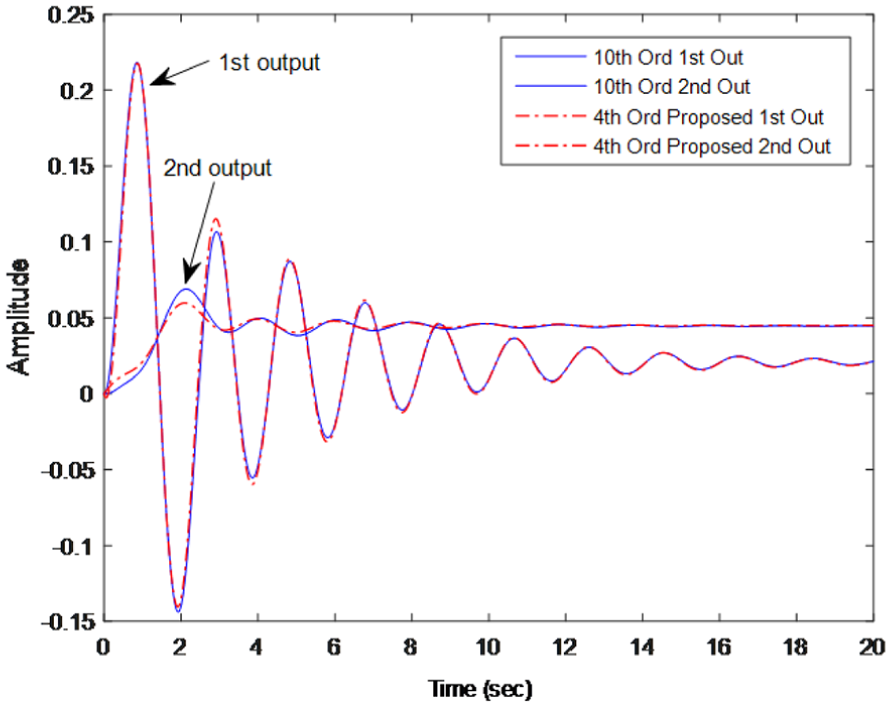
Step responses for the 4th reduced order (dotted line) and the 10th full order models.
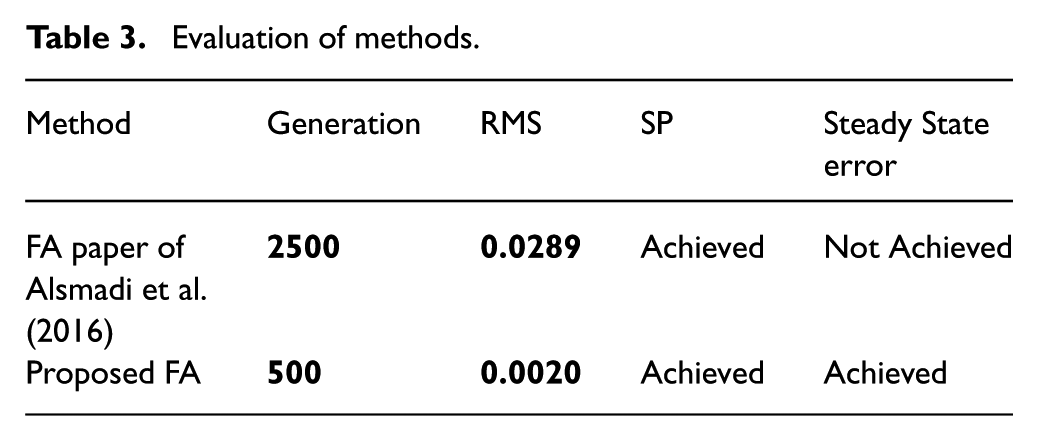
As seen in Figure 10, the reduced 4th order model responses are relatively very close to the full 10th order models’ seen in both stages, the transient and steady state. When comparing the performance of the FA-MOR with the firefly technique proposed in Alsmadi et al. (2016), the responses of the two methods along with the original system responses are presented as shown in Figure 11. Alsmadi et al. (2016) concluded that the FA is not suitable for MOR based on their observations and method parameter design. As can be clearly seen now, the proposed FA method provides much better responses, in which the design of the parameters were found to be best at beta = 1, gama = 1, alpha = 0.98, and zeta = 1. Hence, it can be concluded that the FA-MOR proposed method is superior and has a potential advantage in providing reduced order models with SP and relative accuracy of system response.
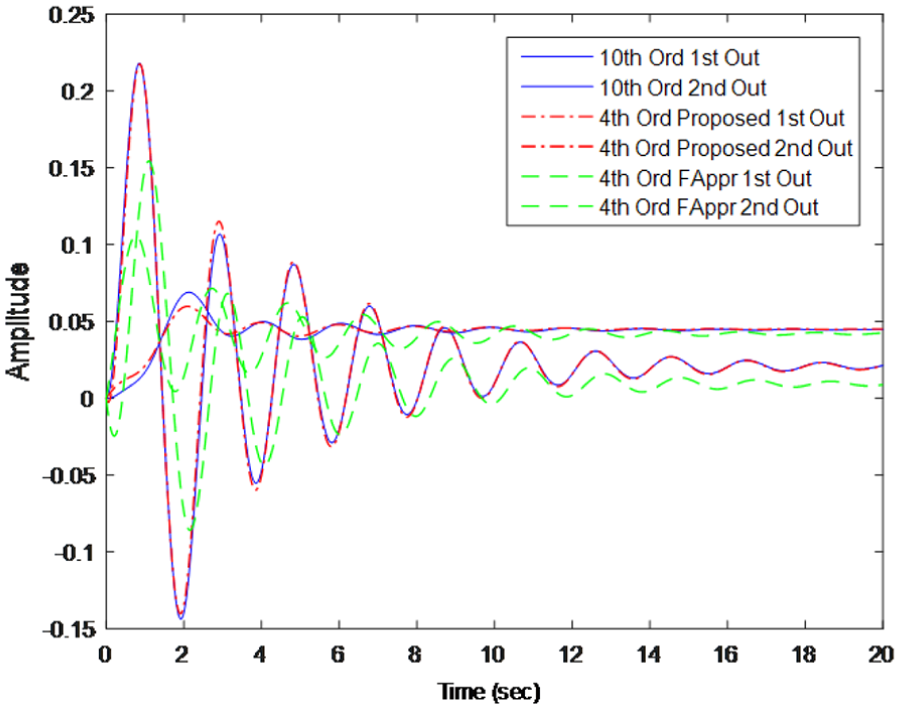
Step responses for the full 10th order (solid line), firefly reduced 4th order (dotted light line), and proposed FA reduced 4th order models (dotted dark line).
Example 2
In this example, we consider an 8th order SISO system evaluated by Desai and Prasad (2013) and Mukherjee et al. (2005). The system is given as follows
with eigenvalues given as {−1, −2, −3, −4, −5, −6, −7, −8}. Observing the dynamics (eigenvalues) of this system, it is seen that the system is not a two-time scale type; however, it is found that the dominant dynamics are seen in the poles {−1, −6}. Hence, the reduction process is performed correspondingly. As a result, the following 2nd order reduced model is obtained
Desai and Prasad (2013) and Abu-Al-Nadi et al. (2011) also found, correspondingly, the following 2nd reduced orders,
The simulation results are presented in Figure 12. In part of the comparison, it is important to mention that the original exact dominant dynamics are only preserved by the new approach.
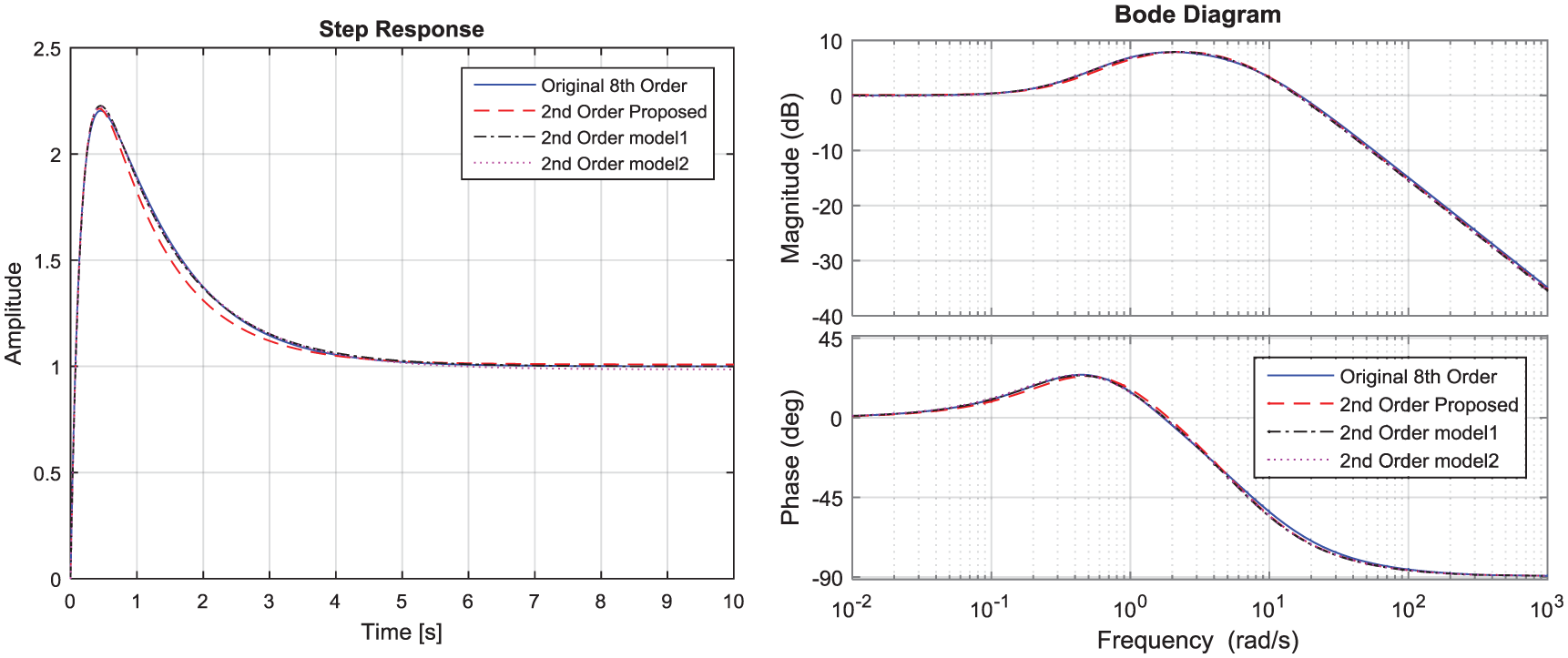
Step and frequency responses for the full 8th order, Model1 reduced 2nd order, Model2 reduced 2nd order and proposed FA reduced 2nd order models.
Example 3
In this example, we consider a 9th order system evaluated by Desai and Prasad (2013) and Boby and Pal (2010). The system is given by the following transfer function
with eigenvalues given as {−1, −1±1i, −1±2i, −1±3i, −1±4i}. Observing the dynamics (eigenvalues) of this system, it is seen that the system is not a two-time scale type; however, it is considered for comparison purposes, keeping in mind that preserving the exact dominant dynamics in the reduced order is only performed in the proposed method.
Performing the FA reduction technique, and focusing on the dynamics {−1, −1±1i}, the following 3rd order reduced model is obtained
while Desai and Prasad (2013) and Boby and Pal (2010), correspondingly, found the following reduced orders,
which provided the simulation results shown in Figure 13. In short, it is seen that each method has its advantages and shortcomings.
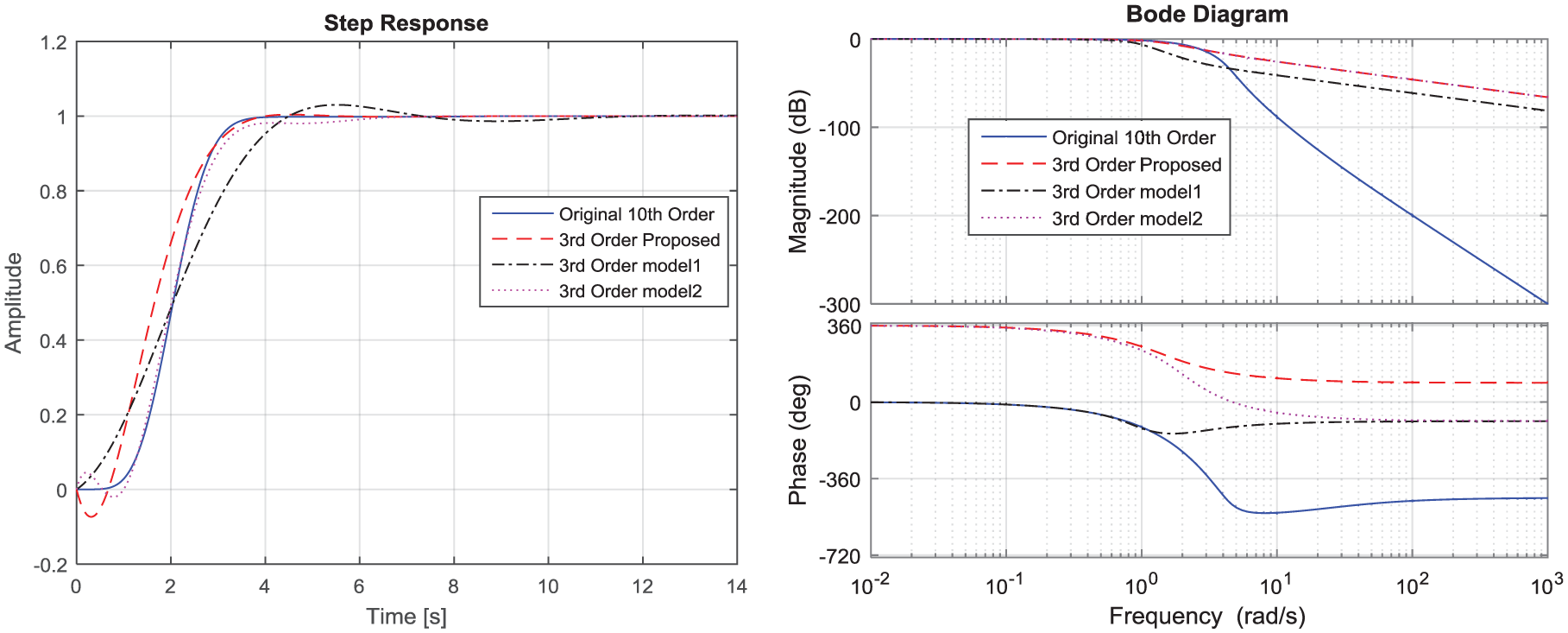
Step and frequency responses for the full 8th order, Model1 reduced 2nd order, Model2 reduced 2nd order and proposed FA reduced 2nd order models.
Discussion
In comparing the performance of the proposed method with others, Figure (14) shows five different diagrams, comparing between the original system of example one, without reduction and reduced models using four different optimization techniques: IWO (Mehrabian and Lucas, 2006), PSO (Kennedy and Eberhart, 1995), GA (Abo-Hammour et al., 2011) and the proposed algorithm (firefly optimization) for fourth order reduction. The comparison between these methods is based on the values of the RMSE, which represented as equation (16).
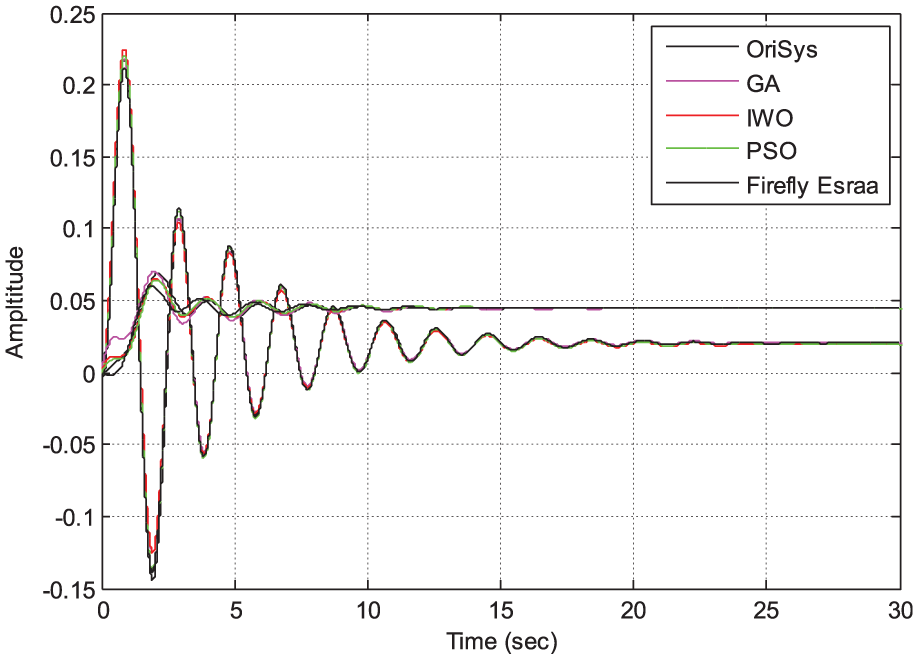
Comparison of step responses for four different techniques.
The results in Table (2) show that proposed FA has the second-best solution after PSO optimization with RMSE of 0.002.
Evaluation of methods.
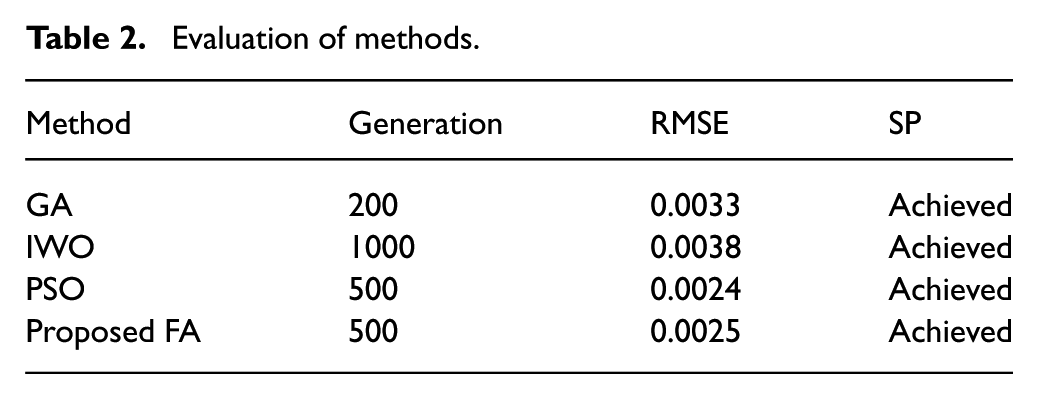
Table (3) presents the evaluations of FA results in Alsmadi et al. (2016) and the proposed FA, with results seen as much better in the proposed work.
Evaluation of methods.
When FA simulation results were compared with other methods’ results, such as GA, PSO algorithm and IWO, in solving MOR problems, it was found that FA transcends the other methods in the error sense by leading to better (lower) RMSE. Also, it is noted that the FA was more accurate and the success rate was remarkably better than the other mentioned algorithms.
Conclusions
We examined the problem of MOR for multi-time scale systems. The reduction process was performed using the firefly optimization technique. This approach was able to produce reduced order models with the advantage of substructure preservation, as to maintaining the system dominant dynamics in the reduced order. The performance of the proposed method was compared with recently published work concerning MOR via the firefly method. Simulation results show the potential of the FA as an artificial intelligence technique for the process of MOR. In addition, the results of the proposed FA reduction technique were compared with three other optimization techniques, namely, IWO, PSO and GA. The results show some superiority of the proposed FA over the other methods.
Footnotes
Funding
The author(s) received no financial support for the research, authorship, and/or publication of this article.