






Abstract
The main goal of this paper is to study, analyse and prove the global convergence property of a nonmonotone semismooth Newton method. Based on this property, we aim to exploit an adaptive nonmonotone line search method and apply it for the approximate solution of elliptic optimal control problems with control constraints. To this end, we first convert the optimal control problem to a bound constrained optimization problem by using a finite-difference discretization scheme and a Newton–Cotes rule. Then we implement the adaptive nonmonotone semismooth Newton method to the resulting bound constrained optimization problem. We give some numerical examples to demonstrate the validity, efficiency and applicability of the presented method.
Keywords
Introduction
Lately, there has been significant progress in the context of optimal control of partial differential equations. Optimization with partial differential equation constraints is widely used in many fields, such as the natural sciences (Aniţa et al., 2011; Cantrell et al., 2009; Christofides et al., 2008) and industry (Capasso et al., 2000; Field and Komkov, 1992; Hu, 2012; Manchanda et al., 2017). Thus, the development, analysis and computer implementation of efficient optimization techniques is required for such optimization problems. Because of these properties, the solution of such problems has become increasingly popular. Also, in the past years, some studies have been published in the context of optimization with partial differential equation constraints (Borzì and Schulz, 2012; Hinze et al., 2008; Lions, 1971; Tröltzsch, 2010).
The goal of this paper is to prove the global convergence property for a nonmonotone semismooth Newton (NSN) method. Using this property, we can exploit an adaptive nonmonotone line search method for the approximate solution of elliptic optimal control problems with control constraints.
Let

subject to


where

There are two main classes of numerical methods for solving optimal control problems: direct methods and indirect methods. In direct methods, the optimal control problem is transformed to a finite-dimensional optimization problem through discretization and then the obtained finite-dimensional optimization problem is solved using a suitable nonlinear optimization algorithm. In indirect methods, the optimality system is derived first and then the obtained optimality system is discretized using a suitable discretization method. In this work, an efficient direct method is used to control-constrained elliptic optimal control problems. To discretize such problems, a finite-difference scheme is used to discretize the state equation. Also, a Newton–Cotes rule is applied to discretize the cost functional. After discretization of the problem (equations (1) to (3)), the obtained finite-dimensional problem is given by

subject to


where


and

Here,
There are various numerical methods for solving the problem (equations (4) to (6)), which include penalty methods, augmented Lagrangian methods, active-set methods, interior point methods, gradient projection methods, trust region techniques or some combination of these methods (Bazaraa et al., 2006; Nocedal and Wright, 2006).
In this work, we prove the global convergence of a nonmonotone semismooth Newton (NSN) method developed by Bonettini and Tinti (2007) to exploit an adaptive nonmonotone line search method. Then, we implement this adaptive method to find the approximate solution of the control problem (equations (4) to (6)). In nonmonotone line search methods, some growth in the function value is permitted. Many researchers pointed out that utilizing nonmonotone schemes can improve the likelihood of finding a global optimum, as well as the convergence rate in cases where a monotone scheme is forced to creep along the bottom of a narrow curved valley (Bonettini and Tinti, 2007; Shen et al., 2012; Su and Pu, 2009; Su and Yu, 2009; Ulbrich and Ulbrich, 2003). Encouraging numerical results have been reported by combining nonmonotone techniques with a Newton-type direction for highly nonlinear and ill-conditioned optimization problems. Many partial differential equation constrained optimization problems have nonlinear and ill-posed structures. Because of this property, using the nonmonotone schemes is more reliable for these problems.
This discussion motivates us to apply a nonmonotone version of the semismooth Newton (NSN) method in the line search framework to find approximate solutions of control-constrained elliptic optimal control problems.
The structure of this paper is outlined as follows. The following section is devoted to discretization techniques for control-constrained elliptic optimal control problems. In the next section, the adaptive NSN method is described for the obtained discretized form. Numerical examples and conclusions are given and discussed in the final sections.
Control-constrained elliptic optimal control problems and their discretization procedure
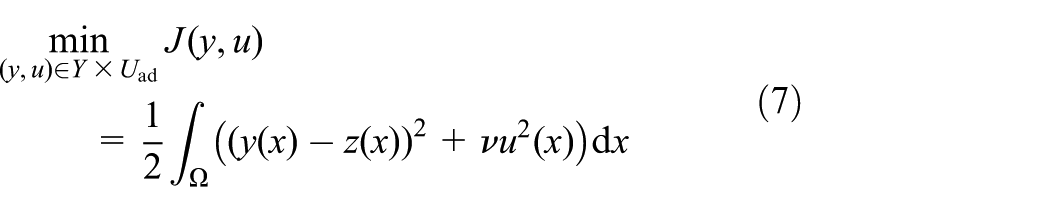
Consider the following control-constrained elliptic optimal control problem


where
A finite-difference discretization scheme is used to discretize equations (8) and (9). By defining the mesh size steps

Let

for

for

and

the matrix form of equations (8) and (9) can be written as

where

Here,

where each block T or I is itself an

and I is the

where h is defined as before,

where

and

which is an
Thus, the fully discretized problem is given as follows

where

and

where


NSN method to solve the obtained bound constrained optimization problem
This section deals with how the NSN method introduced by Bonettini and Tinti (2007) can be applied to solve the bound constrained optimization problem (equations (14) to (16)). To describe the NSN algorithm model, we need first to prove the existence of an optimal solution to the general control problem (equation (4) to (6)). The feasible set is denoted by

Now, consider the following assumptions:
There exists an open set
The constraint
The partial Jacobian of E with respect to

Now, we introduce a theorem for the existence of an optimal solution

exists and hence a minimizing sequence

For all k greater than some number

Under the assumptions (i) to (iv) and regarding equations (4) to (6), the implicit function theorem (Griva et al., 2009) allows us to consider

where

where

where


for all

for

From equation (18), the adjoint representation of the reduced gradient

where

Combining Theorem 2 and equation (19) leads to the following inequality

which implies that

where

The Lagrangian function for the bound constrained optimization problem (equation (14) to (16)) is given by

where

where
From equation (21) and the second optimality condition in equation (22), the last three optimality conditions in equation (22) can be reformulated as

where
The first three optimality conditions in equations (22) and (23) for

Since the max and min functions are not differentiable, the classical Newton method cannot be applied. For this reason, the semismooth Newton method can be used to solve such systems. The concept of the semismooth Newton method has been introduced first by Pang and Qi (1993), Qi (1993) and Qi and Sun (1993) and then developed in many papers and books (Chen et al., 2000; Chi et al., 2017; Hinze et al., 2008; Ito and Kunisch, 2008; Kröner et al., 2011). The semismooth Newton iteration can be stated regarding an active set strategy and the generalized derivatives of the max and min operators.
Let us set

where

where
The last two equations in equation (24) imply that

The semismooth Newton step to equation (24) is determined by the solution of the following system and the update of equation (25)

where

and

Also, C is an
Once the direction

and

where

where
Now, by attention to these descriptions, we establish the global convergence of this NSN method in the following theorem.

Since
It is obvious that when

where

It is clear that when
Now, Algorithm 1 can be outlined as the semismooth Newton method with nonmonotone line search as follows.

Computational results
This section is devoted to the numerical results obtained by testing the proposed adaptive NSN algorithm for the approximate solution of control-constrained elliptic optimal control problems. We set

Example 1
Consider the control-constrained elliptic problem (equations (7) to (9)) with

The values of the cost functional J and residual
Cost functional J and residual

Number of iterations and computational times for Example 1.

Values of

Example 2
In a similar manner as Example 1, consider the control-constrained elliptic problem (equations (7) to (9)) with

Table 4 shows the values of cost functional J and residual
Cost functional J and residual

Number of iterations and computational times for Example 2.

Example 3
Consider the control-constrained elliptic problem (equations (7) to (9)) with

In this example, the bilinear constraint (equation (8)) is replaced by the following nonlinear constraint

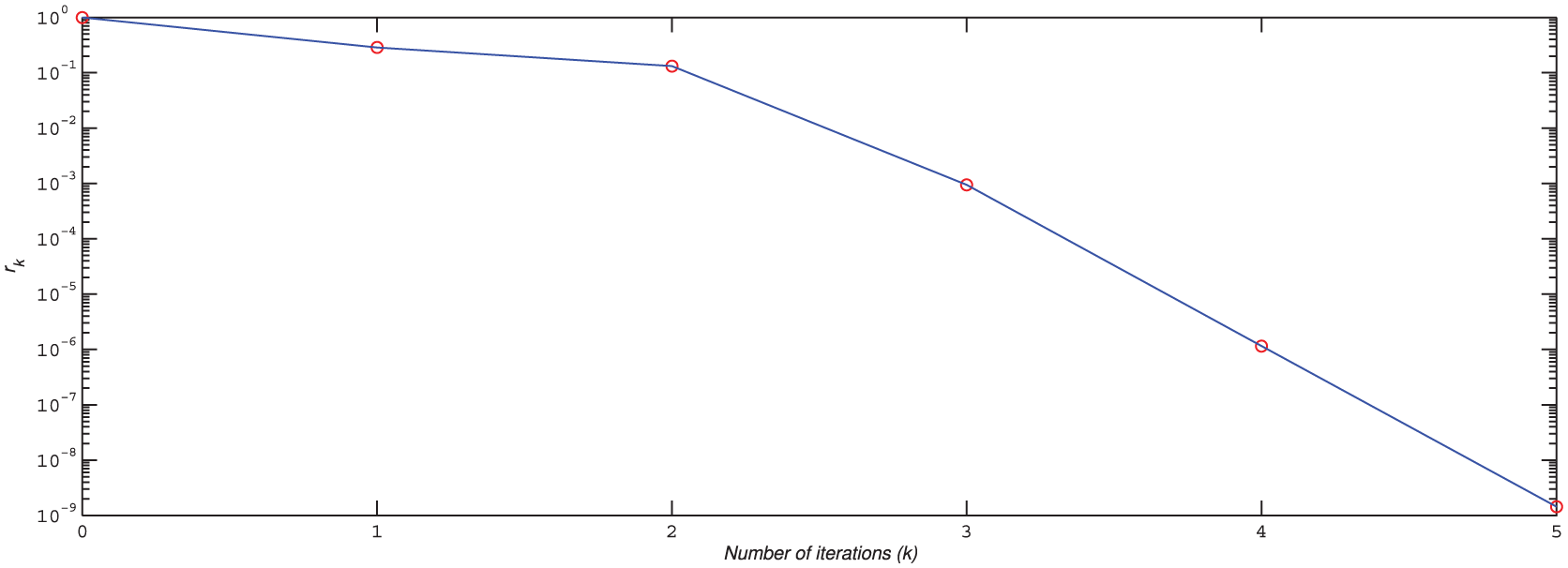
From the perspective of chemistry for equation (32),
We choose
Numerical results for Example 3.

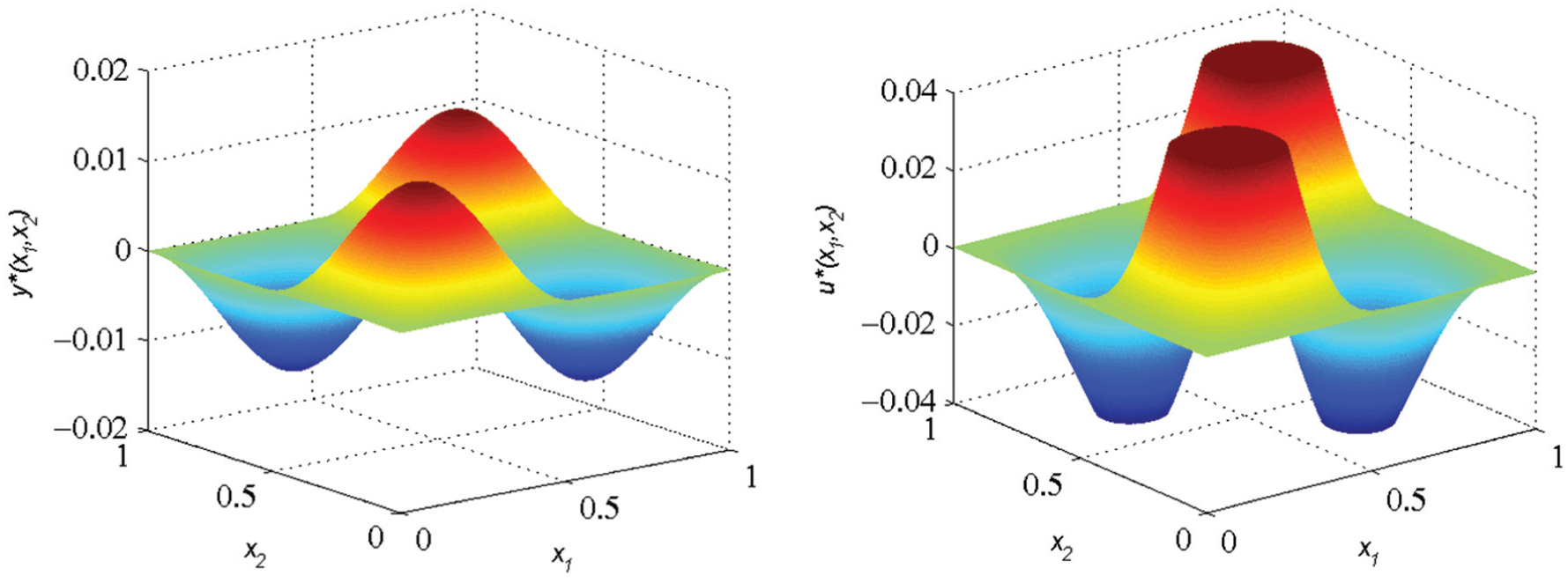
Numerical solutions for the optimal state (left) and optimal control (right) via the nonmonotone semismooth Newton method for Example 1.
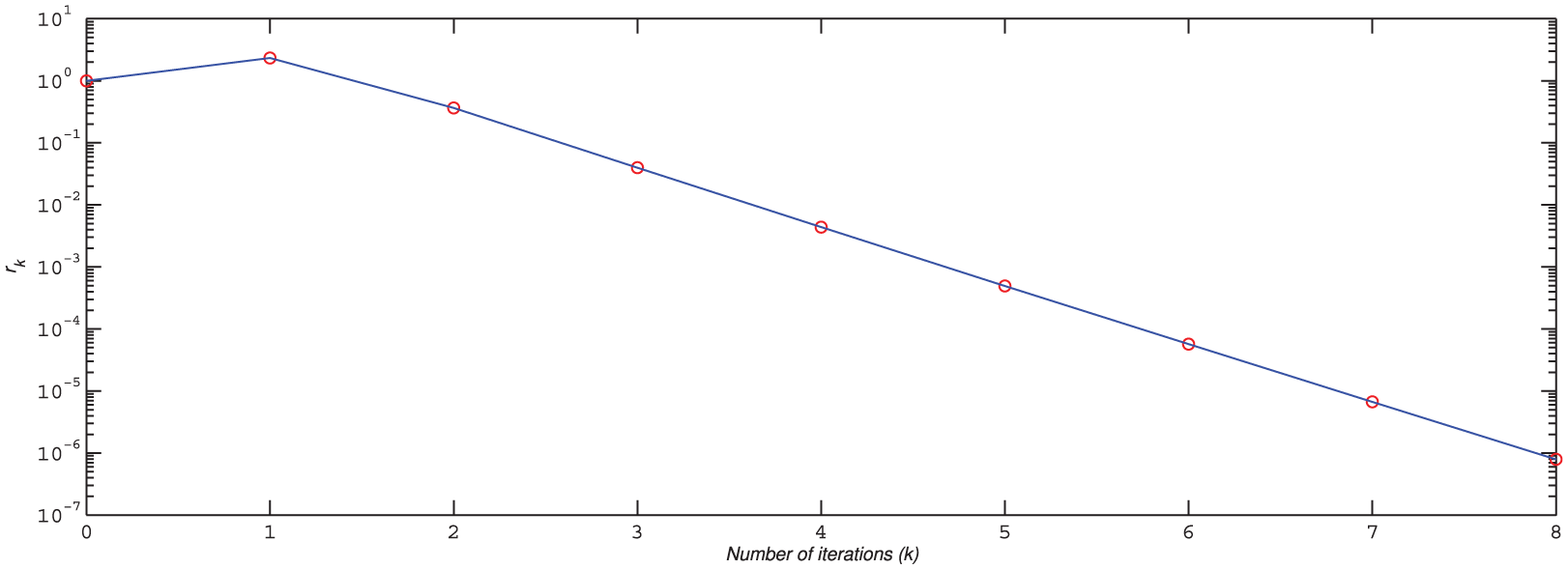
Values of
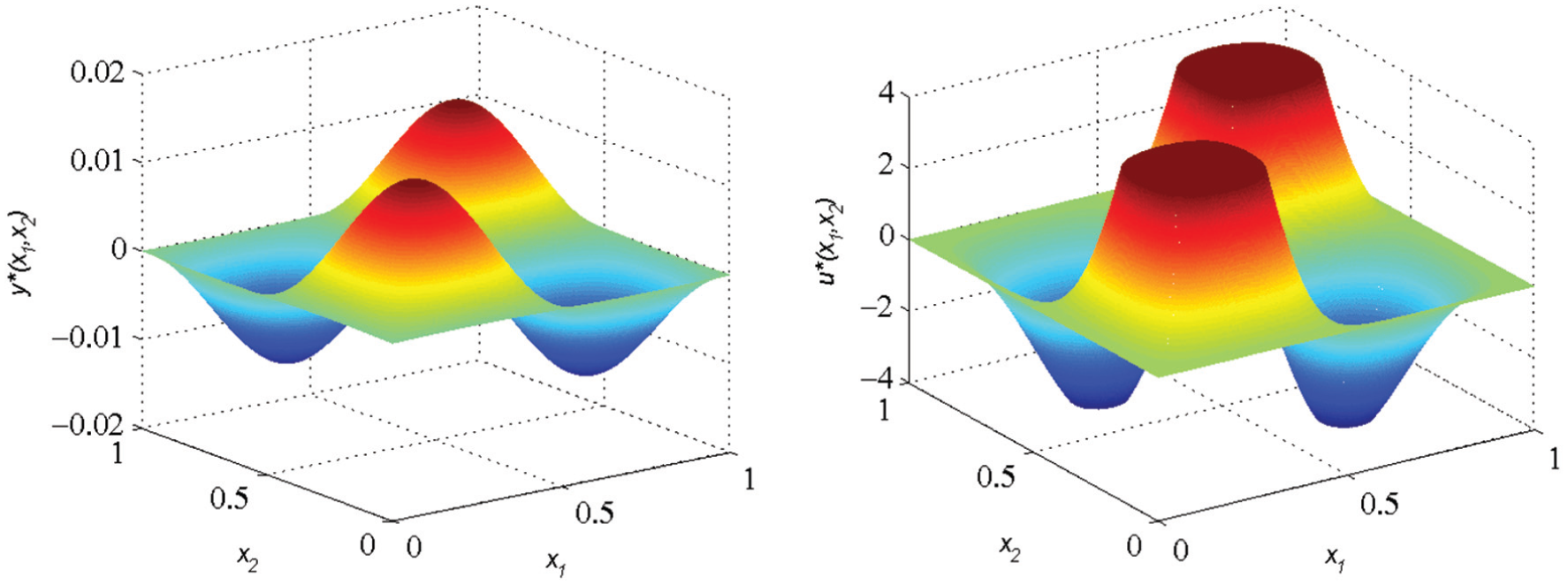
Numerical solutions for the optimal state (left) and optimal control (right) via the nonmonotone semismooth Newton method for Example 2.
Values of
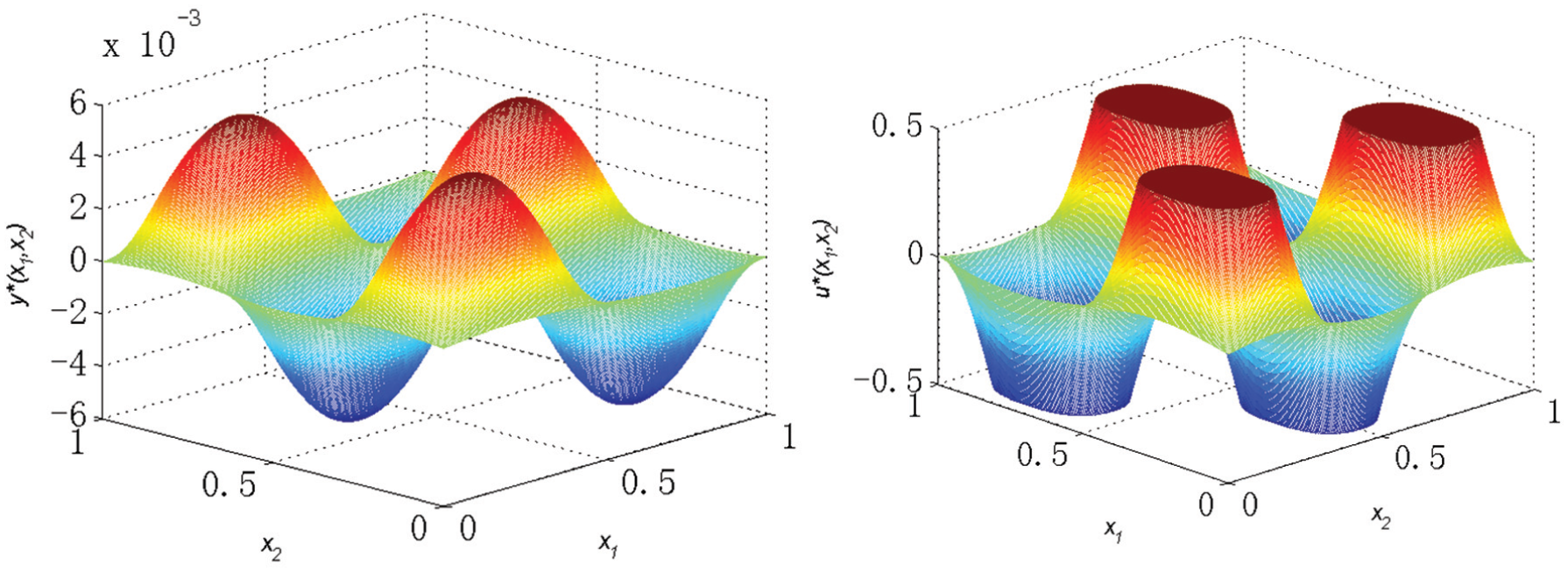
Numerical solutions for the optimal state (left) and optimal control (right) via the adaptive nonmonotone semismooth Newton method for Example 3.
Example 4
Consider the control-constrained elliptic problem (equations (7) to (9)) with

In this example, the bilinear constraint (equation (8)) is replaced by the following nonlinear constraint

Table 7 reports the numerical results obtained by the adaptive NSN method. In addition, Figure 6 shows the values of
Numerical results for Example 4.

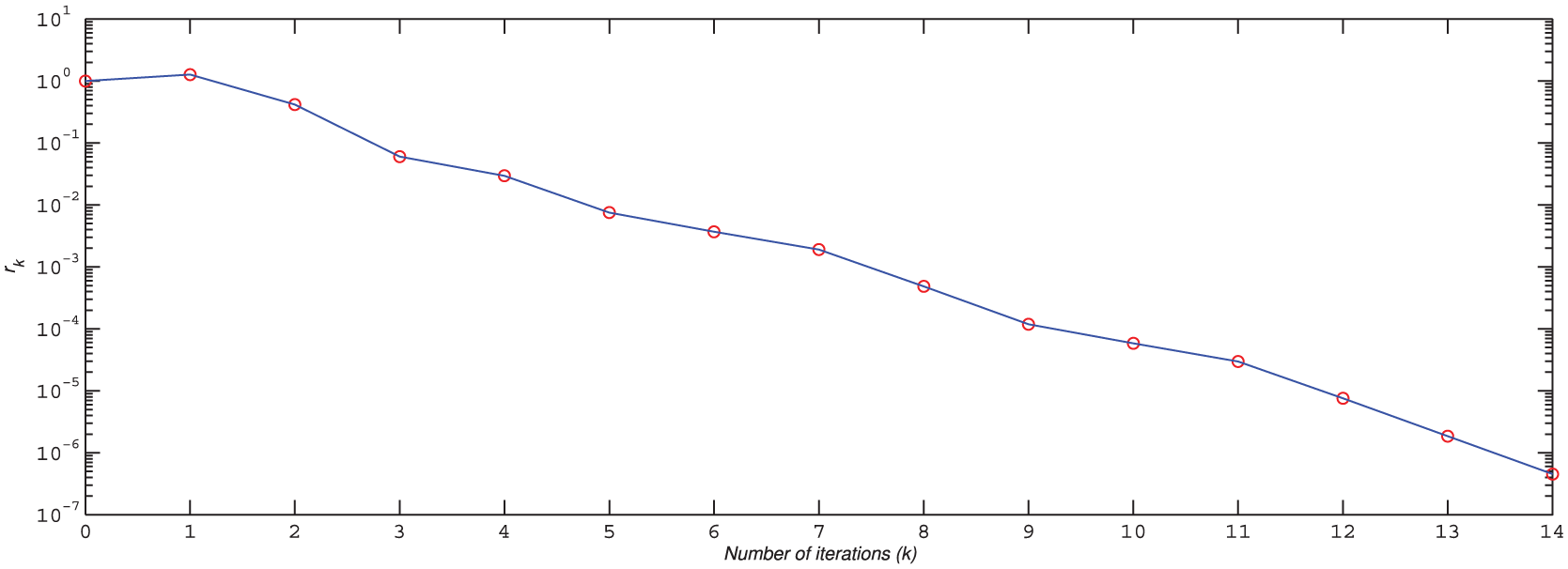
Values of
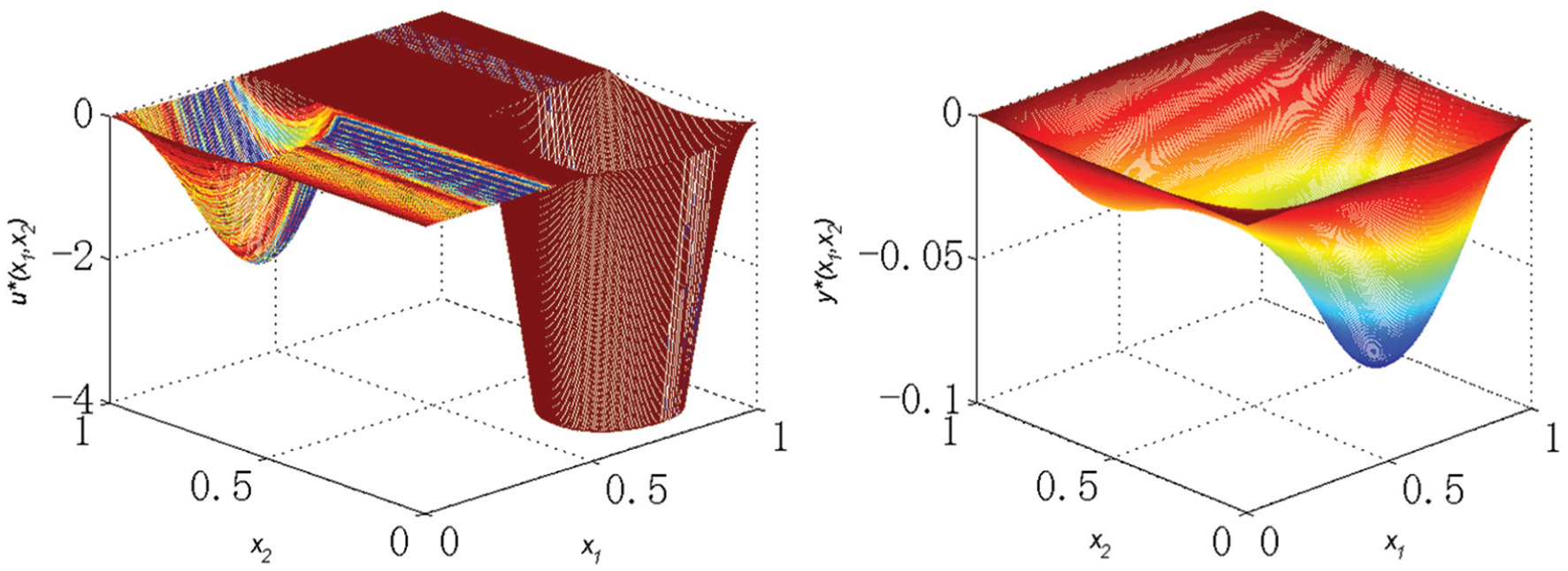
Numerical solutions for the optimal state (left) and optimal control (right) via the adaptive NSN method for Example 4.
Conclusion
In this paper, the global convergence of an NSN method has been proved to exploit an adaptive nonmonotone line search method. Then, this adaptive method has been implemented for the approximate solution of control-constrained elliptic optimal control problems. It is well-known that the nonmonotone globalization technique is a useful method for solving difficult nonlinear problems, because it may help in escaping from steep-sided valleys and may improve both the possibility of finding the global optimum and the rate of convergence. Thus, owing to the efficiency of the semismooth Newton method for bound constrained optimization problems, in this paper an adaptive nonmonotone version of the semismooth Newton method (NSN) has been presented to find the approximate solution of the constrained optimization problem arising from the discretization of the optimal control problem. As shown in the numerical examples, the adaptive NSN method has efficient performance for the approximate solution of control-constrained elliptic optimal control problems.
Footnotes
Declaration of conflicting interests
The author(s) declared no potential conflicts of interest with respect to the research, authorship, and/or publication of this article.
Funding
The author(s) received no financial support for the research, authorship, and/or publication of this article.
