






Abstract
Autonomous underwater vehicles (AUVs) are highly nonlinear underactuated systems with uncertain dynamics and a challenging control problem. The main focus of this paper is to present a control law that shows desirable performance in the presence of modeling uncertainties. In this study, uncertainties are considered to be bounded and the AUV mathematical model is obtained in the presence of such uncertainties. Forces and torques applied to the AUV are also designed using a nonlinear dynamic controller. Appropriate adaptive rules are also presented to overcome system uncertainties and external disturbances. The adaptive nonlinear dynamic controller is designed based on upper bounds of system uncertainties and its stability is proven using the Lyapunov theory. In this article, the performance of the proposed control algorithm for tracking reference trajectories in an obstacle-rich environment is investigated. Therefore, the control algorithm is combined with potential fields for obstacle avoidance. Obtained results show the efficiency of the proposed controller.
Keywords
Introduction
In recent years, autonomous underwater vehicles (AUVs) have played an increasingly significant role in submarine studies and explorations. Such devices are used for a wide range of applications including military, commercial and scientific studies. The high capability of automatic submarine devices and their superiority over humans in accomplishing oceanic tasks, specifically at great depths, has drawn interest. On the other hand, system nonlinear dynamics, structural and non-structural uncertainties and dependency of model parameters on environmental conditions and external disturbances in operational environment make the control problem complicated and also interesting. Therefore, analysis and design of control algorithms for these systems has invited attention. Much effort has been focused on areas of system identification, modeling and control algorithms to enhance the autonomy of such devices. Therefore, several control methods including sliding mode control (Ashrafiuon et al., 2008; Elmokadem et al., 2016; Healey and Lienard, 1993), terminal sliding mode control (Elmokadem et al., 2017), higher order sliding mode (Joe et al., 2014), adaptive control (Sahu and Subudhi, 2014; Ramezani-al and Tavanaei-Sereshki, 2018), neural network control (Yuh, 1990) and back stepping control (Liang et al., 2016) have been proposed.
Considering the environmental conditions for the AUV, it is expected that the AUV controller is capable of resolving system uncertainties, external disturbances and unmodeled dynamics. Robust controllers have always attracted notice as an efficient and robust method against parametric uncertainties.
In Elmokadem et al. (2016, 2017), the sliding mode and terminal sliding mode methods for trajectory tracking of AUVs in the horizontal plane is proposed. In these researches, the control algorithm is designed based on the seperation of the kinematics and the dynamics models. Some studies have used artificial neural networks for adaptive controllers (Li and Lee, 2005; Kim and Inman, 2003; Ishii et al., 1994). In most of these studies, system dynamics models are approximated using neural networks, and then systems are controlled using adaptive laws. In other studies, fuzzy methods have employed adaptive controllers for AUVs (Chang et al., 2003; Jun and Lee, 2011; Xu and Smith, 1994).
Most of the controllers contribute in general control algorithms for known and unknown parts of the dynamic model of AUVs. However, these approches are unaware of the issue of independent control for unknown and known parts of the dynamic model. Therefore, this paper proposes an independent control algorithm considering known and unknown parts of the dynamic model for underactuated AUVs. In fact, this paper has employed adaptive controllers to estimate dynamic model parameters and offer a control algorithm for AUVs.
In Marino and Tomei (1995), a number of adaptive and robust control algorithms have been reviewed and analyzed for nonlinear systems. Also, in Khalaji and Moosavian (2014), appropriate adaptive rules have been investigated to compensate the upper-bounded lumped uncertainties for wheeled mobile robots. In Qiao and Zhang (2018), an adaptive terminal sliding mode tracking controller is presented for fully actuated AUVs. Chen et al. (2016) proposed an independed adaptive fuzzy control algorithm including known and unknown parts of the dynamic model to control the AUV based on the computed torque controller.
As discussed previously, most of the works on AUVs have been focused on the trajectory tracking control and the control algorithm is designed based on the tracking position errors, mostly, while in order to reduce the complexity, the control algorithm can be designed based on the separation of the kinematic and dynamic models. Consequently, this paper is one of the firsts to design a robust adaptive controller for underactuated AUVs.
The proposed tracking control algorithm improves control performance and resolves the uncertainties and disturbances affecting the AUV control. The presented control method provides the benefits of robustness against uncertainties and disturbances, a simple control mechanism and converging results.
To this end, first the system is explained and a dynamic model is obtained in the presence of uncertainties. Then, a robust control algorithm is proposed, and, finally, obtained results are presented to evaluate the performance of the control algorithm. The study’s achievements are:
Employing adaptive laws through estimating bounds of dynamic model matrices instead of estimating system parameters, to reduce estimation parameters and to increase the speed of the control algorithm.
Investigating performance of the control algorithm in the presence of uncertainties and external disturbances.
Developing mathematical potential functions in order to produce a repulsive force between the AUV and the obstacles that intersect the reference path and then generate a safe move for the robot in obstacle-rich environments.
Developing a control law using the theory of virtual potential functions for the control of an AUV in an environment containing some obstacles.
Comparing performance of adaptive nonlinear dynamic controller (ANDC) algorithm with nonlinear dynamic controller (NDC) algorithm in the presence of obstacles.
System description and kinematic modeling
In the present study, the Remote Environmental Monitoring Units (REMUS) underwater vehicle (Figure 1) has been actuated for surge (motion in the x-direction), sway (motion in the y-direction), heave (motion in the z-direction) and yaw (rotation in the z-direction) motions within the 3D workspace of water.
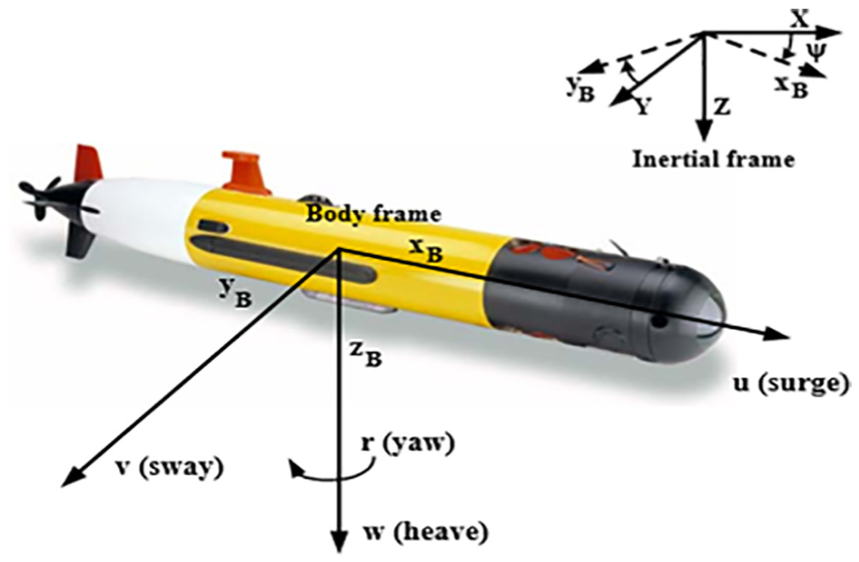
Underwater vehicle (REMUS 100).
With the assumption of negligible motion in roll (rotation in the x-direction) and pitch (rotation in the y-direction) directions, kinematic equations of AUV can be written as

where

In (2),

Dynamic modeling
Dynamic equations of the AUV are extracted in moving frame (body frame), because hydrodynamic forces and torques are also described in this frame.
According to the assumption, the AUV is considered to be a rigid body and its dynamic equations are extracted based on the Euler-Newton laws. Finally, considering the hydrodynamic effects on AUV, the external forces and torques applied to the vehicle are calculated and added to the equations of the rigid body. Thus, the dynamic equations of the system can be expressed as

where
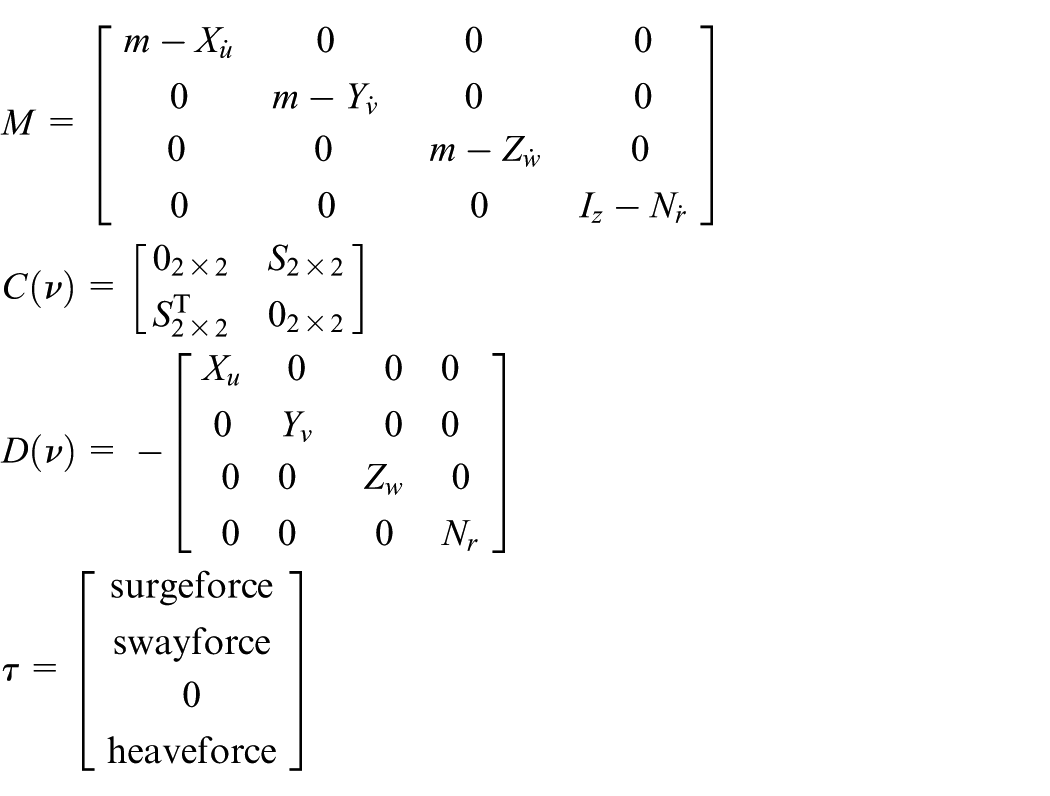
where
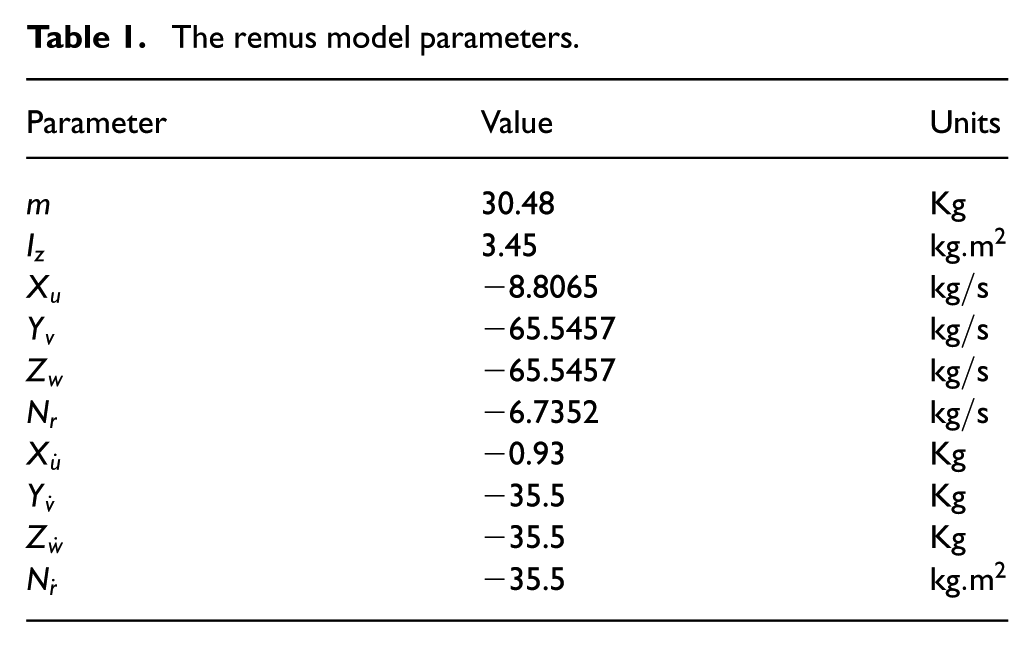
The control inputs are the surge, the sway and the heave forces. It should be noted that, in the above model, the yaw equation of the motion is underactuated. Thus, the AUV is a nonlinear underactuated system. The actual values of the system parameters are expressed in Table 1.
The remus model parameters.
Kinematic controller design
In the present research, controller design is performed in two parts, dynamic and kinematic. In fact, controller design is aimed so that if position and velocity errors are stabilized, the robot would be able to track the reference trajectory.
Convergence of position error to zero is accomplished in this section using the kinematic equations of the system. Convergence of velocity errors is studied in the following sections using appropriate control laws.
Therefore, considering previous studies in designing AUV controllers (Elmokadem et al., 2016, 2017), the designed linear velocities are determined such that convergence of the position error is guaranteed.

where

The differential equation of the tracking error is defined as the differences between designed velocities and the vehicle’s real velocities.

where

The matrix

In order to investigate the convergence of the position errors, the Lyapunov function candidate is selected as

Differentiating the candidate Lyapunov function yields

Substituting (8) into (10), one obtains

NDC
In this section, a control law is designed to produce the actuator forces in order to stabilize the tracking error dynamics around the origin. Accordingly, the tracking error signals (velocity errors) are defined as

where
Now, the following NDC algorithm is considered for the dynamic control of the AUV.


The time derivative of the Lyapunov function candidate is obtained as

Substituting from dynamic model (3) and the controller input (13) yields

Simplifications yield

Consequently, in order to have the closed-loop stability and the convergence of the velocity errors, the time derivative of the Lyapunov function candidate should be negative definite. Therefore, dynamic control gains (K) should be positive.
ANDC
Dynamics model in the presence of uncertainties
In general, modeling a dynamic system has its own inaccuracies and uncertainties. A dynamic model of AUV is no exception. Considering the complexities of modeling robot movement in fluid environment, uncertainties in systems parameters are unavoidable.
Thus, the dynamic model with uncertainties can be represented as

Equation (18) can be rewritten as follows

where

Using (19),

Substituting (21) into (20), one acquires
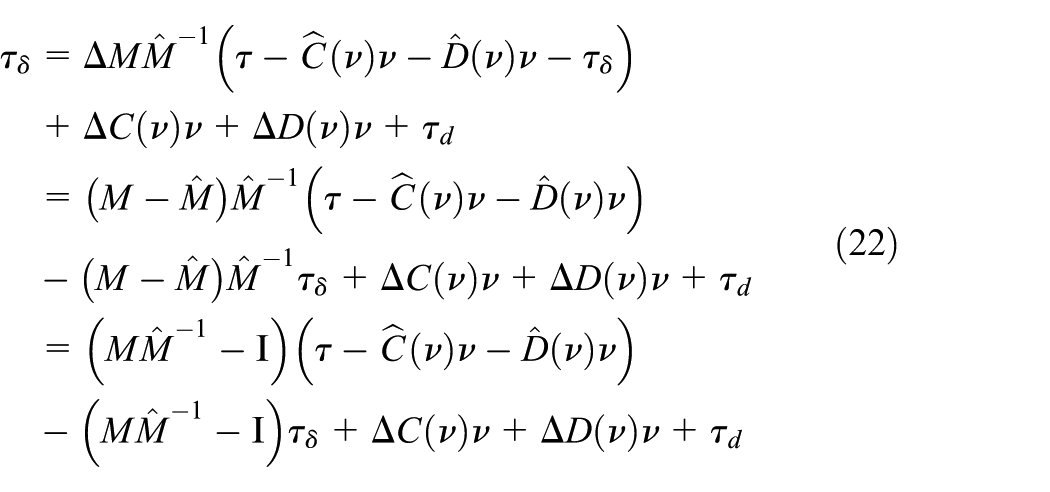
Simplifications yield
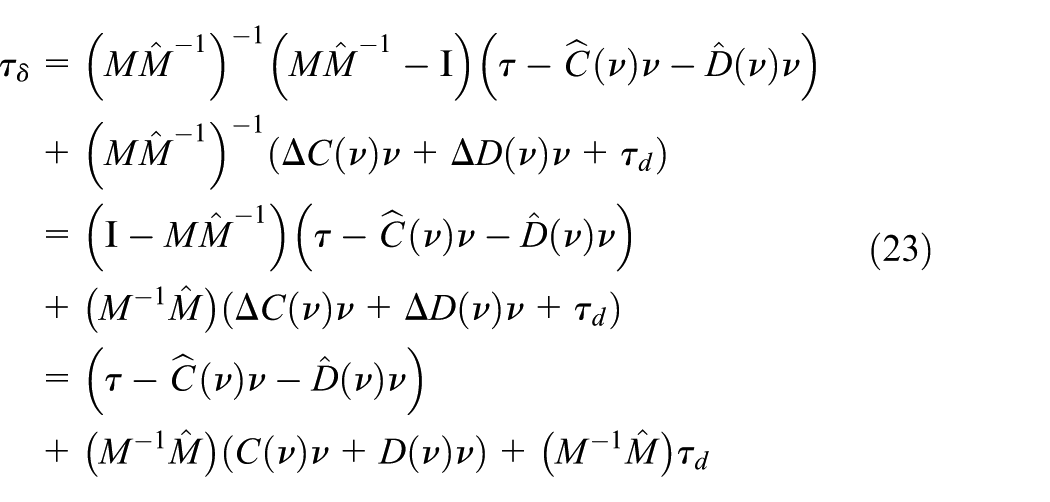
Then,






where
Substituting the Assumptions in (24) one can conclude
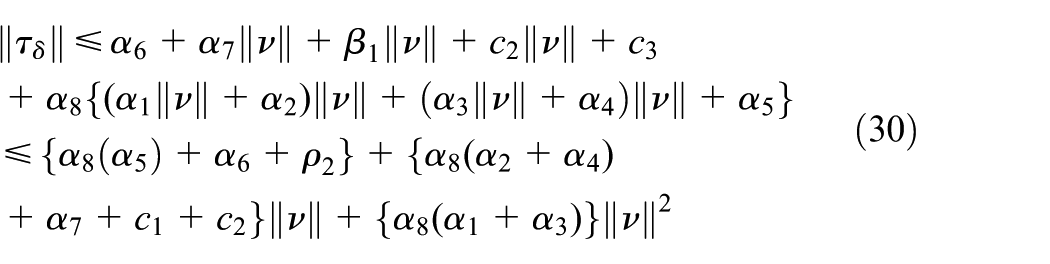

where
ANDC
A nonlinear dynamic controller can be used when modeling is sufficiently accurate, even though the dynamic model has uncertainties and disturbances caused by the environmental structure. Proper control structures might change the model’s behavior in response to the dynamic of the process and disturbances and overcome the effects of these uncertainties. Adaptive control is a strategic control to handle uncertainties.
The following is the ANDC law for AUV

with the following adaptive mechanism to estimate the control parameters of the system (18)

and the estimation error can be defined as follows


where

The time derivative of the Lyapunov function candidate is obtained as
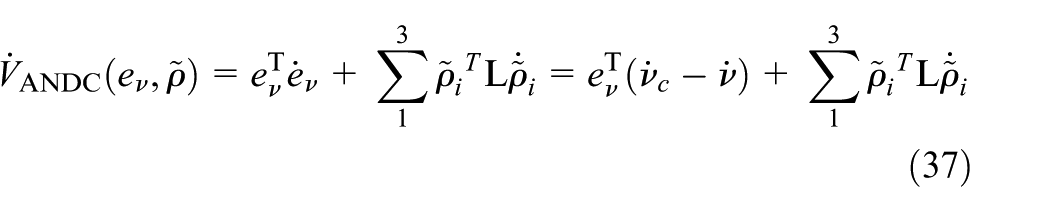
Using the dynamic model with uncertainties (18), can be calculated as
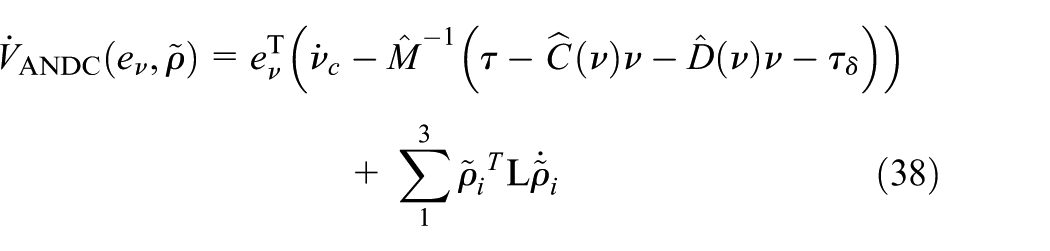
Substituting from (32) and (36), obtain
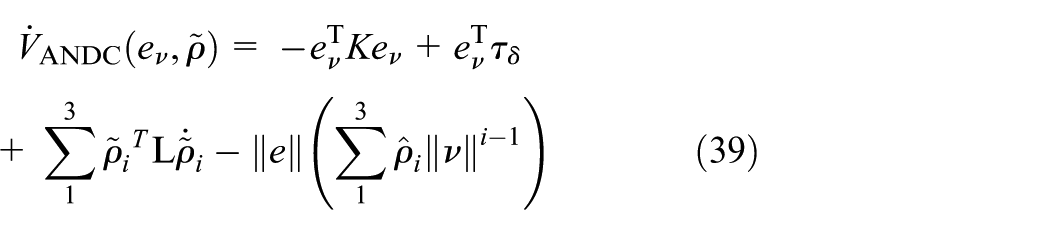
Thus
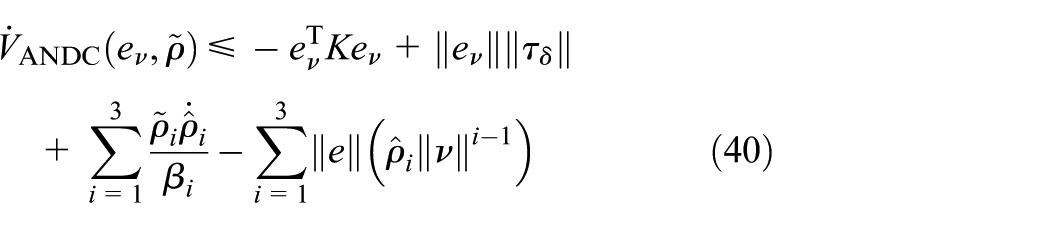
Using (31) and (34) yields
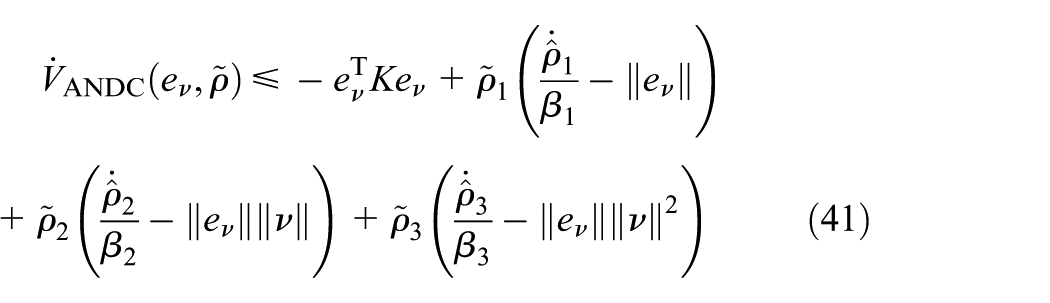
Applying the adaptive mechanism (33) and simplifications yield

Therefore, by proper selection of dynamic control gains (
Obtained results
The proposed controller is applied on the AUV model in order to analyze the stability and the performance of the closed loop system. The control structure for AUV is shown in Figure 2.
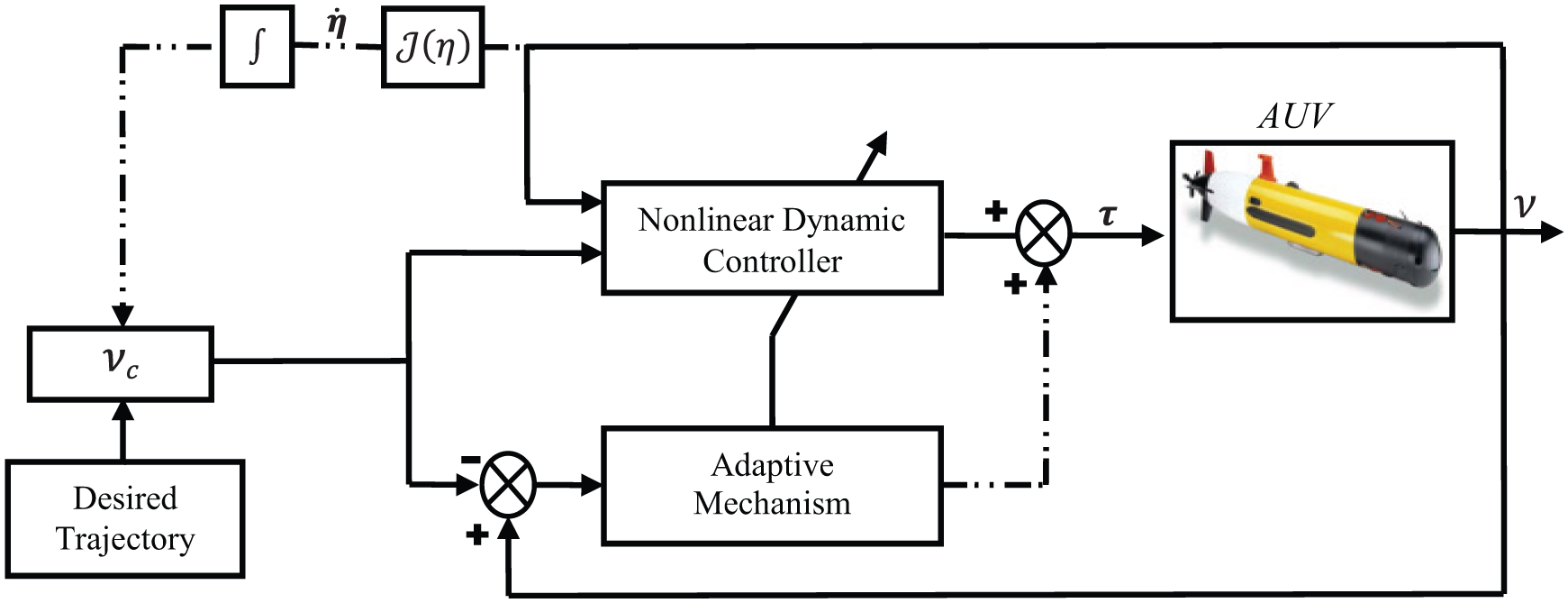
Block diagram of the proposed controller.
The considered reference trajectory in Cartesian space is

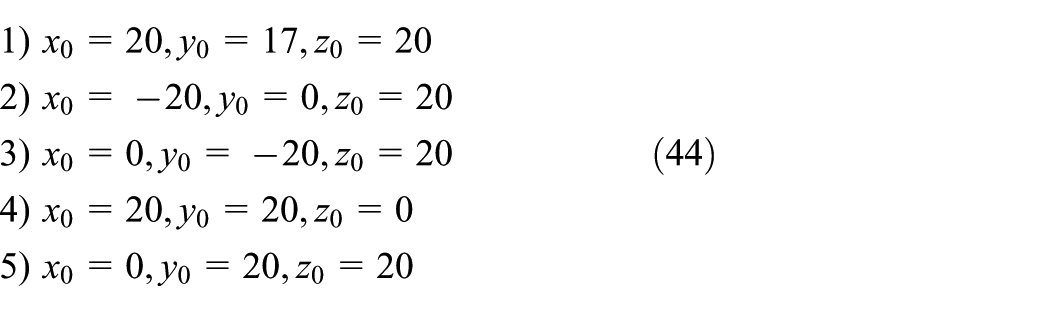
The initial condition of the system is considered as follows
In order to investigate the controller’s robustness, a considerable external disturbance (45) is applied to the system, and the performance results of the control algorithm in the presence and absence of adaptive control are compared. The simulations are performed using MATLAB\Simulink.
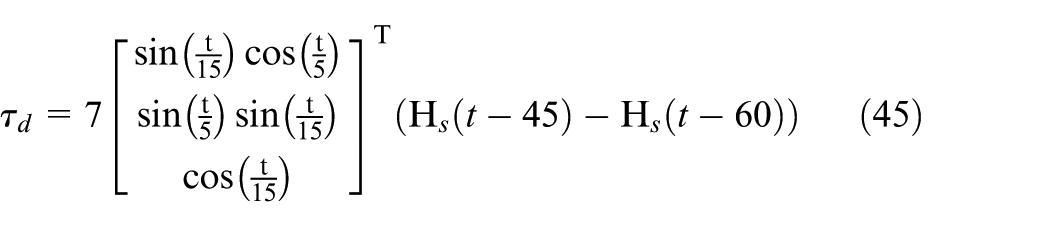
where

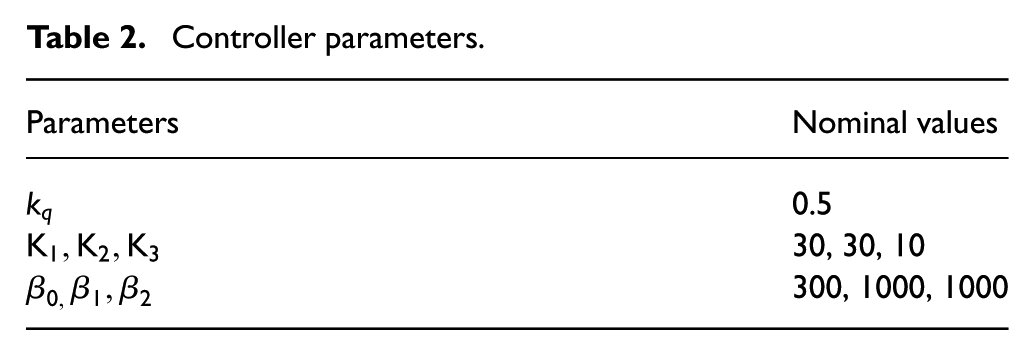
The system parameters are given in Table 2. For the stability of the closed loop system, the values of the controller gains are assumed to be positive. Larger controller gains lead to appropriate performance of the control law and the smaller controller gains lead to inappropriate performance of the closed loop system. On the other hand, larger control gains will lead to higher control inputs. Therefore, control gains should be compromised in order to have appropriate performance and reasonable control inputs at the same time, using trial and error method and simultaneously checking the effectiveness of the closed loop system and the amount of control inputs.
Controller parameters.
Control gains to satisfy stability of the closed loop system are assumed to be positive. Therefore, in order to have proper performance and an acceptable control input, control gains are selected using the trial and error method. Simultaneous investigation of the closed loop system’s performance and the amount of control input has been selected. Since stability of the proposed controller in tracking selected reference trajectories has been proven, it is expected that by starting from each point of the Cartesian space, tracking errors will converge to zero after a short time, and the robot tracks the selected desired trajectory.
The real trajectory of the robot and the reference trajectory (43) in the 3D space for the proposed algorithms are shown in Figure 3.
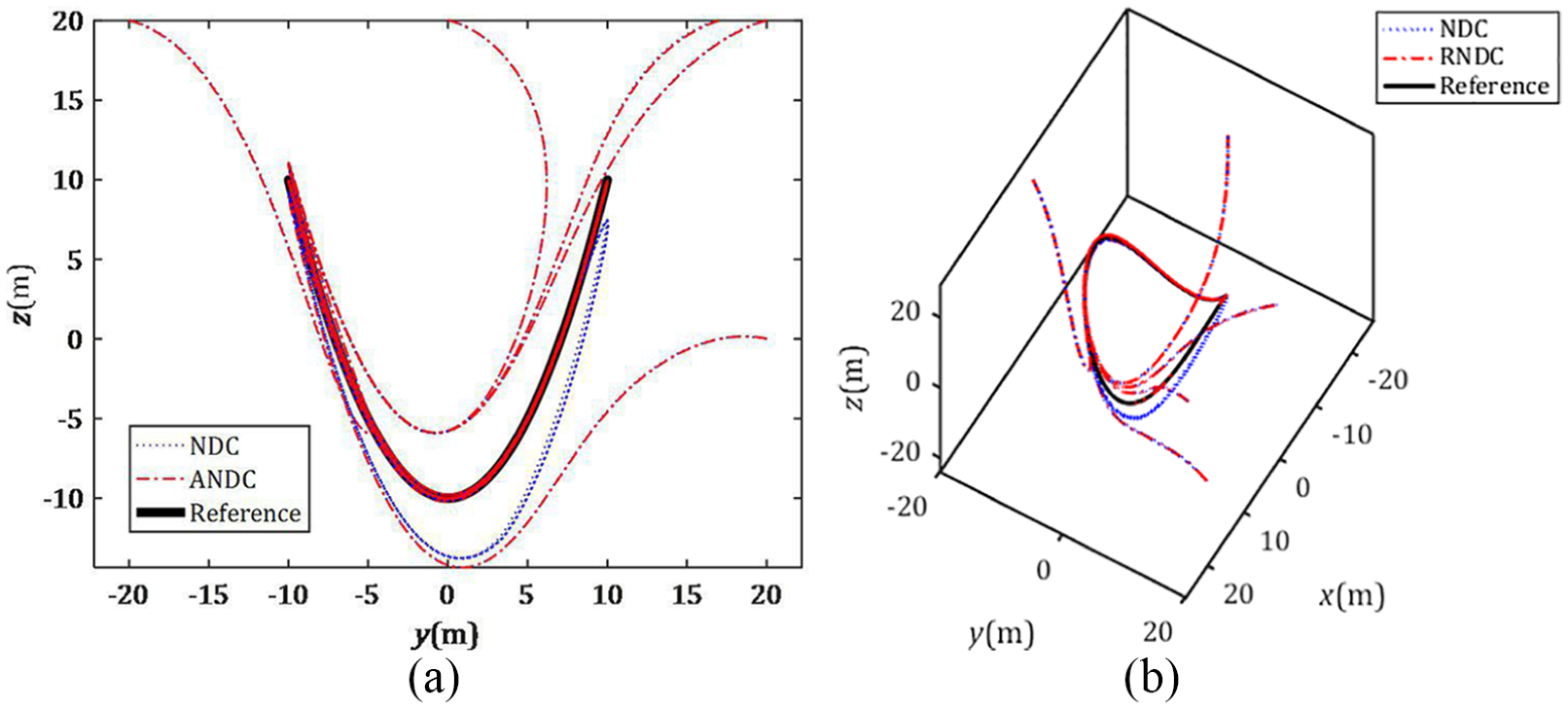
Motion path and the reference path for the AUV. (a) in plane zy (b) in 3D space.
As can be seen, the robot tracks the reference trajectory in the presence of disturbances using the ANDC algorithm.
In the ANDC algorithm, external disturbances imposed on the system are compensated using the adaptive rules at each instant of time.
Tracking error signals under different initial conditions along x, y and z are given in Figures 4, 5 and 6, respectively.
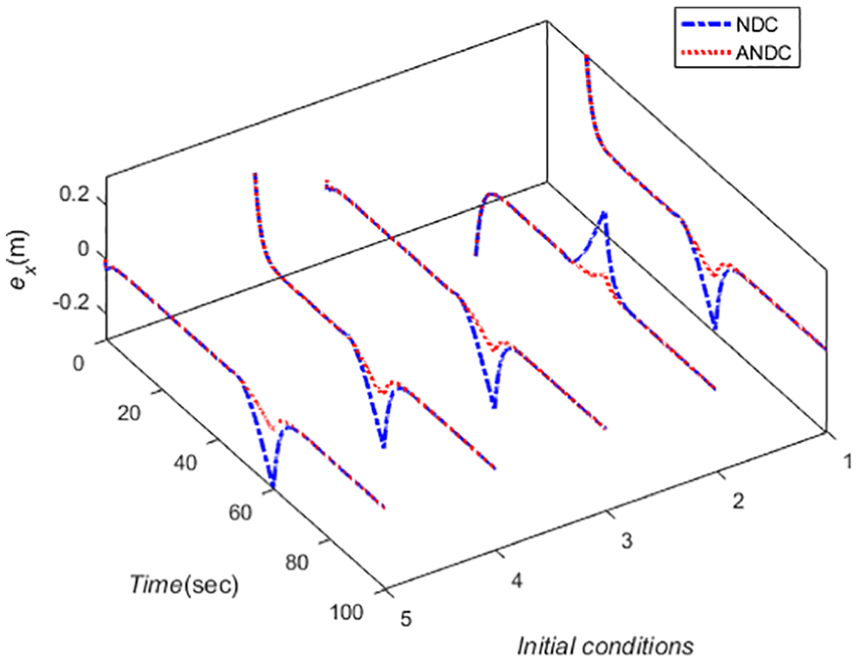
Error signals in the x-direction.
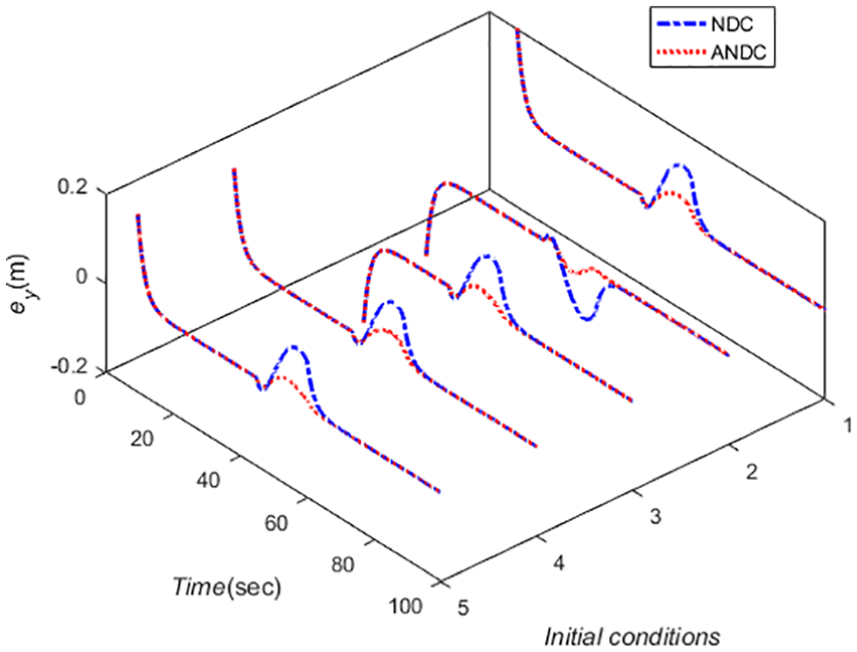
Error signals in the y-direction.
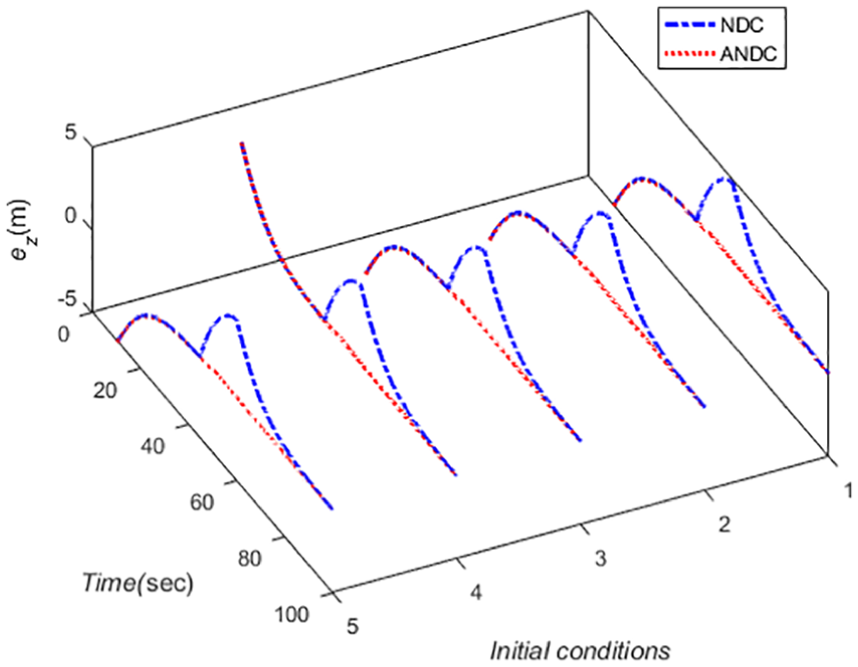
Error signals in the z-direction.
Figures (7), (8) and (9) show control inputs. Generated control inputs have proper values in an acceptable range.
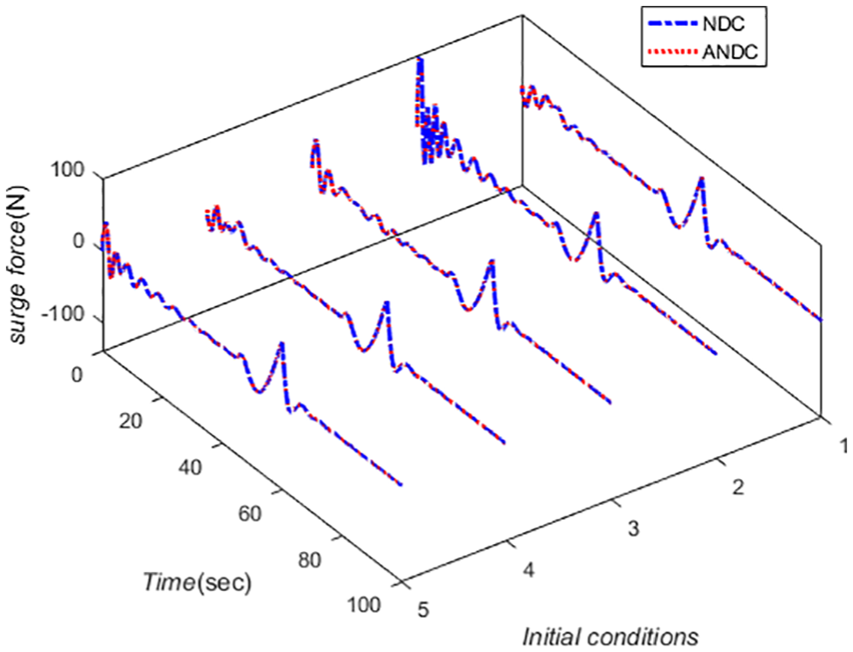
The surge forces of the AUV.
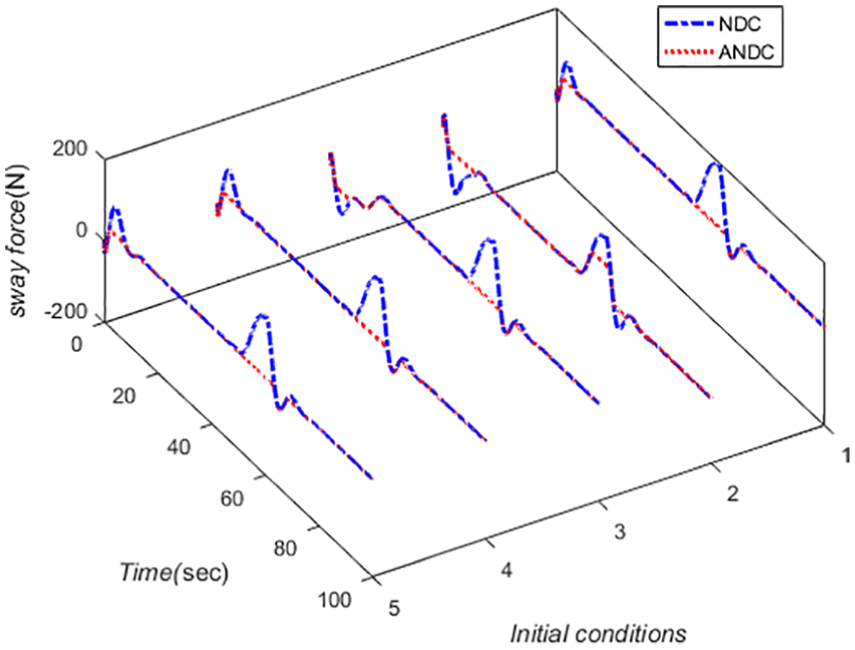
The sway forces of the AUV.
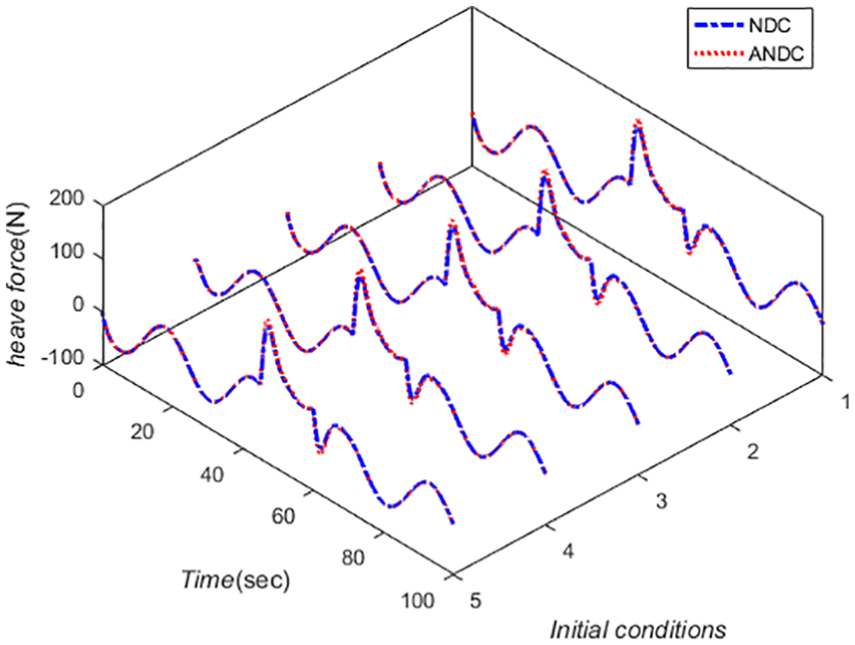
The heave forces of the AUV.
Considering the presented results, the NDC algorithm is able to track the trajectory before applying external disturbances. However, when
The real trajectory of the AUV for sinusoidal and circular reference trajectories in the presence of external disturbances for NDC and ANDC algorithms are shown in Figures 10 and 11.
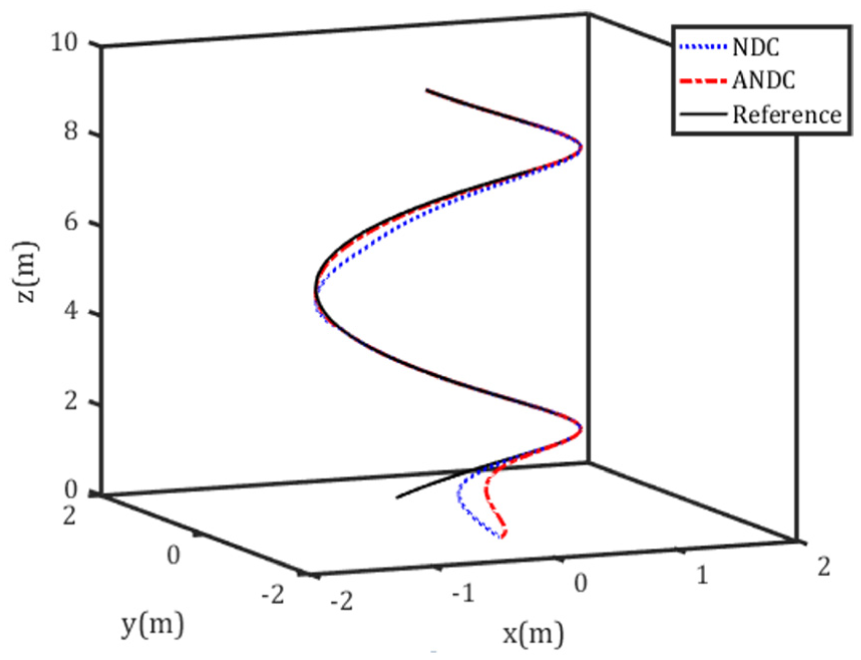
Motion path and the sinusoidal reference trajectory for the AUV.
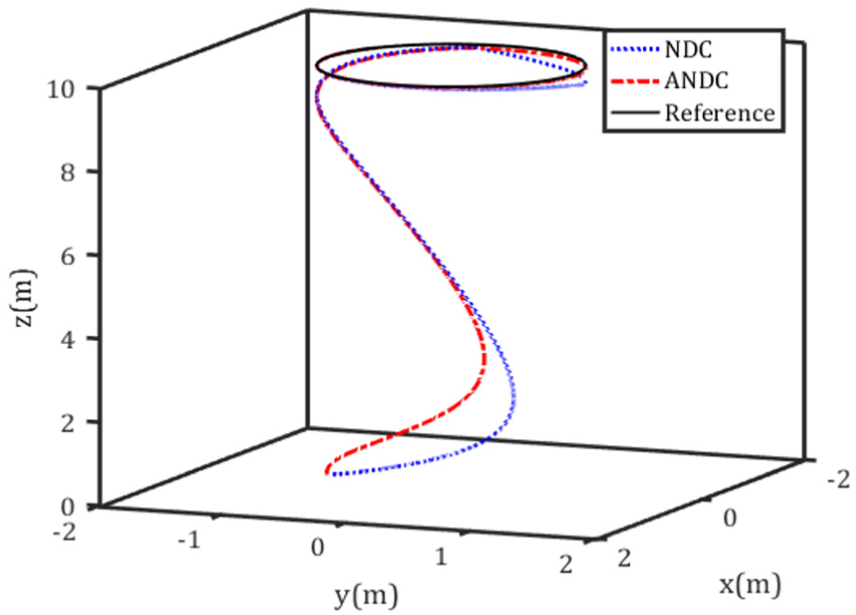
Motion path and the circular reference path for the AUV.
Tracking control in the presence of obstacles
The aim of this section is to investigate a control algorithm to avoid obstacles crossing the desired path, as well as a performance assessment of suggested controller with potential fields in an obstacle-rich environment. Consequently, it is expected that the trajectory tracking errors tend to zero in the absence of obstacles (equation (46)).

When the robot approaches an obstacle, it passes the obstacle, creating an appropriate distance (Sahu and Subudhi, 2017).
One of the common methods to avoid obstacles in mobile robots is the production of virtual forces. In this approach, by decreasing the distance, virtual forces increase in order to prevent collision with the obstacles. Thus, the maximum virtual force is produced when the distance between the robot and the obstacle is zero. Obviously, after passing the obstacle zone, the value of force tends to zero. The repulsive potential force

where
The position of obstacles

Therefore, the modified controller input (

Figure 12 shows the real trajectory of the robot under NDC and ANDC algorithms. Robot starts from the origin and reaches the reference trajectory after a short time. Figures 13, 14 and 15 show position error signal of the system for the reference trajectory. Control forces are also shown in Figures 16, 17 and 18.
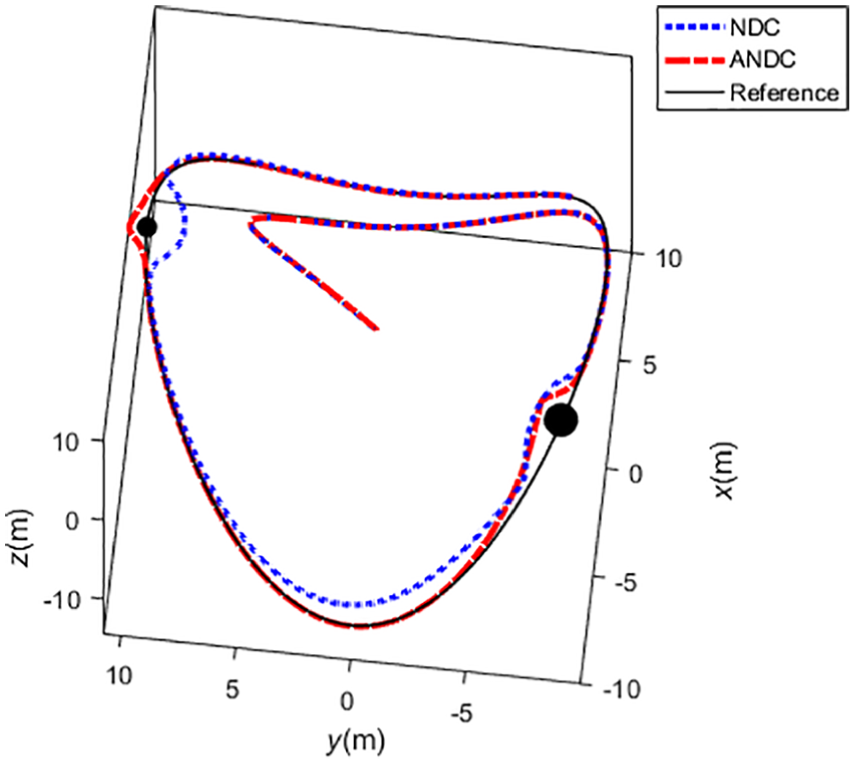
The AUV path in tracking control and obstacle avoidance.
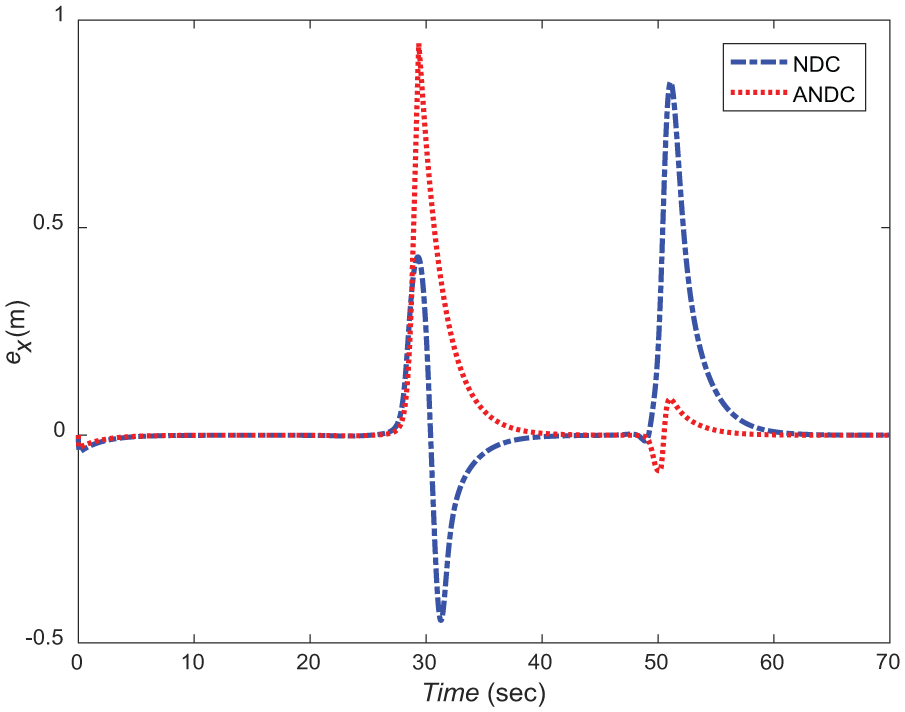
Error signals in the x-direction for the tracking control in the presence of obstacles.
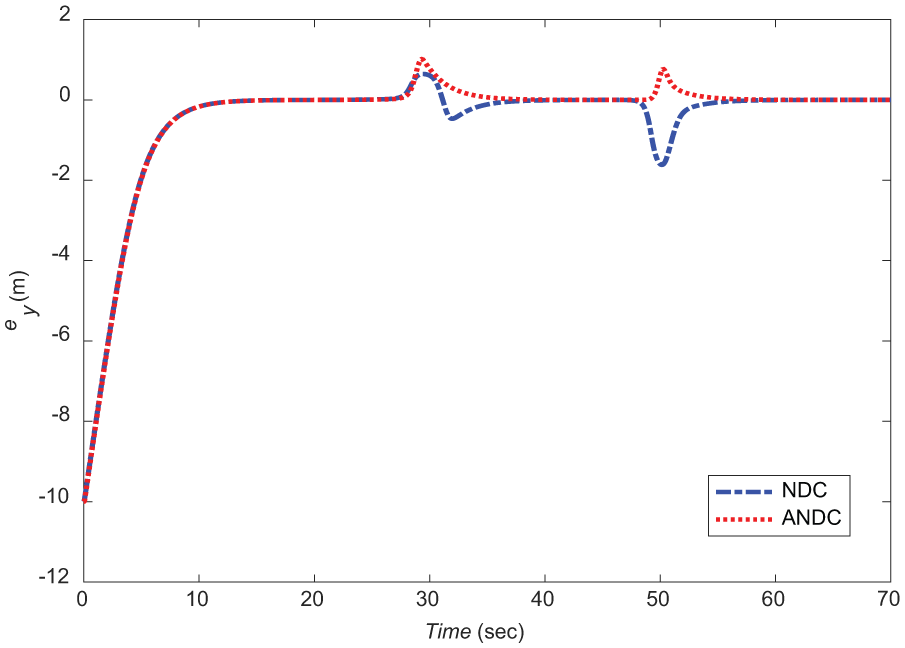
Error signals in the y-direction for the tracking control in the presence of obstacles.
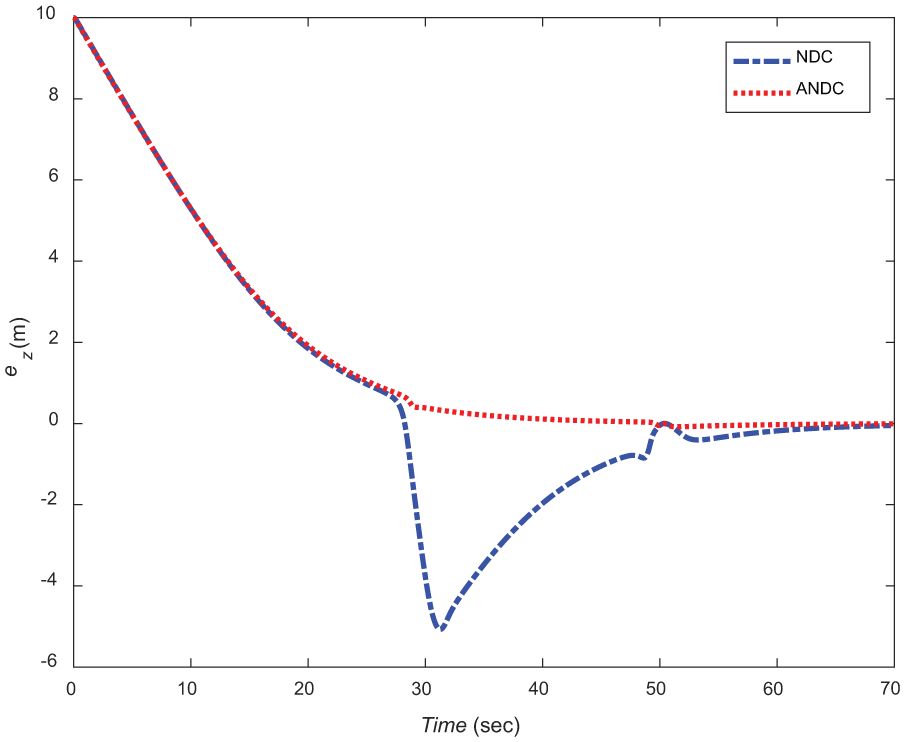
Error signals in the z-direction for the tracking control in the presence of obstacles.
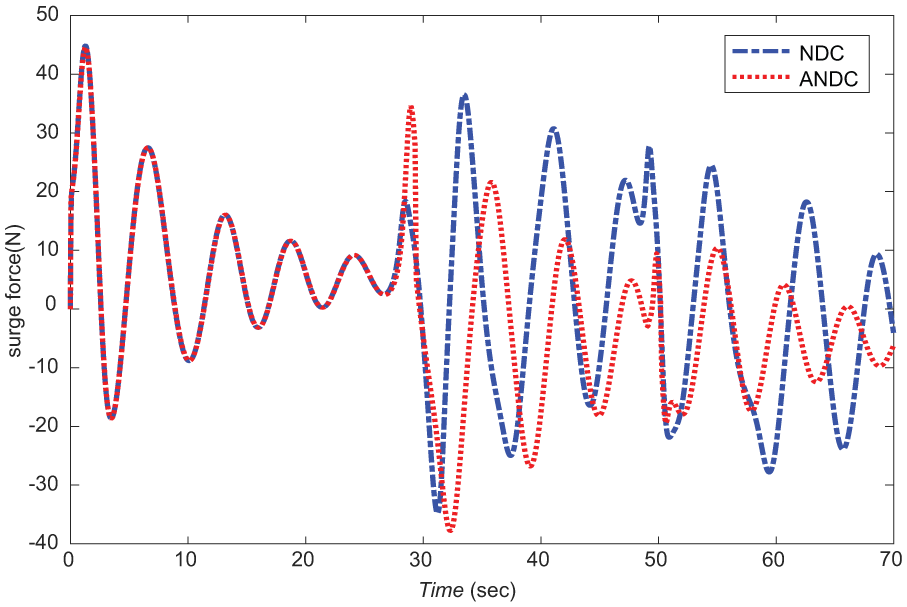
The surge forces of the AUV in the presence of obstacles.
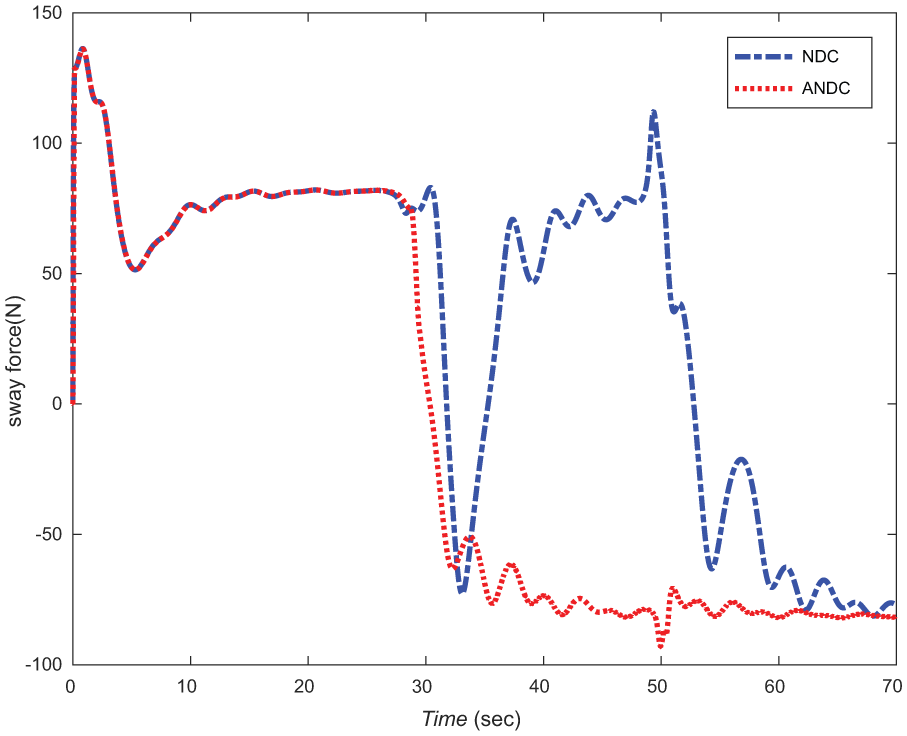
The sway forces of the AUV in the presence of obstacles.
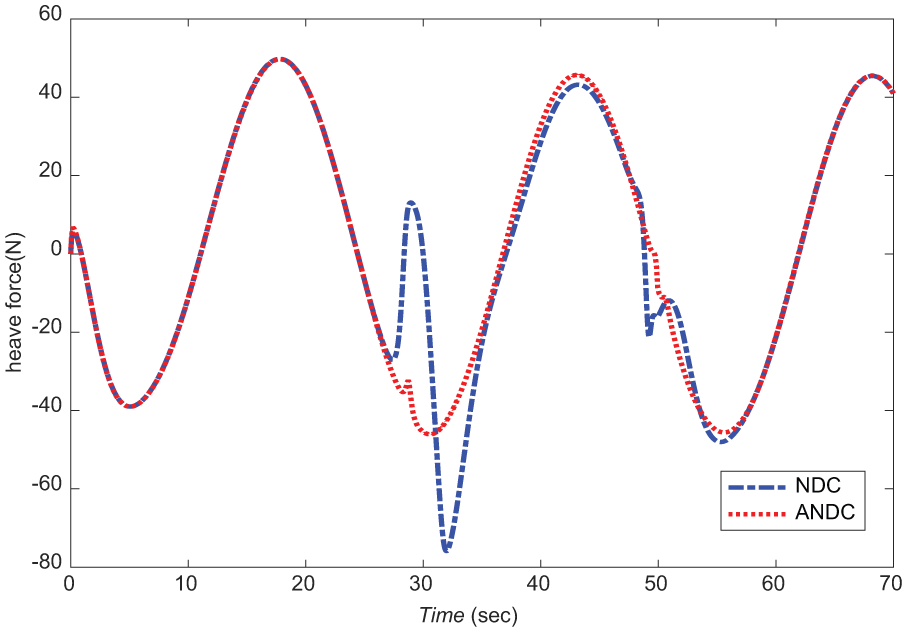
The heave forces of the AUV in the presence of obstacles.
By starting from a position far from the reference trajectory, the robot is located in an acceptable range in a short time and it tracks the selected reference trajectory. When facing obstacles, the robot creates a proper distance without hitting the obstacles and then tracks its own trajectory. The error diagrams show that the error signals diverge from zero in the obstacles zone. This is the result of adding virtual potential forces and avoiding collisions, and converging to zero again after passing the obstacles.
Comparing the presented results shows the better performance of the ANDC control algorithm in handling obstacles. When obstacles are passed, the robot returns to the reference trajectory at a higher speed compared with the NDC, and continues moving on the considered trajectory.
When the control forces, numerical values, magnitude of changes and signal oscillations are in an acceptable range, and robot actuators can easily produce them.
Conclusion
In this study, a new robust control employing adaptive laws is proposed for the AUV, such that it is able to track the planned trajectory in the presence of dynamic uncertainties and external disturbances. The proposed controller is designed to improve all desired control objectives, including transient response and settling time. Obtained results demonstrate the model’s successful performance. Comparison of the results of the ANDC and NDC algorithms shows the superiority of the ANDC in the presence of uncertainties and external disturbances. In addition, the performance of the proposed control algorithm in tracking trajectories with many obstacles is also evaluated. High tracking accuracy and avoiding obstacles show the favorable performance of the proposed controller.
Footnotes
Appendix 1
Declaration of conflicting interests
The author(s) declared no potential conflicts of interest with respect to the research, authorship, and/or publication of this article.
Funding
The author(s) received no financial support for the research, authorship, and/or publication of this article.
