






Abstract
This paper studies the problem of anti-disturbance control for a class of stochastic systems with multiple heterogeneous disturbances, which include the white noise and the non-harmonic disturbance with unknown nonlinear function. An adaptive disturbance observer is constructed to estimate the non-harmonic disturbances with unknown nonlinear function, which is approximated by neural network. A composite hierarchical anti-disturbance control (CHADC) scheme is designed by integrated Lyapunov function and linear matrix inequality (LMI), such that the expected dynamic performance of the composite system is achieved. Finally, simulations show that the approach is proper and effective.
Keywords
Introduction
Disturbance widely exists in practical engineering, which may effect the control accuracy and even destroy the stability of the system. Therefore, anti-disturbance control has been a hot topic in control field. A number of advanced control strategies have emerged, such as active disturbance rejection control (ADRC) (Wang et al., 2018), adaptive control (Hu et al., 2019; Li and Wang, 2018), disturbance observer-based control (DOBC) (Guo and Wen, 2011; Liu et al., 2019; Wei and Chen, 2014; Zhang et al., 2016), sliding control (Liu et al., 2017; Wu et al., 2017; Zhao et al., 2019), filter design (Xu and Lam, 2007),
On the other hand, the DOBC method was used for stochastic systems with multiple disturbances. The DOBC method was extended to stochastic systems with multiple disturbances, including disturbances generated by the linear exogenous system and white noise (Wei et al., 2016). In Sun et al. (2018), a composite DOBC and
Most of the aforementioned DOBC methods for stochastic systems only focus on the exogenous system with known parameter matrix. But, it is difficult to obtain all the exact parameter matrix in practical applications. Therefore, it is necessary to consider the exogenous system with unknown parameter matrix. Moreover, the modeling of nonlinear disturbance has been a difficult question in control areas. It is well known that neural network has been regarded as a powerful tool for highly approximate nonlinear dynamic systems. And it has been considered as a black box identifier, which can track nonlinear dynamics. Therefore, neural network method has been used for modeling of the nonlinear dynamics (Qiao et al., 2018; Wang et al., 2012; Yi et al., 2013). A novel incremental radial basis function (RBF) neural network was proposed for nonlinear systems modeling (Qiao et al., 2018). Recently, the combination of neural network with stochastic systems has received considerable attention (Chen et al., 2017; Gao et al., 2016; Wang et al., 2014). Adaptive neural control (ANC) was proposed for strict-feedback nonlinear stochastic systems (Chen et al., 2017). ANC was proposed for pure-feedback stochastic nonlinear systems (Wang et al., 2014). However, the existing current control methods for the stochastic system only focus on single disturbance or combine multiple disturbances into a new equivalent disturbance. Moreover, the sources and channels of actual disturbances are different, and the higher anti-disturbance control accuracy can be achieved by the comprehensive analyses about the influence mechanism for the multiple heterogeneous disturbances.
The purpose of this paper is to present a CHADC scheme for a class of stochastic system with multiple heterogeneous disturbances, which include the white noise and the non-harmonic disturbance with unknown nonlinear function. The main contributions of this paper are described as follows.
The current DOBC work for the stochastic system is extended to the CHADC work for a class of stochastic systems with multiple heterogeneous disturbances which include the white noise and the non-harmonic disturbance. The proposed CHADC scheme can make full use of the information of disturbances to achieve the higher anti-disturbance control accuracy.
The non-harmonic disturbance is modelled by an exogenous system with unknown nonlinear function, which is approximated by neural network. The range of the system disturbances is extended further. A new adaptive disturbance observer (ADO) is structured to estimate the non-harmonic disturbance by the approximation of the nonlinear function.
The rest of the paper is organised as follows. In Section 2, the problem formulation is introduced. An ADO and a CHADC are designed in Section 3. In Section 4, simulation examples are performed show that method is valid. In Section 5, a short summary of the proposed scheme is given.
Formulation of the problem
The stochastic system with multiple heterogeneous disturbances is modeled as
where
where
According to Øksendal (2003), the substitution of
where
is called a filtration, if
where
where
As a special case of Mao and Yuan (2006), the criterion of the stability for a class of stochastic systems is given. Consider a nonlinear stochastic differential equation (SDE)
where
for all
for all
Then, the equilibrium
Main results
The system states
ADO
The ADO is structured to
where the estimation of
Denoting
According to Assumption 1, since
In the following, the CHADC is designed as
where K is the controller gain to be designed. Substituting (13) into (3), the closed-loop system is expressed as
Combining (14) with (12), yields
and the composite system can be described by
where
CHADC
The aims of this section is to design CHADC scheme such that the expected dynamic performance of the composite system is achieved, which is asymptotically bounded in mean square. Based on Lemma 1, the following result can be obtained.
where
and if the adaptive law satisfies
where
Selecting
Differentiating (23) along with (14), yields
Letting
then
where
Based on (12) and Assumptions 2–3, the differential of (24) is presented as
Selecting
it can be obtained that
where
Based on (23) and (24),
where
where
and
As a result,
where
Based on Lemma 1, then
Thus, the composite system (16) satisfies asymptotically bounded in mean square. The proof is completed.
In Theorem 1, a CHADC is proposed for a class of stochastic systems with multiple heterogenous disturbances which include both multiplicative disturbance and additive disturbance. If there only exists multiplicative disturbance in the stochastic systems, the following result will be obtained.
where
Then the composite system (16) is globally asymptotically stable in probability under the CHADC law (13) with gain
Simulation examples
Numerical simulation
In this section, to verify the result of the proposed method, a numerical example is given. To show the efficiency of the proposed method, a stochastic system in (1) is considered
The stochastic disturbance
In addition, the basis function of neural network
For the case with
Suppose that
Comparing Figures 1a and 1b shows that the system state response curves from divergence to be asymptotically bounded, showing that the effectiveness of the controller is satisfactory. Figure 1c shows the disturbance estimation error, which illustrates estimation error of ADO is satisfying by using the proposed CHADC. Figure 1d illustrates the response of weight vector of neural network. The effectiveness of the proposed CHADC scheme can be seen in Figures 1a–1c the states of composite system (16) are asymptotically bounded in mean square.
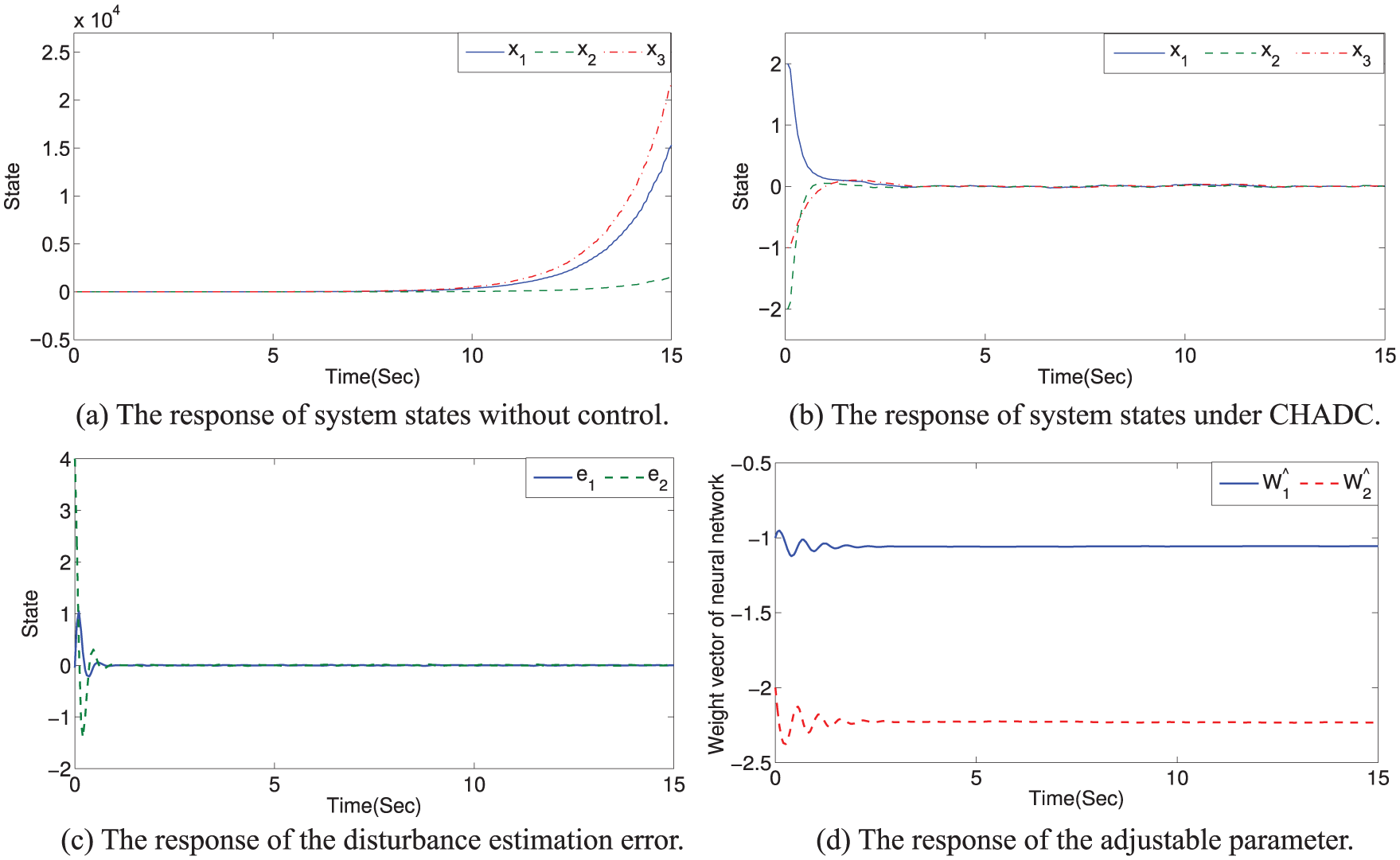
For the case with B1≠0, the response of the composite system under CHADC.
The anti-disturbance control accuracy of the CHADC scheme is shown in Figure 2. The simulation result illustrates that the proposed CHADC scheme can achieve higher anti-disturbance control accuracy compared with

The comparison of anti-disturbance control accuracy for
For the case with
Suppose that
Comparing Figure 3a and 3b shows that the system state response curves from divergence to be asymptotically bounded, showing that the effectiveness of the controller is satisfactory. Figure 3c is the curve of disturbance estimation error. The effectiveness of the proposed CHADC scheme can be demonstrated in Figure 3a-3c the states of composite system (16) are globally asymptotically stable in probability.

For the case with B1 = 0, the response of the composite system under CHADC.
In Figure 4, the more satisfactory system robustness performance and higher anti-disturbance control accuracy can be achieved by comparing with CHADC scheme with

The comparison of anti-disturbance control accuracy for
Application example and simulation
According to Dong et al. (2013, 2019a, 2019b), the coefficient matrix of the state space mathematical model of the system (1) is described as follows
The non-harmonic disturbance
The initial value of the state is given to be
Suppose that
The feasibility of the proposed CHADC scheme can be seen in Figures 5 to 6. Comparing Figures 5a and 5b shows that system state response curves from divergence to be asymptotically bounded, showing that the effectiveness of the controller is satisfactory. Figure 5c gives the response of disturbance estimation error, and Figure 5d illustrates the response of weight vector of neural network. The simulation results shows that although multiple heterogeneous disturbances exist in the FSCWT system, the more satisfactory system robustness performance and higher anti-disturbance control accuracy can be achieved by comparing the

The response of the FSCWT system under CHADC.
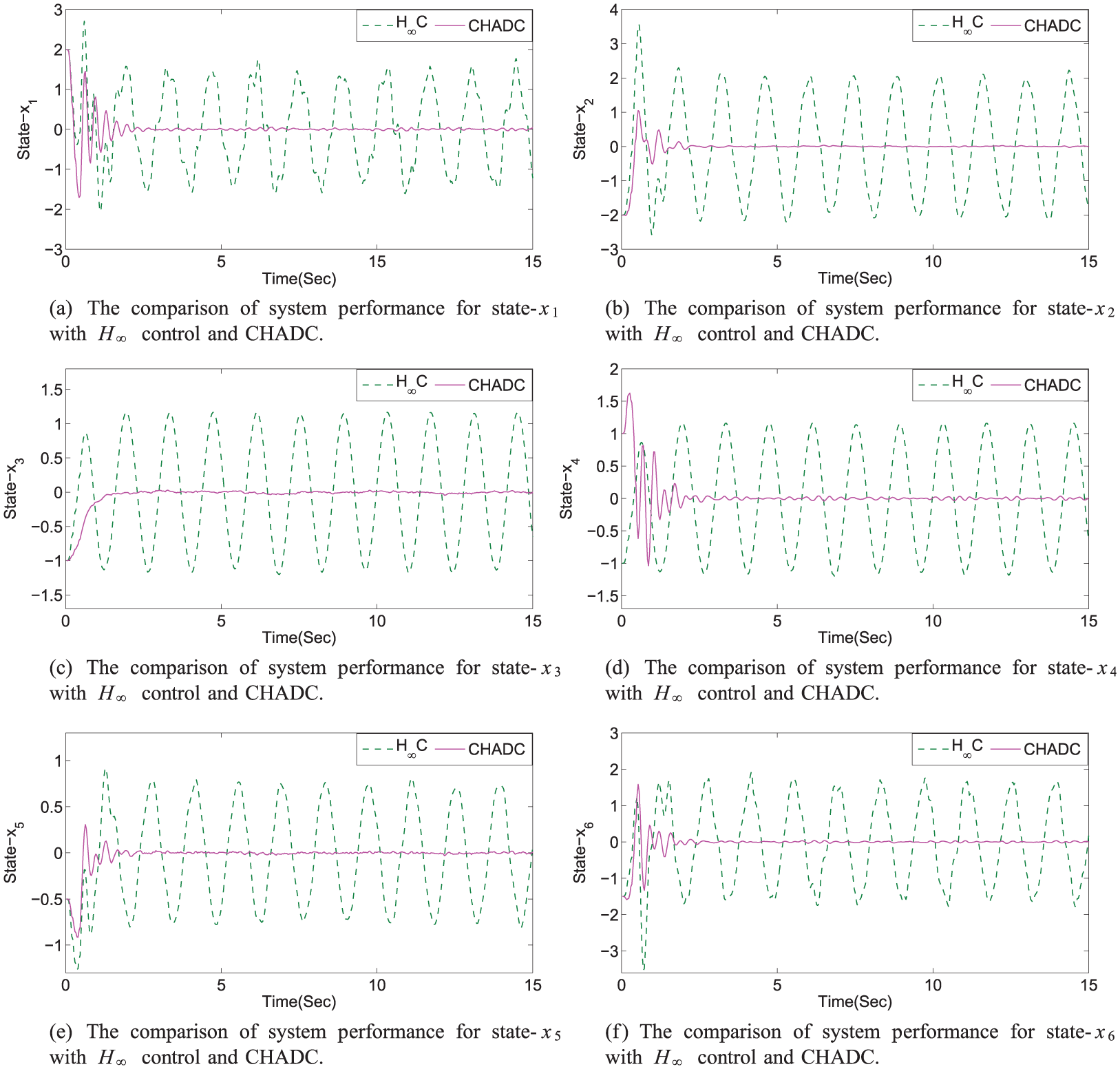
The comparison of anti-disturbance control accuracy for
Conclusion
In this paper, a class of stochastic systems with multiple heterogeneous disturbances has been investigated. For the non-harmonic disturbance with unknown nonlinear function, which is approximated by neural network, an ADO is constructed. Based on the approximation of the nonlinear function, the CHADC scheme is proposed such that composite system is asymptotically bounded in mean square. The works for further research will consider the disturbance with unknown frequency, unknown amplitude and unknown phase for stochastic systems.
Footnotes
Declaration of conflicting interests
The author(s) declared no potential conflict of interests with respect to the research, authorship and/or publication of this article.
Funding
The author(s) disclosed receipt of the following financial support for the research, authorship, and/or publication of this article: The work is supported by National Science Foundation of China 61374108.
