






Abstract
This paper describes a new approach to adaptive control of uncertain nonlinear systems. A fuzzy logic controller is used to combine both direct and indirect methods. Based on the fuzzy neural networks, the plant unknown nonlinear functions are estimated, and then combined to form the indirect control law. In parallel, another fuzzy neural network approximates the direct adaptive control. According to the modelling error and its derivatives, the fuzzy logic controller modulates between direct and indirect adaptive controllers. The global stability of the overall system is shown by constructing a Lyapunov function. The simulation results show that within this scheme, the control objectives can be achieved with a fast convergence and optimal control for different dynamic regimes.
Keywords
Introduction
Adaptive controls can be successfully applied when dynamic nonlinear systems are not exactly modelled or when their parameters are variable. According to the works recorded in Bibi et al. (2018), the use of conventional adaptive control is limited to cases where the unknown dynamics of the system have a linear structure with parameters unknown. However, for strongly nonlinear system, it can lose its stability under high disturbances using linear controllers. To overcome these problems, intelligent nonlinear adaptive controls can be used as a powerful alternative.
Adaptive neural-fuzzy robust control, fuzzy approximation-based adaptive control of nonlinear uncertain state constrained systems with time-varying delays, stochastic adaptive control and fuzzy-based multi-error constraint control for switched nonlinear systems have attracted the attention of many researchers in recent years.
In Sun et al. (2019), a new adaptive neural-fuzzy robust position control scheme for the magnetic suspension system of a low-speed maglev train is developed with stability proof. The result of experimental implementation demonstrated that the impact of the disturbance and parameter perturbations is reduced based on the developed control law. Wei et al. (2019) presented an adaptive fuzzy tracking control for flexible-joint robots with full state constraints. It is also proven that it can be found that the use of tan-type BLF to deal with state constraints can have better performance compared with the log-type BLF (Wei et al., 2019).
In literature, two different approaches have been used for developing the intelligent adaptive control law for uncertain nonlinear systems. The first is a direct adaptive approach in which a set of parameters in the control law is directly modified to form a stable closed-loop system (Bibi et al., 2018). In an indirect approach, unknown nonlinear functions of the dynamic model are first estimated, and then combined to form the overall control law (Bibi et al., 2017). Both methods are well established and can be used to design an efficient robust adaptive controller for the same nonlinear system.
However, the singularity problem (the division-by-zero) can be encountered in the case of indirect adaptive controllers for first order nonlinear systems. In Zhang et al. (2016), some techniques have been reported to overcome this problem and improve the stability of the indirect adaptive schemes. The direct adaptive approach does not pose the singularity problem but requires the boundedness of the gain control derivative by a continuous function to ensure the global stability (Labiod and Boucherit, 2013).
Shun-Feng et al. (2006) proved that inappropriate selection of design parameters for direct adaptive estimator can make the system unstable. It is also reported that the presence of noise leads the direct adaptive control to be unbounded (Shun-Feng et al., 2006). Other technical issues (the stability, the parameter convergence, the performance improvement and the robustness) of either direct or indirect adaptive control brought to light new drawbacks and proposed partial solutions (Bibi et al., 2018; Hojati and Gazor, 2002; Shun-Feng et al., 2006).
One of the major questions that arises is: which approach can achieve control objectives with minimum cost and high performance? It has been proven that the integration of both direct and indirect adaptive control laws can improve performance (Li and Tong, 2016; Sun and Hou, 2017; Wang and Tong, 2018). For this purpose, some research has been reported which makes use of a combined direct and indirect adaptive control to compute the global control law (Li and Tong, 2016; Wang and Tong, 2018). Other schemes are based on hybrid parameter adaptation laws which use both the tracking and the modelling errors to update adaptive parameters (Hojati and Gazor, 2002; Sun and Hou, 2017). In this paper, we develop a hybrid fuzzy direct/indirect adaptive controller (HFDIAC) for uncertain nonlinear systems. A fuzzy logic controller (FLC) is designed to modulate between direct and indirect adaptive controllers based on the modelling error and its derivatives. It means that if the modelling error becomes large, therefore the overall control will be dominated by the direct adaptive control and vice versa. Based on the Lyaponov approach, the stability of the closed loop is performed, where the adaptive algorithms parameters are derived. Within this scheme, the control objectives can be achieved with a fast convergence and optimal control for different dynamic regimes.
This paper is organized as follows. First, the development of ideal control law for a class of uncertain nonlinear systems is described. Next, the direct adaptive control using universal approximators is presented, then the indirect adaptive control is detailed. The following section presents the fuzzy universal approximator used to estimate the direct and the indirect adaptive control. Next, the hybrid fuzzy direct/indirect adaptive controller (HFDIAC) for uncertain nonlinear systems is developed. The penultimate section presents numerical results of the simulated models which validate the proposed scheme of control. The paper ends with concluding remarks and comments.
Problem formulation
Most dynamic systems are essentially represented by a nonlinear state model, allowing their real dynamic behaviour to be described as accurately as possible. Examples of such systems are mechanical and electromechanical systems (unmanned aerial vehicle, unmanned ground vehicle, magnetic suspension system of low-speed maglev train, robot manipulator, etc.). Consider the standard nonlinear dynamic system:


The tracking error is defined as

Where
The filtered tracking error

where
Let

The design and the stability analysis for the uncertain nonlinear system (1) has matured to a stage where theoretically results have become well established. Among these, there are the adaptive model-based nonlinear system controllers (indirect adaptive controllers), which achieve global error convergence even in the presence of uncertainties in the nonlinear system dynamics (Bibi et al., 2017). The design process of this type of controller requires the estimated model of the nonlinear system (1), which is given by

where
The modelling error is defined as

We can also estimate directly the control input
Before the development of the direct and the indirect control law, it is required to make the following assumptions.
Direct adaptive control using universal approximators
The ideal control law which stabilizes the global closed-loop system and ensures an optimal performance can be obtained as follows:

The ideal control law given by the equation (8) cannot be implemented, because the nonlinear functions

where

The adaptive law of the adjusted parameter

Figure 1 shows the overall direct adaptive control scheme. Now, let us give the analytic stability proof of the direct adaptive control scheme, based on the direct Lyaponov approach.
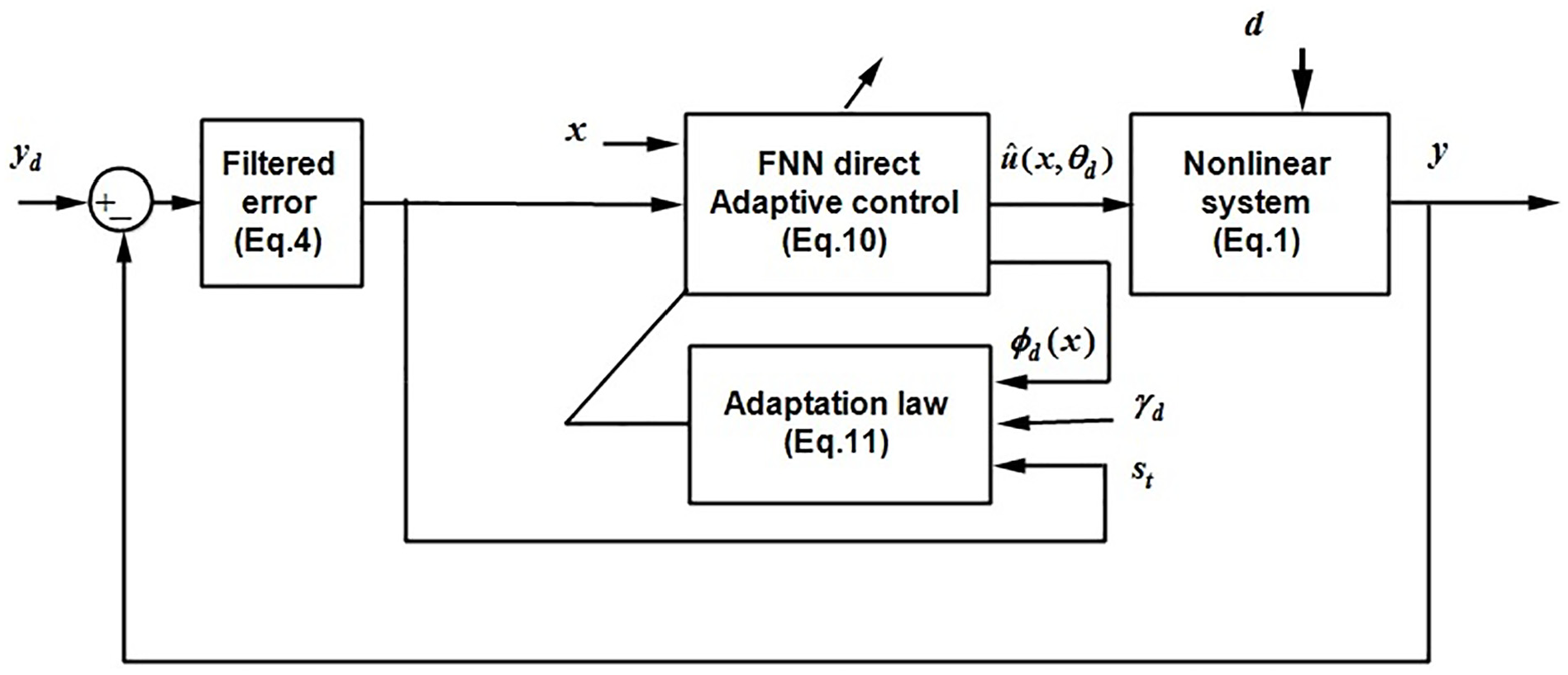
Direct adaptive control scheme.
The boundedness of all signals is ensured in the closed loop.
The filtered tracking error

The derivative of the candidate Lyapunov function

Let us determine the time derivative of the filtered tracking error

Applying (8) and (10), the derivative of the filtered tracking error

Replacing (11) and (15) in (13), the derivative of the candidate Lyapunov function

Where the approximation errors are bounded
Indirect adaptive control using universal approximators
For the same nonlinear system defined by the equation (1), there are other ways to design adaptive controllers, which can also achieve the desired performance. In this section we present the principal steps for developing an indirect adaptive control.
The estimated indirect control law is presented as

The unknown nonlinear functions


where
Using a fuzzy universal approximator, the estimation of unknown nonlinear functions


The adaptive laws of the adjusted parameter


The indirect adaptive control scheme is illustrated in Figure 2. Now, let us prove the stability of the closed-loop system using the indirect adaptive control defined by (17).
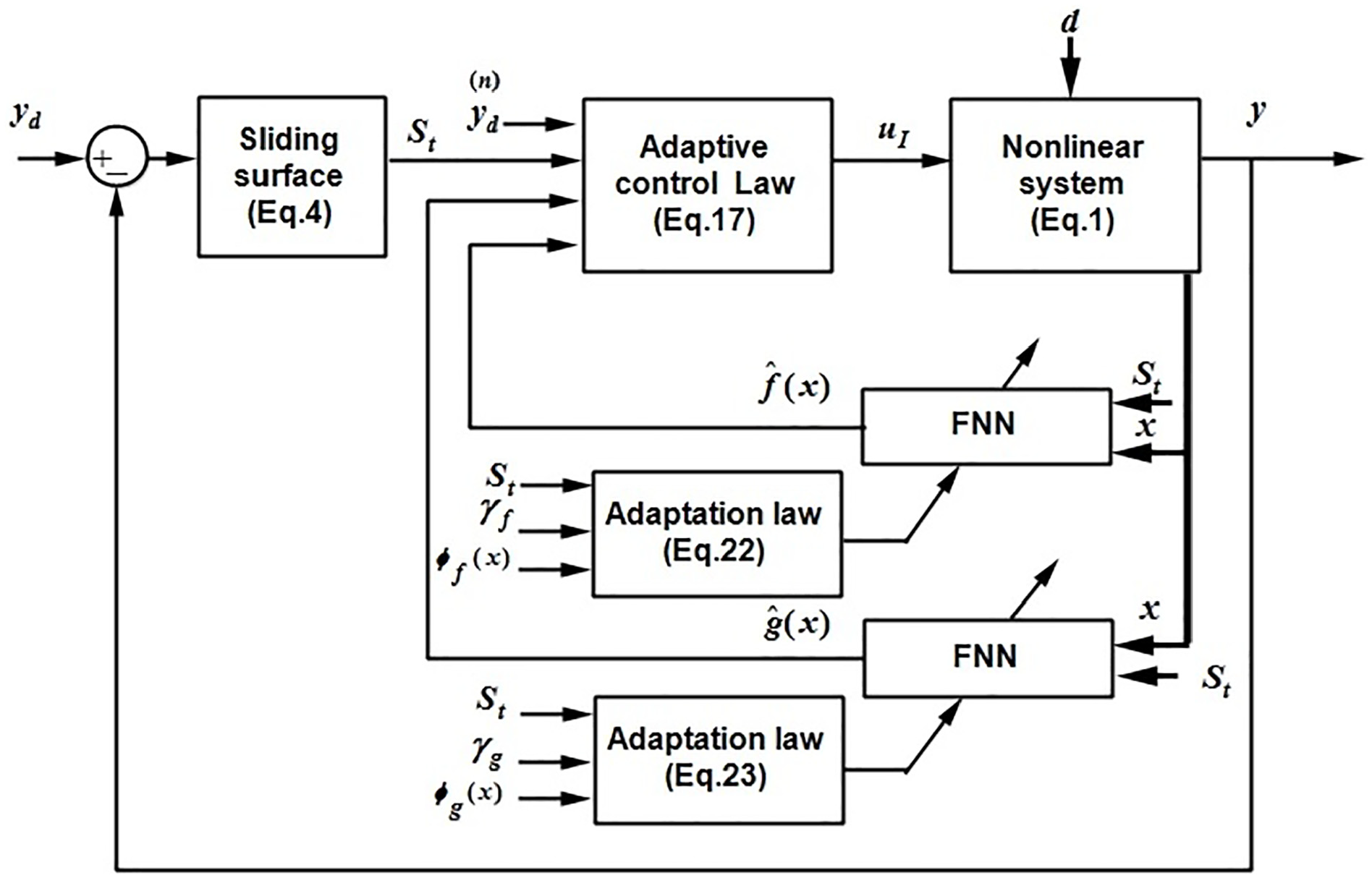
Indirect adaptive control scheme.
The boundedness of all signals is ensured in the closed loop.
The filtered tracking error

The derivative of the candidate Lyapunov function

Based on the indirect adaptive control given by (17), the time derivative of the filtered tracking error

Introducing (17) in (26), the derivative of the filtered tracking error

Let us determine the approximation errors


where

Replacing (30) in (25), the derivative of the candidate Lyapunov function

In the last subsections, it was shown that we can design both direct and indirect adaptive controllers for the nonlinear system (1). The stability is also proved for direct and indirect adaptive schemes. But we cannot specify which strategy of control ensures the fast convergence and the best performance.
Fuzzy universal approximator
The fuzzy neural networks (FNN) approximator is selected in the design of the fuzzy hybrid direct/indirect adaptive control. In this hybrid scheme, a FNN approximator is used to approximate the direct adaptive control
The rule base of FNN consists of
where

where

The output of type 1 fuzzy system given by (32) can be rewritten in the following compact form:

where

The fuzzy system is assumed to be well-defined so that
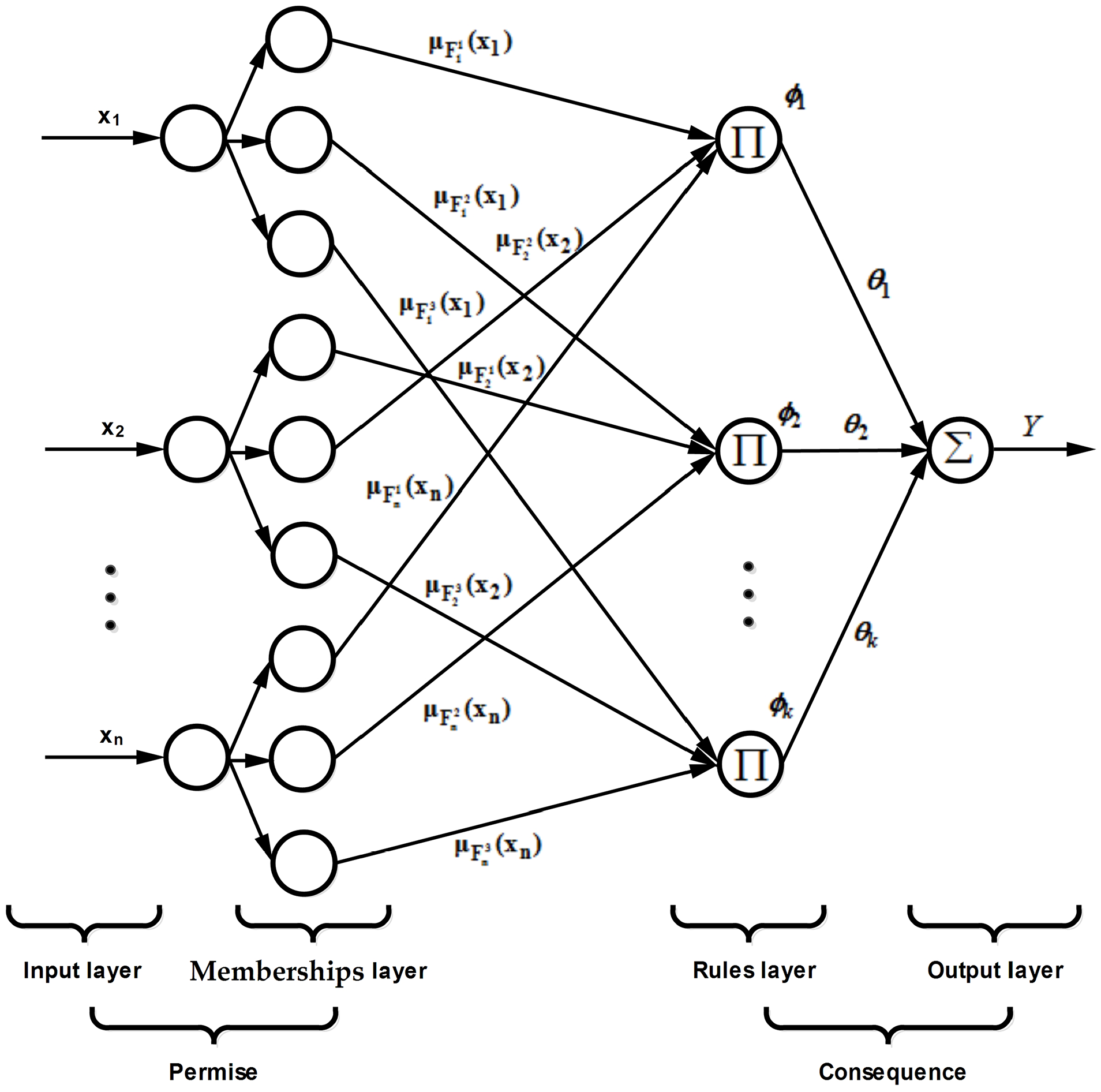
Fuzzy universal approximator architecture.
Hybrid fuzzy direct/indirect adaptive controller (HFDIAC) for uncertain nonlinear systems
Using a FNN approximator, the direct and indirect adaptive control are computed simultaneously as

where

The adaptive laws of the adjusted parameters

The robust control component is chosen as

A block diagram of a closed-loop system with a fuzzy logic controller (FLC) is shown in Figure 4. The FLC controller uses the modelling error
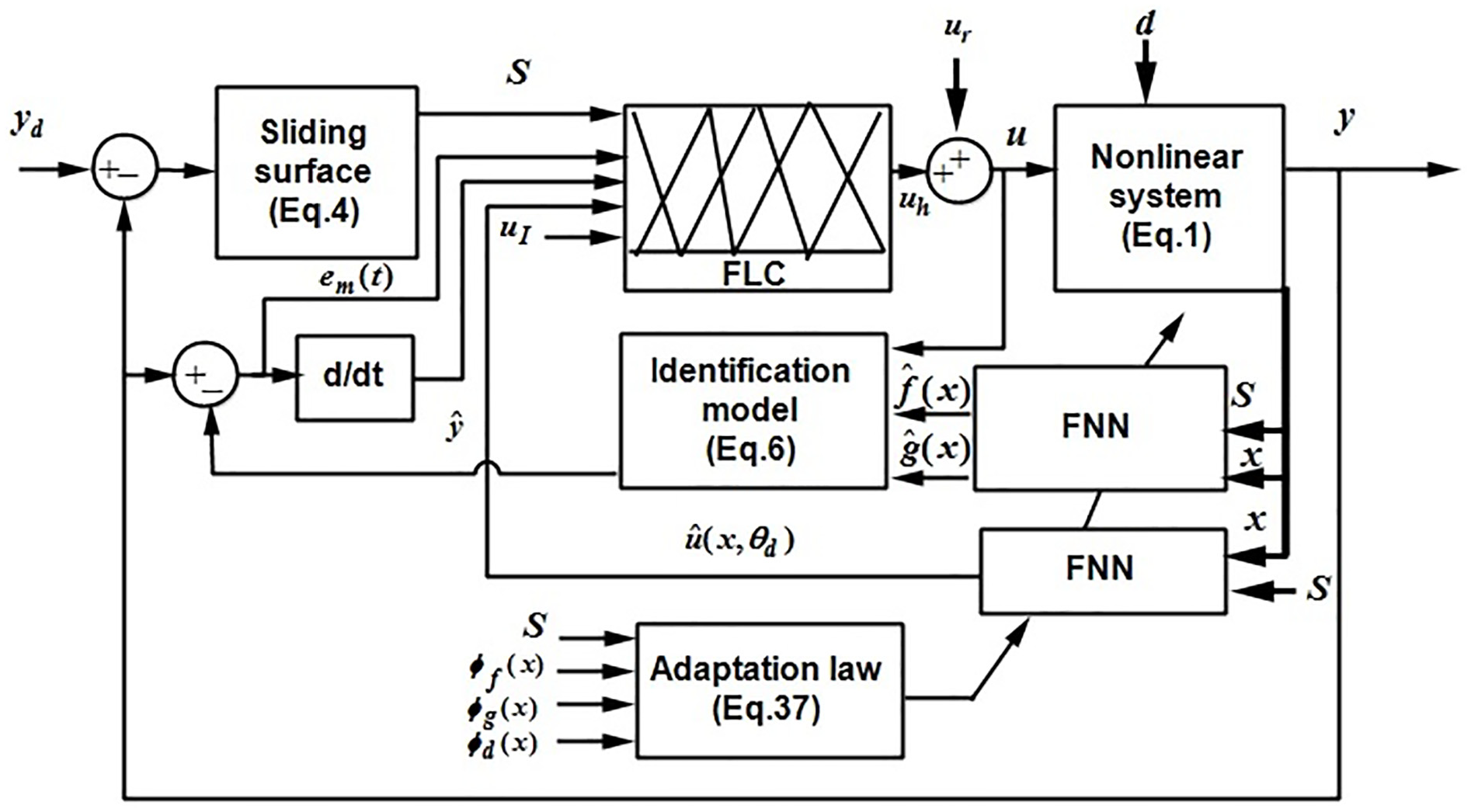
Schematic diagram of hybrid fuzzy direct/indirect adaptive controller.
The interaction of the inputs and outputs into IF–THEN rules can be presented as the following rules matrix:

We can use the product inference rule and the centre-average defuzzifier (equation (32)) to get the hybrid control law as

The overall global control law is given by

where

The candidate Lyapunov function

Replacing adaptive laws (37) and the

Where the approximation errors are bounded
Numerical results
In order to assess the proposed structure, various simulation studies are carried out for single-input single-output (SISO) and multi-input multi-output (MIMO) nonlinear systems; a direct performance comparison is performed based on the plant models taken from literature.
Example 1
Consider the inverted pendulum system:


where
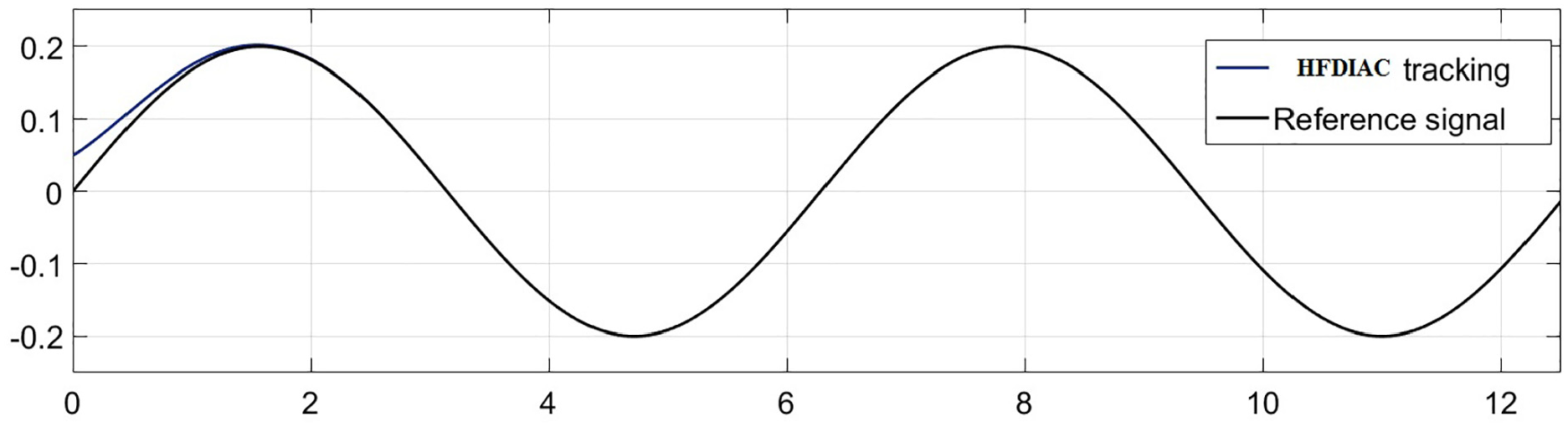
HFDIAC tracking performances.
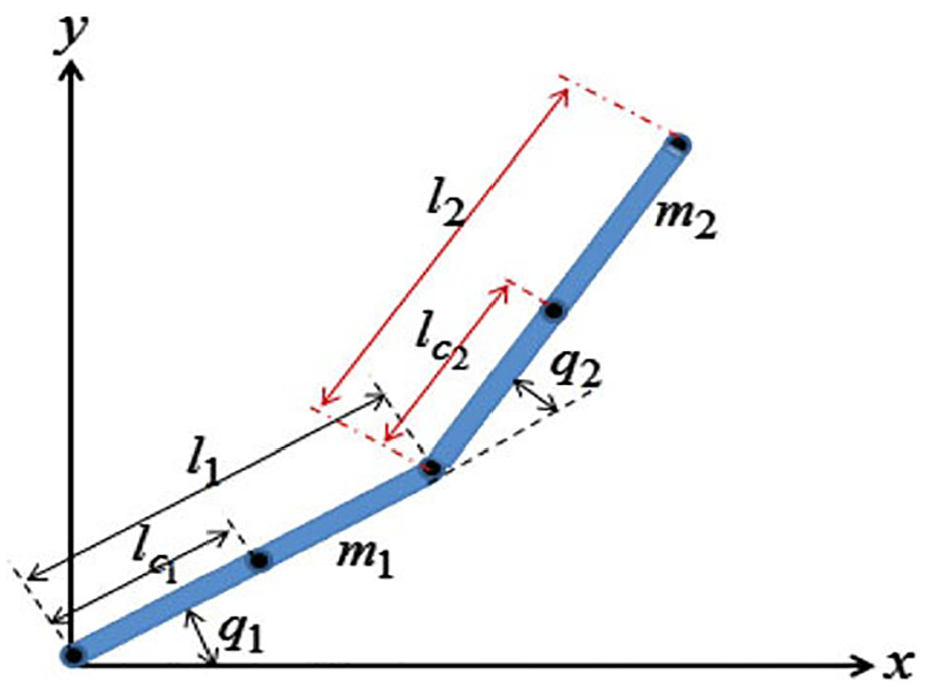
Two-link rigid robot manipulator.
Example 2
Now, a case of controlling a two-link rigid robot manipulator is given to illustrate the effectiveness of the proposed control scheme for MIMO nonlinear systems.
The dynamic equations of the two-link rigid robot manipulator system are

where

with

In the simulation, the following parameter values are used
The system (44) can be written as

where

The matrix

where
Comparative simulation is conducted to examine the performance of the developed controller and compared with other control schemes proposed in the literature (Bibi et al., 2017, 2018). For this purpose, the mean absolute error, the mean of squares error and the control effort given by the equations (49), (50) and (51) respectively are fixed as performance criteria, in order to evaluate the efficiency of each controller (direct adaptive control, indirect adaptive control and the proposed controller). The numerical values are summarized in Table 1.
Comparison of the obtained performances.

The results of the simulation are shown in Figures 7–12. The position tracking errors are illustrated in Figures 13–15.


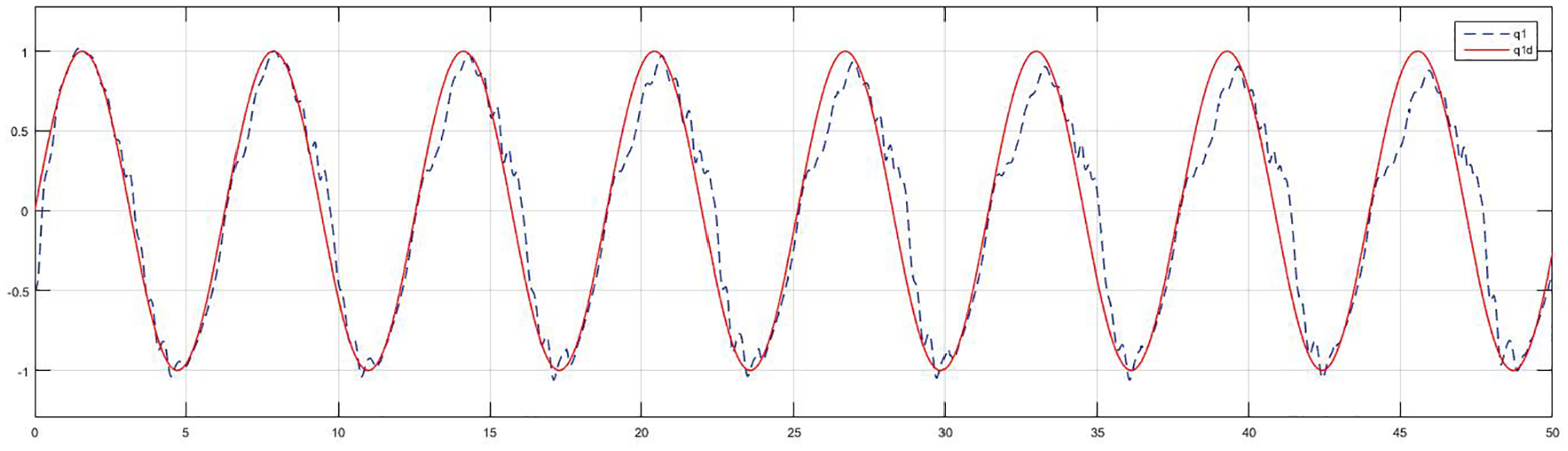
Direct adaptive tracking performances for link 1.
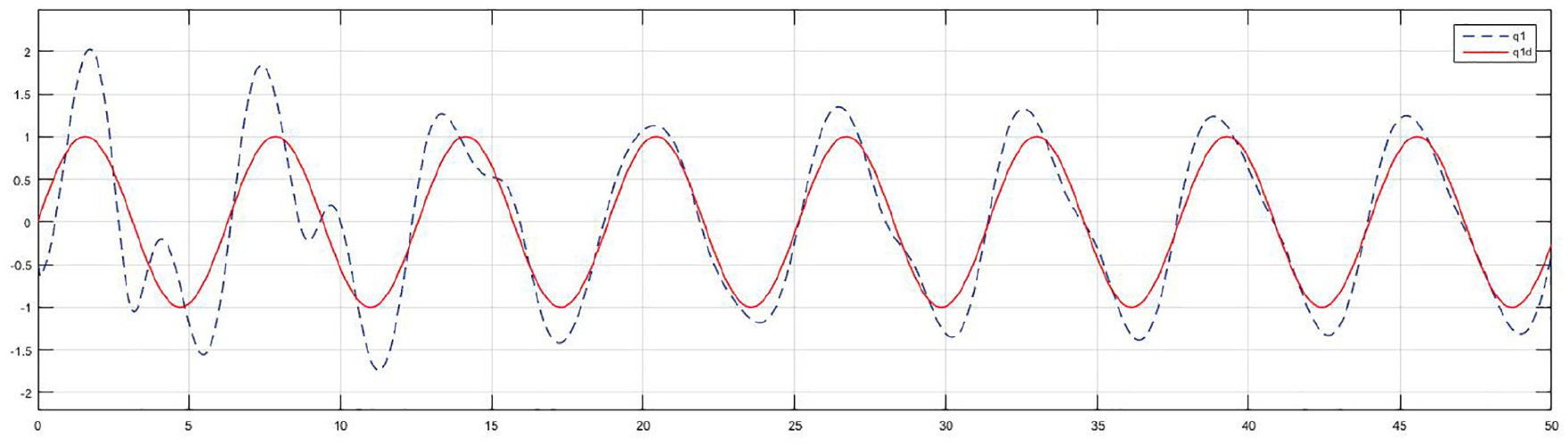
Indirect adaptive tracking performances for link 1.
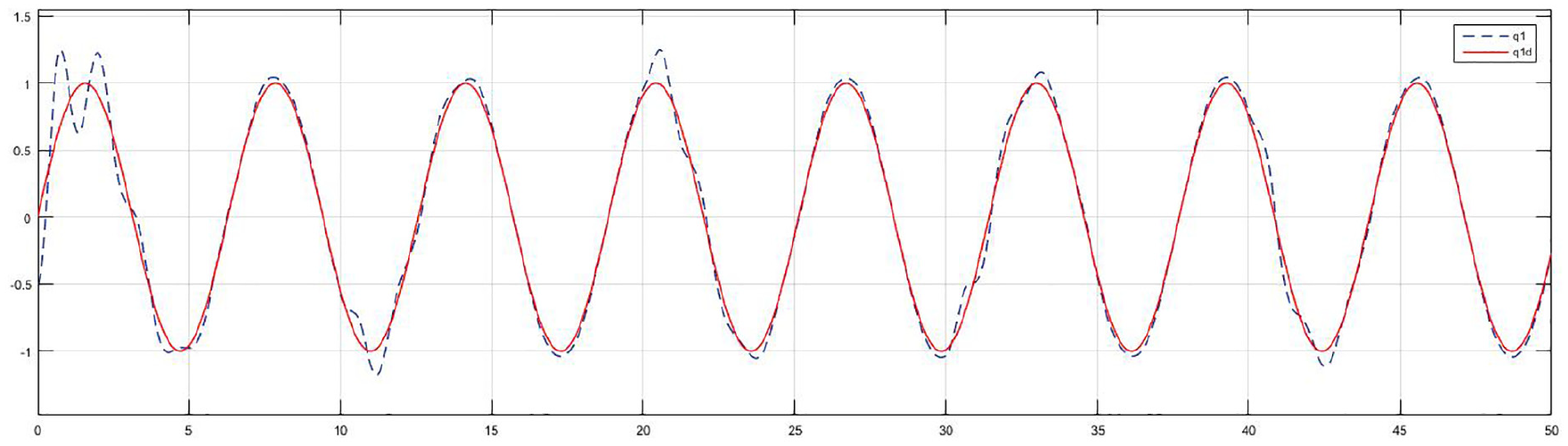
Hybrid adaptive tracking performances for link 1.
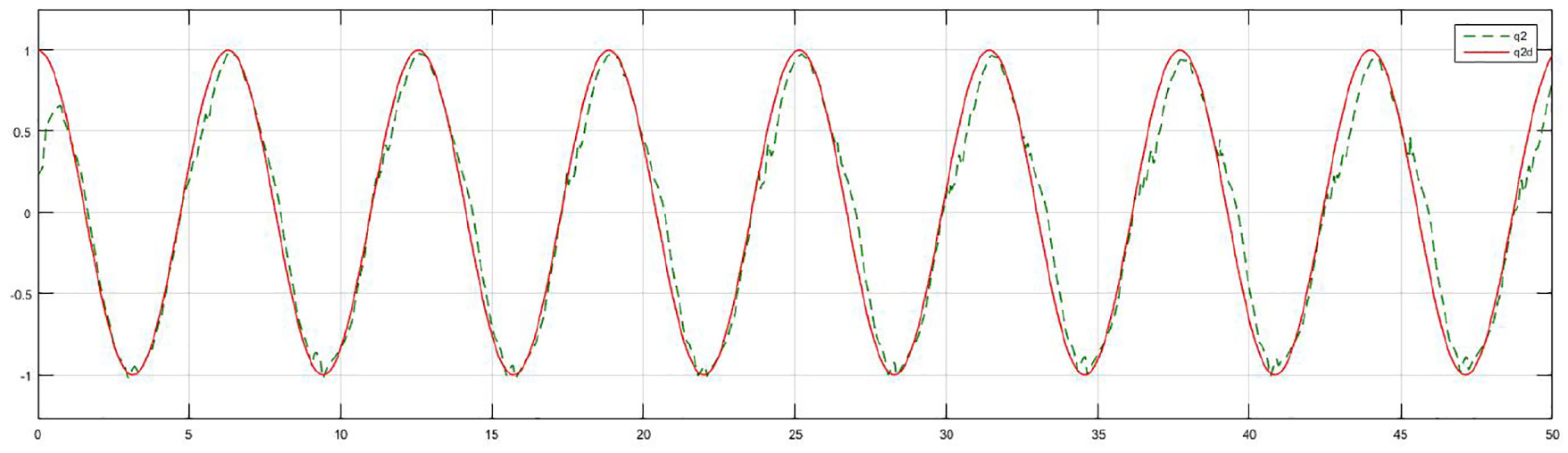
Direct adaptive tracking performances for link 2.
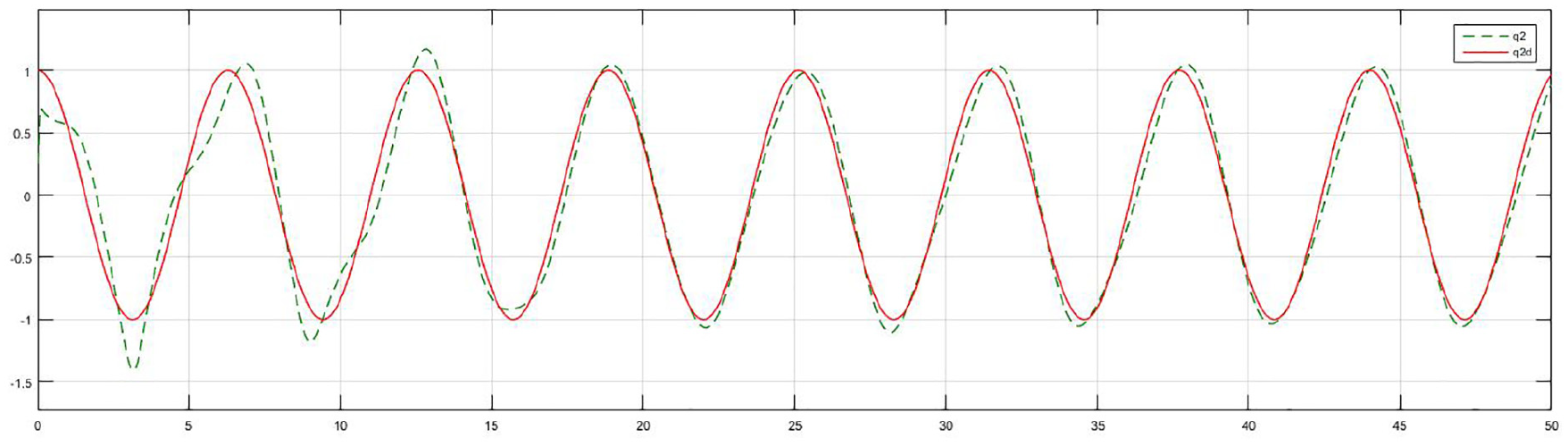
Indirect adaptive tracking performances for link 2.
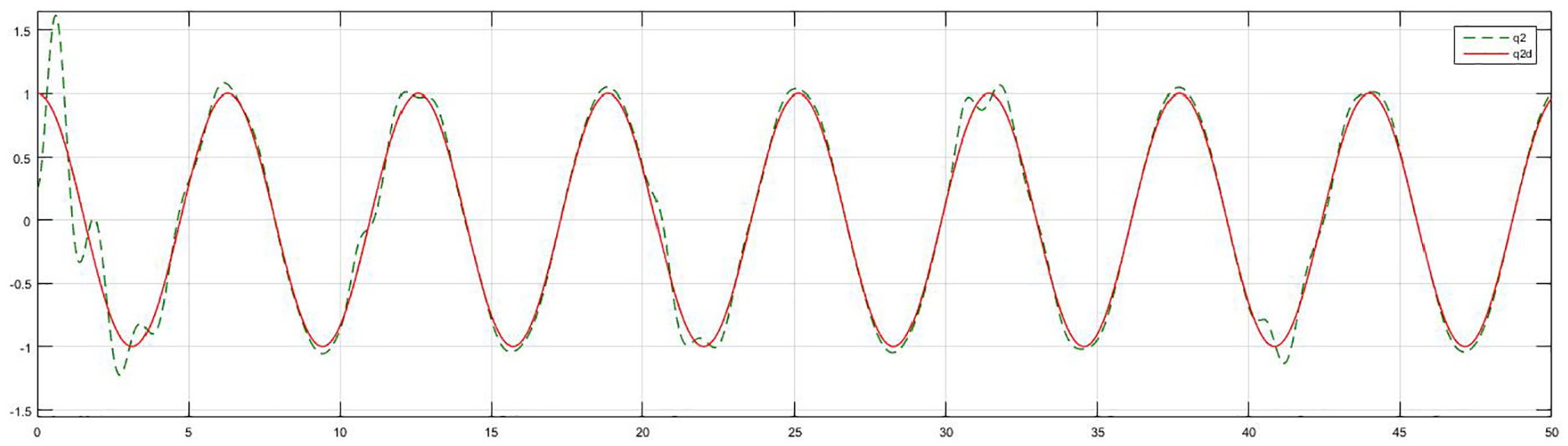
Hybrid adaptive tracking performances for link 2.
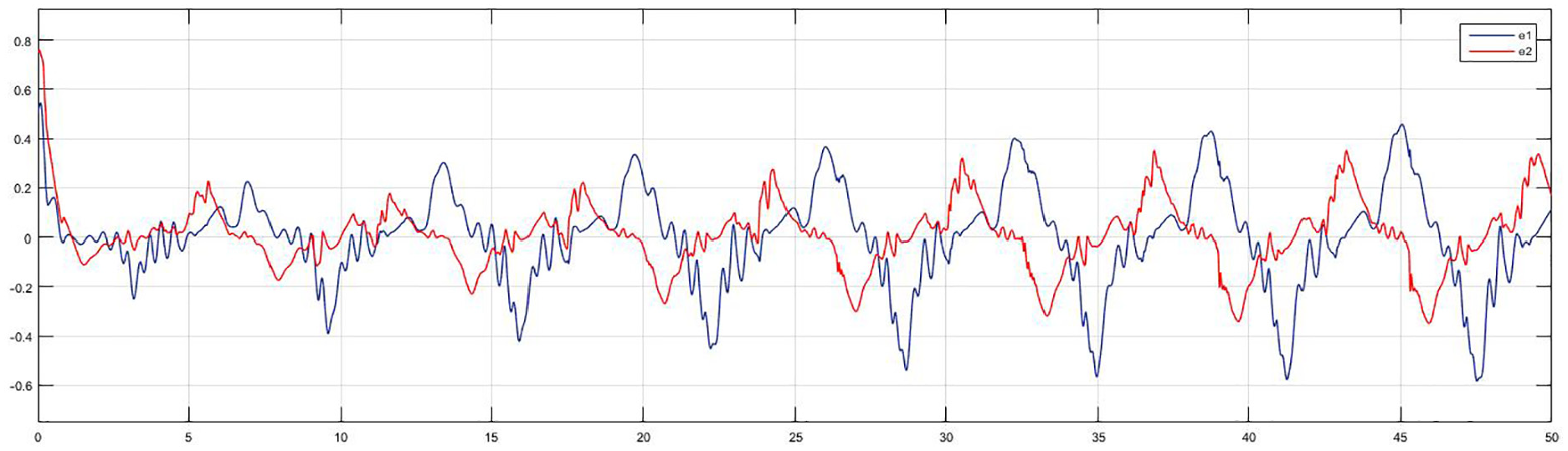
Position tracking errors using direct adaptive controller.
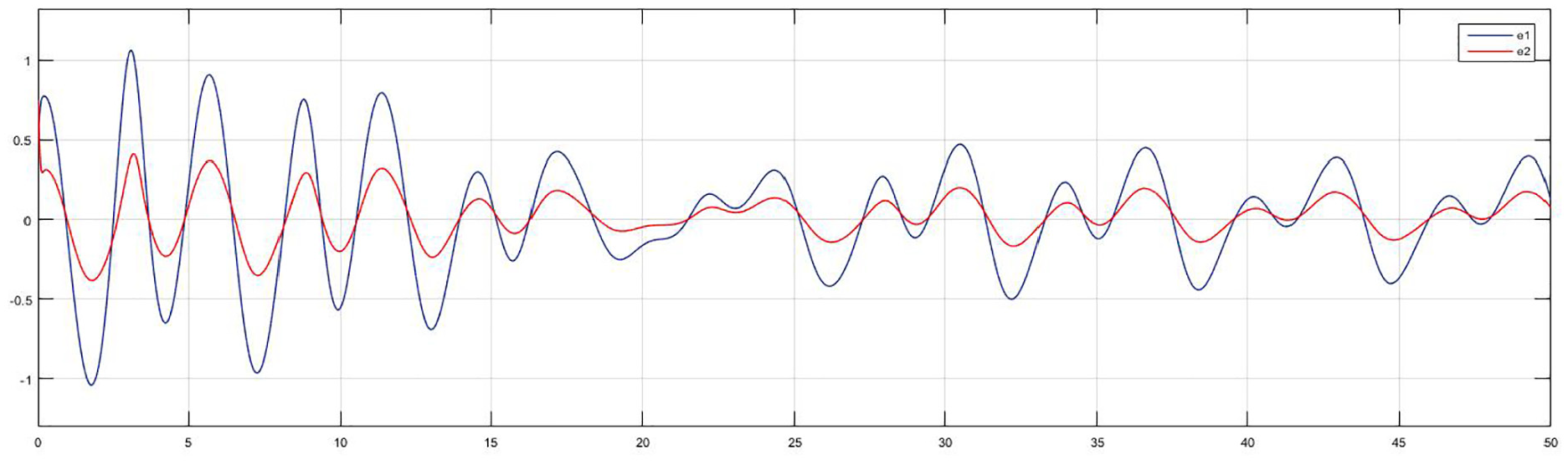
Position tracking errors using indirect adaptive controller.
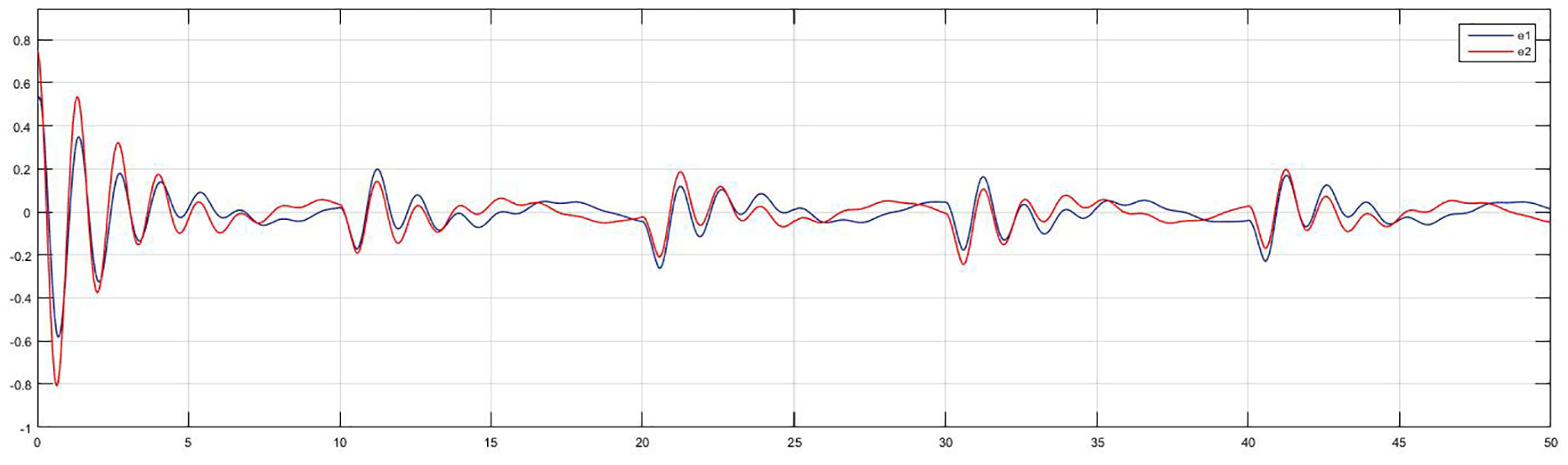
Position tracking errors using hybrid adaptive controller.
From the simulation figures and the statistical Table 1, we can see that the three controllers could ensure the tracking of the reference trajectory and also achieve the global stability. However, we notice also that there is a disparity in the control effort and the degree of accuracy for each controller. Figures 9 and 15 show that the hybrid fuzzy direct/indirect adaptive controller (HFDIAC) provides good results compared with the direct and indirect adaptive controller.
In summary, we studied various approaches to the simulation of both direct and indirect adaptive control for uncertain nonlinear systems reported in the literature using fuzzy neural networks as a universal approximator.
When comparing results, it was found that the results obtained using the developed hybrid fuzzy direct/indirect adaptive control (HFDIAC) responded very well compared with those obtained using the approaches reported in the literature. We also found that there are a number of ways to design either a direct or indirect adaptive controller for the same uncertain nonlinear system. In general, it is typically advantageous to use the HFDIAC based on a mechanism of adaptation, which uses both the tracking and the modelling errors; to account for more uncertainty may often result in a more robust closed-loop system.
Finally, when comparing the overall performance of all three controllers in the presence of external disturbances, the HFDIAC performs best under these conditions, followed by the direct controller and finally the indirect controller
Conclusion
In this paper, a new hybrid fuzzy direct/indirect adaptive controller (HFDIAC) for uncertain nonlinear systems is proposed. Based on the modelling error and its derivatives, the HFDIAC modulates between direct and indirect adaptive controllers in order to ensure fast convergence, optimal control for each time and closed-loop stability. The main contribution of the proposed scheme over the existing approaches is that it can combine the advantages of both direct and indirect controllers and optimize the control effort. In addition, our controller is applicable without any prior knowledge of the dynamic system. Numerical simulations for single-input single-output (SISO) and multi-input multi-output (MIMO) nonlinear systems demonstrate the controller performance in achieving control objectives in the presence of external disturbance.
Footnotes
Declaration of conflicting interests
The author(s) declared no potential conflicts of interest with respect to the research, authorship, and/or publication of this article.
Funding
The author(s) received no financial support for the research, authorship, and/or publication of this article.
