






Abstract
In this paper, a novel distributed tracking method is proposed for the problem of manoeuvring target tracking in sensor networks. Firstly, an adaptive adjustment tracking model is established by extended state observer (ESO) theory. Then, the consensus-based square-root cubature Kalman filter (SCKF) algorithm is proposed in order to improve the global accuracy and stability. In addition, the integrated model could reduce the influence of measurement noise. Finally, simulation is performed to verify the effectiveness of the scheme, whereby comparison results show that the estimation accuracy of the method proposed is higher than that of the traditional ESO and SCKF.
Keywords
Introduction
Locating and tracking the manoeuvring target is of great importance since it has wide applications in military surveillance, mobile robotics, traffic control, etc. (Zhang et al., 2019a). A sensor network is significant for applications in target tracking (Keshavarz-Mohammadiyan and Khaloozadeh, 2018; Yu, 2017; Zhang et al., 2019b). In the distributed sensor networks scheme, each sensor only exchanges its local information with its neighbours and carries out the local computation. Distributed state estimation (DSE) is one of the crucial problems in large-scale sensor networks, namely developing distributed algorithms to estimate the concerned state is more scalable and effective (Chen et al., 2018). Many techniques have been developed to deal with the DSE problems over various sensor networks in the past two decades (Wang et al., 2016; Zhang et al., 2015).
The consensus algorithm is an effective method for DSE in sensor networks. Among consensus-based distributed approaches, distributed Kalman filters (KFs) have been widely explored for linear and Gaussian systems (Olfati-Saber, 2007). A weighted average consensus approach has been developed within the framework of the unscented Kalman filter (UKF) for nonlinear systems (Li et al., 2016). Consensus-based distributed particle filters (PFs) are the natural choice for the DSE of nonlinear/non-Gaussian systems (Hlinka et al., 2013). An unscented information consensus filter based on the interacting multiple model (IMM-ICF) was proposed by Ding et al. (2018) to improve the performance of manoeuvring target tracking with multiple sensors. The disadvantages of these nonlinear consensus algorithms are the high communication requirements and the complex calculations. The cubature Kalman filter (CKF) and square-root cubature Kalman filter (SCKF) proposed by Arasaratnam and Haykin (2009) can provide more precise and stable state estimations compared with traditional nonlinear filters (Li and Jia, 2012; Pakki et al., 2011), which are considered to be one of the most popular techniques for state estimation problems in high-dimensional nonlinear systems. Although the decentralized SCKF has been designed in a networked environment (Liu et al., 2014), the consensus-based SCKF is not applied to improve the accuracy and reduce the computational burden.
The modelling of a moving target through the implementation of a filter to estimate, track and predict its motion state is one of the important processes in the manoeuvring target tracking problem (Zhang et al., 2019c). Since the manoeuvring ability of the target is improved with quick development, it is a critical problem because it is difficult to come up with a single motion model (e.g., the Constant Velocity (CV) model, Constant Acceleration (CA) model, Singer model, Jerk model and Current Statistic (CS) model; Li and Jilkov, 2003) that can account for all possible target manoeuvres. Thus, the current solution to track a manoeuvring target involves multiple-model (MM) methods, where a bank of motion models is used to approximate the target motion (e.g., the Multiple Model Adaptive Estimator (MMAE), Interacting Multiple Model (IMM) estimator and Variable Structure Multiple Model (VSMM) estimator; George, 2019). The MM methods require motion models to describe the manoeuvring target, which costs a great deal of running time. It is necessary to study a general model with better tracking performance.
In the past years, many results with an extended state observer (ESO) method have been found in various applications (Cui et al., 2019; Guo and Zhao, 2011; Li et al., 2012). The ESO was first proposed in the context of active disturbance rejection control (ADRC) (Han, 2009). The ESO can estimate both the internal dynamics and external disturbances of the plant in real-time. However, the ESO is always used in the linear observer model without noise. It is significant to develop the elegant estimation ability of the ESO against disturbance, and solve the nonlinear observer with noise meanwhile.
The motivation of this paper is to derive a general tracking model and a filter algorithm that could be applied to solve the manoeuvring target tracking problem in sensor networks. Firstly, taking into consideration the dynamic changing of the manoeuvring target, a general target tracking single model by ESO theory, named ESOM, is newly established. Secondly, the SCKF is an effective technique for state estimation in the nonlinear system. Based on the consensus algorithm, a distributed SCKF for sensor networks is developed. The estimated state of each node can reach a consensus in sensor networks.
The remainder of this paper is organized as follows: the second section gives a review of the mathematics tool that is necessary for the research. The ESOM for manoeuvring target tracking is presented in the third section. A consensus-based SCKF is designed in the fourth section. Simulation results are provided in the fifth section. Concluding statements are given in the sixth section.
Backgrounds and preliminaries
Problem statement
In the combat environment, estimations of the target states are important for the missile when it intercepts a manoeuvring target. However, because of the limitation of the traditional KF, there is no general tracking model. In addition, estimation error is unavoidable in the sensor networks. Therefore, on the basis of the general tracking model, an effective and reasonable data fusion of multiple sensors is needed for the sensor networks.
The scheme of manoeuvring target tracking for sensor networks is described in Figure 1. The networks consist of N sensors, where each sensor gets the measurement with noise from the manoeuvring target, then a local SCKF is constructed by the novel ESOM that can get the local estimation. Through the sensor communication topology, each sensor exchanges information with its neighbour. Finally, the consensus algorithm is adopted to fuse the estimated states of the target.

Scheme of manoeuvring target tracking in sensor networks. SCKF: square-root cubature Kalman filter; ESOM: general target tracking single model by extended state observer theory.
Graph theory
Let
To discuss the conditions for weighted average consensus in sensor networks, we first recall an important lemma:
Target tracking model design based on extended state observer theory
Brief review of ESO
A brief review of this method is presented in this section for the sake of completeness and ready reference. The following ESO was proposed by Han (1995)
For an n-dimensional single-input and single-output (SISO) nonlinear system
where
where
The LESO is bounded-input bounded-output (BIBO) stable because the roots of the characteristic polynomial of
Target tracking model design based on ESO theory
The manoeuvring target tracking problem is to estimate the position, velocity and even acceleration state of the target. It is essential for non-cooperative targets, such as submarine vehicles, flight vehicles, etc. It is worth noting that the target acceleration is always changing with the actual environment. The tracking task is to estimate the position, velocity and acceleration information as accurately as possible.
Let
The acceleration is viewed as disturbance and denoted as
The single models, CV, CA, CS, etc., differ in how the function
Equation (4) can be written as
where
where
The target acceleration can be estimated by the ESO in (6) in real-time. Because most of the time the acceleration is smooth and the ESO can convergence to its true value finally, the estimated acceleration from (6) can be used in (5) to predicate the target state. The sensor measurement reflects the estimated error and is used in the new estimated progress. Then the ESOM is proposed as
where
where
Consensus-based square-root cubature Kalman filter design
The CKF, essentially a nonlinear filter, is based on the spherical–radial cubature rule to compute the multi-dimensional gauss integrals. The SCKF introduces the square-root of the state error covariance matrix on the basis of the CKF, ensuring the positive definiteness and further improving the filtering stability. It is an effective tool to solve the problem of the high-dimensionality of the ESOM. In this section, the SCKF algorithm is given first for each local node in the distributed sensor networks, then the consensus-based SCKF algorithm is presented.
System model
Consider the following discrete-time nonlinear stochastic systems
where
Local SCKF for each node in the sensor networks
Each sensor node can estimate the target states through the SCKF and then exchange information with its neighbours. For each sensor node
where
Using the Cholesky decomposition approach yields
Then
where j = 1,2,…,2n,
Next, the one-step prediction can be completed according to
where
where
The obtained cubature points can be transformed into the forms as below based on the measurement function
where
Then the prediction of measurement and error covariance can be obtained with
where
The filter gain can be calculated by
In the final step, the state estimation and error variance of node i at time k can be updated with
Consensus-based SCKF algorithm
The consensus method can be summarized as
where
where
Subsequently, Chen et al. (2016) is used to give the proof of Theorem 1.
Recalling that
where
that is
In a similar way
This theorem has been proved.
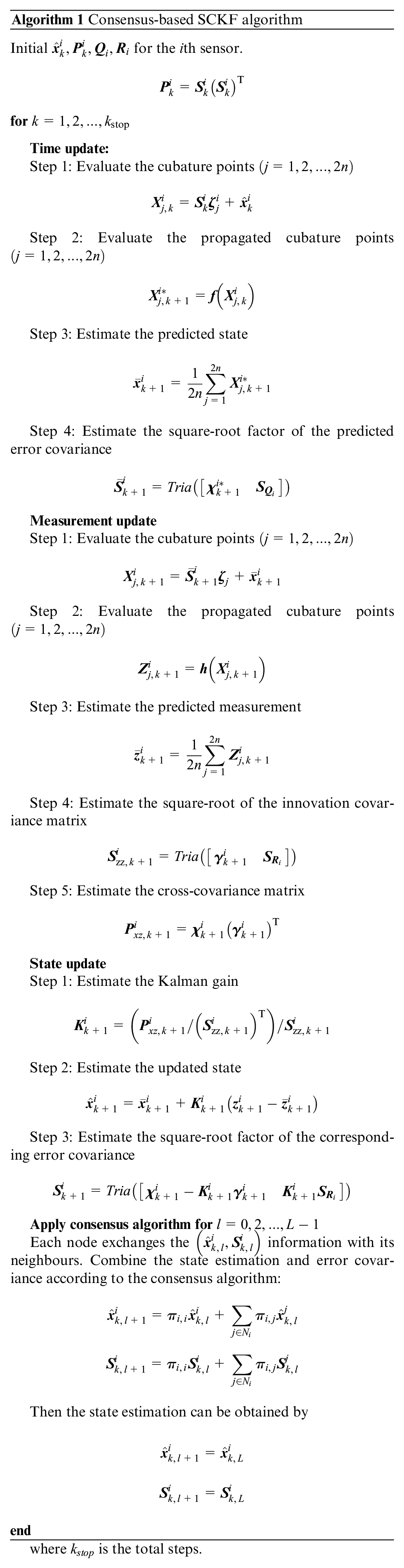
Combing the consensus algorithm with the SCKF, the consensus-based SCKF algorithm proposed in this paper is summarized in Algorithm 1. One cycle of the consensus-based SCKF algorithm flow is shown in Figure 2. Algorithm 1 is constructed by a local SCKF state estimation algorithm and a state consensus fusion algorithm. The local SCKF state estimation algorithm includes three steps: time update, measurement update and state update. After the state estimation is complete, information pairs can be utilized by the state consensus fusion algorithm. Every sensor node exchange information pairs with its neighbours according to the communication topology. Finally, the consensus estimated value of target states will be given by Algorithm 1.
where

The consensus-based square-root cubature Kalman filter (SCKF) algorithm flow. ESOM: general target tracking single model by extended state observer theory.
Simulation results
Tracking the manoeuvring target in three-dimensional space
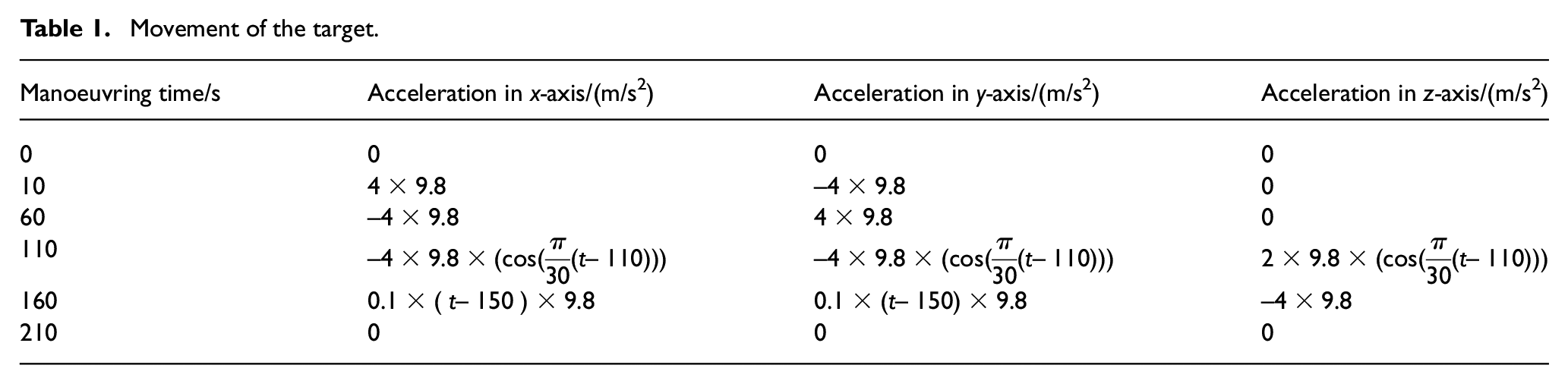
Choose
Movement of the target.
The measurement vector of the ith sensor is

Topology of sensor networks.
The ESO with a low-pass filter (LPF). Considering the noise influence, a LPF is used to filter the node measurements. The position is calculated by
The SCKF using the CA model.
The SCKF using the ESOM.
The average of the root-mean square error (RMSE) is applied to illustrate the overall estimation error. The RMSE for each node at time instant
where
The distributions of the root-mean square errors (RMSEs).
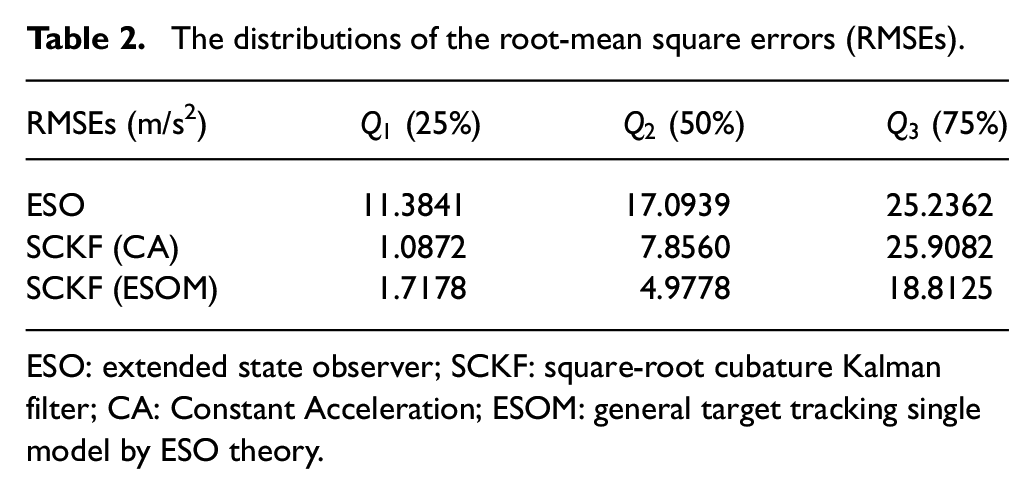
ESO: extended state observer; SCKF: square-root cubature Kalman filter; CA: Constant Acceleration; ESOM: general target tracking single model by ESO theory.

The root-mean square errors (RMSEs) of the three methods. ESO: extended state observer; LPF: low-pass filter; SCKF: square-root cubature Kalman filter; CA: Constant Acceleration; ESOM: general target tracking single model by ESO theory.
The RMSE represents the estimation performance of the designed method: the smaller RMSE, the higher accuracy. It can be seen from Table 2 that in 75% of the simulation time, the RMSE of the SCKF using ESOM is smaller than that of the ESO with the LPF. It shows that the performance of the ESO is influenced by measurement noise easily. Figure 5 also demonstrates this conclusion. In 50% of the simulation time, the SCKF using ESOM has a smaller RMSE than the SCKF using the CA model because some models of the target movement mismatch with the CA model.

The comparative estimations of (a) x-acceleration, (b) y-acceleration and (c) z-acceleration. RMSE: root-mean square error; ESO: extended state observer; LPF: low-pass filter; SCKF: square-root cubature Kalman filter; CA: Constant Acceleration; ESOM: general target tracking single model by ESO theory.
Figure 5 shows the estimation results of the three methods. All of the methods could estimate the target acceleration. However, the estimated results of the ESO with the LPF are influenced by noise easily. When the target motion mismatches with the designed CA model, the estimation performance of the SCKF became worse. Comparing with the ESO with LPF, the SCKF using ESOM has a better performance under the influence of noise. Comparing with the SCKF using the CA model, the SCKF using the ESOM could estimate the states of different target motion. Lag exists in the estimate progress, which is clearer when the target moves with sine wave acceleration.
This case considers running the consensus-based SCKF algorithm in sensor networks with four nodes to track a manoeuvring target in three dimensions. This paper only illustrates the acceleration result as an example. Figure 6 and 7 show the acceleration curves using the consensus-based SCKF and local SCKF, respectively. The tracking model is the same with the ESOM. Firstly, it can be seen clearly that both algorithms perform well to estimate the acceleration, which indicates the outstanding tracking performance of the ESOM. Although the target motion includes constant velocity motion, constant acceleration motion, sine wave motion and bangbang motion in this scenario, they all use the same tracking model, the ESOM. It can be concluded the ESOM is a general method that is suitable for target motion with robustness. It provides a new method to solve the dynamic changing problem in manoeuvring tracking. Then, on the drive of the consensus algorithm, each sensor node in the network estimate state reaches consensus regarding the different measurement noise. The single sensor is influenced by measurement noise easily, as can be seen from node 4 in Figure 7. In Figure 6, the consensus algorithm weakens the influences of measurement noise and enhances the accuracy, stability and robustness of the global networks.

Estimations of (a) x-acceleration, (b) y-acceleration and (c) z-acceleration using the consensus algorithm.

Estimations of (a) x-acceleration, (b) y-acceleration and (c) z-acceleration.
Conclusion
The problem of manoeuvring target tracking in sensor networks has been investigated in this paper via the proposed consensus-based SCKF using the ESOM. The ESOM is a general model with robustness that is convenient to use with other algorithms. The consensus-based SCKF weakens the influences of measurement noise and enhances the accuracy, stability and robustness of the global networks. The results verify the effectiveness of the scheme. In future work, packet loss and time delay in the channel of the remote estimation will be further considered.
Footnotes
Declaration of conflicting interests
The authors declared no potential conflicts of interest with respect to the research, authorship and/or publication of this article.
Funding
The authors disclosed receipt of the following financial support for the research, authorship and/or publication of this article: This work was supported by the National Natural Science Foundation of China (grant no. 61903099) and the Fundamental Research Funds for the Central Universities (3072020CF0406).
