






Abstract
This paper presents fuzzy tracking control strategies for classes of linear and bilinear Takagi-Sugeno Fuzzy System with Uncertainties and Disturbances (T-S FSUD). For both classes, the Lyapunov direct approach and the parallel distributed compensation concept are used to design nonfragile H∞ tracking controllers, which ensure the robust asymptotic stability of augmented systems despite the presence of parameter uncertainties, external disturbances, and controllers fragility. Besides that, based on the Schur complement, the separation lemma, and through some variable transformations, sufficient stability conditions of each augmented T-S FSUD are established and formulated in terms of linear matrix inequalities. Finally, numerical simulations are carried out to demonstrate the validity and the applicability of designed control schemes on tracking control of an inverted pendulum and a nonlinear mechanical system.
Introduction
Over the past years, the study of the Fuzzy Logic Control (FLC) has received considerable attention in numerous fields (Chang and Yang, 2014; Huang et al., 2011; Sun et al., 2017), such as robotics, power systems, chemical engineering, image processing, vehicular technology, sensor technology, industrial automation, communications ad networking, consumer electronics, civil engineering, and automobiles. Particularly, in the area of nonlinear control systems design, an important approach is to represent nonlinear dynamic systems as Takagi-Sugeno (T-S) models by a set of If-then rules. Notably, based on the sector nonlinearity approach Takagi and Sugeno (1985), the overall T-S model is achieved by interpolating local linear models through nonlinear fuzzy membership functions. In the controller design procedure, a parallel distributed compensation (PDC) concept has been employed to overcome different stability and stabilization problems of T-S fuzzy systems (Ghorbel et al., 2020; Tlili, 2019; Wei et al., 2016). In the PDC concept, each control rule is designed from the corresponding rule of a T-S fuzzy model. The purposeful fuzzy controller shares the same fuzzy sets with the fuzzy model in the premise parts. The resulting overall controller, which is in general nonlinear, is a fuzzy blending of these linear controllers. However, the obtained stability conditions of the closed-loop system are in general established in terms of Linear Matrix Inequalities (LMI) and the desired controller gains can be solved efficiently using convex programming techniques.
It is known, however, that many nonlinear dynamic systems cannot be adequately approximated by linear models (Penny et al., 2005; Tang et al., 2006). A good example of a bilinear process is the population of biological species, which is described by
where
However, in real control design problems, uncertainties, inaccuracies, disturbances, modeling errors, measurement errors, exterior conditions, and parameters variations are frequently a source of system’s instability. As well, most control systems necessitate accurate controllers, in which their coefficients are required to be implemented with exact values as those to be designed. Thus, it is not always possible in practical applications since actuators may be of malfunction and/or round-off errors in numerical computations (Nguang and Shi, 2006; Sun et al., 2017). Furthermore, there are considerable studies on the nonfragile
Hence, the main goal of this work is to purpose fuzzy tracking control strategies for classes of linear and bilinear T-S Fuzzy System with Uncertainties and Disturbances (T-S FSUD). In these strategies, a nonfragile
The main contributions can be summarized as follows:
Compared with the previous works, the problem of tracking T-S fuzzy systems with decay rate, attenuation of the disturbances effect, and measure of controller nonfragility is considered;
New sufficient stability conditions in terms of LMI for the existence of
Following the “Introduction,” this paper is structured as follows: In section “Problem formulation and preliminaries,” the problem formulation and preliminaries are exposed. Thereafter, section “Robust
Throughout this paper,
Problem formulation and preliminaries
Consider a nonlinear continuous-time system described by the following state-space representation
where
Using the fuzzy inference method Takagi and Sugeno (1985), the nonlinear system (2) can be represented by a set of linear or bilinear plant rules as below:
for
where
Then, the final dynamic equations of the linear and bilinear fuzzy systems can be described as follows:
with
where
It should be noted that the membership functions verify the convex conditions
Furthermore, the objective is to determine a
where
First of all, the following technical lemmas that will be needed throughout the proof of Theorems 1 and 2 are recalled.
Robust
and nonfragile tracking control design
This section presents fuzzy tracking control strategies for the linear and bilinear T-S FSUD classes, as are defined in (6) and (7). Thus, for each one, sufficient stability conditions are established to ensure the asymptotic stability of an augmented system with guaranteed control objectives.
The linear T-S FSUD case
In this study, the states of system (6) are assumed to be measurable and the
such that
where
The final fuzzy controller is
By substituting control law equation (15) into state-space equations (6) and (10), the dynamic of the tracking error is described as follows
Furthermore, equations (10) and (16) lead to the following augmented system
where
Mainly, the objective is to determine the gains
where
In the following, sufficient stability conditions for the existence of nonfragile
where
Hence, if LMI constraints (equation (19)) are satisfied for
subject to the rapidity performance
where the derivative of the Lyapunov function is
where
From equations (17), (21), and (22), equation (23) is equivalent to
where
As all nonlinearities
where
However, it is clear that equation (26) contains certain parts
where
After replacing
As equation (28) contains anti-diagonal terms, the Lemma 1 is used to transform them into diagonal ones. Besides, for positive scalars
where
As a consequence, equation (27) is rewritten as
where
Assuming that
where
By applying the Schur Complement, as is illustrated in Lemma 2, nonlinear matrix equation (31) is transformed as follows
for
The bilinear T-S FSUD case
In this study, the states of system (7) are assumed to be measurable and the
such that
where
The final fuzzy controller is
where
By substituting control law (equation (35)) into state-space equations (7) and (10), the dynamic of the tracking error is described as follows
where
Furthermore, equations (10) and (36) lead to the following augmented system
where
Mainly, the control objective is to determine the gains
where
where
subject to the rapidity performance
where
From equations (37), (40), and (41), the above condition is equivalent to
where
As all nonlinearities
where
Furthermore, it is pointing out that equation (44) contains certain parts
where
Next, by replacing
where
From equations (46) and (47), equation (45) is equivalent to
where
By applying the Schur Complement, the above nonlinear matrix inequality is transformed as follows
for
Numerical examples
In this section, the objective is to evaluate the applicability and effectiveness of the designed nonfragile
Tracking control of an inverted pendulum
The studied inverted pendulum is described by the nonlinear equations Srinivasan et al. (2009)
where
For
where
Figure 1 depicts the evolutions of the membership functions
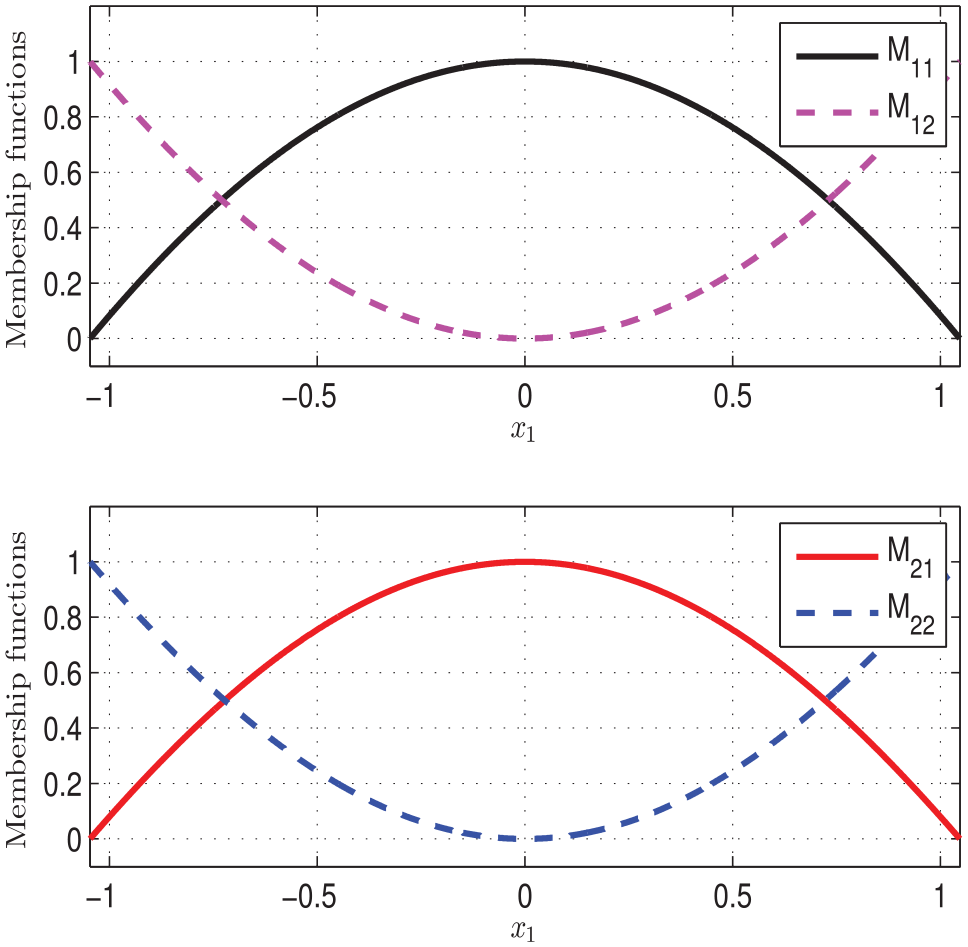
Membership functions evolutions of the linear T-S FSUD.
As membership functions
where
Hence, the final linear T-S fuzzy model is described by
where the normalized weighting functions are
Using
Taking into account these considerations, the designed nonfragile
where
Figures 2 and 3 depict, respectively, the tracking trajectories of the angle and the angular velocity under initial conditions
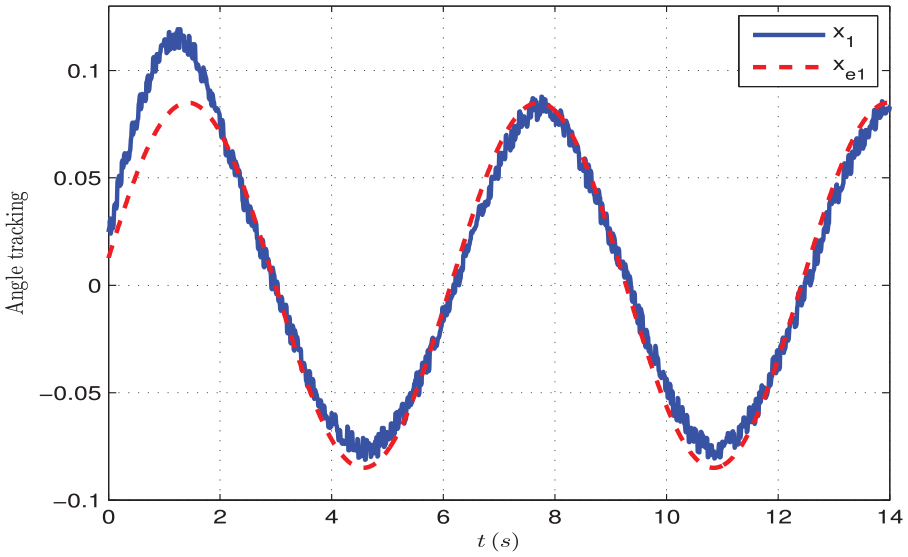
Angle
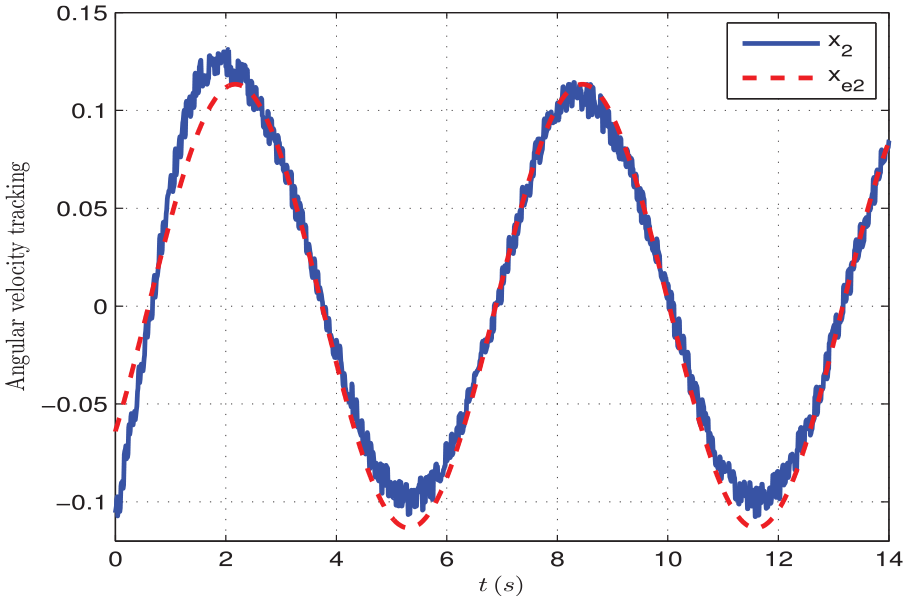
Angular velocity
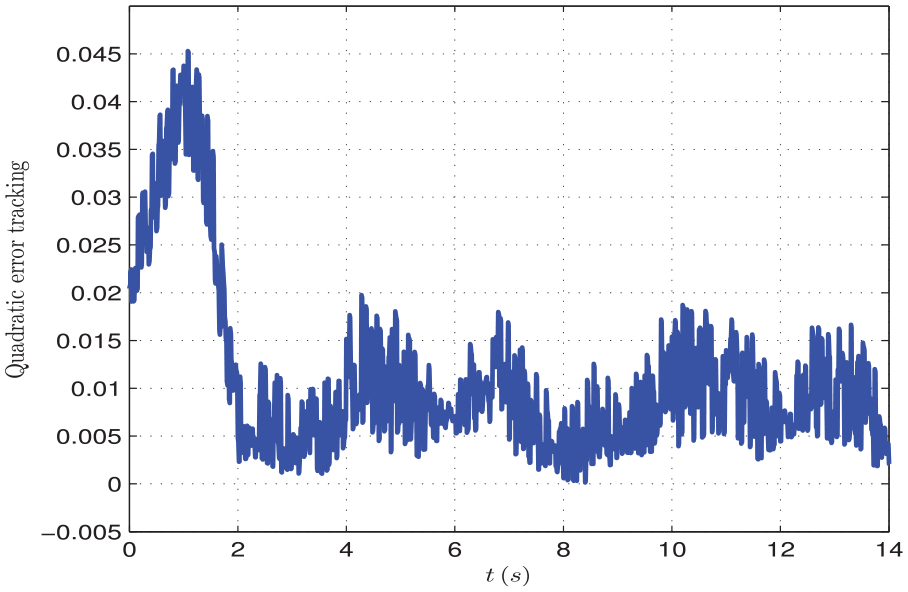
Quadratic error
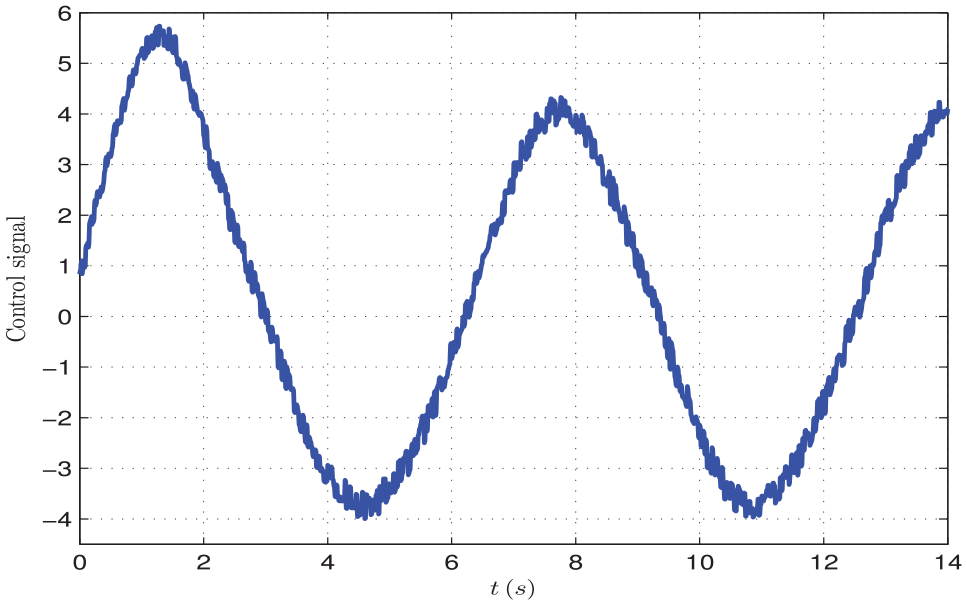
Evolution of the control signal
From these simulation results, the state variables of the controlled system, which is described as a linear T-S FSUD, follow perfectly the desired ones of the reference model. Also, the magnitude of the quadratic error tracking is very small in the entire operating region and its trajectory is close to zero. In light of this, the designed nonfragile
Tracking control of a mass-spring-damper mechanical system
In this section, a bilinear T-S FSUD is designed for a nonlinear mass-spring-damper mechanical system, which is described by Ghorbel and Benhadj Braiek (2021)
where
For
where
Figure 6 depicts the evolution of the membership functions
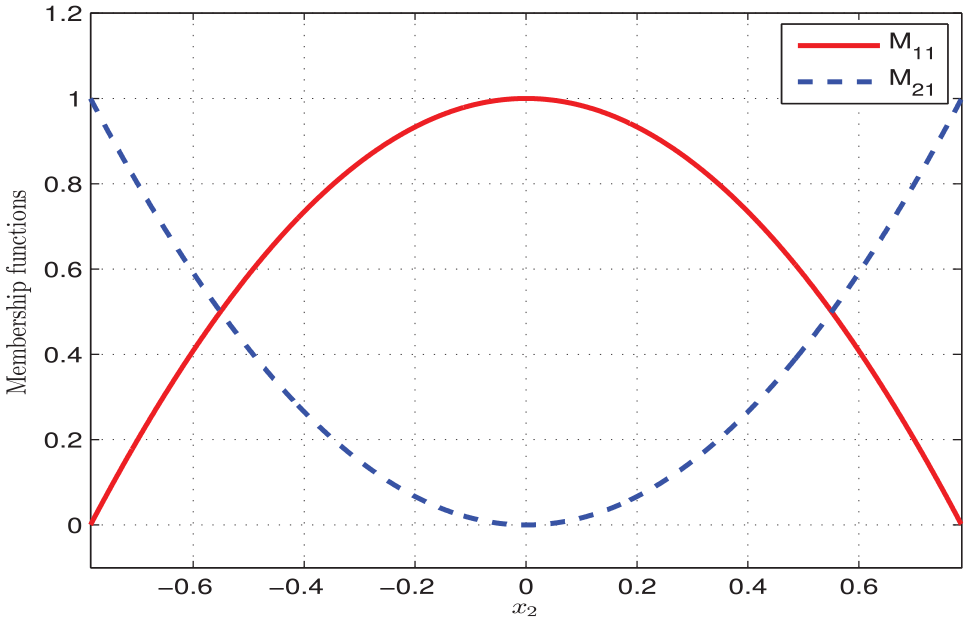
Membership functions evolutions of the bilinear T-S FSUD.
The mechanical system can be described by the following two rules
where
Then, the final bilinear T-S fuzzy model is described by
where the normalized weighting functions are
Using
Taking into account these considerations, the designed nonfragile
where
Figures 7 and 8 depict, respectively, the tracking trajectories of the position and the velocity under initial conditions
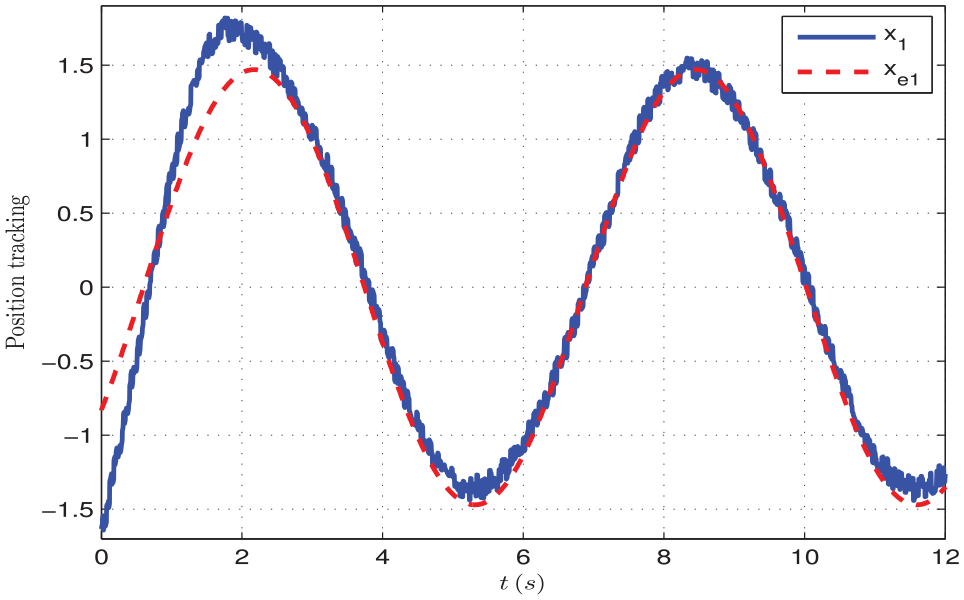
Position
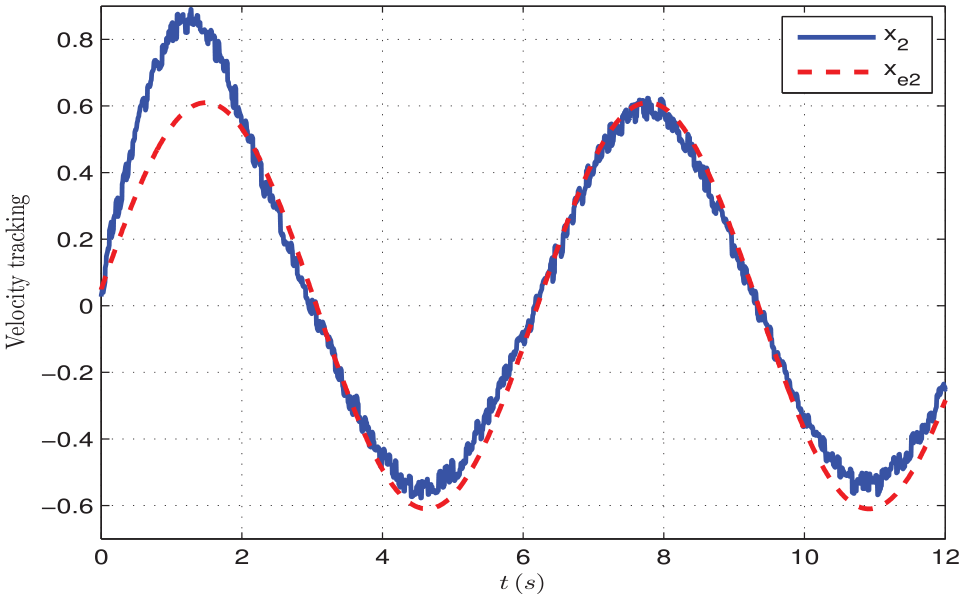
Velocity
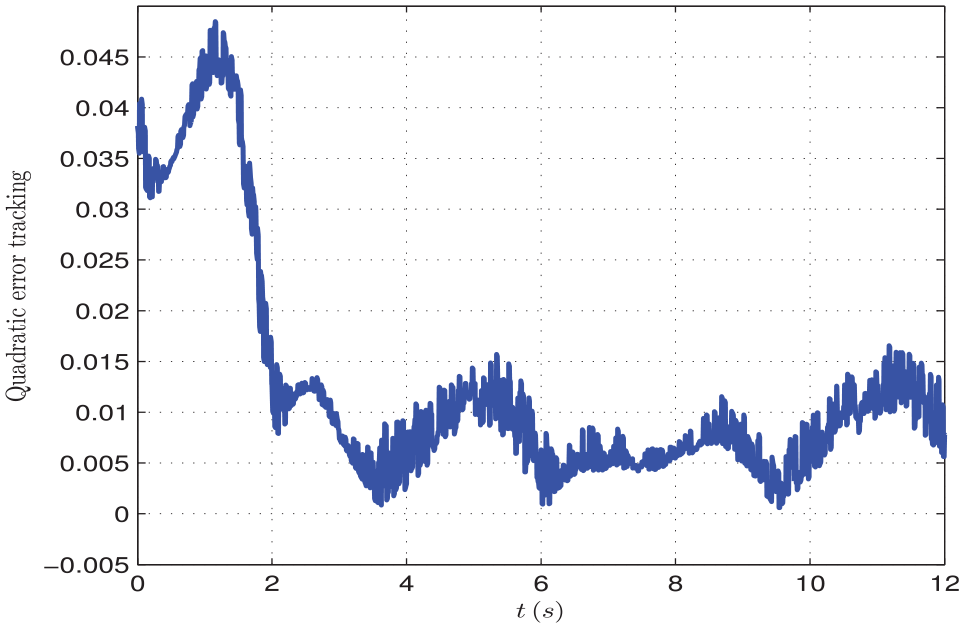
Quadratic error
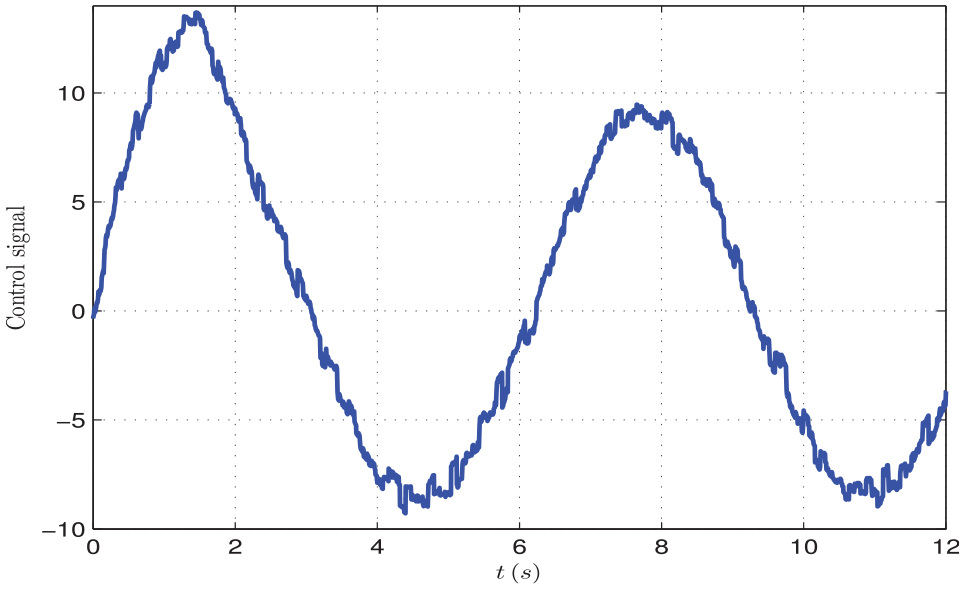
Evolution of the control signal
As a result, the state variables of the controlled mechanical system, which is described as bilinear T-S FSUD, follow perfectly the desired ones of the reference model. Also, the magnitude of the quadratic error tracking is very small in the entire operating region and its trajectory is close to zero. Consequently, the designed nonfragile
Conclusion
This paper has presented nonfragile
Footnotes
Declaration of conflicting interests
The author(s) declared no potential conflicts of interest with respect to the research, authorship, and/or publication of this article.
Funding
The author(s) received no financial support for the research, authorship, and/or publication of this article.
