





Abstract
This paper proposes an adaptive fractional-order (FO) terminal sliding mode control (TSMC) scheme to the robust current control of active power filter (APF) using a recurrent meta-cognitive fuzzy neural network (RMCFNN). An FO TSMC is developed by considering that the parametric perturbations and the external disturbances of APF are bounded. Compared with conventional TSMC approach, the proposed scheme, with an FO sliding surface, can obtain enhanced finite-time high-precision tracking performance due to another degree of freedom. Then, a novel observer-based FO TSMC is derived to achieve an absorbing model-free feature arising from RMCFNN. To improve the capabilities in managing the uncertainties, the specific online updating schemes for the structure and parameters of RMCFNN are designed. Meanwhile, closed-loop stability and finite-time convergence characteristic can be achieved using Lyapunov theory. Finally, simulation and experimental results indicate that the proposed observer-based FO TSMC can be easily implemented by microcontroller and has superior control performance compared with other existing schemes.
Keywords
Introduction
Nowadays, the problems with harmonic pollution give rise to constant trouble for industrial applications. Active power filter (APF) in Figure 1 has become the favorable solution for harmonic suppression due to its flexible features and convenient installation (Chu et al., 2018; Hekss et al., 2021). The significant advantages of APF have been demonstrated in many fields, including radial power distribution feeder, solar photovoltaic power generation system, and synchronous generator.
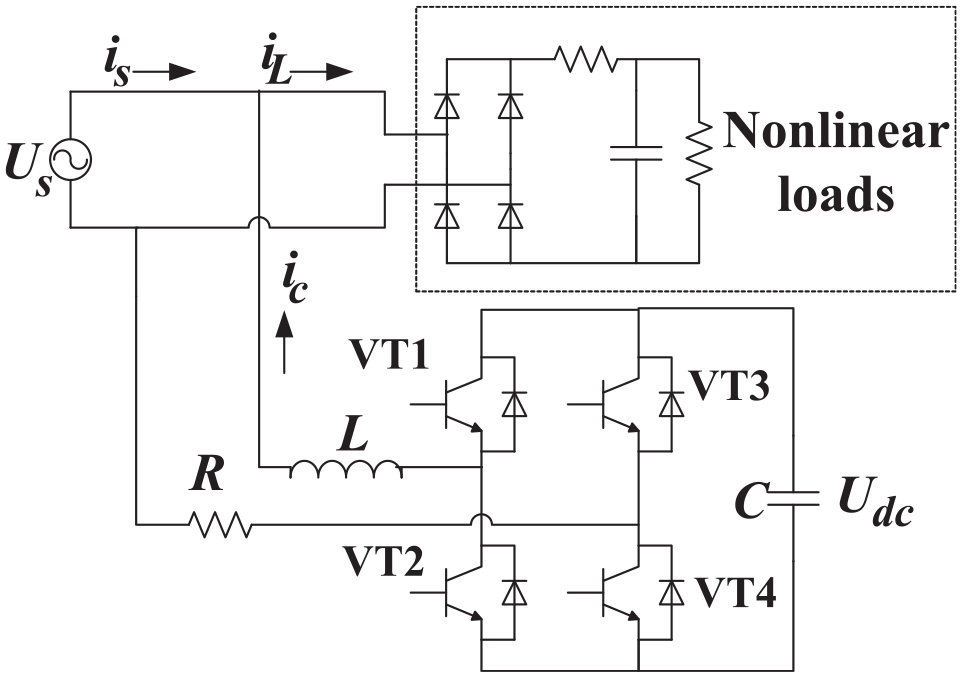
Single-phase shunt active power filter.
Considering parametric uncertainties and other nonlinearities in APF, controller design for APF is treated as a challenging task in the existing works. To obtain remarkable control performance and boost the development of APF, Wang et al. (2021a) have made much effort to design efficient control approaches, such as model predictive control, sliding mode control (SMC) (Guzman et al., 2016; Hou and Fei, 2020), fuzzy control (Ray et al., 2019), and neural network (NN) control (Chu et al., 2020; Fei and Chu, 2020) . Among the abovementioned schemes, SMC has caused increasing attention due to its superior property of disturbance insensitiveness. However, for investigating a practical SMC to APF, one has to solve the conflict between the smooth control signal and the robustness to uncertainties (Hou et al., 2021c). In the traditional SMC, sign function is combined into control law to construct a robustness term for compensating uncertainties (Hou et al., 2021b). However, for APF, the chattering phenomenon caused by robustness term will give rise to undesired high-frequency switch of insulated gate bipolar transistor (IGBT), and this will degenerate the control performance. To suppress chattering, many strategies have been proposed, that is, observer-based compensation, integral compensation, and variable-gain approach (Li et al., 2017). Besides the foregoing methods, the boundary layer is also an attractive technique to alleviate the effect of chattering using saturation function instead sign function (Nguyen et al., 2017). Admittedly, boundary layer technique can achieve smooth control signal at the expense of precision loss. In order to deal with this issue, terminal sliding mode control (TSMC) is introduced to enhance high-precision and fast-response control properties (Mu and He, 2018). High tracking precision performance of TSMC has been indicated by plentiful literature due to finite-time convergence (Feng et al., 2020; Zhang et al., 2021).
However, most existing TSMC approaches only contain integer-order (IO) integrator and differentiator. In fact, the mathematical study of fractional order (FO) has been going on for over 300 years, and it has been applied to the field of control (Balootaki et al., 2020). FO controllers can achieve superior control characteristic due to the introduced another degree of freedom (Kilbas et al., 2006). Motivated by this benefit, FO SMC has been successfully utilized for various industrial applications, such as gyroscope (Fei and Lu, 2018), robot manipulators (Nojavanzadeh and Badamchizadeh, 2016; Wang et al., 2016, 2020), and linear motor (Sun and Ma, 2017). Although the remarkable results have been obtained, most of the abovementioned approaches belong to model-based ones requiring detailed dynamics, which become the potential practical performance limitations. The dependence on prior information of SMC has received much attention (Wang and Chen, 2020; Wang et al., 2021b; Xu, 2018; Zhu et al., 2020). Generally, these studies can be classified into two groups. Part studies introduce NN for learning the supremum of uncertainties. The other studies focus on the direct approximation of uncertain dynamics by constructing an uncertainty estimator. Our study belongs to the latter one.
For the past few decades, fuzzy neural network (FNN) becomes a mature control scheme for extensive practical systems by representing nonlinear dynamics with complex uncertainties (Hou et al., 2022; Sun et al., 2021). Admittedly, most of the foregoing FNN control approaches cannot achieve structure and parameter adjustment simultaneously. Actually, uncertain dynamics including the grid structure, load current, and other parameters in APF are variable. Specifically, APF will also give rise to the load current variation indirectly. In this context, the exciting results using FNN with fixed structure will be limited (Lin et al., 2019). Therefore, in order to achieve high-precision approximation of uncertain dynamics for APF, the structure and parameters of FNN both are required to be online updated. Meta-cognitive FNN (MCFNN) can be a reliable solution to resolve the foregoing issue due to its specific characteristic of flexible network structure (Rong et al., 2017; Subramanian and Suresh, 2012). Specifically, fuzzy rules, hidden nodes, and other parameters in the MCFNN are not required to be defined in advance, and it will adjust structure and all parameters using data deletion and data learning strategies to achieve a whole learning process. In addition, compared with simple feed-forward NN, the generalization ability of NN including recurrent framework is enhanced (Lin et al., 2019). A recurrent NN was introduced for a class of dynamic systems, in which comparative simulation and experimental results demonstrated its superiority (Chu et al., 2020).
In order to tackle the above difficulties, this study proposes an adaptive FO TSMC for APF, by utilizing recurrent meta-cognitive fuzzy neural network (RMCFNN). The major contributions of this study are listed in the following form:
FO TSMC is designed to enhance the tracking performance of existing TSMC by adding adjustable order thanks to FO. Higher precision of current control system can be achieved thanks to finite-time convergence so that harmonic suppression capability of APF can be further improved.
A novel adaptive FO TSMC using RMCFNN is introduced to realize a highly efficient learning of uncertainties considering sensor fault in practical applications. Specifically, fuzzy rules and number of nodes can be generated or pruned through novelty or contribution of current input variable using data learning strategies, which is highly preferable for industry-oriented applications.
To the best of our knowledge, a robust current tracking strategy for APF constructed using FO TSMC with RMCFNN has not been explored until recently. In addition, such investigation can be applied for other various applications, such as robot manipulators, linear motor, and so on.
This remaining part of the study is structured as follows. In section “Problem formulation,” the dynamic model of APF, basic knowledge of FO, and FO TSMC is exploited. Section “RMCFNN” presents a novel adaptive FO TSMC including a RMCFNN estimator. The comparative simulation and experimental evaluations between the proposed FO TSMC and other existing schemes are presented in section “Simulation and experimental results.” Finally, section “Conclusion” gives the conclusions.
Problem formulation
Figure 1 presents the circuit of APF. Generally speaking, two control loops should be designed, that is, DC-side voltage loop and AC-side current loop. The voltage loop is the outer loop whose objective is to maintain a constant DC-side voltage. Traditional PI control is chosen for DC-side voltage loop. The objective of the AC-side current loop, inner loop, is to track the irregular and changing reference signals such that it is vital for purifying harmonics. This study focuses on the robust control design for AC-side current loop.
The dynamic model for AC-side current loop is formulated as (Hou et al., 2019, 2021a)
where
To achieve fast and high-precision control performance for APF, the following FO TSMC surface is designed as given by equation (2)
where
where
where
where
In fact, for practical application systems, the lumped uncertainties
where
Then the FO TSMC is chosen as follows:
where
Then, one can obtain the derivative of
Substituting equation (8) into equation (10) leads to
that is,
where
However, there exists one disadvantage of the proposed FO TSMC, where certain system parameters are required. For example, the detected
where
RMCFNN
In this section, the proposed novel MCFNN with recurrent framework is explained. After describing the signal propagation and updating rules of RMCFNN, the novel adaptive FO TSMC using RMCFNN for APF is presented.
Structure of RMCFNN
The detailed architecture of RMCFNN is given in Figure 2. The proposed FNN contains the following two parts: (1) cognitive component and (2) meta-cognitive component.

The structure of RMCFNN.
1. Cognitive component
A four-layer FNN structure, which is designed as the cognitive component in the proposed RMCFNN, consists of the input layer, the membership layer, the rule layer, and the output layer. The details of each layer are recited in the following form.
Layer 1—Input Layer: In this layer, each node transmits the input variables
where
Layer 2—Membership layer: The function of the node in Layer 2 is to execute fuzzification. Considering that the input range of the actual control system is generally bounded, the membership function of this layer is Gaussian function with better local characteristics. For every node in this layer, the relationship of the input and output can be described as follows
where
where
Layer 3—Rule Layer: The neuron of this layer, represented by
where
Layer 4—Output Layer: Each node in layer 4, represented by
In order to give a more concise form, the outputs of RMCFNN can be denoted as
where
2. Meta-cognitive component
The aim of meta-cognitive component is to execute the online learning algorithm of RMCFNN including data learning strategy, data deleting strategy, and data reserving strategy (Lin et al., 2019). In contrast to the existing meta-cognitive component, specially, there does not exist data reserving strategy and data deleting strategy for the proposed RMCFNN in order to relax the restrictions in the real-time control. Thus, only data learning strategy are utilized in the proposed RMCFNN.
The data learning strategy comprises the structure self-adjusting and parameter learning. With considerations analogous to Lin et al. (2019) and Subramanian and Suresh (2012), spherical potential is regarded as the criterion to determine when to add a new rule. Different with classical error-based criteria, the novelty in the framework of spherical potential will be judged by the projection of the input variable on to a hyper-dimensional feature space. Generally, Gaussian function is selected for projection such that the spherical hyper-dimensional feature space can be represented by mean value and standard deviation of Gaussian function (Subramanian and Suresh, 2012). Let the origin of -dimensional space be
According to Subramanian and Suresh (2012), one can get the expansion of equation (23) as follows
For Gaussian function, it is obvious that
If
Once a new fuzzy rule has been generated, the initial center, width, and corresponding weight should be assigned as follows
where
Besides rule generation approach, there also exists rule removal process under the following condition that the rule is insignificant for the network. From the condition
where
After the structure of network has been determined, the parameter learning strategy will adjust the network parameters online. Considering real-time control, it is unnecessary to update the network parameters at every period such that the parameter update is triggered only if it satisfies
FO TSMC using RMCFNN estimator
As mentioned above, the FO TSMC (8) including uncertain function
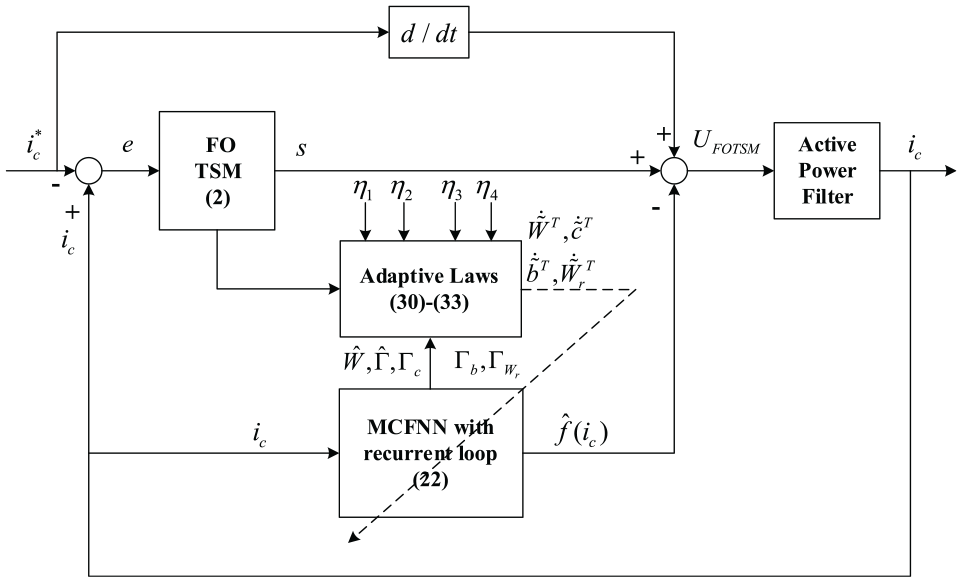
Block diagram of adaptive FO TSMC using RMCFNN.
where
Using equation (28) and Taylor series expansion, one can get the following expression
where
Let us choose a Lyapunov function as
Using equations (28) and (34) and differentiating
where
Assuming
where
Simulation and experimental results
The performance of APF with the adaptive FO TSMC is demonstrated using simulation and experimental studies. A hardware prototype of APF is built, while the system parameters have been listed in Table 1. The proposed adaptive FO TSMC using RMCFNN in Matlab/Simulink using the “C” language is embedded into dSPACE 1104 with 20 kHz of sampling frequency. The results are observed and captured by Agilent DSO X3034A. Harmonic spectrum analysis is obtained by power-quality analysis module of the oscilloscope.
The parameters for simulation and experiment.

The parameters for the developed controller are specified as follows:
The performance of APF under steady state is depicted in Figures 4–7, respectively. In Figure 4, there is grid voltage, load current, compensation current, and grid current. The total harmonic distortion (THD) of highly distorted load current is around 30.24%. The control system of APF can cancel harmonics to a large extent thanks to adaptive FO TSMC using RMCFNN. Figure 5 shows the satisfactory harmonic suppression performance, in which the grid current is purified into be sinusoidal with the THD of 3.08%. Figure 6 depicts the number of rules. One can see that the number of rules is changing to obtain the best results using RMCFNN. Figure 7 depicts the network parameters to demonstrate that the closed-loop system tends to be stable.
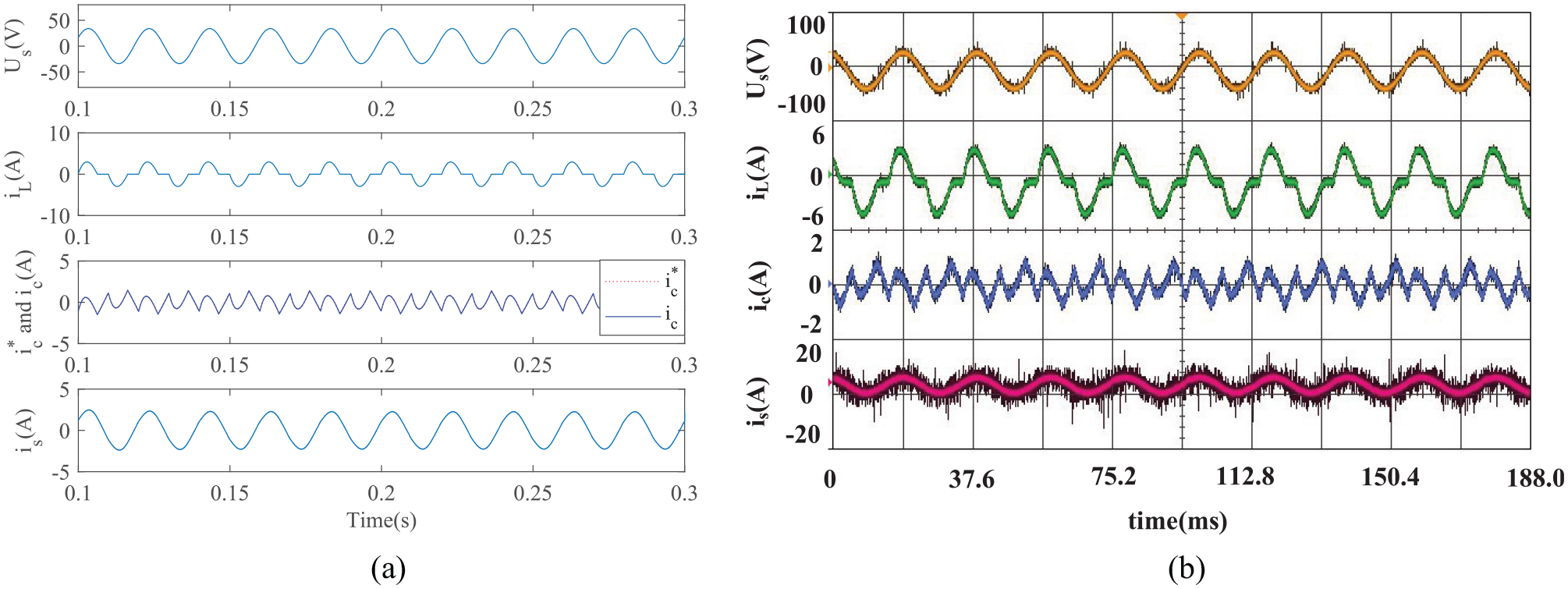
Steady-state waveforms: (a) simulation results and (b) experimental results.
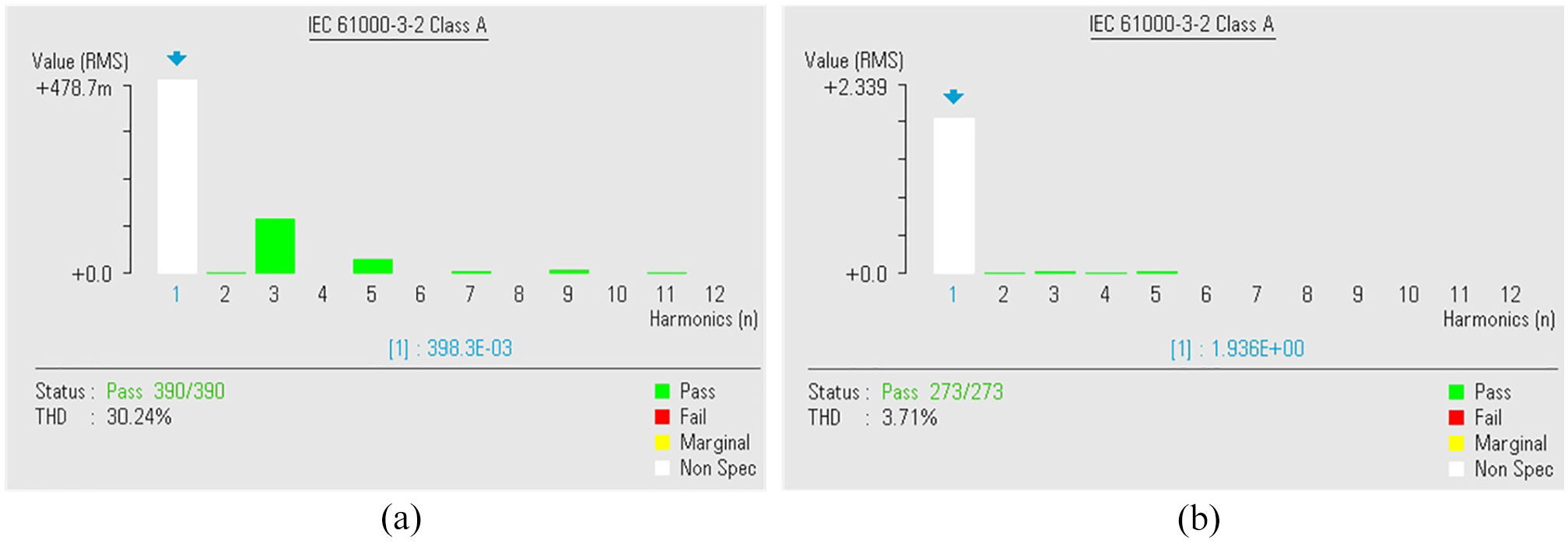
Harmonic spectrum of grid-side current: (a) without compensation and (b) with compensation.
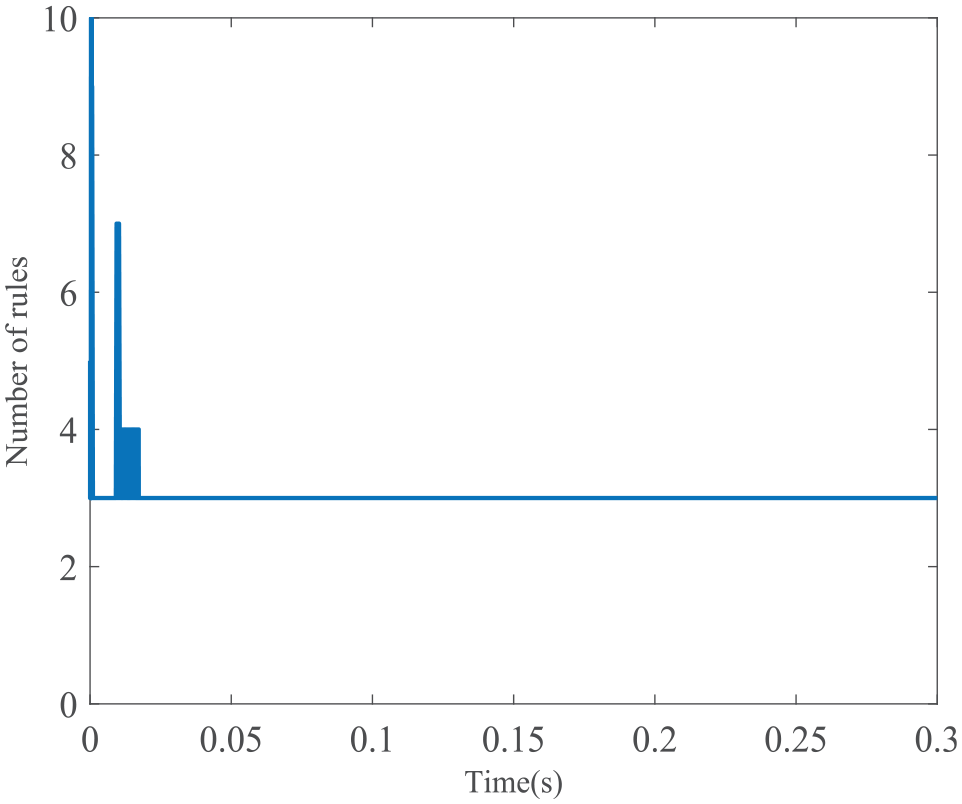
The number of rules.
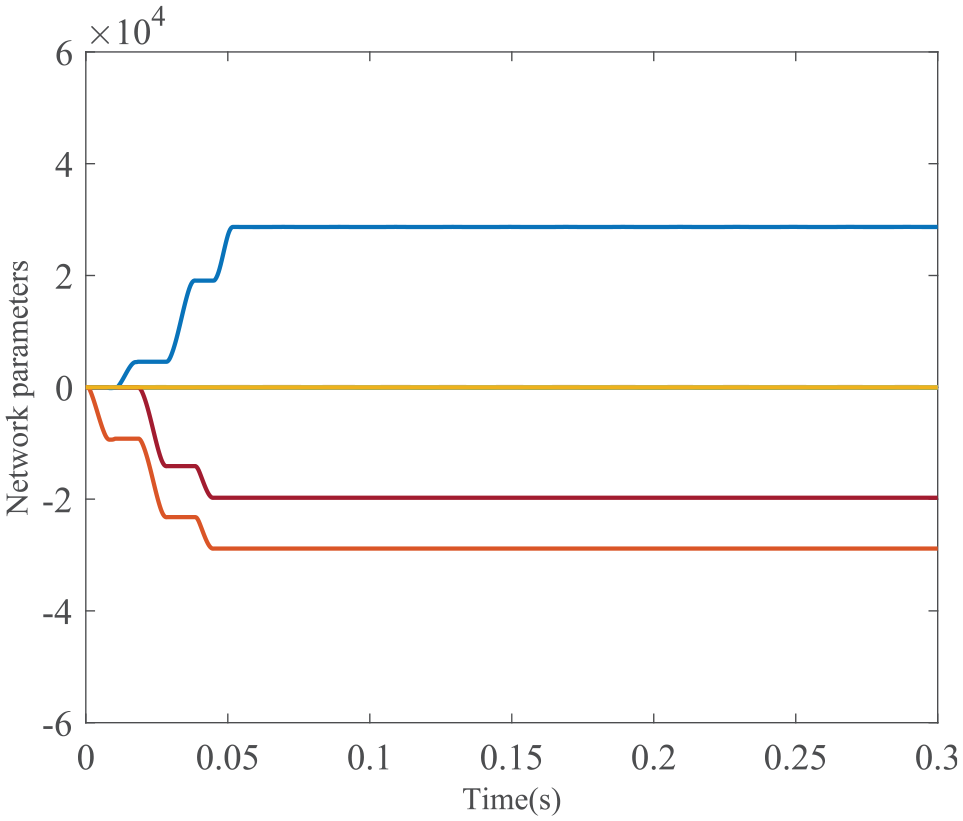
Network parameters.
The performance of APF under load change are depicted in Figures 8 and 9. As the load increases, compensation current to be supplied by APF also increases such that grid current gets purified efficiently. The performance with load reduction also can be seen from Figure 9. Therefore, one can say that APF with FO TSMC using RMCFNN reveal superior dynamic and steady-state performances.
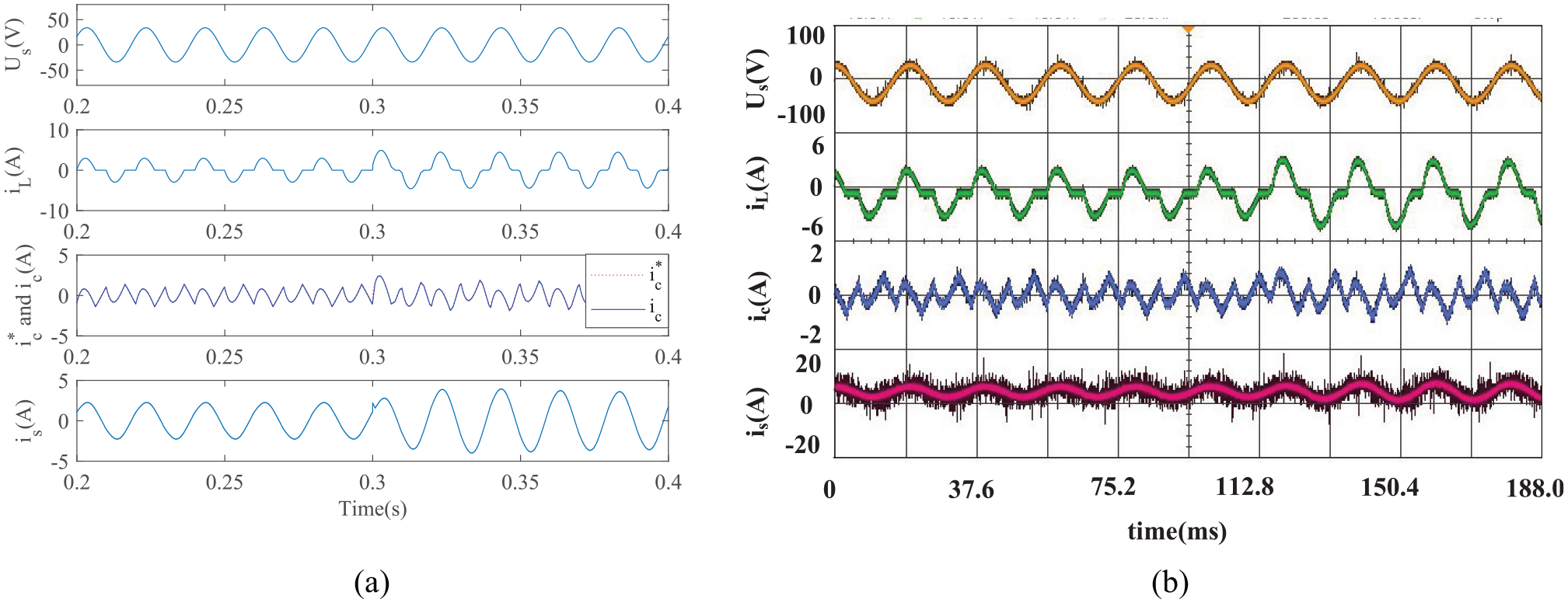
Performance under load increase: (a) simulation results and (b) experimental results.
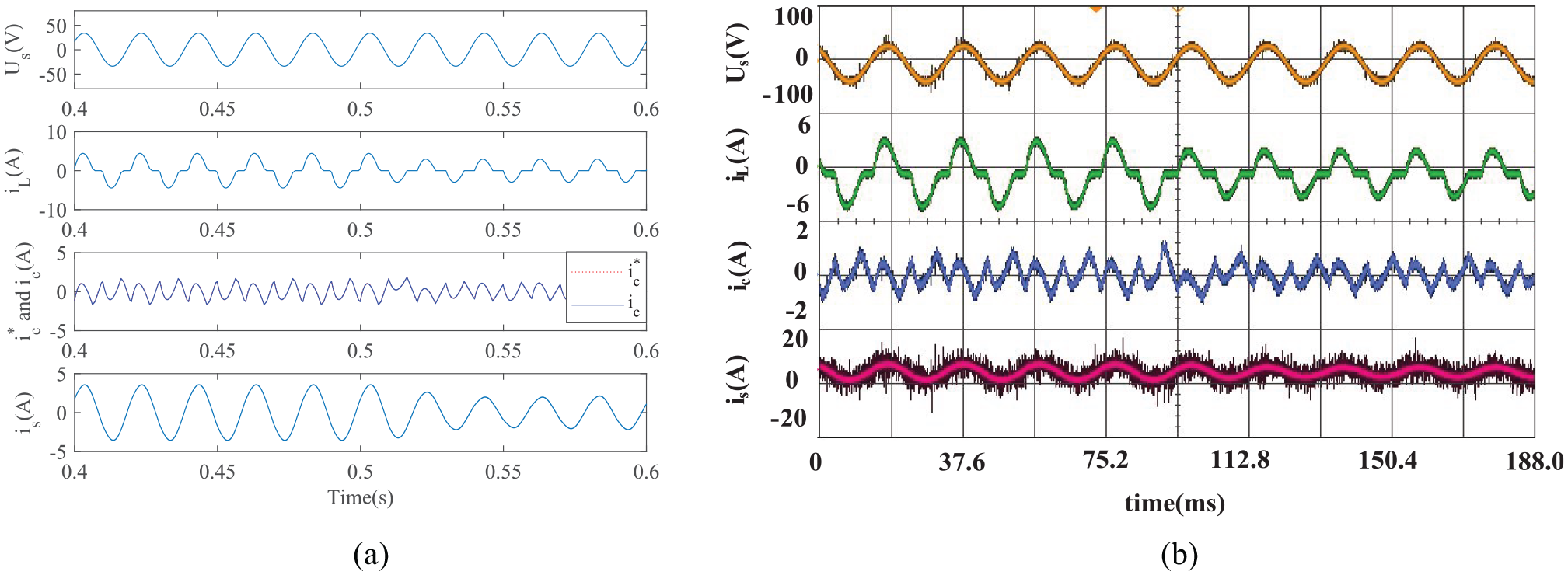
Performance under loads decrease: (a) simulation results and (b) experimental results.
In addition, Figure 10 and Table 2 are given to further validate the control performance of the proposed methodology against other classical methods, for example, TSMC, FNN, and back-propagation neural network (BPNN). In Figure 10,
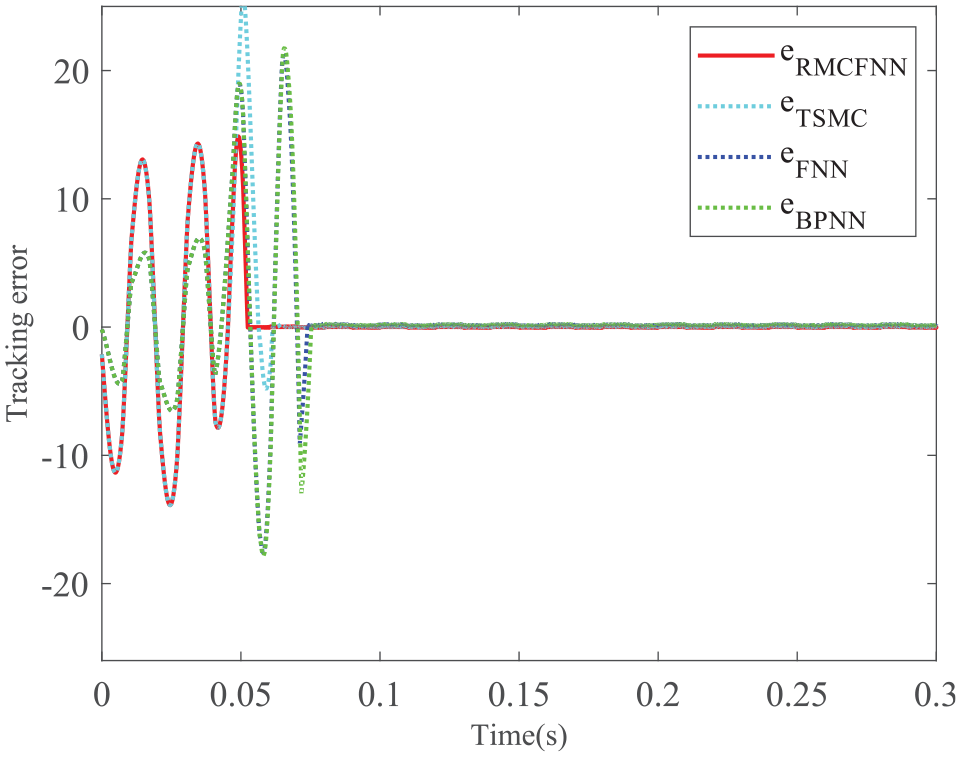
Tracking errors of different control methods.
THD and RMSE of different control methods.

THD: total harmonic distortion; RMSE: root mean square error.
Figure 11 depicts the tracking errors under sensor fault, in which

Tracking errors under sensor fault.
Conclusion
In this paper, an observer-based FO TSMC using RMCFNN is designed for APF. The uncertainties are effectively processed using the proposed RMCFNN to estimate the uncertain function for APF. Based on the experimental results, it is evident that the proposed FO TSMC is able to enhance the dynamic performance of APF. In addition, the performance of the proposed FO TSMC is compared with the conventional and recently reported control approach to show its superiority in harmonic compensation. Despite the sudden change in source voltage, the proposed FO TSMC also can ensure the harmonic suppression ability. Furthermore, the THD of source current is well maintained below 5% in different situations. It is noteworthy that the parameters used in the controller are selected by trail-and-error methodology to achieve the best tracking performance. Nevertheless, numerous tests will be required to obtain these parameters. Thus, parameter selection strategy using adaptive mechanism will be explored in our future work. Moreover, Gaussian membership function also can be replaced by other feasible membership functions such that the generalization performance of the RMCFNN can be further enhanced.
Footnotes
Declaration of conflicting interests
The author(s) declared no potential conflicts of interest with respect to the research, authorship, and/or publication of this article.
Funding
The author(s) disclosed receipt of the following financial support for the research, authorship, and/or publication of this article: This work is supported by the National Natural Science Foundation of China (grant nos. 62103132 and 6200 3132), the Changzhou Sci&Tech Program (grant no. CJ2020 0067), and the Fundamental Research Funds for the Central Universities (grant nos. B200202215 and B220202022).
